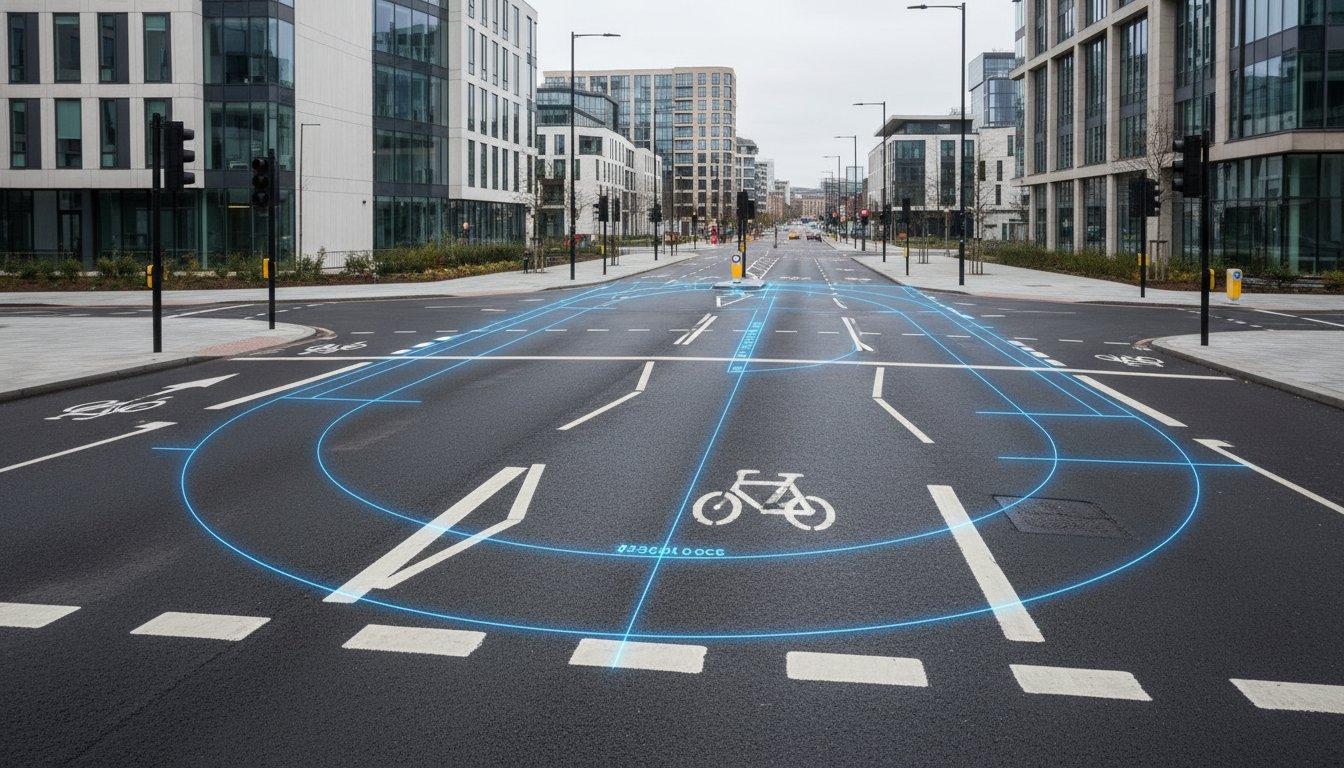
Your Greenwich development lives or dies by its ability to hit a 70% Healthy Streets score before a single brick is laid. Securing approval in 2026 requires more than just a basic site layout; it demands technical precision that aligns with TfL’s Vision Zero and the Royal Borough’s LIP3 mandates. As expert Transport Planning Consultants Greenwich, we recognize that the high density of the Peninsula and the historic constraints of the town centre leave zero margin for error in vehicle access. You likely already feel the pressure of complex TfL requirements and the risk of costly delays caused by inadequate data.
This article explains how to secure your planning permission using expert transport statements and precise parking surveys tailored to current Royal Borough requirements. We will detail how accurate swept path analysis proves site feasibility and how data-driven travel plans help meet the Mayor’s target of 80% sustainable trips by 2041. Our goal is to provide the technical authority you need to move from consultation to execution without regulatory friction. We focus on providing a total, managed solution so your project stays on schedule and within budget.
Key Takeaways
- Understand how the Royal Borough of Greenwich’s World Heritage status influences planning and why aligning with LIP3 policies is non-negotiable for 2026 approvals.
- Identify whether your project requires a Transport Statement or a full Assessment to meet specific Royal Borough requirements and avoid application rejection.
- Learn why specialized Transport Planning Consultants Greenwich use Swept Path Analysis to prove vehicle access feasibility on the borough’s narrowest streets.
- Master the Lambeth Methodology for parking surveys to provide the accurate, data-driven evidence required by TfL and local planning officers.
- Discover how early pre-application engagement and 24/7 technical support can streamline your journey through the PTAL rating and regulatory approval process.
Why Transport Planning in Greenwich Requires Local Expertise
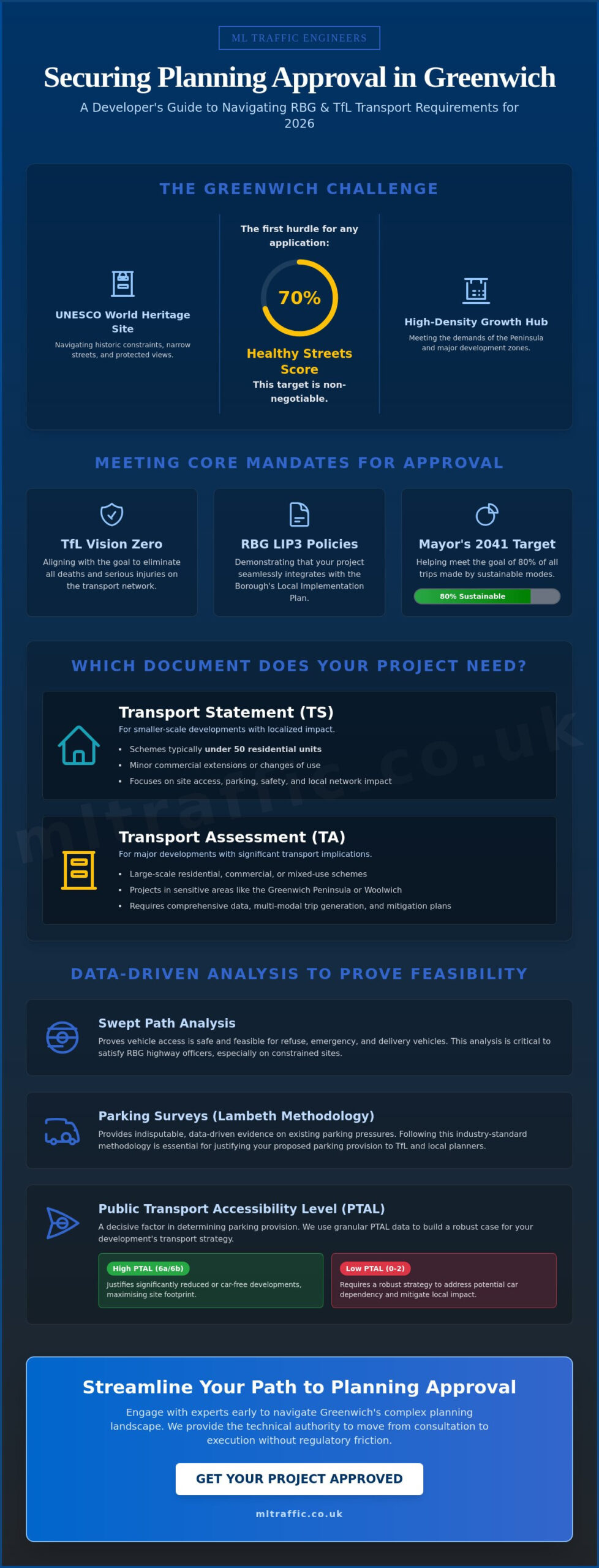
Greenwich presents a unique challenge for developers because of its dual identity as a high-density growth hub and a UNESCO World Heritage Site. Planning applications must navigate the Royal Borough of Greenwich (RBG) Transport Strategy 2022-2032, which prioritizes the Healthy Streets approach over traditional vehicle-first designs. A generic transport report often fails local scrutiny because it overlooks the specific constraints of the borough’s historic road network and the 2041 Vision Zero targets. Precision isn’t just a preference; it’s a regulatory requirement.
Successful projects rely on professional transport planning that integrates seamlessly with RBG’s Local Implementation Plan (LIP3). As experienced Transport Planning Consultants Greenwich, we ensure your technical data reflects the reality of local infrastructure rather than broad regional averages. This localized accuracy is vital for clearing planning conditions without the frustration of unnecessary revisions or delays. We provide the technical authority needed to satisfy both RBG officers and TfL stakeholders.
The Role of the Royal Borough of Greenwich (RBG)
RBG planning officers and local councillors maintain a sharp focus on how new developments impact existing residents. They specifically look for potential traffic displacement and the pressure on local parking stock. We mitigate these concerns by providing robust Transport Statements that demonstrate a project’s alignment with local air quality and safety goals. Engaging with the RBG highways department during the pre-application phase allows us to address technical hurdles before they become formal objections. You can explore our full range of services at what we do to see how we manage these local requirements.
PTAL Ratings and Accessibility in Greenwich
The Public Transport Accessibility Level (PTAL) is a decisive factor in Greenwich planning. In high-density areas like the Greenwich Peninsula, PTAL ratings often reach 6a or 6b, indicating excellent connectivity. This allows developers to justify significantly reduced parking provision, which is essential for maximizing site footprint. Conversely, developments in PTAL 2 areas like Eltham require a different strategy to address car dependency. We use granular PTAL data to prove site feasibility and ensure your parking strategy meets the London Plan’s rigorous standards for 2026 and beyond. Accurate data is the only way to secure a favorable decision in these varying environments.
Essential Transport Documentation for Greenwich Planning Applications
Securing planning approval in the Royal Borough requires a meticulous approach to technical documentation. As Transport Planning Consultants Greenwich, we produce reports that satisfy the specific Royal Borough of Greenwich Regulatory Requirements. Inadequate data leads to immediate delays. We ensure your submission contains the exact level of detail needed to clear highways objections from the outset. Our team manages the entire process; we move from initial data collection to final report submission with total precision.
The scale of your development dictates whether you need a Transport Statement (TS) or a full Transport Assessment (TA). For smaller residential schemes, typically those under 50 units, or minor commercial extensions, a TS often suffices. It focuses on local impact and access safety. Larger developments, particularly those on the Greenwich Peninsula or major sites in Woolwich, require a comprehensive Transport Assessments London. This document provides a deeper analysis of trip generation, junction capacity, and multi-modal impact on the wider network. RBG expects these reports to reflect current traffic volumes and future growth projections for the 10-year period ending in 2029.
Transport Statements vs. Transport Assessments
Determining the correct threshold is the first step in avoiding over-expenditure or planning rejection. While residential thresholds sit at 50 units, commercial thresholds vary by use class. A robust Transport Statement for RBG must include a detailed site audit and a review of local accident data. If your site triggers the need for a full Assessment, we provide the modeling required to prove that the surrounding infrastructure can handle the increased load. We prioritize clarity and speed, ensuring busy project managers grasp the technical benefits of our reports instantly.
Greenwich Travel Plans for 2026
Greenwich is committed to the Mayor’s goal of 80% sustainable travel by 2041. Consequently, Travel Plans are no longer optional for most medium-to-large developments. A 2026-compliant Travel Plan must outline concrete measures to encourage cycling, walking, and public transport use. It isn’t just about providing a map; it requires a commitment to long-term monitoring and annual reporting. Our London Travel Plans Guide provides a deeper look at these requirements. We design these documents to be practical and achievable, ensuring they don’t become a financial burden post-occupation. For more information on how we support your specific development type, view our project types page.
Technical Surveys: Parking and Swept Path Analysis in Greenwich
Greenwich’s historic street layout presents physical barriers that only precise data can overcome. When developing in tight urban mews or high-density areas like Woolwich, proving vehicle accessibility is a non-negotiable requirement for the Royal Borough. We provide the technical evidence needed to demonstrate that your site functions safely within the existing road network. Using professional Swept Path Analysis Services ensures that your architectural vision doesn’t clash with the practicalities of vehicle movement. Our team uses advanced CAD design to simulate real-world scenarios, preventing costly site redesigns later in the planning process.
Precision in these surveys supports the broader goals of the Mayor’s Transport Strategy, specifically the commitment to Vision Zero. By accurately modelling how vehicles interact with the public realm, we help you design safer, more efficient developments. As specialized Transport Planning Consultants Greenwich, we understand that a “near miss” in a digital model is a guaranteed rejection in a planning committee. We provide the certainty that your site can accommodate necessary service vehicles without compromising pedestrian safety or traffic flow.
Swept Path Analysis for Fire Tenders and Refuse Access
The Royal Borough of Greenwich (RBG) maintains strict standards for emergency and service vehicle access. We specifically model for 11.2m refuse vehicles, which are the standard for Greenwich waste collection. If your development features narrow access points or complex internal courtyards, we use SPA to prove that fire tenders can reach within 45m of all points within a building. Early CAD modelling identifies pinch points before they become permanent architectural features. This proactive approach saves time and ensures your project remains compliant with Building Regulations Part B and local highways standards.
Parking Surveys and Overspill Analysis
Even “car-free” developments in Greenwich require robust parking data. RBG often requests parking surveys to ensure that a lack of on-site parking doesn’t lead to “overspill” in surrounding residential streets. We conduct these surveys using the Lambeth Methodology, which is the industry standard recognized by London boroughs. This involves counting parked cars within a 200m walking distance of the site during the early hours of the morning on two separate weekday nights. By providing accurate data on parking stress, we can justify your proposed parking provision and address councillor concerns regarding local displacement. This level of detail is essential for securing approval in areas where PTAL ratings might suggest lower accessibility than the Peninsula.
Navigating TfL and Royal Borough of Greenwich Regulatory Requirements
The approval process for Greenwich developments follows a rigid hierarchy of consultation and technical validation. As leading Transport Planning Consultants Greenwich, we manage this workflow to ensure your project meets both local and regional standards without friction. Success begins with a clear sequence of actions:
- Confirm the PTAL rating to establish baseline parking and density allowances.
- Initiate pre-application discussions with RBG highways and, if necessary, TfL.
- Commission site-specific traffic and parking surveys to provide quantifiable evidence.
- Draft the technical Transport Statement or Assessment using current CAD design standards.
- Negotiate the scope of Section 278 (S278) or Section 106 (S106) obligations.
This logical progression eliminates guesswork and reduces the risk of statutory consultees requesting additional data mid-cycle. We provide a total, managed solution that bridges the gap between your architectural vision and the strict regulatory environment of the Royal Borough. Our team remains available 24/7 to address technical queries from planning officers, ensuring your application stays on the critical path for approval.
The TfL Pre-application Process for Greenwich
Developments located near the A102 Blackwall Tunnel Approach or the A206 Woolwich Road fall under the scrutiny of Transport for London (TfL). These routes form part of the Strategic Road Network; any change to site access or junction design requires early TfL engagement. We manage the Healthy Streets Approach, a framework using 10 indicators to evaluate public realm quality. Since TfL often requires a score of 70% or higher for major applications, our role is to ensure your design meets these benchmarks from day one. This alignment with the Mayor’s Vision Zero 2041 goals is essential for clearing the pre-application stage quickly. We use precise data to prove your site doesn’t compromise the safety or efficiency of London’s red routes.
Section 278 Agreements in Greenwich
If your project requires modifications to the existing public highway, you’ll likely enter into a Section 278 agreement. This legal contract between the developer and RBG ensures that any off-site works meet safety and quality standards. Whether it’s a new junction, footway widening, or public realm improvements, we coordinate the technical approvals to keep your project moving. For a detailed breakdown of these obligations, see our Highway Design S278 & S38 Guide. We handle the complexities of these negotiations so you can focus on the construction phase. If you need immediate assistance with your regulatory strategy, contact our expert team for 24/7 reliability and technical support.
Expert Transport Consultancy for Your Greenwich Development
ML Traffic Engineers provides the technical precision required to move your Greenwich project from a conceptual drawing to a live development. We recognize that the 2026 planning environment is more demanding than ever; it requires a partner who understands both the physical constraints of the Royal Borough and the digital rigour of TfL’s modelling standards. As dedicated Transport Planning Consultants Greenwich, we act as a safe pair of hands for your application. We balance technical authority with a customer-centric approach, ensuring that our bespoke solutions never compromise on project feasibility or safety standards. Our team remains ready to act with a sense of urgency that matches the high-stakes nature of London property development.
Reliability is the foundation of our brand promise. We offer 24/7 availability to handle urgent planning deadline support, providing project managers with constant access to technical experts. Whether you need a rapid site access review or an immediate update to a transport report, our readiness ensures your project doesn’t stall. We manage the logistical and regulatory burdens so you don’t have to, delivering total solutions that integrate seamlessly with your wider project team. Our commitment to precision is a legal and physical necessity in the dense urban landscape of the Royal Borough.
Proven Success in the Royal Borough of Greenwich
Our history with the Royal Borough of Greenwich (RBG) planning department allows us to anticipate the specific concerns of local highways officers. We understand the nuances of the 2022-2032 Transport Strategy and how to present data that aligns with local priorities. This experience is vital when developers must navigate complex requirements, such as those found in Construction Logistics Plans. By providing accurate data for various project types, we ensure that every technical report we submit is robust enough to withstand public and political scrutiny. We take pride in our professional integrity and our role as guardians of public safety on Greenwich roads.
Start Your Greenwich Planning Journey Today
The first step toward securing your planning permission is a comprehensive site access and transport review. We utilize advanced CAD design and Chapter 8 compliance standards to ensure every aspect of your proposal is safe and functional. Our reports don’t just fill a requirement; they provide the technical evidence needed to justify your development’s impact on the local network. We avoid decorative prose and move straight to the core value proposition, saving you time and reducing the risk of costly revisions. Contact us today for a tailored quote and a free initial consultation. Our 24/7 emergency response and unwavering reliability make us the comprehensive partner you need for Greenwich planning success in 2026.
Secure Your Greenwich Planning Approval for 2026
Navigating the Royal Borough’s unique planning landscape requires technical precision and a deep understanding of the LIP3 framework. Successful applications in 2026 rely on reconciling historic site constraints with modern sustainability mandates. By utilizing accurate Swept Path Analysis and Lambeth-standard parking surveys, you eliminate the risk of highways objections and costly redesigns. As experienced Transport Planning Consultants Greenwich, we provide the technical authority needed to clear these regulatory hurdles quickly.
Our team brings over 10 years of London planning expertise to every project. We operate as specialists in Royal Borough of Greenwich highway standards, ensuring your submission meets the highest levels of safety and compliance. With 24/7 technical support for urgent applications, we remain ready to address planning officer queries at a moment’s notice. You don’t have to manage these logistical burdens alone. Take the next step toward a successful development and Get a Transport Statement Quote for Your Greenwich Project. We look forward to helping you achieve a seamless planning outcome.
Frequently Asked Questions
Do I need a Transport Statement for a small residential development in Greenwich?
Yes, developments under 50 residential units generally require a Transport Statement to satisfy Royal Borough of Greenwich (RBG) highway officers. This document provides a concise evaluation of the scheme’s impact on local traffic and pedestrian safety. It’s a critical requirement for securing approval without the need for a full, more complex Transport Assessment. We ensure these reports focus on the specific data points RBG expects, such as local accident history and site accessibility.
How does the Royal Borough of Greenwich define a car-free development?
RBG defines a car-free development as a site with zero allocated parking spaces, excluding essential Blue Badge provision for disabled residents. These developments are typical in high PTAL areas like the Greenwich Peninsula where public transport is readily available. To secure this status, developers must enter a Section 106 agreement that prevents future residents from applying for local on-street parking permits. We provide the parking surveys needed to prove that such a designation won’t negatively impact surrounding residential streets.
What is the required vehicle template for Swept Path Analysis in Greenwich?
RBG requires Swept Path Analysis using a standard 11.2m long three-axle refuse collection vehicle for most residential and commercial projects. This ensures that waste collection services can enter and exit the site in a forward gear without mounting footways. We also model for 8m long fire tenders to meet Building Regulations Part B access standards. Using precise CAD design prevents design rejections and ensures your site layout is physically feasible before you submit your application.
How long does a parking survey take to conduct in Greenwich?
A standard parking survey following the Lambeth Methodology takes two separate weekday nights to complete. Our teams conduct these counts between 00:30 and 05:30 when on-street parking stress is at its peak. This data provides the accurate baseline required by planning officers to assess overspill risks. As professional Transport Planning Consultants Greenwich, we manage the entire data collection process and provide a technical report within days of the survey completion.
Does TfL need to approve my Greenwich planning application?
TfL acts as a statutory consultee if your project is near a Red Route, such as the A102 Blackwall Tunnel Approach or the A206 Woolwich Road. They also review applications for strategically important developments that meet specific size thresholds. TfL focuses on the Healthy Streets Approach and requires a score of 70% or higher for major schemes. We manage the pre-application engagement with TfL to ensure your junction designs and site access points meet their rigorous safety standards.
What happens if my Greenwich development has a low PTAL rating?
Developments in low PTAL areas, such as PTAL 1 or 2 in parts of Eltham, usually require higher on-site parking ratios compared to the Peninsula. RBG recognizes that these sites have higher car dependency due to limited public transport access. We use technical data to justify your proposed parking provision while still aligning with the borough’s long-term sustainability goals. Our reports provide the evidence needed to balance parking needs with the 2041 Vision Zero safety objectives.
Can ML Traffic Engineers help with Section 278 agreements in Greenwich?
We manage the technical design and coordination for Section 278 (S278) agreements to ensure off-site highway works meet RBG safety standards. This includes designing new junctions, footway improvements, or public realm works required as a condition of your planning permission. Our team uses CAD design to produce drawings that comply with Chapter 8 safety requirements. We act as a safe pair of hands, liaising with the highways department to secure technical approval for your road improvements.
What are the 2026 transport standards for Greenwich Peninsula developments?
Standards for 2026 focus on the Mayor’s Transport Strategy target of 80% of trips being made by walking, cycling, or public transport by 2041. Developments on the Peninsula must demonstrate high-quality cycle parking and clear alignment with the Healthy Streets indicators. We provide the Travel Plans and Transport Assessments required to prove your project supports these environmental goals. Our bespoke solutions ensure your high-density project remains compliant with the latest London Plan housing targets and safety mandates.

Article by
Michael Lee
Transport planner with over 35 years’ experience.
Disclaimer
The content on mltraffic.co.uk, including all technical articles, guides, and resources, is provided for general informational and educational purposes only. It is not intended to constitute professional advice in traffic engineering, transportation planning, development approvals, or any other technical or legal field.
While ML Traffic Engineers makes every reasonable effort to ensure the accuracy, completeness, and timeliness of the information published, we do not provide any warranties or representations (express or implied) regarding its reliability, suitability, or availability for any particular purpose. Any reliance you place on the content is strictly at your own risk.
In no event shall ML Traffic Engineers, its directors, employees, authors, or affiliates be liable for any direct, indirect, incidental, special, consequential, or punitive damages (including, without limitation, loss of profits, data, or business opportunities) arising out of or in connection with the use of, or inability to use, any information provided on this website.
The articles and guides on this site are not a substitute for engaging a qualified, professional traffic engineer to assess your specific project requirements. For tailored advice, compliance assessments, or traffic engineering services, please contact a competent professional.
This disclaimer may be updated from time to time without notice. By accessing or using this website, you agree to be bound by the most current version of this disclaimer.