Submitting a planning application in the London Borough of Brent without a verified transport data strategy is now a £627 gamble you simply can’t afford to lose. As the 2026 regulatory landscape tightens, engaging an expert brent transport planning consultant has transitioned from a professional recommendation to a critical financial safeguard against immediate application invalidation. We understand that navigating complex car-free requirements in high PTAL zones and meeting strict refuse access standards feels like a moving target that threatens your project’s momentum.
You aren’t alone in feeling the pressure of these heightened technical expectations and the rigid 2026 planning fee increases. We’re here to help you master the precise data standards and digital modeling requirements necessary to secure first-time transport planning approval. This article provides a comprehensive roadmap through the mandatory Lambeth Methodology for parking surveys, the nuances of BSI PAS2161 compliance, and the digital swept path analysis needed to validate your site access design. You’ll gain the technical clarity required to minimize parking provisions while ensuring your submission remains beyond reproach.
Key Takeaways
- Determine the correct technical report for your site to avoid the £627 invalid application fee and meet 2026 LIP targets.
- Master the Lambeth Methodology for parking surveys to justify parking stress levels within the mandatory 200m radius of your development.
- Leverage a brent transport planning consultant to manage complex S106 and S278 negotiations for essential highway works.
- Prove site accessibility through high-precision Swept Path Analysis that meets the London Fire Brigade’s strict tender access standards.
- Secure planning approval by delivering professional Travel Plans that hit Brent’s ambitious Active Travel and zero-waste benchmarks.
The Role of a Brent Transport Planning Consultant in 2026
A brent transport planning consultant serves as the vital link between a development’s architectural vision and the rigid requirements of Brent Highways policy. These specialist engineers don’t just produce documents; they navigate the technical intersection of safety, capacity, and sustainability. In 2026, this role has become indispensable due to the borough’s heightened focus on digital precision and regulatory compliance. We work to ensure that every design element aligns with the council’s vision for a safer, more efficient urban environment.
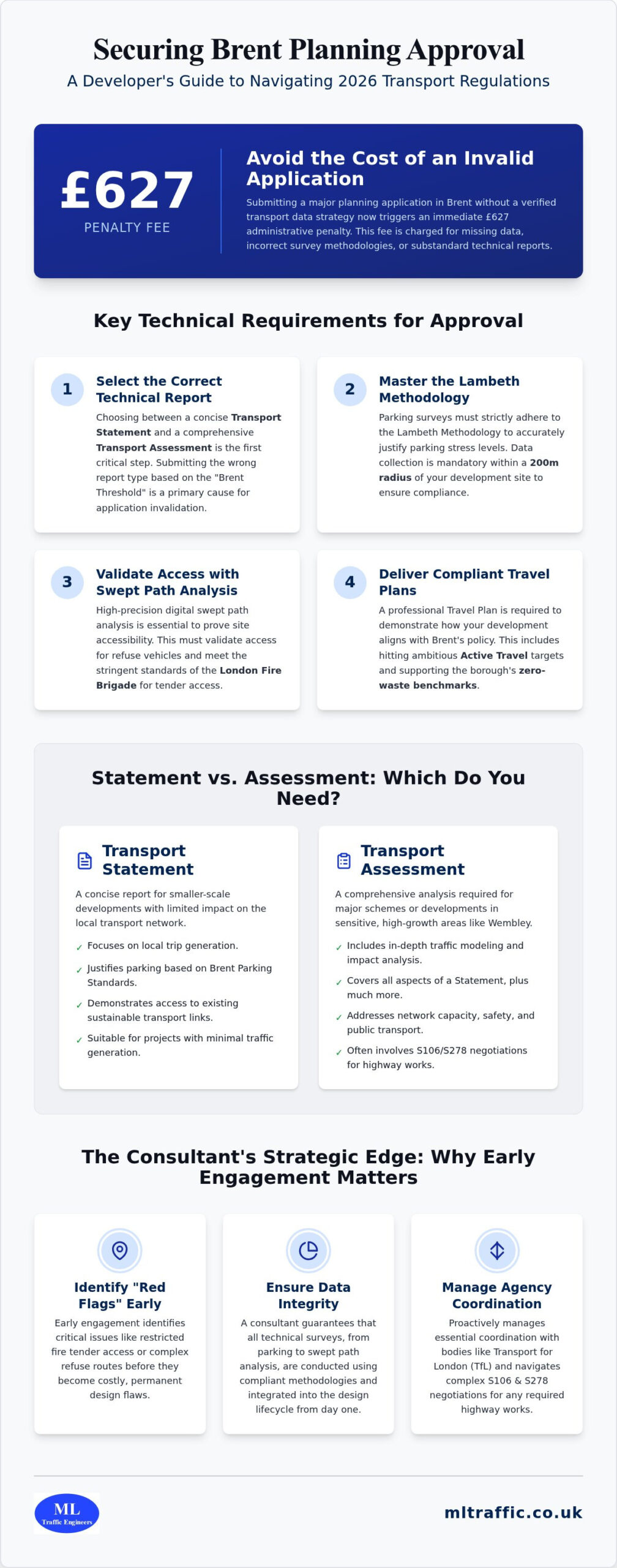
The landscape changed significantly this year. Brent Council now imposes a £627 administrative penalty for invalid major applications. This fee is triggered by missing data, incorrect survey methodologies, or substandard technical reports. By providing robust Transport Assessments, we act as a guardian of submission quality. This technical reporting acts as a shield, protecting developers from both immediate financial losses and the long-term costs associated with planning refusals. Success in 2026 requires a deep understanding of transportation planning principles tailored to London’s unique constraints.
Navigating the 2026 Brent Local Plan
Brent’s current Local Plan emphasizes a radical shift toward “Active Travel.” This means developments must now prove they can function with minimal car dependency while supporting the borough’s zero-waste and environmental targets. We interpret the Mayor of London’s Transport Strategy to ensure your site meets local LIP targets. In high-density zones like Wembley, where growth is rapid, we provide the specific data needed to show that new infrastructure can handle increased pedestrian and cyclist volumes without compromising public safety.
The Value of Early Engagement
Securing a brent transport planning consultant during the initial design phase is a strategic necessity. Early engagement allows us to identify “red flag” issues, such as restricted fire tender access or complex refuse collection routes, before they become permanent design flaws. We also manage the essential coordination with Transport for London (TfL) for any sites adjacent to the Strategic Road Network. This proactive management prevents abortive design costs and ensures that technical surveys, like Swept Path Analysis, are integrated into the project lifecycle from day one. Our constant availability ensures that as your design evolves, the transport strategy remains compliant and ready for submission.
Technical Requirements: Transport Statements vs. Assessments
Selecting the correct technical report is the first critical decision in the planning process. Brent Council differentiates between submissions based on the scale of the development and its potential impact on the local highway network. A brent transport planning consultant determines whether your project requires a concise Transport Statement or a comprehensive Transport Assessment. This choice is governed by the “Brent Threshold,” which typically aligns with GLA guidance but remains subject to local sensitivity. Submitting the wrong report type often leads to immediate application invalidation, triggering the £627 administrative penalty mentioned previously. Precision at this stage protects your timeline and your budget.
The distinction between these documents is defined by the depth of analysis required. Official guidance on Transport Assessments and Statements establishes that smaller developments with limited traffic generation usually qualify for a Statement. However, major schemes or those located in sensitive areas, such as the high-growth zones surrounding Wembley, demand a full Assessment. We analyze your site’s specific context to ensure the level of detail meets Brent’s 2026 standards without over-engineering the solution.
Brent Transport Statement Essentials
For smaller residential or commercial projects, a Transport Statement focuses on local trip generation and existing sustainable transport links. You must justify your parking provision according to the latest Brent Parking Standards, which are increasingly restrictive in high PTAL areas. We provide the technical evidence to support “car-free” or “car-capped” developments by demonstrating the availability of alternative travel modes. If you are preparing a minor application, our Transport Statement London: A Developer’s Buying Guide offers a deeper look at the specific requirements for 2026.
Full Transport Assessments for Major Schemes
Major schemes require a more rigorous approach. These reports include detailed junction capacity modeling and multi-modal impact analysis to prove the network can absorb new demand. We utilize the TRICS database to predict future traffic flows with high accuracy, ensuring your data stands up to council scrutiny. This is particularly vital in areas like Kilburn or Harlesden, where existing congestion is a primary concern for highways officers. For a complete breakdown of these complex requirements, refer to our Transport Assessment London: The Developer’s Guide. Coordinating these elements early ensures your project moves toward approval without technical setbacks. If you’re unsure which threshold applies to your site, exploring our full range of technical services can provide the clarity needed for a successful submission.
Data Standards: Parking Surveys and the Lambeth Methodology
Brent Council demands empirical evidence for any parking provision that deviates from local standards. The Lambeth Methodology is the non-negotiable framework for these justifications in 2026. This process involves mapping overnight parking stress within a 200m walking distance of your site entrance. Surveys are typically conducted between 00:30 and 05:30 on two separate weekday nights to capture the peak residential demand. This technical rigour ensures that your proposal won’t negatively impact existing residents or lead to dangerous levels of on-street congestion.
A brent transport planning consultant uses these specific datasets to negotiate effectively with highways officers. We align our local findings with national Transport analysis guidance to provide a robust defense of your site design. Your Public Transport Accessibility Level (PTAL) rating acts as the primary ceiling for parking provision. Higher ratings allow for significant reductions in on-site spaces, but they also require more sophisticated arguments to prove the network can support the shift in travel behavior. Our team manages the full survey lifecycle to ensure no data gaps trigger the £627 invalidation fee.
Justifying Car-Free Developments in Wembley
In Wembley’s high-growth zones, PTAL ratings often reach the maximum levels of 5 or 6. This accessibility allows us to eliminate on-site parking requirements entirely. However, we must address “displacement” concerns. We prove through detailed analysis that future residents won’t simply park on adjacent residential streets. This often involves negotiating Controlled Parking Zone (CPZ) contributions. These payments support local infrastructure and act as a key planning gain for the council. Our expertise in Travel Plans further strengthens these arguments by promoting car clubs and cycling infrastructure as viable alternatives.
Conducting Accurate Traffic Surveys
Data integrity depends on survey timing and the choice of technology. We deploy both Automatic Traffic Counters (ATC) for long-term volume data and manual turning counts for complex junctions. It’s critical to avoid school holidays or periods of local roadworks, as Brent highways officers will reject unrepresentative data. We translate these raw numbers into a clear narrative that shows your development won’t overwhelm the local street capacity. By managing the full scope of Traffic Surveys, we ensure your submission is based on unassailable facts. This precision reduces regulatory pressure and accelerates the approval process for major schemes.
Design Feasibility: Swept Path Analysis for Brent Sites
Proving vehicle manoeuvrability is a non-negotiable requirement for any urban development in Brent. In densely populated areas like Kilburn or Harlesden, street widths are often at their absolute limit. A brent transport planning consultant uses digital simulations to demonstrate that service vehicles can access the site without damaging infrastructure or endangering pedestrians. This technical rigour prevents costly post-permission design changes that occur when architects realize a truck cannot physically make a turn after the layout is finalized. We ensure that your design works in the real world, not just on paper.
The “Fire Tender Test” is a critical component of the design feasibility stage. We simulate the exact movements of London Fire Brigade appliances to ensure they can reach within 45 metres of all points within a building. Similarly, Brent Council’s waste management team requires refuse trucks to enter and exit every development in a forward gear. Our simulations ensure your site layout accommodates these 10.2-metre vehicles, removing the risk of a late-stage planning refusal. Precision at this stage is the only way to satisfy both highways officers and emergency services.
Vehicle Templates for Brent Compliance
Accuracy in simulation starts with using the correct vehicle templates. We model everything from the standard 10.2m refuse vehicle to the larger 12m pantechnicon used for residential removals. It isn’t enough to show a vehicle moving in a vacuum. We simulate “worst-case” scenarios that account for existing on-street parking obstructions common in residential Brent. For a detailed look at how we apply these standards to your plans, read our AutoTurn Swept Path Analysis Practical Guide.
Mitigating Access Constraints
If a simulation fails, we work directly with your design team to mitigate constraints. This might involve widening site entrances or strategically placing “over-run” areas and mountable kerbs to facilitate tighter turns. Brent’s highways officers generally reject designs that require “reversing in” or “reversing out” maneuvers due to safety risks. We prioritize designs that allow for internal turning heads or circular routes. To ensure your site layout meets every safety and waste collection standard, contact our engineering team for a professional swept path analysis today. This proactive approach ensures your submission is technically sound and ready for council scrutiny.
Securing Brent Approval: The Consultant’s Strategic Edge
Securing a positive decision in the London Borough of Brent requires more than just raw data; it requires a strategic narrative that aligns with the council’s specific policy objectives. While an architect focuses on the internal layout and aesthetic of a development, a brent transport planning consultant provides the technical authority needed to navigate the complex highway requirements that often stall or derail projects. Engaging an experienced brent transport planning consultant ensures that technical arguments carry the weight of professional integrity, which is vital when defending parking reductions or site access designs before the planning committee.
Strategic negotiation is particularly critical when dealing with Section 106 and Section 278 agreements. In 2026, Brent has established a clear fee structure for these negotiations, with S106 administrative charges ranging from £1,051.10 for simple obligations to £2,456.00 for complex review mechanisms. Additionally, S38 and S278 approval fees are set at 9% of the works cost. We use our deep understanding of Brent’s infrastructure priorities to ensure that any requested highway improvements or financial contributions remain proportional to the development’s actual impact. This prevents developers from being burdened with excessive mitigation costs while still satisfying the council’s requirements for public safety and network efficiency.
Developing Effective Travel Plans
With Brent’s 2026 commitment to zero waste and the Mayor of London’s “Active Travel” targets, a robust Travel Plan is no longer a secondary document. It is a primary tool for securing approval. We set realistic modal shift targets that encourage cycling and public transport use, backed by evidence of local connectivity. Our role ensures that these plans are not just static documents but active strategies for long-term compliance. For a comprehensive look at how these strategies bolster your submission, see our guide on Travel Plan Consultants: Strengthening Applications.
Final Submission Checklist for Brent
The final stage of securing approval is ensuring complete document harmony. Highways officers frequently flag inconsistencies between the Transport Statement and the Design and Access Statement, which can lead to the £627 invalidation fee. We perform a rigorous final audit of all technical data against the 2026 Brent Local Plan, verifying that every survey result and swept path simulation is accurately reflected across the entire application suite. This meticulous attention to detail acts as the ultimate safeguard for your project timeline. To ensure your submission is beyond reproach, contact ML Traffic Engineers UK for a professional Brent site review and leverage our proven track record with London planning authorities.
Secure Your Development’s Future in Brent
Navigating the 2026 planning landscape in Brent requires absolute technical precision. We’ve explored how mastering the Lambeth Methodology for parking surveys and utilizing high-fidelity digital modeling are now non-negotiable requirements. These standards act as your primary defense against the borough’s strict invalidation fees and protracted negotiation cycles for Section 106 agreements. By integrating technical reporting early in your design phase, you eliminate the risk of abortive costs and ensure your site layout meets every safety and access benchmark established by the council.
Partnering with a specialized brent transport planning consultant provides the strategic edge needed to move your project forward with confidence. We include expert AutoTurn Swept Path Analysis in our service and maintain a zero-failure rate on technical report validation from 2025. Our team understands the specific expectations of Brent Highway Officers, ensuring your submission is compliant and authoritative from the first day. Secure your Brent planning approval with a professional transport assessment and let us manage the regulatory complexity for you. Your project’s success is within reach, and we’re ready to help you achieve a first-time approval.
Frequently Asked Questions
When is a Transport Statement required for a Brent planning application?
A Transport Statement is typically required for smaller developments with lower traffic impact. In Brent, this usually applies to residential schemes between 10 and 80 units or commercial sites under 2,500 sqm, provided they aren’t situated in sensitive locations. If your proposal exceeds these thresholds or sits near a complex junction, the council will likely request a full Transport Assessment to analyze the wider network impact.
What is the Lambeth Methodology for parking surveys in Brent?
The Lambeth Methodology is the industry-standard framework Brent Council uses to assess on-street parking stress. It requires an overnight assessment of available spaces within a 200m walking distance of the site. You must conduct these surveys between 00:30 and 05:30 on two separate weekday nights. This data proves whether the local network can absorb any additional parking demand without compromising residential amenity or highway safety.
How much does a Brent transport planning consultant cost in 2026?
Professional fees for a brent transport planning consultant vary based on the project’s scale and the complexity of the required technical reports. Costs are typically structured around the specific surveys needed, such as Lambeth Methodology parking surveys or digital Swept Path Analysis. While we don’t provide fixed price lists, we offer tailored quotes that reflect the precise technical requirements and data standards of your Brent planning application.
Can I use a general architect for my Swept Path Analysis?
While architects provide basic site layouts, they often lack the specialized AutoTurn software and engineering expertise required for a valid Swept Path Analysis. Brent highways officers expect high-precision digital simulations that use specific vehicle templates, such as the 10.2m refuse vehicle. A specialist engineer ensures the analysis meets the rigorous standards needed to avoid immediate application invalidation and ensures the design works in real-world conditions.
What happens if my transport report is found to be technically flawed?
A technically flawed report often leads to an immediate “invalid” status for your planning application. In Brent, this triggers a £627 administrative fee for major schemes and causes significant project delays. Beyond the financial penalty, errors in trip generation or junction modeling can lead to a formal refusal. You’ll then need to resubmit corrected data, which restarts the entire statutory determination period and increases your project costs.
Does Brent Council allow car-free developments in low PTAL areas?
Securing a car-free development in low PTAL areas (ratings 0 to 2) is significantly more challenging than in high-accessibility zones like Wembley. Brent Council generally expects on-site parking for these locations unless you provide unassailable evidence through a parking survey. You must prove that any overspill won’t compromise highway safety. These applications usually require robust Travel Plans to mitigate the lack of on-site spaces and promote sustainable travel.
What are the fire tender access requirements for new Brent developments?
Brent follows London Fire Brigade standards, requiring fire appliances to reach within 45 metres of all points within a building. The site access must accommodate a standard fire tender’s turning circle and width. We use Swept Path Analysis to prove that these vehicles can enter, maneuver, and exit the site safely in a forward gear. Failure to meet these standards will result in a direct objection from the emergency services and planning refusal.
How long does it take to prepare a full Transport Assessment for a Brent site?
A full Transport Assessment typically takes four to six weeks to complete, depending on the availability of survey data. This timeline includes conducting overnight parking surveys, performing junction capacity modeling, and drafting the technical report. Early engagement is essential to ensure that site-specific surveys are scheduled during neutral periods, avoiding school holidays or local roadworks that could skew the results and lead to council rejection of the data.

Disclaimer
The content on mltraffic.co.uk, including all technical articles, guides, and resources, is provided for general informational and educational purposes only. It is not intended to constitute professional advice in traffic engineering, transportation planning, development approvals, or any other technical or legal field.
While ML Traffic Engineers makes every reasonable effort to ensure the accuracy, completeness, and timeliness of the information published, we do not provide any warranties or representations (express or implied) regarding its reliability, suitability, or availability for any particular purpose. Any reliance you place on the content is strictly at your own risk.
In no event shall ML Traffic Engineers, its directors, employees, authors, or affiliates be liable for any direct, indirect, incidental, special, consequential, or punitive damages (including, without limitation, loss of profits, data, or business opportunities) arising out of or in connection with the use of, or inability to use, any information provided on this website.
The articles and guides on this site are not a substitute for engaging a qualified, professional traffic engineer to assess your specific project requirements. For tailored advice, compliance assessments, or traffic engineering services, please contact a competent professional.
This disclaimer may be updated from time to time without notice. By accessing or using this website, you agree to be bound by the most current version of this disclaimer.