
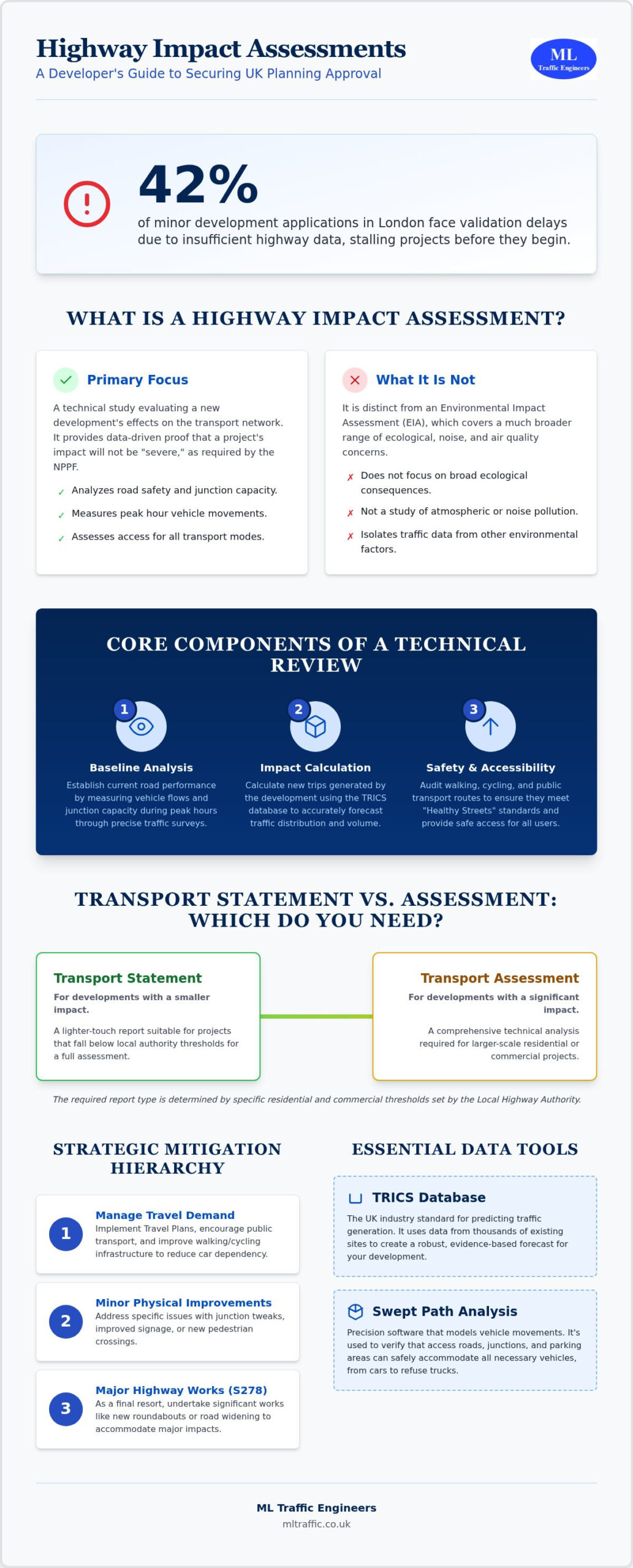
42% of minor development applications across London boroughs face immediate delays at the validation stage due to insufficient highway data. For developers, a highway impact assessment is often the difference between a project that breaks ground on schedule and one that stalls indefinitely under local authority scrutiny. You likely view these requirements as a complex regulatory hurdle that threatens your project timeline and introduces unexpected costs through S278 works or extensive mitigation. It’s frustrating to navigate the technical jargon of TRICS data and the August 2026 NPPF updates while trying to maintain project viability.
This guide provides the technical authority you need to master these complexities and secure planning approval with precision. We’ll show you how to de-risk your development by aligning with the latest statutory requirements and vision-led planning trends. You’ll learn the specific thresholds for 2026, the essential components of a robust assessment, and how to utilize tools like Swept Path Analysis to satisfy council planners from the outset. This logical approach ensures you can manage the full project lifecycle without facing avoidable logistical or regulatory pressures.
Key Takeaways
- Align your planning strategy with the August 2026 NPPF updates to ensure your highway impact assessment meets the latest rules-based decision-making standards.
- Identify whether your project requires a lighter-touch Transport Statement or a comprehensive Transport Assessment by evaluating specific residential and commercial thresholds.
- Analyze baseline road performance and projected peak-hour movements to develop a robust technical case for your development’s transport impact.
- Implement a strategic hierarchy of mitigation, from managing travel demand to physical highway improvements, to satisfy statutory requirements and secure approval.
- Utilize precision data tools like Swept Path Analysis and parking surveys to eliminate validation errors and streamline the planning process.
What is a Highway Impact Assessment in UK Planning?
A highway impact assessment is a technical study that evaluates the physical and operational effects of a new development on the existing transport network. It serves as a critical component of the planning application, providing a data-driven justification for why a project should proceed. In the UK, the National Planning Policy Framework (NPPF), which saw a significant rules-based update in August 2026, dictates that development should only be prevented on transport grounds if the “residual cumulative impacts on the road network would be severe.” This assessment is the primary mechanism developers use to prove their project stays below that severity threshold.
It’s vital to distinguish this study from other regulatory requirements. While an Environmental Impact Assessment (EIA) examines broader ecological and atmospheric consequences, a highway impact assessment focuses specifically on road safety, junction capacity, and peak hour movements. It ensures that the local infrastructure can handle the additional load without compromising public safety or causing gridlock. By isolating traffic data from environmental factors, developers can address specific highway objections with technical precision.
The Legal Basis: Highways Act 1980 and Beyond
The requirement for these assessments is rooted in established legislation. Part VA of the Highways Act 1980 outlines the framework for highway improvements and how developers can contribute to the network. This legal landscape was further refined by the 2007 Regulations, which standardized the technical evaluation of projects affecting trunk roads. Throughout this process, the Local Highway Authority (LHA) acts as a statutory consultee. They review your technical data to ensure compliance with regional standards. Without their support, securing planning permission becomes nearly impossible.
Why Developers Need an Assessment in 2026
The planning environment in 2026 is increasingly complex. Authorities now prioritize “Vision Zero” safety targets, aiming to eliminate road-related deaths, and strict sustainability mandates found in the London Plan. A proactive approach is essential. By identifying potential traffic bottlenecks or safety risks early, you can propose cost-effective mitigation strategies before they become deal-breakers for the council. Professional transport planning services ensure that your data is accurate and compliant from day one.
“A robust assessment is the primary defence against planning delays caused by traffic concerns.”
Securing this technical defense allows you to pre-empt objections. It transforms a potential liability into a verified asset for your project’s viability, reducing the risk of expensive last-minute redesigns.
The Core Components of a Technical Highway Review
A technical review begins by establishing the “Baseline Condition.” We examine how the local road network performs today through precise traffic surveys. This involves measuring current vehicle flows and junction capacities during peak hours. Once the baseline is set, we calculate the “Proposed Development” impact. This identifies how many new trips the site will generate and where that traffic will go. According to the UK Government Guidance on Transport Assessments, this data must be robust to withstand council scrutiny. A highway impact assessment that lacks accurate baseline data is vulnerable to immediate challenge by the local authority.
Beyond vehicle numbers, a modern assessment must prioritize safety and accessibility. This includes auditing walking and cycling routes to meet “Healthy Streets” standards. Integrating sustainable transport options isn’t just a policy goal; it’s a functional way to reduce the overall impact of your development. Providing clear, safe access for all users strengthens your case. If you’re unsure which technical components your site requires, reviewing our project types can help clarify the scope of work needed for your specific application.
Trip Generation and the TRICS Database
The TRICS database is the industry standard for predicting development traffic. It contains survey data from thousands of existing sites across the UK. Our engineers select comparable locations based on land use, size, and region to ensure your highway impact assessment is accurate. We focus on the AM and PM peak hours. These are the critical windows when the network is under the most pressure. If your data doesn’t align with TRICS standards, the local authority will likely reject the application during the validation stage.
Swept Path Analysis: Proving Vehicle Manoeuvrability
Site layouts often fail because they don’t account for large vehicle movements. A swept path analysis uses specialized software to simulate how refuse vehicles, fire tenders, and delivery vans move through your proposed roads. It’s a non-negotiable requirement for modern planning. By testing these movements early, you prevent costly design errors that could lead to a refusal. Our team provides these detailed simulations to ensure every junction and parking bay is functional from day one. This proactive step reduces the risk of expensive off-site highway works being mandated later in the process.
Transport Statement vs. Assessment: Which One Do You Need?
The depth of your highway impact assessment is dictated by the potential scale of the development’s influence on the local network. Local Planning Authorities (LPAs) use specific thresholds to determine whether you need a Transport Statement or a full Transport Assessment. While a statement is a lighter-touch report for smaller schemes, an assessment is a comprehensive technical study for larger projects. For most assessments, a Travel Plan is a mandatory companion. It isn’t just a document; it’s a long-term management strategy. It details how you’ll reduce single-occupancy vehicle trips through active travel, cycling infrastructure, and public transport integration.
Typical Thresholds for Planning Applications
Residential thresholds in 2026 generally require a full assessment for projects exceeding 50 to 80 units. However, high-density London boroughs often lower this threshold to 30 or 40 units due to existing network pressure. Commercial developments under 1,000 square metres typically only need a Transport Statement. If your site is projected to generate between 30 and 50 vehicle movements during peak hours, this usually triggers the requirement for a formal statement. Small sites in sensitive areas, such as those near schools or air quality management zones, might still require detailed reporting to address local safety concerns.
Scope and Technical Depth Differences
The technical requirements differ significantly between the two report types. A Transport Statement focuses on the immediate vicinity, including site access and local junction safety. In contrast, a full Assessment utilizes complex network modelling to evaluate the development’s impact on the wider infrastructure. This process aligns with the Transport Analysis Guidance (TAG), ensuring that environmental factors like air quality and noise are properly appraised. When dealing with congested networks, a “simple” review won’t suffice. You must prove that your project won’t cause severe cumulative impacts under the August 2026 NPPF rules.
Our team at ML Traffic Engineers manages this full lifecycle by identifying the correct scope during pre-application discussions. This prevents the “scope creep” that leads to unexpected consultancy costs and project delays. We ensure your technical submission is right the first time, providing a clear path to planning approval without unnecessary logistical pressure.
Mitigating Impact: How to Satisfy Local Highway Authorities
Local authorities follow a strict hierarchy when reviewing your development’s effect on the network: Avoid, Manage, and Mitigate. Your first goal is to avoid impact through smart site design and layout. If that isn’t possible, you must manage the remaining demand. This often involves “soft” mitigation strategies, such as robust Travel Plans. These documents serve as long-term management tools to encourage cycling and public transport use. By effectively reducing single-occupancy vehicle trips, you can lower the overall traffic figures presented in your highway impact assessment. Only after these steps are exhausted should you move to physical mitigation, such as junction redesigns or new pedestrian crossings.
Parking management plays a vital role in this strategy. Under the 2026 London Plan, developments in areas with high public transport accessibility must be car-free. Even outside London, authorities now demand 100% active electric vehicle charging points for any permitted spaces. Balancing these requirements while satisfying local demand requires a technical approach that prioritizes network safety over simple capacity expansion.
Section 278 and Section 38 Agreements
When physical improvements are required, you’ll likely enter a Section 278 (S278) agreement. This legal framework allows you to carry out works on the public highway, but it carries significant financial implications. A precise assessment is your primary tool to minimize “scope creep.” By providing accurate data, we ensure that the required works are strictly proportional to your development’s impact. Section 38 agreements focus on the adoption of new roads by the council. Both require high standards of technical precision to ensure the Local Highway Authority accepts the infrastructure without demanding costly, unnecessary revisions.
Parking Surveys and the Lambeth Methodology
Parking provision is often a flashpoint for local objections. Using parking surveys based on the Lambeth Methodology allows you to justify lower parking ratios with technical authority. This industry-standard approach measures current parking stress in the surrounding streets. It provides the data-backed evidence needed to prove that any overspill won’t harm highway safety or burden existing residents. This is especially critical in 2026, as 42% of minor applications face delays due to insufficient data. Providing a clear picture of parking capacity early in the process pre-empts objections and secures project viability.
If your project faces scrutiny over vehicle movements or parking stress, our team can provide the technical surveys required to satisfy the council. Contact ML Traffic Engineers today to secure the data needed for your planning approval.
Expert Highway Consultancy for Your Planning Application
Early engagement at the pre-application stage is the most effective way to de-risk your development. By identifying potential highway constraints before you finalize your site layout, you avoid the high costs of late-stage redesigns. To provide a rapid, fixed-fee quote, our team typically requires the site location, the proposed land use, and any existing site plans. This information allows us to determine the necessary scope, whether it’s a simple Transport Statement or a comprehensive highway impact assessment. We focus on delivering the technical authority you need to secure planning success on the first attempt.
Contact ML Traffic Engineers for a comprehensive Highway Impact Assessment to ensure your project meets all statutory requirements and proceeds without delay.
Securing Your Planning Approval in 2026
Master the 2026 planning landscape by understanding the specific residential and commercial thresholds that trigger a full highway impact assessment. Technical precision in your data, from TRICS analysis to swept path simulations, is the most effective way to eliminate validation delays and satisfy council planners on the first attempt. By engaging with expert consultants at the pre-application stage, you can navigate intricate regional regulations and propose data-backed mitigation strategies that protect your project’s viability. It’s the most reliable method to ensure a smooth transition from design to construction.
ML Traffic Engineers has operated as specialist consultants since 2014, offering deep expertise in UK-wide planning regulations and statutory requirements. We deliver high-quality, data-driven reports that satisfy Local Highway Authorities while reducing the logistical pressure on your internal team. Our all-encompassing, fully-managed service model ensures your project moves from initial survey to a successful planning outcome with unwavering reliability and technical authority. Take the first step toward a risk-free planning application today.
Get a Professional Highway Impact Assessment Quote
Frequently Asked Questions
How long does a highway impact assessment take to complete?
A standard assessment typically takes between two and four weeks to complete from the date of the initial site visit. This timeline depends on the scale of the project and the availability of traffic data. For example, if we need to conduct new traffic surveys, we must schedule them during neutral weeks to avoid school holidays. Once data collection is finished, our engineers perform the capacity modelling and report drafting to meet your planning deadline.
Will I need a full Transport Assessment for a small residential development?
You usually won’t need a full assessment for a small residential development under 50 units. Instead, a lighter-touch Transport Statement is the standard requirement for minor schemes. However, local authorities in high-density areas might lower these thresholds if the site is in a sensitive location. We evaluate your specific site location and unit count to ensure you don’t overspend on unnecessary technical depth while still satisfying the local highway authority’s validation criteria.
What happens if the local highway authority objects to my assessment?
If an objection occurs, we act as the primary liaison to resolve technical disputes through data-backed negotiation. We review the specific concerns raised by the authority and provide supplementary evidence, such as a swept path analysis or revised junction modelling. Often, objections are cleared by proposing targeted mitigation strategies or a more robust Travel Plan. Our goal is to address these issues rapidly to prevent your planning application from stalling or reaching a formal refusal.
How much does a highway impact assessment cost in 2026?
The cost of a highway impact assessment varies significantly based on the project’s scale and the complexity of the required technical surveys. A large-scale commercial development requiring extensive junction modelling will naturally involve a different scope than a minor residential scheme. We provide fixed-fee quotes tailored to your specific site requirements after an initial review of your plans. This ensures you only pay for the technical data necessary to secure planning approval without hidden consultancy costs.
What is the difference between a Transport Assessment and a Travel Plan?
A Transport Assessment is a technical study that evaluates the immediate impact of a development on the road network. In contrast, a Travel Plan is a long-term management strategy designed to reduce the total number of vehicle trips generated by the site. While the assessment focuses on junction capacity and safety, the Travel Plan promotes sustainable alternatives like cycling and public transport. Most large-scale planning applications require both documents to demonstrate a comprehensive approach to transport management.
Can I conduct my own traffic surveys for the assessment?
Local authorities rarely accept traffic surveys conducted by non-professionals because the data must follow strict industry methodologies. Professional surveys utilize specialized equipment and are conducted during neutral periods to ensure the results are representative of typical network conditions. We manage the full data collection process using calibrated equipment and trained surveyors. This ensures the technical foundation of your highway impact assessment is robust and capable of withstanding scrutiny during the planning review process.
Is a highway impact assessment the same as an Environmental Impact Assessment (EIA)?
These are distinct regulatory requirements with different technical focuses. An Environmental Impact Assessment (EIA) is a broad study covering ecological, noise, and atmospheric consequences of a development. A highway impact assessment is a specialized transport study focusing on road safety, vehicle movements, and network capacity. While the transport data often feeds into the EIA’s air quality and noise sections, the highway report remains a standalone technical document required by the local highway authority for planning validation.
How does the TRICS database affect my development project?
The TRICS database is the primary tool used to predict how many vehicle trips your development will generate. It uses data from thousands of comparable existing sites to establish a reliable baseline for your project. If the TRICS analysis shows your development will significantly increase local congestion, you’ll need to propose mitigation strategies. Our engineers utilize this database to provide the technical authority required to justify your project’s impact and secure approval from the local authority.

Disclaimer
The content on mltraffic.co.uk, including all technical articles, guides, and resources, is provided for general informational and educational purposes only. It is not intended to constitute professional advice in traffic engineering, transportation planning, development approvals, or any other technical or legal field.
While ML Traffic Engineers makes every reasonable effort to ensure the accuracy, completeness, and timeliness of the information published, we do not provide any warranties or representations (express or implied) regarding its reliability, suitability, or availability for any particular purpose. Any reliance you place on the content is strictly at your own risk.
In no event shall ML Traffic Engineers, its directors, employees, authors, or affiliates be liable for any direct, indirect, incidental, special, consequential, or punitive damages (including, without limitation, loss of profits, data, or business opportunities) arising out of or in connection with the use of, or inability to use, any information provided on this website.
The articles and guides on this site are not a substitute for engaging a qualified, professional traffic engineer to assess your specific project requirements. For tailored advice, compliance assessments, or traffic engineering services, please contact a competent professional.
This disclaimer may be updated from time to time without notice. By accessing or using this website, you agree to be bound by the most current version of this disclaimer.