What if the viability of your school expansion isn’t determined by the quality of the architecture, but by the congestion management at the site entrance? A robust school travel plan has become a critical technical requirement for securing planning approval in 2026. We understand the pressure of navigating the latest NPPF reforms and the logistical strain caused by the 9% increase in SEND transport demand reported by the Department for Education this year. Failing to address these variables with technical precision often leads to costly delays and community objections during the consultation phase.
This guide provides the technical roadmap to develop a compliant strategy that satisfies local highway authorities and secures your planning permission. We will examine the specific components required for approval, from baseline surveys to technical traffic management. ML Traffic Engineers UK provides the precision and regulatory expertise needed to reduce logistical pressures and ensure your educational project moves forward without delay. By following this roadmap, you can transform a complex regulatory hurdle into a streamlined, approved strategy that prioritizes pupil safety and operational reliability.
Key Takeaways
- Understand how the National Planning Policy Framework (NPPF) mandates long-term sustainable travel strategies to secure planning approval.
- Learn how to develop a compliant school travel plan using site audits and baseline habit data to satisfy local highway authorities.
- Identify the critical differences between pre-commencement and pre-occupation planning conditions to avoid project delays.
- Master technical requirements like swept path analysis for bus turning circles to ensure safe site access for all vehicles.
- Discover how integrated traffic surveys and technical reporting streamline the regulatory submission process for school developments.
What is a School Travel Plan and Why Is It Mandatory?
A school travel plan is a comprehensive, long-term management strategy designed to promote sustainable travel for pupils, parents, and staff. It acts as a live document that outlines specific measures to reduce reliance on single-occupancy vehicle journeys. While the general concept of what a travel plan is applies across various sectors, educational institutions face unique logistical pressures. Unlike commercial developments where staff arrivals are often staggered, schools experience intense, concentrated traffic peaks during the morning drop-off and afternoon pick-up periods. This concentration creates specific safety risks that require specialized technical mitigation.
The National Planning Policy Framework (NPPF) mandates these plans to ensure that developments generating significant movement are sustainable. For schools, this means addressing the immediate impact on the local highway network and protecting the safety of vulnerable road users. The primary objectives of a compliant plan include:
- Reducing single-occupancy car journeys: Cutting down the number of individual parent vehicles entering the immediate school vicinity.
- Improving local air quality: Minimizing idling and congestion to reduce nitrogen dioxide levels near playgrounds and entrances.
- Enhancing pedestrian safety: Creating clearer, safer routes for those walking or cycling to the site.
The Statutory Requirement for Educational Developments
Local planning authorities (LPAs) typically trigger the requirement for a travel plan during the planning application process for new school builds. However, requirements also apply to extensions or a change of use to Class F1. If your project increases pupil capacity or significantly alters site access, the Local Highway Authority will demand a formal submission. These plans are often secured through Section 106 agreements, making the delivery of travel targets a legal obligation for the school. This ensures that the mitigation measures proposed during the planning phase are actually implemented and monitored. For complex applications, this often works in tandem with a detailed Transport Assessment to prove the site can handle the projected load.
Benefits Beyond Planning Compliance
Securing planning permission is the immediate goal, but a well-executed plan delivers long-term operational advantages. It directly addresses the fear of planning delays caused by community traffic concerns. By implementing active travel initiatives such as walking buses or improved cycling infrastructure, schools can significantly reduce ‘school run’ congestion. This doesn’t just satisfy council requirements; it creates a safer environment at the school gates. Recent Department for Education data from June 2026 indicates a 9% increase in pupils using SEND home-to-school transport. This shift highlights the need for precise technical planning to manage diverse transport needs without compromising pupil safety or local traffic flow.
Key Components of a Compliant School Travel Plan
A compliant school travel plan must move beyond generic statements about sustainability. It requires a rigorous technical framework that local highway authorities can audit. The process begins with a comprehensive site audit, where we evaluate the existing pedestrian, cycle, and public transport infrastructure within a specific radius of the site. This audit identifies physical barriers to active travel, such as poorly lit pathways or lack of safe crossings, which must be addressed to justify your modal shift projections.
One common pitfall in planning applications is the failure to distinguish between an ‘Interim’ and ‘Full’ travel plan. During the application stage, you often submit a draft based on predicted data. However, once the school opens, you must convert this into a Full Travel Plan using actual baseline data from the first cohort of pupils and staff. This distinction is vital for discharging planning conditions on time. Councils often demand this transition to ensure the mitigation measures proposed are grounded in reality rather than just estimates.
Data Collection: The Foundation of the Plan
Accurate data is the only way to satisfy council scrutiny. We utilize classroom ‘hands-up’ surveys to determine how pupils currently travel and identify their preferred methods. Staff surveys are equally important. Staff journeys often contribute significantly to peak-hour vehicle movements and parking demand. To validate this subjective data, we conduct professional traffic surveys to record actual vehicle counts and turning movements at the school gates. This provides a data-driven baseline that removes ambiguity from the planning process.
Setting Achievable Modal Shift Targets
Targets must be SMART: specific, measurable, achievable, realistic, and time-bound. In a school context, modal shift typically refers to the percentage of journeys converted from private cars to walking, cycling, or bus travel. These goals should align with the Public Transport Accessibility Level (PTAL) of your site. If your school has a low PTAL rating, setting aggressive bus-use targets will likely be rejected by the council as unrealistic. When Creating a School Travel Plan, we ensure these targets mirror local borough transport objectives to increase the likelihood of approval.
The final components are a clear action plan and a long-term monitoring programme. This involves a five-year commitment to conduct annual travel surveys and report findings back to the local authority. This ongoing review process ensures the measures remain effective as the school population evolves. If you need assistance navigating these technical requirements, our travel plan consultants can manage the entire data collection and reporting lifecycle.
Navigating Planning Conditions for School Developments
Planning conditions serve as the regulatory bridge between a proposal and a functional site. For educational projects, a school travel plan is frequently a mandatory requirement to discharge specific “pre-occupation” or “pre-commencement” conditions. While the wider Transport Assessment identifies the macroscopic impact on the road network, the travel plan provides the granular, management-led solutions that keep the project moving. Rejection by the council often occurs when a plan fails to provide enforceable measures or lacks a clear commitment to funding and monitoring. We prioritize precision in these documents to ensure your project bypasses unnecessary delays.
Draft vs. Full Travel Plans
In the early stages of a planning application, a “Framework Travel Plan” or “Draft Travel Plan” is often sufficient. This document outlines the intended strategy before the exact pupil intake is finalized. However, the Local Highway Authority (LHA) will typically attach a condition requiring a “Full Travel Plan” once the school is operational. This transition is critical. If the operational plan doesn’t accurately reflect the baseline surveys or fails to meet the targets agreed upon during the draft phase, you risk breaching your Section 106 obligations. Securing approval from the LHA requires a logical progression from initial theory to real-world implementation.
Negotiating with Local Highway Authorities
A primary concern for Highway Officers is “parental parking” overspilling into adjacent residential streets. This is a common flashpoint for community objections and can lead to the refusal of planning permission. Successful negotiation requires proposing mitigation measures that are both effective and cost-efficient for the developer. For instance, officers are particularly sensitive to the September 2026 changes in free school transport eligibility, which may shift more pupils toward parental car travel if not properly managed within the plan. Engaging travel plan consultants early in this process allows for technical discussions that address LHA concerns before they become roadblocks.
Long-term compliance relies on the appointment of a Travel Plan Coordinator (TPC). This individual acts as the official point of contact for the council and is responsible for the annual monitoring and review process. Without a dedicated TPC, many schools find their travel plans become stagnant, which can trigger enforcement action. Ensuring your plan clearly defines this role and its responsibilities is a hallmark of a professional submission that satisfies even the most rigorous local council requirements.
Road Safety and Technical Traffic Management
Technical traffic management represents the physical implementation of your school travel plan. While earlier sections focused on policy and data collection, this section addresses the engineering precision required to ensure pupil safety. Local Highway Authorities prioritize the elimination of vehicle-pedestrian conflict. We achieve this by designing site layouts that physically segregate pupil play areas from all vehicle movement zones. This design process includes integrating secure, high-capacity cycle storage and rapid electric vehicle (EV) charging points for staff. These features are essential to support the sustainable travel targets mandated by the latest National Planning Policy Framework (NPPF) reforms.
Manoeuvrability and Access Design
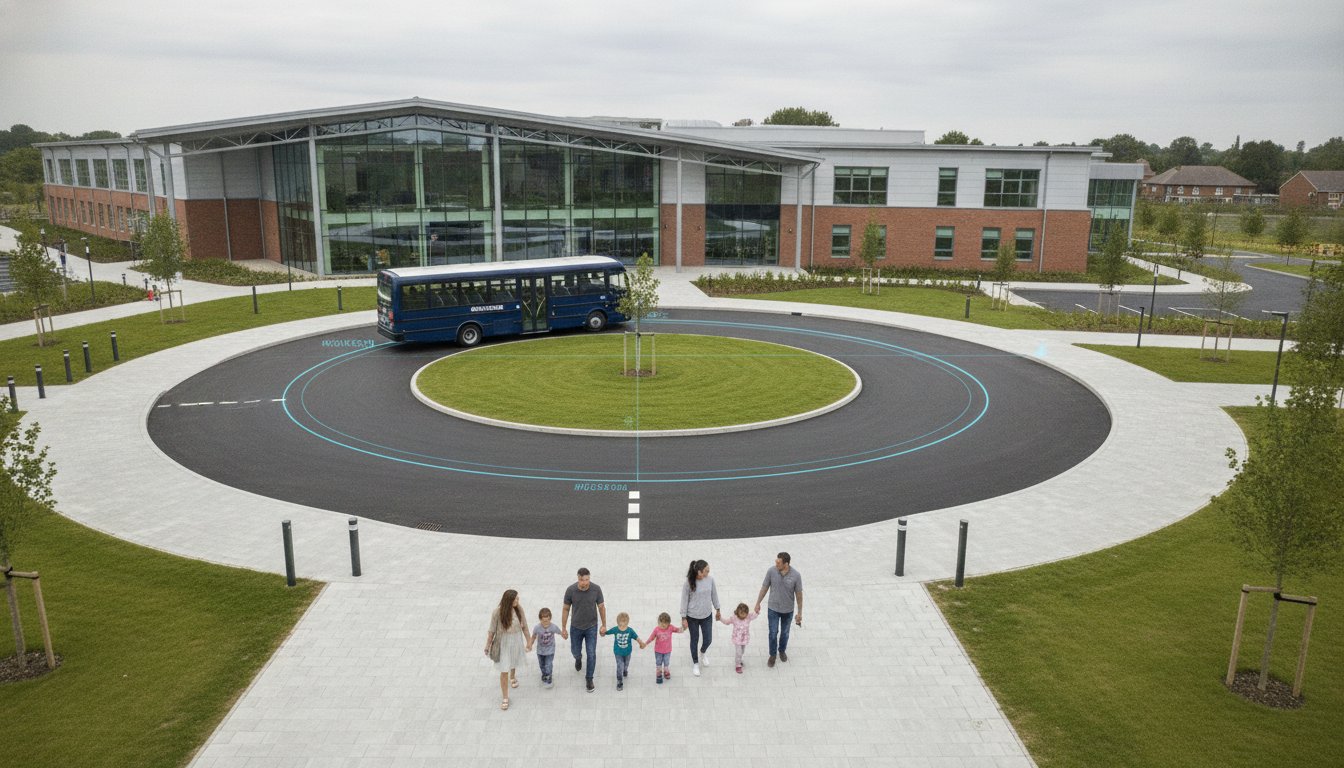
We utilize swept path analysis to provide the technical proof that your site accommodates large vehicles. This is vital in 2026. The Department for Education reported a 9% increase in SEND home-to-school transport usage this year, leading to a higher volume of minibuses and specialized vehicles at school gates. Our simulations ensure that fire tenders maintain unobstructed access to all buildings. We also verify that school buses can complete turning manoeuvres safely without needing to reverse in pedestrian-heavy areas. These technical reports provide the certainty that planning officers require before granting approval.
Managing the ‘School Run’ Impact
Managing the ‘school run’ involves a strategic mix of restriction and redirection. We assist in designing ‘School Streets’ that utilize temporary restricted access zones during peak morning and afternoon hours. To complement these restrictions, we develop ‘Park and Stride’ schemes. These initiatives encourage parents to use designated off-site parking areas, reducing congestion at the immediate school entrance. We justify these strategies using data from detailed parking surveys. This evidence proves to the council that your parking provision is optimized and that parental parking will not negatively impact local residential capacity.
Ensure your site design meets all safety and manoeuvrability standards. Speak to our experts about our integrated traffic survey and analysis services.
Why Partner with ML Traffic Engineers UK for Your School Travel Plan?
Securing planning approval for an educational development requires more than just a conceptual strategy; it demands technical precision and an unwavering adherence to statutory standards. ML Traffic Engineers UK has provided expert consultancy since 2014, positioning ourselves as a dependable partner for developers and school leaders. We understand that a school travel plan is a high-stakes document where regulatory compliance is a functional necessity. Our team manages the full project lifecycle, from initial data collection to the final submission, ensuring that every technical report we produce meets the rigorous requirements of UK local highway authorities.
We take pride in our role as a technical authority. We don’t just write reports; we provide a fully-managed service that handles the complex logistical pressures of transport planning. This integrated approach means ML Traffic Engineers UK conducts our own technical surveys and analysis, providing you with a single point of contact and total accountability. Our professional integrity and commitment to precision act as a safeguard for your project, reducing the risk of planning delays and ensuring that pupil safety remains the non-negotiable foundation of your site design.
Comprehensive Transport Planning Support
Our expertise extends beyond the travel plan itself. We provide comprehensive support by preparing detailed Transport Statements and Transport Assessments that integrate seamlessly with your submission. We utilize industry-standard tools, including the TRICS database for trip generation analysis and the Lambeth Methodology for parking stress assessments. This data-driven approach allows ML Traffic Engineers UK to negotiate effectively with local councils, providing the technical evidence needed to justify your development. By handling these intricate regional regulations, we remove the regulatory pressure from your team, allowing you to focus on the broader aspects of school delivery.
Contact Us for a Technical Consultation
Precision and reliability are the hallmarks of our brand promise. Whether you’re managing a new school build in London or an extension in a rural county, our consultancy services are available to assist with projects across England and the wider UK. We maintain a sense of readiness and urgency, understanding that infrastructure timelines are often fast-moving and unpredictable. We’re committed to providing an all-encompassing service that prioritizes clarity and rapid delivery of information. When you partner with ML Traffic Engineers UK, you’re choosing a highly organized expert dedicated to achieving planning success through technical excellence.
Ready to secure your planning permission with a compliant strategy? Contact ML Traffic Engineers UK for your School Travel Plan quote and ensure your project meets every regulatory benchmark in 2026.
Streamlining Your School Development Approval
Securing planning permission for an educational site in 2026 requires a shift from theory to technical precision. As we have explored, a compliant school travel plan must be rooted in accurate baseline surveys and robust site audits to satisfy local highway authorities. By integrating advanced tools like swept path analysis and professional traffic surveys, you can proactively address council concerns regarding peak-hour congestion and pupil safety. Precision in these documents doesn’t just discharge planning conditions; it builds a foundation of trust with the local community and ensures your site remains operationally viable.
ML Traffic Engineers UK has operated as a specialist transport planning consultancy since 2014. We provide the comprehensive technical reporting and data collection necessary to navigate complex UK planning and highway legislation with confidence. Our team manages the entire regulatory process so you can focus on delivering high-quality educational facilities. Secure your planning approval with a professional School Travel Plan from ML Traffic Engineers UK. We are ready to help you achieve a safe, compliant, and successful development.
Frequently Asked Questions
Is a School Travel Plan a legal requirement in the UK?
Yes, promoting sustainable travel is a statutory duty for local authorities under the Education Act 1996. For developers and school leaders, a school travel plan becomes a legal requirement when it is attached as a condition to a planning permission or secured via a Section 106 agreement. Failure to provide a compliant plan can halt your development’s progress or lead to enforcement action once the site is operational.
How much does a professional School Travel Plan cost to produce?
The investment required to develop a plan depends on the scale of the educational facility and the complexity of the data collection. Factors such as the total pupil capacity, the need for multi-day traffic surveys, and specific local highway authority requirements influence the final technical fee. We provide tailored quotes that reflect the specific regulatory and engineering needs of your planning application to ensure total cost transparency.
What is the difference between an STP and a Workplace Travel Plan?
A school travel plan focuses on the unique, high-intensity traffic peaks associated with the concentrated start and end times of the school day. While workplace plans manage consistent employee commuting patterns, school plans must specifically account for parental drop-off behavior and the safety of vulnerable young pedestrians. They require specialized mitigation measures, such as “School Streets” and “Park and Stride” schemes, that are rarely applicable in commercial workplace strategies.
How often does a School Travel Plan need to be updated or reviewed?
Most local authorities mandate a comprehensive review of the plan every three to five years to ensure it remains effective. Additionally, you must conduct annual monitoring surveys to track progress against your stated modal shift targets. These annual updates are essential for identifying shifts in travel habits as the pupil population evolves or as new local infrastructure, such as cycle lanes or bus routes, becomes available.
Can a poorly written Travel Plan cause my planning application to be refused?
Yes, an inadequate or technically flawed travel plan is a frequent cause of planning delays and refusals. If the Local Highway Authority determines that your plan doesn’t sufficiently mitigate the traffic impact of the school, they’ll likely recommend refusal. Precision in data collection and realistic, evidence-based target setting are essential to demonstrate that the development won’t negatively impact the safety or capacity of the local road network.
What are the common targets included in a 2026 School Travel Plan?
Modern plans prioritize aggressive modal shift targets, often seeking a significant percentage reduction in private car use over a five-year period. In 2026, targets specifically focus on increasing EV charging infrastructure for staff and accommodating the 9% increase in SEND transport demand reported this year. These goals must be SMART: specific, measurable, achievable, realistic, and time-bound to satisfy the rigorous standards of council auditors.
Who is responsible for implementing the measures in a School Travel Plan?
The school leadership team and a designated Travel Plan Coordinator hold primary responsibility for the long-term implementation of the plan. The coordinator acts as the official liaison with the local council and manages the day-to-day delivery of travel initiatives. For new developments, the developer is usually responsible for the initial setup, funding, and physical infrastructure improvements until the school is fully operational and the planning conditions are discharged.
What data is required for the baseline travel survey?
You must collect precise data on how pupils and staff currently travel to the site through “hands-up” surveys and staff questionnaires. This subjective data is then validated using technical traffic surveys to record actual vehicle counts and turning movements at the school gates. We also incorporate parking surveys to assess the impact on local residential streets, ensuring the baseline is a verified reflection of real-world site conditions.

Disclaimer
The content on mltraffic.co.uk, including all technical articles, guides, and resources, is provided for general informational and educational purposes only. It is not intended to constitute professional advice in traffic engineering, transportation planning, development approvals, or any other technical or legal field.
While ML Traffic Engineers makes every reasonable effort to ensure the accuracy, completeness, and timeliness of the information published, we do not provide any warranties or representations (express or implied) regarding its reliability, suitability, or availability for any particular purpose. Any reliance you place on the content is strictly at your own risk.
In no event shall ML Traffic Engineers, its directors, employees, authors, or affiliates be liable for any direct, indirect, incidental, special, consequential, or punitive damages (including, without limitation, loss of profits, data, or business opportunities) arising out of or in connection with the use of, or inability to use, any information provided on this website.
The articles and guides on this site are not a substitute for engaging a qualified, professional traffic engineer to assess your specific project requirements. For tailored advice, compliance assessments, or traffic engineering services, please contact a competent professional.
This disclaimer may be updated from time to time without notice. By accessing or using this website, you agree to be bound by the most current version of this disclaimer.