Tag: site design

  • Swept Path Analysis for Loading Bays: A UK Developer’s Guide

    Swept Path Analysis for Loading Bays: A UK Developer’s Guide

    What if a loading bay fits neatly on the plan but a delivery vehicle can’t reach it without crossing a pedestrian route or striking an obstruction? Swept path analysis for loading bays tests whether vehicles can enter, manoeuvre into position and leave within the proposed layout. The result depends on one crucial choice: modelling a vehicle that reflects the site’s actual operations.

    It’s understandable to want certainty early. A design based on an unsuitable or undersized vehicle can conceal access problems until later reviews, when changing the layout may be more difficult. The assessment also needs clear drawings and agreed assumptions, so the results answer the right operational question instead of simply showing a vehicle moving across a plan.

    This guide explains how vehicle tracking can help test a loading-bay layout, how to choose a suitable design vehicle and what information to provide when commissioning an assessment. It also explains what the analysis can show, and where its limits lie, giving developers a practical framework for reviewing access and manoeuvring before design decisions are fixed.

    Key Takeaways

    • Check whether the vehicle can complete the full arrival, positioning and departure sequence, not just reach the site entrance.
    • Choose a design vehicle that reflects the site’s expected operations. One vehicle type won’t suit every loading bay.
    • Use consistent vehicle and manoeuvre assumptions to compare layout options and identify fixed constraints.
    • For useful swept path analysis for loading bays, prepare clear operational requirements and current site drawings before commissioning.
    • An independent assessment can help the project team review vehicle access and manoeuvring, but it doesn’t guarantee planning approval or compliance.

    Why swept path analysis matters for a loading bay

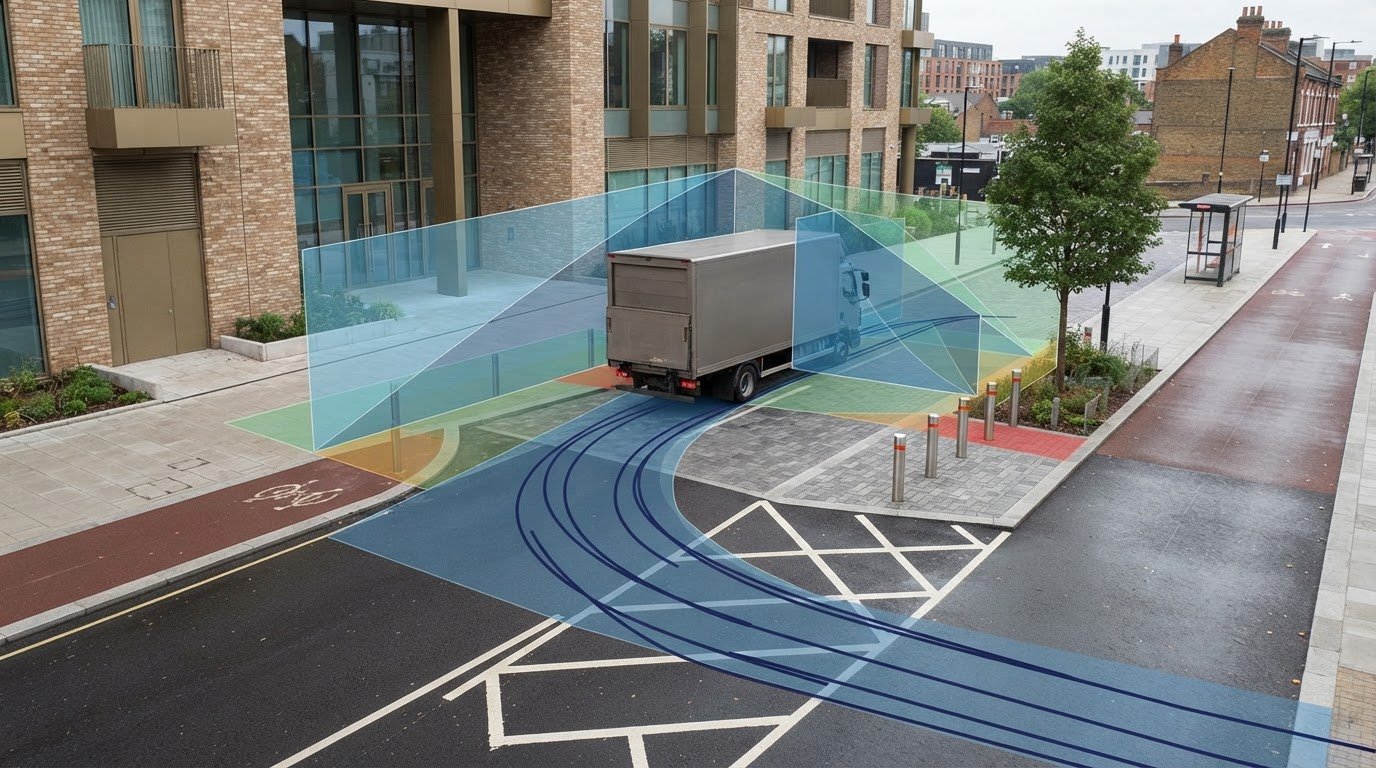
    A vehicle may be able to reach a site entrance but still be unable to line up with a loading bay or leave without conflicting with fixed features. Swept path analysis for loading bays is a drawing-based assessment that plots a selected vehicle’s movement through a proposed layout, following specified manoeuvres.

    A swept path drawing shows the vehicle’s body and wheel paths as it moves. The plotted envelope can be compared with kerbs, walls, columns, doors and other fixed constraints. This tests geometric fit, but it isn’t a complete assessment of how loading operations will work in practice.

    For a visual example of a vehicle manoeuvring with a large load, watch this video:

    What does a loading-bay swept path drawing show?

    The vehicle’s turning radius and dimensions affect the space its body and wheels occupy during a manoeuvre. For background on the geometry, see the explanation of a vehicle’s turning radius. The assessment overlays the movement envelope on the site drawing to help identify potential clashes or tight clearances.

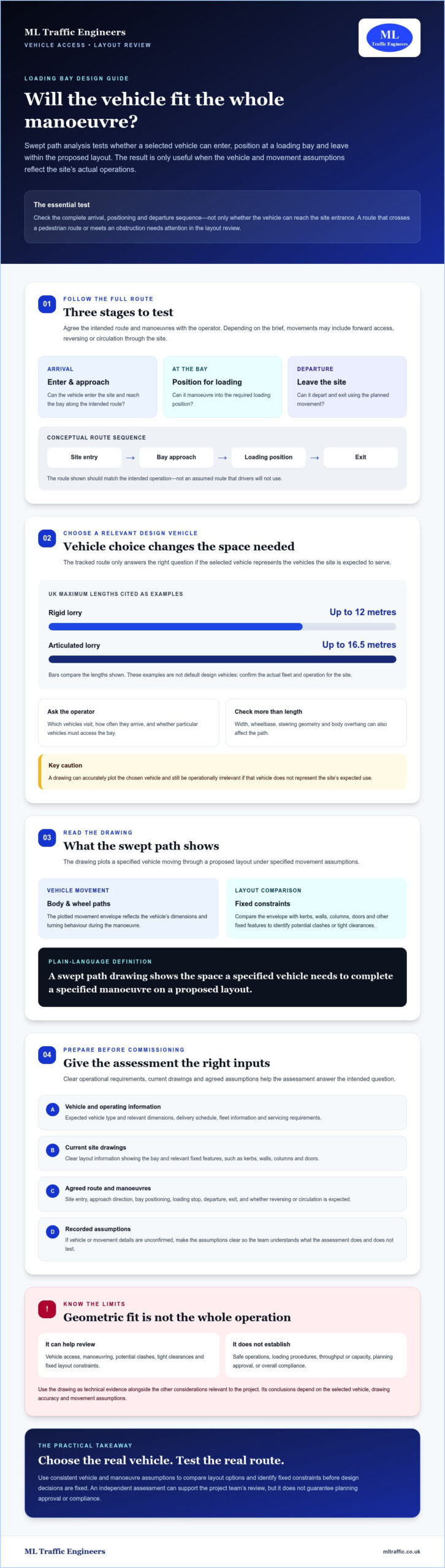
    Quotable definition: A swept path drawing shows the space a specified vehicle needs to complete a specified manoeuvre on a proposed layout. It doesn’t prove the site is safe to operate or that the entire loading process will work. Its conclusions depend on the selected vehicle, the accuracy of the drawing geometry and the movement assumptions.

    Which loading-bay access questions can it help answer?

    The assessment can test whether the selected vehicle can approach the bay, enter the site, position for loading and leave. Depending on the operating brief, movements may include forward access, reversing or circulation through the site. The route shown should reflect the intended operation, not an assumed route that drivers won’t use.

    Vehicle manoeuvrability is only one part of the design. The drawing doesn’t assess loading procedures, throughput or capacity, and it doesn’t replace wider transport planning. Nor does it establish safe operations or secure planning approval. Use it as technical evidence to review vehicle access and layout constraints alongside the other considerations relevant to the project.

    How vehicle choice and manoeuvres shape loading-bay swept paths

    The tracked route is useful only if it represents the vehicles the site is expected to serve. A residential development with refuse collections and occasional deliveries may have different access needs from a logistics site receiving articulated lorries. UK maximum lengths illustrate the difference: a rigid lorry may be up to 12 metres long, while an articulated lorry may be up to 16.5 metres. These are examples, not default design vehicles. Confirm the actual fleet and operation before selecting a vehicle for assessment.

    An unsuitable design vehicle can make a technically accurate swept path drawing operationally irrelevant. A model can faithfully plot the selected vehicle yet fail to represent the vehicle that will use the bay. For reliable swept path analysis for loading bays, establish the vehicle type and relevant dimensions with the client or operator. Start with their delivery schedule, fleet information and servicing requirements. If details remain unconfirmed, record the assumptions clearly so the project team understands what the assessment does and doesn’t test.

    How should a project select its design vehicle?

    Ask the operator which vehicles visit, how often they arrive and whether particular vehicles must access the bay. Consider the largest vehicle the site is genuinely expected to accommodate, rather than choosing one simply because it appears to fit the current plan. Vehicle length is only one factor: width, wheelbase, steering geometry and body overhang can also affect the path. Verify the available vehicle information for the assessment instead of relying on an unconfirmed template.

    Which manoeuvres should the loading-bay assessment test?

    Define the complete route: site entry, approach, bay entry, loading position, departure and exit. Establish whether the vehicle is expected to enter or leave in reverse, and where it stops during loading. The approach direction and available turning space affect the tracked envelope. Testing only the final turn into the bay can miss a constraint earlier in the route.

    Show relevant features on the layout, including gates, barriers, kerbs, columns and any parked vehicles or circulation routes that could affect movement. Test the operating sequence the site is intended to use. If a route works only when a gate is open, a parking space is empty or other traffic is absent, review the drawing against those assumptions. The Health and Safety Executive’s guidance on safety in loading areas provides relevant workplace context, but a swept path drawing alone doesn’t establish safe operations.

    For project-specific support testing proposed vehicle access and manoeuvring, consider ML Traffic Engineers UK’s Swept Path Analysis service.

    How to assess loading-bay swept path drawings and design options

    A swept path drawing is most useful when you review it against the design it is intended to test. Check that the vehicle is identified, its direction of travel is clear and the manoeuvre reflects the intended site operation. Then compare the plotted envelope with the current layout, not an earlier plan that may show different boundaries or obstructions.

    For swept path analysis for loading bays, distinguish vehicle clearance from the space needed to carry out loading. A plotted path may appear to avoid a wall, but the drawing won’t necessarily show whether doors can open, people can move safely around the vehicle or loading can take place without obstructing circulation. Review those practical requirements separately with the relevant design and operations teams.

    What should a reviewer check on the drawing?

    Verify that the vehicle type and movement sequence are clear, then check that the site geometry reflects the latest design information. Pay particular attention to boundaries and fixed features near turning points, such as kerbs, columns, gates and barriers. Note unclear clearances, conflicts or missing assumptions, then ask the designer to confirm whether these are intentional or need further assessment.

    How should teams compare alternative bay layouts?

    Compare options using the same confirmed vehicle and movement criteria. Otherwise, a layout may appear to perform better simply because it was tested with a different vehicle or an easier manoeuvre. Record any extra turns or reversing required, and flag options that depend on unconfirmed conditions, such as a gate being open or an adjacent area being clear. Coordinate proposed changes with the architect and relevant transport or highway advisers.

    Record a short review list for each option to make the comparison clear:

    • Design option: Identify the layout revision being assessed.
    • Vehicle: Record the vehicle used and whether its details are confirmed.
    • Manoeuvre: Note the route and any additional movements required.
    • Constraints: Identify nearby fixed features and any apparent conflicts.
    • Unresolved assumptions: List information that needs confirmation before the option can be judged.

    This approach makes differences easier to explain at design reviews. It also helps the team distinguish a genuine layout improvement from a change in assessment assumptions, and directs follow-up questions to the right project participants.
    Swept Path Analysis for Loading Bays: A UK Developer’s Guide

    What information to prepare before commissioning loading-bay analysis

    A useful assessment starts with a clear brief, not just a plan. For swept path analysis for loading bays, the engineer needs to understand the intended operation and test it against the current site design. If some details are preliminary, identify them openly so assumptions can be recorded and checked before the results inform design decisions.

    Which drawings and operational details should you provide?

    Work through this preparation sequence before commissioning:

    1. Define the operation. Explain what the bay will serve, how loading will take place and any relevant servicing requirements.
    2. Confirm the vehicles. Ask the operator to identify expected vehicle types and provide dimensions where available. Include delivery frequency and any differences between routine and occasional visits.
    3. Describe the route. Mark the intended approach, site entry, bay manoeuvre and exit. Note whether reversing is expected and where vehicles will stop.
    4. Identify restrictions. Flag gates, access controls, parking, operating hours or other known conditions that could affect vehicle movements.
    5. Send current drawings. Provide the latest site layout with dimensions, access points, kerbs and fixed obstructions. Make sure relevant boundaries and design features are shown.

    Consistent, current information helps the engineer assess the layout you intend to build. If vehicle dimensions, site details or operating arrangements are missing, say so. The assessment may need to proceed on stated assumptions. The project team should review and confirm those assumptions rather than treat them as verified facts.

    For more background on swept-path methods used in planning applications, read this practical AutoTURN swept path guidance.

    How does the assessment fit into the design and planning process?

    Arrange the review while the layout can still be coordinated and revised. If a manoeuvre reveals a constraint, the design team can consider it alongside other project requirements before plans are finalised. For a London scheme, confirm directly with the relevant planning or highway authority what project-specific information it expects. Requirements can vary, so don’t assume one assessment format or set of inputs will suit every application.

    Before commissioning, agree the assessment scope, vehicle information, proposed manoeuvres and drawing revision with the engineer. ML Traffic Engineers provides Swept Path Analysis to assess vehicle manoeuvrability and access feasibility within site designs. Discuss your loading-bay assessment requirements with ML Traffic Engineers.

    Commission a loading-bay swept path assessment for your project

    An independent review can help when a proposed bay has tight geometry, the intended vehicle route is uncertain or the design team wants to test access before fixing the layout. Swept path analysis for loading bays assesses vehicle manoeuvrability and access feasibility against the site information and movement assumptions provided. It can help identify constraints for the team to review, but it doesn’t guarantee planning approval or establish that every aspect of site operation is suitable.

    ML Traffic Engineers provides Swept Path Analysis as independent technical support for testing vehicle access and manoeuvring within site designs. Before appointing a consultant, make sure the proposed scope addresses the actual operation and the questions the project needs answered.

    What to ask a swept path consultant before appointing?

    Clarify the assessment basis before work starts. Ask which design vehicle and manoeuvres will be tested, and how the assessment will record assumptions, constraints and any design changes. Confirm that the proposed scope reflects the operational brief and any relevant feedback from the planning or highway authority. If vehicle details or drawings are provisional, agree how those uncertainties will be identified and reviewed.

    Also confirm the project-specific scope and intended deliverables directly with the consultant. These should be clear enough for the design team to understand what the assessment covers and what information it relies on.

    How can a project team take the next step?

    Prepare a concise brief before opening the discussion. Include:

    • The latest site layout, showing dimensions, access points and fixed features.
    • The vehicle type and dimensions, if confirmed by the operator.
    • A short description of delivery operations, including the approach, bay manoeuvre, loading position and exit route.
    • Any known constraints, authority feedback or assumptions that still need confirmation.

    This gives the consultant a basis for discussing the assessment scope and any information gaps. ML Traffic Engineers’ Swept Path Analysis service can support project teams testing proposed vehicle manoeuvrability and access feasibility. Share your operational brief, vehicle information and current drawings to discuss a loading-bay swept path assessment.

    Test your loading-bay layout with confidence

    A reliable assessment starts with the right design vehicle and a realistic account of how it will enter, position and leave the bay. Swept path analysis for loading bays can help the project team test proposed manoeuvres against the layout and identify constraints for review. Findings depend on the vehicle, drawing information and assumptions used, so confirm these before treating a drawing as a basis for design decisions.

    Prepare the operator’s requirements, vehicle details and latest site drawings to support a focused assessment. Vehicle tracking tests manoeuvrability and access feasibility, but it doesn’t by itself confirm that loading operations are safe or secure planning approval.

    ML Traffic Engineers provides Swept Path Analysis and supports development projects across Greater London, Manchester, Birmingham, the West Midlands, Liverpool, Surrey, East Sussex, West Sussex, Hampshire, Berkshire and Buckinghamshire. If you’re reviewing a proposed bay or need independent technical input on vehicle access, discuss a swept path assessment for your loading bay. Share a clear brief and current information to help your team make informed decisions and move the design forward with greater confidence.

    Frequently Asked Questions

    What is swept path analysis for a loading bay?

    Swept path analysis for a loading bay is a drawing-based assessment of how a specified vehicle moves through a proposed site layout. It plots the vehicle’s body and wheel paths along an agreed route, helping the design team review manoeuvres against features such as kerbs, walls, columns and gates. The result depends on the vehicle, drawing geometry and movement assumptions, and doesn’t assess every aspect of loading operations.

    Which vehicles should be included in a loading-bay swept path analysis?

    Include vehicles that reflect the site’s intended operations, as confirmed by the operator or client. Consider regular deliveries, waste collection, servicing and any larger vehicles the site is expected to accommodate. A logistics site and a residential development may need different design vehicles. Provide vehicle types and dimensions where available. If details aren’t confirmed, make sure the assessment records the assumptions so the team can check them.

    Can swept path analysis show whether a vehicle can reverse into a loading bay?

    Yes. The assessment can plot a reversing manoeuvre if that movement is part of the intended operation and the route is specified. The brief should identify the site entrance, approach, reversing path, loading position and exit route, along with relevant fixed features. A drawing can help reveal geometric conflicts, but it doesn’t by itself establish that reversing or other site operations are safe in practice.

    What drawings and information are needed for a loading-bay swept path assessment?

    Provide the latest site layout, with dimensions, boundaries, access points, kerbs and fixed obstructions. Include the vehicle type and dimensions if known, plus a brief describing delivery frequency, approach routes, loading arrangements and whether reversing is expected. Flag gates, access controls, parking and operational restrictions. Preliminary or missing details may require assumptions, so identify these clearly and arrange for the project team to confirm them.

    Does a loading-bay swept path drawing guarantee planning approval?

    No. A swept path drawing tests specified vehicle movements against the proposed layout. It doesn’t guarantee planning approval or prove that every planning, highway or operational requirement has been met. The relevant planning or highway authority may have project-specific information requirements. Treat the assessment as technical evidence for design review, and confirm the wider requirements for your site with the appropriate authority and project advisers.

    When should a project commission swept path analysis for a loading bay?

    Commission an assessment while the layout can still be reviewed and coordinated, particularly if vehicle access or bay manoeuvres are uncertain. Early testing can help the team identify constraints before plans are finalised, though it can also inform review of an existing proposal. ML Traffic Engineers provides Swept Path Analysis for projects across Greater London, Manchester, Birmingham, the West Midlands, Liverpool, Surrey, East Sussex, West Sussex, Hampshire, Berkshire and Buckinghamshire.

    How do you compare two loading-bay layouts using swept path analysis?

    Test both layouts with the same confirmed design vehicle, route and manoeuvre assumptions. Then compare whether each option accommodates the movement, what extra turns or reversing it requires, and whether its path conflicts with fixed features. Record any unresolved assumptions, such as a gate being open or a parking area being clear. This keeps the comparison fair and helps the design team identify which differences need further review.

    Michael Lee

    Article by

    Michael Lee

    Transport planner with over 35 years' experience.

    Disclaimer

    The content on mltraffic.co.uk, including all technical articles, guides, and resources, is provided for general informational and educational purposes only. It is not intended to constitute professional advice in traffic engineering, transportation planning, development approvals, or any other technical or legal field.
    While ML Traffic Engineers makes every reasonable effort to ensure the accuracy, completeness, and timeliness of the information published, we do not provide any warranties or representations (express or implied) regarding its reliability, suitability, or availability for any particular purpose. Any reliance you place on the content is strictly at your own risk.
    In no event shall ML Traffic Engineers, its directors, employees, authors, or affiliates be liable for any direct, indirect, incidental, special, consequential, or punitive damages (including, without limitation, loss of profits, data, or business opportunities) arising out of or in connection with the use of, or inability to use, any information provided on this website.
    The articles and guides on this site are not a substitute for engaging a qualified, professional traffic engineer to assess your specific project requirements. For tailored advice, compliance assessments, or traffic engineering services, please contact a competent professional.
    This disclaimer may be updated from time to time without notice. By accessing or using this website, you agree to be bound by the most current version of this disclaimer.
  • Swept Path Analysis for Planning Applications: The 2026 Developer’s Guide

    Swept Path Analysis for Planning Applications: The 2026 Developer’s Guide

    Did you know that human error contributed to 88% of road collisions in Great Britain according to recent data? This single statistic is driving Local Highway Authorities to demand unprecedented technical precision in 2026. For developers, a simple site layout is no longer enough to win approval. You’ve likely faced the frustration of a planning refusal because a council officer deemed your refuse vehicle tracking unworkable or non-compliant with the latest fire safety standards. It’s a common pain point that leads to expensive, late-stage design revisions and missed project deadlines.

    Securing a successful outcome requires a proactive approach to swept path analysis for planning applications. We understand the pressure of meeting the September 30, 2026, amendments to Approved Document B while balancing local council preferences for bin lorry dimensions. This guide provides the technical clarity you need to master vehicle tracking and avoid site design errors. You’ll learn how to utilize the latest AutoTURN Pro 2026 modeling to confirm access for fire tenders and heavy goods vehicles. We will walk you through the essential steps to produce planning-ready drawings that ensure smooth communication with the Highway Authority from inception to completion.

    Key Takeaways

    • Understand why swept path analysis for planning applications is the essential technical simulation required by Highway Authorities to prove vehicle maneuverability.
    • Identify the critical vehicle templates, such as refuse collection vehicles and fire tenders, that must be modeled to meet current safety and access regulations.
    • Discover how to use vehicle tracking as a proactive design tool to maximize developable site area while eliminating unworkable layouts and “dead zones.”
    • Learn the strategic advantage of submitting technical drawings at the pre-application stage to resolve potential objections before they lead to a formal refusal.
    • Ensure your technical reports meet the specific precision standards and formatting expected by planning officers to streamline the approval process.

    What is Swept Path Analysis for Planning Applications?

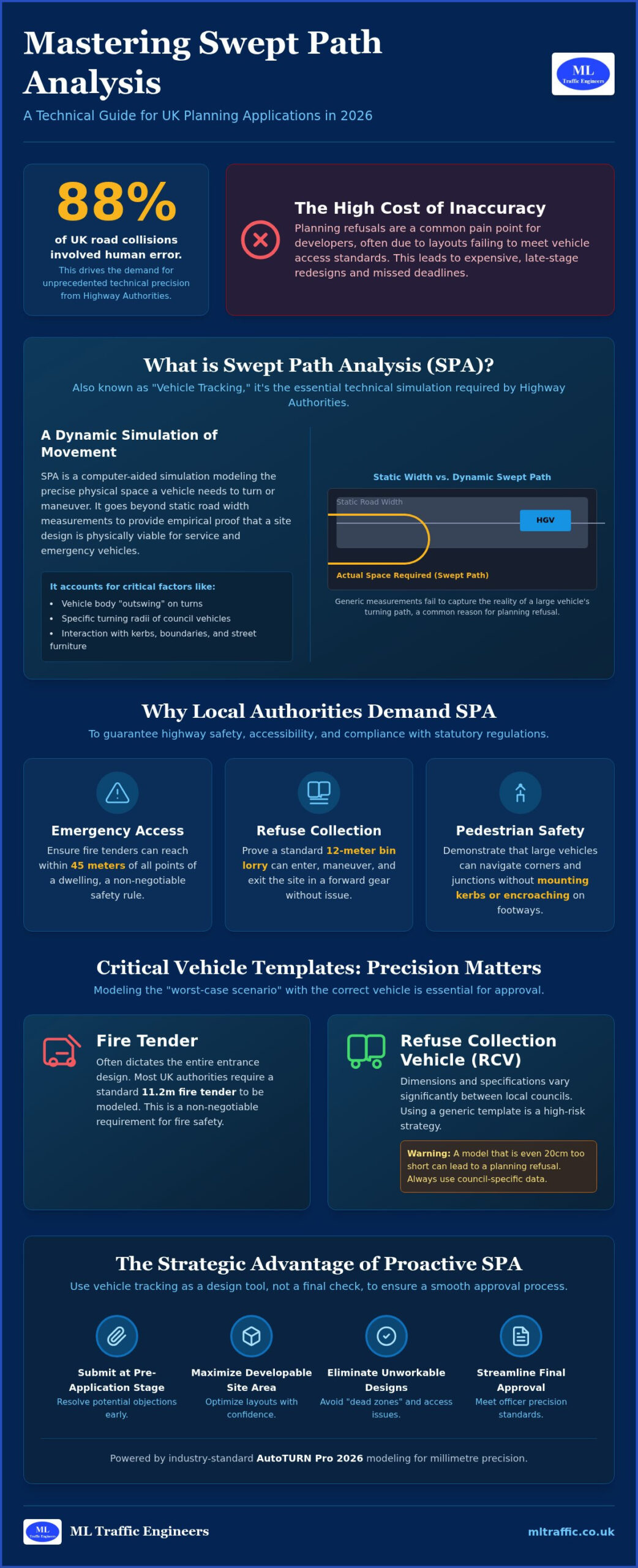
    Swept Path Analysis (SPA) is a computer-aided simulation that models the physical space a vehicle requires to complete a turn or maneuver. In the UK planning system, officers often use the term “Vehicle Tracking” interchangeably with SPA. This process moves beyond static road measurements to provide a dynamic view of how vehicles interact with your site layout. While a road may meet a standard width on paper, it doesn’t account for the “outswing” of a 16.5m articulated HGV or the specific turning radius of a local refuse truck. Relying on generic manual measurements is a risk that often leads to planning refusal.

    A professional swept path analysis for planning applications serves as the technical evidence required to support a Transport Statement or a more detailed Transport Assessment. It provides empirical proof that a site design is physically viable. Without this data, a Highway Authority has no guarantee that service vehicles won’t mount kerbs or become stuck, which typically results in immediate objections from the council.

    The Technology Behind the Analysis

    Precision is the non-negotiable standard for any modern development. We utilize AutoTURN software, which is the industry benchmark for simulating vehicle movements across the UK. By integrating digital vehicle models directly into your CAD site drawings, we achieve millimetre precision. This process requires more than just software; it demands a foundation of accurate Ordnance Survey (OS) mapping to account for existing kerb lines and boundaries. Historically, the evolution of vehicle swept path analysis software has moved from manual overlays to these sophisticated digital twins, allowing us to predict real-world outcomes before a single brick is laid.

    Why Local Authorities Demand SPA

    Local Highway Authorities across England have significantly increased their technical requirements in 2026. Their primary goal is maintaining highway safety and preventing vehicles from mounting pavements, which poses a direct risk to pedestrians. Officers use SPA to verify that your development layout doesn’t impede the flow of existing traffic or cause local congestion. Beyond general traffic, you must meet strict statutory requirements for emergency and service vehicle access. Key requirements include:

    • Emergency Access: Ensuring a fire tender can reach within 45m of all points of a dwelling.
    • Refuse Collection: Proving a 12m bin lorry can enter, turn, and exit the site in a forward gear.
    • Pedestrian Safety: Demonstrating that large vehicles can navigate corners without encroaching on footways.

    If a site layout cannot accommodate the turning circle of these critical vehicles, planning officers will view the scheme as unworkable and unsafe.

    Key Vehicle Templates: From Refuse Trucks to Fire Tenders

    Selecting the correct vehicle profile is the foundation of a robust technical submission. In the context of swept path analysis for planning applications, we focus on “critical vehicles.” These are the largest vehicles expected to visit your site regularly. If your layout accommodates the largest possible vehicle, it’s mathematically certain that smaller cars and vans will also navigate the space safely. We prioritize modeling the worst-case scenario to eliminate any doubt from the Highway Authority’s assessment.

    Many developers make the mistake of using generic vehicle templates found in basic software libraries. This is a high-risk strategy. Local councils across England have specific preferences for refuse collection vehicle (RCV) dimensions, and using a template that is even 20cm too short can lead to a planning refusal. We select the correct vehicle profile based on your specific site location, cross-referencing local authority guidance to ensure the simulation reflects the actual fleet used by the council. For more technical details on these specifications, you can explore our practical guide for planning applications.

    Emergency Vehicle Access Requirements

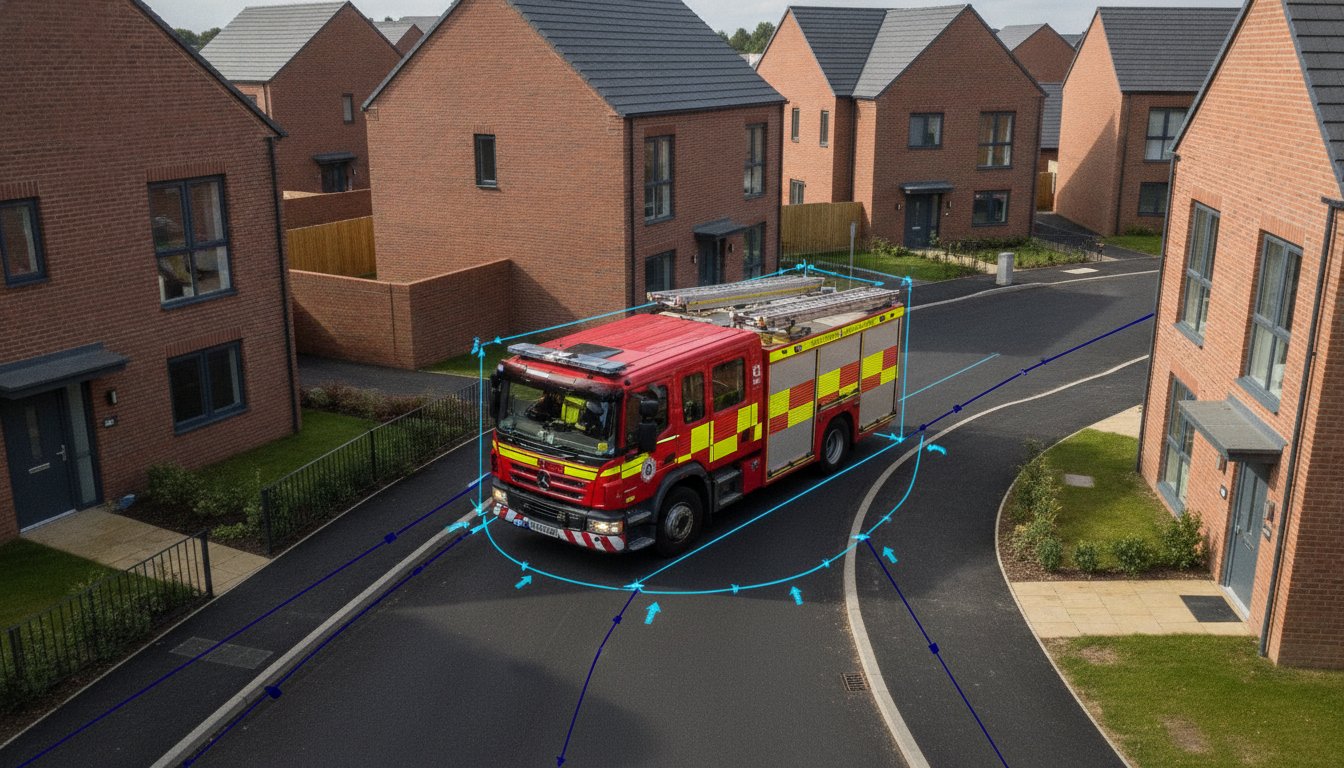
    Fire safety regulations are non-negotiable and often dictate the entire entrance design of a residential development. Most UK authorities require a standard 11.2m fire tender to be modeled. This analysis isn’t just about the turn; it’s about the pump-to-hydrant reach and ensuring the appliance can position itself within 45m of all points within a dwelling. The standard turning circle of a UK fire tender is 16.8 metres. Official resources like the NYC Street Design Manual highlight how these geometric requirements are a global standard for ensuring life safety in urban environments. We model these maneuvers to prove that emergency services can operate without restriction on your site.

    Refuse and Service Vehicle Maneuvers

    Waste management requirements have become more stringent in 2026. We’ve seen a significant shift toward larger 3-axle and 4-axle RCVs as councils aim for higher collection efficiency. A key requirement for planning approval is the “forward gear” rule. Planning officers almost always insist that a bin lorry can enter, turn, and exit the site in a forward gear. This often necessitates a three-point turn within the site boundaries. For mixed-use developments, we also track delivery vans to ensure that loading bays are accessible without blocking the main highway. Our swept path analysis for planning applications provides the visual proof that these essential services won’t cause gridlock or safety hazards.

    Optimising Site Layouts and Access Feasibility

    Balancing parking density with efficient vehicle circulation is a constant challenge for modern developments. We look beyond simple road widths to analyze how visibility splays and turning envelopes interact. It’s vital to ensure that a vehicle’s path doesn’t conflict with pedestrian crossings or site boundaries. When these elements are synchronized, the resulting layout is inherently safer and more likely to receive a positive recommendation from the local Highway Authority. We don’t just provide drawings; we provide the technical confidence that your site works in the real world.

    Urban developments often face significant constraints, such as narrow entrances or historic building lines that cannot be moved. In these high-stakes environments, we use vehicle tracking to prove that site access is feasible even with limited space. We frequently specify “overrun” areas or mounting-strips in modern highway design. These features allow larger vehicles to navigate tight corners while maintaining a narrower road profile for standard traffic. We also demonstrate that two vehicles, such as a car and a van, can safely pass at critical junctions. This prevents potential bottlenecks that would otherwise lead to a planning objection or a “Reason for Refusal.”

    Integrating SPA into the Architectural Workflow

    The most successful projects involve a continuous iteration loop between transport engineers and architects. We work alongside your design team to identify potential flaws before they reach the planning committee. This collaborative approach prevents costly revisions late in the project lifecycle. By integrating our Swept Path Analysis services early, you ensure your architectural vision is grounded in physical reality. We provide the technical evidence to defend your design against scrutiny. This confirms that fire tenders and refuse trucks can operate seamlessly within the proposed layout from the first day of occupation.

    Using swept path analysis for planning applications throughout the project lifecycle provides a significant regulatory advantage. Technical evidence is most effective when used as a proactive communication tool rather than a reactive fix. By integrating vehicle tracking at the earliest stages, you demonstrate to planning officers that your development is grounded in physical reality. This technical transparency builds trust with the Highway Authority and can significantly shorten the determination period for complex sites.

    If a project has previously faced a “Reason for Refusal” based on unworkable layouts or safety concerns, SPA is your most powerful tool for resubmission. It provides the empirical data needed to overturn subjective objections. This technical proof is also a prerequisite for Section 278 (S278) agreements. When your project requires modifications to the existing public highway, the council will demand precise tracking to ensure the new road geometry accommodates standard service vehicles without compromising safety.

    The Pre-Application Phase

    The pre-application stage is the ideal time to open a technical dialogue with the Highway Authority. Presenting professional vehicle tracking early allows you to secure “in principle” support for ambitious access designs. This strategy identifies potential “showstoppers” before you invest in full architectural plans. By addressing the concerns of statutory consultees early, you reduce the risk of a late-stage objection that could derail your entire application. Our experts use this phase to negotiate specific vehicle dimensions, ensuring the final submission aligns perfectly with local requirements.

    Discharging Reserved Matters and Conditions

    Securing outline planning permission is often just the first step. Local authorities frequently attach transport-related conditions that must be discharged before construction begins. We provide the granular detail required for these submissions, often focusing on specific concerns such as construction traffic management or delivery vehicle routing. It’s essential that the final build matches the approved tracking paths exactly. Discrepancies between the approved SPA and the finished site can lead to enforcement action or delays in site adoption. We ensure your technical drawings are robust enough to withstand this scrutiny from inception to completion.

    To ensure your project moves through the planning system without technical delays, contact us to discuss our fully-managed swept path analysis services.

    Swept Path Analysis for Planning Applications: The 2026 Developer’s Guide

    Professional Technical Analysis with ML Traffic Engineers

    ML Traffic Engineers UK brings over a decade of specialized experience to your development team. Founded in 2014, we prioritize precision and regulatory compliance in every report we produce. Our technical team understands that a minor error in vehicle tracking can lead to a major delay in your project timeline. We provide a “ready-to-submit” drawing format that planning officers prefer, which significantly reduces the need for clarification requests. Our expertise spans both London-specific requirements (TfL) and national highway standards across England. We maintain rapid turnaround times because we understand the fast-moving, unpredictable nature of infrastructure maintenance and emergency works; for those requiring safety verification of lifting machinery in these sectors, visit Pulo Compliance Ltd.

    Generalist architectural services often lack the specialized software and regulatory depth required for complex swept path analysis for planning applications. We act as a dependable partner that understands intricate regional regulations so you don’t have to. Our engineers engage in direct communication with Highway Authorities to resolve technical disputes before they escalate. This specialized focus allows us to defend your site layout with technical authority and professional integrity. Beyond vehicle tracking, we offer an all-encompassing, fully-managed service that includes Parking Surveys, Transport Assessments, and Travel Plans. This comprehensive support reduces the logistical pressure on your team from project inception to completion.

    Next Steps for Your Planning Application

    Getting started is a straightforward process designed for efficiency and clarity. To request a quote, we typically require your current site plans in CAD format and a list of the specific vehicle types the council has requested. If you aren’t sure which vehicle templates are required, we advise you based on our extensive database of local authority preferences and the latest 2026 standards. Our consultation process moves logically from an initial review of your layout to the delivery of final, signed-off drawings. We identify potential design flaws early and suggest refinements to ensure your submission is robust.

    We take immense pride in our adherence to industry benchmarks and legislative requirements. Our role is to act as a vital guardian of public safety while ensuring your project remains commercially viable. We are ready to support your application with the technical evidence needed to secure approval and avoid costly site design errors. Contact ML Traffic Engineers UK for a Swept Path Analysis quote today to keep your development on schedule and ensure your site is planning-ready.

    Secure Your Planning Approval with Technical Precision

    Mastering the technical requirements of vehicle tracking is the most reliable way to avoid costly site design errors and planning deadlock. We’ve demonstrated that swept path analysis for planning applications is no longer just a reactive compliance document. It’s a vital tool for maximizing developable land while ensuring public safety. By utilizing advanced AutoTURN precision modeling, you can transform your site layout into a technical drawing that satisfies the strictest Highway Authority requirements.

    Founded in 2014, ML Traffic Engineers UK provides UK-wide planning expertise to help you navigate intricate regional regulations. Our team manages full project lifecycles to ensure your fire tender and refuse truck access paths are indisputable. We reduce the logistical and regulatory pressures on your team so you can focus on the build. Don’t let unworkable layouts or “dead zones” delay your project milestones.

    Get a Professional Swept Path Analysis for Your Project and ensure your development is ready for a successful submission.

    Frequently Asked Questions

    What is the average cost of a swept path analysis for a planning application?

    Costs vary significantly based on the complexity of your project and the number of vehicle profiles required by the council. A single-access residential site requires less modeling than a large-scale logistics hub with multiple HGV loading bays. Getting a tailored quote ensures you only pay for the specific vehicle tracking your local authority demands. This targeted approach prevents overspending on unnecessary simulations while ensuring every statutory requirement is met for your submission.

    Which software is best for swept path analysis in the UK?

    AutoTURN is the industry standard for performing swept path analysis for planning applications across the UK. It provides an extensive library of vehicle templates that align with national standards and specific council fleet dimensions. Most Local Highway Authorities prefer results from this software because it integrates directly with CAD drawings for millimeter precision. Using this recognized platform ensures your technical drawings meet the professional standards expected by planning officers and statutory consultees.

    Does every planning application require vehicle tracking?

    No, vehicle tracking isn’t a universal requirement for every project. It’s typically mandatory for developments that introduce new access points, change internal road layouts, or increase service vehicle demand. Small internal renovations usually don’t need it. However, if your project involves a new residential block or commercial unit, the council will likely request technical proof that fire tenders and refuse trucks can navigate the site safely and exit in a forward gear.

    What happens if my site layout fails the swept path analysis?

    A failed simulation is an opportunity to optimize your design before it reaches the planning committee. If the tracking shows a vehicle hitting a boundary or mounting a kerb, we collaborate with your architects to refine the geometry. This might involve widening a junction, repositioning parking bays, or implementing overrun areas. Identifying these “dead zones” early prevents a formal planning refusal and ensures your final site layout is physically workable.

    Can I do my own swept path analysis using standard CAD tools?

    Performing an accurate analysis is difficult without specialized software and traffic engineering expertise. Standard CAD tools lack the dynamic libraries needed to account for complex vehicle outswing and steering characteristics. Planning officers look for specific professional formatting and technical certification in the reports they review. Submitting an amateur drawing often leads to immediate rejection or technical objections, which can significantly delay your project determination and increase your overall revision costs.

    How long does it take to produce a professional SPA drawing?

    Most professional technical drawings are produced within a few business days once we receive your CAD site plans. The exact timeline depends on the number of maneuvers and vehicle types requested by the Highway Authority. For complex, multi-phase developments, the process may take slightly longer to ensure every junction is thoroughly tested. We prioritize efficient turnaround times to help you meet tight submission deadlines and keep your development project on schedule.

    What vehicle types are most commonly requested by UK councils?

    UK councils most frequently demand tracking for 11.2m fire tenders and 12m refuse collection vehicles. For commercial sites, 16.5m articulated HGVs are the standard for logistics hubs, while 10m rigid trucks are common for retail deliveries. We also model standard 4.8m cars to verify parking bay accessibility. Ensuring your site layout accommodates these specific templates is essential for proving that essential services can operate safely without obstructing the existing public highway.

    Is swept path analysis required for residential driveways?

    Swept path analysis is rarely necessary for a single private driveway. However, it’s often required for shared driveways serving multiple dwellings or sites with narrow access onto busy roads. In these scenarios, the Highway Authority requires proof that a car can turn within the site to enter and exit the highway in a forward gear. This prevents dangerous reversing maneuvers onto the main road, which is a critical factor in maintaining local highway safety.

    Michael Lee

    Article by

    Michael Lee

    Transport planner with over 35 years' experience.

    Disclaimer

    The content on mltraffic.co.uk, including all technical articles, guides, and resources, is provided for general informational and educational purposes only. It is not intended to constitute professional advice in traffic engineering, transportation planning, development approvals, or any other technical or legal field.
    While ML Traffic Engineers makes every reasonable effort to ensure the accuracy, completeness, and timeliness of the information published, we do not provide any warranties or representations (express or implied) regarding its reliability, suitability, or availability for any particular purpose. Any reliance you place on the content is strictly at your own risk.
    In no event shall ML Traffic Engineers, its directors, employees, authors, or affiliates be liable for any direct, indirect, incidental, special, consequential, or punitive damages (including, without limitation, loss of profits, data, or business opportunities) arising out of or in connection with the use of, or inability to use, any information provided on this website.
    The articles and guides on this site are not a substitute for engaging a qualified, professional traffic engineer to assess your specific project requirements. For tailored advice, compliance assessments, or traffic engineering services, please contact a competent professional.
    This disclaimer may be updated from time to time without notice. By accessing or using this website, you agree to be bound by the most current version of this disclaimer.