In the high-stakes 2026 planning environment, a transport statement slough developers submit is far more than a simple validation checkbox. It’s a strategic negotiation tool that can either accelerate your project or leave it stalled in a cycle of technical revisions. As Slough Borough Council transitions toward its new Local Plan and enforces rigid parking standards through the CP6 zone, the margin for error has disappeared. You’re likely already feeling the pressure of these strict local validation requirements and the delays caused by data gaps.
This guide provides the technical authority you need to navigate the council’s transport requirements and secure approval through expert reporting. We’ll show you how to mitigate objections and meet the latest sustainable travel benchmarks effectively. From calculating monitoring contributions to addressing the borough-wide expansion of Controlled Parking Zones, we’ve outlined the essential technical steps for a successful, cost-effective application.
Key Takeaways
- Learn how a professional transport statement slough developers commission acts as a critical negotiation tool to meet NPPF and local planning criteria.
- Identify the specific development thresholds for residential and commercial projects that trigger the requirement for formal transport reporting in Slough.
- Understand Slough Borough Council’s “car-lite” policy and how to justify parking provisions in high-accessibility town centre locations.
- Master the essential technical requirements, including visibility splay analysis and existing site descriptions, to ensure rapid planning validation.
- Discover how proactive technical reporting and early highways department engagement mitigate project risks and prevent costly planning delays.
Understanding Transport Statements for Slough Planning Applications
A transport statement slough developers submit acts as the technical bridge between a proposed site and the local highway authority’s approval. In 2026, Slough Borough Council (SBC) requires this document to prove that a development aligns with both the National Planning Policy Framework (NPPF) and local infrastructure goals. This document evaluates the existing transport network, identifies potential impacts, and proposes mitigation strategies for smaller-scale projects. A foundational grasp of Understanding Transport Statements is essential for any developer looking to mitigate regulatory risks before they cause delays.
To better understand this concept, watch this helpful video:
While a full Transport Assessment is reserved for major schemes with significant traffic generation, the Transport Statement serves as a streamlined alternative. It focuses on local access, parking provision, and safety without the need for the complex computer modeling required for larger infrastructures. SBC uses these reports to determine if a project can proceed without detrimental effects on the borough’s increasingly congested corridors. As the council transitions toward its new Local Plan, the precision of this data becomes even more critical for securing a positive recommendation from highway officers.
The Purpose of Transport Documentation in 2026
Highways safety is a non-negotiable priority for Slough’s planning department. Under current NPPF guidelines, planning permission should only be refused on transport grounds if the residual cumulative impacts are “severe” or if the safety of road users is compromised. Developers must provide clear evidence that their site ensures safe and suitable access for pedestrians, cyclists, and motorists alike. A Transport Statement is a concise report prepared for developments that generate relatively low levels of traffic but still require a technical review of their transport impacts.
Local Validation List: The First Hurdle
Slough Borough Council maintains a Local Validation List that serves as a strict gateway for all planning applications. If your submission lacks the necessary technical reporting, the council won’t validate the application, leading to immediate delays. Submitting a project without professional data often results in a “refusal to register,” which pushes your timeline back by weeks or months. We specialize in various ML Traffic Engineers UK project types to ensure your technical documentation meets every requirement on this list from day one. Using precise data reduces the risk of highways objections and ensures your project moves efficiently through the planning lifecycle. This proactive approach allows you to address potential concerns before they become formal obstacles to your 2026 approvals.
When Does Slough Borough Council Require a Transport Statement?
Slough’s planning department doesn’t just evaluate the size of your development; they assess the potential strain on the local highway network. A transport statement slough developers provide is mandatory when a project meets specific local thresholds. These requirements align with the National Planning Policy Framework, ensuring that every new site contributes to a safe and efficient transport system. Understanding these triggers early prevents the common pitfall of submitting an application that the council immediately deems invalid.
Proactive engagement with Slough Borough Council (SBC) highways officers through pre-application advice is the most reliable way to confirm your requirements. Officers will clarify if your specific location demands a higher level of detail than the standard thresholds suggest. This early dialogue often uncovers site-specific issues that a generic application would miss. It’s a practical step that saves both time and technical resources during the formal submission process.
Residential and Commercial Thresholds
For residential schemes in Slough, the requirement for a Transport Statement typically begins for developments between 50 and 80 dwellings. Once a project exceeds the 80-unit mark, the council generally demands a full Transport Assessment. Commercial and mixed-use triggers depend on the Gross Floor Area (GFA) and the predicted peak-hour trip generation. SBC interprets “significant transport implications” as any development likely to generate more than 30 two-way vehicle movements during peak periods. If your site falls within these parameters, professional technical reporting is a non-negotiable part of your planning pack.
Special Cases: High Street and Level Crossings
Location often overrides dwelling counts. Smaller sites positioned near “sensitive” nodes, such as the A4 Bath Road or busy town centre junctions, frequently require reporting regardless of their size. Any project that might cause a “material increase” in traffic at a level crossing or near rail infrastructure faces intense scrutiny. The council prioritizes the safety of these high-risk areas. Even a minor change in site use can trigger a request for a statement if the highway officer believes the local network is already at capacity. If you’re managing a site in a high-density area, reviewing common project types can help you identify the specific level of reporting necessary for your application.
Navigating Slough’s Local Transport Policy and Parking Standards
Slough Borough Council is aggressively pursuing a “car-lite” strategy to manage the borough’s air quality and urban congestion. For developments within the town centre or along the A4 corridor, the council expects a significant departure from traditional parking ratios. A transport statement slough developers submit must now prioritize sustainable modal shift over vehicle storage. This policy shift means that proving a site is “highly accessible” is a functional necessity for planning approval.
The 2026 landscape in Slough is shaped by the expansion of Controlled Parking Zones (CPZs), such as the recently implemented CP6 zone covering Bath Road and Galleymead Road. These restrictions make it increasingly difficult for developers to rely on on-street parking without rigorous technical justification. We analyze these local constraints to ensure your proposal aligns with the council’s vision for a less car-dependent town centre. This level of precision is required to satisfy highway officers who are under pressure to reduce the borough’s overall traffic volume.
Parking Justification and Surveys
SBC frequently requires a formal parking survey to support any application that proposes a reduction in standard parking provisions. This is particularly vital for mixed-use High Street projects where residential and commercial demands overlap. If you are proposing a “zero parking” development, you must provide empirical evidence that the surrounding network can absorb any residual parking demand without compromising safety. The council won’t accept anecdotal claims about parking availability.
Our team conducts comprehensive Parking Surveys for London and the South East to provide the data highway officers demand. We use industry-standard methodologies to measure “parking stress” during peak hours, ensuring your justification is based on facts rather than assumptions. This technical authority helps mitigate objections from local residents and planning committees who may fear increased street congestion and helps you avoid the costs associated with unnecessary parking infrastructure.
Sustainable Transport and Accessibility
The Elizabeth Line has fundamentally changed how Slough Borough Council views car dependency. High-frequency rail links to central London and Heathrow justify significant reductions in residential parking. When preparing your transport documentation, we evaluate the quality of pedestrian and cycle links to Slough railway station. We look for continuous, safe routes that encourage residents to leave their cars behind.
We also assess local bus infrastructure, focusing on the frequency and reliability of services along the main arterial routes. If your site is within a short walk of a high-frequency bus stop, this becomes a powerful tool for justifying a sustainable transport strategy. By demonstrating that future occupants have viable alternatives to the private car, we reduce the regulatory pressure on your development and streamline the path to approval. This comprehensive approach ensures your project meets the council’s strict sustainability benchmarks.
Key Components of a Compliant Slough Transport Statement
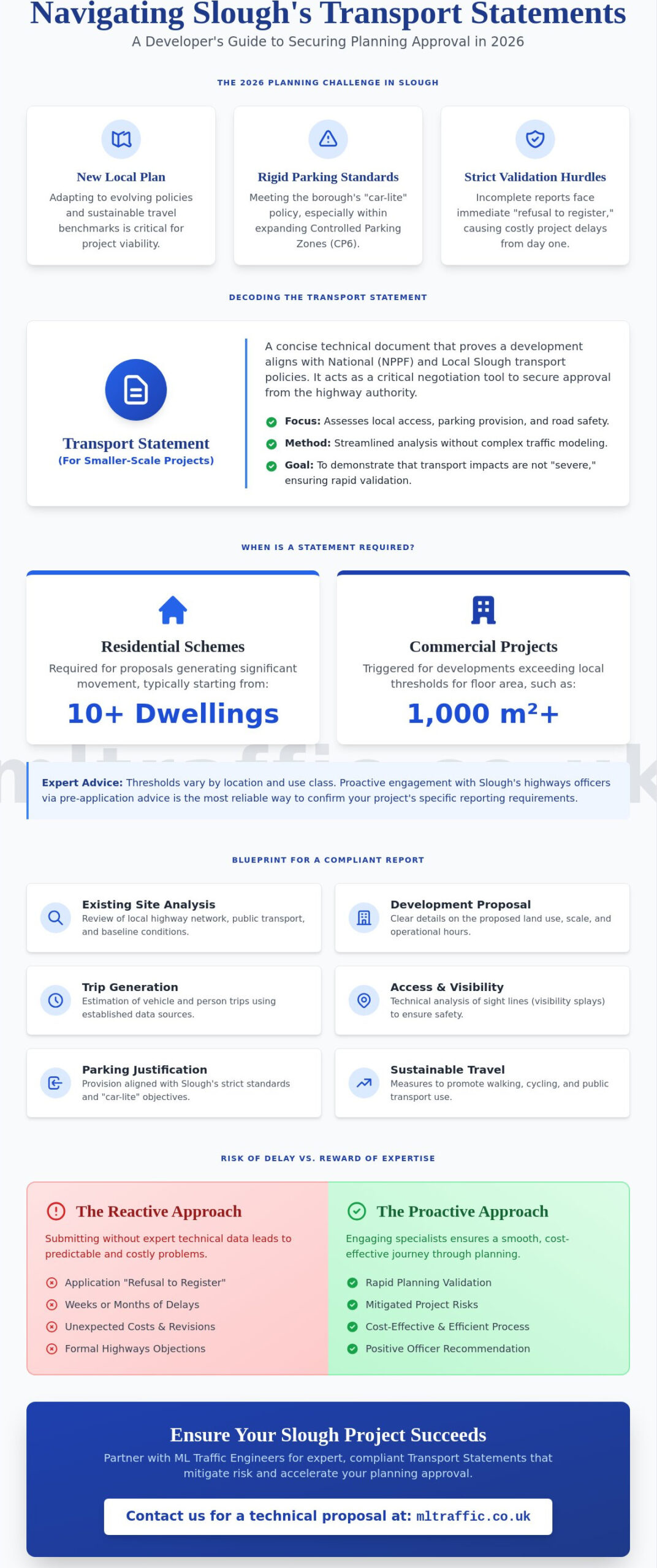
A compliant transport statement slough projects require must provide a sequential and rigorous analysis of the site’s impact. The process begins with a granular description of the existing transport network. We document current highway conditions, public transport proximity, and pedestrian infrastructure within a specific catchment area. Following this, we analyze proposed access arrangements in detail. Precise visibility splays must be plotted based on recorded traffic speeds to ensure safety for all road users, especially when the development joins high-capacity arterial routes. It’s not just a descriptive document; it’s a technical defense of your project’s viability.
Slough Borough Council now mandates the integration of a Draft Travel Plan directly within the statement. This document serves as a roadmap for encouraging sustainable travel modes among future occupants. It includes specific, actionable measures such as high-quality cycle storage provision and public transport incentive schemes. By demonstrating a proactive commitment to reducing car dependency, you align your project with the council’s 2026 sustainability goals and mitigate potential objections regarding local air quality. This integrated approach ensures your application meets the council’s Local Validation List requirements from the first submission.
Technical Analysis: Trip Generation and TRICS
Calculating the net change in traffic is a critical step in the reporting process. We compare the trip generation of the existing site use against the projected numbers for the proposed development. This calculation relies on the TRICS database, the industry standard for trip rate analysis. We select comparable sites based on geographic location, land use, and scale to ensure the projected data is defensible. Utilizing the technical data collection capabilities of ML Traffic Engineers UK services ensures that the council’s highways officers receive accurate, reliable figures. This precision reduces the likelihood of the council requesting additional, time-consuming data during the determination period.
Swept Path Analysis: Proving Maneuverability
Demonstrating that service and emergency vehicles can maneuver safely within the site is a non-negotiable safety requirement. Our Swept Path Analysis Services use specialized software to simulate the exact movements of refuse trucks and fire engines through your proposed layout. This technical check is essential for proving that the site can be serviced without vehicle over-run or safety hazards. SPA prevents costly design revisions during the planning phase by identifying potential pinch points before the layout is finalized. This proactive step ensures your project remains compliant with Slough’s rigid safety standards while protecting your development budget from late-stage changes.
Secure your project’s success by engaging with experts who understand the intricacies of local highway requirements. Request a technical review for your Slough development today.
Securing Planning Approval with ML Traffic Engineers UK
Securing a transport statement slough planning officers will approve requires a blend of technical precision and local diplomatic skill. We don’t simply produce a report and hope for the best. Our team engages in proactive negotiations with Slough Borough Council’s highways department from the earliest stages of your project. This strategy allows us to identify potential friction points before they become formal objections. By anticipating the council’s concerns regarding parking stress or junction capacity, we position your development for a smoother path through the planning committee. We understand that in the fast-moving world of infrastructure, a delay in validation is a direct threat to your project’s ROI.
Precision is our functional necessity. We reduce project risk by grounding every statement in verifiable, high-quality data. From initial traffic surveys to final swept path analysis, we manage the full project lifecycle. This comprehensive support means you don’t have to coordinate multiple consultants to meet local validation requirements. Our experts handle the technical heavy lifting, allowing you to focus on the broader aspects of your development. Local developers trust us with complex Slough sites because we deliver results that align with the borough’s evolving 2026 standards. We take immense pride in our adherence to industry benchmarks and legislative requirements.
Expert Consultancy for Slough Developers
Our consultancy services are built on a foundation of technical authority and a client-focused approach. We tailor every transport statement slough submission to meet the council’s exact requirements, ensuring that every visibility splay and trip generation figure is defensible. Our commitment to professional excellence and regulatory compliance helps reduce the logistical pressures on your internal team. As a reliable partner, we understand intricate regional regulations so that you don’t have to. You can learn more about our full range of services by visiting ML Traffic Engineers UK Home, where we detail our comprehensive approach to transport planning.
Ready to Start Your Slough Project?
Early engagement with transport planning consultants is the most effective way to mitigate project risk. Don’t wait until the council issues a request for further information to seek professional help. We’re ready to provide the technical reporting needed to move your Slough development from inception to completion. Contact us today to request a quote for your transport statement. Our team maintains a constant sense of readiness to support your planning goals. We offer 24/7 availability for urgent projects, ensuring that even the most time-sensitive infrastructure needs are met with unwavering reliability and expert precision.
Accelerate Your Slough Planning Approval
Navigating the technical landscape of Slough Borough Council requires more than just a basic understanding of traffic flow. It demands a rigorous approach to data and a deep familiarity with local validation requirements. By prioritizing precise parking justifications and detailed swept path analysis, you remove the primary obstacles to a successful application. A professionally prepared transport statement slough developers can rely on ensures that every technical benchmark is met before submission, preventing costly delays and regulatory friction.
Since 2014, ML Traffic Engineers has provided extensive UK planning experience to developers facing complex local requirements. Our expertise in TRICS, SPA, and the SBC Local Validation List allows us to deliver a fully managed service from initial data collection to final report submission. We take pride in our role as a reliable partner that understands regional regulations so you don’t have to. We’re ready to help you secure your 2026 approvals with unwavering precision and technical authority.
Get a Professional Transport Statement for Your Slough Project
Your project deserves the highest standard of technical reporting to ensure a smooth transition from planning to construction. We look forward to supporting your next successful development in Slough.
Frequently Asked Questions
Do I need a Transport Statement for a change of use application in Slough?
Yes, you typically need a statement if the new use significantly alters traffic generation or parking demand. Slough Borough Council evaluates whether the proposed use class creates a material increase in vehicle movements compared to the previous site function. Even if the building footprint remains unchanged, a shift from commercial to residential use often triggers a requirement for professional technical reporting to satisfy the highways department.
What is the difference between a Transport Statement and a Transport Assessment?
The primary difference lies in the scale of the development and the complexity of the impact analysis. A transport statement slough developers use for smaller schemes focuses on local access and parking justification. In contrast, a Transport Assessment is reserved for major developments. Assessments require detailed junction modeling and a broader study area to evaluate cumulative impacts across the borough’s strategic road network.
How much does a Transport Statement cost for a Slough development?
Costs vary based on the specific technical requirements and the complexity of the site’s access arrangements. While we don’t provide fixed pricing without a site-specific review, factors such as the need for fresh traffic counts or detailed visibility analysis influence the final resource allocation. Developers should request a tailored quote to ensure all Local Validation List requirements are covered within a cost-effective technical report.
Will Slough Borough Council accept a statement without a Travel Plan?
No, the council usually requires at least a Draft Travel Plan to be integrated into the statement for most applications. This document is a core component of Slough’s commitment to sustainable transport and reducing car dependency in the town centre. Submitting a statement without these measures risks immediate non-validation or a formal objection from highways officers during the statutory consultation period of the planning process.
How long does it take to prepare a Transport Statement for planning?
Preparation usually takes between two to four weeks, depending on the availability of local traffic data and site complexity. If the project requires fresh traffic surveys or overnight parking stress analysis, the timeline extends to accommodate data collection and technical review. Early engagement allows us to manage these timelines effectively and ensure your submission remains on track for your targeted planning committee date.
Can a Transport Statement help if my project has no on-site parking?
Yes, the statement is the primary tool used to justify “car-lite” or zero-parking developments in highly accessible locations. By providing empirical evidence of public transport frequency and walking distances to the Elizabeth Line, the report demonstrates that future occupants don’t require private vehicles. Technical reporting proves that your proposal aligns with Slough’s specific sustainable transport policies for urban densification.
What happens if the highways officer objects to my Transport Statement?
An objection usually leads to a request for further information or a revision of the proposed site layout. We respond to these objections by providing additional technical data or negotiating mitigation measures, such as financial contributions to local highway improvements. Our proactive approach to highways negotiations aims to resolve these technical issues quickly to prevent a formal refusal of your planning application.
Is Swept Path Analysis always required in a Slough Transport Statement?
Swept Path Analysis is required whenever a development involves new access points or internal roads intended for service vehicles. The council demands technical proof that refuse trucks and emergency vehicles can enter, turn, and exit the site in a safe manner. Without this analysis, the highways officer cannot verify that the site is functionally safe for essential services, which often leads to a validation delay.

Disclaimer
The content on mltraffic.co.uk, including all technical articles, guides, and resources, is provided for general informational and educational purposes only. It is not intended to constitute professional advice in traffic engineering, transportation planning, development approvals, or any other technical or legal field.
While ML Traffic Engineers makes every reasonable effort to ensure the accuracy, completeness, and timeliness of the information published, we do not provide any warranties or representations (express or implied) regarding its reliability, suitability, or availability for any particular purpose. Any reliance you place on the content is strictly at your own risk.
In no event shall ML Traffic Engineers, its directors, employees, authors, or affiliates be liable for any direct, indirect, incidental, special, consequential, or punitive damages (including, without limitation, loss of profits, data, or business opportunities) arising out of or in connection with the use of, or inability to use, any information provided on this website.
The articles and guides on this site are not a substitute for engaging a qualified, professional traffic engineer to assess your specific project requirements. For tailored advice, compliance assessments, or traffic engineering services, please contact a competent professional.
This disclaimer may be updated from time to time without notice. By accessing or using this website, you agree to be bound by the most current version of this disclaimer.