Tag: Southwark

  • Southwark Parking Survey: Developer’s Guide 2026

    Southwark Parking Survey: Developer’s Guide 2026

    In Southwark, a parking survey is not just a data set; it’s a strategic argument for development viability that must mirror borough-specific policy to the letter. A single inaccuracy in your parking stress analysis can trigger an immediate planning rejection, costing your project months of avoidable delays. You likely understand that Southwark Council maintains some of the most rigorous standards in London, particularly under the Southwark Plan 2022. Balancing high PTAL scores with the pressures of local Controlled Parking Zones (CPZs) requires a level of technical precision that generic surveys cannot provide.

    This guide ensures you meet all southwark parking survey requirements with total accuracy to secure a planning-ready report on your first submission. We’ll help you manage this intricate regulatory environment so you can focus on your build rather than administrative hurdles. We will detail the specific application of the Lambeth Methodology, examine the impact of PTAL constraints, and provide a clear roadmap for delivering the robust data Southwark planning officers demand in 2026.

    Key Takeaways

    • Learn why a 200m survey radius and specific Tuesday/Wednesday overnight data collection are non-negotiable for borough compliance.
    • Master the technical southwark parking survey requirements, including how to calculate the critical 85% parking stress threshold within Controlled Parking Zones.
    • Discover how to account for “ghost parking” and dropped kerbs to prevent data inaccuracies that often lead to planning application refusals.
    • Understand the relationship between PTAL ratings and parking provision to build a data-driven case for your development’s transport strategy.
    • Find out how to integrate your survey data into a comprehensive Transport Statement to streamline the Southwark Council approval process.

    Understanding the Role of Parking Surveys in Southwark Planning Applications

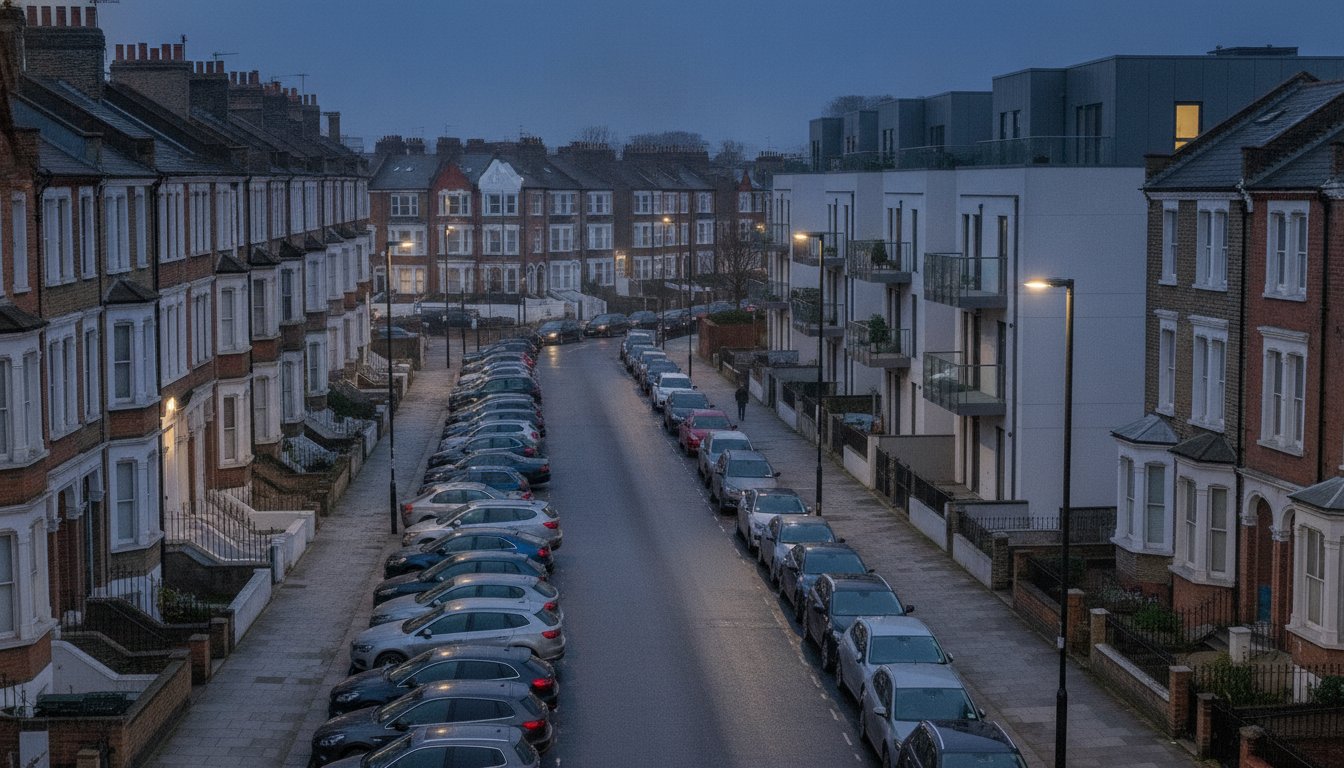
    A parking survey is a technical audit that measures the available capacity of on-street parking within a defined radius of your site. Southwark Council uses this data to determine if a new development will overwhelm local infrastructure. By quantifying “parking stress”, the council protects existing residents from losing access to kerbside space. Meeting southwark parking survey requirements is a fundamental step for any developer seeking to prove their project is sustainable and policy-compliant.

    These surveys form the backbone of a successful Transport Statement. They provide the empirical evidence needed to justify parking provision, or the lack thereof. Without accurate data, planning officers often default to a position of refusal to avoid negative impacts on the local Controlled Parking Zone (CPZ).

    To see how these technical details influence local decision-making, watch this recent planning committee session:

    When is a Parking Survey Mandatory?

    Southwark requires these surveys for most new residential developments, especially those exceeding 10 units. If you’re proposing a change of use for a commercial property that might increase visitor numbers, you’ll need one too. Even “car-free” developments aren’t exempt. You must still prove that residents won’t simply park on nearby streets, especially in areas where public transport accessibility isn’t at its peak. The council uses this data to assess whether your project’s occupants will displace existing parking demand onto already saturated roads.

    Southwark’s 2026 Planning Context

    The Southwark Plan 2022 sets a target of 40,035 new homes by 2036. This rapid growth places immense pressure on the borough’s transport network. Consequently, southwark parking survey requirements have become more stringent to align with 2026 sustainability goals. Major projects now require a full Transport Assessment, which integrates parking data into a broader analysis of carbon reduction and public transport use. The council’s current focus is on reducing private car ownership, making your survey’s accuracy vital for demonstrating how your project supports these civic objectives.

    Essential Methodology: Meeting the Southwark Standard for Data Collection

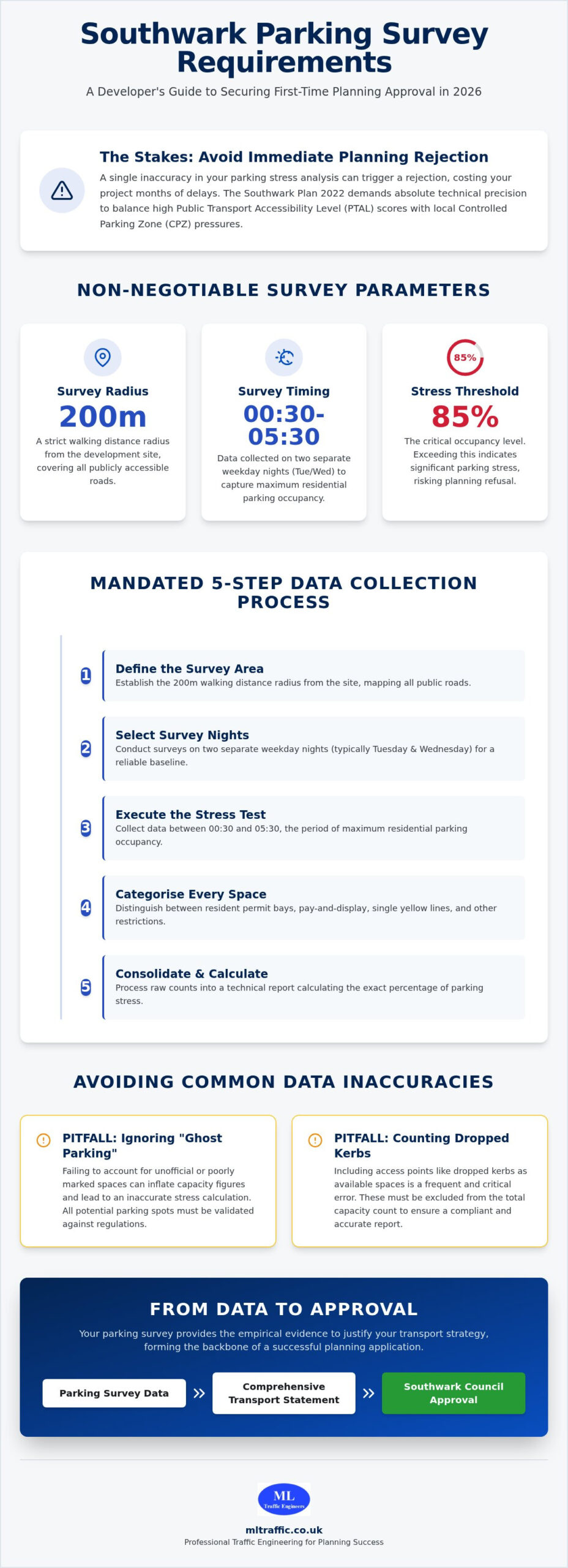
    Precision in data collection is the only way to satisfy southwark parking survey requirements. Planning officers do not accept anecdotal evidence or daytime snapshots. Instead, they demand a rigorous, multi-step process that captures the true peak of residential parking demand. We execute this through a five-step technical framework:

    • Step 1: Defining the Survey Area. We establish a 200m walking distance radius from the development site, covering all publicly accessible roads.
    • Step 2: Selecting Survey Nights. Data collection must occur on two separate weekday nights, typically a Tuesday and a Wednesday, to establish a reliable baseline.
    • Step 3: The Stress Test. Surveys are conducted between 00:30 and 05:30. This window represents the period of maximum residential occupancy when most residents have returned home.
    • Step 4: Detailed Categorisation. Our engineers classify every available space, distinguishing between resident permit holder bays, pay-and-display zones, and restricted yellow lines.
    • Step 5: Data Consolidation. All raw counts are processed into a technical report that calculates the exact percentage of parking stress for the planning officer’s review.

    If your project involves complex site access or tight urban constraints, integrating this data with a professional swept path analysis can further strengthen your application’s technical credibility.

    The Lambeth Methodology Explained

    The Lambeth Methodology for parking surveys is the technical gold standard for London parking surveys. Southwark Council adopts this framework because it provides a consistent, transparent way to measure “effective” kerbside capacity. We don’t just count every metre of kerb; we subtract areas where parking is prohibited, such as near junctions, across driveways, or within 10 metres of a corner. This ensures the capacity figures we report are realistic and legally compliant, leaving no room for council planners to challenge the baseline data.

    Timing and Frequency Requirements

    A single night of data is never sufficient for Southwark planners. They require a minimum of two nights to ensure the results aren’t skewed by a one-off event. We strictly exclude “atypical” periods from our schedules, including school holidays, bank holidays, and major local events that might artificially inflate or deflate parking stress. Every report we produce includes date-stamped photographic evidence for every street surveyed. This level of transparency prevents the council from questioning the validity of the data, which is a common cause of planning delays. Meeting southwark parking survey requirements requires this unwavering commitment to verifiable evidence.

    Analysing Parking Stress: PTAL Ratings and CPZ Considerations

    In Southwark, the presence of a Controlled Parking Zone (CPZ) fundamentally changes how we calculate parking stress. While unrestricted streets allow anyone to park, CPZ streets restrict capacity to specific permit holders during operational hours. We calculate the “Parking Stress Percentage” by dividing the number of parked vehicles by the total number of legal on-street spaces. Southwark planners view 85% as the critical threshold. Once stress exceeds this level, the council considers the area saturated and is likely to reject any development that adds to the burden.

    When we conduct a survey, we also account for dedicated bays. Blue Badge spaces and car-club locations are subtracted from the general pool of available parking to ensure the data reflects real-world availability. If your survey reveals stress levels above 85%, you’ll need robust mitigation strategies. This often involves proposing car-free legal agreements or implementing a comprehensive Travel Plan to reduce the development’s impact on local infrastructure and demonstrate your commitment to sustainable growth.

    The PTAL Factor in Southwark

    Public Transport Accessibility Level (PTAL) scores directly dictate the required depth and scope of your parking data for any planning submission. In Southwark, a high PTAL rating of 5 or 6 often justifies “car-free” developments, as residents have excellent access to rail and bus networks. Conversely, projects in low PTAL areas face much stricter southwark parking survey requirements. In these locations, you must provide extensive data to prove that local streets can handle residual parking demand without exceeding the 85% stress limit. Planners scrutinise low PTAL applications with much higher intensity; technical accuracy is your only defence.

    Navigating Southwark’s Controlled Parking Zones

    Identifying active CPZ hours is vital for accurate survey timing and data interpretation. Many Southwark zones operate from 08:30 to 18:30, but some extended zones near transport hubs remain active much later. We also evaluate the impact of permit-free S106 agreements. These legal clauses prevent residents of new developments from applying for local parking permits, which can be a powerful argument for planning approval. We pay special attention to unrestricted streets on the fringes of CPZs. These areas often experience high “overflow” stress from non-residents, making accurate nighttime data collection essential for a successful Transport Statement. Our reports clearly distinguish between these zones to ensure the planning officer has a transparent view of the local parking landscape.
    Southwark Parking Survey: Developer's Guide 2026

    Avoiding Planning Refusal: Common Mistakes in Southwark Parking Reports

    Planning refusal in Southwark often stems from technical oversights that developers overlook during the initial survey phase. Even a minor discrepancy in your data can invalidate a whole submission, leading to costly delays. We see many applications fail because they don’t adhere to the strict southwark parking survey requirements set by the council’s transport department. Precision is your only safeguard against an officer’s objection.

    The 200m survey radius is a non-negotiable standard. Planners will verify your maps; if you’ve only surveyed a 150m radius, your application is likely to be rejected on arrival. Similarly, ignoring “ghost” parking is a frequent pitfall. You must not count spaces across dropped kerbs or driveways as legal capacity. Doing so artificially inflates the available space and lowers your reported stress percentage, an error that planners identify quickly. Your data must also stay current. Southwark planners typically reject surveys older than six months, as parking patterns in London shift rapidly. If your project faces delays, you’ll probably need a re-survey to ensure your evidence remains valid.

    For sites with restricted access, failing to include a professional Swept Path Analysis is a high-risk move. You must demonstrate that delivery and emergency vehicles can safely navigate the site without mounting pavements or obstructing traffic. If you need to ensure your report is robust enough to withstand scrutiny, contact ML Traffic Engineers today for a comprehensive technical review of your project’s transport needs.

    Technical Inaccuracies in Kerbside Mapping

    Mapping legal parking spaces requires more than just counting cars on a street. You must exclude areas obstructed by street furniture, trees, or visibility splays at junctions. Overestimating capacity by including these unusable zones is a common reason for officer objections. We provide date-stamped visual evidence and annotated site maps to prove every space we count is legally accessible. This transparency makes it much harder for planning officers to challenge our findings during the review process, as we provide the proof they need up front.

    Inadequate Justification of Parking Demand

    Relying on generic TRICS data without specific local context is a major mistake. You must justify your projected parking needs based on the specific demographics and usage of your development. It’s also vital to account for the cumulative impact of other nearby approved developments. If a neighbouring project was recently granted permission, their future residents will also compete for the same on-street spaces. Finally, you must address commercial delivery and servicing needs. Failing to show where a delivery van will park during offloading can lead to an immediate objection from the transport department, regardless of your residential data.

    Professional Traffic Engineering: Securing Your Southwark Approval

    ML Traffic Engineers provides the technical precision required to satisfy the most demanding planning committees. Since our founding in 2014, we’ve specialised in the technical analysis needed for borough-specific compliance. We ensure every report aligns with the latest southwark parking survey requirements, protecting your project from the risk of data-driven refusal. Our team manages the full project lifecycle, from the initial site assessment through to the final submission of planning-ready documentation.

    We don’t just provide raw numbers. We integrate our parking data into a comprehensive Transport Statement that addresses every facet of your development’s impact. This holistic approach proves to Southwark planners that you’ve considered the cumulative effect of your project on local infrastructure. By using expert consultants who understand the specific nuances of Southwark’s transport policies, you gain a partner who can anticipate and resolve technical objections before they stall your application.

    A Tailored Approach for Southwark Developers

    “One-size-fits-all” surveys often fail in dense London boroughs like Southwark. The local geography, ranging from the high-density hubs near London Bridge to the residential fringes of Dulwich, demands a bespoke strategy. Our commitment to precision and regulatory compliance means we identify the exact constraints of your site’s specific Controlled Parking Zone. We handle the technical liaison with Southwark highway officers on your behalf. This direct communication ensures that the data we collect meets their specific expectations, reducing the logistical pressure on your internal team.

    Ready to Start Your Southwark Project?

    Early engagement with transport consultants is the most effective way to avoid project delays. Waiting until a planning officer requests a survey can add weeks to your timeline. We provide a rapid response and professional quotes for developers who need to move quickly. Our team is ready to deploy surveyors to your site to capture the necessary overnight data immediately. If you’re preparing a planning application in 2026, don’t leave your transport evidence to chance. Contact ML Traffic Engineers for a Southwark-Compliant Parking Survey to ensure your project meets all southwark parking survey requirements from the outset.

    Securing Your Development’s Future in Southwark

    Meeting the 2026 standards for planning in London requires more than just a basic car count. You need a data-driven strategy that aligns perfectly with the Southwark Plan 2022 and the Lambeth Methodology. By accurately mapping the 200m survey radius and accounting for complex CPZ hours, you eliminate the technical errors that often lead to planning refusal. Technical precision isn’t just a preference; it’s a functional necessity for project viability.

    With over 10 years of London transport planning experience, ML Traffic Engineers provides the expert knowledge of southwark parking survey requirements needed to navigate these stringent standards. We deliver Lambeth Methodology compliant reporting that withstands officer scrutiny and keeps your project on schedule. Our team handles the intricate technical analysis so you don’t have to manage the regulatory pressure alone.

    Secure Your Planning Approval with a Professional Southwark Parking Survey. We’re ready to provide the reliable evidence your development needs for a successful outcome.

    Frequently Asked Questions

    What is the Lambeth Methodology for parking surveys in Southwark?

    The Lambeth Methodology is the technical standard used to measure parking stress by counting cars within a 200m radius during overnight peak hours. Southwark planners use this to ensure consistent data across all planning applications. It involves subtracting “non-parking” areas like junctions and visibility splays to find the true “effective” capacity of the street. This standardised approach allows the council to objectively compare the parking demand of your project against the existing local infrastructure.

    How many nights of parking data does Southwark Council require?

    Southwark Council requires data from two separate weekday nights to establish a baseline of parking demand. These surveys must occur on a Tuesday and a Wednesday between 00:30 and 05:30. This specific timing captures the maximum residential occupancy. We strictly avoid “atypical” weeks, such as school holidays or major local events, to ensure the data represents the normal, day-to-day conditions that planning officers use for their technical assessments.

    Does a ‘car-free’ development in Southwark still need a parking survey?

    Yes, car-free developments must still meet southwark parking survey requirements to prove they won’t negatively impact local residents. Planners need to confirm that any residual parking demand, such as from visitors or deliveries, can be absorbed by the existing street capacity. You must demonstrate that the surrounding streets are not already saturated. Providing this data is essential for justifying a car-free approach in areas where public transport accessibility might be lower than ideal.

    What is considered a ‘high’ level of parking stress in Southwark?

    Southwark planners consider a parking stress level of 85% or higher to be at capacity. At this threshold, the council views the local streets as saturated, meaning residents struggle to find available spaces. If your survey results exceed this 85% limit, your application faces a much higher risk of refusal. You’ll need to provide clear evidence and mitigation strategies, such as permit-free agreements, to show the council that your project won’t exacerbate this existing problem.

    Can I conduct my own parking survey for a planning application?

    While you can technically collect data yourself, Southwark Council rarely accepts non-professional surveys. Planning officers demand independent reports from qualified traffic engineers to ensure the data is accurate and unbiased. Professional surveys include technical capacity calculations and date-stamped photographic evidence that satisfy strict regulatory standards. Using an expert consultant reduces the risk of your application being rejected due to “insufficient data” or “methodological errors,” which are common pitfalls for developers.

    How long is a Southwark parking survey valid for planning purposes?

    A parking survey is typically valid for six months from the date the data was collected. Southwark planners require recent evidence because parking demand in London is dynamic and can be affected by new local developments or changes to Controlled Parking Zones. If your planning submission is delayed beyond this six-month period, you’ll likely need to re-survey the area to ensure your evidence meets the current southwark parking survey requirements and reflects the latest street conditions.

    What happens if the parking survey shows stress levels above 85%?

    When stress levels exceed 85%, you must provide a robust mitigation strategy to avoid planning refusal. This often involves entering into a Section 106 agreement to make the development “permit-free,” ensuring new residents cannot park on local streets. You might also need to fund new car-club bays or implement a comprehensive Travel Plan. These measures demonstrate to the council that your project is sustainable and won’t add further pressure to an already saturated parking network.

    Does Southwark require a survey for weekend parking stress?

    Southwark Council primarily requires weekday overnight data, but weekend surveys are mandatory for certain developments. If your site is located near high-traffic destinations like shopping centres, leisure facilities, or large religious buildings, planners will want to see how weekend visitors impact local parking. We always review the specific context of your site to determine if a weekend “stress test” is necessary to provide a complete and compliant picture for your planning application.

    Michael Lee

    Article by

    Michael Lee

    Transport planner with over 35 years' experience.

    Disclaimer

    The content on mltraffic.co.uk, including all technical articles, guides, and resources, is provided for general informational and educational purposes only. It is not intended to constitute professional advice in traffic engineering, transportation planning, development approvals, or any other technical or legal field.
    While ML Traffic Engineers makes every reasonable effort to ensure the accuracy, completeness, and timeliness of the information published, we do not provide any warranties or representations (express or implied) regarding its reliability, suitability, or availability for any particular purpose. Any reliance you place on the content is strictly at your own risk.
    In no event shall ML Traffic Engineers, its directors, employees, authors, or affiliates be liable for any direct, indirect, incidental, special, consequential, or punitive damages (including, without limitation, loss of profits, data, or business opportunities) arising out of or in connection with the use of, or inability to use, any information provided on this website.
    The articles and guides on this site are not a substitute for engaging a qualified, professional traffic engineer to assess your specific project requirements. For tailored advice, compliance assessments, or traffic engineering services, please contact a competent professional.
    This disclaimer may be updated from time to time without notice. By accessing or using this website, you agree to be bound by the most current version of this disclaimer.
  • Transport Planning Consultants Southwark: A Developer’s Guide to 2026 Approvals

    Transport Planning Consultants Southwark: A Developer’s Guide to 2026 Approvals

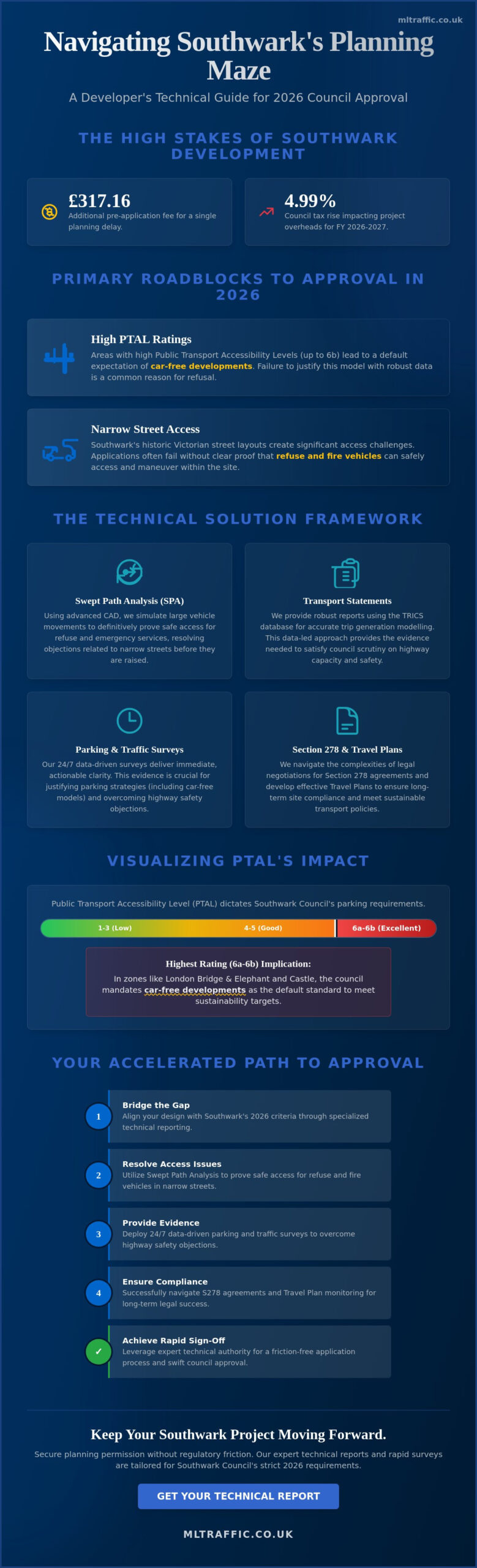
    A single planning delay in Southwark now costs developers £317.16 in additional pre-application fees, even before accounting for the 4.99% council tax rise impacting project overheads for the 2026-2027 financial year. For many, the hurdle isn’t the design; it’s the data. Securing a valid application requires more than just a basic report. You need Transport Planning Consultants Southwark who understand that high PTAL ratings and narrow street access for fire vehicles aren’t just obstacles. They’re the primary reasons applications fail in 2026.

    We know you’re under pressure to meet the “Southwark Plan 2022” requirements while managing tight delivery windows. You need technical reports that are ready 24/7 and surveys that provide immediate, actionable clarity. This guide promises to simplify your path to approval by providing the exact technical framework needed for rapid council sign-off. We’ll show you how to use Swept Path Analysis and Parking Surveys to optimize your site layout and ensure your Section 278 negotiations are successful from the first meeting. Our focus remains on precision and compliance to keep your project moving forward without regulatory friction.

    Key Takeaways

    • Bridge the gap between your development’s design and Southwark Council’s 2026 approval criteria with specialized technical reporting.
    • See why Transport Planning Consultants Southwark prioritize Swept Path Analysis to resolve narrow-street access issues for refuse and fire vehicles.
    • Utilize 24/7 data-driven parking and traffic surveys to provide the evidence needed to overcome highway safety objections.
    • Navigate the complexities of Section 278 agreements and Travel Plan monitoring to ensure long-term site compliance and successful legal negotiations.
    • Accelerate your application timeline by leveraging rapid survey deployment and expert technical authority tailored to Southwark’s sustainable transport policies.

    The Role of Transport Planning Consultants in Southwark’s 2026 Landscape

    Transport planning serves as the critical bridge between your architectural vision and a successful council determination. In high-density boroughs like Southwark, this process isn’t just about traffic flow; it’s about proving that your development integrates safely with existing infrastructure. Professional Transport Planning Consultants Southwark ensure that every technical report aligns with the borough’s strict safety and environmental targets. Since the Southwark Plan 2022 was adopted, the council has intensified its focus on sustainable movement, making specialized reporting a non-negotiable requirement for 2026 applications.

    The core deliverables usually depend on the scale of your project. Small to medium developments typically require a Transport Statement to address trip generation and access safety. Larger schemes trigger a full Transport Assessment, which involves more rigorous data modeling and impact analysis. Getting this distinction right at the start prevents costly delays and application withdrawals. We provide a comprehensive range of services to help developers navigate these specific technical hurdles from the initial feasibility stage.

    Navigating Southwark Council’s Transport Requirements

    Local validation requirements for SE1, SE15, and SE16 are complex due to narrow Victorian street layouts and high footfall. Engaging with Southwark highways officers through pre-application advice is essential. As of April 10, 2026, the fee for this advice on small-scale developments is £317.16 (including VAT). This early consultation helps align your project with the London Plan 2021/2026 updates, ensuring your transport strategy reflects the council’s vision for a “fairer, greener, safer” borough. Our team manages these discussions to secure early buy-in on access points and servicing arrangements, which helps avoid late-stage redesigns.

    PTAL Ratings and Sustainable Transport in the Borough

    Public Transport Accessibility Levels (PTAL) dictate the parking standards for every Southwark site. In areas like Elephant and Castle or London Bridge, PTAL scores often reach 6a or 6b, the highest possible ratings. This means Southwark Council expects car-free developments by default. Transport Planning Consultants Southwark help you justify these car-free models by demonstrating high-quality cycle storage and robust Travel Plans. We use CAD design and technical surveys to prove that your site layout remains functional and safe without relying on private vehicle access, directly supporting the borough’s goal of reaching net-zero by 2030 and the long-term goals of the Movement Plan 2041.

    Technical Deliverables: Transport Statements and Swept Path Analysis

    Securing planning permission in Southwark requires a technical submission that survives rigorous scrutiny from highways officers. A robust Transport Statement acts as your primary evidence, covering trip generation, site access, and pedestrian safety. By following the National guidance on Travel Plans and assessments, we ensure your data is defensible. We utilize the TRICS database to provide accurate traffic modelling, reflecting the specific movement patterns of SE1 or SE15. This precision is vital; inaccurate trip data can lead to immediate objections from the council regarding highway capacity.

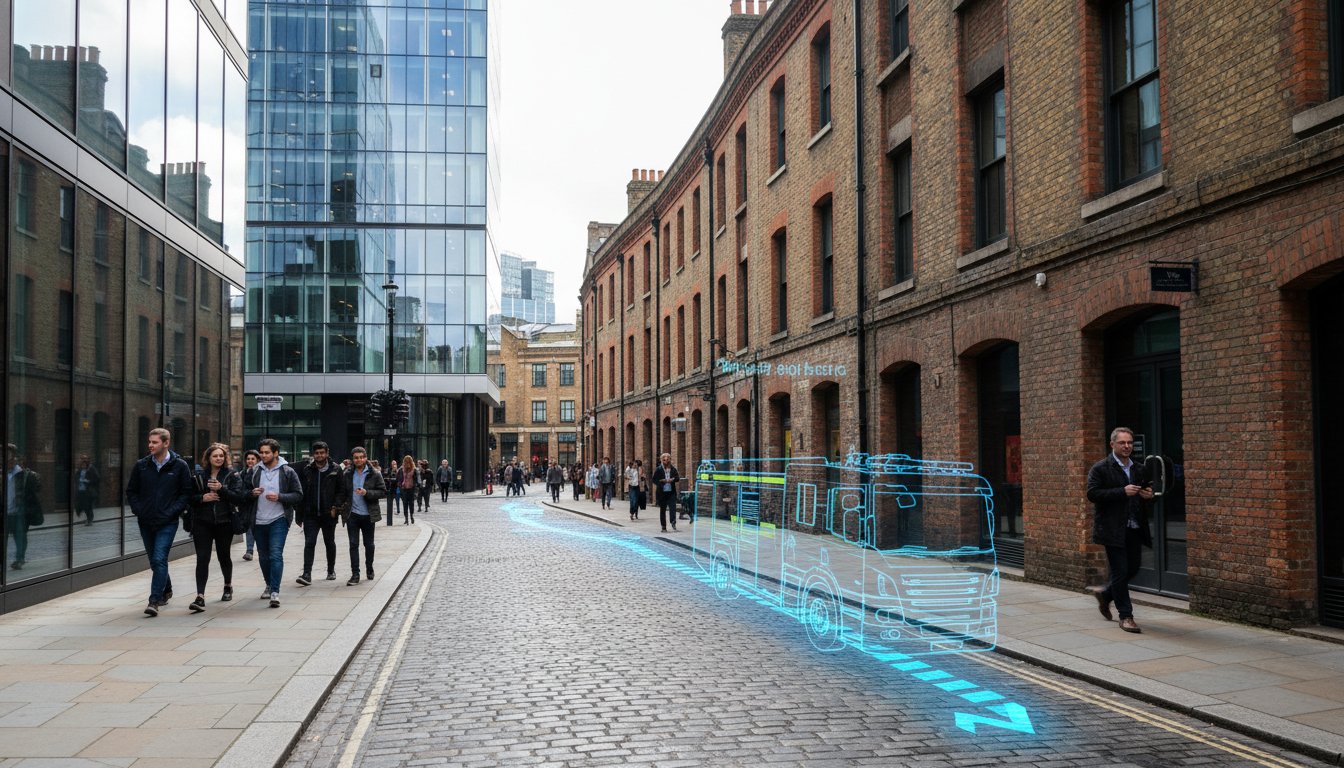
    Swept Path Analysis (SPA) has become a non-negotiable component for Southwark developments due to the borough’s tight urban grain. Using advanced CAD design, Transport Planning Consultants Southwark simulate vehicle movements to prove that your site layout functions in reality, not just on paper. This isn’t just about cars. It’s about ensuring that every vehicle, from a delivery van to a fire engine, can manoeuvre without mounting pavements or striking street furniture. If you’re unsure which report your project needs, you can view our full scope of technical services to find the right fit.

    Swept Path Analysis for Fire Tender and Refuse Access

    Southwark Council maintains strict waste management standards that require specific refuse vehicle templates. If your design doesn’t account for the turning circle of a 10.2 metre refuse collector, your application will likely face refusal. Similarly, we must demonstrate safe access for London Fire Brigade vehicles. Our SPA reports use industry-standard vehicle dimensions to verify that emergency services can reach every part of your development without delay. We identify design errors early, allowing for site layout optimisation before you submit your final plans.

    Transport Assessments for Major Southwark Schemes

    For larger developments, a simple Statement isn’t enough. You’ll need a full Transport Assessment to evaluate junction capacity and the wider impact on the local highway network. This is particularly critical near major intersections like the Bricklayers Arms or Camberwell Green. These assessments require detailed modelling of peak hour traffic and public transport capacity. For a deeper dive into these requirements, read our Transport Assessment London Guide to understand how major schemes are evaluated in 2026. Expert Transport Planning Consultants Southwark provide the technical authority needed to navigate these high-stakes negotiations with the council.

    Transport Planning Consultants Southwark: A Developer’s Guide to 2026 Approvals

    Data-Driven Planning: Parking and Traffic Surveys in SE London

    Southwark’s planning committees rarely accept generic traffic estimates; they demand empirical proof. High-traffic zones in SE1 and SE16 are under constant scrutiny from both highways officers and local residents. Professional Transport Planning Consultants Southwark utilize 24/7 survey capabilities to capture real-time road conditions. This readiness is vital because a single day of missed data can delay a project by weeks. We deploy Automatic Traffic Counts (ATC) to establish long-term volume trends and Manual Classified Counts to analyze specific junction turning movements. This data-driven approach removes the guesswork from highway safety assessments.

    In 2026, information speed is a developer’s greatest asset. Our teams provide immediate deployment for traffic surveys, ensuring technical reports reflect current May 2026 conditions. This is particularly relevant as the council manages its 2026-2027 budget following the 4.99% council tax increase approved on March 6, 2026. Precise data allows you to defend your project against claims of increased congestion, especially for sites identified during the borough’s “Call for Sites” period that concluded on April 19, 2026. Reliable evidence is the only way to overcome highway safety objections during the public consultation phase.

    The Lambeth Methodology for Parking Surveys

    Southwark Council adheres to the Lambeth Methodology for parking stress surveys. This industry-standard approach requires two separate overnight “beats” conducted between 00:30 and 05:30 on weekday nights. We measure every available parking space within a 200-metre walking distance of the site. If survey results show parking stress levels below 85%, we can successfully argue for “parking-light” or car-free proposals, even in areas with lower PTAL scores. When you hire Transport Planning Consultants Southwark, you gain access to specialists who understand how to interpret these results to support your development’s specific density goals within Controlled Parking Zones (CPZs).

    Traffic Data and Technical Analysis for Access Design

    Baseline data collection is the first step toward successful junction modelling. Without accurate counts, any simulation of future traffic impact remains flawed. We use this data to negotiate Section 106 transport contributions, which can often be reduced if the actual traffic generation is lower than the council’s initial estimates. For instance, our Parking Surveys for Planning help developers avoid overpaying for infrastructure that their site won’t actually impact. This level of technical analysis ensures your project remains financially viable while meeting all safety and regulatory requirements set out in the Southwark Plan 2022.

    Legal agreements turn a planning permission into a buildable reality. Section 278 (S278) agreements allow you to make permanent alterations to the public highway, such as new site access points, footway improvements, or pedestrian crossings. If your site sits on the Strategic Road Network, you’ll need to engage directly with Transport for London (TfL) alongside Southwark Council. This dual-agency coordination requires precise technical drawings and a clear understanding of the Traffic Management Act 2004. Professional Transport Planning Consultants Southwark manage this complex interface to prevent project stagnation during the final legal stages.

    We ensure your technical submission meets the council’s standards for safety and longevity. A well-negotiated S278 agreement prevents unexpected financial liabilities during the construction phase. Our team provides the CAD designs and technical data required to satisfy Southwark’s highways officers, ensuring that your off-site works are both feasible and safe. By aligning with the council’s “Fairer, greener, safer” delivery plans, we help developers secure technical approval without the typical back-and-forth delays that plague uncoordinated applications.

    Securing Section 278 Agreements in Southwark

    Southwark Council typically charges administration fees for S278 agreements based on a percentage of the total construction costs, usually ranging between 7% and 12%. The process involves a technical audit of your designs followed by the legal drafting of the agreement. You’ll also need to provide a financial bond to cover the cost of the works, which is only released once the council adopts the new highway. Managing these bonds and technical approvals requires a proactive approach to avoid delays in your construction schedule. To understand the full technical journey, see our Highway Design S278 Guide.

    Effective Travel Plans for Residential and Commercial Sites

    A Travel Plan isn’t a static document; it’s a long-term commitment to sustainable movement. It reduces the perceived transport impact of a scheme by setting realistic targets for walking, cycling, and public transport use. In 2026, Southwark Council requires robust monitoring to ensure developments remain compliant post-occupancy. This lifecycle begins with a Framework Travel Plan during the application stage and evolves into a Full Travel Plan once the site is occupied. Failure to meet these targets can lead to enforcement action or financial penalties under Section 106 obligations. For more details on maintaining compliance, read our London Travel Plans Essential Guide.

    If you’re managing a complex site in SE1 or SE15, contact our team today to secure your S278 technical approval and Travel Plan monitoring.

    Why Choose ML Traffic Engineers for Your Southwark Project?

    Selecting the right Transport Planning Consultants Southwark determines whether your project faces months of regulatory delays or moves straight to a valid application. We position ourselves as a safe pair of hands, managing the logistical and regulatory burdens so you don’t have to. Our team maintains a 24/7 readiness, ensuring that urgent survey data collection and technical reporting never become a bottleneck for your planning application. We take immense pride in precision and compliance, aligning every report with the high-stakes requirements of UK road regulations and Southwark’s local validation standards.

    We provide a comprehensive partner experience rather than acting as a mere equipment supplier. From the initial feasibility stage through to final implementation, our support is total and managed. Our expertise in Southwark-specific planning policy includes navigating complex Low Traffic Neighbourhood (LTN) restrictions and the borough’s unique sustainable transport targets. We’ve secured technical approvals for diverse schemes across SE1, SE15, and SE16, proving our capability in the most demanding urban environments. We understand that in traffic management, precision is a legal and physical necessity.

    Our Approach to Southwark Planning Success

    We de-risk your application through direct engagement with local highway authorities. This proactive strategy identifies potential objections regarding access safety or trip generation early in the design phase. We provide bespoke solutions tailored to the specific constraints of SE London sites, where narrow street access and high PTAL ratings require technical ingenuity. Our focus remains on clarity and speed. We use CAD design for Swept Path Analysis and provide data-driven Parking Surveys that satisfy the council’s strict validation requirements. This technical authority ensures your project meets all safety standards and legislative foundations without navigating through unnecessary filler or decorative prose.

    Start Your Southwark Planning Journey Today

    Success begins with a clear understanding of your site’s transport potential. We offer initial site access and feasibility reviews to identify any “red flag” issues before you commit to a full application. Our fee proposals are transparent and reflect the specific technical deliverables your project requires, whether that’s a full Transport Assessment or a targeted Travel Plan. We understand the fast-moving, often unpredictable nature of construction and utility works. We bring that same sense of urgency to your planning documents to ensure you hit your 2026 development milestones. Contact ML Traffic Engineers for Southwark Transport Planning today to secure the technical expertise your development deserves.

    Securing Your 2026 Planning Approval in Southwark

    Securing a valid planning application in Southwark requires more than just meeting basic requirements; it demands technical precision and defensible data. We’ve explored how Swept Path Analysis and TRICS modelling provide the evidence needed to overcome highway safety objections. Managing the lifecycle of a Travel Plan and securing Section 278 agreements are equally vital for long-term site viability. As expert Transport Planning Consultants Southwark, we’ve provided these managed solutions since 2014, ensuring developers meet the borough’s strict 2026 standards.

    Our team offers comprehensive 24/7 traffic survey capability to capture the real-time data your project needs for rapid approval. We handle the intricate complexities of UK road regulations so you don’t have to worry about compliance hurdles. Don’t let non-compliant reports or data gaps stall your progress in SE1 or SE15. We’re ready to provide the technical authority and reassuring support your project requires. Precision and safety are at the core of everything we do.

    Get a Professional Quote for Your Southwark Transport Planning Application

    Your development’s success starts with a robust transport strategy. We’re eager to help you navigate the council’s requirements and achieve a successful outcome for your scheme.

    Frequently Asked Questions

    Do I need a Transport Statement for a small development in Southwark?

    Most minor developments in SE1, SE15, or SE16 require a Transport Statement to address local validation requirements. This document proves that your site access and trip generation won’t compromise safety on narrow Southwark streets. Transport Planning Consultants Southwark help you determine if your specific site meets the thresholds set in the Southwark Plan 2022, ensuring you don’t face delays from an invalid application.

    What is the required methodology for parking surveys in Southwark?

    Southwark Council strictly requires the Lambeth Methodology for parking stress surveys. This involves two separate overnight “beats” conducted between 00:30 and 05:30 on weekday nights to measure parking demand within a 200-metre radius of the site. Our team conducts these surveys with 24/7 readiness, providing the empirical data needed to support car-free or parking-light development proposals in line with borough standards.

    How much does a Transport Planning Consultant cost in Southwark?

    Consultant fees depend on the complexity of your technical deliverables and the scale of the project. While we don’t provide fixed pricing here, Southwark Council’s pre-application advice fee for householder applications is £317.16 including VAT as of April 10, 2026. Investing in high-quality transport documents early prevents the cost of multiple council reviews and potential planning refusals.

    How long does it take to get a Swept Path Analysis completed?

    A standard Swept Path Analysis typically takes 3 to 5 working days from the moment we receive your CAD site plan. We understand the urgency of planning deadlines and maintain 24/7 availability for technical reporting and survey data collection. This rapid turnaround ensures your design team can optimize site layouts for fire tender and refuse access without stalling your submission schedule.

    What happens if my development has a high PTAL rating?

    A high PTAL rating of 5 or 6, common in areas like London Bridge or Elephant and Castle, means the council expects a car-free development by default. You’ll need to justify this model with a robust Travel Plan and high-quality cycle storage. Transport Planning Consultants Southwark specialize in proving that these sites remain functional and accessible through sustainable transport modes while meeting the council’s net-zero targets.

    Can a Travel Plan help me secure planning permission in a car-free zone?

    Yes, a Travel Plan is essential for car-free zones as it demonstrates a commitment to reducing vehicle trips. By promoting walking, cycling, and public transport, you alleviate council concerns regarding local parking stress and congestion. Setting measurable targets and monitoring post-occupancy use significantly strengthens your case for planning approval by showing the development’s long-term sustainability.

    What is a Section 278 agreement and do I need one?

    A Section 278 agreement is a legal contract required whenever a development involves permanent alterations to the public highway. This includes creating new site access points, improving footways, or installing pedestrian crossings. You’ll need one if your planning permission includes conditions for off-site highway works, which involves a technical audit of your designs and a financial bond held by the council.

    How do I know if I need a Transport Statement or a full Transport Assessment?

    The choice depends on the scale and impact of your development. Small schemes typically require a Transport Statement, while larger projects, such as those over 80 residential units or significant commercial floor space, trigger a full Transport Assessment. We review your project against Southwark’s specific thresholds and the London Plan 2021/2026 updates to ensure you submit the correct level of technical analysis from the start.

    Michael Lee

    Article by

    Michael Lee

    Transport planner with over 35 years’ experience.

    Disclaimer

    The content on mltraffic.co.uk, including all technical articles, guides, and resources, is provided for general informational and educational purposes only. It is not intended to constitute professional advice in traffic engineering, transportation planning, development approvals, or any other technical or legal field.
    While ML Traffic Engineers makes every reasonable effort to ensure the accuracy, completeness, and timeliness of the information published, we do not provide any warranties or representations (express or implied) regarding its reliability, suitability, or availability for any particular purpose. Any reliance you place on the content is strictly at your own risk.
    In no event shall ML Traffic Engineers, its directors, employees, authors, or affiliates be liable for any direct, indirect, incidental, special, consequential, or punitive damages (including, without limitation, loss of profits, data, or business opportunities) arising out of or in connection with the use of, or inability to use, any information provided on this website.
    The articles and guides on this site are not a substitute for engaging a qualified, professional traffic engineer to assess your specific project requirements. For tailored advice, compliance assessments, or traffic engineering services, please contact a competent professional.
    This disclaimer may be updated from time to time without notice. By accessing or using this website, you agree to be bound by the most current version of this disclaimer.