
What if the difference between a stalled project and a successful planning approval rests not on vehicle capacity, but on the technical precision of a single multi-modal interchange? With the 2026 NPPF shifting transport planning from a “predict and provide” model to a “vision-led” approach, developers face unprecedented pressure to deliver infrastructure that performs. Integrating a robust transport assessment for sustainable development is no longer an optional extra; it’s the technical foundation of modern site yield.
We know the frustration of navigating ambiguous local authority requirements while trying to balance rising infrastructure costs. This guide eliminates that uncertainty. You’ll master the technical standards needed to specify high-quality mobility hubs that satisfy even the most stringent planning officers. We’ll provide a clear framework for hub components, show you how to integrate them into your Transport Assessments, and demonstrate how robust data can accelerate your approval timeline in a landscape where 33% of local authorities are currently failing their housing delivery targets.
Key Takeaways
- Identify the specific technical requirements for mobility halts, local hubs, and regional interchanges under the 2026 UK planning framework.
- Specify micro-mobility and EV charging infrastructure that complies with the latest standards for shared transport and active travel.
- Use a robust transport assessment for sustainable development to quantify mode shift and justify reduced on-site parking requirements.
- Apply Swept Path Analysis to ensure safe, efficient interactions between pedestrians, cyclists, and vehicles within the hub layout.
- Streamline the planning process by following a data-driven specification sequence from initial feasibility to final technical documentation.
Defining the Mobility Hub Specification Framework
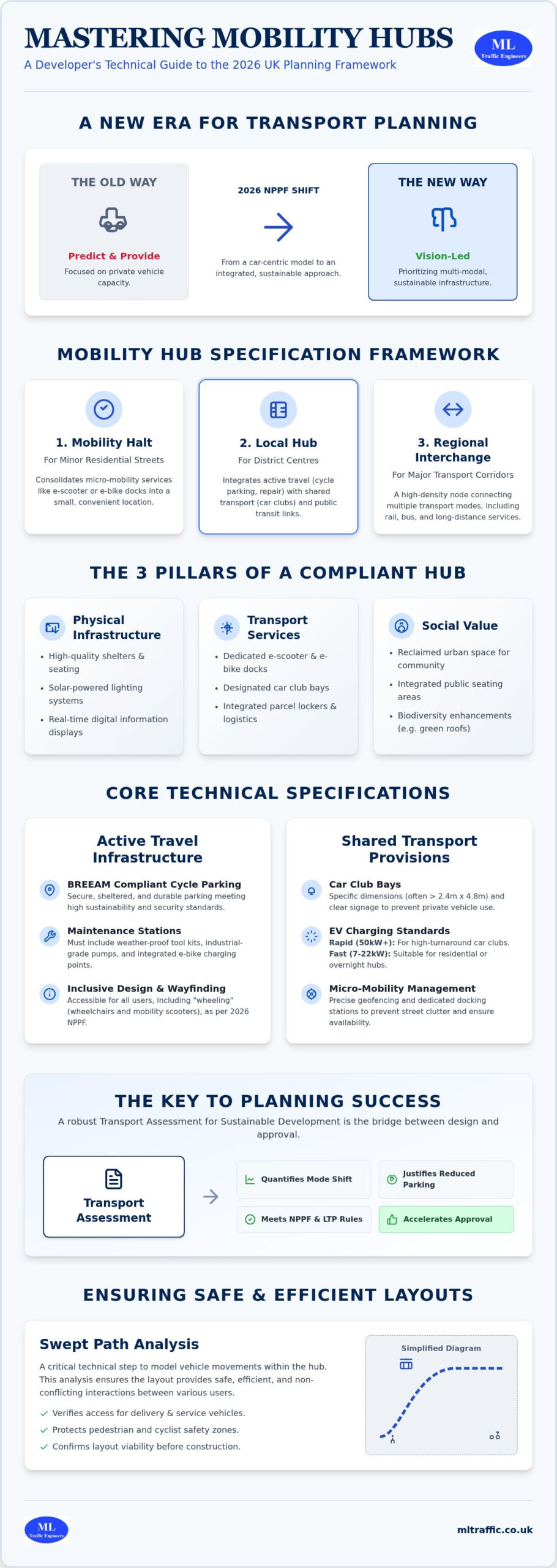
A mobility hub is a high-density, multi-modal interchange that consolidates shared transport services and active travel infrastructure. In the 2026 UK planning context, it isn’t just a collection of bike racks; it’s a strategic engineering framework. Understanding What is a Mobility Hub? requires looking past the physical shelter to the data-driven integration of services. We categorize these into three distinct specifications: Mobility Halts for minor residential streets, Local Hubs for district centres, and Regional Interchanges for major transport corridors.
Securing planning approval requires a formal specification that stands up to scrutiny during Section 106 and Community Infrastructure Levy (CIL) negotiations. Local authorities now demand evidence that these facilities will actively reduce private car dominance. Integrating this technical data into your transport assessment for sustainable development provides the necessary justification to local planners. Without a precise technical definition in your planning submission, you risk costly delays or over-specification that erodes site yield.
The Three Pillars of Hub Specification
A compliant hub must address three critical areas to satisfy modern planning standards. First, physical infrastructure provides the foundation, including high-quality shelters, solar lighting, and real-time digital interfaces. Second, transport services must integrate seamlessly. This includes dedicated bays for e-scooters, e-bike docks, and shared car club spaces. Finally, social value components reclaim urban space for community use through integrated seating and biodiversity enhancements. This holistic approach ensures the hub functions as a destination, not just a transit point.
Regulatory Alignment in England
Your hub must align with the revised National Planning Policy Framework (NPPF) published on August 17, 2026. Specifically, policies TR3 through TR8 require developments to prioritize active travel and decarbonisation. A robust transport assessment for sustainable development acts as the bridge between these national mandates and your site-specific design. It ensures your proposal meets Homes England sustainable placemaking guidance and contributes directly to the objectives set out in the Local Transport Plan (LTP) guidance published on April 2, 2026. By meeting these benchmarks, you demonstrate a commitment to inclusive mobility and public safety.
Core Technical Components and Standards
Precision in technical specification separates a viable mobility hub from a planning liability. Developers must move beyond aesthetic concepts to hard engineering standards that satisfy local highways authorities. According to the UK Government Guidance on Mobility Hubs, the success of these sites depends on functional reliability and safety. For a transport assessment for sustainable development to be robust, it must detail the power load for EV chargers and the specific dimensions of shared transport bays to ensure they accommodate diverse vehicle types.
Active Travel Infrastructure Specifications
Secure, sheltered cycle parking must meet BREEAM compliance, ensuring long-term durability and user security. Maintenance stations are now a standard requirement; these must include weather-proof tool kits, industrial-grade pumps, and integrated e-bike charging points. Inclusive design is non-negotiable. Wayfinding must be accessible for all users, including those “wheeling”-a term the 2026 NPPF uses to explicitly include wheelchairs and mobility scooters. These elements ensure the hub remains a safe, accessible environment for every demographic.
Shared Transport Provisions
Shared car club bays require specific signage and dimensions to prevent private vehicle encroachment. While standard UK parking spaces are 2.4m by 4.8m, hub bays often require additional clearance for ease of access and charging cable management. For shared car clubs, Rapid charging (50kW+) is preferred to ensure vehicle turnaround, though Fast charging (7kW to 22kW) may suffice for overnight residential hubs. E-scooter integration relies on precise geofencing and docking station technicalities to prevent street clutter. Integrating parcel lockers and last-mile logistics within the footprint further reduces local delivery traffic. If you’re unsure about the spatial requirements for these components, a professional Swept Path Analysis will confirm the layout’s viability before you submit.
Digital integration, such as Real-Time Passenger Information (RTPI) and smart ticketing kiosks, bridges the gap between different transport modes. Finally, the hub’s footprint must incorporate Sustainable Drainage Systems (SuDS) and greening. This isn’t just for aesthetics; it’s a regulatory requirement that supports biodiversity and manages surface water runoff. These technical layers ensure the hub remains a functional asset throughout the lifecycle of the development, providing the data-driven evidence needed for a successful transport assessment for sustainable development.
Strategic Layout and Swept Path Analysis
Strategic placement is the foundation of a successful mobility hub. For a hub to function effectively, it must sit within the 800-metre “reasonable walking distance” defined by the 2026 NPPF. Visibility and accessibility are non-negotiable. A hub tucked away in a low-traffic corner will fail to achieve the mode shift required for a successful transport assessment for sustainable development. We prioritize locations that intersect with existing desire lines, ensuring the facility is a natural choice for residents and commuters alike.
Designing for safe interaction between pedestrians, “wheelers,” and vehicles requires technical precision. Conflict points must be engineered out through clear segregation and intuitive wayfinding. Validating these designs with Swept Path Analysis provides the technical assurance that the layout works in the real world. This data-driven approach proves to planning authorities that your site can accommodate multi-modal movements without compromising safety or public realm quality.
Vehicle Manoeuvrability Standards
Ensuring smooth ingress and egress for shared transport is a technical requirement that often determines site yield. We use AutoTurn simulations to analyze car club vehicle movements, ensuring that bays are accessible even when the hub is at peak capacity. Logistics integration, such as parcel lockers, introduces the need for delivery van access. Your transport assessment for sustainable development must demonstrate that these larger vehicles can maneuver safely without overrunning pedestrian footways. We also prioritize fire tender access, ensuring that even the most constrained urban layouts meet statutory emergency requirements without sacrificing valuable development space.
Safety and Lighting Specifications
Operational safety is a primary hallmark of a reliable mobility hub. Because these facilities operate 24/7, lighting lux levels must be specified to ensure user confidence during hours of darkness. We adhere to “Safe Space” design principles, integrating CCTV and open sightlines to reduce the risk of anti-social behavior. Surface materials are equally critical. We specify high-durability, slip-resistant finishes that perform in all UK weather conditions. These choices reduce long-term maintenance pressures and ensure the hub remains a vital, safe guardian of public mobility throughout its lifecycle. High-quality specifications at the design stage prevent costly retrofits and strengthen your position during planning negotiations.
Integrating Mobility Hubs into Transport Assessments
The 2026 NPPF has fundamentally altered the requirements for planning submissions by mandating a “vision-led” approach to transport planning. A mobility hub is the primary mechanism for delivering this vision. By providing a technical framework for shared transport, developers can move beyond qualitative descriptions and provide the quantitative data required for a successful transport assessment for sustainable development. This document must prove exactly how the hub will facilitate mode shift and reduce the impact of the development on the local highway network.
Quantifying this impact requires a rigorous analysis of trip generation. We use TRICS data to benchmark the potential reduction in private vehicle movements when a high-quality mobility hub is present. This evidence allows developers to justify reduced parking ratios, which is essential for maximizing site yield in high-density urban environments. A robust Transport Assessment that incorporates these metrics demonstrates a commitment to decarbonisation that resonates with statutory consultees. It transforms the hub from a site amenity into a non-negotiable piece of strategic infrastructure.
Data-Driven Justification
Success begins with accurate baseline data. We conduct comprehensive Parking Surveys to identify existing demand and potential overspill risks within the local area. This analysis determines the optimal sizing and service mix for your hub. If traffic survey data indicates a high volume of short-distance commuting, the specification should prioritize e-bikes and e-scooters. Conversely, in suburban settings, the focus might shift to shared car club provision to address the “first and last mile” challenge. Calculating CO2 reductions based on these specific modal shifts provides the necessary technical weight for sustainability statements and planning credits.
Planning Policy Compliance
Highways authorities now expect a “Vision and Validate” strategy rather than the outdated “Predict and Provide” model. Your transport assessment for sustainable development must show how the hub will be managed over the long term. Integrating hub operations into a comprehensive Travel Plan ensures that the facility remains functional and well-utilized post-completion. This proactive management strategy reduces the logistical pressure on local authorities and secures their support by providing a clear roadmap for traffic mitigation. Robust technical data is the only way to overcome the ambiguity often found in local authority requirements.
Our team specializes in translating complex mobility concepts into the precise technical reports required for planning success. If you need to justify reduced parking or prove the sustainability of your site, book a technical consultation to discuss your transport assessment requirements.
The Specification Process with ML Traffic Engineers
Securing planning approval in 2026 requires more than a conceptual sketch; it demands a data-led engineering strategy. As ML Traffic Engineers UK, we manage the full project lifecycle, translating complex site constraints into a robust transport assessment for sustainable development. Our process ensures every mobility hub component is justified by technical data, reducing regulatory pressure on your development team and providing a clear path to approval.
Step 1: Data Collection and Analysis
We begin with a granular analysis of the existing transport network. We utilize comprehensive traffic surveys to map movement patterns and identify latent demand for shared transport. By assessing Public Transport Accessibility Level (PTAL) scores, we determine the necessary service density for the site. This is particularly critical for developments in London, where the 2026 London Plan mandates car-free schemes in areas with a PTAL score of 4 or higher. We pinpoint specific gaps in the local micro-mobility network, ensuring your hub provides the e-bike or cargo bike services the community actually needs. This data-driven foundation ensures your transport assessment for sustainable development is based on reality, not just projections.
Step 2: Technical Design and Validation
Our technical team creates layout plans that maximize space efficiency while ensuring smooth user flow between different transport modes. We run AutoTurn simulations for all expected vehicle types, from shared car club EVs to fire tenders and delivery vans. This validation process proves the physical viability of the hub to highways officers and prevents costly design revisions later in the process. To ensure the hub remains a functional asset post-completion, we draft a bespoke Travel Plan. This document outlines the long-term management and monitoring strategies required by local authorities to maintain mode shift targets.
The final stage involves consolidating this technical data into a professional Transport Statement or Assessment. We ensure every drawing and calculation aligns with the 2026 NPPF policies TR3 through TR8. This comprehensive approach provides the technical authority needed to secure faster planning approvals and navigate Section 106 negotiations with confidence. We act as your dependable partner, ensuring your development meets modern sustainability benchmarks while protecting your site yield and public safety.
Securing Future-Ready Planning Approvals
The shift toward vision-led transport planning in 2026 requires developers to move beyond conceptual amenities to precise engineering frameworks. Successful mobility hubs rely on three critical factors: technical alignment with 2026 NPPF standards, robust multi-modal integration, and data-driven validation through Swept Path Analysis. By quantifying mode shift potential and optimizing site layouts, you protect your development yield while satisfying the stringent requirements of local highways authorities.
A robust transport assessment for sustainable development serves as the bridge between ambitious design and regulatory compliance. We provide the technical authority needed to translate these complex infrastructure requirements into planning-ready documentation. Since 2014, we’ve specialized in navigating England-specific statutory requirements and delivering comprehensive analysis for complex urban sites. Our proven track record with UK planning authorities ensures your project moves from initial assessment to execution with unwavering reliability.
Ready to validate your site’s potential? Contact ML Traffic Engineers for a Mobility Hub Feasibility Review to ensure your next development meets the highest technical standards. We’re here to help you navigate these intricate regulations with precision and confidence.
Frequently Asked Questions
What is the minimum space required for a mobility hub?
The minimum space for a mobility hub varies by its specific classification. A basic “Mobility Halt” can be integrated into the footprint of two standard parking bays, which is approximately 24 square metres. This allows for essential cycle parking and a micro-mobility dock. Larger local hubs require 50 to 100 square metres to accommodate EV car club bays and parcel lockers. We use Swept Path Analysis to ensure these footprints remain functional without compromising vehicle movement.
Do mobility hubs require specific planning permission?
Most mobility hubs are included as integral components of a wider planning application. If you’re adding a hub to an existing site, it may require a separate application depending on the scale and visual impact. Certain elements, like bike racks or small shelters, might fall under Permitted Development rights. We recommend including the hub early in your transport assessment for sustainable development to ensure all technical specifications are approved simultaneously.
How do mobility hubs impact residential parking requirements?
Mobility hubs directly support reduced residential parking ratios. By providing on-site shared transport alternatives, developers can justify a lower number of private spaces to planning authorities. This is particularly effective in high-density urban areas. We use TRICS data and localized parking surveys to prove that hub provision mitigates the need for traditional parking, which often increases the overall residential yield of the site.
Can a mobility hub be integrated into an existing development?
Integration into existing developments is possible through strategic retrofitting. We often identify underutilized parking areas or redundant public realm spaces that can be converted into mobility hubs. This process requires a detailed feasibility study to ensure power supplies for EV charging and micro-mobility docks are accessible. We use vehicle tracking simulations to ensure the new hub layout doesn’t interfere with existing service or emergency vehicle access.
What are the typical maintenance requirements for a mobility hub?
Maintenance requirements depend on the hub’s specific component list. Standard tasks include cleaning shelters, inspecting lighting, and servicing digital real-time information displays. EV chargers and e-bike docks require specialist technical inspections. These obligations are typically outlined in a Travel Plan. Developers often partner with shared transport operators who manage the day-to-day upkeep of the vehicles and docking infrastructure, ensuring the hub remains a safe guardian of public mobility.
How does a mobility hub affect a site’s PTAL rating?
A mobility hub doesn’t technically alter a site’s Public Transport Accessibility Level (PTAL) score, as that metric is fixed by distance to rail and bus stops. However, it significantly improves the practical accessibility profile of a development. By bridging the “first and last mile” gap, a hub can mitigate the impact of a lower PTAL score. This improvement is a vital component of a transport assessment for sustainable development when seeking higher-density approvals.
Are there grants available for delivering mobility hubs in the UK?
Funding opportunities for mobility hubs are available through several channels. Local authorities often secure funding via the Department for Transport’s decarbonisation schemes or the Transforming Cities Fund. Homes England also provides funding for infrastructure that supports sustainable placemaking. We help developers identify these opportunities during the initial site feasibility stage. Securing these grants can offset initial capital costs while ensuring the development meets national net-zero targets.
What is the role of a mobility hub in a Section 278 agreement?
If a mobility hub is situated on or impacts the public highway, it must be incorporated into the Section 278 agreement. This legal mechanism ensures the infrastructure meets the local highway authority’s safety and design standards. Our technical drawings and Swept Path Analysis provide the precise data required for these negotiations. This ensures the hub is properly integrated into the surrounding road network and meets all statutory requirements for adoption or maintenance.

Disclaimer
The content on mltraffic.co.uk, including all technical articles, guides, and resources, is provided for general informational and educational purposes only. It is not intended to constitute professional advice in traffic engineering, transportation planning, development approvals, or any other technical or legal field.
While ML Traffic Engineers makes every reasonable effort to ensure the accuracy, completeness, and timeliness of the information published, we do not provide any warranties or representations (express or implied) regarding its reliability, suitability, or availability for any particular purpose. Any reliance you place on the content is strictly at your own risk.
In no event shall ML Traffic Engineers, its directors, employees, authors, or affiliates be liable for any direct, indirect, incidental, special, consequential, or punitive damages (including, without limitation, loss of profits, data, or business opportunities) arising out of or in connection with the use of, or inability to use, any information provided on this website.
The articles and guides on this site are not a substitute for engaging a qualified, professional traffic engineer to assess your specific project requirements. For tailored advice, compliance assessments, or traffic engineering services, please contact a competent professional.
This disclaimer may be updated from time to time without notice. By accessing or using this website, you agree to be bound by the most current version of this disclaimer.