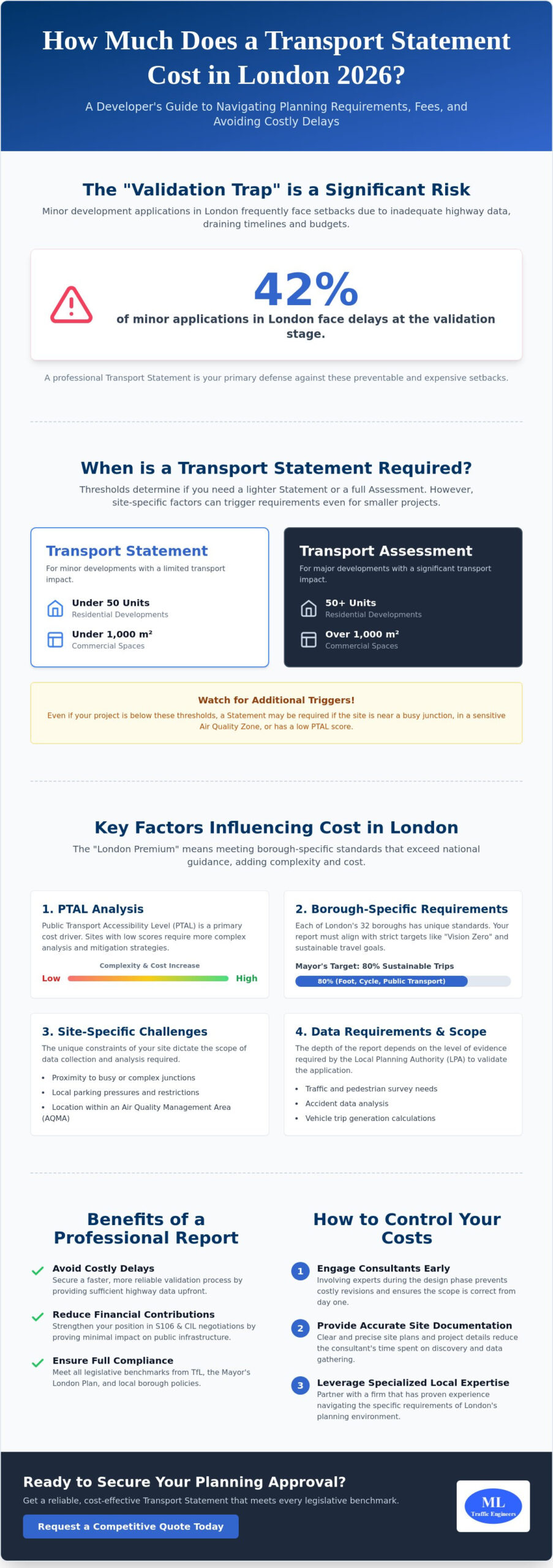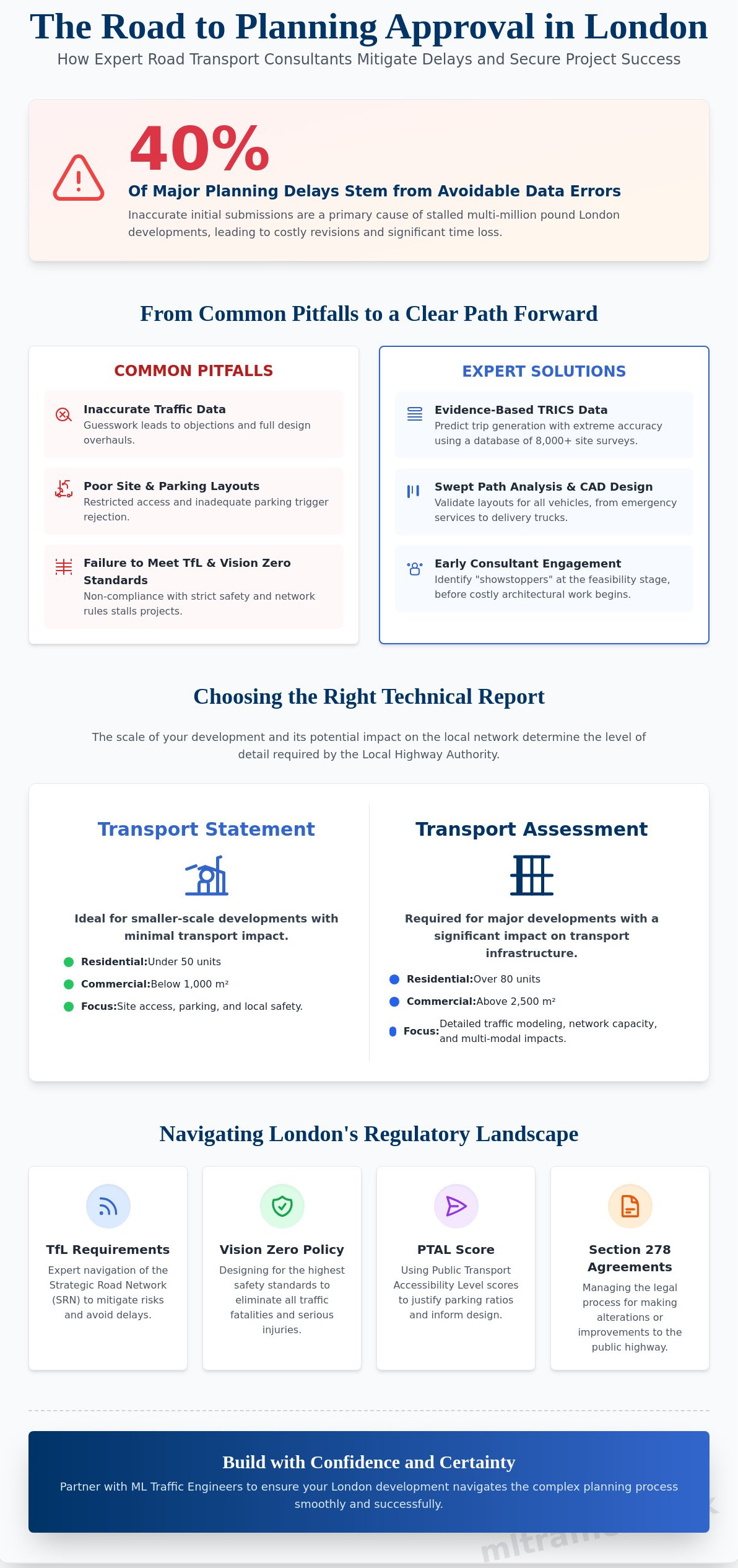
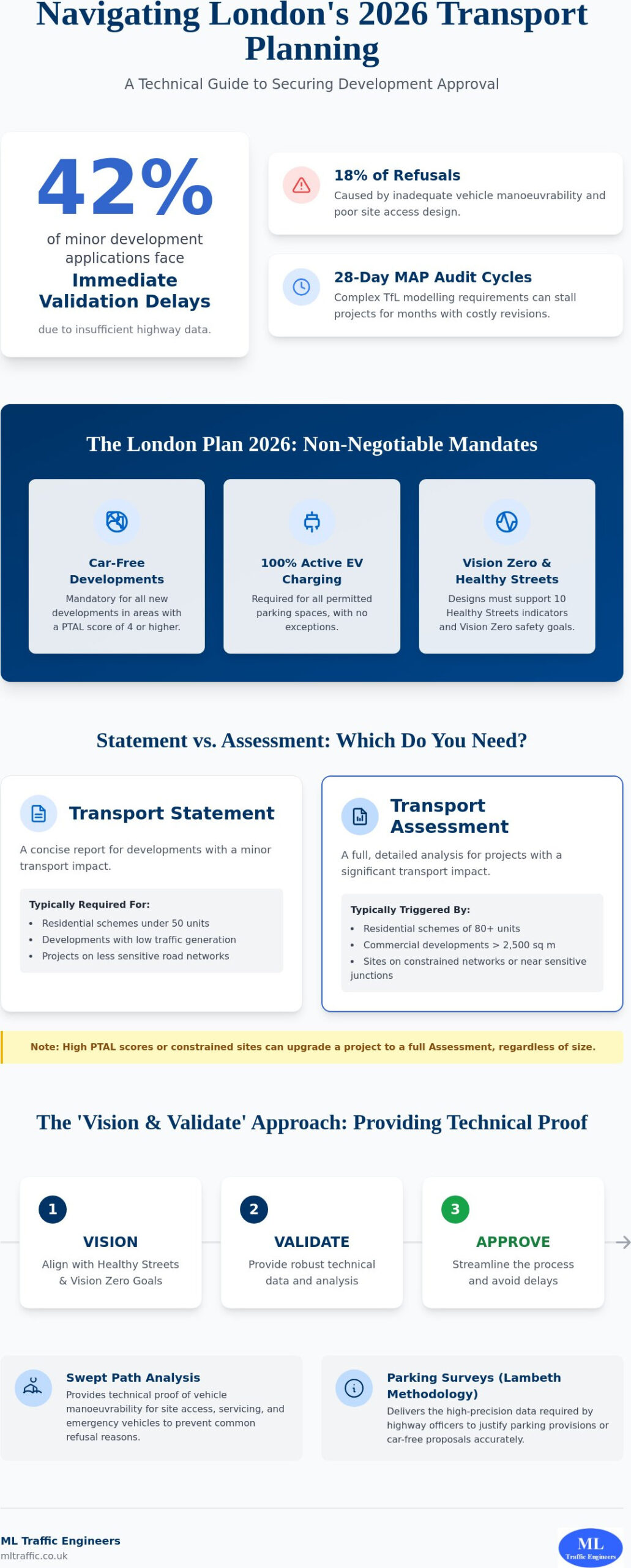
42% of minor development applications across London boroughs face immediate delays at the validation stage because of insufficient highway data. In a city where the 2026 London Plan mandates car-free developments in PTAL 4 zones and strict Vision Zero safety standards, a single technical oversight can stall a project for months. You’re likely aware that transport planning for planning applications london has become a high-stakes regulatory hurdle where precision is a functional necessity. The 28-day MAP audit cycles and complex TfL modelling requirements often feel designed to trigger costly design revisions rather than project progress.
This guide provides the technical roadmap you need to satisfy highway authorities and secure approval with confidence. We’ll examine the 2026 standards for Swept Path Analysis, explain how to apply the Lambeth Methodology for parking surveys, and show you how a “Vision and Validate” approach turns regulatory pressure into a clear path for development. By aligning your strategy with current borough expectations, you can avoid the 18% of refusals caused by manoeuvrability issues and keep your project on schedule.
Key Takeaways
- Understand how the London Plan 2026 mandates car-free developments in high PTAL zones and requires 100% active electric vehicle charging for all permitted parking spaces.
- Identify the specific thresholds that determine whether your project requires a concise Transport Statement or a full Transport Assessment to meet borough validation requirements.
- Learn to use high-precision Swept Path Analysis and parking surveys conducted via the Lambeth Methodology to provide the technical proof required by highway officers.
- Master the shift toward the “Vision and Validate” model, ensuring your transport planning for planning applications london aligns with Healthy Streets indicators and Vision Zero safety goals.
- Discover how professional technical documentation reduces regulatory friction and prevents the common delays associated with the 28-day MAP audit cycles.
The 2026 London Transport Planning Landscape
The London Plan 2026 has fundamentally redefined the criteria for development success across the capital. It mandates car-free developments in any area with a Public Transport Accessibility Level (PTAL) of 4 or higher, while requiring 100% active electric vehicle charging for all permitted spaces. In the field of transportation planning, the shift toward active travel infrastructure is the most significant change in decades. Developers can no longer rely on traditional “predict and provide” models. You must now demonstrate how your site supports the ten Healthy Streets indicators and aligns with the city’s Vision Zero safety goals to eliminate road deaths by 2041.
To better understand how planning committees evaluate these technical requirements, watch this helpful video:
Understanding TfL’s Role in Your Application
Transport for London (TfL) acts as a statutory consultee for any development that impacts the Strategic Road Network, commonly known as Red Routes. If your site access connects to these critical arteries, TfL’s oversight is absolute. Their pre-application service fees increased by 6.0% for the 2026/27 period, reflecting the intensive technical review required. A primary hurdle is the 28-day Model Auditing Process (MAP) for junction designs. Precision in your initial Transport Assessment is the only way to avoid repeated audit cycles that can delay a project by months. We prioritize technical accuracy to ensure your designs meet TfL’s rigid safety and flow requirements on the first submission.
Local Borough Variations
While the London Plan provides a city-wide framework, the 32 boroughs apply these rules with varying intensity. Inner London authorities like Tower Hamlets often enforce stricter car-free mandates and lower parking ratios than Outer London boroughs. You must also account for local Low Traffic Neighbourhoods (LTNs), which can significantly alter site feasibility and vehicle routing. Effective transport planning for planning applications london requires identifying these borough-specific hurdles during the feasibility stage. Securing pre-application advice is a strategic necessity to understand local sensitivities before finalizing your site layout. This front-loaded approach prevents the 18% of refusals currently caused by inadequate manoeuvrability and poor site access design.
Transport Statement vs. Assessment: Which Do You Need?
Determining whether your project requires a Transport Statement or a full Assessment is a critical first step in transport planning for planning applications london. The primary difference lies in the scale of the development and its anticipated impact on the local highway network. National guidance on Transport Assessments and Statements provides the baseline, but London boroughs apply specific local thresholds that you must navigate to avoid validation delays.
In 2026, a full Transport Assessment is typically triggered for residential schemes of 80 units or more, or commercial developments exceeding 2,500 square metres. For smaller residential projects, usually under 50 units, a Transport Statement is often sufficient. However, London’s unique urban density means that even a minor development on a constrained site or near a sensitive junction can be upgraded to a full Assessment by a planning officer. We know that 42% of minor applications face validation delays due to insufficient data. Making the correct choice of report type is a pivotal decision for your project timeline.
The PTAL Factor in Report Selection
The Public Transport Accessibility Level (PTAL) score of your site heavily influences council expectations. Sites in high PTAL zones (5-6), such as those in Inner London, are now strictly car-free under the 2026 London Plan. In these instances, the focus of your report shifts from vehicle capacity to robust Travel Plans and active travel infrastructure. Our Transport Assessment London guide details how these PTAL scores dictate the depth of technical data required to satisfy borough officers and demonstrate site sustainability.
Choosing the Right Strategy for Approval
Submitting a Transport Statement when the borough expects a full Assessment is a high-risk strategy. This often leads to immediate refusal or costly design revisions. We recommend negotiating the scope of work with highway officers during the pre-application phase. This early engagement allows you to agree on the necessary modelling and data points before you commit to a site layout. If you’re unsure which report your site requires, our team can help you identify the correct technical documentation to ensure a smooth validation process. Investing in detailed reporting at the start is significantly more cost-effective than managing a resubmission after a transport-related refusal.
Technical Data: Swept Path Analysis and Parking Surveys
In 2026, transport planning for planning applications london relies on empirical evidence rather than subjective projections. Planning officers require “hard data” to validate site feasibility and safety. We use high-precision traffic surveys to establish baseline flows, ensuring every model aligns with the latest Transport analysis guidance (TAG). This technical foundation is essential for overcoming objections related to congestion or safety. Without this data, applications often stall at the validation stage or face immediate refusal. Technical precision is the only way to demonstrate that your development integrates safely into the existing highway network.
Swept Path Analysis as a Design Tool
On tight London plots, every centimetre matters. Swept Path Analysis (SPA) uses digital modelling to simulate the movement of specific vehicles, such as 12-metre refuse trucks, emergency fire tenders, and delivery vans. This analysis proves that these vehicles can safely access and egress the site without striking kerbs, overhanging structures, or parked cars. In 2026, “inadequate manoeuvrability” was cited in 18% of all transport-related planning refusals in London. By using SPA during the early design phase, you prevent costly revisions after planning has been granted. It ensures your site layout is functionally sound and compliant with borough safety standards. You can explore our specific Swept Path Analysis services to see how this tool secures your site access and protects your project timeline.
The Lambeth Methodology for Parking Surveys
As the 2026 London Plan pushes for car-free developments, developers must often prove that a reduction in on-site parking won’t lead to “overspill” on local streets. The Lambeth Methodology is the industry-standard for these surveys. It requires data collection within a 200-metre walking distance of the site during overnight hours, typically between 01:00 and 05:30. We conduct these parking surveys on two separate weekday nights to capture “peak stress” levels accurately. If local parking stress remains below 85%, we can successfully argue that the area has sufficient capacity to absorb any potential demand. This data-driven approach is the most effective way to satisfy council concerns regarding local parking pressure. It prevents the need for unnecessary on-site parking provision that could otherwise compromise your development’s density or profitability.
The ‘Vision and Validate’ Approach to Sustainable Travel
The 2026 policy landscape has moved decisively away from the traditional “Predict and Provide” model. In the past, developers focused on forecasting vehicle numbers and building capacity to accommodate them. Today, transport planning for planning applications london follows the “Vision and Validate” approach. This means you first establish a sustainable vision for how residents or employees will access your site, then provide the technical validation to prove that vision is achievable. It shifts the focus from managing cars to enabling active travel and public transport use.
Creating an Effective London Travel Plan
The Travel Plan is the primary document used to formalise your vision. It must include SMART targets (Specific, Measurable, Achievable, Relevant, and Time-bound) for reducing single-occupancy vehicle trips. Councils now scrutinise these documents to ensure they meet Healthy Streets standards. For example, providing secure, accessible cycle storage is no longer optional; it’s a baseline requirement for approval. We help you draft these plans to ensure they are both ambitious enough to satisfy transport officers and practical enough to implement. Reviewing our London Travel Plans guide is a good starting point for understanding these 2026 standards.
Active Travel Zone (ATZ) Assessments
An ATZ assessment is often a mandatory component of your transport documentation. It evaluates the quality of the walking and cycling environment within a 20-minute catchment area of your site. This assessment identifies barriers to movement, such as poor lighting, narrow pavements, or dangerous crossings. By addressing these factors, you strengthen your final Transport Statement and prove that your development supports the city’s wider environmental goals. These assessments are critical for sites in high-density areas where pedestrian flow is a primary concern for the borough.
If you need to ensure your project meets these evolving standards, you can book a technical review of your travel strategy today to avoid unnecessary delays.
Streamlining Your Application with ML Traffic Engineers UK
Successfully navigating the technical complexities of transport planning for planning applications london requires a proactive strategy that anticipates officer requirements. We reduce regulatory friction by providing the precise data sets that planning committees expect from the outset. Similarly, for projects that involve international supply chains, you can explore Customs Brokerage and Logistics Service Fees to minimize regulatory friction and costs when importing essential materials. Our role is to act as your technical partner, ensuring that every report we produce is robust enough to withstand the scrutiny of both TfL and local borough authorities. By front-loading the technical work, we prevent the common validation delays that often stall minor developments in the capital. We understand that your project timeline depends on getting it right the first time.
A generic report is often the quickest route to a “further information” request or an outright refusal. Instead, ML Traffic Engineers UK provides a tailored transport strategy that addresses the specific physical and policy constraints of your site. Whether you’re dealing with the strict parking standards of a high PTAL zone or the manoeuvrability requirements of a tight urban plot, our documentation provides the empirical evidence needed for approval. We manage the full project lifecycle, from initial site feasibility and data collection to final submission and negotiation with highway authorities. This end-to-end approach ensures consistency and technical integrity throughout the planning process.
Our Technical Capabilities
Our methodology is built on high-fidelity data collection and industry-standard modelling techniques. We utilise the TRICS database to provide accurate trip generation forecasts and deploy Automatic Traffic Counts (ATC) to establish undeniable baseline flows. This technical rigor is particularly vital for Swept Path Analysis, where we use the latest software templates to prove your site can safely accommodate refuse and emergency vehicles. We don’t just identify constraints; we engineer solutions that protect your site’s density while ensuring full compliance with Vision Zero safety standards. Our data-driven approach removes the guesswork from the officer’s decision-making process.
Securing Your Planning Approval
Securing a positive outcome often depends on effective liaison with borough transport officers. ML Traffic Engineers UK engages with authorities early in the process to pre-empt objections and agree on the scope of modelling before you commit to a final design. This negotiation is critical for sites with complex constraints, such as those near Red Routes or within local Low Traffic Neighbourhoods. We integrate our transport planning for planning applications london with other project requirements to ensure a cohesive submission. If you’re ready to move forward without the risk of costly design revisions, you can request a quote for your London transport planning needs to ensure your application is supported by expert technical documentation.
Securing Your Project’s Future in a Car-Free London
The regulatory environment in 2026 demands more than just compliance; it requires a proactive commitment to the capital’s sustainable transport goals. As we have discussed, navigating transport planning for planning applications london effectively requires moving beyond basic vehicle counts to embrace the vision-and-validate model. By prioritising technical precision in your Swept Path Analysis and parking surveys, you demonstrate a site’s functional readiness and safety. This strategic approach turns potential highway objections into validated design solutions that align with the Mayor’s transport objectives and the Healthy Streets indicators.
ML Traffic Engineers UK provides the specialized authority needed to manage these complex regional regulations. Our proven track record with London Boroughs and TfL ensures your technical documentation meets every legislative benchmark from the initial assessment to the final submission. We reduce the logistical pressure on your team by delivering a fully-managed service that prioritises project reliability and precision. Secure your London planning approval with an expert Transport Statement from ML Traffic Engineers UK. We are ready to provide the professional technical support your development requires for a successful outcome.
Frequently Asked Questions
What is the difference between a Transport Statement and a Transport Assessment in London?
A Transport Statement is a concise report for developments with relatively low transport impacts, while a Transport Assessment is a comprehensive study required for larger schemes. In London, the threshold for a full Assessment is typically triggered by residential developments of 80 units or commercial spaces exceeding 2,500 square metres. Both documents must demonstrate compliance with borough-specific highway standards and the overarching London Plan.
Do I need a Transport for London (TfL) audit for a small residential development?
You generally don’t need a formal TfL audit for a small residential development unless the site access impacts the Strategic Road Network or “Red Routes.” If your project connects directly to these critical arteries, TfL becomes a statutory consultee regardless of project size. For most minor applications on borough roads, the local highway authority manages the review process without TfL’s direct involvement.
How much does a parking survey cost for a London planning application?
The cost of a parking survey depends on the required methodology and the geographic scope specified by the local council. Most London boroughs require the Lambeth Methodology, which involves surveying a 200-metre radius over two separate weekday nights. Factors such as the number of street segments and the complexity of local parking restrictions will influence the final technical requirements and the scale of data collection needed.
What is a PTAL rating and how does it affect my planning application?
PTAL stands for Public Transport Accessibility Level, a measure that grades a location’s connectivity to the public transport network on a scale from 0 to 6b. A high PTAL score of 4 or above often mandates car-free development under the 2026 London Plan. This rating is a decisive factor in transport planning for planning applications london because it dictates the maximum number of parking spaces the council will permit for your site.
Is Swept Path Analysis mandatory for all London developments?
Swept Path Analysis is mandatory for any development where vehicle manoeuvrability is a potential safety concern or where access for emergency vehicles must be proven. London boroughs strictly enforce these standards to ensure refuse trucks and fire tenders can enter and exit a site in a forward gear. Failure to provide digital SPA modelling often results in immediate validation delays or refusal on safety grounds during the planning process.
What happens if the council objects to my Transport Statement?
If a council objects to your Transport Statement, you must address their specific technical concerns through design revisions or additional data. This often involves conducting further traffic surveys or refining your site access layout to improve safety. We proactively liaise with borough officers during the pre-application stage to pre-empt these objections and ensure the technical documentation aligns with local expectations before the final submission is made.
How has the NPPF 2026 update changed London transport requirements?
The NPPF 2026 update has reinforced the shift toward sustainable transport by prioritising the “Vision and Validate” approach over traditional capacity-based modelling. It requires developers to prove that their sites are designed to maximize walking, cycling, and public transport use from the outset. This national policy alignment supports London’s Healthy Streets indicators and makes robust Travel Plans a non-negotiable component of the planning process for most urban developments.
Can a Travel Plan help me get permission for a car-free development?
A robust Travel Plan is the primary tool for securing permission for car-free developments because it provides the technical justification for a zero-parking strategy. It outlines specific measures, such as high-quality cycle storage and car club memberships, that will reduce the need for private vehicle ownership. By setting SMART targets for sustainable travel, you provide the council with the reassurance needed to approve a development with no on-site parking provision.

Disclaimer
The content on mltraffic.co.uk, including all technical articles, guides, and resources, is provided for general informational and educational purposes only. It is not intended to constitute professional advice in traffic engineering, transportation planning, development approvals, or any other technical or legal field.
While ML Traffic Engineers makes every reasonable effort to ensure the accuracy, completeness, and timeliness of the information published, we do not provide any warranties or representations (express or implied) regarding its reliability, suitability, or availability for any particular purpose. Any reliance you place on the content is strictly at your own risk.
In no event shall ML Traffic Engineers, its directors, employees, authors, or affiliates be liable for any direct, indirect, incidental, special, consequential, or punitive damages (including, without limitation, loss of profits, data, or business opportunities) arising out of or in connection with the use of, or inability to use, any information provided on this website.
The articles and guides on this site are not a substitute for engaging a qualified, professional traffic engineer to assess your specific project requirements. For tailored advice, compliance assessments, or traffic engineering services, please contact a competent professional.
This disclaimer may be updated from time to time without notice. By accessing or using this website, you agree to be bound by the most current version of this disclaimer.