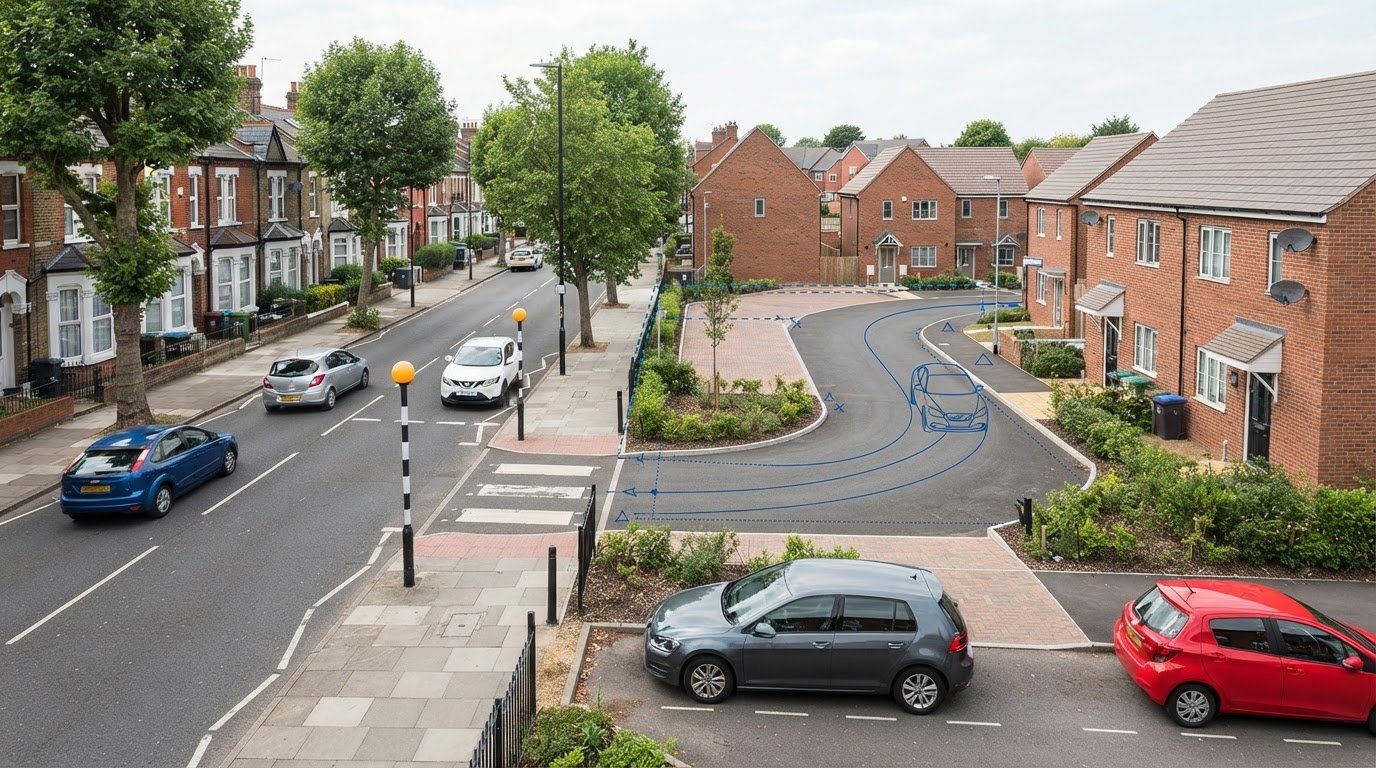
The right alternative to ML Traffic Engineers UK depends on what your development needs to demonstrate. Compare transport-planning support by the task involved: assessing a proposal’s effects, understanding existing traffic and parking conditions, analysing vehicle movements, or explaining how travel demand will be managed. Choose an approach that matches the planning question and provides evidence relevant to the site.
It is sensible to compare more than a company name or headline service. The scope of work, the information used and the resulting documents all matter. This guide explains which transport-planning alternatives to consider, how common reports differ from supporting surveys, and what can help you decide what your project needs. You will have a clearer basis for comparing options and identifying the next step for a UK planning application.
Key Takeaways
- Match the transport-planning option to the evidence your development needs, rather than comparing company names alone.
- Distinguish between a Transport Statement and a Transport Assessment by considering the scope of the planning question and the level of analysis required.
- Use traffic or parking evidence and vehicle-movement analysis to address specific site-access and operational questions.
- ML Traffic Engineers UK can prepare a Transport Statement or Transport Assessment and support the analysis with Parking Surveys or Swept Path Analysis.
- Clarify the planning issue first to identify the most relevant report and supporting evidence for your project.
David Tucker Associates DTA transport alternatives
Searching for David Tucker Associates DTA transport alternatives means comparing the work your project needs, not simply replacing one consultancy name with another. Start with the planning question. A housing proposal beside a narrow access road, for example, raises different transport issues from a town-centre change of use with limited parking.
The company record is a separate point from service comparison. Companies House records that D T A TRANSPORTATION LIMITED reported share capital of GBP 796 on 19 May 2025. That corporate filing doesn’t explain which transport-planning work a particular development needs. For that, compare the proposed project, the decision to be supported and the evidence required.
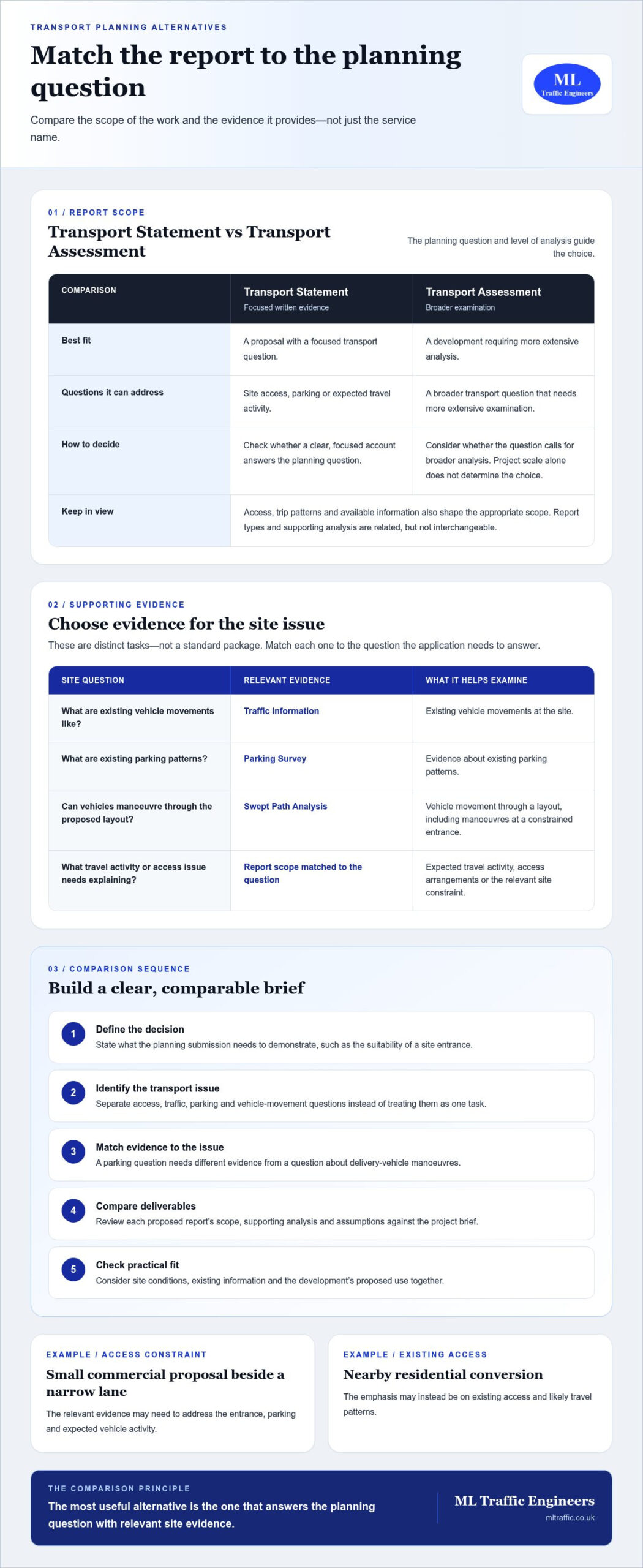
Transport-planning alternatives can include different report types, supporting analysis or providers. These options are related, but not interchangeable. A concise written statement may suit a proposal with a focused transport question. A broader assessment may be appropriate when a development requires more extensive examination. Project scale alone does not determine the choice: access, trip patterns and available information also shape the scope.
Consider the evidence needed before choosing a report. An existing site with established vehicle movements might need traffic information. A proposal with constrained parking could require parking evidence. A site where delivery vehicles use a tight entrance may need vehicle-tracking analysis. These are distinct tasks, not a standard package. The most useful alternative is the one that answers the planning question.
Compare approaches by defining the expected output. Identify what the report must explain, which site conditions it must assess and what drawings or survey information may support it. A scheme proposing new access arrangements, for example, needs a clear account of how vehicles would enter and leave. A conversion with existing access may instead focus on likely travel demand and parking provision.
Keep the comparison focused on scope and evidence. Limited analysis can leave an important question unanswered, while a broader scope can add work that does not support the planning decision. Set out the proposal, site access, anticipated users and known constraints in a project brief. This gives each option the same starting point and makes differences in proposed outputs easier to identify.
Use this sequence to narrow the options:
- Define the decision. State what the planning submission needs to demonstrate, such as the suitability of a site entrance.
- Identify the transport issue. Separate access, traffic, parking and vehicle movement questions instead of treating them as one task.
- Match evidence to the issue. A parking question needs different evidence from a question about delivery-vehicle manoeuvres.
- Compare deliverables. Review the proposed report’s scope, supporting analysis and assumptions against the project brief.
- Check practical fit. Consider site conditions, existing information and the development’s proposed use together.
This approach also helps distinguish a provider comparison from a report comparison. Two transport consultancies may describe similar services but propose different scopes. Review the deliverables, not just the service labels. A proposal explaining how it will address the site’s access constraints is easier to assess than one listing report titles without linking them to the development.
For example, a small commercial proposal beside a narrow lane may require evidence about the entrance, parking and expected vehicle activity. A nearby residential conversion could have a different emphasis, such as existing access and likely travel patterns. These examples show why a transport alternative should be tailored to the site rather than selected by title alone.
Before choosing an approach, write down the site’s main transport question in one sentence. Then list the evidence needed to answer it and the document that should present the findings. This sequence keeps comparisons focused, prevents unrelated tasks from shaping the scope and gives the project team a clear basis for reviewing transport-planning alternatives.
ML Traffic Engineers UK: Transport Statements
ML Traffic Engineers UK prepares Transport Statements for developments that need a clear account of their transport implications for planning. Choose this service when your proposal needs focused written evidence about site access, parking or expected travel activity. Where the planning question requires broader analysis, a Transport Assessment may be more appropriate.
Supporting evidence can address specific site conditions. Parking Surveys can help establish existing parking patterns, while Swept Path Analysis can assess whether vehicles can manoeuvre through a proposed layout. The right work depends on the question the application needs to answer, so defining that question helps set the scope.
For transport-planning support tailored to your development, contact ML Traffic Engineers UK or visit mltraffic.co.uk.
Set a Clear Direction for Your Planning Work
Make your next step a defined transport brief. Record the planning question, the site conditions that affect it and the evidence your application needs. This gives your project team a practical basis for setting the scope and keeps the work focused on the planning decision.
Comparing David Tucker Associates DTA transport alternatives is most useful when you assess how each option addresses your development’s specific transport issues. ML Traffic Engineers UK provides Transport Statements, Swept Path Analysis and Parking Surveys to support relevant planning work. The right combination depends on the questions your proposal needs to answer.
Bring your project requirements into focus and explore the appropriate next step with ML Traffic Engineers UK. Contact ML Traffic Engineers UK to discuss your transport-planning needs. A clear brief is a strong foundation for moving your application forward with confidence.

Disclaimer
The content on mltraffic.co.uk, including all technical articles, guides, and resources, is provided for general informational and educational purposes only. It is not intended to constitute professional advice in traffic engineering, transportation planning, development approvals, or any other technical or legal field.
While ML Traffic Engineers makes every reasonable effort to ensure the accuracy, completeness, and timeliness of the information published, we do not provide any warranties or representations (express or implied) regarding its reliability, suitability, or availability for any particular purpose. Any reliance you place on the content is strictly at your own risk.
In no event shall ML Traffic Engineers, its directors, employees, authors, or affiliates be liable for any direct, indirect, incidental, special, consequential, or punitive damages (including, without limitation, loss of profits, data, or business opportunities) arising out of or in connection with the use of, or inability to use, any information provided on this website.
The articles and guides on this site are not a substitute for engaging a qualified, professional traffic engineer to assess your specific project requirements. For tailored advice, compliance assessments, or traffic engineering services, please contact a competent professional.
This disclaimer may be updated from time to time without notice. By accessing or using this website, you agree to be bound by the most current version of this disclaimer.