
With van traffic rising 10% above pre-pandemic levels and London drivers losing 109 hours a year to congestion, your development’s access strategy isn’t a simple box-ticking exercise. It’s a high-stakes regulatory hurdle. You’ve likely felt the frustration when a highway authority objection stalls your project; these delays create unnecessary costs and uncertainty for your timeline. A specialist traffic engineer acts as your technical advocate, transforming these logistical barriers into a clear path toward planning approval.
This guide explains how expert transport data secures your site’s future. You’ll learn how to determine whether you need a Transport Statement or a full Transport Assessment to satisfy local authorities. We’ll also explore how technical tools like Swept Path Analysis and Parking Surveys provide the evidence needed to counter local objections. By the end of this article, you’ll understand how to design a safe, efficient layout that meets 2026 standards and maximises your land value.
Key Takeaways
- Understand the vital role of a traffic engineer in navigating complex UK transport policies and securing planning approval for your site.
- Identify the specific technical documents, such as Transport Assessments and Travel Plans, required to satisfy highway authority requirements.
- Learn to distinguish between traffic engineers and transport planners to ensure you engage the correct specialist for your project’s technical needs.
- Discover how utilizing technical data like Swept Path Analysis and Parking Surveys can proactively mitigate risks and counter local objections.
- Explore how early intervention and professional accuracy from ML Traffic Engineers streamline the planning process and maximize land value.
Table of Contents
-
Core Technical Services: How Engineers Solve Site Constraints
-
Traffic Engineer vs. Transport Planner: Navigating the Terminology
The Role of a Traffic Engineer in Modern UK Development
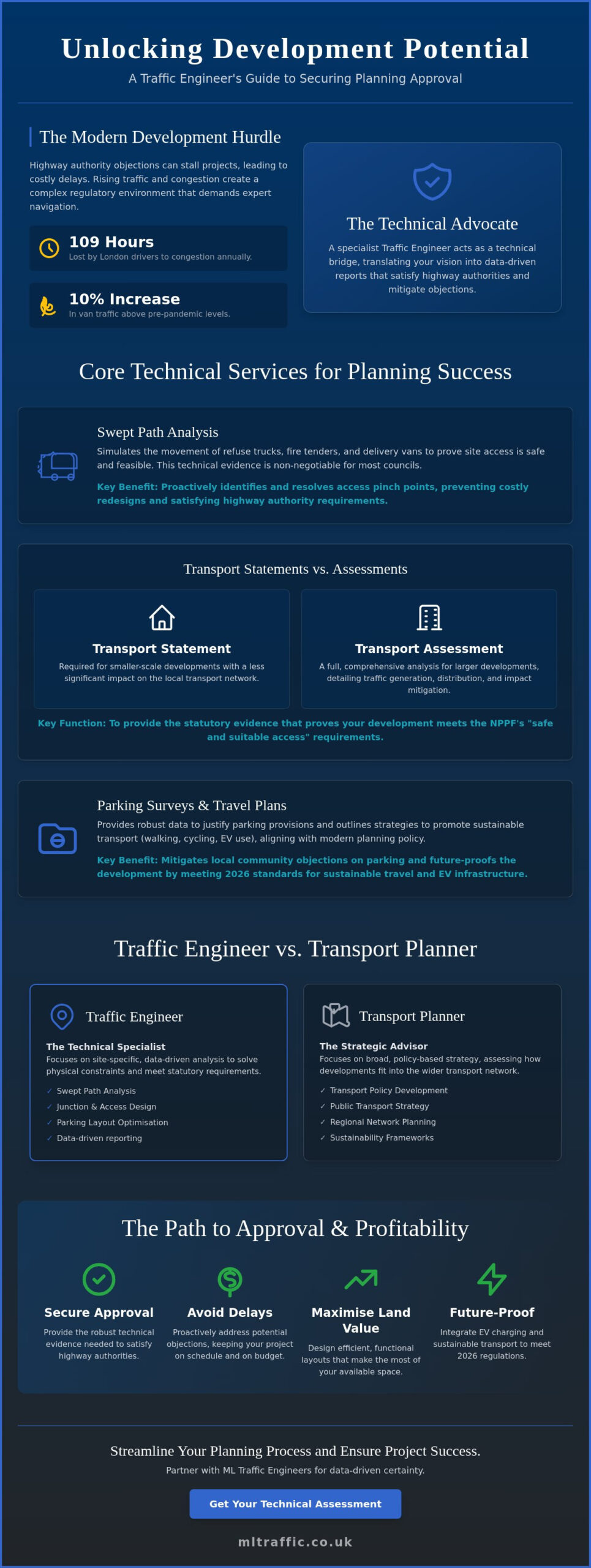
A traffic engineer serves as the technical bridge between your architectural vision and the strict requirements of the local highway authority. While the broad discipline of traffic engineering (transportation) encompasses highway capacity and signal timing, the modern UK developer needs a specialist focused on the planning cycle. These professionals translate complex vehicle movements into data-driven reports that satisfy statutory bodies and reduce regulatory friction. In a high-stakes environment where precision is a necessity, their role is to ensure your project moves from inception to completion without highway-related delays.
To better understand this concept, watch this helpful video:
Beyond Cones and Signs: Defining the Consultancy Role
Many developers initially associate "traffic" with physical roadworks or temporary closures. However, in a consultancy context, the role is purely analytical and advisory. A traffic engineer focuses on data-driven reporting for statutory approvals rather than physical construction. They analyze how your proposed site will interact with the existing network through detailed Traffic Surveys. This work requires close collaboration with architects and planning officers to ensure that site layouts aren’t just aesthetic but functional. They provide the technical certainty that a refuse vehicle can turn safely or that a delivery van won’t block a primary arterial road. Accuracy is a functional necessity here.
Why Traffic Engineering is Essential for Planning Approval
Securing "safe and suitable access" remains a non-negotiable pillar of the National Planning Policy Framework (NPPF). Without expert technical evidence, your application is vulnerable to immediate highway authority objections. In 2026, the planning environment has become even more rigorous. New regulations, including the Traffic Management Permit Scheme (England) (Amendment) Regulations 2026, now mandate a focus on Electric Vehicle infrastructure and sustainable transport integration. A traffic engineer provides the evidence to mitigate local community objections. Whether it’s through a detailed Transport Assessment or a robust Travel Plan, they prove your development won’t compromise public safety or highway efficiency. This proactive approach saves time and protects your land value by removing the logistical barriers to approval.
Core Technical Services: How Engineers Solve Site Constraints
A traffic engineer provides the technical evidence required to prove a development is viable and safe. In 2026, this process relies heavily on digital modelling and simulation to test site layouts before any physical work begins. Recent updates to the Design Manual for Roads and Bridges (DMRB) on March 30, 2026, have refined the technical standards for these assessments. Additionally, the Traffic Management Permit Scheme (England) (Amendment) Regulations 2026, which came into force on April 10, 2026, now integrate Electric Vehicle (EV) charge point operators into the permit system. A specialist engineer ensures these new regulatory requirements are met without compromising site efficiency or parking capacity. Precision in these early stages is a functional necessity for project success.
Swept Path Analysis: Ensuring Vehicle Access Feasibility
Proving that emergency and service vehicles can navigate your site is a non-negotiable requirement for planning approval. A traffic engineer uses Swept Path Analysis Services to simulate the movement of specific vehicles, such as a 12-metre refuse truck or a fire tender. Modern councils demand this data for even small residential projects to prevent future access issues. This technical simulation identifies pinch points in your layout early. It allows for adjustments that protect your land value while ensuring public safety. If you’re developing on a tight urban site, accurate simulation is your best defense against highway authority objections.
Transport Statements and Assessments: The Statutory Requirement
The scale of your development determines whether you need a Transport Statement or a full Transport Assessment. While a Statement is typical for smaller projects with limited impact, an Assessment is a comprehensive study for larger developments. These reports evaluate how your project affects the local road network and public transport capacity. Understanding these requirements is vital, as this resource from Michigan State University explains the difference between broader transportation disciplines and specific technical applications. For projects in the capital, following a Transport Assessment London Guide ensures your submission aligns with the specific policies of the London Plan, such as car-free mandates in high-accessibility areas. Providing this technical evidence early reduces the risk of costly delays during the planning cycle. You can explore our technical planning services to see which reports your specific project requires.
Traffic Engineer vs. Transport Planner: Navigating the Terminology
Developers often use the terms "transport planner" and "traffic engineer" interchangeably, but this confusion can lead to critical gaps in a planning submission. A transport planner typically focuses on the "why" of a project. They handle high-level policy alignment, sustainable travel strategies, and long-term social impacts. In contrast, a traffic engineer is a technical specialist focused on the "how." They analyze the physical geometry of a site, calculate junction capacity, and ensure vehicle movements are safe and compliant with the latest standards. It’s also vital to distinguish these roles from traffic management contractors; an engineer provides the analytical design required long before any physical cones or signs appear on the road.
This distinction is essential for meeting the technical requirements of modern UK infrastructure. The professional profile for Transportation Engineers highlights a reliance on mathematical modelling and complex problem-solving. While a planner might argue for a reduction in car parking based on local public transport accessibility, the engineer proves the remaining parking layout functions without causing vehicle conflict or safety risks. Precision is a functional necessity here. A successful planning application requires these two disciplines to work in tandem, ensuring policy goals are supported by technical reality.
Strategic Planning vs. Technical Design
Strategic planners are your primary navigators for the London Plan or national sustainability targets. They excel at arguing for a project’s place within a wider urban context. However, they rarely possess the tools to simulate the physical dynamics of a 12-metre vehicle entering a narrow mews. This is where the engineering role becomes indispensable. When you hire a traffic engineer, you’re securing the technical feasibility of your site. They focus on design elements such as visibility splays, gradient changes, and Swept Path Analysis. They provide the hard data that highway authorities demand before they’ll sign off on a project. Without this engineering input, a planner’s strategy remains a theoretical exercise rather than a buildable reality.
When Do You Need a Specialist Traffic Engineer?
Specific "trigger points" in a development cycle mandate the involvement of an engineering specialist. If your site has a complex junction, a steep access ramp, or a particularly tight entrance, a planner’s report won’t suffice. You need an engineer when your project involves works within the existing highway, specifically for Section 278 or Section 38 agreements. These legal requirements demand a level of technical precision that only an engineering consultant can provide. Early intervention is key to avoiding highway authority objections. You can find more technical guidance in our Highway Design S278 & S38 Guide. Using an engineer early ensures your site layout is optimized for both safety and land value, preventing expensive redesigns late in the planning process.
Maximising Success in Your Planning Application
Planning success is rarely accidental. It requires a proactive strategy where technical evidence addresses regulatory concerns before they escalate into formal refusals. A specialist traffic engineer identifies potential highway authority objections early in the cycle, allowing for design adjustments that protect your project’s timeline and budget. With Great Britain’s road traffic reaching 342.6 billion vehicle miles in 2025, local authorities are more critical than ever. The 2026 regulatory environment, including recent updates to the Design Manual for Roads and Bridges (DMRB) published on March 30, 2026, demands a higher standard of technical precision. Early technical intervention is a functional necessity to mitigate risk and avoid the heavy financial burden of a failed application.
Early Engagement with Local Highway Authorities
Pre-application engagement provides a clear path to approval. This process allows your consultant to discuss site constraints with council highway officers before you submit a formal application. Because engineers understand the technical lexicon of regulatory compliance, they can resolve "deal-breakers" like substandard visibility splays or restricted access points. This collaborative approach prevents the friction often caused by late-stage redesigns. It ensures that your site layout adheres to industry benchmarks from the outset, providing the reassurance that planning officers require. By speaking the same technical language as the authority, a traffic engineer builds the professional trust necessary to navigate complex urban sites.
Using Data to Overcome Objections
The primary obstacle for many developers is the public perception that a new site will cause "traffic chaos." You can dismantle these objections with high-quality data. Robust Traffic Surveys provide the evidence needed to prove that additional vehicle movements won’t compromise local junction capacity, even with van traffic now 10% higher than pre-pandemic levels. Similarly, Parking Surveys are vital when proposing car-free or low-parking developments. In London contexts, adhering to the Lambeth Methodology is essential for data to be accepted by local authorities. This methodology provides a standardised way to demonstrate that existing on-street capacity can accommodate any residual parking demand. This technical approach removes the subjectivity from local planning committee debates. It replaces anecdotal concerns with verifiable facts, securing your planning certainty and protecting the project’s overall land value.
Precision in your technical submission is non-negotiable. Contact ML Traffic Engineers to secure the professional surveys needed for your planning application.
Partnering with ML Traffic Engineers for Planning Certainty
Success in the 2026 planning environment requires more than just technical data; it demands a partner who understands the high-stakes nature of property development. ML Traffic Engineers operates as a specialist UK consultancy dedicated to removing the regulatory and logistical pressures from your project. We recognize that precision is a functional necessity in every report we produce. Our team maintains a constant state of readiness to address the evolving requirements of highway authorities across England. By positioning ourselves as a vital guardian of public safety and professional integrity, we ensure your development meets every industry benchmark and legislative requirement from the outset.
Our service model prioritizes rapid response and unwavering reliability. We manage full project lifecycles, moving your application from initial feasibility through to final statutory approval. This all-encompassing approach allows you to focus on the broader aspects of your development while we handle the intricate technical details. We take immense pride in our adherence to standards, ensuring that every submission is bulletproof and safety-conscious. When you work with a traffic engineer from our team, you gain a dependable partner who understands regional regulations so you don’t have to.
Expert Technical Reporting for England’s Developers
Our track record demonstrates a consistent ability to secure planning certainty for diverse project types. We specialize in delivering robust Transport Statements and Travel Plans tailored to the specific needs of your site. Navigating complex urban environments with restricted access is a core strength of our consultancy. We use advanced modelling tools to prove that even the tightest sites can function safely and efficiently. You can explore our full range of technical services by visiting What We Do. Each report we generate serves as a definitive piece of evidence to support your application’s success.
Comprehensive Support from Inception to Approval
The path to planning approval often involves technical challenges and unexpected comments from council highway officers. We provide comprehensive support that extends well beyond the initial data collection phase. Our proactive approach includes managing the dialogue with highway authorities and resolving technical objections with precision and speed. We don’t just provide reports; we provide solutions that protect your land value and project timeline. This commitment to excellence ensures that your development remains compliant with the latest 2026 standards, including recent updates to the Design Manual for Roads and Bridges. Contact ML Traffic Engineers for a project review to secure the technical authority your development requires.
Secure Your Planning Approval with Technical Precision
Navigating the 2026 planning landscape requires more than just a viable site; it demands technical evidence that satisfies the most rigorous highway authority standards. You’ve learned how a specialist traffic engineer transforms complex vehicle dynamics into the clear data required for statutory approval. By utilizing professional Parking Surveys and junction modelling, you replace local uncertainty with verifiable facts. From detailed Swept Path Analysis to comprehensive Transport Statements, these technical documents are the foundation of a successful application. Early intervention doesn’t just resolve objections; it actively protects your project’s timeline and land value.
ML Traffic Engineers has provided this essential technical authority since 2014. With over a decade of planning success, we specialize in delivering the precise evidence developers need to navigate UK regional highway regulations. We ensure your site layout is safe, compliant, and ready for approval. Get Expert Traffic Engineering Support for Your Planning Application. Your project’s success is within reach when you have a dependable partner managing your technical submission.
Frequently Asked Questions
What is the difference between a traffic engineer and a transport planner?
A traffic engineer focuses on the technical and operational aspects of a transport system, including road design, vehicle dynamics, and safety management. In contrast, a transport planner deals with strategic development and long-term policy implementation. While planners handle the high-level "why" of a project, engineers manage the "how" by calculating junction capacity and ensuring site geometry meets strict safety standards.
When is a Transport Statement required for a planning application in the UK?
A Transport Statement is typically required for developments that have relatively small transport implications but still need to demonstrate safe access. Local authorities set specific thresholds based on the number of residential units or commercial floor space proposed. This concise report proves that the development’s impact on the local network is acceptable and that the internal site layout functions correctly.
How much does a traffic engineer cost for a small residential development?
Consultancy fees depend on the complexity of the site and the specific reports required by the local highway authority. Developers should check with a consultant for a tailored quote based on their specific project scope. Factors such as the need for Parking Surveys or complex access designs will influence the final cost. It’s best to check directly to ensure all statutory requirements are covered.
What is Swept Path Analysis and why does my architect need it?
Swept Path Analysis is a digital simulation used to calculate the space required for specific vehicles, such as refuse trucks and fire tenders, to turn and manoeuvre. Architects use this data to ensure the site layout is functional and safe. Providing this technical evidence early prevents highway authority objections regarding vehicle access and protects the overall land value of the development by avoiding late-stage redesigns.
Can a traffic engineer help if the council has already objected to my project?
Yes, an engineer can provide technical evidence to counter specific highway authority objections. By conducting Traffic Surveys or using Swept Path Analysis to redesign access points, they can prove that the council’s concerns are mitigated. This technical advocacy often resolves disputes through data-driven reporting, frequently avoiding the need for a costly and time-consuming planning appeal.
How long does it take to prepare a Transport Assessment for planning?
The preparation time for a Transport Assessment varies based on the scale of the development and the depth of data collection required. A standard assessment usually takes several weeks to complete because it involves site visits, junction modelling, and coordination with planning officers. Starting this process early ensures the final report is robust and satisfies all regulatory requirements before the submission deadline.
Do I need a traffic survey for a change of use application?
A survey is often necessary if the change of use results in a significant increase in vehicle trips or a change in delivery patterns. Planning officers need to understand how the new use affects the local highway network compared to the previous permission. Providing accurate data demonstrates that the proposal won’t compromise local road safety or capacity, reducing the risk of a highway objection.
What is a Section 278 agreement and why do I need an engineer for it?
A Section 278 agreement is a legal contract between a developer and the Highway Authority for permanent works on a public road. You need a traffic engineer to provide the technical design and capacity analysis required for these works. Their expertise ensures that the proposed changes meet strict safety benchmarks and legislative requirements, which is a non-negotiable foundation for securing final approval.
Which areas in London do you cover?
We service Acton, Balham, Barking, Barnes, Barnet, Battersea, Beckenham, Bexleyheath, Brentford, Brixton, Bromley, Camberwell, Carshalton, Charlton, Chelsea, Chiswick, Clapham, Coulsdon, Croydon, Crystal Palace, Dagenham, Dulwich, Ealing, Edgware, Eltham, Enfield, Finchley, Forest Gate, Fulham, Golders Green, Greenwich, Hackney, Hammersmith, Hampstead, Harrow, Hayes, Highgate, Hounslow, Ilford, Islington, Kensington, Kentish Town, Kingston upon Thames, Lewisham, Mitcham, Muswell Hill, New Malden, Notting Hill, Orpington, Peckham, Pinner, Purley, Putney, Richmond, Romford, Ruislip, Sidcup, Southall, Southgate, Streatham, Surbiton, Sutton, Tooting, Tottenham, Twickenham, Uxbridge, Walthamstow, Wembley, West Norwood, Wimbledon, Wood Green, Woolwich, Bethnal Green, Shoreditch, Canary Wharf, Deptford, Leyton, Palmers Green, Stanmore, Upminster, Chislehurst, Erith, Feltham.
Which cities in England do you cover?
We service London, Birmingham, Manchester, Liverpool, Sheffield, Leeds.

Disclaimer
The content on mltraffic.co.uk, including all technical articles, guides, and resources, is provided for general informational and educational purposes only. It is not intended to constitute professional advice in traffic engineering, transportation planning, development approvals, or any other technical or legal field.
While ML Traffic Engineers makes every reasonable effort to ensure the accuracy, completeness, and timeliness of the information published, we do not provide any warranties or representations (express or implied) regarding its reliability, suitability, or availability for any particular purpose. Any reliance you place on the content is strictly at your own risk.
In no event shall ML Traffic Engineers, its directors, employees, authors, or affiliates be liable for any direct, indirect, incidental, special, consequential, or punitive damages (including, without limitation, loss of profits, data, or business opportunities) arising out of or in connection with the use of, or inability to use, any information provided on this website.
The articles and guides on this site are not a substitute for engaging a qualified, professional traffic engineer to assess your specific project requirements. For tailored advice, compliance assessments, or traffic engineering services, please contact a competent professional.
This disclaimer may be updated from time to time without notice. By accessing or using this website, you agree to be bound by the most current version of this disclaimer.