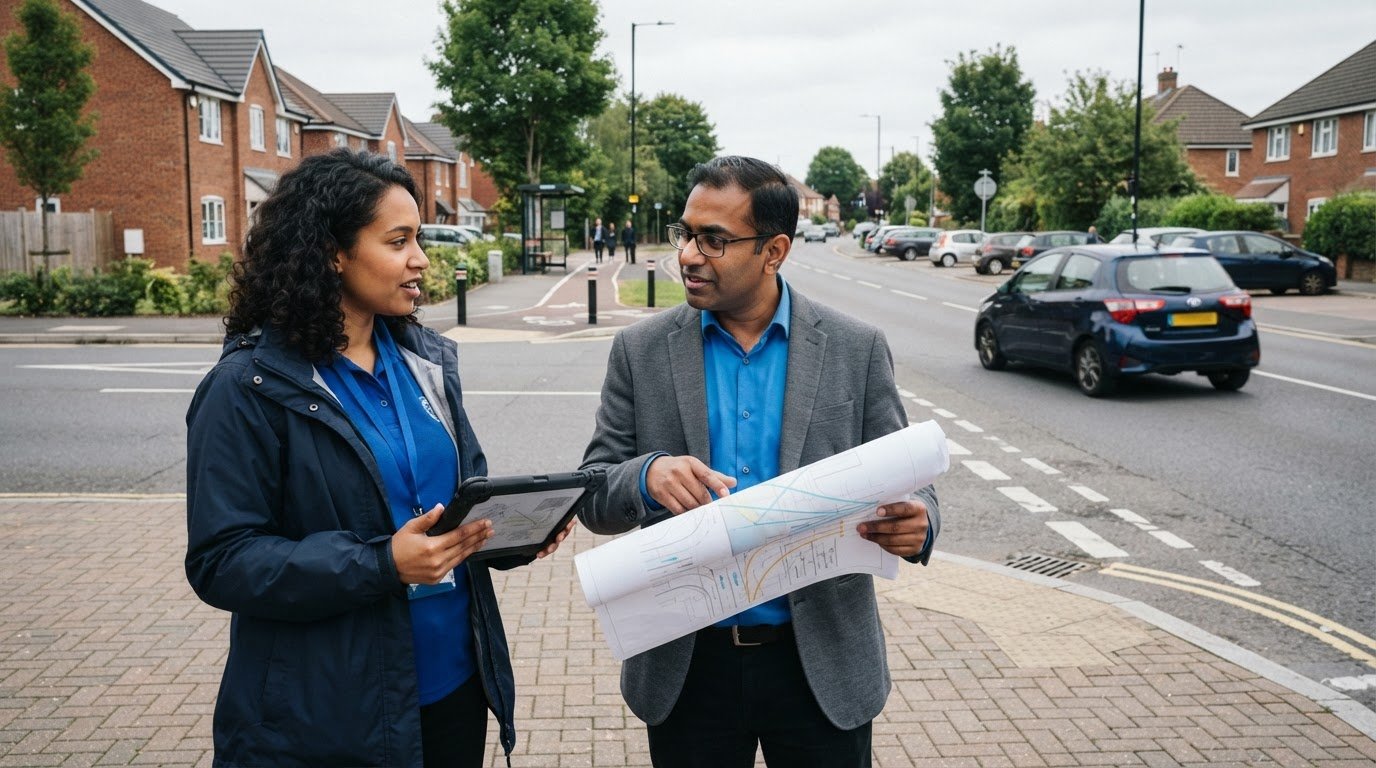
What if the key to challenging a highway refusal isn’t repeating your original case, but answering the concern the decision-maker says it left unresolved? Appealing a planning refusal on highway grounds can be difficult when highway authority advice, planning officer comments and your transport evidence don’t appear to align.
A refusal is frustrating, especially if you believed access, traffic or parking had already been addressed. The right next step depends on the precise reasons given and whether your evidence can respond to them. The highway authority’s advice can carry significant weight, but the planning authority makes the decision on the application.
This guide explains how to assess a refusal, compare an appeal with a revised application, and identify transport evidence that may help address each objection. Visibility, access design, parking, turning space, traffic effects, and walking or cycling provision can each call for a different response. A Transport Statement, Transport Assessment, traffic data or Swept Path Analysis may be relevant, but the evidence should be chosen to answer the specific concern. Check current official guidance for the applicable appeal route, deadline and process before deciding how to proceed.
Key Takeaways
- Use the decision notice and officer report to pinpoint the highway concerns the planning authority relied on.
- When appealing a planning refusal on highway grounds, address the stated objections and evidence gaps rather than simply restating the original application.
- Compare an appeal, revised application and further pre-application engagement against the design changes and evidence each route may require.
- Match each concern, such as traffic generation, access visibility, parking or vehicle manoeuvring, to relevant technical evidence and a clear next action.
- Gather the planning documents, confirm the current appeal process, then agree the evidence scope with your planning agent and relevant specialists.
What a planning refusal on highway grounds means for your application
A refusal on highway grounds means the planning authority considers that a transport-related aspect of the proposal weighs against permission. The stated concern might relate to traffic effects, access, highway safety or how the road network would operate. For example, the notice may refer to restricted visibility at a proposed access, insufficient space for vehicles to turn, or the effect of additional traffic.
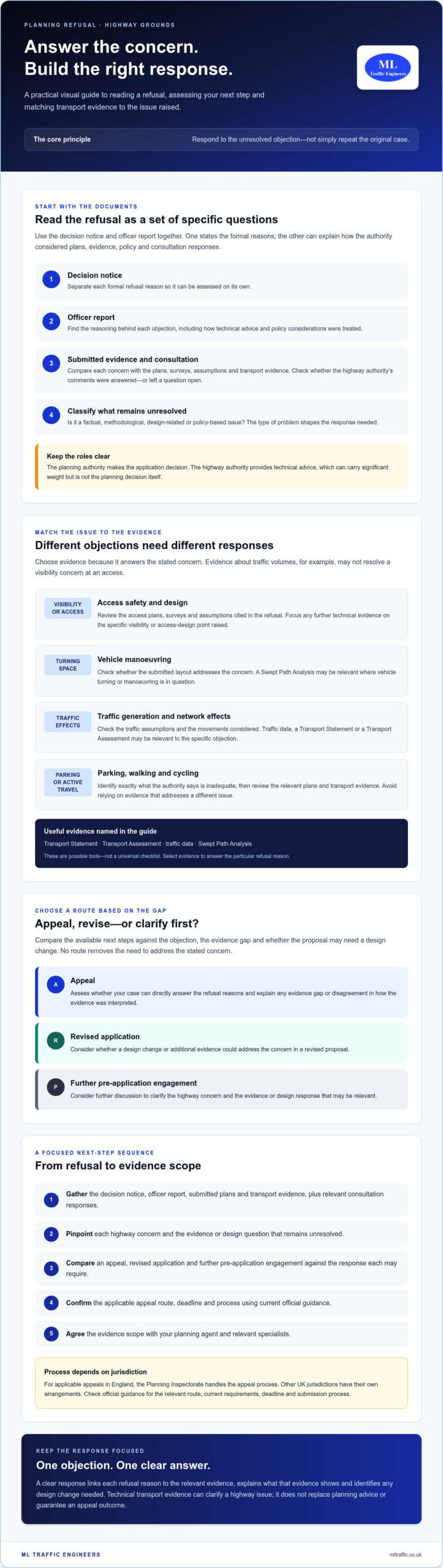
Start with the decision notice, which sets out the formal refusal reasons, then read the officer report for the reasoning behind them. The report may explain how the authority considered the submitted plans, technical evidence and consultation responses. Read the two documents together: the notice tells you what was refused, while the report can show which evidence or policy considerations informed that conclusion. This is the starting point for deciding what needs further investigation before appealing a planning refusal on highway grounds.
The Town and Country Planning Act 1990 provides statutory context for planning in England and Wales, but it isn’t a guide to appeal procedure. Planning rules and appeal arrangements vary across the UK. Confirm the correct route, current requirements and submission process for the relevant jurisdiction using official guidance.
How to identify the highway issues in the decision notice
Break each refusal reason into an issue to investigate. Note the plans, surveys, assumptions, policy references and consultee responses cited in the notice and officer report. Then classify the concern: is it about highway safety, access geometry, trip generation, parking or another transport effect? This distinction helps you avoid using evidence that doesn’t answer the objection. Traffic-volume analysis, for example, may not resolve a concern about visibility at an access.
Who makes the decision and who advises on highways?
The local planning authority decides the application, taking account of relevant planning considerations. The highway authority provides technical advice under the arrangements that apply locally. Its comments can inform the decision, but they are not the planning decision itself. Read the officer report to see how the authority treated that advice, whether the refusal relies on it, and whether it raises additional concerns.
For applicable appeals in England, the Planning Inspectorate handles the appeal process. Other UK jurisdictions have their own arrangements, so check official guidance before selecting a route or relying on procedural information. Technical transport evidence can help clarify a highway issue, but it doesn’t replace planning advice or guarantee an appeal outcome.
How to assess an appeal against a planning refusal on highway grounds
Before appealing a planning refusal on highway grounds, establish whether the refusal identifies a concern your evidence did not answer, or whether the authority has interpreted that evidence differently. A persuasive response should deal with the actual reason for refusal. Repeating the application case without addressing the gap is unlikely to clarify the issue or change how it is understood.
What to review before deciding whether to appeal
Work through the documents in sequence and record what each tells you:
- Decision notice: Separate the formal refusal reasons so you can assess each one on its own.
- Officer report: Find the reasoning behind each reason, including how the planning authority treated technical advice and relevant policy references.
- Submitted evidence: Compare each concern with the Transport Statement or Transport Assessment, plans, surveys and assumptions submitted with the application.
- Consultation record: Review the highway authority’s comments and any response from the applicant. Check whether the response resolved the concern or left a specific question unanswered.
- Outstanding issue: Classify the problem as factual, methodological, design-related or policy-based. A dispute about traffic assumptions needs a different response from an access layout that may need to change.
Compare the objection with the evidence on the same point. If the concern is peak-hour traffic, check whether the analysis covers the relevant movements and explains its assumptions. If it concerns access visibility, check whether the submitted plans and supporting information address that specific issue. The government’s guidance on transport evidence bases can help frame the role of transport evidence in planning decisions.
When a revised application may be worth considering
An appeal and a revised submission address different situations. If the objection appears to arise from a misunderstanding or a gap in the evidence, further analysis may help explain the existing proposal. If the concern depends on the design itself, such as the position or arrangement of an access, a revised layout may address it more directly. Discuss the options with your planning agent and, where relevant, the highway authority.
A Transport Assessment should be proportionate to the proposal and the issues being examined. For context on the report’s role, see this Transport Assessment guide. A technical review may also help identify what evidence is missing before you commission further work. You can review ML Traffic Engineers UK’s transport planning services to understand the reports and analysis available.
Don’t assume an appeal can introduce any new evidence, or that a revised application is automatically the better route. Procedures differ by jurisdiction and may depend on the application and appeal type. Check current official guidance for the correct route, evidence rules and deadline before deciding.
Appeal or revised application: compare your options on highway evidence
Choose the next step by identifying what would need to change to resolve each highway objection. If the dispute concerns how the existing evidence was interpreted, an appeal may be worth investigating. If the refusal identifies a design issue, such as an access arrangement, a revised proposal may address it more directly. Further pre-application engagement can help clarify the authority’s concerns before you commit to either route.
| Route | May suit where… | Key point to check |
|---|---|---|
| Appeal | You dispute the authority’s assessment of the submitted evidence or its reasoning. | Can the case and supporting material be presented under the current appeal procedure? |
| Revised application | A specific design change or further analysis could respond to the objection. | What must change, and what evidence will support the revised proposal? |
| Pre-application engagement | You need to clarify an unresolved highway issue or discuss potential changes. | What feedback can the relevant authority provide, and how will you record and use it? |
Timing and procedure matter. An appeal follows the rules for the relevant jurisdiction and appeal type, while a revised submission involves preparing and determining a new application. Neither route guarantees a particular outcome. Before appealing a planning refusal on highway grounds, check current official guidance for eligibility, procedure and deadlines. The GOV.UK guide explains how to appeal a planning decision.
When an appeal may be the route to investigate
Consider an appeal if you believe the authority’s conclusion doesn’t fairly reflect the Transport Statement, Transport Assessment or other material already submitted. First confirm that the proposal and its evidence can be presented through the applicable process. Don’t assume you can introduce new technical material later: appeal evidence rules can vary, so check current guidance before deciding.
When a revised submission may address the problem more directly
A revised application may be more practical where the objection identifies a design or access deficiency that can be changed. If the proposal remains suitable but the evidence is incomplete, updated survey data or a clearer explanation of the transport case may help. In either situation, scope the work against the precise refusal reason. Another report will not resolve an objection unless it answers the question the authority raised.
For background on the purpose and scope of a Transport Assessment, see this Transport Assessment guide. Discuss the evidence needed with your planning agent and, where appropriate, the relevant highway authority before commissioning further technical work.
Build a focused technical response to each highway refusal reason
A useful response connects each refusal reason to the evidence that can answer it, the action required, the person responsible and any decision still outstanding. This keeps the work focused and helps the planning agent, transport consultant, applicant and relevant highway authority coordinate around the same issues. Scope the evidence to the refusal wording and site circumstances, not to a generic checklist.
Use a reason-by-reason matrix to manage the response:
- Objection: Quote or accurately summarise the specific refusal reason.
- Evidence needed: Identify what would test or clarify the concern, such as trip-generation assumptions, access-visibility information, parking data or vehicle-manoeuvring drawings.
- Action and owner: Record the analysis, plan change or information required, and who will prepare or confirm it.
- Outstanding decision: Note any point that requires agreement or clarification from the planning agent, applicant or relevant authority.
For example, a concern about vehicle manoeuvring calls for evidence that tests the relevant movements against the proposed layout. A concern about traffic effects may instead require analysis of trip assumptions and network impacts. Don’t commission every possible report by default. New evidence is useful only if it addresses the identified issue and is appropriate to the chosen planning route.
Match transport evidence to the objection
A Transport Statement or Transport Assessment may be relevant where trip impacts or transport policy are disputed. Swept Path Analysis can test whether vehicles can access or manoeuvre within a proposed layout. Traffic or parking surveys may be appropriate where current, relevant data is needed to examine a specific concern. Each report is an evidence input, not a guaranteed solution to the refusal.
Where manoeuvring is the central issue, this Swept Path Analysis planning guide explains the role of that type of assessment in planning applications.
Prepare a clear response for the decision-maker
Address the exact wording of each refusal reason first, then explain how the analysis responds. Identify the assumptions used, evidence sources, relevant drawings and any limitations. If a plan has changed, make clear which revision you are discussing and how it relates to the objection. Ask the planning agent and transport consultant to check that the technical response is consistent with the application or appeal material. Where appropriate, coordinate unresolved points with the relevant authority.
For technical analysis matched to your highway concerns, discuss transport evidence requirements with ML Traffic Engineers UK.
Get specialist transport evidence for your next planning step
Before commissioning further work, make sure it responds to the refusal rather than adding evidence without a clear purpose. An independent transport review can help identify whether the issue is missing analysis, an assumption that needs testing, a design constraint or a question for the planning agent or highway authority. This can help you scope proportionate work, but it cannot predict or guarantee the outcome of an appeal.
Use this sequence to prepare:
- Gather the record: Collect the decision notice, officer report, application plans and submitted transport documents.
- Confirm the route: Check current official guidance for the applicable appeal or resubmission process, including relevant deadlines and evidence requirements.
- Scope the evidence: Link each refusal reason to the information or design response that may address it.
- Coordinate advice: Discuss the technical issues with your planning agent, transport consultant and, where appropriate, the relevant highway authority.
- Record decisions: Note what evidence will be prepared, who is responsible and which issues remain unresolved.
What to prepare before speaking with a transport consultant
Bring the full decision record, not just the refusal notice. Include highway authority consultation comments, relevant correspondence, any applicant responses and revised drawings. A short list of the refusal issues, site or project constraints, and decisions still requiring professional advice will help focus the discussion. Note which documents or assumptions you believe relate to each concern.
How ML Traffic Engineers UK can support transport evidence
ML Traffic Engineers UK prepares transport planning reports and technical analysis for planning submissions. Depending on the refusal reasons and project scope, relevant evidence may include a Transport Statement, Transport Assessment, traffic or parking surveys, Travel Plan or Swept Path Analysis. The appropriate work depends on the issue being examined. Scope each report to the specific transport concern rather than selecting it simply because a refusal has occurred.
Support with technical evidence is distinct from legal representation. If you’re appealing a planning refusal on highway grounds, confirm the appeal route and evidence rules through current official guidance, and coordinate the technical scope with your planning agent. ML Traffic Engineers UK can discuss the refusal reasons and relevant transport evidence for your project, without guaranteeing an appeal outcome.
For schemes in Greater London, Manchester, Birmingham, the West Midlands, Liverpool, Surrey, East Sussex, West Sussex, Hampshire, Berkshire and Buckinghamshire, discuss your planning project with ML Traffic Engineers UK.
Choose your next step with confidence
A highway refusal doesn’t automatically mean an appeal is the right response. Start by identifying the exact concerns in the decision notice, then check whether the existing transport evidence answers them. If the issue is a design deficiency, a revised proposal may be worth considering. If it’s a disagreement about the evidence or its interpretation, investigate whether an appeal is appropriate.
For appealing a planning refusal on highway grounds, focus on evidence that directly addresses each stated reason. The right technical work depends on the site, proposal and refusal. Commissioning another report without a clear purpose may not resolve the underlying concern.
ML Traffic Engineers UK prepares Transport Statements and Transport Assessments for planning submissions, as well as traffic surveys and Swept Path Analysis. These services can contribute relevant technical evidence, but they don’t constitute legal representation or guarantee an appeal outcome. Coordinate your next steps with your planning agent and check current official guidance on the applicable process.
To discuss the transport evidence that may be relevant to your project, contact ML Traffic Engineers UK about your planning project. A focused review can help clarify what evidence may be needed for your next step.
Frequently Asked Questions
Can I appeal a planning refusal on highway grounds?
Yes, you can appeal a refusal if you’re entitled to appeal under the rules for your application and jurisdiction. When appealing a planning refusal on highway grounds, focus on the authority’s specific reasons and whether the evidence supports a different conclusion. Check current official guidance before proceeding, especially if the refusal relates to access safety, traffic effects or parking. An appeal does not guarantee that permission will be granted.
How long do I have to appeal a planning refusal?
In England, the general deadline is six months from the decision date, while householder appeals generally have a shorter 12-week deadline. If an enforcement notice is involved, the time limit may be shorter still. These periods can depend on the application and appeal route, and procedures differ across the UK. Check the date on your decision notice and promptly confirm the applicable deadline and submission process through current official guidance.
What evidence can help challenge a highway-related planning refusal?
Useful evidence depends on the exact objection. A traffic or parking survey may provide relevant data; a Transport Statement or Transport Assessment may address trip effects or transport policy; and access plans or Swept Path Analysis may help respond to layout or manoeuvring concerns. First compare the refusal reason with the evidence already submitted. New material is most useful when it answers a specific gap rather than repeating the original case.
Should I appeal or submit a revised planning application?
Consider an appeal if you dispute the authority’s assessment of the proposal or existing evidence. A revised application may be more direct if the refusal identifies a design issue that can be changed, such as an access arrangement. Further pre-application engagement may help clarify what the relevant authority would need to see. For a project in Greater London, Manchester or Birmingham, discuss options with your planning agent and check current procedures before choosing a route.
Can a Transport Assessment address a highway objection?
Yes, a Transport Assessment may help where the refusal concerns matters such as trip generation, network effects or transport policy, provided its scope matches the objection. It should make its assumptions, evidence sources and limitations clear. It won’t automatically resolve a design or access-safety concern, and submitting another report alone doesn’t guarantee a different decision. Coordinate its scope with your planning agent and, where appropriate, the relevant highway authority.
Is Swept Path Analysis useful when access or manoeuvring is disputed?
It can be useful when the objection concerns whether a vehicle can enter, leave or manoeuvre within the proposed layout. The analysis tests vehicle movements against the drawings and site arrangement, helping show where clearance or turning constraints may arise. It won’t answer unrelated issues such as trip generation or parking demand. Confirm that the vehicle type and layout assessed reflect the concern raised and the proposal under consideration.
Who decides a planning appeal involving highway concerns?
The local planning authority decides the original planning application, taking account of highway advice and other relevant planning matters. In England, the Planning Inspectorate handles applicable appeals, and an Inspector typically considers the appeal and makes a decision under the relevant procedure. Arrangements differ across the UK, so confirm which body and process apply to your location. The highway authority advises on technical highway matters but doesn’t make the planning appeal decision.

Disclaimer
The content on mltraffic.co.uk, including all technical articles, guides, and resources, is provided for general informational and educational purposes only. It is not intended to constitute professional advice in traffic engineering, transportation planning, development approvals, or any other technical or legal field.
While ML Traffic Engineers makes every reasonable effort to ensure the accuracy, completeness, and timeliness of the information published, we do not provide any warranties or representations (express or implied) regarding its reliability, suitability, or availability for any particular purpose. Any reliance you place on the content is strictly at your own risk.
In no event shall ML Traffic Engineers, its directors, employees, authors, or affiliates be liable for any direct, indirect, incidental, special, consequential, or punitive damages (including, without limitation, loss of profits, data, or business opportunities) arising out of or in connection with the use of, or inability to use, any information provided on this website.
The articles and guides on this site are not a substitute for engaging a qualified, professional traffic engineer to assess your specific project requirements. For tailored advice, compliance assessments, or traffic engineering services, please contact a competent professional.
This disclaimer may be updated from time to time without notice. By accessing or using this website, you agree to be bound by the most current version of this disclaimer.