A planning decision depends on more than how many trips a development may generate. It also depends on how clearly its transport effects are explained. To understand what a transport technical note covers, start with its purpose: it presents focused evidence about a development’s transport implications to support a planning application. It may set out trip forecasts, explain the assumptions behind them and assess potential effects on the surrounding highway network.
A useful report is technically robust and straightforward for planning teams to assess. This guide explains what a transport technical note typically covers, when it may be suitable and how forecasts translate development activity into estimated vehicle movements. It also outlines the expertise involved in preparing the report and how its evidence can fit into a wider transport planning submission.
Key Takeaways
- Identify when a focused transport note may support a planning application and when a broader assessment is more suitable.
- Understand how development details, traffic evidence and forecasting assumptions shape the report’s conclusions.
- Learn what transport planning expertise helps prepare clear, defensible technical evidence.
- Follow a practical sequence for gathering information, estimating trip generation and presenting likely highway effects.
- See how relevant planning guidance informs the scope and content of transport documents in the UK.
When is a transport technical note required for a planning application in England?
A transport technical note provides focused evidence when a planning proposal raises a specific question about traffic or transport. Its scope depends on the development, expected vehicle movements and highway issues involved. A small proposal with a straightforward access arrangement may need different analysis from a waste facility generating heavy goods vehicle movements. The essential step is to match the evidence to the planning questions raised by the application.
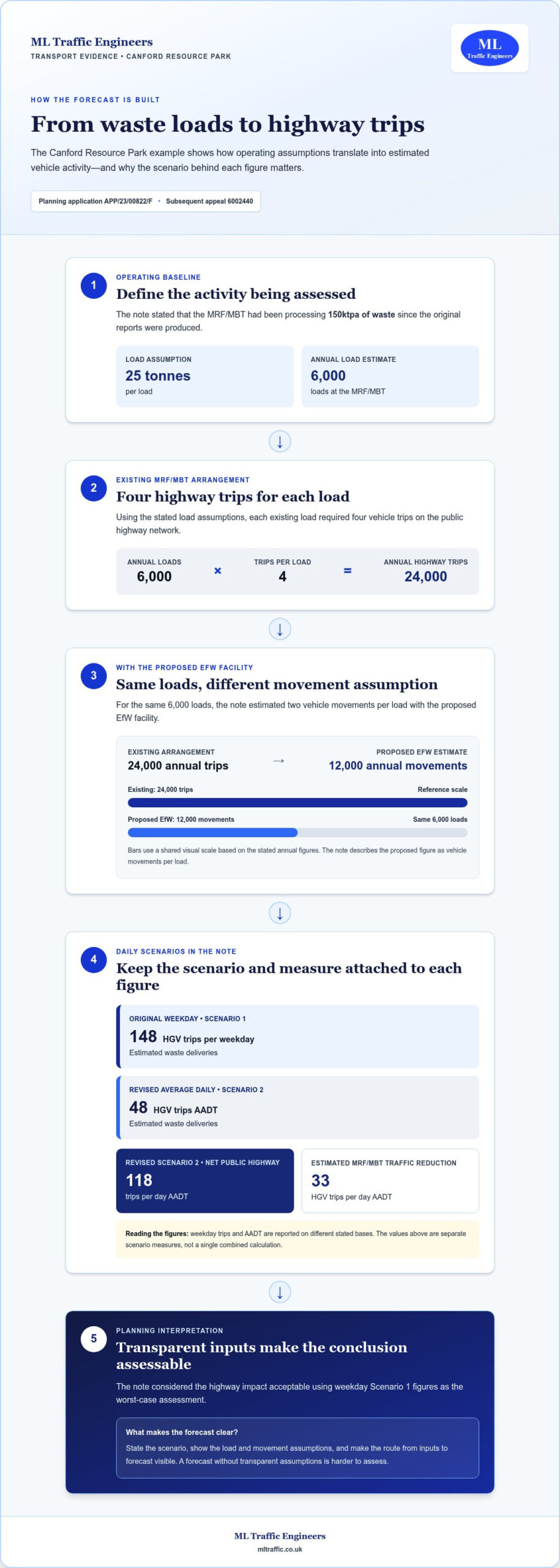
Consider the Canford Resource Park proposal, made under planning application APP/23/00822/F and subsequent appeal 6002440. Its technical note examined waste processing and forecast vehicle activity. It stated that 150ktpa of waste was being processed at the MRF/MBT since the original reports were produced. This example shows why a note may be needed: operational changes can alter traffic forecasts, even where a site already exists.
The Canford analysis set out its assumptions rather than presenting a forecast alone. It used 25 tonne loads and estimated 6000 loads annually at the MRF/MBT. Each existing load required four vehicle trips on the public highway network, producing 24,000 trips annual. With the proposed EfW facility, the same 6000 loads were estimated to require two vehicle movements per load, producing 12,000 trips annual. These calculations make the effect of operational assumptions visible.
It also compared daily scenarios. The original weekday Scenario 1 estimate for waste deliveries was 148 HGV trips per weekday. The revised average daily waste-delivery estimate for Scenario 2 was 48 HGV trips AADT. The revised Scenario 2 estimate for net AADT on the public highway network was 118 trips per day AADT. The MRF/MBT-related traffic reduction was estimated at 33 HGV trips per day AADT, using the stated load assumptions.
Those figures help explain when a note adds value: when a decision depends on trip generation, route use, or a change in operating assumptions. A useful report identifies its scenarios, explains inputs and shows how calculations lead to forecasts. At Canford Resource Park, the technical note considered highway impact acceptable using weekday Scenario 1 figures as the worst-case assessment. A forecast without transparent assumptions would be harder to assess.
Start by identifying the transport questions raised by the development. Then decide whether focused evidence can answer them or whether a wider assessment is needed. A transport technical note should define its scope and explain its evidence, rather than imply that every transport issue has been assessed. Knowing what a transport technical note covers, and what its forecasts include, helps align the report with the planning decision.
What is the difference between a transport technical note and a transport assessment?
The main difference between a technical note and a transport assessment is scope, not simply the document title. A technical note usually addresses a defined transport issue. A transport assessment considers a development’s transport effects more broadly. For example, a note might focus on access visibility or a revised delivery arrangement. An assessment may examine trip generation, travel choices, site access and effects across the surrounding network. The evidence should answer the planning questions raised by the proposal.
Consider a small change to an existing site entrance. If the key question is vehicle access, a focused note could explain the layout and relevant vehicle movements. A proposal with several uses, staff and visitor travel, servicing and network effects may require a broader assessment. The practical distinction is that one document answers a narrower question, while the other builds a wider transport picture. Neither title alone shows whether the analysis is sufficient.
Compare reports by checking their scope and evidence. A useful review asks whether the document:
- Defines the proposal, including its uses and access arrangements.
- Identifies the transport questions that the planning application must address.
- Explains its data, assumptions and method for forecasting trips.
- Connects its findings to relevant routes, junctions or travel options.
For example, a note about servicing should explain how delivery activity relates to the site and its access. If the development also generates substantial staff travel, a narrow focus on servicing may leave important questions unanswered. A transport assessment can bring these issues together, explain how they interact and set out their wider implications. The appropriate scope depends on the proposal and the issues requiring analysis.
Use a step-by-step scope test before choosing a report type. First, describe the development and its access. Next, list the transport effects that could influence the planning decision. Then identify the evidence needed to address each effect. If one defined issue is central, a focused note may be suitable. If several effects need joined-up analysis, a transport assessment may provide a clearer structure.
A transport assessment is not automatically better because it covers more. Unnecessary scope can obscure the central planning question, while an overly narrow note can omit relevant effects. For a mixed-use proposal, for instance, staff, visitor and servicing movements may need to be considered together. For a single access change, focused analysis may be more direct. The key is whether the report answers the application’s transport questions with clear, traceable evidence.
When reviewing a draft, compare each conclusion with its supporting evidence. Forecasts should follow from stated assumptions, and conclusions about access should relate to the proposed layout. If the scope leaves out a material transport issue, revise it before relying on the findings. This helps applicants choose a document that fits the planning task rather than relying on its title.
Who prepares a transport technical note and what qualifications are needed?
A transport technical note is prepared by a transport planning professional with relevant analytical experience. The work may involve reviewing site access, estimating trip generation, assessing routes and explaining assumptions. For example, a note about a proposed change to deliveries needs clear evidence about vehicle activity. The author should connect that evidence to the planning question, rather than rely on technical language alone.
No single qualification defines every author. One professional benchmark is the Transport Planning Professional qualification, developed by CIHT and the Transport Planning Society. It offers a structured route to demonstrate knowledge and continuing development. Applicants can consider this credential alongside relevant experience preparing transport reports when assessing expertise.
Applicants for the Transport Planning Professional qualification must be members of CIHT, TPS or CILT. They must show at least 25 hours of continuing professional development each year. This requirement covers at least two years before application. Applicants are also likely to need at least five years of transport planning experience. These criteria indicate the commitment and applied understanding associated with the qualification.
The qualification has different routes. The Standard route requires a UK bachelor’s degree or equivalent, plus an approved UK Transport Master’s degree. The PTK route is for applicants with a UK bachelor’s degree or equivalent but without an approved UK Transport Master’s degree. Both routes lead to the professional assessment process. Successful completion makes a candidate eligible to register as a Chartered Transport Planning Professional.
For a planning report, the author’s practical method matters alongside their credentials. Check whether the report identifies its data sources, states its assumptions and shows how forecasts were calculated. For example, it should link proposed site activity to expected vehicle movements and explain which routes were considered. Conclusions should follow from the analysis, not appear as unsupported assertions.
When reviewing a draft, follow these steps:
- Match the author’s transport planning experience to the development’s issues.
- Check that the note explains its scope and evidence.
- Trace key conclusions back to calculations or site information.
- Confirm that limitations and assumptions are plainly described.
A specialist may coordinate relevant inputs, such as access details or parking information, when they affect the analysis. For example, a forecast based on a particular delivery pattern should explain that pattern clearly. Professional judgement determines which evidence is relevant and how to present it. Technical understanding, transparent methods and relevant experience help make a note easier for planning officers to assess.
How do you prepare a transport technical note step by step
Start with the planning question, then build a clear trail of evidence. For a proposed change to site access, the note should explain the arrangement, expected vehicle activity and likely effects. Each conclusion should link to information or an explicit assumption. This keeps the report focused and helps readers follow how its findings were reached.
- Define the scope. Describe the development, its location and the transport issues being assessed. For an access proposal, state whether the note covers vehicle entry, servicing, or both. This prevents the report from implying that it examines effects beyond its stated purpose.
- Gather project information. Collect the site layout, proposed uses, operating details and access plans. A delivery-related proposal needs its delivery pattern described. Keep versions consistent, so the drawing assessed matches the development described in the text.
- Set out the existing context. Describe relevant roads, junctions, access points and travel options. For a site beside a narrow road, identify that road and explain its relevance to the assessment. Separate observed conditions from assumptions about future activity.
- Estimate trip generation. Explain how the proposed activity translates into vehicle movements. State the input assumptions, calculation method and resulting forecast. If a forecast depends on deliveries, show how the assumed delivery pattern affects the estimate. Readers should be able to follow the calculation.
- Assess the effects. Relate forecast movements to the relevant access and routes. Explain which effects matter for the proposal, such as additional vehicle activity at a junction. Keep the analysis proportionate to the scope, and support each conclusion with the evidence presented.
- Present and check the report. Organise the note from proposal details through methods, findings and conclusions. Check that every table, drawing and forecast refers to the same scheme. Resolve inconsistent terminology before submission, such as different names for one entrance.
For a site with staff and deliveries, show those activities separately in the forecast. Explain each input before combining movements into a total. If the proposal changes during design, revisit the affected calculations and drawings. A revised access layout, for example, may change the routes considered. Recording these changes makes the analysis easier to follow.
Finish with a concise conclusion that answers the original planning question. Identify the supporting evidence and state the report’s scope clearly. Reviewers should be able to follow the sequence from proposal description to forecast, assessment and final finding without having to guess how each step connects.
What UK planning guidance and rules apply to transport technical notes
Transport technical notes sit within a planning system shaped by national policy and local requirements. The relevant policies and guidance depend on the application’s location and transport issues. In England, first identify the planning authority and highway context. Then determine which policies or technical guidance apply to the site, access and proposed development. The note should explain how its evidence responds to those considerations.
Guidance differs across the UK. Welsh Government Technical Advice Note 18 covers the integration of land use and transport planning, the location of development, regional transport plans and development design. It is a Wales-specific reference, not an England-wide rule. For an English application, the report should use guidance relevant to its location and avoid presenting Welsh policy as applicable there.
Local technical documents may address detailed design matters. Hampshire County Council’s published technical guidance includes highway cross-sections, alignment design, visibility splays, and pedestrian and cycle facilities. These topics may inform drawings or design evidence related to a proposal, but their titles alone do not determine the scope of every transport technical note. Match each reference to the issue it addresses.
Hampshire County Council’s TG0 Introduction to the Technical Guidance Notes was last updated on 24 October 2025. TG1 Highways Cross-Sections was last updated on 14 July 2025, while TG2 Alignment Design was last updated on 15 October 2025. These dates help readers identify the relevant edition when a report refers to those documents.
Other Hampshire examples include TG3 Stopping Sight Distances and Visibility Splays, last updated on 27 May 2025, and TG10 Pedestrian and Cycle Facilities, last updated on 12 February 2026. TG11 Traffic Calming was last updated on 3 July 2026. A note discussing visibility or walking routes should clearly connect the cited topic to its analysis, rather than include guidance references without explanation.
Use a clear document-checking sequence:
- Identify whether the application is in England or Wales.
- Confirm the relevant planning authority and highway context.
- Match each policy or technical document to a report topic.
- Record the document title and applicable update date.
- Explain how the reference informs the evidence or conclusion.
This approach helps distinguish planning considerations from detailed design guidance. A report about access visibility, for example, should show how the visibility evidence relates to the access being assessed. It should also avoid treating a county technical note as a national planning rule. For support preparing transport evidence for a planning submission, discuss your transport planning requirements.
ML Traffic Engineers UK: Transport Statements
ML Traffic Engineers UK prepares Transport Statements to support planning applications where transport evidence is needed. The statement presents relevant site and access information, with its scope shaped around the proposal’s transport issues. Where a development needs broader analysis, a Transport Assessment provides a wider assessment of transport effects.
Supporting evidence may also include Parking Surveys or Swept Path Analysis when they address the application’s specific questions. For example, a proposal involving vehicle access may need analysis of how vehicles manoeuvre, while parking evidence can inform consideration of site demand. Choose the report and supporting evidence to fit the planning task.
If your application needs transport planning evidence, contact ML Traffic Engineers UK or visit mltraffic.co.uk.
Move your planning submission forward
Define the transport evidence needed before your planning submission takes shape. Identify the question the report must answer, the project information that supports it and how its findings will inform the application. If you are considering what a transport technical note is for your proposal, focus on the planning issue it must address and the evidence needed to make its conclusions clear.
ML Traffic Engineers UK prepares Transport Statements and provides related transport evidence through Swept Path Analysis and Parking Surveys. These services can address specific project needs, such as documenting vehicle movements or understanding parking provision. Choose support that fits your project requirements and planning context.
Start a conversation about the transport evidence your application needs. Contact ML Traffic Engineers UK to discuss the next step, and move ahead with a clear plan for your submission.
Frequently Asked Questions
What is a transport technical note in UK planning?
In UK planning, a transport technical note is a focused report presenting evidence about a development’s transport implications. It explains a specific issue relevant to a planning application, such as access or vehicle activity. Understanding what a transport technical note covers helps distinguish its defined scope from a broader assessment. Its value depends on how clearly its findings relate to the proposal and planning question.
What information is included in a transport technical note?
A note commonly identifies the proposal, the transport issue examined, relevant site details and evidence supporting its conclusions. It may include a location plan, access drawings, assumptions and analysis. For example, a note about a redesigned entrance could explain how the submitted layout relates to vehicle access. Check that drawings match the proposal being assessed and that technical terms or abbreviations are clear to planning readers.
What transport data, surveys and modelling are needed for a technical note?
The evidence depends on the question the note must answer. A proposal affecting traffic may need traffic counts or trip forecasts; a parking issue may call for parking survey data. Modelling is relevant when network or junction effects need analysis, not automatically required for every note. The report should explain the data sources, collection conditions and assumptions so readers can understand how the evidence supports its conclusions.
How do local planning authorities and highways authorities review transport technical notes?
Check whether the note defines the proposal and access, identifies the transport questions, explains its data and forecasting assumptions, and connects its findings to relevant routes, junctions or travel options. Its conclusions should rest on clear, traceable evidence, and its scope should cover material transport issues.

Disclaimer
The content on mltraffic.co.uk, including all technical articles, guides, and resources, is provided for general informational and educational purposes only. It is not intended to constitute professional advice in traffic engineering, transportation planning, development approvals, or any other technical or legal field.
While ML Traffic Engineers makes every reasonable effort to ensure the accuracy, completeness, and timeliness of the information published, we do not provide any warranties or representations (express or implied) regarding its reliability, suitability, or availability for any particular purpose. Any reliance you place on the content is strictly at your own risk.
In no event shall ML Traffic Engineers, its directors, employees, authors, or affiliates be liable for any direct, indirect, incidental, special, consequential, or punitive damages (including, without limitation, loss of profits, data, or business opportunities) arising out of or in connection with the use of, or inability to use, any information provided on this website.
The articles and guides on this site are not a substitute for engaging a qualified, professional traffic engineer to assess your specific project requirements. For tailored advice, compliance assessments, or traffic engineering services, please contact a competent professional.
This disclaimer may be updated from time to time without notice. By accessing or using this website, you agree to be bound by the most current version of this disclaimer.