At appeal, transport evidence faces closer scrutiny. Its methodology, assumptions and professional judgement may all be challenged. An independent transport assessment review can identify weaknesses in trip generation, traffic distribution or junction capacity evidence before they become points of dispute. The inspector’s assessment of that evidence may also influence how the wider planning case is considered.
It is understandable to want clarity about what an appeal means for a transport assessment and whether its conclusions can withstand challenge. The key question is not simply whether another party disagrees, but whether the evidence explains its assumptions and reasoning clearly and consistently.
This article explains how transport evidence is considered at appeal, which points are commonly challenged and how an independent review can help test the case. It also covers baseline traffic data, early engagement with the Local Highway Authority and what to expect from a professional review.
Key Takeaways
- At appeal, inspectors examine the evidence’s methodology, assumptions and professional judgement, not just its conclusions.
- Trip generation, traffic distribution and junction capacity are common points of challenge, so clear reasoning strengthens the case.
- Baseline surveys should reflect typical current conditions; outdated data can invite scrutiny.
- The appropriate report depends on the development’s scale, complexity and likely transport impacts, with early scope discussions helping align the assessment.
- An independent review can identify weaknesses in transport evidence before they become central issues at appeal.
Assessment of existing transport conditions
An assessment begins by describing how people and vehicles currently reach the site, including access by walking, cycling, public transport and private car. This gives the planning case a baseline for understanding the development’s likely transport effects. An independent transport assessment review checks whether that description is relevant, balanced and supported by appropriate evidence.
For walking, a review considers routes between the site and nearby destinations such as shops, schools and community facilities. It examines whether connected pedestrian routes lead to the site and whether access points are clear. A site beside a main road, for example, may be close to local facilities but still require careful consideration of how pedestrians cross or travel along the road.
Cycling and public transport need separate consideration. The assessment should describe available cycle connections and the site’s relationship to public transport services, then explain how these options affect access for future users. Simply listing nearby infrastructure is not enough. A nearby bus stop, for instance, does not explain how people can travel between the stop and the site.
Existing highway conditions also matter. An assessment considers site access, surrounding roads and relevant junctions, along with traffic movement and highway safety. It should show how the development relates to current conditions and where its effects may need closer examination. The scope should be proportionate to the development’s scale and nature.
- Accessibility: walking, cycling and public transport connections.
- Movement: how people and vehicles use nearby roads and junctions.
- Safety: conditions that affect access and movement around the site.
- Planning context: transport impacts, sustainability and policy considerations.
These elements need to form a coherent picture. A strong description links the site’s location, access arrangements and transport choices, then explains why they matter to the proposal. For example, it distinguishes a nearby destination from a practical route to reach it. This helps decision-makers understand the transport context rather than rely on isolated observations.
The appropriate report also depends on the proposal. Transport Assessments typically support larger or more complex developments, while Transport Statements are used for smaller schemes with more limited impacts. Both can explain how transport effects are understood and managed. A review can test whether the evidence covers the relevant modes and conditions, and whether its conclusions follow from the information presented. Transport assessment considerations can also help explain how this evidence supports a planning application.
Background growth and baseline traffic data
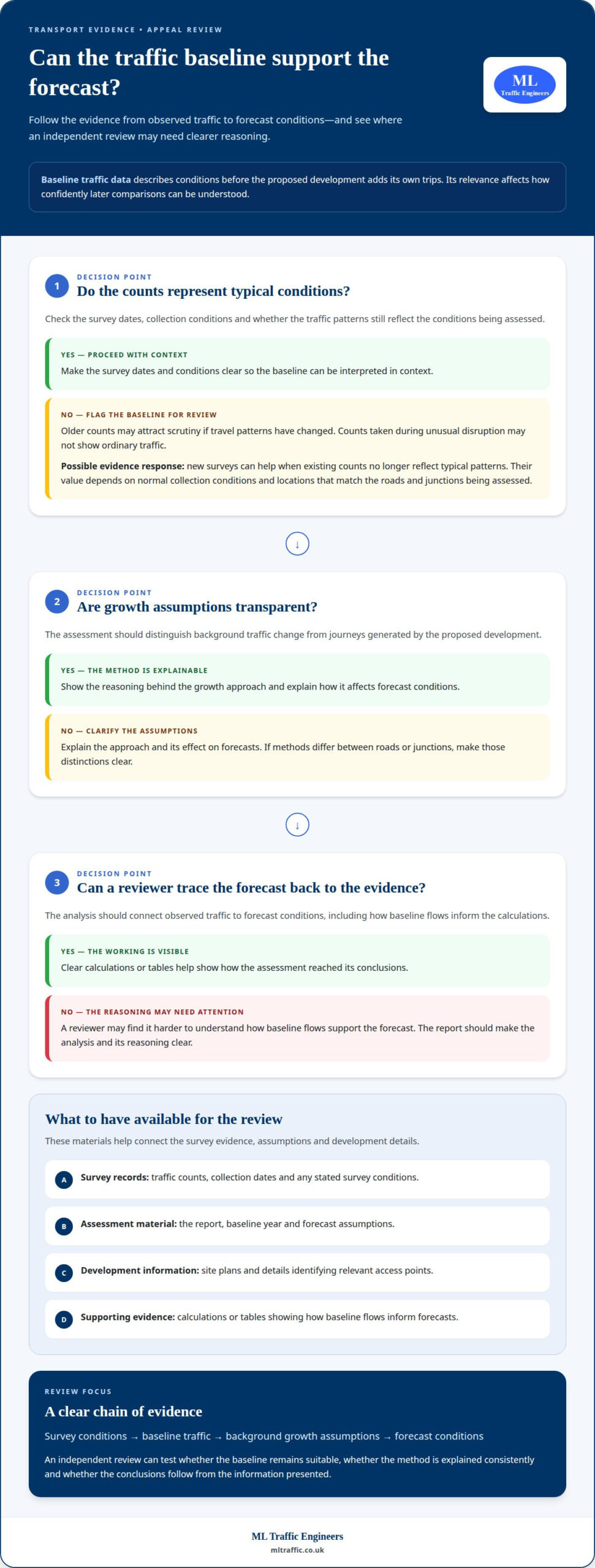
A review needs the existing assessment, traffic survey results, survey dates and stated growth assumptions. Site plans and development details help show which roads, junctions and travel movements the evidence covers.
Baseline traffic data describes conditions before the proposed development adds its own trips. A reviewer considers whether the evidence represents typical conditions and whether the circumstances of its collection are explained. Older counts may attract scrutiny if travel patterns have changed. Counts taken during unusual disruption can also give an incomplete picture of ordinary traffic.
Survey dates matter because the baseline underpins later comparisons. If counts are old, the assessment should explain why they remain suitable for the site and the decision. A survey period that does not reflect typical conditions may weaken the evidence, even if the figures were recorded accurately. The key question is how well the data represents the conditions being assessed.
Growth assumptions also need to be transparent. A reviewer considers how the assessment accounts for background traffic change, separately from journeys generated by the proposed development. The report should explain the reasoning behind its approach and how that approach affects forecast conditions. If the method differs between roads or junctions, the report should make that distinction clear.
- Survey records: traffic counts, collection dates and any stated survey conditions.
- Assessment material: the report, baseline year and forecast assumptions.
- Development information: site plans and details used to identify relevant access points.
- Supporting evidence: calculations or tables showing how baseline flows inform forecasts.
These documents let the reviewer trace the analysis from observed traffic to forecast conditions. If a junction forecast relies on older counts, for example, the review considers whether the report explains why they remain relevant. It also checks whether the growth method is applied consistently across the network. Clear working makes it easier to understand how the assessment reached its conclusions.
New traffic surveys can help when existing counts no longer reflect typical patterns. Their value depends on collecting evidence under normal conditions and choosing locations that match the relevant roads and junctions in the assessment. The survey record should clearly state its dates and scope so the figures can be interpreted in context.
Where a project needs updated traffic evidence, traffic survey work can provide data for assessment and review. The reviewer can then consider whether the baseline supports the forecasts, or whether its age, coverage or collection conditions need closer explanation.
Old baseline data and survey periods that do not reflect typical conditions may attract scrutiny during a transport assessment challenge. Traffic surveys collected under normal conditions can provide a more relevant picture than older data that may no longer reflect current patterns.
Grounds for challenging transport assessments at appeal
At planning appeal, transport evidence can receive closer scrutiny than at the application stage. An inspector may examine the assessment’s methodology, assumptions and professional judgement directly. A challenge should identify a weakness in the evidence, not simply disagree with its conclusions. For example, a challenge to a forecast should explain which assumption or calculation may produce an unreliable result.
Trip generation is a common point of dispute. An appellant may argue that the selected trip rates are too low for the development, understating expected traffic. The assessment should explain why the chosen rates suit the proposal and how they shape the forecast. A reviewer tests that reasoning rather than treating a trip-rate figure as self-explanatory.
Traffic distribution and assignment can also be contested. These choices determine which roads and junctions are expected to carry development traffic. If too few trips are assigned to a constrained junction, the forecast may understate the effect there. A defensible explanation links distribution assumptions to the site and expected travel patterns, then applies the reasoning consistently across the network.
Junction capacity results may be challenged when the method or inputs appear to understate development impacts. A reviewer considers whether the assessment explains its modelling assumptions and how the results relate to forecast traffic. A favourable result alone does not demonstrate robust analysis. The reasoning should let the inspector follow how the evidence supports its conclusion.
- Trip generation: whether the selected rates have a clear, relevant rationale.
- Traffic distribution: whether forecast journeys are assigned plausibly across affected roads.
- Junction capacity: whether assumptions and results fairly represent the proposed impact.
- Professional judgement: whether decisions are explained consistently and transparently.
Credibility matters as much as technical detail. An assessment that acknowledges a material impact and explains how it has been considered can appear more balanced than one that minimises every effect. If a junction is forecast to face additional pressure, for instance, the report should explain the result and its planning significance. Omitting or downplaying it may prompt questions about the wider analysis.
Transport is often a technically contested appeal issue, but it rarely stands alone. If an inspector doubts the transport evidence, that concern may affect how the wider planning case is weighed. An independent transport assessment review can identify weaknesses before appeal, clarify which assumptions need better explanation and distinguish a substantive flaw from a difference in professional opinion. The aim is a transparent evidence trail, not a guaranteed appeal outcome.
Early engagement with the Local Highway Authority
Early discussions with the Local Highway Authority help define the assessment’s scope and methodology. They give the assessment team an opportunity to understand which issues the authority considers relevant. A proposal affecting a busy junction, for example, may need focused consideration of its operation. Agreeing the approach early helps clarify what the report needs to address.
Scope discussions should link the proposed development to its likely transport effects. The assessment team can explain the proposal, identify access arrangements and discuss which parts of the highway network need attention. The authority can then comment on whether the proposed coverage addresses local concerns. This exchange helps prevent a report from examining the wrong locations or overlooking an important movement.
Methodology matters just as much. The parties can discuss how the assessment will address trip generation, traffic distribution, background growth and junction capacity. If a particular junction may receive development traffic, for example, the methodology should explain how it will be assessed. Clear reasoning at this stage makes the later analysis easier to follow.
Early engagement can also reveal where local expectations differ from the proposed approach. A methodology may be technically sound yet differ significantly from the approach normally expected by the local authority and its highway consultees. That difference may prompt questions during the application or appeal. Explaining the rationale early gives the assessment team an opportunity to address it transparently in the evidence.
- Define the scope: identify relevant access points, roads and junctions.
- Discuss the method: explain how trip generation and traffic effects will be assessed.
- Record the reasoning: make clear why the selected approach suits the proposal.
- Address differences: explain any significant departure from the authority’s expected approach.
These discussions do not replace the technical assessment; they establish a clear basis for it. If the proposal changes after the initial discussions, the assessment team should consider whether the agreed scope still reflects the revised access, development scale or transport effects. A changed access arrangement, for example, may alter which junctions need examination.
At appeal, an independent reviewer can compare the report’s actual scope and method with the approach discussed with the Local Highway Authority. The reviewer can identify unresolved differences and assess whether the report explains its choices. An unexplained departure may distract from otherwise sound analysis. A clear record of the authority’s comments and the assessment team’s response helps show how key decisions were reached.
Early engagement is most useful when it leads to specific, traceable decisions. The report should explain its methods and relevant assumptions, rather than rely on an unexplained reference to earlier discussions. This clarity helps an inspector assess the evidence directly and understand why the assessment took its chosen approach.
When is an independent transport assessment required in the UK?
The need for a particular report depends on the development’s scale, complexity and likely transport effects. Larger or more complex proposals typically use a Transport Assessment, while smaller schemes with more limited impacts typically use a Transport Statement. The scope should be proportionate to the proposal, not based on a one-size-fits-all threshold.
An independent review has a different purpose from preparing an assessment: it tests whether existing transport evidence is robust, relevant and clearly explained. It may be useful when an application receives a technical objection, a planning decision relies on disputed transport conclusions or an appeal is being prepared. The aim is to test the evidence, not to assume every application needs a second report.
The scheme’s scale and nature help determine how much transport analysis is needed. A complex development may require closer examination of trip generation, traffic distribution and junction capacity. A smaller proposal with limited effects may need a more focused account. In either case, the report should explain why its methods and coverage suit the development and its location.
Consider an application where the highway authority questions predicted traffic at a junction. An independent review can examine the trip assumptions, distribution method and capacity results together. If the dispute concerns whether walking, cycling or public transport access has been assessed adequately, the reviewer can focus on those connections instead. The scope should follow the specific issue, not expand without a clear reason.
- At application stage: seek an independent review if a material technical concern needs closer analysis.
- Before appeal: review contested assumptions and identify where the report’s reasoning needs clearer explanation.
- For a changed proposal: consider whether revised access or development details affect the existing transport evidence.
- For proportionate reporting: match the assessment’s scope to the proposal’s scale, complexity and likely effects.
An independent review does not replace the planning authority’s consideration of an application. It provides a technical examination of the evidence and its reasoning. The reviewer can distinguish a methodological weakness from a difference in professional judgement, then explain how the issue affects the transport conclusions. This distinction is useful when preparing a focused response to an objection or appeal argument.
For a project team, the practical starting point is to identify the transport question requiring independent scrutiny. A clear scope helps keep the review relevant, whether it concerns a full assessment or a specific assumption. Discuss transport assessment support for a planning proposal or contested transport evidence.
ML Traffic Engineers UK: Transport Assessments
ML Traffic Engineers UK prepares Transport Assessments and Transport Statements for development planning applications. Turn to the team when a proposal needs transport evidence or when its scale and likely effects call for a clearly scoped assessment. The report can address site access and the potential effects of the proposed development on surrounding transport conditions.
Where a project needs supporting technical information, Swept Path Analysis can assess vehicle movement, while Parking Surveys can provide evidence about parking conditions. These services address specific project requirements alongside transport planning documents.
For a planning proposal, the next step is to discuss its transport evidence needs and relevant project details. Contact ML Traffic Engineers UK to discuss your transport planning requirements.
Make your next planning decision with confidence
An appeal can put transport evidence under direct scrutiny, so review findings should inform a clear, focused response. An independent transport assessment review can clarify which evidence needs refinement and which points need stronger explanation. This gives the project team a practical basis for addressing transport concerns as the planning process continues.
ML Traffic Engineers UK supports development projects with transport planning work, including Transport Statements, Swept Path Analysis and Parking Surveys. These services can address specific documentation or data needs alongside a wider planning proposal. The right scope depends on the transport questions raised by the project.
If you’re preparing an application or responding to a transport objection, take the next step with a clear account of the evidence required. Contact ML Traffic Engineers UK to discuss your project’s transport planning needs.
Frequently Asked Questions
What is an independent transport assessment review?
An independent transport assessment review is a technical examination of transport evidence by a reviewer separate from its preparation. It tests whether the report’s conclusions follow from its data, methods and reasoning. For example, where an appeal statement disputes a forecast, a reviewer can assess whether the evidence supports that criticism. The review helps clarify which points need a technical response and which conclusions remain supported.
What does a transport assessment review include?
A review typically examines the submitted report and relevant supporting material, such as survey records, plans and calculations. Its focus follows the planning issue. For example, it may assess whether a proposed access layout matches the vehicle movements shown in the drawings. The reviewer considers how the evidence fits together and identifies gaps or inconsistencies. Findings can inform a response, an appeal case or decisions about further technical work.
How does an independent transport assessment differ from a transport statement or audit?
A Transport Assessment or Transport Statement describes and assesses a development’s transport effects. An independent review examines existing transport evidence; it is a review process, not another report category. “Audit” can refer to different types of scrutiny, so its meaning depends on the stated scope. For a planning matter, specify whether the work tests a report, a design detail or another submission.
What are common risks or reasons a transport assessment is rejected?
A planning application may receive an adverse decision if its transport evidence fails to address a material concern, although no single technical criticism automatically determines the outcome. Risks include unclear evidence about site access, unsupported forecasts or a report that does not explain how its findings relate to the proposal. For example, inconsistent vehicle access drawings and traffic conclusions may raise questions about the evidence’s overall reliability.
What UK planning rules and guidance apply to transport assessments?
Transport Assessments and Statements address transport impacts, highway safety, sustainability and policy compliance. The report’s scope should be proportionate to the development, with its scope and methodology discussed early with the Local Highway Authority.

Disclaimer
The content on mltraffic.co.uk, including all technical articles, guides, and resources, is provided for general informational and educational purposes only. It is not intended to constitute professional advice in traffic engineering, transportation planning, development approvals, or any other technical or legal field.
While ML Traffic Engineers makes every reasonable effort to ensure the accuracy, completeness, and timeliness of the information published, we do not provide any warranties or representations (express or implied) regarding its reliability, suitability, or availability for any particular purpose. Any reliance you place on the content is strictly at your own risk.
In no event shall ML Traffic Engineers, its directors, employees, authors, or affiliates be liable for any direct, indirect, incidental, special, consequential, or punitive damages (including, without limitation, loss of profits, data, or business opportunities) arising out of or in connection with the use of, or inability to use, any information provided on this website.
The articles and guides on this site are not a substitute for engaging a qualified, professional traffic engineer to assess your specific project requirements. For tailored advice, compliance assessments, or traffic engineering services, please contact a competent professional.
This disclaimer may be updated from time to time without notice. By accessing or using this website, you agree to be bound by the most current version of this disclaimer.