Will a single inconsistency between Transport for London (TfL) requirements and borough-specific mandates derail your 2026 planning application? You already know that securing approval in the capital requires more than just a standard transport assessment. It demands robust green travel plans that satisfy conflicting regulatory bodies while remaining financially viable. Planning delays often stem from inadequate documentation, yet the cost of getting it wrong can exceed tens of thousands in lost project time.
We’ve designed this guide to help you master these complexities and secure a safe pair of hands for your project’s logistics. You’ll gain a clear roadmap to planning approval, learn how to reduce site car-dependency by up to 20% based on recent London trends, and implement cost-effective transport strategies that satisfy every stakeholder. We’ll examine the technical requirements for 2026 and provide a sequential implementation strategy to keep your project compliant and moving forward without delay.
Key Takeaways
- Align your development with the latest London Plan 2021 and 2026 updates to ensure a seamless route to planning approval.
- Master the technical requirements for developing robust green travel plans, including site audits and PTAL-based SMART targets.
- Identify the essential ‘Hard’ and ‘Soft’ mitigation strategies needed to meet stringent cycle parking and sustainable transport standards.
- Understand the long-term compliance obligations, from appointing a Travel Plan Co-ordinator to managing the Year 1, 3, and 5 monitoring cycles.
- Learn why bespoke, borough-specific strategies are vital for navigating the complex regulatory landscape of London’s diverse planning authorities.
Table of Contents
What is a Green Travel Plan in the London Planning Context?
A Green Travel Plan (GTP) is a package of bespoke measures designed to reduce single-occupancy car use and promote sustainable transport alternatives. It’s no longer a "nice-to-have" document; it’s a technical requirement for modern development. For developers, What is a Travel Plan? provides the foundational context, noting that while the industry often uses the term "Green Travel Plan," the UK planning system officially refers to it as a Travel Plan. These documents align development goals with the Mayor of London’s 80% sustainable mode share target for 2041.
The evolution of green travel plans under the London Plan 2021 and the 2026 updates has shifted the focus from soft encouragement to hard enforcement. It’s about proving that a development won’t just "try" to reduce car use, but will actively achieve it through infrastructure and monitoring. We see a clear distinction between workplace plans focusing on staff commuting, residential plans targeting household shopping trips, and school plans prioritising safe, active routes for pupils. Each requires a different set of interventions, from cycle parking and car clubs to electric vehicle charging infrastructure.
To better understand this concept, watch this helpful video:
The Legal Framework: The London Plan and Local Borough Requirements
The National Planning Policy Framework (NPPF) sets the baseline for transport decisions, but the London Plan adds layers of city-specific rigour. The 10 "Healthy Streets" indicators now drive GTP requirements, forcing developers to consider how their projects impact the public realm. Thresholds for green travel plans vary significantly across the capital. For instance, Barnet may trigger a full GTP requirement at a different density level than Lambeth. These local variations mean developers need precise, CAD-backed data to ensure compliance from the initial planning phase through to final implementation.
Why a Green Travel Plan is Essential for Planning Permission
How to Develop a Robust Green Travel Plan for Your Site
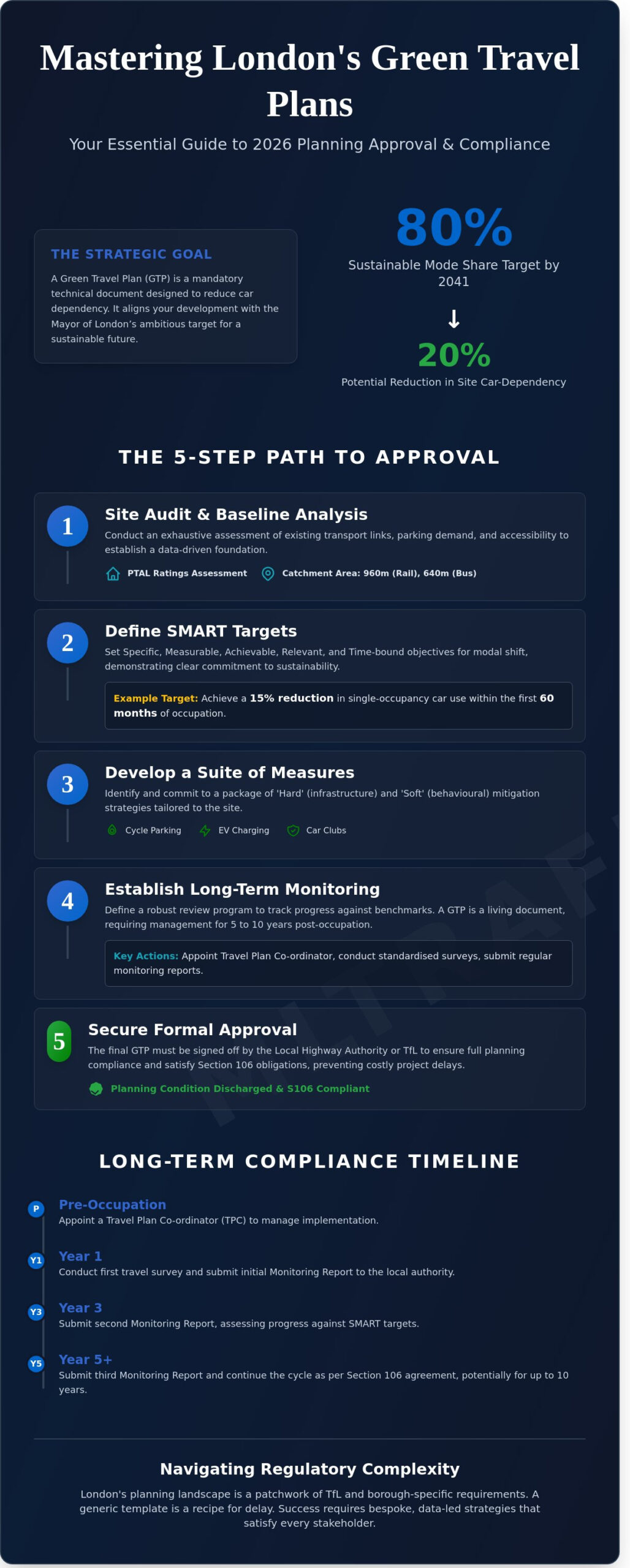
Creating effective green travel plans requires a sequential, data-led approach. Developers must move beyond generic templates to deliver site-specific strategies that satisfy Transport for London (TfL) requirements and local borough mandates. The process follows five critical stages:
-
Step 1: Site Audit. Conduct an exhaustive assessment of existing transport links and PTAL ratings within a 960-metre radius for rail and 640-metre for bus.
-
Step 2: SMART Targets. Define clear goals for modal shift, such as a 15% reduction in single-occupancy car use within the first 60 months of occupation.
-
Step 3: Suite of Measures. Identify site-specific interventions like secure cycle storage, electric vehicle charging points, and car club memberships.
-
Step 4: Monitoring. Establish a review programme spanning 5 to 10 years to track progress against benchmarks using standardised survey methods.
-
Step 5: Formal Approval. Secure sign-off from the Local Highway Authority or TfL to ensure planning compliance and satisfy Section 106 obligations.
Baseline Data Collection: Parking Surveys and PTAL Ratings
Accurate parking surveys form the foundation of any GTP. These surveys identify current demand and prevent overspill into adjacent residential streets. Understanding Public Transport Accessibility Levels (PTAL) is equally vital. A site with a PTAL of 6b allows for car-free developments, whereas a PTAL 2 location requires more intensive mitigation measures. Developers should use the TRICS database to predict trip generation for their specific land use, ensuring the plan reflects realistic traffic volumes.
Setting SMART Targets for Sustainable Modal Shift
Goals must be Specific, Measurable, Achievable, Relevant, and Time-bound. By 2026, London developers must align their targets with the Mayor’s Transport Strategy, which aims for 80% of all trips to be made by foot, cycle, or public transport by 2041. Targets must be ambitious yet grounded in the site’s PTAL reality. If a development fails to meet these shifts, the local authority may trigger financial penalties or require additional mitigation measures. Our team provides comprehensive support for developers seeking to navigate these regulatory requirements with precision.
A well-structured plan doesn’t just tick a compliance box; it enhances the long-term viability of the development. By integrating these five steps early in the design phase, you reduce the risk of costly retrofits or planning delays. Precision in the initial data collection phase ensures that the final green travel plans are both defensible during the planning committee and functional once the site is operational.
Key Components and Sustainable Mitigation Strategies
Effective green travel plans categorise interventions into ‘Hard’ infrastructure and ‘Soft’ behavioural measures. Developers must integrate both to meet the modal shift targets set by Transport for London (TfL) and individual boroughs. Precision in the planning stage ensures these strategies remain compliant with the London Plan 2021 and its 2026 iterations, which demand a prioritisation of active travel over private car use. You’ll find that a balanced approach reduces the need for costly highway capacity increases while satisfying local planning authorities.
Infrastructure Measures: Cycle Parking and EV Charging
The London Plan 2021, enforced through to 2026, mandates strict cycle storage ratios that developers cannot ignore. For residential developments, you must provide 1 space per studio or 1-bedroom unit, and 2 spaces for all other dwellings. These long-stay stores must be secure, covered, and integrated into the building fabric to prevent theft and weather damage. Short-stay visitor parking should be located near main entrances, typically at a rate of 1 space per 40 units.
Integrating EV charging and car club bays requires careful spatial planning. Current regulations require 20% of parking spaces to have active charging facilities from the point of completion, with the remaining 80% featuring passive provision for future connection. You’ll need swept path analysis to prove that car club vehicles and maintenance vans can navigate the site layout without compromising pedestrian safety or obstructing the public highway. Designing for active travel means creating wide, well-lit pathways that make walking and cycling the most natural and efficient choices for residents.
Soft Measures: Incentives, Car Clubs, and Information
Marketing and communication form the backbone of behavioural change. Travel Information Packs (TIPs) are now a standard planning condition in London. These packs must be bespoke to the site and include:
-
High-quality local walking and cycling maps showing safe routes to nearby hubs.
-
Timetables and route maps for local bus, Tube, and rail services.
-
Details of Workplace Travel Plans, including Cycle to Work schemes and the location of on-site shower facilities for staff.
-
Vouchers for cycle training or discounts at local bike shops.
Implementation and Monitoring: Ensuring Long-Term Compliance
Successful green travel plans aren’t static documents that sit on a shelf after planning approval. They’re active commitments that require rigorous oversight to meet London’s 2026 sustainability targets. Local authorities demand proof that the proposed modal shift from private cars to sustainable transport is actually happening. This phase shifts the focus from theoretical planning to operational reality, where precision and data accuracy become the primary metrics of success.
The Role of the Travel Plan Co-ordinator (TPC)
Appointing a qualified TPC is a mandatory legal condition for most major London developments. This individual serves as the bridge between the developer, the residents, and the Borough’s Transport Officer. They don’t just distribute bus timetables; they manage the entire lifecycle of the plan. The TPC’s duties include resident engagement, managing car club memberships, and coordinating annual reporting. Many developers choose to outsource these technical duties to transport consultants to ensure that every regulatory milestone is met without delay. Professional TPCs provide the technical authority needed to manage complex data sets and maintain 24/7 readiness for council audits.
Annual Monitoring Reports and Section 106 Obligations
Compliance is measured through a strict monitoring cycle, typically occurring in years 1, 3, and 5 post-occupation. These surveys must be standardised and often require iTRACE or TRICS-compliant methodologies to ensure the data is robust. You’ll need to collect specific information on how people arrive at the site, including walking, cycling, and public transport usage. Once the data is gathered, it’s compiled into a Monitoring Report and submitted to the local authority for review. Failure to monitor can lead to enforcement action under the Town and Country Planning Act.
If your development fails to meet its modal shift targets, the Section 106 agreement often triggers "remedial measures." This might include:
-
Additional financial contributions to local bus services.
-
Enhanced cycle training programmes for residents.
-
Increased investment in on-site infrastructure like secure bike storage.
-
Financial penalties if targets are missed by a specific percentage, often defined in the original planning consent.
Staying ahead of these requirements prevents costly legal disputes and protects the development’s reputation. It’s about maintaining a safe pair of hands throughout the project’s life. We understand the intricate complexities of UK road regulations and planning obligations so you don’t have to worry about compliance gaps.
Ensure your development meets every regulatory hurdle by partnering with experts who prioritise precision. Contact ML Traffic for comprehensive support with your travel plan implementation.
Navigating London Borough Nuances with ML Traffic Engineers
London’s 33 local authorities operate with distinct priorities, making a generic approach to green travel plans a recipe for planning delays. Developers often face friction when a strategy that succeeded in Havering fails to meet the stringent requirements of Camden or Islington. ML Traffic Engineers specialise in bridging this gap. We translate complex developer ambitions into technical documents that Local Highway Authorities trust. Our team has extensive experience across diverse project types, ranging from high-density residential towers to complex mixed-use commercial developments. We understand that a site’s success depends on precision and an intimate knowledge of local street hierarchies.
Our engineers act as a safe pair of hands throughout the consultation process. We don’t just submit reports; we defend them. By using data-driven insights, we justify sustainable travel choices that align with the Mayor’s Transport Strategy. This technical authority reduces the need for multiple revisions, often accelerating the approval timeline by several weeks. We remain available 24/7 to address urgent queries from planning officers, ensuring your project remains on schedule regardless of the regulatory hurdles.
Tailoring Plans to Specific Borough Requirements
Thresholds for mandatory GTPs vary significantly across the capital. In Inner London boroughs like Southwark, developers often trigger full travel plan requirements at lower unit counts compared to Outer London counterparts. The City of London requires specific focus on freight consolidation and pedestrian comfort levels that differ from the suburban requirements of Bromley. We ensure your travel plans are bespoke to the local street network. This involves analysing local cycle quietways, existing bus capacity, and specific borough targets for car-free housing. For developments in west London, working with specialist Transport Planning Consultants Hammersmith and Fulham is essential to navigate the borough’s Vision Zero safety standards and car-free policies. We focus on Chapter 8 compliance and safety standards to ensure every proposed measure is physically and legally viable.
Why Expert Technical Analysis Secures Planning Success
Standalone documents rarely suffice in the 2026 planning environment. We achieve the best results by integrating green travel plans with comprehensive transport assessments. ML Traffic Engineers utilise CAD design and advanced traffic modelling to prove that sustainable travel targets are achievable. We use real-time data to justify cycle parking ratios and electric vehicle charging infrastructure. This level of detail provides the certainty that Highway Authorities demand. Don’t leave your site’s accessibility to chance. Contact our team today to organise a professional consultation and secure a robust transport strategy that guarantees compliance and project momentum.
Future-Proof Your London Development for 2026
Success in the London planning landscape requires a rigorous commitment to the London Plan 2021 and TfL’s Healthy Streets approach. Navigating these requirements means moving beyond basic compliance to deliver green travel plans that offer genuine sustainable mitigation. Your site must demonstrate measurable shifts toward active travel to meet the 80% sustainable mode share target set for 2041. Precision in data collection and long-term monitoring remains the only way to avoid costly delays or enforcement action.
ML Traffic Engineers provides the technical authority required to secure your project’s future. We offer expert knowledge across all 32 London Boroughs and the City of London. Our team remains available 24/7 for urgent technical planning support. We ensure every bespoke solution aligns with the latest Chapter 8 standards and London Plan mandates. We manage the entire process from initial CAD design through to final implementation. Secure your London planning approval with a professional Green Travel Plan from ML Traffic Engineers. We’re ready to help you navigate the complexities of UK road regulations with total confidence.
Frequently Asked Questions
Is a Green Travel Plan a legal requirement for all London developments?
A Green Travel Plan is a legal requirement for all major developments as defined by the London Plan 2021. This includes residential projects with 80 or more units and commercial spaces exceeding 2,500 square metres. Local Planning Authorities enforce these requirements via Section 106 agreements to ensure compliance with Transport for London sustainability targets. Smaller sites often require a simplified travel statement if the local borough identifies specific transport pressures or environmental concerns.
What is the difference between a Framework Travel Plan and a Full Travel Plan?
A Framework Travel Plan applies to outline planning applications where final occupiers aren’t yet known. It sets broad modal shift targets and overarching strategies for the site. A Full Travel Plan is required for detailed applications or once a building is occupied. It includes specific measures tailored to the actual site users’ needs. Switching from a framework to a full plan typically occurs within six months of site occupation to reflect real-world travel data.
How much does it cost to monitor a Green Travel Plan in London?
Monitoring fees for green travel plans in London typically range from £3,000 to £15,000 over a five-year period. These costs are paid to the local council to cover the administration and review of annual monitoring reports. For example, some boroughs charge a flat fee per unit or a fixed sum based on the development’s total floor area. Developers must budget for these mandatory statutory fees as part of their initial Section 106 financial obligations.
Can a Green Travel Plan help reduce the number of parking spaces required on-site?
Yes, a robust Travel Plan can justify a significant reduction in on-site parking provision. In areas with high Public Transport Accessibility Levels (PTAL) of 4 to 6, the London Plan 2021 mandates car-free developments. By demonstrating viable alternatives like cycle hubs and car clubs, developers can satisfy planners that minimal parking is necessary. This approach maximises buildable space while meeting the Mayor’s target for 80% of trips to be sustainable by 2041.
Who is responsible for implementing the Green Travel Plan measures?
The developer holds initial responsibility for the plan’s creation and approval during the planning phase. Once the site is operational, a designated Travel Plan Coordinator (TPC) manages day-to-day implementation. The TPC role is a standard condition of the Section 106 agreement. They oversee data collection, promote sustainable transport initiatives, and act as the primary liaison between the development and the local borough’s transport officers to ensure ongoing compliance and safety.
What happens if a development fails to meet its modal shift targets?
Failure to meet modal shift targets triggers a review process where the developer must implement remedial measures at their own expense. Many London boroughs require a financial bond or contingency fund as part of the legal agreement. If targets aren’t met by the year five milestone, the council can claim these funds to improve local sustainable transport infrastructure. Local authorities use these enforcement powers to ensure developments don’t increase local road congestion or pollution.
How long does a Green Travel Plan remain in effect?
What are the common triggers for a London Borough to request a Travel Plan?
The primary trigger for a London Borough to request a Travel Plan is the scale of the development reaching major status under the Town and Country Planning Order. Other triggers include sites located in Air Quality Management Areas (AQMAs) or those expected to generate significant traffic in congested zones. Even if a project falls below the standard size thresholds, a borough might request a plan if the local road network is at capacity or safety risks exist.
Which areas do you cover?
We service Acton, Balham, Barking, Barnes, Barnet, Battersea, Beckenham, Bexleyheath, Brentford, Brixton, Bromley, Camberwell, Carshalton, Charlton, Chelsea, Chiswick, Clapham, Coulsdon, Croydon, Crystal Palace, Dagenham, Dulwich, Ealing, Edgware, Eltham, Enfield, Finchley, Forest Gate, Fulham, Golders Green, Greenwich, Hackney, Hammersmith, Hampstead, Harrow, Hayes, Highgate, Hounslow, Ilford, Islington, Kensington, Kentish Town, Kingston upon Thames, Lewisham, Mitcham, Muswell Hill, New Malden, Notting Hill, Orpington, Peckham, Pinner, Purley, Putney, Richmond, Romford, Ruislip, Sidcup, Southall, Southgate, Streatham, Surbiton, Sutton, Tooting, Tottenham, Twickenham, Uxbridge, Walthamstow, Wembley, West Norwood, Wimbledon, Wood Green, Woolwich, Bethnal Green, Shoreditch, Canary Wharf, Deptford, Leyton, Palmers Green, Stanmore, Upminster, Chislehurst, Erith, Feltham.

Disclaimer
The content on mltraffic.co.uk, including all technical articles, guides, and resources, is provided for general informational and educational purposes only. It is not intended to constitute professional advice in traffic engineering, transportation planning, development approvals, or any other technical or legal field.
While ML Traffic Engineers makes every reasonable effort to ensure the accuracy, completeness, and timeliness of the information published, we do not provide any warranties or representations (express or implied) regarding its reliability, suitability, or availability for any particular purpose. Any reliance you place on the content is strictly at your own risk.
In no event shall ML Traffic Engineers, its directors, employees, authors, or affiliates be liable for any direct, indirect, incidental, special, consequential, or punitive damages (including, without limitation, loss of profits, data, or business opportunities) arising out of or in connection with the use of, or inability to use, any information provided on this website.
The articles and guides on this site are not a substitute for engaging a qualified, professional traffic engineer to assess your specific project requirements. For tailored advice, compliance assessments, or traffic engineering services, please contact a competent professional.
This disclaimer may be updated from time to time without notice. By accessing or using this website, you agree to be bound by the most current version of this disclaimer.