Tag: Travel Plan

  • Transport Planning Consultants Brent: Securing 2026 Planning Approvals

    Transport Planning Consultants Brent: Securing 2026 Planning Approvals

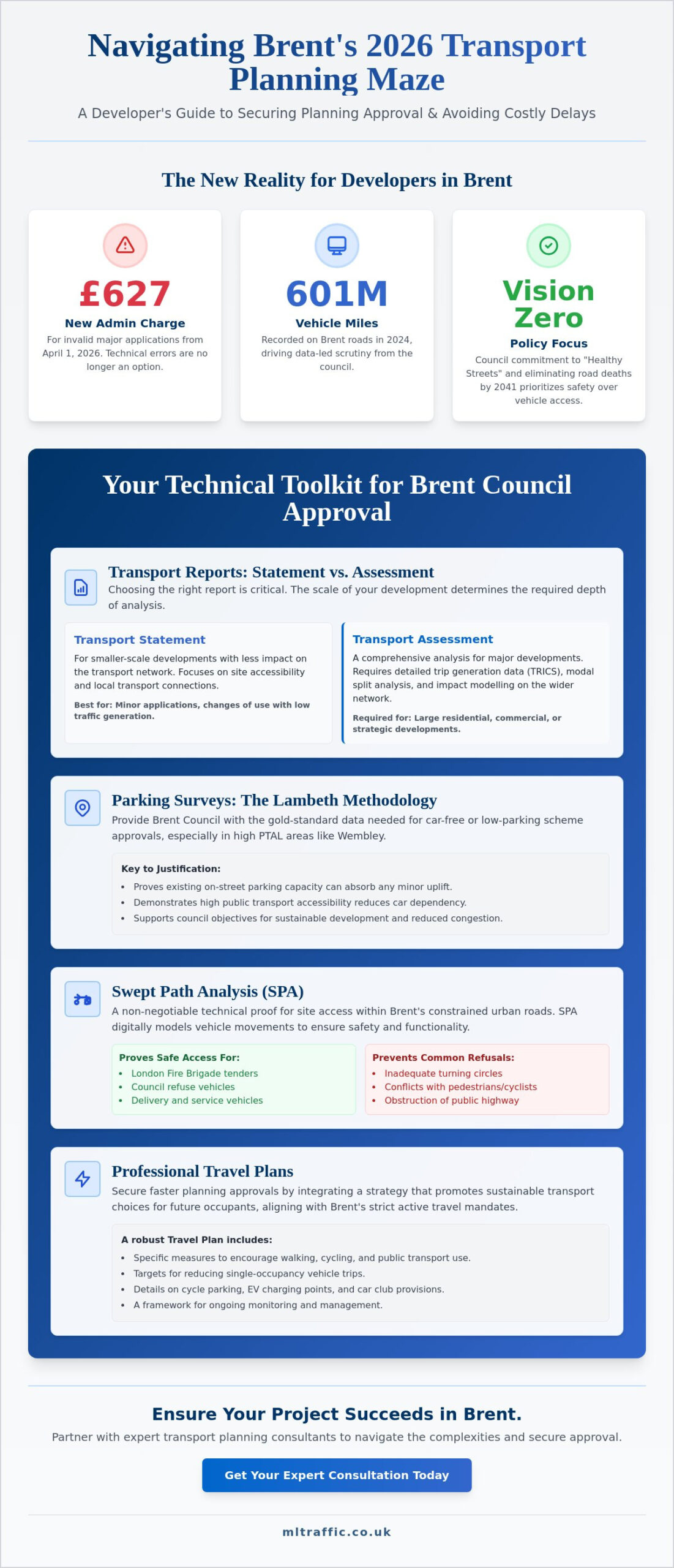
    With 601 million vehicle miles recorded on Brent roads in 2024, the council’s focus on the Mayor of London’s Transport Strategy has reached a critical peak. As of April 1, 2026, developers face new administrative charges of up to £627 for invalid major applications, leaving no room for technical errors in your submission. Engaging expert Transport Planning Consultants Brent is now a baseline requirement for those who want to avoid these costly delays. You likely understand that balancing Wembley’s high PTAL requirements against the car-free expectations of the 2025/26 Local Implementation Plan is a complex technical challenge.

    We agree that the pressure to deliver precise data that highways officers will actually accept can feel like a moving target. This guide promises to simplify Brent’s strict parking standards and active travel mandates into a clear, actionable strategy for your next project. We’ll outline the specific technical reports you need, from Swept Path Analysis to bespoke Travel Plans, to ensure your development secures approval while maintaining cost-effective reporting standards.

    Key Takeaways

    • Understand how the 2026 Brent Local Plan shifts requirements for new developments, particularly in high-PTAL areas like Wembley.
    • Identify when your project requires a Transport Statement versus a full Assessment to ensure Transport Planning Consultants Brent provide the exact data highways officers expect.
    • Master the Lambeth Methodology for parking surveys to provide Brent Council with the gold-standard data needed for car-free or low-parking approvals.
    • Utilize Swept Path Analysis (SPA) to prove safe site access for London Fire Brigade tenders and refuse vehicles within Brent’s constrained urban environments.
    • Secure faster planning approvals by integrating professional Travel Plans that align with the borough’s strict active travel and sustainability mandates.

    Securing planning approval in the London Borough of Brent requires more than just submitting architectural drawings. It demands a technical understanding of the borough’s evolving infrastructure and policy framework. Transport Planning Consultants Brent serve as the essential link between your development goals and the council’s strict highways requirements. They translate complex site constraints into acceptable technical reports. With Brent recording 601 million vehicle miles in 2024, the council uses data-led scrutiny to manage congestion and safety. These consultants ensure your project aligns with the broader principles of transportation planning, which prioritizes sustainable movement and network efficiency.

    The Brent Local Plan and Transport Policy

    The Brent Local Plan 2026 dictates how growth areas like Wembley and Kilburn High Road evolve. Since the council’s climate emergency declaration, every transport report must prove it supports carbon reduction. Brent’s commitment to “Vision Zero” aims to eliminate all road deaths and serious injuries by 2041. This means your submission must prioritize pedestrian safety and cycling infrastructure over private vehicle access. Highways officers now look for “Healthy Streets” compliance as a non-negotiable standard. Developments in the Wembley Growth Area, in particular, face intense scrutiny regarding their contribution to active travel networks and public transport capacity.

    When Do You Need a Transport Consultant in Brent?

    You need professional transport input the moment your project impacts the public highway. For major applications, which trigger a £627 administrative charge if found invalid as of May 2026, technical accuracy is vital. Transport Planning Consultants Brent identify potential access issues before they become grounds for refusal. In high PTAL areas like Wembley Park, the council often mandates “Car-Free” developments. A consultant justifies these designs through robust Travel Plans and Parking Surveys. For larger schemes, pre-application fees for strategic developments can reach £15,620.40 as of the 2026/2027 fee schedule. Investing in professional data early protects this significant capital outlay. You can explore the specific technical reports required for these submissions at what we do. Early engagement with the council’s transport team prevents the common delays that stall London developments.

    Essential Technical Reports: Transport Statements and Assessments for Brent

    Brent Council highways officers expect a high degree of technical precision before they’ll validate your planning application. The primary tool for this is either a Transport Statement or a full Transport Assessment. While both documents evaluate a project’s impact on the local network, the depth of analysis required depends on the scale of the development and the sensitivity of the surrounding infrastructure. Every report must now align with the borough’s Local Implementation Plan for 2025/26 through 2027/28, which prioritizes sustainable movement over car-centric design.

    The TRICS database remains the industry standard for trip generation data, but you can’t rely on national averages alone for a London project. You must demonstrate how your site encourages walking and cycling through a detailed modal split analysis that reflects Brent’s specific urban density. These reports must follow the Transport analysis guidance (TAG) to ensure the methodology withstands council scrutiny. Professional Transport Planning Consultants Brent ensure these technical documents aren’t just compliant but are optimized to support your development’s commercial viability.

    Preparing a Robust Transport Statement

    Small-to-medium residential developments in Brent typically require a Transport Statement. These documents focus on local connectivity and the “Healthy Streets” approach. With the borough benefiting from the Jubilee, Bakerloo, and Overground lines, many sites have high accessibility that justifies car-free designs. You must analyze these links to prove that future residents won’t rely on private vehicles. Unlike generic reports, a Brent-specific statement must explicitly address how the design reduces car dependency in line with the council’s 2026 parking standards. If your data doesn’t convincingly support these active travel goals, you risk facing the new £159 administrative charge for invalid minor applications.

    Full Transport Assessments for Major Brent Developments

    Major projects in Wembley or Alperton demand a full Transport Assessment. These high-occupancy sites often sit near the Strategic Road Network (SRN), which requires direct collaboration with Transport for London (TfL). You’ll need a comprehensive impact analysis that accounts for cumulative traffic from neighboring developments. This is particularly vital in growth areas where the council monitors the network’s total capacity. For a deeper look at these requirements across the capital, read our guide on Transport Assessment London. Securing approval for these complex sites requires data that is both accurate and defensible. If you’re unsure which report your site needs, you can consult our technical team to receive a bespoke scoping opinion.

    Transport Planning Consultants Brent: Securing 2026 Planning Approvals

    Accurate Data Collection: Parking Surveys and Traffic Analysis in Brent

    Securing planning approval in Brent requires more than just high-level estimates; it demands empirical evidence that council highways officers can verify. Data-led submissions are the only way to navigate the borough’s complex parking standards, especially given the new administrative charges for invalid applications effective from April 2026. Reliable Transport Planning Consultants Brent prioritize accurate traffic surveys and parking stress tests to ensure your project doesn’t stall at the validation stage. Whether you’re developing near the busy A406 North Circular or a quiet residential street in North Brent, the quality of your data determines your success.

    The Lambeth Methodology in a Brent Context

    Brent Council considers the Lambeth Methodology the gold standard for assessing parking capacity. To provide a true reflection of residential parking stress, we conduct surveys during the peak period between 00:30 and 05:30 on two separate weekday nights. This timeframe captures the maximum number of residents at home. We define a survey area within a 200m walking distance of the site, which is the standard radius for Brent applications. Our reports explicitly detail the impact of Controlled Parking Zones (CPZs). Since resident parking permits now cost £49 for the first vehicle and £136 for the second as of May 2026, understanding these permit restrictions is vital for accurate capacity reporting. We ensure every survey accounts for these local constraints to provide a defensible data set.

    PTAL Ratings and Parking Justification

    The Public Transport Accessibility Level (PTAL) of your site dictates the council’s starting position on parking provision. In Wembley Park, where PTAL ratings often reach 6, the council’s Local Implementation Plan mandates car-free developments. However, projects in Kingsbury or Kenton often fall into PTAL 1 or 2 zones. In these areas, developers must provide robust data to justify any parking provision. We use professional Parking Surveys to demonstrate that the local network can absorb the anticipated demand without compromising road safety or active travel goals. For sites along the Strategic Road Network like the A406, we also provide detailed traffic counts to justify new or modified site access points. This precision ensures that highways officers have the exact data they need to recommend approval without requesting expensive revisions.

    Site Access and Swept Path Analysis: Overcoming Brent’s Constraints

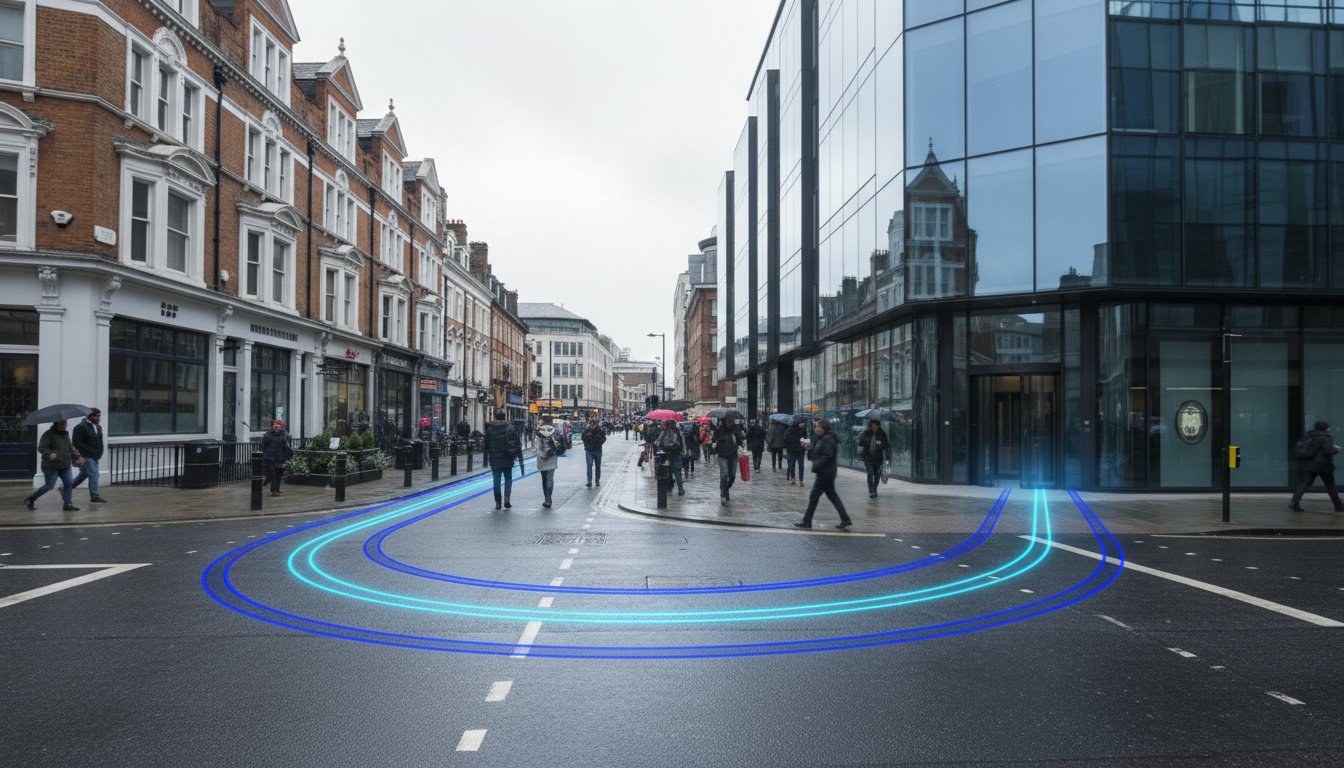
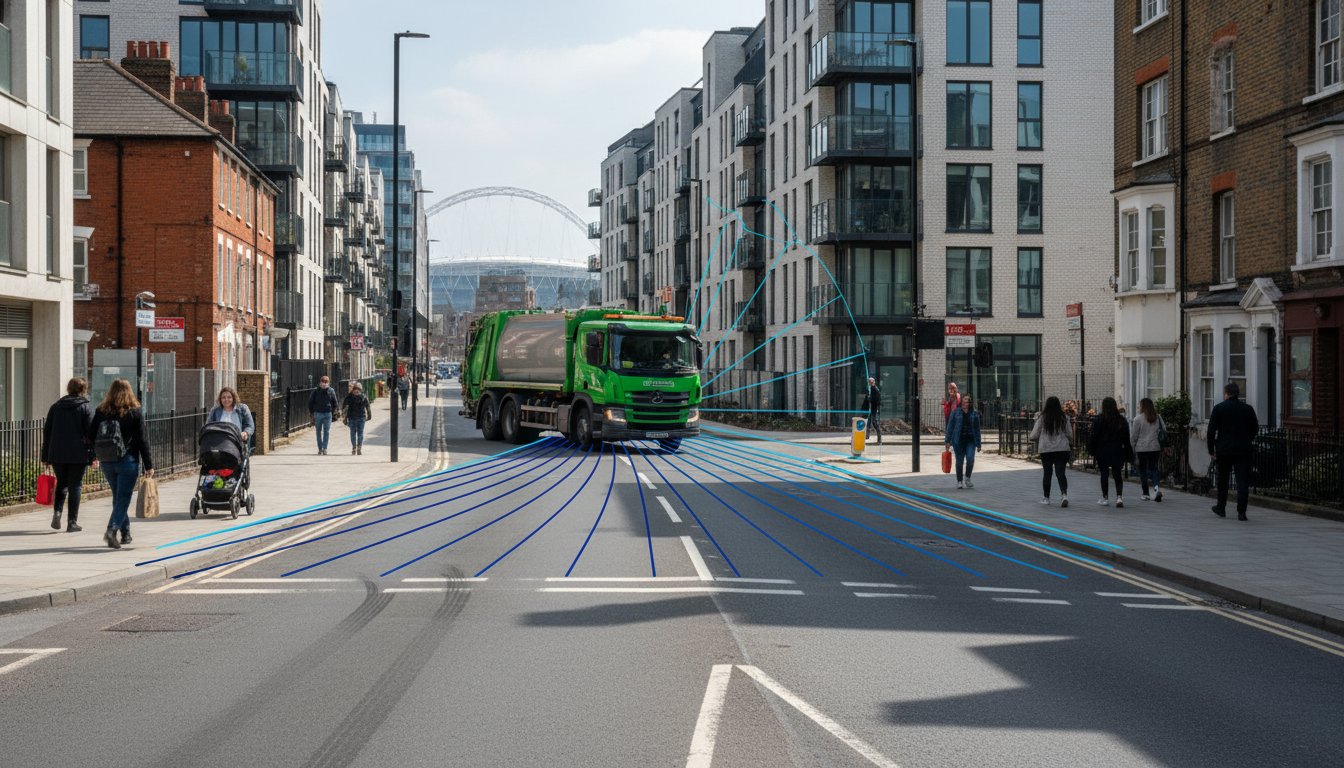
    Brent’s urban fabric presents significant physical challenges for new developments. Narrow Victorian streets in areas like Harlesden and Willesden leave little room for error when designing site entrances. Swept Path Analysis is a computer-aided simulation of vehicle turning circles. We use this technology to prove that your site access works before you commit to a final layout. Experienced Transport Planning Consultants Brent identify these physical constraints early in the design phase to prevent costly redesigns during the planning process. Our CAD-based simulations provide the technical certainty that council highways officers require for validation.

    Vehicle Maneuverability and Refuse Collection

    Brent Council’s waste management policies for 2026 are uncompromising. You must demonstrate that a standard refuse vehicle can enter, turn, and exit the site in forward gear without overhanging the footway. We use professional software to model the specific dimensions of Brent’s 26-tonne refuse collection vehicles. This analysis also confirms that bin carry distances remain within the council’s mandated limits, typically 10 to 15 metres from the collection point. Failure to provide this data often results in immediate objections. You can view our full range of Swept Path Analysis Services to see how we handle these technical requirements for London developers.

    Fire Tender Access and Safety Compliance

    The “Fire Tender Swept Path” is a non-negotiable safety requirement for any residential approval in the borough. The London Fire Brigade requires clear, unobstructed routes that accommodate their specific turning radii. In tight urban infill sites near Kilburn or Harlesden, this often requires centimetre-perfect planning. We simulate these movements to ensure that fire crews can reach every part of your development without delay. Our reports also prioritize the safety of pedestrians and cyclists at site access points. We design visibility splays that protect vulnerable road users while maintaining vehicle flow. This comprehensive approach satisfies both safety inspectors and planning officers. Transport Planning Consultants Brent ensure that your access strategy meets the highest safety standards while maximizing the developable area of your site. If your project faces challenging access constraints, request a Swept Path Analysis from our technical team today.

    Partnering with ML Traffic Engineers: Expert Transport Planning for Brent Developers

    Securing planning permission in the London Borough of Brent requires a partner who treats technical precision as a legal and physical necessity. We understand that the stakes are high. As of April 1, 2026, Brent Council’s administrative charges mean that an invalid major application can cost you up to £627 in wasted fees alone. ML Traffic Engineers act as a safe pair of hands, managing the technical and regulatory burdens so you can focus on the construction phase. Our team provides a total, managed solution that bridges the gap between your site’s potential and the council’s strict highways requirements. We operate with a sense of readiness and urgency, offering 24/7 availability to ensure your project stays on track regardless of the timeline.

    Our track record across Brent is built on professional integrity and data-led reporting. We don’t just provide equipment; we deliver comprehensive support from the initial consultation through to final implementation. Whether your site is a high-density development in Wembley Park or a complex infill project in Harlesden, we produce reports that Brent highways officers trust. Our expertise as Transport Planning Consultants Brent ensures that every Transport Statement and Parking Survey we submit meets the highest standards of compliance. ML Traffic Engineers take pride in our ability to navigate the intricate complexities of UK road regulations on your behalf.

    Why ML Traffic Engineers?

    We possess deep knowledge of Brent’s specific highways and parking standards, which is vital for clearing modern planning conditions. Our engineers specialize in what we do, providing everything from CAD-based Swept Path Analysis to detailed Travel Plans. We prioritize clarity and speed, using direct sentence structures in our reports to help project managers grasp key benefits quickly. ML Traffic Engineers utilize technical vocabulary rooted in industry reality, employing CAD design and multi-way systems to solve access constraints. We maintain a standard of formal excellence that matches the strict regulatory environment of 2026.

    Ready to Start Your Brent Project?

    Waiting for a response can stall your development’s momentum. We offer a sequential and logical communication flow that mirrors your project’s lifecycle. You can access our technical resources to understand the latest requirements for architects and developers. If you need immediate assistance with an upcoming submission, our team is ready to provide a bespoke quote tailored to your site’s PTAL rating and scale. Contact our Transport Planning Consultants today to secure the technical authority your Brent planning application requires.

    Success in Brent’s 2026 development landscape hinges on data that withstands rigorous highways officer scrutiny. We’ve detailed how the borough’s Local Plan and Vision Zero principles dictate the technical requirements for your specific submission. Whether you’re navigating high-PTAL zones in Wembley or proving access on the narrow streets of Harlesden, the role of Transport Planning Consultants Brent is to provide the empirical evidence that validates your design. This technical certainty prevents the administrative delays and financial penalties associated with invalid applications that can stall a project before it begins.

    ML Traffic Engineers provide a comprehensive suite of services, from overnight parking surveys to CAD-based simulations, ensuring your submission is both compliant and defensible. Our 24/7 availability ensures that even the most urgent project timelines are met with professional integrity and safety-conscious precision. We’re ready to help you navigate the intricate highways regulations of the London Borough of Brent so you don’t have to. Get a Professional Transport Report for Your Brent Project today and move your development toward a successful 2026 planning approval.

    Frequently Asked Questions

    Do I need a Transport Statement for a small residential conversion in Brent?

    Yes, Brent Council requires a Transport Statement for most residential conversions to confirm the project doesn’t negatively impact local parking stress or active travel routes. Since April 2026, the council has increased its scrutiny of minor applications to ensure they align with the borough’s sustainability targets. We assess your site’s specific footprint to ensure your submission meets these strict validation requirements without unnecessary revisions.

    What is the current parking standard for new developments in Wembley?

    Developments in Wembley typically follow a car-free standard due to the area’s high accessibility ratings. To compensate for the lack of parking, you must provide high-quality cycle storage and a robust Travel Plan that encourages the use of local bus and rail networks. These measures satisfy the council’s requirements for reducing private vehicle dependency in high-density growth zones.

    How much does a Lambeth Methodology parking survey cost in London?

    The cost of a Lambeth Methodology survey varies based on the size of the survey area and the number of nights required to establish a baseline for parking stress. We conduct these surveys over two separate weekday nights to provide the representative data that Brent highways officers demand. Accuracy at this stage is vital to avoid the administrative charges the council applies to invalid or poorly evidenced applications.

    Can Brent Council refuse my application based on traffic impact alone?

    Brent Council can refuse an application if the technical data suggests a development will cause a severe impact on the safety or capacity of the local road network. Our role as Transport Planning Consultants Brent is to identify these risks early and propose effective mitigation measures. We provide the empirical evidence needed to prove your site operates safely within the constraints of the borough’s existing infrastructure.

    What happens if my site has a low PTAL rating?

    Sites in areas like Kingsbury or Kenton with lower PTAL ratings may be allowed a higher ratio of on-site parking compared to Wembley. You must still provide a detailed justification within your Transport Statement to show that this provision won’t lead to overspill parking on surrounding streets. We use overnight stress tests to demonstrate that the local network has the capacity to accommodate your project’s specific needs.

    Is Swept Path Analysis required for all commercial developments in Brent?

    Swept Path Analysis is mandatory for any commercial site where delivery vehicles or refuse trucks must enter the property. We use CAD software to model the movements of specific vehicles, ensuring they can turn safely without overhanging the public footway. This analysis also protects the safety of pedestrians and cyclists by ensuring that visibility splays at the site entrance are clear and compliant.

    How long does it take ML Traffic Engineers to produce a Transport Statement?

    ML Traffic Engineers typically deliver a completed Transport Statement within 10 to 14 working days once the initial site surveys are finished. Our 24/7 readiness allows us to deploy survey teams immediately, capturing the real-world data your project requires without delay. This efficient turnaround helps you meet tight planning deadlines while maintaining the technical authority that highways officers expect.

    Do you liaise directly with Brent Council highways officers?

    We frequently liaise with Brent Council highways officers to discuss technical scoping and resolve potential objections before they lead to a refusal. As expert Transport Planning Consultants Brent, we understand the specific preferences of the local highways team regarding active travel and site access. This proactive communication is a core part of our managed solution, helping to streamline the approval process for complex London developments.

    Michael Lee

    Article by

    Michael Lee

    Transport planner with over 35 years’ experience.

    Disclaimer

    The content on mltraffic.co.uk, including all technical articles, guides, and resources, is provided for general informational and educational purposes only. It is not intended to constitute professional advice in traffic engineering, transportation planning, development approvals, or any other technical or legal field.
    While ML Traffic Engineers makes every reasonable effort to ensure the accuracy, completeness, and timeliness of the information published, we do not provide any warranties or representations (express or implied) regarding its reliability, suitability, or availability for any particular purpose. Any reliance you place on the content is strictly at your own risk.
    In no event shall ML Traffic Engineers, its directors, employees, authors, or affiliates be liable for any direct, indirect, incidental, special, consequential, or punitive damages (including, without limitation, loss of profits, data, or business opportunities) arising out of or in connection with the use of, or inability to use, any information provided on this website.
    The articles and guides on this site are not a substitute for engaging a qualified, professional traffic engineer to assess your specific project requirements. For tailored advice, compliance assessments, or traffic engineering services, please contact a competent professional.
    This disclaimer may be updated from time to time without notice. By accessing or using this website, you agree to be bound by the most current version of this disclaimer.
  • Transport Planning Consultants Hammersmith and Fulham: The 2026 Developer’s Guide

    Transport Planning Consultants Hammersmith and Fulham: The 2026 Developer’s Guide

    By 2026, Hammersmith and Fulham Council’s commitment to the ‘Vision Zero’ safety standard means even a minor technical oversight in your site access plan will trigger an immediate planning refusal. You already know that securing approval in this borough is a high-stakes balancing act between ambitious density and rigid highways constraints. It’s frustrating when inadequate data or confusion over PTAL ratings stalls your project before it even begins. Working with expert Transport Planning Consultants Hammersmith and Fulham ensures your technical submissions are precise, compliant, and ready for scrutiny.

    This guide provides the technical roadmap you need to satisfy council demands and turn complex car-free policies into viable development opportunities. We’ll show you how to produce accurate reports that pass the most rigorous inspections while keeping your site access solutions cost-effective. We’ll cover everything from the latest 2026 Transport Assessment requirements to specific strategies for mitigating highways safety concerns. This ensures your project moves from the drawing board to the construction phase without the friction of regulatory delays.

    Key Takeaways

    • Expert Transport Planning Consultants Hammersmith and Fulham provide the essential technical bridge between your development design and the London Borough of Hammersmith and Fulham’s (LBHF) rigorous highway authority requirements.
    • Learn to distinguish between Transport Statements and full Assessments while understanding how a robust Travel Plan secures essential planning consent for complex London sites.
    • Discover how to resolve site access challenges in dense urban environments like Fulham using Swept Path Analysis for fire tenders and refuse vehicles.
    • Master the LBHF planning process by conducting preliminary PTAL assessments and engaging in strategic pre-application discussions with both the council and TfL.
    • Secure a total managed solution that leverages extensive experience with local planning officers to move your project seamlessly from initial data collection to final implementation.

    The Role of Transport Planning Consultants in Hammersmith and Fulham

    Transport planning consultants act as the technical bridge between a developer’s vision and the strict requirements of the London Borough of Hammersmith and Fulham (LBHF) highway authority. For 2026 applications, these specialists ensure that a project’s design doesn’t just look good on paper but functions within the existing road network. They analyze traffic flow, pedestrian safety, and logistics to secure planning approval. The Role of Transport Planning involves data-driven strategies that prevent costly design errors before they reach the public inquiry stage.

    Engaging expert Transport Planning Consultants Hammersmith and Fulham is essential for 2026 developments due to the borough’s evolving Local Plan. High Public Transport Accessibility Level (PTAL) ratings, common in areas like Shepherd’s Bush and Hammersmith Broadway, trigger specific density and parking constraints. A consultant mitigates the risk of refusal by proving that a development won’t negatively impact local highway capacity or safety. We provide total, managed solutions that handle everything from initial data collection to final implementation, ensuring your project remains compliant with the latest UK road regulations.

    Why LBHF is a Unique Planning Environment

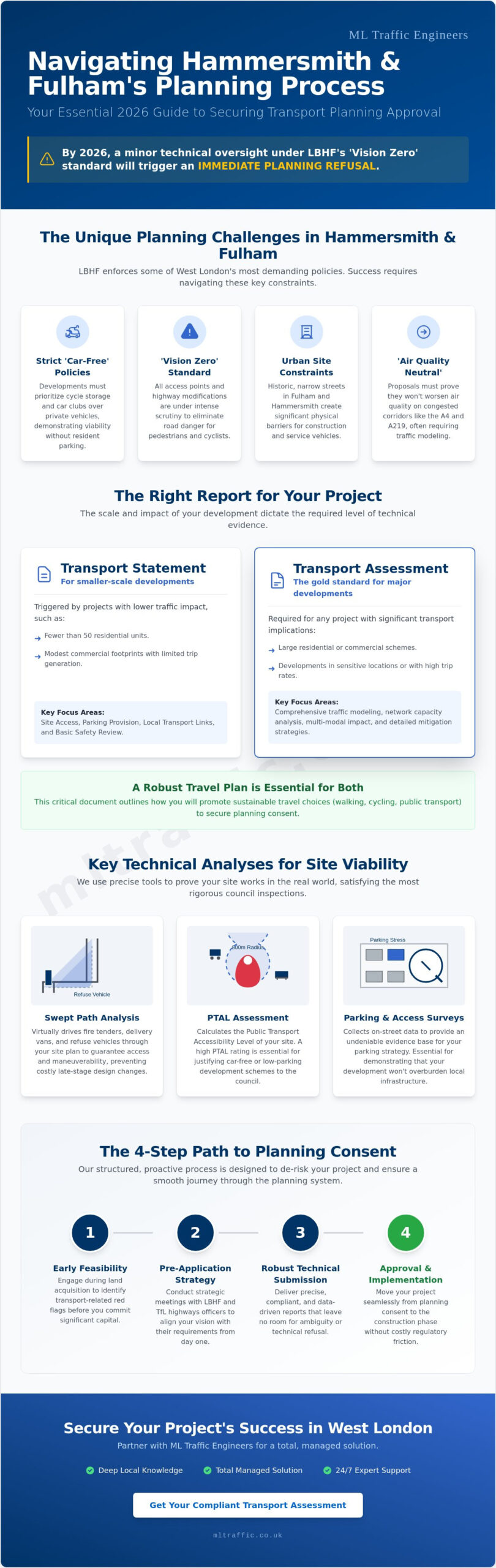
    LBHF enforces some of the strictest ‘Car-Free’ development policies in West London. Developers must demonstrate how residents will thrive without private vehicles, focusing instead on cycle storage and car club integration. The borough’s historic street layouts in Fulham and Hammersmith create physical constraints that modern delivery vehicles often struggle to navigate. Additionally, every 2026 application must support ‘Air Quality Neutral’ objectives. Our consultants use CAD design and traffic modeling to prove that your site won’t increase nitrogen dioxide levels on congested corridors like the A4 or A219.

    When to Engage a Transport Consultant

    Early engagement is the only way to avoid design dead-ends. Commissioning a site feasibility study during the land acquisition phase identifies potential access issues that could kill a project. You’ll need a solid transport strategy before your first pre-application meeting with LBHF highways officers to set a professional tone. This ensures the transport strategy aligns with the architect’s vision from day one, preventing late-stage revisions that blow the budget. Our team remains available 24/7 to provide technical support, ensuring your transport assessment

    Essential Technical Reports for LBHF Planning Applications

    The 2026 planning landscape in West London demands absolute precision from developers. Securing planning consent requires a technical evidence base that aligns with the Hammersmith and Fulham Planning Process. As specialist Transport Planning Consultants Hammersmith and Fulham, we focus on delivering reports that satisfy both the London Plan and the LBHF Local Plan. Your submission must demonstrate a clear commitment to the Healthy Streets approach, prioritizing pedestrian safety and sustainable movement over private vehicle use.

    Transport Statements vs. Assessments

    The scale and location of your development dictate which technical report you need. Smaller projects, typically those creating fewer than 50 residential units or modest commercial footprints, require a Transport Statement. This document outlines site access, parking provision, and local transport links. A Transport Assessment serves as the gold standard for major developments, providing a comprehensive analysis of all potential traffic impacts.

    Key components of a robust Transport Statement for Hammersmith projects include:

    • A detailed audit of the existing transport infrastructure within a 400-meter radius of the site.
    • Analysis of the Public Transport Accessibility Level (PTAL) rating, which often exceeds level 5 in areas like Shepherd’s Bush.
    • Accurate multi-modal trip generation data using the TRICS database, which currently holds over 7,500 survey counts.
    • Evidence of compliance with the 2021 London Plan zero-parking standards for well-connected areas.

    Travel Plans: More Than Just a Document

    A well-crafted Travel Plan acts as a long-term strategy to reduce the environmental impact of your site. It isn’t a static paper; it’s a commitment to encouraging sustainable transport modes such as cycling and car-sharing. LBHF planners look for specific targets and monitoring regimes to ensure these plans remain effective post-occupation. Failing to meet these targets can lead to financial penalties under Section 106 agreements.

    You’ll encounter three primary types of Travel Plans during the development lifecycle:

    • Framework Travel Plans: Used for outline applications where final occupiers are unknown.
    • Interim Travel Plans: Applied during the transition phase before a full survey of site users is possible.
    • Full Travel Plans: The final version based on actual travel data from site occupants.

    For a deep dive into these requirements, consult our London Travel Plans Guide. Our team provides comprehensive support throughout this process, ensuring your application moves through the council’s pipeline without unnecessary delays. We operate with 24/7 readiness to address any technical queries raised by highway officers during the consultation period.

    Transport Planning Consultants Hammersmith and Fulham: The 2026 Developer’s Guide

    Overcoming Site Constraints with Swept Path Analysis and Parking Surveys

    Tight urban environments like Fulham’s residential streets present significant logistical hurdles for modern developers. Narrow roads and historic Victorian layouts mean standard vehicle movements are rarely guaranteed. Expert Transport Planning Consultants Hammersmith and Fulham provide the technical precision required to prove a site is viable. We use data to transform constrained sites into approved developments by addressing access and parking concerns early in the design phase. This proactive approach ensures that site layouts are functional and compliant with the latest 2026 safety standards.

    Visualising Access with Swept Path Analysis

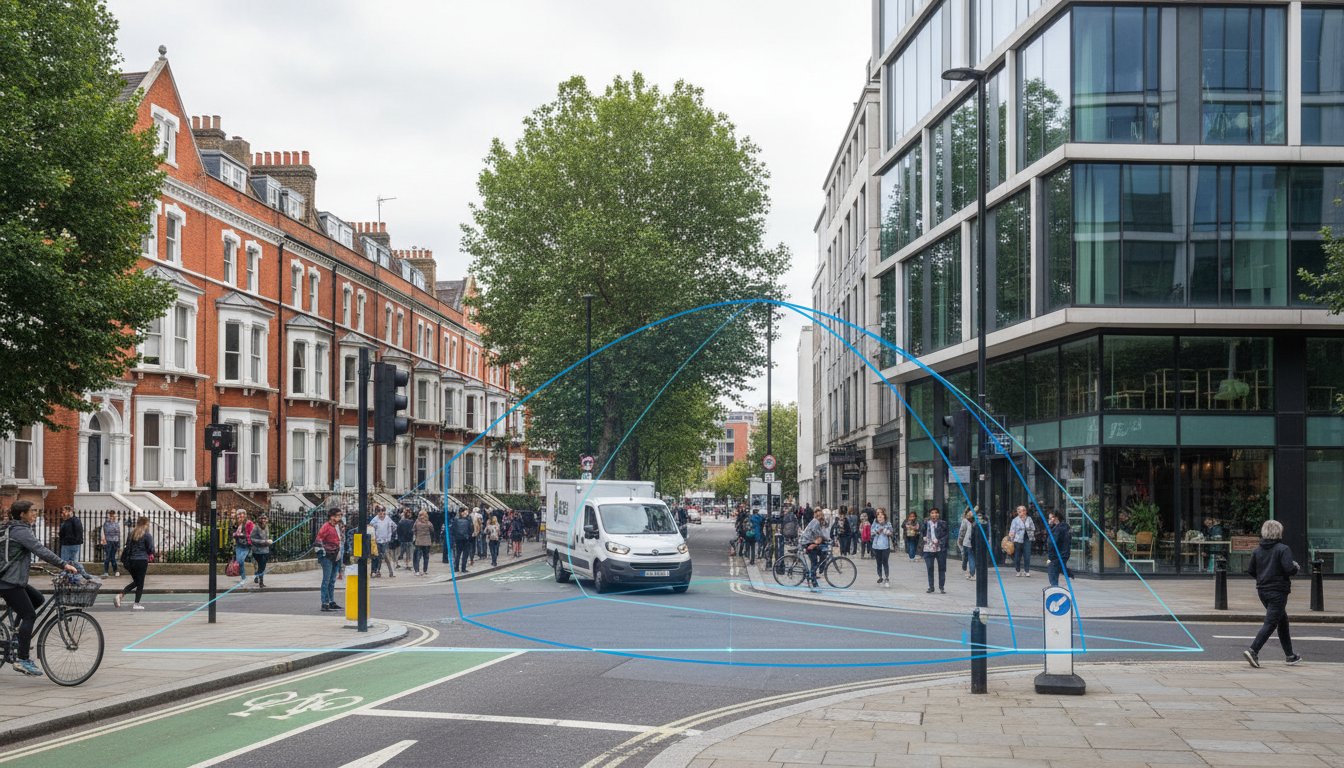
    The London Borough of Hammersmith and Fulham (LBHF) prioritises safety and efficient refuse collection above all else. We use advanced CAD software to simulate vehicle movements within your proposed site layout. This process identifies pinch points before they become construction-phase nightmares. If a 12-metre fire tender or a 10.5-metre refuse vehicle can’t clear a corner, the project stalls. Our Swept Path Analysis Services provide the visual proof needed for planning approval. The team at ML Traffic Engineers follows strict industry standards to ensure every turn and reverse maneuver is mathematically sound. This technical authority removes guesswork and prevents costly redesigns during the later stages of the project.

    By simulating the exact wheel paths and body overhangs of specific vehicles, we provide a total, managed solution for site access. This level of detail is essential for securing the trust of highways officers who must ensure that emergency services and utility vehicles can operate without obstruction. Our reports highlight exactly where kerbs need to be dropped or site entrances widened to accommodate the necessary traffic flow, keeping your project on track for a successful planning committee decision.

    The Lambeth Methodology for Parking Surveys

    LBHF often insists on the Lambeth Methodology for overnight parking stress tests. This is a non-negotiable requirement when you want to justify lower-than-standard parking provision in high-density areas. We measure parking stress within a 200-metre walking distance of the development site. These surveys typically occur between 00:30 and 05:30 on two separate weekday nights to capture peak residential demand. This data reveals the actual capacity of the street network. If the survey shows a parking stress level below 80 percent, it often unlocks development potential that would otherwise be blocked by restrictive local policies.

    Data-driven evidence is the most effective tool to overcome local resident objections regarding traffic increases. It moves the conversation from subjective fears to objective facts. As leading Transport Planning Consultants Hammersmith and Fulham, we ensure these surveys are conducted with 24/7 precision, providing the robust evidence needed to satisfy both the council and the community. Our comprehensive support ensures that every survey meets the specific technical requirements of the borough’s highways department.

    Securing planning approval in the London Borough of Hammersmith and Fulham (LBHF) requires a precise, sequential approach. Developers must align their transport strategies with the LBHF Local Plan and the latest London Plan standards. Professional Transport Planning Consultants Hammersmith and Fulham provide the technical rigour needed to move from initial concept to site commencement without regulatory friction. We focus on delivering a total, managed solution that satisfies both local and strategic authorities.

    • Step 1: Preliminary site access and PTAL assessment. We begin by determining the Public Transport Accessibility Level (PTAL). In areas like Hammersmith Broadway, PTAL scores frequently reach 6b. This high rating often dictates car-free development mandates under 2026 planning policy.
    • Step 2: Pre-application discussions. Engaging LBHF and Transport for London (TfL) early identifies potential constraints. This stage clarifies expectations for the A4 Great West Road and other Strategic Road Network (SRN) routes.
    • Step 3: Prepare technical documentation. This includes Transport Assessments, Travel Plans, and Construction Logistics Plans (CLP). Every document must meet the latest safety and sustainability benchmarks to avoid immediate rejection.
    • Step 4: Respond to statutory consultee comments. We manage the technical dialogue when LBHF Highways or TfL request clarifications on trip generation, swept path analysis, or cycle parking.
    • Step 5: Negotiate legal agreements. Finalising Section 106 and Section 278 agreements ensures off-site highway improvements are legally compliant and financially predictable.

    Dealing with Statutory Consultees

    TfL’s involvement is mandatory for major applications or those impacting the Transport for London Road Network (TLRN). Their focus remains on Healthy Streets indicators and Vision Zero safety targets. Addressing concerns from the LBHF Highways Department requires immediate, data-backed responses. Proactive communication prevents the standard 13-week statutory period from stretching into months of delays. Our Transport Planning Consultants Hammersmith and Fulham maintain constant availability to resolve technical objections as they arise, ensuring your project stays on schedule.

    Section 278 Agreements and Highway Works

    When a development requires physical changes to the public highway, such as new crossovers or junction remodelling, a Section 278 (S278) agreement is essential. This legal framework allows developers to fund and execute works on the local road network under LBHF supervision. Precision in CAD design and traffic management planning is vital to meet the borough’s strict safety standards. For a detailed breakdown of these requirements, see our Highway Design S278 Guide. We ensure your project moves from the planning phase to implementation with total compliance and zero safety compromises.

    To secure your project’s technical approval and navigate LBHF regulations, contact our expert planning team for a comprehensive consultation.

    Why ML Traffic Engineers is Your Partner in West London

    Successfully delivering a project in the London Borough of Hammersmith and Fulham (LBHF) requires more than just technical drawings. It demands a deep, working knowledge of the specific expectations held by local planning officers. ML Traffic Engineers brings years of direct experience to the table, having successfully navigated the borough’s strict requirements for air quality, noise reduction, and pedestrian safety. We don’t just provide advice; we offer a total, managed solution. This lifecycle begins with precise site data collection and continues through to professional CAD design and final on-site implementation. We take full responsibility for the logistics so you can focus on the build.

    Construction doesn’t stop at 5:00 PM, and neither do we. Our 24/7 availability is a core pillar of our service, designed to meet the urgent needs of fast-moving West London projects. Whether it’s an emergency utility repair on the A4 or a scheduled crane lift in Fulham, our team remains ready to respond. This round-the-clock readiness ensures that your project stays on schedule and avoids costly delays. As experienced Transport Planning Consultants Hammersmith and Fulham, we prioritize precision and compliance in every report we produce. We ensure every detail aligns with the Traffic Signs Manual and local highways authority mandates to prevent legal bottlenecks.

    Our Technical Expertise

    Our team consists of highly organized specialists who live and breathe UK road regulations. We maintain a rigorous standard of Chapter 8 compliance, ensuring every temporary traffic management scheme is legally watertight and physically safe. We use advanced CAD software to create bespoke traffic plans that minimize disruption to the public while maximizing site efficiency. You can view our project types to see how we handle diverse challenges, or explore what we do to understand our full range of technical capabilities. Precision isn’t an option for us; it’s our baseline.

    Securing Your Development’s Future

    In a borough as densely populated as Hammersmith and Fulham, local sentiment matters. By partnering with ML Traffic, you position your development as a ‘safe pair of hands’ for the local community. We design systems that protect cyclists, pedestrians, and motorists alike, reducing the regulatory burden on your management team. Our reports provide the clarity needed to secure planning approvals quickly and maintain positive relationships with LBHF stakeholders. We manage the intricate complexities of the road network so you don’t have to worry about compliance failures. Contact ML Traffic for a consultation on your LBHF project today and secure a partner dedicated to your project’s success.

    Accelerate Your Hammersmith and Fulham Planning Success

    Navigating the London Borough of Hammersmith and Fulham planning process requires more than just standard reports. It demands technical precision in Swept Path Analysis and a deep understanding of local S278 and S38 requirements. Since 2014, ML Traffic Engineers has provided this level of detail for developers across West London. Our team brings over 10 years of specific London planning experience to every project; we ensure your Transport Assessment meets the highest regulatory standards.

    Delays in the planning phase can be costly for any 2026 development. We eliminate these bottlenecks with our 24/7 emergency response and rapid report turnaround times. By choosing the right Transport Planning Consultants Hammersmith and Fulham, you gain a partner dedicated to technical excellence and professional integrity. We handle the intricate CAD designs and parking surveys so you don’t have to. Our proactive approach transforms complex site constraints into viable, compliant solutions.

    Secure your project’s approval with expert transport planning advice from ML Traffic. Your development’s success is our priority.

    Frequently Asked Questions

    Do I need a Transport Statement for a small residential conversion in Fulham?

    You generally need a Transport Statement for a small residential conversion in Fulham if the project creates new dwellings or alters existing access. The London Borough of Hammersmith and Fulham (LBHF) requires these documents to ensure your development doesn’t negatively impact local traffic flow or parking capacity. Our transport planning consultants Hammersmith and Fulham team reviews your site against the LBHF Local Plan 2018 to ensure full compliance from the first submission.

    What is a PTAL rating and how does it affect my planning application in London?

    PTAL stands for Public Transport Accessibility Level, a standard method used by Transport for London (TfL) to grade locations on a scale from 0 to 6b. A high PTAL rating, such as 5 or 6, often allows for car-free developments with zero on-site parking. Conversely, a low rating of 1 or 2 typically requires more robust parking provisions to satisfy LBHF planning officers during the application process.

    How long does a parking survey take to complete according to LBHF standards?

    A standard parking survey in Hammersmith and Fulham takes two consecutive weekday nights to complete, typically between 00:30 and 05:30. This follows the Lambeth Methodology, which is the industry standard for measuring overnight parking stress. We collect data on Tuesday and Wednesday or Wednesday and Thursday nights to provide a representative snapshot of local parking demand for your specific planning application.

    Can Swept Path Analysis help if my site has very narrow access?

    Swept Path Analysis uses CAD software to simulate the movement of specific vehicles, proving that delivery trucks or emergency services can navigate narrow site entrances safely. This technical drawing is a non-negotiable requirement for constrained urban sites in Fulham where access margins are tight. It removes guesswork by providing accurate visual evidence that your site layout functions correctly without risking collisions or blocking public highways.

    What is the difference between a Transport Assessment and a Transport Statement?

    The primary difference lies in the scale of the development and its projected impact on the local road network. A Transport Statement is a concise report for smaller projects with limited traffic implications, while a Transport Assessment is a comprehensive study for larger developments. LBHF guidance clarifies that developments exceeding 50 residential units or 1,000 square metres of commercial space usually trigger a full Assessment.

    Will I need to pay for off-site transport improvements under a Section 106 agreement?

    You’ll likely pay for off-site transport improvements through a Section 106 agreement if your project increases demand on local infrastructure. These legally binding contributions fund specific upgrades like new cycle lanes, bus stop improvements, or pedestrian crossings near your site. In 2023, LBHF secured millions in developer contributions to enhance the borough’s sustainable transport network, ensuring that new growth doesn’t compromise existing public safety.

    How much does it cost to hire a transport planning consultant for a London project?

    Hiring transport planning consultants Hammersmith and Fulham typically costs between £1,500 and £3,000 for a standard Transport Statement on a small-scale project. For complex Transport Assessments involving detailed traffic modelling or extensive junction analysis, fees can exceed £5,000. These costs vary based on the project’s complexity and the specific technical requirements set out by the local highway authority during your pre-application discussions.

    What happens if the council’s highways department objects to my development?

    If the council’s highways department objects, you must address their specific technical concerns through design revisions or additional data. We immediately review the objection to identify if a revised Swept Path Analysis or a more robust Travel Plan can mitigate their concerns. Our 24/7 readiness ensures we respond to these regulatory hurdles quickly, negotiating bespoke solutions that satisfy safety standards while keeping your development timeline on track.

    Michael Lee

    Article by

    Michael Lee

    Transport planner with over 35 years’ experience.

    Disclaimer

    The content on mltraffic.co.uk, including all technical articles, guides, and resources, is provided for general informational and educational purposes only. It is not intended to constitute professional advice in traffic engineering, transportation planning, development approvals, or any other technical or legal field.
    While ML Traffic Engineers makes every reasonable effort to ensure the accuracy, completeness, and timeliness of the information published, we do not provide any warranties or representations (express or implied) regarding its reliability, suitability, or availability for any particular purpose. Any reliance you place on the content is strictly at your own risk.
    In no event shall ML Traffic Engineers, its directors, employees, authors, or affiliates be liable for any direct, indirect, incidental, special, consequential, or punitive damages (including, without limitation, loss of profits, data, or business opportunities) arising out of or in connection with the use of, or inability to use, any information provided on this website.
    The articles and guides on this site are not a substitute for engaging a qualified, professional traffic engineer to assess your specific project requirements. For tailored advice, compliance assessments, or traffic engineering services, please contact a competent professional.
    This disclaimer may be updated from time to time without notice. By accessing or using this website, you agree to be bound by the most current version of this disclaimer.