
Transport evidence can shape whether a development proposal is workable, not just its cost. The cost of a traffic engineering consultancy for planning permission depends on the project’s scale, location and transport issues, including the analysis and survey evidence required. A project-specific quote sets out the cost.
It is reasonable to want a clear explanation of why transport reports are needed. They assess how a proposal could affect travel, access and the surrounding road network, and identify measures to address potential impacts. The information should be proportionate to the development’s scale, location and nature.
This article explains what can affect consultancy costs, why a Transport Assessment or Transport Statement may be needed, and when surveys or a Travel Plan could support an application. It also shows how early transport input can inform a site layout before key design decisions are settled.
Key Takeaways
- Engage with the highway authority early so transport concerns can inform the proposal before the site layout is finalised.
- Match the scope of a Transport Assessment or Transport Statement to the development’s scale, location and likely transport impacts.
- Clear evidence on access, parking and vehicle movements can help address transport issues that might otherwise delay an application.
- Trip generation and junction capacity analysis help show how additional traffic could affect the surrounding network.
- A Travel Plan can set out how a development will support sustainable travel; its need and form depend on the proposal.
Pre-application engagement with highway authorities
Early engagement gives the Local Highway Authority the opportunity to identify transport issues before the proposal is fixed. It can clarify what evidence, access arrangements and highway changes the planning submission needs.
Departures from Design Standards
A departure is needed when a highway design does not align with relevant design guidance. It can help progress a development where local constraints make standard solutions difficult. An experienced consultant should explain the constraint, identify the proposed departure and show how the design addresses safety and network operation. For example, a restricted site boundary may affect the access layout.
Applicable Policy and Standards
UK planning policy says a proposal should only be refused on highways grounds if it would have an unacceptable impact on highway safety, or severe residual cumulative impacts on the road network after mitigation. Transport assessments should follow relevant highway design guidance and local authority requirements. At pre-application stage, establish which guidance applies to the site and how the assessment will address safety and network effects.
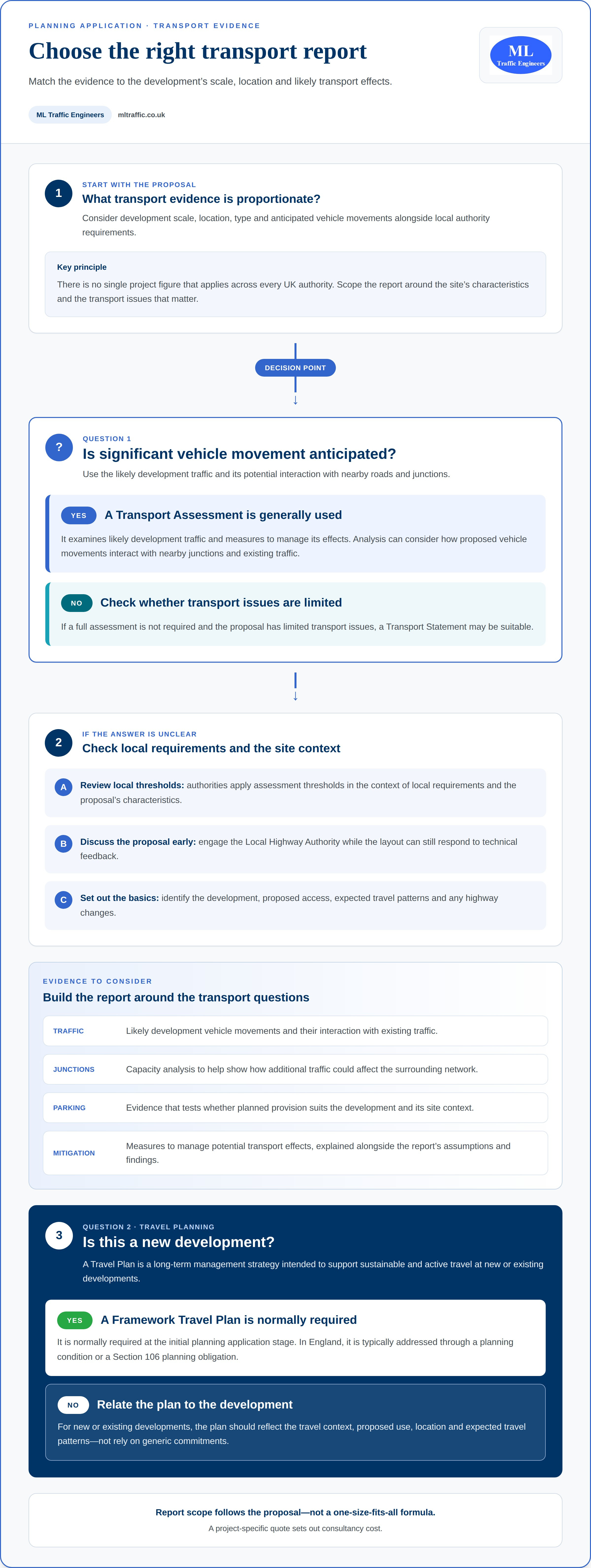
Discuss the proposal with the Local Highway Authority while the site layout can still respond to technical feedback. A useful early submission identifies the development, proposed access, expected travel patterns and any highway changes. The authority can then indicate which transport questions need further assessment. In London, Transport for London may also be consulted where a development affects its road network, bus services or stations.
Public consultation can influence highway decisions, so the evidence needs to explain the proposal clearly. In the planning consultation process described by the guide, the public are usually given at least 21 days to submit comments, objections or support, according to the Ministry of Housing, Communities and Local Government. This makes it important to address access, parking and safety concerns with specific plans and evidence rather than broad assurances.
Development-related changes to parking, loading, speed limits or vehicle access may require a Traffic Regulation Order (TRO), a legal document made under the Road Traffic Acts. The Local Highway Authority manages the process for a new or amended TRO and normally recharges associated costs to the developer. Consultation includes interested stakeholders such as the Police, public transport providers, emergency services, user groups and elected officials before formal second-stage public advertisement. The authority approves the order, with an appointed committee considering the application and public responses.
Pre-application engagement should also test whether the proposal’s highway effects can be mitigated. National planning policy focuses on unacceptable highway safety impacts and severe residual cumulative effects on the network after mitigation. The authority’s feedback helps identify whether access design, traffic evidence or proposed changes need refinement before submission. A clear response to those points gives decision-makers a more complete basis for assessing the application.
Transport assessments and statements for planning applications
A transport report explains how a proposed development could affect travel, access and nearby infrastructure. Its scope should match the proposal’s scale, location and transport effects.
Development Traffic and Capacity Analysis
A Transport Assessment examines likely development traffic and measures to manage its effects. It is generally used where significant vehicle movement is anticipated. A Transport Statement may suit a proposal with limited transport issues when a full assessment is not required. Both can set out the evidence behind conclusions on access and the surrounding network.
Analysis can consider how proposed vehicle movements interact with nearby junctions and existing traffic. Parking evidence can test whether planned provision suits the development and its site context. Where an environmental impact assessment considers transport effects, traffic analysis can help explain likely changes in movement and identify mitigation. The report should distinguish assumptions from findings so decision-makers can follow its reasoning.
Travel Plan Requirements
A Travel Plan is a long-term management strategy intended to support sustainable and active travel at new or existing developments. For a new development, a Framework Travel Plan is normally required at the initial planning application stage. In England, it is typically addressed through a planning condition or a Section 106 planning obligation.
The plan should relate to the development’s travel context, rather than make generic commitments. It can describe how sustainable travel will be supported and how measures will be managed over time. A consultant considers the proposed use, location and expected travel patterns when preparing it. The Travel Plan planning process can help clarify how this document supports an application.
Local Transport Assessment Thresholds
Local planning authorities apply transport assessment thresholds in the context of local requirements and the proposal’s characteristics. Scale, location, development type and anticipated vehicle movements help determine whether a Transport Statement or fuller Transport Assessment is appropriate. There is no single project figure that applies across every UK authority.
A consultant can review relevant local requirements alongside the proposal’s likely transport effects. The report’s scope should be proportionate and address the issues that matter for the site. For example, a small proposal with limited transport effects may need a different level of evidence from a development expected to generate significant vehicle movement.
Transport Assessment Preparation Steps and Timescales
Preparation starts with the development proposal and available site information. The client supplies project details and current plans, including the proposed use, layout and access arrangements. The consultant then defines the assessment scope, identifies the transport questions, gathers relevant evidence and evaluates potential effects and mitigation.
After analysis, the consultant checks that the report’s assumptions, evidence and conclusions align. Timescales depend on the information available, the development’s complexity, the evidence required and whether survey work is needed. Changes to the proposal can also affect the work. Clear project information at the outset helps establish a focused scope and a report suited to the application.
Common causes of transport-related delays and refusals
Transport is a material planning consideration because development can affect highway safety and the surrounding network. A traffic engineering consultancy for planning permission prepares technical evidence to assess those effects, identify mitigation and support the local planning application.
National planning policy sets the key highways tests: a proposal should only be refused on highways grounds if it would have an unacceptable impact on highway safety, or severe residual cumulative impacts on the road network after mitigation. A report should connect its findings to those tests. It should explain what the development changes, which effects matter and how proposed measures respond.
Gaps between the proposal and its transport documents can delay assessment. For example, an access shown on one drawing but described differently in supporting documents leaves decision-makers without a consistent basis for review. A consultant checks that the development description, access arrangements and transport analysis align. Clear explanations of assumptions also help the local planning authority understand how conclusions were reached.
Traffic modelling and data analysis should address the actual development and its surroundings. The consultant considers likely vehicle movements, relevant junctions and available evidence, then explains the method and results. If a model’s assumptions are unclear or its conclusions do not address a network concern, the authority may request further information. This can extend the application process while the evidence is clarified.
Transport consultants prepare reports that connect technical evidence with planning decisions. A Transport Assessment or Transport Statement examines potential transport impacts and mitigation, with the appropriate scope depending on the proposal. A Travel Plan may also accompany the application. Reports should identify the site, explain the development assumptions, assess relevant effects and present practical responses. The Transport Assessment planning process illustrates the role of this evidence.
Early transport planning input matters because consultants are most effective before the site layout is finalised. At that stage, findings can inform access position, circulation and parking arrangements before design decisions become harder to change. For instance, an early review may show that an access layout needs further analysis. Addressing the issue during design can reduce avoidable revisions to plans and supporting documents later.
Common causes of transport-related delay include incomplete evidence, inconsistent drawings, unexplained assumptions and unresolved effects on safety or network operation. A focused review helps identify the issue and the evidence needed to address it. The consultant can then coordinate the technical report with the application documents, giving the local planning authority a clear account of impacts and proposed mitigation.
Trip generation and junction capacity
Trip generation estimates the vehicle movements a proposed development could add to nearby roads. The consultant considers the development’s use, scale, location and travel options, then explains the assumptions behind the estimate. A housing proposal, for example, has a different movement profile from a commercial site. The assessment should show how its estimate relates to the actual proposal, rather than rely on an unexplained total.
The next step is to consider when and where those journeys may affect the network. A consultant assesses relevant junctions and relates expected development traffic to existing conditions. The focus is not simply the number of trips, but their distribution and interaction with local infrastructure. Clear diagrams and written explanations help decision-makers trace how the analysis moves from development assumptions to potential junction effects.
Capacity analysis examines whether a junction can accommodate forecast movements and where pressure may arise. The report should identify the junctions assessed, explain the evidence and describe any constraints affecting the conclusion. For example, a site access may perform differently from a nearby junction serving several routes. If the analysis identifies a potential issue, the consultant can consider whether layout changes or other mitigation would address it.
These findings inform feasibility before the development layout is settled. If a proposed access creates operational concerns, early analysis can inform its position or design while options remain open. For a commercial proposal, the consultant may also examine how servicing and customer travel interact with access arrangements. The purpose is to test the transport consequences of the design, not to assume approval or reject a layout without evidence.
Good analysis distinguishes observed information from assumptions and forecasts. The consultant explains the basis for trip estimates, the network considered and how mitigation changes the assessment. If a conclusion depends on a proposed measure, the report should state that clearly. This lets the local planning authority assess whether remaining effects meet the highways tests, including highway safety and severe residual cumulative impact after mitigation.
Trip generation also relates to sustainable travel choices. The assessment considers the site’s location and available travel options, rather than treating every journey as a car trip. A consultant can explain how these assumptions affect forecast traffic and junction findings. Changes to the proposal, such as revised access or land use, should be reflected in the evidence so the application describes one coherent scheme.
For a robust planning submission, the report links each conclusion to evidence and a practical response. It should make clear which junctions matter, what effects the analysis identifies and whether mitigation changes those effects. This structure supports an informed decision on network impact and gives the development team a clearer basis for design, feasibility and the next planning steps.
What is a Travel Plan and when is it required?
A Travel Plan is a long-term management strategy for supporting sustainable and active travel at a new or existing development. For planning applications, it explains how travel choices relate to the site and how proposed measures will be managed.
For a new development, a Framework Travel Plan is normally required at the initial planning application stage. In England, it is typically addressed through a planning condition or a Section 106 planning obligation. This means the plan can form part of the application’s supporting documents, with its delivery secured through the planning process.
The plan should respond to the development’s location, proposed use and expected travel patterns. A site near public transport, for example, has different opportunities from a location where journeys rely more heavily on cars. The consultant considers those conditions when identifying suitable measures. The aim is to connect the plan to the actual proposal, not insert generic commitments that do not reflect its setting.
A useful Framework Travel Plan explains the proposed approach, the measures under consideration and how responsibility for delivery will be managed. It should align with the application’s development description and layout. If the site design changes, the plan may also need to reflect revised access or travel arrangements. Consistency helps the local planning authority assess the proposal and understand how its travel strategy supports the development.
Travel Plans can support active travel by setting out how walking and cycling are encouraged alongside other sustainable options. Measures need to suit the site and its users. For example, a residential development and a workplace have different travel patterns and practical considerations. A consultant relates the plan’s approach to the development rather than assuming the same measures suit every project.
Preparation involves understanding the proposal, reviewing its travel context and shaping a proportionate framework. The consultant considers how the plan fits with transport evidence and the application’s other documents. Where a Transport Assessment or Transport Statement accompanies the application, the Travel Plan should support its account of likely travel impacts. Coordinated documents give decision-makers a clearer picture of the proposal.
Early planning input helps the team consider travel measures while the development is being designed. That gives the plan a better connection to the site layout and proposed access. For a new development preparing its application, discuss a Travel Plan as part of the transport planning work.
ML Traffic Engineers UK
ML Traffic Engineers UK supports planning applications with transport evidence tailored to each development. Its work includes Transport Assessments and Transport Statements, as well as surveys and analysis to explain access, parking and vehicle movements. Swept Path Analysis can assess whether vehicles can manoeuvre within a proposed layout, while Parking Surveys provide evidence about parking conditions. The appropriate work depends on the proposal and the transport questions it raises.
Engage the consultancy while plans are being developed or when an application needs transport documentation. Early involvement can help align the analysis with the site layout and planning requirements. Contact ML Traffic Engineers UK to discuss your planning application.
Set the transport scope before plans are fixed
The next step is to align the transport work with the decisions your development team still needs to make. A traffic engineering consultancy for planning permission can help define the evidence required for the proposal, with scope shaped by its site, access arrangements and transport impacts. Establishing that scope early gives the project team a clearer basis for coordinating planning documents and design work.
ML Traffic Engineers UK provides Transport Statements, Swept Path Analysis and Parking Surveys to support planning applications. The relevant work depends on the questions the proposal needs to address, rather than a standard package. Contact ML Traffic Engineers UK to discuss your project requirements and the appropriate technical input.
Take the next step by contacting ML Traffic Engineers UK about your planning application. A clear transport scope can help your team move forward with informed design decisions.
Frequently Asked Questions
Why do you need Transport Assessments?
A Transport Assessment gives decision-makers evidence about how a development could affect travel and the surrounding network. It can examine expected vehicle movements, access arrangements and potential mitigation. For example, a proposal with a new site access may need analysis showing how it connects with nearby roads. The assessment helps show whether transport effects have been understood and addressed in the planning application.
What traffic and transport reports are required for planning permission in the UK?
The documents depend on the development and its transport effects. A Transport Assessment may suit proposals expected to generate significant vehicle movement; a Transport Statement may be appropriate where transport issues are limited. A Travel Plan can support the application, while Parking Surveys, Traffic Surveys or Swept Path Analysis can provide evidence for specific questions about parking, traffic or vehicle manoeuvring.
When is a Transport Assessment or Transport Statement required?
A fuller Transport Assessment is generally used where significant vehicle movement is anticipated. A Transport Statement may be suitable when a proposal has limited transport issues and a full assessment is not required. Local requirements and the proposal’s scale, location and nature also shape the scope. For instance, a small scheme with straightforward access may require different evidence from a development affecting several junctions.
How do I choose and compare UK transport planning consultants?
Start by defining the planning decision your transport evidence must support. Assess whether the consultant can explain the proposed scope, the evidence needed and how the findings will address the site’s specific access and travel issues. Review how the report will coordinate with development plans and local authority requirements. ML Traffic Engineers UK prepares planning reports and technical analysis for development proposals.
What happens if a planning application lacks adequate transport evidence?
Missing or inconsistent evidence can leave the local planning authority unable to understand a proposal’s transport effects. The authority may seek further information, delaying consideration while the documents are clarified. If highway safety or severe residual cumulative network effects remain unresolved after mitigation, the application may face refusal on highways grounds. Clear, coordinated evidence helps decision-makers assess the transport case.
How do parking, access, road safety and traffic impact affect planning permission?
Transport evidence helps determine whether a proposal can operate safely and what effects it may have on the local network. A Parking Survey can document existing parking conditions, while access analysis can examine vehicle movements into and within a site. The planning decision considers whether highway safety impacts are unacceptable or residual cumulative network impacts remain severe after mitigation. Evidence should relate directly to the proposed layout.
Which local authority or highway authority should I contact about transport requirements?
Discuss planning requirements with the Local Planning Authority handling the application, and highway matters with the relevant Local Highway Authority. The planning authority considers the application; the highway authority advises on impacts involving the public highway. In London, Transport for London may also be consulted if a development affects its road network, bus services or stations. Early discussion can help establish what transport evidence the proposal needs.

Disclaimer
The content on mltraffic.co.uk, including all technical articles, guides, and resources, is provided for general informational and educational purposes only. It is not intended to constitute professional advice in traffic engineering, transportation planning, development approvals, or any other technical or legal field.
While ML Traffic Engineers makes every reasonable effort to ensure the accuracy, completeness, and timeliness of the information published, we do not provide any warranties or representations (express or implied) regarding its reliability, suitability, or availability for any particular purpose. Any reliance you place on the content is strictly at your own risk.
In no event shall ML Traffic Engineers, its directors, employees, authors, or affiliates be liable for any direct, indirect, incidental, special, consequential, or punitive damages (including, without limitation, loss of profits, data, or business opportunities) arising out of or in connection with the use of, or inability to use, any information provided on this website.
The articles and guides on this site are not a substitute for engaging a qualified, professional traffic engineer to assess your specific project requirements. For tailored advice, compliance assessments, or traffic engineering services, please contact a competent professional.
This disclaimer may be updated from time to time without notice. By accessing or using this website, you agree to be bound by the most current version of this disclaimer.