Tag: urban development

  • Transport Planning Consultants Lambeth: Navigating Local Planning Requirements in 2026

    Transport Planning Consultants Lambeth: Navigating Local Planning Requirements in 2026

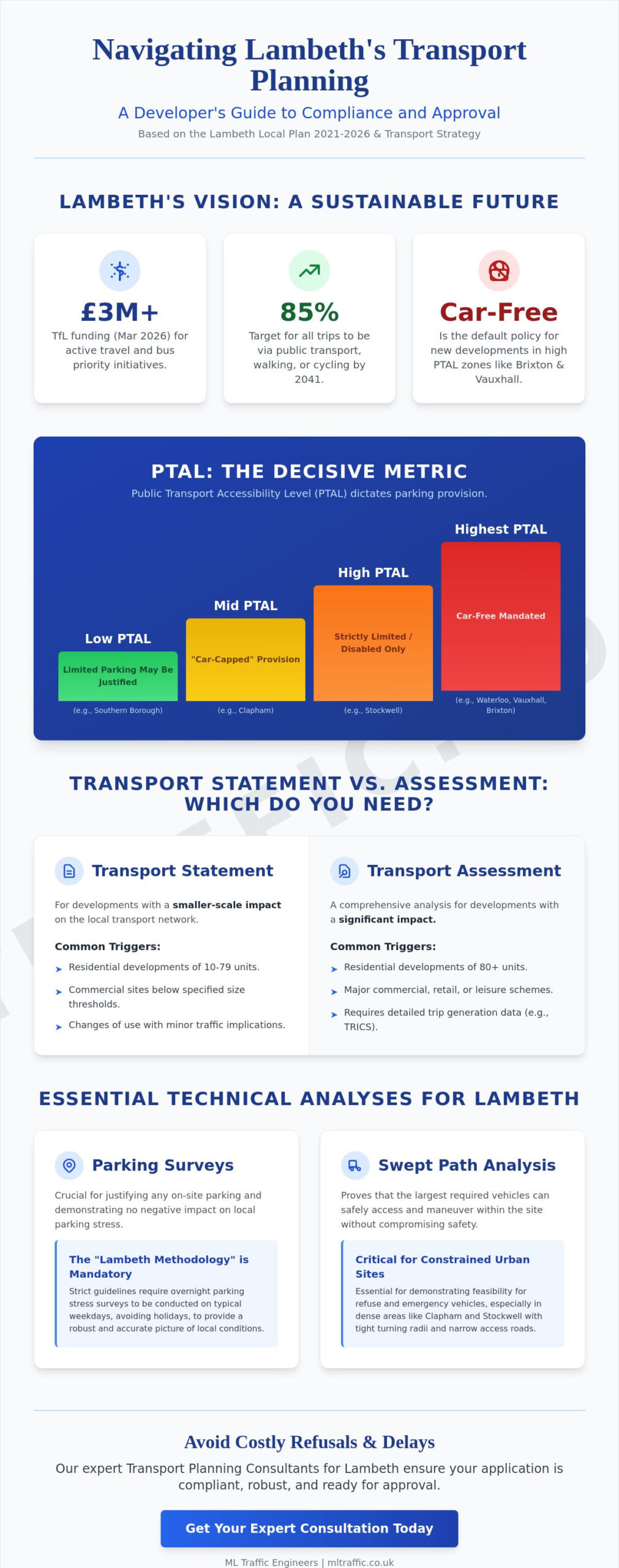
    Could a single oversight in your parking survey methodology be the reason your next development faces a costly planning refusal? With Lambeth’s recent £3 million funding injection from Transport for London in March 2026, the borough’s shift toward active travel and bus priority is no longer a suggestion; it’s a strict regulatory mandate. As specialized Transport Planning Consultants Lambeth, we recognize that securing approval requires a hyper-local technical strategy that aligns perfectly with the Lambeth Local Plan 2021-2026.

    We understand the logistical strain of managing high PTAL areas that limit parking provision while still ensuring complex urban access for refuse and emergency vehicles. It’s a high-stakes balancing act where precision is a functional necessity. This guide provides the technical clarity you need to master local requirements, from conducting compliant Parking Surveys to executing detailed Swept Path Analysis. We’ll preview the essential reporting steps and the April 2026 national guidance updates to ensure your planning submission is robust, compliant, and ready for immediate approval.

    Key Takeaways

    • Understand how the Lambeth Local Plan 2021-2026 mandates car-free developments in high PTAL zones and the impact this has on your site’s parking provision.
    • Identify whether your project triggers the need for a Transport Statement or a full Assessment by reviewing specific residential and commercial development thresholds.
    • Expert Transport Planning Consultants Lambeth ensure your application follows the strict “Lambeth Methodology” for overnight parking stress surveys to avoid technical objections.
    • Utilize Swept Path Analysis to prove site feasibility for refuse and emergency vehicles, especially within the constrained urban layouts of Clapham and Stockwell.
    • Learn how data-driven reporting and professional Travel Plans reduce regulatory pressure and streamline the path toward a successful planning submission.

    The Lambeth Planning Landscape: Transport Policy and Requirements

    The Lambeth Local Plan 2021-2026 serves as the primary regulatory framework for all development within the borough. Its transport objectives are uncompromising, prioritizing sustainable growth and the reduction of private vehicle use. For developers, this means traditional parking-led designs are rarely acceptable. Instead, the council enforces a “car-free” or “car-capped” approach for most new projects, particularly those located in high-density areas. Professional Transport Planning Consultants Lambeth are essential for translating these high-level policies into actionable site layouts that meet technical scrutiny.

    Effective transportation planning in Lambeth requires more than just meeting minimum standards; it demands an active contribution to the borough’s environmental targets. With Lambeth securing over £3 million in TfL funding in March 2026 to support walking and cycling initiatives, the pressure on developers to provide robust sustainable infrastructure has never been higher. Early engagement with the Lambeth Highway Authority is critical for major developments. It allows us to identify potential site access constraints and traffic impact issues before they become grounds for refusal.

    To better understand the borough’s vision for expansion and infrastructure, watch this overview of the Lambeth Growth Plan:

    Understanding PTAL Ratings in Lambeth

    Public Transport Accessibility Level (PTAL) is the decisive metric for development in areas like Brixton, Vauxhall, and Waterloo. These districts often achieve the highest possible scores, which triggers a mandatory restriction on residential parking provision. We help developers navigate these constraints by providing data-driven justifications for site-specific requirements. In the southern, lower PTAL areas of the borough, we use detailed Parking Surveys to demonstrate where limited parking is necessary without compromising local network capacity.

    The Impact of the Lambeth Transport Strategy 2019-2040

    The Lambeth Transport Strategy sets an ambitious target for 85% of all trips to be made via public transport, walking, or cycling by 2041. Your planning submission must reflect the “Healthy Streets” approach, focusing on air quality and pedestrian safety. We integrate active travel infrastructure into site designs, ensuring that cycle storage and pedestrian pathways are core components of the project. Our role as Transport Planning Consultants Lambeth is to mitigate local traffic impact through precise reporting, ensuring your development supports the borough’s long-term vision while remaining commercially viable.

    Transport Statements vs. Assessments: Which Do You Need?

    Determining the correct level of reporting is the first step in any successful planning application. The distinction between a Transport Statement and a Transport Assessment depends on the scale of your development and its potential impact on the local highway network. As experienced Transport Planning Consultants Lambeth, we use the TRICS database to provide accurate trip generation forecasts. This data is vital for negotiating S106 and S278 legal agreements, ensuring that developer contributions are proportional to the project’s impact.

    The requirements are grounded in Lambeth’s Transport Strategy, which prioritizes sustainable modes over private car use. Since the UK government updated national guidance for Local Transport Plans in April 2026, the emphasis on integrated ticketing and road safety has become even more central to these reports. We provide the technical evidence needed to satisfy the Lambeth Local Plan’s specific development management policies, reducing the risk of costly delays during the consultation period.

    When is a Transport Statement Sufficient?

    A Transport Statement is typically required for smaller residential developments, often those under 20 units, where the traffic impact is expected to be minimal. These reports focus on accessibility and local transport links rather than complex junction modelling. We ensure every statement covers essential components like parking provision and high-quality cycle storage. If you’re unsure about your project’s scale, learn more about our Transport Statements and how they streamline the approval process for minor works.

    Full Transport Assessments for Major Lambeth Projects

    Large-scale developments, particularly in high-growth areas like Vauxhall or Nine Elms, trigger the need for a full Transport Assessment. These major projects require sophisticated traffic modelling to analyze the impact on surrounding junctions. Our expertise as Transport Planning Consultants Lambeth ensures that your major project addresses the 23,000 new jobs expected in Waterloo and Vauxhall through comprehensive multi-modal analysis. We manage the full project lifecycle, from initial assessment to ongoing support. For a deeper dive into these requirements, read The Developer’s Guide to Transport Assessments.

    Precision in these reports prevents delays and secures your site’s future. If you’re preparing a submission, it’s often beneficial to review our project types to see how we’ve handled similar technical challenges across the borough.
    Transport Planning Consultants Lambeth: Navigating Local Planning Requirements in 2026

    The Lambeth Parking Survey Methodology: Precision for Approval

    Generic parking surveys often lead to immediate planning delays or technical refusals in Lambeth. The council requires a specific, evidence-based approach to assess overnight parking stress, known as the Lambeth Methodology. This process is far more rigorous than standard industry practices. As specialized Transport Planning Consultants Lambeth, we manage the full data collection lifecycle to ensure your application meets these precise standards. We recognize that in a high-stakes planning environment, technical accuracy is a functional necessity.

    The core of this process is the 200-meter walking distance requirement. Unlike a simple radial line on a map, this measurement follows the actual pedestrian route from the site entrance. Within this defined area, every available on-street parking space must be mapped, categorized, and analyzed. This includes identifying spaces within various Controlled Parking Zones (CPZs) and understanding how their specific operating hours impact potential development overspill. This level of detail is a non-negotiable foundation of Lambeth’s official Transport Strategy, which seeks to manage street capacity without compromising safety.

    Conducting an Accurate Lambeth Parking Survey

    Lambeth Council mandates two separate overnight surveys to ensure data reliability. These must occur on a Tuesday/Wednesday and a Wednesday/Thursday between 00:30 and 05:30. We meticulously exclude “unusable” spaces, such as those within 10 meters of a junction, across driveways, or at bus stops. Our final report calculates parking stress percentages to the council’s exact standards, providing a transparent view of local capacity. We deliver these results with the readiness and precision required to withstand intense scrutiny from highway officers.

    Justifying Parking Provision in High-Density Zones

    In high-density urban zones, planning officers often worry that new developments will saturate existing street parking. We use our detailed survey data to prove that local streets can absorb any projected overflow. This technical evidence is vital for projects that do not meet the car-free criteria discussed in the previous sections. By presenting a clear delta between current stress levels and future projections, we mitigate officer concerns and reduce regulatory pressure. Explore our parking survey expertise to see how we translate complex street data into successful planning outcomes.

    Our team understands that a single misplaced data point can derail a project. We prioritize clarity and rapid delivery of information, ensuring that your submission remains on schedule. By adhering to these strict benchmarks, we act as a reliable partner that understands intricate regional regulations so that you don’t have to. Our goal is to provide an all-encompassing, fully-managed service that secures your planning approval through technical excellence.

    Swept Path Analysis: Ensuring Access in Lambeth’s Urban Fabric

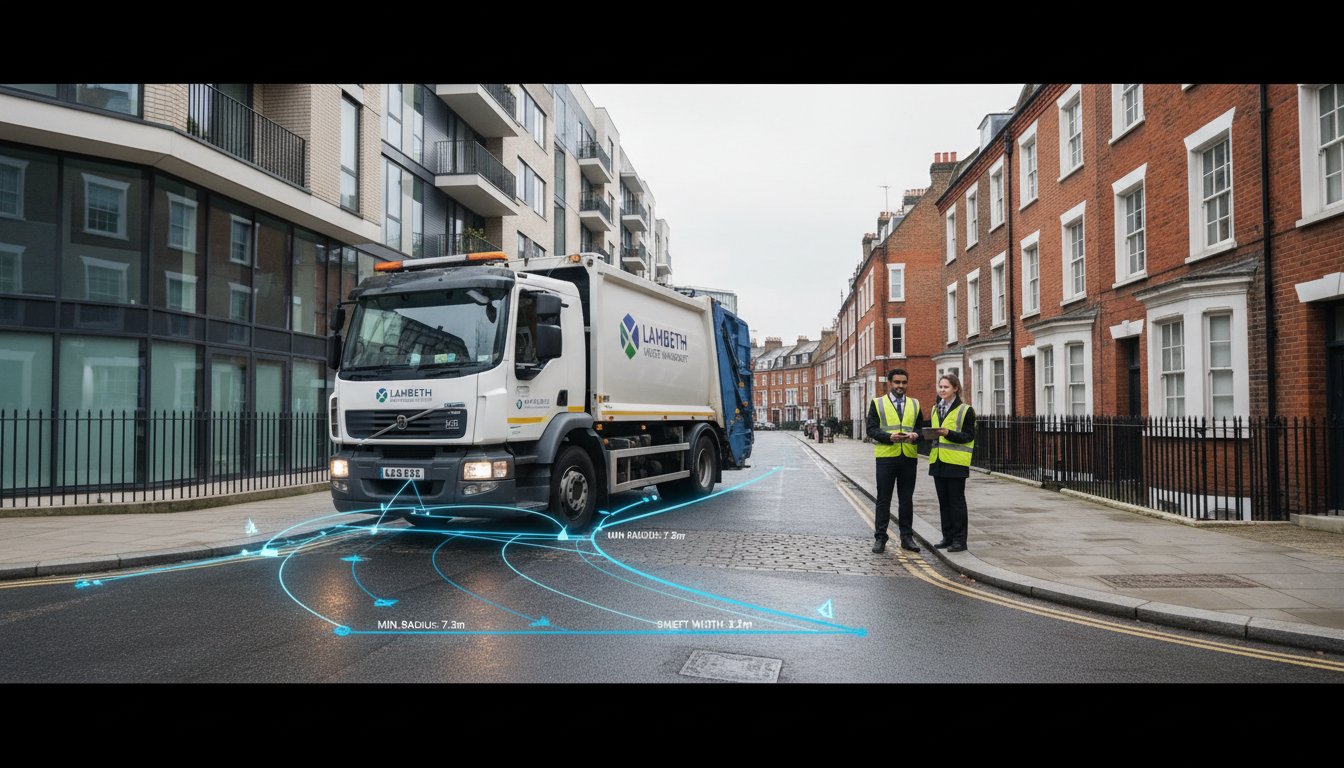
    Proving that a site is physically accessible is a prerequisite for any Lambeth planning submission. In high-density areas like Vauxhall, Waterloo, or Brixton, every centimeter of road space is contested. We use Swept Path Analysis (SPA) to simulate vehicle movements through the borough’s narrowest streets, such as those found in Clapham or Stockwell. This technical modelling ensures that proposed developments don’t create gridlock or safety hazards. As Transport Planning Consultants Lambeth, we prioritize precision to reduce regulatory friction and demonstrate site feasibility from the outset.

    We use advanced software to track the path of specific vehicle templates against your proposed site layout. This process identifies potential “pinch points” where a vehicle might strike a curb, building, or street furniture. Catching these issues during the design phase helps developers avoid costly redesigns after a planning refusal. Our team provides the technical authority required to reassure highway officers that your project is safe and functional. We manage this process with the readiness and urgency that the industry demands.

    Refuse and Emergency Vehicle Access

    Lambeth Council enforces strict standards for refuse collection vehicle (RCV) maneuvering. We use specific London-standard templates to prove that a large RCV can safely service your site without multiple-point turns that block traffic. Emergency access is equally critical. We demonstrate compliance with Building Regulations Part B by showing clear, unobstructed paths for fire tenders. This documentation is essential for securing approval in constrained urban settings. For more technical details, see our guide on Securing Approval with Swept Path Analysis.

    Designing for Modern Delivery Needs

    The rise in online retail has changed how we design residential and commercial access. Modern developments must accommodate frequent van deliveries without obstructing the public highway. We calculate precise turning circles and visibility splays to ensure safe ingress and egress for all users. This data-driven approach allows us to optimize car park layouts and delivery bays, maximizing site value while meeting all highway safety requirements. If you need to prove site feasibility in a constrained location, book a professional Swept Path Analysis to secure your project’s future.

    Expert Transport Planning Consultancy in Lambeth: Why Local Knowledge Wins

    ML Traffic Engineers provides a level of technical depth that generalist planning firms often cannot match. While generalists offer broad advice, we function as specialized Transport Planning Consultants Lambeth, focusing specifically on the engineering and data requirements that drive planning decisions. Our local presence in London ensures we’re available for urgent site visits and direct liaison with Lambeth Highway Authority officers. This proximity allows our team to respond rapidly to evolving project demands, which is vital in a fast-moving infrastructure environment where timing is everything.

    We manage the full project lifecycle, moving from initial feasibility assessments to post-approval support for S278 agreements. Our reports use objective data to anticipate and neutralize the unique objections often raised by Lambeth Council regarding parking stress or vehicle access. If a project moves to an appeal, our data-driven reporting provides the robust technical evidence needed to defend your site layout. We take immense pride in our precision and adherence to standards, acting as a dependable partner so you don’t have to navigate complex regional regulations alone. Our support ensures that any required highway works are designed to adoptable standards from the outset.

    A Tailored Approach for Lambeth Developers

    Every development requires a strategy that speaks the specific language of local planning officers. We reduce project risk by offering pre-application transport advice, identifying potential hurdles before they lead to formal objections during the consultation phase. This proactive approach ensures that your initial submission is technically sound and aligned with the Lambeth Local Plan. To see how we’ve applied this methodology to diverse sites across the borough, you can view our project types and experience.

    Securing Your Planning Approval

    Technical precision is the foundation of a successful application in 2026. Minor errors in a parking survey or a flawed swept path analysis often result in costly design revisions and months of avoidable delays. Our Travel Plans complement your submission by demonstrating a clear commitment to the borough’s sustainability goals, helping to mitigate the impact of car-free development mandates. We provide an all-encompassing, fully-managed service that prioritizes your project’s timeline and regulatory compliance. If you’re ready to move forward with a partner who understands the high-stakes nature of London infrastructure, contact ML Traffic Engineers for a Lambeth project quote and ensure your development is backed by expert technical authority.

    Securing Technical Approval for Your Lambeth Development

    Mastering the intricate requirements of the Lambeth Local Plan 2021-2026 is essential for any developer looking to avoid project delays. As specialized Transport Planning Consultants Lambeth, we provide the technical authority needed to navigate high PTAL constraints and strict parking survey methodologies. Our team delivers data-driven reports that withstand the scrutiny of London Highway Authorities, ensuring your site layout is both compliant and optimized for modern urban needs. We understand that precision is a functional necessity in this high-stakes environment.

    We offer a proven track record in executing expert Swept Path Analysis for tight urban sites, proving feasibility where others see obstacles. Our commitment to the specific Lambeth Methodology ensures your submission is robust and ready for immediate review. Don’t leave your planning submission to chance when you can partner with a reliable expert who manages the full project lifecycle. We are ready to provide the technical evidence your project requires. Get a Professional Transport Report Quote for Your Lambeth Project and take the final step toward a successful planning outcome.

    Frequently Asked Questions

    Do I need a Transport Statement for a small residential conversion in Lambeth?

    Yes, you’ll likely need a Transport Statement if your conversion triggers the thresholds set in the Lambeth Local Plan. For smaller projects under 20 units, this report proves that the change in use won’t negatively impact local traffic or pedestrian safety. It focuses on accessibility, cycle storage, and parking provision to ensure your site remains compliant with the borough’s sustainable travel objectives.

    What is the Lambeth Methodology for parking surveys?

    The Lambeth Methodology is a strict technical standard for assessing overnight parking stress. It requires two separate surveys on consecutive weekday nights, typically Tuesday/Wednesday or Wednesday/Thursday, between 00:30 and 05:30. The survey must cover a 200-meter walking distance from the site entrance. We meticulously exclude unusable spaces near junctions or bus stops to provide the precision planning officers demand.

    How does a car-free development policy affect my planning application?

    A car-free policy prohibits on-site parking for residents, except for disabled badge holders, in high PTAL areas like Brixton or Vauxhall. Your application must include robust data showing how the project supports the borough’s goal of 85% sustainable mode share by 2041. Professional Transport Planning Consultants Lambeth are essential for justifying these designs and ensuring they meet the council’s strict car-capped development criteria.

    Can I use a generic vehicle template for Swept Path Analysis in London?

    No, generic vehicle templates are frequently rejected by Lambeth highway officers. You must use specific London-standard templates for refuse collection vehicles and fire tenders to prove site feasibility. Our Swept Path Analysis uses these precise dimensions to identify potential pinch points in narrow streets like those in Clapham. This ensures your site access is safe and functional for the exact vehicles operating in the borough.

    What happens if my parking survey shows 100% parking stress?

    If your survey shows 100% parking stress, it indicates that local streets are at capacity. Planning officers will likely object to any development that adds further demand to the network. We help you mitigate this risk by proposing car-free legal agreements or optimizing your site layout. These strategies prevent overspill into the surrounding neighborhood and maintain the safety and integrity of the local highway.

    How long does it take to prepare a Transport Assessment for Lambeth Council?

    Preparing a full Transport Assessment typically takes between four and six weeks. This timeframe allows for detailed site visits, data collection, and any necessary junction modelling for major projects in growth areas like Nine Elms. We prioritize rhythmic efficiency to ensure your reporting is delivered rapidly without compromising technical accuracy. This proactive approach helps you avoid costly delays during the planning consultation period.

    Does Lambeth require a Travel Plan for all new developments?

    No, Lambeth only requires a full Travel Plan for major developments or projects with significant transport implications. These plans outline specific measures to encourage walking, cycling, and public transport use among site users. For smaller developments, a shorter Travel Plan Statement might be sufficient. We provide the technical evidence needed to satisfy these requirements and reduce the regulatory pressure on your planning submission.

    What is the role of a Section 278 agreement in my transport planning?

    A Section 278 agreement is a legal contract that allows you to make permanent alterations to the public highway as part of your development. This includes creating new site entrances or improving pedestrian crossings to meet safety standards. We provide the expert reporting and technical data required to secure these agreements. Our support ensures all highway works are designed to adoptable standards from the very beginning.

    Michael Lee

    Article by

    Michael Lee

    Transport planner with over 35 years' experience.

    Disclaimer

    The content on mltraffic.co.uk, including all technical articles, guides, and resources, is provided for general informational and educational purposes only. It is not intended to constitute professional advice in traffic engineering, transportation planning, development approvals, or any other technical or legal field.
    While ML Traffic Engineers makes every reasonable effort to ensure the accuracy, completeness, and timeliness of the information published, we do not provide any warranties or representations (express or implied) regarding its reliability, suitability, or availability for any particular purpose. Any reliance you place on the content is strictly at your own risk.
    In no event shall ML Traffic Engineers, its directors, employees, authors, or affiliates be liable for any direct, indirect, incidental, special, consequential, or punitive damages (including, without limitation, loss of profits, data, or business opportunities) arising out of or in connection with the use of, or inability to use, any information provided on this website.
    The articles and guides on this site are not a substitute for engaging a qualified, professional traffic engineer to assess your specific project requirements. For tailored advice, compliance assessments, or traffic engineering services, please contact a competent professional.
    This disclaimer may be updated from time to time without notice. By accessing or using this website, you agree to be bound by the most current version of this disclaimer.
  • Swept Path Analysis Services in London: Securing Planning Approval in 2026

    Swept Path Analysis Services in London: Securing Planning Approval in 2026

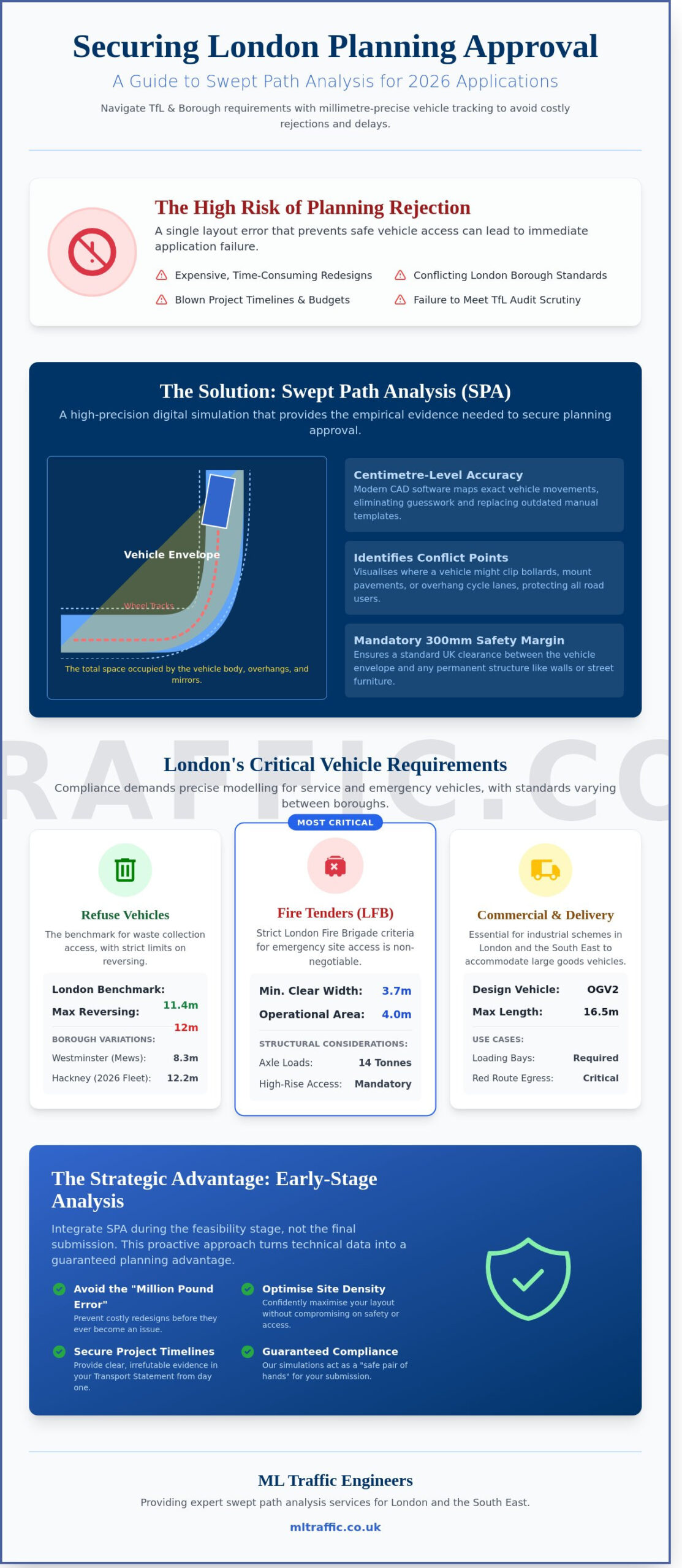
    Will your 2026 planning application survive the scrutiny of a Transport for London (TfL) audit if your vehicle tracking isn’t precise to the millimetre? You understand that navigating the conflicting requirements of different London Boroughs is one of the most stressful aspects of modern development. A single layout error that prevents a 12-metre refuse vehicle or a standard fire appliance from turning safely can result in an immediate rejection, forcing expensive redesigns that blow your project timeline and budget.

    Utilising expert swept path analysis services early in the design phase ensures your site layout is both functional and compliant from day one. At ML Traffic Engineers, we provide the technical CAD simulations and reports that act as a "safe pair of hands" for your submission. This article explores how to secure council approval with clear evidence for your Transport Statements while optimising site density without compromising on safety or access requirements. We’ll demonstrate how to turn technical data into a guaranteed planning advantage for your next London project.

    Key Takeaways

    • Understand how professional swept path analysis services use CAD simulation to ensure your development complies with TfL and local London Borough planning requirements.

    • Discover why precise vehicle modelling for refuse trucks and fire tenders is critical, especially with varying dimensional standards between boroughs like Westminster and Hackney.

    • Learn how to navigate London’s narrow Victorian streets and complex Red Route egress points by identifying access issues before they become physical obstacles.

    • Avoid the “Million Pound Error” by integrating digital vehicle tracking during the feasibility stage rather than waiting for the final submission phase.

    • Secure your project timeline with 24/7 engineering support designed to meet urgent planning deadlines across London and the South East.

    Table of Contents

    What is Swept Path Analysis for London Planning Applications?

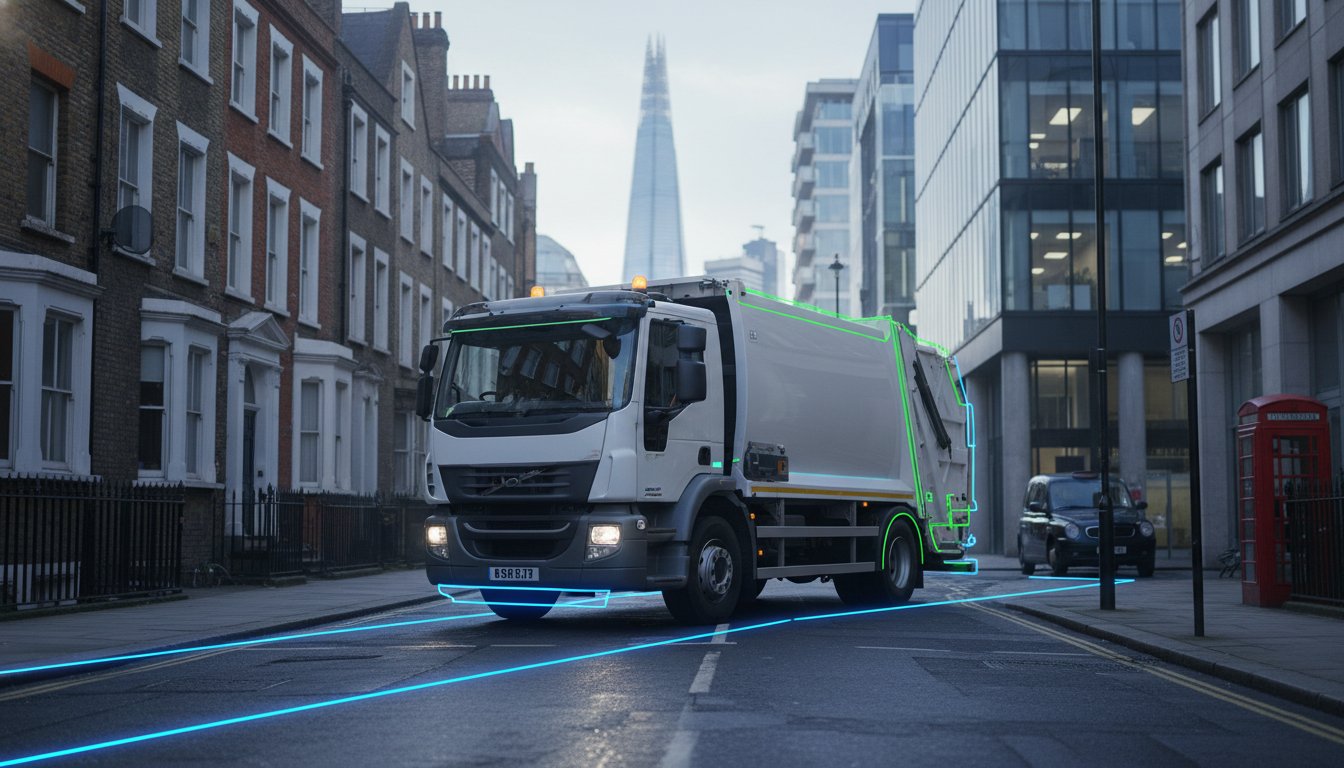
    Swept Path Analysis (SPA) is a technical digital simulation that calculates the exact space a vehicle requires to complete a manoeuvre. Our engineers use AutoCAD and specialised vehicle swept path analysis software to map these movements with centimetre-level accuracy. This process has evolved significantly from the manual ‘turning circle’ templates of the past. By 2026, high-precision digital modelling is the absolute standard for every London Borough planning department. It’s a non-negotiable requirement for developers because it provides the technical backbone for any credible Transport Statement or Assessment.

    Professional swept path analysis services provide the empirical evidence needed to secure planning approval. These simulations prove that refuse trucks, emergency vehicles, and delivery vans can navigate a site without mounting pavements or striking permanent structures. We use these models to eliminate guesswork during the design phase, ensuring that the proposed layout is physically viable before a single brick is laid.

    To better understand this concept, watch this helpful video:

    The Role of SPA in Modern Urban Design

    SPA allows designers to visualise two distinct paths: the wheel tracks and the vehicle body’s outer edge. This distinction is vital in London’s tight urban grain. We identify potential conflict points where a vehicle might clip a bollard or overhang a cycle lane. By simulating these movements early, we protect pedestrians and cyclists in shared spaces. It ensures that 100% of the site’s footprint remains safe and functional for all road users.

    Terminology: Tracking, Envelopes, and Clearances

    Precision in swept path analysis services relies on understanding the vehicle envelope. This represents the total area occupied by the vehicle, including its wing mirrors and body overhang. UK industry standards typically dictate a 300mm safety margin between this envelope and any permanent structure. We distinguish between kerb-to-kerb turns, which focus on wheel movement, and wall-to-wall turns, which account for the entire vehicle body. In London’s narrow corridors, analysing the front and rear overhang is critical. It prevents expensive damage to street furniture and ensures site compliance from day one.

    Essential Vehicle Models: From Refuse Trucks to Fire Tenders

    Precision in transport planning requires a clear distinction between the ‘Design Vehicle’ and the ‘Check Vehicle’. Designers use the Design Vehicle to dictate the standard geometry of the site. The Check Vehicle ensures that larger, less frequent arrivals can still navigate safely without damaging infrastructure. For London developments, this often means balancing daily delivery needs against emergency access requirements. Our swept path analysis services provide the technical certainty that these vehicles can coexist within a single site layout.
    The principles of vehicle movement analysis apply across a vast spectrum of transport, from the utility vehicles we model daily to the complex logistical choreography of world-renowned services like the Maharaja Express on its trans-India journeys.

    Emergency and Service Vehicle Requirements

    The London Fire Brigade (LFB) maintains strict criteria for site entry. They require a minimum clear width of 3.7 metres between kerbs, which increases to 4 metres for operational working areas. High-rise developments also require specific weight-bearing considerations for 14-tonne axle loads. The Standard 11.4m Refuse Vehicle serves as the London benchmark for waste collection.

    Local variations are common across the capital. Westminster often employs smaller 8.3m vehicles for historic mews, while Hackney adheres to larger 12.2m multi-compartment trucks for 2026 fleet projections. Councils strictly cap reversing distances at 12 metres to protect pedestrians and operatives. We use the Manual for Streets to justify tighter, more urban-friendly layouts while ensuring these service vehicles remain fully operational.

    Commercial and Delivery Vehicle Simulations

    Industrial schemes in the South East must accommodate OGV2 vehicles, which reach 16.5 metres in length. These simulations are vital for retail loading bays and distribution hubs. The ‘Final Mile’ shift has introduced electric cargo bikes and small EV vans like the 5.3-metre Vauxhall Vivaro-e into the modelling mix. These vehicles have tighter turning circles but different front and rear overhangs compared to diesel predecessors.
    Beyond vehicle movements, planning for these modern fleets often involves new electrical infrastructure requirements. For developers considering the integration of EV charging points, you can learn more about Great Park Electrical.

    Construction phase logistics require separate, detailed analysis. We model abnormal loads for 50-tonne mobile cranes and long-reach piling rigs to ensure plant positioning is viable before work begins. This proactive approach prevents costly delays during the implementation phase. Working with a specialist construction logistics plan consultant ensures that heavy vehicle movements during the build phase are fully coordinated and compliant with TfL and borough-specific requirements. If you need clarity on your site’s access constraints, our team can provide bespoke CAD simulations to de-risk your planning application and ensure full compliance with Transport for London (TfL) standards.

    Swept Path Analysis Services in London: Securing Planning Approval in 2026

    Overcoming London’s Unique Site Constraints with CAD Simulation

    London’s historic infrastructure creates immediate hurdles for modern developers. Most streets in central postcodes like Soho or Marylebone follow a Victorian layout, never intended for 12-metre HGVs or articulated delivery vans. We use swept path analysis services to model these narrow access points with millimetre precision. This CAD simulation proves that a site is accessible before a single brick is laid, preventing costly mid-construction revisions. When dealing with TfL Red Routes, the margin for error disappears. Egress points must allow vehicles to join the flow of traffic without causing braking or swerving. Our simulations account for the specific turning radii of vehicles required for your project, ensuring compliance with strict Transport for London safety standards.

    On-street parking pressures further complicate the simulation process. A design that works on an empty street often fails in a real-world London environment where residents’ cars narrow the available carriageway. We model these "worst-case" scenarios to ensure your site remains functional 24/7. In high-value postcodes where land costs exceed £2,000 per square foot, SPA justifies "tight" designs. By proving a vehicle can safely clear a corner with only 300mm of leeway, we help clients maximise their developable footprint without compromising safety.

    High-Density Development Challenges

    Modern London developments often rely on basement car parks and multi-storey vehicle lifts to save space. We optimise these areas by simulating 1:7 ramp gradients and tight transition curves. For luxury residential blocks, "In-and-Out" driveways must function seamlessly to prevent tailbacks onto the public highway. We also manage the "Visibility Splay" alongside swept path requirements. This ensures drivers have a clear line of sight to pedestrians, a non-negotiable factor for securing planning approval in high-footfall areas.

    Local Authority Variations in Greater London

    Planning requirements shift significantly across the 32 London boroughs. A vehicle tracking layout that passes in Croydon might face an immediate fail in the City of London due to different street furniture tolerances. We use council-specific refuse vehicle templates, as an 11.4m Phoenix II vehicle requires a different turning circle than standard models. Adhering to local council planning guidance ensures that waste collection and emergency access meet the distinct criteria of each authority. This precision is vital for meeting the London Plan 2026 requirements, which demand sustainable transport access and reduced congestion through smarter site design. For East London developments, particularly those navigating the New Local Plan 2023–2038 and active travel requirements, working with experienced Transport Planning Consultants Tower Hamlets specialists ensures your swept path data aligns with the borough’s strict PTAL ratings and zero-car development policies. For South East London projects, working with experienced Transport Planning Consultants Bromley specialists ensures your swept path data aligns precisely with the London Borough of Bromley’s specific parking and access standards. Our swept path analysis services provide the technical evidence needed to satisfy these rigorous regulatory frameworks.

    The Strategic Value of Early-Stage Swept Path Analysis

    Timing determines the profitability of a London development. Architects frequently wait until the formal submission phase to request transport simulations, but this delay creates unnecessary risk. Integrating swept path analysis services during the initial feasibility stage identifies physical constraints while the site layout is still fluid. This proactive approach prevents the "Million Pound Error" where a developer discovers a 12-metre refuse vehicle cannot navigate a junction only after the concrete slab is poured. Retrofitting structural changes at that stage is 15 times more expensive than adjusting a CAD drawing during week one.

    Professional simulations serve as a powerful negotiation tool when meeting with Highways Officers. Local authorities often demand conservative road widths that eat into your developable land. We use high-fidelity CAD data to prove that specific vehicles can safely navigate tighter radii. This evidence allows you to justify narrower access points, protecting your site’s density while maintaining full safety compliance. It moves the conversation from subjective opinion to hard, defensible data. Partnering with the transport consultants UK developers trust for 2026 London planning success ensures your swept path evidence is presented within a comprehensive transport assessment that satisfies both local highway authorities and TfL.

    SPA as a Design Optimisation Tool

    Every square metre of wasted tarmac represents lost revenue. Precise tracking allows designers to trim excess road surfacing and reallocate that space to sellable square footage or green infrastructure. Beyond the footprint, SPA improves the internal flow of car parks. Well-designed bays and aisles increase user safety and have been shown to improve tenant satisfaction ratings by 22% in commercial hubs. Implementing SPA early can reduce construction costs by 5-10% through layout efficiency and reduced material requirements.

    Mitigating Planning Rejection Risks

    Planning departments are becoming stricter regarding vehicle movements. In 2026, London authorities cited "inadequate manoeuvrability" in 18% of all transport-related planning refusals. A professional SPA drawing provides the technical certainty required for highway design S278 and S38 agreements with local councils. Manual guesstimates don’t satisfy the rigorous standards of a Planning Committee. You need CAD-verified accuracy to ensure your project moves from the drawing board to the construction phase without costly delays or redesigns.

    Secure your site’s viability with precision data. Book our swept path analysis services to eliminate design uncertainty today.

    Expert Swept Path Analysis Services from ML Traffic Engineers

    London’s urban landscape demands exactness. ML Traffic Engineers provides essential support for developers navigating the complex planning environment of the South East. We offer 24/7 availability to meet urgent submission deadlines, ensuring your project remains on schedule even when local authorities demand revisions at short notice. Our professional engineers use the latest AutoDESK Vehicle Tracking software to deliver precision-led swept path analysis services that satisfy both safety and regulatory standards.

    We tailor our approach to the scale of your development. Whether you’re designing a single residential driveway in a constrained borough or managing a 45,000-square-foot distribution centre near the M25, our team provides the technical data required. This work integrates seamlessly with our Transport Statements and Parking Survey services. By providing a total, managed solution, we remove the logistical burden from your project team.

    Our Process: Precision and Compliance

    Our workflow is designed for speed and accuracy. We begin with a comprehensive review of your site plans, selecting design vehicles based on specific council requirements. This often includes 11.4-metre refuse trucks or London Fire Brigade appliances. Our engineers then produce:

    • Detailed CAD modelling featuring colour-coded conflict reporting to identify tight turns.

    • Simulations of multiple manoeuvres to ensure site safety and functionality.

    • A final technical note prepared for immediate inclusion in your planning pack.

    This rigorous approach ensures that swept path analysis services act as a robust defence of your site layout during the consultation phase. For developments requiring comprehensive transport strategies, our team also specialises in London travel plans for planning applications, ensuring your project meets TfL’s 2026 sustainability targets while maintaining operational efficiency.

    Why London Developers Trust ML Traffic

    We act as a safe pair of hands for complex London road regulations. Our engineers have over 15 years of experience negotiating with local Highways Authorities to resolve technical disputes. We don’t just provide drawings; we provide solutions. If a vehicle movement appears unworkable, we suggest immediate layout modifications to achieve compliance. Our team maintains a high success rate in overturning technical objections through direct, professional dialogue with council officers. Contact ML Traffic today for a bespoke Swept Path Analysis quote and ensure your planning application is supported by industry-leading expertise.

    London’s 2026 planning environment leaves no margin for error regarding vehicle access. Integrating professional swept path analysis services during your initial design phase is the most effective way to satisfy local authority requirements for fire tenders and refuse vehicles. Our expert CAD design team has been a dependable partner for UK developers since 2014. We provide the technical authority needed to overcome tight site constraints and avoid the high costs of planning refusals. We don’t just deliver drawings; we provide a total managed solution that ensures your site’s safety and compliance.

    ML Traffic Engineers maintains 24/7 availability for London projects to match the fast-moving pace of the construction industry. We understand the regulatory burdens you face and act as a safe pair of hands to manage the complexities of road layout design. Beyond vehicle tracking, successful planning applications increasingly require comprehensive traffic surveys for London planning applications to provide the baseline data that supports your transport assessments. You can Request a Fast Fee Proposal for Swept Path Analysis right now to keep your project moving forward. We’re here to ensure your development meets every safety standard with unwavering reliability and technical precision.

    Frequently Asked Questions

    What is the typical cost of swept path analysis services in London?

    Professional swept path analysis services in London typically cost between £350 and £850 per site for a standard assessment. This fee covers the CAD design and a comprehensive technical report for your planning application. Prices vary depending on the number of vehicle manoeuvres required and the complexity of the existing road layout. We provide fixed-price quotations within 4 hours to give your project team immediate budget certainty.

    How long does it take to complete a Swept Path Analysis report?

    We deliver standard Swept Path Analysis reports within 48 to 72 hours of receiving your site layout in CAD format. More complex projects involving multi-stage construction logistics or large industrial distribution centres may require up to 5 business days. Our 24/7 operational capacity means we can often fast-track urgent requests to meet tight local authority deadlines. We prioritise speed and precision to keep your development schedule on track.

    Do I need an SPA for a small residential development in London?

    Yes, most London boroughs now require an SPA for developments as small as a single new dwelling if access is restricted. Planning officers in authorities like Camden or Hackney frequently demand proof that a 9.2-metre refuse vehicle can service the property safely. Statistics show that 88% of London planning applications face delays if they don’t include professional vehicle tracking simulations. It’s a vital step for ensuring both safety and regulatory compliance.

    Which software do you use for vehicle tracking simulations?

    Our engineers utilise the latest versions of Autodesk Vehicle Tracking and AutoTURN software to produce millimetre-accurate simulations. These industry-standard tools allow us to overlay vehicle movements directly onto your architectural drawings. We ensure every simulation aligns with the UK Manual for Streets and specific Transport for London (TfL) requirements. This technical precision provides a safe pair of hands for your project’s transport planning needs.

    Can you model specific vehicles like the London Fire Brigade’s latest tenders?

    We maintain a comprehensive library of specific vehicle profiles, including the 11.2-metre Mercedes-Benz Atego pumping appliances used by the London Fire Brigade. Our team also models 32-tonne aerial ladder platforms to ensure your site meets all fire safety access requirements. This level of detail is essential for securing Building Regulations approval. We don’t rely on generic templates; we use the exact dimensions specified by emergency services.

    What happens if the Swept Path Analysis shows a vehicle cannot turn?

    If our analysis identifies a conflict, we immediately propose bespoke design modifications to resolve the issue. This might involve adjusting kerb radii, widening site entrances, or relocating parking bays by as little as 500mm to create the necessary clearance. We don’t just report problems; we provide the engineering solutions needed to secure planning consent. Our proactive approach helps 94% of our clients overcome transport-related objections on their first attempt.

    Is Swept Path Analysis required for temporary construction access?

    Swept Path Analysis is a mandatory component of a Construction Logistics Plan (CLP) for sites across Greater London. We simulate the movement of 10-metre tippers and 12-metre articulated lorries to ensure they can enter and exit your site without mounting pavements. This protects public safety and prevents damage to local infrastructure. It’s a critical part of our total managed solution, ensuring your site remains compliant with Chapter 8 safety standards. For a comprehensive understanding of how to structure your CLP submission, our guide on working with a construction logistics plan consultant for 2026 London approvals covers the full range of data points and pedestrian impact assessments required by local authorities.

    Do you provide swept path analysis services for sites outside of Greater London?

    We provide swept path analysis services for projects across the entire United Kingdom, including major urban centres like Manchester, Birmingham, and Bristol. Our team is well-versed in the specific transport policies of local authorities nationwide. Whether you’re developing a rural housing estate or a regional distribution hub, we deliver the same high standard of technical expertise. We operate 24/7 to support your projects regardless of their location.

    Which areas in London do you cover?

    We service Acton, Balham, Barking, Barnes, Barnet, Battersea, Beckenham, Bexleyheath, Brentford, Brixton, Bromley, Camberwell, Carshalton, Charlton, Chelsea, Chiswick, Clapham, Coulsdon, Croydon, Crystal Palace, Dagenham, Dulwich, Ealing, Edgware, Eltham, Enfield, Finchley, Forest Gate, Fulham, Golders Green, Greenwich, Hackney, Hammersmith, Hampstead, Harrow, Hayes, Highgate, Hounslow, Ilford, Islington, Kensington, Kentish Town, Kingston upon Thames, Lewisham, Mitcham, Muswell Hill, New Malden, Notting Hill, Orpington, Peckham, Pinner, Purley, Putney, Richmond, Romford, Ruislip, Sidcup, Southall, Southgate, Streatham, Surbiton, Sutton, Tooting, Tottenham, Twickenham, Uxbridge, Walthamstow, Wembley, West Norwood, Wimbledon, Wood Green, Woolwich, Bethnal Green, Shoreditch, Canary Wharf, Deptford, Leyton, Palmers Green, Stanmore, Upminster, Chislehurst, Erith, Feltham.

    Which cities in England do you cover?

    We service London, Birmingham, Manchester, Liverpool, Sheffield, Leeds.

    Michael Lee

    Article by

    Michael Lee

    Transport planner with over 35 years' experience.

    Disclaimer

    The content on mltraffic.co.uk, including all technical articles, guides, and resources, is provided for general informational and educational purposes only. It is not intended to constitute professional advice in traffic engineering, transportation planning, development approvals, or any other technical or legal field.
    While ML Traffic Engineers makes every reasonable effort to ensure the accuracy, completeness, and timeliness of the information published, we do not provide any warranties or representations (express or implied) regarding its reliability, suitability, or availability for any particular purpose. Any reliance you place on the content is strictly at your own risk.
    In no event shall ML Traffic Engineers, its directors, employees, authors, or affiliates be liable for any direct, indirect, incidental, special, consequential, or punitive damages (including, without limitation, loss of profits, data, or business opportunities) arising out of or in connection with the use of, or inability to use, any information provided on this website.
    The articles and guides on this site are not a substitute for engaging a qualified, professional traffic engineer to assess your specific project requirements. For tailored advice, compliance assessments, or traffic engineering services, please contact a competent professional.
    This disclaimer may be updated from time to time without notice. By accessing or using this website, you agree to be bound by the most current version of this disclaimer.