Tag: workplace travel plan

  • Transport Planning for Commercial Developments 2026

    Transport Planning for Commercial Developments 2026

    Could an overlooked detail in your access strategy trigger a multi-million pound redesign of your commercial site? It’s a valid concern for developers facing the strict requirements of local highway authorities and the latest 2024 NPPF updates. You need to move forward, but the uncertainty of which technical reports are mandatory often stalls progress. Effective transport planning for commercial developments in 2026 is no longer just about meeting a checklist. It requires navigating a “Vision and Validate” model that prioritizes sustainable outcomes and precise data collection.

    We understand the pressure of balancing regulatory compliance with site efficiency. This guide provides the technical clarity you need to secure planning approval, from understanding TRICS database thresholds to mastering Swept Path Analysis for optimal vehicle movement. You’ll find a clear roadmap for your submission, ensuring you can discharge transport-related conditions and avoid the regulatory bottlenecks that delay major projects. We will cover everything from Workplace Travel Plan requirements to the impact of the 2026 Infrastructure Planning Regulations on data centres and commercial hubs.

    Key Takeaways

    • Identify the specific development thresholds that dictate whether your project requires a concise Transport Statement or a comprehensive Transport Assessment.
    • Utilize Swept Path Analysis to verify vehicle manoeuvrability, ensuring your site layout accommodates HGVs and emergency services without costly redesigns.
    • Streamline the approval process for transport planning for commercial developments by integrating early-stage data from Traffic and Parking Surveys.
    • Develop robust Workplace Travel Plans that meet local authority standards and support the long-term sustainability goals of your commercial scheme.
    • Understand the technical requirements for Section 278 agreements to manage off-site highway improvements with precision and regulatory certainty.

    The Strategic Role of Transport Planning in Commercial Infrastructure Engineering

    Effective The Strategic Role of Transport Planning functions at the critical intersection of civil engineering, policy compliance, and site logistics. For developers, transport planning for commercial developments serves as the technical foundation that determines whether a project is physically possible and financially viable. It isn’t merely a box-ticking exercise for the local council; it’s a strategic tool used to optimize how goods, services, and people move through a space. Precision at this stage prevents operational bottlenecks that could diminish the long-term utility of the asset.

    Securing early transport input is a non-negotiable requirement for commercial viability in the UK market. A site with poor connectivity or unresolved access issues suffers from depressed land value because the potential for high-density use is restricted. By addressing these factors during the initial feasibility studies, we help clients maximize their return on investment. The core objectives remain consistent: ensuring public safety, meeting sustainability targets, and providing the operational efficiency that commercial occupiers demand for their daily logistics.

    Identifying Transport Constraints Early in the Design Phase

    Commercial infrastructure engineering is the technical management of vehicle and pedestrian movement within a development site. During the design phase, we analyze site access points against strict local highway authority standards to identify potential deal-breakers before they become expensive problems. These constraints often dictate the maximum commercial floor space potential of a plot. If a site cannot safely accommodate the required volume of HGV traffic or lacks sufficient visibility splays, the allowable building footprint may be reduced. Proactive planning ensures every square meter of the site is utilized effectively while maintaining technical compliance.

    Meeting Statutory Requirements for UK Planning Applications

    The regulatory environment for 2026 requires a sophisticated approach to statutory compliance. Following the National Planning Policy Framework (NPPF) updates in December 2024 and the subsequent reforms in early 2026, the focus has shifted heavily toward sustainable outcomes. The Local Highway Authority acts as a primary consultee, scrutinizing how a development impacts the wider road network. We utilize the TRICS database to provide accurate trip generation forecasting, which is essential for justifying the scale of a project. Whether you are submitting a Transport Statement or a full assessment, your data must be robust enough to withstand rigorous public and professional scrutiny.

    Transport Statements vs. Assessments: Determining Your Commercial Submission

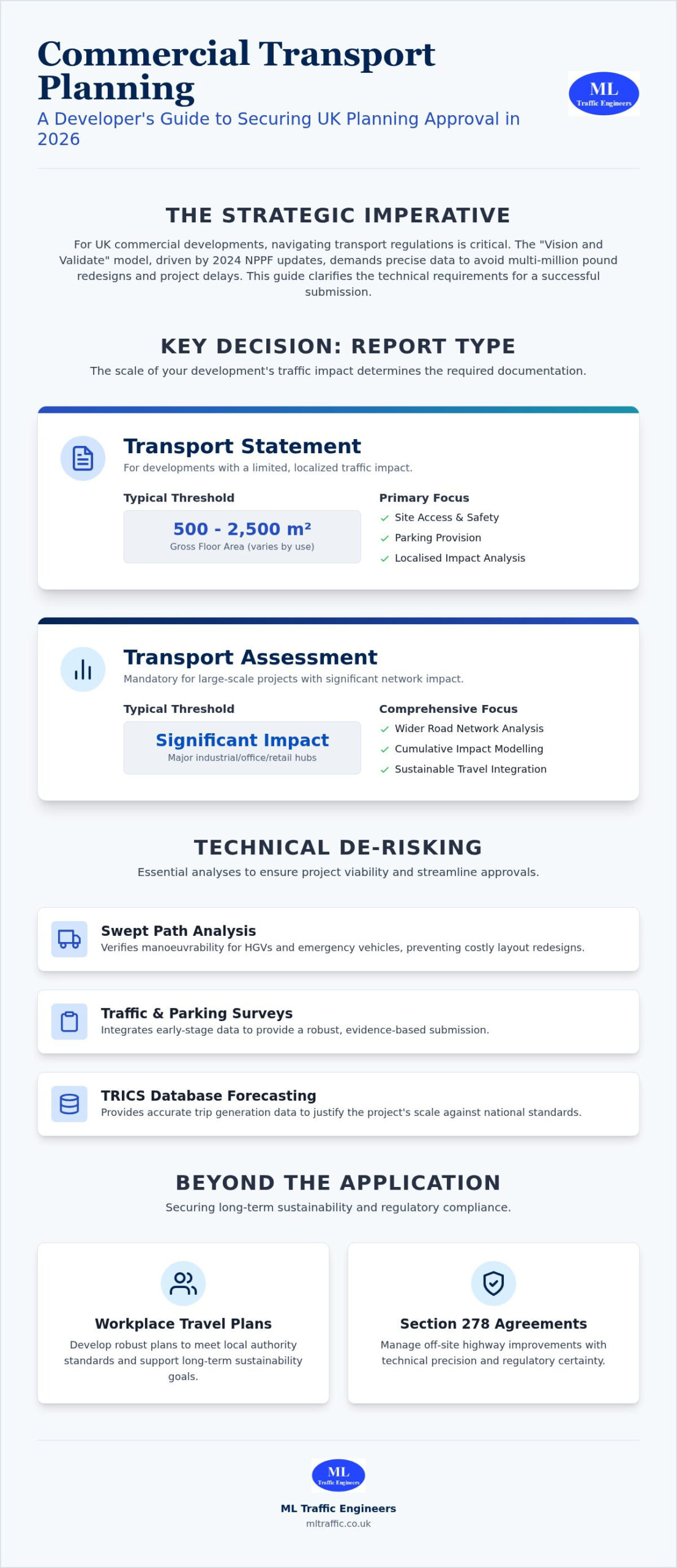
    Choosing the correct reporting level is a pivotal decision in transport planning for commercial developments. It’s the difference between a streamlined approval and a protracted negotiation with the highway authority. The primary driver for this decision is the anticipated scale of traffic impact, which is typically measured by the gross floor area and the specific use class of the proposal. Local Highway Authorities apply different thresholds, but the objective remains the same: ensuring the network can safely absorb the new demand.

    The TRICS database provides the empirical evidence needed to forecast trip generation. If these figures suggest a minimal impact on the local network, a Transport Statement usually suffices. However, for large-scale industrial hubs or major office complexes, a full Transport Assessment becomes mandatory to address cumulative impacts on the wider infrastructure. Retail developments often face stricter scrutiny due to high customer turnover and specific peak-hour demands that differ from traditional employment sites.

    When to Commission a Transport Statement

    A Transport Statement is appropriate for smaller commercial units where the impact is limited to the immediate vicinity of the site. Typical floor area thresholds for these reports often fall between 500 and 2,500 square meters, depending on the use class and local policy. These documents focus on local access, parking provision, and basic safety rather than complex network modeling. You can find more detail on these requirements in our Transport Statement London: A Developer’s Buying Guide. It’s a cost-effective way to demonstrate that a small-scale development is sustainable and safe.

    The Scope of a Comprehensive Transport Assessment

    Major schemes require the deeper technical rigour of a Transport Assessment. This document models the impact on major junctions and the wider highway network, often requiring sophisticated software to simulate traffic flow. We integrate multi-modal travel analysis to prove that the site is accessible by public transport, walking, and cycling. This is essential for developments exceeding 2,500 square meters, such as B2 general industrial or B8 storage and distribution centers. Our Transport Assessment London: The Developer’s 2026 Guide outlines how these comprehensive reports de-risk large-scale planning applications.

    Confirming your reporting requirements early prevents the risk of the local authority requesting additional data mid-application. If you are unsure which threshold your project meets, ML Traffic Engineers provides the technical expertise to determine the most efficient route for your submission.

    Technical De-Risking: Swept Path Analysis and Parking Surveys

    Assumptions are the enemy of planning approval. In the high-stakes environment of commercial development, technical de-risking through precise data ensures that transport planning for commercial developments withstands the scrutiny of local highway authorities. We move beyond general layout drawings to provide empirical proof that a site functions as intended. This proactive approach prevents “design-locked” errors, which occur when a site layout is finalized but cannot actually accommodate necessary vehicle movements.

    Site accessibility is a non-negotiable safety requirement. We utilize technical data to demonstrate that every vehicle, from HGV deliveries to emergency fire tenders and refuse trucks, can enter, turn, and exit the site safely. By identifying these logistical constraints during the early design phases, we protect developers from the costly redesigns that often follow a failed planning consultation. This precision is what allows a project to move from a concept to a viable, operational asset.

    Precision in Swept Path Analysis for Commercial Loading

    For industrial and retail developments, the ability to handle large-scale logistics is essential. We use specialized software to simulate the movements of 16.5m articulated lorries, ensuring they can navigate constrained urban sites without impacting public safety or damaging infrastructure. This simulation proves that turning circles and loading bays are fit for purpose. Our AutoTURN Swept Path Analysis: A Practical Guide provides a deeper look at how this technical modeling supports your planning application. We prioritize these simulations to ensure that fire tender access and refuse vehicle routes meet the specific statutory requirements of the local council.

    Evidence-Based Parking Strategies

    Local authorities often push for lower parking provision to meet sustainability goals, especially in areas with high Public Transport Accessibility Levels (PTAL). However, insufficient parking can lead to overspill that impacts the local community. We conduct overnight parking surveys to establish a baseline of existing street capacity. Using the Lambeth Methodology, we provide the technical justification needed to balance operational requirements with policy expectations. This evidence-based approach allows us to justify specific parking layouts, ensuring that your commercial scheme remains functional for occupiers while satisfying the highway authority’s demand for reduced car dependency.

    Beyond the Application: Travel Plans and Section 278 Agreements

    Transport planning for commercial developments doesn’t end when the planning committee grants permission. In fact, the most operationally critical work often begins with the discharge of transport-related planning conditions. These obligations ensure that the development remains sustainable and safe once it becomes operational. For developers, this phase involves a transition from theoretical modeling to active management and physical infrastructure delivery. Precision during this stage is essential to avoid the enforcement of Travel Plan Bonds or delays in site occupation.

    Multi-occupant commercial parks often require a Framework Travel Plan. This high-level document sets the overarching strategy for the entire site, which individual occupiers then refine through their own subsidiary plans. Consistent monitoring and reporting are standard requirements. Most UK local highway authorities mandate a five-year monitoring cycle to track the effectiveness of travel interventions. If data shows that trip generation targets are not being met, developers may be required to implement additional mitigation measures to reduce local traffic impact.

    Securing Approval with Effective Travel Planning

    A successful Workplace Travel Plan sets realistic targets for modal shift. This involves moving employees and visitors away from single-occupancy car use toward walking, cycling, and public transport. The role of the Travel Plan Coordinator is vital for long-term compliance. They act as the primary point of contact for both the local authority and the site’s tenants, ensuring that the agreed strategy is implemented effectively. Engaging expert Travel Plan Consultants: Strengthening Planning Applications allows you to design incentives that work, such as cycle-to-work schemes or car-sharing initiatives, which are increasingly prioritized under the 2026 “Vision and Validate” planning model.

    The Developer’s Guide to S278 Agreements

    When a commercial development requires modifications to the existing public highway, a Section 278 agreement becomes necessary. This covers works such as new site access junctions, roundabouts, or improved pedestrian crossings. S278 agreements are legally binding contracts for road improvements necessitated by new developments. Managing the relationship with the Highway Authority is crucial during this process to ensure that technical approvals and site inspections proceed without delay. We recommend establishing the scope of highway works early to prevent unexpected costs from arising during the construction phase.

    If you need technical support to discharge your planning conditions or manage your highway obligations, contact ML Traffic Engineers to ensure your project moves from approval to successful operation.

    Why UK Developers Choose ML Traffic Engineers

    The 2026 planning environment requires more than just technical skill; it demands a partner who understands the high stakes of commercial infrastructure. We position ourselves as that partner. Our commitment to technical authority ensures that transport planning for commercial developments meets every benchmark set by the December 2024 NPPF and the latest 2026 regulatory updates. We don’t just provide data. We provide the certainty that your development is safe, compliant, and operationally sound. Precision is a functional necessity in this industry, and we deliver it without compromise.

    Our engineers maintain round-the-clock readiness to meet urgent planning deadlines. We know the infrastructure sector is unpredictable. We’ve built our workflow to respond with speed and precision. This reliability reduces the logistical and regulatory pressures on your team, allowing you to focus on the broader vision of your project. From the first data point to the final discharge of conditions, we manage the entire technical lifecycle. We view our role as a vital guardian of public safety and a facilitator of commercial growth.

    Expert Technical Reporting for Commercial Success

    A specialized focus leads to higher approval rates. Our team produces robust Transport Statements and Assessments that stand up to the most rigorous Highway Authority consultations. We leverage deep local knowledge across England to navigate regional variations in policy and infrastructure requirements. This technical lexicon is paired with a clear understanding of commercial viability. Our data-driven approach uses the most current TRICS database thresholds to ensure your trip generation forecasts are unassailable. If you need a clear path forward, request a tailored transport planning fee proposal today to see how we can support your specific scheme.

    A Fully Managed Service for Commercial Infrastructure

    We integrate Traffic Surveys, Swept Path Analysis, and Parking Surveys into a single, seamless workflow. This end-to-end approach eliminates the friction of managing multiple consultants and ensures data consistency across all reports. The ML Traffic promise is built on precision, safety, and unwavering reliability. We prioritize the rapid delivery of information to keep your project on track. By identifying site constraints during the initial assessment, we help you maximize the floor space potential of your development. Contact our engineers for a pre-application review of your site to address potential transport issues before they impact your planning timeline.

    Securing Your Commercial Site’s Operational Future

    Mastering the technical requirements of transport planning for commercial developments is the most effective way to eliminate project delays and avoid costly design revisions. By prioritizing early-stage data collection and precise Swept Path Analysis, you ensure that your site is both safe and operationally efficient from the start. Technical accuracy remains your strongest asset when navigating the thresholds for a Transport Assessment or managing the long-term obligations of a Workplace Travel Plan. These reports are the foundation of a successful planning submission and a viable commercial asset.

    ML Traffic Engineers provides the comprehensive support needed to navigate these intricate regional regulations. We deliver expertly prepared Transport Statements and Assessments alongside specialist Swept Path Analysis for all vehicle types. Our team maintains a proven track record with UK Local Highway Authorities, ensuring that your technical documentation meets every statutory requirement with precision. Secure your planning approval with expert transport planning support from ML Traffic Engineers. We are ready to help you move your project from the design phase to successful completion with confidence and reliability.

    Frequently Asked Questions

    When is a full Transport Assessment required for a commercial development?

    A full Transport Assessment is typically mandatory for developments that exceed 2,500 square meters of gross floor area, particularly for B1 office, B2 industrial, or B8 storage use classes. Local highway authorities may also trigger this requirement for smaller sites if the proposal is expected to generate significant traffic or impact sensitive junctions. We use the TRICS database to forecast trip generation and confirm whether your project meets these specific reporting thresholds.

    What is the difference between a Transport Statement and a Transport Assessment?

    The primary difference lies in the scope and depth of technical modeling. A Transport Statement is a concise report focused on local site access and parking for smaller schemes with minimal network impact. In contrast, a Transport Assessment is a comprehensive document that analyzes the wider highway network and multi-modal travel patterns. It’s an essential component of transport planning for commercial developments that reach major scale or complexity.

    How does Swept Path Analysis help with planning permission for commercial sites?

    Swept Path Analysis provides empirical proof that your site layout can safely accommodate the specific vehicles required for your operations. By simulating the movements of 16.5m articulated lorries or fire tenders, we demonstrate that there is sufficient space for turning and loading. This technical data removes the guesswork for planning officers and prevents objections based on highway safety or vehicle manoeuvrability, significantly de-risking your application.

    Do I need a Travel Plan for a small office development?

    You generally need a full Workplace Travel Plan if your office development exceeds 2,500 square meters or if staff numbers surpass 50. However, local councils often request a “Travel Plan Statement” for smaller developments in urban areas with high congestion. These documents outline how you’ll encourage sustainable commuting through cycle storage or public transport incentives. It’s always best to check the specific supplementary planning documents of your local authority.

    What is a Section 278 agreement in the context of commercial infrastructure?

    A Section 278 (S278) agreement is a legally binding contract between a developer and the Highway Authority that allows for permanent alterations to the public road. This is necessary when your commercial development requires a new junction, a roundabout, or improved pedestrian crossings to ensure safe access. We manage the technical details of these agreements to ensure that the required highway works are approved and executed without delaying your site’s occupation.

    How long does it take to conduct a parking survey for a planning application?

    Conducting a parking survey usually takes between one and two weeks from the initial site visit to the final technical report. Data collection typically occurs during peak stress periods, such as overnight on weekdays for residential areas or during business hours for commercial zones. We use the Lambeth Methodology to provide a robust snapshot of parking capacity, which is essential for transport planning for commercial developments in areas with restricted space.

    What happens if my commercial development doesn’t meet local parking standards?

    If your development provides less parking than local standards require, you must provide technical justification to prove that it won’t cause overspill. We use Parking Surveys to demonstrate existing capacity on nearby streets or leverage high Public Transport Accessibility Level (PTAL) scores to support your case. A strong Workplace Travel Plan also helps by showing how you will actively reduce car dependency among employees and visitors to the site.

    Can a transport consultant help with discharging planning conditions?

    Yes, transport consultants are vital for the successful discharge of transport-related planning conditions post-approval. We prepare the detailed monitoring reports, updated Travel Plans, and technical drawings required by the local authority to satisfy these obligations. This service ensures that you meet all legal requirements within the agreed timelines, preventing enforcement action and allowing for the smooth, long-term operation of your commercial infrastructure project.

    Michael Lee

    Article by

    Michael Lee

    Transport planner with over 35 years' experience.

    Disclaimer

    The content on mltraffic.co.uk, including all technical articles, guides, and resources, is provided for general informational and educational purposes only. It is not intended to constitute professional advice in traffic engineering, transportation planning, development approvals, or any other technical or legal field.
    While ML Traffic Engineers makes every reasonable effort to ensure the accuracy, completeness, and timeliness of the information published, we do not provide any warranties or representations (express or implied) regarding its reliability, suitability, or availability for any particular purpose. Any reliance you place on the content is strictly at your own risk.
    In no event shall ML Traffic Engineers, its directors, employees, authors, or affiliates be liable for any direct, indirect, incidental, special, consequential, or punitive damages (including, without limitation, loss of profits, data, or business opportunities) arising out of or in connection with the use of, or inability to use, any information provided on this website.
    The articles and guides on this site are not a substitute for engaging a qualified, professional traffic engineer to assess your specific project requirements. For tailored advice, compliance assessments, or traffic engineering services, please contact a competent professional.
    This disclaimer may be updated from time to time without notice. By accessing or using this website, you agree to be bound by the most current version of this disclaimer.

  • Workplace Travel Plans: The 2026 Developer’s Guide to Planning Approval

    Workplace Travel Plans: The 2026 Developer’s Guide to Planning Approval

    The era of “predict and provide” is over, and developers who fail to adapt to the “vision and validate” model risk seeing their projects stalled by increasingly stringent planning conditions. It’s a common frustration to find yourself caught between the high costs of onsite parking and the demand for sustainable infrastructure. A robust workplace travel plan is no longer just a box-ticking exercise for the local authority; it’s a strategic tool to reduce capital expenditure and clear regulatory hurdles with precision.

    This guide provides the technical roadmap you need to master the workplace travel plan, allowing you to secure planning permission while justifying reduced parking provision. We’ll examine the latest 2026 regulatory updates, including the shifting National Planning Policy Framework (NPPF) landscape and the strategic use of OZEV grants to streamline your approval process. You’ll gain a clear roadmap for implementation that transforms onerous planning conditions into a manageable, data-led path toward project completion. Our focus is on providing the technical authority you need to navigate these intricate regional regulations so you can focus on delivery.

    Key Takeaways

    • Understand how a workplace travel plan serves as a vital management strategy to align your development with the latest National Planning Policy Framework requirements.
    • Identify the essential technical components, including site audits and traffic surveys, needed to build a data-led case for your planning application.
    • Learn to use sustainable travel strategies to justify reduced parking provision, significantly cutting your land and construction expenditure.
    • Master the five-year monitoring lifecycle and the reporting standards required to ensure long-term compliance with local authority conditions.
    • See how expert transport consultancy streamlines the planning process by handling complex regulatory negotiations on your behalf.

    Understanding Workplace Travel Plans in the UK Planning Process

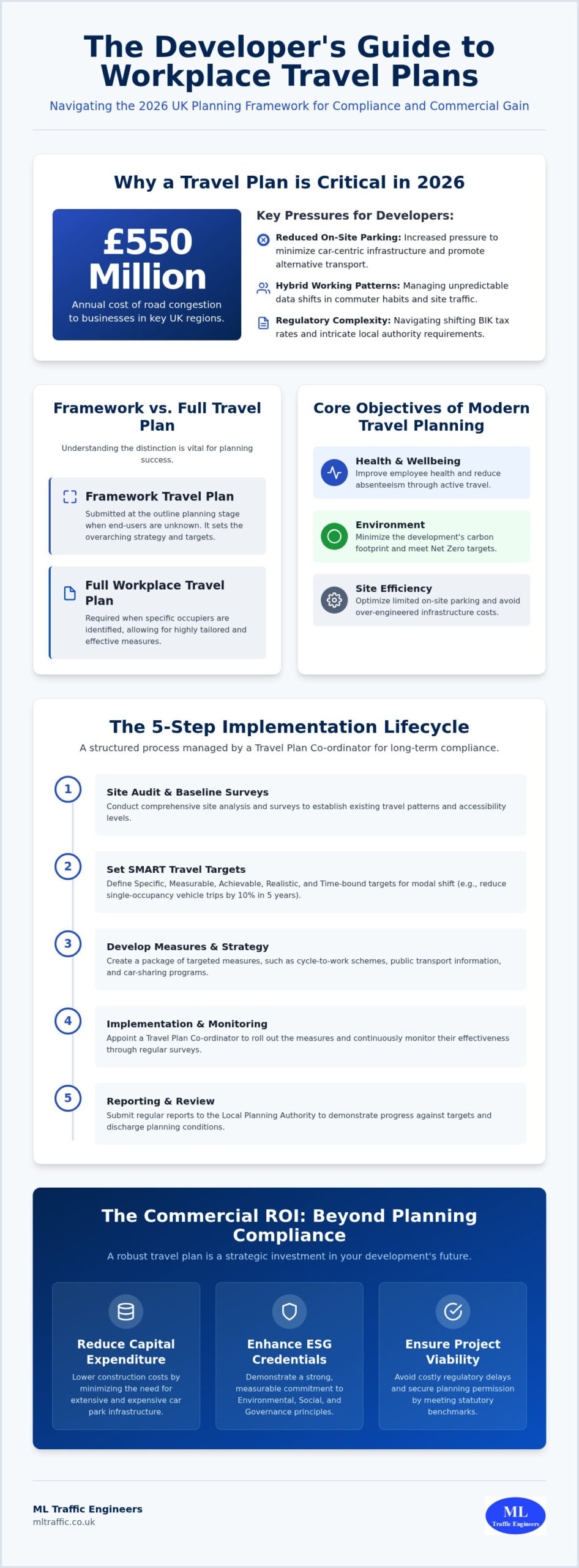
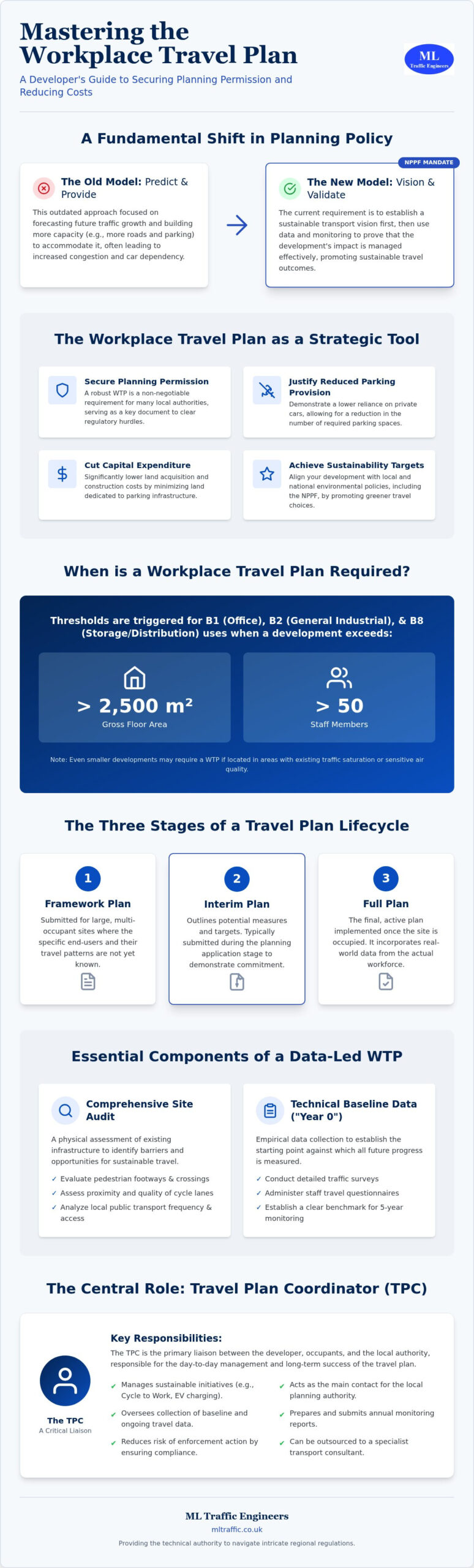
    A workplace travel plan is a dynamic, long-term management strategy designed to mitigate the transport impacts of a development. It is not a static document submitted once and forgotten; it is a living framework that evolves throughout the project lifecycle. The statutory basis for these plans is rooted in the National Planning Policy Framework (NPPF). While the December 2024 version remains the current standard, developers must prepare for reforms following the major national consultation that concluded in March 2026. These updates emphasize a shift toward a “Vision and Validate” model, requiring developers to prove sustainable outcomes rather than just predicting traffic flow. Understanding Workplace Travel Plans involves recognizing that these documents are essential for meeting environmental targets and reducing local congestion.

    To better understand the practical implementation of these strategies, watch this helpful video:

    Local planning authorities typically require different versions of the plan depending on the project stage. A “Framework” plan covers large multi-occupant sites where specific users aren’t yet known. An “Interim” plan is often submitted during the planning application stage to outline potential measures. Once the site is occupied, a “Full” plan is implemented, incorporating real-world data from the actual workforce. Each version must align with industry benchmarks to ensure the development remains compliant with regional transport goals.

    When is a Workplace Travel Plan Required?

    Thresholds for mandatory plans vary by local authority, but general benchmarks exist for specific land use classes. For B1 (Office), B2 (General Industrial), and B8 (Storage and Distribution), a full plan is often triggered when gross floor area exceeds 2,500 square metres or when staff numbers exceed 50. However, even smaller developments may require a plan if the site is located in an area with existing traffic saturation or sensitive air quality. At ML Traffic Engineers UK, we often identify these requirements during the initial preparation of Transport Statements, which act as the first technical filter for planning compliance.

    The Role of the Travel Plan Coordinator (TPC)

    The Travel Plan Coordinator (TPC) acts as the primary liaison between the developer, the occupants, and the local authority. This role is responsible for the day-to-day management of sustainable initiatives, such as coordinating the Cycle to Work scheme or managing EV charging infrastructure. They oversee the collection of baseline travel data through staff questionnaires and traffic surveys. Outsourcing this role to a specialist consultant ensures that monitoring fees and annual reports are handled with technical precision. This proactive management reduces the risk of enforcement action and ensures the development meets its long-term sustainable transport targets.

    Essential Components of a Robust Workplace Travel Plan

    Building a robust workplace travel plan requires a technical foundation that goes beyond generic templates. It begins with a comprehensive site audit to evaluate existing pedestrian and cycle infrastructure. We examine the quality of footways, the proximity of cycle lanes, and the frequency of local public transport services. This physical assessment identifies the specific barriers to sustainable travel that your development must overcome to satisfy local planning authorities. Precision at this stage prevents delays during the later phases of the planning cycle.

    Technical baseline data is the next critical element. We utilize Traffic Surveys and detailed staff questionnaires to capture current or predicted commuting behaviors. These baseline surveys provide the “Year 0” data point, which serves as the benchmark for all future monitoring. Without this empirical starting point, it’s impossible to demonstrate the effectiveness of your proposed measures to a planning officer. This data-led approach ensures that every target you set is Specific, Measurable, Achievable, Realistic, and Time-bound (SMART).

    Data-Driven Target Setting using TRICS

    The TRICS database provides the essential benchmark for predicted trip generation across various land use classes. We use this system to compare your development against similar sites, ensuring your transport projections are accurate. By analyzing this data, we set “modal shift” targets designed to reduce single-occupancy car trips over a defined period. This technical rigor is vital for justifying the transport impact of your project and securing approval without excessive infrastructure demands. It allows us to present a case based on verified industry standards rather than simple estimates.

    Effective Sustainable Travel Measures

    A high-performing workplace travel plan integrates both hard and soft measures to influence commuter behavior. Hard measures include physical infrastructure such as secure cycle parking and shower facilities. In 2026, the integration of smart EV chargers is a legal necessity for new developments. You can leverage the Workplace Charging Scheme (WCS) grant, which provides up to £500 per socket for up to 40 sockets, to offset these installation costs. Soft measures focus on behavioral change through car-sharing schemes and the Cycle to Work salary sacrifice program, which remains a highly effective tool for reducing car dependency.

    Modern technology now plays a central role in plan implementation. We often recommend using mobile apps to track sustainable commuting and provide incentives for employees who avoid driving. This integration makes monitoring easier and provides real-time data for your annual reports. If you need assistance selecting the most cost-effective interventions for your project, our travel plan consultancy service can help you build a compliant and efficient strategy that stands up to scrutiny.

    Strategic Benefits: Reducing Parking Requirements and Costs

    A workplace travel plan serves as a high-value strategic asset that directly impacts a developer’s bottom line. The most significant financial advantage lies in the “Parking Justification” argument. By implementing a robust travel strategy, you can formally justify a reduction in on-site parking provision. This is particularly critical in urban environments where local authorities increasingly enforce “Zero Parking” or “Car-Lite” policies. Reducing parking ratios allows you to repurpose valuable land for additional floor space or landscaping, maximizing the development’s overall yield.

    The construction costs for multi-storey or underground parking facilities are substantial. Every parking space eliminated through sustainable travel measures represents a direct saving in excavation, structural engineering, and materials. We ensure that your travel plan is integrated seamlessly with our Transport Assessments. This coordination provides a unified technical case that proves your development will not negatively impact the local highway network, even with minimal parking provision.

    Mitigating Transport Impacts via Modal Shift

    A strong plan focuses on achieving a measurable modal shift, which reduces the “residual impact” of your development on local roads. When you lower the number of single-occupancy vehicle trips, you often negate the need for expensive off-site highway improvements, such as junction upgrades or Section 278 (S278) works. This proactive approach helps overcome local objections regarding traffic congestion. It demonstrates to planning committees that you have a managed, data-led solution for the increased demand on the transport network. Our technical reporting provides the evidence required to secure approval with minimal friction.

    Commercial Advantages for Business Occupiers

    Beyond the planning phase, a workplace travel plan offers long-term commercial benefits for the eventual business occupiers. Accessible workplaces that support walking, cycling, and public transport are highly attractive to modern talent. This support for active travel aids in employee recruitment and retention, especially among a workforce that prioritizes health and sustainability. Additionally, businesses gain significant Corporate Social Responsibility (CSR) value by documenting a reduced carbon footprint. Managed travel schemes can also lead to direct savings on business travel expenses and fleet management costs, making the site more economically viable for high-profile tenants; you can learn more about Bucks Travel Ltd to see how professional minibus and coach hire services can be integrated into these corporate travel strategies.

    Workplace Travel Plans: The 2026 Developer’s Guide to Planning Approval

    How to Implement and Monitor Your Travel Plan for Success

    Securing planning approval is just the beginning of the process. Once your development is operational, the workplace travel plan transitions into a critical five-year monitoring lifecycle. This period is the standard duration required by most UK local highway authorities to ensure that sustainable travel habits are firmly established. It’s a high-stakes phase where precision in data collection is a functional necessity. You’re legally required to demonstrate that the development is meeting the modal shift targets agreed upon during the application stage. Failure to adhere to these monitoring requirements can lead to enforcement action or financial penalties under your planning conditions.

    The Monitoring and Review Cycle

    A structured approach to monitoring ensures you stay compliant with your planning conditions. This cycle follows three essential steps to provide the technical authority required by the council:

    • Step 1: Conduct annual staff travel surveys to track modal shift. These must be performed at the same time each year to ensure data consistency and accuracy.
    • Step 2: Compare these results against the SMART targets established in your original plan. This analysis identifies any gaps between predicted and actual travel behavior.
    • Step 3: Submit a comprehensive Annual Monitoring Report (AMR) to the local highway authority. This report proves your progression and is essential for the ongoing discharge of planning obligations.

    Navigating Section 106 and Monitoring Fees

    Planning approvals for significant developments are almost always tied to Section 106 (S106) legal agreements. These contracts include your workplace travel plan obligations and the associated monitoring fees. Councils charge these fees to cover the technical review of your annual reports over the five-year period. You’ll also encounter Travel Plan Bonds. These are financial guarantees that the council holds; they’re only released once you prove the travel plan is working as intended. If targets aren’t met, the council can trigger remedial measures. This often involves using your bond money to implement secondary transport initiatives, such as additional cycle infrastructure or subsidized bus passes.

    Sanctions for non-compliance are not limited to the loss of a bond. Local authorities can issue breach of condition notices, which may stall future phases of a development or lead to legal challenges. This is why many developers outsource the monitoring process to specialized consultants who understand the strict regulatory environment. We take pride in our adherence to industry standards, providing a fully-managed service that removes the logistical pressure from your team. If you’re preparing for your next monitoring milestone, our Traffic Surveys provide the accurate data needed to satisfy local authority scrutiny.

    Securing Approval with Expert Transport Planning Consultancy

    Professional Travel Plan Consultants are essential for navigating the high-stakes environment of 2026 planning approvals. While some local authorities offer basic guidance or free support, these services rarely provide the technical modeling and data-led rigor required for complex developments. A successful workplace travel plan must be defensible under professional scrutiny. Professional representation acts as a safeguard against costly planning delays and potential refusals. We provide the technical authority needed to justify reduced infrastructure spend and parking provision, ensuring your application moves through the regulatory process with minimal friction.

    Our approach at ML Traffic Engineers UK is bespoke and planning-focused. We don’t just produce documents; we build a strategic case for your development. By integrating your travel strategy with other essential services like Swept Path Analysis and Traffic Surveys, we create a unified narrative for planning officers. This all-encompassing service model ensures that every piece of technical documentation supports your project goals. We understand the “Vision and Validate” model and ensure your data aligns with current industry benchmarks.

    The ML Traffic Advantage: Precision and Reliability

    We manage full project lifecycles from initial inception to the final discharge of planning conditions. Our team understands that precision is a functional necessity in a strict regulatory environment. We take pride in our safety-conscious and reassuring approach, reducing the logistical pressure on your internal teams. Having a single partner for all technical transport documentation ensures consistency across your submission. This reliability is a hallmark of our brand promise, providing you with constant support as you navigate intricate regional regulations so you don’t have to.

    Next Steps for Your Development

    Early engagement is the most effective way to avoid transport-related hurdles. We recommend involving a consultant during the design phase to ensure that sustainable travel measures are integrated into the site layout from the start. This proactive strategy allows for more effective negotiation of targets and monitoring fees during pre-application discussions. It ensures that your “Year 0” baseline data is accurate and that your SMART targets are realistic for the site’s specific context.

    To begin the process, you can request a detailed fee proposal for a comprehensive workplace travel plan. Our team is ready to assess your site specific requirements and provide a technical roadmap for approval. Contact ML Traffic Engineers UK for a professional Travel Plan consultation to secure your project’s future and ensure compliance with the latest 2026 standards.

    Streamlining Your Path to Planning Success in 2026

    Navigating the complexities of current transport policy requires a shift from simple mitigation to strategic, data-led planning. A well-executed workplace travel plan does more than satisfy local authorities. It unlocks significant commercial value by justifying reduced parking provision and lowering long-term construction costs. By integrating technical tools like TRICS modeling and rigorous annual monitoring, you ensure your development remains compliant throughout its five-year lifecycle. This proactive approach transforms potential regulatory hurdles into a roadmap that’s ready for project delivery.

    ML Traffic Engineers UK has provided specialized transport planning consultancy since 2014. We deliver expert technical analysis, including Swept Path Analysis and comprehensive TRICS modeling, to support high-stakes UK planning applications. Our team manages the full project lifecycle, from initial assessment to ongoing monitoring, ensuring every benchmark is met with precision. This all-encompassing service model reduces logistical pressure and provides the technical authority required for a successful submission.

    Secure your planning approval with a professional Workplace Travel Plan from ML Traffic Engineers UK. With a dependable partner handling your transport documentation, you can move forward with confidence and technical certainty.

    Frequently Asked Questions

    What is the minimum number of employees that triggers a Workplace Travel Plan?

    A workplace travel plan is typically mandatory for developments expecting 50 or more employees. However, local planning authorities have the discretion to lower this threshold based on site-specific factors such as local traffic congestion or air quality concerns. Developers should consult local plan documents early, as requirements for land use classes B1, B2, and B8 often vary significantly between different councils.

    How long does a Workplace Travel Plan remain in effect?

    The standard monitoring period for these plans is five years following the full occupation of the site. This timeframe allows local authorities to verify that sustainable travel habits are firmly established and that modal shift targets are being achieved. In some high-impact or phased developments, the Section 106 agreement may specify an extended monitoring lifecycle to ensure long-term compliance with regional transport goals.

    Can a Travel Plan really help me get planning permission with less parking?

    Yes, a robust plan is a primary technical tool used to justify reduced on-site parking provision. By presenting a data-led strategy that encourages walking, cycling, and public transport, you can satisfy “Car-Lite” or “Zero Parking” policies. This approach reduces the need for costly multi-storey or underground parking infrastructure while meeting the “Vision and Validate” requirements of the current planning framework.

    What are the typical monitoring fees charged by local authorities in 2026?

    Monitoring fees are set by individual local planning authorities and vary based on the scale of the project and the level of technical review required. These fees are paid by the developer to cover the council’s administrative costs for reviewing annual monitoring reports over the agreed five-year period. It’s essential to identify these costs during the pre-application phase to ensure they are accurately reflected in the project budget.

    Who is responsible for the costs of implementing the Travel Plan measures?

    The developer is responsible for the initial capital costs, such as installing cycle parking or EV charging infrastructure. Once the site is occupied, the responsibility for ongoing soft measures and management often transitions to the business occupiers. Clear provisions should be included in lease agreements to ensure the Travel Plan Coordinator has a dedicated budget for staff surveys, promotional events, and travel incentives.

    What happens if the staff do not change their travel habits as targeted?

    If monitoring reports show that modal shift targets are not being met, the local authority may trigger remedial measures specified in the Section 106 agreement. This can include the implementation of secondary measures or the use of travel plan bonds to fund additional sustainable transport initiatives. Councils prioritize engagement and evidence of effort, but persistent non-compliance can lead to enforcement action or financial penalties.

    Is a Workplace Travel Plan the same as a Construction Logistics Plan?

    No, these documents manage different stages of the development lifecycle. A workplace travel plan manages the long-term commuting patterns of employees and visitors once the site is operational. A Construction Logistics Plan (CLP) focuses exclusively on the transport impacts of the construction phase, such as HGV routing and delivery timing. Both are essential for compliance but serve distinct regulatory purposes.

    How often do I need to survey my staff for the monitoring report?

    Staff travel surveys are typically required on an annual basis to provide the data necessary for the Annual Monitoring Report (AMR). These surveys must capture the actual travel behavior of the workforce to compare against the baseline data collected at “Year 0.” Consistent annual surveying is a non-negotiable requirement for demonstrating progress toward SMART targets and ensuring the eventual release of any associated financial bonds.

    Michael Lee

    Article by

    Michael Lee

    Transport planner with over 35 years' experience.

    Disclaimer

    The content on mltraffic.co.uk, including all technical articles, guides, and resources, is provided for general informational and educational purposes only. It is not intended to constitute professional advice in traffic engineering, transportation planning, development approvals, or any other technical or legal field.
    While ML Traffic Engineers makes every reasonable effort to ensure the accuracy, completeness, and timeliness of the information published, we do not provide any warranties or representations (express or implied) regarding its reliability, suitability, or availability for any particular purpose. Any reliance you place on the content is strictly at your own risk.
    In no event shall ML Traffic Engineers, its directors, employees, authors, or affiliates be liable for any direct, indirect, incidental, special, consequential, or punitive damages (including, without limitation, loss of profits, data, or business opportunities) arising out of or in connection with the use of, or inability to use, any information provided on this website.
    The articles and guides on this site are not a substitute for engaging a qualified, professional traffic engineer to assess your specific project requirements. For tailored advice, compliance assessments, or traffic engineering services, please contact a competent professional.
    This disclaimer may be updated from time to time without notice. By accessing or using this website, you agree to be bound by the most current version of this disclaimer.