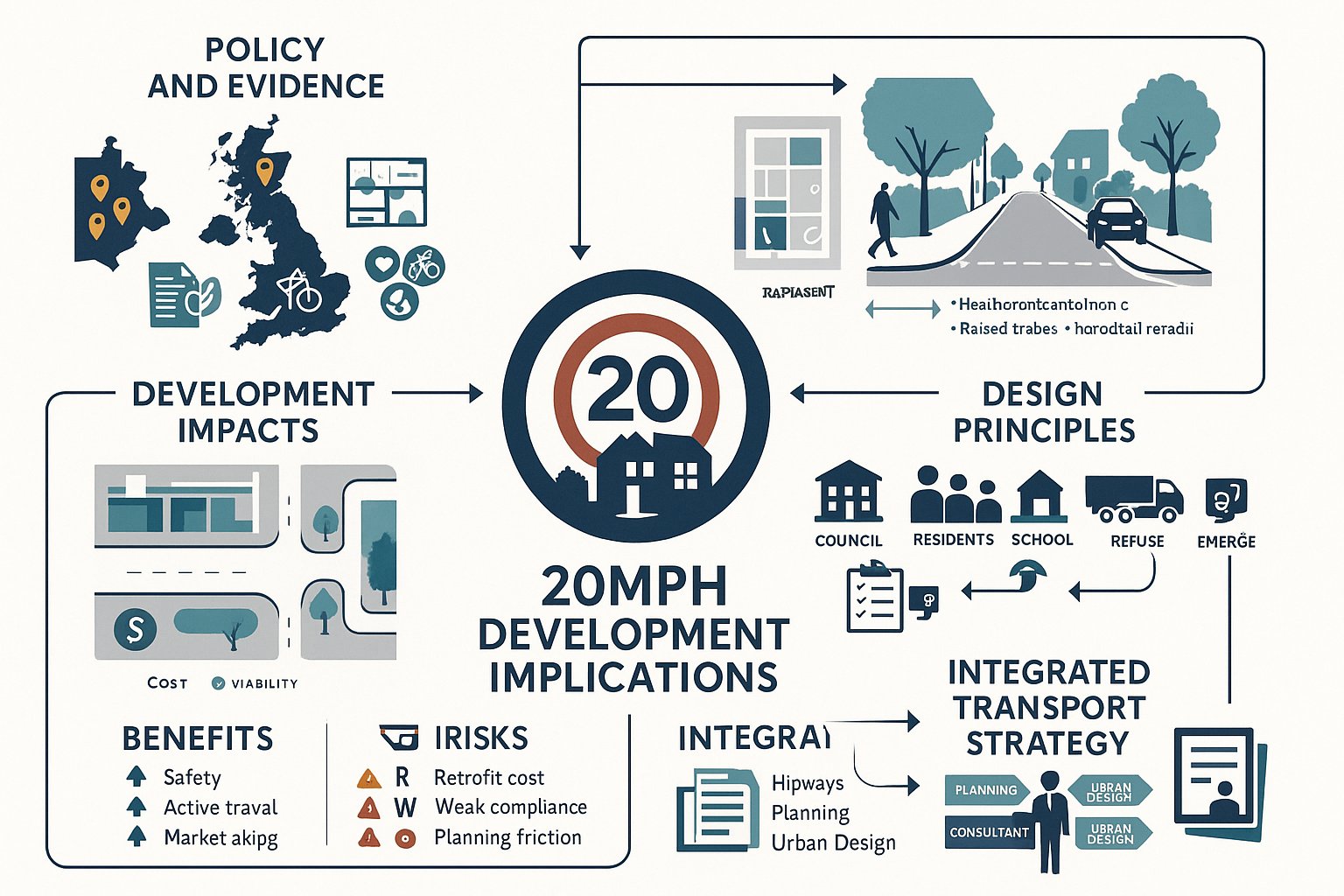
Planning teams are seeing the same question come up more often, and earlier: what do 20mph speed limit development implications actually mean for a scheme’s design, viability and planning case? It’s a fair question. A 20mph limit sounds simple on paper, but in practice it sits at the junction of road safety, placemaking, active travel, local authority policy and engineering detail.
We’ve found that the biggest mistake is treating 20mph as a sign-only decision. It rarely works that way. Speed outcomes depend much more on the character of the street, the way junctions are laid out, where people cross, how parking is arranged, and whether the route feels like a place rather than a distributor road. For developers, that has direct implications for layout efficiency, planning support, Section 38 conversations and long-term scheme quality.
Below, we set out the essentials: the evidence base, the practical development impacts, and why a design-led approach matters if you want 20mph streets that actually behave like 20mph streets.
Key Takeaways
If you need the short version, here it is.
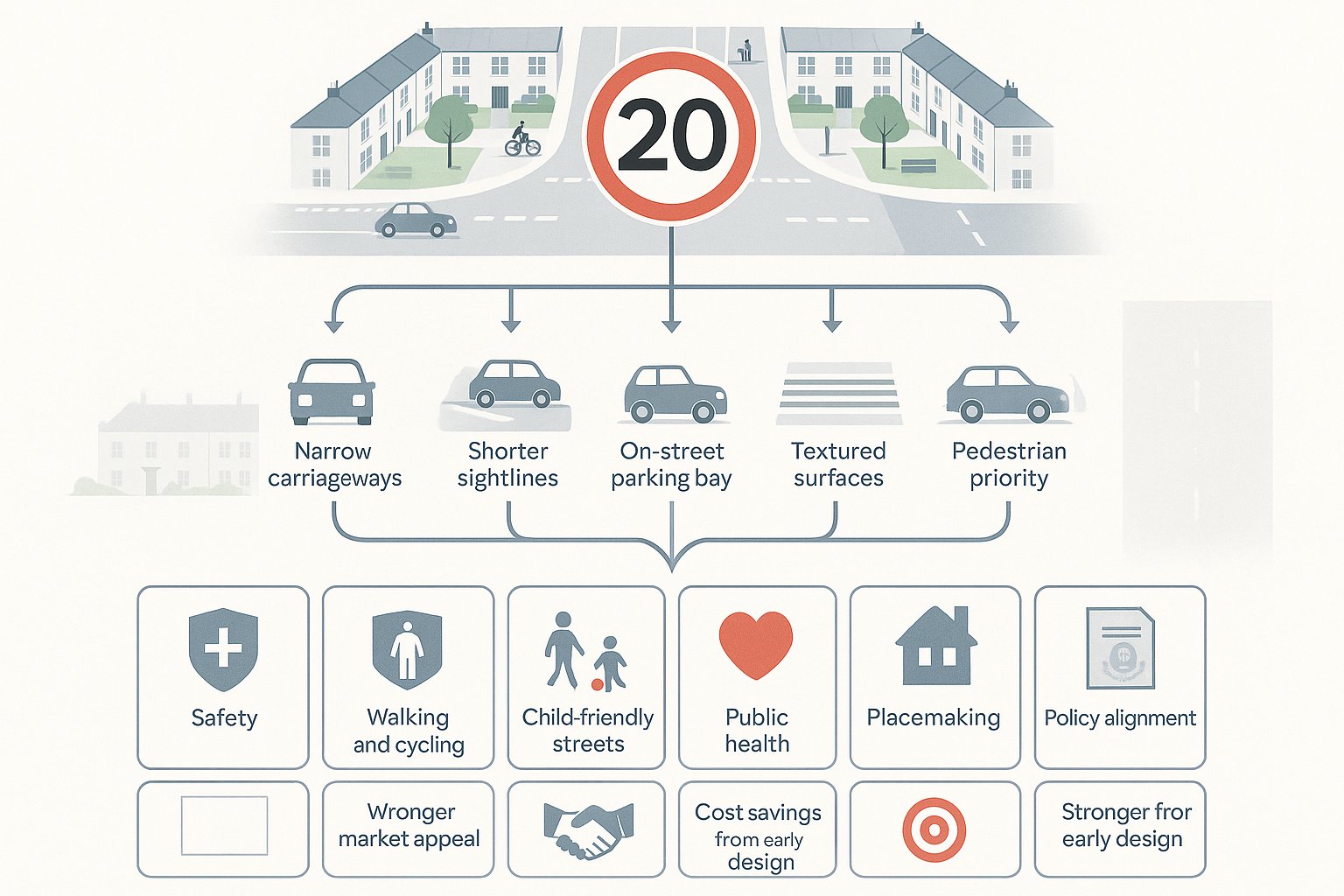
- 20mph limits can support safer, more liveable development, especially where a scheme is meant to prioritise walking, cycling, frontage activity and a stronger sense of place.
- Signs alone usually don’t do enough. UK evidence has repeatedly shown that signed-only 20mph limits often produce modest speed reductions, but not necessarily a clear short-term casualty reduction without wider supporting measures.
- Street design matters more than the number on the roundel. Width, forward visibility, corner radii, on-street parking, crossings, surface treatment and horizontal deflection all shape how fast drivers feel comfortable travelling.
- For new development, 20mph is often easiest to achieve at the masterplanning stage. It’s much cheaper to build the right geometry in from day one than retrofit traffic calming after residents move in and complaints start landing.
- Planning benefits are real. Lower-speed environments can strengthen arguments around sustainable transport, public health, child-friendly design, placemaking and compliance with local policy expectations.
- Compliance still needs thought. Even in a well-designed layout, some locations may need targeted interventions, communications or enforcement support, particularly on longer straight links or routes with a more ‘road-like’ character.
- The commercial angle shouldn’t be ignored. Streets that feel safer and quieter are often more attractive to buyers, occupiers and local authorities. That can improve both marketability and long-term value.
In other words, the real 20mph speed limit development implications are strategic, not cosmetic. They affect transport evidence, highway negotiations, urban design, cost planning and eventually the quality of the place you’re creating.
From a policy and evidence perspective, the direction of travel is clear. National and local planning frameworks increasingly support development that reduces car dominance, improves active travel conditions and creates healthier neighbourhoods. A 20mph environment can fit that brief very well. But the phrase can fit matters. If the street still reads like a 30mph road, drivers tend to behave accordingly.
That’s why we approach 20mph questions as part of a broader development strategy. We’re not just asking whether a limit can be posted. We’re asking whether the proposed network, plot arrangement and public realm will naturally support the outcome that planning officers, highway authorities and future residents expect.
And yes, there’s a practical side too. On many schemes, getting this right early helps avoid the familiar late-stage scramble: redesigning junctions, justifying inconsistent speed strategy, or trying to explain why a nominally low-speed neighbourhood has long straights and oversized radii that invite the opposite behaviour.
Table of Contents
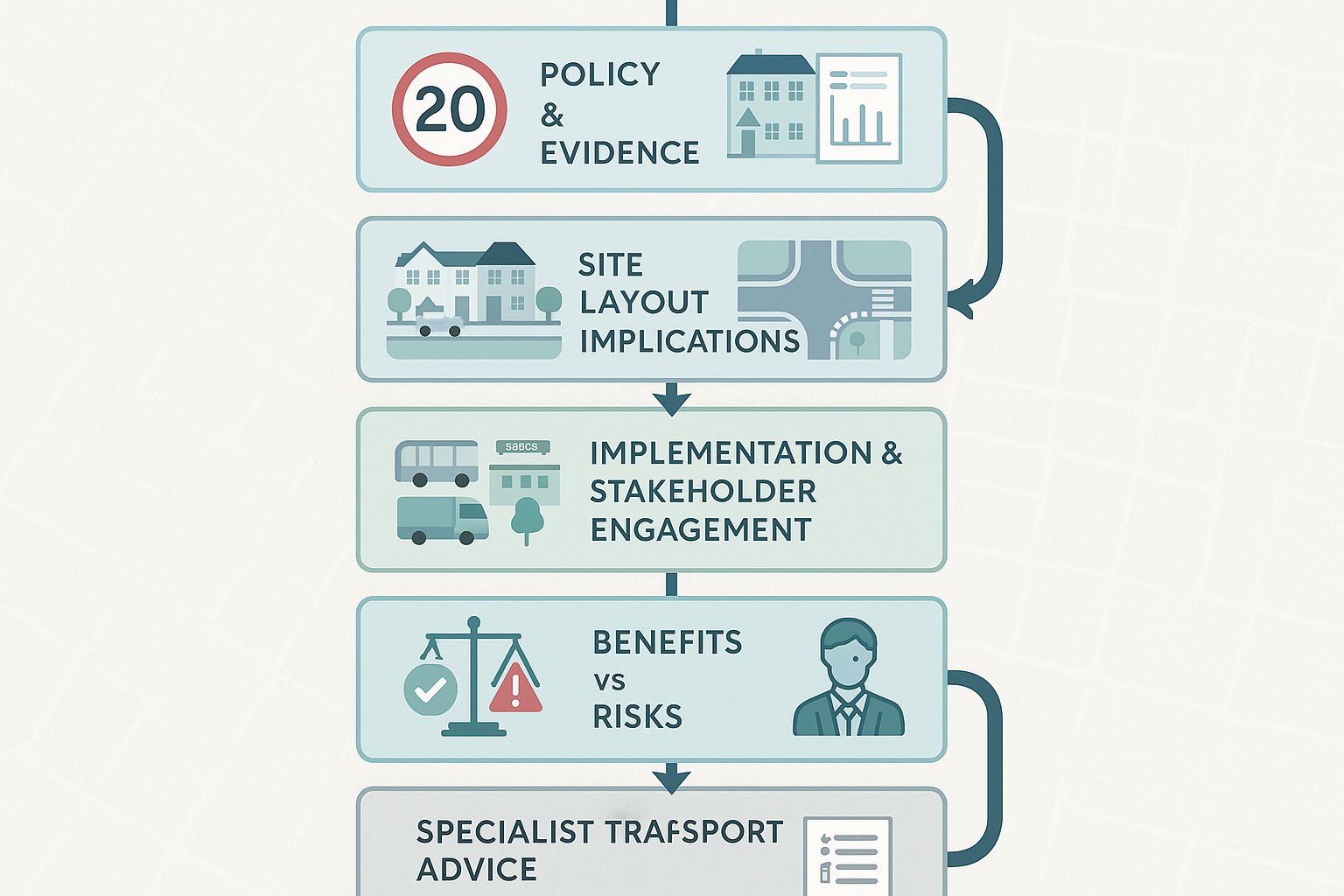
A useful way to think about 20mph speed limit development implications is through six linked themes. They tend to show up on almost every scheme, whether it’s a small residential site or a major mixed-use allocation.
- Policy and evidence context
Local authorities increasingly expect developments to support safer, healthier and lower-carbon travel choices. That means 20mph is rarely just a highways question: it often overlaps with planning policy, design coding, public health priorities and climate commitments. The evidence base also matters. Studies from across the UK suggest that lower limits can support broader liveability goals, but signed-only approaches often achieve only limited speed reduction. So the detail of implementation becomes critical.
- Implications for new developments
For developers, 20mph affects the structure of the site. It can influence street hierarchy, block length, junction spacing, parking strategy, visibility standards, servicing routes and the relationship between carriageway and public realm. In some cases it also affects viability decisions, because the cheapest highway layout upfront isn’t always the most efficient option once planning risk, future retrofit costs and adoption discussions are factored in.
- Design principles for effective 20mph environments
This is where good schemes separate themselves from performative ones. If a street is visually wide, linear and forgiving, drivers will tend to travel faster. If it feels enclosed, active, interrupted and pedestrian-oriented, speeds usually come down more naturally. Measures can include tighter geometry, horizontal deflection, raised tables, regular crossing points, street trees, parking bays and materials that communicate a lower-speed place function.
- Implementation, engagement and enforcement
Even well-designed developments need a delivery plan. Local authority expectations differ. Some councils are comfortable with area-wide 20mph strategies: others want stronger evidence of self-enforcing design. Residents may support slower speeds in principle but object to certain calming features once they see them on a drawing. Schools, bus operators, refuse teams and emergency services may all have a view. Getting alignment early usually saves time later.
- Summary: development-scale benefits and risks
The upside is strong: safer-feeling streets, better active travel conditions, stronger placemaking, and a planning narrative that aligns with current policy direction. The risk is equally familiar: a weakly designed 20mph proposal that satisfies nobody, fails to secure meaningful compliance, and stores up future problems.
- Why choose ML Traffic Engineers UK for your project
This is where specialist transport input matters. A good consultant won’t simply label roads 20mph and hope for the best. We need to interpret evidence properly, understand local adoption and planning thresholds, and integrate speed strategy with the full transport and design story of the site.
Those six themes are worth keeping together because they’re connected. For example, a planning officer may support lower speeds because of placemaking and health outcomes, while a highway authority focuses on geometry and compliance. A developer, understandably, is looking at programme, cost and deliverability. Our job is to bridge those conversations so the proposal is robust from all sides.
There’s also a timing issue that often gets overlooked. The earlier 20mph strategy is embedded, the more efficient it becomes. At concept stage, we can shape the street pattern, hierarchy and frontages around the intended speed environment. By reserved matters or technical design stage, options narrow quickly. At that point, teams are sometimes left choosing between awkward compromises: adding stronger calming features than they wanted, accepting weaker compliance than they promised, or reopening layout decisions that should have been settled months earlier.
So while this section is labelled a table of contents, it also works as a checklist. If a scheme team hasn’t seriously addressed all six themes, there’s a decent chance the 20mph strategy is still too superficial.
Why choose ML Traffic Engineers UK for your project
At ML Traffic Engineers UK, we help clients turn policy aspirations into practical, consentable and buildable transport strategies. That matters a great deal with 20mph proposals, because this is one of those areas where broad agreement on the goal can hide real disagreement on the detail.
We bring more than 30 years of transport engineering experience to that problem. In plain terms, we know how to read a site, understand a highway authority’s likely concerns, and produce concise technical advice that doesn’t get lost in theory. On schemes involving 20mph speed limit development implications, that means we focus on what actually makes the difference: evidence, geometry, planning alignment and delivery.
Evidence-led advice, not generic assumptions
There’s no shortage of commentary on lower speed limits, but clients don’t need another opinion piece. They need applied judgement. We draw on major UK evidence, including work commonly referenced from Atkins, AECOM, PACTS, RoSPA and public-health research, and then test what that means for the actual site in front of us.
That distinction matters. A signed-only 20mph limit on an existing road network may deliver one result: a purpose-designed development street with active frontages, tighter geometry and lower design speeds may deliver another. We help clients make that distinction clearly in Transport Assessments, technical notes and planning submissions, so the strategy is credible rather than generic.
Integrated design that supports natural compliance
One of the most common failures in this area is expecting posted limits to compensate for street geometry that says something else. We don’t approach 20mph in isolation. We look at carriageway width, tracking, parking form, junction spacing, crossing demand, frontage activity, visibility, servicing and public realm together.
That integrated view is especially important in residential-led and mixed-use schemes. A road can still accommodate refuse vehicles, emergency access and day-to-day movement without being overdesigned into a speed-friendly corridor. In fact, the strongest layouts usually feel calm because every element is pulling in the same direction.
Where targeted measures are needed, we’ll say so. Raised tables, tighter corner radii, build-outs, surface changes or horizontal deflection may be appropriate at specific locations. But we also know that overengineering can create cost and adoption issues if it isn’t justified. The aim is proportionate design, not a catalogue of bolt-on features.
Planning support that strengthens the consent case
A well-handled 20mph strategy can do more than satisfy a transport condition. It can strengthen the wider planning story. National planning policy and many local plans now place real weight on sustainable transport, healthy places, road safety and good design. Lower-speed streets often support all four.
We prepare Transport Assessments, Travel Plans and supporting technical reports that connect those threads properly. Instead of presenting speed strategy as a narrow highways note, we frame it within the scheme’s broader objectives: encouraging walking and cycling, improving child-friendly mobility, reducing conflict, supporting mixed-use vitality and creating streets that are places in their own right.
That can be especially useful where planning officers, design officers and highway engineers are looking at the same drawings through different lenses. We help make the case in language each audience recognises.
Local authority awareness and concise reporting
Every authority has its own thresholds, priorities and tolerance for risk. Some are strongly supportive of 20mph environments but expect the layout to be visibly self-enforcing. Others may accept a more flexible approach if the route hierarchy is clear and the evidence is sound. Knowing how to pitch the strategy matters.
Our reporting is built around that reality. Because we specialise in concise, accurate transport engineering reports, we avoid burying key points under unnecessary volume. Decision-makers are busy. Clear plans, focused justification and locally relevant evidence usually travel further than bloated documents.
And that helps clients too. Better targeted reporting can reduce rounds of clarification, speed up review, and make technical submissions easier for the wider consultant team to work with.
Stakeholder engagement that deals with real concerns
The technical case is only part of the job. Residents, schools, councillors and operational stakeholders often have practical concerns: Will vehicles actually slow down? Will this affect access? Will emergency response be compromised? Are the calming measures going to feel intrusive? Those questions need straight answers.
We support stakeholder discussions by translating transport engineering into plain English without oversimplifying it. Where concerns about compliance are justified, we identify them early. Where fears are overstated, we explain why. That helps build trust and often prevents the scheme being pushed into reactive redesign.
Whole-life value, not just immediate layout efficiency
A cheaper layout at planning stage isn’t always the better commercial decision. If the street environment later proves too fast, too hostile for walking, or too weakly aligned with policy expectations, the cost comes back in other forms: delayed approvals, extra conditions, retrofit works or reputational drag.
We look at whole-life value. That means considering collision risk, future adaptability, adoptability, placemaking quality and the attractiveness of the development to end users. A genuinely calm street network tends to perform better across all of those metrics.
In short, if you’re dealing with 20mph speed limit development implications, we can help you move beyond slogans and into a strategy that works on paper, on site and in front of decision-makers. Our role is to make the transport case clearer, more proportionate and more persuasive, while keeping a sharp eye on the practical realities of planning and delivery.
For developers, land promoters, architects and planning consultants, that combination is usually what matters most. Not just whether 20mph can be mentioned, but whether it can be designed, justified and delivered properly.
The bottom line? Lower-speed streets can absolutely add value to a development, but only when they’re thought through as part of the place from the start. That’s the approach we take, and it’s why clients bring us in early.
Frequently Asked Questions about 20mph Speed Limit Development Implications
What are the key development implications of introducing a 20mph speed limit?
Implementing a 20mph speed limit affects street design, layout efficiency, planning support, and long-term quality. It influences junction spacing, parking strategies, and road geometry, requiring a design-led approach rather than relying on signs alone to ensure natural driver compliance and safer, more liveable environments.
Why is a design-led approach important for effective 20mph speed limits in new developments?
Because vehicle speeds depend more on street character—such as width, crossings, parking, and visual cues—than just posted limits. Designing roads with features like narrower lanes, horizontal deflection, and active frontages encourages natural compliance, making 20mph limits more effective and sustainable.
Can a signed-only 20mph speed limit reduce accidents effectively?
Evidence from the UK shows that signed-only 20mph limits typically produce modest speed reductions and do not achieve clear short-term casualty reductions without supporting engineering measures and wider interventions, such as enforcement and community engagement.
How does a 20mph speed limit support planning and public health objectives?
Lower speed environments promote active travel modes like walking and cycling, enhance child-friendly design, reduce road danger, and align with local policies focused on sustainable transport and healthier neighbourhoods, strengthening the planning case for developments.
What challenges exist in enforcing 20mph speed limits in new developments?
Even well-designed layouts may require targeted interventions to ensure compliance, especially on long straight roads or routes with a road-like feel. Enforcement, community communication, and stakeholder engagement are critical to maintain effective speed management.
How can ML Traffic Engineers UK assist with 20mph speed limit strategies?
They provide evidence-led advice integrating UK research with site-specific factors, support design that promotes natural compliance, prepare planning documents to strengthen consent cases, facilitate stakeholder engagement, and focus on whole-life value to balance safety, cost, and development attractiveness.