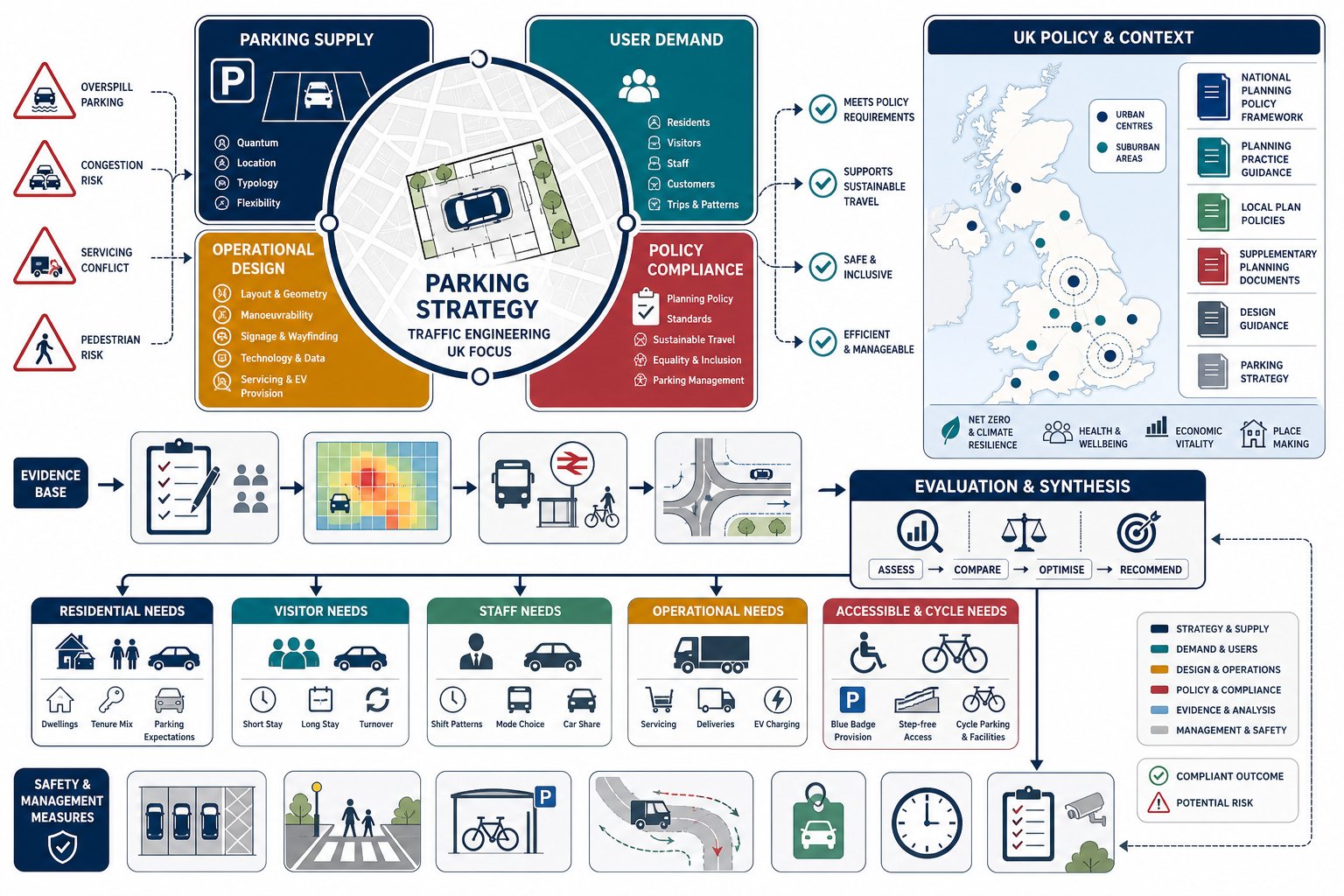
A parking strategy can make or break a planning application long before anyone debates façade treatments or landscape details. When parking is undercooked, the same objections tend to surface fast: overspill onto nearby streets, congestion at the site access, servicing conflicts, poor pedestrian safety, and claims that the proposal simply does not reflect how people actually travel. In traffic engineering, that is not a minor detail. It sits right at the centre of how a development functions day to day.
For architects, planners, developers, surveyors and local authorities, the challenge in 2026 is sharper than it used to be. Standards are more nuanced, town centre and edge-of-centre sites are under pressure to use land efficiently, and councils increasingly expect evidence rather than assumptions. A good parking strategy hence needs to do more than count spaces. It has to show why the provision is appropriate, how it will operate, and how it supports wider transport and land-use objectives.
In this guide, we set out a practical view of parking strategy traffic engineering: what it means, why it matters in planning and development control, how demand should be assessed, and what design and management measures strengthen the final case. The aim is simple: help teams produce strategies that are credible, policy-aware, and much harder to pick apart at application stage.
What Parking Strategy Means In Traffic Engineering
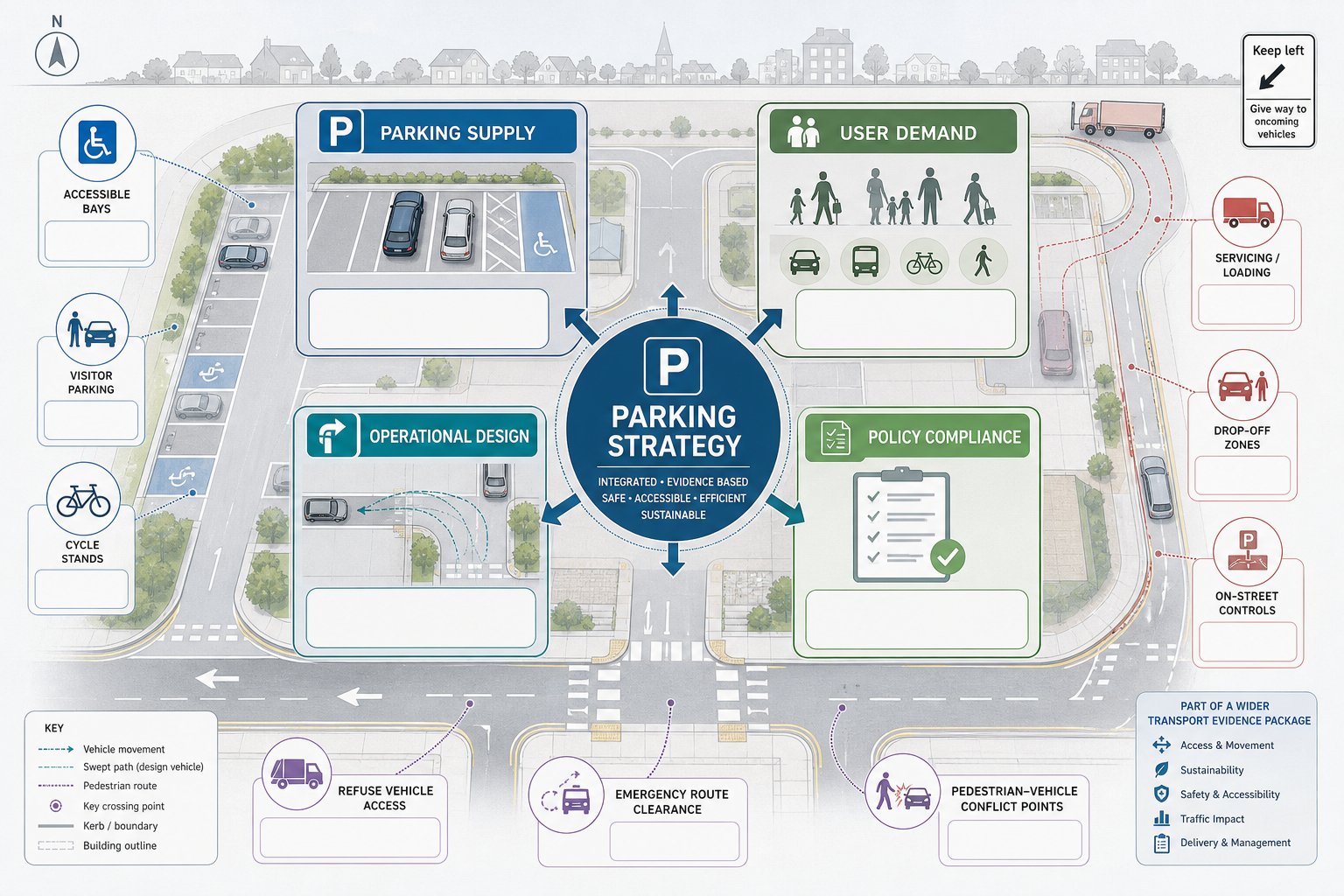
In traffic engineering, a parking strategy is the structured, evidence-led approach to deciding how much parking is needed, where it should sit, how it should work, and how it should be managed over time. That includes private car parking, accessible bays, visitor spaces, cycle parking, servicing areas, drop-off activity, and sometimes on-street controls beyond the red line boundary. It is not just a layout exercise done at the end of design.
A strong strategy connects four things that are often treated separately: supply, user demand, operational design, and policy compliance. In practice, that means asking whether parking numbers fit the land use, whether vehicles can enter and leave safely, whether spaces are usable in real conditions, and whether the proposal supports sustainable travel rather than undermining it.
That broader view matters because parking affects trip distribution, internal circulation, access design, and even street character. On mixed or constrained sites, it can also determine whether refuse collection works properly, whether emergency access is maintained, and whether pedestrians are forced into conflict with turning vehicles.
We usually treat parking strategy as part of the wider transport evidence package rather than a stand-alone afterthought. On more complex schemes, it sits alongside transport statements, travel planning and junction reviews. That is why parking decisions often overlap with wider Traffic Engineering: Your principles and with the movement assumptions tested in Traffic Engineering and Transportation work. The result should be a joined-up argument: enough parking to function, not so much that it wastes land or generates avoidable traffic.
Why Parking Strategy Matters In Planning Applications And Development Control
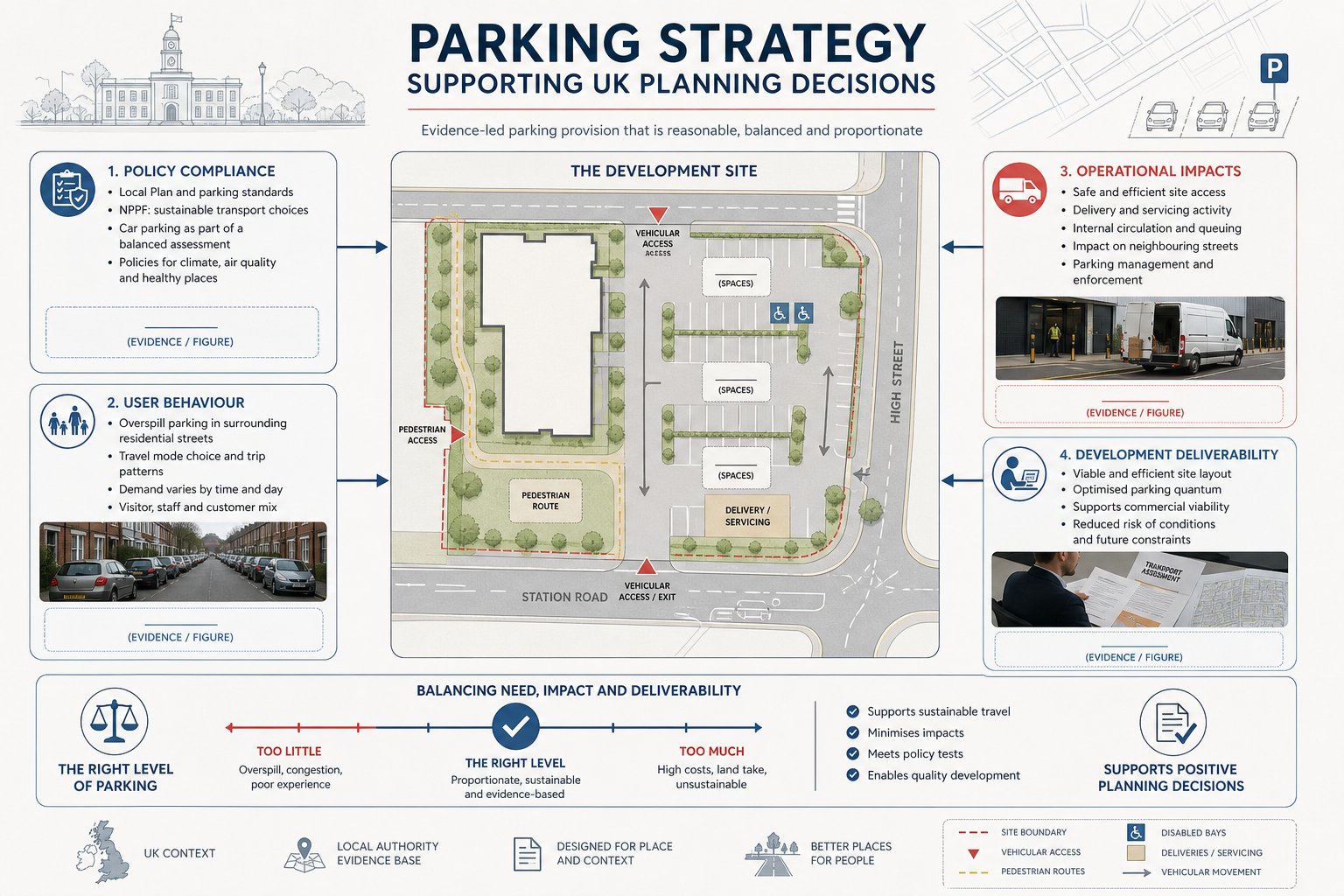
Planning officers, highway officers and local members rarely look at parking in isolation. They read it as a signal of whether the development team understands the site, the local network and likely user behaviour. If parking provision appears arbitrary, confidence in the rest of the transport case tends to fall with it.
That is why parking strategy matters so much in planning applications and development control. It helps demonstrate compliance with local plan policies, parking standards and accessibility expectations. It also addresses practical questions that can trigger objections: Will cars overspill into nearby streets? Will delivery activity block the access? Will visitors circulate around the site looking for spaces? Are disabled users being properly accommodated? Those are not academic concerns: they go straight to amenity, safety and network impact.
For developers, a robust strategy also protects deliverability. An under-supported parking schedule can lead to lengthy queries, redesign, additional surveys or awkward planning conditions. In some cases, a weak approach spills into the wider transport package, especially where parking assumptions influence trip rates, queueing or servicing assessments. That link is obvious on employment and retail schemes, where parking demand can shape the whole traffic impact assessment narrative.
Equally, councils are not always looking for the highest possible number of spaces. They want the right level of provision, backed by evidence, and aligned with place-making, mode share and local constraints. Good parking strategy traffic engineering gives decision-makers a clear reason to support that judgement.
Core Principles That Shape An Effective Parking Strategy
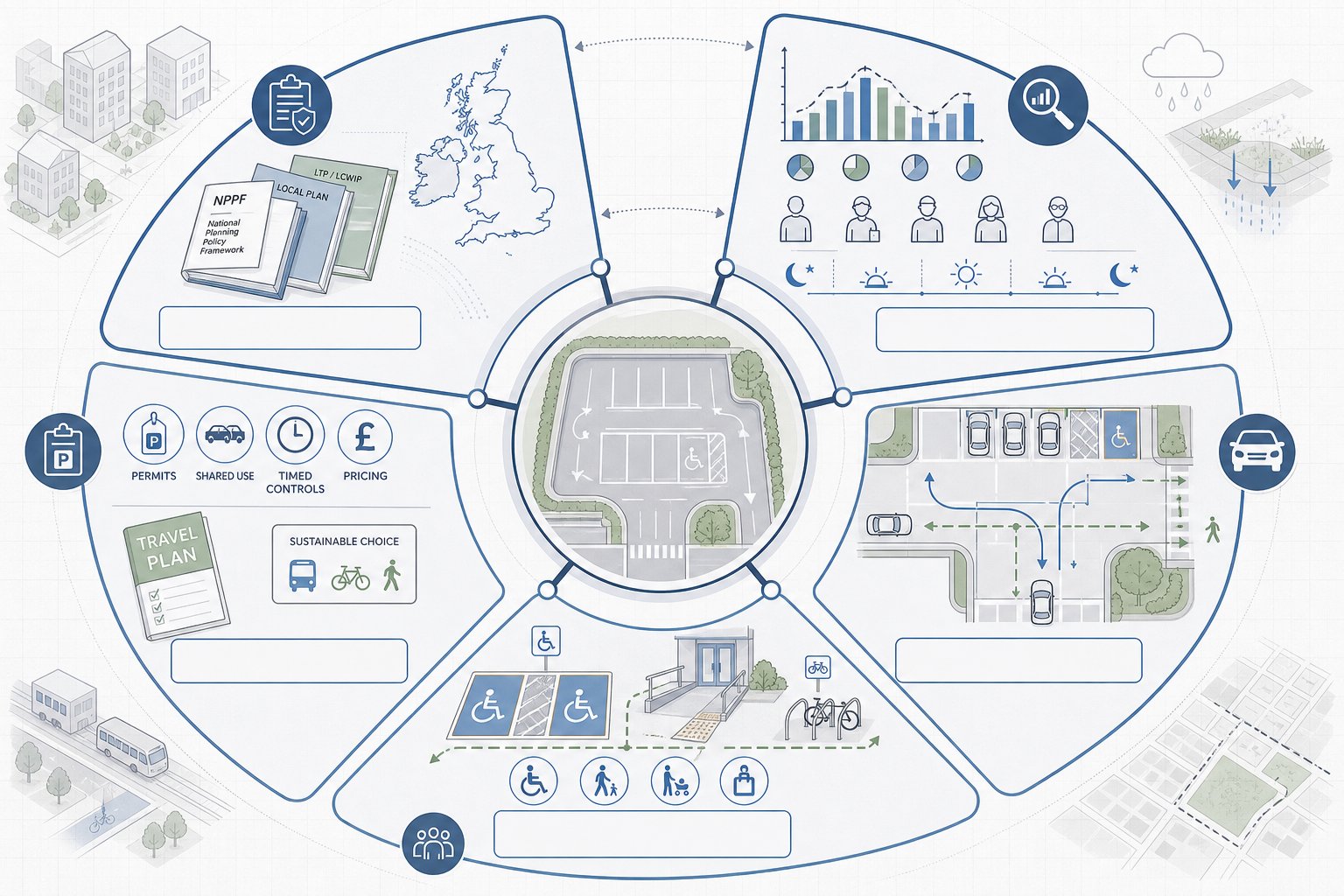
The best parking strategies are rarely complicated on paper. But they are disciplined. We generally build them around a handful of principles that keep the assessment grounded.
First, policy alignment. The strategy has to start with the adopted local plan, supplementary guidance, and any area-specific standards or restraint policies. Some authorities set maximums, some minimums, some allow reductions for highly accessible sites, and many expect bespoke justification on constrained urban plots.
Second, real demand rather than guesswork. Parking should reflect likely users, operating hours, dwelling mix, employment type, and local travel conditions. Standard ratios can be useful, but they are only a starting point. Actual survey evidence often tells a more persuasive story.
Third, safe and efficient operation. A space that exists on a drawing but cannot be reached comfortably, reversed into safely, or used without blocking another movement is not real capacity. Usability matters as much as raw numbers.
Fourth, accessibility and inclusion. Blue Badge provision, pedestrian routes, cycle parking, and step-free connections are not side issues: they are central to whether the scheme works fairly.
Finally, management before overprovision. On many sites, permits, allocation, time controls, shared use or travel plan measures solve problems more effectively than simply paving over more land. That is especially true where land value, drainage and urban design are already under pressure.
A practical Parking Strategy For approach usually succeeds because it combines all five, rather than leaning on one and hoping it carries the rest.
Assessing Parking Demand And User Behaviour
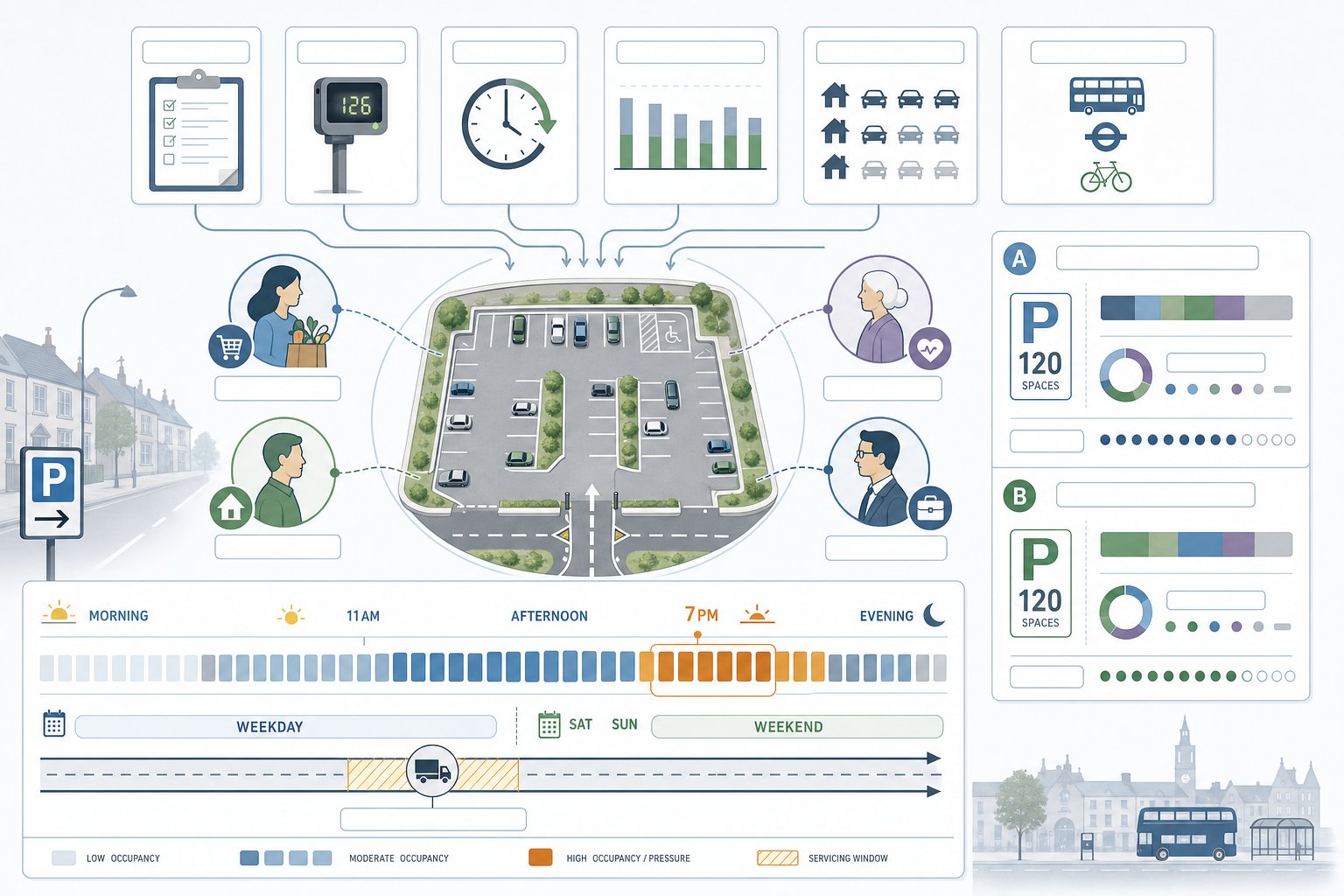
Parking demand assessment is where many strategies either become convincing or unravel. The key is to understand not just how many vehicles may arrive, but who they belong to, when they appear, how long they stay, and what alternatives exist. A supermarket, a care facility, a suburban housing scheme and a town-centre office can all have similar headline parking numbers while behaving completely differently on the ground.
In practice, we draw from several sources: local surveys, occupancy counts, turnover studies, census and car ownership data, public transport accessibility, and published demand references where appropriate. For planning purposes, local evidence usually carries the most weight because it reflects the authority area, the site context and actual observed behaviour rather than abstract averages.
Good assessment also recognises that demand is dynamic. There may be spare spaces at 11am and acute pressure at 7pm. Visitor demand can be negligible on weekdays and awkward at weekends. Servicing may only occur briefly, but if it conflicts with access geometry, that short period can create a disproportionate problem.
This is where parking strategy traffic engineering becomes less about arithmetic and more about pattern recognition. We are not simply asking, “How many spaces?” We are asking, “How will this place operate over a normal day, a busy day, and an awkward day?” If that operational story is weak, decision-makers tend to assume the risk will fall onto surrounding roads.
Residential, Visitor, Staff, And Operational Parking Needs
Breaking demand into user groups is one of the simplest ways to improve a parking strategy.
Residential parking is usually the most stable but not always the easiest to predict. Overnight demand is influenced by dwelling size, tenure, local car ownership, charging opportunities and whether residents can realistically rely on walking, cycling or public transport. Flats close to rail stations may justify lower provision than family housing on the edge of a market town.
Visitor parking is more elastic. It often peaks in short windows, and poor visitor provision can quickly lead to informal parking on bends, verges or access roads. That tends to generate neighbour complaints even when resident parking is technically adequate.
Staff parking is shaped by shift patterns, availability of public transport, permit allocation and workplace policy. For employment uses, not all staff arrive at the same time or stay all day, so a blanket assumption can misstate demand either way.
Operational parking is frequently overlooked. Loading bays, courier stopping, carers, maintenance vehicles, refuse collection and emergency access all need room to function. If operational activity spills into standard parking aisles, the whole layout starts to fail.
On larger schemes, those categories should be tested against the broader assumptions used in Commercial Traffic Engineering or a residential traffic impact review, so parking is consistent with the rest of the transport evidence.
Peak Periods, Turnover, Dwell Time, And Seasonal Variation
A strategy that only reports daily demand can hide the very pressures that cause objections. Peak accumulation matters because parking stress is usually localised in time. Residential demand may crest overnight. Retail and leisure uses often spike mid-afternoon or early evening. School-related activity can produce short but intense pressure that feels far worse than the average daily figure suggests.
Turnover and dwell time are just as important. A small number of spaces can work well if vehicles stay briefly and bays are easy to access. The same number can fail if dwell times are long, bays are blocked by poor circulation, or users are unwilling to park in remote corners of the site. This is why short-stay visitor parking often needs different positioning and management from long-stay resident or staff parking.
Seasonal variation can also alter the picture. Coastal towns, tourist locations, university areas and event-led destinations do not behave like neutral annual averages. Even weather can influence cycling rates and hence car demand at the margin.
When we assess these patterns, we normally combine occupancy profiles with local observation and conservative judgement. Published references such as the ITE Parking Generation Manual can help frame expectations, but UK planning decisions are usually stronger when local evidence leads. The point is not to chase false precision. It is to show that the strategy has anticipated busy periods, user churn and non-standard operating conditions rather than hoping they never occur.
How Local Policy, Standards, And Site Context Influence Parking Provision
No parking strategy sits outside policy context. Even a beautifully designed car park can run into trouble if the supporting case ignores local standards or the wider aims of the development plan.
Across the UK, authorities vary a lot. Some councils still rely on relatively simple zone-based standards. Others apply nuanced maximums and reductions linked to accessibility, town-centre location, housing mix, car club membership, or low-car development models. In London and other highly accessible urban areas, restraint is often a policy objective in its own right. In suburban or rural locations, officers may expect more on-site parking because alternatives are weaker and overspill effects can be harder to absorb.
Site context matters just as much as the written standard. A site next to a station, frequent bus corridor and active high street may support lower provision if the walking environment is good and local parking controls are credible. A poorly connected edge-of-settlement site usually cannot rely on the same argument. Likewise, constrained infill sites may justify different arrangements from large greenfield schemes, but only if the operational impacts are properly managed.
Mixed-use projects need special care because parking can often be shared across complementary peaks. Done well, that reduces land take without creating conflict. Done badly, it just moves stress from one user group to another. On larger allocations, mixed use masterplan work often provides the framework for those trade-offs.
The practical rule is simple: quote the standard, explain the context, and justify any departure clearly. Policy compliance is rarely about copying a table and stopping there.
Designing Parking Layouts For Safety, Access, And Efficient Circulation
Numbers alone do not make a parking strategy credible. The physical layout has to prove that vehicles, people and servicing activity can coexist without friction becoming a daily problem.
That begins with fundamentals: bay dimensions, aisle widths, gradients, visibility, turning space, headroom where relevant, and clear route hierarchy. A layout may technically fit the required count while remaining awkward to use in real conditions, especially on tight or sloping sites. Drivers avoid difficult bays. Visitors stop informally near entrances. Delivery vehicles mount kerbs. Once that happens, the operational capacity shown on the drawing starts to shrink.
Entry and exit design deserves close attention too. A poorly positioned access can push queueing back onto the public highway or create uncertain priority at the threshold. Internal circulation should be legible, with obvious direction of travel and minimal reversing across main pedestrian routes.
For planning teams, the strongest layouts show they have been tested, not merely sketched. That usually means vehicle tracking, visibility review, parking allocation logic and sensible treatment of pinch points. On more involved schemes, input from Traffic Engineering Consultants: can help tie the parking design back to access, servicing and planning evidence.
Good layout design is often invisible when it works. People enter, park, walk and leave without thinking much about it. That is exactly the point.
Access Geometry, Swept Paths, And Servicing Conflicts
This is one of the most common weak spots in parking submissions. A layout may accommodate cars reasonably well but fail once refuse vehicles, vans, emergency access or occasional larger deliveries are introduced.
Access geometry needs to reflect the actual design vehicles expected on site, not an optimistic assumption. That means checking entry radii, gate positions, aisle widths, ramp transitions and turning heads. Swept path analysis is especially important where larger vehicles must enter, turn, load or exit in forward gear. If those movements rely on overrunning pedestrian space or parked bays, officers will notice.
Servicing conflicts are another frequent problem. Delivery areas placed across the main car park route, bin stores requiring awkward reversing, or drop-off activity close to the access can all create periods of localised congestion and safety risk. These issues often appear minor on plan but become obvious when tested operationally.
We usually advise teams to identify the highest-risk interaction points early: where a refuse vehicle crosses a pedestrian desire line, where a van blocks visibility, where a turning movement narrows the aisle enough to trap opposing cars. Then either redesign the geometry or manage the activity through timing and control. A strategy becomes stronger the moment it acknowledges these pinch points frankly instead of pretending every movement will occur in ideal conditions.
Walking Routes, Accessibility, And Cycle Integration
Parking design is not just about vehicles. It is also about what happens after people get out of them.
Pedestrian routes from parking areas to entrances should be direct, readable, well lit and, where possible, naturally overlooked. If users have to cut behind reversing vehicles, cross servicing space or detour through blank corners of a site, they usually create their own desire lines. That can undo otherwise sound traffic design.
Accessible parking needs more than compliant bay markings. Blue Badge spaces should be close to entrances, served by step-free routes, and located where dropped kerbs, gradients and surface quality support independent movement. The same principle applies to parent-and-child areas and any short-stay bays intended for users with limited mobility.
Cycle integration is increasingly important in planning discussions because parking provision is now judged alongside mode shift potential. Secure, convenient cycle parking near entrances can reduce short local car trips and help justify a more balanced parking offer overall. But it has to be genuinely usable: covered where appropriate, easy to reach, and not hidden behind plant areas or awkward doors.
In practice, the best schemes treat parking, walking and cycling as one movement system rather than three separate drawings. That joined-up thinking is central to modern parking strategy traffic engineering, especially where authorities are trying to support lower car dependency without compromising access for those who still need to drive.
Parking Management Measures That Reduce Traffic Impacts
Not every parking issue should be solved with more tarmac. In many cases, management measures are cheaper, faster and more defensible in planning terms than increasing supply.
The most common tools are permits, allocation by user group, time limits, pricing, validation systems, controlled visitor parking, shared parking between uses with different peaks, and clear enforcement. For larger or more dynamic sites, real-time information and booking systems can also reduce circulation within the site and cut the familiar problem of drivers cruising for a space.
Management matters because parking impacts are often operational rather than structural. A development might have enough spaces overall, but the wrong users occupy the wrong bays at the wrong times. Staff use visitor spaces. Residents store vehicles in short-stay areas. Deliveries arrive during peak arrival periods. These are management failures more than capacity failures.
Planning authorities usually respond well when a strategy includes practical controls, trigger points and monitoring rather than vague assurances. For example, if overspill becomes evident after occupation, what happens next? Are permit rules tightened, visitor allocation reviewed, or travel plan measures escalated?
This is also where wider transport strategy comes in. Better walking links, cycle facilities, public transport incentives and travel planning can reduce parking demand at source. In that sense, parking management is not separate from transport planning: it is one of the tools that makes it work.
Common Risks, Objections, And How To Strengthen A Parking Strategy
Most objections to parking strategies are predictable. Overspill onto nearby streets is probably the most common, followed by claims of under-provision, unsafe access, blocked servicing, poor disabled access, and visual concerns where parking dominates the frontage. Sometimes the objection is technical: sometimes it is really about trust. Residents may simply not believe the scheme has accounted for real-world behaviour.
The best response is evidence, presented clearly. Start with local policy and standards, then explain demand using surveys, observed occupancy, user segmentation and realistic peak analysis. If the proposal departs from standard provision, say so openly and justify it through site accessibility, management controls, shared use or comparable evidence.
Drawings matter too. A strategy is much easier to defend when the layout demonstrates usable bays, safe walking routes, servicing logic and swept paths for relevant vehicles. Vague linework invites scepticism. Tested drawings reduce it.
It also helps to commit to monitoring and review. Councils are often more comfortable with a strategy that includes occupation-stage checks and a mechanism for adjustment if conditions differ from forecasts.
For applicants, speed and clarity count. At ML Traffic, we find that concise, authority-aware reporting often avoids avoidable rounds of questions because the thresholds, local expectations and transport evidence are addressed early. In other words, a strong parking strategy is not only about being right. It is about being convincingly, visibly right to the people determining the application.
Conclusion
A robust parking strategy in traffic engineering does four things well: it measures likely demand honestly, aligns with local policy, proves the layout will function safely, and shows how parking will be managed after occupation. When those pieces work together, parking stops being a weak point in the planning submission and becomes part of the scheme’s credibility.
For architects, planners, developers and councils, that is the real value. The strategy should not just justify a number of spaces on a drawing. It should explain how the site will operate in practice, how risks have been anticipated, and why the proposal supports both movement and place.
In 2026, parking strategy traffic engineering is less about default standards and more about evidence-based judgement. And that is a good thing. Better analysis leads to better schemes, fewer avoidable objections, and transport reports that stand up when scrutiny becomes detailed.
Frequently Asked Questions About Parking Strategy Traffic Engineering
What is a parking strategy in traffic engineering?
A parking strategy in traffic engineering is an evidence-based plan that determines how much parking is needed, where spaces should be located, and how parking operations and management can support safe, efficient movement and sustainable travel objectives.
Why is a robust parking strategy important for planning applications?
A robust parking strategy demonstrates compliance with local parking policies, addresses concerns like overspill and congestion, supports accessibility, and assures planners that the development meets practical transport and land-use requirements, enhancing application success.
How do parking demand and user behaviour influence parking strategy design?
Effective parking strategies assess demand by user groups—residents, visitors, staff, and operational vehicles—and consider peak times, turnover, and local context to ensure accurate parking provision and prevent issues like overcrowding or unsafe conditions.
What management measures can reduce traffic impacts related to parking?
Traffic impacts can be mitigated by implementing parking controls such as permits, time restrictions, pricing, shared parking arrangements, and real-time information, which help regulate demand and minimise cruising and congestion without necessarily increasing parking supply.
How do local policies and site context affect parking provision?
Local policies set minimum or maximum parking standards that vary by site accessibility and land use. Urban sites might emphasise parking restraint and sharing, while suburban or rural sites generally require more on-site provision to accommodate less sustainable travel options.
What role do pedestrian routes and cycle parking play in parking strategy traffic engineering?
Safe, direct pedestrian routes and convenient, secure cycle parking are essential for integrating parking with sustainable travel modes, improving accessibility, and supporting mode shift goals in modern parking strategies.