
Planning applications are rarely refused on transport grounds because one number is slightly off. More often, schemes run into trouble because the overall story does not convince: too many car trips, weak active travel provision, unrealistic assumptions about bus use, or a Travel Plan that reads as an afterthought. That is exactly where modal shift consultants earn their place.
In practice, modal shift consultants help us show that a development can function with less reliance on private cars and stronger support for walking, cycling, public transport and shared mobility. For architects, planners, lawyers, surveyors, developers and local authorities, that matters far beyond transport engineering. It affects density, parking, viability, climate policy compliance, highway negotiations and, eventually, the prospects of securing permission without avoidable delay.
By 2026, this work sits even more firmly within the planning mainstream. Net zero commitments, healthier place-making, air quality concerns and constrained highway capacity mean councils increasingly expect robust evidence of how sustainable travel will be enabled, not merely mentioned. A credible modal shift strategy can strengthen a Transport Assessment, make a Travel Plan more defensible and reduce the gap between design ambition and planning reality.
Below, we set out what modal shift consultants do, when their input becomes valuable, how their evidence is used, and what separates a persuasive strategy from one that is likely to unravel under scrutiny.
What Modal Shift Consultants Do And Why They Matter In Planning

Modal shift consultants are specialist transport planners who focus on changing travel behaviour at the development level. Their role is not just to argue for fewer car trips in principle. It is to analyse baseline travel patterns, understand the site context, forecast likely trip-making, and identify practical measures that can shift journeys towards walking, cycling, public transport and shared mobility.
In planning terms, that work matters because sustainable transport is no longer a soft aspiration tucked away in policy wording. It is often central to whether a scheme is considered acceptable. Local plans, design codes, climate strategies and national policy all push in the same direction: reduce car dependency where realistic, improve access by non-car modes, and ensure development patterns support healthier and lower-carbon travel choices.
A good consultant turns those policy ambitions into evidence. That may include mode share analysis, accessibility mapping, parking restraint strategies, bus service enhancement proposals, cycle parking standards, Travel Plan targets and monitoring frameworks. It may also involve testing whether the proposed layout actually supports the behaviour the planning statement promises.
This is especially important when authorities are concerned about congestion, air quality or carbon. In those cases, broad claims about sustainability are not enough. We need a coherent narrative backed by data and implementation measures. That is why many project teams now bring in specialists alongside wider modal shift consultants and transport assessment authors rather than treating mode choice as an afterthought.
How Modal Shift Supports Sustainable Development Goals
Modal shift has a direct connection to several Sustainable Development Goals. The clearest links are to SDG 3 on health and wellbeing, SDG 11 on sustainable cities and communities, and SDG 13 on climate action.
When developments make walking and cycling easier, they can increase daily physical activity and reduce short car trips that add little social value but substantial traffic and emissions. Better public transport access can widen travel choice for people who do not drive, which improves inclusion as well as network efficiency. And where car dependence is reduced, local places often become quieter, safer and more attractive.
The planning system increasingly reflects that broader value. A scheme with a serious modal shift strategy is not simply trying to pass a highways test. It is responding to public health, decarbonisation and liveability objectives in a joined-up way. Done well, that gives decision-makers more confidence that the proposal supports long-term place outcomes rather than creating a transport problem to be managed later.
When A Development May Need Modal Shift Input

Not every application needs a standalone modal shift specialist, but many developments benefit from that input far earlier than teams expect. The trigger is not only scheme size. It is often the level of planning sensitivity around travel demand and whether the proposal depends on reduced car use to be acceptable.
Larger residential schemes are an obvious example, particularly where access to the highway network is constrained or parking provision is intentionally below historic norms. Mixed-use developments also tend to need stronger modal shift thinking because they create varied trip patterns across the day and are often promoted partly on the basis of walkable access. Employment parks, logistics sites, universities, hospitals and town-centre redevelopments can all raise similar questions.
We usually recommend early input where one or more of the following applies:
- parking provision is constrained or reduced
- local policy places strong emphasis on active travel or decarbonisation
- the authority is sensitive to congestion or air quality
- the site relies on improved public transport accessibility
- density assumptions depend on lower car mode share
- planning negotiations are likely to focus on Travel Plan performance
Early advice can also avoid a common problem: a scheme masterplanned around vehicle circulation and only later retrofitted with sustainable travel language. Once that happens, the design may already work against the target mode split.
Typical Schemes That Benefit From Early Advice
Certain development types consistently benefit from early modal shift input because land use mix, street layout and access strategy shape travel behaviour from day one.
New settlements and urban extensions are prime examples. Their long-term success depends on whether schools, shops, workspaces and public transport are built into the structure early enough to reduce reliance on the car. Town-centre intensification schemes similarly need careful thought about servicing, parking restraint and pedestrian priority.
Station-area developments often look sustainable on paper, but that advantage can be overstated if walking routes are indirect, cycle storage is poor, or rail capacity and frequency are not properly considered. Hospital and university projects usually involve complex staff, visitor and shift-based travel patterns, so a generic Travel Plan rarely works. Distribution hubs and logistics schemes face another challenge: staff travel can be difficult to shift if sites are remote, even where freight policy supports rail or consolidated transport options.
In these cases, teams often need transport input that goes beyond highway capacity. Wider planning support from experienced developer transport consultants can help align the site layout, access strategy and evidence base before positions harden in pre-application discussions.
How Modal Shift Evidence Fits Into Transport Assessments And Travel Plans
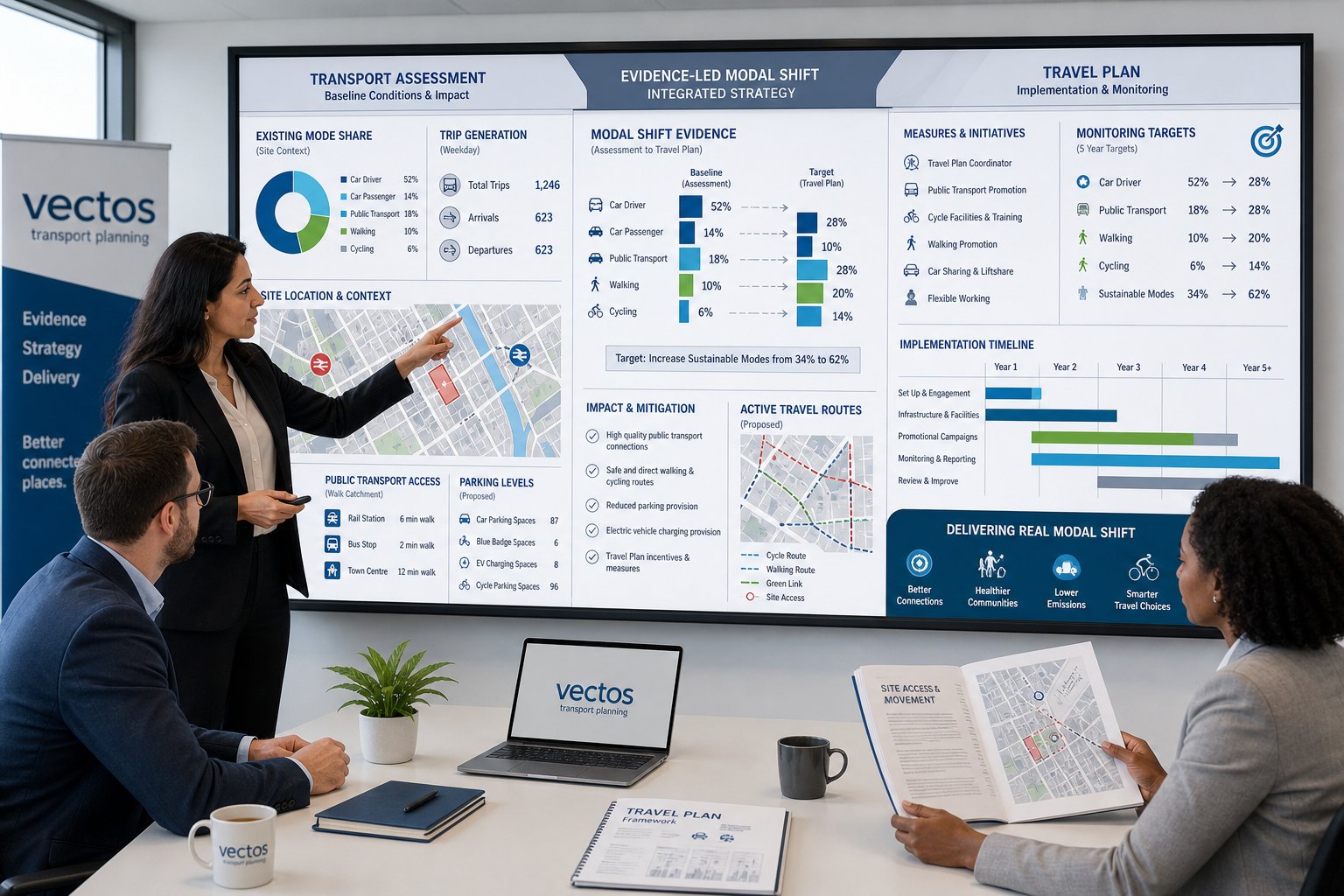
Modal shift evidence sits at the centre of the relationship between a Transport Assessment and a Travel Plan. The Transport Assessment explains likely trip generation, accessibility, network effects and mitigation. The Travel Plan then sets out how travel behaviour will be influenced over time. If the two documents are prepared in isolation, that disconnect is usually obvious.
A robust modal shift approach helps bridge the gap. We start by establishing the baseline: existing mode share, surrounding land uses, public transport accessibility, active travel connections, and local travel behaviour drawn from census data, surveys, counts and comparable sites. From there, we test what is realistically achievable given the scheme type and local context.
That evidence can shape assumptions in several ways. It may justify lower peak car trip rates than a purely suburban comparator would suggest. It may support reduced parking provision where good alternatives exist. It may also identify where stronger mitigation is needed because the desired shift will not happen on site design alone.
The resulting Travel Plan should not read like a separate document created to satisfy a validation checklist. It should convert the strategy into targets, actions, responsibilities, funding arrangements, monitoring schedules and review triggers. Authorities are increasingly alert to weak plans that promise mode shift without delivery mechanisms.
And this is where experience matters. Firms with a strong record in planning success in 2026 tend to understand how to tie modal assumptions, mitigation commitments and condition wording together so the application remains coherent under scrutiny.
Core Measures Used To Encourage Walking, Cycling And Public Transport

Most modal shift strategies rely on a package of measures rather than one big intervention. People rarely change travel behaviour because of a single leaflet, a token cycle stand, or a line in a Travel Plan. They respond to the combined effect of convenience, cost, safety, legibility and habit.
For walking, the basics still matter most: direct routes, overlooked spaces, safe crossing points, reasonable gradients, good lighting and clear connections to nearby destinations. If walking routes feel secondary to vehicle access roads, mode shift claims weaken immediately.
For cycling, secure and convenient parking is essential, but it is not enough on its own. Schemes often need coherent internal routes, links to local cycle networks, changing facilities for employment uses and design that avoids conflict with servicing. The rise of e-bikes has also changed viability thresholds for distance and topography, which can materially alter catchment assumptions.
Public transport measures vary by site, but common interventions include upgraded stops, pedestrian connections to stations, contributions to service improvements, real-time information, integrated ticketing offers and marketing support during early occupation. On larger sites, bus routing and stop placement can make or break uptake.
Parking strategy is another major lever. Managed restraint, unbundled parking, car clubs, electric car share bays and priority spaces for disabled users can all support broader objectives. But restraint only works where alternatives are credible. If the non-car offer is weak, reduced parking tends to create conflict rather than shift.
Digital tools now play a larger role too: personalised journey planning, app-based incentives, mobility hubs, and occupancy or pass data that allows Travel Plan coordinators to refine measures over time. The best strategies combine hard infrastructure with behaviour-change mechanisms rather than relying on either in isolation.
Assessing Site Constraints, Opportunities And Local Policy Requirements
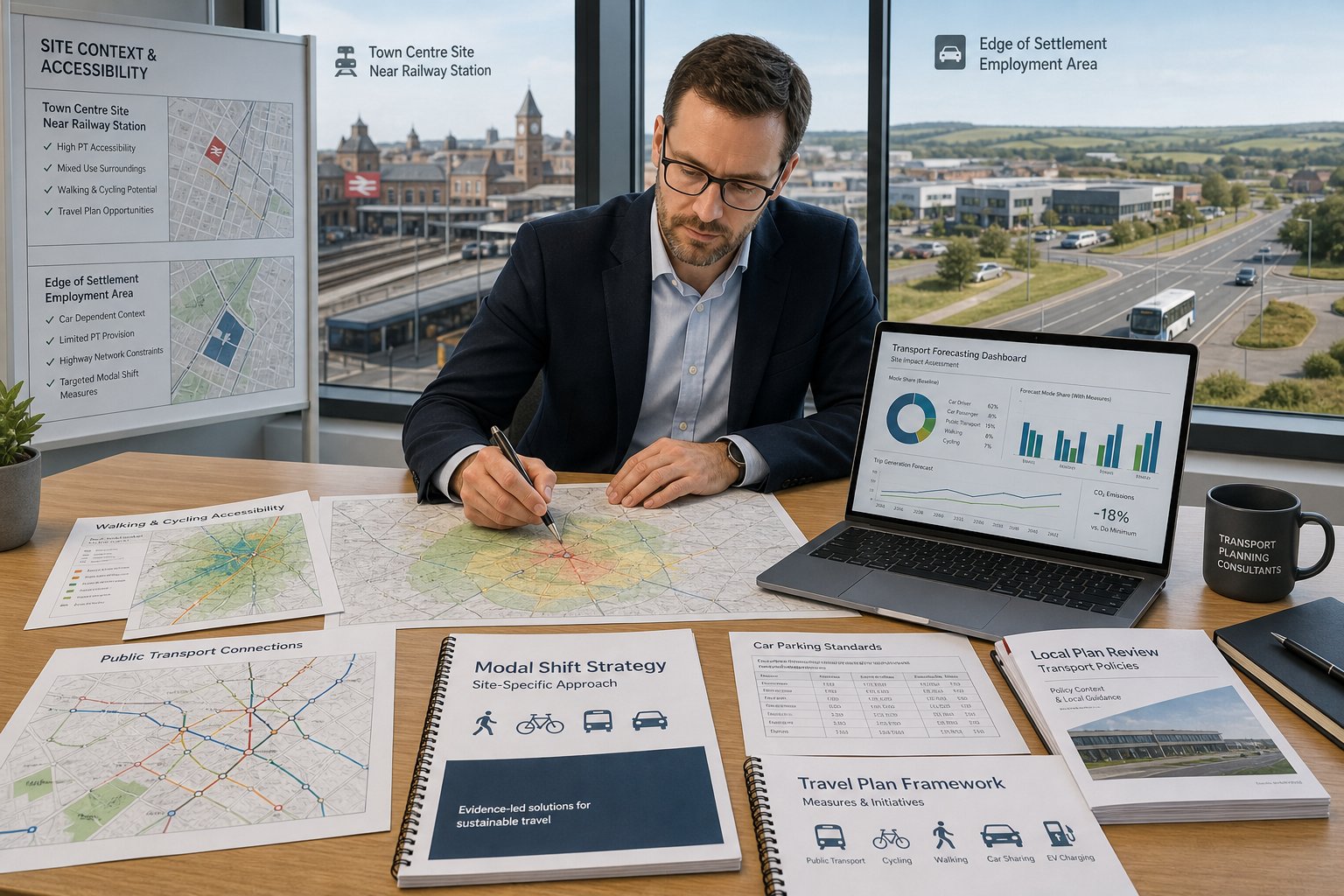
A persuasive modal shift strategy starts with realism. Every site has constraints, and pretending otherwise usually damages credibility. The key is to identify what can genuinely be improved, what needs mitigation, and what limits should shape expectations from the outset.
We typically assess accessibility to key destinations, walking and cycling route quality, topography, severance, safety, public transport frequency, network resilience, parking context and surrounding land use pattern. A town-centre infill site next to a railway station invites a very different strategy from an edge-of-settlement employment site near a bypass. That sounds obvious, but many weak submissions still apply generic targets without enough local calibration.
Policy review is equally important. Local plan transport policies, parking standards, cycling design guidance, air quality plans, climate commitments and town-wide movement strategies often carry more practical weight than applicants first assume. National policy sets the direction, but local requirements usually shape what evidence is needed and what officers regard as realistic.
This is where local knowledge helps. At ML Traffic, our work is shaped by authority-specific thresholds, expectations and planning contexts, which often makes the difference between a technically correct report and one that actually answers the questions a case officer or highway authority is likely to ask.
Common Data Sources And Forecasting Methods
Good modal shift advice depends on a broad evidence base. Census journey-to-work data remains useful, though it must be interpreted carefully because hybrid working and changing travel patterns have affected some historic assumptions. Household travel surveys, site-specific questionnaires, mode share counts, roadside and cordon surveys, public transport timetable and patronage data, and accessibility mapping all have a role.
Consultants also draw on TRICS, local model outputs, mobile movement data where available, school or employer travel data, and comparative evidence from similar developments. No single source tells the whole story. The point is triangulation.
Forecasting methods vary by scheme complexity. At the simpler end, we may use benchmark mode shares adjusted for accessibility and site design factors. For more complex sites, scenario testing and elasticity-based assessments can estimate how parking restraint, improved bus frequency, better cycle links or pricing measures influence mode choice. In strategic schemes, multimodal assignment models or corridor studies may be needed.
The important thing is transparency. Authorities do not expect perfect prediction. They do expect assumptions to be clearly explained, locally grounded and proportionate to the scale of the planning decision.
The Role Of Modal Shift In Planning Negotiations And Condition Discharge
Modal shift evidence often becomes most valuable once the application moves from submission into negotiation. At that stage, the debate is rarely theoretical. Officers, members and consultees want to know what can be secured, how performance will be measured and what happens if uptake falls short.
A strong strategy gives the project team options. It can support lower parking ratios, justify higher density in accessible locations, explain why a junction mitigation package can be moderated, or demonstrate that highway impacts should be considered alongside sustainable travel interventions rather than in isolation. It can also help negotiate proportionate planning obligations by showing which measures genuinely affect behaviour and which are unlikely to deliver value.
Condition wording matters here more than many teams realise. If obligations are vague, implementation becomes difficult. If they are too rigid, the Travel Plan may not adapt to actual travel behaviour once the site is occupied. Well-drafted measures allow for monitoring, review and refinement while still providing clear accountability.
After permission, modal shift work continues through condition discharge and monitoring. That may involve appointing a Travel Plan coordinator, confirming baseline surveys, reporting on target performance, agreeing remedial actions and evidencing that commitments have been delivered. Authorities are increasingly interested in whether Travel Plans function as living management tools rather than shelf documents.
In our experience, schemes progress more smoothly when the transport evidence, legal drafting and delivery plan all point in the same direction. Otherwise, even a good concept can become tangled in avoidable post-permission disputes.
Common Challenges That Can Weaken A Modal Shift Strategy
The most common weakness is over-optimism. Some strategies assume significant reductions in car use without enough evidence that people will have attractive alternatives. That can happen because teams are trying to support density, reduce parking or soften highway objections. But if the assumptions are not credible, officers will spot the gap quickly.
Another recurring issue is mismatch between aspiration and design. A planning statement may talk about walkable neighbourhoods while the layout prioritises vehicle movement, creates indirect pedestrian routes or places cycle parking in inconvenient corners. The words and the plan need to agree.
Public transport is also frequently overstated. A site may be described as well served because a bus stop exists nearby, yet frequency is poor, evening service is limited, or links do not match shift patterns. Occupiers and residents respond to actual usefulness, not theoretical coverage.
Travel Plans can be weakened by soft commitments too. If there is no clear coordinator role, no budget, no monitoring schedule, and no trigger for remedial action, the strategy will struggle to carry weight. The same applies to parking control. Restraint only influences behaviour where management and enforcement are real.
Finally, local context matters. What works in a dense urban centre may fail on a semi-rural edge site. The strongest strategies are not the most ambitious on paper: they are the ones most tightly aligned with the geography, market, occupier profile and policy environment of the development.
Choosing A Modal Shift Consultant For Planning Support
Choosing the right consultant is partly a technical decision and partly a planning one. You need someone who can analyse travel demand and mode share with rigour, but also someone who understands how that evidence will be read by officers, highway authorities, committees and, in some cases, inspectors.
We would usually look for five things.
First, proven experience with Transport Assessments and Travel Plans. Modal shift advice is most useful when it feeds directly into planning documents rather than sitting in a separate silo.
Second, local policy awareness. A consultant should understand authority thresholds, parking standards, active travel expectations, climate policies and the particular issues that tend to arise in the relevant area.
Third, practical design understanding. Sustainable travel outcomes are shaped by layout, frontage, crossings, servicing and parking management, not just by forecasting spreadsheets.
Fourth, negotiation experience. Many schemes are won or lost in the detail of pre-application advice, committee queries, planning obligations and discharge submissions. Consultants who can explain assumptions clearly and defend them calmly are often worth their fee several times over.
Fifth, realism. Be wary of teams that promise dramatic mode shift without first interrogating the site context. Ambition is useful: implausibility is not.
For many project teams, the best choice is a consultant who combines concise reporting, local authority awareness and a planning-led approach. That is why transport advice tied closely to planning strategy, programme and evidence quality tends to deliver better outcomes than a generic compliance exercise.
Conclusion
Modal shift is no longer a side note in planning. In many applications, it is part of the core argument for why a scheme is acceptable, policy-compliant and deliverable. That makes the role of modal shift consultants increasingly important in 2026.
When brought in early, they help us test assumptions before they harden into design liabilities, align Transport Assessments with Travel Plans, and build strategies that stand up in negotiation as well as on paper. More importantly, they connect transport evidence to the wider outcomes planning now expects: lower emissions, healthier places, better accessibility and less dependence on private car travel.
For developers, architects, planners and public bodies alike, that is not just about reducing refusal risk. It is about producing schemes that work more convincingly in the real world, and are easier to defend through the planning process.
Frequently Asked Questions about Modal Shift Consultants
What role do modal shift consultants play in planning applications?
Modal shift consultants analyse travel demand to reduce car dependency by promoting walking, cycling, public transport and shared mobility, helping developments meet climate and transport policies which reduces planning refusal risks.
How can modal shift strategies support sustainable development goals?
Modal shift strategies encourage active travel and public transport, contributing to better health, sustainable cities, and climate action by lowering emissions, improving air quality, and creating more liveable environments.
When is it necessary to involve modal shift consultants in a development project?
Early input from modal shift consultants is key for larger housing, mixed-use developments, employment parks, or sites sensitive to congestion and air quality, ensuring travel patterns align with planning and sustainability goals.
How do modal shift consultants integrate their work with Transport Assessments and Travel Plans?
They provide evidence-based mode share analysis and scenario testing feeding into Transport Assessments and set realistic targets, actions, and monitoring frameworks in Travel Plans to ensure sustainable travel behaviour change.
What are common measures used to promote walking, cycling, and public transport in modal shift strategies?
Typical measures include direct, safe walking routes; secure cycle parking and internal cycle networks; reduced managed parking; enhanced public transport access; and digital tools for journey planning and behaviour incentives.
What factors should be considered when choosing a modal shift consultant for planning support?
Choose consultants with a strong record in Transport Assessments and Travel Plans, knowledge of local policies, practical design insight, negotiation experience, and a realistic approach tailored to the specific site context.