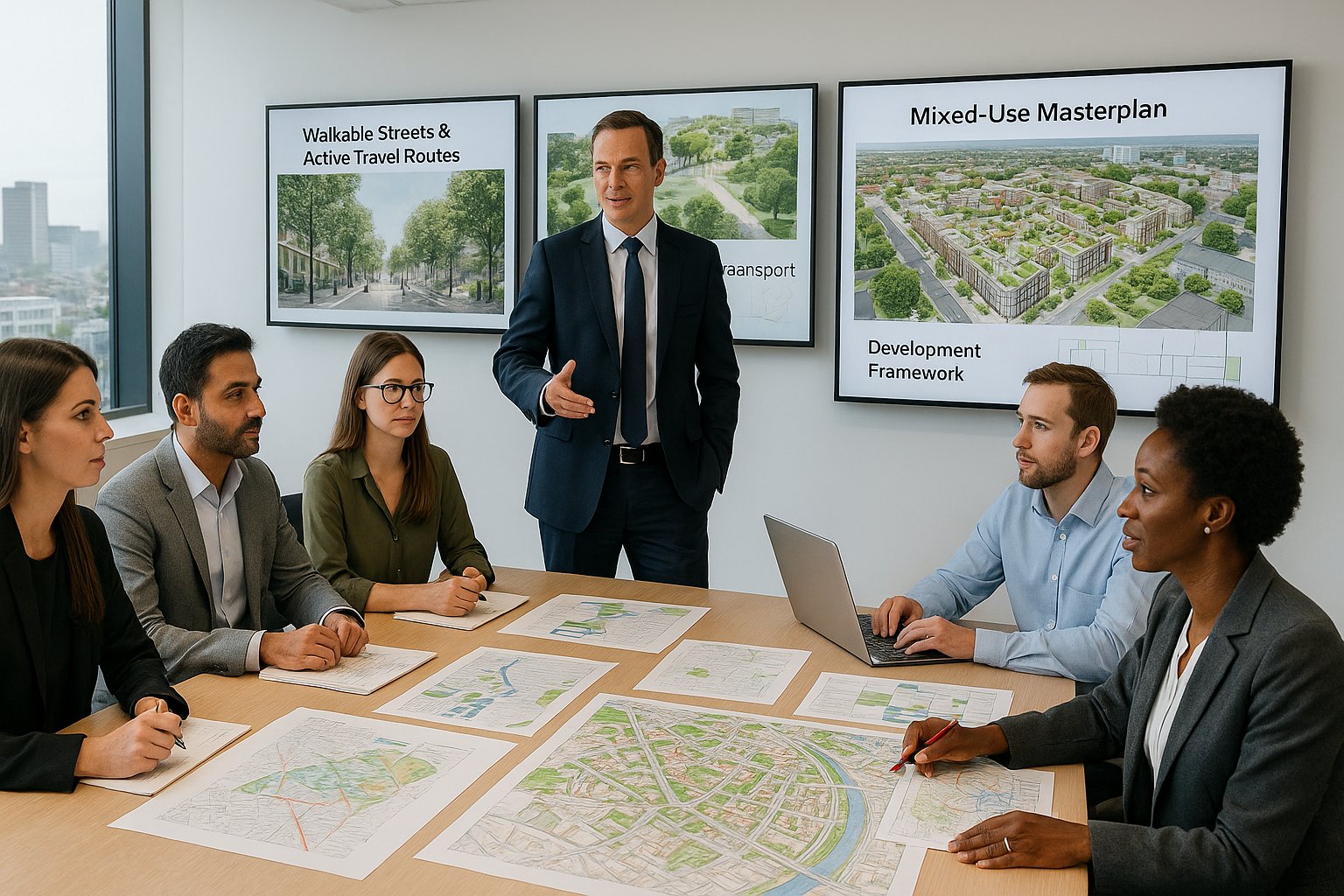
A planning application can look technically sound on paper and still feel unconvincing in the room. We’ve all seen it: a scheme with the right land use, the right density, even the right policy references, yet something is missing. The streets don’t quite work, the public realm feels generic, the movement strategy sits apart from the design narrative, and local stakeholders struggle to picture a place they’d actually want to use.
That gap is exactly where placemaking consultants add value. They help turn a development proposal from a collection of compliant components into a coherent, viable and liveable place. In practice, that means bringing together urban design, movement, economics, engagement and delivery thinking early enough to shape decisions that matter.
For developers, councils, architects, planners and legal teams, this has become more important, not less, in 2026. Design quality expectations are higher. Local authorities are under pressure to secure better places, not just more floorspace. And transport evidence, active travel, climate policy and community scrutiny increasingly influence whether schemes move forward smoothly or get dragged into delay.
In this guide, we’ll look at what placemaking consultants actually do, how their role differs from adjacent disciplines, when to bring them in, and why the strongest outcomes usually come from collaborative teams that connect place vision with planning strategy and transport reality.
What Placemaking Consultants Do And Why Their Role Matters
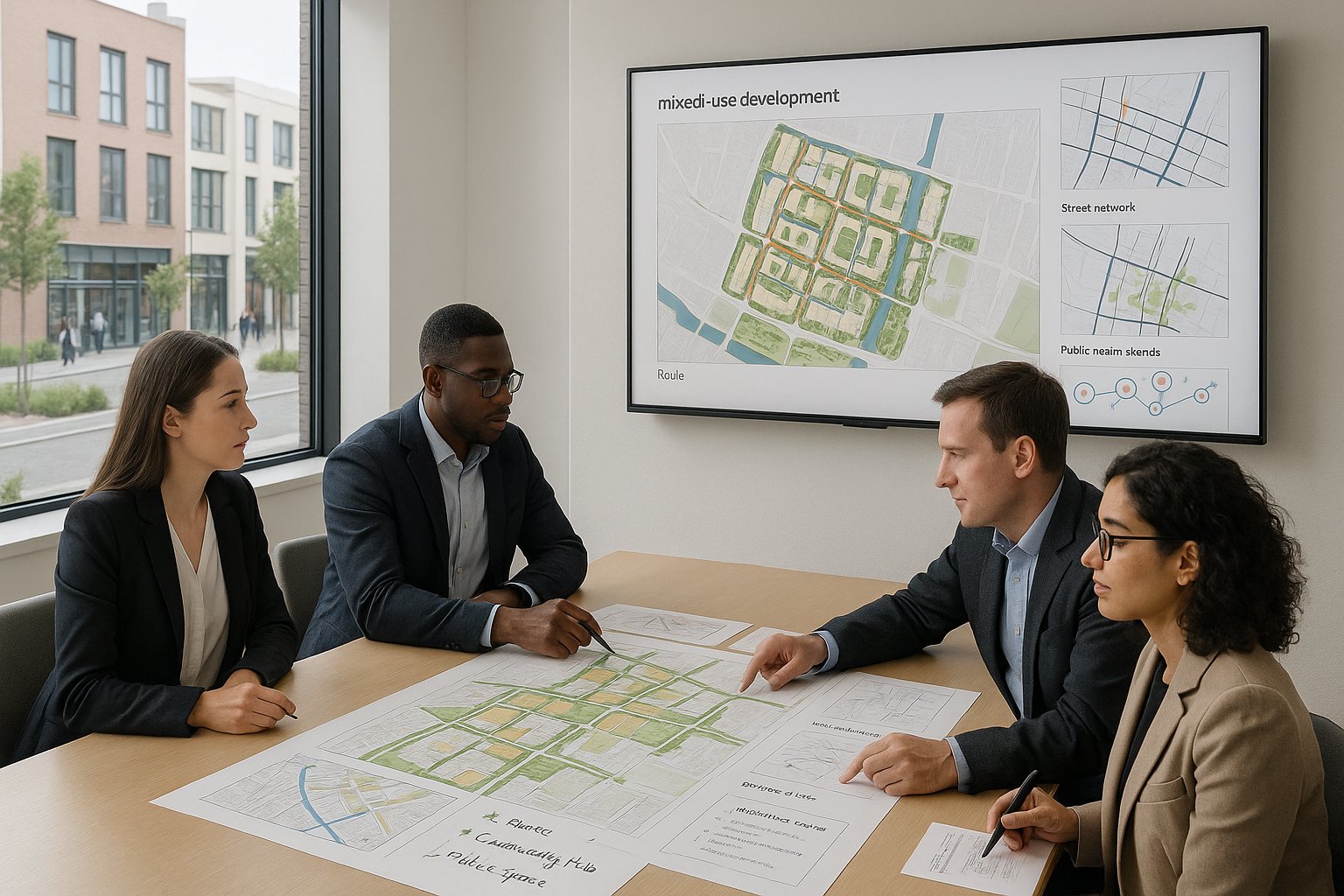
Placemaking consultants are specialist advisers who help shape places people can understand, use and support. That sounds simple. It rarely is.
Their job sits at the intersection of design, planning, movement, economics and local identity. They help define what a place is for, who it serves, how it should function day to day, and what physical and operational decisions are needed to make that vision real. That can apply to town centres, strategic urban extensions, residential-led mixed-use schemes, campuses, business parks, estates renewal projects and regeneration areas.
At their best, placemaking consultants don’t just produce attractive diagrams or polished strategy documents. They create a shared logic for decision-making. Why should one street carry through-traffic while another prioritises walking and spill-out activity? Where should community uses sit to support footfall? How should public realm, servicing, parking and activation work together rather than in conflict? Those are placemaking questions.
Their role matters because development risk often hides in the spaces between disciplines. A scheme may be policy-compliant but unloved. Beautifully designed but operationally weak. Commercially ambitious but socially thin. A placemaking approach helps avoid that fragmentation.
For project teams, this often translates into clearer narratives, stronger stakeholder confidence, better briefs for design teams, and more robust planning submissions. For councils and communities, it can mean places that feel less imposed and more grounded in actual local patterns of life.
How Placemaking Differs From Masterplanning, Urban Design, And Planning Consultancy
Masterplanning, urban design, planning consultancy and placemaking overlap, but they aren’t interchangeable.
Masterplanning usually focuses on the big spatial structure: land uses, blocks, routes, density, phasing and development parcels. It answers the question, “How is this place laid out?”
Urban design goes deeper into built form, streets, edges, heights, frontage, materials and the relationship between buildings and public space. It asks, “What will this place look and feel like physically?”
Planning consultancy deals with policy analysis, application strategy, evidence, negotiations, appeals and consent routes. In other words, “How do we secure permission within the planning system?”
Placemaking pulls across all three, but with a different centre of gravity: lived experience and long-term place performance. It asks, “Will this place work socially, commercially and practically once people arrive?”
That distinction matters. A masterplan can be rational without being memorable. Urban design can be elegant without supporting local activity. A planning strategy can be watertight without generating community trust. Placemaking consultants bridge those gaps by focusing on use, identity, movement, stewardship and activation alongside form and policy.
In many UK projects, placemaking is the connective tissue rather than a standalone silo. It helps the architect, planner, transport team, council officers and developer work towards the same place outcome instead of parallel objectives.
Why Placemaking Matters For Developers, Councils, And Design Teams
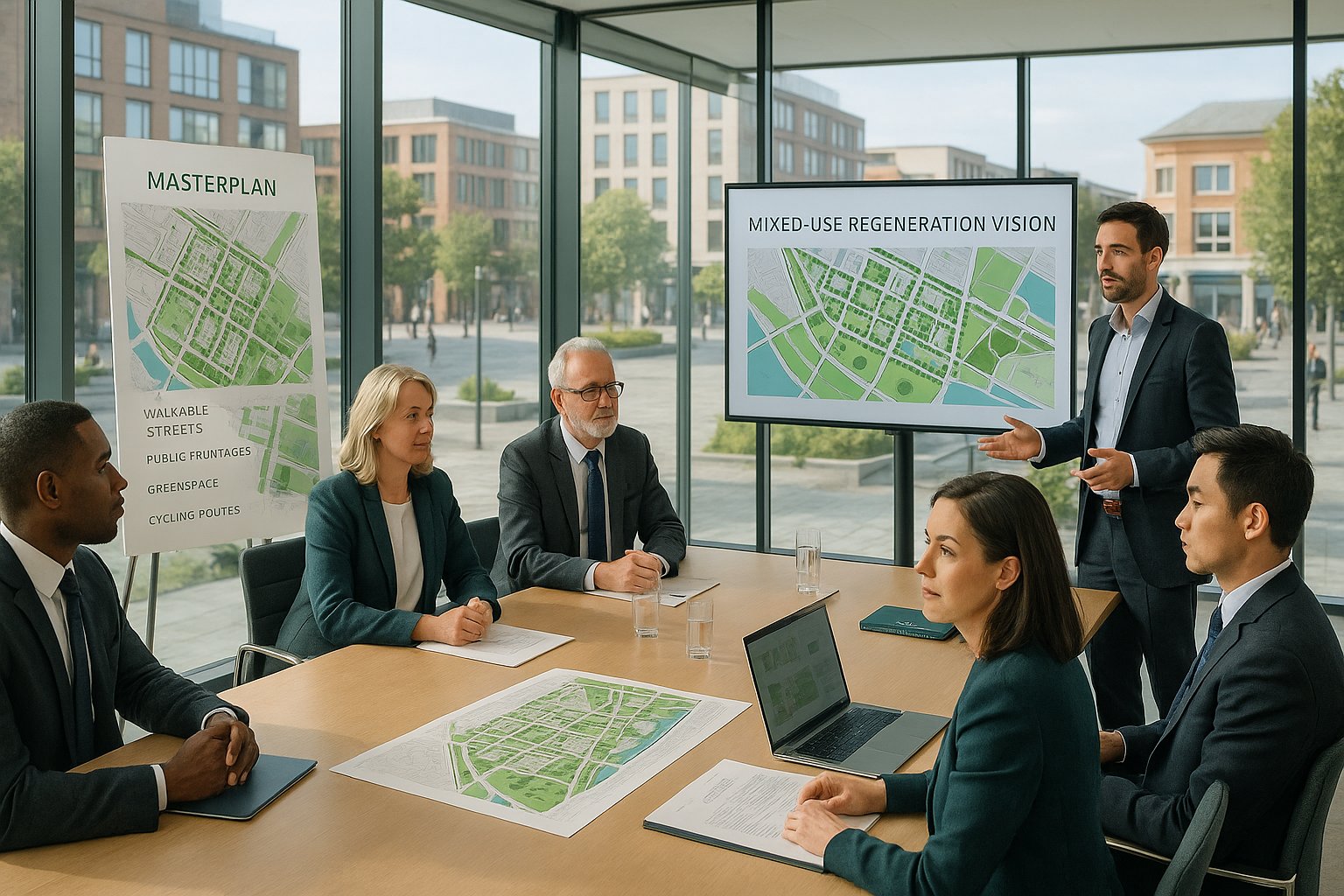
Placemaking matters because poor places are expensive. They slow planning, weaken demand, generate objections, reduce dwell time, undermine value and often require later fixes that cost far more than getting the fundamentals right first time.
For developers, a strong placemaking strategy can improve investor confidence and occupier appeal. It helps explain not just what is being built, but why the scheme will succeed in the market and fit its context. That’s especially important for mixed-use and regeneration sites, where a compelling place narrative can support viability, leasing and phasing.
For councils, placemaking supports broader policy goals: healthier streets, stronger town centres, inclusive public spaces, better design quality and climate-conscious growth. Local authorities are increasingly expected to secure social value and long-term place quality, not merely process applications quickly.
For architects and wider design teams, placemaking gives a sharper brief. It can clarify priorities around movement, public realm, activation, meanwhile uses, landscape, frontages and the sequencing of delivery. Good design gets easier when the team agrees what kind of place they’re trying to make.
There’s also a political reality here. Community support is rarely won by technical compliance alone. Residents, members and consultees respond to whether a proposal seems useful, walkable, safe, distinctive and well connected. Placemaking provides the language and evidence to show that those issues have been considered seriously.
In our experience, it also improves conversations between disciplines. A transport note, viability review or design code lands better when it is clearly tied to a bigger place strategy rather than presented in isolation.
The Core Services A Placemaking Consultant Typically Provides
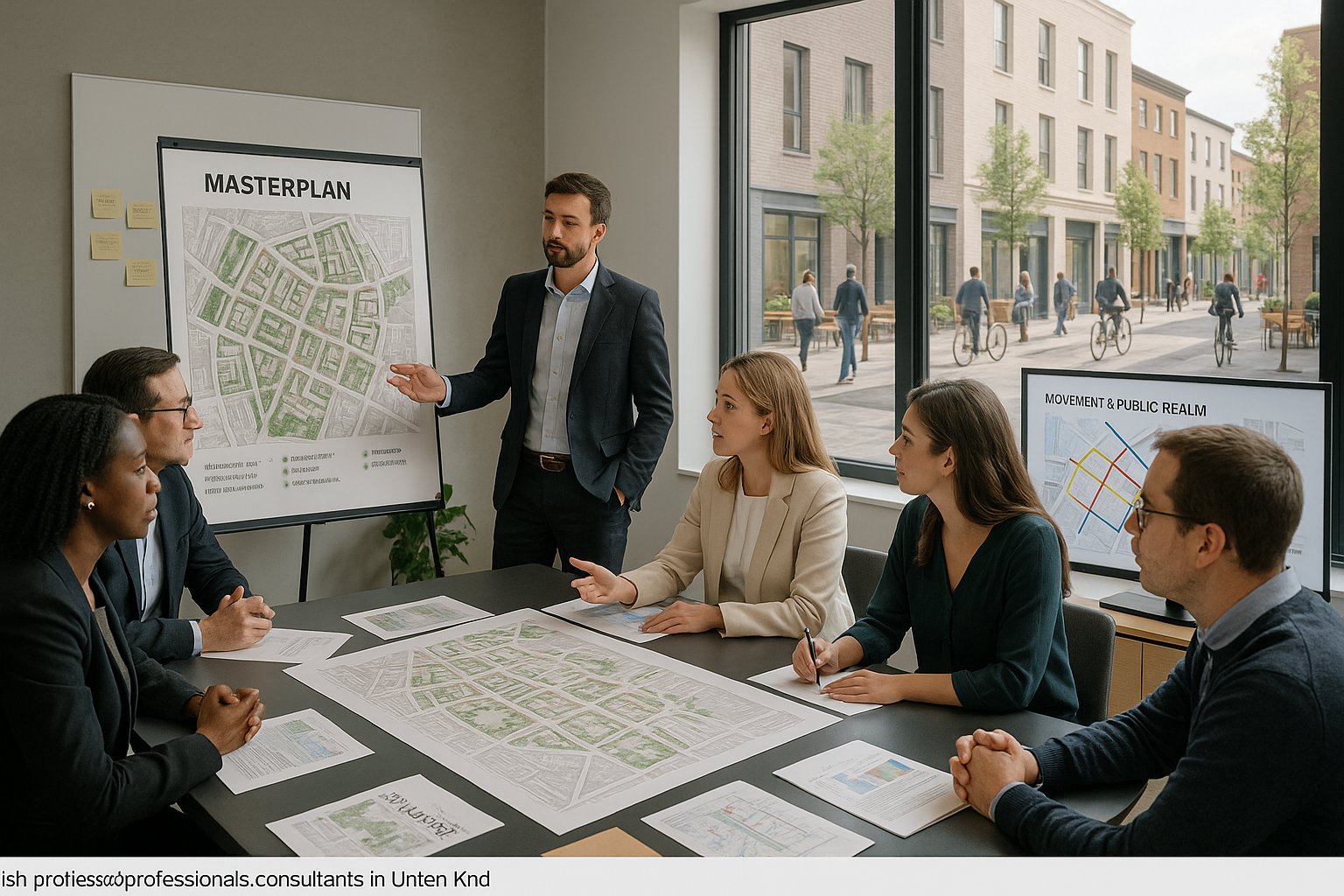
Placemaking consultants can be appointed for a single strategic task or embedded through a full project lifecycle. The exact scope varies, but most commissions revolve around shaping a place vision and turning that vision into decisions people can deliver.
Typical services include place analysis, visioning, stakeholder engagement, development frameworks, movement and access principles, public realm guidance, town centre or regeneration strategy, design coding, meanwhile use planning, cultural and economic activation advice, and input into planning documentation.
Some practices lean heavily into urban regeneration and high street revival. Others specialise in strategic housing growth, campus environments or estate transformation. The strongest teams tend to be multidisciplinary, or at least comfortable working hand-in-glove with planners, architects, transport specialists and economists.
A key point often missed: placemaking is not only about concept generation. It also deals with delivery. A consultant may help test whether the proposed uses can support footfall at different times of day, whether streets can balance place and movement functions, or whether stewardship and management models are realistic after completion.
That practical side is why placemaking has become more valuable in planning. Local authorities and applicants alike are looking for evidence that a proposal will operate well, not just present well.
Visioning, Stakeholder Engagement, And Place Strategy
Visioning is where placemaking usually starts. Before drawings become fixed, the team needs a shared view of what success looks like. Is the ambition to create a family neighbourhood, a civic destination, a productive employment district, a revived high street, or a mixed-use quarter with evening activity? If that sounds obvious, it isn’t. Plenty of projects drift because no one defines the place clearly enough at the start.
Placemaking consultants structure that thinking. They analyse context, user groups, constraints, local identity, competing centres, movement patterns and market positioning. Then they translate that analysis into a place strategy: a practical narrative about who the place is for, how it should work, and what principles should guide design and delivery.
Stakeholder engagement is central, not optional. This can include workshops with officers, councillors, landowners, businesses, institutions, residents and delivery partners. Done well, engagement is not a theatrical exercise to validate decisions already made. It is a way to test assumptions, surface local knowledge and build legitimacy.
And yes, it can save time. Early engagement often reveals issues around access, safety, servicing, parking behaviour, public transport use or local sensitivities that would otherwise emerge later as objections.
Design Codes, Public Realm, Movement, And Delivery Advice
Once the vision is set, placemaking consultants often help codify it. That may involve design codes, public realm principles, street hierarchy guidance, frontage expectations, landscape strategies, or advice on how meanwhile uses and phased delivery can maintain life in the area as development progresses.
Design codes are particularly useful where multiple parties will deliver different plots over time. Without clear coding, a place can lose coherence quickly. But good coding is not about reducing design to a rulebook. It is about protecting the qualities that matter most: active edges, enclosure, walkability, legibility, green infrastructure, material consistency, and public spaces that actually feel usable.
Movement is a big part of this. A place that looks attractive in a visualisation but feels hostile to walk through won’t perform well for long. Placemaking consultants hence work closely with transport and highways specialists to align street design, active travel, access, servicing and parking with the intended character of the place.
That alignment is where firms like ML Traffic can add serious value within a wider consultant team. Concise, planning-focused transport evidence, tailored to local authority expectations, helps ensure the movement strategy is not an afterthought but a credible part of the place story.
Delivery advice rounds things out: phasing, stewardship, management, activation and practical recommendations that help the scheme remain coherent beyond the planning stage.
When To Bring In A Placemaking Consultant During A Project
The best time to appoint placemaking consultants is at project inception, before the core assumptions harden.
That early stage matters because the most important place decisions are often made quietly and quickly: where access points go, how much land is given to movement corridors, which uses anchor the scheme, what public spaces are expected to do, and how the proposal is positioned in relation to surrounding centres or neighbourhoods. If placemaking arrives after those decisions are locked in, the role becomes cosmetic.
At pre-feasibility, a placemaking consultant can shape the brief, test scenarios and help the team understand what kind of place is realistic, supportable and policy-aligned. During concept design, they help maintain coherence as architects, planners, transport consultants and commercial teams refine the proposal.
Their value doesn’t end at submission. Retaining placemaking input through planning, reserved matters and delivery helps preserve the original vision when inevitable compromises appear. Value engineering, tenant demands, highways comments and programme pressure can all chip away at place quality if no one is guarding the wider logic.
For regeneration and town centre schemes, continued involvement can be even more important. These projects often rely on phasing, activation and changing market conditions. A placemaking consultant can help ensure short-term interventions still support the long-term direction of travel.
In plain terms: bring them in early, keep them engaged long enough to matter, and don’t mistake a late-stage “sense of place” workshop for actual placemaking.
How Placemaking Supports Planning Applications And Policy Alignment
Planning decisions increasingly hinge on whether a scheme demonstrates quality, integration and credibility, not just numerical compliance. Placemaking helps make that case.
A strong placemaking approach supports planning applications by showing how the proposal responds to context, policy and user experience in a joined-up way. It can inform development frameworks, design and access narratives, parameter plans, design codes, public realm strategies and consultation material. It also helps teams articulate how the scheme supports wider objectives around health, town centre vitality, active travel, climate resilience and inclusive design.
This matters because UK planning policy has moved steadily towards place quality. National and local policy now places greater emphasis on beauty, design coding, healthy streets, modal shift, green infrastructure and the long-term management of places. Decision-makers want to see that these are embedded, not bolted on.
Placemaking consultants can also help align a scheme with supplementary planning documents, regeneration frameworks and local plan aspirations. That can be invaluable where policy is supportive in principle but nuanced in execution. The consultant helps interpret what “good growth” or “high-quality place” means for this particular site.
There’s a strategic benefit too. A planning statement may tell the policy story, but placemaking makes the proposal legible to broader audiences. Councillors, residents and non-specialists often respond more strongly to a coherent place narrative than to technical planning language.
The smoother applications tend to be the ones where policy, design, movement and engagement all point in the same direction. Placemaking is often what creates that alignment.
The Link Between Placemaking, Movement Strategy, And Transport Evidence
This is where many schemes either come together or unravel.
Movement strategy is not a side topic in placemaking: it is one of the main determinants of whether a place feels comfortable, connected and commercially alive. The width of crossings, the continuity of cycle routes, bus accessibility, traffic speeds, servicing arrangements, parking placement and street hierarchy all shape how a place is experienced.
That’s why placemaking consultants often work closely with transport planners and highways engineers. The aim is not simply to “fit in” active travel measures around a traffic-led layout. It is to create movement networks that support the intended character of the place. A local centre needs different street behaviour from a logistics corridor. A residential square should not be designed like a distributor road with nicer paving.
Transport evidence also plays a practical planning role. Officers and consultees need confidence that the place vision can function in reality. That means transport assessments, travel plans, junction analysis, access appraisals and active travel evidence must reinforce, not contradict, the placemaking strategy.
This is where specialist transport input becomes crucial. On projects requiring concise, authority-aware transport reporting, teams such as ML Traffic can help translate movement ambitions into planning evidence that is technically robust and proportionate. That reduces the risk of a disconnect between what the design team promises and what the transport documents actually support.
Done properly, placemaking and transport evidence create a virtuous circle: better movement choices improve place quality, and a clearer place strategy produces more defensible transport assumptions.
What To Look For When Choosing A Placemaking Consultant
Not every consultant using the word “placemaking” offers the same thing. Some are excellent strategists but less experienced in delivery. Others are strong on engagement yet weaker on movement or commercial realities. So selection matters.
First, look for multidisciplinary capability. The consultant doesn’t need to do everything in-house, but they should be comfortable operating across urban design, planning, movement, economics, activation and community engagement. If they can only talk about aesthetics, that’s a warning sign.
Second, check for a credible UK track record. Have they worked with both developers and councils? Do they understand local authority processes, political sensitivities, design review expectations and the evidence base needed for planning? A glossy portfolio is nice: built projects and adopted frameworks are better.
Third, test their engagement approach. Strong placemaking consultants know how to listen as well as present. Ask how they’ve handled contested schemes, local scepticism or multi-stakeholder environments. If engagement is treated as a branding exercise, expect trouble later.
Fourth, ask about delivery. How have they maintained a place vision through phasing, viability pressure and consultant turnover? Can they point to design codes, stewardship models or public realm guidance that actually influenced outcomes?
Finally, consider chemistry. Placemaking is collaborative and occasionally messy. You want a consultant who can challenge constructively, translate across disciplines and keep a project team aligned when tensions appear.
Common Mistakes That Undermine Successful Placemaking
The first mistake is treating placemaking as branding. A name, logo, brochure and some lifestyle imagery do not make a place work. If the street network is poor, ground floors are inactive, crossings are awkward and public spaces lack purpose, no amount of marketing language will fix it.
The second is bringing placemaking consultants in too late. Once access strategy, parcel structure, densities and commercial assumptions are fixed, there may be little room left to influence the things that shape actual experience. Late-stage placemaking often becomes decorative narrative wrapped around decisions already made by others.
The third is ignoring movement and access realities. We’ve seen schemes promise walkable, sociable environments while transport evidence still assumes vehicle-dominated streets or oversized parking provision. When the movement strategy and place story clash, everyone notices.
A fourth mistake is neglecting viability and long-term management. Public realm can look generous at planning stage but deteriorate if there is no stewardship model, activation plan or realistic maintenance approach. Places need operating logic, not just design intent.
Another common issue is genericity. A template-led approach may satisfy process requirements, yet fail to reflect local identity, local movement patterns or the economic role of the site. Places that could be anywhere often struggle to gain loyalty anywhere.
And, frankly, some teams mistake consultation for consensus. Engagement should inform the scheme, but it won’t eliminate disagreement. The real goal is to create a proposal that is responsive, evidence-based and capable of standing up under scrutiny.
How A Collaborative Consultant Team Creates Better Development Outcomes
Successful placemaking is almost never the product of one discipline working alone. It happens when planning, design, transport, landscape, economics, engagement and delivery advice pull in the same direction.
That collaboration improves outcomes in very practical ways. Planners help align the proposal with policy and consent strategy. Architects and urban designers translate the place vision into form and character. Transport specialists test whether movement assumptions are workable and supportable. Economists and commercial advisers check viability and market logic. Engagement specialists make sure local voices and political realities are understood early rather than dealt with reactively.
When these inputs are coordinated, projects become more coherent. The public realm strategy supports footfall assumptions. The street hierarchy reflects both design intent and operational needs. The planning narrative is backed by evidence. Consultation feedback feeds into real revisions instead of being filed away politely.
This collaborative model also reduces friction during planning. Officers are more likely to engage positively when the application tells one joined-up story. Internal contradictions are fewer. Technical notes reinforce the design case rather than weakening it.
For transport-related schemes in particular, the value of a joined-up team is hard to overstate. If movement strategy, access design and supporting reports are developed alongside placemaking from the outset, the result is usually a more persuasive and resilient planning submission.
In other words, better places are not designed in silos. They are assembled through disciplined collaboration.
Conclusion
Placemaking consultants matter because development is judged by more than compliance. The strongest schemes create places people can move through easily, recognise, support and use over time. That requires more than good intentions. It needs a clear place vision, policy awareness, realistic delivery thinking and movement strategies that work in the real world.
For developers, councils and project teams, the lesson is straightforward: involve placemaking early, connect it to planning and transport evidence, and keep it active through delivery. When placemaking is treated as a core discipline rather than a finishing touch, planning outcomes tend to be smoother and the places themselves more resilient.
And in 2026, that joined-up approach is increasingly what separates schemes that merely get submitted from schemes that genuinely stand a chance of succeeding. If the aim is to create places that are viable, well-used and easier to consent, placemaking consultants have become one of the smartest appointments a team can make.
Frequently Asked Questions About Placemaking Consultants
What do placemaking consultants do in urban development projects?
Placemaking consultants specialise in shaping places that are liveable, commercially viable and socially vibrant by combining urban design, movement, economic strategy and community engagement to create coherent place visions and delivery plans.
How does placemaking consultancy differ from masterplanning or urban design?
While masterplanning focuses on spatial layout and urban design on physical form, placemaking consultancy integrates design with social, economic and movement factors to ensure places work well in everyday life and are supported by local communities.
When is the best time to involve a placemaking consultant in a project?
The ideal time to bring in placemaking consultants is at project inception or pre-feasibility, allowing them to influence key decisions on access, land use and vision and remain engaged through planning and delivery phases to maintain place quality.
Why is placemaking important for developers and councils?
Placemaking adds value by improving design quality, securing planning consent, enhancing community support, boosting investor confidence and ensuring developments align with policy goals for active travel, climate and social value.
How do placemaking consultants support planning applications?
They provide evidence aligning proposals with policies, design codes, town centre and regeneration strategies, and deliver narratives that show how developments meet design quality, transport integration and community needs, improving approval chances.
What should you look for when choosing a placemaking consultant?
Choose multidisciplinary consultants experienced in urban design, transport, economics and engagement with a strong UK project record, proven community involvement skills, and capability to influence delivery beyond just producing reports.