
Parking can make or break a planning application. We see it all the time: a scheme may be architecturally strong, commercially sound, and broadly aligned with local policy, yet still run into trouble because the parking evidence is thin, inconsistent, or simply missing. For architects, planners, developers, solicitors, and local authorities, that’s not a minor technical issue. It can affect development capacity, layout efficiency, neighbour impacts, highway safety, and eventually whether consent is granted.
That is where parking strategy consultants come in. Their role goes far beyond counting spaces on a plan. We use parking analysis to connect policy, demand forecasting, site operation, accessibility, servicing, and sustainable transport objectives into one clear planning narrative. In practice, that means helping teams justify parking levels, respond to local authority concerns, and create workable arrangements that still function once the site is built and occupied.
In 2026, this matters even more. Planning authorities are under pressure to support growth while meeting climate, accessibility, and placemaking goals. At the same time, many sites are more constrained than ever, especially in town centres, controlled parking zones, and mixed-use regeneration areas. A robust parking strategy helps resolve those tensions with evidence rather than assumption.
For project teams preparing transport assessments and planning submissions, expert parking advice is often the difference between a credible application and a vulnerable one.
What Parking Strategy Consultants Do And Why Their Input Matters

Parking strategy consultants are specialist transport and parking planners who analyse how parking will actually work on and around a development. That sounds straightforward, but the discipline sits at the intersection of planning policy, highway engineering, site design, building operation, and user behaviour. In other words, it’s rarely just about whether there are enough bays.
Our job typically starts with evidence. We assess existing parking conditions, local restrictions, occupancy patterns, turnover, demand by user type, and the interaction between on-site provision and surrounding streets. From there, we help shape a parking strategy or parking management plan that supports the wider planning case. That can include resident allocation, visitor controls, servicing arrangements, blue-badge provision, EV charging, cycle parking, permit systems, tariff approaches, and monitoring measures.
Why does that input matter? Because parking is often a binding constraint on development. Too much parking can undermine placemaking, active travel goals, viability, and efficient land use. Too little, without proper justification, can trigger overspill parking, neighbour objections, operational friction, and refusal on highway grounds. Weak assumptions here tend to get noticed quickly by planning officers and highway authorities.
Strong parking advice reduces that risk. It gives decision-makers confidence that the proposed level of parking is evidence-led, policy-aware, and operationally realistic. It also helps align the application with broader outcomes: less congestion, better accessibility, more sustainable travel choices, and a site layout that works in the real world, not just on a drawing.
When A Parking Strategy Is Needed For A Planning Application

Not every planning application needs a standalone parking strategy report, but many more schemes benefit from one than teams initially expect. In our experience, the tipping point is usually not just scale. It is complexity, local sensitivity, or a proposal that departs from standard parking assumptions.
A formal parking strategy is often needed for major residential, commercial, mixed-use, education, healthcare, leisure, or institutional developments. It also becomes important where parking provision is lower than local standards, where a scheme is described as low-car or car-free, or where there is likely to be pressure on nearby streets. Sites in controlled parking zones, town centres, conservation areas, and tightly constrained urban plots are especially likely to attract scrutiny.
Many local planning authorities expect parking evidence to sit alongside the Transport Assessment and Travel Plan, even if they do not always label it in exactly the same way. If parking demand, parking controls, servicing, or operational management are central to whether the development can function acceptably, a dedicated strategy is usually the safest route.
And there’s a practical point here. If a design team waits until late-stage planning review to address parking properly, the options narrow fast. Layouts may need redesign, access arrangements can become compromised, and policy conflicts are harder to explain. Bringing in parking strategy consultants early allows the parking approach to inform the scheme, rather than patch over problems after they have been designed in.
Projects That Commonly Benefit From Specialist Parking Advice
Some project types nearly always benefit from specialist parking input because their parking profile is variable, sensitive, or operationally complex.
Town centre regeneration schemes are a clear example. These often involve reduced parking ratios, mixed-user demand, servicing pressures, and public concern about overspill. Offices and business parks also need careful analysis, particularly where employers are expected to support modal shift while still accommodating staff, visitors, and fleet vehicles.
Hospitals, universities, and stadiums are even more nuanced. They have different user groups, peak demand periods, accessibility obligations, and operational requirements, so standard parking ratios rarely tell the whole story. Retail and leisure developments can face similar issues, especially where evening and weekend peaks dominate.
Visitor destinations, heritage sites, coastal attractions, park-and-ride schemes, multi-storey car parks, and EV charging hubs also benefit from robust parking planning. In each case, the key issue is not simply volume of spaces. It is how parking demand changes by season, time of day, event pattern, or user type. Specialist advice helps translate those patterns into evidence a planning authority can actually rely on.
How Parking Strategy Fits Within Transport Assessments And Travel Planning
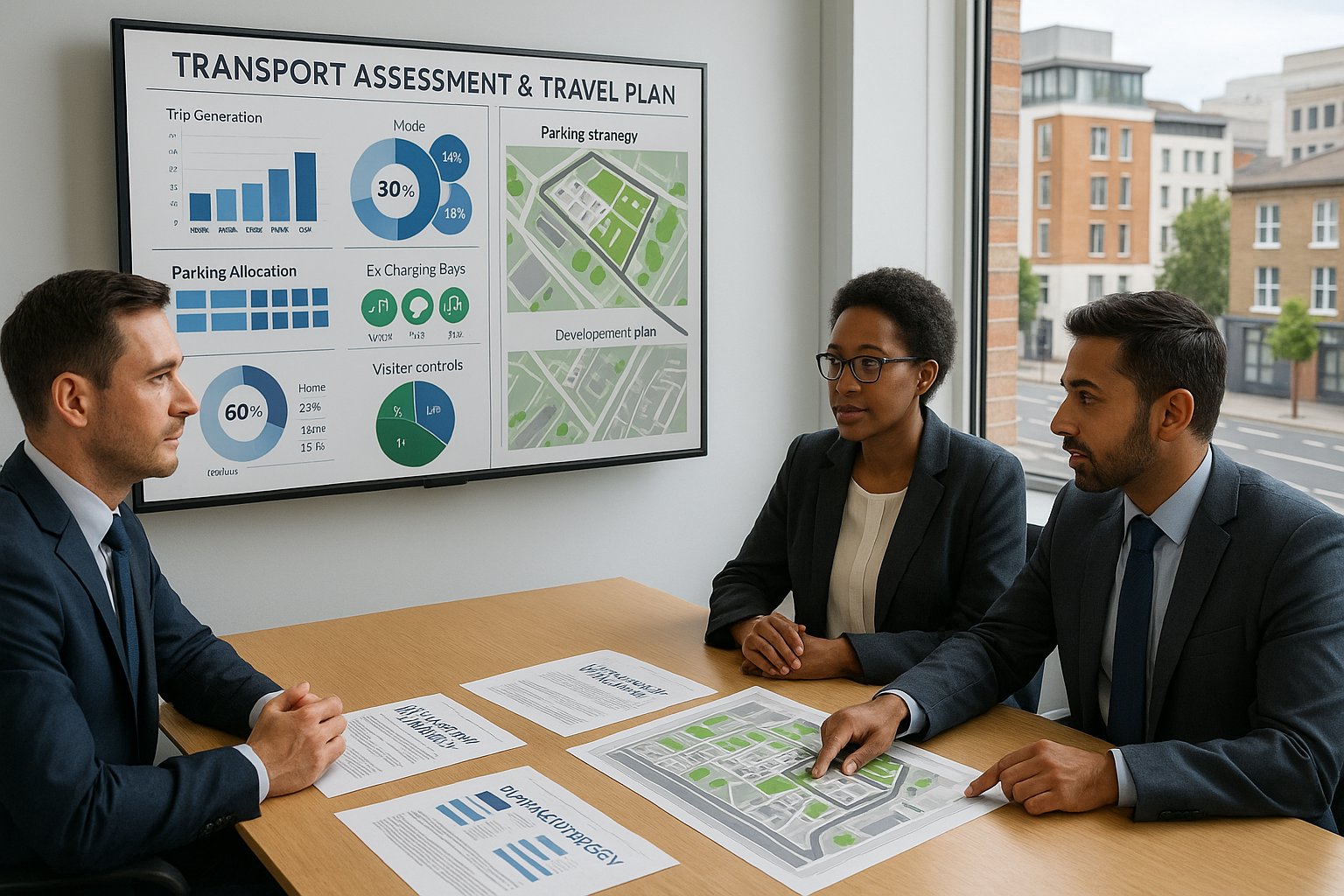
A parking strategy should never sit in isolation. It needs to work as part of the wider transport evidence base, especially the Transport Assessment and Travel Plan. When those documents pull in different directions, local authorities notice, and fairly quickly.
The Transport Assessment typically considers trip generation, distribution, junction impact, accessibility, and highway effects. Parking directly influences all of that. The amount of parking provided can shape mode share, vehicle ownership assumptions, arrival profiles, and internal site circulation. If a Transport Assessment assumes strong public transport uptake but the parking design effectively encourages high car use, the evidence starts to look inconsistent.
That is why we often describe the parking strategy as the bridge between travel behaviour forecasts and day-to-day site operation. It turns broad transport assumptions into practical measures. How many resident permits will be issued? Who gets priority spaces? How are visitor bays controlled? Where are deliveries handled? What happens if early monitoring shows parking stress building up? These are operational questions, but they matter in planning terms because they determine whether the transport case is credible.
The Travel Plan is just as closely linked. A good Travel Plan promotes walking, cycling, public transport, car sharing, and demand management. Parking is one of the strongest levers available to support those aims. Limited supply, allocation rules, EV prioritisation, car-club bays, pricing structures, and cycle parking standards all influence travel choices in a way posters and awareness campaigns never quite can.
Done properly, the parking strategy supports the same policy narrative as the Transport Assessment and Travel Plan: development that is accessible, functional, and less dependent on private car use where that is realistic.
Core Elements Of A Robust Parking Strategy Report
A robust parking strategy report is evidence-led, policy-aware, and operationally specific. It should explain not just how much parking is proposed, but why that level is appropriate and how it will be managed over time.
Most strong reports begin with a review of the planning and policy framework. That includes the National Planning Policy Framework where relevant, local plan policies, supplementary planning documents, parking standards, controlled parking zone rules, and any site-specific constraints or commitments. This matters because parking standards are rarely applied mechanically: interpretation is often where applications succeed or fail.
From there, the report should establish the baseline. What is happening on street? How full are nearby car parks? Are there parking restrictions, waiting controls, or resident permit systems? What are the local accessibility conditions by bus, rail, walking, and cycling? Those factors shape whether reduced or alternative provision can be justified.
A good strategy then sets out forecast demand by land use, user group, and time period. Residential overnight demand is different from office weekday peaks or leisure evening peaks. Mixed-use schemes especially need this broken down carefully. The report should also define the proposed parking quantum by type: standard spaces, accessible bays, cycle parking, motorcycle parking, EV charging spaces, loading areas, servicing space, and often short-stay or operational bays.
Finally, it needs a management framework. Allocation, controls, signage, enforcement, technology, review mechanisms, and trigger points for intervention all matter. Planning officers are rarely reassured by a number on a drawing alone: they want to know the system will keep working after occupation.
Parking Demand, Stress Surveys, And Evidence Gathering
This is often the heart of the report. Without credible survey evidence, even well-argued parking strategies can look theoretical.
Parking demand analysis usually combines on-street and off-street surveys, occupancy counts, turnover observations, arrival and departure patterns, and user profiling. For some schemes, we also examine duration of stay, beat surveys, or peak spreading over time. The objective is to understand not just whether spaces exist, but how parking behaves under real conditions.
Stress surveys are particularly important where a proposal may rely on surrounding streets, or where objectors are likely to claim overspill effects. The term usually refers to the proportion of spaces occupied in an area at relevant times. Once occupancy climbs very high, even small extra demand can create disproportionate operational problems and neighbour concern. That is why survey timing, seasonality, local event patterns, and school-term conditions all need careful thought.
Good evidence also segments users properly. Residents, staff, visitors, customers, deliveries, and servicing vehicles have different parking needs. Treating them as one homogenous demand pool tends to weaken the analysis. The same goes for mixed-use developments, where peaks may complement each other or, occasionally, stack up in the worst possible way.
At planning appeal stage, this level of detail matters even more. Inspectors are often less interested in broad assertions than in whether the evidence is transparent, representative, and logically connected to the final recommendation.
Design Standards, Accessibility, Servicing, And Operational Needs
Parking strategy is not only about quantity. Design quality and operation are just as critical.
A robust report should show that the parking layout aligns with relevant local and national design standards for bay dimensions, aisle widths, gradients, visibility, headroom, turning, and safe access. It should also confirm that servicing and refuse collection can take place without conflict, unsafe manoeuvring, or dependence on informal parking behaviour. If delivery vans are likely to occupy disabled bays because there is nowhere else to stop, the strategy clearly is not finished.
Accessibility deserves specific attention. Blue-badge spaces need appropriate numbers, correct dimensions, logical placement near entrances, and step-free routes into buildings. Inclusive design is not a bolt-on. It should shape the layout from the outset.
Operational matters also deserve more respect than they often get. Signage, permit systems, tariffs, ANPR, barriers, lighting, security, and monitoring arrangements can determine whether a technically adequate parking supply works in practice. A development may have the right number of spaces on paper but still fail operationally if users cannot understand the system, if controls are unenforceable, or if servicing activity clashes with peak demand.
This is where experienced parking strategy consultants add real value: we test whether the parking arrangement will function on a wet Tuesday in November, not just in the design statement.
Balancing Car Parking With Active Travel And Sustainable Transport Goals
One of the biggest planning tensions in 2026 is this: developments still need to function for real users, yet planning policy increasingly expects lower car dependence, better placemaking, and progress toward net-zero goals. Parking strategy sits right in the middle of that tension.
Too often, the debate is framed as a choice between “provide enough parking” or “cut parking for sustainability”. In practice, good strategy is more nuanced. We need to understand the site, local accessibility, likely user behaviour, and what management tools are available. A central urban site with strong public transport and walkable amenities can usually support a different parking model from an edge-of-town employment scheme with limited bus service.
The most effective strategies combine measured parking restraint with positive alternatives. That means well-located cycle parking, secure stores, showers and lockers where appropriate, attractive walking routes, clear wayfinding, links to local bus or rail services, and practical incentives for lower-car travel. It can also mean permit hierarchies, pricing structures, car-club bays, EV charging strategies, and phased delivery so parking can respond to actual uptake rather than worst-case fear.
There is also a commercial reality here. Developers and occupiers often worry that reduced parking will make a scheme less marketable. Sometimes that concern is justified: sometimes it is based on habit more than evidence. A credible parking strategy helps separate the two. It shows where lower provision is realistic, where management measures can bridge the gap, and where a site genuinely needs more parking to operate well.
Done well, balancing parking with active travel is not anti-car. It is about using limited land more intelligently while supporting transport choices that planning policy now expects.
Common Planning Risks Caused By Weak Or Missing Parking Evidence
Weak parking evidence creates planning risk quickly, and not always in obvious ways.
The clearest risk is objection or refusal on highway or amenity grounds. If the local authority believes a proposal will lead to overspill parking, unsafe manoeuvring, blocked servicing, or excessive pressure on nearby streets, the application becomes vulnerable. That is especially true where neighbours already experience parking stress or where councillors are sensitive to resident concerns.
But there are subtler risks too. Poor evidence can lead to planning conditions that are restrictive, expensive, or difficult to discharge. We sometimes see permissions granted only with reduced occupancy, delayed implementation triggers, detailed management plan conditions, or redesign requirements that could have been avoided earlier with stronger analysis. None of that is ideal for programme certainty.
Appeals are another weak point. A scheme may look defensible until the parking case is tested against survey quality, local standards, and realistic behavioural assumptions. If the data are outdated, unrepresentative, or internally inconsistent with the Transport Assessment, the whole planning narrative can start to fray.
There is also post-consent risk. Inadequate parking strategies can produce day-to-day operational problems once a development opens: resident dissatisfaction, blocked access, delivery conflicts, neighbour complaints, enforcement issues, and pressure for retrofitted controls. By then, redesign is much harder and more expensive.
In short, missing or weak parking evidence rarely stays a minor omission. It tends to cascade into policy, design, legal, operational, and reputational problems. That is why this part of the planning process deserves more than a quick schedule of spaces.
How Consultants Respond To Local Authority Policies And Site Constraints
Local authority parking policy is rarely as simple as a single standard in a table. Most councils combine parking ratios with broader objectives around accessibility, town centre vitality, climate response, inclusive design, and protection of residential amenity. Parking strategy consultants need to interpret that full picture, not just quote the headline numbers.
Our approach usually starts with reading the local framework closely: adopted local plan policy, supplementary guidance, parking standards, controlled parking zone rules, enforcement context, committee history, and where relevant, appeal decisions. That local understanding matters because two authorities may use similar wording but apply it very differently in practice.
Site constraints then shape the response. Tight footprints, retained buildings, heritage settings, limited frontage, awkward servicing access, level changes, tree constraints, flood requirements, and viability pressures all affect what parking solution is realistically deliverable. A generic standard may say one thing: the physical site may say another.
That is where tailored strategy becomes important. Shared parking arrangements, phased provision, permit restrictions, car-club integration, prioritised accessible bays, visitor management, or revised servicing windows can all help a constrained site perform acceptably. Sometimes the right answer is to provide less parking but control it carefully. Sometimes it is to reallocate space from standard bays to operational uses the scheme cannot do without.
What matters most is that the final strategy responds to both policy and reality. Councils do not need perfection. They need evidence that the proposed arrangement has been thought through, tested against local conditions, and designed to be manageable after approval.
Urban, Edge-Of-Town, And Mixed-Use Considerations
Different development contexts create very different parking problems, so the strategy has to adapt.
In urban centres, plots are often constrained and policy pressure for reduced car dependence is strong. Public transport accessibility may be good, but kerbside competition is intense. In these locations, parking strategy often prioritises short-stay demand, disabled access, servicing coordination, and strict management controls rather than generous private parking provision. A low-car approach can work well, but only if backed by evidence and realistic alternatives.
Edge-of-town schemes usually face the opposite challenge. Sites are larger and easier to park, yet they may be more car dependent because bus services, walkability, and surrounding land uses are weaker. Here the strategy often needs to provide functional parking while still future-proofing the site for EV uptake, active travel improvements, and changing travel patterns over time.
Mixed-use schemes are another category again. They may benefit from shared parking because different uses peak at different times, such as offices by day and leisure in the evening. But that is not automatic. Internal capture, user conflict, wayfinding, servicing overlap, and operational control all need testing. The opportunity is efficiency: the risk is confusion. Good strategy helps secure the first without drifting into the second.
Choosing Parking Strategy Consultants For Complex Development Schemes
Choosing the right consultant matters because parking strategy sits across planning, design, transport, and operation. It is not enough for a team to understand one of those areas in isolation.
For complex schemes, we would look first for a proven track record in both parking and wider transport planning. A consultant should be comfortable with surveys, forecasting, policy interpretation, design review, and planning support, not just one technical niche. Experience on similar land uses helps too. Residential restraint in a city-centre scheme is a very different exercise from parking planning for a hospital, logistics site, or mixed-use regeneration project.
Local knowledge is another major factor. Understanding how a particular authority applies its standards, what issues tend to concern members, and how previous decisions have been framed can make the advice much sharper. That does not mean telling clients only what they want to hear. It means anticipating the real planning questions early enough to address them properly.
We would also test whether the consultant can provide a full chain of evidence: survey design, site appraisal, demand analysis, management planning, report writing, and, where needed, expert witness support. Parking strategy can become contentious surprisingly fast, so the ability to defend assumptions matters.
For project teams seeking concise and reliable planning evidence, firms with established transport engineering experience and a practical understanding of local authority thresholds can add particular value. That is one reason practices such as ML Traffic position parking strategy within a broader transport planning service rather than treating it as a standalone afterthought.
Eventually, the best parking strategy consultants are the ones who help the whole development team make better decisions, earlier.
Conclusion
Parking is rarely the most glamorous part of a planning application, but it is often one of the most decisive. A well-prepared parking strategy links policy, transport evidence, site design, accessibility, servicing, and long-term management into one coherent case. That is exactly why parking strategy consultants play such an important role in modern development planning.
For architects, developers, planners, solicitors, surveyors, and councils, the value is practical. Strong parking evidence reduces refusal risk, supports sustainable travel objectives, improves operational resilience, and gives decision-makers confidence that a scheme will work beyond the red line on a drawing.
In 2026, with local authorities balancing growth, liveability, and climate goals, assumptions about parking are rarely enough. Evidence is what carries weight. And when that evidence is assembled early, aligned with the Transport Assessment and Travel Plan, and tailored to local conditions, the planning application is simply in a stronger position.
That’s the real contribution of parking strategy consultants: turning a recurring planning vulnerability into a clear, defensible part of the solution.
Frequently Asked Questions about Parking Strategy Consultants
What role do parking strategy consultants play in planning applications?
Parking strategy consultants analyse parking demand, policy, and site operations to create evidence-based strategies that support planning applications, ensuring developments have appropriate, manageable parking that meets local and national requirements and reduces risk of refusal.
When is a parking strategy report typically required for a development project?
A parking strategy report is usually needed for major residential, commercial, mixed-use, or institutional developments, especially when parking provision is below local standards, in controlled parking zones, or in constrained urban sites where parking demand and management are complex.
How do parking strategy consultants help balance car parking needs with sustainable transport goals?
They integrate parking supply with active travel measures like cycle parking, public transport links, and pricing policies to encourage modal shift, supporting net-zero and placemaking goals while maintaining functional and commercially viable parking solutions.
What are the common risks of submitting a planning application without robust parking evidence?
Weak parking evidence can lead to objections or refusals based on highway or amenity concerns, restrictive planning conditions, costly redesigns, appeals lost due to poor data, and operational problems like overspill parking and neighbour complaints post-consent.
How do parking strategy consultants ensure parking layouts meet design and accessibility standards?
Consultants align parking layouts with local and national design standards for dimensions, gradients, and accessibility, ensuring sufficient blue-badge bays with step-free routes, and incorporate proper servicing areas and operational measures like signage and enforcement for safe use.
What factors should be considered when selecting parking strategy consultants for complex development schemes?
Choose consultants with proven expertise in both parking and transport planning, familiarity with local policies and planning contexts, strong survey and modelling capabilities, relevant experience in similar land uses, and the ability to provide comprehensive evidence and expert witness support if needed.