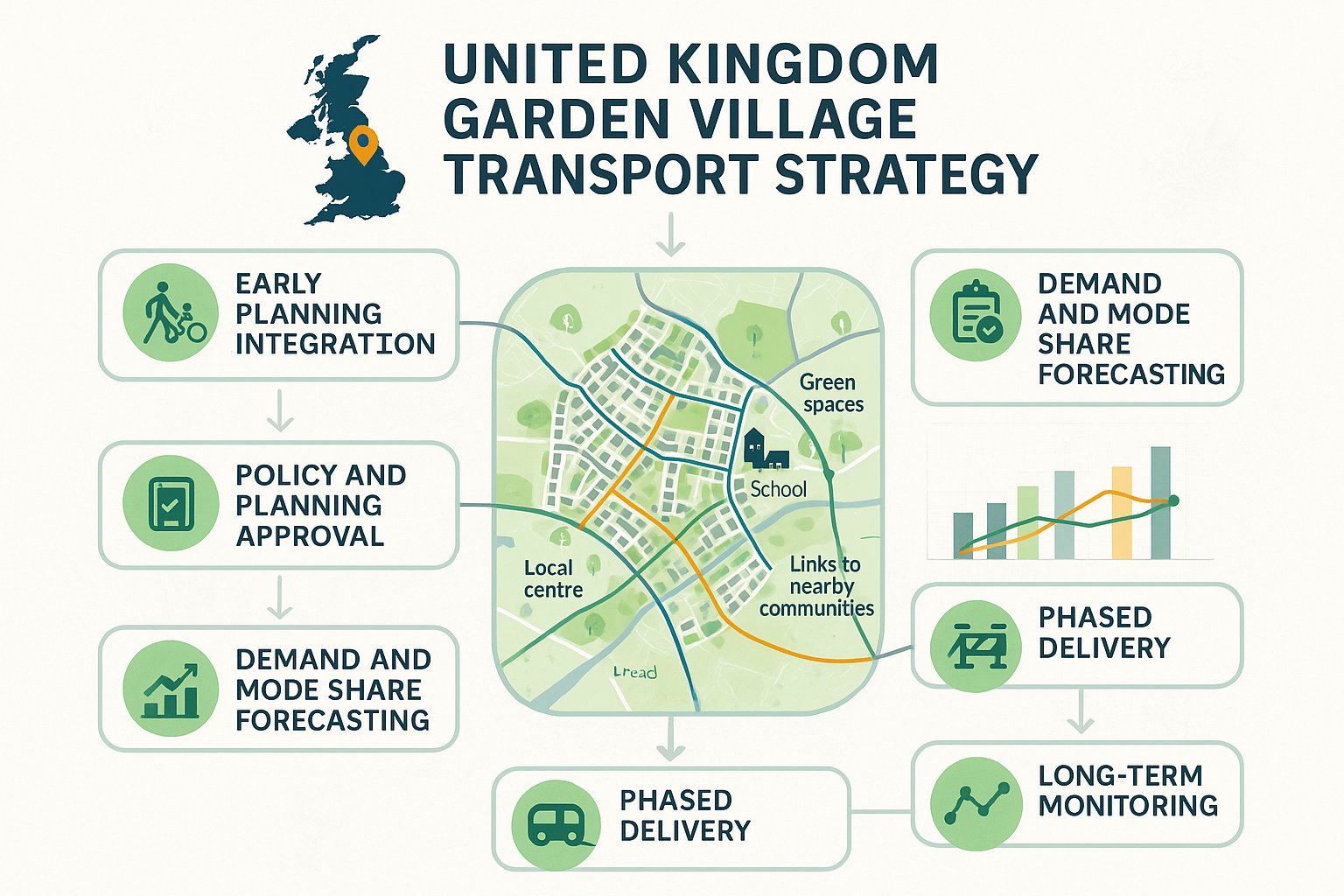
A garden village transport strategy can’t be treated as a late-stage appendix once the masterplan is mostly fixed. By that point, the hard choices have already been made: where homes sit, how streets connect, whether walking routes feel direct, whether buses can work from day one, and whether local authorities will believe the promised mode shift is realistic rather than decorative.
For architects, planners, lawyers, surveyors, developers and councils, that matters because transport is often where otherwise strong schemes start to wobble. Not always because the site is fundamentally wrong, but because the evidence base is thin, the access logic is inconsistent, or the phasing story doesn’t match how people will actually travel in the first five years.
In practice, a transport strategy for a new settlement has to do several jobs at once. It needs to support planning approval, demonstrate safe and efficient movement, enable low-carbon travel, and show how the place will function over decades rather than just at first occupation. It also has to deal with the less glamorous bits: servicing, refuse, emergency access, junction performance, delivery triggers and monitoring.
That’s exactly where clear, authority-ready reporting makes a difference. At ML Traffic, we see repeatedly that concise, locally tailored transport evidence tends to move projects forward faster than bulky documents that say less. In this guide, we set out what a strong garden village transport strategy needs to cover in 2026, and how to shape one that is credible, deliverable and planning-ready.
What A Garden Village Transport Strategy Needs To Achieve
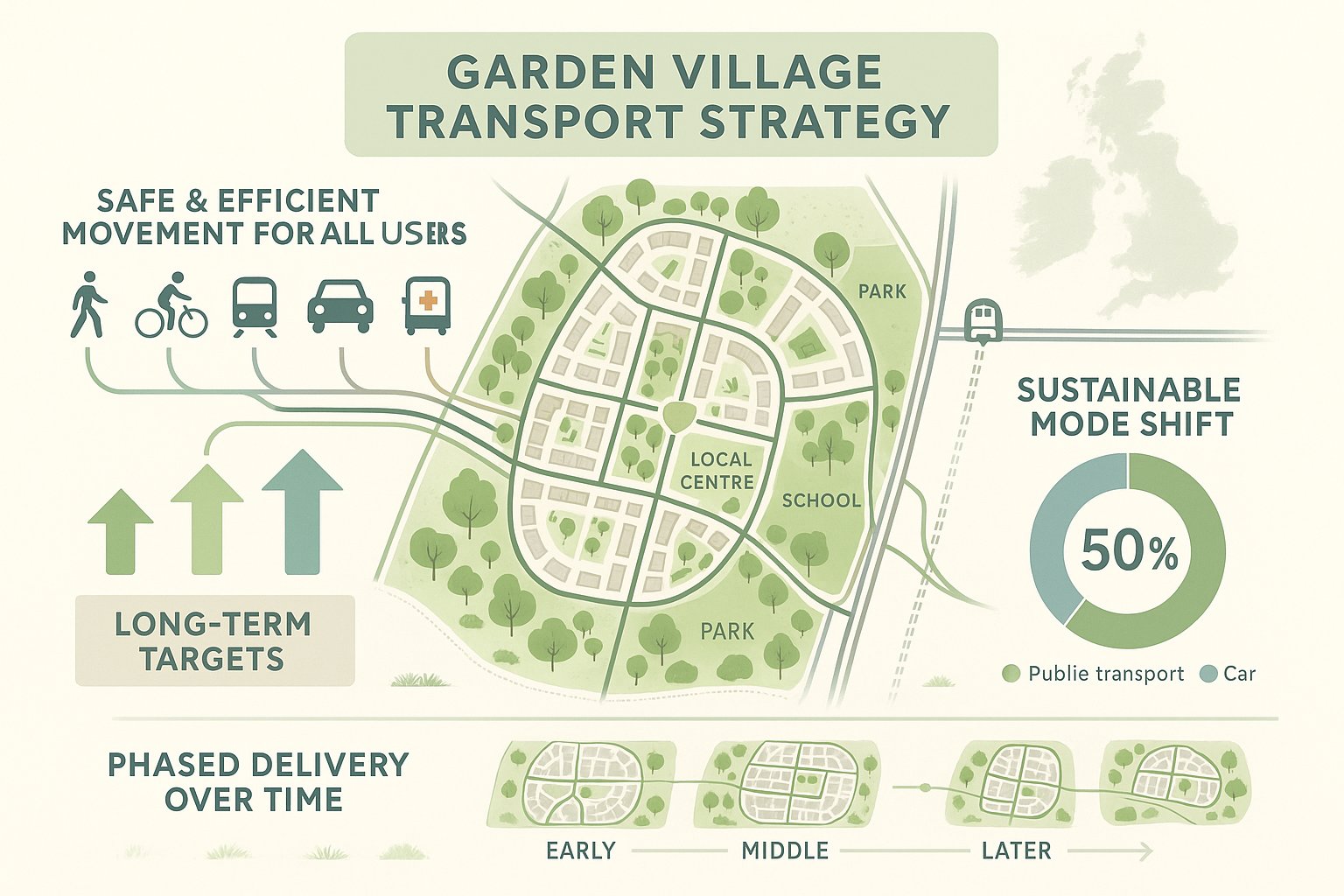
A garden village transport strategy has to be more than a technical statement about access points and traffic flows. At settlement scale, it becomes a framework for how people will live day to day: how they reach schools, local centres, rail stations, jobs, parks and neighbouring communities without being forced into the car for every trip.
At its core, the strategy should prove three things.
First, the development can function safely and efficiently for all users: walking, cycling, public transport, private vehicles, freight, servicing and emergency access. Second, it can achieve a credible shift towards sustainable travel, not just as an aspiration but through design, infrastructure and delivery commitments. Third, it can support housing and mixed-use delivery over time, including interim conditions during phased build-out.
That means setting clear objectives from the outset. Many successful garden community strategies now work around measurable targets for mode share, accessibility and network performance. Hemel Garden Communities, for instance, has framed an ambition for 60% of person trips to, from and within new neighbourhoods to be made by sustainable modes by 2050. The exact number will differ by location, but the principle is useful: targets should be bold enough to shape design, yet grounded enough to withstand scrutiny.
We should also expect the strategy to align transport with placemaking. Compact neighbourhoods, direct active travel routes, and everyday destinations within easy reach aren’t nice extras: they’re the mechanics of reducing car dependence. If the layout, density and land use pattern don’t support short local trips, no amount of travel planning language will rescue it later.
How Transport Strategy Supports The Planning Application Process
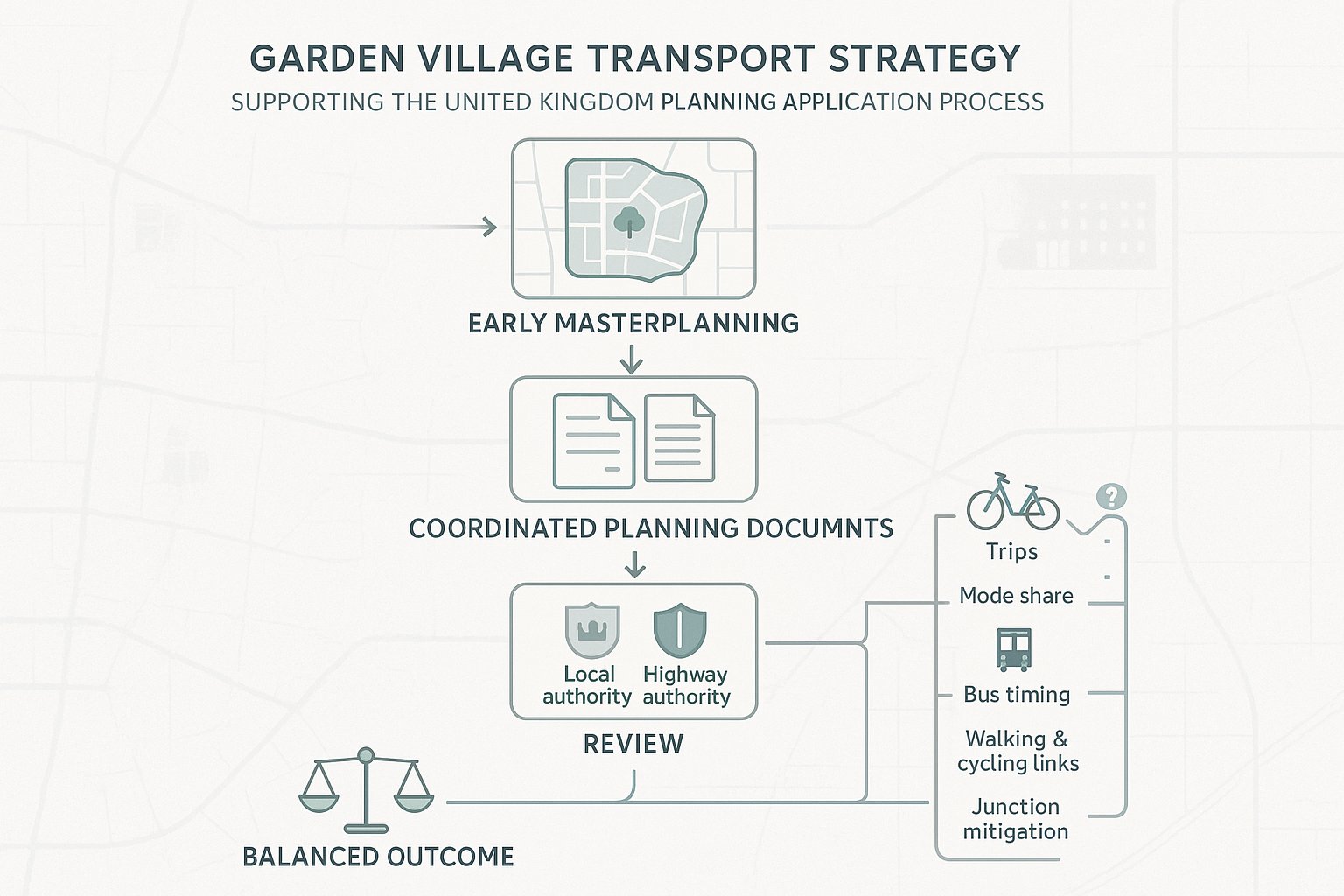
In planning terms, the transport strategy is one of the key documents that translates masterplanning intent into a defensible case for development. It helps explain why the site is suitable, how access will work, what mitigation is required, and whether the likely impacts are acceptable in policy and highway terms.
For outline applications especially, this role is critical. The strategy often underpins the Transport Assessment, Travel Plan, parameter plans and access drawings. It gives local planning authorities and highway authorities a joined-up narrative: not just what is proposed, but how movement will be managed from first occupation through to full build-out.
A good strategy reduces planning risk because it tackles the questions consultees will ask anyway. Are the trip forecasts reasonable? Is the mode share assumption realistic? Can buses operate early enough to influence travel behaviour? Are walking and cycling links direct beyond the red line boundary? Which junctions need mitigation, and when? What happens if later phases come forward before strategic infrastructure is complete?
This is where precision matters. Vague wording about “encouraging sustainable travel” rarely helps if the access strategy, trigger points or modelling assumptions are unclear. Local authorities want a robust, flexible and deliverable framework, not a hopeful sketch.
We’ve found that planning teams benefit most when the transport strategy is written in plain English but backed by technical discipline. That usually means tailoring evidence to local authority thresholds, relevant allocations policy, and known network concerns rather than submitting a generic national template. In effect, the strategy becomes the transport justification for the scheme, and often the difference between a smooth determination and a long round of avoidable objections.
Policy Context For Garden Villages And Sustainable Movement
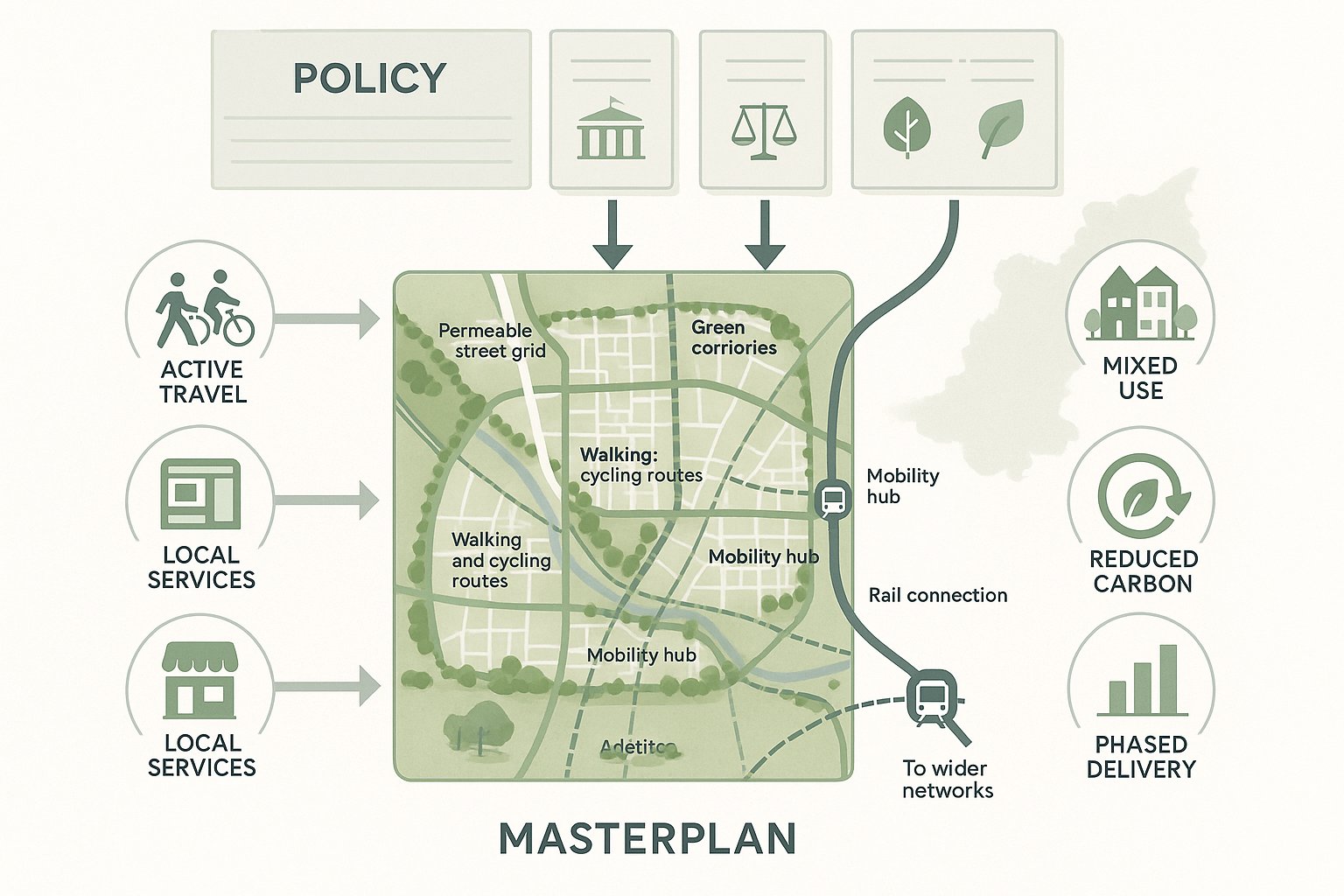
The policy backdrop for a garden village transport strategy is broader than standard development management policy. New settlements are expected to embody long-term planning principles: self-sufficiency where feasible, strong connections to wider networks, healthier travel choices, and reduced carbon intensity.
At national level, the direction of travel is clear. The planning system continues to emphasise sustainable transport, safe access, and patterns of development that prioritise walking, cycling and public transport. Garden village and garden community concepts also draw on established Garden City principles: mixed uses, green infrastructure, local services, and communities designed around everyday life rather than traffic dominance.
That policy context matters because it changes the test. For a conventional edge-of-settlement site, a highway authority may focus primarily on whether severe residual cumulative impacts can be avoided. For a garden village, the question is usually wider: does the transport approach actively support a different kind of place?
So the strategy should show alignment with local plan policy, strategic allocation requirements, county transport policy, LCWIP priorities where relevant, bus service ambitions, and any corridor studies or growth plans affecting the area. If nearby rail improvements, mobility hubs or strategic cycle links are in play, they need to be reflected.
And there’s a practical point here. Policy compliance isn’t just something we write into the executive summary. It should shape the network design itself: route permeability, frontage-led streets, active travel priority, public transport penetration, and phased delivery of key links. In other words, policy should be visible on the plan, not just quoted in the report.
Understanding Trip Generation, Travel Demand And Mode Share
Forecasting demand is one of the most scrutinised parts of any garden village transport strategy because it affects almost everything else: junction modelling, access design, public transport viability, Travel Plan commitments, environmental effects and phasing triggers.
The aim isn’t simply to produce the biggest or smallest traffic number. It’s to understand how many trips the settlement is likely to generate, when they occur, where they go, how those patterns change over time, and how policy-led intervention can alter travel behaviour.
Traditional database comparisons still have a role, but they’re only a starting point. Garden villages are not standard suburban estates, so trip generation assumptions need to reflect land-use mix, internal trip capture, local centre provision, school locations, active travel infrastructure and public transport quality. If we rely too heavily on blunt proxy sites, we can end up with forecasts that are technically neat but behaviourally weak.
Mode share is equally important. A target for walking, cycling and public transport should be set early and then tested against design reality. Can residents reach shops, primary schools and open space comfortably on foot? Are cycle routes direct enough to compete with driving? Will bus services be frequent, legible and early enough in the phasing programme to shape habits? If the answer is no, the target is just a slogan.
The strongest strategies connect trip generation and mode share to actual place design. That’s when the forecasting stops being a spreadsheet exercise and starts becoming a delivery tool.
Building A Robust Evidence Base
A robust evidence base usually combines several strands rather than relying on one model or one survey snapshot. We typically need baseline traffic data, collision review, junction assessments, accessibility analysis, public transport review, committed development information, and an understanding of wider strategic growth.
For larger schemes, multi-modal modelling or area-wide assignment may be needed alongside local junction modelling. Accessibility mapping can be particularly useful because it shows whether key destinations are genuinely reachable by non-car modes within realistic travel times. That evidence often proves more persuasive than broad statements about “encouraging” walking and cycling.
There’s also value in testing assumptions transparently. Sensitivity tests around car ownership, internalisation, school travel, and bus uptake can help demonstrate that the strategy is resilient rather than over-optimised.
Accounting For Phasing And Future Growth
Phasing is where many transport strategies become vulnerable. A garden village might work well on paper at full build-out, with a complete bus network, local centre, schools and off-site links in place. But what about the first 300 homes? Or the stage before the southern link road opens? Or the period when one school is occupied but another hasn’t been delivered yet?
The strategy should address interim conditions honestly. That means checking whether early access arrangements are safe, whether temporary routing is acceptable, whether early junction improvements are sufficient, and whether sustainable modes are available from the outset rather than postponed indefinitely.
Future growth also needs to be factored in beyond the site boundary. Local highway authorities will expect cumulative assessment of committed development and, where relevant, planned allocations. If the settlement depends on strategic upgrades delivered by others, the strategy must be clear about dependencies, risks and fallback positions.
Designing A Connected Movement Network
A garden village succeeds when movement feels intuitive. People should be able to walk to the local centre without taking a convoluted route, cycle to a school without negotiating hostile junctions, and catch a bus from a stop that’s actually part of daily life rather than hidden at the edge of a distributor road.
That requires a connected movement network, not a car network with a few shared paths attached. Permeability is the key word here. The layout should offer a fine-grained pattern of streets and routes, allowing direct movement between neighbourhoods, services, open spaces and surrounding communities. Dead ends, severance points and circuitous links undermine sustainable mode share very quickly.
For strategic sites, we should think in layers. There’s the internal street network, the active travel spine, links to nearby settlements and services, public transport corridors, and the vehicular access structure. Each has a different function, but they need to work together rather than compete.
The best transport strategies describe not just physical infrastructure, but movement priority. Which routes are primarily for pedestrians and cyclists? Where are buses given clear, legible paths? How are lower-speed streets designed to support social and civic life? Where is through-traffic discouraged? These are planning questions as much as engineering ones.
And importantly, the connected network must extend beyond the site boundary. A beautifully permeable internal layout is not enough if it feeds into disconnected footways, missing cycle links or inaccessible bus corridors once residents leave the development.
Walking, Cycling And Public Transport Priorities
If walking, cycling and public transport are supposed to be the natural choice, the strategy needs to show exactly why that would happen. Usually that comes down to directness, comfort, safety and visibility.
Walking routes should connect homes to schools, local centres, play areas, green spaces and bus stops with minimal detour. Cycling infrastructure should be coherent, not intermittent, ideally linking internal routes to existing or planned wider networks. Public transport should be easy to understand, physically integrated into the layout, and attractive enough to compete with car use for key destinations.
Traffic-free or low-traffic routes can be particularly effective where they shorten journeys compared with driving. That’s the sort of design move that changes behaviour because it gives sustainable modes a real advantage.
Bus planning deserves special attention in garden villages. Stops need to be within convenient walking distance, routes should avoid awkward deviations, and the service pattern should be deliverable from an early phase. If public transport is deferred until the population “matures”, residents often establish car-based habits that are difficult to reverse.
Vehicular Access, Street Hierarchy And Network Capacity
Prioritising sustainable movement does not remove the need for a credible vehicular strategy. A garden village still has to accommodate cars, visitors, servicing vehicles, school traffic, construction movement and emergency access in a way that is safe and proportionate.
That starts with street hierarchy. Primary routes, secondary streets, local streets and lanes should each have a clear role, speed environment and design character. The hierarchy should help manage movement rather than simply maximise traffic throughput.
Site access arrangements need to be robust, but not over-engineered to the point where they encourage car dominance. Capacity testing should focus on whether the network can operate acceptably with proposed mitigation, while recognising that lower traffic generation is part of the strategic aim. In other words, we shouldn’t design away the ambition by defaulting to highway forms that signal “drive first” everywhere.
The balance is subtle. We need enough vehicular capacity and resilience to satisfy operational and safety requirements, but not a layout that weakens walkability, bus legibility or place quality.
Managing Traffic Impact And Junction Performance
Traffic impact assessment for a garden village is rarely just about one roundabout or one priority junction. It’s usually a network question: how the settlement interacts with surrounding villages, town centres, strategic roads, schools and commuting patterns across different phases and forecast years.
A sound garden village transport strategy should identify the critical locations, define the assessment years clearly, and explain the modelling approach in a way decision-makers can follow. That includes baseline scenarios, committed development, future year growth, and the with-development case. Where mitigation is proposed, it should be tied to demonstrated need and realistic delivery timing.
Junction performance still matters, of course. Highway authorities will want evidence on capacity, delay, queuing and practical operation. But the interpretation of results is just as important as the outputs. A model may show stress at a junction in a future year: the strategic question is whether that stress is severe, whether mitigation is proportionate, and whether the transport strategy as a whole remains consistent with sustainable travel objectives.
We should also be careful not to treat all impacts as highway capacity problems. Sometimes the better response is demand management, revised bus provision, school travel intervention, or active travel links that remove shorter car trips from the network. Good transport strategy is often about solving the right problem, not just enlarging the junction.
Finally, traffic impact work should acknowledge uncertainty. Travel patterns shift, background growth forecasts change, and infrastructure timing moves around. A strategy that openly addresses those uncertainties tends to be more credible than one that pretends perfect foresight.
Integrating Freight, Servicing And Emergency Access
Freight and servicing can get surprisingly little attention in early masterplanning, yet they’re essential to whether a garden village functions properly. Homes need deliveries. Retail and community uses need servicing. Refuse vehicles need safe collection routes. Emergency services need reliable access at all times. And if these movements aren’t planned carefully, they can undermine the very walking and cycling environments the scheme is trying to create.
The transport strategy should hence set out a practical operating logic for larger vehicles. That includes swept path considerations, turning areas where necessary, loading arrangements for local centre uses, refuse collection strategy, and how servicing activity interacts with pedestrian-priority spaces.
Emergency access is not simply a standards check. For phased developments, we need to know that each parcel can be reached safely during interim stages, including where primary connections are incomplete or temporary routes are in place. Redundancy can also matter on larger sites: a single point of failure may be operationally risky.
For freight, proportionality is important. A garden village is not an industrial estate, but it still depends on a steady pattern of vans, maintenance vehicles and occasional larger goods vehicles. The objective is to accommodate them without allowing service movement to define the character of the place.
That usually means designing streets and service arrangements with enough operational realism to work on a wet Tuesday morning in February, not just on a glossy parameter plan. If the strategy can reconcile servicing needs with sustainable movement priority, it is doing something valuable.
Phasing, Delivery And Long-Term Monitoring
A transport strategy only becomes meaningful when it is tied to delivery. For garden villages, that means being explicit about what infrastructure arrives when, what triggers apply, who is responsible, and how performance will be reviewed over time.
Phasing schedules should cover both on-site and off-site works: access junctions, bus service introduction, active travel links, schools-related measures, crossing facilities, strategic road mitigation and public realm changes. The sequence matters because early travel behaviour tends to stick. If residents move in before safe walking routes or credible bus services are available, the strategy may struggle to recover its intended mode share later.
Delivery planning should also distinguish between essential infrastructure and enhancements that can follow later phases. That helps local authorities, land promoters and developers understand what is critical to make each stage acceptable.
Monitoring is equally important. Travel surveys, traffic counts, bus patronage review, cycle usage data and junction performance checks can all inform whether the strategy is working as expected. If mode share falls short or traffic impacts are higher than forecast, the strategy should allow for adaptive measures, additional Travel Plan actions, bus service support, parking management, improved crossings, or further network intervention.
This is where a garden village transport strategy becomes more than a planning submission document. It turns into a living framework for long-term settlement management. And frankly, that is often what gives decision-makers confidence: not the promise that forecasts will be perfect, but the evidence that the scheme can respond intelligently if reality turns out differently.
Conclusion
A strong garden village transport strategy is not just about proving that cars can enter and exit the site. It is the movement framework for an entire settlement: one that must support planning approval, low-carbon travel, safe access, staged delivery and long-term place performance.
In 2026, the most convincing strategies do a few things well. They set clear sustainable mode share ambitions. They connect transport evidence to actual masterplanning decisions. They deal honestly with phasing, cumulative growth and operational detail. And they show that walking, cycling and public transport are built into the scheme from the start, not added later as mitigation language.
For project teams, that means transport should be embedded early and coordinated closely with design, planning and delivery strategy. When it is, the transport document stops being a hurdle and starts becoming an asset.
That’s very much the approach we value at ML Traffic: concise, accurate reporting shaped around local authority expectations and real planning outcomes. Because for a garden village, movement is not a side issue. It is one of the main reasons the place will succeed, or struggle, for decades.
Garden Village Transport Strategy FAQs
What are the main goals of a garden village transport strategy?
A garden village transport strategy aims to ensure safe and efficient movement for all users, achieve a credible shift to sustainable travel modes like walking, cycling and public transport, and support phased housing delivery while integrating transport and placemaking.
How does a transport strategy support the garden village planning application?
It provides a robust evidence base explaining site suitability, access arrangements, mitigation needs, and impact assessments, helping local authorities understand and approve the development through a clear, deliverable framework aligned with policies and local concerns.
Why is setting a sustainable mode share target important in garden village transport planning?
Setting a measurable sustainable mode share target, such as 60% of trips by non-car modes, guides design and delivery decisions, ensures realistic goals for reducing car dependence, and strengthens the strategy’s credibility and alignment with policy objectives.
How should a garden village transport strategy address phasing and future growth?
It must consider interim transport conditions during early development phases, ensuring safe access and sustainable travel options are available from the start, and plan for cumulative impacts and dependencies on wider strategic infrastructure as the settlement expands.
What role does walking, cycling and public transport play in a garden village transport strategy?
These sustainable modes are prioritised through direct, safe, and comfortable routes, integrated transit services, and traffic-free connections, making them the natural choice for everyday trips and reducing reliance on cars.
How are freight, servicing and emergency access managed in a garden village transport strategy?
The strategy ensures practical arrangements for deliveries, refuse collection, servicing, and emergency vehicles that maintain safe access while not compromising pedestrian and cycling environments, balancing operational needs with sustainable movement priorities.