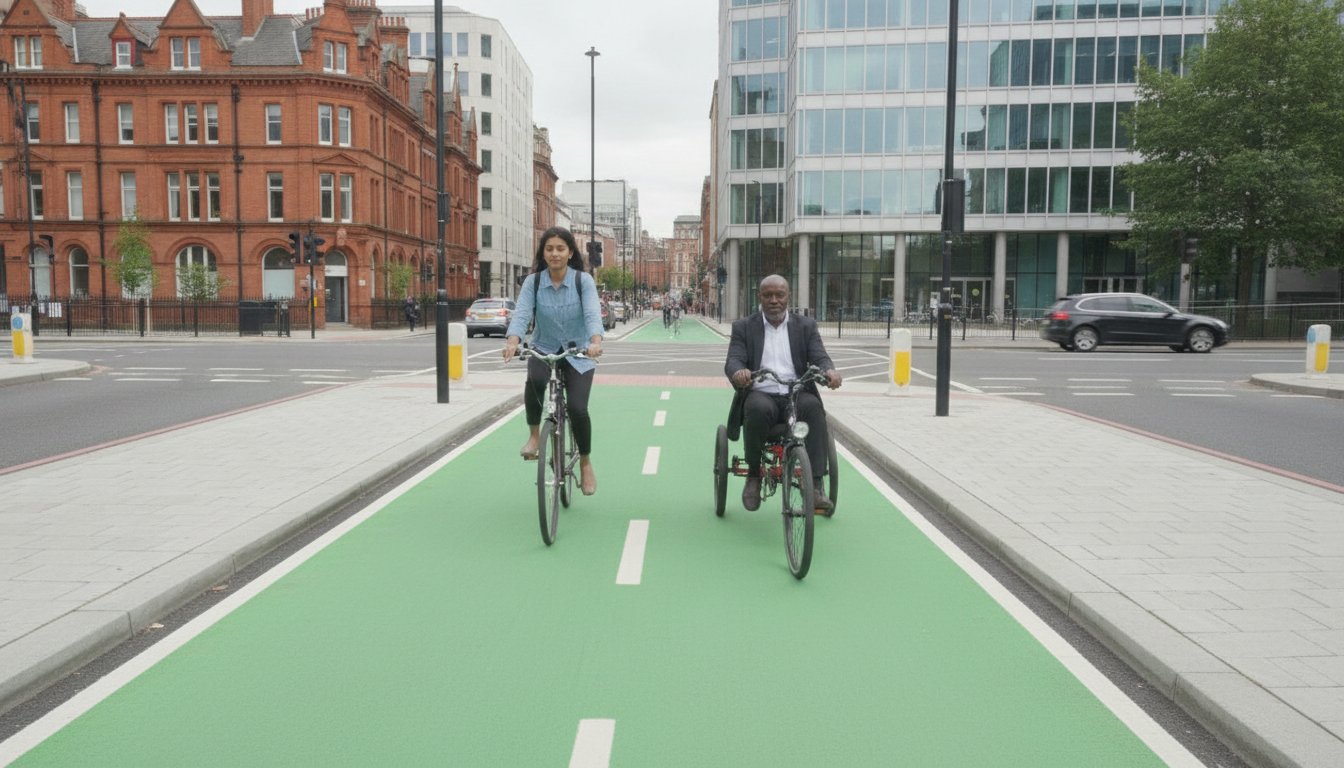
Could a single non-compliant cycle junction derail your development’s planning approval? Since Active Travel England began enforcing strict adherence to national standards, the margin for error has disappeared. You likely recognize the difficulty of balancing rigid parking requirements with the technical demands of cycle track widths on constrained sites. It’s often a challenge to translate the “Summary of Design Principles” into a functional layout when space is at a premium. This article explores LTN 1/20 cycle infrastructure design case studies and best practice to help you bridge that gap.
You’ll gain a clear understanding of how to apply the core principles; Coherent, Direct, Safe, Comfortable, and Attractive; to real-world scenarios. We provide actionable examples of compliant junctions and tracks that serve as robust evidence for your Transport Statement. By examining these successful applications, you’ll see how to align your project with the June 2026 Cycling and Walking Investment Strategy (CWIS3) and secure a reliable path through the regulatory process. Our goal is to ensure your infrastructure meets the highest safety standards while satisfying the logistical needs of your specific site.
Key Takeaways
- Understand how to apply the five core design principles to create coherent and direct networks that satisfy Active Travel England’s requirements.
- Learn the technical specifications for CYCLOPS junctions and all-ability segregation to ensure your infrastructure accommodates cargo bikes and adaptive cycles.
- Review LTN 1/20 cycle infrastructure design case studies and best practice from urban retrofits and new residential developments to see proven solutions in action.
- Discover strategies for overcoming common planning objections, such as parking loss and heritage site constraints, to maintain project momentum.
- See how professional technical reporting and comprehensive Transport Assessments provide the evidence base needed for successful Section 278 agreements.
The 5 Core Principles of LTN 1/20 Cycle Infrastructure
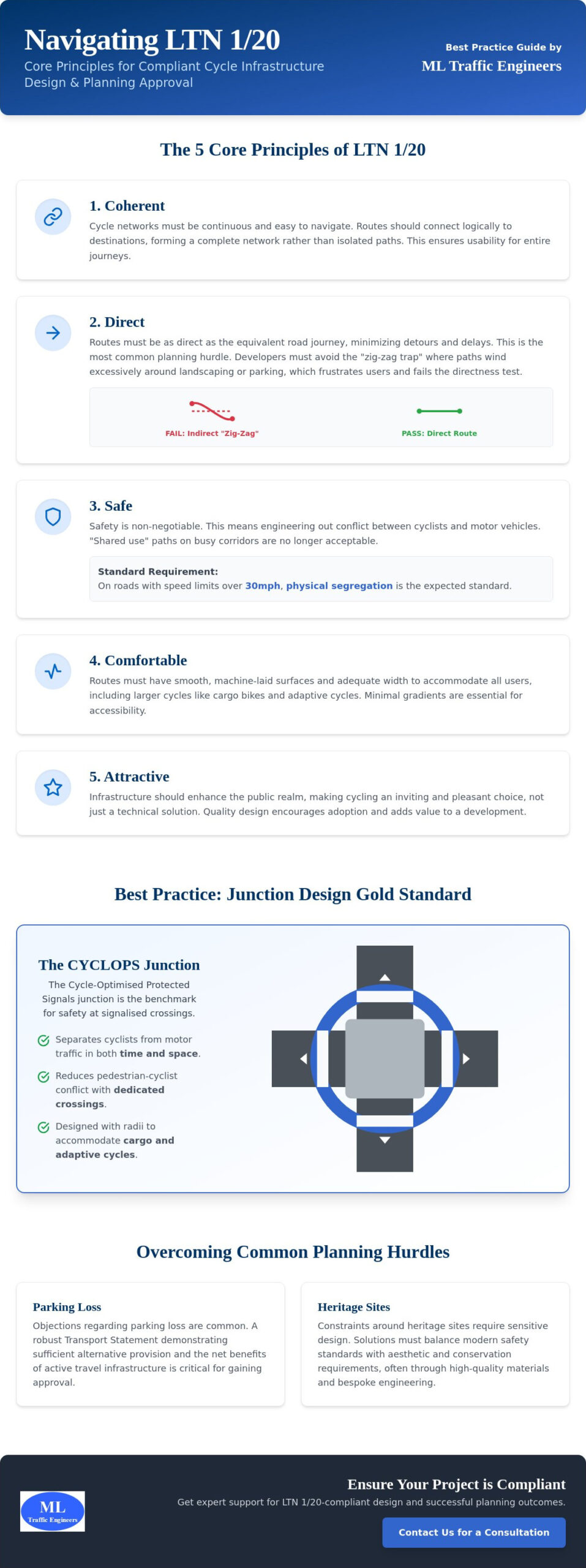
Local Transport Note 1/20 (LTN 1/20) represents a fundamental shift in how the UK approaches active travel. It moves away from the era of “painting lines on roads” toward high-quality, inclusive engineering. To achieve planning success, developers must prove their schemes satisfy five core principles: coherence, directness, safety, comfort, and attractiveness. These are not merely aesthetic goals. They are the technical benchmarks used by highway authorities to measure the viability of a development. By studying LTN 1/20 cycle infrastructure design case studies and best practice, it becomes clear that these principles must be integrated from the initial site layout stage.
To better understand how these design tiers interact in real-world environments, watch this helpful video analysis:
Why “Directness” is the most common planning hurdle
Directness remains the most frequent point of friction in planning applications. If a cycle route adds significant distance or time compared to the equivalent road journey, it fails the directness test. This often leads to “cyclist frustration,” where users ignore designated paths in favour of faster, less safe road routes. In residential masterplans, designers often fall into the “zig-zag” trap. This happens when paths wind around landscaping or parking bays to save space. While visually pleasing, these routes fail to provide the utility required for modern networks. Developers must balance site topography with the requirement for minimal gradients to ensure the route remains accessible for all users.
The “Safety” principle and the hierarchy of users
Safety is the non-negotiable foundation of LTN 1/20. The guidance has effectively ended the use of “shared use” paths on busy urban corridors, as they create conflict between pedestrians and cyclists. On any road with speed limits exceeding 30mph, physical segregation is now the expected standard. Adhering to Cycle track design standards ensures that conflict between motorised traffic and vulnerable users is engineered out of the scheme. When we prepare Transport Assessments, we use these safety metrics to justify design choices. This protects the developer’s liability while ensuring the project meets Active Travel England’s 2026 oversight requirements. Safety audits should happen concurrently with design to avoid costly late-stage revisions.
Comfort and attractiveness complete the framework. A comfortable route provides smooth, machine-laid surfaces and adequate widths for all cycle types, including cargo bikes. An attractive route enhances the public realm, making the choice to cycle feel inviting rather than a technical necessity. When all five principles align, the resulting infrastructure becomes a powerful asset for securing planning approval.
Best Practice in Junction Design and Segregation
The technical success of any active travel scheme depends on how it manages conflict at intersections. While core principles establish the intent, the actual implementation of LTN 1/20 cycle infrastructure design case studies and best practice relies on robust junction engineering. Moving cyclists safely through complex environments requires more than just paint. It requires physical separation and signal timing that prioritizes vulnerable road users. Precise design at this stage prevents the “critical fails” that often lead to planning delays or funding withdrawal.
The CYCLOPS Junction: A 2026 Best Practice Standard
The CYCLOPS (Cycle-Optimised Protected Signals) junction has emerged as the gold standard for signalised crossings. By encircling the junction with a protected cycle track, it separates cyclists from turning motorised vehicles in both time and space. This design significantly reduces pedestrian-cyclist conflict by providing dedicated crossing phases. When designing these junctions, engineers must account for all-ability cycling. This means ensuring minimum radii that allow cargo bikes and adaptive cycles to navigate turns without overshooting the track. Referencing the official LTN 1/20 guidance is essential to ensure these geometric requirements are met during the planning phase.
Segregation Techniques: Kerbs, Wands, and Verges
Choosing the right segregation method is a balance between budget, site constraints, and safety requirements. Light segregation, such as wand-protected lanes, offers a rapid response solution for urban retrofits. However, permanent kerb segregation or landscaped verges provide superior protection and lower long-term maintenance costs. Designers must also calculate adequate buffer zones. A minimum 0.5 metre strip is often necessary to protect cyclists from the dooring zone of parked cars. If you’re unsure which method fits your site, our Autoturn swept path analysis can help determine the most cost-effective, compliant approach.
Swept Path Analysis for Cycle-Optimised Junctions
A common reason for planning refusal is the failure to prove that large vehicles can still operate within a redesigned junction. You must verify that refuse vehicles and emergency services can complete turns without encroaching on protected cycle tracks. Using professional swept path analysis services allows you to prove design feasibility to the highway authority. This technical evidence prevents the creation of pinch points that compromise both cycle safety and essential vehicle access. Precise simulation ensures that the infrastructure remains functional for all users throughout the project lifecycle.
LTN 1/20 Case Studies: Lessons from Successful Schemes
Examining real-world applications provides the most reliable evidence for your own planning application. LTN 1/20 cycle infrastructure design case studies and best practice show that even the most constrained sites can achieve compliance with a precise engineering approach. These successes aren’t just about meeting a checklist. They represent a shift toward creating functional, high-capacity networks that local authorities and Active Travel England will approve without delay.
Case Study: The Waltham Forest Mini-Holland Success
Waltham Forest transformed high-traffic corridors by prioritizing cycle safety through modal filters. These filters prevent through-traffic on residential streets while maintaining full access for cyclists and pedestrians. By applying official LTN 1/20 guidance, the borough redesigned complex urban junctions to include protected signals. The technical compliance of these schemes proved that high-quality infrastructure directly increases cycling uptake. It also demonstrates that a clear technical strategy can overcome local resistance during the planning phase. Success here relied on balancing technical authority with a focus on public safety.
Case Study: Sustainable Urban Extensions (SUEs)
Large-scale greenfield developments offer a unique opportunity to integrate cycle ‘superhighways’ from the inception of the masterplan. These routes must ensure seamless connectivity to existing local cycle networks to be effective. Active Travel England now audits all developments over 50 dwellings for LTN 1/20 compliance. This means developers must provide high-quality, segregated tracks that meet exact width and surface standards early in the process. Integrating these requirements into your Transport Assessments ensures your project avoids late-stage design changes. These changes are often costly and can significantly impact the overall site layout if not addressed during the initial assessment.
Managing industrial site access requires careful coordination between HGV movements and cycle provision. Successful schemes use physical separation to ensure that heavy vehicle swept paths don’t encroach on cycle tracks. This level of precision is also visible when local authorities convert failed ‘shared use’ paths into LTN 1/20 compliant routes. By separating pedestrians and cyclists, these retrofits reduce conflict and improve the user experience for everyone. These LTN 1/20 cycle infrastructure design case studies and best practice serve as a blueprint for developers who need to secure planning approval in a pro-active travel regulatory environment.
Overcoming Common Planning Hurdles with LTN 1/20
Planning departments and Active Travel England (ATE) now treat LTN 1/20 as a pass/fail requirement. Failure to align your site layout with these standards often results in immediate objections that can stall a project for months. However, LTN 1/20 cycle infrastructure design case studies and best practice demonstrate that technical compliance can actually resolve traditional planning conflicts. By using data-driven design, you can navigate regulatory pressure while maintaining the commercial viability of your development. Precision in the early stages is the only way to avoid costly redesigns later in the process.
The Parking vs. Cycling Conflict
The removal of on-street parking to accommodate cycle tracks is frequently the most contentious part of a planning application. You can address these objections by conducting professional Parking Surveys to prove that existing capacity can absorb the proposed changes. Designing ‘floating’ parking bays provides a physical buffer for cyclists while retaining essential spaces for residents and businesses. For retail environments, mitigation strategies like dedicated loading windows or inset delivery bays ensure that cycle-priority zones don’t disrupt essential commerce. These solutions prove to the highway authority that you’ve considered the needs of all road users without compromising on safety.
Active Travel England: The New Gatekeeper
Active Travel England (ATE) now reviews any development over 50 dwellings, and their influence on the planning outcome is absolute. They typically issue “Conditional” or “Object” responses based on how well a scheme adheres to national standards. An “Object” response from ATE is a significant barrier to progress. Pre-application engagement is the most effective way to avoid these delays. During this phase, using the ‘Cycle Level of Service’ (CLoS) tool helps quantify how well your design performs against national benchmarks. Providing this level of technical detail within your Transport Statement creates a robust defense for your scheme and signals your commitment to high-quality infrastructure.
Heritage sites present a unique challenge where strict adherence to track widths might be physically impossible due to historic building lines. In these cases, you must provide a technical justification for any deviations from the standard. This involves demonstrating that the proposed alternative still meets the core safety and comfort objectives of the guidance. Expert reporting ensures that these compromises are framed as “best practice” within the specific constraints of the site. If you are facing complex site constraints, our team can provide the technical evidence needed to secure approval. Request a technical review for your cycle infrastructure design today to ensure your project remains on schedule and fully compliant.
Expert Support for Compliant Cycle Infrastructure Design
ML Traffic Engineers UK specializes in navigating the complex regulatory landscape of modern active travel. We integrate LTN 1/20 cycle infrastructure design case studies and best practice into every Transport Assessment we produce. This ensures that your development isn’t just compliant on paper, but ready for the technical rigours of a Section 278 agreement. Professional technical reporting is essential at this stage to prevent the highway authority from rejecting your design due to minor geometric oversights. By managing the full project lifecycle from initial assessment to final execution, we provide a reliable bridge between your architectural vision and the highway authority’s requirements.
Integrating Cycling into the Wider Transport Strategy
High-quality cycle provision is the cornerstone of effective Travel Plans and sustainable mode shift targets. By linking your infrastructure design directly to these targets, you provide the robust evidence needed to justify reduced car parking or increased development density. We ensure total consistency between your highway design for S278 works and the strict requirements of LTN 1/20. To guarantee operational success, ML Traffic Engineers UK utilizes AutoTurn software to perform precise cycle track swept path analysis, ensuring that even large cargo bikes and adaptive cycles can navigate your proposed layout safely. This technical precision reduces project risk and ensures that your infrastructure performs as intended from day one.
Securing Your Planning Approval
Navigating the specific requirements of London Boroughs and Transport for London (TfL) requires a deep understanding of regional variations in active travel policy. Professional representation is vital during negotiations with highway authorities to defend your design against unnecessary revisions that could compromise your site layout. We reduce your project risk by conducting early-stage design feasibility studies, identifying potential “critical fails” before you submit your application. This proactive approach saves months of potential delays and protects your project’s budget from late-stage engineering changes. Our team understands the intricate regional regulations so that you don’t have to, positioning your development for a successful outcome in a high-stakes regulatory environment.
A dependable, highly organized expert is your best asset when dealing with Active Travel England’s review process. We provide the technical authority needed to move straight to the core value proposition of your development. Get a quote for your Transport Statement or Design Review today to ensure your development meets the highest standards of safety and compliance. Our unwavering reliability ensures that your project remains on track and fully aligned with the latest industry benchmarks.
Secure Planning Approval Through Technical Precision
Adhering to national standards is no longer just a recommendation; it’s a fundamental requirement for modern development. By applying LTN 1/20 cycle infrastructure design case studies and best practice, you transform potential planning objections into robust technical justifications. You’ve seen how precise junction engineering and data-driven parking surveys can overcome the most rigid site constraints. These strategies ensure your project satisfies Active Travel England while maintaining its commercial viability. Early integration of these principles into your initial site layout prevents costly redesigns and keeps your delivery schedule on track.
ML Traffic Engineers provides the specialized expertise needed to navigate this high-stakes regulatory environment. We are specialists in Swept Path Analysis and Transport Statements with a proven track record of meeting Active Travel England requirements across the UK. Our team manages the full project lifecycle to ensure your infrastructure is safe, compliant, and ready for execution. Don’t let technical delays stall your progress. Ensure your development is LTN 1/20 compliant with ML Traffic Engineers and move forward with confidence in your scheme’s success.
Frequently Asked Questions
Is LTN 1/20 mandatory for all new developments in the UK?
LTN 1/20 is technically national guidance, but it acts as a mandatory standard for any development seeking planning approval. Local highways authorities and Active Travel England use it as the primary yardstick for evaluating active travel provision. Schemes that fail to meet these design standards often face significant delays or outright rejection. Adhering to these benchmarks is a non-negotiable foundation for securing regulatory consent in the current planning environment.
What is the minimum width for a segregated cycle track under LTN 1/20?
The desirable minimum width for a one-way segregated cycle track is 2.0 metres, while two-way tracks should ideally be 3.0 metres wide. These dimensions ensure that the infrastructure is inclusive and accommodates all cycle types, including cargo bikes and adaptive cycles. While absolute minimums of 1.5 metres exist for specific constrained locations, designers should aim for the desirable widths to ensure long-term comfort and safety for all users.
How does LTN 1/20 differ from the old LTN 2/08 guidance?
LTN 1/20 represents a significant shift from LTN 2/08 by prioritizing physical segregation and high-quality junction design over shared surfaces. While the older guidance often accepted on-road paint and shared-use paths, the current standard demands dedicated space for cyclists. It also introduces five core principles; coherent, direct, safe, comfortable, and attractive; to ensure infrastructure is functional for people of all ages and abilities, regardless of their confidence level.
Can shared-use paths still be used in new designs?
Shared-use paths are generally discouraged in urban environments where pedestrian and cycle volumes are high. LTN 1/20 specifically states that these paths are often inappropriate on roads with speed limits above 30mph. Designers should prioritize segregated tracks to reduce conflict and improve safety. In rural or low-traffic settings, shared use might remain an option, but it must be technically justified within your Transport Statement to avoid planning objections.
What is a CYCLOPS junction and why is it recommended?
How does Active Travel England influence the planning process?
Active Travel England (ATE) acts as a statutory consultee for developments exceeding 50 dwellings. They audit planning applications to ensure they align with LTN 1/20 cycle infrastructure design case studies and best practice. ATE has the authority to issue “Conditional” or “Object” responses, which directly impact the likelihood of securing planning permission. Their role is to ensure that new infrastructure meets national targets for active travel uptake and safety.
Do I need a Swept Path Analysis for my cycle infrastructure design?
Swept Path Analysis is essential for verifying that large vehicles can operate within a redesigned highway layout. You must prove that refuse trucks, buses, and emergency vehicles can navigate junctions without mounting kerbs or encroaching on protected cycle tracks. This technical evidence is a critical component of any planning submission. It demonstrates that your design is safe and operationally feasible for all road users, preventing late-stage design revisions.
What are the core design principles of LTN 1/20?
The core principles are Coherent, Direct, Safe, Comfortable, and Attractive. These pillars ensure that LTN 1/20 cycle infrastructure design case studies and best practice result in networks that are easy to navigate and efficient to use. Infrastructure must feel safe and inviting to encourage a genuine shift away from motorised transport. When these five principles are integrated into a site masterplan, the resulting development meets the high standards required by modern authorities.

Disclaimer
The content on mltraffic.co.uk, including all technical articles, guides, and resources, is provided for general informational and educational purposes only. It is not intended to constitute professional advice in traffic engineering, transportation planning, development approvals, or any other technical or legal field.
While ML Traffic Engineers makes every reasonable effort to ensure the accuracy, completeness, and timeliness of the information published, we do not provide any warranties or representations (express or implied) regarding its reliability, suitability, or availability for any particular purpose. Any reliance you place on the content is strictly at your own risk.
In no event shall ML Traffic Engineers, its directors, employees, authors, or affiliates be liable for any direct, indirect, incidental, special, consequential, or punitive damages (including, without limitation, loss of profits, data, or business opportunities) arising out of or in connection with the use of, or inability to use, any information provided on this website.
The articles and guides on this site are not a substitute for engaging a qualified, professional traffic engineer to assess your specific project requirements. For tailored advice, compliance assessments, or traffic engineering services, please contact a competent professional.
This disclaimer may be updated from time to time without notice. By accessing or using this website, you agree to be bound by the most current version of this disclaimer.