
Planning decisions increasingly turn on evidence, not assumptions. If a proposed development, junction change, or wider highway scheme is likely to alter how traffic behaves on the network, a simple junction model often won’t be enough. That’s where Paramics modelling consultants come in.
We use Paramics microsimulation to show how individual vehicles move through a real network, how queues build, where delay shifts, and whether proposed mitigation genuinely works. For architects, planners, lawyers, surveyors, developers, and local authorities, that level of detail can make the difference between a smooth planning process and months of avoidable challenge.
In 2026, expectations are only getting tighter. Local authorities want modelling evidence that is properly scoped, calibrated, validated, and clearly explained. Planning teams need reports that tie technical outputs back to planning risk. And development teams need consultants who can work quickly without cutting corners.
At ML Traffic, we’ve seen the same pattern repeatedly over more than 30 years in transport planning: the right modelling approach saves time early, strengthens transport assessments, and gives decision-makers confidence. The wrong one creates delay, disagreement, and expensive rework.
This guide explains what Paramics modelling consultants actually do, when you need one, what a robust study should contain, how councils review the evidence, and what to look for before appointing a specialist.
What Paramics Modelling Consultants Do And When You Need One

A Paramics modelling consultant builds a digital representation of a road network using microsimulation software so that traffic can be tested in realistic, dynamic conditions. Unlike a high-level spreadsheet exercise, Paramics tracks individual vehicle movements across links, lanes, merge points, signals, and junctions. That means we can examine not only whether traffic increases, but how those increases affect queue formation, travel times, blocking back, lane choice, and network resilience.
In practice, this work usually starts with defining the study area and the decision that the model needs to support. Is the issue a planning application for a large development? A sensitive signalised junction? A package of highway changes? A town-centre network where impacts move from one node to another? The model has to be shaped around the real question.
You typically need Paramics modelling consultants when the transport effects are too complex for simpler methods alone. That often includes situations where:
- traffic reroutes across multiple junctions
- queue interaction between junctions matters
- signal timing changes may alter network performance
- development traffic could materially affect nearby roads
- mitigation options need to be compared visually and operationally
- local authorities request microsimulation evidence
It’s also especially useful where stakeholders need confidence. A well-prepared model can help planners, design teams, and councils see the operational picture rather than argue over theory. And that matters, because planning programmes rarely slip because everyone agrees too quickly.
How Paramics Modelling Supports Planning Applications And Transport Assessments
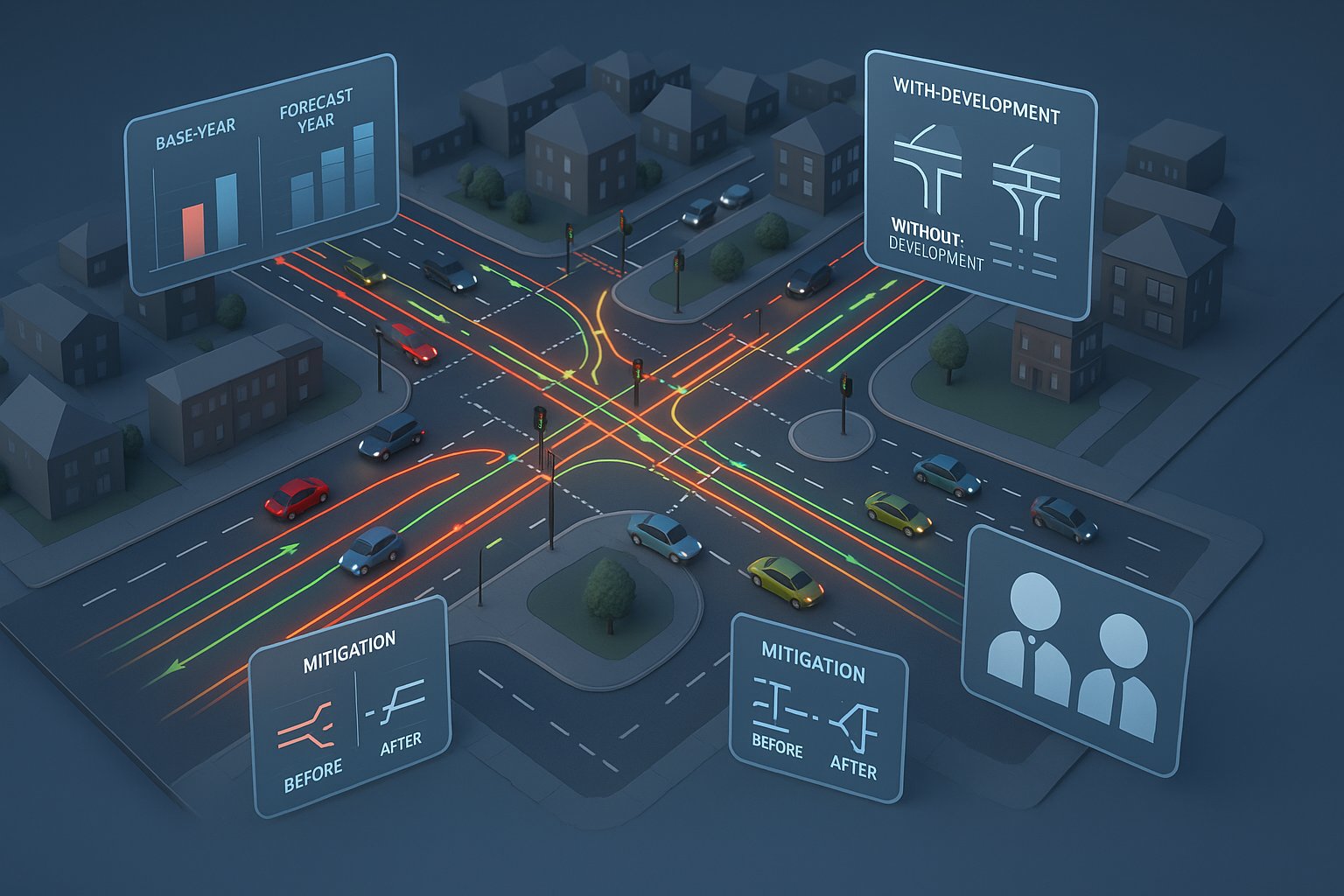
For planning applications, Paramics modelling is valuable because it turns a broad transport case into something demonstrable. A transport assessment may identify trip generation, distribution, assignment, and likely impact. But where the surrounding network is sensitive or already under pressure, decision-makers often want more than a set of summary figures. They want evidence that the proposal has been tested under realistic operating conditions.
That is exactly where Paramics helps. We can validate an existing network model against observed traffic conditions, then test future scenarios that include background growth, committed development, and the proposed scheme. From there, we can examine whether the network continues to operate acceptably, where pressure points emerge, and what mitigation may be needed.
This is particularly useful in planning contexts because the software allows us to compare:
- base year and forecast year operation
- with-development and without-development scenarios
- alternative access arrangements
- signal changes and junction redesigns
- mitigation packages before and after implementation
The visual element matters too. Videos, snapshots, and clearly presented outputs can help a planning officer, committee member, or legal team understand impacts quickly. That doesn’t replace technical rigour, but it does make the evidence more accessible.
For transport assessments, the best use of microsimulation is not flashy animation for its own sake. It is disciplined scenario testing tied to planning questions: will this development cause severe impact, is the mitigation proportionate, and does the proposed network arrangement function in practice?
Common Project Types That Require Paramics Modelling

Some schemes move through planning with straightforward transport evidence. Others need microsimulation because traffic conditions are more interconnected, politically sensitive, or operationally complex. Paramics modelling is most helpful where small changes in one place can have knock-on effects elsewhere across the network.
Broadly, we see two recurring categories. First, developments that add traffic to already constrained networks. Second, infrastructure or highway schemes where the proposed change itself reshapes how the network operates. In both cases, the value lies in understanding whole-network behaviour rather than judging one junction in isolation.
When a local authority is concerned about cumulative impact, queue interaction, lane discipline, or route choice, Paramics can provide the level of detail needed to support planning and design decisions with greater confidence.
Residential, Mixed-Use, And Commercial Developments
Large residential schemes, mixed-use masterplans, retail parks, logistics sites, offices, and urban regeneration projects are common candidates for Paramics modelling. The reason is simple: development traffic rarely affects just one access point. It disperses through the surrounding network, interacts with existing demand, and may change peak-period conditions across several junctions at once.
For residential development, morning and evening commuter peaks are often critical, but school traffic, local rat-running, and weekend movement can also become planning issues. Mixed-use schemes are even more nuanced because different land uses generate and attract trips at different times of day. Commercial schemes, particularly retail and logistics, can create sharp traffic pulses and operational conflicts that need more detailed testing.
A microsimulation model helps us answer practical planning questions, such as:
- Will queues from the site access block back to the main road?
- Do nearby roundabouts or signals still operate effectively?
- Is a ghost island right-turn lane enough, or is stronger mitigation needed?
- How does cumulative development in the area change the picture?
This matters for applicants and councils alike. Developers want a robust, defensible case. Authorities want confidence that approval will not create avoidable harm. Where transport effects are likely to be scrutinised closely, Paramics gives both sides a more reliable basis for discussion.
Junction Improvements, Highway Schemes, And Network Changes
Paramics is equally valuable for highway-led projects. Junction upgrades, signal alterations, road widening, bus priority measures, lane reallocations, one-way systems, access strategy changes, and wider urban realm schemes can all produce consequences that are hard to capture with simpler tools.
Take a seemingly modest signal change. On paper, the capacity gain at one arm may look positive. In reality, altered staging can shift delay elsewhere, affect progression between signals, or create new queue interaction at the next junction downstream. Microsimulation helps expose those effects before they become expensive on-site surprises.
For larger schemes, the benefits are broader. We can test:
- revised lane layouts
n- merge and diverge performance
- network resilience during peak periods
- interaction between closely spaced junctions
- temporary and permanent mitigation concepts
Where relevant, a Paramics model can also consider public transport operations and, depending on scope, interactions with pedestrians and cyclists. That is increasingly important in town and city schemes, where transport planning is not only about moving cars efficiently but balancing multiple users within constrained highway space.
In short, if a network change could alter traffic behaviour beyond a single node, Paramics modelling often becomes the sensible evidence base rather than an optional extra.
What A Robust Paramics Modelling Study Should Include
A robust Paramics study is not defined by how polished the animation looks. It is defined by whether the model is fit for purpose, technically defensible, and aligned with the planning or design decision being made.
That starts with scope. The study area must be wide enough to capture meaningful effects, but not so bloated that time is wasted modelling roads with no real bearing on the outcome. Inputs must be evidence-based. Assumptions must be transparent. And every scenario should map clearly back to the questions that officers, stakeholders, or decision-makers are likely to ask.
Good consultants also know that a model is only one part of the job. The analysis, interpretation, and reporting are just as important. A strong study should not dump outputs on the reader and leave them to guess the significance. It should explain what the results mean, what drives them, and how much confidence can reasonably be placed in them.
At its best, Paramics modelling provides a credible chain of evidence from existing conditions to future forecasts to tested mitigation. That chain is what helps a planning application stand up under scrutiny.
Data Collection, Calibration, And Validation Standards
This is where weak studies usually unravel. If the base model does not reflect observed conditions with enough realism, confidence in every forecast scenario drops quickly.
A proper study should begin with sound traffic data collection, typically including turning counts, queue surveys, journey times, signal information, geometry checks, and any other network-specific observations needed to reflect real operation. There is no virtue in collecting everything imaginable: the point is collecting the right information for the modelling purpose.
Calibration then adjusts model parameters so that simulated conditions align with observed behaviour. Validation checks whether the model reproduces actual network performance to an acceptable standard. Local authorities usually want to see that this process has been carried out carefully and documented clearly.
In practical terms, we expect to see:
- a defined study area and rationale
- observed traffic flows and queue data
- explanation of coding assumptions
- calibration against existing conditions
- validation using recognised criteria where appropriate
- transparent commentary on limitations
No model is a perfect clone of reality. Experienced Paramics modelling consultants do not pretend otherwise. Instead, we show that the model is credible enough for the decisions it is being used to support. That distinction matters. A fit-for-purpose model inspires confidence: an overclaimed one invites challenge.
Forecast Scenarios, Mitigation Testing, And Reporting
Once the base model is established, the real value comes from scenario testing. A robust study should normally include future-year scenarios that reflect background traffic growth, committed development, and the proposed scheme. Depending on the planning context, sensitivity tests may also be needed.
The key is relevance. There is little value in producing dozens of model runs if they do not answer the actual planning questions. We focus on a clear scenario structure: what happens without the development, what changes with it, and what the network looks like once mitigation is in place.
Mitigation testing may include revised signal timings, additional lanes, altered access layouts, physical junction changes, or wider network interventions. Good consultants do not stop at reporting that a measure improves one metric. We check whether it creates side effects elsewhere.
Reporting should then bring the evidence together in a way that planners, lawyers, and engineers can all use. That means:
- concise explanation of each scenario
- clear presentation of queues, delays, and journey times
- comparison between do-minimum and do-something cases
- visuals where they add understanding
- reasoned conclusions, not just raw output tables
A report that is technically correct but impossible to follow is only half finished. Decision-makers need evidence they can interrogate, understand, and rely on.
How Local Authorities Review Paramics Modelling Evidence
Local authorities do not usually review Paramics models by asking whether they are impressive. They ask whether they are credible, proportionate, and relevant to the planning decision in front of them.
In our experience, councils and their advisors tend to focus on a few core issues. First, is the model scoped appropriately? If the area is too small, key impacts may be missed. If assumptions are poorly justified, confidence weakens. Second, does the base model represent existing conditions with enough accuracy to support forecasts? Third, are the future scenarios aligned with the development proposal, background growth, and any committed schemes?
Authorities also look closely at whether mitigation testing is realistic. A model that relies on heroic assumptions or unexplained signal changes will attract questions. So will reporting that cherry-picks favourable outputs while ignoring less convenient ones.
Reviewers often expect to see:
- a clear technical note or modelling report
- transparent assumptions and inputs
- evidence of calibration and validation
- forecast scenarios tied to planning need
- outputs interpreted in plain language
This is why consultant choice matters. The strongest submissions anticipate likely authority concerns from the outset. On complex planning applications, that can materially reduce rounds of clarification and technical challenge. And if issues are likely, it is far better to surface them early than discover them in an objection letter three weeks before committee.
Key Qualities To Look For In Paramics Modelling Consultants
Not all transport consultants are interchangeable, and not every traffic modeller is the right fit for a planning-led commission. When appointing Paramics modelling consultants, we suggest looking beyond software familiarity alone.
First, check experience in both microsimulation and planning applications. A technically capable modeller who does not understand planning thresholds, authority expectations, or how evidence is challenged in committee or appeal may produce work that is academically fine but strategically weak.
Second, look for consultants who can scope sensibly. Overmodelling wastes budget and time. Undermodelling creates risk. The best specialists know how to define a study area and testing framework that is proportionate to the decision.
Third, ask how they communicate. You want a team that can explain results clearly to non-modellers, not just produce a technical appendix. This is especially important where lawyers, design teams, and public-sector reviewers all need to work from the same evidence base.
Other strong signals include:
- a track record with local authority engagement
- understanding of transport assessments and planning statements
- ability to test mitigation options practically
- clear reporting and visual presentation
- reliable programme management and responsiveness
At ML Traffic, our approach is shaped by more than 30 years of transport planning experience and a focus on concise, accurate reporting tailored to local authority requirements. That combination tends to matter just as much as modelling capability itself.
Common Risks, Delays, And Mistakes To Avoid
Most problems with Paramics modelling do not come from the software. They come from decisions made before and during the study.
Poor scoping is one of the biggest risks. If the network extent is too narrow, the model may miss rerouting or displaced queues. If it is too broad, the study can become slow, expensive, and harder to calibrate without adding real value. Getting scope right early is crucial.
Another frequent issue is weak calibration and validation. If existing conditions are not reproduced credibly, every future test becomes easier to attack. Planning teams sometimes underestimate how damaging that can be. One shaky base model can delay an entire application.
We also see problems when scenario design is muddled. For example, background growth may be inconsistent, committed development omitted, or mitigation introduced without enough operational detail. That creates confusion and invites authority queries.
To avoid delay, watch out for these common mistakes:
- starting modelling too late in the planning programme
- failing to agree scope with the authority where appropriate
- relying on outdated or incomplete traffic data
- presenting results without clear interpretation
- testing mitigation that cannot realistically be delivered
And one more, slightly unfashionable point: don’t appoint purely on price. Cheap modelling can become very expensive if it leads to resubmissions, redesign, or prolonged technical debate. In planning, speed comes from getting the evidence right first time, not from rushing the wrong study.
Conclusion
Paramics modelling consultants play a critical role where planning and transport decisions depend on understanding how a road network actually behaves, not how we hope it behaves. For developments, junction upgrades, and wider highway changes, robust microsimulation can strengthen transport assessments, test mitigation properly, and give local authorities confidence in the evidence.
The difference between a helpful model and a problematic one usually comes down to fundamentals: good scoping, reliable data, proper calibration and validation, relevant forecast scenarios, and reporting that decision-makers can genuinely use.
If you are preparing a planning application or transport study in 2026, the right consultant should do more than run software. They should help shape the strategy, anticipate authority concerns, and present a clear, defensible case. That is the standard we work to at ML Traffic: concise, accurate, planning-focused transport evidence delivered quickly and with the experience to stand up under scrutiny.
Paramics Modelling Consultants – Frequently Asked Questions
What do Paramics modelling consultants do?
Paramics modelling consultants build detailed microsimulation models of road networks to simulate individual vehicle movements and assess traffic flows, queue formation, and network delays for planning and transport assessments.
When is it necessary to use Paramics modelling in transport planning?
Paramics modelling is needed when transport impacts are complex, such as traffic rerouting across junctions, cumulative traffic effects from developments, signal timing changes, or when local authorities require detailed microsimulation evidence.
How does Paramics modelling support planning applications?
Paramics modelling validates current traffic conditions and tests future scenarios including development impacts and mitigation options, providing visual and technical evidence to help planners assess network performance under realistic conditions.
What should a robust Paramics modelling study include?
A robust study includes well-defined scope, thorough data collection, calibration and validation against observed traffic, clear forecast scenarios, mitigation testing, and comprehensive reporting that explains results in plain language.
What qualities should I look for when appointing Paramics modelling consultants?
Choose consultants with experience in microsimulation and planning, the ability to scope projects sensibly, clear communication skills for diverse audiences, expertise in mitigation testing, and a proven track record with local authority engagement.
What common mistakes should be avoided in Paramics modelling studies?
Avoid poor scoping, weak calibration or validation, unclear scenario design, unrealistic mitigation assumptions, late-stage modelling, and appointing based solely on low cost, as these can cause delays or challenges in planning approval.