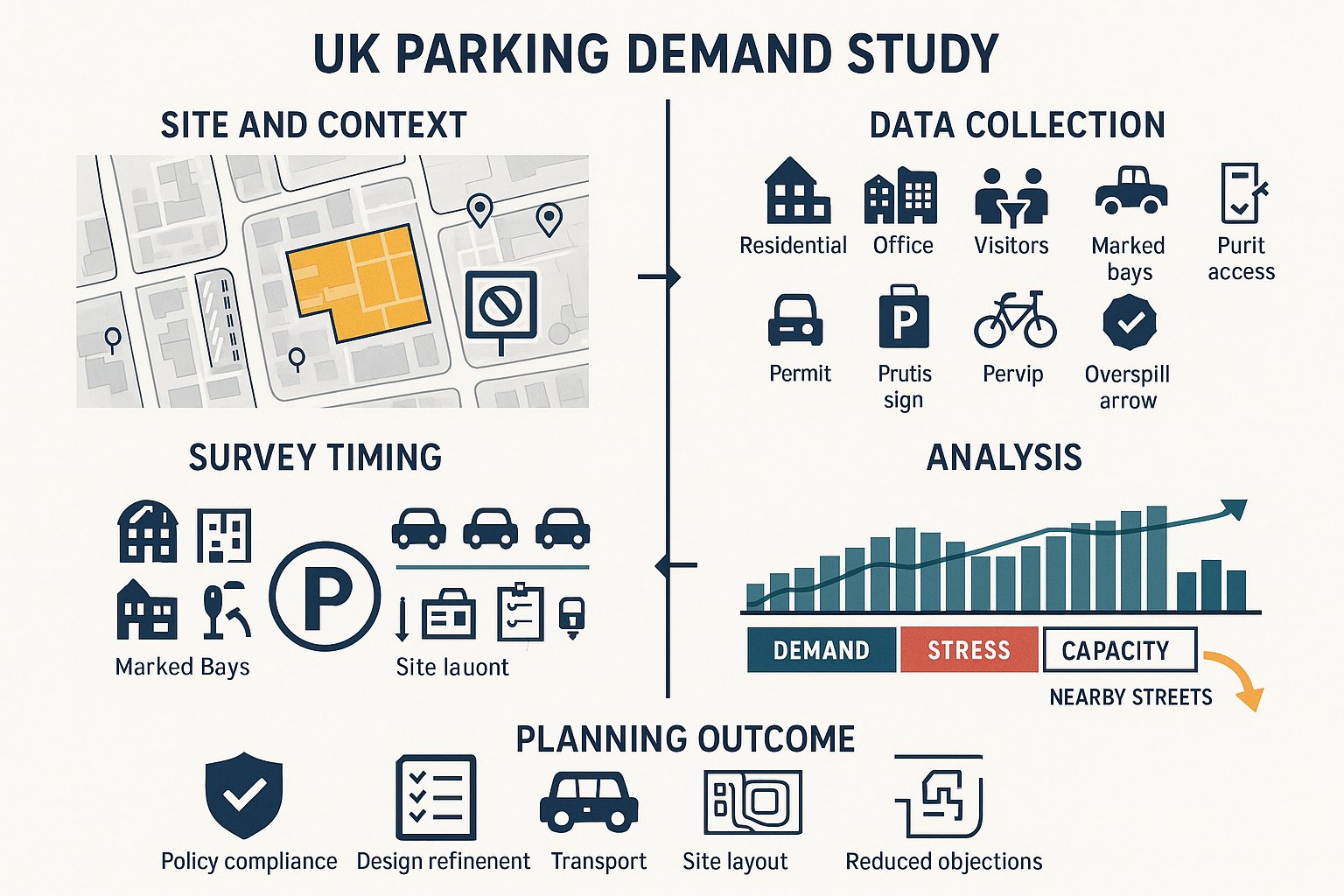
A parking demand study can look deceptively simple from the outside. Count some cars, compare the result with a standard, and move on. In practice, it rarely works like that.
For architects, planning consultants, developers, councils and project teams preparing planning applications in 2026, parking is still one of the quickest routes to delay, objection, or a costly redesign. A scheme may be well considered in design terms, policy-led in principle, and supported by highways access information, yet still run into trouble if the likely parking demand has not been evidenced properly. That is especially true for larger sites, mixed-use schemes, constrained urban plots, or developments in areas where residents already feel parking pressure.
We see this regularly in transport planning work: local planning authorities are not simply asking how many spaces can fit on a drawing. They want to know how parking will actually operate once the development is occupied. That means understanding demand, nearby supply, likely overspill, user behaviour, and whether any management measures are realistic.
In this guide, we explain what a parking demand study is, when it is needed, what data it relies on, and how it should sit within a wider planning and transport evidence base. Done properly, it strengthens the application. Done poorly, it creates questions you could have avoided.
What A Parking Demand Study Is And When It Is Required
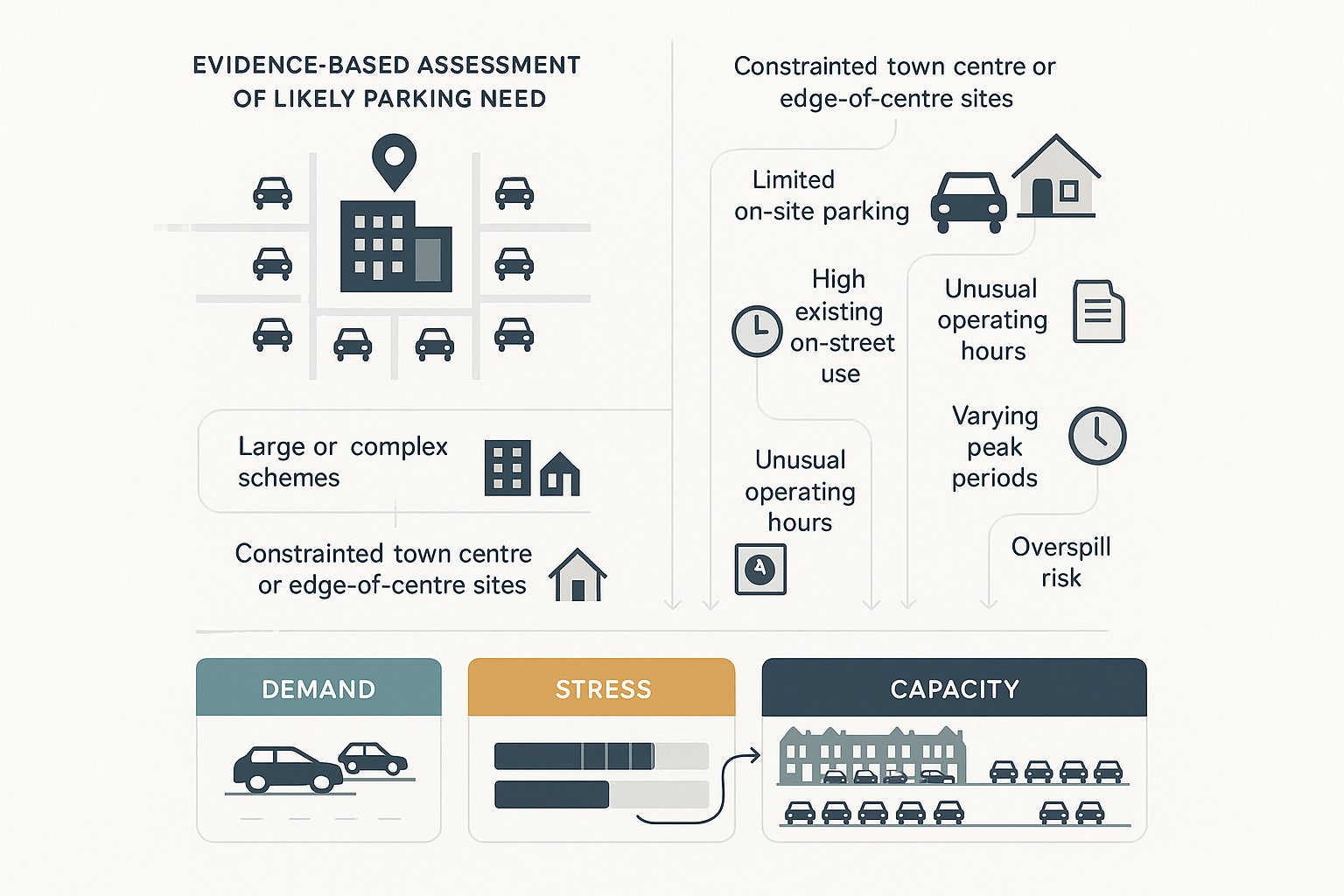
A parking demand study is an evidence-based assessment that estimates how much parking a proposed development is likely to need and whether that demand can be accommodated on site or within the surrounding area without unacceptable effects. In UK planning terms, it is not just a parking count. It is a structured piece of planning and transport evidence used to test whether a scheme is workable in real-world conditions.
Authorities usually ask for a parking demand study where standard maximum or minimum parking standards do not tell the full story. That often happens when a proposal is large, complex, car-sensitive, or located in a constrained area. Town centre schemes, edge-of-centre developments, suburban infill, sites near controlled parking zones, and proposals with limited on-site parking are common examples.
We would usually expect a parking demand study to be considered where:
- the scale of development could materially change local parking conditions:
- existing on-street parking is already heavily used:
- the proposal departs from local parking standards:
- the site has unusual user characteristics or operating hours:
- parking demand will vary significantly by time of day or day of week: or
- planning officers or highways officers need clearer evidence on overspill risk.
It can be submitted as a standalone technical note, but more often it forms part of a Transport Statement or Transport Assessment. For firms such as ML Traffic, the value lies in tailoring the study to local policy thresholds, local authority expectations, and the actual operational pattern of the development rather than relying on generic assumptions.
How Parking Demand Differs From Parking Stress And Capacity Assessments
These three terms get mixed up all the time, but they are not interchangeable.
Parking demand is the level of parking likely to be used by the development. It is forward-looking and predictive. It asks: how many spaces will residents, staff, visitors, customers or service users actually need at peak times?
Parking stress describes how full an area is at a given moment, usually expressed as a percentage of occupied spaces. A street with 90% occupancy is under high parking stress. This is often used to understand how much headroom exists nearby.
Parking capacity is the physical or practical number of spaces available. That may include marked bays, legal on-street opportunities, private spaces, or managed car parks. Capacity says what exists: demand says what will want to use it.
A robust parking demand study may compare all three. For example, if a development generates 20 additional parked vehicles at peak times, but nearby streets are already operating at 88% occupancy, the practical spare capacity may be too limited to absorb any overspill. That distinction matters in planning decisions.
Why Local Planning Authorities Ask For Parking Demand Evidence
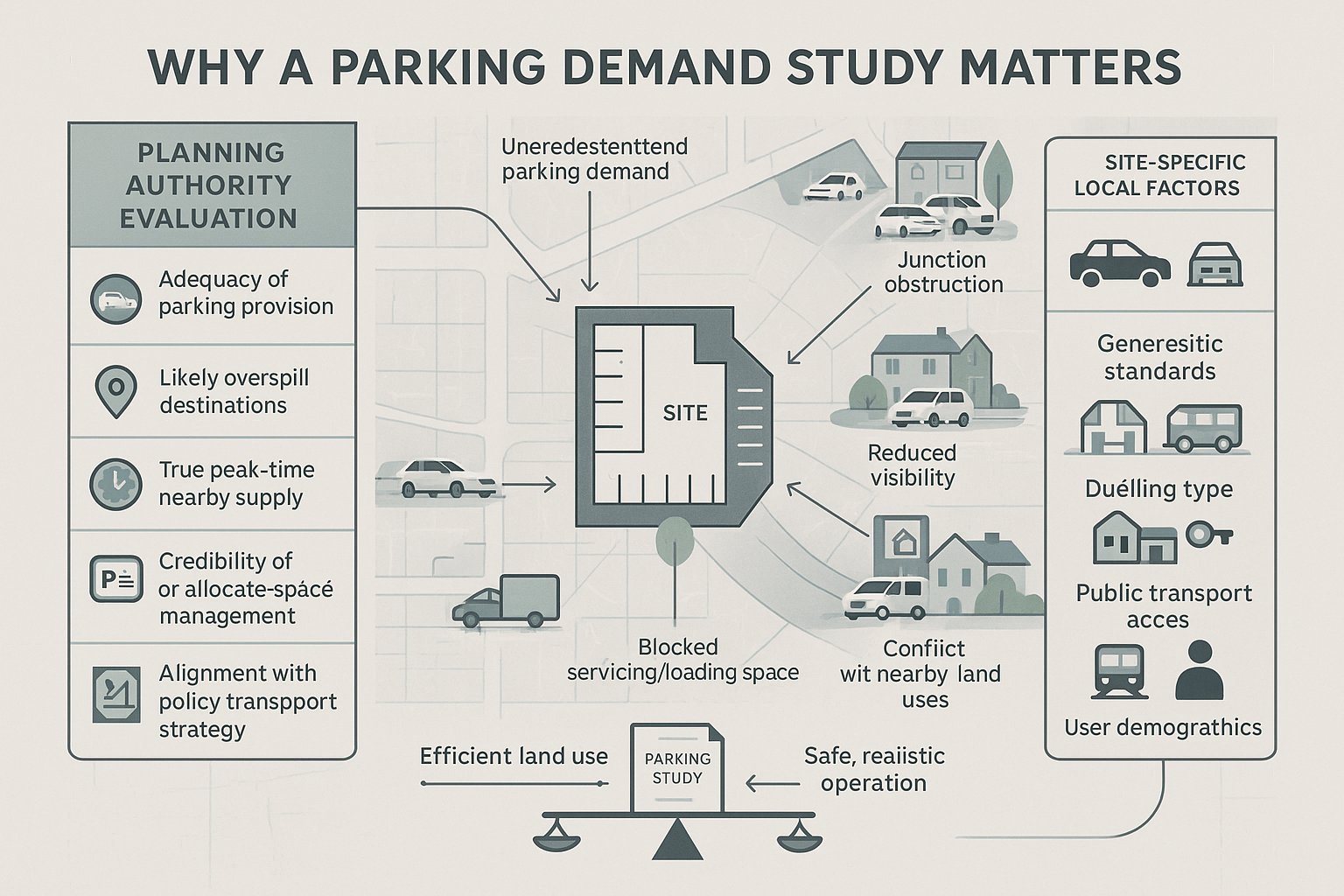
Local planning authorities ask for parking demand evidence because parking is rarely just a parking issue. It quickly becomes a highway safety issue, an amenity issue, a policy compliance issue, and sometimes a political issue as well.
From an authority’s perspective, the main concern is whether a proposal will function acceptably once built and occupied. If parking demand is underestimated, the consequences can spread beyond the red line boundary: overspill parking on nearby streets, obstruction near junctions, pressure on residents’ bays, poor visibility, blocked servicing areas, and friction with existing land uses.
That is why officers often want something more site-specific than a simple reference to local standards. Standards are useful benchmarks, but they do not always capture local behaviour. Car ownership can vary sharply by location, dwelling type, tenure, public transport accessibility, and the demographic profile of likely users. A one-size-fits-all ratio can miss that.
A parking demand study helps authorities test several planning questions at once:
- Will the proposed level of parking be enough?
- If not, where will overspill go?
- Is nearby supply genuinely available at peak times?
- Are management measures, such as permit controls or allocated spaces, credible?
- Does the proposal align with adopted parking policy and broader transport strategy?
In 2026, this matters even more because authorities are balancing two pressures at once. On one hand, they want efficient land use, lower car dependency and support for sustainable travel. On the other, they still need developments to operate safely and realistically. Good parking evidence helps reconcile those aims instead of forcing officers to choose between design ambition and operational practicality.
Common Development Types That Benefit From A Parking Demand Study
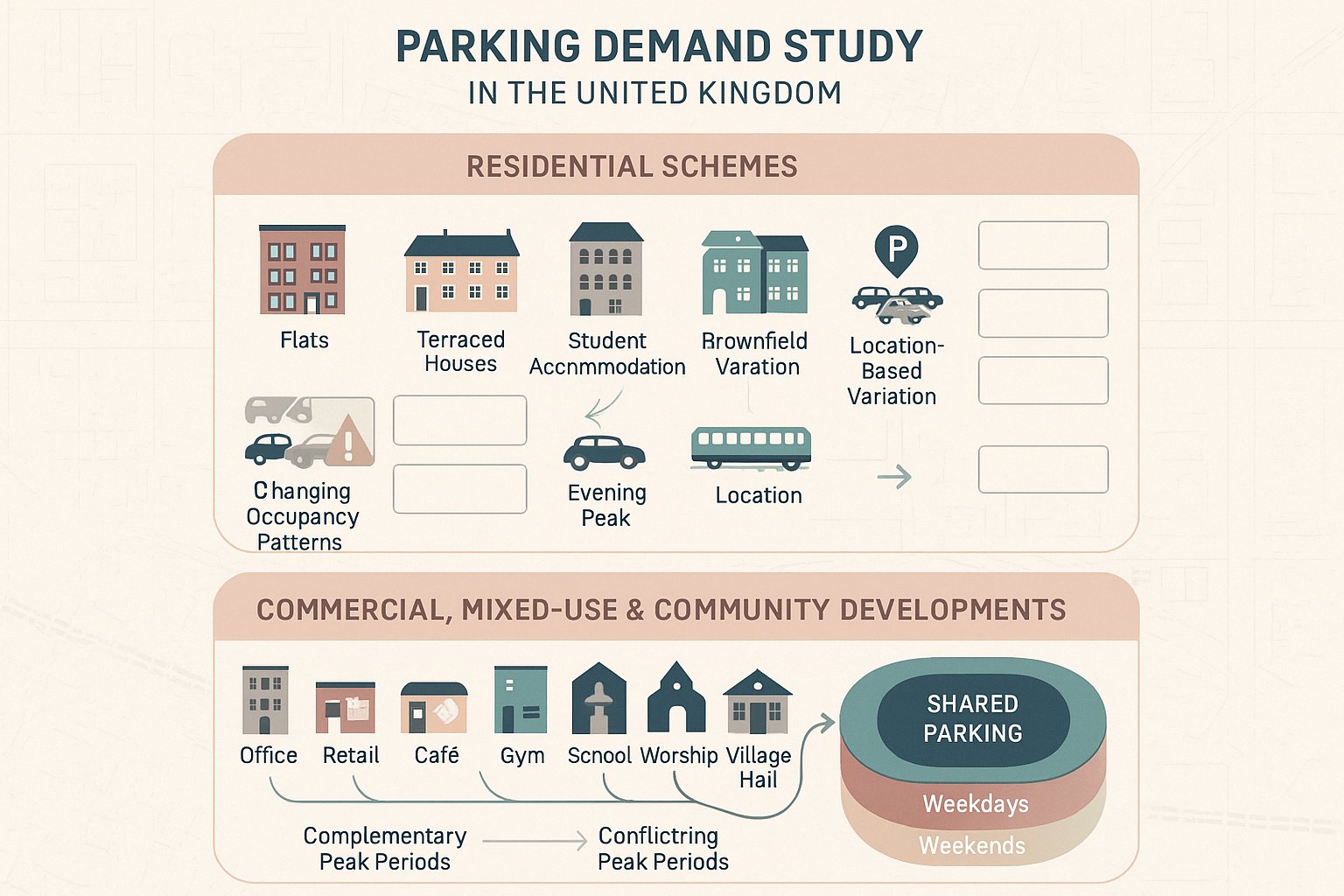
Not every proposal needs a detailed parking demand study, but many schemes benefit from one even where it is not explicitly requested at validation stage. In practice, the more a development’s parking profile depends on timing, user mix, or local constraints, the stronger the case for proper evidence.
Residential Schemes
Residential development is one of the most common contexts for a parking demand study. That includes flats, housing estates, specialist accommodation, build-to-rent schemes, student housing in some cases, and redevelopment of brownfield sites with tight layouts.
The reason is simple: residential parking demand is not uniform. A two-bed flat in a town centre with strong rail access may behave very differently from a family house on the edge of a village. Car ownership often varies by dwelling size, tenure, affordability, and resident profile. Visitor parking adds another layer, especially in higher-density developments where on-site visitor provision is limited.
Authorities are often cautious where schemes propose parking below adopted standards. They may accept a lower provision, but they will want evidence explaining why. A study can show whether lower demand is credible because of location, accessibility, or comparable local schemes. Just as importantly, it can identify where risk remains, for example around evening peaks, informal visitor parking, or unallocated spaces that may be used inefficiently.
Commercial, Mixed-Use, And Community Developments
Commercial and community uses can be even more complex because demand changes by hour, by day, and by user group. Offices, retail, food and drink uses, health facilities, places of worship, schools, leisure venues, and village halls all generate different parking patterns.
Mixed-use sites are especially sensitive. Shared parking can work very well if peak periods are complementary, but poorly if they overlap. An office and gym may not peak at the same time: a café and community hall might. A parking demand study tests those interactions rather than assuming spaces can be shared without conflict.
Community developments often attract particular local scrutiny because parking demand may spike during events, weekend activity or seasonal use. In those situations, a single weekday survey is rarely enough. We need evidence that reflects actual operation, not just an average day. That is where good study design becomes the difference between a persuasive planning submission and a weak one.
What Data Is Collected In A Parking Demand Study
The credibility of a parking demand study depends on the quality of its inputs. If the data is thin, the conclusions will be thin too.
At a minimum, we would usually collect information on the proposed development itself: land use, floor area or unit mix, number of proposed spaces, allocation arrangements, visitor provision, disabled parking, cycle parking, servicing arrangements, and access constraints. But the surrounding parking environment matters just as much.
Typical study data includes:
- Existing parking supply: on-site spaces, nearby private parking, on-street spaces, marked bays, and any off-street public car parks.
- Occupancy levels: how many spaces are occupied at different times.
- Turnover and duration: whether spaces are used briefly, repeatedly, or for long stays.
- User type: residents, employees, visitors, customers, blue badge holders, delivery drivers, and other users where relevant.
- Parking controls: permit schemes, time limits, pay-and-display, yellow lines, loading restrictions, and private enforcement.
- Site context: accessibility by walking, cycling and public transport, nearby competing land uses, and local street characteristics.
- Behavioural indicators: informal parking patterns, double parking, parking on verges, or use of spaces that are technically available but operationally poor.
Good studies also record the practical quality of spaces, not just their existence. A narrow space beside a bin store, or a legal kerbside opportunity on a heavily trafficked road, may count as capacity on paper but not in reality. That distinction is often where objections begin.
Where appropriate, the dataset can also include census-based car ownership context, TRICS-informed benchmarks, and observations from comparable developments. The key is to use evidence as support, not as a substitute for site-specific judgement.
Survey Methods, Timing, And Peak Period Selection
Method matters. A parking demand study can be undermined by poor survey design even if the final report looks polished.
Most studies rely on parking beat surveys or occupancy counts undertaken at regular intervals across a defined study area. The survey area should be large enough to capture realistic overspill behaviour, not just the spaces immediately outside the site. For a constrained urban development, that may mean several surrounding streets. For a rural or edge-of-settlement site, it may involve fewer locations but a wider understanding of practical parking choices.
Timing is crucial. Surveys should capture the highest realistic parking demand for the proposed land use, and that is not always the obvious weekday commuter peak. Residential schemes often need evening and overnight observations. Retail and leisure may require weekend peaks. Community uses may need event-based surveying. Mixed-use schemes usually require more than one survey period.
Common survey considerations include:
- weekday and weekend coverage where relevant:
- seasonal representativeness:
- school term versus holiday conditions:
- weather and one-off local events:
- interval frequency, often every 30 minutes or hour depending on the use:
- whether repeat surveys are needed to confirm consistency.
The best approach is not simply to gather the maximum amount of data, but to gather the right data. We need periods that are representative, defensible, and linked directly to the operational profile of the development. If a proposed medical centre will peak on weekday mornings and a church hall peaks on Sunday afternoons, the survey strategy should reflect that. Otherwise the authority may reasonably conclude that the evidence misses the critical demand window.
How A Parking Demand Study Is Analysed And Presented
Analysis should turn raw survey information into clear planning evidence. That means moving beyond tables of parked cars and explaining what the numbers mean for decision-makers.
A typical analysis looks at occupancy by location and by time period, identifies peak demand, and compares existing and future conditions. For many applications, the central question is whether the development can be accommodated within the parking supply available on site and, where policy allows, in the surrounding area without causing material harm.
Useful outputs often include:
- peak occupancy percentages:
- spare capacity calculations:
- parking accumulation profiles across the day:
- parking ratios by unit, floor area or use class:
- demand comparisons with local standards or comparable sites:
- plans showing where parking pressure occurs:
- sensitivity testing for visitor peaks or lower-than-expected sustainable mode share.
Presentation matters more than people think. Planning officers, members and local residents respond better to findings that are transparent and visual. Annotated plans, simple charts and concise methodology notes are often more persuasive than dense technical appendices.
We also need to explain assumptions plainly. If a study assumes that a proportion of visitors will arrive on foot, by cycle or by public transport, the report should show why that is credible. If spaces are shared between uses, the analysis should demonstrate how overlapping peaks have been tested. And if there is a residual overspill risk, that should be acknowledged and addressed with mitigation rather than buried in the wording.
A good report feels balanced. It should support the scheme, yes, but it should do so by being rigorous enough that a highways officer can follow the logic and agree with it.
Key Policy, Design, And Planning Considerations
A parking demand study does not sit in a vacuum. It needs to respond to planning policy, design quality, and the wider transport case for the development.
First, local parking standards remain a key reference point, even where they are flexible. Some authorities set minimum standards, some maximums, and many use location-specific guidance. We need to understand whether the proposal complies, departs, or seeks a justified exception. That policy context should be explicit.
Second, accessibility matters. A lower parking provision is easier to support where the site has strong public transport links, walkable services, safe cycle connections, and realistic travel plan measures. But those factors should be evidenced, not asserted. A bus stop nearby is not the same as an attractive, frequent, and useful service.
Third, design and operation matter just as much as numbers. Questions typically include:
- Are spaces allocated or unallocated?
- Is visitor parking adequate and convenient?
- Can disabled users park close to entrances?
- Will refuse, delivery and servicing activity interfere with parking operation?
- Are turning areas protected from informal parking?
- Is EV charging provision aligned with likely use?
There is also the issue of lived experience. A scheme can technically meet policy while still creating awkward day-to-day parking behaviour because spaces are poorly located, too small, or difficult to use. Conversely, a slight policy shortfall may be acceptable if the operational case is strong.
This is why parking demand studies are most effective when integrated early with site layout and planning strategy. They should influence design, not merely defend it after the fact.
Common Issues That Delay Approval Or Trigger Objections
Most parking objections are predictable. They usually arise not because the principle of the scheme is impossible, but because the evidence leaves too many unanswered questions.
One of the most common problems is poor survey timing. If residential parking is surveyed at midday, or a community use is assessed only on a quiet weekday, the study will not carry much weight. Authorities and local residents are quick to spot that.
Another frequent issue is a study area that is too narrow. Overspill does not respect neat boundaries. If nearby streets are excluded without a clear reason, the authority may conclude that parking pressure has been understated.
Other recurring weaknesses include:
- relying on a single survey with no justification:
- ignoring visitor parking or short-stay demand:
- treating all legal spaces as equally usable:
- failing to account for permit controls or private restrictions:
- assuming shared parking works without testing overlapping peaks:
- not addressing what happens if sustainable travel uptake is lower than forecast.
There is also a communication problem in some reports. Technical evidence may exist, but it is buried in jargon, inconsistent tables, or plans that are hard to read. That creates friction where none was needed.
From a planning strategy perspective, delay often happens when parking evidence is disconnected from mitigation. If the study identifies pressure but offers no response, objections become more likely. Sometimes the answer is extra parking. Sometimes it is allocation changes, visitor controls, a car club bay, permit restrictions, layout amendments, or a stronger travel plan. The point is that evidence should lead somewhere. A parking demand study that finds risk and then stops short of a practical solution rarely helps an application move smoothly.
How To Use A Parking Demand Study Within A Wider Transport Assessment
A parking demand study is strongest when it is not treated as a standalone appendix that nobody revisits. It should inform the wider Transport Statement or Transport Assessment and help create a coherent development case.
At the most basic level, parking demand evidence supports the proposed parking provision and tests whether the site access and internal layout will operate effectively. But its value goes further than that.
Within a wider transport assessment, the study can inform:
- Trip generation assumptions: car ownership and parking availability often influence mode split and vehicle trip rates.
- Access design: if parking turnover is high, entry and exit arrangements may need more scrutiny.
- Servicing strategy: loading activity should not displace parking or vice versa.
- Travel planning: measures to reduce single-occupancy car use need to be proportionate to the actual parking context.
- Mitigation proposals: overspill risk may justify controls, monitoring, or highway management measures.
- Street design and safety: likely kerbside demand affects visibility, refuse collection, cycle infrastructure and pedestrian movement.
This joined-up approach is increasingly important because planning decisions are seldom made on one metric alone. Authorities want to see that parking, access, sustainable travel, and highway operation have been considered together.
That is where concise, locally aware transport reporting makes a real difference. On schemes across England and Wales, we often find that a targeted parking demand study can resolve one of the most contentious parts of the application, provided it is aligned with the transport narrative as a whole. In other words, the study should not only answer ‘how many spaces?’. It should also help answer ‘will this development work here?’.
Conclusion
A parking demand study is not just a technical extra for difficult schemes. It is often the piece of evidence that turns a planning application from arguable to defensible.
For planners, architects, developers and local authorities, the real value lies in clarity. A well-prepared study shows how much parking a development is likely to generate, when that demand will peak, whether nearby supply can absorb any pressure, and what mitigation is needed if it cannot. That gives decision-makers something firmer than assumption or local anxiety.
In 2026, with tighter sites, evolving policy and continued concern about overspill parking, that level of evidence matters more than ever. The strongest applications do not wait for parking to become an objection. They address it early, realistically and in context.
When a parking demand study is based on representative surveys, sound analysis and clear planning judgement, it does exactly what good transport evidence should do: reduce uncertainty and help the right scheme move forward with confidence.
Parking Demand Study FAQs
What is a parking demand study and when is it necessary?
A parking demand study estimates the likely parking needs of a proposed development and assesses whether these can be met on-site or locally without causing issues. It is usually required for large, complex, or sensitive sites where standard parking standards don’t fully apply.
How does parking demand differ from parking stress and parking capacity?
Parking demand predicts how many spaces a development will need, parking stress shows how full parking is at a given time, and parking capacity is the actual number of available spaces. A study compares all three to understand parking impacts accurately.
Why do local planning authorities request parking demand studies?
Authorities ask for these studies to ensure developments won’t cause overspill parking, highway safety problems, or policy conflicts. The study helps them assess actual parking impacts beyond just fitting spaces on a plan.
Which types of developments benefit most from a parking demand study?
Residential schemes with variable car ownership, as well as commercial, mixed-use, and community developments with fluctuating parking needs, especially where parking demand changes by time or user type, benefit greatly from tailored demand studies.
What data and methods are used in conducting a parking demand study?
Studies collect data on proposed parking provision, existing local supply, occupancy levels, turnover, user types, nearby controls, and site context. Surveys are timed to capture representative peak demand periods, often including weekdays and weekends.
How is a parking demand study integrated within a wider Transport Assessment?
The study informs trip generation, access design, servicing, and sustainable travel proposals. It links parking evidence to overall transport planning, helping balance operational feasibility with policy goals to support smoother planning approvals.