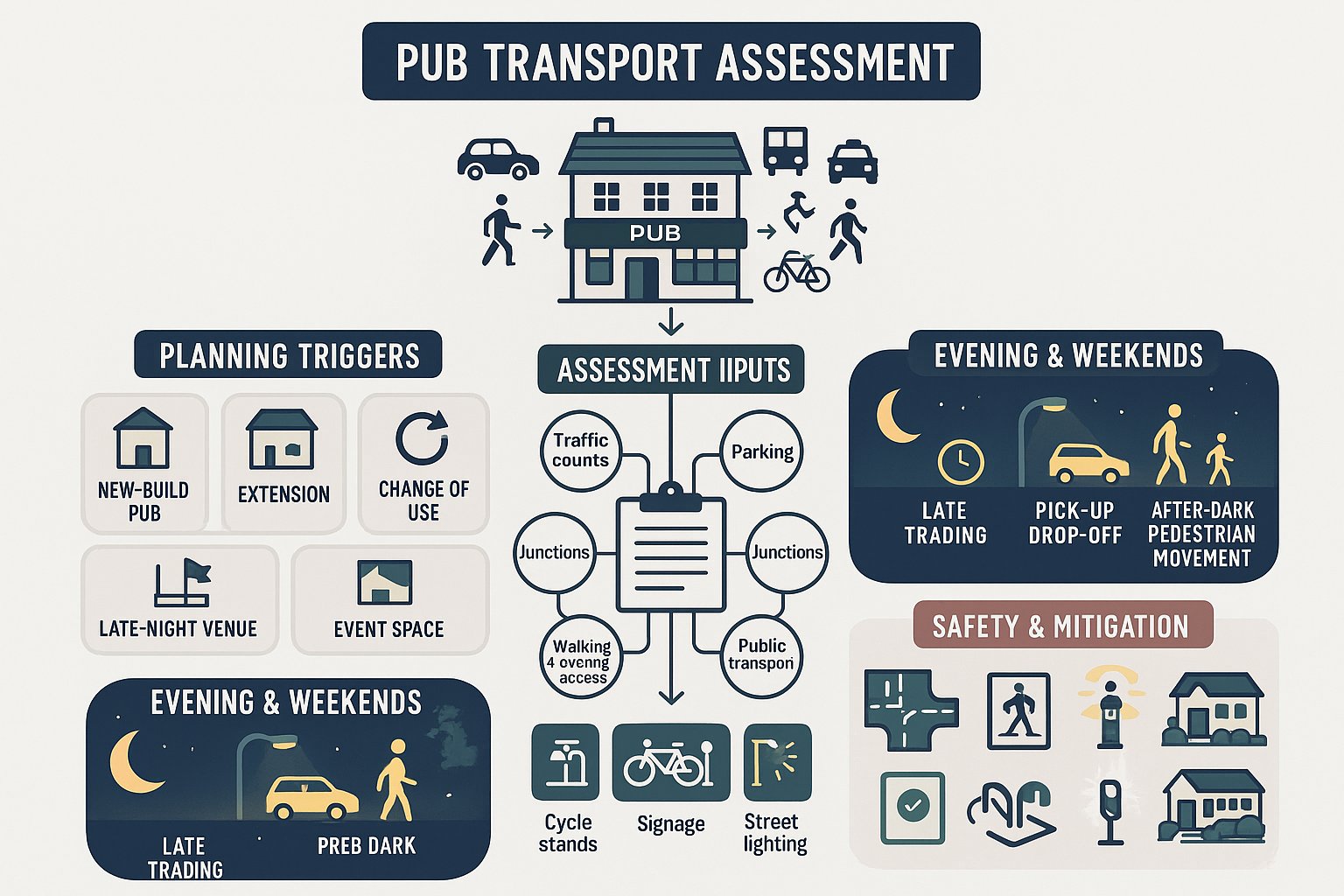
A pub transport assessment can look deceptively simple from the outside. It’s “just” a pub, after all. But anyone who has worked through a planning application for a public house, bar, gastropub or drinking-led mixed-use venue knows that these schemes raise transport questions that are anything but routine.
Pubs behave differently from many other land uses. Their busiest periods are often evenings and weekends. Travel patterns can swing sharply between weekday lunches, Friday nights, live events and summer beer-garden peaks. Add taxis, pick-up and drop-off activity, servicing on constrained streets, nearby residents, and the ever-present scrutiny of highway safety, and the transport case quickly becomes more nuanced than a standard daytime assessment.
That is exactly why local planning authorities often ask for robust, site-specific evidence. A well-prepared pub transport assessment helps demonstrate whether the proposal will work in practice, what impacts need to be addressed, and which mitigation measures are realistic. It can also save a great deal of time in planning negotiations by dealing with the likely highways concerns early rather than reactively.
In this guide, we set out what a pub transport assessment is, when it is usually required, what should go into it, and where applications most commonly come unstuck. We’ll also cover the surveys, technical inputs and practical judgement needed to get it right first time in 2026.
What A Pub Transport Assessment Is And When It Is Required
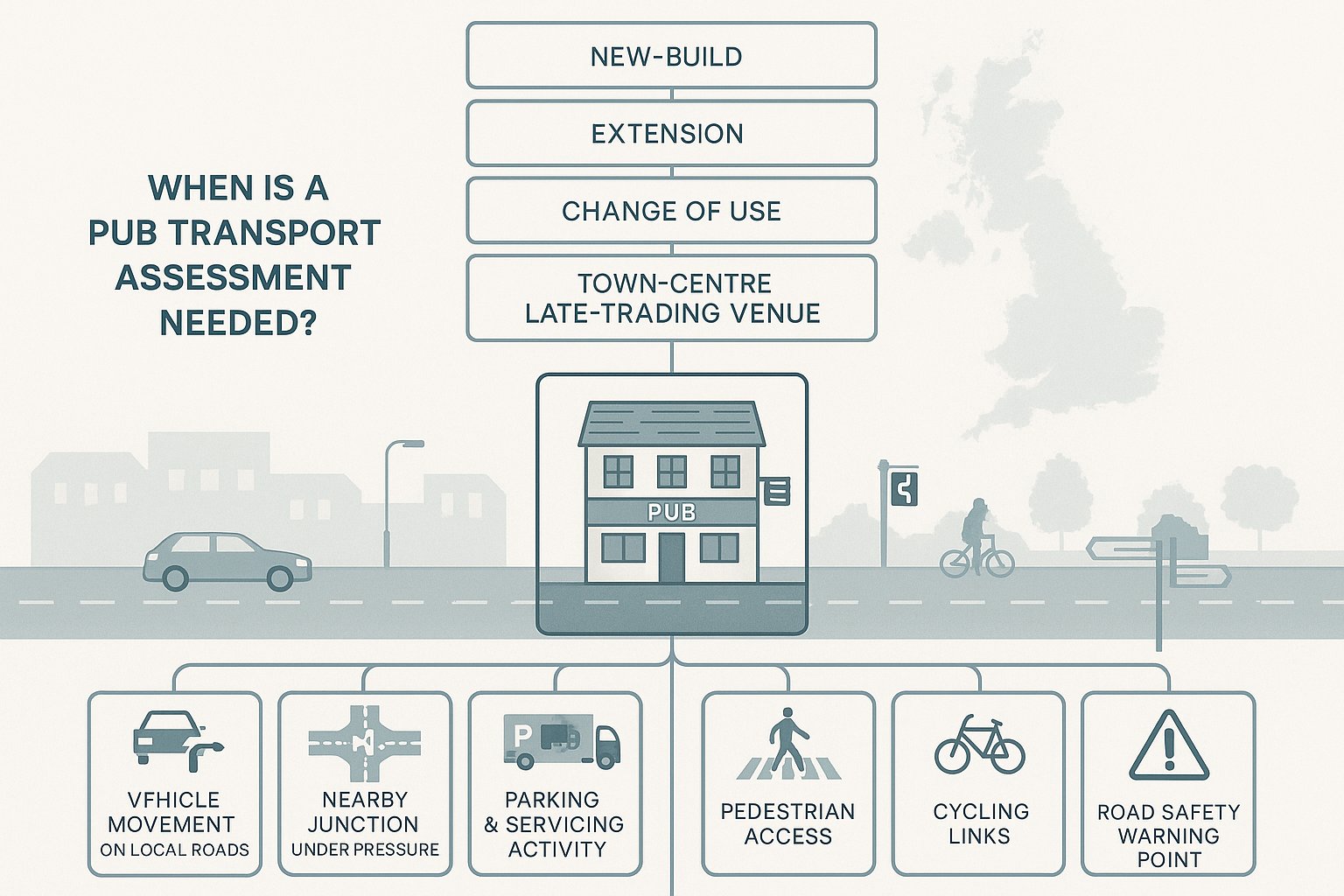
A pub transport assessment is a transport planning document that examines how a proposed pub development will affect movement to and from a site, the surrounding highway network, and local accessibility by sustainable modes. In planning terms, its purpose is straightforward: to give the decision-maker clear evidence on likely transport impacts and whether those impacts are acceptable or can be mitigated.
In practice, the level of detail varies. Some schemes need a concise technical note or transport statement. Others need a fuller assessment with traffic surveys, trip generation analysis, junction capacity testing, parking accumulation, servicing review and road safety evidence. The right scope depends on the scale and nature of the proposal.
A transport assessment is commonly required where a pub scheme is expected to generate material movement impacts. Typical examples include a new-build roadside pub, a larger edge-of-settlement pub/restaurant, a town-centre venue with late trading, or an extension that materially increases covers, event capacity or dwell time. Change-of-use proposals can also trigger the need, particularly where the former use had very different operating characteristics.
The key point is that planning authorities are not only looking at traffic volume. They are also looking at timing, safety, accessibility and operational practicality. A venue with modest floorspace can still justify a detailed assessment if it sits on a constrained access, near a sensitive junction, or in an area with a poor safety record.
For applicants, that means an early, proportionate appraisal matters. We usually advise treating the question as one of likely transport effect, not just gross floorspace threshold.
Why Pubs Create Distinct Transport And Highway Considerations
Pubs are not simply another food-and-drink use in transport terms. Their movement profile is often less predictable than standard retail, office or even many restaurant schemes, and that is why local highways officers tend to look at them closely.
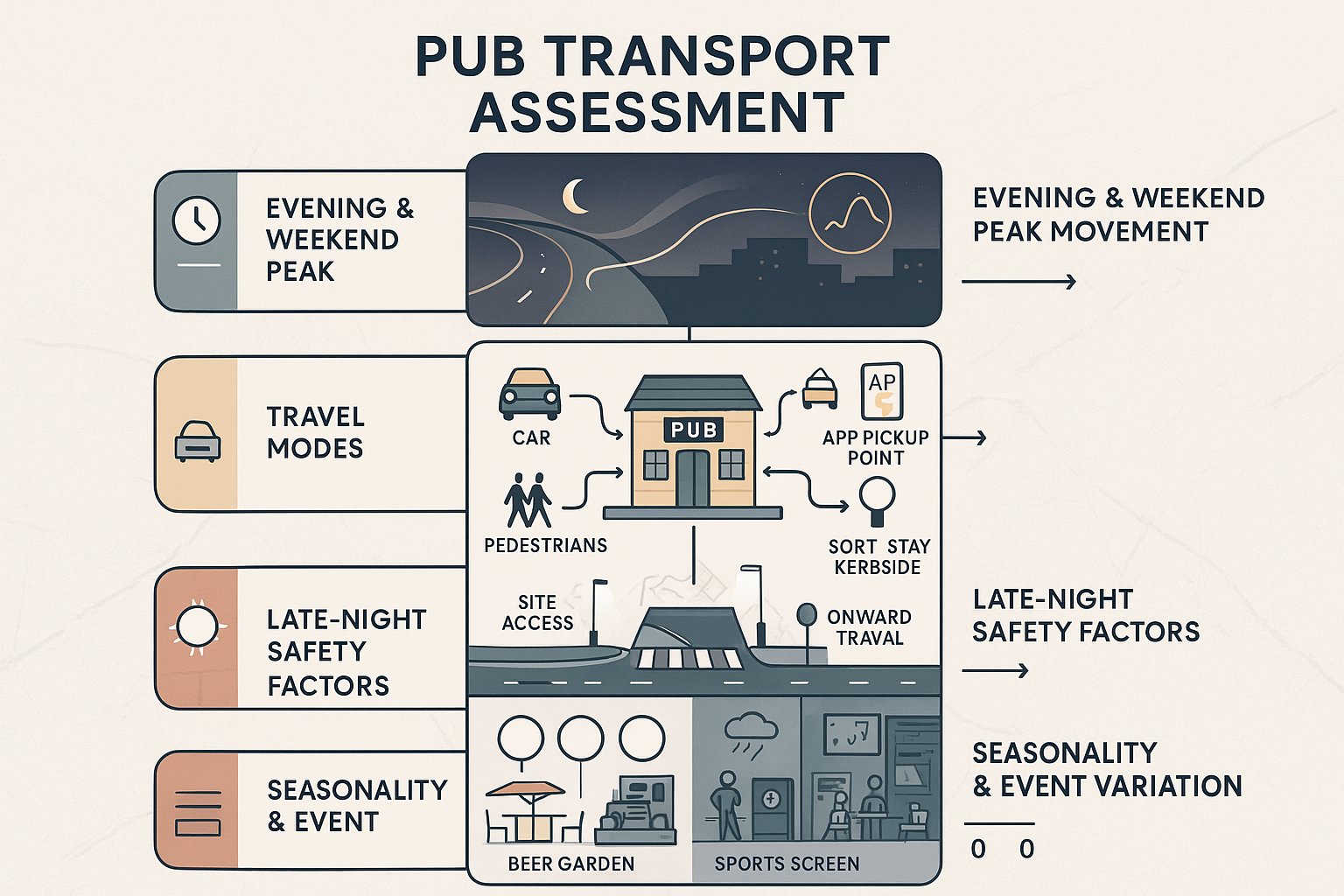
First, many pubs generate strong evening and weekend peaks rather than conventional weekday commuter peaks. That can be helpful in some locations where background traffic falls away after 6pm. But it can also create pressure at exactly the times when visibility is poorer, parking controls are relaxed, and neighbouring residential amenity is more sensitive.
Second, pubs often generate a wider mix of transport modes than applicants first assume. Yes, private car demand can be significant, especially in suburban and rural locations. But pubs also tend to produce taxi activity, app-based pick-up/drop-off movements, short-stay stopping on the carriageway, and pedestrian movements after dark. Those modes need proper analysis because they affect kerbside operation and highway safety in very practical ways.
Third, alcohol-related risk changes the character of the assessment. We are not suggesting that planning should assume irresponsible behaviour. But highway authorities will reasonably ask how the site design, access arrangement, lighting, crossings and onward travel options support safer movement, especially late at night.
Then there is seasonality. A pub with a beer garden or event space may trade very differently in July from November. Live music, sports screenings and private functions can sharply alter trip patterns. That is why generic trip assumptions so often fail.
In short, pubs are operationally distinctive. A credible assessment has to reflect that reality rather than squeeze the proposal into a standard land-use template.
Typical Planning Scenarios That Trigger A Pub Transport Assessment
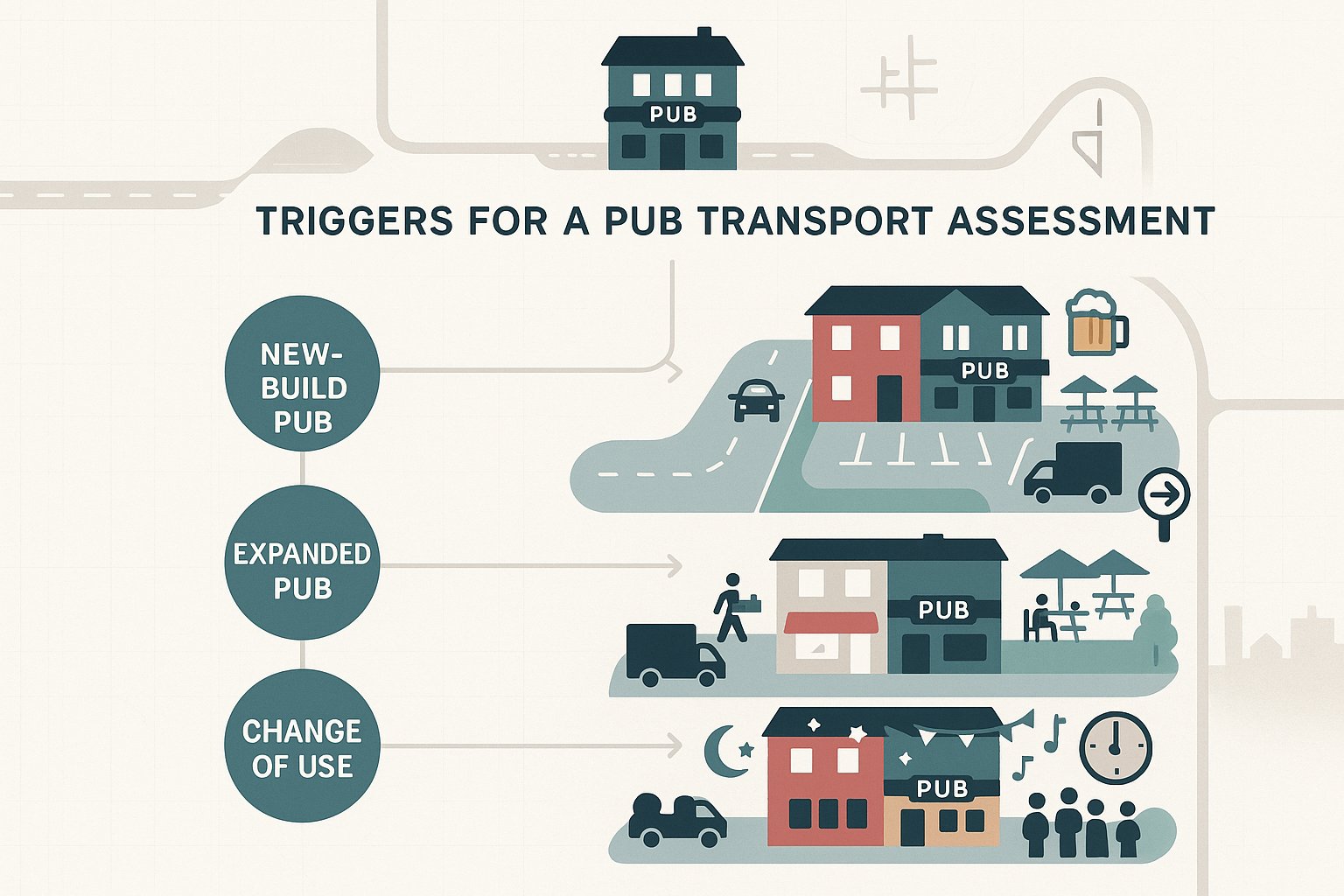
There are a handful of recurring planning scenarios in which a pub transport assessment becomes necessary, either because local validation requirements say so or because the case officer and highway authority need evidence before they can support the application.
One obvious trigger is a new-build pub, particularly on roadside, edge-of-town or out-of-centre sites where car-borne trips are likely to be high. Even where the access arrangement looks simple on a drawing, the authority will usually want comfort on trip generation, parking demand, servicing and junction performance.
Another is a sizeable expansion of an existing venue. Extensions can materially alter how the site functions, even if the pub is already established. More covers, a larger kitchen, a function suite, an outdoor trading area or later hours can all intensify transport demand beyond the current baseline.
Change-of-use proposals are also common trigger points. A former shop, bank, restaurant or community building may be moving to a pub or bar use with very different arrival times, dwell times and servicing needs. That change alone can justify a fresh assessment.
Finally, there are operational changes that look modest on paper but are significant in reality: longer opening hours, live entertainment, regular events, or a shift from food-led to drink-led trading. These applications often need transport input because the impacts are more about timing and concentration of activity than floorspace alone.
Key Elements Included In A Pub Transport Assessment Report
A strong report is not just a bundle of traffic counts. It is a reasoned planning document that links policy, evidence, design and mitigation into one coherent transport case.
Most pub transport assessments start with a review of relevant planning and transport policy at national and local level, followed by a description of the site, surrounding highway conditions and accessibility context. From there, the report usually establishes the baseline: traffic flows, personal injury collision history, existing parking conditions, public transport availability and active travel opportunities.
The next stage is normally the operational analysis. That includes trip generation, the distribution and assignment of those trips, and where necessary an assessment of junction capacity or local network effect. Parking demand is then considered, together with any risk of overspill into nearby streets or conflict with existing uses.
Servicing is another core component. Pub developments often rely on regular deliveries, keg drops, food supply vehicles and refuse collection, and these movements can be awkward on constrained sites. A robust report should show not only that service vehicles can reach the site, but that they can do so safely and without undermining general operation.
Access and safety are then tested in detail, including visibility, internal circulation, pedestrian routes, cycle provision and public transport connectivity. Where issues are identified, the report should set out mitigation clearly.
Done properly, the assessment reads less like a defensive technical note and more like a practical explanation of how the development will work day to day.
Access, Highway Safety, Walking, Cycling, And Public Transport
Access design is often where a pub planning application lives or dies. A site can appear commercially attractive yet still be difficult to support if the vehicular entry is awkward, visibility is constrained, or there is no safe way for people to arrive without a car.
From a highways perspective, authorities will typically want to know whether the access geometry is suitable, whether visibility splays are achievable and maintainable, and whether vehicles can enter and leave in a safe and logical way. On existing sites, we also look closely at whether historic operation masks current problems. “It’s always been a pub” is not, by itself, a transport argument.
Road safety analysis matters too. That usually means reviewing personal injury collision data, local speed environment, crossing opportunities, frontage activity and any conflict points involving servicing or informal pick-up/drop-off. If a site sits on a bend, near a busy junction, or on a road with poor walking conditions, the assessment needs to tackle those issues directly.
Equally important is sustainable access. Planning policy expects development to support walking, cycling and public transport where reasonable. For pubs, that means more than listing the nearest bus stop. We need to examine whether walking routes are continuous, lit and usable after dark: whether cycle parking is secure and convenient: and whether local public transport actually supports likely trading hours.
In many cases, modest improvements make the difference: better signage, a new dropped kerb, improved lighting, cycle stands, or a safer kerbside arrangement for taxis. These are not glamorous interventions, but they are often what unlock a workable planning outcome.
How The Assessment Supports Planning Applications And Negotiations
A well-prepared assessment does more than satisfy a validation checklist. It shapes the planning conversation.
When a pub application lands without convincing transport evidence, the highway authority is left to imagine the worst-case scenario. That usually leads to holding objections, requests for more surveys, and a slow, expensive back-and-forth. By contrast, a robust assessment answers the obvious questions early: how many trips are likely, when they occur, whether the access works, where people will park, how deliveries will be managed, and what mitigation is proposed.
That evidence is especially valuable in negotiations. Many pub schemes are not approved because there is zero impact: they are approved because the residual impact is shown to be acceptable with reasonable controls or improvements. A transport assessment gives the technical basis for those discussions.
Mitigation might include access amendments, lining and signing, crossing upgrades, revised parking layout, cycle parking, delivery management measures, or a travel plan. In some cases, it supports planning conditions or Section 106 obligations by showing what is necessary and proportionate.
It also helps the wider consultant team. Architects can refine site layout, planning consultants can frame the planning balance more confidently, and solicitors have clearer evidence if highway matters become contentious.
At ML Traffic, this is often where experience counts most: aligning the report not only with guidance, but with how local authorities actually review pub and leisure applications in practice.
Common Issues That Delay Approval And How To Avoid Them
The same problems come up again and again in pub applications, and most of them are avoidable.
A frequent issue is underestimating trip rates. Applicants sometimes rely on generic land-use databases without asking whether the comparison sites truly reflect the proposal. A rural family pub with a large car park behaves very differently from an urban bar near a rail station. If the comparator set is weak, the authority will spot it quickly.
Another common problem is ignoring the wrong peak. For many pubs, the decisive period is not the weekday AM or PM commuter peak but the Friday evening, Saturday night or event-specific peak. Miss that, and the whole assessment can feel detached from how the venue will really operate.
Parking is another flashpoint. Overspill risk, informal on-street stopping, and the interaction between customer parking and servicing need to be thought through in a practical way. A layout that technically fits the numbers but fails under real trading conditions rarely survives scrutiny.
Safety evidence is often thin too. Missing collision analysis, no speed survey where visibility is constrained, or vague statements about pedestrian access can all trigger further information requests.
The fix is usually simple, though not always easy: scope the work early, agree assumptions where possible, use realistic survey periods, and explain the operation honestly. In our experience, authorities are far more receptive to a candid assessment with clear mitigation than to an optimistic report that glosses over the awkward bits.
Choosing The Right Evidence, Surveys, And Technical Input
The quality of a pub transport assessment depends heavily on the evidence behind it. And this is where proportionate judgement matters. Not every pub proposal needs every survey under the sun, but every report needs enough credible data to answer the planning questions that actually arise on that site.
Typical inputs include classified traffic counts, junction turning counts, parking beat surveys, accessibility mapping, collision data and site observations. If access visibility is marginal, speed surveys may be required. If the internal layout is tight, swept path analysis for delivery and refuse vehicles is often essential. Where late-night activity is central to the proposal, survey timing should reflect that rather than defaulting to daytime periods.
Choosing the right trip-rate evidence is equally important. We generally prefer comparison sites that genuinely match the proposal’s scale, location and offer. National databases can be useful, but they need careful filtering and professional judgement. A poor benchmark is often worse than none at all.
Technical input should also match the issue. Transport planners, highway engineers and sometimes road safety auditors each have a role depending on the scheme. For more complex applications, early dialogue with the local highway authority can save weeks later on.
And speed matters. Planning programmes are often tight, so the best process is one that produces concise, accurate reporting without sacrificing rigour. That is particularly valuable where validation deadlines, committee dates or appeal timetables leave little room for rework.
Conclusion
A good pub transport assessment is not about generating paperwork for its own sake. It is about showing, with credible evidence, that a proposed pub can operate safely, accessibly and without unacceptable impact on the surrounding network.
For architects, planners, lawyers, surveyors, developers and councils, the practical lesson is the same: pub schemes need transport analysis that reflects how pubs actually trade. That means looking beyond generic thresholds and modelling the real issues, evening peaks, pick-up activity, parking pressure, servicing, highway safety and sustainable access.
When those points are addressed early, applications tend to move more smoothly and negotiations become more productive. When they are ignored, delay is almost guaranteed.
In 2026, that gap between a generic transport note and a genuinely site-specific assessment is often what determines whether a pub proposal stalls or secures support. Getting the scope right, using the right evidence and presenting the findings clearly is what makes the difference.
Pub Transport Assessment FAQs
What is a pub transport assessment and why is it required?
A pub transport assessment studies how a proposed pub affects local traffic, parking, access, and highway safety. It is required when a pub development is likely to generate significant movements, such as new-builds, large extensions, or late-night venues, to ensure safe and manageable impacts on the transport network.
When do local planning authorities typically ask for a pub transport assessment?
Local planning authorities request a pub transport assessment for new roadside or edge-of-town pubs, major expansions including function rooms or beer gardens, change of use to pubs or bars, and operational intensifications like longer opening hours to assess transport impacts and safety concerns.
How do pubs create distinct transport and highway considerations compared to other land uses?
Pubs generate strong evening and weekend travel peaks, involve diverse transport modes like taxis and pick-ups, and present unique safety concerns due to alcohol-related risks. These factors differ from typical daytime uses, requiring detailed assessment of timing, accessibility, parking, and safety measures.
What key elements should be included in a thorough pub transport assessment?
A comprehensive assessment incorporates policy review, baseline traffic and accident data, trip generation including evening/weekend peaks, parking analysis with overspill risk, servicing and delivery vehicle access, plus evaluation of access design, highway safety, walking, cycling, and public transport provision.
How can a pub transport assessment help in planning applications and negotiations?
By providing clear, site-specific transport evidence, a pub transport assessment addresses highway authority concerns early, supports mitigation proposals like access improvements or parking controls, and facilitates smoother planning approvals and effective Section 106 or conditions negotiations.
What common issues delay approval of pub transport assessments, and how can they be avoided?
Delays often stem from underestimated trip rates, ignoring peak times like Friday nights, insufficient parking or servicing analysis, and missing safety data. Early scoping with authorities, robust surveys timed to reflect actual trading hours, appropriate comparator sites, and honest reporting help prevent these problems.