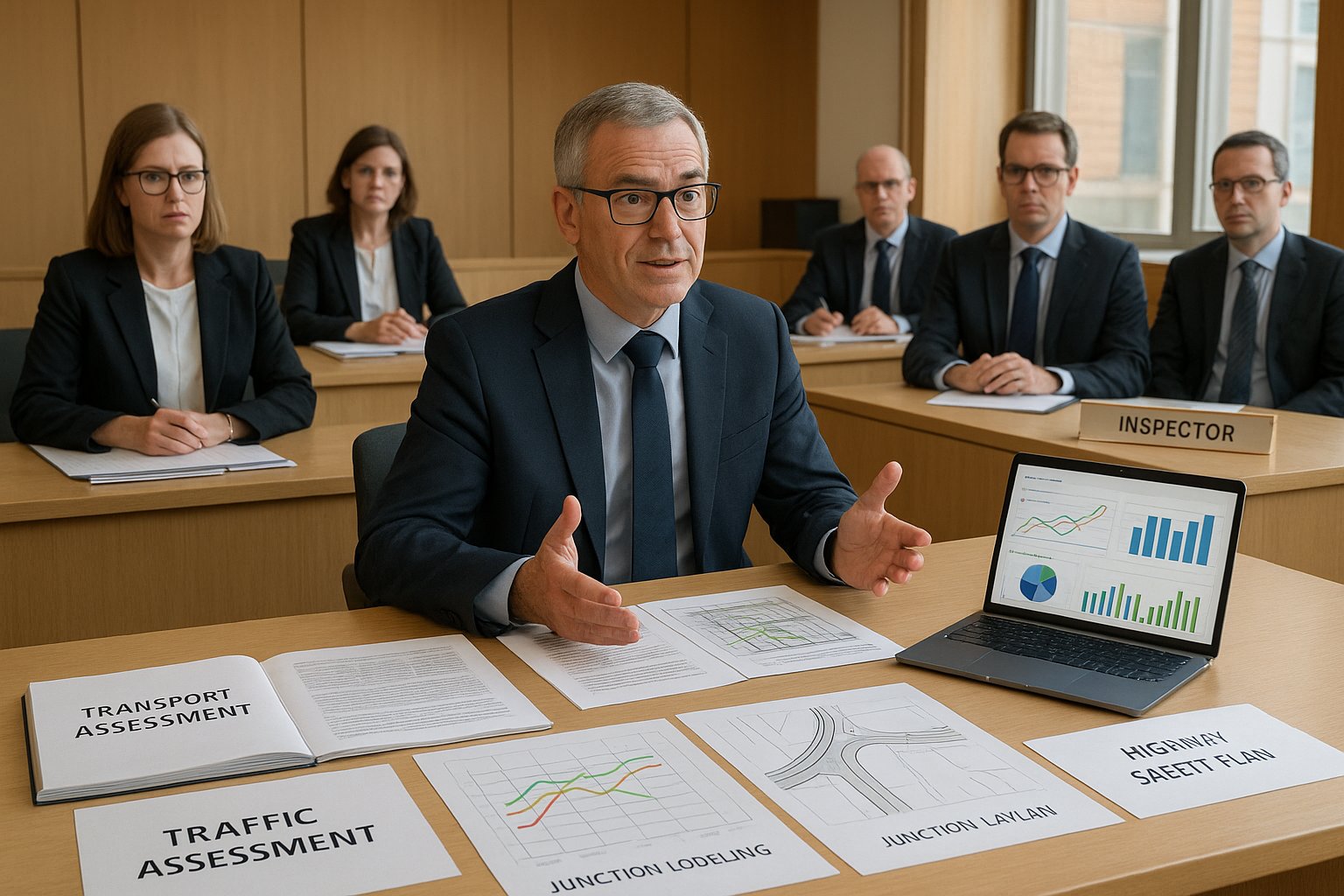
A public inquiry rarely turns on rhetoric alone. More often, it turns on evidence: the traffic counts that stand up, the modelling that can be replicated, the policy interpretation that survives scrutiny, and the expert who can explain all of it calmly under pressure. That’s where a public inquiry transport expert witness becomes pivotal.
For architects, developers, planners, solicitors and local authorities, transport issues are often the hinge point in a case. A scheme may be acceptable in principle, yet delayed or refused because of junction capacity, highway safety, access design, servicing, parking, or sustainable travel concerns. Equally, a weak objection can fall away when the technical case is properly assembled and tested.
We see this repeatedly in planning appeals, called-in applications, Local Plan examinations, compulsory purchase matters and operator licensing proceedings. The decision-maker, whether an Inspector, Traffic Commissioner or another public body, needs clear, independent help on the transport issues that actually matter. Not noise. Not advocacy disguised as expertise. Just evidence that is methodical, policy-led and intelligible.
In this guide, we set out what to expect from a public inquiry transport expert witness, when one is needed, what documents they review, how they prepare evidence, and why some cases succeed while others unravel under cross-examination. If you’re building a case for inquiry in 2026, this is the practical picture.
What A Public Inquiry Transport Expert Witness Does

A public inquiry transport expert witness gives independent professional evidence on transport, traffic, highway and accessibility matters. In practice, that usually means translating technical material into something a decision-maker can rely on.
Their role goes well beyond writing a report. They analyse the factual baseline, test assumptions, review policy, identify weaknesses in the opposing case and prepare formal evidence in inquiry format. In planning matters, that often includes trip generation, junction performance, parking demand, servicing, active travel connections and mitigation. In operator or compliance cases, the focus may shift towards road safety, fleet operation, maintenance systems, tachograph records or transport management arrangements.
Just as importantly, the expert’s duty is to the inquiry, not simply to the party instructing them. That independence matters. A credible witness can support our case strongly while still acknowledging uncertainty, reasonable differences of opinion and the limits of the available data.
At firms such as ML Traffic, the value often lies in combining speed with rigour: concise reporting, authority-aware advice and evidence tailored to the real planning context rather than generic templates. That’s what inquiry work demands. The expert must be technically sound, but also clear, practical and ready to defend every material conclusion in the room.
When A Transport Expert Witness Is Needed For A Public Inquiry

Not every planning dispute needs expert witness evidence. But once transport effects become a principal issue, or a stated reason for refusal, specialist input is usually essential.
The most common scenario is a planning appeal for a major development where traffic impact is contested. Typical flashpoints include whether a proposal would create an unacceptable impact on highway safety, whether residual cumulative effects would be severe, whether parking is adequate, or whether the access strategy is suitable for all users. If the case turns on technical modelling or policy interpretation, the evidence has to be properly prepared for inquiry.
We also see transport experts needed in Local Plan examinations, compulsory purchase order inquiries, major infrastructure cases and Transport Commissioner proceedings. The latter are different in tone but no less technical: fitness to hold an operator’s licence, compliance failings, maintenance systems and safety management can all require detailed specialist review.
A good rule of thumb is simple. If the decision-maker will need help weighing traffic, highways, safety or accessibility evidence against policy tests, an expert witness is likely to be necessary. And if the opposing side already has one, turning up without equivalent technical support is usually a false economy.
The Planning And Appeal Context Behind Transport Evidence

Transport evidence never sits in a vacuum. It is assessed within a legal and planning framework, and strong expert evidence is always tied back to that framework.
In mainstream planning appeals, the central references usually include the National Planning Policy Framework, the development plan, any neighbourhood plan, and technical guidance such as the Department for Transport’s Guidance on Transport Assessment and Manual for Streets. The key point is that numbers alone do not win. The expert has to explain what those numbers mean in policy terms.
For example, a junction model may show increased delay, but the real question is whether that translates into a policy breach, a severe cumulative impact, or a harm that can be mitigated through conditions or obligations. Similarly, a highway safety concern has to be grounded in evidence rather than assertion, accident history, geometry, visibility, speed environment, user conflict and likely behavioural response all matter.
At inquiry, Inspectors weigh transport harms against the wider planning balance. Benefits such as housing delivery, employment, regeneration or school places may be relevant. In operator licensing or Traffic Commissioner hearings, the emphasis is different: public safety, compliance, repute and professional competence sit centre stage. The expert’s task in either setting is to connect technical findings to the actual decision test, not just to present a stack of calculations.
Core Documents A Transport Expert Witness Reviews
Before any opinion is formed, the expert needs the paper trail, and usually more of it than clients first expect. Inquiry evidence is only as good as the documents beneath it.
A typical review includes the planning application, decision notice, committee report, reasons for refusal, consultation responses, approved and refused drawings, local and national policy extracts, prior technical notes and the existing transport evidence on both sides. Depending on the case, the bundle may also include speed surveys, classified counts, queue observations, accident data, travel plans, swept-path analysis, parking surveys and road safety audits.
For operator or compliance matters, the core set changes. Maintenance records, PMI sheets, defect reporting systems, drivers’ hours data, tachograph analysis and management structures can become central.
The point of this review is not clerical completeness for its own sake. It is to identify what is agreed, what is disputed, which assumptions are driving the outcome and where the evidence base is thin. That early diagnosis often shapes the whole inquiry strategy.
Transport Assessments, Statements, And Proofs Of Evidence
Transport Assessments and Transport Statements are usually the starting point. They describe baseline conditions, forecast development trips, assign movement patterns, assess junctions, review parking and servicing, and explain mitigation. A witness will test whether those documents follow accepted practice and whether the assumptions remain defensible at inquiry stage.
Then comes the Proof of Evidence. This is not just a longer report. It is a formal inquiry document that sets out the expert’s credentials, instructions, methodology, data sources, conclusions and policy position in a disciplined, transparent way. It should respond directly to the issues in dispute, especially the reasons for refusal or the main inquiry questions.
The best proofs are readable without being simplistic. They guide the Inspector through the logic step by step, show where professional judgement has been applied, and make it easy to trace each conclusion back to evidence.
Drawings, Modelling Outputs, And Technical Appendices
Drawings and appendices often decide whether a case feels robust or flimsy. A neat access drawing, visibility splay plan, pedestrian route audit or swept-path diagram can resolve an argument in minutes. Equally, a vague or inconsistent drawing can create unnecessary doubt.
Modelling outputs matter in the same way. Whether the case uses PICADY, ARCADY, LINSIG, VISSIM or another tool, the expert has to understand calibration, validation, sensitivity testing and the effect of key assumptions. Can the model be replicated? Are growth rates sensible? Has background traffic been treated consistently? Were mitigation changes tested properly? Those are standard lines of challenge.
Technical appendices should make the analysis auditable. Raw counts, survey records, worksheets, model files, accident plans and calculations need to be available and coherent. If the underlying material is missing or contradictory, cross-examination will usually find it.
How Traffic, Highway Safety, And Accessibility Issues Are Tested
Transport evidence is persuasive when it shows not only an outcome, but the route taken to get there. That means testing traffic, safety and accessibility in a way that is transparent and proportionate.
On traffic, the usual sequence is baseline flows, future-year forecasts, development trip generation, distribution and assignment, then junction or network assessment. TRICS-derived trip rates are common, but they need judgement: site selection, filtering and comparison with local context all matter. We then look at cumulative development, committed schemes and realistic sensitivity scenarios. A model that works only under one optimistic assumption usually won’t survive long.
Highway safety is wider than accident totals. STATS19 data can identify clusters and trends, but causation, road geometry, visibility, speed environment and user mix all need review. Sometimes a location has several recorded incidents with no clear pattern: sometimes a seemingly minor design feature creates obvious conflict for pedestrians, cyclists or turning vehicles. Road Safety Audits can help, but they are not substitutes for expert judgement.
Accessibility testing is often underplayed, which is a mistake. Inspectors increasingly want to know whether a site is genuinely accessible by walking, cycling and public transport, and whether that is true for a wide range of users. Catchments, journey times, gradients, crossing quality, bus frequencies and inclusive design standards all deserve careful attention. A development does not become sustainable because a bus stop exists on a plan.
Preparing Robust Evidence For Inquiry Proceedings
Robust inquiry evidence is built, not improvised. By the time the hearing opens, the transport case should already be stress-tested from several angles.
First, the methodology has to be explicit. Data sources, survey dates, growth assumptions, distribution logic, modelling software and policy references should be easy to identify. If there has been a departure from standard guidance, the reason needs to be explained rather than hidden in a footnote.
Second, the evidence must answer the actual case against the proposal. If the refusal reason concerns severe cumulative impacts, the proof should address severity directly. If the concern is highway safety, the witness must show why the design and operational evidence does or does not support that concern. Too many reports are technically busy but strategically vague.
Third, rebuttal preparation matters. We usually want to know where the opposing expert is likely to attack: survey scope, trip rates, sensitivity tests, accident interpretation, or deliverability of mitigation. It is much better to deal with those points in chief than to appear surprised later.
Pre-inquiry meetings with solicitors, counsel, planners and the client are part of that process. They help align the transport position with the wider planning case, identify sensible concessions and avoid inconsistencies between witnesses. Good preparation doesn’t make the evidence rigid. It makes it resilient.
Presenting Evidence Under Cross-Examination
Cross-examination is where many people imagine the drama lies. In reality, the strongest performances are usually the least dramatic.
A transport expert witness will typically be taken through their evidence in chief, then cross-examined by opposing counsel, and may also be questioned by the Inspector or Commissioner. The aim is not to sound clever. It is to be accurate, measured and dependable.
That means answering the question actually asked, not the one we wish had been asked. It means distinguishing fact from opinion, and professional judgement from assumption. It also means conceding the obvious where a fair point is made. Strange as it sounds, a carefully limited concession often strengthens a witness because it shows independence.
The opposite is easy to spot. Evasive answers, over-claiming, straying beyond one’s expertise, or defending a weak assumption long after it has collapsed can damage an otherwise decent case. Decision-makers notice demeanour, but they notice clarity even more.
Preparation helps here. We often run through likely challenge points, awkward documents and technical detail in advance so the witness can explain them cleanly. But preparation should never become scripting. The expert’s credibility depends on sounding like a professional giving their honest opinion, because that is exactly what they are meant to be doing.
Common Reasons Transport Evidence Succeeds Or Fails
When transport evidence succeeds, it usually does so for fairly unglamorous reasons. The data is current. The methods are standard or well-justified. The assumptions are realistic. The modelling can be checked. The conclusions link clearly to policy. And the proposed mitigation is specific enough to be delivered and secured.
In planning appeals, one of the biggest differentiators is whether the witness engages with the actual policy threshold. It is not enough to show some increase in traffic or some extra queueing. The case has to explain why that effect is, or is not, unacceptable in planning terms. The same applies to parking stress, servicing concerns or pedestrian environment quality.
Failure tends to follow a familiar pattern. Outdated surveys. Selective use of accident data. Models that no one else can reproduce. Optimistic trip assumptions with little explanation. Drawings that do not match the written case. Or an expert who appears more like an advocate than an independent witness.
And sometimes the problem is simpler: the evidence may be technically correct but poorly communicated. Inspectors do not have unlimited time. If the key point is buried in appendix 14, surrounded by caveats and unexplained acronyms, it may never land with the force it should. Good evidence wins twice, once technically, and once in the way it is presented.
Working Effectively With Planners, Lawyers, And The Wider Project Team
Inquiry work is collaborative by nature. Even the strongest transport witness will struggle if the wider team is misaligned.
With planners, the job is to ensure the transport case supports the overall planning strategy. There is little value in proving a junction is acceptable if the transport evidence undermines the design narrative, sustainability case or viability assumptions elsewhere. The best results come when technical transport points are integrated into the planning balance from the start.
With solicitors and barristers, coordination is more forensic. We need a clear understanding of the issues in dispute, the likely approach of the other side, document management, programme deadlines and the structure of examination. Legal teams often help sharpen the presentation of evidence: expert teams help ensure the legal theory is grounded in defensible facts.
The design team matters too. Access geometry, servicing layouts, crossing points, tracking and mitigation details often need refinement once objections are understood properly. Small design changes can remove large inquiry risks.
Then there is the client. They need to provide full and accurate instructions, not just helpful fragments. Surprises are expensive in inquiry work. When information is shared early and honestly, the team can usually deal with it. When it emerges halfway through cross-examination, not so much.
How To Choose The Right Transport Expert Witness For Your Case
Choosing the right witness is not only about finding someone technically qualified. It is about finding someone whose experience, manner and specialism fit the dispute in front of you.
First, look for actual inquiry experience. Writing a sound Transport Assessment is valuable, but it is not the same as defending evidence under cross-examination. Ask whether the expert has appeared at planning appeals, called-in inquiries, examinations or Traffic Commissioner hearings, and in what capacity.
Second, check the match of expertise. A witness who is excellent on development planning may not be the best fit for fleet compliance or freight operator licensing. Likewise, a highly technical modeller may need support if the case will turn heavily on planning judgement and oral advocacy.
Third, assess clarity. Can they explain complex capacity modelling to a lay client, a solicitor and an Inspector without becoming vague or patronising? Concise, accurate communication is a major part of the job. It is one reason firms with long practical experience and streamlined reporting processes often perform well in this space.
Finally, ask how they work with the broader team and how quickly they can mobilise. Public inquiries are deadline-driven. A strong expert should be organised, candid about risks and able to produce evidence tailored to local authority expectations rather than generic national boilerplate.
Conclusion
A public inquiry transport expert witness can be decisive because transport issues are often where planning, policy and hard technical evidence collide. The winning cases are rarely the loudest. They are the ones built on reliable data, transparent methods, policy-aware reasoning and evidence that remains steady under challenge.
For developers, architects, planners, lawyers and councils, the practical lesson is straightforward: treat transport evidence as part of case strategy from the outset, not as a late-stage add-on. Get the surveys right. Make the modelling auditable. Tie every technical point back to the relevant decision test. And choose a witness who can explain the case clearly, independently and without defensiveness.
In 2026, that combination still carries weight, perhaps more than ever. Because at inquiry, a well-prepared opinion is useful. But evidence that can be tested and trusted is what usually wins.
Public Inquiry Transport Expert Witness – Frequently Asked Questions
What does a public inquiry transport expert witness do?
A public inquiry transport expert witness analyses transport, traffic, safety, and accessibility issues, prepares clear, policy-based reports and Proofs of Evidence, and presents their findings while answering questions under cross-examination to assist decision-makers in inquiries.
When is a transport expert witness required for a public inquiry?
A transport expert witness is typically needed when transport impacts are a principal issue, such as in planning appeals for major developments with contested traffic effects, Local Plan examinations, compulsory purchase inquiries, or Traffic Commissioner hearings on operator compliance and safety.
Which core documents does a public inquiry transport expert witness review?
They review planning applications, decision notices, local and national policy extracts, Transport Assessments, prior technical notes, highway authority consultations, traffic counts, accident data, and for operator cases, records like maintenance logs and tachograph data to build robust evidence.
How is transport evidence tested in public inquiries?
Transport evidence is tested through transparent analysis of traffic flows, junction capacity modelling, accident trends, safety audits, and accessibility evaluations, including alternative and cumulative impact scenarios, ensuring methods and assumptions are sound and replicable.
What makes transport expert evidence succeed or fail in public inquiries?
Successful evidence relies on up-to-date and auditable data, realistic assumptions, clear links to planning policy tests, and specific mitigation. Failure often stems from outdated surveys, irreproducible modelling, partisan presentation, or poor communication that obscures key points.
How should you choose the right public inquiry transport expert witness?
Choose an expert with proven inquiry experience, relevant specialism matching your case, strong references, clear and comprehensible reporting skills, ability to explain complex issues to non-specialists, and a collaborative approach aligned with legal and planning teams.