
A road layout can look neat on a drawing set and still create trouble once real people start using it. That’s the awkward truth behind many planning and highway schemes. A swept path may work, visibility splays may tick a box, and junction capacity may model acceptably, yet the built arrangement can still encourage risky driver behaviour, expose pedestrians at the wrong point, or leave cyclists squeezed where conflicts are most likely.
That’s why road safety audit consultants matter. They bring an independent, safety-led review to proposed or completed highway changes, focusing on collision risk rather than simply whether a design is technically elegant or policy-compliant. For architects, planners, surveyors, developers, legal teams and local authorities, that independence is often the difference between a scheme that progresses smoothly and one that stalls late, costs more, or attracts avoidable objections.
In our experience, the best outcomes come when the audit is not treated as a last-minute hurdle. It works best when it is built into planning and design from the start, with enough time for proper responses and sensible amendments. In this guide, we explain what road safety audit consultants actually do, when an audit is likely to be needed, what authorities expect from the process, and how to choose a consultant who can help de-risk planning, design and delivery in 2026.
What Road Safety Audit Consultants Do And When You Need One
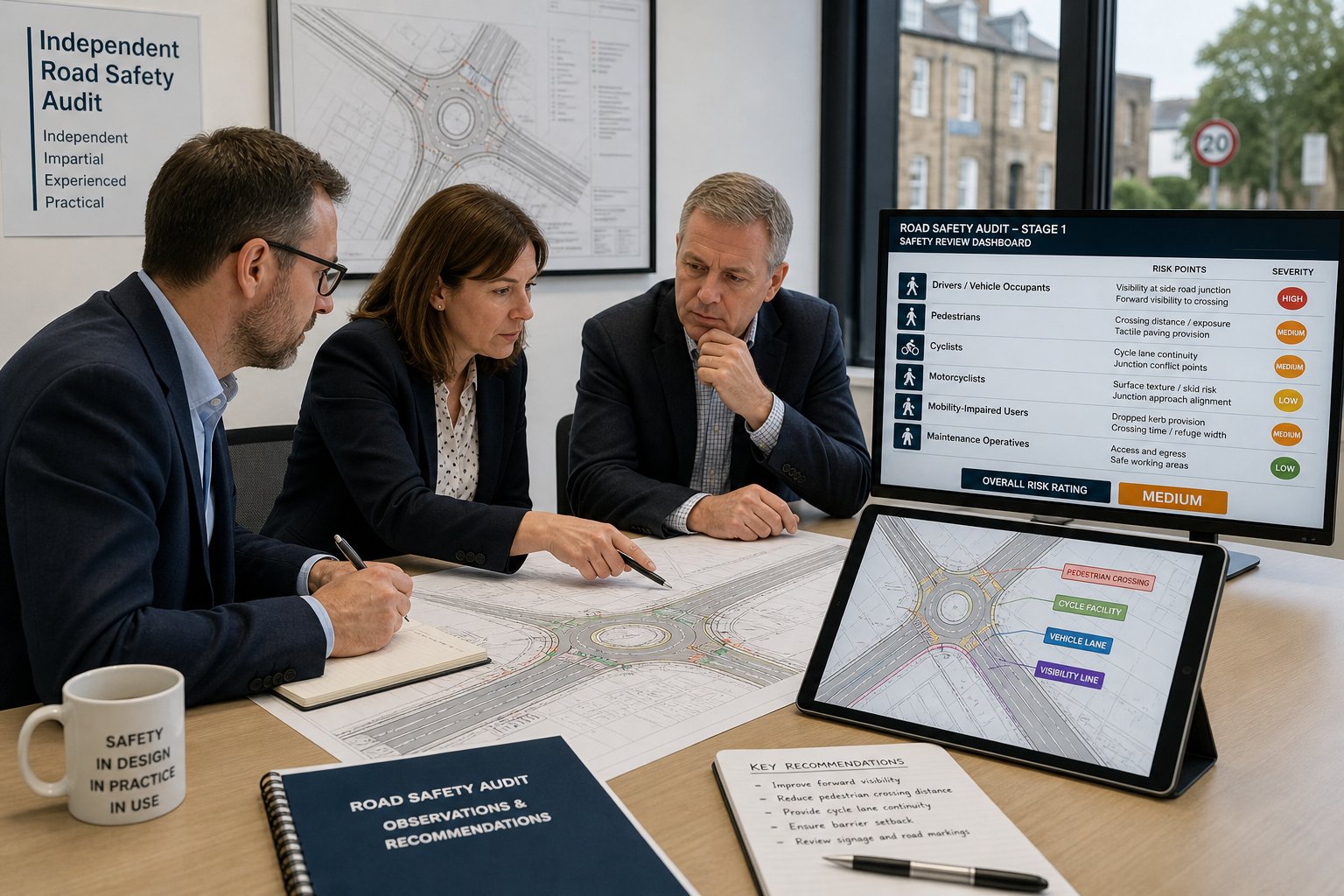
Road safety audit consultants are independent specialists who review highway schemes to identify features that may contribute to collisions or unsafe behaviour. Their role is not to redesign the project from scratch, and it is not simply to police standards. Instead, they examine how the scheme is likely to operate for all users, drivers, pedestrians, cyclists, motorcyclists, mobility-impaired people, equestrians and even maintenance operatives, and they flag safety problems with practical recommendations.
That independence matters. An audit should be carried out separately from the design team so there is a genuine challenge function. The consultant is asking a different question from the engineer or planner: not “does this layout achieve the design brief?” but “could this arrangement create avoidable risk when people use it in real conditions?”
You typically need road safety audit consultants when a development or highway project involves physical changes to the road network. Common examples include new priority junctions, signal upgrades, ghost island right turns, altered accesses, new pedestrian crossings, cycle facilities, lane reallocation, estate roads for adoption, and Section 278 or Section 38 works. On the strategic road network, audits are governed by DMRB GG 119. On local roads, many highway authorities apply similar expectations through planning and technical approval processes.
For project teams handling wider planning submissions, it often helps to align the audit with related technical inputs from Traffic Engineering Consultants: and access designers, so safety issues are identified early rather than after positions have hardened.
How A Road Safety Audit Differs From A Transport Assessment Or Travel Plan
A road safety audit is often confused with a Transport Assessment, but they serve different purposes. A Transport Assessment examines trip generation, traffic distribution, junction impact, capacity and network performance. It helps answer whether the development can be accommodated on the surrounding highway network and what mitigation may be needed.
A Travel Plan is different again. It focuses on travel behaviour, how staff, residents, pupils or visitors reach the site, and sets out measures to encourage sustainable modes such as walking, cycling, public transport, car sharing or electric vehicle use.
The RSA is narrower and sharper. It is a formal, independent safety review of the highway proposals or completed scheme. It does not exist to confirm that every element complies with standards, although departures from standards may be relevant where they create a safety concern. Nor is it primarily a capacity exercise. A junction can operate within capacity and still be unsafe: equally, a technically compliant layout can still generate risk because of visibility, speed perception, user confusion or poor accommodation of vulnerable road users.
That distinction is important for planning applications. We regularly see teams assume that because a TA is robust and a travel strategy is well-developed, safety has effectively been “covered”. It hasn’t. The audit is the discipline that specifically tests whether the scheme is likely to function safely in practice.
The Stages Of A Road Safety Audit Across Planning And Design
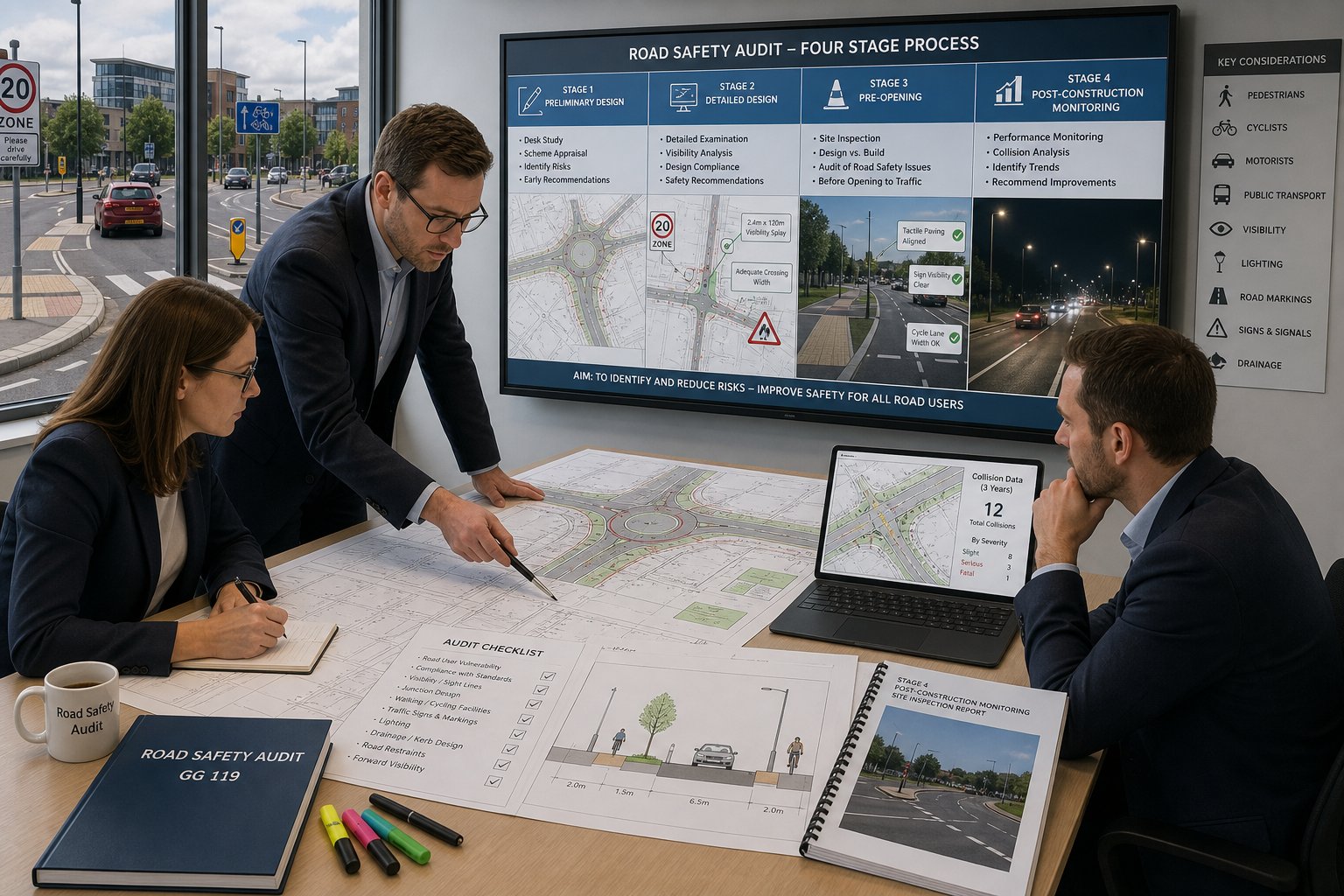
A proper road safety audit is staged so that safety is reviewed at the points where change is still possible and meaningful. Under UK practice, this usually means Stage 1 at preliminary design, Stage 2 at detailed design, Stage 3 after construction and Stage 4 once the scheme has been in operation long enough to review performance data. On smaller schemes, Stage 1 and Stage 2 may be combined.
This staged approach is one of the reasons early appointment matters. If the audit only appears once drawings are effectively fixed, the team loses the chance to resolve issues while amendments are still efficient and proportionate. By contrast, when the right audit team is appointed alongside experienced Highway Design Consultants:, safety considerations can be tested while geometry, access position, crossing strategy and user routes are still flexible.
Stage 1 To Stage 2: Feasibility, Preliminary And Detailed Design Reviews
Stage 1 focuses on the broad safety implications of the preliminary design. This is where auditors examine the fundamentals: junction form, alignment, cross-sections, anticipated speeds, access arrangements, pedestrian desire lines, cycle continuity, visibility and how different user groups are likely to interpret the layout. At this point, the biggest value often comes from catching strategic problems early, an access too close to a bend, a crossing placed away from natural movement patterns, or a lane arrangement that may confuse drivers.
Stage 2 then looks at the detailed design before construction. The principles may already be settled, but details now matter enormously: sign locations, lining, tactile paving, signal phasing, refuge widths, kerb alignments, intervisibility and the relationship between street furniture and available footway space. This is also where apparently small design choices can generate larger operational risks.
For planning-led projects, the Stage 1 or combined Stage 1/2 audit is often the most commercially important. It can influence technical approval, negotiation with the local highway authority and the confidence that a scheme is genuinely deliverable without major redesign later.
Stage 3 To Stage 4: Post-Construction And Monitoring Checks
Stage 3 happens once the scheme is substantially complete, before or shortly after opening to traffic. This is the point where the audit team can test the as-built layout rather than the designer’s intention. And those are not always the same thing. Kerb lines can differ slightly from drawings, signs may have been relocated on site, surfacing may affect skid resistance, vegetation may constrain visibility, and lighting or signal visibility can perform differently in real-world conditions.
A Stage 3 audit normally includes daytime and, where relevant, night-time inspections. That matters because night operation often reveals issues hidden in daylight, poor sign conspicuity, glare, uneven lighting, ambiguous road markings or crossing points that become harder to read.
Stage 4 is the longer-view check. Usually carried out around 12 to 36 months after opening, it considers collision data, operational patterns and sometimes near-miss indicators or maintenance observations. Not every private development team will be deeply involved at that stage, but for larger schemes and public-sector works it is a valuable feedback loop. It shows whether the design is functioning as intended and whether residual risks need further mitigation.
Good road safety audit consultants do not treat Stage 4 as a paper exercise. They use it to connect design assumptions with actual behaviour on the ground.
Who Typically Needs A Road Safety Audit For A Planning Application
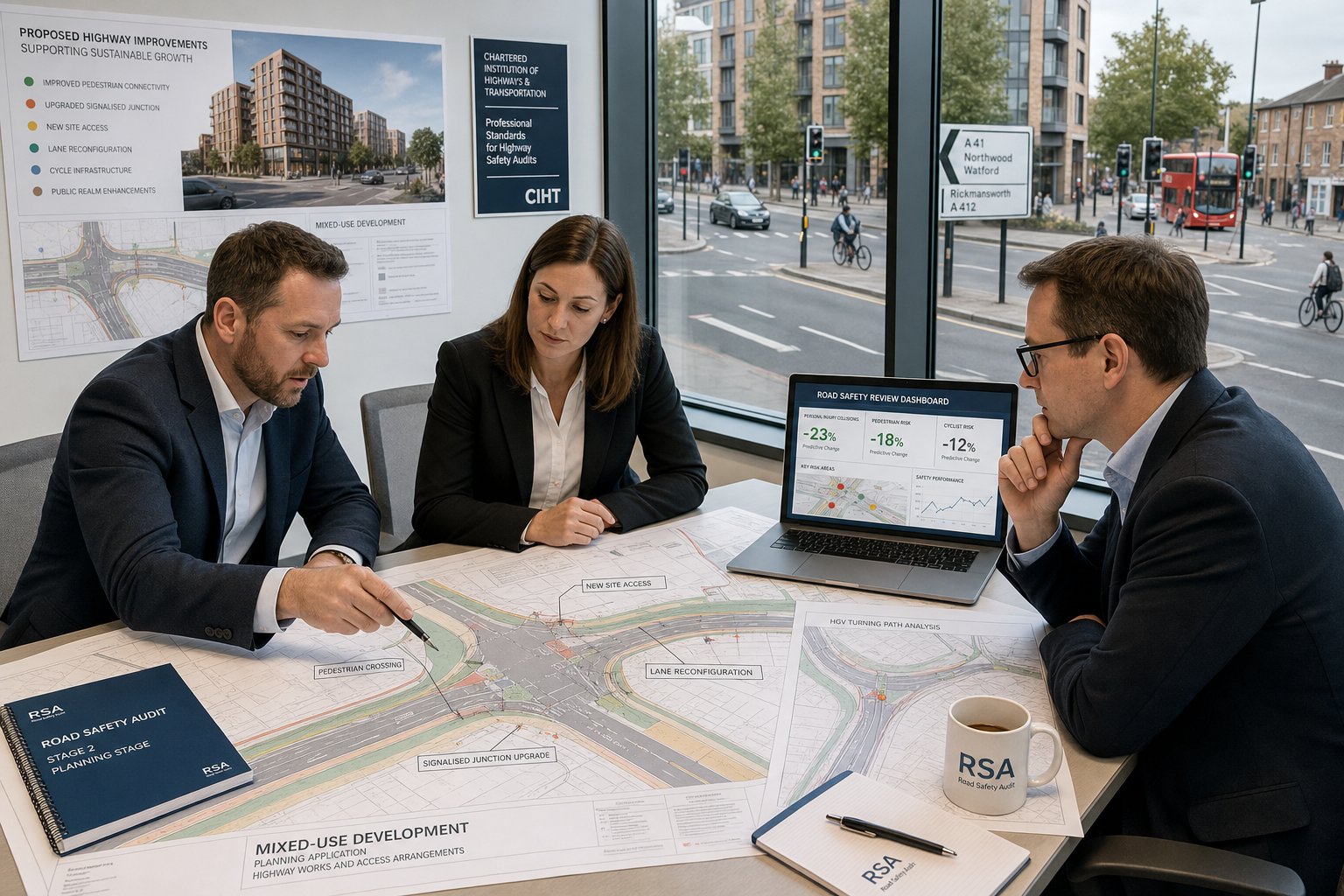
In planning terms, a road safety audit is most commonly needed where a proposal changes the way the highway operates. That may sound obvious, but in practice teams still underestimate how widely this applies. A major residential access onto a classified road will often trigger the need. So will a commercial scheme requiring a new ghost island, a retail development with revised signal staging, a school project introducing crossings, or an industrial site altering HGV turning movements.
The requirement is especially common where applications involve new or modified site accesses, junction improvement works, new internal roads intended for adoption, lane reconfiguration, signalised junction changes, pedestrian or cycle crossing infrastructure, or direct effects on the strategic road network. Many local authorities also routinely seek an RSA for Section 278 and Section 38 works because those schemes eventually affect publicly used highway space.
For developers, architects and planning consultants, the key point is that the need for an audit often arises before formal technical approval, not after. If the authority is likely to ask for one, it is usually better to commission it proactively and frame the safety response on your own timetable.
This is particularly relevant in urban areas where constrained geometry, frontage activity and complex multimodal movement patterns raise the risk profile. Teams working on regionally sensitive schemes often benefit from local design insight as well as audit independence, especially where highway design consultants are already coordinating access and off-site works.
In short, if your scheme changes how road users approach, enter, cross, merge, turn, wait or perceive the highway environment, an RSA may well be required, and even when it is not formally mandated, it may still be the smartest way to de-risk planning.
Key Risks Road Safety Audit Consultants Are Trained To Identify
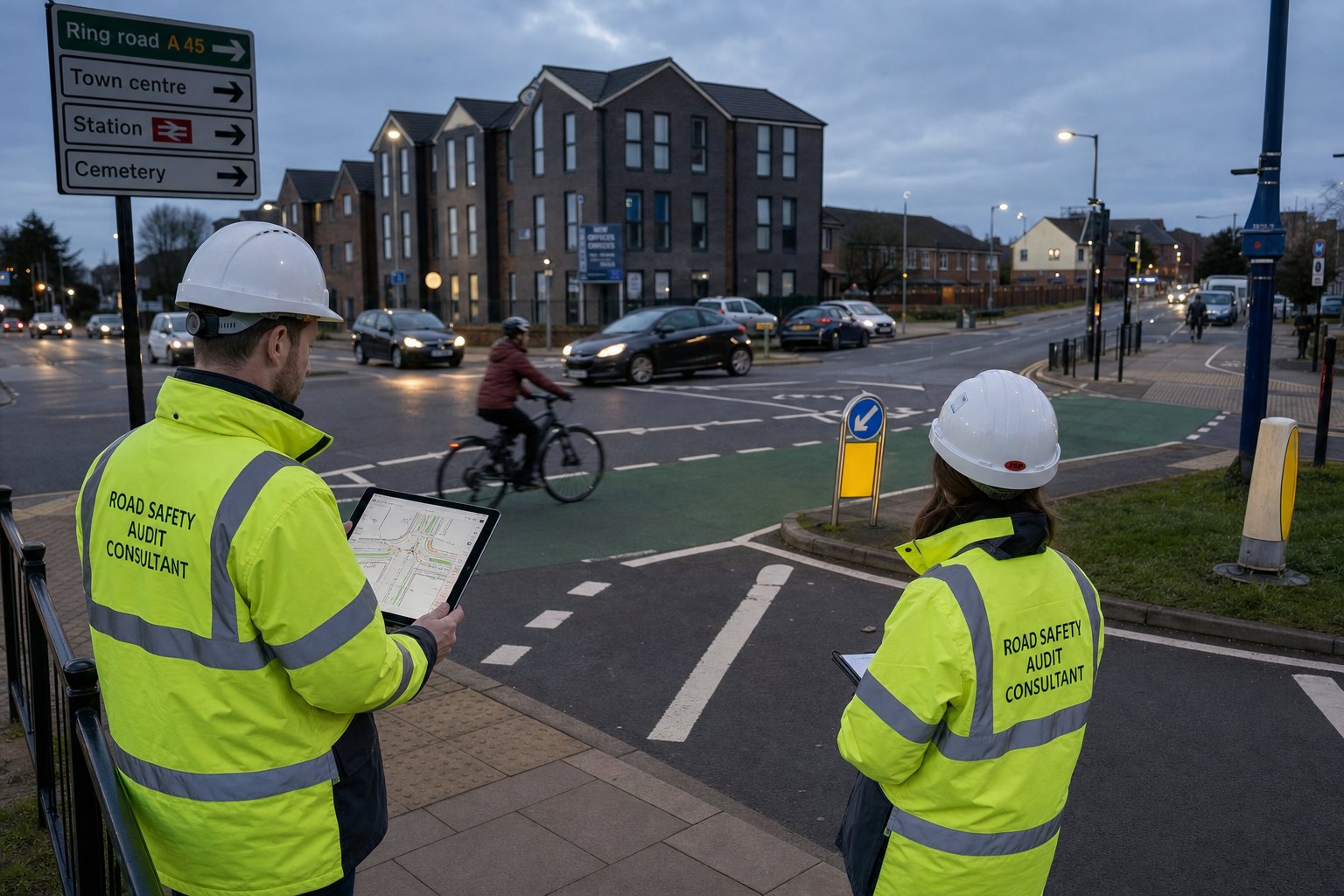
The strongest audit consultants are not just checking isolated details. They are reading how a whole environment may behave once real users interact with it under pressure, in poor weather, in darkness, or for the first time. That skill comes from a mix of safety engineering knowledge, site observation, design awareness and, ideally, experience of collision patterns.
A recurring theme in good audits is human behaviour. People do not use roads as perfectly as drawings assume. Drivers misread priority. Pedestrians follow desire lines instead of planned routes. Cyclists avoid narrow or intimidating space. Riders and delivery vehicles make choices based on momentum and visibility, not tidy CAD geometry. The consultant’s job is to anticipate that gap between design intent and actual use.
Visibility, Junction Layout, Pedestrian Crossings And Cycle Safety
Visibility is one of the first things auditors assess, but not in a simplistic box-ticking way. They look at whether drivers can see and be seen at the right moment, whether pedestrians are visible to turning traffic, whether landscaping or parked vehicles will obstruct sight lines, and whether crossing locations provide enough intervisibility for all user groups.
Junction layout is another major source of audit findings. Problems often arise where the arrangement is technically possible but behaviourally messy: excessive flare widths, awkward skew angles, unclear lane discipline, overlapping turning movements, or signal staging that creates uncertainty. Even a modest access can become risky if drivers emerge quickly into a high-speed environment or if queueing blocks critical visibility.
Pedestrian crossings are examined in relation to desire lines, waiting space, refuge dimensions, tactile provision, approach speed and visibility. A crossing that is a few metres away from where people naturally want to walk may simply not be used as intended.
Cycle safety has become a sharper focus in recent years, for good reason. Auditors will consider continuity of provision, conflict at side roads, pinch points, turning vehicle overrun, priority ambiguity and whether cyclists are pushed into uncomfortable interactions with faster traffic.
Speed Environment, Signing, Lighting And Road Markings
Speed environment is about more than posted limits. Auditors assess whether the road geometry, visibility, frontage activity and overall character of the route encourage speeds consistent with safe operation. If the design says one thing but the road “reads” another way, driver behaviour tends to follow the road, not the drawing note.
Signing, lighting and markings are often underestimated until late in the process. Yet many practical safety problems sit here. Signs can be obscured, cluttered, poorly sequenced or positioned too late for decision-making. Markings can be ambiguous, wear quickly, or fail to reinforce lane discipline. Lighting can leave crossing points or conflict areas under-emphasised, especially in wet conditions or winter darkness.
Auditors also look at how these elements work together. A layout with acceptable geometry can still feel uncertain if the visual cues are weak or contradictory. On completed schemes, night-time inspections are particularly revealing because they test conspicuity and comprehension under the conditions where many users are least forgiving.
Put simply, audit consultants are trained to spot the sort of risk that is easy to miss in office-based design reviews and expensive to fix once the scheme is built.
What Local Authorities And Design Teams Expect From The Audit Process
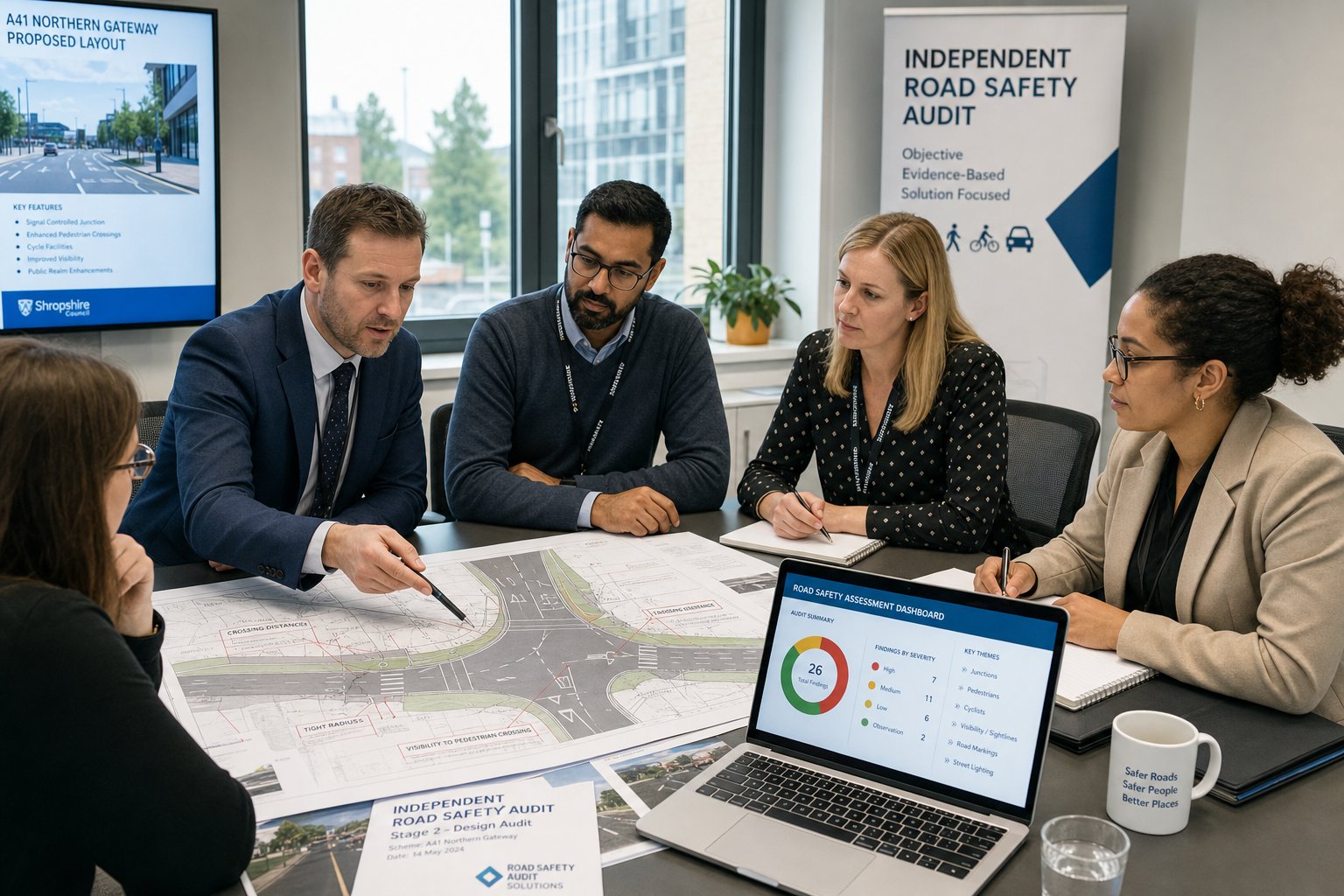
Local authorities and design teams generally want the same thing from a road safety audit process, even if they sometimes express it differently: a clear, defensible, independent review that helps the scheme move forward safely. They are not looking for drama. They are looking for competent, proportionate, technically sound input that can stand up in planning, technical approval and delivery.
First, they expect genuine independence. If the audit team appears too close to the design organisation, the process loses credibility fast. That does not mean auditors and designers need to be adversaries, far from it, but their roles must remain separate.
Second, they expect trained auditors with relevant experience. On straightforward schemes this may mean solid highway safety engineering competence. On more sensitive sites, schools, urban mixed-use environments, strategic roads, constrained town centres, it often means demonstrable experience of similar schemes and a strong understanding of vulnerable road users.
Third, they expect a concise report that identifies safety problems, explains why they matter and recommends measures in a way that can be acted upon. The best reports are specific without becoming theatrical. They avoid vague criticism and focus on credible, observable risk.
The process does not end with the audit report. Authorities typically expect a formal designer’s response to each problem raised, followed by a decision from the overseeing organisation on whether a recommendation is accepted, modified or rejected. That audit trail is important. It shows that safety issues were considered properly rather than brushed aside.
For planning teams, the practical takeaway is simple: treat the RSA as part of structured project governance, not an add-on PDF to satisfy a condition.
How To Assess A Consultant’s Experience, Independence And Technical Quality
Choosing between road safety audit consultants is not just about who can produce a report fastest. Speed matters, of course, particularly in planning programmes, but technical quality and credibility matter more. A weak audit can create false comfort or invite challenge from the authority, and neither outcome saves time.
Start with competence. Ask whether the auditors are trained following current UK practice and whether they regularly undertake audits on schemes comparable to yours. A consultant who mainly audits simple access junctions may not be the right fit for a town-centre public realm project with buses, loading, cycling and heavy pedestrian demand.
Then test relevant experience, not just years in business. We would want to know how many audits they complete, what stages they cover, whether they understand Section 278 and Section 38 contexts, and whether they can demonstrate insight into collision causation and vulnerable user safety. A consultant with thirty years in transport can still be a poor RSA choice if that experience is broad but not deep in safety audit work.
Independence should be checked carefully. If the consultant has helped prepare the design they are now auditing, that may undermine compliance and confidence. Ask direct questions about organisational separation, internal firewalls and who exactly is responsible for the design versus the audit.
Finally, review the quality of their reporting. Good consultants write clearly, identify real problems, avoid overreach and understand commercial reality without diluting safety. That balance is rare enough that it is worth asking for anonymised examples.
At ML Traffic, our broader planning support is built around concise, authority-aware reporting and practical highway advice. That same mindset is what clients should look for in an RSA team: independent judgement, technical depth and recommendations that are realistic to deliver.
Common Mistakes That Delay Approval Or Trigger Redesign
The most common mistake is timing. Too many teams commission the audit after the design is effectively frozen, after stakeholder expectations are set, or even after tender information is moving. At that point, perfectly reasonable safety recommendations can become programme problems because changing the design now means revisiting drawings, budgets, land requirements or planning commitments.
Another frequent issue is misunderstanding the purpose of the audit. When teams treat it as a standards check, they can become defensive about anything that is technically compliant. But compliance does not automatically remove safety risk. That tension often leads to unproductive debate and delayed responses.
Poor information is another cause of trouble. Incomplete drawings, missing speed data, unclear context plans, absent swept paths, or failure to explain pedestrian and cycle desire lines can all produce avoidable findings or requests for clarification. Auditors can only assess what they are given, and if the pack is thin, the report will necessarily be more cautious.
We also regularly see insufficient attention to vulnerable users. Crossings placed for geometric convenience rather than natural movement, cycle routes that disappear at the point of conflict, narrow refuges, awkward tactile layouts, and access positions that expose footway users to turning vehicles are classic triggers for redesign.
And then there is the on-site reality problem. Schemes can look acceptable in plan and still struggle in darkness or wet weather. Omitting required night-time inspections at later stages, or failing to account for vegetation, parking stress and street clutter, leaves risk hidden until late.
Most delays are not caused by the audit itself. They are caused by treating safety as something to prove at the end, rather than something to shape from the beginning.
How To Prepare For A Smoother Road Safety Audit And Better Project Outcomes
The best preparation starts earlier than many teams expect. If a scheme is likely to require a road safety audit, appoint the independent team while the design is still fluid, ideally around pre-application or early concept design for planning-led work. Early review tends to produce cheaper changes, clearer negotiation with the authority and far less frustration all round.
Next, make sure the auditors receive a coherent package. That usually means general arrangement drawings, tracking where relevant, traffic data, speed environment information, topographical context, proposed signs and markings if available, details of walking and cycling routes, and enough narrative to explain how the scheme is meant to operate. If there are known constraints, land, utilities, frontage access, adoption requirements, say so. Auditors do better work when they understand the real design envelope.
It also helps to prepare the internal team for the designer’s response process. An audit report is not the finish line: it is part of an exchange. Designers need time to consider recommendations, explain where they agree or disagree, and develop amendments that the overseeing organisation can support.
For stronger outcomes, keep safety visible from the outset. Think about speeds, visibility, crossing demand, cycle continuity, servicing, maintenance access and night-time legibility before the first submission leaves the office. That sounds simple, but it is where good schemes separate themselves from costly ones.
If we are advising clients on planning risk, we usually frame the RSA as one part of a coordinated evidence base: transport strategy, highway design, authority thresholds and safety review all working together. Done that way, the audit is not a hurdle. It becomes a design advantage.
Choosing the right road safety audit consultants, then, is less about buying a report and more about securing informed, independent judgement at the moments when it can still improve the scheme. In 2026, with tighter scrutiny on active travel, access design and public accountability, that is not optional polish. It is part of competent project delivery.
Frequently Asked Questions about Road Safety Audit Consultants
What do road safety audit consultants do?
Road safety audit consultants independently review road schemes to identify potential collision risks for all users, including pedestrians and cyclists, and recommend practical design changes to improve safety and reduce accident likelihood.
When is a road safety audit needed during a highway project?
A road safety audit is typically required when a development involves physical changes to the road, such as new junctions, crossings, or lane reallocations, especially if it affects user behaviour or collision outcomes as per DMRB GG119 standards.
How does a road safety audit differ from a Transport Assessment or Travel Plan?
A road safety audit focuses solely on safety risks in highway design, unlike a Transport Assessment which evaluates traffic impact and capacity, or a Travel Plan that promotes sustainable travel behaviours among site users.
What are the key stages of a road safety audit under UK guidance?
The UK process includes Stage 1 (preliminary design review), Stage 2 (detailed design review), Stage 3 (post-construction inspection), and Stage 4 (post-opening monitoring), ensuring safety is evaluated from concept through operation.
How can I choose the right road safety audit consultant for my project?
Choose consultants who are independent, trained per GG119 standards, experienced in relevant scheme types, knowledgeable about vulnerable road users, and who provide clear, practical reports that support smooth project delivery.
What common mistakes delay approval or cause redesign related to safety audits?
Delays often result from commissioning audits too late, treating audits as mere standards checks, ignoring pedestrian and cyclist needs, and omitting necessary site visits at night, rather than from the audits themselves.