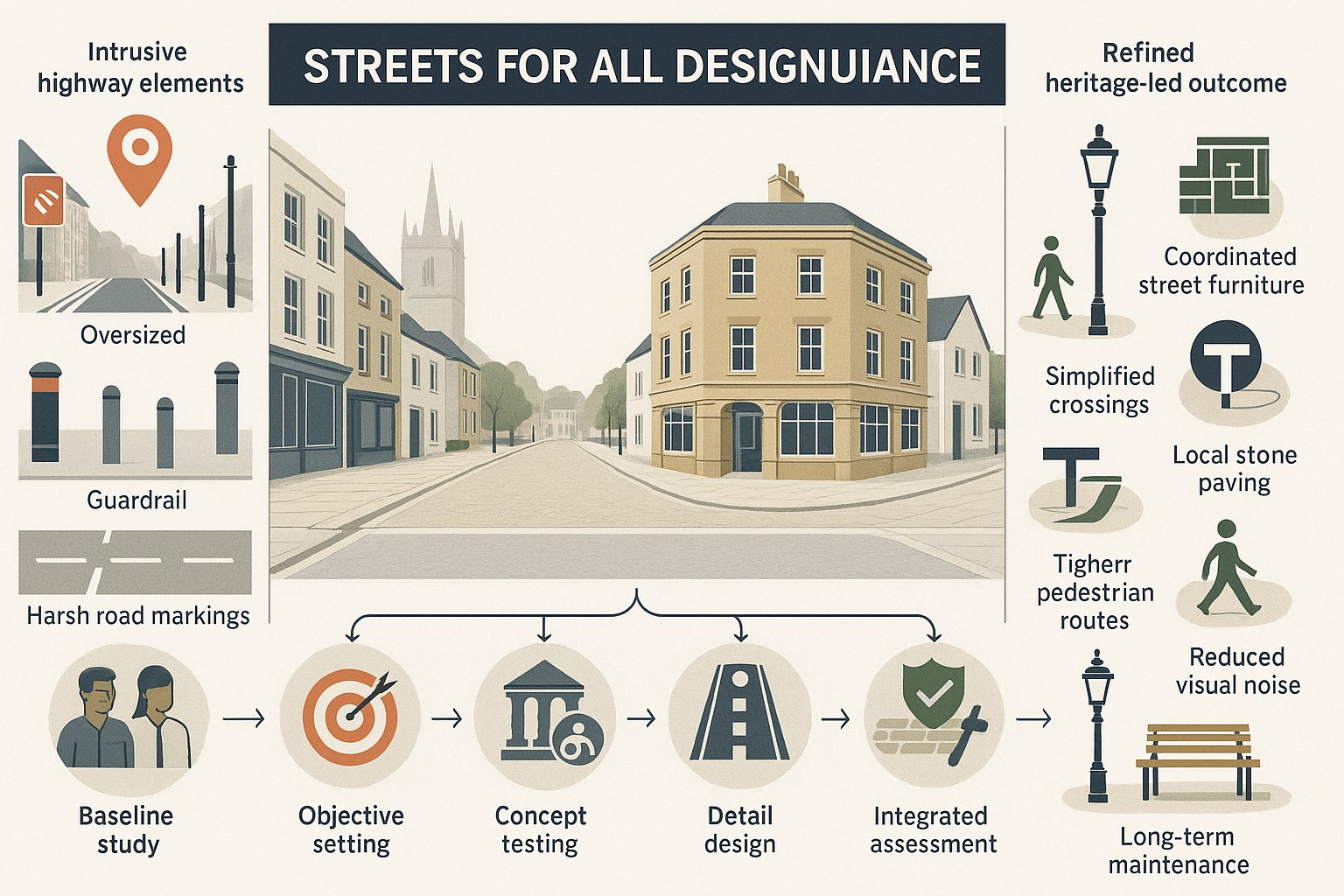
Historic streets rarely fail because people care too much about them. They fail because projects treat them like ordinary roads. A junction gets widened, signs multiply, bollards appear one by one, surfacing changes without much thought, and before long, the very qualities that made the place distinctive are harder to see.
That is exactly why streets for all design guidance matters. Produced by Historic England, it gives planners, highway engineers, architects, developers and local authorities a practical framework for improving safety, accessibility and street function in sensitive historic places without eroding their character. It is not anti-change, and it is not a nostalgic plea to freeze streets in time. It is a method for making change more intelligent.
For teams preparing planning applications, transport statements or detailed public realm proposals, the guidance is especially useful because it helps bridge disciplines that too often work in silos: transport, heritage, urban design and accessibility. In our experience, that is where many delays begin. A scheme may be technically workable from a traffic point of view, yet still attract objections because the design has not responded properly to setting, materials, visual clutter or conservation significance.
In this guide, we explain what Streets for All is, how it supports heritage-led design, and how to apply it in a real project workflow. We also look at the mistakes that commonly trigger planning pushback, and how to avoid them early.
What Streets For All Design Guidance Is And Why It Matters
Streets for All is Historic England’s design guidance for highways and public realm works in sensitive historic environments. It was created for practitioners who have to make modern streets work, highway designers, transport consultants, planners, urban designers, conservation officers and developers, while respecting the special interest of historic places.
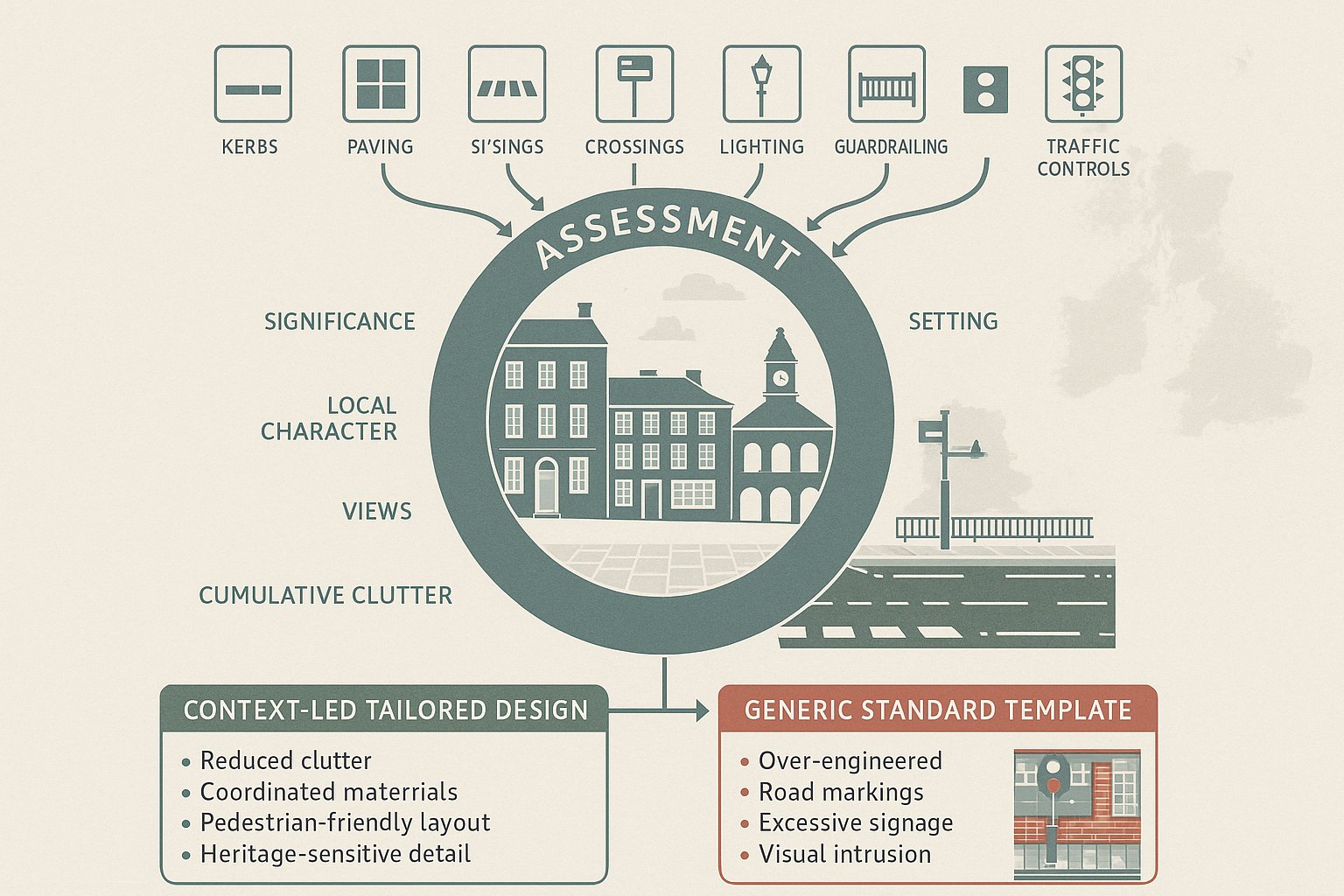
Its importance lies in its practicality. Rather than speaking only in broad conservation principles, it addresses the real design decisions that shape a street: kerbs, signs, paving, crossings, traffic management, parking, lighting, guardrailing and clutter. The central message is simple: historic places can accommodate change, but the response must start with the place itself, not with a default highway template.
That matters because many planning and highway problems stem from standardisation. A design developed for a suburban distributor road can cause real harm if dropped into a conservation area, around listed buildings or within a historic market town. Streets for All helps teams avoid that mismatch by requiring a more careful reading of significance, setting and local character.
It also matters from a planning-risk perspective. In historic areas, design quality is not decorative: it is material. Schemes that overlook townscape character, views, or the cumulative effect of street equipment can face objections, redesign requests or delays. Using the guidance early can strengthen planning, heritage and transport submissions by showing that accessibility, safety and functionality have been considered alongside historic character rather than at its expense.
How The Guidance Supports Heritage-Led Street Design
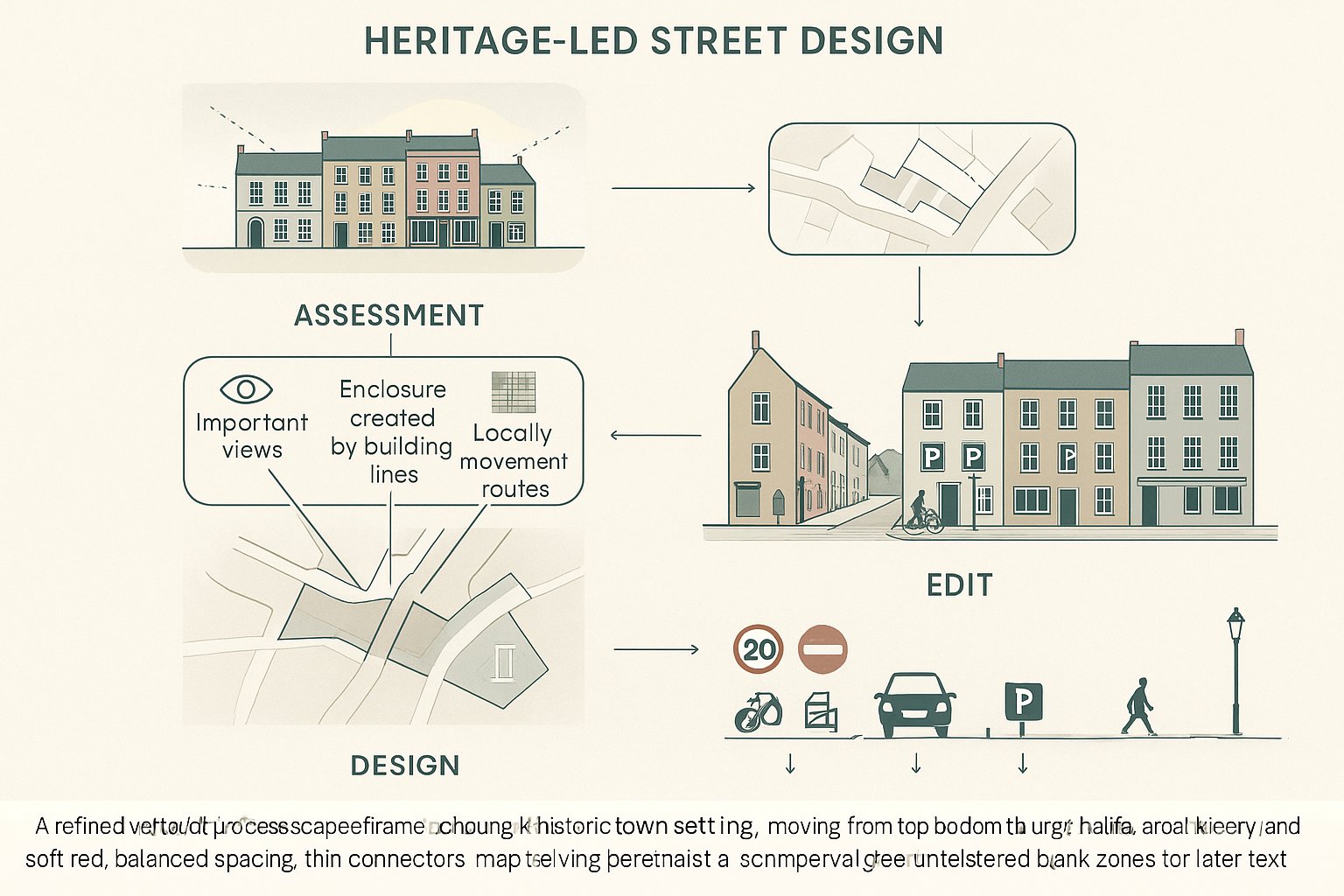
Heritage-led street design does not mean designing by sentiment. It means understanding what is significant about a place and letting that understanding guide technical choices. Streets for All supports this approach by beginning with significance and setting.
In practice, that means asking different first questions. Not just: how many vehicles use the street, what is the recorded speed, or where can signs be installed? But also: what are the important views, how do building frontages define enclosure, which materials are locally characteristic, what historic patterns of movement still survive, and which features contribute to the area’s identity?
That shift is powerful. Once we understand a street as part of a historic environment, the design task becomes one of revealing character rather than obscuring it. Traffic management, servicing arrangements, surfacing upgrades and accessibility improvements are still possible, often necessary, but they are shaped to support the place. Good schemes reduce visual noise, simplify cluttered edges and make the townscape easier to read.
Historic England’s wider body of guidance, alongside Streets for All, has been influential because it shows that heritage-sensitive design can still be robust, safe and contemporary. The strongest schemes usually look calm, not because little has changed, but because every change has been edited. And that, frankly, is where many successful town-centre and conservation-area projects differ from schemes that feel over-engineered from day one.
Core Principles That Shape Streets For All Schemes
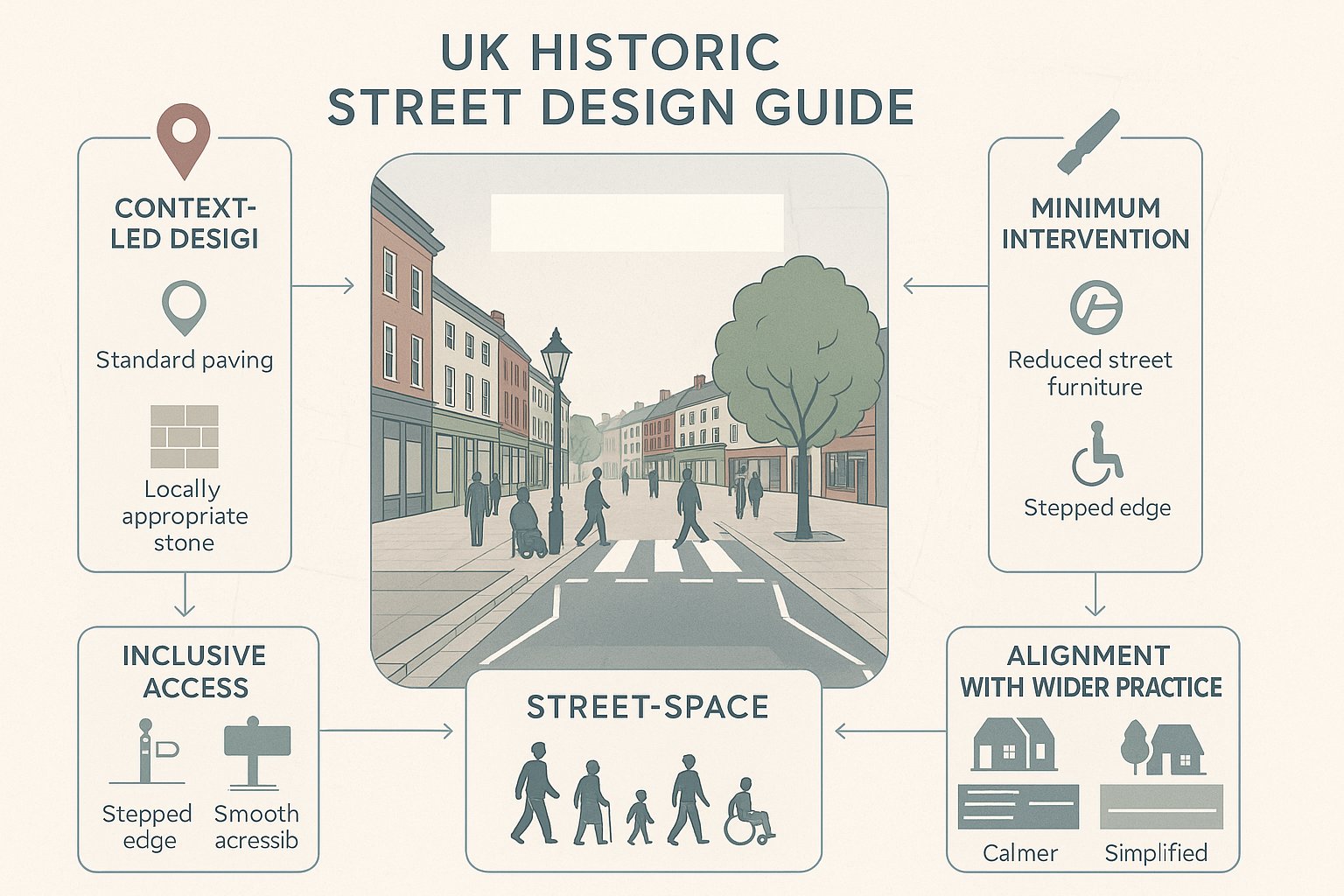
Several core principles run through streets for all design guidance, and they are as relevant in 2026 as ever.
First, place comes before pure traffic movement. Streets are not simply corridors for vehicles: they are civic spaces, settings for historic buildings, and places where people walk, wait, meet, shop and navigate. Second, design should be context-led and character-sensitive. Historic streets are rarely interchangeable, so standard details should never be applied without challenge. Third, the guidance promotes minimum necessary intervention. In other words, do what is needed for function and safety, but do not add signs, barriers, markings or furniture just because they are available in the catalogue.
A fourth principle is inclusive design. Heritage value is not protected by making a place harder to use. Step-free movement, legible routes, crossing opportunities and appropriate surface contrasts matter. The task is to integrate them with care.
Finally, Streets for All aligns closely with wider good practice, especially the place-focused thinking found in Manual for Streets. That overlap is useful for planning teams because it creates a common language across transport, urban design and conservation disciplines.
Place Before Movement
The phrase sounds obvious now, but it still cuts against some deeply embedded habits in highway design. For decades, too many schemes judged success mainly by capacity, deflection geometry, visibility splays and traffic throughput. Streets for All challenges that narrow lens.
In historic centres especially, traffic dominance can quickly damage character. Wide carriageways, over-marked junctions and fast vehicle speeds do more than alter movement patterns: they change how a place feels. They make streets harder to cross, less pleasant to linger in, and visually less coherent. A market square starts reading like a traffic machine.
Putting place before movement does not mean ignoring vehicles. It means balancing movement with civic, commercial and social value. That can lead to lower design speeds, tighter geometry, simpler layouts, stronger pedestrian priority or a reallocation of kerbside space. Sometimes the best intervention is not adding more hardware, but removing what has accumulated over time.
Context-Led And Character-Sensitive Design
This principle is where many proposals either become convincing or unravel. Context-led design starts with observation. We need to understand local materials, kerb traditions, plot rhythm, enclosure, views, surface hierarchy, drainage patterns, tree presence, street widths and the relationship between buildings and carriageway.
Why does that matter? Because historic character is often carried by subtle things. A flush kerb where a conservation area historically used granite upstands. A bright, standard paving module where the town’s identity comes from irregular stone. A sign placed in front of a key facade. None of these decisions seems dramatic in isolation, but together they can erode the legibility of a place.
Streets for All rejects one-size-fits-all design. It asks us to respond to the street that is actually there, not the one assumed by a standard drawing pack. For design teams, that usually means more analysis early on, but fewer surprises later.
Accessibility, Safety, And Inclusion In Historic Streets
One of the most persistent myths in historic street design is that accessibility and heritage are somehow in tension by default. They are not. Poorly considered design creates the tension: thoughtful design resolves it.
Streets for All is clear that historic places must still work for everyone. That includes older people, wheelchair users, blind and partially sighted people, parents with prams, visitors unfamiliar with the area, and those moving through the street under time pressure rather than leisurely admiration. Inclusive design is not an optional add-on for modern schemes: it is part of making a street function properly.
In practical terms, that means providing clear and legible pedestrian routes, avoiding unnecessary level changes, ensuring crossing points are where people actually want to cross, and using tonal and tactile contrasts carefully. It also means recognising that some apparently “traditional” details can create barriers if used without thought. Uneven surfaces, awkward drainage channels and poorly repaired paving may look authentic, but they can exclude people very effectively.
Safety needs the same balanced approach. In historic streets, safety measures should not automatically default to the most visually intrusive option. Guardrail, excessive lining, oversized signing and cluttered islands may solve one perceived issue while creating several others. Lower speeds, simpler layouts, better crossing alignment and reduced ambiguity can often improve safety more elegantly.
For planning submissions, this is where joined-up evidence matters. We have seen stronger outcomes when transport, heritage and accessibility arguments are prepared together rather than in separate documents that barely acknowledge each other. On projects requiring transport assessments, that integration can also help demonstrate to local authorities that functionality and historic character have been weighed in a coherent way.
Materials, Street Furniture, And Public Realm Details
If strategy sets the direction, materials and details decide whether a scheme actually feels right on the ground. Historic streets are highly sensitive to small components. A dozen minor decisions can shape the result more than one grand masterplan diagram.
Streets for All hence places strong emphasis on durable, repairable and locally appropriate materials. Natural stone, traditional kerbs and finishes that reflect local precedent are often preferred where justified, not because they are quaint, but because they weather better visually, support continuity and reinforce local identity. That said, appropriateness is not the same as expensive mimicry. The best material choice is usually the one that matches context, performs well in use and can be maintained realistically.
Street furniture deserves the same discipline. Bollards, signs, lighting columns, bins, guardrail, planters, benches and cabinets can quickly overwhelm a historic street if each is chosen in isolation. The guidance pushes us towards rationalisation: fewer items, better placed, with a coherent visual language.
Three details matter especially:
- Number: only keep what is genuinely necessary.
- Placement: avoid blocking views, pinching footways or cluttering building frontages.
- Consistency: use coordinated families of elements rather than piecemeal additions.
This sounds modest, but it has major impact. Many objection-prone schemes are not rejected because of one catastrophic design move. They struggle because they look busy, generic or unresolved. In contrast, a disciplined palette of surfaces and furniture can make even technically complex interventions read as calm and considered.
Managing Traffic, Parking, And Servicing Without Harming Character
Traffic, parking and servicing are usually where idealism meets delivery. Historic centres still need to function. Shops need loading. Residents need access. Buses need to move. Emergency services cannot be designed out of the conversation. Streets for All is useful precisely because it does not ignore these realities: it asks us to manage them more intelligently.
A heritage-sensitive approach starts by questioning whether traffic dominance has become normalised. Do all vehicle movements need to be there, in that form, at that speed, all day? Could servicing be time-managed? Could parking be consolidated, reduced or better designed? Could signage be simplified? Could kerbside space be reallocated to improve pedestrian comfort or support cycling and public transport?
Often, the answer is yes, at least in part. Rationalised parking layouts, carefully located loading bays, lower-speed environments and cleaner kerbside management can reduce harm without undermining function. The trick is precision. A few badly sited parking spaces can damage the setting of listed buildings more than a modest reduction in general carriageway width ever would.
The visual impact of management measures also matters. Markings, upright signs, ticket machines, cameras and protective barriers can colonise a street surprisingly quickly. The guidance encourages restraint and integration, with the minimum equipment needed to make a management regime work.
For development-led schemes, we often advise clients to address these issues early in transport work rather than leaving them to late-stage landscape or public realm notes. If the access and servicing strategy fights the heritage logic of the scheme, that conflict usually surfaces during consultation, and by then redesign is more painful and more expensive.
The Role Of Streets For All In Planning And Transport Assessments
For planning professionals and transport consultants, Streets for All is not just background reading: it can be a useful evidential tool. In historic settings, it helps show that a proposal has been developed with recognised good practice in mind and that design choices have been tested against more than traffic operation alone.
That is important because schemes in conservation areas or near designated heritage assets are often judged through multiple policy lenses at once: design quality, accessibility, highway safety, heritage impact, public realm quality and local character. Streets for All helps connect those strands. Used alongside Manual for Streets, local plan policy, conservation area appraisals and authority-specific guidance, it strengthens the logic behind a proposal.
In transport statements and transport assessments, the guidance can support narrative around:
- why lower-speed or place-led design is appropriate:
- how crossing, servicing or parking arrangements have been balanced with townscape sensitivity:
- why clutter reduction or simplified geometry improves the street as a whole:
- how the scheme responds to the significance and setting of heritage assets.
For a specialist practice such as ML Traffic, this is exactly where clear reporting matters. Local authorities do not just want data: they want confidence that the transport case understands the planning context. A concise, accurate assessment that reflects local thresholds and historic-place sensitivities can make the broader application more persuasive.
And there is a practical benefit too: when transport evidence is aligned with heritage-led design principles from the start, the planning team spends less time trying to reconcile contradictory consultant outputs later.
Common Design Mistakes That Trigger Objections Or Delays
Most objections in historic street projects are not caused by ambition. They are caused by carelessness, standardisation or unresolved trade-offs. A few mistakes appear again and again.
Over-engineered junctions are a classic example. Large corner radii, multiple lanes, heavy lining and excessive islands may satisfy a narrow highway instinct, but in a historic town centre they can dominate the entire scene and make pedestrian movement feel secondary.
Suburban or generic materials are another frequent problem. Bright concrete block paving, oversized kerbs or standard precast details can jar badly in historic cores, especially where local stone, restrained palettes and finer grain are part of the area’s identity.
Too much equipment is probably the most common issue of all. Sign proliferation, bollard creep, unnecessary guardrail, duplicate poles and poorly coordinated cabinets create clutter and weaken visual coherence. One sign may be justified. Fifteen often are not.
There are also more subtle errors:
- failing to assess key views and settings before fixing layout:
- treating accessibility as a late compliance exercise instead of a design principle:
- using standard details without understanding local character:
- separating transport, heritage and public realm design into silos.
What triggers delay is not just the presence of these issues, but the impression they create: that the scheme has not really understood the place. Once that concern takes hold among planners, conservation officers or local stakeholders, even sensible parts of the proposal can come under heavier scrutiny. Prevention, as ever, is cheaper than redesign.
How To Apply The Guidance In A Real Project Workflow
The best way to use streets for all design guidance is not as a final polish, but as a workflow. Applied early, it helps teams make better decisions before positions harden.
1. Baseline
Start with a proper understanding of the street. That means heritage significance, conservation context, listed buildings, views, materials, movement patterns, collision data, accessibility barriers, servicing needs and existing clutter. Photographs, character analysis and on-site observation matter here. Desk work alone rarely captures why a street feels as it does.
2. Objectives
Set project objectives that balance place, movement, safety and inclusion. Be explicit. Are we trying to reduce vehicle dominance? Improve crossings? Rationalise parking? Protect setting? Support town-centre vitality? Vague briefs tend to produce compromised design.
3. Concept design
Test options against place-before-movement and inclusive design principles. At this stage, we should be willing to compare genuinely different approaches rather than polishing the first highway layout produced. Simple sketches can reveal whether a concept respects building lines, views and pedestrian desire lines.
4. Detail design
Once the concept is right, develop materials, kerbs, furniture, drainage, lighting and traffic measures with discipline. Every element should justify its presence. This is where many schemes drift back into standardisation, so design review is vital.
5. Assessment and iteration
Quality audit the scheme through transport, heritage and accessibility lenses. If a crossing point works technically but damages an important setting, revisit it. If a material is beautiful but fragile in a high-turnover area, reconsider. Iteration is normal, not failure.
6. Implementation and maintenance
Finally, protect the design through delivery and long-term management. Poor workmanship, ad hoc repairs and uncoordinated future additions can undo a thoughtful scheme surprisingly fast. Historic streets need maintenance strategies, not just capital works approval.
Conclusion
Used well, streets for all design guidance gives us a practical way to design streets that are safer, more inclusive and easier to manage without sacrificing the qualities that make historic places distinctive. Its value lies in that balance. It does not ask us to choose between movement and character, or between accessibility and heritage. It asks us to design well enough to serve both.
For architects, planners, surveyors, highway engineers, developers and local authorities, that makes it more than a heritage document. It is a delivery tool, especially when combined with Manual for Streets, local policy and robust transport evidence.
The projects that succeed are rarely the ones with the most intervention. They are the ones with the clearest understanding of place, the strongest coordination between disciplines, and the discipline to remove as much as to add. In historic streets, that restraint is not a limitation. It is usually the difference between a scheme that belongs and one that merely arrives.
Streets for All Design Guidance – Frequently Asked Questions
What is Streets for All design guidance and why is it important?
Streets for All is Historic England’s practical design guidance for highways and public realm works in sensitive historic areas. It helps improve accessibility, safety, and street function without harming the heritage character, reducing the risk of planning refusals or delays.
How does Streets for All support heritage-led street design?
It begins with understanding the significance and setting of historic places, guiding technical choices to reveal rather than obscure character. This ensures that traffic management, surfacing, and street equipment respect local identity while accommodating necessary modern functions.
What are the core principles behind Streets for All schemes?
Core principles include prioritising place and character over pure traffic movement, context-sensitive design, minimum necessary street clutter, inclusive accessibility, and alignment with the people-centred approach of Manual for Streets.
How can designers balance accessibility and heritage in historic streets?
By adopting inclusive design that provides step-free routes, clear crossings, and appropriate surface contrasts while using discreet safety measures. Thoughtful design avoids tension by integrating accessibility needs with historic fabric and visual sensitivity.
Why is managing traffic and parking carefully important in historic areas?
Because traffic dominance and poorly located parking or signage can damage heritage settings. Streets for All encourages traffic restraint, rationalised signage, and kerbside management that supports local character and reallocates space to pedestrians, cyclists, and public transport where possible.
How should Streets for All be applied in a real project workflow?
Use it from the start by assessing heritage significance and street function, setting clear objectives, testing concepts with place-first and inclusive principles, selecting appropriate materials and furniture, iterating with quality audits, and ensuring good implementation and maintenance to safeguard character.