Tag: 2026 Planning

  • Traffic Calming for Residential Areas: 2026 Planning Guide

    Traffic Calming for Residential Areas: 2026 Planning Guide

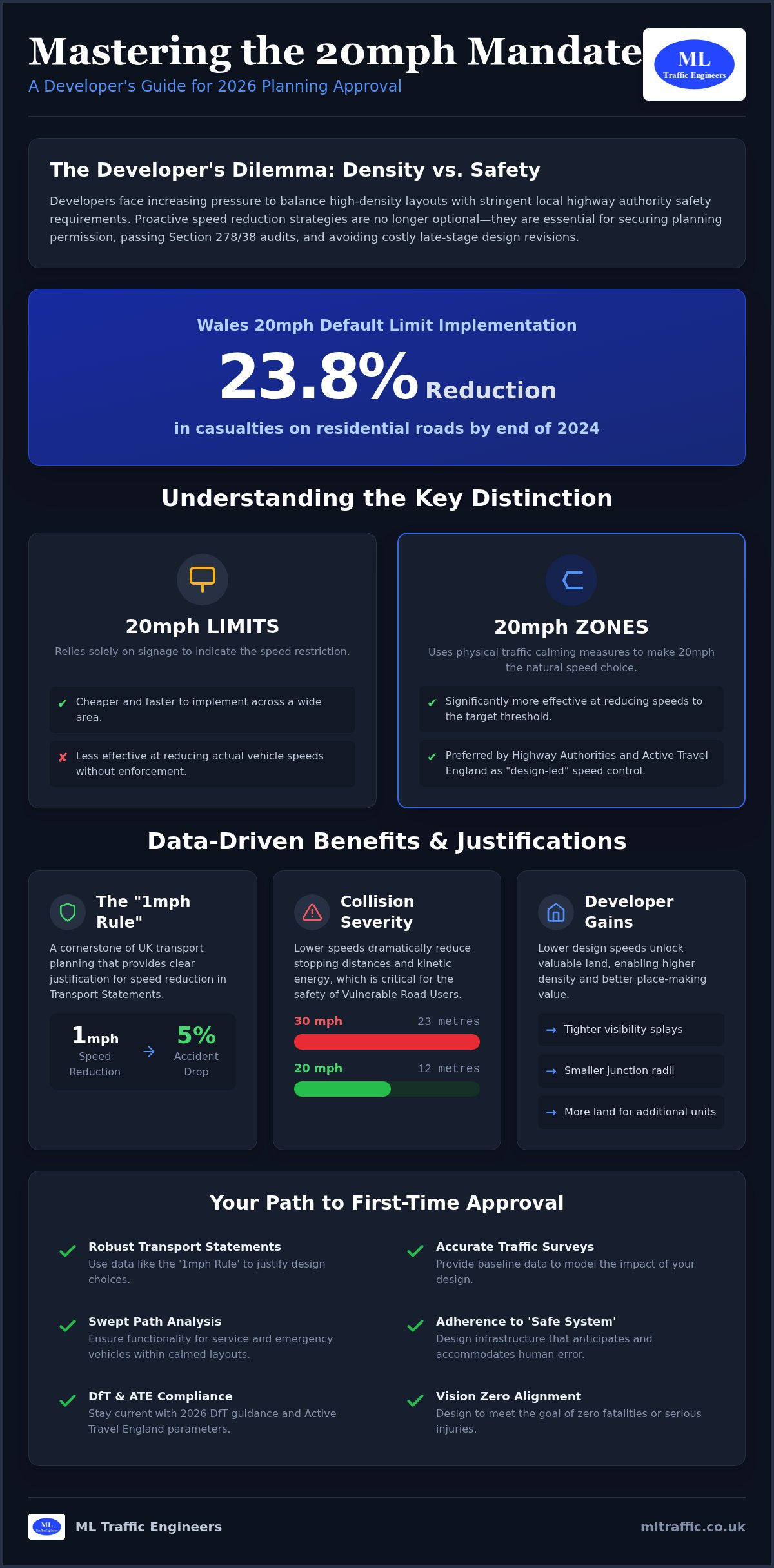
    Did you know that the 20mph default limit implementation in Wales contributed to a 23.8% reduction in casualties on residential roads by the end of 2024? As a developer or planner, you understand the increasing pressure to balance high-density site layouts with the stringent safety requirements of local highway authorities. It’s frustrating when essential traffic calming measures for residential developments lead to failed Swept Path Analysis or expensive design revisions at the eleventh hour.

    This 2026 planning guide helps you master the technical implementation of speed reduction to secure planning approval and pass Section 278 audits the first time. We will examine the latest 2026 Road Safety Strategy targets, the specific costs of physical interventions like £22,500 road narrowing features, and how to use data-driven Transport Statements to justify your site design. You’ll gain the technical authority needed to turn regulatory mandates into enhanced place-making value while ensuring every layout remains functional and compliant.

    Key Takeaways

    • Distinguish between signage-led 20mph limits and physical 20mph zones to align your site design with the latest 2026 Vision Zero safety standards.
    • Learn how implementing strategic traffic calming measures for residential developments can optimize land use by enabling tighter visibility splays and smaller junction radii.
    • Utilize the “1mph Rule” and evidence from national rollouts to provide robust justification for speed reduction within your Transport Statements.
    • Understand the role of accurate Traffic Surveys and Swept Path Analysis in securing first-time approval for Section 278 and Section 38 audits.
    • Stay compliant with 2026 DfT guidance and Active Travel England parameters to reduce regulatory friction and avoid expensive layout revisions.

    The Evolution of 20mph Speed Limits and Traffic Calming in 2026

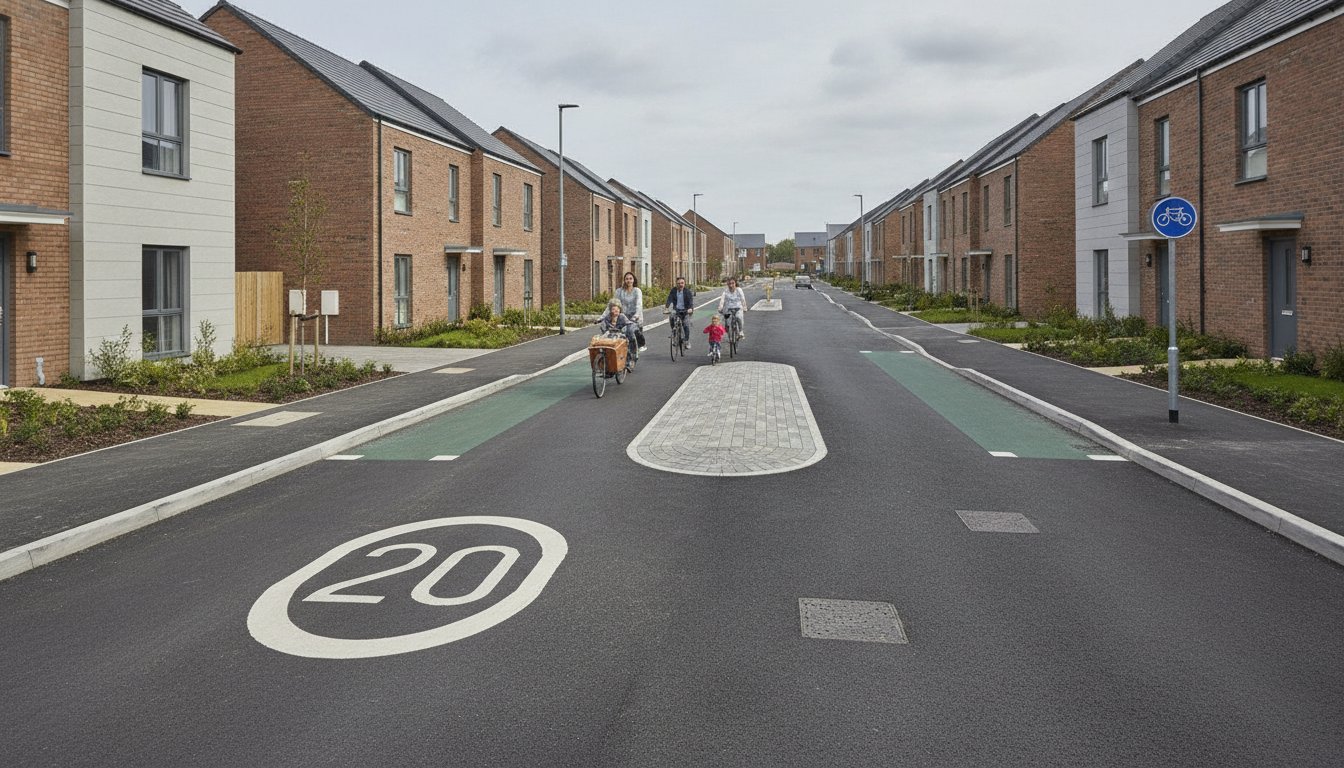
    The 2026 planning environment demands a sophisticated approach to road safety. Planners no longer view traffic calming as a reactive fix for speed complaints. Instead, it’s a proactive requirement for securing planning permission. A major distinction exists between 20mph limits, which rely solely on signage, and 20mph zones, which use physical traffic calming measures for residential developments. While limits are cheaper to implement, zones are significantly more effective at reducing speeds to the desired threshold. For a deeper look at these interventions, you can consult this comprehensive overview of traffic calming.

    Vision Zero has evolved from a metropolitan ambition into a standard local authority benchmark. In Wales, the default 20mph limit introduced in September 2023 has already shown a 23.8% reduction in casualties on residential roads by the end of 2024. Scotland continues its nationwide rollout, while England maintains a local-choice model, though Active Travel England now heavily influences these decisions. Design-led speed control is the preferred standard. Highway authorities want to see layouts that naturally restrict speed through geometry rather than relying on retrospective enforcement or signage that drivers might ignore.

    National vs. Local Implementation Trends

    Active Travel England now sets rigorous infrastructure standards that developers must follow to unlock funding and approval. In high-density areas like London, 20mph mandates aren’t just safety measures; they’re tools to support site density. Lower design speeds allow for tighter visibility splays, which saves valuable land for additional units. Moving from a 30mph to a 20mph default design speed for new-build estates is now the expected starting point for any Transport Statement.

    Technological Shifts in Speed Management

    Technology now supports physical design. Mandatory Intelligent Speed Assistance (ISA) in new vehicles helps keep drivers within limits, but it doesn’t replace the need for physical traffic calming measures for residential developments. Connected vehicle data now provides authorities with real-world compliance maps, showing exactly where speeds exceed thresholds without the need for manual spot checks. The ‘Safe System’ approach used by UK highway authorities defines safety as a shared responsibility where the road system is designed to accommodate human error and limit impact forces to survivable levels. This shift ensures that even when mistakes happen, the infrastructure prevents fatal outcomes.

    Quantifiable Benefits: Safety, Environment, and Urban Quality

    Implementing traffic calming measures for residential developments isn’t just a regulatory hurdle. It’s a data-led strategy for risk mitigation. The ‘1mph Rule’ is a cornerstone of UK transport planning. Evidence shows that every 1mph reduction in average vehicle speed correlates to a 5% drop in accident frequency. This metric provides developers with a clear, quantifiable justification for speed reduction in their planning submissions. By designing for lower speeds, you’re directly reducing the likelihood of collisions from the outset.

    Road Safety and Collision Severity

    The physics of urban collisions are unforgiving. At 30mph, a vehicle’s stopping distance is approximately 23 metres, but at 20mph, this nearly halves to 12 metres. This reduction is critical for child safety in high-density residential layouts where reaction times are shorter. Kinetic energy in a collision increases with the square of the vehicle’s speed, meaning a 10mph difference dramatically alters survival outcomes. Vulnerable Road Users (VRUs), such as cyclists and pedestrians, face a significantly higher fatality risk at 30mph compared to 20mph. Beyond physical safety, lower speeds reduce the ‘severance’ effect. This allows residents to move freely across the site without the psychological barrier of fast-moving traffic, effectively reconnecting communities within the development.

    Air Quality and Smooth Traffic Flow

    Critics often argue that lower speed limits increase emissions due to constant braking. However, well-designed traffic calming measures for residential developments promote a steady-state driving style. Maintaining a consistent 20mph reduces the heavy acceleration and braking cycles that spike NO2 and particulate matter levels. This smoother flow also results in a measurable decibel drop, improving the acoustic environment for residents. There are many proven outcomes of traffic calming, including the promotion of active travel for ‘last-mile’ trips. When people feel safe, they’re more likely to walk or cycle, which directly supports the targets in your Travel Plan. Lower speeds also reduce the mechanical stress on road surfaces, extending the longevity of the infrastructure and lowering long-term maintenance costs for the management company.

    UK Case Studies: Evidence-Based Planning Success

    Securing planning approval in 2026 requires more than just a compliant design. It requires evidence. Local authorities increasingly look to established case studies to justify the inclusion of traffic calming measures for residential developments. These real-world examples prove that lower speed environments don’t just improve safety; they enhance the commercial and social value of a site. By referencing successful rollouts, developers can provide the robust justification needed in a Transport Assessment to satisfy highway officers.

    The Welsh Default Model: A 2026 Retrospective

    The Welsh national rollout remains the most significant data set for 20mph implementation. Following the 2023 shift, casualty figures on 20mph and 30mph roads fell by 23.8% by the end of 2024. By 2026, this downward trend has stabilized, providing a clear baseline for residential safety. While initial public resistance was high, residential preference has shifted as the benefits became tangible. Real-world GPS data from Welsh urban centres shows that while journey times saw marginal increases, bus reliability actually improved in many areas due to more predictable traffic flow. This data helps developers counter arguments that lower speeds will lead to gridlock or service delays.

    London Borough Innovations

    London has pioneered the integration of 20mph limits with Low Traffic Neighbourhoods (LTNs) in boroughs like Hackney and Islington. A comprehensive analysis published in May 2025 by Transport for London (TfL) evaluated 157 schemes. The results were stark. Total casualties dropped by 36%, while fatal or serious injuries decreased by 34%. Most notably, child casualties saw a 46% reduction. These figures provide an unassailable argument for “Vision Zero” milestones. For those seeking a foundational understanding of these principles, the Federal Highway Administration’s Traffic Calming ePrimer offers an authoritative look at how these measures integrate with broader safety initiatives.

    The Developer’s Perspective: Traffic Calming in Transport Planning

    Traffic calming is often viewed as a cost burden, but for savvy developers, it’s a strategic tool. It’s about land optimization. Integrating traffic calming measures for residential developments allows you to design site layouts in ways that 30mph zones simply don’t permit. Lower design speeds directly influence the technical requirements in your Transport Statements. By committing to a 20mph environment, you can justify tighter visibility splays and smaller junction radii. This reduction in land take for highway infrastructure translates into more sellable floor area or higher unit density. In constrained urban sites, 20mph limits facilitate ‘Shared Space’ designs. These layouts remove the traditional distinction between pavement and road, creating a high-quality public realm that increases the overall marketability of the development.

    Impact on Swept Path Analysis and Site Layout

    A successful layout must balance speed reduction with operational functionality. Integrating 20mph geometry into your Swept Path Analysis is critical to ensure fire tenders and refuse vehicles can navigate the site without mounting kerbs. Developers must choose between horizontal deflection, such as chicanes, and vertical deflection, like speed tables. While vertical measures are highly effective for speed, they can sometimes delay emergency vehicle response times if poorly placed. We recommend using ‘tight’ urban design, building lines close to the street and reduced forward visibility, to naturally enforce speed limits. This approach reduces the need for unsightly signage and physical humps that residents often dislike.

    Justifying Development through Safety Compliance

    Securing planning permission for high-density schemes often hinges on mitigating the impact on sensitive local roads. Using speed data from comprehensive Traffic Surveys allows you to establish a baseline and prove that your proposed traffic calming measures for residential developments will maintain safety standards. This evidence is vital during S278 negotiations for off-site infrastructure. A 20mph environment also significantly strengthens your Travel Plan. When walking and cycling feel safe, modal shift targets become realistic rather than aspirational. This safety compliance makes your application much harder for local authorities to refuse on highway grounds.

    If you are facing challenges with a constrained layout, our team can help you optimize your site design with expert Swept Path Analysis.
    Traffic Calming for Residential Areas: 2026 Planning Guide

    Implementing traffic calming measures for residential developments requires a balance of technical precision and regulatory insight. At ML Traffic Engineers UK, our Transport Planning Consultants specialize in adapting site designs to meet the evolving speed policies of 2026. We bridge the gap between your commercial goals and the safety mandates of local Highway Authorities. By applying Manual for Streets principles within 20mph environments, we optimize site access and layout efficiency. This ensures your development remains functional while satisfying the most stringent safety audits. Our approach focuses on reducing the logistical pressure on your team by managing the entire technical justification process.

    Technical Expertise for Planning Success

    Our team prepares comprehensive Transport Assessments that leverage lower design speeds to mitigate traffic impact. We provide expert witness services for planning hearings when road safety or speed management becomes a point of contention. Additionally, we offer tailored advice on Section 278 and Section 38 highway design agreements. This technical support ensures that any off-site infrastructure is delivered cost-effectively without compromising on compliance. We understand the specific requirements of both London-specific and national UK planning frameworks, allowing us to navigate regional variations in speed limit mandates with confidence.

    Why Precision Data Matters

    Precision data is the foundation of any successful speed reduction request. We conduct detailed Traffic Surveys and Parking Surveys to establish existing speed profiles and justify design changes. Accurate data reduces regulatory pressure by providing highway officers with the evidence they need to approve your scheme. We use specialized industry terminology and regulatory compliance language to ensure our reports stand up to scrutiny. When you use traffic calming measures for residential developments as part of a data-backed strategy, you reduce the risk of costly design revisions. If you’re ready to secure planning approval for your next residential project, contact ML Traffic Engineers UK today to request a consultation and ensure your site layout is fully optimized.

    Securing Your Development’s Future Through Technical Precision

    The transition toward 20mph environments represents a fundamental change in UK highway design that requires a proactive response from developers. By integrating traffic calming measures for residential developments early in the design phase, you don’t just meet safety targets. You create more efficient, high-density layouts that satisfy local authorities while maximizing sellable land. We’ve explored how evidence from national rollouts and London-specific schemes provides the necessary weight to support your planning application and secure Section 278 approval.

    ML Traffic Engineers UK has been a dependable partner in UK transport planning since 2014. We provide the technical authority needed to navigate both London Borough and national highway standards so you don’t have to. Our comprehensive reporting, ranging from detailed Swept Path Analysis to robust Travel Plans, ensures your project moves through the planning process without costly delays. Don’t let layout revisions stall your progress. Contact ML Traffic Engineers UK for a Transport Statement Quote to ensure your site is fully optimized for the 2026 planning landscape. We’re ready to help you turn safety requirements into a strategic asset for your next residential project.

    Frequently Asked Questions

    What is the difference between a 20mph zone and a 20mph limit?

    A 20mph zone utilizes physical engineering features to self-enforce speeds, whereas a 20mph limit relies solely on signage and road markings. Zones are generally more effective because they use traffic calming measures for residential developments, such as speed tables or chicanes, to naturally restrict vehicle velocity. Local authorities often prefer zones for new-build estates to ensure the design speed is maintained without constant police enforcement.

    Do 20mph limits actually reduce the number of road accidents in residential areas?

    Yes, implementing 20mph limits is associated with a 23% reduction in road casualties and a 26% decrease in collisions across the UK. Data from the Wales rollout showed that casualties on residential roads fell by 23.8% between Q2 2023 and Q4 2024. These reductions occur because lower speeds provide drivers with more reaction time and significantly decrease the kinetic energy involved in impacts, making collisions more survivable.

    How do 20mph limits affect vehicle emissions and local air quality?

    20mph environments typically improve air quality by encouraging a smoother, steady-state driving style that reduces the heavy acceleration and braking cycles responsible for emission spikes. While some critics suggest lower speeds increase pollution, evidence indicates that reducing the stop-start nature of urban driving helps lower NO2 and particulate matter levels. This shift also supports a transition toward walking and cycling for shorter trips, further reducing total vehicle emissions.

    Will a 20mph limit significantly increase journey times for residents?

    The impact on journey times is usually minimal, often adding just seconds to short urban trips. In residential areas, average speeds are already constrained by junctions, parked cars, and pedestrian activity. Real-world data suggests that while peak speeds are lower, more predictable traffic flow can actually improve the reliability of public transport services. For most residents, the safety and noise reduction benefits far outweigh the negligible increase in travel time.

    Is a Transport Statement required if my development is in an existing 20mph zone?

    Yes, a Transport Statement is still required to demonstrate how your specific development interacts with the existing network and to justify site access safety. Even in an established 20mph zone, you must prove that your internal layout and access points comply with national highway standards. This document provides the technical evidence needed to satisfy the local authority that your scheme won’t negatively impact the prevailing safety environment or traffic flow.

    How does a 20mph design speed impact the required length of visibility splays?

    Lowering the design speed from 30mph to 20mph significantly reduces the required length of visibility splays at junctions and access points. According to Manual for Streets principles, a 20mph design speed allows for shorter ‘Y’ distances, which reduces the amount of land that must be kept clear of obstructions. This enables developers to optimize site layouts and potentially increase the number of units or sellable floor area on constrained residential sites.

    Are 20mph limits legally enforceable for all vehicle types in the UK?

    20mph limits are legally enforceable for all motor vehicles in the UK, provided the correct Traffic Regulation Order is in place and signage is compliant. Enforcement is typically carried out by the police using mobile speed cameras or fixed ANPR technology. While some drivers believe these limits are advisory, they carry the same legal weight and penalties as any other speed limit on the public highway, including fines and license points.

    Can a developer request a 20mph limit as part of their planning application?

    Developers frequently request 20mph limits as part of their planning application to mitigate the traffic impact of their schemes. Proposing traffic calming measures for residential developments as part of a Section 278 agreement can help secure planning approval for high-density layouts that might otherwise be refused on safety grounds. This proactive approach demonstrates to the Highway Authority that you’ve prioritized the safety of vulnerable road users from the inception of the project.

    Michael Lee

    Article by

    Michael Lee

    Transport planner with over 35 years' experience.

    Disclaimer

    The content on mltraffic.co.uk, including all technical articles, guides, and resources, is provided for general informational and educational purposes only. It is not intended to constitute professional advice in traffic engineering, transportation planning, development approvals, or any other technical or legal field.
    While ML Traffic Engineers makes every reasonable effort to ensure the accuracy, completeness, and timeliness of the information published, we do not provide any warranties or representations (express or implied) regarding its reliability, suitability, or availability for any particular purpose. Any reliance you place on the content is strictly at your own risk.
    In no event shall ML Traffic Engineers, its directors, employees, authors, or affiliates be liable for any direct, indirect, incidental, special, consequential, or punitive damages (including, without limitation, loss of profits, data, or business opportunities) arising out of or in connection with the use of, or inability to use, any information provided on this website.
    The articles and guides on this site are not a substitute for engaging a qualified, professional traffic engineer to assess your specific project requirements. For tailored advice, compliance assessments, or traffic engineering services, please contact a competent professional.
    This disclaimer may be updated from time to time without notice. By accessing or using this website, you agree to be bound by the most current version of this disclaimer.
  • Transport Planning Consultants Islington: Navigating 2026 Planning Approvals

    Transport Planning Consultants Islington: Navigating 2026 Planning Approvals

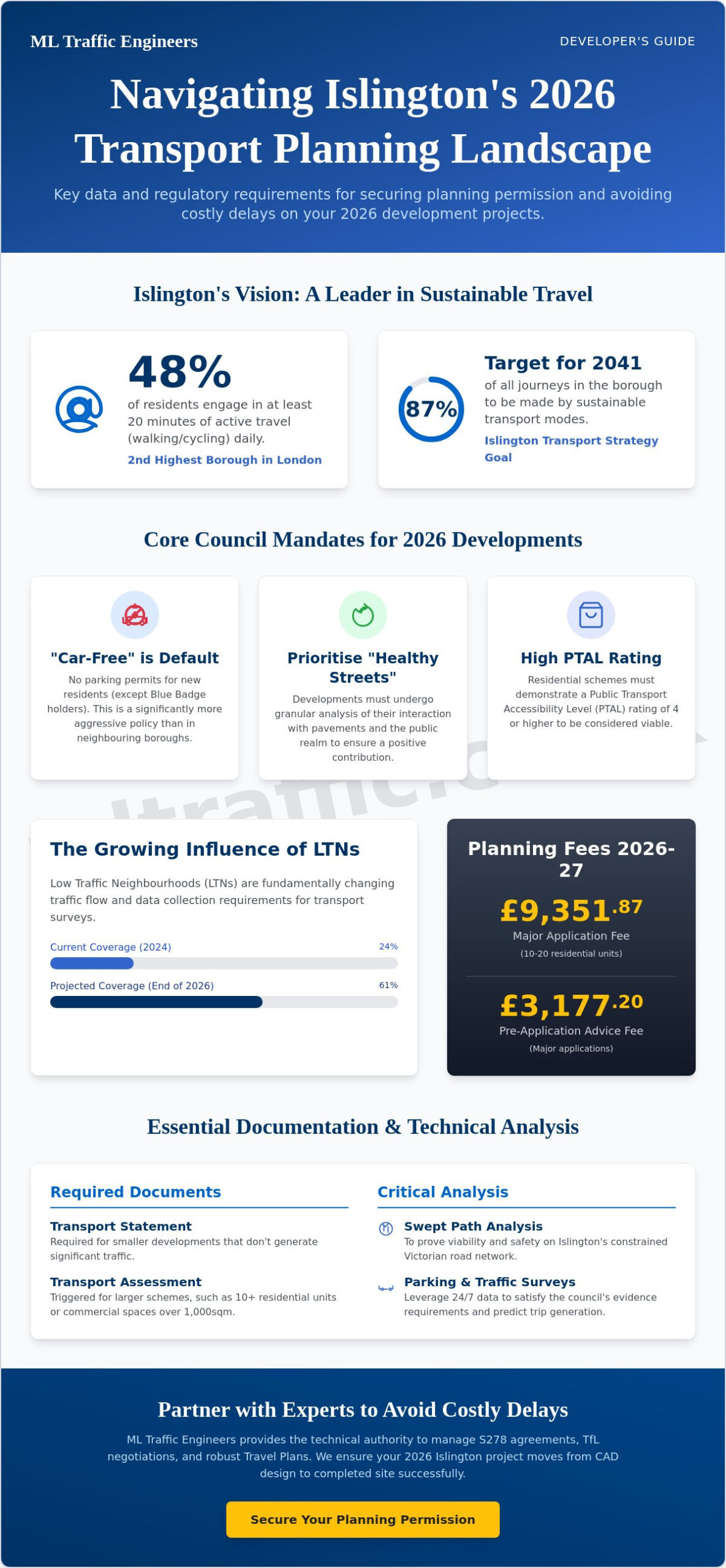
    With 48% of Islington’s population now engaging in at least 20 minutes of active travel every day, the borough ranks as the second highest in London for walking and cycling. This shift is a core pillar of the Islington Transport Strategy which aims for 87% of all journeys to be sustainable by 2041. For developers, this means the margin for error is zero. You’re likely feeling the pressure of Islington Council’s strict “car-free” mandates and the high risk of a planning refusal due to transport concerns. Partnering with experienced Transport Planning Consultants Islington is the only way to ensure your 2026 development project moves from a CAD design to a completed site without costly regulatory delays.

    We understand that coordinating between architects and highway authorities is a logistical burden you don’t need. Our team provides a total, managed solution, from initial Transport Assessments to robust Travel Plans that satisfy the latest 2026 requirements. By reading this guide, you’ll master the complexities of the current planning fees, such as the £9,351.87 charge for major applications, and learn how to use Swept Path Analysis to justify your site’s viability. We’ll show you exactly how to secure planning permission by aligning your project with the council’s vision for a net-zero borough through proactive, data-driven planning.

    Key Takeaways

    • Understand how the Islington Local Plan impacts 2026 planning submissions, specifically regarding car-free mandates and active travel targets.
    • Determine whether your project requires a full Transport Assessment or a Transport Statement based on current London Borough of Islington size thresholds.
    • Master the technical requirements for Swept Path Analysis and Parking Surveys to prove your development’s viability on Islington’s constrained Victorian road network.
    • Professional Transport Planning Consultants Islington provide the technical authority needed to manage S278 agreements and strategic negotiations with Transport for London.
    • Leverage 24/7 traffic survey data and bespoke Travel Plans to satisfy the council’s evidence requirements and minimize the risk of planning refusal.

    Understanding Islington’s Transport Planning Landscape in 2026

    Transport Planning Consultants Islington act as the vital bridge between your development vision and the London Borough of Islington’s (LBI) stringent regulatory framework. In 2026, this role is more technical than ever. We don’t just provide documents; we provide the data-led justification for your project’s impact on the local network. This involves a deep understanding of transportation planning to ensure every submission aligns with the borough’s long-term environmental goals. Our team manages the logistical burdens of the planning process, allowing you to focus on the architectural integrity of your build.

    Islington has cemented “car-free” as the default for almost all new developments as of May 2026. Unless you’re building specifically for Blue Badge holders, you won’t get parking permits for residents. This policy is significantly more aggressive than in neighboring Camden or Hackney. It requires precise site selection based on Public Transport Accessibility Level (PTAL) ratings. We use CAD design and detailed site analysis to prove that your project can thrive without traditional vehicle infrastructure.

    The Islington Local Plan and Transport Policy

    The Islington Local Plan mandates that developers prioritize the “Healthy Streets” approach. Unlike other boroughs, LBI requires a highly granular analysis of how a building interacts with the existing pavement and public realm. If your project involves 10 to 20 residential units, you’ll face a planning application fee of £9,351.87 for the 2026 to 2027 period. Islington residential schemes are required to demonstrate a PTAL rating of 4 or higher to successfully support the borough’s mandatory car-free development standards. We ensure your documentation meets these thresholds before you commit to the pre-application advice fee, which currently stands at £3,177.20 for major applications.

    The Shift Toward Sustainable and Active Travel

    Active travel is a non-negotiable priority for the council. 48% of residents walk or cycle for at least 20 minutes daily, making Islington the second highest borough in London for this metric as of 2024 data. Low Traffic Neighbourhoods (LTNs) now cover 24% of the borough, with plans to reach 61% by the end of 2026. These zones fundamentally change how we collect traffic data for our surveys. You must align your project with London Travel Plans to show you’re supporting these active travel targets. We provide bespoke solutions that integrate cycle storage and pedestrian access into the very start of your project lifecycle.

    Essential Documentation: Transport Statements and Assessments

    Securing planning approval in 2026 requires more than just a site plan; it demands technical proof of feasibility. Transport Planning Consultants Islington are responsible for determining whether your project requires a Transport Statement or a full Transport Assessment. The London Borough of Islington (LBI) typically requires a Transport Statement for smaller developments that don’t generate significant traffic. Larger schemes, such as those with 10 to 20 residential units or commercial spaces exceeding 1,000sqm, trigger the need for a comprehensive Assessment. We use the TRICS database to predict trip generation accurately, ensuring your project doesn’t exceed the capacity of local infrastructure. Following standards set by the Chartered Institution of Highways & Transportation, we provide the technical rigor necessary to satisfy council officers.

    Transport Statements for Small to Medium Developments

    A robust Islington Transport Statement focuses on the immediate impact of infill projects. Even for “car-free” developments, you must address parking stress for visitors and service vehicles. We conduct detailed Parking Surveys to prove that local highway capacity can handle the added demand. A common pitfall that leads to planning delays is failing to account for the cumulative impact of nearby approved schemes. By providing a total, managed solution, we prevent these administrative bottlenecks. If you aren’t sure which document you need, our team can review your site requirements immediately to ensure compliance.

    Full Transport Assessments for Major Islington Schemes

    Major developments require a deeper level of scrutiny. Our Transport Assessment London guide highlights that for LBI, this includes junction capacity analysis and multi-modal impact studies. You must show how residents will access the site via walking, cycling, or public transport. We integrate air quality and noise data into our reporting to align with the council’s 2030 net-zero goals. Engaging with LBI highways officers for pre-application advice is essential; the current fee for a major application follow-up meeting is £3,177.20. This proactive engagement, supported by our technical data, mitigates potential objections before the final submission. We manage the entire lifecycle of this documentation to keep your 2026 project on track.

    Transport Planning Consultants Islington: Navigating 2026 Planning Approvals

    Technical Precision: Swept Path Analysis and Parking Surveys

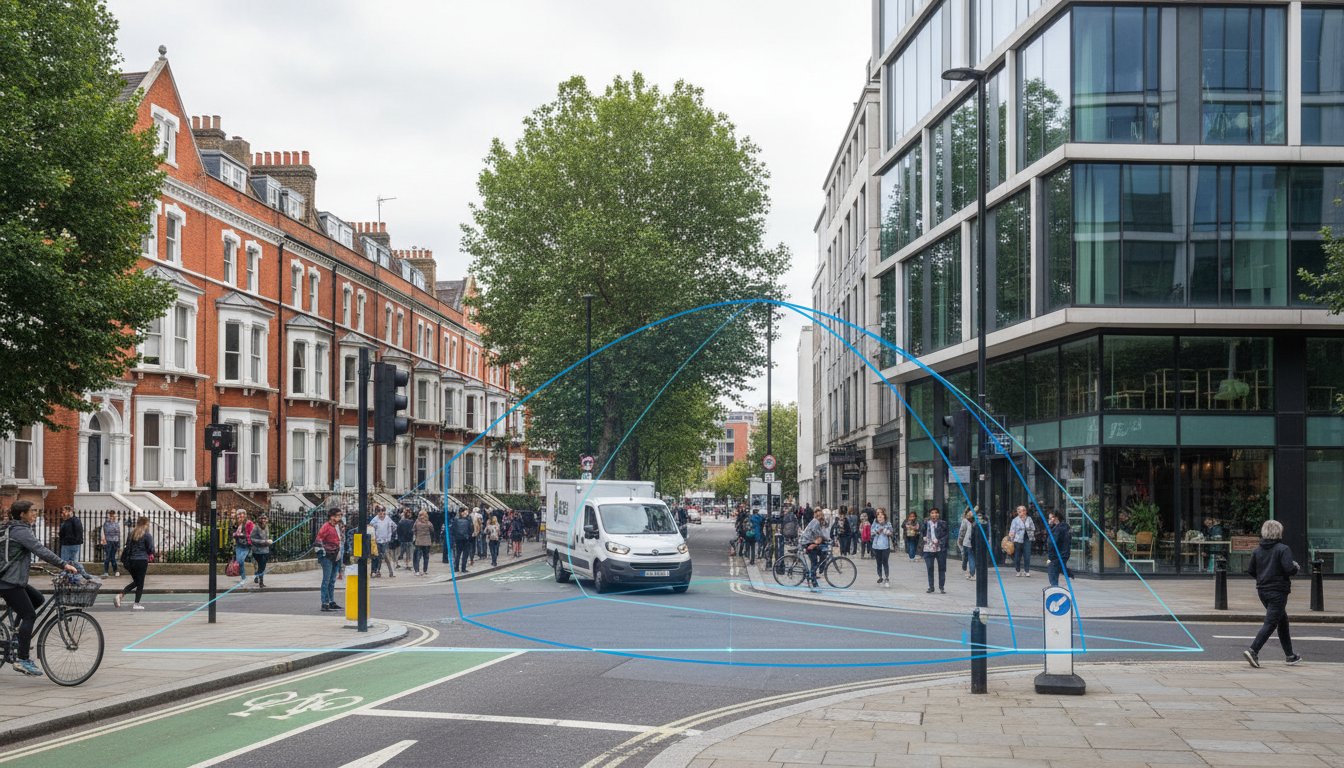
    Islington’s Victorian street layout presents unique logistical challenges that require surgical precision during the planning phase. Transport Planning Consultants Islington must provide definitive proof that a site is accessible before a single brick is laid. This is where technical data replaces guesswork. We utilize advanced CAD modeling to simulate vehicle movements, ensuring that your development doesn’t create a safety hazard or a traffic bottleneck. By integrating Swept Path Analysis Services early in the project lifecycle, we identify potential access issues that would otherwise trigger costly design revisions during the council’s review process. Our approach prioritizes safety and regulatory compliance, giving you a clear path to approval.

    Swept Path Analysis for Tight Urban Access

    Islington Council (LBI) is particularly strict about servicing and delivery arrangements on red routes and narrow residential roads. Our team uses industry-standard CAD software to model specific vehicle paths, ensuring that every truck can enter and exit the site in a forward gear. This is a non-negotiable safety requirement for urban projects. For all major residential and commercial schemes, LBI mandates the use of 12m refuse vehicle templates as the standard for verifying waste collection access. We also model fire tender movements to guarantee that emergency services aren’t obstructed by the building’s footprint or tight corner radii. This technical precision removes the ambiguity from your submission and demonstrates that your site is fit for purpose.

    Parking Surveys and Stress Testing

    While Islington’s “car-free” policy is the default, you must still justify the lack of parking through rigorous stress testing. We conduct Parking Surveys using the Lambeth Methodology to assess the available on-street capacity within a 200m radius of the site. This methodology is the gold standard for London boroughs and is expected by LBI highways officers. This data is essential for developments in PTAL 5 and 6 zones, where the council expects high public transport usage but still requires evidence of local impact. Our 24/7 survey teams perform overnight counts between 00:30 and 05:30 to capture the most accurate snapshot of resident parking demand. We also provide the technical data needed to justify the loss of any on-street bays for new crossovers or access points. By delivering a comprehensive data set, we ensure the council has no grounds to refuse your application based on parking concerns.

    Strategic Negotiations: S278 Agreements and TfL Engagement

    Strategic negotiation is where a project’s technical data meets the legal reality of the public highway. Transport Planning Consultants Islington don’t just stop at the application stage; we guide you through the financial and regulatory commitments required to break ground. Section 278 (S278) agreements are the primary mechanism for this. These legal contracts allow you to make permanent alterations to the public road, such as new junctions or pavement widening. For major works valued over £1m, the drawing approval fee is £6,380 for the 2026-2027 period. Even small-scale works up to £25,000 require a £570 fee. We manage these technical approvals to prevent your project from stalling after you’ve already secured planning permission.

    A critical gap in many submissions is the lack of integration between initial transport reports and the eventual logistics of the build. While our focus remains on the planning data, we ensure your Transport Assessment aligns with the requirements of a Construction Logistics Plan Consultant. This alignment is vital for clearing pre-commencement triggers. If your transport report doesn’t account for the physical constraints of the 2026 streetscape, you’ll face delays when applying for a Street Works Licence. New “Additional Short notice” fees were introduced in January 2026 for applications submitted without the correct notice period, making early coordination a financial necessity.

    The S278 Agreement Process in London

    The S278 process follows a strict sequence that we manage on your behalf. First, we secure technical approval of the highway designs from the local authority, ensuring they meet current safety standards. Next, we help you navigate the bonding process, where a financial guarantee is set aside to cover the cost of the works. Finally, we oversee the transition into the implementation and maintenance periods. During this phase, the council typically retains a portion of the bond for 12 months to ensure the new road layout performs as expected. Our proactive approach ensures these legal hurdles don’t disrupt your project timeline.

    Coordinating with Transport for London

    Engagement with Transport for London (TfL) is mandatory if your site borders a red route like the A1 (Upper Street). TfL applies the “Healthy Streets” lens to every major application near hubs like Angel or Archway. This means your project must demonstrate a positive impact on the pedestrian environment and public transport network. We negotiate mitigation measures, often involving Section 106 transport contributions, to ensure your development remains viable while meeting London-wide safety standards. If you’re managing a complex site near a TfL route, you can partner with our expert team to navigate these high-stakes negotiations with confidence.

    Partnering with ML Traffic Engineers for Islington Success

    Choosing the right Transport Planning Consultants Islington is the difference between a project that stalls and one that succeeds. ML Traffic Engineers provides a total, managed solution for developers who need to navigate the high-stakes environment of London planning. We position ourselves as a safe pair of hands, an entity that understands the intricate complexities of the 2026 regulatory environment so you don’t have to. Our technical authority balances precision with a customer-centric approach, aiming to alleviate the logistical and regulatory burdens placed on your project team. We manage the entire lifecycle of your transport requirements, from initial feasibility through to final implementation.

    Our 24/7 availability is a primary hallmark of our brand promise. Planning deadlines are often tight and unpredictable. We maintain a constant state of readiness to conduct urgent Traffic Surveys or collect technical data when the council demands immediate evidence. This reliability is essential in the fast-moving world of Islington development. Whether it’s an overnight Parking Survey using the Lambeth Methodology or a rapid CAD design revision for a Swept Path Analysis, our team is available to ensure your submission remains on track. We take immense pride in our precision and compliance, viewing our role as a vital partner in your project’s success.

    Why Local Expertise Matters

    Success in the London Borough of Islington (LBI) requires more than just technical skill; it requires local insight. We have a deep understanding of what we do specifically for the Islington context. Our team has direct experience with LBI highways officers and understands the specific nuances of the Islington Local Plan. We’ve successfully managed various project types across North London, ranging from small-scale infill residential units to major commercial developments. In early 2026, we secured approval for a challenging site near Highbury Corner by utilizing data-driven justifications that satisfied the council’s strict car-free mandates. This proactive approach prevents the common pitfalls that lead to planning refusal.

    Get Started with Your Islington Project

    Securing your 2026 planning approval starts with a robust fee proposal tailored to your site’s specific constraints. We provide comprehensive support for both Transport Statements and full Transport Assessments. Our initial consultations include site access reviews and feasibility checks to identify potential highway issues before they become expensive problems. We use bespoke solutions and seamless integration to ensure your transport documentation aligns perfectly with your architect’s vision. Contact us at mltraffic.co.uk for immediate expert support. Let our team manage the technical complexities while you focus on delivering a high-quality development for the Islington community.

    Securing Your Development’s Future in Islington

    Successful planning applications in May 2026 require more than just compliance; they demand a proactive strategy built on technical data. You’ve seen how Islington Council’s strict car-free policies and the 87% sustainable travel target by 2041 leave no room for error. Whether you’re navigating the £9,351.87 fee for major applications or negotiating complex S278 agreements, precision is your greatest asset. Our team provides the technical authority needed to justify every aspect of your site access and trip generation. We focus on results so you can focus on construction.

    As specialist Transport Planning Consultants Islington, we act as a safe pair of hands for your 2026 development. We offer 24/7 availability for urgent surveys and bring expert witness experience to planning appeals. We ensure your documentation, from Swept Path Analysis to Travel Plans, meets the highest safety and regulatory standards. Don’t let logistical burdens or planning delays derail your timeline. Request a Transport Planning Quote for Your Islington Project today. We’re ready to help you secure approval and move your project toward a successful completion.

    Frequently Asked Questions

    Do I need a transport consultant for a small extension in Islington?

    You don’t usually need a consultant for a simple residential extension. However, you must hire Transport Planning Consultants Islington if your project creates a new crossover or alters the public highway. Islington Council (LBI) often requests a brief Transport Statement for small commercial conversions to ensure local capacity isn’t overwhelmed. We provide the technical data required to clear these minor planning hurdles quickly.

    What is the “car-free” policy in Islington and how does it affect my project?

    Islington’s car-free policy is the mandatory standard for almost all new developments as of May 2026. This means the council won’t issue on-street parking permits to future residents or occupiers. The only exceptions are for Blue Badge holders or specific operational needs. You must demonstrate how your site will function without private vehicle access by providing robust Travel Plans and highlighting local public transport links.

    How long does it take to prepare a Transport Statement for an Islington application?

    A standard Transport Statement typically takes 14 to 21 days to complete. This timeline includes the 24/7 data collection phase and the technical drafting of the report. If your site requires a multi-day Parking Survey or complex Swept Path Analysis, the process might extend to four weeks. We maintain a constant state of readiness to meet tight submission deadlines and prevent administrative delays.

    Can I get planning permission in Islington if my site has a low PTAL rating?

    You can secure planning permission with a low PTAL rating, but the council requires stronger evidence of sustainability. Sites with a PTAL of 0 or 1 must prove they won’t increase local parking stress. We use detailed Traffic Surveys to show that your development’s trip generation remains minimal. High-quality Travel Plans that prioritize cycling and walking are essential for overcoming a site’s public transport limitations.

    What is a Swept Path Analysis and why is it required for my Islington site?

    Swept Path Analysis is a CAD-based simulation that proves vehicles can safely navigate your site’s access points. It’s a non-negotiable requirement for Islington’s narrow Victorian streets. We model the movements of 12m refuse vehicles and fire tenders to ensure emergency and service access. This technical precision prevents the council from refusing your application based on highway safety concerns or restricted vehicle maneuverability.

    How much does a parking survey cost for a London planning application?

    We don’t provide fixed pricing for surveys because costs vary based on the number of streets covered and the survey duration. However, it’s worth noting that Islington’s 2026-2027 fee schedule includes a £570 charge for S278 works up to £25,000. Our team provides bespoke fee proposals after an initial site review. This ensures you only pay for the specific data required for your unique planning application.

    What is the difference between an S278 and an S106 agreement in transport planning?

    An S278 agreement is a legal contract for physical works on the public highway, such as a new junction. Conversely, an S106 agreement involves financial contributions to mitigate the development’s impact on the wider community. While S278 covers the actual road construction costs and bonds, S106 might fund local bus improvements or cycling infrastructure. We manage the technical negotiations for both to keep your project compliant.

    How do Low Traffic Neighbourhoods (LTNs) in Islington affect traffic surveys?

    Low Traffic Neighbourhoods (LTNs) cover 24% of Islington and fundamentally change local traffic flow. When we conduct Traffic Surveys, we must account for these restricted routes to ensure our data reflects real-world conditions. The council expects survey data to show how your development interacts with these “Liveable Neighbourhoods.” We use 2024-2025 baseline data to provide a comparative analysis that satisfies LBI highways officers.

    Michael Lee

    Article by

    Michael Lee

    Transport planner with over 35 years’ experience.

    Disclaimer

    The content on mltraffic.co.uk, including all technical articles, guides, and resources, is provided for general informational and educational purposes only. It is not intended to constitute professional advice in traffic engineering, transportation planning, development approvals, or any other technical or legal field.
    While ML Traffic Engineers makes every reasonable effort to ensure the accuracy, completeness, and timeliness of the information published, we do not provide any warranties or representations (express or implied) regarding its reliability, suitability, or availability for any particular purpose. Any reliance you place on the content is strictly at your own risk.
    In no event shall ML Traffic Engineers, its directors, employees, authors, or affiliates be liable for any direct, indirect, incidental, special, consequential, or punitive damages (including, without limitation, loss of profits, data, or business opportunities) arising out of or in connection with the use of, or inability to use, any information provided on this website.
    The articles and guides on this site are not a substitute for engaging a qualified, professional traffic engineer to assess your specific project requirements. For tailored advice, compliance assessments, or traffic engineering services, please contact a competent professional.
    This disclaimer may be updated from time to time without notice. By accessing or using this website, you agree to be bound by the most current version of this disclaimer.