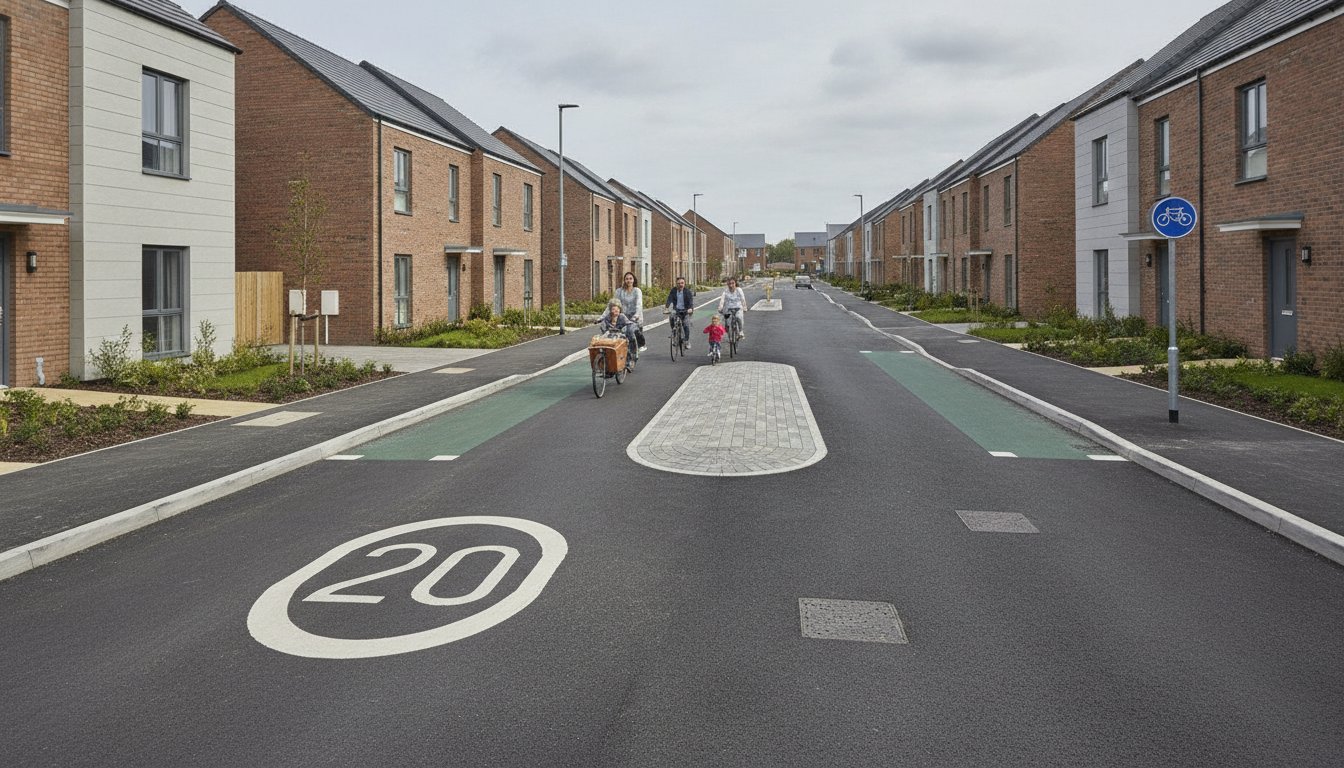
Did you know that the 20mph default limit implementation in Wales contributed to a 23.8% reduction in casualties on residential roads by the end of 2024? As a developer or planner, you understand the increasing pressure to balance high-density site layouts with the stringent safety requirements of local highway authorities. It’s frustrating when essential traffic calming measures for residential developments lead to failed Swept Path Analysis or expensive design revisions at the eleventh hour.
This 2026 planning guide helps you master the technical implementation of speed reduction to secure planning approval and pass Section 278 audits the first time. We will examine the latest 2026 Road Safety Strategy targets, the specific costs of physical interventions like £22,500 road narrowing features, and how to use data-driven Transport Statements to justify your site design. You’ll gain the technical authority needed to turn regulatory mandates into enhanced place-making value while ensuring every layout remains functional and compliant.
Key Takeaways
- Distinguish between signage-led 20mph limits and physical 20mph zones to align your site design with the latest 2026 Vision Zero safety standards.
- Learn how implementing strategic traffic calming measures for residential developments can optimize land use by enabling tighter visibility splays and smaller junction radii.
- Utilize the “1mph Rule” and evidence from national rollouts to provide robust justification for speed reduction within your Transport Statements.
- Understand the role of accurate Traffic Surveys and Swept Path Analysis in securing first-time approval for Section 278 and Section 38 audits.
- Stay compliant with 2026 DfT guidance and Active Travel England parameters to reduce regulatory friction and avoid expensive layout revisions.
The Evolution of 20mph Speed Limits and Traffic Calming in 2026
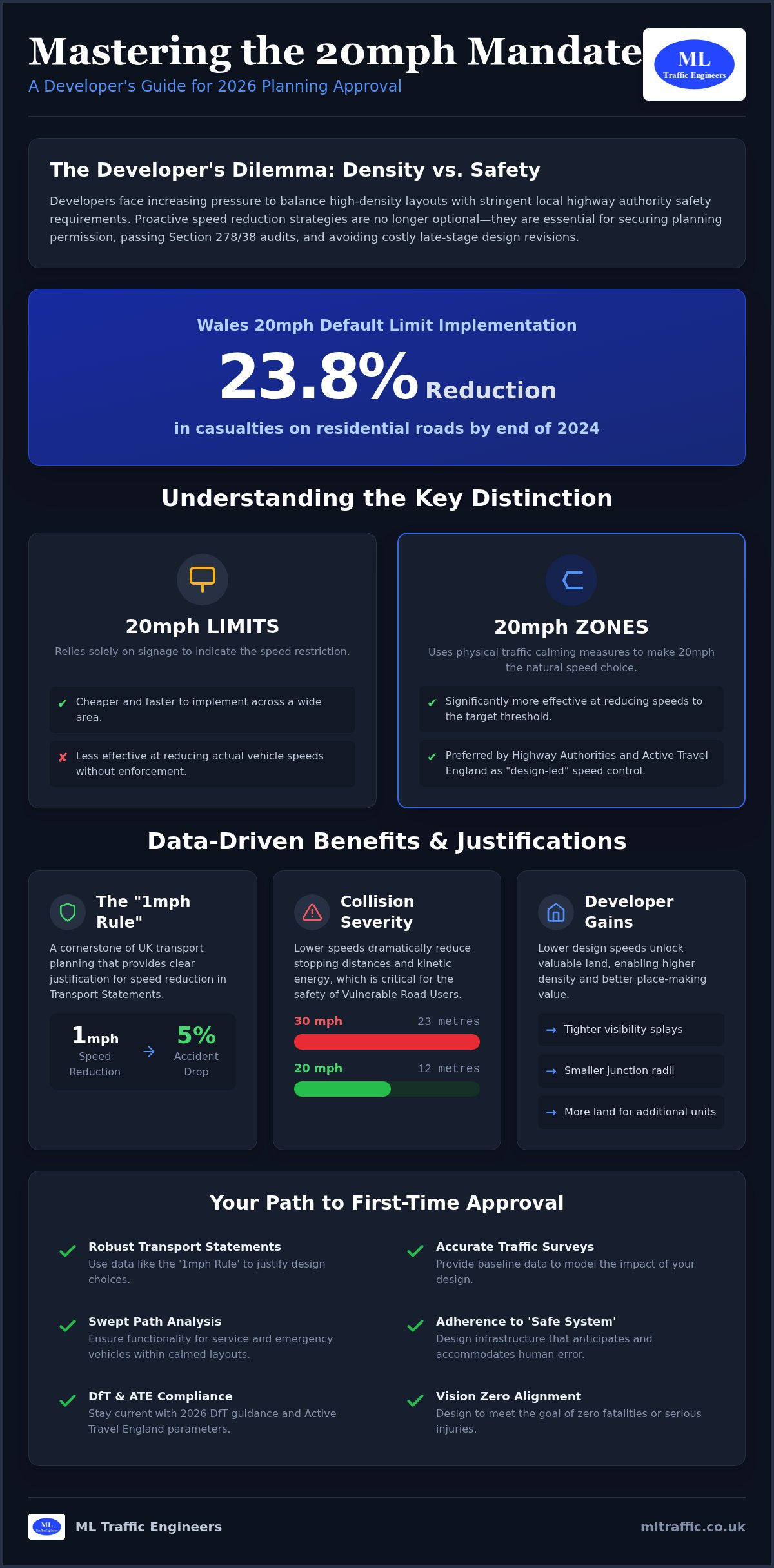
The 2026 planning environment demands a sophisticated approach to road safety. Planners no longer view traffic calming as a reactive fix for speed complaints. Instead, it’s a proactive requirement for securing planning permission. A major distinction exists between 20mph limits, which rely solely on signage, and 20mph zones, which use physical traffic calming measures for residential developments. While limits are cheaper to implement, zones are significantly more effective at reducing speeds to the desired threshold. For a deeper look at these interventions, you can consult this comprehensive overview of traffic calming.
Vision Zero has evolved from a metropolitan ambition into a standard local authority benchmark. In Wales, the default 20mph limit introduced in September 2023 has already shown a 23.8% reduction in casualties on residential roads by the end of 2024. Scotland continues its nationwide rollout, while England maintains a local-choice model, though Active Travel England now heavily influences these decisions. Design-led speed control is the preferred standard. Highway authorities want to see layouts that naturally restrict speed through geometry rather than relying on retrospective enforcement or signage that drivers might ignore.
National vs. Local Implementation Trends
Active Travel England now sets rigorous infrastructure standards that developers must follow to unlock funding and approval. In high-density areas like London, 20mph mandates aren’t just safety measures; they’re tools to support site density. Lower design speeds allow for tighter visibility splays, which saves valuable land for additional units. Moving from a 30mph to a 20mph default design speed for new-build estates is now the expected starting point for any Transport Statement.
Technological Shifts in Speed Management
Technology now supports physical design. Mandatory Intelligent Speed Assistance (ISA) in new vehicles helps keep drivers within limits, but it doesn’t replace the need for physical traffic calming measures for residential developments. Connected vehicle data now provides authorities with real-world compliance maps, showing exactly where speeds exceed thresholds without the need for manual spot checks. The ‘Safe System’ approach used by UK highway authorities defines safety as a shared responsibility where the road system is designed to accommodate human error and limit impact forces to survivable levels. This shift ensures that even when mistakes happen, the infrastructure prevents fatal outcomes.
Quantifiable Benefits: Safety, Environment, and Urban Quality
Implementing traffic calming measures for residential developments isn’t just a regulatory hurdle. It’s a data-led strategy for risk mitigation. The ‘1mph Rule’ is a cornerstone of UK transport planning. Evidence shows that every 1mph reduction in average vehicle speed correlates to a 5% drop in accident frequency. This metric provides developers with a clear, quantifiable justification for speed reduction in their planning submissions. By designing for lower speeds, you’re directly reducing the likelihood of collisions from the outset.
Road Safety and Collision Severity
The physics of urban collisions are unforgiving. At 30mph, a vehicle’s stopping distance is approximately 23 metres, but at 20mph, this nearly halves to 12 metres. This reduction is critical for child safety in high-density residential layouts where reaction times are shorter. Kinetic energy in a collision increases with the square of the vehicle’s speed, meaning a 10mph difference dramatically alters survival outcomes. Vulnerable Road Users (VRUs), such as cyclists and pedestrians, face a significantly higher fatality risk at 30mph compared to 20mph. Beyond physical safety, lower speeds reduce the ‘severance’ effect. This allows residents to move freely across the site without the psychological barrier of fast-moving traffic, effectively reconnecting communities within the development.
Air Quality and Smooth Traffic Flow
Critics often argue that lower speed limits increase emissions due to constant braking. However, well-designed traffic calming measures for residential developments promote a steady-state driving style. Maintaining a consistent 20mph reduces the heavy acceleration and braking cycles that spike NO2 and particulate matter levels. This smoother flow also results in a measurable decibel drop, improving the acoustic environment for residents. There are many proven outcomes of traffic calming, including the promotion of active travel for ‘last-mile’ trips. When people feel safe, they’re more likely to walk or cycle, which directly supports the targets in your Travel Plan. Lower speeds also reduce the mechanical stress on road surfaces, extending the longevity of the infrastructure and lowering long-term maintenance costs for the management company.
UK Case Studies: Evidence-Based Planning Success
Securing planning approval in 2026 requires more than just a compliant design. It requires evidence. Local authorities increasingly look to established case studies to justify the inclusion of traffic calming measures for residential developments. These real-world examples prove that lower speed environments don’t just improve safety; they enhance the commercial and social value of a site. By referencing successful rollouts, developers can provide the robust justification needed in a Transport Assessment to satisfy highway officers.
The Welsh Default Model: A 2026 Retrospective
The Welsh national rollout remains the most significant data set for 20mph implementation. Following the 2023 shift, casualty figures on 20mph and 30mph roads fell by 23.8% by the end of 2024. By 2026, this downward trend has stabilized, providing a clear baseline for residential safety. While initial public resistance was high, residential preference has shifted as the benefits became tangible. Real-world GPS data from Welsh urban centres shows that while journey times saw marginal increases, bus reliability actually improved in many areas due to more predictable traffic flow. This data helps developers counter arguments that lower speeds will lead to gridlock or service delays.
London Borough Innovations
London has pioneered the integration of 20mph limits with Low Traffic Neighbourhoods (LTNs) in boroughs like Hackney and Islington. A comprehensive analysis published in May 2025 by Transport for London (TfL) evaluated 157 schemes. The results were stark. Total casualties dropped by 36%, while fatal or serious injuries decreased by 34%. Most notably, child casualties saw a 46% reduction. These figures provide an unassailable argument for “Vision Zero” milestones. For those seeking a foundational understanding of these principles, the Federal Highway Administration’s Traffic Calming ePrimer offers an authoritative look at how these measures integrate with broader safety initiatives.
The Developer’s Perspective: Traffic Calming in Transport Planning
Traffic calming is often viewed as a cost burden, but for savvy developers, it’s a strategic tool. It’s about land optimization. Integrating traffic calming measures for residential developments allows you to design site layouts in ways that 30mph zones simply don’t permit. Lower design speeds directly influence the technical requirements in your Transport Statements. By committing to a 20mph environment, you can justify tighter visibility splays and smaller junction radii. This reduction in land take for highway infrastructure translates into more sellable floor area or higher unit density. In constrained urban sites, 20mph limits facilitate ‘Shared Space’ designs. These layouts remove the traditional distinction between pavement and road, creating a high-quality public realm that increases the overall marketability of the development.
Impact on Swept Path Analysis and Site Layout
A successful layout must balance speed reduction with operational functionality. Integrating 20mph geometry into your Swept Path Analysis is critical to ensure fire tenders and refuse vehicles can navigate the site without mounting kerbs. Developers must choose between horizontal deflection, such as chicanes, and vertical deflection, like speed tables. While vertical measures are highly effective for speed, they can sometimes delay emergency vehicle response times if poorly placed. We recommend using ‘tight’ urban design, building lines close to the street and reduced forward visibility, to naturally enforce speed limits. This approach reduces the need for unsightly signage and physical humps that residents often dislike.
Justifying Development through Safety Compliance
Securing planning permission for high-density schemes often hinges on mitigating the impact on sensitive local roads. Using speed data from comprehensive Traffic Surveys allows you to establish a baseline and prove that your proposed traffic calming measures for residential developments will maintain safety standards. This evidence is vital during S278 negotiations for off-site infrastructure. A 20mph environment also significantly strengthens your Travel Plan. When walking and cycling feel safe, modal shift targets become realistic rather than aspirational. This safety compliance makes your application much harder for local authorities to refuse on highway grounds.
If you are facing challenges with a constrained layout, our team can help you optimize your site design with expert Swept Path Analysis.
Navigating Implementation with ML Traffic Engineers UK
Implementing traffic calming measures for residential developments requires a balance of technical precision and regulatory insight. At ML Traffic Engineers UK, our Transport Planning Consultants specialize in adapting site designs to meet the evolving speed policies of 2026. We bridge the gap between your commercial goals and the safety mandates of local Highway Authorities. By applying Manual for Streets principles within 20mph environments, we optimize site access and layout efficiency. This ensures your development remains functional while satisfying the most stringent safety audits. Our approach focuses on reducing the logistical pressure on your team by managing the entire technical justification process.
Technical Expertise for Planning Success
Our team prepares comprehensive Transport Assessments that leverage lower design speeds to mitigate traffic impact. We provide expert witness services for planning hearings when road safety or speed management becomes a point of contention. Additionally, we offer tailored advice on Section 278 and Section 38 highway design agreements. This technical support ensures that any off-site infrastructure is delivered cost-effectively without compromising on compliance. We understand the specific requirements of both London-specific and national UK planning frameworks, allowing us to navigate regional variations in speed limit mandates with confidence.
Why Precision Data Matters
Precision data is the foundation of any successful speed reduction request. We conduct detailed Traffic Surveys and Parking Surveys to establish existing speed profiles and justify design changes. Accurate data reduces regulatory pressure by providing highway officers with the evidence they need to approve your scheme. We use specialized industry terminology and regulatory compliance language to ensure our reports stand up to scrutiny. When you use traffic calming measures for residential developments as part of a data-backed strategy, you reduce the risk of costly design revisions. If you’re ready to secure planning approval for your next residential project, contact ML Traffic Engineers UK today to request a consultation and ensure your site layout is fully optimized.
Securing Your Development’s Future Through Technical Precision
The transition toward 20mph environments represents a fundamental change in UK highway design that requires a proactive response from developers. By integrating traffic calming measures for residential developments early in the design phase, you don’t just meet safety targets. You create more efficient, high-density layouts that satisfy local authorities while maximizing sellable land. We’ve explored how evidence from national rollouts and London-specific schemes provides the necessary weight to support your planning application and secure Section 278 approval.
ML Traffic Engineers UK has been a dependable partner in UK transport planning since 2014. We provide the technical authority needed to navigate both London Borough and national highway standards so you don’t have to. Our comprehensive reporting, ranging from detailed Swept Path Analysis to robust Travel Plans, ensures your project moves through the planning process without costly delays. Don’t let layout revisions stall your progress. Contact ML Traffic Engineers UK for a Transport Statement Quote to ensure your site is fully optimized for the 2026 planning landscape. We’re ready to help you turn safety requirements into a strategic asset for your next residential project.
Frequently Asked Questions
What is the difference between a 20mph zone and a 20mph limit?
A 20mph zone utilizes physical engineering features to self-enforce speeds, whereas a 20mph limit relies solely on signage and road markings. Zones are generally more effective because they use traffic calming measures for residential developments, such as speed tables or chicanes, to naturally restrict vehicle velocity. Local authorities often prefer zones for new-build estates to ensure the design speed is maintained without constant police enforcement.
Do 20mph limits actually reduce the number of road accidents in residential areas?
Yes, implementing 20mph limits is associated with a 23% reduction in road casualties and a 26% decrease in collisions across the UK. Data from the Wales rollout showed that casualties on residential roads fell by 23.8% between Q2 2023 and Q4 2024. These reductions occur because lower speeds provide drivers with more reaction time and significantly decrease the kinetic energy involved in impacts, making collisions more survivable.
How do 20mph limits affect vehicle emissions and local air quality?
20mph environments typically improve air quality by encouraging a smoother, steady-state driving style that reduces the heavy acceleration and braking cycles responsible for emission spikes. While some critics suggest lower speeds increase pollution, evidence indicates that reducing the stop-start nature of urban driving helps lower NO2 and particulate matter levels. This shift also supports a transition toward walking and cycling for shorter trips, further reducing total vehicle emissions.
Will a 20mph limit significantly increase journey times for residents?
The impact on journey times is usually minimal, often adding just seconds to short urban trips. In residential areas, average speeds are already constrained by junctions, parked cars, and pedestrian activity. Real-world data suggests that while peak speeds are lower, more predictable traffic flow can actually improve the reliability of public transport services. For most residents, the safety and noise reduction benefits far outweigh the negligible increase in travel time.
Is a Transport Statement required if my development is in an existing 20mph zone?
Yes, a Transport Statement is still required to demonstrate how your specific development interacts with the existing network and to justify site access safety. Even in an established 20mph zone, you must prove that your internal layout and access points comply with national highway standards. This document provides the technical evidence needed to satisfy the local authority that your scheme won’t negatively impact the prevailing safety environment or traffic flow.
How does a 20mph design speed impact the required length of visibility splays?
Lowering the design speed from 30mph to 20mph significantly reduces the required length of visibility splays at junctions and access points. According to Manual for Streets principles, a 20mph design speed allows for shorter ‘Y’ distances, which reduces the amount of land that must be kept clear of obstructions. This enables developers to optimize site layouts and potentially increase the number of units or sellable floor area on constrained residential sites.
Are 20mph limits legally enforceable for all vehicle types in the UK?
20mph limits are legally enforceable for all motor vehicles in the UK, provided the correct Traffic Regulation Order is in place and signage is compliant. Enforcement is typically carried out by the police using mobile speed cameras or fixed ANPR technology. While some drivers believe these limits are advisory, they carry the same legal weight and penalties as any other speed limit on the public highway, including fines and license points.
Can a developer request a 20mph limit as part of their planning application?
Developers frequently request 20mph limits as part of their planning application to mitigate the traffic impact of their schemes. Proposing traffic calming measures for residential developments as part of a Section 278 agreement can help secure planning approval for high-density layouts that might otherwise be refused on safety grounds. This proactive approach demonstrates to the Highway Authority that you’ve prioritized the safety of vulnerable road users from the inception of the project.

Disclaimer
The content on mltraffic.co.uk, including all technical articles, guides, and resources, is provided for general informational and educational purposes only. It is not intended to constitute professional advice in traffic engineering, transportation planning, development approvals, or any other technical or legal field.
While ML Traffic Engineers makes every reasonable effort to ensure the accuracy, completeness, and timeliness of the information published, we do not provide any warranties or representations (express or implied) regarding its reliability, suitability, or availability for any particular purpose. Any reliance you place on the content is strictly at your own risk.
In no event shall ML Traffic Engineers, its directors, employees, authors, or affiliates be liable for any direct, indirect, incidental, special, consequential, or punitive damages (including, without limitation, loss of profits, data, or business opportunities) arising out of or in connection with the use of, or inability to use, any information provided on this website.
The articles and guides on this site are not a substitute for engaging a qualified, professional traffic engineer to assess your specific project requirements. For tailored advice, compliance assessments, or traffic engineering services, please contact a competent professional.
This disclaimer may be updated from time to time without notice. By accessing or using this website, you agree to be bound by the most current version of this disclaimer.