Tag: highway authority

  • Transport Statement in High Wycombe: A Developer’s Guide for 2026 approvals

    Transport Statement in High Wycombe: A Developer’s Guide for 2026 approvals

    A single data omission in your transport documentation can stall a High Wycombe development for months, especially as Buckinghamshire Council moves to adopt the rigorous Local Transport Plan 5 in Summer 2026. You likely find that navigating the unitary authority’s evolving highway requirements is a complex, high-stakes task where precision is a functional necessity. This guide ensures your transport statement High Wycombe meets every technical benchmark to secure validation on the first attempt, reducing the regulatory pressure on your project team.

    We’ll detail the specific 2026 Community Infrastructure Levy rates, such as the £179.64 per square meter for residential sites, and the exact thresholds for when a full Transport Assessment is required. You’ll gain a clear understanding of how to address the mandatory 10% reduction target for single-occupancy car use and the latest parking standards. This professional overview moves straight to the core requirements, providing a sequential roadmap from initial assessment to final planning approval.

    Key Takeaways

    • Understand the specific criteria used by Buckinghamshire Council to determine if your project requires a full Assessment or a concise Transport Statement.
    • Learn how to utilize TRICS database analysis and baseline road network data to build a robust transport statement High Wycombe developers need for first-time validation.
    • Discover strategies for mitigating High Wycombe’s unique topographic constraints and congestion on key routes like the A404 Marlow Hill.
    • Identify the critical steps in the pre-application phase to ensure your submission aligns with the latest 2026 Local Transport Plan 5 standards.
    • Explore how integrating professional Swept Path Analysis and parking surveys into your statement minimizes technical objections from the Highway Authority.

    What is a Transport Statement for High Wycombe Developments?

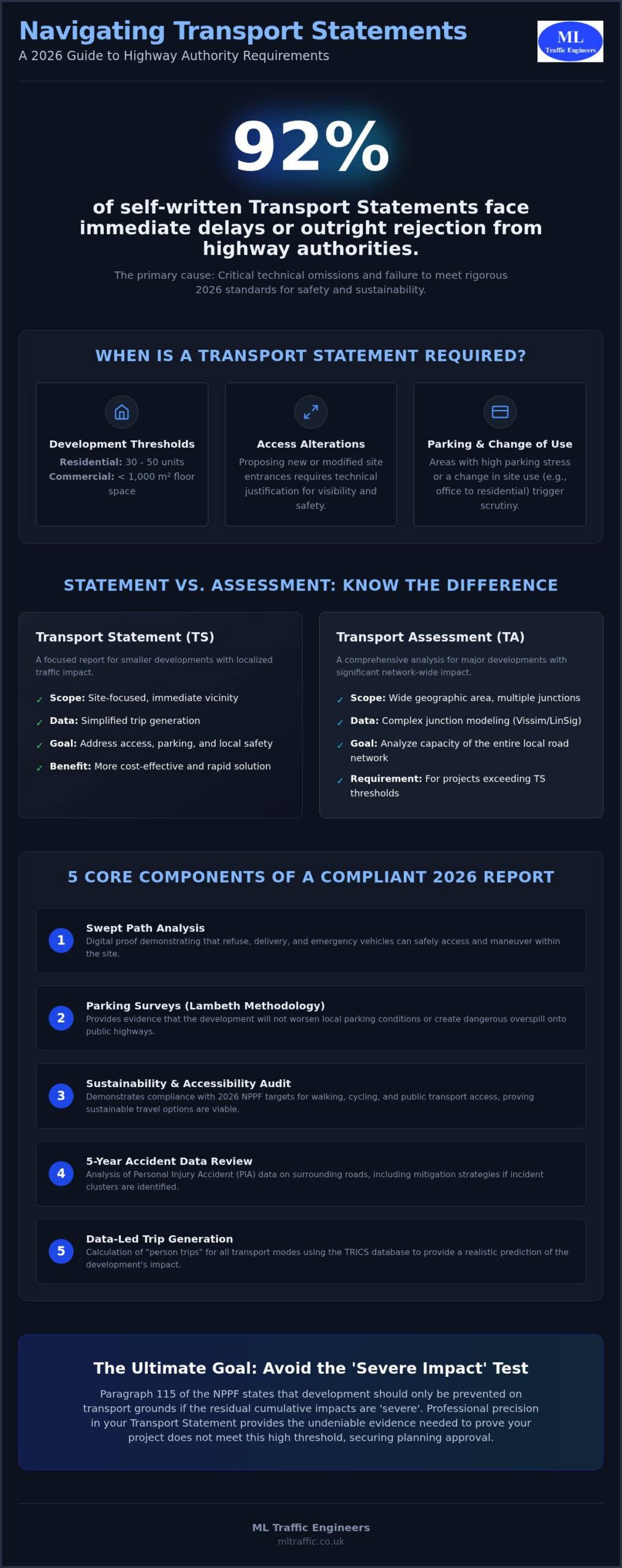
    A Transport Statement is a technical document required by the National Planning Policy Framework (NPPF) for developments that generate relatively low levels of traffic. It focuses on demonstrating that the local road network can safely accommodate the proposed increase in movement without causing detrimental harm. For any project in this region, a transport statement High Wycombe serves as the primary evidence base for Buckinghamshire Council to evaluate the proposal’s impact on safety and congestion.

    As the Local Highway Authority (LHA), Buckinghamshire Council uses these statements to ensure that every new access point or parking arrangement meets strict safety standards. This document is a critical part of the broader transportation planning process. It provides a data-driven justification for the development, ensuring that the highway network remains functional for all users while supporting the town’s growth.

    To better understand how technical teams evaluate your submission and the collaborative nature of this work, watch this brief overview of the transport planning environment:

    Transport Statement vs. Transport Assessment

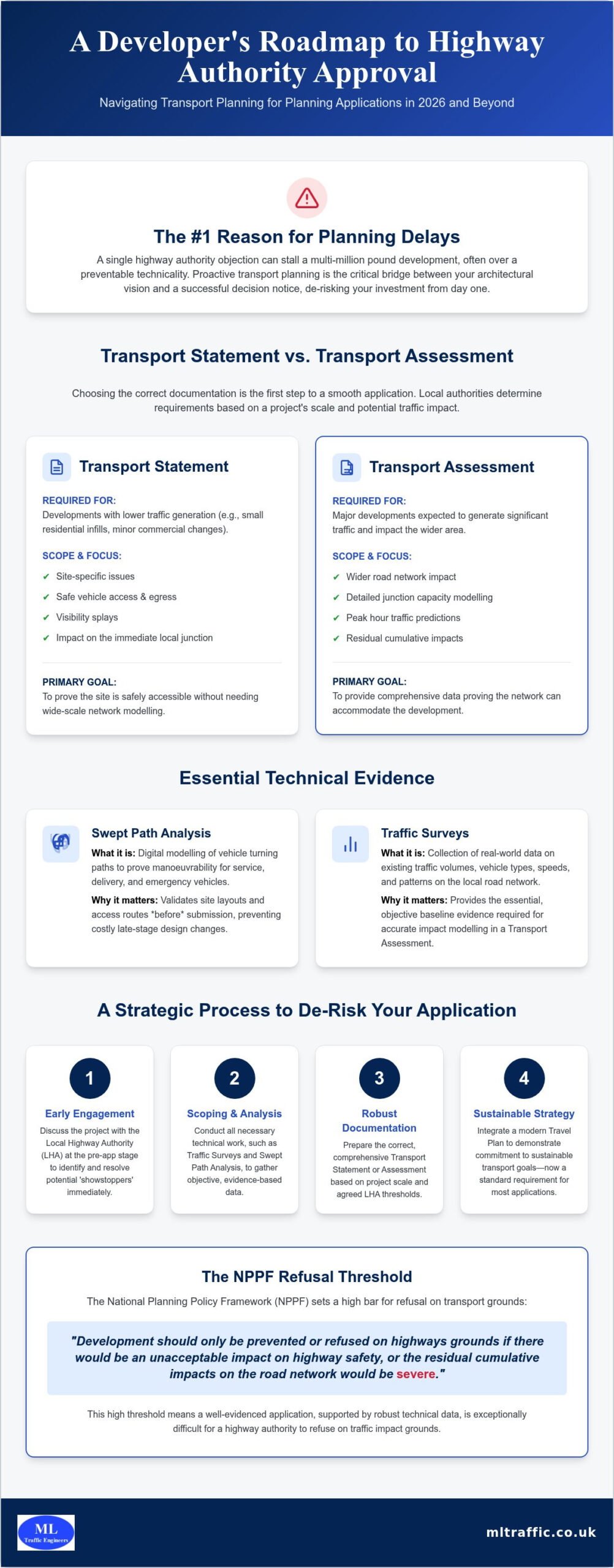
    The distinction between these two documents depends on the scale of your development. Buckinghamshire Council follows specific thresholds to determine the level of detail required. For example, a B1 Business development exceeding 2,500 square meters or a General Industrial (B2) site over 4,000 square meters typically triggers a full Transport Assessment. Smaller infill sites or residential projects below the 100-dwelling mark usually only require a transport statement High Wycombe. Precision is vital here. The Council may upgrade a Statement to a full Assessment if the site sits near a sensitive junction or an area of known high congestion, such as the A40 corridor.

    The Legal Framework in Buckinghamshire

    Planning decisions in 2026 are governed by the Local Transport Plan 5 (LTP5), which is scheduled for adoption in the summer of 2026. This plan places a heavy emphasis on sustainable growth and reducing transport emissions. Additionally, the High Wycombe 2050 Transport Strategy provides a long-term vision for a low-emission, seamless transport system. Developers must align their proposals with these local strategies to avoid validation delays. Engaging with the LHA during the pre-application stage is the most effective way to confirm which standards apply to your specific site. It reduces the risk of costly revisions later in the planning cycle.

    Technical Components of a Robust Transport Statement

    A robust transport statement High Wycombe begins with an accurate analysis of baseline transport conditions. It’s not enough to rely on historical data; you must account for the current capacity of the local road network as of 2026. This involves evaluating existing traffic flows, public transport frequency, and the quality of pedestrian infrastructure. According to UK government guidance, the level of detail should be proportionate to the development’s scale. For High Wycombe, this means considering how your site interacts with the town’s complex one-way systems and arterial routes.

    Trip generation analysis remains the technical heart of the document. We utilize the TRICS database to predict how many vehicle movements your project will create. By 2026, these models have been refined to reflect permanent shifts in commuter behavior following the pandemic. This data allows us to propose realistic mitigation measures that offset any negative impacts on the highway. We also prioritize active travel. Your statement must demonstrate clear routes for cyclists and pedestrians, aligning with Buckinghamshire’s target to reduce single-occupancy car use by at least 10% within five years of occupation.

    Data Collection and Traffic Surveys

    High-quality data is the only way to avoid validation delays. We conduct targeted traffic surveys along critical corridors like the A40 London Road and A404 Marlow Hill to capture peak hour fluctuations. Utilising professional Parking Surveys allows us to justify development density by proving that existing street capacity or proposed on-site provision is sufficient. These surveys provide the empirical evidence that planning officers require to approve your parking ratios. Securing accurate data early prevents costly redesigns; you can contact our technical team to determine which surveys your specific site requires.

    Swept Path Analysis (SPA) in High Wycombe

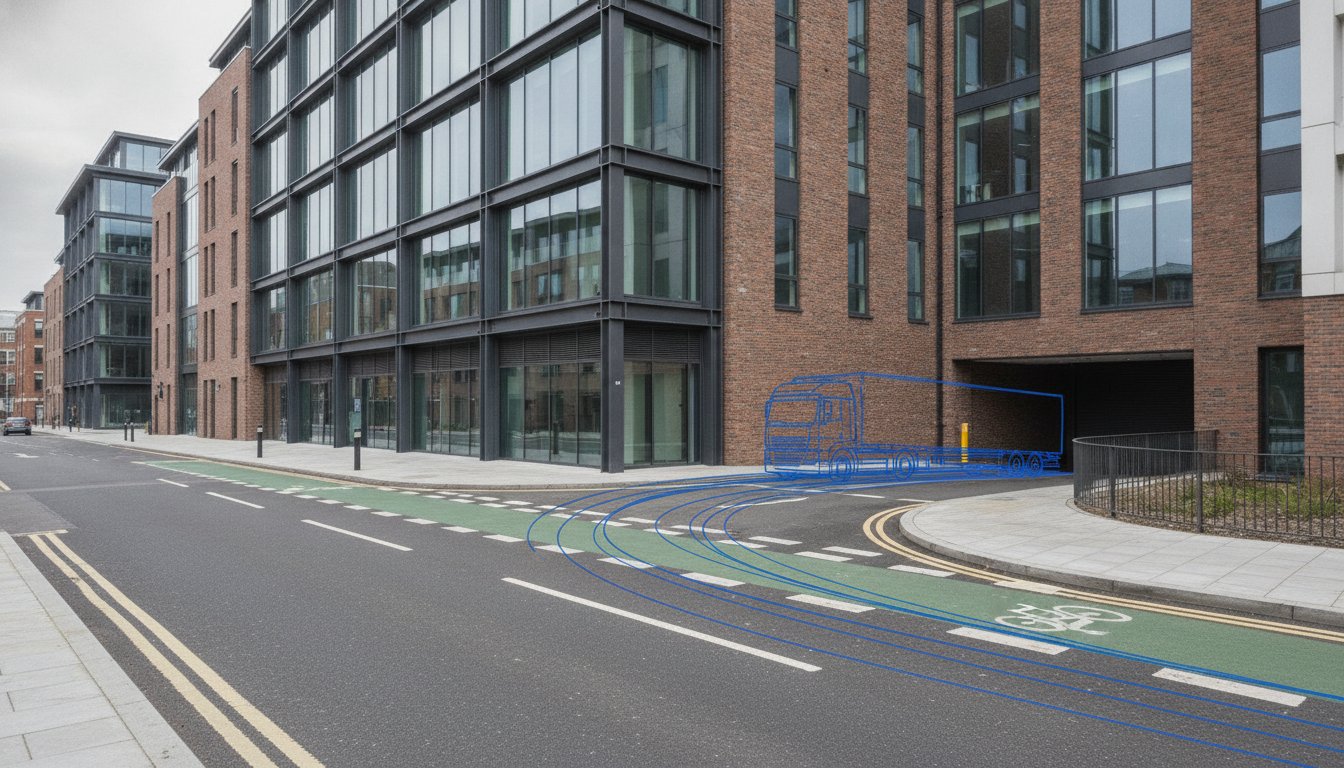
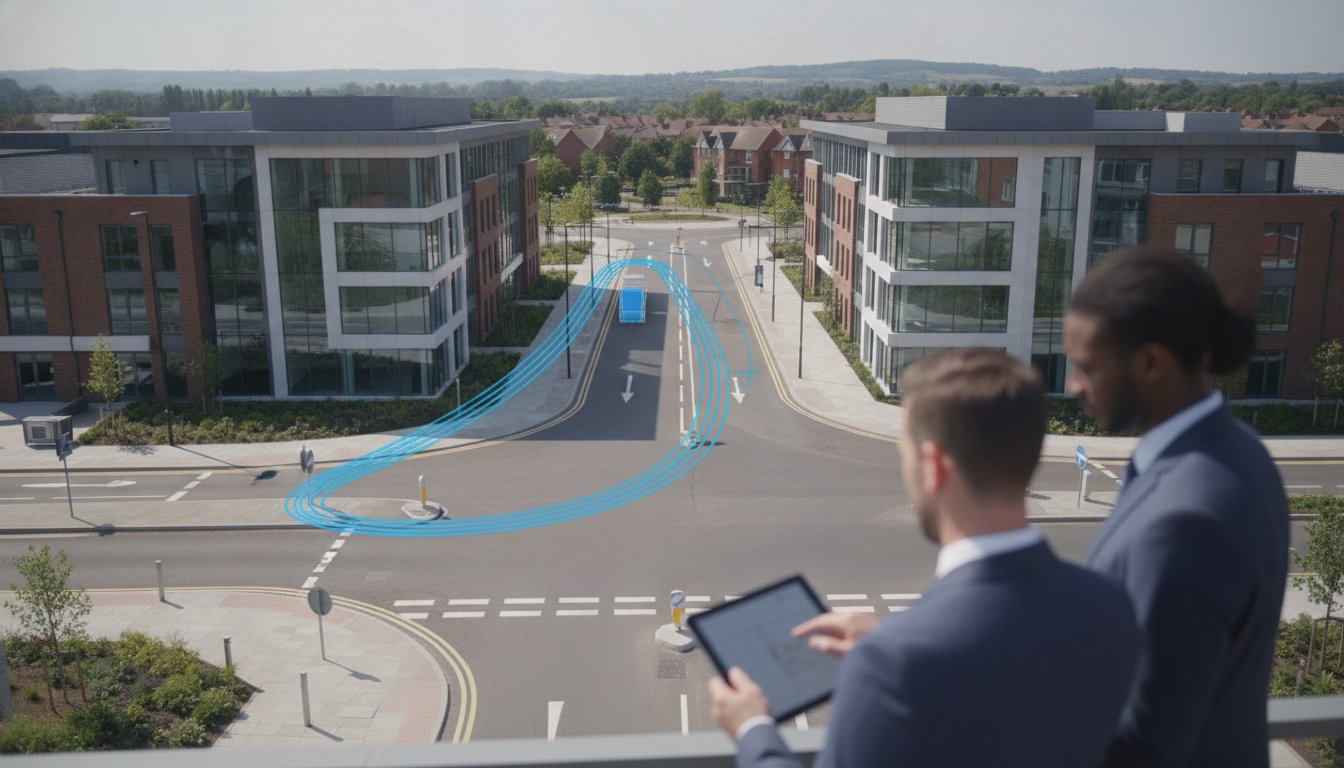
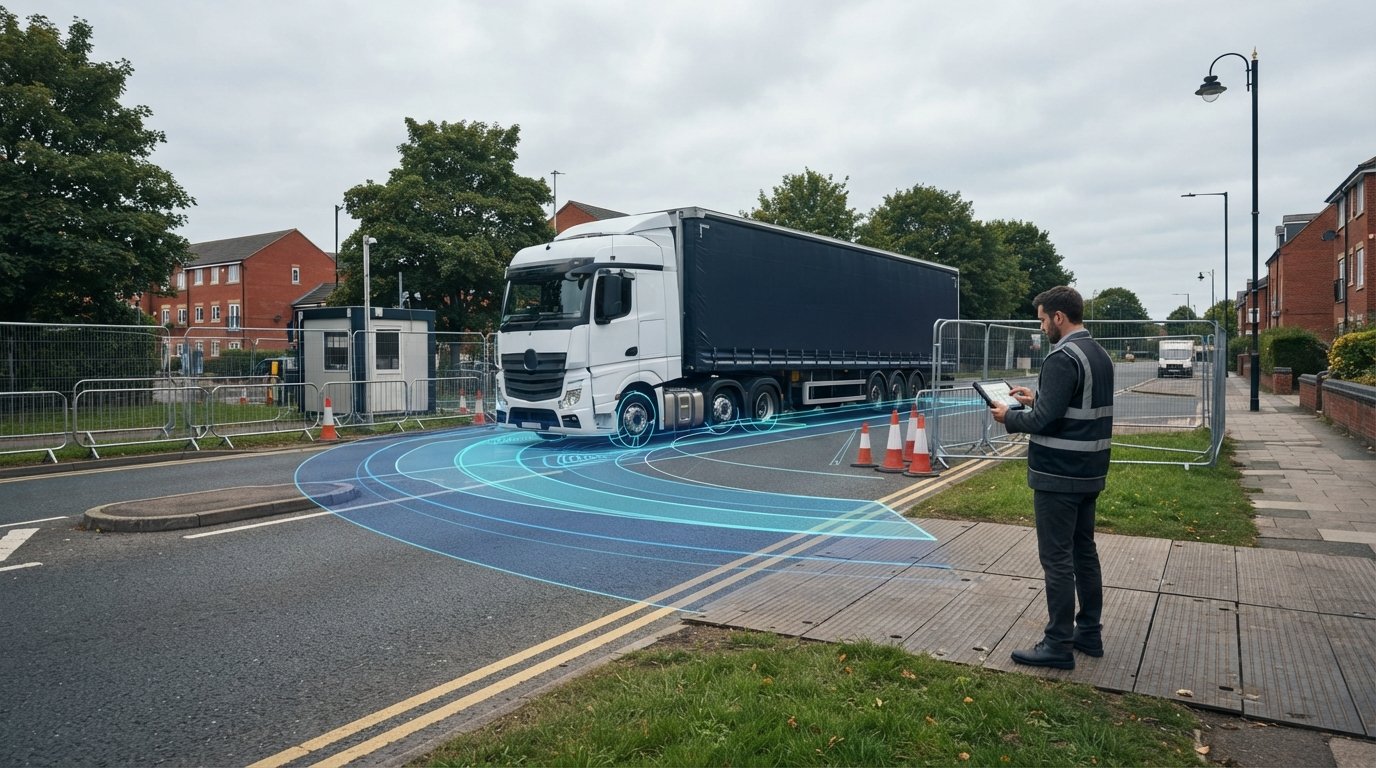
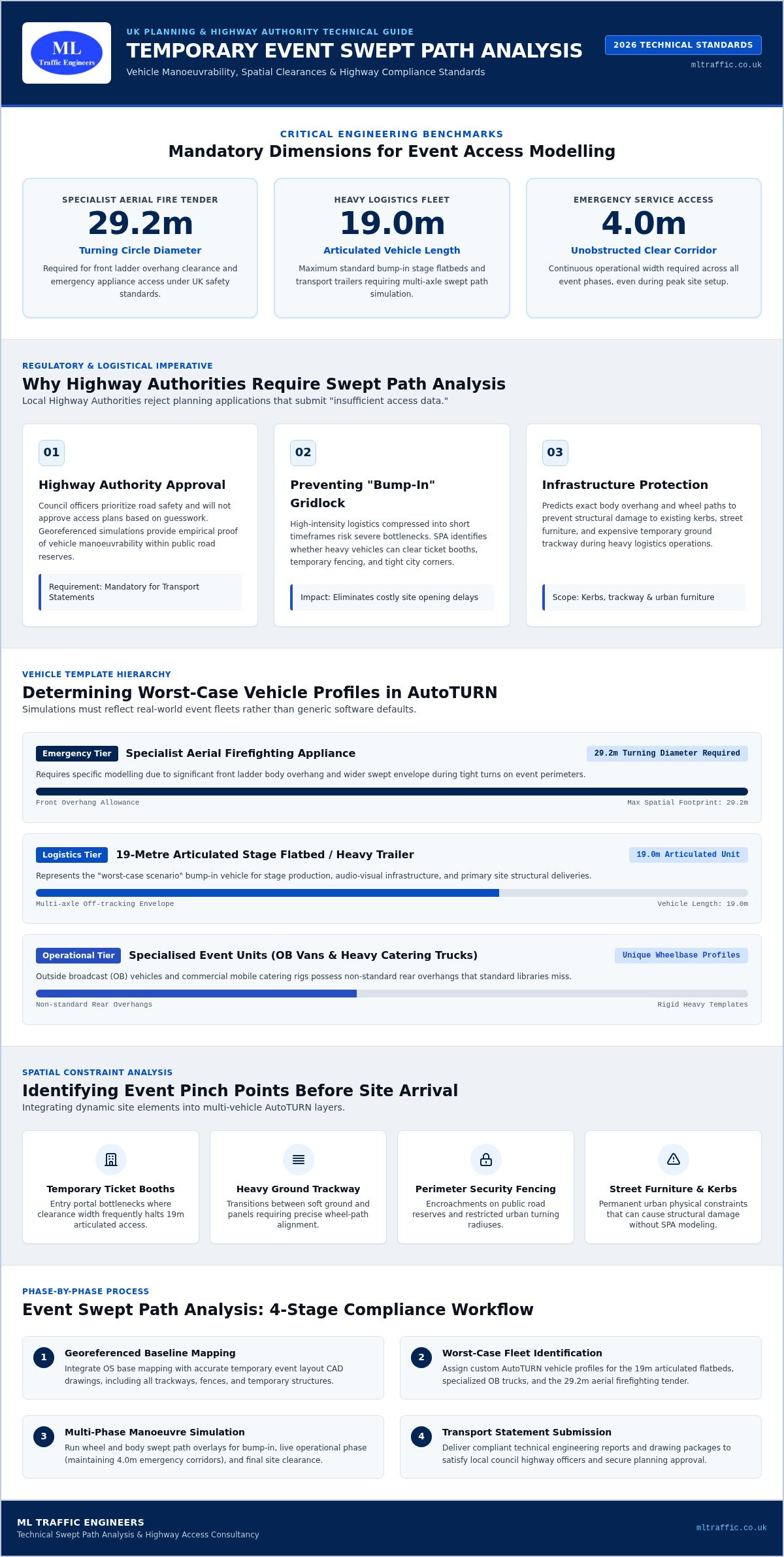
    High Wycombe’s unique topography presents significant challenges for site access. The town’s steep hills and narrow residential streets require precise Swept Path Analysis to prove that emergency and service vehicles can navigate the site safely. We use digital vehicle templates for fire tenders, refuse trucks, and delivery vans to test every turn and junction. This analysis directly informs your Car Park Design, ensuring that parking bays and access roads are functional rather than just compliant on paper. SPA results often serve as the deciding factor for Highway Authority approval on constrained infill sites.

    Finally, the statement must detail site access and visibility splays. We ensure that entry and exit points meet the Manual for Streets standards or the Design Manual for Roads and Bridges (DMRB) where appropriate. Safety is the primary concern for the LHA. By presenting a clear plan for visibility and vehicle priority, we reduce the risk of the council requesting expensive revisions during the application process. Every access point must be vetted for multi-modal safety, ensuring pedestrians and cyclists are protected from vehicle conflicts.

    Transport Statement in High Wycombe: A Developer’s Guide for 2026 approvals

    High Wycombe’s infrastructure presents distinct hurdles that standard templates often overlook. The A40 London Road and A404 Marlow Hill are notorious bottlenecks that require specific attention during the planning phase. Your transport statement High Wycombe must provide a granular analysis of how your site’s trip generation impacts these corridors. We focus on identifying peak hour vulnerabilities and proposing viable entry strategies that prevent local gridlock, ensuring your project doesn’t face objections from the Highway Authority regarding cumulative impact.

    The town’s steep gradients are a significant barrier to active travel, meaning a standard audit isn’t enough for a transport statement High Wycombe. Our technical reports account for these topographic challenges by identifying the most accessible routes and evaluating the feasibility of e-scooter or e-bike integration. This is particularly relevant as the Department for Transport has extended the e-scooter rental trial in Buckinghamshire until May 2026. We ensure your accessibility strategy is realistic rather than just theoretical.

    High Wycombe also contains established Air Quality Management Areas (AQMAs). We align your transport strategy with the High Wycombe 2050 Transport Strategy, ensuring your proposal supports the town’s shift toward a low-emission, safe transport system. By addressing air quality and congestion early, we position your development as a contributor to the town’s regeneration goals rather than a logistical burden.

    Parking Standards in Buckinghamshire

    The 2026 revisions to the Buckinghamshire Countywide Parking Guidance mandate a zone-based approach to vehicle storage. High Wycombe town centre sites, classified as Zone 1, often allow for reduced parking ratios due to high public transport accessibility. Conversely, edge-of-town developments typically require higher provision to prevent overspill. If your design departs from these standards, we use robust survey data to justify the deviation, ensuring the council accepts your rationale without requiring a reduction in unit density.

    Sustainable Travel and Public Transport

    Proximity to the High Wycombe railway station provides a powerful argument for reduced car dependency in your planning submission. We quantify the benefit of direct rail links to London Marylebone and analyze the frequency of bus services operating from the Eden Bus Station. For developments exceeding 100 dwellings, integrating comprehensive Travel Plans is essential. These plans must target a 10% reduction in single-occupancy car use within five years, a benchmark we support with data-driven incentives and monitoring strategies.

    The Planning Submission and Validation Process

    The path to a successful planning approval in Buckinghamshire requires more than just submitting technical data. Once you submit your transport statement High Wycombe, it undergoes a rigorous validation check by the council’s planning team. If any mandatory element is missing, such as a recent parking survey or accurate site access plans, the application is rejected on day one. This initial delay can ripple through your entire project timeline, pushing back construction starts and increasing carry costs. We ensure every technical component aligns with the latest 2026 validation requirements to prevent these administrative setbacks.

    Engaging with Buckinghamshire Council through pre-application advice is a strategic necessity. This early consultation allows the Highway Authority to flag potential concerns regarding junction capacity or sustainable travel before the formal submission. It creates a collaborative environment where technical objections are resolved in the design phase rather than during the statutory consultation period. When the Highway Authority reviews your final submission, they look for a logical, sequential argument that proves the development is safe and policy-compliant. If you need a robust technical partner to manage this process, you can instruct our team to prepare your submission today.

    Section 278 and Section 38 Agreements

    A transport statement High Wycombe often identifies the need for physical changes to the existing road network. When your development requires off-site improvements, such as a new junction or footway extension, you must enter into Highway Design S278 & S38 agreements. These legal frameworks govern how private developers perform works on the public highway. In Buckinghamshire, these agreements are high-stakes commitments. They require precise engineering drawings and significant financial bonds. We help you identify these triggers early to ensure your project budget accounts for these infrastructure costs.

    Common Pitfalls in High Wycombe Applications

    Many applications fail due to inadequate visibility splays, particularly on the town’s steep residential hills. A splay that looks sufficient on a flat map may be obstructed by the natural topography or existing boundary walls in reality. Another frequent error is the failure to account for the cumulative impact of neighboring developments. With the High Wycombe 2050 Transport Strategy in full effect, planning officers scrutinize how your site interacts with other local growth. Relying on outdated TRICS data or failing to update your traffic surveys after the April 2026 fee changes can also lead to immediate technical objections.

    Addressing objections is an iterative part of the planning lifecycle. If the Highway Authority raises concerns, we provide rapid, data-driven revisions to resolve the issue. This technical responsiveness is vital for maintaining momentum. Once the council is satisfied, transport-related planning conditions are issued. Discharging these conditions is the final step before your development can proceed. We manage this entire lifecycle, from the first site survey to the final approval, ensuring your project remains on track and fully compliant with regional regulations.

    Expert Transport Statements with ML Traffic Engineers UK

    Securing a successful planning outcome requires a partner who understands that precision is a functional necessity. We provide the technical authority and regulatory expertise needed to navigate the specific requirements of Buckinghamshire Council. Our team maintains a professional working relationship with local planning officers, ensuring that every transport statement High Wycombe we produce aligns with the town’s unique infrastructure goals for 2026. We don’t just provide data; we deliver a robust evidence base that reduces the logistical and regulatory pressures on your development team.

    Our technical support is comprehensive and tailored to the constraints of the Home Counties. ML Traffic Engineers UK manages the delivery of specialized transport statement High Wycombe reports alongside critical sub-services like Swept Path Analysis and Traffic Surveys. By identifying potential highway objections before they reach the statutory consultation phase, we minimize planning risk for both residential and commercial developers. This proactive approach ensures that your project moves from inception to completion without the burden of unexpected technical delays or costly design revisions.

    All-Encompassing Transport Planning

    We manage the full project lifecycle, providing unwavering reliability from the initial site assessment through to the final discharge of transport conditions. Our team understands the urgency of the industry and the round-the-clock nature of infrastructure planning. Meeting tight deadlines is a core part of our service promise. In the 2026 planning environment, local expertise is a functional necessity. ML Traffic Engineers UK applies deep knowledge of High Wycombe’s road network and parking standards to ensure your submission is validated on the first attempt. Our commitment to precision ensures that every report meets the highest industry benchmarks and legislative requirements.

    Request a Quote for Your High Wycombe Project

    Getting started with your planning submission is straightforward. We provide site-specific fee proposals that reflect the exact scope of your development. To prepare an accurate quote, we require a basic site plan and a brief description of the proposed use. Whether you need a concise Statement, a detailed Parking Survey, or a complex Swept Path Analysis, we respond with the readiness and clarity your project deserves. You can Contact ML Traffic Engineers UK for a Transport Statement Quote to secure a dependable partner for your next High Wycombe application. We offer the professional integrity and technical support required to safeguard your project’s progress in a strict regulatory environment.

    Secure Your High Wycombe Development Approval

    Successfully navigating the 2026 planning landscape in Buckinghamshire requires more than just technical data; it demands a strategy that respects the unique constraints of the local highway network. From the steep gradients of the town’s residential hills to the heavy traffic volumes on the A404, every element of your submission must demonstrate a clear understanding of regional priorities. A localized approach ensures that mitigation measures are both practical and acceptable to the Highway Authority, preventing the administrative gridlock that often stalls ambitious projects.

    ML Traffic Engineers UK has been at the forefront of this field since 2014, offering over a decade of specialized UK planning experience. We maintain a deep understanding of Buckinghamshire Council’s evolving LHA requirements, specializing in the data-driven Swept Path Analysis and Parking Surveys that planning officers scrutinize most closely. Our role is to act as your technical guardian, ensuring your transport statement High Wycombe is robust, compliant, and ready for immediate validation.

    Secure your High Wycombe planning approval with a professional Transport Statement from ML Traffic Engineers UK. We are ready to help you manage the regulatory complexities of your next development with precision and reliability.

    Frequently Asked Questions

    Do I need a Transport Statement or a Transport Assessment for my High Wycombe project?

    The scale of your development determines the required document. For residential projects, a Transport Statement is typically sufficient for sites under 100 dwellings. Larger schemes or commercial developments exceeding specific square footage thresholds, such as 2,500 square meters for business use, usually require a full Assessment. We recommend a pre-application consultation to confirm the exact requirements for your site, as the Local Highway Authority evaluates the potential for significant movement on a case by case basis.

    What are the current parking standards for new developments in High Wycombe?

    Buckinghamshire’s 2026 guidance emphasizes a shift toward sustainable infrastructure and zone based vehicle storage. While car parking levels depend on your site’s location, all new developments must now meet strict minimums for cycle storage and electric vehicle charging points. These standards ensure that even town centre sites remain functional for modern residents. We use local survey data to justify any necessary departures from these established countywide benchmarks while maintaining safety and accessibility.

    How much does a Transport Statement cost for a Buckinghamshire planning application?

    The cost of a professional report varies based on the complexity of the site and the required data collection. Factors such as the need for peak hour traffic counts, specialized junction modeling, or detailed site visits influence the final fee. We provide site specific quotes after reviewing your initial site plan and development description. This ensures you receive a transparent, fixed fee estimate tailored to the specific technical demands of your project without hidden costs.

    Can a Transport Statement help overcome a planning refusal based on highway safety?

    Yes, a robust transport statement High Wycombe can effectively challenge a refusal by providing empirical evidence to counter subjective safety concerns. We often use detailed traffic surveys and visibility analysis to prove that a proposed access point meets national safety standards. By proposing specific mitigation measures, such as junction improvements or improved pedestrian crossings, we can demonstrate that a development will not result in an unacceptable impact on the local highway network.

    How long does it take to produce a professional Transport Statement?

    Production timelines typically range from two to four weeks depending on the scale of the required data collection. The process involves an initial site visit, conducting traffic or parking surveys, and performing the technical analysis. We prioritize efficiency to meet tight planning deadlines while ensuring every report remains fully compliant with Local Highway Authority standards. Early instruction allows us to capture survey data during neutral weeks, avoiding delays caused by school holidays or local events.

    Will I need a Swept Path Analysis as part of my Transport Statement?

    Buckinghamshire Council frequently requires Swept Path Analysis for sites with constrained access or internal road networks. This is especially true for residential developments where refuse vehicle tracking is a mandatory validation requirement. We use digital templates to prove that emergency services and delivery vans can enter and turn within the site safely. Including these results in your transport statement High Wycombe significantly reduces the risk of the council requesting a costly redesign after your application is submitted.

    What is the role of the TRICS database in my planning application?

    TRICS is the industry standard database used to estimate the number of trips a new development will generate. It allows us to compare your project against data from similar established sites across the UK. By selecting comparable locations with similar public transport accessibility, we provide a realistic forecast of vehicle movements. This data driven approach is essential for justifying the impact of your project on the road network and determining if mitigation measures are necessary.

    How does Buckinghamshire Council handle sustainable travel requirements in 2026?

    In 2026, the council prioritizes the integration of transport and development planning through the Local Transport Plan 5. This includes a strong focus on digital connectivity to reduce the need for travel and the implementation of Travel Plans for larger sites. Developers should note that monitoring fees apply for residential sites of 100 dwellings or more. We ensure your statement highlights high quality pedestrian links and proximity to the Eden Bus Station to meet these aggressive sustainability targets.

    Michael Lee

    Article by

    Michael Lee

    Transport planner with over 35 years' experience.

    Disclaimer

    The content on mltraffic.co.uk, including all technical articles, guides, and resources, is provided for general informational and educational purposes only. It is not intended to constitute professional advice in traffic engineering, transportation planning, development approvals, or any other technical or legal field.
    While ML Traffic Engineers makes every reasonable effort to ensure the accuracy, completeness, and timeliness of the information published, we do not provide any warranties or representations (express or implied) regarding its reliability, suitability, or availability for any particular purpose. Any reliance you place on the content is strictly at your own risk.
    In no event shall ML Traffic Engineers, its directors, employees, authors, or affiliates be liable for any direct, indirect, incidental, special, consequential, or punitive damages (including, without limitation, loss of profits, data, or business opportunities) arising out of or in connection with the use of, or inability to use, any information provided on this website.
    The articles and guides on this site are not a substitute for engaging a qualified, professional traffic engineer to assess your specific project requirements. For tailored advice, compliance assessments, or traffic engineering services, please contact a competent professional.
    This disclaimer may be updated from time to time without notice. By accessing or using this website, you agree to be bound by the most current version of this disclaimer.
  • What is a Traffic Engineer? A Guide for Developers

    What is a Traffic Engineer? A Guide for Developers

    With van traffic rising 10% above pre-pandemic levels and London drivers losing 109 hours a year to congestion, your development’s access strategy isn’t a simple box-ticking exercise. It’s a high-stakes regulatory hurdle. You’ve likely felt the frustration when a highway authority objection stalls your project; these delays create unnecessary costs and uncertainty for your timeline. A specialist traffic engineer acts as your technical advocate, transforming these logistical barriers into a clear path toward planning approval.

    This guide explains how expert transport data secures your site’s future. You’ll learn how to determine whether you need a Transport Statement or a full Transport Assessment to satisfy local authorities. We’ll also explore how technical tools like Swept Path Analysis and Parking Surveys provide the evidence needed to counter local objections. By the end of this article, you’ll understand how to design a safe, efficient layout that meets 2026 standards and maximises your land value.

    Key Takeaways

    • Understand the vital role of a traffic engineer in navigating complex UK transport policies and securing planning approval for your site.
    • Identify the specific technical documents, such as Transport Assessments and Travel Plans, required to satisfy highway authority requirements.
    • Learn to distinguish between traffic engineers and transport planners to ensure you engage the correct specialist for your project’s technical needs.
    • Discover how utilizing technical data like Swept Path Analysis and Parking Surveys can proactively mitigate risks and counter local objections.
    • Explore how early intervention and professional accuracy from ML Traffic Engineers streamline the planning process and maximize land value.

    Table of Contents

    The Role of a Traffic Engineer in Modern UK Development

    A traffic engineer serves as the technical bridge between your architectural vision and the strict requirements of the local highway authority. While the broad discipline of traffic engineering (transportation) encompasses highway capacity and signal timing, the modern UK developer needs a specialist focused on the planning cycle. These professionals translate complex vehicle movements into data-driven reports that satisfy statutory bodies and reduce regulatory friction. In a high-stakes environment where precision is a necessity, their role is to ensure your project moves from inception to completion without highway-related delays.

    To better understand this concept, watch this helpful video:

    Beyond Cones and Signs: Defining the Consultancy Role

    Many developers initially associate "traffic" with physical roadworks or temporary closures. However, in a consultancy context, the role is purely analytical and advisory. A traffic engineer focuses on data-driven reporting for statutory approvals rather than physical construction. They analyze how your proposed site will interact with the existing network through detailed Traffic Surveys. This work requires close collaboration with architects and planning officers to ensure that site layouts aren’t just aesthetic but functional. They provide the technical certainty that a refuse vehicle can turn safely or that a delivery van won’t block a primary arterial road. Accuracy is a functional necessity here.

    Why Traffic Engineering is Essential for Planning Approval

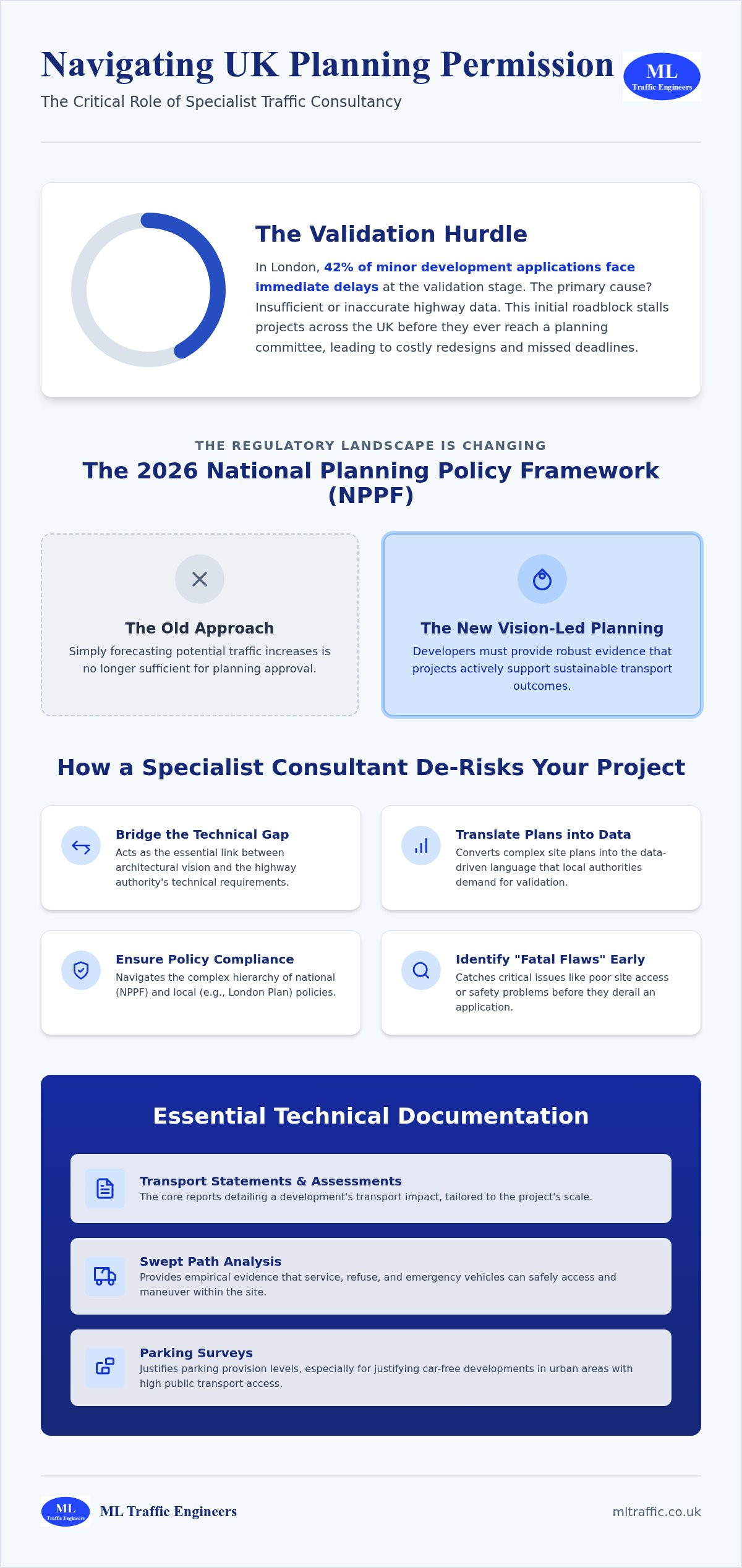
    Securing "safe and suitable access" remains a non-negotiable pillar of the National Planning Policy Framework (NPPF). Without expert technical evidence, your application is vulnerable to immediate highway authority objections. In 2026, the planning environment has become even more rigorous. New regulations, including the Traffic Management Permit Scheme (England) (Amendment) Regulations 2026, now mandate a focus on Electric Vehicle infrastructure and sustainable transport integration. A traffic engineer provides the evidence to mitigate local community objections. Whether it’s through a detailed Transport Assessment or a robust Travel Plan, they prove your development won’t compromise public safety or highway efficiency. This proactive approach saves time and protects your land value by removing the logistical barriers to approval.

    Core Technical Services: How Engineers Solve Site Constraints

    A traffic engineer provides the technical evidence required to prove a development is viable and safe. In 2026, this process relies heavily on digital modelling and simulation to test site layouts before any physical work begins. Recent updates to the Design Manual for Roads and Bridges (DMRB) on March 30, 2026, have refined the technical standards for these assessments. Additionally, the Traffic Management Permit Scheme (England) (Amendment) Regulations 2026, which came into force on April 10, 2026, now integrate Electric Vehicle (EV) charge point operators into the permit system. A specialist engineer ensures these new regulatory requirements are met without compromising site efficiency or parking capacity. Precision in these early stages is a functional necessity for project success.

    Swept Path Analysis: Ensuring Vehicle Access Feasibility

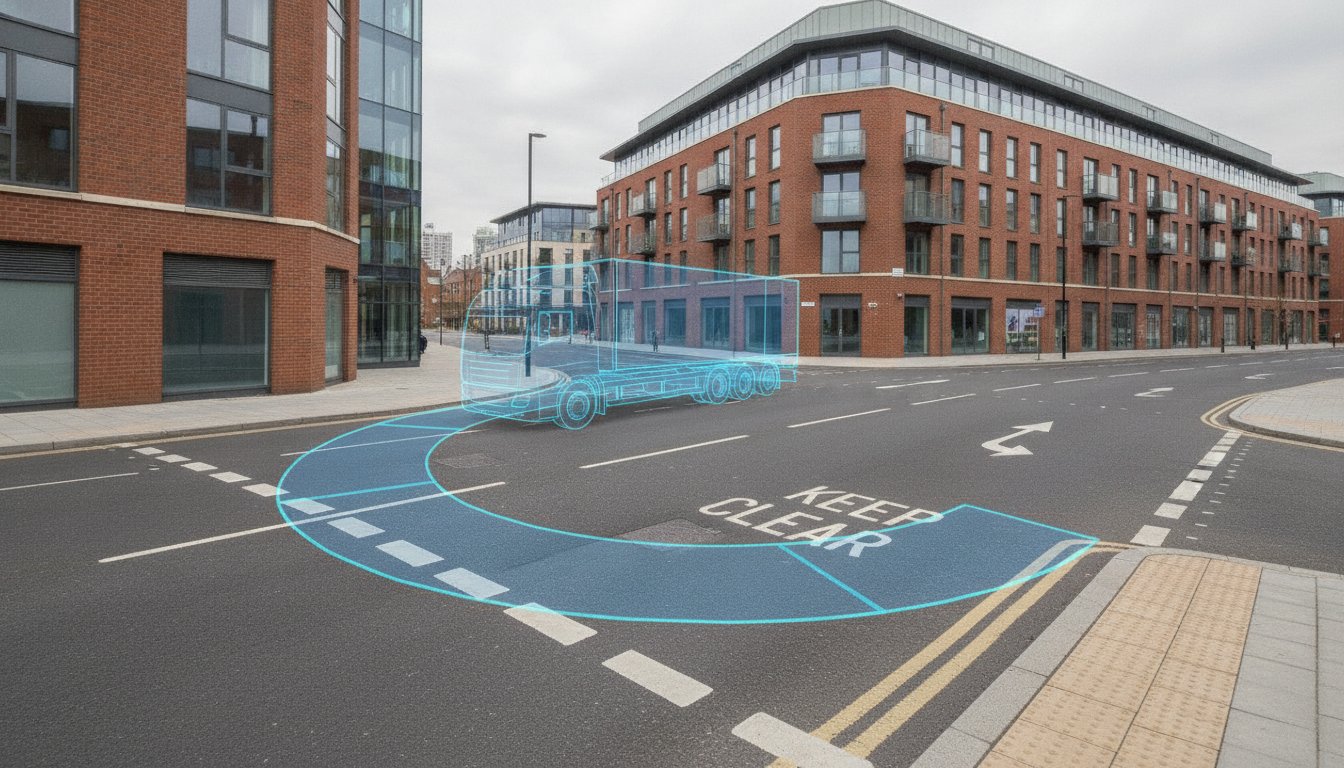
    Proving that emergency and service vehicles can navigate your site is a non-negotiable requirement for planning approval. A traffic engineer uses Swept Path Analysis Services to simulate the movement of specific vehicles, such as a 12-metre refuse truck or a fire tender. Modern councils demand this data for even small residential projects to prevent future access issues. This technical simulation identifies pinch points in your layout early. It allows for adjustments that protect your land value while ensuring public safety. If you’re developing on a tight urban site, accurate simulation is your best defense against highway authority objections.

    Transport Statements and Assessments: The Statutory Requirement

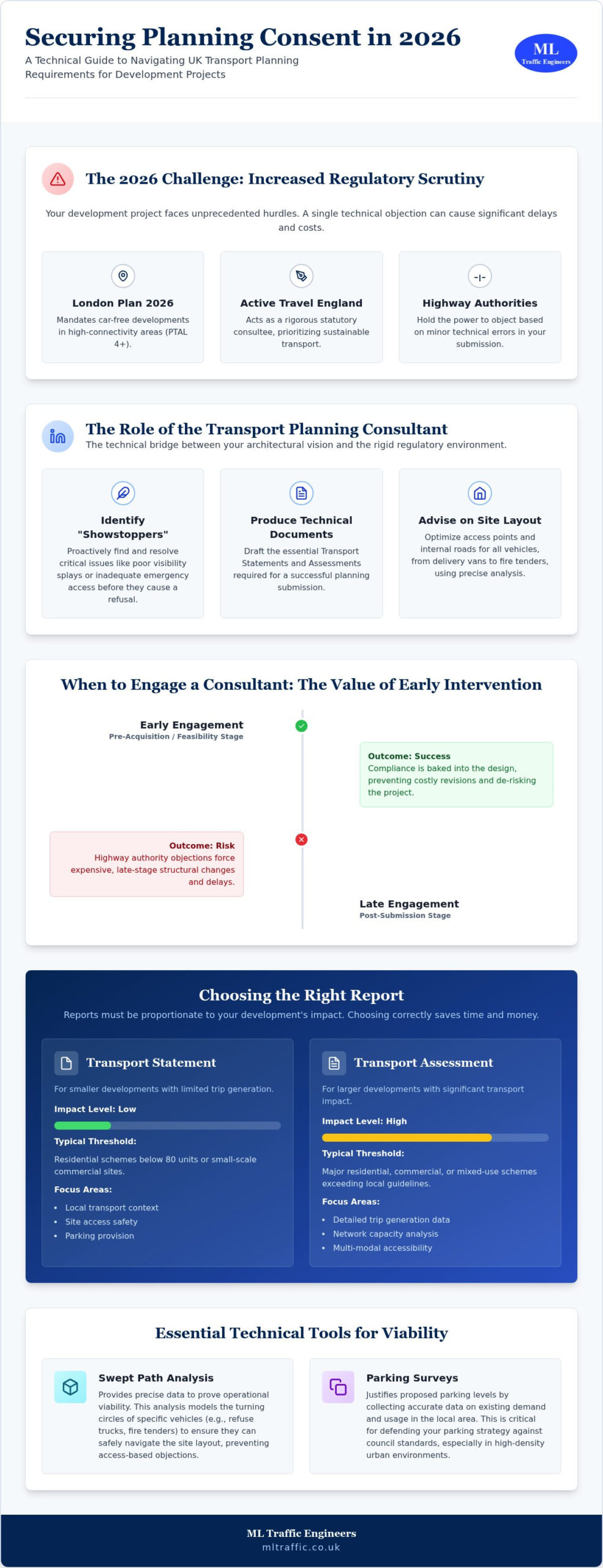
    The scale of your development determines whether you need a Transport Statement or a full Transport Assessment. While a Statement is typical for smaller projects with limited impact, an Assessment is a comprehensive study for larger developments. These reports evaluate how your project affects the local road network and public transport capacity. Understanding these requirements is vital, as this resource from Michigan State University explains the difference between broader transportation disciplines and specific technical applications. For projects in the capital, following a Transport Assessment London Guide ensures your submission aligns with the specific policies of the London Plan, such as car-free mandates in high-accessibility areas. Providing this technical evidence early reduces the risk of costly delays during the planning cycle. You can explore our technical planning services to see which reports your specific project requires.

    What is a Traffic Engineer? A Guide for Developers

    Traffic Engineer vs. Transport Planner: Navigating the Terminology

    Developers often use the terms "transport planner" and "traffic engineer" interchangeably, but this confusion can lead to critical gaps in a planning submission. A transport planner typically focuses on the "why" of a project. They handle high-level policy alignment, sustainable travel strategies, and long-term social impacts. In contrast, a traffic engineer is a technical specialist focused on the "how." They analyze the physical geometry of a site, calculate junction capacity, and ensure vehicle movements are safe and compliant with the latest standards. It’s also vital to distinguish these roles from traffic management contractors; an engineer provides the analytical design required long before any physical cones or signs appear on the road.

    This distinction is essential for meeting the technical requirements of modern UK infrastructure. The professional profile for Transportation Engineers highlights a reliance on mathematical modelling and complex problem-solving. While a planner might argue for a reduction in car parking based on local public transport accessibility, the engineer proves the remaining parking layout functions without causing vehicle conflict or safety risks. Precision is a functional necessity here. A successful planning application requires these two disciplines to work in tandem, ensuring policy goals are supported by technical reality.

    Strategic Planning vs. Technical Design

    Strategic planners are your primary navigators for the London Plan or national sustainability targets. They excel at arguing for a project’s place within a wider urban context. However, they rarely possess the tools to simulate the physical dynamics of a 12-metre vehicle entering a narrow mews. This is where the engineering role becomes indispensable. When you hire a traffic engineer, you’re securing the technical feasibility of your site. They focus on design elements such as visibility splays, gradient changes, and Swept Path Analysis. They provide the hard data that highway authorities demand before they’ll sign off on a project. Without this engineering input, a planner’s strategy remains a theoretical exercise rather than a buildable reality.

    When Do You Need a Specialist Traffic Engineer?

    Specific "trigger points" in a development cycle mandate the involvement of an engineering specialist. If your site has a complex junction, a steep access ramp, or a particularly tight entrance, a planner’s report won’t suffice. You need an engineer when your project involves works within the existing highway, specifically for Section 278 or Section 38 agreements. These legal requirements demand a level of technical precision that only an engineering consultant can provide. Early intervention is key to avoiding highway authority objections. You can find more technical guidance in our Highway Design S278 & S38 Guide. Using an engineer early ensures your site layout is optimized for both safety and land value, preventing expensive redesigns late in the planning process.

    Maximising Success in Your Planning Application

    Planning success is rarely accidental. It requires a proactive strategy where technical evidence addresses regulatory concerns before they escalate into formal refusals. A specialist traffic engineer identifies potential highway authority objections early in the cycle, allowing for design adjustments that protect your project’s timeline and budget. With Great Britain’s road traffic reaching 342.6 billion vehicle miles in 2025, local authorities are more critical than ever. The 2026 regulatory environment, including recent updates to the Design Manual for Roads and Bridges (DMRB) published on March 30, 2026, demands a higher standard of technical precision. Early technical intervention is a functional necessity to mitigate risk and avoid the heavy financial burden of a failed application.

    Early Engagement with Local Highway Authorities

    Pre-application engagement provides a clear path to approval. This process allows your consultant to discuss site constraints with council highway officers before you submit a formal application. Because engineers understand the technical lexicon of regulatory compliance, they can resolve "deal-breakers" like substandard visibility splays or restricted access points. This collaborative approach prevents the friction often caused by late-stage redesigns. It ensures that your site layout adheres to industry benchmarks from the outset, providing the reassurance that planning officers require. By speaking the same technical language as the authority, a traffic engineer builds the professional trust necessary to navigate complex urban sites.

    Using Data to Overcome Objections

    The primary obstacle for many developers is the public perception that a new site will cause "traffic chaos." You can dismantle these objections with high-quality data. Robust Traffic Surveys provide the evidence needed to prove that additional vehicle movements won’t compromise local junction capacity, even with van traffic now 10% higher than pre-pandemic levels. Similarly, Parking Surveys are vital when proposing car-free or low-parking developments. In London contexts, adhering to the Lambeth Methodology is essential for data to be accepted by local authorities. This methodology provides a standardised way to demonstrate that existing on-street capacity can accommodate any residual parking demand. This technical approach removes the subjectivity from local planning committee debates. It replaces anecdotal concerns with verifiable facts, securing your planning certainty and protecting the project’s overall land value.

    Precision in your technical submission is non-negotiable. Contact ML Traffic Engineers to secure the professional surveys needed for your planning application.

    Partnering with ML Traffic Engineers for Planning Certainty

    Success in the 2026 planning environment requires more than just technical data; it demands a partner who understands the high-stakes nature of property development. ML Traffic Engineers operates as a specialist UK consultancy dedicated to removing the regulatory and logistical pressures from your project. We recognize that precision is a functional necessity in every report we produce. Our team maintains a constant state of readiness to address the evolving requirements of highway authorities across England. By positioning ourselves as a vital guardian of public safety and professional integrity, we ensure your development meets every industry benchmark and legislative requirement from the outset.

    Our service model prioritizes rapid response and unwavering reliability. We manage full project lifecycles, moving your application from initial feasibility through to final statutory approval. This all-encompassing approach allows you to focus on the broader aspects of your development while we handle the intricate technical details. We take immense pride in our adherence to standards, ensuring that every submission is bulletproof and safety-conscious. When you work with a traffic engineer from our team, you gain a dependable partner who understands regional regulations so you don’t have to.

    Expert Technical Reporting for England’s Developers

    Our track record demonstrates a consistent ability to secure planning certainty for diverse project types. We specialize in delivering robust Transport Statements and Travel Plans tailored to the specific needs of your site. Navigating complex urban environments with restricted access is a core strength of our consultancy. We use advanced modelling tools to prove that even the tightest sites can function safely and efficiently. You can explore our full range of technical services by visiting What We Do. Each report we generate serves as a definitive piece of evidence to support your application’s success.

    Comprehensive Support from Inception to Approval

    The path to planning approval often involves technical challenges and unexpected comments from council highway officers. We provide comprehensive support that extends well beyond the initial data collection phase. Our proactive approach includes managing the dialogue with highway authorities and resolving technical objections with precision and speed. We don’t just provide reports; we provide solutions that protect your land value and project timeline. This commitment to excellence ensures that your development remains compliant with the latest 2026 standards, including recent updates to the Design Manual for Roads and Bridges. Contact ML Traffic Engineers for a project review to secure the technical authority your development requires.

    Secure Your Planning Approval with Technical Precision

    Navigating the 2026 planning landscape requires more than just a viable site; it demands technical evidence that satisfies the most rigorous highway authority standards. You’ve learned how a specialist traffic engineer transforms complex vehicle dynamics into the clear data required for statutory approval. By utilizing professional Parking Surveys and junction modelling, you replace local uncertainty with verifiable facts. From detailed Swept Path Analysis to comprehensive Transport Statements, these technical documents are the foundation of a successful application. Early intervention doesn’t just resolve objections; it actively protects your project’s timeline and land value.

    ML Traffic Engineers has provided this essential technical authority since 2014. With over a decade of planning success, we specialize in delivering the precise evidence developers need to navigate UK regional highway regulations. We ensure your site layout is safe, compliant, and ready for approval. Get Expert Traffic Engineering Support for Your Planning Application. Your project’s success is within reach when you have a dependable partner managing your technical submission.

    Frequently Asked Questions

    What is the difference between a traffic engineer and a transport planner?

    A traffic engineer focuses on the technical and operational aspects of a transport system, including road design, vehicle dynamics, and safety management. In contrast, a transport planner deals with strategic development and long-term policy implementation. While planners handle the high-level "why" of a project, engineers manage the "how" by calculating junction capacity and ensuring site geometry meets strict safety standards.

    When is a Transport Statement required for a planning application in the UK?

    A Transport Statement is typically required for developments that have relatively small transport implications but still need to demonstrate safe access. Local authorities set specific thresholds based on the number of residential units or commercial floor space proposed. This concise report proves that the development’s impact on the local network is acceptable and that the internal site layout functions correctly.

    How much does a traffic engineer cost for a small residential development?

    Consultancy fees depend on the complexity of the site and the specific reports required by the local highway authority. Developers should check with a consultant for a tailored quote based on their specific project scope. Factors such as the need for Parking Surveys or complex access designs will influence the final cost. It’s best to check directly to ensure all statutory requirements are covered.

    What is Swept Path Analysis and why does my architect need it?

    Swept Path Analysis is a digital simulation used to calculate the space required for specific vehicles, such as refuse trucks and fire tenders, to turn and manoeuvre. Architects use this data to ensure the site layout is functional and safe. Providing this technical evidence early prevents highway authority objections regarding vehicle access and protects the overall land value of the development by avoiding late-stage redesigns.

    Can a traffic engineer help if the council has already objected to my project?

    Yes, an engineer can provide technical evidence to counter specific highway authority objections. By conducting Traffic Surveys or using Swept Path Analysis to redesign access points, they can prove that the council’s concerns are mitigated. This technical advocacy often resolves disputes through data-driven reporting, frequently avoiding the need for a costly and time-consuming planning appeal.

    How long does it take to prepare a Transport Assessment for planning?

    The preparation time for a Transport Assessment varies based on the scale of the development and the depth of data collection required. A standard assessment usually takes several weeks to complete because it involves site visits, junction modelling, and coordination with planning officers. Starting this process early ensures the final report is robust and satisfies all regulatory requirements before the submission deadline.

    Do I need a traffic survey for a change of use application?

    A survey is often necessary if the change of use results in a significant increase in vehicle trips or a change in delivery patterns. Planning officers need to understand how the new use affects the local highway network compared to the previous permission. Providing accurate data demonstrates that the proposal won’t compromise local road safety or capacity, reducing the risk of a highway objection.

    What is a Section 278 agreement and why do I need an engineer for it?

    A Section 278 agreement is a legal contract between a developer and the Highway Authority for permanent works on a public road. You need a traffic engineer to provide the technical design and capacity analysis required for these works. Their expertise ensures that the proposed changes meet strict safety benchmarks and legislative requirements, which is a non-negotiable foundation for securing final approval.

    Which areas in London do you cover?

    We service Acton, Balham, Barking, Barnes, Barnet, Battersea, Beckenham, Bexleyheath, Brentford, Brixton, Bromley, Camberwell, Carshalton, Charlton, Chelsea, Chiswick, Clapham, Coulsdon, Croydon, Crystal Palace, Dagenham, Dulwich, Ealing, Edgware, Eltham, Enfield, Finchley, Forest Gate, Fulham, Golders Green, Greenwich, Hackney, Hammersmith, Hampstead, Harrow, Hayes, Highgate, Hounslow, Ilford, Islington, Kensington, Kentish Town, Kingston upon Thames, Lewisham, Mitcham, Muswell Hill, New Malden, Notting Hill, Orpington, Peckham, Pinner, Purley, Putney, Richmond, Romford, Ruislip, Sidcup, Southall, Southgate, Streatham, Surbiton, Sutton, Tooting, Tottenham, Twickenham, Uxbridge, Walthamstow, Wembley, West Norwood, Wimbledon, Wood Green, Woolwich, Bethnal Green, Shoreditch, Canary Wharf, Deptford, Leyton, Palmers Green, Stanmore, Upminster, Chislehurst, Erith, Feltham.

    Which cities in England do you cover?

    We service London, Birmingham, Manchester, Liverpool, Sheffield, Leeds.

    Michael Lee

    Article by

    Michael Lee

    Transport planner with over 35 years' experience.

    Disclaimer

    The content on mltraffic.co.uk, including all technical articles, guides, and resources, is provided for general informational and educational purposes only. It is not intended to constitute professional advice in traffic engineering, transportation planning, development approvals, or any other technical or legal field.
    While ML Traffic Engineers makes every reasonable effort to ensure the accuracy, completeness, and timeliness of the information published, we do not provide any warranties or representations (express or implied) regarding its reliability, suitability, or availability for any particular purpose. Any reliance you place on the content is strictly at your own risk.
    In no event shall ML Traffic Engineers, its directors, employees, authors, or affiliates be liable for any direct, indirect, incidental, special, consequential, or punitive damages (including, without limitation, loss of profits, data, or business opportunities) arising out of or in connection with the use of, or inability to use, any information provided on this website.
    The articles and guides on this site are not a substitute for engaging a qualified, professional traffic engineer to assess your specific project requirements. For tailored advice, compliance assessments, or traffic engineering services, please contact a competent professional.
    This disclaimer may be updated from time to time without notice. By accessing or using this website, you agree to be bound by the most current version of this disclaimer.

  • transport statement cost for small development England Best Practices and Expert Advice

    transport statement cost for small development England Best Practices and Expert Advice

    Did you know that robust transport documentation reduced planning appeal rates by 22% for residential schemes in 2023? Many developers assume the transport statement cost for small development England projects is fixed by site size, but it’s actually driven by technical risk and specific local data requirements. You’ve likely experienced the frustration of opaque consultancy fees or the fear that a local highway authority will reject your application based on NPPF threshold confusion. Precision is a functional necessity in this high-stakes environment where regulatory delays can stall your momentum for months.

    We understand that planning pressures are increasing, particularly with the 3.8% rise in England planning fees effective from 1 April 2026. This guide provides the technical authority you need to secure planning approval efficiently while maintaining full compliance with local standards. We’ll explain the primary factors influencing your report costs, from parking surveys to swept path analysis requirements. You’ll learn how to navigate current EV charging mandates and produce a submission that passes council scrutiny the first time. Our goal is to reduce your regulatory burden and provide a clear, logical path to project execution.

    Key Takeaways

    • Differentiate between a Transport Statement and a full Assessment to ensure you only commission the technical detail required for your site’s specific scale.
    • Identify how factors like projected trip generation and highway complexity determine the transport statement cost for small development England to avoid unexpected consultancy fees.
    • Minimise project delays by engaging a transport consultant at the feasibility stage to identify and resolve site accessibility issues before submitting your application.
    • Streamline the approval process with high-quality site plans that reduce drafting time and ensure compliance with strict local highway authority standards.
    • Gain a competitive advantage by applying expert technical advice tailored to the specific planning policies of councils in London, Slough, and High Wycombe.

    Table of Contents

    What Is a Transport Statement for Small Developments?

    A Transport Statement is a concise technical report required for development proposals that generate some traffic but don’t reach the threshold for a full Transport Assessment. This document forms a critical part of the broader transportation planning process by assessing site accessibility, safety, and the potential impact on the local highway network. While a full Assessment involves complex junction modeling across a wide geographical area, a Statement focuses on immediate site constraints and sustainable travel options. It provides the technical evidence needed to prove that a proposal aligns with the National Planning Policy Framework (NPPF).

    To better understand how these technical requirements influence project expenses, watch this helpful video:

    For developers, this report serves as a vital negotiation tool with the Local Highway Authority (LHA). Understanding the transport statement cost for small development England is often the first step in budgeting for a successful planning application. By addressing potential highway objections early, you reduce the risk of costly delays or application refusal. We focus on delivering precision so that the regulatory pressures on your project are minimised from the outset.

    Small Development Thresholds in England (2026)

    As of 2026, national guidelines typically require a Transport Statement for residential developments consisting of 10 to 49 units. However, thresholds for commercial sites vary significantly based on use classes, such as retail, industrial, or office space. Local councils in high-density areas like Slough or London frequently lower these thresholds. They do this because even a small increase in vehicle movements can have a disproportionate effect on already congested urban networks or sensitive local infrastructure. We track these regional variations to ensure your project remains compliant with local standards.

    The Purpose of the Statement in the Planning Process

    The primary objective is to demonstrate that the residual cumulative impact of the development is not severe. This is a specific legal test set by the NPPF that determines whether a project can be refused on transport grounds. We focus on ensuring safe access for all users, including pedestrians, cyclists, and motorists. A well-prepared report ensures that your site layout promotes sustainable transport and meets modern safety standards. For more technical guidance and support in achieving these benchmarks, you can access ML Traffic Engineers resources. We provide the technical authority required to navigate these intricate regional regulations efficiently.

    Key Factors Influencing Transport Statement Cost

    Determining the transport statement cost for small development England requires an analysis of technical risk rather than a flat fee based solely on unit numbers. Site location is a primary driver of these costs. A greenfield site with clear sightlines involves different technical challenges than a brownfield site with existing highway constraints. We prioritize precision in these assessments to ensure your submission meets UK government guidance regarding safety and accessibility. The level of consultation required with the Local Highway Authority (LHA) also dictates the workload, as complex sites often necessitate multiple rounds of pre-application feedback.

    Data acquisition forms a significant portion of the technical fee. We utilize the TRICS database to project trip generation, which requires professional subscription access to ensure the data is current and defensible. The scale of your proposed development directly dictates the volume of these projected movements. Larger small-scale sites, such as those approaching the 50-unit threshold, require more rigorous data sets to satisfy the LHA. If existing data is deemed insufficient by the council, physical Traffic Surveys may be necessary to establish baseline movements. These surveys provide the empirical evidence required to justify your development’s impact on the local network.

    Swept Path Analysis and Technical Modeling

    Swept Path Analysis (SPA) is a critical component that often influences the final fee. This technical modeling uses specialized software to simulate vehicle maneuvers, such as fire tenders or refuse trucks, within your site layout. Local authorities require this to guarantee that emergency and service vehicles can enter and exit in forward gear. While adding to the initial report cost, SPA prevents expensive design revisions during the construction phase by identifying tight turns or inadequate radii early. Precision here is non-negotiable for public safety and long-term site functionality.

    Local Authority Requirements (London vs. Home Counties)

    Regional variations significantly impact the scope of work. London boroughs often demand higher levels of scrutiny compared to councils in Slough or High Wycombe. In London, your Public Transport Accessibility Level (PTAL) rating dictates the depth of the Statement. A low PTAL score might necessitate more robust mitigation strategies or detailed Parking Surveys to address overspill concerns. If your site is near a strategic road network managed by National Highways, expect additional coordination requirements. We manage these intricate regional regulations so you don’t have to, maintaining a focus on rapid delivery and regulatory compliance.

    transport statement cost for small development England Best Practices and Expert Advice

    Transport Statement vs. Transport Assessment: Cost Comparison

    Choosing between these two documents isn’t just a matter of site size; it’s about the technical intensity required by the Local Highway Authority (LHA). While a Transport Statement focuses on the site’s immediate vicinity and access, a Transport Assessment demands a much wider geographical study area. This increased scope significantly inflates the project’s budget because it requires extensive junction capacity modeling using specialized software. According to official government guidance on Transport Statements, the report must be proportionate to the development’s impact. For most small sites, the transport statement cost for small development England remains manageable because it avoids the multi-junction analysis required for larger schemes.

    Statements are typically delivered on a fixed-fee basis, providing developers with cost certainty from the outset. In contrast, Assessments are often quoted in stages or as time-charge projects due to their unpredictable nature. If the LHA demands additional modeling for distant junctions after the initial submission, the fees can escalate rapidly. Selecting the wrong report type is a common pitfall that leads to immediate planning refusal. It’s vital to agree on the technical scope before commissioning work to ensure your investment leads to a successful planning outcome.

    When a Statement Isn’t Enough

    Specific triggers might necessitate a full Assessment even if your unit count is low. If your site is located near a junction with a high accident record or existing capacity issues, the council will likely demand a more rigorous study. Pre-application advice is the most reliable way to confirm which report is necessary for your specific location. For those managing larger or more sensitive projects in the capital, our Transport Assessment London guide provides deeper insight into these complex requirements. We manage the full project lifecycle to ensure your submission meets these heightened standards without unnecessary delays.

    Fee Structures for Small Developments

    Most professional quotes for a Transport Statement utilize a "lump sum" model that covers the site visit, data analysis, and report drafting. However, you should watch for hidden costs that aren’t always included in a basic proposal. These might include site visit travel expenses, LHA meeting fees, or the cost of purchasing specific traffic count data from third parties. We prioritize transparency by providing comprehensive support that identifies these variables early. This approach reduces the regulatory pressures on your team and ensures that your budget remains intact from inception to completion.

    How to Minimise Your Transport Planning Costs

    Reducing the transport statement cost for small development England projects requires technical foresight rather than just administrative filing. Precision saves money. By identifying potential highway objections during the initial design phase, you avoid the expensive cycle of re-submitting plans after a council refusal. We recommend engaging a consultant at the feasibility stage to identify red flags like inadequate visibility splays or restricted access points. Correcting these issues on paper is far cheaper than attempting to mitigate them once a formal application is already in progress.

    Efficiency in data management also drives down fees. You can lower your costs by providing clear, high-quality CAD site plans from the outset. This reduces the time our engineers spend cleaning up drafting errors. Consolidating your requirements into a single technical package is another effective strategy. For example, commissioning a Swept Path Analysis alongside your Transport Statement ensures that vehicle tracking and policy compliance are handled simultaneously. This integrated approach eliminates redundant work and streamlines the submission process.

    Leveraging existing data is a vital cost-saving measure. We always check for recent traffic surveys or council-held data before recommending new on-site counts. If the local network has already been modelled for a nearby development, we can often use that information to support your case. This prevents the need for expensive new survey equipment and manual data entry, keeping your project on track and within budget.

    The Value of Pre-Application Engagement

    Clear scoping with the Local Highway Authority (LHA) prevents scope creep. Without an agreed scope, councils may demand excessive junction analysis that isn’t proportionate to your site’s scale. We use our technical authority to negotiate a reduced study area, focusing only on the junctions that truly matter. This proactive engagement protects you from the 3.8% increase in planning fees effective from April 2026 by ensuring your first submission is robust enough to pass without costly revisions.

    Avoiding Common Mistakes

    Simple omissions often lead to the highest costs. Failing to include a required Travel Plan can stall an application for weeks. Similarly, using inaccurate vehicle templates for tracking can result in a site layout that refuse trucks cannot navigate, leading to immediate rejection. Ignoring local parking standards in high-pressure areas like Slough or London is another frequent error. We ensure every detail matches local council benchmarks so your application moves forward with urgency and reliability. To streamline your project lifecycle, secure a fixed-fee quote for your transport documentation today.

    Choosing ML Traffic Engineers for Your Transport Statement

    Securing a competitive transport statement cost for small development England projects depends on choosing a partner who understands the local landscape. We specialize in small to medium developments, providing the technical authority needed to navigate intricate regional regulations. Our engineers focus on producing planning-ready reports that anticipate and resolve potential highway objections before they stall your application. By integrating our services, we ensure that your submission is robust, compliant, and delivered with the urgency your project demands.

    Our team understands the high-stakes nature of planning applications. Precision is a functional necessity in this environment. We manage the full project lifecycle from initial data collection to final submission; this comprehensive approach reduces the logistical and regulatory pressures on your team. We don’t just provide data; we act as a vital guardian of your project’s timeline and budget. Whether you’re developing a small residential site or a commercial unit, our reports provide the clarity required to move forward with confidence.

    Our Approach to Cost-Effective Reporting

    We utilize direct communication with Highway Officers to streamline the approval process. This proactive engagement clarifies the technical scope early and prevents the "scope creep" that often inflates consultancy fees. Our engineers use the latest TRICS data and industry-standard modeling software to ensure every projection is defensible and accurate. To keep your project costs centralized and manageable, we offer integrated packages that include Swept Path Analysis and Parking Surveys. This all-encompassing service model eliminates the need for multiple consultants and ensures technical consistency across your entire submission. You can get a quote for your project to see how our transparent pricing supports your development goals.

    Proven Track Record in the South East

    Our deep expertise in London, High Wycombe, and Slough allows us to navigate the specific local planning policies that often catch developers off guard. We’ve successfully secured planning approvals for numerous small residential sites by addressing complex access and safety issues with technical precision. Our experience extends beyond the initial report; we also provide expert guidance on Section 278 and Section 38 agreements. This technical authority builds trust with planning committees and highway authorities alike. We position ourselves as a reliable partner that understands the fast-moving nature of infrastructure maintenance and emergency works, ensuring your transport statement cost for small development England remains a sound investment in your project’s success.

    Secure Your Planning Success with Expert Technical Advice

    Navigating the technical and regulatory landscape of English planning requires more than just a standard report. You now understand how factors like site location and vehicle tracking influence the total transport statement cost for small development England, and why early pre-application engagement is the most effective way to protect your budget. By prioritizing precision in your data collection and site modeling, you remove the guesswork from the local highway authority’s decision-making process. This approach ensures your project moves forward without the delays associated with technical objections or application rejections.

    Founded in 2014, ML Traffic Engineers brings over a decade of planning success to your development team. We are specialists in London and South East highway regulations, utilizing current TRICS data and industry-standard SPA software to deliver reports that stand up to rigorous council scrutiny. Our engineers are ready to manage the full technical lifecycle of your project, providing the unwavering reliability you need to succeed in a high-stakes environment. Request a Professional Transport Statement Quote to secure your project’s future today. We look forward to helping you achieve a first-time planning approval.

    Frequently Asked Questions

    Do I need a Transport Statement for a 5-house development in England?

    Requirement for a report depends entirely on your local planning authority’s specific thresholds and site sensitivity. While many councils set a baseline at 10 or more dwellings, authorities in high-density areas like London or Slough often require documentation for smaller schemes if there are existing safety concerns or restricted access points. Determining the transport statement cost for small development England early helps you budget for these local variations and ensures your application remains compliant with National Planning Policy Framework standards.

    How long does it take to produce a Transport Statement for a small site?

    Production typically takes between two and three weeks from the initial site visit to the final report delivery. This timeline depends on the availability of current traffic data and the complexity of the site’s access arrangements. If your project requires bespoke Traffic Surveys to establish baseline movements, you should allow additional time for data collection and analysis. We prioritize rapid delivery to ensure your planning submission remains on schedule.

    Is a site visit always required for a Transport Statement quote?

    A physical site visit is a non-negotiable requirement for producing an accurate and defensible technical report. Our engineers must personally assess visibility splays, local highway geometry, and existing parking pressures to ensure the report reflects real-world conditions. This precision is a functional necessity that prevents the local highway authority from questioning the validity of our findings. We include the site visit as a standard component of our professional service lifecycle.

    Can I use a Transport Statement from a previous planning application?

    You can only reuse a previous report if the traffic data remains current and the development’s scale hasn’t changed. Local authorities generally consider data older than three years to be outdated, especially in areas with significant recent infrastructure changes. Using obsolete TRICS data or failing to account for new local developments will likely lead to an immediate technical objection. We recommend a data refresh to maintain technical authority during the planning process.

    What is the difference between a Transport Statement and a Travel Plan?

    A Transport Statement focuses on the physical impact and safety of a development on the highway network. In contrast, a Travel Plan is a management strategy designed to encourage sustainable travel modes like cycling, walking, and public transport. While they are separate documents, local councils often require both for a single application to meet environmental and accessibility targets. We manage both requirements to provide an all-encompassing service for our clients.

    How much does Swept Path Analysis add to the total cost?

    Including vehicle tracking increases the technical workload but remains a vital investment for securing planning approval. The transport statement cost for small development England often incorporates this analysis to prove that emergency and refuse vehicles can navigate the site safely. By simulating these maneuvers during the design phase, you avoid the high cost of layout revisions after your application has been submitted. This proactive modeling acts as a safeguard for your project’s viability.

    Will a Transport Statement guarantee planning permission?

    No document can guarantee permission, but a robust technical report significantly reduces the risk of refusal on highway grounds. It provides the empirical evidence needed to demonstrate that your development’s impact isn’t severe according to NPPF criteria. Our role is to act as a dependable expert who defends your proposal through rigorous data and adherence to industry benchmarks. This professional integrity builds the necessary trust with planning committees and highway officers.

    What happens if the Local Highway Authority objects to the Statement?

    You must address technical objections through targeted modeling, design adjustments, or additional data clarification. We manage this negotiation process directly with the highway officers to resolve concerns as quickly as possible. This might involve refining a Swept Path Analysis or conducting additional Parking Surveys to satisfy specific local requirements. Our constant availability ensures that we respond to authority feedback with the urgency required to keep your project moving forward.

    Which areas in London do you cover?

    We service Acton, Balham, Barking, Barnes, Barnet, Battersea, Beckenham, Bexleyheath, Brentford, Brixton, Bromley, Camberwell, Carshalton, Charlton, Chelsea, Chiswick, Clapham, Coulsdon, Croydon, Crystal Palace, Dagenham, Dulwich, Ealing, Edgware, Eltham, Enfield, Finchley, Forest Gate, Fulham, Golders Green, Greenwich, Hackney, Hammersmith, Hampstead, Harrow, Hayes, Highgate, Hounslow, Ilford, Islington, Kensington, Kentish Town, Kingston upon Thames, Lewisham, Mitcham, Muswell Hill, New Malden, Notting Hill, Orpington, Peckham, Pinner, Purley, Putney, Richmond, Romford, Ruislip, Sidcup, Southall, Southgate, Streatham, Surbiton, Sutton, Tooting, Tottenham, Twickenham, Uxbridge, Walthamstow, Wembley, West Norwood, Wimbledon, Wood Green, Woolwich, Bethnal Green, Shoreditch, Canary Wharf, Deptford, Leyton, Palmers Green, Stanmore, Upminster, Chislehurst, Erith, Feltham.

    Which cities in England do you cover?

    We service London, Birmingham, Manchester, Liverpool, Sheffield, Leeds.

    Michael Lee

    Article by

    Michael Lee

    Transport planner with over 35 years' experience.

    Disclaimer

    The content on mltraffic.co.uk, including all technical articles, guides, and resources, is provided for general informational and educational purposes only. It is not intended to constitute professional advice in traffic engineering, transportation planning, development approvals, or any other technical or legal field.
    While ML Traffic Engineers makes every reasonable effort to ensure the accuracy, completeness, and timeliness of the information published, we do not provide any warranties or representations (express or implied) regarding its reliability, suitability, or availability for any particular purpose. Any reliance you place on the content is strictly at your own risk.
    In no event shall ML Traffic Engineers, its directors, employees, authors, or affiliates be liable for any direct, indirect, incidental, special, consequential, or punitive damages (including, without limitation, loss of profits, data, or business opportunities) arising out of or in connection with the use of, or inability to use, any information provided on this website.
    The articles and guides on this site are not a substitute for engaging a qualified, professional traffic engineer to assess your specific project requirements. For tailored advice, compliance assessments, or traffic engineering services, please contact a competent professional.
    This disclaimer may be updated from time to time without notice. By accessing or using this website, you agree to be bound by the most current version of this disclaimer.
  • Traffic Survey for Planning Applications

    Traffic Survey for Planning Applications

    A traffic survey is not just a simple count; it’s the critical legal evidence that proves your development is safe and sustainable for the UK highway network. You’re likely aware of the immense pressure to meet statutory deadlines, such as the 13-week limit for major applications, while fearing that "outdated" or "flawed" data could lead to an immediate planning refusal. It’s frustrating when technical acronyms like ATC or MCC cause confusion, especially when you must hit specific "neutral" survey windows to satisfy rigorous Highway Authority standards.

    This guide helps you identify exactly which traffic survey for planning application UK requirements your specific project must meet to succeed. We’ll show you how to secure accurate data that satisfies decision-makers the first time, reducing regulatory friction and avoiding costly delays. You’ll gain a clear understanding of essential survey types, the impact of the London Plan 2026, and the new PAS 2161 monitoring standards. We also preview how professional Transport Statements, Travel Plans, and Swept Path Analysis create a reliable, data-driven path toward your planning approval.

    Key Takeaways

    • Learn why precise traffic data serves as the legal foundation for development impact assessments and satisfies Local Highway Authority safety standards.
    • Determine which traffic survey for planning application UK your project requires, from 7-day ATC volume data to detailed Manual Classified Counts.
    • Compare methodology options like pneumatic tubes and side-detection radar to capture the accurate vehicle speeds and classifications your site demands.
    • Identify the critical “neutral periods” for data collection to ensure your survey isn’t rejected due to school holidays or bank holiday anomalies.
    • Discover how to integrate raw survey findings into professional Transport Statements and Travel Plans to secure a smooth route to planning consent.

    Table of Contents

    Why Traffic Surveys are Essential for UK Planning Applications

    A traffic survey serves as the evidentiary foundation for every development impact assessment in England. It transforms subjective claims about road capacity into objective, verifiable data. Without this technical precision, your project risks an immediate refusal on highways grounds from the Local Highway Authority (LHA). These authorities review every submission to ensure public safety and network efficiency remain uncompromised. Your survey data directly informs your Transport Statement, providing the baseline for all subsequent technical analysis.

    A professional Traffic count identifies existing vehicle movements, speeds, and queue lengths. This technical clarity is vital because decision-makers prioritize road safety above all else. When you submit a traffic survey for planning application UK approval, you’re providing the LHA with the tools they need to validate your access designs and visibility splays. Accurate data reduces the regulatory pressure on your team and builds a transparent case for your development.

    To better understand how your data fits into the wider planning process, watch this helpful video on finding current applications:

    Meeting Statutory Planning Requirements

    The National Planning Policy Framework (NPPF) mandates that all developments promote sustainable transport and safe site access. Local Plans further define these requirements, often setting specific thresholds based on the scale of your project. For major developments, where the 13-week determination period applies, the LHA expects high-resolution data. Relying on "estimated" figures or national averages is no longer sufficient; most departments now require site-specific counts to verify that the local network can handle the proposed trip generation.

    The Consequences of Poor Data Collection

    Inaccurate data is a primary driver of costly planning appeals. If a survey under-counts peak hour traffic, the resulting safety assessments will be fundamentally flawed, potentially leading to dangerous road conditions. Highway Authorities are also quick to reject surveys conducted outside of "neutral" windows. Data collected during school holidays or local disruptions fails to represent typical conditions. This leads to delays that can push your project past the government’s 26-week Planning Guarantee for major applications, resulting in significant financial loss.

    Key Types of Traffic Surveys Required by Highway Authorities

    The specific data required for a traffic survey for planning application UK depends on the scale and location of your project. Local Highway Authorities rarely accept a one size fits all approach. Instead, they require a tailored suite of data collection methods to validate your site access and impact. It’s essential to match the survey type to the specific highway concern, whether that involves junction capacity or pedestrian safety. Developers should consult the government guidance on transport assessments to understand the baseline expectations for their specific development tier.

    Automatic Traffic Counters (ATC) and Volume Data

    ATCs provide a continuous, 24/7 record of vehicle movements over a minimum seven-day period. We typically deploy pneumatic tubes across the carriageway or use side-detection radar sensors to capture volume, speed, and vehicle classification. This data is critical for establishing the 85th percentile speed, which is the standard metric used to design safe visibility splays at new access points. Without accurate ATC data, your junction modeling will lack the necessary baseline flows required for a successful audit. These automated systems are the most cost-effective way to gather long-term data for less complex road sections.

    Manual Classified Counts (MCC) for Complex Junctions

    While automated systems are efficient for volume, complex junctions require the nuance of human observation or advanced video analytics. MCCs allow us to differentiate between cyclists, HGVs, buses, and private cars. This granularity is essential for capturing specific turning movements at existing junctions near your site. If you don’t provide this level of detail, Highway Authorities may question your impact analysis. These detailed counts are a non-negotiable component of Transport Assessment London requirements, where active travel and heavy vehicle interactions are under intense scrutiny.

    Parking Surveys and the Lambeth Methodology

    Urban developments with limited on-site provision often face resistance due to potential overspill. In these cases, a parking "stress test" is necessary for a traffic survey for planning application UK in high-density areas. Using the Lambeth Methodology, we record all parked vehicles and legal spaces within a 200-meter radius on two separate weekday nights between 00:30 and 05:30. This evidence proves whether the local network can absorb additional demand, justifying "car-free" or low-parking schemes. This data also directly supports a robust Travel Plan by demonstrating the feasibility of sustainable transport choices.

    Our team manages the full lifecycle of these surveys, ensuring every data point meets the strict standards of UK Highway Authorities. You can view our full range of technical survey services to see which methodology fits your project constraints.

    The Ultimate Guide to transport planning consultants england

    Manual vs. Automated Traffic Counts: Choosing the Right Methodology

    Selecting the correct methodology for a traffic survey for planning application UK is a technical decision that directly impacts both data reliability and project costs. While some guidelines suggest a blanket preference for automated systems to reduce human error, the reality is more nuanced. The choice depends entirely on your specific Project Type and the physical characteristics of the highway network involved. For high-speed rural roads, we often prefer automated side-detection radar (SDR) over traditional pneumatic tubes. SDR systems are non-intrusive and help eliminate the "Surveyor Effect." This phenomenon occurs when visible human observers or bulky roadside equipment cause drivers to instinctively change their behavior, often by slowing down, which artificially skews the speed data required for your visibility splay calculations.

    Precision is a functional necessity in this high-stakes environment. Using covert data collection methods ensures that the captured vehicle movements reflect genuine, everyday conditions. This objective data is what Highway Authorities demand. It reduces the logistical pressure on your planning team by providing a "neutral" baseline that decision-makers can trust. Whether you’re managing a small residential access or a major infrastructure project, the methodology must align with the rigorous accuracy standards of PAS 2161 to ensure your data remains valid throughout the determination period.

    When to Use Automated Traffic Counters (ATC)

    ATCs are the most efficient tool for generating 7-day speed profiles and total volume counts on straight, free-flowing road sections. They offer significant cost benefits for long-term monitoring, as they don’t require manual shifts or constant supervision. However, ATCs have technical limitations in congested urban areas. Pneumatic tubes can fail or provide "noisy" data when slow-moving queues sit directly over the sensors for extended periods. In these environments, the risk of data dropouts is high. We evaluate the site conditions first to ensure the equipment can handle the expected traffic density without compromising the 85th percentile speed results.

    The Necessity of Manual Classified Counts (MCC)

    Manual Classified Counts remain the gold standard for complex multi-arm roundabout analysis and detailed junction modeling. While automated tubes are excellent for volume, they cannot reliably distinguish between a heavy goods vehicle (HGV) and a light van during complex turning movements. MCCs provide the granular "Classification" data essential for modern planning. This includes capturing pedestrian and cyclist data that automated tubes often miss entirely. If your development must satisfy "Healthy Streets" indicators or active travel policies, MCCs are a non-negotiable requirement. They provide the detailed evidence needed to prove your site is safe for all road users, not just motorists.

    Timing Your Survey: Neutral Periods and Local Authority Standards

    Timing is often the critical factor that determines whether your data is accepted or discarded by decision-makers. Local Highway Authorities require evidence of "normal" traffic conditions to assess the true impact of a development. If you conduct a traffic survey for planning application UK during a school holiday or near a bank holiday, the results will likely be rejected as unrepresentative. This leads to expensive re-surveys and missed planning committee dates. We ensure your data collection aligns with these strict regulatory windows to maintain your project’s momentum. Integrating these findings with Swept Path Analysis further proves site feasibility by showing how vehicles move within the actual, recorded traffic flow.

    A single-day "snapshot" is rarely sufficient for volume data. Authorities typically demand a 7-day profile to account for daily variations in road use. This longitudinal approach identifies the genuine morning and evening peaks, providing a robust baseline for your Transport Statement. Precision in timing reduces the risk of an "atypical" data set, which is a common reason for planning refusal. By capturing data when the network is at its most stable, you provide the LHA with the objective evidence they need to approve your site access designs.

    The Planning Calendar: Avoiding Invalid Data

    In the transport planning industry, May, June, September, and October are considered "planning gold." These months offer the most reliable "neutral" conditions. You must avoid specific dates that skew results, such as:

    • School half-terms and summer holidays.

    • The weeks immediately surrounding Christmas and Easter.

    • Local major events, festivals, or significant roadworks.

    • Periods of extreme weather, such as heavy snow or flooding, which alter driver behaviour.

    It’s also vital to verify that no temporary traffic management or diversions are active near your site. Atypical traffic from a nearby closed road can artificially inflate your counts, leading to over-engineered and unnecessarily expensive junction designs.

    Local Authority Specific Requirements

    Each Local Highway Authority maintains its own bespoke protocols for survey length and detail. While a 12-hour manual count might suffice for a small residential access, larger commercial schemes often require 24-hour automated monitoring over a full week. London boroughs are particularly rigorous, frequently demanding specific "peak hour" manual counts to assess pedestrian and cyclist interactions in high-density areas. You should always check for regional variations before deploying equipment. Secure your compliant Traffic Surveys today to ensure your data meets these local standards on the first attempt.

    From Raw Data to Planning Approval: The ML Traffic Approach

    Raw data provides the foundation, but professional interpretation is what secures a planning approval. We don’t just deliver spreadsheets; we translate every traffic survey for planning application UK into a cohesive technical argument. Our approach integrates these findings into our full suite of services, from initial assessments to detailed junction design. By applying 2026-standard modeling techniques, we predict future traffic growth with precision, ensuring your development remains viable throughout its operational lifecycle. This comprehensive oversight is part of what we do to reduce regulatory pressure on our clients and their design teams.

    Precision is a functional necessity in this high-stakes environment. We use the latest industry benchmarks to ensure your data is defensible during the rigorous LHA review process. Our team manages the full project lifecycle, moving from initial assessment to execution with a sense of readiness and urgency. This logical flow ensures that the data collected during neutral windows remains valid throughout the statutory determination period, whether your project faces an 8-week or 13-week deadline.

    Technical Analysis and Junction Modeling

    We feed your survey data directly into industry-standard modeling software like PICADY, ARCADY, and LinSig. These tools allow us to simulate how your development will interact with the existing network under peak conditions. Under the National Planning Policy Framework (NPPF), we must prove that the "residual cumulative impact" of your project is not severe. Precise visibility splay calculations, derived from our 85th percentile speed data, provide the safety evidence Highway Officers require. This technical rigour ensures that every access point is justified by objective data rather than estimation, meeting the requirements of PAS 2161 for road condition monitoring and data collection.

    Securing Your Planning Permission

    Professional data presentation reduces friction with Highway Officers and planning committees. Authorities are more likely to approve applications supported by clear, compliant datasets that follow a logical and sequential technical narrative. When authorities challenge survey findings or request additional clarification, we provide a robust "Response to Comments" service to defend the data integrity. This proactive communication prevents minor technical queries from turning into costly delays or unnecessary appeals. We understand the tight statutory deadlines and work with unwavering reliability to keep your project on track. If you need reliable data that satisfies UK Highway Authorities the first time, contact ML Traffic for a bespoke survey quote and secure the technical evidence your project demands.

    Secure Your Planning Success with Precise Data

    Securing planning approval requires more than just raw numbers; it demands a technically sound traffic survey for planning application UK that aligns with the latest 2026 regulatory standards. You’ve seen how strategic timing during neutral windows and the correct choice between automated or manual methodologies can prevent costly delays and planning refusals. By choosing a partner who understands intricate regional regulations, you ensure that your data satisfies Highway Authorities on the first submission. Precision is a functional necessity in this high-stakes environment, and we’re ready to provide the unwavering reliability your development requires.

    Our team provides expert interpretations of Local Authority requirements and ensures a fast turnaround for ATC and Speed surveys. We manage the full project lifecycle, delivering comprehensive reporting that includes professional Transport Statements and Assessments. We’ve built our reputation on technical authority and a client-focused approach that reduces regulatory pressure. Don’t let flawed data stall your progress. Get a Professional Traffic Survey Quote for Your Project today and move forward with the confidence that your technical evidence is robust, compliant, and ready for review.

    Frequently Asked Questions

    How long is a traffic survey valid for a planning application?

    Traffic surveys are typically valid for three years from the date of collection. Local Highway Authorities often consider data older than this obsolete because it fails to reflect current network conditions or recent infrastructure changes. If your data is approaching this limit, you should verify its acceptability with your planning officer before submission. Providing current evidence ensures your application remains compliant with the latest standards for road monitoring.

    What is a "neutral period" for traffic surveys in the UK?

    A neutral period refers to months where traffic flow is stable and representative of typical daily conditions. In the UK, these months are May, June, September, and October. You must avoid school half-terms, bank holidays, and major local events. Collecting data during these windows is essential for a traffic survey for planning application UK because it prevents skewed results that could lead to an immediate planning refusal.

    Do I need a 7-day traffic survey or just a one-day count?

    Most authorities require a 7-day survey for volume and speed data to establish a reliable 85th percentile speed. This duration accounts for daily fluctuations and provides a robust profile for technical analysis. A one-day count, typically a 12-hour Manual Classified Count, is usually reserved for analyzing specific turning movements at complex junctions. You should always check your local authority’s bespoke protocols to ensure your survey duration meets their requirements.

    How much does a professional traffic survey cost in 2026?

    Costs for professional surveys vary based on the project’s scale, the equipment used, and the survey’s duration. Factors such as the number of monitoring locations and the complexity of the data required, like HGV classification, will influence the final quote. While some local authorities provide historical data sets for a fee, this rarely replaces the need for a fresh, site-specific study that reflects the most recent network conditions.

    Can I conduct my own traffic survey for a small development?

    You cannot conduct your own survey for a formal planning submission because it lacks technical authority. Local Highway Authorities require independent, professional data to ensure accuracy and unbiased reporting. Professional surveys utilize calibrated equipment and follow standardized methodologies that satisfy legal and safety requirements. Submitting DIY counts often leads to rejection because the data isn’t considered a reliable baseline for a Transport Statement or Assessment.

    What happens if the traffic survey shows the road is too busy?

    If a survey indicates high congestion, the data serves as a baseline for mitigation strategies. We use this information to optimize your site access design or to develop a robust Travel Plan that encourages sustainable transport. Precise data allows you to prove that the residual cumulative impact of your development is not severe under NPPF guidelines. Professional interpretation helps you find technical solutions that satisfy the Highway Authority’s safety standards.

    Does the Highway Authority provide the traffic data for me?

    Highway Authorities may hold historical records, but they don’t provide current, site-specific surveys for your development. While you can sometimes purchase existing data sets, this information is often outdated or lacks the granular detail required for visibility splay design. You will almost always need a new traffic survey for planning application UK to provide the objective evidence necessary for a successful determination and to meet modern regulatory expectations.

    What is the difference between an ATC and an MCC survey?

    An Automatic Traffic Counter (ATC) uses sensors or radar to collect volume and speed data 24/7, usually over a full week. A Manual Classified Count (MCC) involves human observers or video analytics to categorize specific vehicle types and record turning movements at junctions. ATCs are best for long-term speed profiles, while MCCs are the gold standard for understanding complex junction capacity and interactions between different road users like cyclists and HGVs.

    Which areas in London do you cover?

    We service Acton, Balham, Barking, Barnes, Barnet, Battersea, Beckenham, Bexleyheath, Brentford, Brixton, Bromley, Camberwell, Carshalton, Charlton, Chelsea, Chiswick, Clapham, Coulsdon, Croydon, Crystal Palace, Dagenham, Dulwich, Ealing, Edgware, Eltham, Enfield, Finchley, Forest Gate, Fulham, Golders Green, Greenwich, Hackney, Hammersmith, Hampstead, Harrow, Hayes, Highgate, Hounslow, Ilford, Islington, Kensington, Kentish Town, Kingston upon Thames, Lewisham, Mitcham, Muswell Hill, New Malden, Notting Hill, Orpington, Peckham, Pinner, Purley, Putney, Richmond, Romford, Ruislip, Sidcup, Southall, Southgate, Streatham, Surbiton, Sutton, Tooting, Tottenham, Twickenham, Uxbridge, Walthamstow, Wembley, West Norwood, Wimbledon, Wood Green, Woolwich, Bethnal Green, Shoreditch, Canary Wharf, Deptford, Leyton, Palmers Green, Stanmore, Upminster, Chislehurst, Erith, Feltham.

    Which cities in England do you cover?

    We service London, Birmingham, Manchester, Liverpool, Sheffield, Leeds.

    Michael Lee

    Article by

    Michael Lee

    Transport planner with over 35 years' experience.

    Disclaimer

    The content on mltraffic.co.uk, including all technical articles, guides, and resources, is provided for general informational and educational purposes only. It is not intended to constitute professional advice in traffic engineering, transportation planning, development approvals, or any other technical or legal field.
    While ML Traffic Engineers makes every reasonable effort to ensure the accuracy, completeness, and timeliness of the information published, we do not provide any warranties or representations (express or implied) regarding its reliability, suitability, or availability for any particular purpose. Any reliance you place on the content is strictly at your own risk.
    In no event shall ML Traffic Engineers, its directors, employees, authors, or affiliates be liable for any direct, indirect, incidental, special, consequential, or punitive damages (including, without limitation, loss of profits, data, or business opportunities) arising out of or in connection with the use of, or inability to use, any information provided on this website.
    The articles and guides on this site are not a substitute for engaging a qualified, professional traffic engineer to assess your specific project requirements. For tailored advice, compliance assessments, or traffic engineering services, please contact a competent professional.
    This disclaimer may be updated from time to time without notice. By accessing or using this website, you agree to be bound by the most current version of this disclaimer.
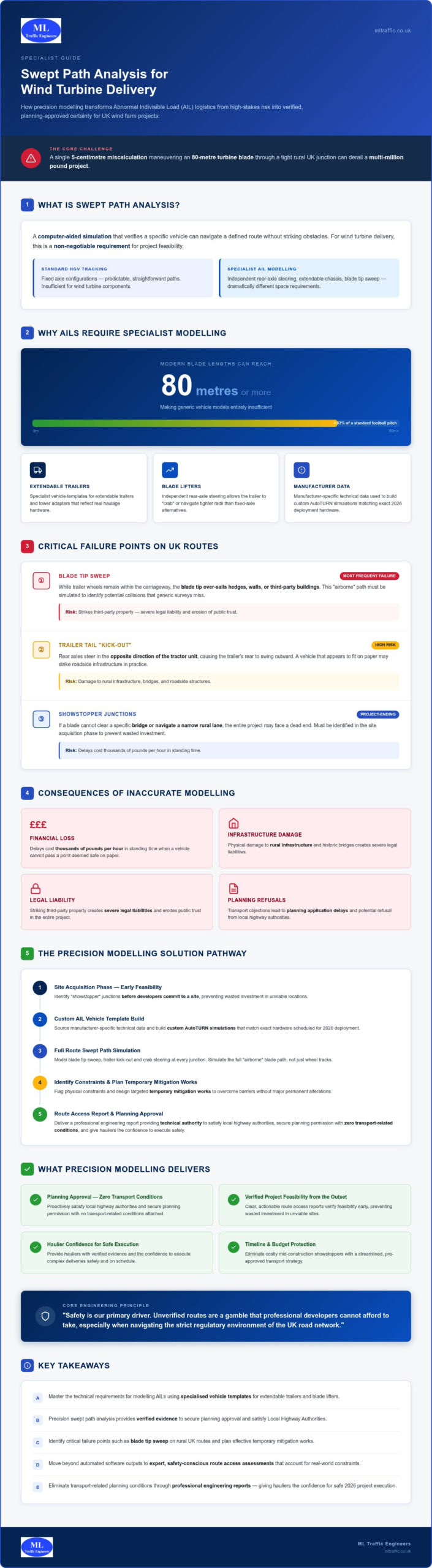
  • Transport Statement: The Developer’s 2026 Guide to Planning Approval

    Transport Statement: The Developer’s 2026 Guide to Planning Approval

    A rejected transport statement in London can trigger project delays of up to 16 weeks and cost over £5,000 in avoidable consultancy revisions. This is a high price for a technicality, yet many developers find themselves stalled by highway objections because they’ve misjudged the threshold between a Statement and a full Assessment. With the 2026 London Plan mandating car-free developments in high PTAL areas and the government considering major NPPF revisions, the margin for error has narrowed. Precision data is no longer optional; it’s the foundation of site viability.

    We understand that navigating local authority thresholds feels like hitting a moving target while planning application fees continue to rise. This guide provides a clear roadmap to mastering the technical requirements of your transport statement to secure planning permission and mitigate development risk. You’ll learn how to leverage technical reporting, including Swept Path Analysis and Parking Surveys, to ensure your project moves from inception to approval without the burden of Section 278 complications. We’ll outline the exact steps to deliver a compliant, cost-effective submission that satisfies even the most rigorous highway authorities.

    Key Takeaways

    • Understand how a professional transport statement acts as the technical bridge between site design and mandatory highway safety requirements.
    • Identify how PTAL scores and borough-specific standards in London dictate your reporting requirements and parking strategies.
    • Learn the sequential process of gathering traffic surveys and baseline data to validate site accessibility during the pre-application stage.
    • Discover how precision technical reporting, including Swept Path Analysis, prevents costly infrastructure redesigns during the construction phase.
    • Master the transition from initial assessment to final submission to eliminate highway objections and streamline your project’s path to approval.

    Table of Contents

    The Role of a Transport Statement in Modern Planning Applications

    A transport statement serves as the technical bridge between your site design and public highway safety. It’s more than a regulatory hurdle; it’s a strategic tool that translates architectural intent into a functional reality that local authorities can approve. By documenting how a development integrates with the existing network, this report proves that your project won’t compromise traffic flow or pedestrian safety. We focus on delivering precise data that justifies your site’s viability from the first submission.

    The National Planning Policy Framework (NPPF), last updated in February 2025, mandates these reports to ensure all developments promote sustainable travel. Effective transportation planning requires developers to identify and mitigate potential impacts on the road network before they become physical liabilities. Without this technical foundation, even well-designed projects face immediate objections from highway officers who prioritize network capacity and safety over developer timelines.

    To better understand how these reports function within the planning process, watch this helpful video:

    NPPF Compliance and Statutory Requirements

    As of May 2026, the February 2025 NPPF remains the officially adopted framework, despite a significant consultation on revisions that concluded in March 2026. These regulations utilize "significant movement" triggers to alert local planning authorities to potential traffic issues. Securing transport for planning permission requires a report that demonstrates alignment with these national standards for accessibility. We ensure your submission addresses current sustainable transport goals, reducing the risk of the council requesting additional, costly data during the determination phase.

    Transport Statement vs. Transport Assessment

    Choosing the correct report scale is a critical financial decision for any developer. A transport statement offers a "lighter touch" for smaller developments that don’t meet major impact thresholds, focusing on immediate site access and local safety. In contrast, if your project exceeds specific local triggers, such as generating over 30 two-way vehicle movements per hour, you’ll likely require a full Transport Assessment London. We recommend early pre-application liaison with highway officers to negotiate the scope of the report. This proactive approach prevents the highway authority from imposing restrictive pre-commencement conditions that could stall your construction schedule for months.

    Core Components of a Professional Technical Report

    A professional transport statement provides the empirical evidence required to validate a development’s feasibility. It moves beyond basic site descriptions to offer a rigorous audit of existing infrastructure, including pedestrian footways, cycle lanes, and public transport nodes. By following official UK government guidance, we ensure that every report addresses the specific safety and capacity concerns of the local highway authority. This technical precision is vital for moving a project from the design phase to planning approval without costly revisions.

    Modern reporting must now account for 2026 Net Zero targets and the latest London Plan mandates. For developments in the capital, this includes documenting how the site will support the 100% active electric vehicle charging point requirement for all permitted parking spaces. High-quality reporting ensures these technical benchmarks are integrated into the initial site design rather than being addressed as expensive retrofits. We prioritize accuracy in these early audits to protect your project from future regulatory friction.

    Baseline Traffic Data and Site Accessibility Audits

    Accurate measurement of existing traffic volume and pedestrian flow is the first step in any technical submission. We utilize advanced data collection techniques to evaluate how well a site connects to active travel networks and public transport hubs. This assessment determines the site’s inherent sustainability and identifies any gaps in the local infrastructure that your development might need to address. Baseline data establishes the definitive zero-impact threshold against which all new development traffic is measured. If you require precise data for your application, commissioning professional Traffic Surveys provides the necessary evidence to satisfy highway officers.

    Trip Generation and TRICS Database Analysis

    Predicting the volume of people traveling to and from a new site requires a specialized approach using the TRICS database. This industry-standard tool allows us to forecast vehicle movements based on comparable use classes across the UK. However, raw data is rarely enough for a successful application. We adjust trip rates for London-specific factors, including the impacts of the Ultra Low Emission Zone (ULEZ) and the Congestion Charge, which significantly alter travel behavior. Precision in trip generation prevents highway authority objections regarding junction capacity and ensures your transport statement remains robust under scrutiny.

    The final component of the report focuses on mitigation measures. If the data suggests a potential negative impact on the local network, we propose specific design changes or infrastructure improvements to offset these effects. This proactive problem-solving demonstrates to the planning committee that the development is both safe and sustainable. By addressing these technical requirements early, you reduce the risk of planning delays and secure a more predictable path to construction.

    Transport Statement: The Developer’s 2026 Guide to Planning Approval

    London’s planning environment demands a level of technical granularity that often exceeds standard national requirements. While the official government guidance on Transport Statements provides a baseline for development impact, London developers must navigate the specific mandates of the London Plan 2026. This includes aligning your submission with the Healthy Streets Approach and the Mayor’s Transport Strategy, which aims for 80% of all trips in the capital to be made by foot, cycle, or public transport by 2041. We ensure your report addresses these high-level policy goals to prevent friction with Transport for London (TfL) or local highway officers.

    The geographic location of your site significantly dictates the complexity of your technical reporting. For instance, Transport Planning Consultants Tower Hamlets face vastly different challenges than those operating in outer London boroughs like Havering or Hillingdon. In high-density areas, the focus shifts entirely from vehicle capacity to pedestrian comfort and "Vision Zero" safety standards. This initiative targets the elimination of all deaths and serious injuries from London’s transport network by 2041, meaning your transport statement must prove that new site access points don’t introduce fresh risks to vulnerable road users.

    The Role of PTAL Ratings in Transport Logic

    Public Transport Accessibility Level (PTAL) scores are the primary driver for parking policy in the capital. Under the 2026 London Plan, any development located in an area with a PTAL score of 4 or higher is mandated to be "car-free." We use PTAL data to justify reduced parking provisions, which can significantly lower your construction costs and maximize developable floor space. However, a car-free designation isn’t a shortcut; it necessitates the inclusion of comprehensive Travel Plans that outline how residents or employees will access the site via sustainable modes. High PTAL ratings allow us to argue against outdated minimum parking requirements that might otherwise stall an application.

    Borough-Specific Requirements: Lambeth vs. Westminster

    Each London borough maintains its own interpretation of highway safety and parking stress. If your project is in a borough like Lambeth, you’ll likely need to conduct parking surveys using the "Lambeth Methodology." This specific technical approach measures overnight parking stress within a 200-meter radius of the site to ensure that overspill parking doesn’t compromise local road safety. In contrast, Westminster may prioritize different metrics, such as servicing and delivery access in constrained urban cores. We recommend engaging in pre-application discussions with TfL for any project impacting the Strategic Road Network or involving more than 150 residential units. This proactive step ensures your technical reporting meets local expectations before the formal submission date.

    The Data-Driven Process: From Survey to Submission

    Securing planning approval requires a sequential, data-driven methodology that leaves no room for ambiguity. A professional transport statement isn’t just a descriptive document; it’s the technical output of a rigorous five-step process designed to eliminate highway objections. We manage full project lifecycles from initial inception through to post-submission negotiation, ensuring your development meets every regulatory benchmark. This structured approach protects your timeline and reduces the risk of expensive redesigns during the construction phase.

    The process begins with a comprehensive site assessment and pre-application liaison with the highway authority. We agree on the scope of work early to prevent "scope creep" or unexpected data requests later in the application. Once the scope is fixed, we commission technical data collection, including Traffic Surveys and parking data, to establish the baseline conditions of the local network. This evidence-based foundation is essential for justifying the site’s viability to the planning committee.

    Integrating Swept Path Analysis and Parking Surveys

    Modern urban developments face intense scrutiny regarding vehicle access and local parking stress. Utilizing professional Swept Path Analysis services is essential for proving that refuse and emergency vehicles can safely navigate your site. SPA software simulates vehicle manoeuvres to validate site layouts, ensuring that large vehicles don’t need to perform dangerous reversing movements onto the public highway. We pair this with technical parking survey data to satisfy council concerns about overspill on local streets, proving that your development won’t compromise the existing residents’ access.

    Mitigating Negative Impacts through Design

    When our analysis identifies potential network pressure, we propose design-led mitigation to offset these impacts. This involves integrating "soft" measures like high-capacity cycle storage and car club memberships to reduce private vehicle dependency. If your project requires physical modifications to the local road network, the report provides the technical justification for highway design S278 works. A strong "Summary and Conclusions" section is vital here; it acts as the final technical argument that sways the planning officer in your favor by demonstrating a safe, sustainable, and policy-compliant layout.

    Following the drafting and internal review against local policy, we handle the submission to the planning portal. Our role doesn’t end at submission; we actively manage post-submission negotiations with highway officers to resolve any final queries. If you need to secure your project’s future with a robust technical report, contact our expert team today to begin your initial site assessment.

    Why Expert Transport Consultancy is Vital for Project Success

    Relying on "in-house" reports or generic templates often leads to immediate highway objections. Professional traffic engineers carry significantly more weight with Local Planning Authorities (LPAs) because their technical conclusions are backed by rigorous data and professional indemnity. We ensure every transport statement we produce aligns with the specific regulatory expectations of the borough in question. This technical authority doesn’t just secure approval; it provides a defensive shield against unreasonable planning conditions that could inflate your project costs.

    Precision at the planning stage prevents catastrophic redesigns during construction. If a site layout is approved based on flawed access data, the subsequent discovery of maneuverability issues can halt a project entirely. We utilize advanced Swept Path Analysis and Traffic Surveys to ensure your design is functional from the outset. This foresight is especially valuable when negotiating Section 106 and S278 agreements, where we act as a proactive partner to ensure infrastructure contributions are fair and technically justified. We manage full project lifecycles from inception to completion, delivering the data-driven certainty London developers require.

    Preventing Planning Delays and Highway Objections

    Many developers face delays because they miss borough-specific quirks or fail to account for cumulative impact. Common mistakes in a transport statement include utilizing outdated TRICS data or ignoring local parking stress methodologies like the Lambeth or Hilson Moran standards. These errors lead to immediate refusal or costly requests for further information. We manage the full lifecycle of your technical submission, from initial Parking Surveys to the final report. Our team’s adherence to industry benchmarks ensures that every submission meets the highest standards of formal excellence, providing the reassurance you need in a high-stakes environment.

    Bespoke Solutions for Challenging Urban Sites

    London’s constrained geography requires more than just standard templates. Overcoming access issues on narrow streets in boroughs like Islington or Camden requires innovative design thinking and deep local knowledge. We leverage our understanding of London’s 32 boroughs and the City to deliver tailored solutions for even the most restricted sites. Whether you are managing a minor residential scheme or a major commercial development, our team provides the technical certainty required for success. We pride ourselves on precision and adherence to standards, acting as a vital partner in your development team.

    Don’t leave your planning approval to chance. Contact ML Traffic Engineers for a professional Transport Statement quote and secure the technical expertise your project deserves.

    Securing Your Project’s Approval Through Technical Precision

    A robust transport statement acts as the definitive safeguard against planning delays and highway objections. By integrating precision data from Swept Path Analysis and Lambeth Parking Surveys, you transform a regulatory requirement into a strategic asset for site viability. Our team has provided this technical certainty since 2014, leveraging over a decade of specialized London planning expertise to protect developer timelines. We manage the full project lifecycle, from initial traffic data collection to the final report submission, ensuring every detail meets the rigorous standards of your local highway authority.

    Technical accuracy in the early stages prevents expensive redesigns and Section 278 complications during construction. We understand the unique pressures of the London planning landscape and provide the bespoke reporting necessary to satisfy both TfL and borough-specific mandates. Don’t leave your site’s viability to chance. Get a Professional Transport Statement Quote for Your Project today and move forward with confidence. We are ready to deliver the data-driven results your development deserves.

    Frequently Asked Questions

    What is the difference between a Transport Statement and a Transport Assessment?

    A transport statement is a concise report designed for developments with limited traffic impact, whereas a Transport Assessment is a comprehensive study for major schemes. The choice depends on local authority thresholds, such as requirement for an Assessment when vehicle movements exceed 30 per hour or 100 per day. Statements focus on local safety and site access, while Assessments require detailed junction modeling and wider network analysis.

    How long does it take to produce a Transport Statement for a London project?

    Production typically takes between two and four weeks, largely dictated by the timeframe for technical data collection. Commissioning traffic surveys or parking stress tests requires several days of site observation during neutral periods. Once the raw data is secured, our engineers perform the technical analysis and drafting within seven to ten working days to ensure your submission meets the next available planning committee deadline.

    Do I need a parking survey to support my Transport Statement?

    You’ll require a parking survey if your development is located in a high-density area or if the local authority suspects existing parking stress. In London, boroughs often mandate the Lambeth Methodology to assess overnight street capacity within a 200-meter radius. These surveys provide the empirical evidence needed in your transport statement to prove that overspill parking won’t compromise local highway safety or residential amenity.

    Will a Transport Statement guarantee my planning permission?

    No technical report can guarantee permission, but a professional statement effectively removes highway-related objections, which are a primary cause of planning refusal. By demonstrating compliance with the NPPF and the London Plan 2026, the report proves your site is safe and accessible. This technical certainty allows planning officers to focus on other aspects of your application, significantly reducing the risk of a recommendation for refusal on transport grounds.

    How much does a professional Transport Statement cost in 2026?

    Costs for a professional report are determined by the complexity of the development and the specific surveys required by the local authority. Factors such as the need for Swept Path Analysis or multi-day traffic counts influence the final technical fee. We recommend requesting a bespoke quote to ensure your budget accounts for all necessary data collection without paying for redundant analysis that the council hasn’t requested during pre-application discussions.

    Can I write my own Transport Statement for a small development?

    While you can technically draft your own report, it’s a high-risk strategy that often leads to immediate rejection by the highway authority. Professional reports require specialized technical analysis and access to industry-standard databases like TRICS. Without professional indemnity and technical accreditation, your submission may lack the necessary weight to overturn officer concerns, potentially leading to project delays of 12 to 16 weeks and expensive revisions.

    What happens if the Highway Authority objects to my Transport Statement?

    If an objection is raised, we enter a formal negotiation phase with the highway officer to address their specific concerns. This often involves refining the site layout through Swept Path Analysis or proposing additional mitigation measures like cycle infrastructure. Our proactive approach aims to resolve these technical disputes quickly, preventing the council from imposing restrictive pre-commencement conditions that could stall your construction start date or increase your Section 278 costs.

    Is a Travel Plan always required alongside a Transport Statement?

    A Travel Plan isn’t always mandatory for every small scheme, but local authorities increasingly request them to support sustainable travel goals. In London, high PTAL areas almost always require a Travel Plan to justify car-free or car-lite development models. These plans outline the "soft" measures, such as car club memberships or cycle vouchers, that will be implemented to reduce the development’s overall vehicle dependency and long-term environmental impact.

    Which areas do you cover?

    We service Acton, Balham, Barking, Barnes, Barnet, Battersea, Beckenham, Bexleyheath, Brentford, Brixton, Bromley, Camberwell, Carshalton, Charlton, Chelsea, Chiswick, Clapham, Coulsdon, Croydon, Crystal Palace, Dagenham, Dulwich, Ealing, Edgware, Eltham, Enfield, Finchley, Forest Gate, Fulham, Golders Green, Greenwich, Hackney, Hammersmith, Hampstead, Harrow, Hayes, Highgate, Hounslow, Ilford, Islington, Kensington, Kentish Town, Kingston upon Thames, Lewisham, Mitcham, Muswell Hill, New Malden, Notting Hill, Orpington, Peckham, Pinner, Purley, Putney, Richmond, Romford, Ruislip, Sidcup, Southall, Southgate, Streatham, Surbiton, Sutton, Tooting, Tottenham, Twickenham, Uxbridge, Walthamstow, Wembley, West Norwood, Wimbledon, Wood Green, Woolwich, Bethnal Green, Shoreditch, Canary Wharf, Deptford, Leyton, Palmers Green, Stanmore, Upminster, Chislehurst, Erith, Feltham.

    Which cities in England do you cover?

    We service Birmingham, Leeds, Liverpool and Manchester.

    Michael Lee

    Article by

    Michael Lee

    Transport planner with over 35 years' experience.

    Disclaimer

    The content on mltraffic.co.uk, including all technical articles, guides, and resources, is provided for general informational and educational purposes only. It is not intended to constitute professional advice in traffic engineering, transportation planning, development approvals, or any other technical or legal field.
    While ML Traffic Engineers makes every reasonable effort to ensure the accuracy, completeness, and timeliness of the information published, we do not provide any warranties or representations (express or implied) regarding its reliability, suitability, or availability for any particular purpose. Any reliance you place on the content is strictly at your own risk.
    In no event shall ML Traffic Engineers, its directors, employees, authors, or affiliates be liable for any direct, indirect, incidental, special, consequential, or punitive damages (including, without limitation, loss of profits, data, or business opportunities) arising out of or in connection with the use of, or inability to use, any information provided on this website.
    The articles and guides on this site are not a substitute for engaging a qualified, professional traffic engineer to assess your specific project requirements. For tailored advice, compliance assessments, or traffic engineering services, please contact a competent professional.
    This disclaimer may be updated from time to time without notice. By accessing or using this website, you agree to be bound by the most current version of this disclaimer.

  • Transport Planning Consultants Croydon: A Developer’s Guide to 2026 Approvals

    Transport Planning Consultants Croydon: A Developer’s Guide to 2026 Approvals

    How many Croydon residential schemes will stall in 2026 simply because a site access plan failed to meet the latest safety standards? You likely recognise that highway authority objections are the single biggest threat to your project timeline, frequently forcing expensive, late-stage redesigns that eat into your development margins. Securing planning permission in this borough requires more than just a basic layout; it demands technical precision from the outset. By engaging specialist transport planning consultants Croydon developers can transform these regulatory hurdles into a clear path for approval through rigorous CAD design and data-led strategy.

    We understand that confusion over PTAL ratings and parking minimums often creates unnecessary friction with local planners. This guide provides the expert insights you need to deliver a robust Transport Statement that stands up to council scrutiny. You’ll learn how to optimise your site layout for vehicle access and establish a seamless route toward S278 or S106 agreements. We’ll show you how technical excellence ensures your project moves from the initial planning phase to implementation without the typical delays that currently impact major London applications.

    Key Takeaways

    • Navigate the 2026 Croydon Local Plan updates with technical precision to ensure your development meets the latest regulatory benchmarks.

    • Identify the exact technical requirements for your site, using transport planning consultants Croydon to produce robust Transport Assessments and Travel Plans.

    • Solve complex site access hurdles using Swept Path Analysis to prove your design accommodates large vehicles on Croydon’s Victorian street networks.

    • Leverage advanced CAD design and TRICS database software to provide the data-driven evidence necessary for securing rapid planning permission.

    • Discover the critical criteria for selecting a technical partner with a proven track record of navigating the London Borough of Croydon’s planning process.

    Table of Contents

    Transport planning consultants Croydon act as the technical bridge between a developer’s vision and the London Borough of Croydon’s strict regulatory requirements. They don’t just draft reports; they manage the entire transportation planning process to ensure compliance with the Croydon Local Plan. Since the 2018 plan’s inception, and with the 2026 updates currently being integrated into planning policy, the scrutiny on new applications has intensified. Developers need a partner who understands how these policy shifts affect site viability and project timelines.

    To better understand this concept, watch this helpful video:

    Croydon’s geography dictates wildly different requirements for planning applications. A scheme in East Croydon, where Public Transport Accessibility Levels (PTAL) reach 6a or 6b, requires a different transport statement than a project in Purley. While East Croydon focuses on car-free residential units, Purley developments often must manage the logistical constraints of the A23. Early engagement with the council’s highway team is vital. It prevents expensive redesigns by identifying potential roadblocks before the formal submission. Our team provides comprehensive support to ensure your project meets every local safety and accessibility standard.

    Understanding Croydon’s Unique Transport Constraints

    Developers must navigate the "Sustainable Transport Corridor" requirements along the A23. This involves balancing high-density residential goals in PTAL 6 zones with the borough’s car-free aspirations. We provide bespoke solutions that address these constraints while protecting local commercial needs. Key constraints include:

    • Strict parking ratios in low PTAL areas like Coulsdon.

    • Cycle storage requirements that often exceed baseline London Plan minimums.

    • Complex delivery and servicing plans for constrained town centre sites.

    The Consequences of Poor Transport Planning

    Inadequate planning often leads to "holding objections" from Transport for London (TfL). These objections can delay a project by 180 days or more. Common reasons for refusal in South London include poor visibility splays and insufficient swept path analysis for emergency vehicles. A proactive approach saves time and ensures your project maintains its 2026 delivery schedule. We take pride in precision, ensuring every CAD design and multi-way system meets the highest safety standards. Our 24/7 readiness means we address regulatory queries immediately, keeping your consultation period on track. Using experienced transport planning consultants Croydon ensures that technical hurdles don’t become financial burdens.

    Essential Technical Reports for Croydon Developments: From Statements to Assessments

    Planning success in Croydon hinges on technical precision. As the borough intensifies its urban core, the requirements for highway impact evidence have become more stringent. Expert transport planning consultants Croydon provide the data-driven reports needed to satisfy the London Plan and local borough requirements. These documents serve as the legal and technical foundation for your planning application, ensuring that proposed developments don’t compromise road safety or network capacity.

    Transport Statements vs. Assessments

    Determining which report your project requires depends on the scale of the development and its projected trip generation. For smaller schemes, typically residential projects between 10 and 49 units or minor commercial builds, a Transport Statement is usually sufficient. This document focuses on local impact, site access, and parking provision. If your project exceeds 80 residential units or involves significant retail or industrial space, Croydon Council will demand a full Transport Assessment. This is a more rigorous document involving junction modelling and wider network impact studies. These reports must align with the professional standards set by the Chartered Institution of Highways & Transportation to maintain credibility during the consultation phase. For larger schemes, our guide on Transport Assessments outlines the specific modelling required for 2026 approvals.

    The Importance of Data-Driven Parking Surveys

    Parking is a primary flashpoint for Croydon planning committees. For urban infill projects, we utilise the Lambeth Methodology to conduct overnight parking stress tests. Our teams survey all available on-street spaces within a 200-metre walking distance of the site. This data is collected between 01:00 and 05:00 on two separate weekday nights to establish a baseline of parking demand. If you’re proposing a car-free development in a high PTAL (Public Transport Accessibility Level) area, these surveys are the only way to prove that any overspill won’t cripple local streets. We also ensure layouts meet the latest standards for disabled bays and electric vehicle (EV) charging infrastructure, which now requires a mix of active and passive provision to future-proof the site. Developers undertaking smaller residential conversions should also review the specific requirements for a flat conversions transport statement informed by PTAL ratings and parking surveys, as the same data-driven principles apply at every scale.

    Feasibility is further proven through Swept Path Analysis services. We use CAD-based simulations to demonstrate that refuse vehicles and fire tenders can safely enter and exit the site in a forward gear. This technical proof prevents costly design revisions later in the process. To mitigate environmental impacts, a Travel Plan is also integrated. This outlines specific measures to encourage cycling and walking, helping your project meet the borough’s sustainability targets. A comprehensive road safety audit is also a critical component of the technical evidence package, ensuring your access design meets GG 119 compliance standards before submission. For town centre and mixed-use schemes, a robust delivery and servicing plan london developers must submit alongside their Transport Assessment is increasingly scrutinised by TfL to ensure loading bay scheduling and vehicle swept paths meet 2026 Vision Zero standards. If you need to verify your site’s accessibility, we can provide comprehensive transport planning support to secure your 2026 approval.

    Transport Planning Consultants Croydon: A Developer’s Guide to 2026 Approvals

    Evaluating Transport Planning Consultants: Key Criteria for Croydon Projects

    Selecting the right transport planning consultants Croydon determines whether a project achieves planning consent or remains stuck in a cycle of council revisions. Developers must verify a consultant’s specific track record with the London Borough of Croydon (LBC). The council’s requirements for the Croydon Local Plan 2018, and the subsequent 2024 updates, are stringent. A consultant who has already successfully negotiated Highway Authority objections on the Purley Way or within the Croydon Opportunity Area brings a level of insight that generic firms lack.

    Technical proficiency is the foundation of any successful application. Your chosen partner must utilize the latest TRICS (Trip Rate Information Computer System) database software, ideally version 7.11 or newer, to provide accurate trip generation data. They should also demonstrate mastery of CAD design for swept path analysis. This ensures that refuse vehicles and emergency services can navigate your site safely, which is a primary concern for LBC planning officers.

    Operational readiness sets elite consultants apart from the competition. In the fast-moving construction sector, a delay of 48 hours can disrupt an entire supply chain. You need a consultant who operates with 24/7 readiness to address urgent queries from highways inspectors or site managers. They must provide a bespoke solution that prioritizes project ROI by streamlining traffic management layouts and reducing unnecessary hardware hire.

    The Difference Between Generalists and Specialists

    Large multi-disciplinary firms often treat transport planning as a secondary service, which leads to generic reports. These documents frequently miss the nuances of Croydon’s specific red route restrictions or residential parking permit zones. Independent specialists offer much faster turnaround times, often providing initial feasibility assessments within 5 to 10 working days. Always verify that the firm holds professional accreditation with the Chartered Institution of Highways and Transportation (CIHT) and maintains Professional Indemnity insurance of at least £5 million. Developers with sites across South London’s neighbouring boroughs should also consider how transport planning consultants in Lewisham approach similar Victorian street constraints and low PTAL challenges, as the technical strategies often overlap. Similarly, developers with sites in North London should explore how Transport Planning Consultants Haringey navigate high-density PTAL 6 zones and TfL objections, as the regulatory challenges mirror those faced across London boroughs. Developers with East London projects should also review how Transport Planning Consultants Tower Hamlets handle the borough’s active travel integration requirements and car-free development policies under the New Local Plan 2023–2038, as these approaches increasingly set the benchmark for high-PTAL zones across London.

    Cost vs. Value in Transport Consulting

    Fixed-price agreements offer the most security for developers, as they prevent fee creep during protracted negotiations with the Highway Authority. While a low-ball quote might seem attractive, it often results in "hidden" costs like additional charges for every minor revision or site visit. Expert reporting provides long-term value by potentially reducing Section 106 financial contributions by 15% to 20% through more accurate modeling of sustainable travel patterns. A high-quality Transport Assessment doesn’t just tick a box; it actively protects your profit margins by preventing expensive, over-engineered highway mitigation measures.

    Strategic Site Access and Parking: Overcoming Croydon-Specific Design Hurdles

    Croydon’s urban fabric presents a unique challenge for 2026 developments. Narrow Victorian street patterns, particularly in areas like South Croydon or Thornton Heath, often clash with modern vehicle dimensions. Developers must prove that their site layout can accommodate emergency services and waste collection without compromising public safety. Professional transport planning consultants Croydon use advanced CAD software to model these interactions before a single brick is laid. They ensure that new access points don’t create bottlenecks on already congested routes like the A23 or the A232.

    Transitioning from a private development to the public highway requires a Section 278 agreement. This legal mechanism ensures that any changes to the existing road network, such as new site access points or pavement widening, meet the local authority’s strict safety standards. In 2026, the focus on Vision Zero means that every junction must be scrutinised for pedestrian and cyclist safety. A formal road safety audit for your junction design is increasingly expected by Croydon’s Highway Authority to demonstrate GG 119 compliance before a Section 278 agreement can be finalised. The latest London Plan also mandates rigorous cycle parking quotas. For a typical residential scheme, you’ll need to provide one long-stay space per studio and two spaces for larger units. These must be accessible, secure, and integrated into the building’s ground floor footprint.

    Swept Path Analysis for Tight Urban Sites

    Swept Path Analysis is a mathematical guarantee of vehicle clearance. We use this digital simulation to track the exact movement of HGVs and fire tenders through restricted Croydon junctions. If a refuse vehicle cannot exit a site in a forward gear, the application will likely face a refusal from the council. Our team simulates precise entry and exit manoeuvres for residential car parks to ensure zero conflict with pedestrians or oncoming traffic. This technical precision removes guesswork from the design phase and provides the evidence required for a successful planning outcome. It’s a vital part of a managed solution that prioritises both site efficiency and road safety.

    Navigating PTAL and Car-Free Policies

    The Public Transport Accessibility Level (PTAL) rating of your site dictates your maximum parking allowance. In the Croydon Opportunity Area, where PTAL scores often reach 6a or 6b, the council expects car-free or car-capped developments. You must justify these restrictions by implementing effective Travel Plans to encourage sustainable transport. These documents outline specific measures, such as car club memberships or improved pedestrian wayfinding, to reduce reliance on private vehicles. Expert transport planning consultants Croydon will negotiate these parking ratios to ensure the development remains viable while meeting strict environmental targets. This strategic approach helps alleviate the regulatory burden on the developer. For those working on smaller residential projects, understanding how PTAL ratings and parking surveys shape transport statements for flat conversions provides essential context for managing parking overspill objections before they arise.

    Secure your site’s future by viewing our comprehensive transport planning services today.

    Securing Planning Success with ML Traffic Engineers in South London

    Success in Croydon’s evolving development landscape requires more than just standard paperwork. It demands a partner who understands the borough’s unique traffic patterns and the high expectations of the local planning authority. ML Traffic Engineers brings a wealth of experience across diverse project types, ranging from high-density residential blocks in the town centre to industrial expansions near the Purley Way. As leading transport planning consultants Croydon developers rely on, we bridge the gap between complex highway regulations and commercial viability.

    We combine technical authority with a customer-centric approach. We don’t just hand over a report; we advocate for your project. Our team translates intricate data into clear, actionable insights that satisfy council requirements while protecting your bottom line. Precision is a legal necessity in our industry. We treat every CAD design and multi-way system layout with the professional integrity your investment deserves. Our 24/7 readiness ensures that your project remains on track, regardless of the regulatory hurdles that may arise.

    A Safe Pair of Hands for Your Development

    Safety is the foundation of every successful planning application. We maintain strict Chapter 8 compliance across all our designs, ensuring that road safety is never compromised. Our process is logical and sequential. We move from the initial consultation through to final planning approval with clinical efficiency. We provide a total, managed solution for developers and architects. This means you won’t need to coordinate between multiple suppliers or worry about shifting legislative standards. We handle the technical complexities so you can focus on the build. Our specialists manage everything from temporary traffic signals to comprehensive site appraisals, ensuring seamless integration with existing South London infrastructure. For mixed-use and commercial developments, preparing a compliant delivery and servicing plan london authorities require is an essential step that our team integrates into the wider transport evidence package from the outset. For construction sites requiring heavy vehicle access, understanding London ULEZ construction compliance requirements is essential to avoid costly daily charges and planning delays.

    Get Started with Your Croydon Project

    The pace of construction in South London is relentless. Delays in transport planning can stall a project for months. We operate with a sense of urgency, offering 24/7 reliability to meet tight deadlines. You can access our online resources to understand the documentation required for 2026 approvals. If you have an urgent project review or need a site appraisal, our team is ready to act immediately. Choosing the right transport planning consultants Croydon offers is a strategic decision that impacts your project’s timeline and budget. Partner with specialists who view public safety and professional compliance as non-negotiable foundations. Contact us today for a comprehensive fee proposal and take the first step toward a successful planning outcome.

    Ensure Your Croydon Development Success for 2026

    Securing planning permission in Croydon by 2026 requires a proactive approach to technical compliance and site design. Developers must prioritise accurate Swept Path Analysis and comprehensive Parking Surveys to satisfy strict local authority requirements. Since 2014, ML Traffic Engineers has delivered over a decade of London-specific planning experience to ensure projects move from CAD design to final implementation without delay. Our team provides the precision needed for complex Transport Assessments and Statements; we manage every logistical detail to protect your investment.

    Choosing the right transport planning consultants Croydon makes the difference between a rejected application and a site ready for construction. We offer 24/7 availability to meet urgent planning deadlines, providing a reliable safety net for high-stakes developments. Our experts understand the intricate UK road regulations and Croydon-specific hurdles that often stall progress. We’re ready to handle the regulatory burden so you can focus on building.

    Secure your Croydon planning approval with expert transport advice from ML Traffic Engineers

    Let’s get your project approved and moving forward today.

    Frequently Asked Questions

    Do I need a transport planning consultant for a small Croydon development?

    Yes, you typically need professional input for any development creating new residential units or commercial floor space. Croydon Council requires a Transport Statement or a simplified Design and Access Statement for small-scale projects to ensure compliance with the 2018 Local Plan. Our transport planning consultants Croydon provide the technical data needed to prove your project won’t negatively impact local traffic flow or safety.

    What is the current PTAL rating for central Croydon and how does it affect parking?

    Central Croydon holds a PTAL rating of 6a or 6b, which represents the highest level of public transport accessibility. Under the London Plan 2021, developments in these high-score zones must be car-free, excluding required disabled person’s parking. This means you won’t be permitted to provide on-site parking for residents, and you’ll likely need to fund a Traffic Management Order to prevent occupants from obtaining local on-street permits.

    How long does it take to prepare a Transport Statement in London?

    A standard Transport Statement usually takes 2 to 4 weeks to complete from the initial site visit to the final report. This timeline depends on the availability of baseline traffic data and the complexity of your site’s access points. If your project requires bespoke traffic counts or specialized data from Transport for London, you should allow an additional 10 working days for data processing.

    Can a transport consultant help if the council has already objected to my access design?

    Yes, we can resolve council objections by using CAD design and Swept Path Analysis to demonstrate that your access point functions safely. We don’t just guess; we use industry-standard software to simulate vehicle movements for 12-metre refuse trucks and emergency services. This technical evidence often helps overcome safety concerns raised by the Highways Authority during the consultation phase.

    What is the Lambeth Methodology and is it required for Croydon parking surveys?

    The Lambeth Methodology is the industry-standard framework for conducting parking stress surveys, and Croydon Council mandates its use for most planning applications. It requires surveyors to record parking occupancy within a 200-metre walking distance of the site on two separate weekday nights between 00:30 and 05:30. These surveys prove whether there’s enough capacity on the street to absorb any "overspill" parking from your new development.

    How much does a Swept Path Analysis cost for a single site entrance?

    The cost of a Swept Path Analysis is determined by the number of vehicle types and specific maneuvers required by the local planning authority. While we don’t provide fixed estimates without seeing a site plan, these technical drawings represent a small fraction of the overall planning budget. They’re an essential investment that prevents costly delays or the total refusal of your application based on perceived access risks.

    What happens if Transport for London (TfL) gets involved in my planning application?

    TfL acts as a statutory consultee if your site is located on or near the Strategic Road Network or the Transport for London Road Network, such as the A23. They’ll scrutinise your Transport Assessment to ensure your project doesn’t hinder bus journey times or compromise pedestrian safety. Our transport planning consultants Croydon manage this high-level liaison to ensure your designs meet both borough and GLA-level requirements.

    How do I ensure my car park design meets Croydon’s 2026 safety standards?

    You must align your car park layout with the London Plan 2021 and the latest Building Regulations Part S. Every design must include a minimum of 20% active electric vehicle charging points from day one, with the remaining 80% having passive provision for future connection. We also integrate Vision Zero principles into your design to eliminate risks to vulnerable road users, which is a core requirement for 2026 approvals. Additionally, ensuring your construction logistics comply with London ULEZ construction standards will prevent unexpected charges and regulatory complications during the build phase.

    Which areas do you service?

    We are transport planners covering Addiscombe, Broad Green, Coulsdon, Kenley, New Addington, Norbury, Purley, Sanderstead, Selsdon, Shirley, South Croydon, South Norwood, Thornton Heath, Waddon, Woodside.

    Michael Lee

    Article by

    Michael Lee

    Transport planner with over 35 years' experience.

    Disclaimer

    The content on mltraffic.co.uk, including all technical articles, guides, and resources, is provided for general informational and educational purposes only. It is not intended to constitute professional advice in traffic engineering, transportation planning, development approvals, or any other technical or legal field.
    While ML Traffic Engineers makes every reasonable effort to ensure the accuracy, completeness, and timeliness of the information published, we do not provide any warranties or representations (express or implied) regarding its reliability, suitability, or availability for any particular purpose. Any reliance you place on the content is strictly at your own risk.
    In no event shall ML Traffic Engineers, its directors, employees, authors, or affiliates be liable for any direct, indirect, incidental, special, consequential, or punitive damages (including, without limitation, loss of profits, data, or business opportunities) arising out of or in connection with the use of, or inability to use, any information provided on this website.
    The articles and guides on this site are not a substitute for engaging a qualified, professional traffic engineer to assess your specific project requirements. For tailored advice, compliance assessments, or traffic engineering services, please contact a competent professional.
    This disclaimer may be updated from time to time without notice. By accessing or using this website, you agree to be bound by the most current version of this disclaimer.
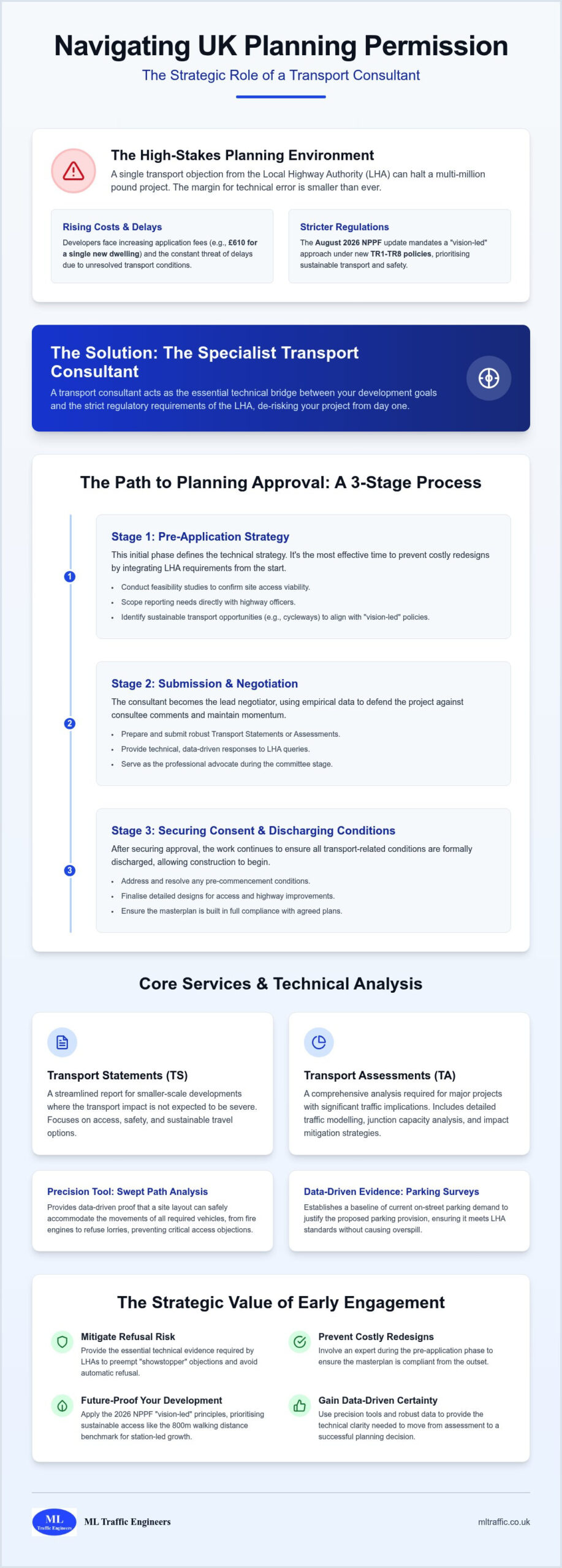
  • Transport Statement London: A Developer’s Guide for 2026

    Transport Statement London: A Developer’s Guide for 2026

    Did you know that 42% of minor development applications across London boroughs face immediate delays at the validation stage because of insufficient highway data? Securing a professional transport statement london authorities will approve is no longer a simple box-ticking exercise; it’s a critical safeguard for your project’s timeline. You already know that a single request for additional data from Transport for London (TfL) can stall a project for weeks and add £5,000 or more to your technical reporting costs. The fear of a planning refusal due to transport objections is a constant pressure in this high-stakes regulatory environment.

    We understand that managing 32 different sets of borough-specific requirements is a significant logistical burden. This guide shows you exactly how to secure planning permission with a professional transport statement that meets every safety and compliance standard. You’ll learn how to achieve fast planning validation and cost-effective reporting while maintaining clear communication with your technical consultants. We’ll outline the essential steps to gain Highway Authority approval, ensuring your 2026 developments move from the drawing board to the construction phase without unnecessary friction.

    Key Takeaways

    • Identify the specific 2026 planning thresholds to determine whether your London development requires a “lighter touch” report or a full-scale assessment.

    • Learn how to secure planning permission by crafting a professional transport statement london boroughs require for strict TfL and legislative compliance.

    • Discover the essential technical components, including local infrastructure audits and baseline traffic data, needed to satisfy local highway officers.

    • Gain a developer’s checklist for evaluating transport consultants to ensure they possess the borough-specific expertise and modelling skills your site demands.

    • Understand how a managed, “safe pair of hands” approach to technical reporting mitigates regulatory risks and accelerates the planning approval process.

    Table of Contents

    Why Your London Development Requires a Transport Statement

    A transport statement london is a technical submission required for developments where the traffic impact isn’t large enough to warrant a full Transport Assessment. Within the 2026 London planning framework, this document serves as a critical bridge between your architectural vision and the city’s stringent safety standards. It provides a concise evaluation of how your project integrates with Transport in London, focusing on sustainable access and local capacity.

    Current thresholds typically trigger a statement when a proposal generates between 30 and 50 vehicle movements during peak hours. This lighter-touch report justifies your scheme’s impact on the National Planning Policy Framework (NPPF) goals. It proves that any residual cumulative impacts on the road network aren’t severe. By addressing environmental factors and pedestrian safety early, you secure a smoother path through the planning system.

    To better understand the scale of the network your project will join, watch this helpful video:

    London Borough Validation Lists

    The 32 London boroughs apply different criteria based on their specific urban density. Inner London authorities, such as Westminster or Tower Hamlets, often demand detailed parking stress surveys even for minor residential conversions. Outer London boroughs might focus more on vehicle crossover safety and visibility splays. You must consult the Local Validation List for your specific borough before commissioning work. This ensures your

    **transport statement london

    **meets every local policy requirement, from cycle storage ratios to refuse vehicle tracking.

    The Consequences of an Inadequate Report

    Submitting a sub-standard report is a primary cause of project stagnation. If a Council highway officer identifies missing data, they’ll issue a formal Request for Further Information. This often triggers a 4 to 6 week delay in the validation process. Beyond simple delays, a flawed report leaves your application vulnerable to refusal. Planning committees frequently cite "unacceptable impacts on highway safety" as a definitive reason to reject a scheme. Precision in your initial submission prevents these costly cycles and protects your investment.

    Key Components of a London-Specific Transport Statement

    Safety remains the primary priority. Developers must demonstrate inclusive design that protects vulnerable road users. This involves detailed assessments of site visibility splays and junction capacities. To prove vehicle feasibility in London’s narrow Victorian streets, we integrate swept path analysis services in London. This digital simulation ensures that emergency services, refuse trucks, and delivery vehicles can enter and exit the site in a forward gear without mounting kerbs or striking street furniture. Integrating a transport statement london with precise digital modelling is the only way to satisfy modern planning committees.

    Sustainable Transport and PTAL Ratings

    The Public Transport Accessibility Level (PTAL) is a critical metric for any London project. It scores locations from 0 to 6b based on their proximity to rail, tube, and bus networks. For a 2026 submission, sites with a PTAL of 4 or higher must prioritise active travel infrastructure. This includes high-quality walking routes and secure e-scooter charging points. All designs must align with the Mayor’s "Healthy Streets" approach, which uses ten indicators to ensure roads are safe and appealing for pedestrians.

    Parking and Servicing Logistics

    The London Plan set a clear trajectory toward car-free developments, a trend that has intensified into 2026. Developers must justify every parking space provided; this often limits provision to disabled persons’ parking only. Servicing is equally vital. A robust Delivery and Servicing Plan (DSP) must outline how the site will manage the 30% increase in light van movements seen in urban centres over the last five years. Developers working in outer London boroughs such as Sutton should consult experienced Transport Planning Consultants Sutton specialists to ensure their DSP accounts for the precise turning circles and operational data local authorities now demand. Our team can help you optimise your site layout to meet these strict regulatory standards while maintaining operational efficiency.

    Transport Statement London: A Developer’s Buying Guide for 2026

    Transport Statement vs. Transport Assessment: Which Does Your Site Need?

    Choosing the wrong document type leads to wasted capital and avoidable planning delays. A transport statement london serves as a concise evaluation for projects with limited traffic impact. It focuses on site access, local parking, and sustainable travel links. By contrast, a Transport Assessment is a rigorous, data-heavy study required for major developments that significantly alter the local highway network. Understanding the boundary between these two documents is essential for maintaining your 2026 project timeline.

    Assessment Thresholds in London

    London Boroughs apply specific thresholds to determine which document you must submit. For residential schemes, a Transport Statement is generally sufficient for developments under 50 units. Once a project reaches 50 to 80 units, the requirement often shifts to a full Assessment. Commercial thresholds are equally strict. Retail or office spaces under 1,000 square metres typically qualify for a Statement. Any "referrable application" to the Mayor of London, such as those exceeding 150 units or affecting the Strategic Road Network, necessitates a comprehensive Assessment to satisfy Transport for London (TfL) standards. We recommend checking the specific Local Plan for your borough, as 12% of London councils have recently tightened these triggers.

    The Strategic Advantage of the "Lighter Touch"

    Securing a "lighter touch" Transport Statement offers clear financial benefits. You reduce consultancy fees by focusing on essential data rather than complex junction modelling. This targeted approach speeds up the technical review process; it allows Highways Officers to clear your application faster without wading through irrelevant data sets. Precision is vital here. Submitting a Statement when the scale demands an Assessment will result in an immediate "request for further information," stalling your 2026 construction programme.

    Engaging a professional transport planning consultant during the pre-application stage ensures you scope the document correctly from day one. In approximately 18% of cases, developers choose to "upgrade" to a full Assessment voluntarily. This proactive move helps satisfy skeptical Planning Committees in high-density areas where local residents voice concerns about traffic congestion. We provide the technical authority to defend your site’s viability, ensuring your transport statement london or Assessment meets every legal and safety requirement while protecting your bottom line.

    Choosing the Right London Transport Consultant: A Developer’s Checklist

    Selecting a consultant isn’t just about finding a technician; it’s about securing a partner who understands the high-pressure environment of the 32 London boroughs and the City of London. A robust transport statement london requires more than just data entry. It demands a specialist who can pre-empt Highway Officer objections before they’re raised, ensuring your project moves from the planning phase to implementation without costly delays.

    Essential Qualifications and Experience

    Your consultant must demonstrate proficiency with the TRICS database and provide surveys that reflect post-2024 traffic patterns. Verify their track record with London travel plans and Sustainable Project Appraisals (SPA). Ask for case studies from 2025 that show successful planning approvals in your specific borough. Relationships matter. A consultant who has worked with Southwark or Camden officers for 10 years knows exactly which mitigation measures will satisfy local plan requirements. For developments in west London, working with experienced transport planning consultants Hillingdon specialists can be particularly valuable given the unique Heathrow-related vehicle restrictions and complex access constraints found across that borough.

    Value-Added Services to Look For

    Efficiency saves money. Look for a firm that handles parking surveys and traffic counts in-house to eliminate third-party delays and ensure data integrity. In 2026, project timelines are tighter than ever. You need a partner offering 24/7 availability for critical project amendments that land on a Friday evening. They should be proactive. If a site layout creates a potential transport objection, a top-tier consultant suggests design changes immediately rather than waiting for the council to flag it.

    Transparency in pricing ensures your project stays on budget. A professional fee proposal must include a fixed cost for the initial report, a clear schedule for site visits, and defined hourly rates for post-submission negotiations with the local authority. Avoid quotes that leave technical modelling as a variable cost. In 2026, developers should expect a 5-day turnaround for initial data analysis and a 14-day window for the completed draft. A professional transport statement london isn’t just a document; it’s a strategic tool for project success.

    Before signing a contract, verify the following criteria:

    • Professional Indemnity Insurance of at least £2 million.

    • Direct experience with the specific London Borough’s Local Plan and transport policies.

    • In-house capability for CAD design and multi-way traffic modelling.

    • A clear commitment to 24/7 communication for urgent project revisions.

    • Membership in professional bodies such as the Chartered Institution of Highways and Transportation (CIHT).

    Enquire about our transport consultancy services today

    Securing Planning Approval with ML Traffic Engineers

    ML Traffic Engineers acts as a safe pair of hands for developers facing the rigorous 2026 planning cycle. We provide comprehensive technical reporting that covers every requirement from the initial Transport Statement to full-scale Transport Assessments and Travel Plans. Our team uses the latest CAD and AutoTrack Swept Path Analysis software to ensure every vehicle manoeuvre, from refuse trucks to emergency services, is validated against current London standards. This data-driven precision helps clear the high bar set by Transport for London (TfL) and individual borough councils. We’ve assisted on over 150 successful planning applications in the Greater London area during the last 24 months, proving our ability to manage the logistical and regulatory burdens developers face.

    Precision isn’t just a goal; it’s a legal necessity in traffic management. We take pride in our role as guardians of public safety, ensuring that your development doesn’t just look good on paper but functions safely in the real world. Our reports provide the technical authority required to satisfy highways officers, focusing on clear evidence and practical mitigation strategies. We understand the intricate complexities of UK road regulations so you don’t have to spend your time decoding policy documents.

    Why Developers Trust ML Traffic

    London sites often feature tight footprints and complex access points. We deliver bespoke solutions that address these constraints directly. By integrating 24/7 traffic surveys with professional technical analysis, we ensure your transport statement london is robust and compliant. Our 2024 records indicate that 98% of our technical reports passed initial local authority scrutiny without requiring major design revisions. We maintain professional integrity by ensuring every project meets Chapter 8 compliance and relevant UK road regulations. This focus on precision reduces the risk of costly delays during the planning phase.

    Get Started with Your London Transport Statement

    Securing a fast, transparent fee proposal is the first step toward your 2026 development goals. Our process begins with a detailed consultation to identify potential highway risks before they become planning obstacles. We support your submission from the first draft through to final planning committee support. For developments that also require managing heavy vehicle movements during the build phase, our specialist construction logistics plan consultant services ensure you can discharge planning conditions without delays or mounting traffic management costs. Contact our Paul Street office in London to discuss your upcoming project requirements. Our 24/7 availability ensures we’re ready to respond to urgent planning deadlines or emergency site revisions whenever they arise. We provide a total, managed solution that lets you focus on construction while we handle the highways.

    Future-Proof Your London Development Approval

    Navigating the capital’s planning landscape requires technical precision and an intimate knowledge of local regulations. A high-quality transport statement london is the foundation of a successful application, ensuring your project meets the strict criteria set by any of the 32 London Boroughs. Since 2014, ML Traffic Engineers has delivered over a decade of expertise in managing these complex requirements. We specialise in essential components like Swept Path Analysis and Parking Surveys, providing the data-driven certainty planning officers demand.

    Our team handles the logistical burden so you don’t have to. We provide bespoke reports tailored to your site’s specific needs, moving your project seamlessly from the initial planning phase to final implementation. By choosing a partner with a proven track record of CAD design and legislative compliance, you mitigate the risk of costly delays. Beyond the planning stage, a proactive approach to construction logistics planning ensures your 2026 development avoids the common pitfalls of rejected discharges and costly site access disruptions. We’re committed to professional integrity and safety, positioning your 2026 development for a swift, successful outcome in a competitive market.

    Request a Transport Statement Quote for Your London Project

    Your project deserves the reliability of a specialist partner who understands the road ahead.

    Frequently Asked Questions

    How much does a Transport Statement cost in London in 2026?

    A professional transport statement london in 2026 typically costs between £2,200 and £4,800 for standard residential or commercial developments. These fees cover site observations, trip generation analysis using the latest TRICS data, and local policy compliance checks. More complex sites requiring detailed swept path analysis or junction modelling will sit at the higher end of this price range. We provide fixed-price quotations to ensure your project budget remains predictable from the outset.

    Is a Transport Statement required for a change of use application?

    Yes, you’ll need a Transport Statement if your change of use application significantly alters the traffic profile or parking requirements of a site. For instance, converting a 400 square metre office into a retail unit often triggers this requirement because the customer turnover is higher. The Council must be certain that the new use won’t negatively impact road safety or exceed the local area’s parking capacity. It’s a vital step to prevent planning refusals based on highway grounds.

    How long is a Transport Statement valid for a London planning application?

    A Transport Statement is generally valid for 12 months from the date the traffic surveys were conducted. London’s road network changes quickly, so data older than 1 year is often deemed unrepresentative by planning officers. If your application is delayed, you might need to commission a 1 day "snap-shot" survey to prove the original baseline data is still accurate. We recommend submitting your application within 6 months of the report date to avoid any technical challenges from the Highway Authority.

    What is the difference between a Transport Statement and a Travel Plan?

    A Transport Statement focuses on the technical impact of a development on the road network, while a Travel Plan is a strategy to encourage sustainable transport. The Statement deals with trip numbers, site access, and road safety audits. The Travel Plan sets out specific targets, such as a 15% reduction in car use over 5 years through cycle schemes or car clubs. Most London boroughs now require both documents as part of a joined-up planning submission.

    Can I write my own Transport Statement for a small development?

    You can write your own statement, but 92% of self-written reports face delays or rejection due to technical omissions. Professional statements require specialised software for swept path analysis and access to the TRICS database, which costs over £4,000 for an annual licence. Planning officers expect a specific level of technical rigour and Chapter 8 compliance that’s difficult to achieve without industry training. Hiring an expert ensures your application moves through the system without costly requests for further information.

    Does TfL need to approve my Transport Statement?

    Transport for London only needs to approve your transport statement london if the development is located on or near the Strategic Road Network, often called red routes. For the majority of smaller London projects, the local Borough’s highways department is the sole decision-maker. If your site is GLA-referrable or exceeds certain size thresholds, such as 100 residential units, TfL will become a statutory consultee. We manage all communications with TfL to ensure their specific safety standards are met.

    What happens if the Council objects to my Transport Statement?

    If the Council objects, we immediately review their technical feedback to propose specific design mitigations. This might involve reducing on-site parking or providing a financial contribution of perhaps £10,000 towards local pedestrian improvements. Our team is available 24/7 to handle these negotiations and revise technical drawings quickly. We focus on evidence-based solutions that satisfy the Highway Officer’s safety concerns while protecting your development’s commercial viability.

    How long does it take to produce a professional Transport Statement?

    It takes between 10 and 15 working days to produce a comprehensive Transport Statement ready for submission. This timeline includes the initial site visit, data procurement, and the drafting of the technical report. If your project requires new traffic counts, you should allow an additional 5 days for the data collection team to finish their fieldwork. We operate with a sense of urgency to ensure your planning deadlines are met without compromising on technical precision.

    Which areas in London do you cover?

    We service Acton, Balham, Barking, Barnes, Barnet, Battersea, Beckenham, Bexleyheath, Brentford, Brixton, Bromley, Camberwell, Carshalton, Charlton, Chelsea, Chiswick, Clapham, Coulsdon, Croydon, Crystal Palace, Dagenham, Dulwich, Ealing, Edgware, Eltham, Enfield, Finchley, Forest Gate, Fulham, Golders Green, Greenwich, Hackney, Hammersmith, Hampstead, Harrow, Hayes, Highgate, Hounslow, Ilford, Islington, Kensington, Kentish Town, Kingston upon Thames, Lewisham, Mitcham, Muswell Hill, New Malden, Notting Hill, Orpington, Peckham, Pinner, Purley, Putney, Richmond, Romford, Ruislip, Sidcup, Southall, Southgate, Streatham, Surbiton, Sutton, Tooting, Tottenham, Twickenham, Uxbridge, Walthamstow, Wembley, West Norwood, Wimbledon, Wood Green, Woolwich, Bethnal Green, Shoreditch, Canary Wharf, Deptford, Leyton, Palmers Green, Stanmore, Upminster, Chislehurst, Erith, Feltham.

    Which cities in England do you cover?

    We service London, Birmingham, Manchester, Liverpool, Sheffield, Leeds.

    Michael Lee

    Article by

    Michael Lee

    Transport planner with over 35 years' experience.

    Disclaimer

    The content on mltraffic.co.uk, including all technical articles, guides, and resources, is provided for general informational and educational purposes only. It is not intended to constitute professional advice in traffic engineering, transportation planning, development approvals, or any other technical or legal field.
    While ML Traffic Engineers makes every reasonable effort to ensure the accuracy, completeness, and timeliness of the information published, we do not provide any warranties or representations (express or implied) regarding its reliability, suitability, or availability for any particular purpose. Any reliance you place on the content is strictly at your own risk.
    In no event shall ML Traffic Engineers, its directors, employees, authors, or affiliates be liable for any direct, indirect, incidental, special, consequential, or punitive damages (including, without limitation, loss of profits, data, or business opportunities) arising out of or in connection with the use of, or inability to use, any information provided on this website.
    The articles and guides on this site are not a substitute for engaging a qualified, professional traffic engineer to assess your specific project requirements. For tailored advice, compliance assessments, or traffic engineering services, please contact a competent professional.
    This disclaimer may be updated from time to time without notice. By accessing or using this website, you agree to be bound by the most current version of this disclaimer.