
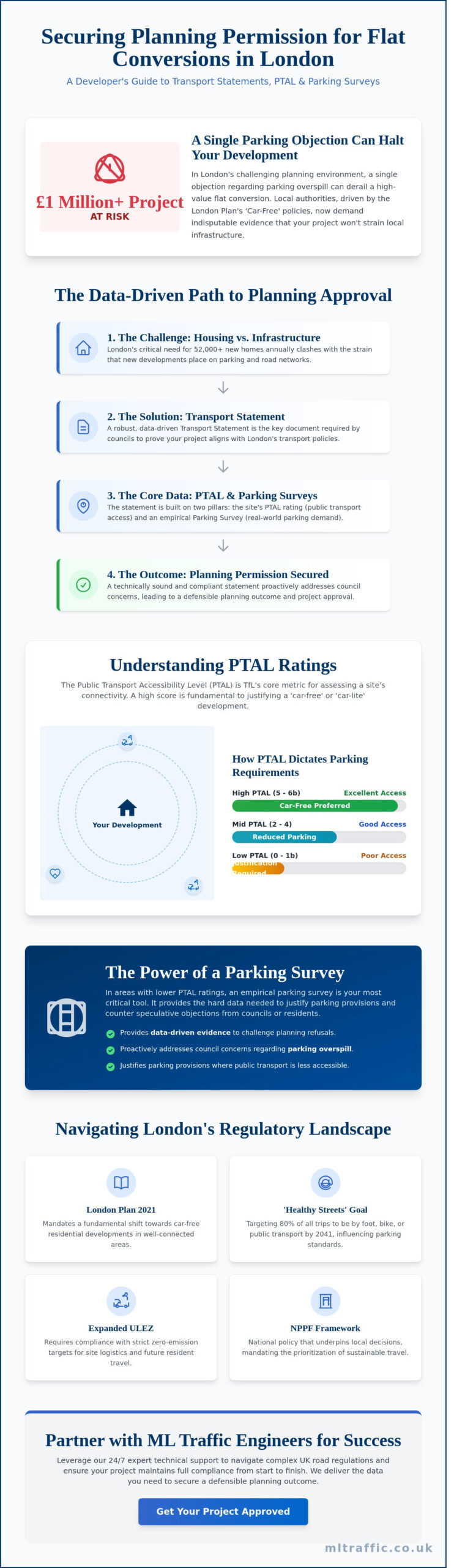
A single parking overspill objection can derail a £1 million flat conversion project before the first internal wall is even removed. You understand that securing planning permission in London is increasingly difficult, especially as local authorities tighten their grip on car-free housing policies. Obtaining a robust transport statement for flat conversions, informed by PTAL ratings and comprehensive parking surveys, is no longer optional; it’s the technical foundation of a successful application. This precision-led approach ensures your project meets the strict criteria of the London Plan 2021 while addressing the specific concerns of highways officers.
At ML Traffic Engineers, we understand that the pressure of tight submission deadlines and the fear of a refusal based on anecdotal parking data is a significant burden for developers. This guide provides the clarity you need to navigate these regulatory requirements using data-driven transport assessments and bespoke parking surveys. You’ll learn exactly how to leverage PTAL ratings to justify your parking provision and secure a defensible planning outcome. We’ll outline the sequential steps from initial site assessment to the final, compliant transport statement that satisfies every legal and physical necessity of the planning process.
Key Takeaways
- Master the latest London Plan requirements to successfully navigate the regulatory shift toward car-free residential developments and housing targets.
- Understand how PTAL ratings are calculated by TfL and why this specific metric is the foundation of every London-based transport engineering project.
- Learn how to use empirical parking surveys as vital evidence to challenge planning refusals and justify parking provision in areas with lower accessibility.
- Streamline your application with a professional flat conversions transport statement by ptal parking survey to proactively address council concerns regarding parking overspill.
- Leverage 24/7 expert technical support to ensure your project maintains full compliance with complex UK road regulations and planning standards.
Table of Contents
- Navigating London’s Planning Hurdles for Residential Flat Conversions
- The Role of PTAL Ratings in London Transport Engineering Projects
- Justifying Parking in Low PTAL Areas: The Role of Parking Surveys
- Case Study: Overcoming ‘Car-Free’ Requirements in a London Flat Conversion
- Partnering with ML Traffic Engineers for London Planning Success
Navigating London’s Planning Hurdles for Residential Flat Conversions
London faces a critical housing shortage, requiring at least 52,000 new homes annually to keep pace with demand. While converting large houses or commercial units into multiple flats is a strategic priority for meeting these targets, it presents a significant logistical challenge for local authorities. Adding residential units increases the strain on existing road networks, parking availability, and public services. Planning departments now demand rigorous documentation to ensure these conversions don’t compromise road safety or accessibility.
A flat conversions transport statement by ptal parking survey is often the deciding factor in whether a project receives the green light. This document analyzes how new residents will move, where they will park, and how the development aligns with the latest ‘Car-Free’ mandates. Under the 2021-2026 London Plan updates, developments in well-connected areas must prioritize walking, cycling, and public transport over private vehicle ownership. We provide the technical data required to prove your project meets these stringent standards.
For most London boroughs, any conversion that creates a net increase in residential units requires a formal Transport Statement. While the threshold for a full Transport Assessment often sits at 10 units or 1,000sqm, smaller conversions in high-density areas often face mandatory validation requirements. Developers must undertake specific transport engineering projects London officials use to evaluate site feasibility. Our team operates 24/7 to deliver these essential surveys and reports, ensuring your planning application remains on track.
Why Councils Require a Transport Statement
Local councils focus on the cumulative impact of increased density. A single conversion might seem minor, but ten similar projects on one street can paralyze local traffic. A Transport Statement provides the data needed to mitigate these risks. It ensures safe access for emergency services and waste collection through technical assessments like Swept Path Analysis. This data-driven approach aligns with the Mayor of London’s ‘Healthy Streets’ initiative, which aims to make 80% of all trips by foot, bike, or public transport by 2041.
The 2026 Regulatory Landscape for London Developers
The planning environment in 2026 is strictly defined by zero-emission targets and the expanded ULEZ framework. Developers must now account for how site logistics and resident movements comply with these environmental standards. Our London ULEZ and Construction guide highlights the complexities of managing site deliveries within these zones. Additionally, the National Planning Policy Framework (NPPF) mandates that local decisions prioritize sustainable travel. Success requires a deep understanding of Public Transport Accessibility Level (PTAL) scores to justify reduced parking provisions. We use this data to build a robust flat conversions transport statement by ptal parking survey that satisfies even the most rigorous planning committees.
The Role of PTAL Ratings in London Transport Engineering Projects
PTAL (Public Transport Accessibility Level) serves as the primary metric for transport density across every London borough. Transport for London (TfL) calculates this score by measuring the walking distance from a specific point to the nearest public transport nodes. The calculation assumes a constant walking speed of 4.8 kilometres per hour. It specifically considers bus stops within a 640-metre radius and rail or tube stations within 960 metres. These distances equate to approximately an 8-minute and 12-minute walk, respectively. The frequency of services at these points determines the final Access Index, which then maps to a PTAL grade ranging from 0 to 6b.
A flat conversions transport statement by ptal parking survey is the technical foundation of your planning application. Local planning authorities use these scores to set strict limits on residential parking allocations. Under the London Plan 2021, sites with high accessibility must minimize car ownership to reduce congestion and improve urban air quality. This data ensures that the proposed increase in residential density does not compromise the safety or flow of the existing road network.
Interpreting Your PTAL Score
Sites rated PTAL 0 or 1 are classified as having low accessibility. In these zones, planners may allow a specific ratio of on-site parking to prevent residents from clogging narrow residential streets. Conversely, sites scoring between 4 and 6b face a different reality. Planners usually mandate car-free or car-capped units in these areas. This requires developers to provide high-quality cycling infrastructure and often involves legal agreements to prevent residents from obtaining street parking permits. You can find your base rating using the TfL WebPTAL tool, but this often requires a professional traffic consultant to interpret correctly for a planning committee.
Strategic Use of PTAL in Planning Appeals
The automated PTAL score does not always capture the full potential of a development site. We often identify “shadow accessibility” where a site sits just outside a high-score boundary but benefits from excellent local infrastructure. Professional consultants use this data to argue for higher density in suburban boroughs where the baseline data might be outdated. For example, Transport Planning Consultants Croydon frequently utilize detailed PTAL analysis to secure approvals for larger conversions in areas originally deemed low-density. Similarly, Transport Planning Consultants Lewisham apply the same rigorous approach to navigate the borough’s unique constraints in areas like Deptford and Catford, where low PTAL ratings and narrow Victorian streets present comparable challenges. Developers working in north London face equally complex regulatory environments, and engaging Transport Planning Consultants Haringey is essential for sites where high-density PTAL 6 zones intersect with strict London Plan parking standards that have already led to over 15% of major residential applications being rejected. In east London, where active travel integration and Low Traffic Neighbourhood policies are reshaping the planning landscape, working with specialist Transport Planning Consultants Tower Hamlets is equally critical for developers navigating the borough’s New Local Plan 2023–2038 and its stringent car-free requirements.
If your project faces resistance due to transport concerns, reviewing what we do can help you identify the technical evidence needed to support a density increase. Using a flat conversions transport statement by ptal parking survey ensures that your arguments are backed by empirical data rather than speculation. This precision is vital for overcoming objections from highways officers and ensuring a smooth path to project implementation.
Justifying Parking in Low PTAL Areas: The Role of Parking Surveys
In outer London boroughs where PTAL scores are frequently low, relying solely on public transport accessibility metrics is a significant risk for developers. A PTAL score of 1 or 2 doesn’t tell the full story of a street’s actual capacity. To secure planning permission, you need a flat conversions transport statement by ptal parking survey. This document provides the hard, empirical evidence required to justify your parking provision or lack thereof. It moves the conversation from speculation to data-driven reality, ensuring that your proposal doesn’t adversely affect road safety or local amenity.
The Lambeth Methodology Explained
Local authorities across London typically mandate the Lambeth Methodology for parking surveys. This standard requires us to survey a 200m radius around the site. We conduct these observations between 12:30 AM and 05:30 AM on two separate weekday nights. This specific timing captures the peak period when residents are home and parking demand is at its highest. Our team measures “Parking Stress” by dividing the number of parked vehicles by the total available legal spaces. We look for a threshold below 85%. Staying under this 85% figure proves to the council that the street can handle additional vehicles without reaching a saturation point.
Overcoming the ‘Car-Free’ Mandate
Council planners often default to “car-free” mandates to reduce congestion, but this isn’t always practical in areas with limited bus or rail links. We use survey data to prove that on-street capacity is sufficient to handle the conversion’s impact. If the data shows high stress, we facilitate Permit Free Agreements. These legal mechanisms ensure that new residents cannot apply for on-street permits, protecting the existing community. ML Traffic professionals integrate this survey data directly into the wider Transport Assessment London framework. We provide the precision and technical authority needed to navigate these regulatory hurdles. Our 24/7 readiness ensures that data collection happens exactly when required, preventing delays in your planning timeline. We act as a safe pair of hands, managing the technical complexities so you can focus on the build.
- 200m Radius: The standard distance for assessing local parking impact.
- 85% Threshold: The critical point beyond which a street is considered over-capacity.
- Empirical Data: Essential for challenging restrictive council parking policies.
Case Study: Overcoming ‘Car-Free’ Requirements in a London Flat Conversion
A recent project in South London involved a developer converting a large Victorian semi-detached property into four self-contained apartments. The site was located in a PTAL 2 zone, which signifies moderate public transport accessibility. Initially, the local planning authority signaled a refusal. Their primary concern focused on the “cumulative impact” of parking. They feared the additional residents would saturate the narrow residential streets, creating a safety hazard for emergency vehicles and pedestrians.
The developer faced a common hurdle: a “car-free” planning condition that would prevent future residents from obtaining street parking permits. This restriction often lowers the market value of finished units. To counter this, we implemented a strategy centered on a flat conversions transport statement by ptal parking survey. By replacing the council’s assumptions with empirical data, we shifted the narrative from perceived risk to proven capacity.
Technical Execution of the Case Study
Step 1: PTAL Boundary Analysis. We conducted a granular review of the site’s accessibility. While the broad zone was PTAL 2, our analysis showed the property was exactly 180 metres from a high-frequency bus corridor. This proximity meant the site functioned with the practical convenience of a PTAL 3 location, supporting a lower reliance on private vehicles.
Step 2: Two-Night Lambeth-Style Survey. We performed a parking stress survey following the Lambeth Methodology. Our team recorded street occupancy within a 200-metre walking distance on two separate weekday nights between 00:30 and 05:30. This established a baseline of existing demand. The data proved that even at peak residential hours, there was 40% spare capacity on the adjacent streets, amounting to 22 available spaces.
Step 3: Drafting the Transport Statement. We integrated the survey results into a formal Transport Statement. This document didn’t just focus on cars; it highlighted sustainable alternatives. We proposed 1.5 secure cycle spaces per unit, exceeding the minimum standards set in the London Plan 2021, and identified nearby car-club bays to provide residents with flexible mobility options. A comprehensive road safety audit was also incorporated to ensure the proposed access arrangements met TfL’s GG 119 compliance requirements and satisfied the council’s highway safety concerns. To further strengthen the application, we also prepared a compliant delivery and servicing plan london authorities require, addressing waste collection vehicle access and loading bay scheduling to satisfy TfL’s Vision Zero safety standards.
Key Lessons for London Developers
- Don’t accept ‘Car-Free’ as a default. If your survey shows more than 15% to 20% spare capacity, you have a strong technical argument to resist restrictive parking permits.
- Professional reporting reduces risk. A DIY parking count won’t stand up in a planning committee. Using transport planning consultants UK ensures your data meets the rigorous Chapter 8 and Lambeth standards councils demand.
- Early engagement saves money. Identifying parking constraints during the due diligence phase, rather than after a refusal, can save a developer upwards of £10,000 in appeal costs and monthly interest holding fees.
The result for this project was clear. The planning officer accepted that the 40% spare capacity could comfortably absorb the projected demand of two additional cars. Planning permission was granted without the car-free restriction, significantly increasing the project’s GDV. If you are facing similar parking objections, contact ML Traffic for a professional transport assessment today.
Partnering with ML Traffic Engineers for London Planning Success
ML Traffic Engineers provides the technical precision required for modern London developments. Securing a successful flat conversions transport statement by ptal parking survey requires more than just data collection. It demands an understanding of the 2026 London Plan and local borough variations. We operate 24/7 because we know London’s development pace doesn’t stop. If you need an urgent parking survey in Camden or a technical report in Southwark, our team is ready to deploy immediately.
We act as a safe pair of hands for developers. You focus on the build and the architectural vision while we handle the complex regulatory landscape. Our reports are designed to meet the strict criteria of local planning authorities across the capital, from Barnet to Southwark. We prioritize clarity and speed, ensuring your application meets every legal and physical necessity of traffic management without unnecessary delays.
Our Comprehensive Transport Services
We offer a total, managed solution for residential developers. This starts with initial PTAL checks and extends to full Transport Assessments and London Travel Plans. Our engineers specialize in Swept Path Analysis. This is critical for tight London mews and restricted access points where every centimeter matters for waste collection and emergency vehicles. You can see our track record on our Project Types page, which details our experience with complex residential conversions and urban site constraints.
Start Your Application with Precision
Accuracy is the foundation of planning approval. Using a consultancy that understands the nuances of the 2026 London Plan prevents costly delays. We provide bespoke solutions that address specific borough requirements, ensuring your application isn’t stalled by technical queries or data gaps. Precision is a legal necessity in our industry. We treat every project with that level of gravity and professional integrity.
Request a quote for your next London project today. Our team is available to discuss your specific site constraints and provide a clear roadmap for your transport documentation. We manage the technical details so you can move your project from the planning phase to final implementation. Contact ML Traffic Engineers today for a consultation and ensure your flat conversion project moves forward without regulatory friction.
Accelerate Your London Development Approval
Successful residential projects in the capital depend on navigating the intricate planning frameworks of all 32 London Boroughs and the City. You’ve learned that a low PTAL rating isn’t an automatic rejection; it’s a technical challenge that requires robust data. By utilizing the Lambeth Methodology for parking surveys, developers can effectively justify parking provisions or mitigate car-free requirements. Securing a flat conversions transport statement by ptal parking survey provides the objective evidence needed to satisfy strict council officers and secure your planning consent.
ML Traffic Engineers offers 10+ years of London planning expertise to ensure your project remains compliant and on track. We provide 24/7 technical support for urgent site surveys, delivering precise CAD designs and comprehensive reports when timing is critical. Our team acts as a dependable partner, managing the regulatory complexities so you can focus on the build. We’re ready to transform your site’s constraints into a viable, approved residential development. Secure your London planning approval with an expert Transport Statement from ML Traffic Engineers. Your vision for a successful London conversion is well within reach with the right technical support behind you.
Frequently Asked Questions
Do I need a Transport Statement for a small flat conversion in London?
Yes, most London boroughs require a Transport Statement for any development that increases the number of residential units. This applies even to single-dwelling conversions if the site sits in an area with high parking stress. All 33 London boroughs have specific Local Plan policies that mandate these documents to ensure traffic safety. Our team provides a comprehensive flat conversions transport statement by ptal parking survey to meet these exact regulatory requirements.
What is a ‘good’ PTAL rating for a car-free development?
A PTAL rating of 4 or higher indicates good accessibility and allows councils to enforce car-free developments. Transport for London uses this scale from 0 to 6b to measure proximity to public transport hubs. If your site scores 4, 5, or 6, planners typically prohibit on-site parking permits for new residents. Conversely, sites with ratings of 0 to 2 usually require a detailed parking survey to justify any proposed vehicle use.
How long does a London parking survey take to complete?
A standard Lambeth-method parking survey takes exactly two nights of observation to complete. We conduct these surveys on a Tuesday and Wednesday night between 00:30 and 05:30 to capture peak residential parking demand. You’ll receive your final report within 7 to 10 working days from the initial instruction. This timeframe ensures all data undergoes rigorous quality checks to meet the strict standards required for planning submissions in the UK.
Can I do my own parking survey for a planning application?
No, planning authorities require surveys to be conducted by independent, professional traffic engineers to ensure unbiased data. Councils like Southwark and Lambeth reject self-conducted surveys because they lack the necessary technical methodology and Chapter 8 compliance expertise. Using an external expert provides a safe pair of hands for your application. Our engineers use industry-standard CAD design and data collection tools to produce reports that stand up to council scrutiny.
What happens if my site has a PTAL of 0?
A PTAL of 0 signifies very poor access to public transport, requiring a robust transport statement to justify the development. You’ll need to provide 100% of the required parking on-site or propose alternative solutions like cycle storage. In these cases, a flat conversions transport statement by ptal parking survey is vital. It proves to the council how your conversion won’t negatively impact the safety and flow of the local road network during peak hours.
Is a Transport Statement different from a Transport Assessment?
Yes, a Transport Statement is a concise report for smaller developments, while a Transport Assessment covers larger projects with wider impacts. National Planning Practice Guidance specifies that developments under 50 residential units usually only need a Statement. Larger schemes exceeding 80 units or those creating peak-hour traffic require the more detailed Assessment. We manage the entire process from planning to execution, ensuring your project meets all relevant UK road regulations and safety standards.
Which areas do you cover?
We service Acton, Balham, Barking, Barnes, Barnet, Battersea, Beckenham, Bexleyheath, Brentford, Brixton, Bromley, Camberwell, Carshalton, Charlton, Chelsea, Chiswick, Clapham, Coulsdon, Croydon, Crystal Palace, Dagenham, Dulwich, Ealing, Edgware, Eltham, Enfield, Finchley, Forest Gate, Fulham, Golders Green, Greenwich, Hackney, Hammersmith, Hampstead, Harrow, Hayes, Highgate, Hounslow, Ilford, Islington, Kensington, Kentish Town, Kingston upon Thames, Lewisham, Mitcham, Muswell Hill, New Malden, Notting Hill, Orpington, Peckham, Pinner, Purley, Putney, Richmond, Romford, Ruislip, Sidcup, Southall, Southgate, Streatham, Surbiton, Sutton, Tooting, Tottenham, Twickenham, Uxbridge, Walthamstow, Wembley, West Norwood, Wimbledon, Wood Green, Woolwich, Bethnal Green, Shoreditch, Canary Wharf, Deptford, Leyton, Palmers Green, Stanmore, Upminster, Chislehurst, Erith, Feltham.

Article by
Michael Lee
Transport planner with over 35 years’ experience.
Disclaimer
The content on mltraffic.co.uk, including all technical articles, guides, and resources, is provided for general informational and educational purposes only. It is not intended to constitute professional advice in traffic engineering, transportation planning, development approvals, or any other technical or legal field.
While ML Traffic Engineers makes every reasonable effort to ensure the accuracy, completeness, and timeliness of the information published, we do not provide any warranties or representations (express or implied) regarding its reliability, suitability, or availability for any particular purpose. Any reliance you place on the content is strictly at your own risk.
In no event shall ML Traffic Engineers, its directors, employees, authors, or affiliates be liable for any direct, indirect, incidental, special, consequential, or punitive damages (including, without limitation, loss of profits, data, or business opportunities) arising out of or in connection with the use of, or inability to use, any information provided on this website.
The articles and guides on this site are not a substitute for engaging a qualified, professional traffic engineer to assess your specific project requirements. For tailored advice, compliance assessments, or traffic engineering services, please contact a competent professional.
This disclaimer may be updated from time to time without notice. By accessing or using this website, you agree to be bound by the most current version of this disclaimer.