Tag: Local Plan 2026

  • Transport Planning Consultants Kingston upon Thames: Securing 2026 Approvals

    Transport Planning Consultants Kingston upon Thames: Securing 2026 Approvals

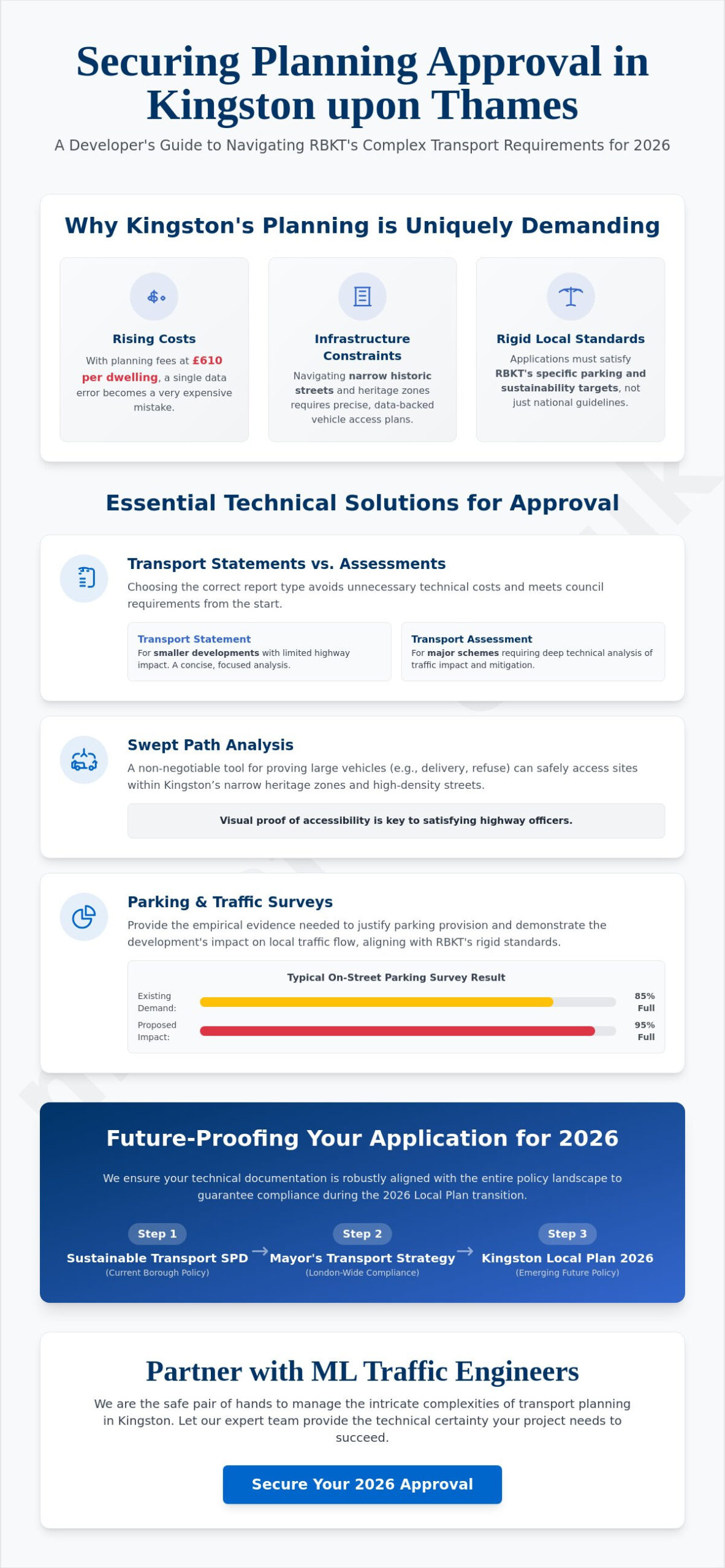
    With planning application fees for minor developments rising to £610 per dwelling this April, a single data error is now a very expensive mistake. You likely recognize that securing approval in the Royal Borough of Kingston upon Thames (RBKT) requires more than just a standard application. The borough’s narrow historic streets and rigid parking standards mean that generic advice rarely satisfies highway officers. Partnering with expert Transport Planning Consultants Kingston upon Thames ensures your project aligns with the Sustainable Transport SPD and the new Local Plan scheduled for consultation in Summer 2026.

    We’ll demonstrate how to navigate RBKT’s complex requirements using precise transport statements and parking surveys that provide the technical certainty you need. You’ll learn how tools like swept path analysis can solve the logistical challenges of Kingston’s town centre while keeping your submission cost-effective. This guide provides a clear path to securing 2026 approvals by focusing on high-quality technical analysis and proactive communication with council officials. We act as a safe pair of hands, managing the intricate complexities of current regulations so your project remains compliant and moves forward without delay.

    Key Takeaways

    • Identify whether your project requires a concise Transport Statement or a comprehensive Assessment to avoid unnecessary technical costs and submission errors.
    • Learn how Transport Planning Consultants Kingston upon Thames utilize parking surveys to provide the empirical evidence needed for RBKT highway approval.
    • Explore why Swept Path Analysis is a non-negotiable tool for proving vehicle accessibility within Kingston’s narrow heritage zones and high-density residential streets.
    • Discover how data-driven traffic surveys and bespoke Travel Plans proactively address the sustainability concerns of local planning officers to prevent application delays.
    • Understand how to align your technical documentation with the Mayor of London’s Transport Strategy to ensure compliance during the 2026 Local Plan transition.

    The Role of Transport Planning in Kingston upon Thames Developments

    The Royal Borough of Kingston upon Thames is entering a pivotal phase with the 2026 Local Plan consultation. For developers, this means the window for generic planning applications has closed. Precision in transportation planning is now the standard requirement for any successful submission. We see many projects stall because they underestimate the technical scrutiny of RBKT highway officers. Engaging expert Transport Planning Consultants Kingston upon Thames early in the process prevents costly holding objections and ensures your project meets the borough’s evolving safety and sustainability targets.

    To better understand the technical expertise required for these projects, watch this helpful video about the role of a transport planner:

    Modern urban development in South West London focuses heavily on reducing car dependency. The 2026/27 Local Implementation Plan (LIP) funding from TfL reinforces this shift toward walking, cycling, and public transport. We provide the technical authority needed to navigate these high-stakes requirements. Our team manages the logistical and regulatory burdens of your project from the initial planning phase through to final implementation. We act as a safe pair of hands, ensuring that every technical report we produce is rooted in industry-specific terminology and Chapter 8 compliance where necessary.

    Kingston’s Unique Infrastructure Constraints

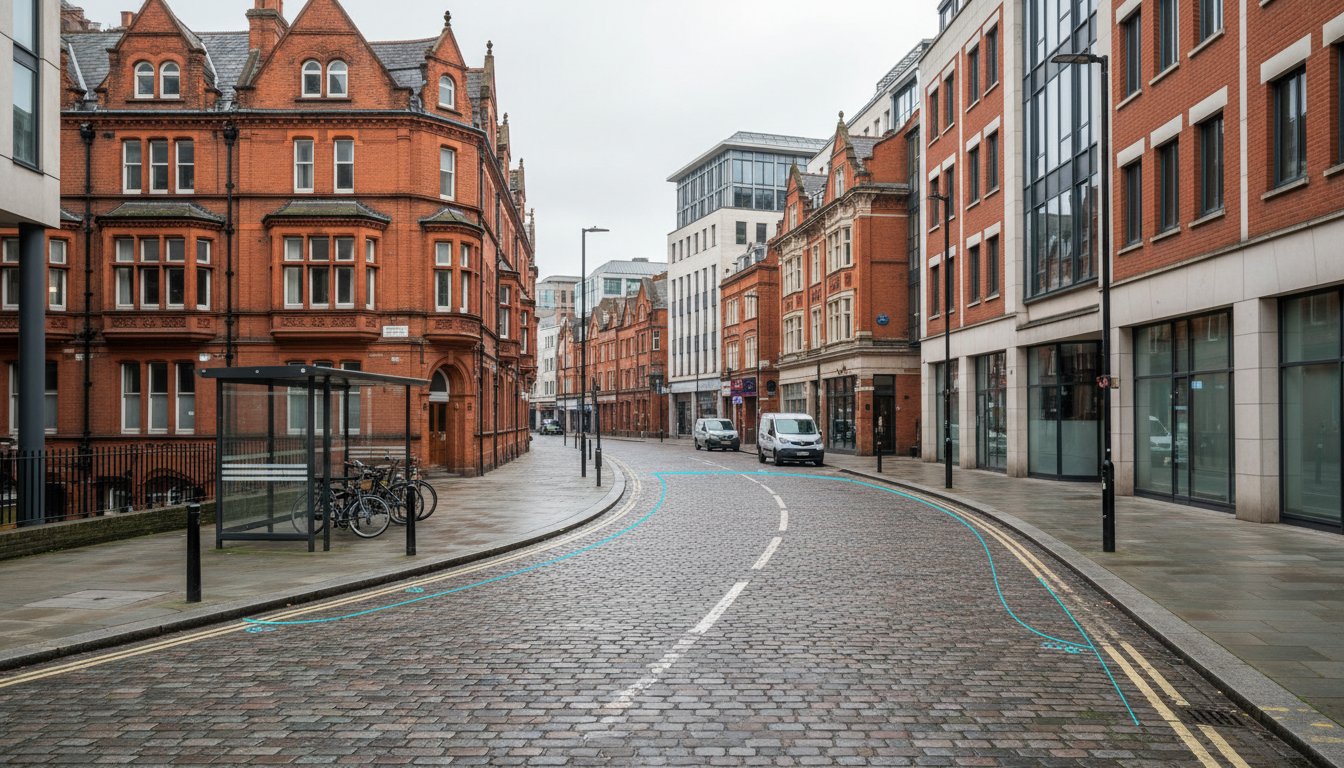
    The historic medieval street patterns of Kingston Town Centre present significant challenges for modern vehicle access. Narrow lanes and heritage zones require exact data to prove that delivery or residential vehicles won’t compromise public safety. Beyond the town centre, the A3 corridor and major arterial routes dictate how site access must be managed to maintain traffic flow. We balance these physical constraints with the borough’s air quality objectives. Our bespoke solutions ensure your development supports sustainable travel while remaining functional for residents and businesses.

    When is a Transport Consultant Required?

    Whether you’re developing 1-9 dwellings or a major commercial hub, transport documentation is essential. For minor developments, the new £610 per dwelling application fee makes first-time approval a financial necessity. Early engagement during the pre-application phase allows us to identify potential roadblocks before you commit to final designs. As the borough transitions to the Kingston Local Plan 2026, Transport Planning Consultants Kingston upon Thames must align technical reports with both current SPD standards and emerging policy requirements. We provide the comprehensive support needed to satisfy council officials and secure your planning permission.

    Essential Technical Reports for Planning Approval

    Securing planning approval in Kingston depends on the quality of your technical documentation. National standards set by the UK government guidance require developers to assess the impact of their projects on the local highway network. As experienced Transport Planning Consultants Kingston upon Thames, we specialize in producing reports that satisfy both national NPPF requirements and the borough’s specific Sustainable Transport SPD. Precision is a legal necessity. We ensure every data point stands up to the scrutiny of RBKT highway officers, reducing the risk of costly delays or application refusals.

    Transport Statements vs. Transport Assessments

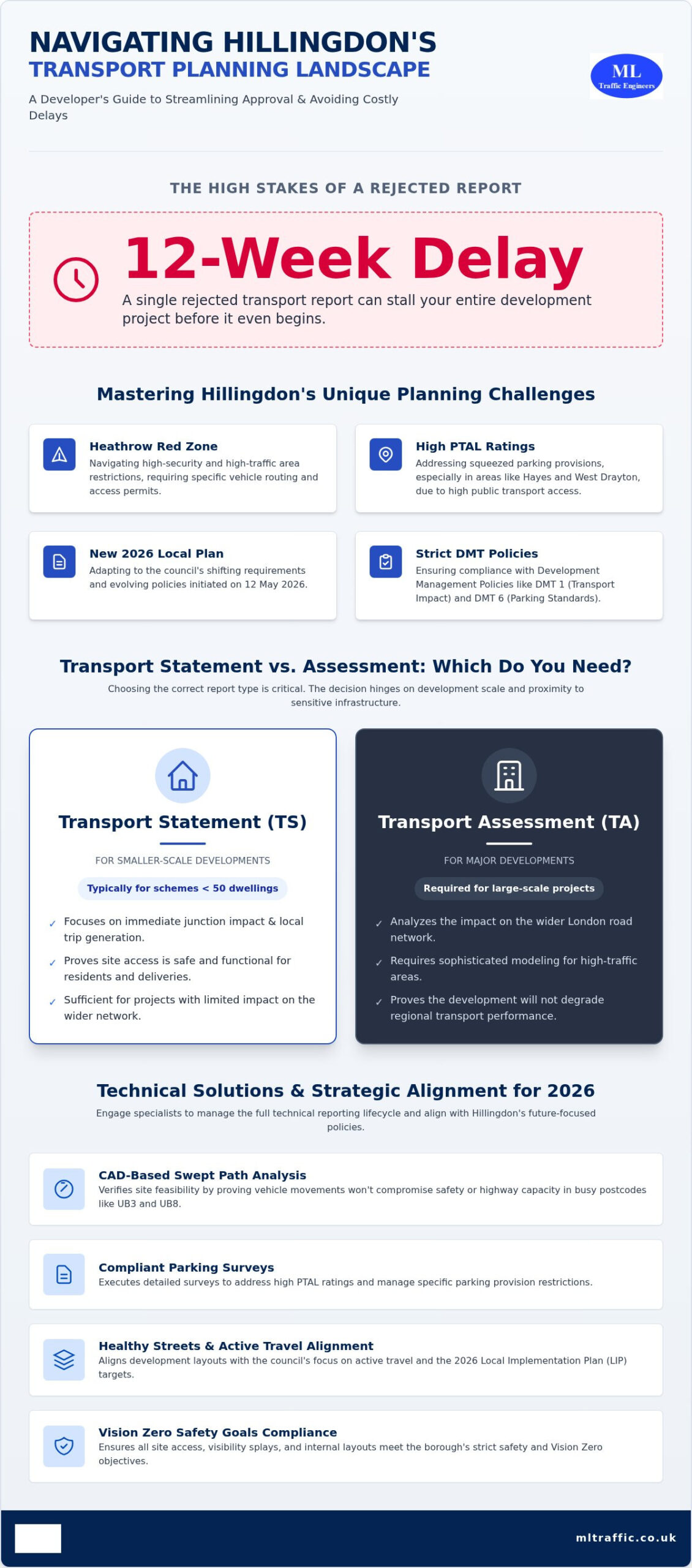
    While a Transport Statement focuses on smaller developments with limited impacts, a full Transport Assessment provides the deep technical analysis required for major residential or commercial schemes. In Kingston, triggers for a full assessment often include projects exceeding 50 residential units or those situated near sensitive arterial routes like the A3. These reports require detailed junction modeling and multi-modal trip generation data. You’ll find more details on these requirements in our Transport Assessment London Guide. Engaging Transport Planning Consultants Kingston upon Thames early ensures you commission the correct level of reporting for your specific site.

    Travel Plans for Kingston Sites

    Sustainability is a core pillar of the emerging 2026 Local Plan. RBKT highway officers look for proactive strategies that reduce car dependency and encourage active travel. A Travel Plan outlines how a development will promote cycling and walking through infrastructure and incentives. For sites in high-density areas like Surbiton or New Malden, these plans are often a mandatory condition of planning. Our London Travel Plans Essential Guide explains how to draft these documents to meet 2026 standards. We focus on realistic, achievable targets that align with the Mayor of London’s Transport Strategy.

    We provide the technical authority to ensure your reports are robust and compliant. Whether you need a simple statement for a minor development or a complex assessment for a major scheme, our team manages the data collection and analysis. Precision in these reports prevents “holding objections” and keeps your project on track for 2026 approval. If you aren’t sure which report your project needs, reviewing our full range of transport services can help clarify the requirements for your specific site.

    Transport Planning Consultants Kingston upon Thames: Securing 2026 Approvals

    Data-Driven Success: Parking Surveys and Swept Path Analysis

    Technical precision isn’t optional when dealing with Kingston’s historic constraints. We use empirical data to eliminate guesswork and satisfy the Royal Borough’s high standards. Planning committees in RBKT are often skeptical of development impact claims that lack rigorous evidence. As Transport Planning Consultants Kingston upon Thames, we produce the technical drawings and data sets that prove a site works in the real world. This evidence-based approach is the most effective way to overcome local objections and secure a positive recommendation from highway officers.

    Data collection serves as the backbone of every successful submission we manage. We don’t rely on generic assumptions or outdated traffic models. Instead, we deploy precise traffic surveys and technical analysis tailored to your site’s specific geography. This level of detail provides a safe pair of hands for your project, ensuring that every claim regarding vehicle movement or parking capacity is backed by verifiable facts. Our team understands the high-stakes nature of traffic management where precision is both a legal and physical necessity.

    Swept Path Analysis for Kingston Access

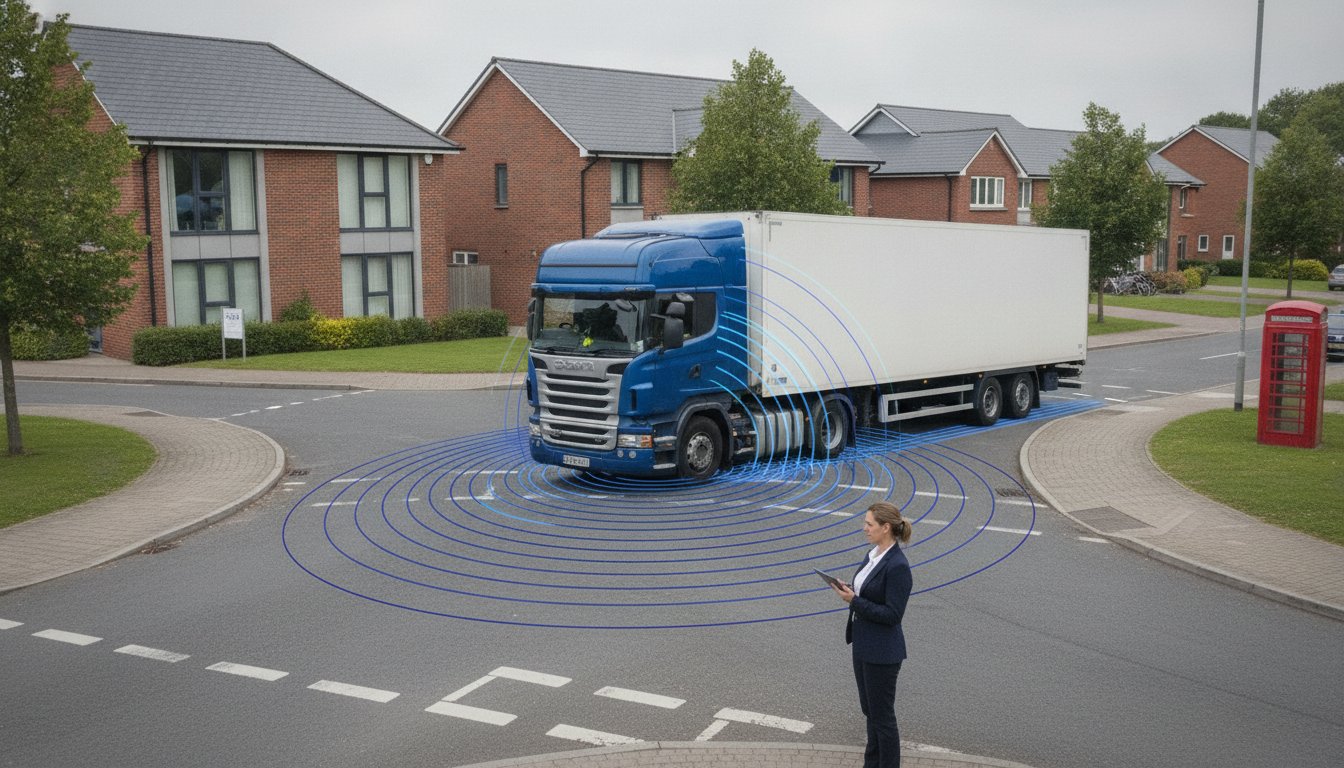
    Kingston’s medieval street layouts weren’t built for modern refuse freighters or 12-meter fire tenders. We use CAD-based simulations to model vehicle movements with centimeter-level accuracy. This process identifies potential access issues before you commit to a final design or submit your application. It prevents the need for expensive redesigns and ensures your site layout complies with safety standards. You can explore our Swept Path Analysis Services in London to see how we secure approvals for even the most constrained urban sites. Proving that an emergency vehicle can maneuver safely on-site is often the difference between approval and a flat refusal.

    Parking Surveys and the Lambeth Methodology

    RBKT’s strict parking standards often conflict with the density goals of modern developers. We conduct overnight parking surveys using the Lambeth Methodology to assess local parking stress within a 200-meter radius of your project. This data is vital for justifying car-free or low-parking schemes, particularly in areas with high Public Transport Accessibility Level (PTAL) ratings like Kingston Town Centre or Surbiton. By providing a clear, sequential picture of current street capacity, Transport Planning Consultants Kingston upon Thames help you align your project with the London Plan’s sustainable transport objectives. We manage the entire lifecycle of the survey, from initial planning to the final technical report, ensuring seamless integration with your planning application.

    Overcoming Kingston’s Specific Planning Challenges

    Kingston’s planning environment is defined by its unique heritage and evolving infrastructure. The Ancient Market area and surrounding heritage zones require a delicate balance between modern accessibility and historical preservation. As Transport Planning Consultants Kingston upon Thames, we help developers navigate these constraints by providing technical reports that respect the borough’s architectural integrity. The Kingston Mini-Holland (Go Cycle) program has significantly altered the local road network. New cycle lanes and pedestrianized zones mean that traditional site access points often need a complete rethink to ensure safety and compliance with the latest highway standards.

    Negotiating highway improvements requires technical authority and clear communication with RBKT officers. We assist clients with the technical analysis required for Section 278 and Section 38 agreements. These legal frameworks ensure that any modifications to the public highway meet the borough’s exacting safety requirements. Whether it’s a new junction design or footway widening, we manage the data collection to prevent application delays. Our goal is to provide a total, managed solution that alleviates the regulatory burdens on your project team.

    PTAL Ratings and Development Density

    PTAL is the standard London metric for public transport access. In Kingston Town Centre, high PTAL scores of 5 or 6 allow for greater development density and significantly reduced parking requirements. Conversely, sites in PTAL 1 or 2 zones, such as parts of Chessington or Old Malden, face stricter parking standards to prevent overspill onto local roads. We analyze these ratings to justify your project’s density, ensuring it aligns with the London Plan while remaining viable for the local infrastructure. This data-driven approach helps planning committees understand the relationship between transport accessibility and site capacity.

    Construction Logistics and Management Plans

    High-density residential areas like Surbiton and New Malden present significant logistical challenges during the build phase. Mitigating the impact of heavy vehicle movements on local residents is a priority for RBKT’s street works team. We provide the technical data and traffic surveys that inform how these movements are coordinated to minimize disruption. You can find more information on how these technical requirements are managed in our Construction Logistics Plan Consultant Guide. We ensure your documentation is robust enough to pass council scrutiny on the first attempt.

    If you’re facing specific access hurdles or heritage constraints, our team can provide the technical analysis needed to secure your 2026 approval.

    Partnering with ML Traffic Engineers for Kingston Projects

    ML Traffic Engineers provides the technical authority required to navigate the Royal Borough of Kingston upon Thames’ evolving planning landscape. We understand that precision is a legal necessity. Our team acts as a safe pair of hands; we manage the logistical and regulatory burdens of your project from the initial consultation through to final implementation. As specialized Transport Planning Consultants Kingston upon Thames, we focus on delivering high-quality technical reports that stand up to the most rigorous council scrutiny. We prioritize clarity and speed of information. This ensures your project manager can grasp the scope of our work without navigating through unnecessary filler.

    Our readiness stems from the 24/7 nature of the industry. We understand that construction timelines and utility works move fast. This environment demands constant availability and unwavering reliability. We don’t just supply equipment; we offer a total, managed solution. This includes everything from initial traffic surveys to the complex modeling required for Transport Assessments. Our work is fundamentally safety-conscious and reassuring. We take pride in our professional integrity and our role as guardians of public safety within the borough’s unique road network.

    Why Technical Expertise Matters

    Generalist planners often lack the specific traffic engineering data needed to satisfy RBKT highway officers. We bridge that gap with industry-specific expertise. As experienced Transport Planning Consultants Kingston upon Thames, we utilize CAD design for high-accuracy swept path analysis and follow the Lambeth Methodology for parking surveys. This level of detail is essential for securing 2026 approvals under the new Local Plan. We’ve a proven track record of helping developers overcome the challenges of narrow heritage streets and strict parking standards. You can explore our Project Types to see how we’ve secured planning permission for a diverse range of residential and commercial projects across London.

    Get Started with Your Kingston Planning Application

    Securing your development’s future in Kingston begins with robust technical data. We offer bespoke solutions tailored to the specific constraints of your site, whether you’re in Surbiton, New Malden, or the Town Centre. You can request a quote for Transport Statements, Travel Plans, or comprehensive Traffic Surveys directly from our senior engineering team. We provide direct access to experts who understand the intricate complexities of UK road regulations. Visit ML Traffic Engineers to learn more about our services and how we can support your next planning application. We’re ready to help you navigate the 2026 approval process with confidence and technical precision.

    Secure Your Kingston Planning Approval Today

    Securing planning permission in the Royal Borough of Kingston upon Thames requires a shift from general planning to technical engineering precision. We’ve explored how empirical data from parking surveys and swept path analysis provide the technical authority needed to satisfy highway officers. As the borough transitions toward its 2026 Local Plan, having robust documentation that aligns with the Mayor of London’s Transport Strategy is no longer optional. It’s a legal and physical necessity for any successful urban development. Partnering with expert Transport Planning Consultants Kingston upon Thames ensures your project stands up to the most rigorous technical scrutiny.

    ML Traffic Engineers has been a safe pair of hands for developers since 2014. We bring over a decade of London planning experience to your project; specializing in high-accuracy swept path analysis and technical traffic data. Our team maintains 24/7 availability to meet urgent planning deadlines and navigate complex regulatory hurdles. We manage the entire lifecycle of your transport documentation so you don’t have to. Contact ML Traffic Engineers for a Kingston Transport Consultation to ensure your project remains compliant and moves forward without delay. Your successful 2026 approval is our priority.

    Frequently Asked Questions

    Do I need a transport planning consultant for a small extension in Kingston?

    You generally don’t need a specialist for minor householder extensions that don’t alter parking or access. However, if your extension removes a garage or creates a new driveway, Kingston Council may require technical proof of compliance. Professional Transport Planning Consultants Kingston upon Thames provide the necessary swept path analysis to ensure your new layout meets safety standards. We help you avoid unexpected delays by providing technical certainty from the start.

    What is the difference between a Transport Statement and a Transport Assessment in RBKT?

    The primary difference lies in the scale of the development and its projected impact on the local highway. A Transport Statement is a concise report for smaller projects with limited traffic implications. Major developments, such as those exceeding 50 residential units, require a full Transport Assessment. This comprehensive document includes detailed junction modeling and multi-modal trip generation data. We manage both types of reporting to ensure your submission meets RBKT’s specific criteria.

    How much does a parking survey cost for a Kingston planning application?

    Costs for parking surveys vary depending on the site size and the number of survey hours required by the council. We provide bespoke quotes based on the specific scope of your project and the current Lambeth Methodology requirements. Every survey we conduct is tailored to provide the precise data needed for your application. Our team manages the entire process from data collection to final reporting, ensuring your project remains on track.

    Will Kingston Council accept a car-free development?

    Kingston Council often accepts car-free developments in areas with high Public Transport Accessibility Level (PTAL) ratings, such as Kingston Town Centre. You must provide a robust Travel Plan and evidence that the project won’t increase local parking stress. We use parking surveys to prove that existing street capacity can accommodate the development. This data-driven approach is essential for securing approval for low-parking or car-free schemes under the London Plan.

    What vehicle templates are used for Swept Path Analysis in Kingston?

    We use standard UK vehicle templates within our CAD-based simulations, focusing on the largest vehicles expected to access your site. In Kingston, this typically includes a 12-meter fire tender and a standard 11.2-meter refuse freighter. Proving these vehicles can maneuver safely within your site layout is a mandatory requirement for highway approval. Our precise technical drawings demonstrate maneuverability without compromising public safety or damaging historic street furniture.

    How long does it take to prepare a Transport Statement for planning?

    Preparing a comprehensive Transport Statement typically takes between two and four weeks, depending on the availability of survey data. This timeline includes site visits, traffic surveys, and the technical analysis required for a robust report. We operate with a sense of readiness and urgency to meet your project deadlines. Our 24/7 availability ensures that we can respond quickly to urgent requests from project managers and developers across the borough.

    What happens if my planning application is refused on transport grounds?

    You can either appeal the decision or resubmit the application with improved technical evidence if your project is refused. Refusals often stem from insufficient data or failure to address specific highway safety concerns. Transport Planning Consultants Kingston upon Thames analyze the refusal notice to identify exactly where the submission fell short. We then produce the necessary traffic surveys or swept path analysis to resolve the council’s objections in your next submission.

    Can a Travel Plan help reduce my CIL (Community Infrastructure Levy) payments?

    A Travel Plan doesn’t directly reduce CIL payments, but it can influence the overall Section 106 infrastructure requirements for your development. By promoting sustainable travel and reducing car dependency, you demonstrate a lower impact on the borough’s road network. This can lead to more favorable negotiations regarding site-specific highway improvements. We design Travel Plans that align with RBKT’s carbon-neutral targets while supporting the commercial viability of your project.

    Michael Lee

    Article by

    Michael Lee

    Transport planner with over 35 years' experience.

    Disclaimer

    The content on mltraffic.co.uk, including all technical articles, guides, and resources, is provided for general informational and educational purposes only. It is not intended to constitute professional advice in traffic engineering, transportation planning, development approvals, or any other technical or legal field.
    While ML Traffic Engineers makes every reasonable effort to ensure the accuracy, completeness, and timeliness of the information published, we do not provide any warranties or representations (express or implied) regarding its reliability, suitability, or availability for any particular purpose. Any reliance you place on the content is strictly at your own risk.
    In no event shall ML Traffic Engineers, its directors, employees, authors, or affiliates be liable for any direct, indirect, incidental, special, consequential, or punitive damages (including, without limitation, loss of profits, data, or business opportunities) arising out of or in connection with the use of, or inability to use, any information provided on this website.
    The articles and guides on this site are not a substitute for engaging a qualified, professional traffic engineer to assess your specific project requirements. For tailored advice, compliance assessments, or traffic engineering services, please contact a competent professional.
    This disclaimer may be updated from time to time without notice. By accessing or using this website, you agree to be bound by the most current version of this disclaimer.
  • Transport Planning Consultants Tower Hamlets: A Developer’s Guide to 2026 Approvals

    Transport Planning Consultants Tower Hamlets: A Developer’s Guide to 2026 Approvals

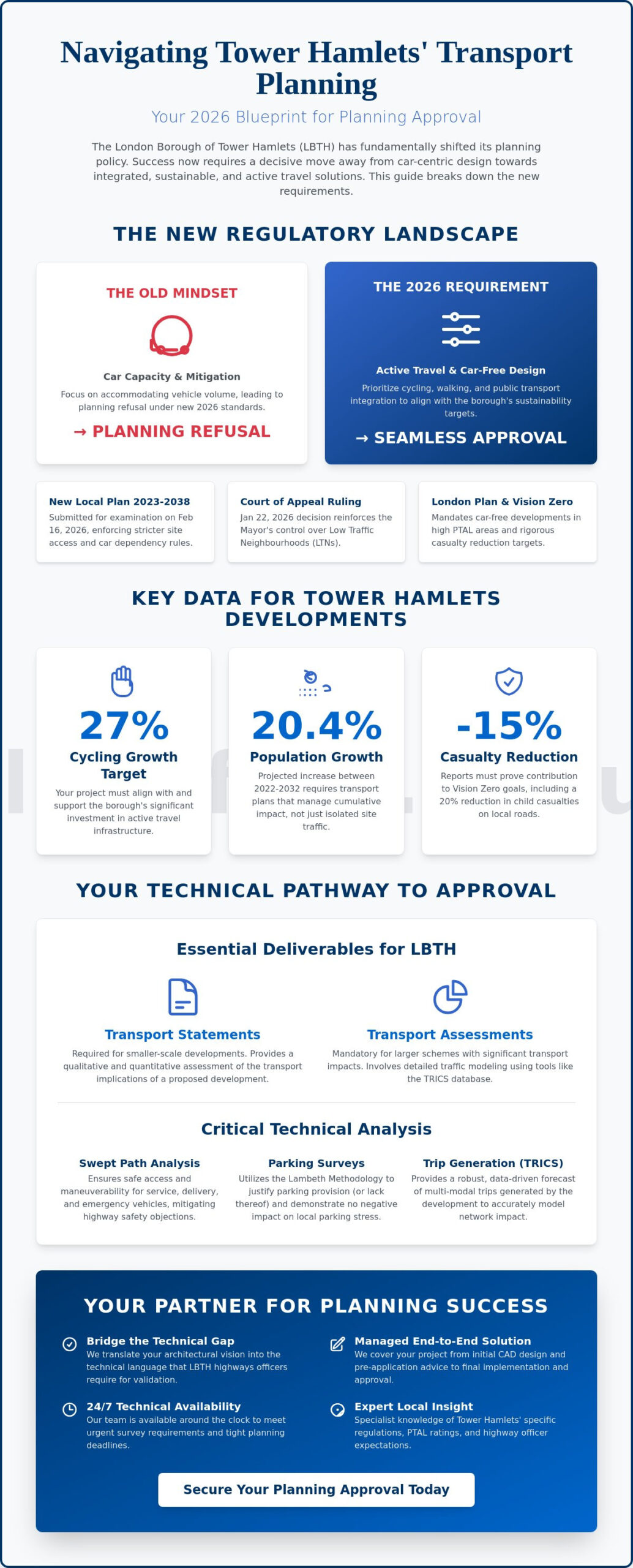
    In Tower Hamlets, your development’s success no longer hinges on how many cars you can fit; it depends on how many you can keep away. With the New Local Plan 2023–2038 submitted for examination on February 16, 2026, the borough has pivoted sharply toward active travel integration. As specialist Transport Planning Consultants Tower Hamlets, we recognize that the old traffic mitigation mindset is now a fast track to a planning refusal.

    You probably feel the weight of these shifting requirements, especially with the Court of Appeal’s January 22, 2026, ruling reinforcing the Mayor’s control over Low Traffic Neighbourhoods. Whether you’re struggling with PTAL ratings on the Isle of Dogs or the new 2026 CIL indexation rates, the regulatory burden is significant. This guide simplifies the process by providing the technical insights necessary to navigate Tower Hamlets’ safety standards and sustainability targets. You’ll learn exactly which transport reports are mandatory for 2026 and how to align your project with the borough’s 27% cycling growth to ensure a seamless approval.

    Key Takeaways

    • Identify the specific criteria for Transport Statements and Assessments to ensure your LBTH planning application is validated without technical delays.
    • Navigate high PTAL ratings in areas like Bethnal Green by implementing car-free development strategies that align with 2026 sustainability targets.
    • Use technical Swept Path Analysis and the Lambeth Methodology for parking surveys to mitigate highway safety objections and fire access concerns.
    • Partner with specialist Transport Planning Consultants Tower Hamlets to bridge the gap between your development goals and the borough’s complex highways regulations.
    • Leverage 24/7 availability for urgent traffic survey requirements and a managed solution that covers your project from initial CAD design to final implementation.

    Why You Need Specialist Transport Planning Consultants in Tower Hamlets

    In the London Borough of Tower Hamlets (LBTH), transport planning validation is the gatekeeper of your project timeline. It involves more than just drafting a site map; it’s a technical discipline that aligns your development goals with the borough’s strict safety and environmental standards. Professional transportation planning ensures your proposal meets the legal requirements for highway safety and public access from day one. Without this precision, developers face the immediate financial risk of planning refusal. These setbacks often stem from inadequate data or a failure to address the borough’s specific movement strategies.

    Expert Transport Planning Consultants Tower Hamlets act as a vital bridge between your design team and the local highways officers. We translate complex architectural visions into the technical language that LBTH officials require for validation. This technical authority is essential because 2026 regulations now demand comprehensive active travel integration rather than simple traffic volume counts. We manage the logistical and regulatory burdens so you don’t have to.

    To better understand the evolution of these planning tools, watch this helpful video:

    Navigating the Tower Hamlets Local Plan 2031

    The “Vision for Tower Hamlets” focuses on high-density growth and reduced car dependency. With the New Local Plan 2023–2038 submitted for independent examination on February 16, 2026, the requirements for site access have become more stringent. Our consultants interpret how programs like “Liveable Streets” affect your specific site layout and access points. We prioritize obtaining pre-application advice from highways officers. This early engagement identifies potential objections before they become costly roadblocks during the formal application phase. It’s about securing a safe pair of hands for your project’s future.

    The 2026 Regulatory Landscape for London Developers

    The London Plan 2021/2026 has introduced rigorous parking maximums that effectively mandate car-free developments in high PTAL areas. These updates, combined with the expanded ULEZ and the Mayor’s Vision Zero policy, have transformed transport reporting. Modern reports must prove a 15% overall casualty reduction on roads, mirroring borough-wide successes seen between 2017 and 2023. At ML Traffic Engineers, we stay ahead of these statutory changes by integrating bespoke technical solutions into every report. We ensure your project addresses the 20% reduction in child casualties required by current safety standards, providing the unwavering reliability needed for 2026 approvals.

    Essential Deliverables: Transport Statements and Assessments in LBTH

    Securing planning approval in Tower Hamlets requires a robust technical submission that addresses the borough’s unique highway constraints. The primary deliverables include Transport Statements and Transport Assessments. These documents provide the evidence base for your development’s impact on the local network. We use the TRICS database to predict trip generation with high precision, comparing your site against similar developments across London. This data-driven approach is essential for 2026 approvals, as it allows us to model junction capacity and multi-modal traffic flow accurately.

    A failed submission often ignores the cumulative impact of neighboring projects. Our team ensures that your reports account for the 20.4% projected population growth in the borough between 2022 and 2032. We provide a managed solution that covers everything from initial CAD design to final implementation, acting as a safe pair of hands for your application. If you’re facing tight deadlines, our technical team is available 24/7 to finalize your sustainable transport strategy.

    Transport Statements vs. Assessments: Which Do You Need?

    The requirement depends on the scale of your project. Generally, developments exceeding 80 residential units or 1,000 square meters of floor space require a full Transport Assessment. For smaller schemes, a Transport Statement is typically sufficient. However, Tower Hamlets officers frequently demand Statements for even minor ‘car-free’ developments in areas with high PTAL ratings. Understanding the Transport Statement vs. Assessment: London Differences is vital for setting your project’s budget and timeline. As experienced Transport Planning Consultants Tower Hamlets, we determine the exact level of detail required to satisfy LBTH Highways and avoid unnecessary technical delays.

    Travel Plans: More Than Just a Document

    Travel Plans are now a mandatory component for most Tower Hamlets applications. These are living documents designed to reduce single-occupancy vehicle trips and promote the borough’s 27% cycling participation rate. A successful Travel Plan includes site-specific measures such as subsidized transit passes or expanded cycle storage. For major residential schemes, you’ll likely need a dedicated Travel Plan Coordinator to oversee these initiatives for at least five years. This proactive management helps mitigate ‘unacceptable’ transport impacts that could otherwise lead to a refusal.

    Transport Planning Consultants Tower Hamlets: A Developer’s Guide to 2026 Approvals

    Tower Hamlets Specifics: PTAL Ratings and Active Travel

    PTAL (Public Transport Accessibility Level) is the primary metric Tower Hamlets uses to dictate parking density and development scale. In 2026, high PTAL scores of 5 or 6 in areas like Bethnal Green and Spitalfields make car-free development a mandatory requirement. We utilize Transport for London’s 100m x 100m grid resolution data from 2023 to verify these ratings with total precision. For developers, this means shifting focus from traditional parking bays to Active Travel Zone (ATZ) assessments. These assessments are now a non-negotiable 2026 standard; they require a detailed audit of walking and cycling routes within a 20 minute radius of your site to ensure safety and connectivity.

    Our role as Transport Planning Consultants Tower Hamlets is to prove your site can handle increased density without adding to road congestion. We analyze existing infrastructure to ensure your project aligns with the borough’s 15% overall casualty reduction targets. This technical authority helps you avoid highway safety objections that often stall major schemes in the borough’s densest wards. We provide the technical evidence needed to satisfy officers that your development supports the borough’s goal of a cleaner, greener environment.

    Understanding PTAL in the Isle of Dogs and Canary Wharf

    The Elizabeth Line has significantly recalibrated PTAL ratings across the borough, turning previously isolated spots into transport hubs. While Canary Wharf enjoys elite connectivity, pockets of the Isle of Dogs and Blackwall still present accessibility challenges. We specialize in justifying development in these lower PTAL areas by proposing targeted infrastructure improvements. This might include new pedestrian links or improved bus stop facilities to bridge the accessibility gap. For smaller projects, our expertise in Flat Conversions in London ensures that even complex subdivisions meet PTAL-based parking constraints without triggering a refusal.

    Integrating Active Travel and Cycling Infrastructure

    With 27% of residents now cycling, LBTH demands infrastructure that exceeds basic racks in a basement. We design secure, accessible storage that strictly adheres to the London Cycle Design Standards (LCDS). Your site entrance must also account for the heavy flow of Cycle Superhighways CS2 and CS3. Our CAD design team ensures these interfaces are safe and functional, preventing conflicts between residents and high-speed cycle traffic. We provide a total, managed solution that integrates these active travel requirements into your initial planning phase, ensuring your site is ready for the 2026 regulatory environment.

    Technical Precision: Swept Path Analysis and Parking Surveys

    Technical precision is the foundation of a successful planning application in East London. As Transport Planning Consultants Tower Hamlets, we provide the rigorous data collection needed to satisfy the borough’s highways department. Our team conducts detailed traffic counts and pedestrian flow surveys to establish a baseline for your site. We don’t just guess; we use CAD design to simulate real-world movements. This level of detail is particularly critical for sites near the Limehouse Cut or Regent’s Canal, where we must coordinate with the Canal & River Trust to ensure development doesn’t impede waterway maintenance or emergency towpath access.

    Our technical authority extends to managing the logistical burdens of night-time economy areas. In districts like Shoreditch and Brick Lane, we perform ‘Stress Surveys’ to measure peak parking and traffic demand during evening hours. This data ensures your development won’t exacerbate existing congestion, aligning with the borough’s safety standards. If you need immediate technical support for your site layout, book a consultation with our CAD engineers today.

    Swept Path Analysis for Narrow Tower Hamlets Streets

    Tower Hamlets features some of London’s most challenging historic street layouts. We use Swept Path Analysis Services in London to model the movement of 12m refuse vehicles and emergency fire tenders. For high-rise developments in Poplar, proving fire tender access is a non-negotiable safety requirement. We simulate various approach angles to ensure these critical vehicles can navigate tight corners without overrunning curbs or striking street furniture. This precision supports the borough’s goal of a 20% reduction in child casualties by ensuring service vehicles operate safely in residential zones.

    Overcoming Parking Objections with Robust Data

    Parking objections are a common cause of planning delays. To mitigate this, we conduct parking surveys using the ‘Lambeth Methodology,’ which is the gold standard in LBTH. We analyze on-street capacity within a 200m radius of your site during the early morning hours when residents are most likely to be at home. This data allows us to justify ‘car-free’ schemes even when local parking appears at capacity. We also address the impact of Controlled Parking Zones (CPZs) on new residents, ensuring your proposal complies with the New Local Plan 2023–2038 policies regarding on-street stress levels.

    Partnering with ML Traffic Engineers for Planning Success in Tower Hamlets

    Securing a planning approval in the current regulatory climate requires a partner who treats precision as a legal necessity. We position ourselves as a safe pair of hands, ensuring your development meets the strict 2026 safety standards set by the London Borough of Tower Hamlets. As experienced Transport Planning Consultants Tower Hamlets, we manage the intricate complexities of UK road regulations so you don’t have to. Our team provides a total, managed solution that moves your project seamlessly from the initial consultation through to final implementation.

    The high-stakes nature of traffic management in East London demands a sense of readiness and urgency. We offer 24/7 availability for urgent survey requirements, which is a primary hallmark of our brand promise. Whether you need a rapid response for a parking survey or a late-night traffic count in a busy night-time economy zone, we’re ready to act. This constant availability ensures that busy project managers can maintain their timelines without navigating through unnecessary delays or logistical hurdles.

    Our approach balances technical authority with a customer-centric focus. We develop bespoke transport solutions that protect your return on investment while ensuring full compliance with the New Local Plan 2023–2038. By prioritizing clarity and speed of information, we help you clear the final hurdles of the planning process with confidence. Contact our technical team today to discuss your project requirements and receive a professional, safety-conscious quote.

    Why Experience in East London Matters

    Success in LBTH depends on a deep understanding of local constraints and a history of successful negotiations with highways officers. We know how the borough’s team interprets the London Plan 2021/2026, especially regarding sites near the Limehouse Link or the A12 corridor. Our expertise allows us to anticipate potential objections before they lead to a refusal. You can view What We Do – Our Full Range of Transport Services to see how we’ve helped other developers navigate these specific East London challenges. We use the active voice to demonstrate capability and immediate action on every project we undertake.

    Start Your Tower Hamlets Project with a Site Appraisal

    The most effective way to save on design fees is to identify transport risks before you commit to a site. A pre-acquisition transport appraisal identifies PTAL limitations or access constraints that could impact your development’s density. We provide these technical insights early in the lifecycle to ensure your project remains viable and compliant. You can access our technical library and Resources to learn more about the safety standards and legislative compliance that form the foundation of our work. Our rhythmic efficiency and professional integrity make us the vital guardian of your project’s planning success.

    Accelerate Your Highway Approval in Tower Hamlets

    The 2026 planning landscape in East London requires a shift from simple traffic counts to comprehensive active travel integration. Navigating the New Local Plan 2023–2038 demands technical precision, especially when dealing with the borough’s historic street layouts and high PTAL zones. As specialist Transport Planning Consultants Tower Hamlets, we provide the technical authority needed to clear these hurdles. We specialize in Swept Path Analysis for narrow London streets, ensuring fire tenders and refuse vehicles maintain safe access in Poplar and beyond.

    Our team offers 24/7 availability for emergency survey data, providing a safe pair of hands when deadlines are tight. We leverage expert knowledge of the LBTH Local Plan 2031 to justify your development’s impact and secure highway validation. By partnering with a firm that prioritizes safety and legislative compliance, you alleviate the regulatory burden on your design team. It’s about moving from uncertainty to a guaranteed technical solution.

    Secure your Tower Hamlets planning approval with ML Traffic Engineers today. We’re ready to transform your site’s transport constraints into a validated, compliant success.

    Frequently Asked Questions

    Is a Transport Statement mandatory for all developments in Tower Hamlets?

    A Transport Statement isn’t mandatory for every minor internal refurbishment, but it’s required for any development creating a net increase in residential units or commercial floor space. Tower Hamlets officers often request these reports for even single-unit conversions in high PTAL areas to confirm car-free compliance. Professional Transport Planning Consultants Tower Hamlets ensure these documents meet the borough’s specific validation requirements to avoid immediate technical rejection or costly delays.

    What is the ‘car-free’ policy in Tower Hamlets and how does it affect my project?

    The ‘car-free’ policy, rooted in the Tower Hamlets Local Plan and the London Plan 2021/2026, prohibits residents in new developments from obtaining on-street parking permits. This policy applies to almost all new residential projects in areas with high public transport accessibility. You must provide a legal agreement under Section 106 to enforce this restriction. It ensures that the 20.4% projected population growth doesn’t lead to gridlock on local roads.

    How long does it take to complete a Transport Assessment for a LBTH application?

    A standard Transport Assessment for a London Borough of Tower Hamlets (LBTH) application typically takes four to six weeks to complete. This timeline includes seven days for automated traffic counts and the technical modeling required for junction capacity analysis. Complex major schemes may require longer if extensive pre-application discussions with highways officers are necessary. Our 24/7 availability for data collection helps compress these timelines for urgent planning deadlines.

    Does Tower Hamlets require a specific parking survey methodology?

    Yes, Tower Hamlets strictly requires the ‘Lambeth Methodology’ for all on-street parking surveys. You must survey a 200m radius around the site on two separate weekday mornings between 00:30 and 05:30. This data proves whether there’s sufficient capacity for visitor parking or if local ‘stress’ levels exceed the 85% threshold. Using this specific methodology is a non-negotiable requirement for a successful planning validation in 2026 and beyond.

    What happens if TfL objects to my planning application in Tower Hamlets?

    If Transport for London (TfL) objects, you must address their concerns through technical mitigation or design revisions before the Planning Committee meets. Objections often relate to site access near the Strategic Road Network or impacts on bus journey times. As Transport Planning Consultants Tower Hamlets, we negotiate directly with TfL officers to resolve these issues. We use CAD design to prove that your site entrance doesn’t compromise the safety of the red route network.

    Can Swept Path Analysis help reduce the land required for my site access?

    Yes, Swept Path Analysis optimizes the site layout by proving exactly how much space a 12m refuse vehicle or fire tender needs to turn. By simulating these movements with CAD software, we often reduce the land dedicated to oversized access roads. This technical precision allows you to maximize the developable area while maintaining full safety compliance. It’s a vital tool for high-density projects in narrow East London streets where space is at a premium.

    How much does a transport planning consultant cost for a London project?

    Fees for transport consulting in London vary significantly based on the project’s scale and the complexity of the required reports. A basic Transport Statement for a minor conversion costs less than a full multi-modal Assessment for a major Poplar high-rise. While we don’t provide fixed prices here, industry data suggests that technical reporting typically accounts for a small percentage of the total planning budget. Contact our team for a bespoke, safety-conscious quote.

    What is an Active Travel Zone (ATZ) assessment?

    An Active Travel Zone (ATZ) assessment is a mandatory audit of the walking and cycling environment within a 20 minute radius of your development. It follows the Mayor of London’s ‘Healthy Streets’ approach to identify improvements needed for pedestrian safety and cycle connectivity. These assessments are now a standard requirement for 2026 approvals. They ensure your project contributes to the borough’s target of a 15% overall casualty reduction on local roads.

    Michael Lee

    Article by

    Michael Lee

    Transport planner with over 35 years' experience.

    Disclaimer

    The content on mltraffic.co.uk, including all technical articles, guides, and resources, is provided for general informational and educational purposes only. It is not intended to constitute professional advice in traffic engineering, transportation planning, development approvals, or any other technical or legal field.
    While ML Traffic Engineers makes every reasonable effort to ensure the accuracy, completeness, and timeliness of the information published, we do not provide any warranties or representations (express or implied) regarding its reliability, suitability, or availability for any particular purpose. Any reliance you place on the content is strictly at your own risk.
    In no event shall ML Traffic Engineers, its directors, employees, authors, or affiliates be liable for any direct, indirect, incidental, special, consequential, or punitive damages (including, without limitation, loss of profits, data, or business opportunities) arising out of or in connection with the use of, or inability to use, any information provided on this website.
    The articles and guides on this site are not a substitute for engaging a qualified, professional traffic engineer to assess your specific project requirements. For tailored advice, compliance assessments, or traffic engineering services, please contact a competent professional.
    This disclaimer may be updated from time to time without notice. By accessing or using this website, you agree to be bound by the most current version of this disclaimer.