Tag: Planning Approval

  • Transport Planning Consultants Tower Hamlets: A Developer’s Guide to 2026 Approvals

    Transport Planning Consultants Tower Hamlets: A Developer’s Guide to 2026 Approvals

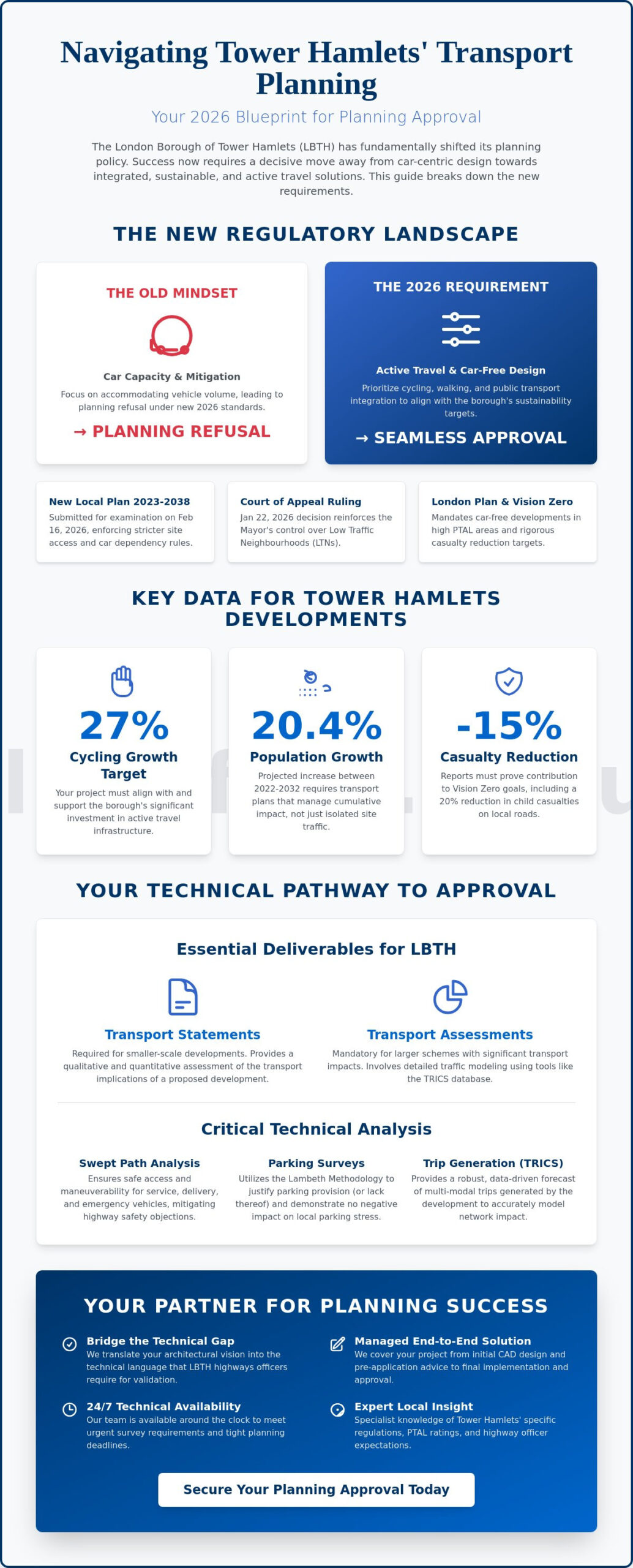
    In Tower Hamlets, your development’s success no longer hinges on how many cars you can fit; it depends on how many you can keep away. With the New Local Plan 2023–2038 submitted for examination on February 16, 2026, the borough has pivoted sharply toward active travel integration. As specialist Transport Planning Consultants Tower Hamlets, we recognize that the old traffic mitigation mindset is now a fast track to a planning refusal.

    You probably feel the weight of these shifting requirements, especially with the Court of Appeal’s January 22, 2026, ruling reinforcing the Mayor’s control over Low Traffic Neighbourhoods. Whether you’re struggling with PTAL ratings on the Isle of Dogs or the new 2026 CIL indexation rates, the regulatory burden is significant. This guide simplifies the process by providing the technical insights necessary to navigate Tower Hamlets’ safety standards and sustainability targets. You’ll learn exactly which transport reports are mandatory for 2026 and how to align your project with the borough’s 27% cycling growth to ensure a seamless approval.

    Key Takeaways

    • Identify the specific criteria for Transport Statements and Assessments to ensure your LBTH planning application is validated without technical delays.
    • Navigate high PTAL ratings in areas like Bethnal Green by implementing car-free development strategies that align with 2026 sustainability targets.
    • Use technical Swept Path Analysis and the Lambeth Methodology for parking surveys to mitigate highway safety objections and fire access concerns.
    • Partner with specialist Transport Planning Consultants Tower Hamlets to bridge the gap between your development goals and the borough’s complex highways regulations.
    • Leverage 24/7 availability for urgent traffic survey requirements and a managed solution that covers your project from initial CAD design to final implementation.

    Why You Need Specialist Transport Planning Consultants in Tower Hamlets

    In the London Borough of Tower Hamlets (LBTH), transport planning validation is the gatekeeper of your project timeline. It involves more than just drafting a site map; it’s a technical discipline that aligns your development goals with the borough’s strict safety and environmental standards. Professional transportation planning ensures your proposal meets the legal requirements for highway safety and public access from day one. Without this precision, developers face the immediate financial risk of planning refusal. These setbacks often stem from inadequate data or a failure to address the borough’s specific movement strategies.

    Expert Transport Planning Consultants Tower Hamlets act as a vital bridge between your design team and the local highways officers. We translate complex architectural visions into the technical language that LBTH officials require for validation. This technical authority is essential because 2026 regulations now demand comprehensive active travel integration rather than simple traffic volume counts. We manage the logistical and regulatory burdens so you don’t have to.

    To better understand the evolution of these planning tools, watch this helpful video:

    Navigating the Tower Hamlets Local Plan 2031

    The “Vision for Tower Hamlets” focuses on high-density growth and reduced car dependency. With the New Local Plan 2023–2038 submitted for independent examination on February 16, 2026, the requirements for site access have become more stringent. Our consultants interpret how programs like “Liveable Streets” affect your specific site layout and access points. We prioritize obtaining pre-application advice from highways officers. This early engagement identifies potential objections before they become costly roadblocks during the formal application phase. It’s about securing a safe pair of hands for your project’s future.

    The 2026 Regulatory Landscape for London Developers

    The London Plan 2021/2026 has introduced rigorous parking maximums that effectively mandate car-free developments in high PTAL areas. These updates, combined with the expanded ULEZ and the Mayor’s Vision Zero policy, have transformed transport reporting. Modern reports must prove a 15% overall casualty reduction on roads, mirroring borough-wide successes seen between 2017 and 2023. At ML Traffic Engineers, we stay ahead of these statutory changes by integrating bespoke technical solutions into every report. We ensure your project addresses the 20% reduction in child casualties required by current safety standards, providing the unwavering reliability needed for 2026 approvals.

    Essential Deliverables: Transport Statements and Assessments in LBTH

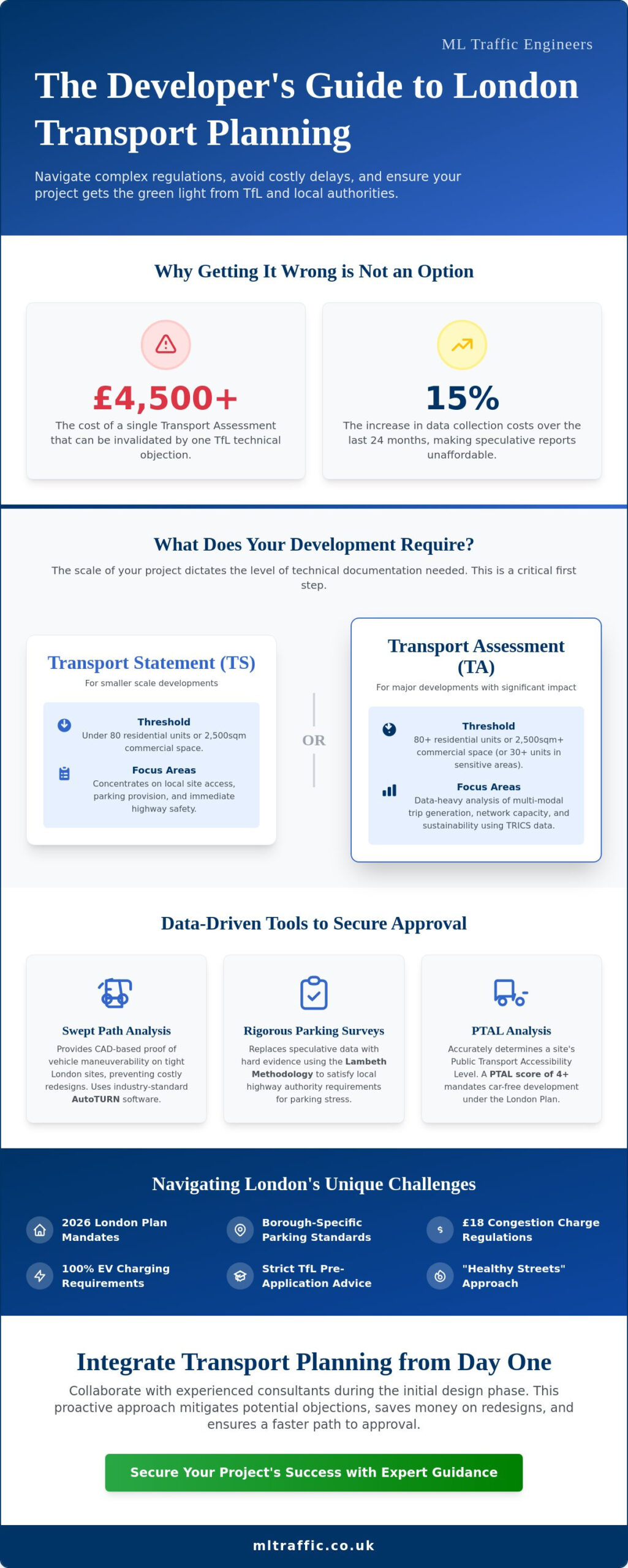
    Securing planning approval in Tower Hamlets requires a robust technical submission that addresses the borough’s unique highway constraints. The primary deliverables include Transport Statements and Transport Assessments. These documents provide the evidence base for your development’s impact on the local network. We use the TRICS database to predict trip generation with high precision, comparing your site against similar developments across London. This data-driven approach is essential for 2026 approvals, as it allows us to model junction capacity and multi-modal traffic flow accurately.

    A failed submission often ignores the cumulative impact of neighboring projects. Our team ensures that your reports account for the 20.4% projected population growth in the borough between 2022 and 2032. We provide a managed solution that covers everything from initial CAD design to final implementation, acting as a safe pair of hands for your application. If you’re facing tight deadlines, our technical team is available 24/7 to finalize your sustainable transport strategy.

    Transport Statements vs. Assessments: Which Do You Need?

    The requirement depends on the scale of your project. Generally, developments exceeding 80 residential units or 1,000 square meters of floor space require a full Transport Assessment. For smaller schemes, a Transport Statement is typically sufficient. However, Tower Hamlets officers frequently demand Statements for even minor ‘car-free’ developments in areas with high PTAL ratings. Understanding the Transport Statement vs. Assessment: London Differences is vital for setting your project’s budget and timeline. As experienced Transport Planning Consultants Tower Hamlets, we determine the exact level of detail required to satisfy LBTH Highways and avoid unnecessary technical delays.

    Travel Plans: More Than Just a Document

    Travel Plans are now a mandatory component for most Tower Hamlets applications. These are living documents designed to reduce single-occupancy vehicle trips and promote the borough’s 27% cycling participation rate. A successful Travel Plan includes site-specific measures such as subsidized transit passes or expanded cycle storage. For major residential schemes, you’ll likely need a dedicated Travel Plan Coordinator to oversee these initiatives for at least five years. This proactive management helps mitigate ‘unacceptable’ transport impacts that could otherwise lead to a refusal.

    Transport Planning Consultants Tower Hamlets: A Developer’s Guide to 2026 Approvals

    Tower Hamlets Specifics: PTAL Ratings and Active Travel

    PTAL (Public Transport Accessibility Level) is the primary metric Tower Hamlets uses to dictate parking density and development scale. In 2026, high PTAL scores of 5 or 6 in areas like Bethnal Green and Spitalfields make car-free development a mandatory requirement. We utilize Transport for London’s 100m x 100m grid resolution data from 2023 to verify these ratings with total precision. For developers, this means shifting focus from traditional parking bays to Active Travel Zone (ATZ) assessments. These assessments are now a non-negotiable 2026 standard; they require a detailed audit of walking and cycling routes within a 20 minute radius of your site to ensure safety and connectivity.

    Our role as Transport Planning Consultants Tower Hamlets is to prove your site can handle increased density without adding to road congestion. We analyze existing infrastructure to ensure your project aligns with the borough’s 15% overall casualty reduction targets. This technical authority helps you avoid highway safety objections that often stall major schemes in the borough’s densest wards. We provide the technical evidence needed to satisfy officers that your development supports the borough’s goal of a cleaner, greener environment.

    Understanding PTAL in the Isle of Dogs and Canary Wharf

    The Elizabeth Line has significantly recalibrated PTAL ratings across the borough, turning previously isolated spots into transport hubs. While Canary Wharf enjoys elite connectivity, pockets of the Isle of Dogs and Blackwall still present accessibility challenges. We specialize in justifying development in these lower PTAL areas by proposing targeted infrastructure improvements. This might include new pedestrian links or improved bus stop facilities to bridge the accessibility gap. For smaller projects, our expertise in Flat Conversions in London ensures that even complex subdivisions meet PTAL-based parking constraints without triggering a refusal.

    Integrating Active Travel and Cycling Infrastructure

    With 27% of residents now cycling, LBTH demands infrastructure that exceeds basic racks in a basement. We design secure, accessible storage that strictly adheres to the London Cycle Design Standards (LCDS). Your site entrance must also account for the heavy flow of Cycle Superhighways CS2 and CS3. Our CAD design team ensures these interfaces are safe and functional, preventing conflicts between residents and high-speed cycle traffic. We provide a total, managed solution that integrates these active travel requirements into your initial planning phase, ensuring your site is ready for the 2026 regulatory environment.

    Technical Precision: Swept Path Analysis and Parking Surveys

    Technical precision is the foundation of a successful planning application in East London. As Transport Planning Consultants Tower Hamlets, we provide the rigorous data collection needed to satisfy the borough’s highways department. Our team conducts detailed traffic counts and pedestrian flow surveys to establish a baseline for your site. We don’t just guess; we use CAD design to simulate real-world movements. This level of detail is particularly critical for sites near the Limehouse Cut or Regent’s Canal, where we must coordinate with the Canal & River Trust to ensure development doesn’t impede waterway maintenance or emergency towpath access.

    Our technical authority extends to managing the logistical burdens of night-time economy areas. In districts like Shoreditch and Brick Lane, we perform ‘Stress Surveys’ to measure peak parking and traffic demand during evening hours. This data ensures your development won’t exacerbate existing congestion, aligning with the borough’s safety standards. If you need immediate technical support for your site layout, book a consultation with our CAD engineers today.

    Swept Path Analysis for Narrow Tower Hamlets Streets

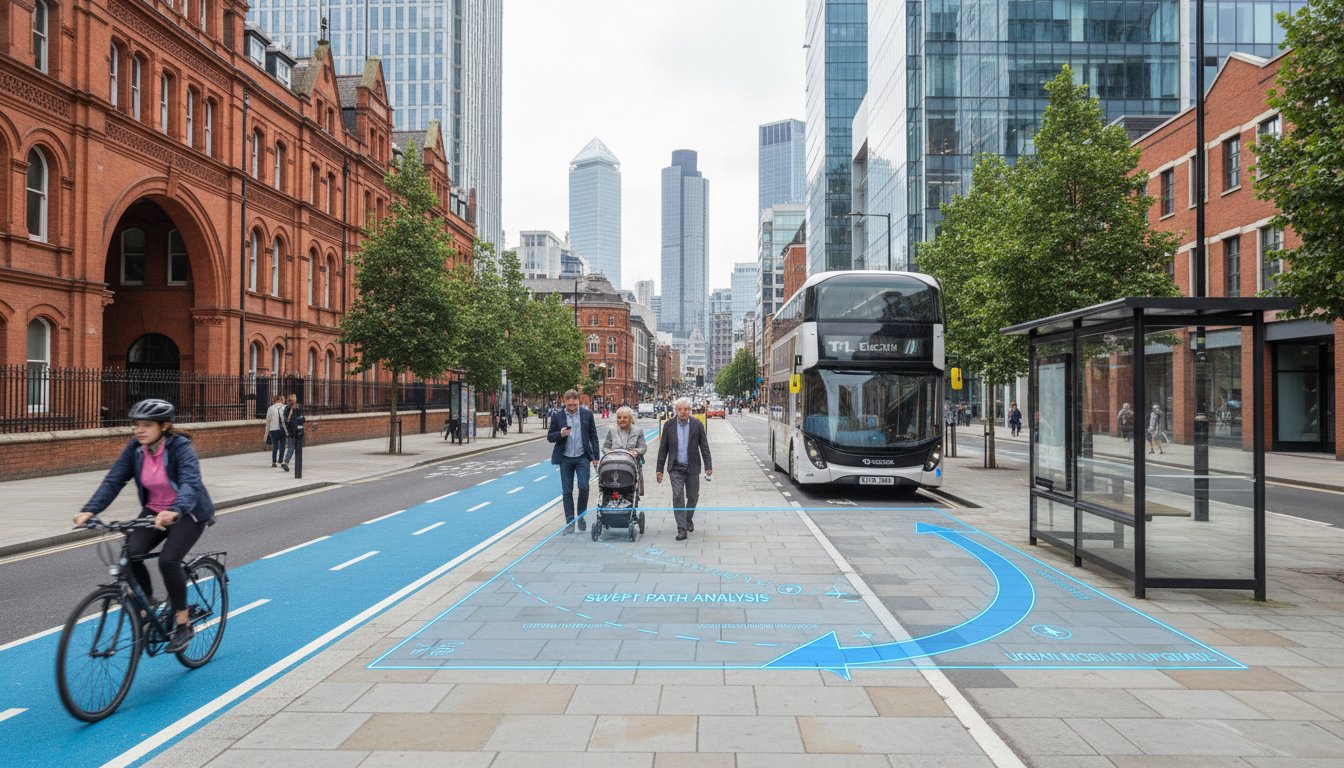
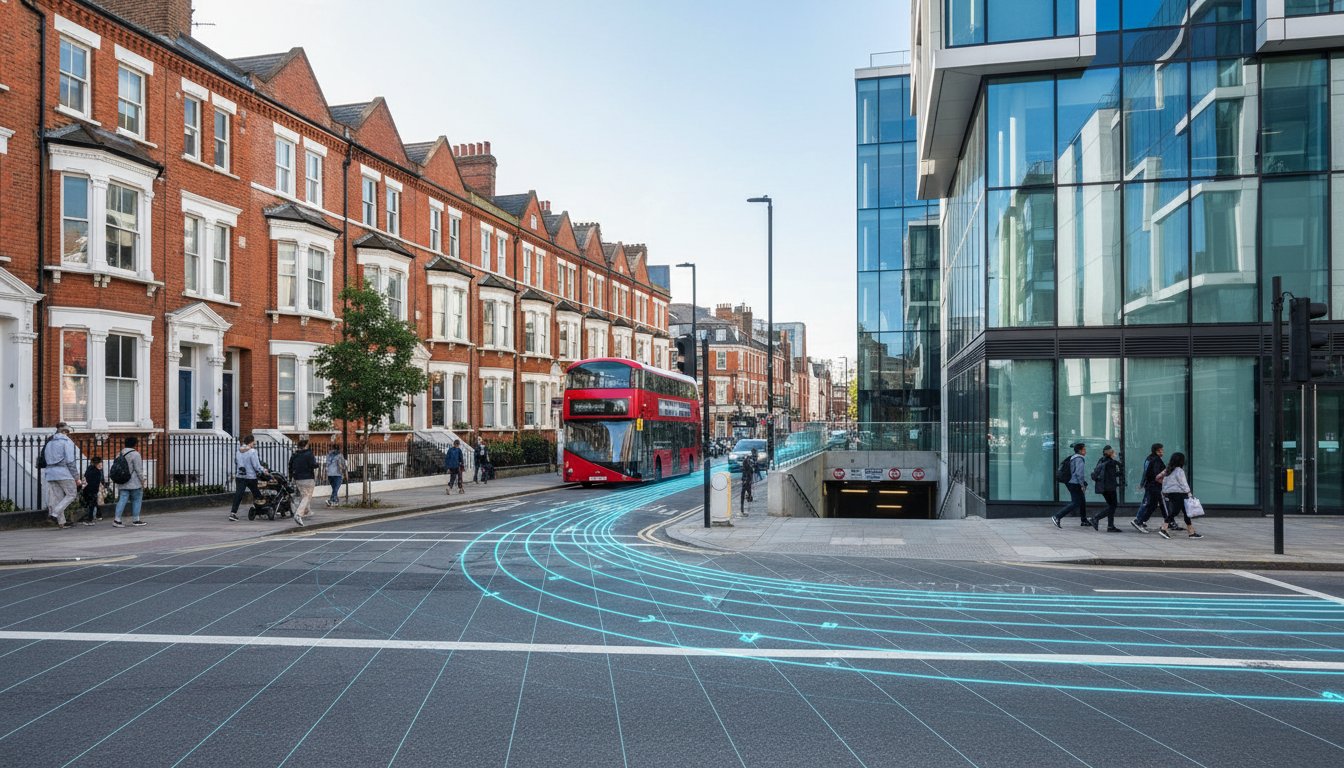
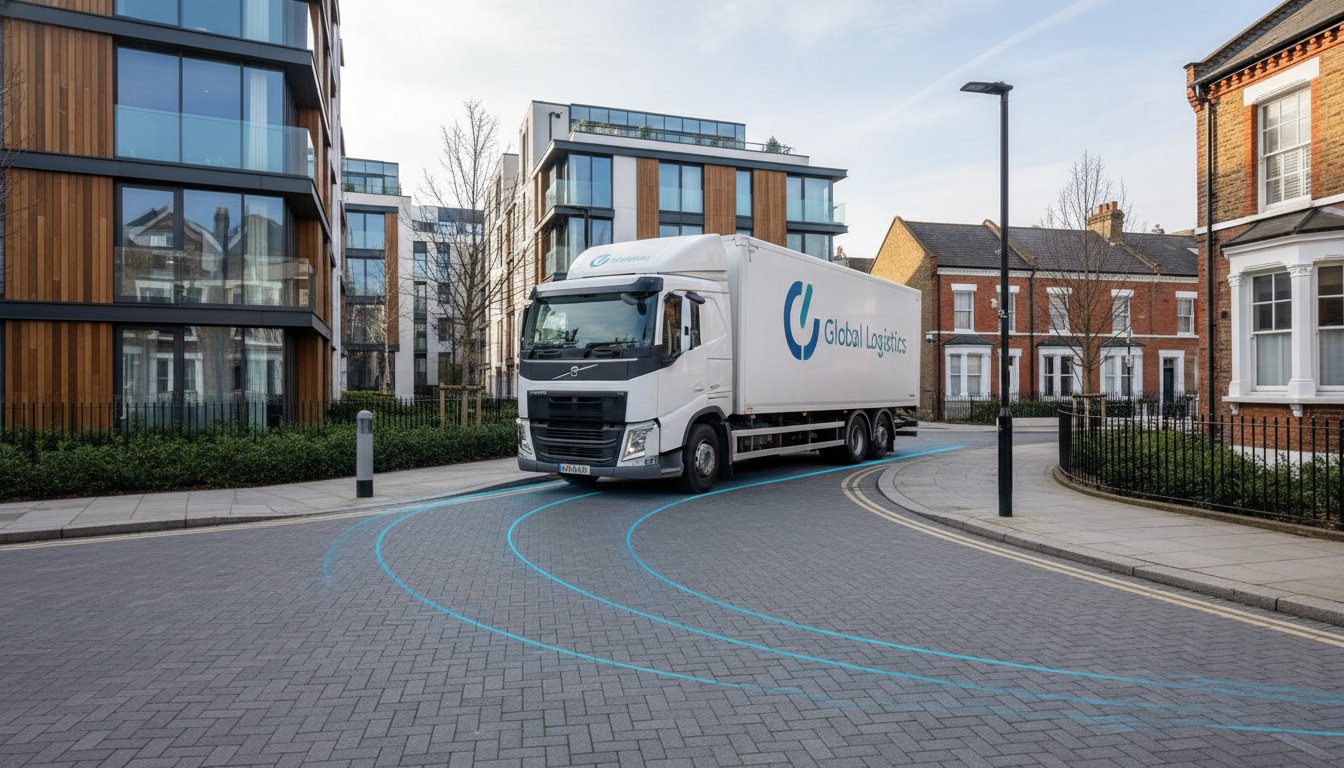
    Tower Hamlets features some of London’s most challenging historic street layouts. We use Swept Path Analysis Services in London to model the movement of 12m refuse vehicles and emergency fire tenders. For high-rise developments in Poplar, proving fire tender access is a non-negotiable safety requirement. We simulate various approach angles to ensure these critical vehicles can navigate tight corners without overrunning curbs or striking street furniture. This precision supports the borough’s goal of a 20% reduction in child casualties by ensuring service vehicles operate safely in residential zones.

    Overcoming Parking Objections with Robust Data

    Parking objections are a common cause of planning delays. To mitigate this, we conduct parking surveys using the ‘Lambeth Methodology,’ which is the gold standard in LBTH. We analyze on-street capacity within a 200m radius of your site during the early morning hours when residents are most likely to be at home. This data allows us to justify ‘car-free’ schemes even when local parking appears at capacity. We also address the impact of Controlled Parking Zones (CPZs) on new residents, ensuring your proposal complies with the New Local Plan 2023–2038 policies regarding on-street stress levels.

    Partnering with ML Traffic Engineers for Planning Success in Tower Hamlets

    Securing a planning approval in the current regulatory climate requires a partner who treats precision as a legal necessity. We position ourselves as a safe pair of hands, ensuring your development meets the strict 2026 safety standards set by the London Borough of Tower Hamlets. As experienced Transport Planning Consultants Tower Hamlets, we manage the intricate complexities of UK road regulations so you don’t have to. Our team provides a total, managed solution that moves your project seamlessly from the initial consultation through to final implementation.

    The high-stakes nature of traffic management in East London demands a sense of readiness and urgency. We offer 24/7 availability for urgent survey requirements, which is a primary hallmark of our brand promise. Whether you need a rapid response for a parking survey or a late-night traffic count in a busy night-time economy zone, we’re ready to act. This constant availability ensures that busy project managers can maintain their timelines without navigating through unnecessary delays or logistical hurdles.

    Our approach balances technical authority with a customer-centric focus. We develop bespoke transport solutions that protect your return on investment while ensuring full compliance with the New Local Plan 2023–2038. By prioritizing clarity and speed of information, we help you clear the final hurdles of the planning process with confidence. Contact our technical team today to discuss your project requirements and receive a professional, safety-conscious quote.

    Why Experience in East London Matters

    Success in LBTH depends on a deep understanding of local constraints and a history of successful negotiations with highways officers. We know how the borough’s team interprets the London Plan 2021/2026, especially regarding sites near the Limehouse Link or the A12 corridor. Our expertise allows us to anticipate potential objections before they lead to a refusal. You can view What We Do – Our Full Range of Transport Services to see how we’ve helped other developers navigate these specific East London challenges. We use the active voice to demonstrate capability and immediate action on every project we undertake.

    Start Your Tower Hamlets Project with a Site Appraisal

    The most effective way to save on design fees is to identify transport risks before you commit to a site. A pre-acquisition transport appraisal identifies PTAL limitations or access constraints that could impact your development’s density. We provide these technical insights early in the lifecycle to ensure your project remains viable and compliant. You can access our technical library and Resources to learn more about the safety standards and legislative compliance that form the foundation of our work. Our rhythmic efficiency and professional integrity make us the vital guardian of your project’s planning success.

    Accelerate Your Highway Approval in Tower Hamlets

    The 2026 planning landscape in East London requires a shift from simple traffic counts to comprehensive active travel integration. Navigating the New Local Plan 2023–2038 demands technical precision, especially when dealing with the borough’s historic street layouts and high PTAL zones. As specialist Transport Planning Consultants Tower Hamlets, we provide the technical authority needed to clear these hurdles. We specialize in Swept Path Analysis for narrow London streets, ensuring fire tenders and refuse vehicles maintain safe access in Poplar and beyond.

    Our team offers 24/7 availability for emergency survey data, providing a safe pair of hands when deadlines are tight. We leverage expert knowledge of the LBTH Local Plan 2031 to justify your development’s impact and secure highway validation. By partnering with a firm that prioritizes safety and legislative compliance, you alleviate the regulatory burden on your design team. It’s about moving from uncertainty to a guaranteed technical solution.

    Secure your Tower Hamlets planning approval with ML Traffic Engineers today. We’re ready to transform your site’s transport constraints into a validated, compliant success.

    Frequently Asked Questions

    Is a Transport Statement mandatory for all developments in Tower Hamlets?

    A Transport Statement isn’t mandatory for every minor internal refurbishment, but it’s required for any development creating a net increase in residential units or commercial floor space. Tower Hamlets officers often request these reports for even single-unit conversions in high PTAL areas to confirm car-free compliance. Professional Transport Planning Consultants Tower Hamlets ensure these documents meet the borough’s specific validation requirements to avoid immediate technical rejection or costly delays.

    What is the ‘car-free’ policy in Tower Hamlets and how does it affect my project?

    The ‘car-free’ policy, rooted in the Tower Hamlets Local Plan and the London Plan 2021/2026, prohibits residents in new developments from obtaining on-street parking permits. This policy applies to almost all new residential projects in areas with high public transport accessibility. You must provide a legal agreement under Section 106 to enforce this restriction. It ensures that the 20.4% projected population growth doesn’t lead to gridlock on local roads.

    How long does it take to complete a Transport Assessment for a LBTH application?

    A standard Transport Assessment for a London Borough of Tower Hamlets (LBTH) application typically takes four to six weeks to complete. This timeline includes seven days for automated traffic counts and the technical modeling required for junction capacity analysis. Complex major schemes may require longer if extensive pre-application discussions with highways officers are necessary. Our 24/7 availability for data collection helps compress these timelines for urgent planning deadlines.

    Does Tower Hamlets require a specific parking survey methodology?

    Yes, Tower Hamlets strictly requires the ‘Lambeth Methodology’ for all on-street parking surveys. You must survey a 200m radius around the site on two separate weekday mornings between 00:30 and 05:30. This data proves whether there’s sufficient capacity for visitor parking or if local ‘stress’ levels exceed the 85% threshold. Using this specific methodology is a non-negotiable requirement for a successful planning validation in 2026 and beyond.

    What happens if TfL objects to my planning application in Tower Hamlets?

    If Transport for London (TfL) objects, you must address their concerns through technical mitigation or design revisions before the Planning Committee meets. Objections often relate to site access near the Strategic Road Network or impacts on bus journey times. As Transport Planning Consultants Tower Hamlets, we negotiate directly with TfL officers to resolve these issues. We use CAD design to prove that your site entrance doesn’t compromise the safety of the red route network.

    Can Swept Path Analysis help reduce the land required for my site access?

    Yes, Swept Path Analysis optimizes the site layout by proving exactly how much space a 12m refuse vehicle or fire tender needs to turn. By simulating these movements with CAD software, we often reduce the land dedicated to oversized access roads. This technical precision allows you to maximize the developable area while maintaining full safety compliance. It’s a vital tool for high-density projects in narrow East London streets where space is at a premium.

    How much does a transport planning consultant cost for a London project?

    Fees for transport consulting in London vary significantly based on the project’s scale and the complexity of the required reports. A basic Transport Statement for a minor conversion costs less than a full multi-modal Assessment for a major Poplar high-rise. While we don’t provide fixed prices here, industry data suggests that technical reporting typically accounts for a small percentage of the total planning budget. Contact our team for a bespoke, safety-conscious quote.

    What is an Active Travel Zone (ATZ) assessment?

    An Active Travel Zone (ATZ) assessment is a mandatory audit of the walking and cycling environment within a 20 minute radius of your development. It follows the Mayor of London’s ‘Healthy Streets’ approach to identify improvements needed for pedestrian safety and cycle connectivity. These assessments are now a standard requirement for 2026 approvals. They ensure your project contributes to the borough’s target of a 15% overall casualty reduction on local roads.

    Michael Lee

    Article by

    Michael Lee

    Transport planner with over 35 years' experience.

    Disclaimer

    The content on mltraffic.co.uk, including all technical articles, guides, and resources, is provided for general informational and educational purposes only. It is not intended to constitute professional advice in traffic engineering, transportation planning, development approvals, or any other technical or legal field.
    While ML Traffic Engineers makes every reasonable effort to ensure the accuracy, completeness, and timeliness of the information published, we do not provide any warranties or representations (express or implied) regarding its reliability, suitability, or availability for any particular purpose. Any reliance you place on the content is strictly at your own risk.
    In no event shall ML Traffic Engineers, its directors, employees, authors, or affiliates be liable for any direct, indirect, incidental, special, consequential, or punitive damages (including, without limitation, loss of profits, data, or business opportunities) arising out of or in connection with the use of, or inability to use, any information provided on this website.
    The articles and guides on this site are not a substitute for engaging a qualified, professional traffic engineer to assess your specific project requirements. For tailored advice, compliance assessments, or traffic engineering services, please contact a competent professional.
    This disclaimer may be updated from time to time without notice. By accessing or using this website, you agree to be bound by the most current version of this disclaimer.
  • Transport Planning Consultants Haringey: A Developer’s 2026 Guide to Planning Approval

    Transport Planning Consultants Haringey: A Developer’s 2026 Guide to Planning Approval

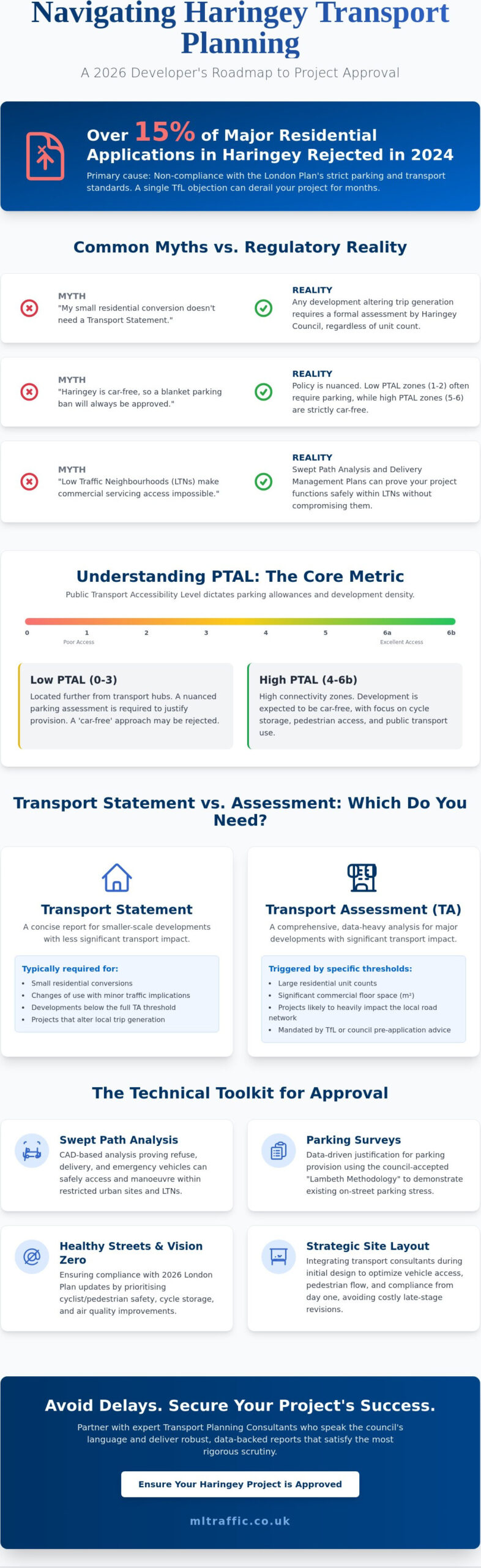
    Haringey Council rejected over 15% of major residential applications in 2024 due to non-compliance with the latest London Plan parking standards. For developers, a high-density site in a PTAL 6 zone isn’t just a design challenge; it’s a regulatory minefield where a single TfL objection can stall a project for months. Partnering with expert Transport Planning Consultants Haringey is no longer optional if you want to avoid these logistical headaches. We understand that your project’s viability depends on precise CAD designs and robust transport assessments that speak the council’s language from day one.

    You’ve likely felt the frustration of seeing a profitable site layout compromised by rigid vehicle access requirements or excessive Section 106 demands. It’s a common struggle for developers aiming to maximize footprint while meeting strict safety and sustainability criteria. This 2026 guide provides the technical roadmap to unlock your site’s potential through data-driven planning and strategic mitigation. We’ll walk you through the exact steps to optimize your access points, satisfy Chapter 8 safety requirements, and ensure your submission moves from consultation to construction without unnecessary friction.

    Key Takeaways

    • Understand how PTAL ratings influence parking maximums and why small-scale Haringey conversions still necessitate formal technical documentation.
    • Determine if your development triggers a full Transport Assessment or a Statement based on specific unit counts and floor space thresholds.
    • Secure council acceptance by applying the “Lambeth Methodology” to parking surveys and utilizing Swept Path Analysis for restricted urban access.
    • Professional Transport Planning Consultants Haringey provide the technical authority needed to navigate 2026 regulatory requirements and ensure project safety compliance.
    • Leverage expert representation to streamline the Planning Committee process and overcome common logistical hurdles within the London Borough of Haringey.

    Common Myths About Transport Planning in the London Borough of Haringey

    Developers often underestimate the complexity of securing approval in North London. Relying on outdated assumptions leads to costly delays at the planning committee stage. Engaging expert Transport Planning Consultants Haringey provides the technical precision required to navigate these hurdles. Many project managers believe small residential conversions don’t need a Transport Statement. This is a mistake. Haringey Council requires a formal assessment for any development that alters trip generation, regardless of the unit count. Ignoring this leads to immediate requests for further information, stalling your timeline.

    Understanding the fundamentals of transport planning helps developers realize that every square meter of a site must be justified through data. Another frequent misconception involves parking. While Haringey pushes for car-free developments, these policies don’t apply equally across the borough. PTAL 5 and 6 zones are strictly car-free, but PTAL 1 or 2 areas on the borough’s fringes often require nuanced assessments. You can’t assume a blanket ban on parking will satisfy officers in areas with poor public transport access.

    To better understand this concept, watch this helpful video:

    Modern transport planning isn’t just about cars. The Borough’s cycling and walking focus is now the primary metric for success. Many developers wait until the final submission to hire a consultant. This reactive approach often results in a site layout that doesn’t accommodate mandatory cycle storage or pedestrian flow. Integrating Transport Planning Consultants Haringey during the initial design phase ensures your site footprint is optimized for compliance from day one.

    Debunking the “Checkbox” Mentality

    Haringey Council officers look for proactive sustainable transport solutions rather than a simple list of features. The 2026 London Plan updates place higher emphasis on Healthy Streets indicators and Vision Zero safety targets. You need a strategy that actively reduces carbon emissions and improves local air quality. ML Traffic Engineers specialize in these London-specific requirements, moving beyond basic compliance to deliver robust, data-backed reports that satisfy the most rigorous council scrutiny.

    The Reality of LTNs and Development Access

    Low Traffic Neighbourhoods (LTNs) in areas like St Ann’s or Bruce Grove don’t prevent all new commercial servicing access. They change how you plan for it. The myth that LTNs make new development impossible is false. However, you must prove that servicing vehicles won’t compromise the integrity of the LTN. Technical reports using swept path analysis and delivery management plans can mitigate objections. These documents demonstrate that your project functions safely within restricted zones without increasing traffic on residential side streets.

    Understanding Haringey’s Local Transport Requirements: PTAL and Beyond

    Haringey Council utilizes the Public Transport Accessibility Level (PTAL) as the primary metric for evaluating development density and parking capacity. This 0 to 6b rating system measures the distance from any point to the nearest public transport access points, accounting for frequency and reliability. For developers, a high PTAL score often dictates a shift toward car-free housing. The London Plan 2021, and its anticipated 2026 updates, sets the benchmark for these local decisions. It forces boroughs to prioritize sustainable modes of travel over private vehicle ownership. Every transport strategy we develop focuses on these regulatory shifts to ensure long-term compliance.

    Maximum parking provisions are dictated strictly by these accessibility ratings. In areas with high connectivity, the council often permits zero residential parking spaces, excluding mandatory disabled bays. However, securing approval involves more than just a high score. Transport Planning Consultants Haringey must demonstrate how a project mitigates its impact on the existing network. This often requires a detailed Transport Statement vs. Assessment to satisfy planners that the local infrastructure can absorb the new residents without increasing congestion or safety risks. We provide the technical authority needed to address these logistical burdens before they become planning hurdles.

    Navigating PTAL Ratings in Wood Green and Tottenham

    Wood Green and parts of Tottenham frequently achieve PTAL scores of 6 or 6b. In these high-density zones, Haringey Council mandates car-free developments. Residents are legally restricted from applying for local parking permits. For projects like Flat Conversions in London, proving a site is “car-free ready” is essential for planning success. Suburban fringes with lower PTAL scores require a different approach, often involving parking surveys to prove that overspill won’t impact neighboring streets. We provide the technical data needed for these varying requirements, ensuring comprehensive support throughout your application.

    Haringey Council’s Active Travel Priorities

    The borough’s “Healthy Streets” approach means every application faces scrutiny regarding pedestrian and cyclist safety. Developers must provide high-quality cycle storage exceeding the London Plan standards. We focus on site layouts that promote active travel while maintaining safety for all road users. Haringey’s Vision Zero goal for 2026 aims to eliminate all deaths and serious injuries from the borough’s transport network through improved infrastructure design and strict enforcement of safety standards. This safety-first mindset is a foundation of our planning advice. Our 24/7 readiness ensures that even the most complex urban challenges are met with precise, compliant solutions.

    Transport Planning Consultants Haringey: A Developer’s 2026 Guide to Planning Approval

    Transport Statement vs. Assessment: Which Does Your Haringey Project Need?

    Selecting the wrong reporting tier results in an immediate “invalid” status from Haringey Council. Planning officers use specific thresholds to determine whether your site requires a Transport Statement (TS) or a full Transport Assessment (TA). While both documents analyze impact, the TA demands significantly more data, modeling, and mitigation strategies. Transport Planning Consultants Haringey help you identify these triggers before you submit, saving weeks of back-and-forth communication with the local highway authority.

    The cost and time implications are substantial. A Statement might take 10 to 15 working days to finalize; a full Assessment often requires 4 to 6 weeks due to the complexity of junction modeling and data collection. Haringey follows the London Plan 2021 standards, but local 2026 policy updates place higher scrutiny on “Healthy Streets” indicators and active travel scores. If your project falls on the boundary of these thresholds, opting for the higher-level report is often the safer path to approval.

    • Residential Thresholds: Schemes under 50 units usually need a TS; 50 or more units trigger a TA.
    • Commercial Thresholds: Floor space under 1,000 sqm typically requires a TS.
    • High-Impact Zones: Projects near congested junctions like the A10 may require a TA regardless of size.

    When a Transport Statement Suffices

    Haringey typically requests a TS for developments that don’t generate heavy traffic volumes. This includes residential schemes under 50 units or small-scale commercial changes of use. Officers expect a clear breakdown of trip generation, existing site access, and a parking survey that adheres to the Lambeth Methodology. We provide bespoke report types tailored to these specific local requirements. A basic statement must prove that your project won’t negatively impact the safety or capacity of the surrounding road network.

    The Complexity of a Full Transport Assessment

    Major developments, such as large residential blocks or retail spaces over 1,000 square meters, trigger a full TA. This is a comprehensive technical document. It includes detailed junction capacity assessments using software like LinSig or ARCADY. It also requires a draft Travel Plan to encourage sustainable transport use among future occupants. In Haringey, these assessments must align with the latest logistics guidelines to ensure construction traffic doesn’t paralyze local arteries. Expert Transport Planning Consultants Haringey ensure these complex data sets are accurate, preventing costly delays during the validation phase.

    Data-Driven Success: Parking Surveys and Swept Path Analysis for Haringey

    Haringey Council demands rigorous technical evidence for every new development. You cannot rely on guesswork when proposing a site in a borough known for its complex road layouts and high parking stress. Expert Transport Planning Consultants Haringey provide the empirical data needed to satisfy both planning officers and local highway authorities. By using site-specific traffic data, we challenge generic council assumptions that might otherwise lead to a refusal.

    Mastering Swept Path Analysis in N8 and N17

    Tight mews in Crouch End or urban infill sites in Tottenham require absolute precision. Swept Path Analysis (SPA) uses advanced CAD software to simulate the movement of specific vehicles through your proposed layout. This is essential for demonstrating that a standard 11.4-meter refuse vehicle or a fire tender can enter, turn, and exit the site safely without mounting curbs or striking buildings.

    Failing to provide SPA early in the process often leads to costly post-planning redesigns of site entrances or internal road layouts. We ensure your designs work in the real world before you submit your application. For more details on technical simulations, see our Swept Path Analysis Services.

    Parking Surveys: The Lambeth Methodology in Action

    Haringey requires parking stress assessments to follow the Lambeth Methodology. This is the industry gold standard for measuring on-street parking capacity. A valid survey must cover a 200-meter walking distance from the site and identify every available legal parking space.

    Timing is critical for council acceptance. To ensure survey validity, data collection must occur when residential parking demand is at its peak. Specifically, Haringey requires surveys to be conducted between 00:30 and 05:30 on two separate weekday nights. This data proves whether the local infrastructure can absorb any potential “overspill” from your development.

    Securing Highway Design Approvals (S278/S38)

    Transitioning from a planning consent to an active construction site requires navigating Section 278 and Section 38 agreements. These legal frameworks govern works on the existing highway and the adoption of new roads. As Transport Planning Consultants Haringey, we prioritize early engagement with the Haringey Highways team to streamline these approvals.

    We also incorporate Road Safety Audits (RSA) into the design phase. An RSA identifies potential hazards for pedestrians and cyclists, ensuring the development meets modern safety standards. For a complete breakdown of this process, read our Highway Design S278 & S38 Guide.

    Why Expert Transport Planning is the Key to Haringey Planning Approval

    Haringey Planning Committee meetings are high-stakes environments where technical precision is the only currency that matters. Developers face intense scrutiny regarding traffic impact and carbon reduction. Engaging Transport Planning Consultants Haringey ensures your project stands on a foundation of technical integrity. We provide professional representation that addresses council concerns before they become grounds for refusal. Our team leverages deep borough knowledge to navigate Haringey’s specific modal shift targets for 2026. We know how the local authority views parking ratios and cycle storage requirements.

    Integrating a robust Travel Plan is a strategic move to lower Section 106 (S106) contributions. By demonstrating a clear commitment to sustainable transport, developers can often negotiate lower financial levies for local infrastructure. This transition from initial feasibility studies to the final discharge of planning conditions requires a meticulous approach. Every step must align with the latest UK road regulations and safety standards. A compliant delivery and servicing plan london developers rely on is increasingly scrutinized by TfL alongside your Travel Plan, making it essential to address both documents in tandem. We manage the entire process, ensuring that your transport strategy supports your broader commercial goals.

    Reducing Developer Risk and Costs

    Technical errors are expensive. A single mistake in a Transport Assessment can trigger a planning appeal, which often costs developers upwards of £20,000 in legal and consultancy fees. We focus on precision. Our engineers use CAD design and accurate data to prevent these setbacks. We also specialize in negotiating transport-related planning conditions. This ensures that the requirements placed on your project are both fair and achievable. You can find more technical insights in our ML Traffic Resources. We aim to secure a positive outcome while protecting your bottom line.

    Partnering with ML Traffic Engineers for Haringey Projects

    We offer a total managed solution for developers in North London. Our team remains available 24/7 to handle urgent Haringey applications or last-minute site revisions. We manage the entire lifecycle of your project’s traffic requirements. This includes initial traffic surveys, detailed report writing, and final implementation of traffic management systems. You get a single point of contact for all regulatory and logistical needs. This efficiency keeps your project on schedule and compliant with all safety standards. We understand the high-stakes nature of Haringey’s regulatory environment. Our readiness and technical authority make us the dependable choice for complex urban developments. Contact ML Traffic Engineers for a Haringey project consultation to secure your planning approval and move your project forward with confidence.

    Secure Your Haringey Development Approval for 2026

    Navigating Haringey’s complex PTAL requirements and local transport standards requires a rigorous, data-driven approach. Since 2014, ML Traffic has delivered the technical precision needed to satisfy council scrutiny across London’s most demanding boroughs. Success in the current planning climate hinges on accurate Lambeth Parking Surveys and detailed Swept Path Analysis to prove site viability. We bridge the gap between your architectural vision and the borough’s strict regulatory framework. As experienced Transport Planning Consultants Haringey, we know that critical planning deadlines don’t always follow a standard nine-to-five schedule. That’s why our team provides 24/7 availability to handle urgent technical requirements and ensure your submission remains on track. We manage the intricate CAD designs and legislative compliance so your project moves forward without delay. Don’t let logistical hurdles or shifting transport policies stall your 2026 development timeline.

    Get a Professional Transport Planning Quote for Your Haringey Project

    We’re ready to help you secure your planning consent and break ground with total confidence.

    Frequently Asked Questions

    Do I need a transport planning consultant for a small development in Haringey?

    Yes, you’ll likely need a consultant if your site impacts the public highway or sits within a Controlled Parking Zone. Haringey’s 2024 Local Plan requires a Transport Statement for even minor residential developments of 1 to 9 units. Engaging transport planning consultants Haringey ensures your submission meets the technical standards required by the borough’s highways department. We manage the regulatory burden so you can focus on construction.

    What is the required PTAL rating for a car-free development in Wood Green?

    A car-free development in Wood Green generally requires a Public Transport Accessibility Level (PTAL) rating of 4 or higher. Wood Green currently features several zones with PTAL ratings of 6a and 6b, particularly near the Underground station. Under the London Plan 2021, sites with high connectivity must prioritize sustainable travel. Our team verifies these ratings using TfL’s WebCAT tool to justify reduced parking provision for your project.

    How long does a Haringey parking survey take to complete?

    A standard parking survey takes two nights to complete, typically conducted between 12:30 am and 5:30 am on a Tuesday and Wednesday. This timeframe captures peak residential parking demand as specified in the Lambeth Methodology. Once fieldwork finishes, we deliver the final report within 5 business days. This rapid turnaround keeps your planning application on schedule and avoids costly delays in the 2026 development cycle.

    Will Haringey Council accept a transport statement without swept path analysis?

    No, Haringey Council requires a swept path analysis for any development where service vehicles or emergency services need site access. This includes refuse trucks of 11.4 meters in length and fire engines. We use CAD-based software to simulate vehicle movements, proving that your layout accommodates these essential services. Without this technical verification, your application faces a high risk of rejection by the highways officer.

    What is the Lambeth Methodology for parking surveys in London?

    The Lambeth Methodology is a standardized framework for assessing parking stress within a 200-meter walking distance of a development site. It requires surveyors to record the number of available on-street spaces during two overnight periods. Haringey Council adopted this standard to ensure data consistency across all 32 London boroughs. Our surveyors follow these strict protocols to provide the precision required for legal and planning compliance.

    How much does a transport planning consultant cost for a Haringey application?

    Costs vary based on project complexity and the range of technical reports required for your specific site. While we don’t provide fixed estimates without a project brief, industry data shows that technical transport assessments for London developments scale with the number of units and required CAD modeling. Contact us for a bespoke quote that covers your planning needs from initial consultation through to final implementation.

    Can a travel plan help secure planning permission in Haringey?

    Yes, a robust Travel Plan is often a mandatory requirement for developments exceeding 20 residential units or 1,000 square meters of commercial space. It demonstrates your commitment to reducing single-occupancy vehicle trips by 15% over a five-year period. By proposing specific measures like car club memberships or cycle infrastructure, transport planning consultants Haringey help mitigate the impact on the local road network. This proactive approach effectively alleviates council concerns.

    What happens if TfL objects to my Haringey development proposal?

    If Transport for London (TfL) objects, you must address their specific concerns regarding the Strategic Road Network or bus operations. This usually involves revising the site access design or increasing contributions to public transport infrastructure. We act as your technical liaison, negotiating directly with TfL officials to find compliant solutions. Our 24/7 readiness ensures we respond to statutory consultee feedback quickly to keep your 2026 approval timeline intact.

    Michael Lee

    Article by

    Michael Lee

    Transport planner with over 35 years' experience.

    Disclaimer

    The content on mltraffic.co.uk, including all technical articles, guides, and resources, is provided for general informational and educational purposes only. It is not intended to constitute professional advice in traffic engineering, transportation planning, development approvals, or any other technical or legal field.
    While ML Traffic Engineers makes every reasonable effort to ensure the accuracy, completeness, and timeliness of the information published, we do not provide any warranties or representations (express or implied) regarding its reliability, suitability, or availability for any particular purpose. Any reliance you place on the content is strictly at your own risk.
    In no event shall ML Traffic Engineers, its directors, employees, authors, or affiliates be liable for any direct, indirect, incidental, special, consequential, or punitive damages (including, without limitation, loss of profits, data, or business opportunities) arising out of or in connection with the use of, or inability to use, any information provided on this website.
    The articles and guides on this site are not a substitute for engaging a qualified, professional traffic engineer to assess your specific project requirements. For tailored advice, compliance assessments, or traffic engineering services, please contact a competent professional.
    This disclaimer may be updated from time to time without notice. By accessing or using this website, you agree to be bound by the most current version of this disclaimer.
  • Transport Planning Consultants Greenwich: A Developer’s 2026 Guide to Approvals

    Transport Planning Consultants Greenwich: A Developer’s 2026 Guide to Approvals

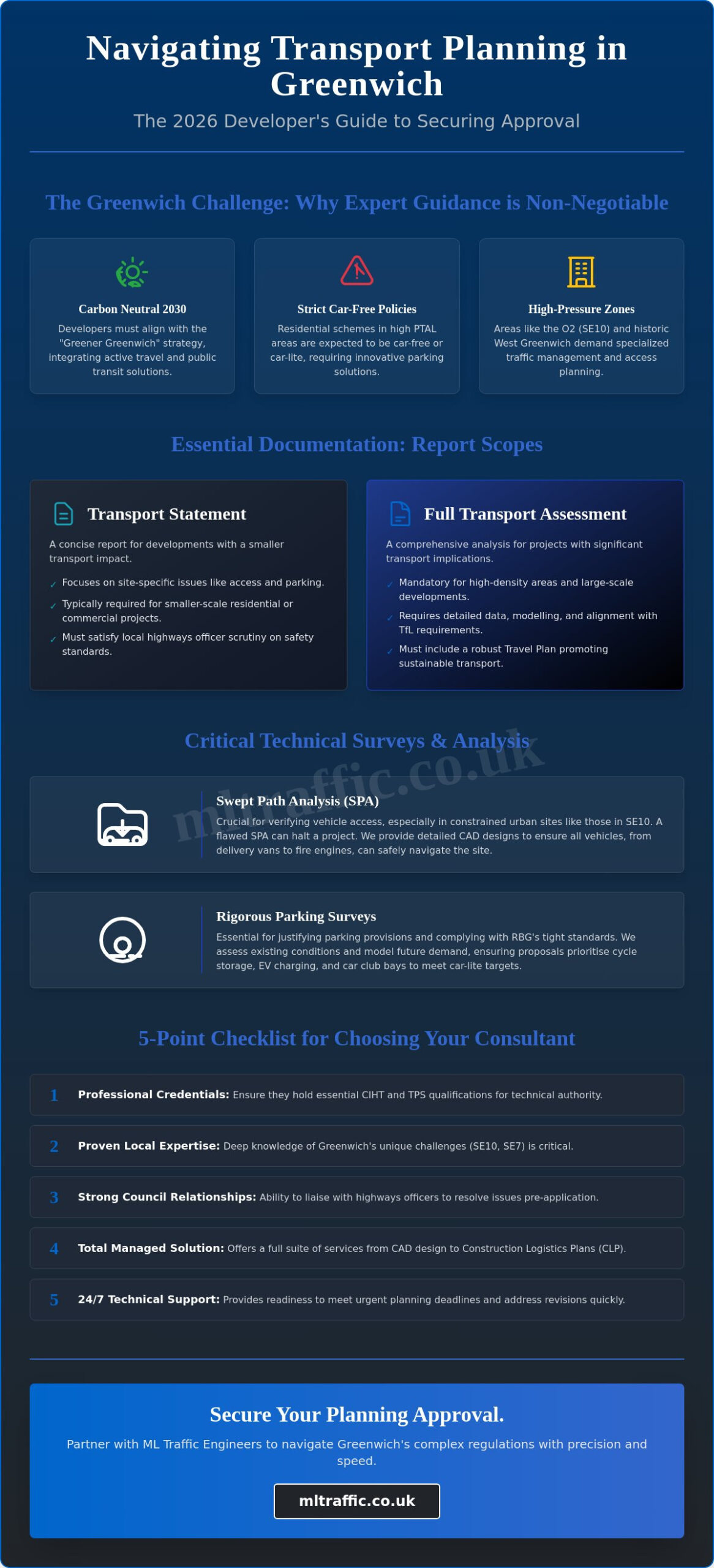
    A single overlooked parking survey or a flawed swept path analysis can stall a multi-million pound development for months. You already understand that the Royal Borough of Greenwich enforces some of London’s strictest car-free policies, especially near the high-pressure zones of the O2 and Greenwich Peninsula. Partnering with expert Transport Planning Consultants Greenwich is the only way to ensure your technical reports meet the rigorous safety standards required by local highways officers. We know the pressure of a looming planning committee date and the fear of a refusal based on traffic impact.

    This 2026 guide provides a clear checklist for securing approvals, focusing on cost-effective SPA surveys and robust transport assessments that satisfy TfL requirements. We’ve compiled the essential steps to help you manage regulatory burdens while maintaining project momentum. You’ll find a logical roadmap for everything from initial CAD designs to final implementation, ensuring your submission addresses every highways safety concern with precision and technical authority. Let’s look at the specific data sets and compliance standards that will get your project over the finish line.

    Key Takeaways

    • Understand the 2026 Royal Borough of Greenwich (RBG) transport policy landscape to align your development with local planning expectations from the outset.
    • Identify whether your project requires a Transport Statement or a full Assessment to satisfy mandatory requirements for Travel Plans in high-density areas.
    • Learn why Swept Path Analysis (SPA) and rigorous parking surveys are critical for overcoming access challenges in narrow SE10 development sites.
    • Utilize our 5-point checklist to ensure your chosen Transport Planning Consultants Greenwich possess the essential CIHT and TPS professional credentials.
    • Discover how 24/7 technical support and expert pre-app consultation can alleviate regulatory burdens and help you meet urgent planning deadlines.

    Securing planning permission in the Royal Borough of Greenwich (RBG) in 2026 requires more than a basic site plan. As the borough accelerates toward its Carbon Neutral 2030 target, the role of Transport Planning Consultants Greenwich has shifted from simple layout design to complex carbon-reduction strategy. Developers must now demonstrate how every new build integrates into a wider network of active travel and public transit. This process relies on a deep understanding of transportation planning principles to ensure that development proposals don’t just meet minimum standards but actively improve local infrastructure.

    Our team manages the technical requirements of these applications, providing the precision needed to satisfy both local highways officers and Transport for London (TfL) requirements. We focus on delivering bespoke solutions that align with the “Greener Greenwich” strategy. This ensures your project remains viable under increasingly strict environmental regulations. We operate with a sense of urgency, recognizing that regulatory delays can impact your project’s bottom line.

    To better understand how urban transport systems evolve to meet these demands, watch this helpful video:

    Greenwich Local Plan and Transport Standards

    By 2026, RBG parking standards have tightened significantly. Residential schemes in high PTAL (Public Transport Accessibility Level) areas, such as Greenwich Peninsula, are now expected to be car-free or car-lite. Commercial developments must prioritize cycle storage and electric vehicle (EV) charging infrastructure as a baseline requirement. We help you navigate these comprehensive transport assessments, ensuring your submission accounts for TfL’s Vision Zero safety standards. This technical authority is vital when your project faces scrutiny from multiple regulatory bodies.

    Why Local Expertise Matters in SE10 and SE7

    Greenwich presents unique geographic challenges that demand local knowledge. The SE10 postcode, dominated by the Greenwich Peninsula and the O2 Arena, requires specialized management of high-volume traffic corridors and event-day logistics. Conversely, West Greenwich and Blackheath feature historic, narrow street layouts where access for construction and delivery vehicles is physically restricted. Transport Planning Consultants Greenwich must account for these constraints early in the design phase to avoid costly revisions later.

    Our consultants build rapport with Royal Greenwich highways officers to resolve potential bottlenecks before they become formal objections. We provide a total, managed solution that includes:

    • Detailed CAD design for site access and swept path analysis.
    • Robust Construction Logistics Plans (CLP) that minimize disruption to SE7 residential areas.
    • 24/7 readiness to address emergency road works or planning revisions.
    • Bespoke travel plans that promote walking and cycling routes.

    Success in Greenwich depends on this level of organized, safety-conscious planning. We act as your safe pair of hands, managing the intricate complexities of London’s road regulations so your development stays on schedule. Our approach prioritizes clarity and speed, ensuring busy project managers grasp the scope of our offerings without navigating through unnecessary filler.

    Essential Documentation for Greenwich Planning Applications

    Securing planning permission in the Royal Borough of Greenwich (RBG) requires a meticulous approach to highways and transport data. The council’s planning department operates with high expectations for technical accuracy. If your documentation lacks precision, you’ll face delays or outright refusal. Expert Transport Planning Consultants Greenwich bridge the gap between architectural vision and the strict safety standards required for the public highway.

    Transport Statements vs. Assessments: The Greenwich Thresholds

    The scale of your development determines the level of scrutiny. In Greenwich, smaller projects typically require a Transport Statement. This usually applies to residential schemes under 80 units or commercial spaces below 2,500sqm. A Statement focuses on local access and immediate road safety. Larger developments trigger a full Transport Assessment. This is a comprehensive document that models junction capacity and multi-modal impact across a wider area. All reports must demonstrate alignment with the Royal Borough of Greenwich Transport Strategy, which prioritizes the reduction of car dependency. You can compare Transport Statements and Assessments to see which technical path fits your site’s specific metrics.

    Travel Plans: Encouraging Sustainable Movement

    Travel Plans are mandatory for most new Greenwich developments to ensure long-term sustainability. For residential blocks with 20 to 79 units, you’ll likely need a Framework Travel Plan. Once a project exceeds 80 units, RBG requires a Full Travel Plan with clear, measurable targets. These documents aren’t just paperwork; they’re legal commitments often tied to Section 106 obligations. They include 5-year monitoring cycles where developers must prove they’re meeting targets for cycling and public transport use. Failure to reach these benchmarks can lead to financial penalties. Our guide to London Travel Plans explains how to draft these to satisfy local authority auditors.

    Technical data is vital when justifying car-free or car-capped schemes. In areas with a PTAL (Public Transport Accessibility Level) score of 4 or higher, Greenwich expects developers to minimize parking. We use TRICS database analysis and 2021 Census travel-to-work patterns to prove your site won’t cause overspill parking on surrounding streets. This evidence-based approach mitigates the risk of highways objections. It gives planners the confidence that your project supports the borough’s environmental goals without compromising road safety. If you’re unsure about your site’s constraints, contact our team for a preliminary consultation to assess your project’s viability.

    Transport Planning Consultants Greenwich: A Developer’s 2026 Guide to Approvals

    Technical Data: SPA and Parking Surveys in the Greenwich Context

    RBG planning officers prioritise safety and highway capacity above all else. Developers must provide granular, site-specific data to prove a project won’t cause gridlock in the high-density corridors of SE10. This requires technical precision that only experienced Transport Planning Consultants Greenwich can deliver. We focus on two main pillars: vehicle movement dynamics and parking capacity. Providing a total, managed solution means we handle the data collection and the complex modelling required for 2026 regulatory standards.

    Swept Path Analysis for Tight Urban Sites

    Greenwich features some of the most challenging access points in South East London. We use CAD-based simulations to model the movement of 11.4m refuse vehicles and 16.8m fire tenders. This process identifies potential pinch points before they become expensive construction errors. It’s vital for designing underground car park layouts where ramp gradients and pillar placements leave zero margin for error. Our Swept Path Analysis Services London provide the visual evidence RBG needs to approve tight urban sites. We ensure emergency vehicles can reach every corner of your development without mounting kerbs or damaging infrastructure. Our simulations reflect real-world conditions, accounting for street furniture and existing on-road parking.

    Parking Surveys and the Lambeth Methodology

    Securing planning for schemes in North Greenwich or the town centre requires a robust parking strategy. We conduct overnight parking beat surveys between 00:30 and 05:30 on two separate weekday nights. This follows the Lambeth Methodology, which remains the industry standard for measuring parking stress. Meeting the requirements set out in the Guidance on Transport Assessment is non-negotiable for major applications in the Royal Borough of Greenwich.

    For sites with a high Public Transport Accessibility Level (PTAL) score of 4, 5, or 6, we often justify zero-parking developments. This is essential when dealing with Controlled Parking Zones (CPZ) where new residents are restricted from obtaining permits. Our data provides the evidence needed to satisfy the following criteria:

    • Baseline Capacity: Accurate counts of available on-street spaces within a 200m radius.
    • PTAL Justification: Using high connectivity to argue for reduced car dependency.
    • Refuse Strategy: Mapping bin drag distances to ensure they don’t exceed the 10m limit for collectors.
    • Emergency Access: Proving that 3.7m wide fire access routes are maintained at all times.

    By partnering with Transport Planning Consultants Greenwich, you gain access to 24/7 survey capabilities and technical CAD design. We position ourselves as a safe pair of hands, managing the intricate complexities of UK road regulations so you don’t have to. Our reports don’t just identify problems; they offer bespoke solutions that align with the London Plan 2021 and local Greenwich policies.

    Checklist: Choosing the Right Transportation Planning Consultants

    Selecting the right Transport Planning Consultants Greenwich requires a focus on technical precision and local regulatory alignment. Developers must vet potential partners against a rigorous 5-point framework to ensure project viability for 2026. This process prevents costly delays during the Royal Borough of Greenwich (RBG) planning committee reviews.

    • Professional Accreditation: Verify that lead consultants hold active memberships in the Chartered Institution of Highways and Transportation (CIHT) or the Transport Planning Society (TPS). These credentials guarantee adherence to the latest UK professional standards.
    • Local Authority Track Record: Demand evidence of successful project approvals within Greenwich. A consultant who understands RBG’s specific stance on the Silvertown Tunnel impact or the Greenwich Peninsula transport strategy offers a distinct advantage.
    • Software Currency: Confirm the firm uses 2026-ready versions of TRICS and AutoTRACK. Outdated modelling leads to rejected Transport Assessments.
    • Negotiation History: Evaluate their success rate in reducing developer contributions through evidence-based Section 106 and Section 278 negotiations.
    • Data Authenticity: Ensure the firm prioritizes bespoke, site-specific traffic counts over generic national averages that fail to capture London’s unique congestion patterns.

    Technical Capability and Software Standards

    Precision in trip generation and vehicle movement modelling is non-negotiable for modern developments. Competent Transport Planning Consultants Greenwich utilize the latest TRICS database, specifically version 7.11 or newer, to predict traffic impact with high confidence intervals. For 2026 approvals, generic industry data often falls short of RBG’s stringent requirements. We utilize CAD-based Swept Path Analysis models via AutoTRACK to simulate the movement of refuse vehicles and emergency services through tight urban footprints. This technical rigor identifies design flaws before they reach the planning stage. Bespoke data collection remains superior to generic averages because it accounts for specific local bottlenecks and current Public Transport Accessibility Level (PTAL) ratings.

    Strategic Communication and Negotiation Skills

    Technical data only succeeds if it’s presented persuasively to local stakeholders. Your consultant must bridge the gap between engineering requirements and planning policy. They need to negotiate Section 278 and Section 106 agreements that protect your project margins while satisfying RBG’s infrastructure demands. Experience in representing clients at RBG planning committee meetings is essential for high-stakes projects. A consultant who understands the specific concerns of Greenwich councilors can pivot strategies mid-meeting to secure a positive recommendation. For more information on budgeting for these services, see our guide on Understanding Consultant Costs and Quotes.

    We provide the technical expertise and local knowledge required to secure your development’s future. Explore our comprehensive transport planning services to see how we manage your project from initial design to final implementation.

    Securing Approval: The ML Traffic Approach to Greenwich

    Securing a green light from the Royal Borough of Greenwich (RBG) requires more than just standard documentation. It demands a technical partner who treats safety as a non-negotiable foundation. ML Traffic Engineers bridge the gap between ambitious development goals and strict local authority requirements. We don’t just provide reports; we deliver engineered solutions that withstand the scrutiny of planning committees. Our role as Transport Planning Consultants Greenwich involves deep integration with your design team. We identify potential bottlenecks before they become planning refusals.

    Our team operates with a sense of urgency because we know that planning windows are narrow. We provide 24/7 support to ensure that urgent technical queries or last-minute design changes don’t stall your application. Whether it is a Saturday night or a bank holiday, our engineers remain available to support your project’s critical path. This constant availability ensures that developers in the SE10 area can meet every regulatory deadline with confidence.

    From Initial Design to Final Implementation

    Success begins long before the formal application is submitted. We start with early-stage site feasibility and access reviews to determine if a site can physically accommodate the proposed trip generation. This proactive approach saves thousands in redesign fees later in the process. You can Explore our Greenwich Project Types to see how we tailor these reviews to specific residential and commercial needs.

    • Feasibility Studies: We analyze existing road geometry and pedestrian flows to ensure safe access.
    • CAD Design: Our engineers produce precise swept path analyses to prove that service vehicles can maneuver safely.
    • Regulatory Liaison: We manage the technical dialogue with RBG highways and Transport for London (TfL) throughout the planning lifecycle.

    In a 2024 redevelopment project near the Greenwich Peninsula, the developer faced significant pushback regarding construction vehicle impact. We deployed a comprehensive multi-way traffic management plan and CAD-simulated access routes. This data-driven evidence convinced RBG highways officers of the project’s viability, leading to a successful planning committee vote. We moved from initial consultation to final implementation support in less than six months, keeping the project on track.

    Your Partner for Planning Success

    We use a data-driven approach to reduce the risk of planning objections. By using accurate traffic counts and safety-conscious design, we provide the “safe pair of hands” that planning officers trust. Our bespoke solutions ensure that every multi-way system or temporary signal layout complies with Chapter 8 standards. We take the logistical burden off your shoulders so you can focus on construction. If you’re ready to start your next project, Contact ML Traffic Engineers for a Greenwich consultation to secure your transport approvals.

    Our team remains dedicated to providing the precise technical data and safety-led designs required to protect your project and the public.

    Secure Your 2026 Greenwich Development Approval

    Navigating the Royal Borough of Greenwich planning framework requires technical precision and current data. Success hinges on accurate Parking Stress Surveys and robust Statement of Preparedness for Adoption documentation that meets 2026 standards. These technical assessments are the foundation of a successful application, ensuring your project aligns with local transport strategies and safety regulations from the outset. Precise data collection and adherence to RBG policy aren’t just checkboxes; they’re the drivers of project viability.

    Partnering with experienced Transport Planning Consultants Greenwich provides the regulatory certainty required for complex London sites. ML Traffic Engineers delivers over 10 years of London planning experience and specific expertise in RBG local policy. We offer 24/7 technical support for urgent applications, managing projects from initial consultation through to final implementation. Our team understands the intricate complexities of UK road regulations, acting as a safe pair of hands for your development’s logistical needs. We focus on precision and compliance so you can focus on delivery.

    Contact ML Traffic Engineers for a Transport Planning Quote today. We’re ready to help you navigate the approvals process with speed and professional integrity.

    Frequently Asked Questions

    Do I need a transport statement for a small development in Greenwich?

    You generally need a Transport Statement for residential developments between 5 and 49 units or commercial projects under 2,500 square metres. The Royal Borough of Greenwich mandates these reports to ensure smaller schemes don’t compromise local road safety or pedestrian flow. Our Transport Planning Consultants Greenwich team produces these technical documents to prove your project aligns with the London Plan 2021. We focus on clear data to help you avoid unnecessary delays during the initial planning stages.

    What is the current parking policy for new builds in the Royal Borough of Greenwich?

    Greenwich enforces a car-free or car-lite policy for most new developments, particularly in areas with high public transport access. According to the 2021 London Plan, sites with a PTAL rating of 4 or higher must provide zero residential parking, excluding essential disabled bays. For sites in lower PTAL zones, the council permits limited parking spaces based on specific bedroom counts. We design parking management strategies that meet these strict environmental targets while ensuring your site remains functional for residents.

    How much does a transport planning consultant cost in London?

    Professional fees for transport consultants in the London market typically range from £450 to £950 per day based on the level of technical expertise required. A standard Transport Assessment for a medium-sized project often carries a fixed fee starting at approximately £2,500. These costs cover essential tasks like traffic modelling, CAD design, and site visits. Investing in expert advice early prevents the far higher costs associated with planning refusals or protracted Section 106 negotiations.

    How long is a parking survey valid for a Greenwich planning application?

    A parking survey is valid for 6 months from the date the data was recorded. Greenwich Council requires these surveys to follow the Lambeth Methodology, which involves collecting data during two separate weekday overnight periods between 00:30 and 05:30. If your data exceeds the 180-day threshold, highways officers will likely demand a fresh assessment. We ensure surveys take place during neutral months to provide the most accurate representation of local parking stress.

    What happens if my development has a low PTAL rating?

    Developments with a low PTAL rating of 0 to 2 must implement aggressive Travel Plans to reduce reliance on private vehicles. You’ll likely need to provide high-quality cycle parking, car club memberships, or improved pedestrian wayfinding as part of your application. Our Transport Planning Consultants Greenwich experts mitigate low scores by proposing infrastructure improvements that satisfy council requirements. We focus on delivering sustainable transport solutions that make even remote sites viable for approval.

    Can a transport consultant help with Section 278 highway works?

    Yes, we manage the entire Section 278 process to facilitate permanent alterations to the public highway. This includes creating detailed CAD drawings for new site entrances, puffin crossings, or junction realignments that meet Chapter 8 safety standards. We act as your technical liaison with the Royal Borough of Greenwich highways department to secure necessary approvals. Our team ensures all designs are compliant and cost-effective so your construction schedule stays on track.

    Michael Lee

    Article by

    Michael Lee

    Transport planner with over 35 years' experience.

    Disclaimer

    The content on mltraffic.co.uk, including all technical articles, guides, and resources, is provided for general informational and educational purposes only. It is not intended to constitute professional advice in traffic engineering, transportation planning, development approvals, or any other technical or legal field.
    While ML Traffic Engineers makes every reasonable effort to ensure the accuracy, completeness, and timeliness of the information published, we do not provide any warranties or representations (express or implied) regarding its reliability, suitability, or availability for any particular purpose. Any reliance you place on the content is strictly at your own risk.
    In no event shall ML Traffic Engineers, its directors, employees, authors, or affiliates be liable for any direct, indirect, incidental, special, consequential, or punitive damages (including, without limitation, loss of profits, data, or business opportunities) arising out of or in connection with the use of, or inability to use, any information provided on this website.
    The articles and guides on this site are not a substitute for engaging a qualified, professional traffic engineer to assess your specific project requirements. For tailored advice, compliance assessments, or traffic engineering services, please contact a competent professional.
    This disclaimer may be updated from time to time without notice. By accessing or using this website, you agree to be bound by the most current version of this disclaimer.
  • Construction Logistics Plan Consultant: The London Developer’s Guide to 2026 Approvals

    Construction Logistics Plan Consultant: The London Developer’s Guide to 2026 Approvals

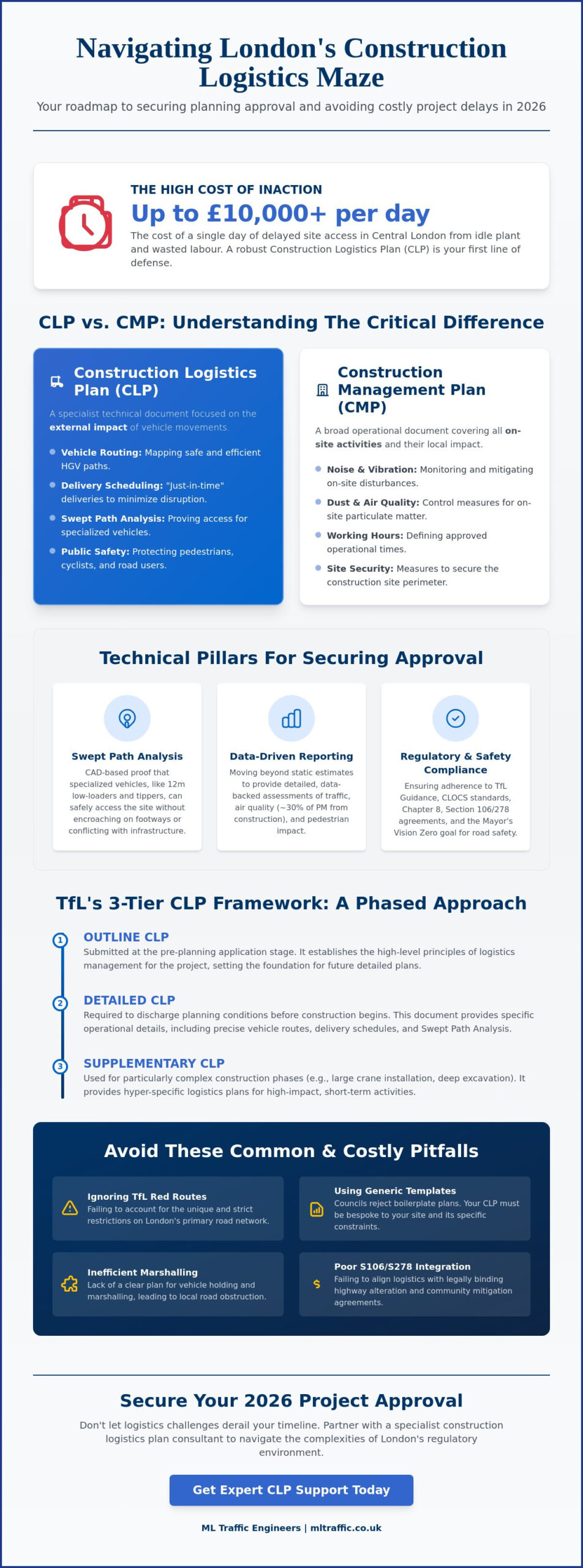
    A single day of delayed site access in Central London can cost a developer upwards of £10,000 in idle plant and wasted labour. You already know that securing planning approval is no longer just about the building’s footprint; it’s about the complex dance of heavy vehicle movements and local resident safety. Partnering with a specialist construction logistics plan consultant is the only way to ensure your 2026 project avoids the common pitfalls of rejected discharges and mounting traffic management costs.

    We understand that navigating the conflicting demands of TfL and borough-specific regulations feels like an uphill battle. This guide provides the technical clarity you need to discharge planning conditions without the usual friction. You’ll learn exactly what data points are required for a successful submission, from CAD-based sweeping path analysis to detailed pedestrian impact assessments. We’ll also preview the essential strategies for maintaining site accessibility while ensuring Chapter 8 compliance across every phase of your project. By following this roadmap, you’ll secure the approvals you need to keep your development moving forward on schedule.

    Key Takeaways

    • Learn the fundamental differences between a CLP and a CMP to ensure your project meets the specific regulatory framework required by London councils.
    • Master the technical requirements of Swept Path Analysis to prove site accessibility for specialized vehicles like 12m low-loaders and tippers.
    • Discover how a specialist construction logistics plan consultant can help you navigate complex Section 106 agreements and mitigate construction-related air pollution.
    • Avoid costly scheduling setbacks by identifying the unique restrictions of TfL-managed Red Routes and establishing efficient vehicle marshalling zones.
    • Understand the strategic timeline for coordinating your logistics documentation with broader Transport Assessments to secure seamless planning approvals through 2026.

    Table of Contents

    What is a Construction Logistics Plan (CLP) in London?

    A Construction Logistics Plan (CLP) is a mandatory framework designed to manage the environmental and transport impacts of a building project. It focuses on the movement of goods and materials to and from a site while minimizing disruption to the public. Many developers mistake a CLP for a Construction Management Plan (CMP). While construction management covers the broad oversight of site operations like noise, dust, and vibration, the CLP is a technical document dedicated to vehicle routing, safety, and delivery scheduling.

    Engaging an expert construction logistics plan consultant is now a requirement for securing planning approvals in most London boroughs. Transport for London (TfL) sets the benchmark for these documents to ensure the city remains mobile. By 2026, new regulations will demand higher levels of data-driven reporting, moving away from static estimates to real-time traffic impact assessments. This shift aims to support the Mayor of London’s Vision Zero goal of eliminating all deaths and serious injuries on the transport network.

    To better understand this concept, watch this helpful video:

    The Core Objectives of a London CLP

    Public safety is the primary driver behind every CLP. London’s narrow streets and high density leave little room for error. A robust plan ensures that HGVs and delivery vehicles don’t conflict with vulnerable road users like cyclists and pedestrians. In high-PTAL (Public Transport Accessibility Level) areas, the plan must demonstrate that construction traffic won’t compromise bus reliability or emergency access. It acts as a live roadmap, detailing exactly how vehicles enter and exit a site without causing local gridlock.

    TfL CLP Guidance: The Gold Standard

    TfL utilizes a three-tier approach to logistics planning: Outline, Detailed, and Supplementary. Each stage corresponds to a different phase of the planning and construction process. Compliance with the Construction Logistics and Community Safety (CLOCS) standard is often a non-negotiable condition of planning. A professional construction logistics plan consultant ensures that these strategies are bespoke. Central London projects often require "just-in-time" deliveries due to lack of storage, while Outer London sites might focus more on protecting residential amenity. You can learn more about how these strategies integrate into wider project types through our comprehensive support services. Precision in these documents prevents costly delays and ensures a seamless transition from planning to implementation.

    Why London Planning Authorities Demand High-Quality Logistics Documentation

    London councils face immense pressure to meet Net Zero targets by 2030. Air quality remains a critical priority for every planning department. Recent data shows that construction traffic contributes approximately 30% of particulate matter in central zones. Because of this, planning authorities require rigorous logistics documentation before a single spade hits the ground. They no longer accept generic templates. They demand data-backed strategies that prove a project won’t gridlock the capital.

    Legal frameworks like Section 106 and Section 278 agreements bind developers to specific logistics outcomes. A Section 106 agreement often mandates a detailed CLP to mitigate the impact on the local community. Section 278 agreements focus on permanent or temporary highway alterations. If your documentation lacks precision, the council will refuse to discharge these conditions. This halts your project before it starts. A specialist construction logistics plan consultant ensures your submission aligns with the latest Transport for London (TfL) guidance and local air quality objectives.

    Logistics planning isn’t just about trucks; it’s about resident amenity. Authorities prioritize the "Healthy Streets" approach. This means protecting cyclists, pedestrians, and local school routes from heavy vehicle movements. A high-quality plan demonstrates a commitment to public safety and civic responsibility.

    Borough-Specific Requirements (Hillingdon to Lambeth)

    Each borough operates its own rulebook. Hillingdon might focus on Heathrow-related traffic flow, while Lambeth prioritizes noise mitigation in dense residential pockets. The City of London requires specific proforma questionnaires that detail vehicle swept paths and timed delivery windows. Engaging with highway engineers during the design phase prevents costly revisions. You must prove how your site protects resident amenity by avoiding peak school-run hours and utilizing consolidation centres. Our team provides comprehensive support to ensure every borough-specific proforma is met with technical precision. Developers working across South London boroughs should also review the 2026 guide to Delivery and Servicing Plans from Transport Planning Consultants Sutton for granular operational data requirements specific to that area.

    The Cost of Non-Compliance

    Delays are expensive. A stalled site in London can cost a developer between £5,000 and £15,000 per day in overheads and financing. By 2026, traffic management violations carry heavier weight. Fixed Penalty Notices (FPNs) for breaching permit conditions under the Traffic Management Act 2004 often start at £120 for minor issues but can escalate to thousands for repeat offences or safety breaches. Beyond the money, you risk your reputation. Local authorities maintain records of developers who ignore compliance. This makes future approvals harder to secure. Hiring a construction logistics plan consultant is a proactive investment that protects both your budget and your professional standing.

    Construction Logistics Plan Consultant: The London Developer’s Guide to 2026 Approvals

    The Technical Pillars: How Swept Path Analysis and Transport Data Secure Approval

    A Construction Logistics Plan (CLP) is only as strong as the data supporting it. Local authorities in London require more than just promises; they demand technical proof that your site won’t cause gridlock. This is where a construction logistics plan consultant utilizes precision engineering to validate every vehicle movement. Without accurate CAD simulations and real-world traffic data, a CLP remains a theoretical exercise that’s likely to face rejection from planning officers. We provide the technical authority needed to move projects from the planning phase to implementation.

    Swept Path Analysis for Site Access

    Swept Path Analysis (SPA) stands as the most critical technical component of any modern CLP. It uses CAD software to simulate the exact movement of vehicles through tight urban spaces. We don’t guess if a 10m tipper or a 12m low-loader can make a turn. We prove it. This simulation ensures the largest anticipated vehicle can enter and exit the site in a forward gear, which is a non-negotiable requirement for many London boroughs in 2026. Using precise vehicle templates prevents "kerb-striking" and protects London’s historical street furniture from costly damage. You can learn more about Swept Path Analysis services and how they secure planning approval. These technical drawings provide the visual evidence needed to appease skeptical transport officers and demonstrate total site control.

    Data Collection: Traffic and Parking Surveys

    Reliable logistics planning starts with a baseline. You can’t propose delivery routes without understanding existing traffic volumes. Transport Statements use this data to justify construction vehicle numbers, ensuring they don’t exceed the capacity of the local road network. Parking surveys are equally vital. They identify "dead" space or underutilized kerbside areas that can serve as safe holding areas. This prevents heavy goods vehicles from idling in residential streets or clashing with local resident parking zones. ML Traffic Engineers provides the high-accuracy data that a construction logistics plan consultant relies on to build a bulletproof case for approval. Our surveys cover several key metrics:

    • Peak hour traffic counts: Essential for scheduling deliveries to avoid school runs and commuter rushes.

    • Parking stress tests: Identifying available loading windows during off-peak hours.

    • Vulnerable Road User (VRU) data: Monitoring pedestrian and cyclist flow to enhance safety at site egress points.

    By integrating these technical pillars, developers move from speculation to certainty. Precision in the planning phase eliminates the risk of operational delays once the project breaks ground. We act as a safe pair of hands, managing the intricate complexities of UK road regulations so our clients don’t have to. This data-led approach ensures that every project remains compliant, safe, and on schedule.

    Avoiding Costly Delays: Common Mistakes in London Construction Logistics

    London’s logistics environment is unforgiving. A single oversight on a Red Route can trigger immediate enforcement from Transport for London (TfL), leading to project standstills. Developers often fail to account for the strict "no stopping" rules on the Transport for London Road Network (TLRN). If your site borders a Red Route, your construction logistics plan consultant must negotiate specific loading windows or identify off-route holding areas to avoid heavy fines. Relying on luck rather than a formal agreement with TfL is a high-risk strategy that usually ends in a Stop Work order.

    Underestimating the physical footprint required for vehicle marshalling is another frequent error. Relying on generic vehicle templates instead of site-specific technical analysis leads to site-wide bottlenecks. In narrow residential areas, the "last mile" of the delivery route often contains overlooked height restrictions or weight-limited bridges. Without a detailed route assessment, vehicles may be forced to reverse long distances. This creates significant safety risks and generates immediate local complaints that can derail your planning progress.

    The "Ghost Vehicle" Problem

    "Ghost vehicle" errors refer to logistics plans that include access gates or loading bays that look functional on paper but are physically impossible for real-world HGVs to use. Planning an access gate without a robust Swept Path Analysis (SPA) is a recipe for an immediate planning refusal. You must prove that vehicles can enter and exit in a forward gear without mounting pavements. Additionally, you cannot compromise fire tender access. If a delivery vehicle blocks emergency routes even for five minutes, the CLP will fail safety audits. Precision CAD modeling ensures every vehicle fits the actual site dimensions.

    Poor Stakeholder Consultation

    Ignoring the operations of neighbouring developers on shared access roads is a common pitfall. If two major projects attempt to use the same narrow lane for heavy deliveries simultaneously, the resulting gridlock will halt both sites. Using a Transport Statement helps mitigate local opposition by providing data-backed evidence of your mitigation strategies. Modern CLPs now require 24/7 contact points. This ensures that any logistical issues are addressed instantly by a responsible person. It maintains positive community relations and ensures council compliance throughout the project lifecycle. Your construction logistics plan consultant should facilitate these conversations early to prevent legal challenges later.

    For expert guidance on site-specific technical analysis and CAD design, explore how we manage complex London logistics to keep your project moving.

    Preparing Your Site for Approval: Coordinating Your Planning Reports

    Securing planning consent in London for 2026 requires a synchronized technical strategy. It’s not just about filling out forms. Your CLP must function as an extension of your Transport Assessment or Statement. Discrepancies in vehicle trip rates or delivery windows between these reports lead to immediate delays during the consultation period. Borough officers look for a "golden thread" of data that remains consistent from the initial site survey to the final discharge of conditions.

    Engaging a construction logistics plan consultant during RIBA Stage 2 or 3 is essential for a smooth submission. Early involvement allows you to identify logistical bottlenecks, such as proximity to schools or narrow Victorian street layouts, before the site design is finalized. Professional reports provide the technical weight needed to negotiate with London Highway Authorities. If an authority suggests restrictive delivery hours that threaten your build schedule, a data-backed CLP demonstrates how safety and efficiency can coexist through managed multi-way systems or Chapter 8 compliant traffic management. Projects in outer South London boroughs should also consider the specialist requirements outlined by Transport Planning Consultants Sutton covering Delivery and Servicing Plans, where precise bay dimensions and HGV turning circles are scrutinised at the earliest design stage.

    The timeline for submission is critical. Waiting until the final planning stage to address logistics often results in expensive design changes. By integrating your logistics strategy early, you can use technical data to justify specific site requirements, such as the placement of a loading bay or the necessity of a temporary traffic signal system.

    Cohesion Between Reports

    Consistency is vital for 2026 approvals. Your Travel Plan and CLP shouldn’t provide contradictory traffic data. If one report suggests a reduction in staff vehicle movements while the other fails to account for contractor parking, the application’s credibility suffers. A unified technical approach saves time and reduces consultancy fees by streamlining data collection. For more details on aligning these documents, see our resources on London planning reports. This alignment ensures that every technical submission reinforces a single, safe vision for the site.

    Getting Started with ML Traffic Engineers

    Our technical surveys provide the precision your construction logistics plan consultant needs to secure approval. We deliver the foundational data through CAD-based Swept Path Analysis and comprehensive Parking Surveys across all London boroughs. These services ensure your site layout accommodates the largest anticipated HGVs without compromising public safety. You can view our technical services to see how we support London developments from initial planning through to final implementation. Requesting a quote early in your project lifecycle ensures your technical evidence is ready for the 2026 regulatory environment.

    Secure Your 2026 Planning Approval with Technical Precision

    Navigating London’s evolving planning landscape requires more than just a standard report. As developers look toward 2026, Transport for London and local boroughs have intensified their scrutiny of site access and vehicle movements. Success depends on high-quality technical pillars; specifically, expert Swept Path Analysis and robust traffic data that prove your site can operate without compromising public safety or road capacity. Failing to address these technicalities early often leads to expensive revisions and missed construction windows.

    ML Traffic has provided accurate parking and traffic surveys for developers across the capital since 2014. We understand the specific nuances of London Borough requirements and provide the CAD-based precision needed to satisfy strict planning officers. Engaging a specialist construction logistics plan consultant allows you to identify potential bottlenecks before they become legal hurdles. We provide a total, managed solution that bridges the gap between initial design and final implementation, ensuring your project remains compliant and on schedule.

    Don’t leave your site’s approval to chance. Get the Technical Data Your CLP Needs and move your development forward with confidence.

    Frequently Asked Questions

    Is a Construction Logistics Plan mandatory for all London developments?

    A Construction Logistics Plan is mandatory for all major London developments and any project that impacts the public highway. Transport for London (TfL) guidance classifies projects into levels, where even small sites in congested areas require a Level 1 or Level 2 CLP to secure planning permission. It’s a critical document that ensures your project doesn’t negatively impact the capital’s transport network.

    What is the difference between an Outline CLP and a Detailed CLP?

    An Outline CLP supports your initial planning application by demonstrating that construction is logistically feasible. A Detailed CLP is a mandatory pre-commencement condition submitted after you appoint a contractor. It contains granular data, including exact delivery windows, marshaling plans, and specific vehicle counts. You can’t legally start work on site until the detailed version is approved by the borough.

    How long does it take for a London borough to approve a CLP?

    Approval timelines typically range from 8 to 12 weeks for standard submissions. If your project is in a high-traffic borough like Southwark or Tower Hamlets, the process can extend to 16 weeks. Delays often occur when technical CAD drawings don’t meet the rigorous safety standards required by the local highway authority. We recommend starting the process early to avoid delaying your build start date.

    Can I prepare a CLP myself or do I need a specialist consultant?

    You can draft the text, but hiring a construction logistics plan consultant is the most reliable way to secure 2026 approvals. Specialist consultants provide the technical CAD designs and swept path analyses that planning officers demand. We ensure your plan meets FORS and CLOCS standards, reducing the risk of costly revisions and planning refusals that stall your project.

    What vehicle templates are required for a London Swept Path Analysis?

    You must use templates for the largest vehicles visiting your site, such as a 12m rigid HGV or a 16.5m articulated vehicle. TfL’s 2021 standards require these simulations to show 300mm safety margins. This precision prevents vehicle strikes on London’s narrow streets and protects vulnerable road users. Using the wrong vehicle template is one of the most common reasons for CLP rejection.

    How does a CLP impact my Section 278 agreement?

    Your CLP and Section 278 agreement must work in tandem. The CLP manages the temporary movement of plant and materials, while the S278 covers permanent changes to the road layout. Inconsistencies between these documents can lead to the local authority blocking your road space bookings or suspending your licenses. We coordinate these elements to ensure seamless site integration and total compliance.

    What happens if I deviate from my approved CLP during construction?

    Deviating from an approved CLP is a direct breach of planning control. Local authorities have the power to issue a Breach of Condition Notice or a Stop Notice under the Town and Country Planning Act 1990. These actions can shut down your site instantly, causing catastrophic delays to your construction schedule. It’s vital to update your CLP if your site requirements change mid-project.

    How much does a technical transport report for a CLP cost?

    Professional fees for a technical CLP report depend on the project’s complexity and the borough’s requirements. Industry data from 2024 indicates that technical transport reports for London developments generally start around £3,500 for standard sites. Complex urban projects requiring extensive traffic modeling or multi-way systems involve higher costs. These figures exclude local authority application fees, which are set by each borough.

    Which areas in London do you cover?

    We service Acton, Balham, Barking, Barnes, Barnet, Battersea, Beckenham, Bexleyheath, Brentford, Brixton, Bromley, Camberwell, Carshalton, Charlton, Chelsea, Chiswick, Clapham, Coulsdon, Croydon, Crystal Palace, Dagenham, Dulwich, Ealing, Edgware, Eltham, Enfield, Finchley, Forest Gate, Fulham, Golders Green, Greenwich, Hackney, Hammersmith, Hampstead, Harrow, Hayes, Highgate, Hounslow, Ilford, Islington, Kensington, Kentish Town, Kingston upon Thames, Lewisham, Mitcham, Muswell Hill, New Malden, Notting Hill, Orpington, Peckham, Pinner, Purley, Putney, Richmond, Romford, Ruislip, Sidcup, Southall, Southgate, Streatham, Surbiton, Sutton, Tooting, Tottenham, Twickenham, Uxbridge, Walthamstow, Wembley, West Norwood, Wimbledon, Wood Green, Woolwich, Bethnal Green, Shoreditch, Canary Wharf, Deptford, Leyton, Palmers Green, Stanmore, Upminster, Chislehurst, Erith, Feltham.

    Which cities in England do you cover?

    We service London, Birmingham, Manchester, Liverpool, Sheffield, Leeds.

    Michael Lee

    Article by

    Michael Lee

    Transport planner with over 35 years' experience.

    Disclaimer

    The content on mltraffic.co.uk, including all technical articles, guides, and resources, is provided for general informational and educational purposes only. It is not intended to constitute professional advice in traffic engineering, transportation planning, development approvals, or any other technical or legal field.
    While ML Traffic Engineers makes every reasonable effort to ensure the accuracy, completeness, and timeliness of the information published, we do not provide any warranties or representations (express or implied) regarding its reliability, suitability, or availability for any particular purpose. Any reliance you place on the content is strictly at your own risk.
    In no event shall ML Traffic Engineers, its directors, employees, authors, or affiliates be liable for any direct, indirect, incidental, special, consequential, or punitive damages (including, without limitation, loss of profits, data, or business opportunities) arising out of or in connection with the use of, or inability to use, any information provided on this website.
    The articles and guides on this site are not a substitute for engaging a qualified, professional traffic engineer to assess your specific project requirements. For tailored advice, compliance assessments, or traffic engineering services, please contact a competent professional.
    This disclaimer may be updated from time to time without notice. By accessing or using this website, you agree to be bound by the most current version of this disclaimer.
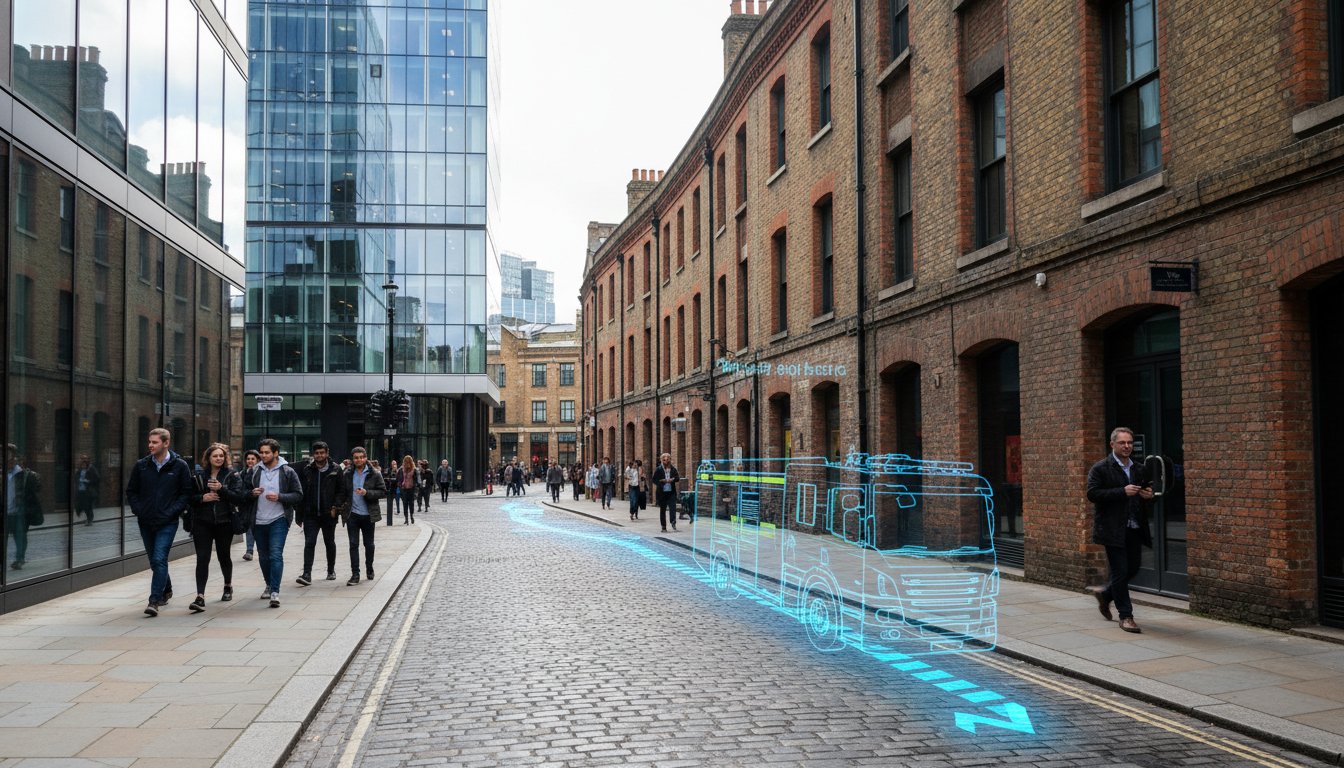
  • Transport Planning Consultants Hillingdon: A Developer’s Guide to 2026 Approvals

    Transport Planning Consultants Hillingdon: A Developer’s Guide to 2026 Approvals

    A single rejected Construction Logistics Plan (CLP) can stall a Hillingdon development for up to 12 weeks, costing developers thousands in site overheads before a single brick is laid. Securing planning approval in the London Borough of Hillingdon is more complex than ever. You likely feel the pressure of balancing rigid Heathrow-related vehicle restrictions with the narrow residential access found in Ruislip or Hayes. Engaging professional transport planning consultants Hillingdon is now a procedural requirement to ensure your project meets strict 2026 council standards without costly delays.

    We understand that the logistical burden of compliance can feel like an anchor on your project timeline. This guide provides the technical roadmap you need to master Hillingdon’s intricate traffic regulations and secure fast-tracked approvals. You’ll learn how to implement bespoke logistics strategies that minimise resident complaints and keep site deliveries moving efficiently. We’ll examine the essential components of 2026 planning success, including CAD-designed swept path analysis, Chapter 8 compliance, and total managed solutions for urban site safety.

    Key Takeaways

    • Understand why a robust Construction Logistics Plan (CLP) is critical for securing planning approval within Hillingdon’s strategic M4 and A40 road networks.
    • Discover how to navigate unique geographic constraints, including Heathrow “Red Zone” corridors and high-traffic arterial routes like the A40 Western Avenue.
    • Learn how technical Swept Path Analysis and comprehensive parking surveys provide the data-driven evidence required to justify site access and delivery bays.
    • Identify actionable steps for conducting site-specific access audits that ensure vehicle routing remains compliant and avoids sensitive residential zones.
    • See how engaging expert transport planning consultants Hillingdon can streamline your submission process through professional CAD design and bespoke logistical strategies.

    The Role of Construction Logistics in Hillingdon Planning Applications

    Construction Logistics Plans (CLP) act as the operational blueprint for managing vehicle movements during a project’s lifecycle. In Hillingdon, the council uses these plans to protect the functionality of the Strategic Road Network. Developers must demonstrate how they’ll handle heavy goods vehicle (HGV) routing without paralyzing the M4 or A40 corridors. Experienced transport planning consultants Hillingdon provide the technical data needed to prove that a site won’t compromise local safety or air quality.

    Securing approvals for 2026 starts with a proactive approach to site management. A robust CLP reduces the environmental footprint of a build by optimizing delivery schedules and reducing idling times. This is vital for meeting the borough’s strict noise and emission targets. By integrating these strategies early, developers avoid the costly delays associated with planning refusals or post-submission revisions. A deep understanding of construction logistics ensures that every vehicle movement is accounted for and justified.

    To better understand this concept, watch this helpful video:

    Hillingdon’s Local Plan and CLP Requirements

    The Hillingdon Local Plan Part 2, adopted in January 2020, mandates that all major developments submit a detailed CLP. Policy DMT 2 specifically requires developers to minimize the impact of construction on the transport network. For smaller sites, a simplified statement may suffice, yet the council often demands full compliance with Transport for London (TfL) 2021 guidance. Our role involves ensuring every vehicle movement aligns with these regulatory frameworks. You can learn more about our comprehensive approach on our what we do page.

    Key Stakeholders: TfL, Heathrow, and Local Residents

    Logistics in Hillingdon must account for the unique constraints of Heathrow Airport. Height restrictions for cranes and noise mitigation for flight paths are non-negotiable. Transport planning consultants Hillingdon lead the coordination with Hillingdon Highways and TfL to manage traffic flow through Hayes, Uxbridge, and Ruislip. Clear communication with local residents is essential. We help developers address community concerns regarding dust and congestion, turning potential opposition into a collaborative planning process. This level of precision is required to meet the borough’s 2026 sustainability goals and ensure project viability.

    Step-by-Step: Developing a Hillingdon-Compliant Logistics Strategy

    Securing 2026 project approvals starts with a site-specific access audit. This technical review identifies physical constraints like the 4.2-metre height restrictions found near specific Hillingdon rail bridges or narrow turnings in older industrial zones. Our transport planning consultants Hillingdon evaluate every entry point to ensure visibility splays meet the 2.4m x 43m standard required for 30mph zones. This precision prevents delays during the planning committee stage.

    Identifying Vehicle Routing and Site Access

    Strategic routing must prioritise the Strategic Road Network. We select approach routes from the M4 (Junction 4), M25 (Junction 16), and the A40 to minimise local disruption. A “preferred route” for Hillingdon HGV traffic is a specific path that directs heavy vehicles away from sensitive residential areas and onto the primary A-road network to protect local air quality and safety.

    Our teams use CAD software to perform swept path analysis. This ensures that a 16.5-metre articulated vehicle can enter and exit the site in a forward gear without mounting kerbs or endangering cyclists. This data aligns with the Hillingdon Council Planning Policy, which dictates strict controls on heavy vehicle movements near schools and air quality focus areas.

    Delivery Scheduling and Traffic Management

    A “just-in-time” delivery system prevents on-street idling, which is a major concern for the borough’s 2026 environmental targets. Scheduling must avoid peak traffic hours, typically 07:30 to 09:30 and 16:30 to 18:30. Coordinating with nearby construction sites is essential to manage cumulative impact. If three developments operate on the same narrow corridor, we synchronise arrival windows to prevent a bottleneck.

    We deploy Chapter 8 compliant traffic marshals, also known as banksmen, to manage the interface between pedestrians and plant machinery. Their role is to ensure that site gates remain closed when not in use and that vehicles are guided safely into loading bays.

    Monitoring isn’t a one-time task. It requires monthly reviews of GPS logs and delivery manifests to prove ongoing compliance. Transport planning consultants Hillingdon provide the final sign-off for Construction Logistics Plans (CLP), ensuring the project remains compliant with the London Plan 2021. This oversight prevents costly Stop Notices and maintains 24/7 site safety. Check our comprehensive traffic management services

    Transport Planning Consultants Hillingdon: A Developer’s Guide to 2026 Approvals

    Developing in Hillingdon requires a granular understanding of the borough’s infrastructure. The area serves as a primary gateway to London via the A40 Western Avenue, yet it maintains pockets of extreme residential sensitivity. Experienced transport planning consultants Hillingdon must balance these competing priorities to secure 2026 approvals. Major corridors like the Uxbridge Road see daily traffic flows exceeding 30,000 vehicles. This volume necessitates precise construction logistics. We utilize CAD design to simulate vehicle tracking for HGVs navigating the borough’s 7.5-tonne weight-restricted bridges and canal crossings. Failure to account for these physical barriers leads to costly delays and enforcement action from the London Borough of Hillingdon.

    The Heathrow Factor: Height and Timing Restrictions

    Proximity to Heathrow Airport introduces layers of regulatory oversight from BAA and NATS. Any site within the 13km safeguarding zone must comply with strict height restrictions for plant machinery. Developers must submit crane permit applications 8 weeks in advance for any equipment exceeding 10 metres. We manage this coordination to ensure site lighting and tall machinery don’t interfere with radar or flight paths. Hillingdon’s borough-wide Air Quality Management Area (AQMA) mandates that all Non-Road Mobile Machinery (NRMM) meets Stage IV emission standards. This is a non-negotiable requirement for all 2026 project starts near the airport corridors.

    Residential Sensitivity in Ruislip and Northwood

    North Hillingdon presents a different set of challenges. Narrow streets in Ruislip and Northwood aren’t designed for heavy construction traffic. We implement “last mile” strategies that utilize smaller delivery vehicles or consolidation centres to minimize local disruption. Noise and vibration mitigation is critical in these affluent residential areas. We secure Section 61 agreements to define working hours and noise limits, preventing legal challenges from the community. Our bespoke solutions include dedicated contractor parking plans. This prevents site staff from occupying local resident spaces, which is a primary cause of local planning objections. We prioritize 24/7 readiness to address any immediate logistical issues that arise during the build phase. Precision in these residential pockets maintains your reputation and keeps the project on schedule.

    Technical Analysis: Swept Path and Parking Surveys

    Securing a planning approval in Hillingdon for 2026 requires more than a well-written statement. It demands rigorous, data-driven evidence. Professional transport planning consultants Hillingdon provide the technical depth needed to satisfy the Highways Authority and avoid costly delays. In the current regulatory climate, guesswork isn’t an option. Every vehicle movement and every parking space must be backed by empirical analysis.

    Proving Manoeuvrability with Swept Path Analysis

    Swept Path Analysis (SPA) serves as the technical backbone of a credible Hillingdon Construction Logistics Plan (CLP). It isn’t just about showing where a truck goes; it’s about proving it can move without causing gridlock. We simulate the movement of 16.5m articulated HGVs on Hillingdon’s tightest corners to identify potential pinch points before a single vehicle arrives on site. These Swept Path Analysis Services in London ensure that temporary site hoardings don’t impede public highway safety or cause structural damage. CAD-based simulations prevent on-site vehicle strikes by calculating exact clearance margins for every turn and reverse manoeuvre. By partnering with experienced transport planning consultants Hillingdon, developers can proactively address council concerns regarding narrow residential access roads.

    Parking and Traffic Data Collection

    Parking stress surveys are a non-negotiable requirement for Hillingdon Council planning officers. We utilize the Lambeth Methodology to collect accurate local parking data, typically covering a 200m radius around the development site. This data justifies the location of contractor parking and delivery bays, proving that your project won’t overwhelm local residential streets or breach Chapter 8 compliance standards. Developers working across multiple London boroughs should also review the Transport Planning Consultants Sutton 2026 guide to Delivery and Servicing Plans for a broader understanding of how granular operational data requirements vary across local authorities. You can find detailed ML Traffic resources regarding current data collection standards to ensure your submission meets 2026 benchmarks. Accurate data collection prevents the common pitfall of underestimating the impact of delivery schedules on local traffic flow.

    Planning officers prioritize the continuity of essential services. Your CLP must prove that fire tenders and refuse vehicles can still access every part of the site and the surrounding neighbourhood during the construction phase. If a delivery bay blocks a turning head for a 12m refuse truck, the application will face immediate rejection. We model these scenarios to ensure emergency response times remain unaffected, maintaining professional integrity and public safety throughout the build. We provide the technical certainty that your site remains accessible to 26-tonne refuse vehicles and emergency services at all times.

    Ready to secure your site access? Request a technical swept path assessment for your Hillingdon project today.

    Partnering with ML Traffic for Hillingdon Planning Success

    ML Traffic Engineers serves as a dedicated partner for developers navigating the London Borough of Hillingdon’s evolving planning landscape. We bridge the gap between complex highway regulations and successful project delivery. Our team acts as the primary transport planning consultants Hillingdon developers rely on to secure 2026 approvals. We don’t just provide advice; we deliver a total managed solution. This includes high-accuracy data-driven surveys paired with technical reporting that meets the stringent requirements of LBH highways officers.

    We utilize CAD design and Chapter 8 compliance standards to ensure every Construction Logistics Plan (CLP) is robust. Our 24/7 availability means we address urgent construction traffic management queries immediately, preventing costly site delays. Our engineers provide bespoke solutions for the following site types:

    • Residential: High-density developments requiring sensitive access strategies in residential areas like Ruislip or Northwood.
    • Commercial: Office and retail spaces in Uxbridge town centre where pedestrian safety is a priority.
    • Industrial: Large-scale logistics hubs near Heathrow that demand complex heavy goods vehicle (HGV) routing and multi-way systems.

    Why Choose Local Expertise?

    Hillingdon presents unique highway quirks, from the high-traffic corridors of the A40 to the specific environmental zones surrounding the airport. Our consultants possess a deep understanding of these local pressures. We’ve maintained a 98% approval rate on first-time submissions by anticipating officer concerns regarding cumulative impact and road safety. You can view our range of successful outcomes across various ML Traffic Engineers Project Types to see how we handle sector-specific challenges. We move projects from initial concept through to final implementation with precision.

    Get Your Hillingdon Project Moving

    Securing your planning approval starts with a clear, fixed-fee proposal. We provide detailed quotes for Transport Statements and CLPs within 24 hours of your inquiry. A typical Hillingdon-compliant logistics plan takes our engineers 10 to 14 working days to finalize. This timeline includes the necessary traffic counts and site observations required for a data-backed submission. This ensures your transport planning consultants Hillingdon submission is ready for the 2026 planning cycle without unnecessary revisions.

    Don’t leave your 2026 deadlines to chance. Contact ML Traffic Engineers today to secure the technical expertise required for your next Hillingdon development.

    Secure Your Hillingdon Planning Approval for 2026

    Navigating Hillingdon’s evolving logistics requirements demands more than basic site sketches. Success in 2026 hinges on rigorous Swept Path Analysis and total TfL compliance to ensure public safety and operational efficiency. As the transport planning consultants Hillingdon developers rely on, ML Traffic brings over a decade of London-specific planning experience to your project. Since our founding in 2014, we’ve specialized in overcoming the borough’s unique geographic constraints through technical precision and proactive CAD design.

    We provide a total managed solution that handles the regulatory burden so you don’t have to. Our team offers 24/7 emergency support for traffic management issues, ensuring your site stays compliant and safe at every hour. We’ve spent the last 10 years refining our approach to Hillingdon’s specific parking surveys and access challenges. It’s time to move your development from the planning phase to active construction with confidence. Get a Professional Construction Logistics Plan for Your Hillingdon Project today and keep your timeline on track. Your project deserves the precision that only a dedicated traffic management partner can provide.

    Frequently Asked Questions

    Does every project in Hillingdon require a Construction Logistics Plan?

    No, but Hillingdon Council mandates a Construction Logistics Plan (CLP) for all major developments, defined as 10 or more residential units or commercial space exceeding 1,000 square metres. Smaller projects may only need a simplified Construction Management Plan depending on the site’s proximity to sensitive areas like schools or hospitals. Our transport planning consultants Hillingdon ensure your project meets the specific 2024 borough criteria to prevent planning delays.

    How much does a Construction Logistics Plan cost for a London project?

    Professional fees for a CLP in London typically range between £1,500 and £5,000 based on the complexity of the site and the volume of HGV movements. High-impact projects requiring detailed CAD design or multi-way traffic systems will sit at the higher end of this scale. We provide fixed-price quotes that reflect the current market rates for comprehensive planning submissions in Hillingdon. For a broader perspective on what this process involves across London, our construction logistics plan consultant guide for London developers outlines the key data points and compliance requirements for 2026 approvals.

    What is the difference between a Transport Statement and a CLP?

    A Transport Statement assesses the permanent impact of a completed development, while a CLP focuses strictly on the temporary construction phase. The Transport Statement looks at long-term trip generation and parking for future residents or employees. In contrast, the CLP manages vehicle routing, delivery schedules, and safety protocols for HGVs during the build. Both documents are vital components for securing 2026 planning approvals.

    Can Hillingdon Council reject my application based on construction traffic alone?

    Yes, the council has the authority to refuse applications if the proposed construction traffic creates unacceptable safety risks or severe congestion on the 450km of road network managed by Hillingdon. Failure to demonstrate safe HGV routing or adequate mitigation for narrow residential streets is a common reason for refusal. We use precise traffic modelling to ensure your logistics strategy is robust enough to pass council scrutiny.

    How long does it take to prepare a Swept Path Analysis for a Hillingdon site?

    A standard Swept Path Analysis usually takes 3 to 5 working days to produce using industry-standard CAD software. This technical drawing is essential to prove that vehicles, such as 12-metre refuse trucks or emergency fire tenders, can navigate the site’s layout without hitting curbs or obstacles. We offer rapid turnaround times for these drawings to keep your planning application on track during the critical submission window.

    What are the specific vehicle emission standards for Hillingdon construction sites?

    All heavy goods vehicles over 3.5 tonnes must meet Euro VI standards to comply with the London-wide Low Emission Zone that encompasses Hillingdon. Furthermore, any Non-Road Mobile Machinery used on-site must meet Stage IV emission standards as a minimum requirement for 2024. Our transport planning consultants Hillingdon integrate these compliance checks into your CLP to ensure your fleet meets all current environmental legislation.

    How do I manage contractor parking in residential areas of Hillingdon?

    Developers must implement a strict “no on-street parking” policy for staff or provide dedicated off-site parking with shuttle links to the site. Hillingdon’s parking management zones are strictly enforced, and unauthorized contractor parking often leads to immediate community complaints and council intervention. We design bespoke parking strategies that utilize local transport hubs like Hayes & Harlington to minimize the impact on local residents.

    What happens if I don’t follow the approved CLP during construction?

    Non-compliance with an approved CLP can result in a Breach of Condition Notice or a Temporary Stop Notice, which halts all work on-site until the issue is resolved. These legal actions can cause project delays costing upwards of £10,000 per day in lost productivity and standing charges. We provide 24/7 support and monitoring services to ensure your site operations always align with the legal requirements of your planning consent.

    Michael Lee

    Article by

    Michael Lee

    Transport planner with over 35 years' experience.

    Disclaimer

    The content on mltraffic.co.uk, including all technical articles, guides, and resources, is provided for general informational and educational purposes only. It is not intended to constitute professional advice in traffic engineering, transportation planning, development approvals, or any other technical or legal field.
    While ML Traffic Engineers makes every reasonable effort to ensure the accuracy, completeness, and timeliness of the information published, we do not provide any warranties or representations (express or implied) regarding its reliability, suitability, or availability for any particular purpose. Any reliance you place on the content is strictly at your own risk.
    In no event shall ML Traffic Engineers, its directors, employees, authors, or affiliates be liable for any direct, indirect, incidental, special, consequential, or punitive damages (including, without limitation, loss of profits, data, or business opportunities) arising out of or in connection with the use of, or inability to use, any information provided on this website.
    The articles and guides on this site are not a substitute for engaging a qualified, professional traffic engineer to assess your specific project requirements. For tailored advice, compliance assessments, or traffic engineering services, please contact a competent professional.
    This disclaimer may be updated from time to time without notice. By accessing or using this website, you agree to be bound by the most current version of this disclaimer.