Tag: planning permission

  • What is a Highway Consultant? A Guide for Developers

    What is a Highway Consultant? A Guide for Developers

    With planning fees in England rising by 3.8% as of April 2026 and new statutory consultee surcharges now in effect, a single objection from a Local Highway Authority can turn a profitable project into a financial liability. You likely feel the pressure of these escalating costs and the technical complexity of the 2025 updates to the Design Manual for Roads and Bridges (DMRB). A professional highway consultant acts as your technical advocate, ensuring that your submission meets these rigorous standards before they cause a validation bottleneck.

    This guide explains how a highway consultant navigates technical reporting and regulatory hurdles to secure your development’s planning approval. You’ll learn how precision tools like AutoTURN 2026 and detailed Transport Assessments prevent delays and mitigate unexpected costs in Section 278 agreements. We will outline the essential services, from Swept Path Analysis to Parking Surveys, that transform technical constraints into planning assets and ensure clear communication with highway authorities.

    Key Takeaways

    • Understand how a highway consultant bridges the gap between your development design and the Local Highway Authority’s rigorous safety standards.
    • Discover how to prevent application validation delays by preparing the correct hierarchy of technical reports, from Transport Statements to full Transport Assessments.
    • Learn why Swept Path Analysis and Parking Surveys are critical for proving your site layout can safely accommodate refuse trucks and emergency vehicles.
    • Identify potential “showstoppers” early in the planning lifecycle through strategic feasibility reviews and pre-application consultations.
    • Explore how Travel Plans help satisfy modern environmental quotas by promoting sustainable transport options within your project’s design.

    Table of Contents

    What is a Highway Consultant and Why Does Your Project Need One?

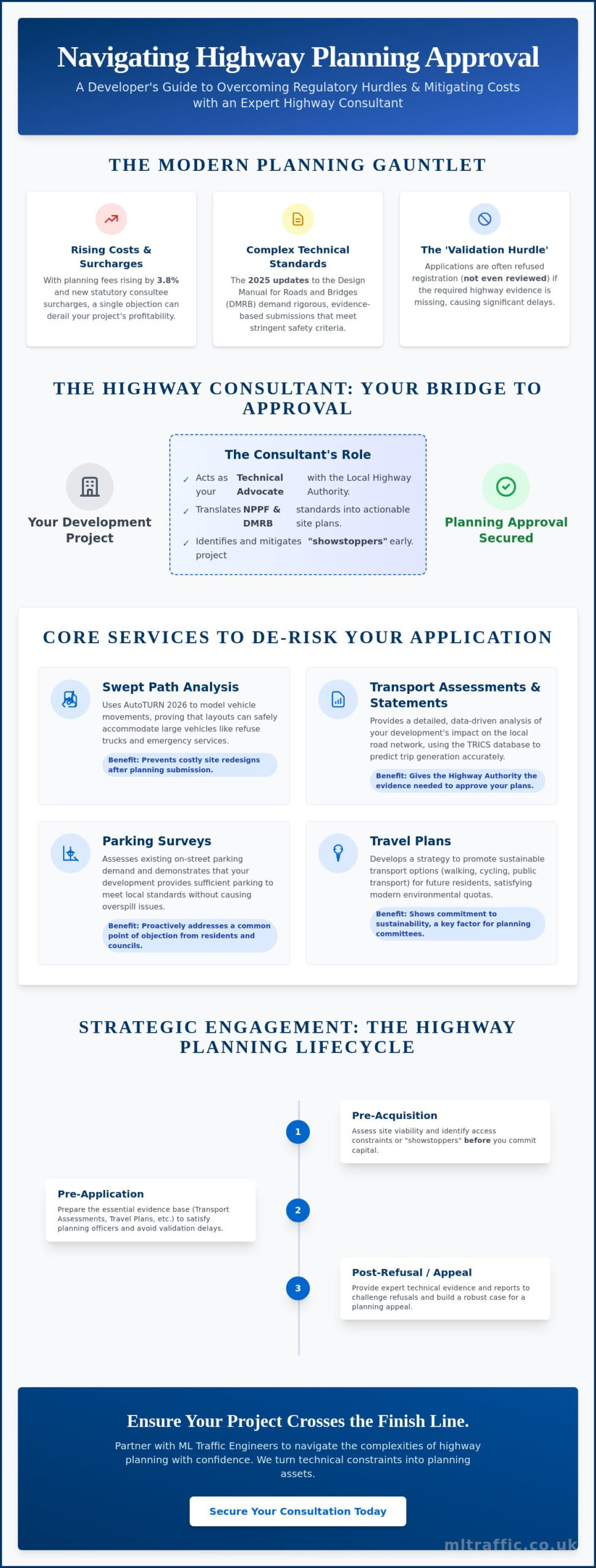
    A highway consultant serves as the technical liaison between your development team and the Local Highway Authority. They apply the principles of Highway engineering to ensure your site layout is safe, functional, and compliant with current UK standards. Many developers encounter the “validation hurdle” early in the process. This is an administrative wall where a planning department refuses to register an application because the required highway evidence is missing. By providing precision data from the outset, a consultant ensures your project moves past the validation stage and into the review phase without delay.

    Beyond administrative support, these experts offer significant commercial value. They optimize access designs to reduce unnecessary infrastructure spending while maintaining safety. A highway consultant doesn’t just fill out forms. They negotiate with local authorities to ensure that required works are proportionate to the development’s scale. Their role involves managing the full project lifecycle, from initial Traffic Surveys to the final coordination of Transport Assessments. Precision is a functional necessity in this environment.

    The Intersection of Engineering and Planning Law

    Highway consultants translate the National Planning Policy Framework (NPPF) into actionable site plans. They anticipate the requirements of statutory consultees, such as National Highways, before objections are raised. Early engagement during the feasibility stage identifies “showstoppers” like insufficient visibility splays or junction capacity issues. This proactive approach ensures your project aligns with the 2025 updates to the Design Manual for Roads and Bridges (DMRB) and avoids costly late-stage redesigns.

    When to Appoint a Highway Consultant

    Strategic timing dictates the profitability of your development. During pre-acquisition, a consultant assesses site viability to identify access constraints before you commit capital. At the pre-application stage, they prepare the essential evidence base, including Travel Plans and Parking Surveys, to satisfy planning officers. Even in post-refusal scenarios, a highway consultant provides the expert technical evidence needed to challenge decisions during planning appeals and reduce regulatory pressure.

    Technical Reports: Securing Planning Approval through Evidence

    Evidence is the foundation of planning success. A highway consultant uses technical reports to prove that a development’s impact on the road network is acceptable or can be mitigated through design. This data-driven approach mirrors the state use of engineering consultants to provide specialized expertise that internal teams often lack. With traffic volumes reaching 342.6 billion vehicle miles in 2025, local authorities demand higher levels of proof regarding junction capacity and road safety than in previous years. Precision in these reports is a functional necessity to avoid costly delays.

    Central to this proof is the TRICS database. This tool allows us to predict trip generation with high accuracy by comparing your project to similar existing sites. Beyond just vehicle numbers, modern planning requires Transport Planning and Assessment Reports that incorporate sustainable travel strategies. Travel Plans are now a standard requirement for most developments. They promote walking, cycling, and public transport to satisfy environmental quotas and reduce the overall traffic footprint. Reviewing our technical service list helps determine which report hierarchy your specific site requires.

    Transport Statements for Small to Medium Developments

    For smaller projects, a Transport Statement provides a concise evaluation of access and safety. In 2026, these reports must strictly adhere to local parking standards and provide robust cycle storage solutions. They ensure that even modest developments don’t negatively impact the existing highway. These documents focus on the immediate vicinity of the site and confirm that the proposed use is compatible with the local road character. You can find more details in our 2026 guide to Transport Statements.

    Transport Assessments for Complex Projects

    Large-scale or high-impact developments trigger the need for a full Transport Assessment. This involves complex junction capacity modeling and an analysis of the wider highway network. We develop mitigation strategies that balance the authority’s requirements with your commercial viability. When the Strategic Road Network (SRN) is involved, the level of scrutiny increases significantly. We provide the technical authority needed to negotiate these high-stakes environments. Our team manages the full lifecycle of these assessments, ensuring that every data point stands up to rigorous examination by the Local Highway Authority.
    What is a Highway Consultant? A Guide for Developers

    The Data Layer: Swept Path Analysis and Parking Surveys

    Data is the only objective defense against planning refusal. While a developer might assume a site entrance is wide enough, a highway consultant uses empirical evidence to remove that uncertainty. Guesswork in site layout often leads to immediate objections from the Local Highway Authority, particularly regarding safety and accessibility. By integrating precise data collection with technical analysis, we ensure your layout is both functional and compliant with the latest 2025 updates to the DMRB. Guesswork kills projects.

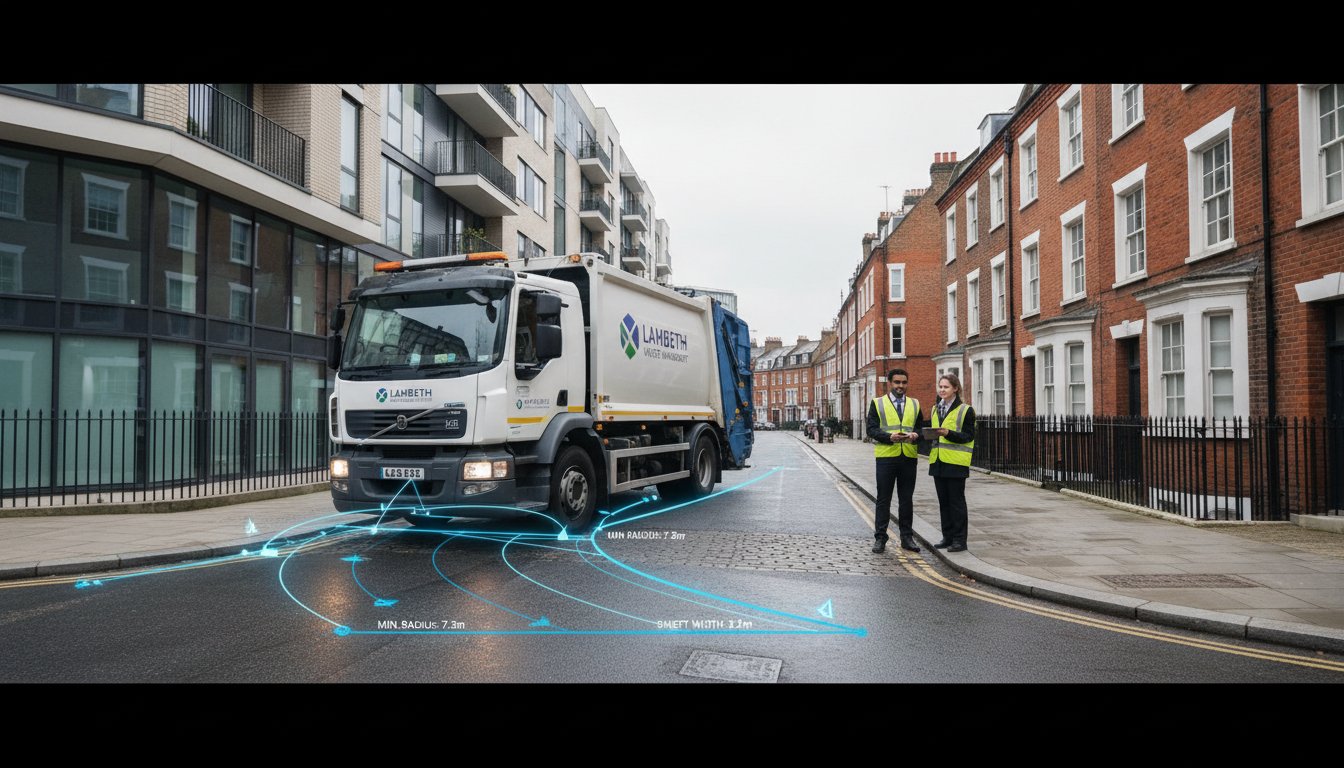
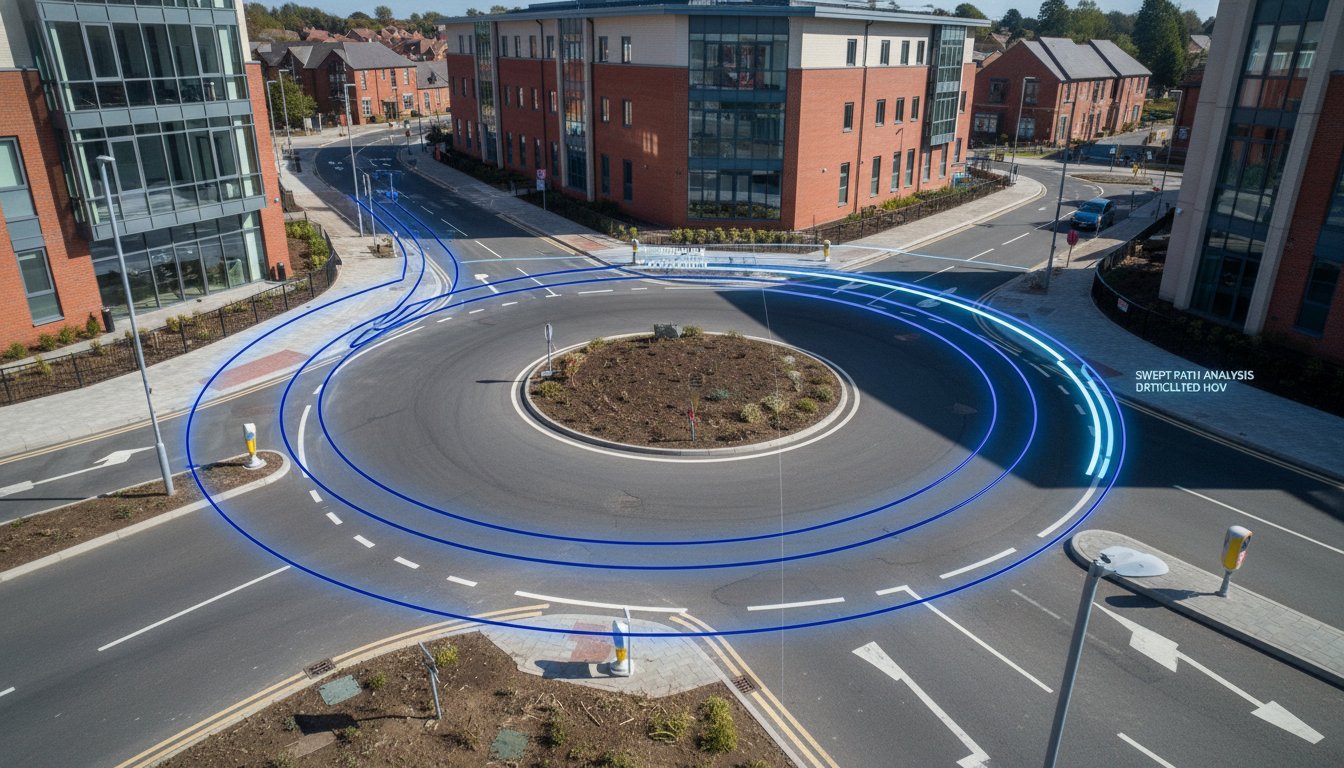
    Swept Path Analysis (SPA) is the primary tool for proving that large vehicles, such as fire tenders and refuse lorries, can safely maneuver within your development. Adhering to rigorous technical standards, much like the framework found in Federal Highway Administration policies, ensures that every vehicle movement is mathematically verified. This technical rigor prevents the safety hazards that arise when site designs fail to accommodate essential services. You can explore our full range of Swept Path Analysis services to see how this data secures your approval.

    Visualizing Access with Swept Path Analysis

    We use industry-standard software, specifically AutoTURN 2026, to simulate real-world vehicle movements. This version includes 102 new standard vehicles for Europe, ensuring your design accounts for modern transport dimensions. By visualizing these paths, we confirm compliance with the “Manual for Streets” and specific local design guides. This isn’t just about safety. Accurate SPA can actually save space. By refining the geometry of junctions and turning heads, we maximize your developable land area while maintaining full regulatory compliance.

    The Critical Role of Parking and Traffic Surveys

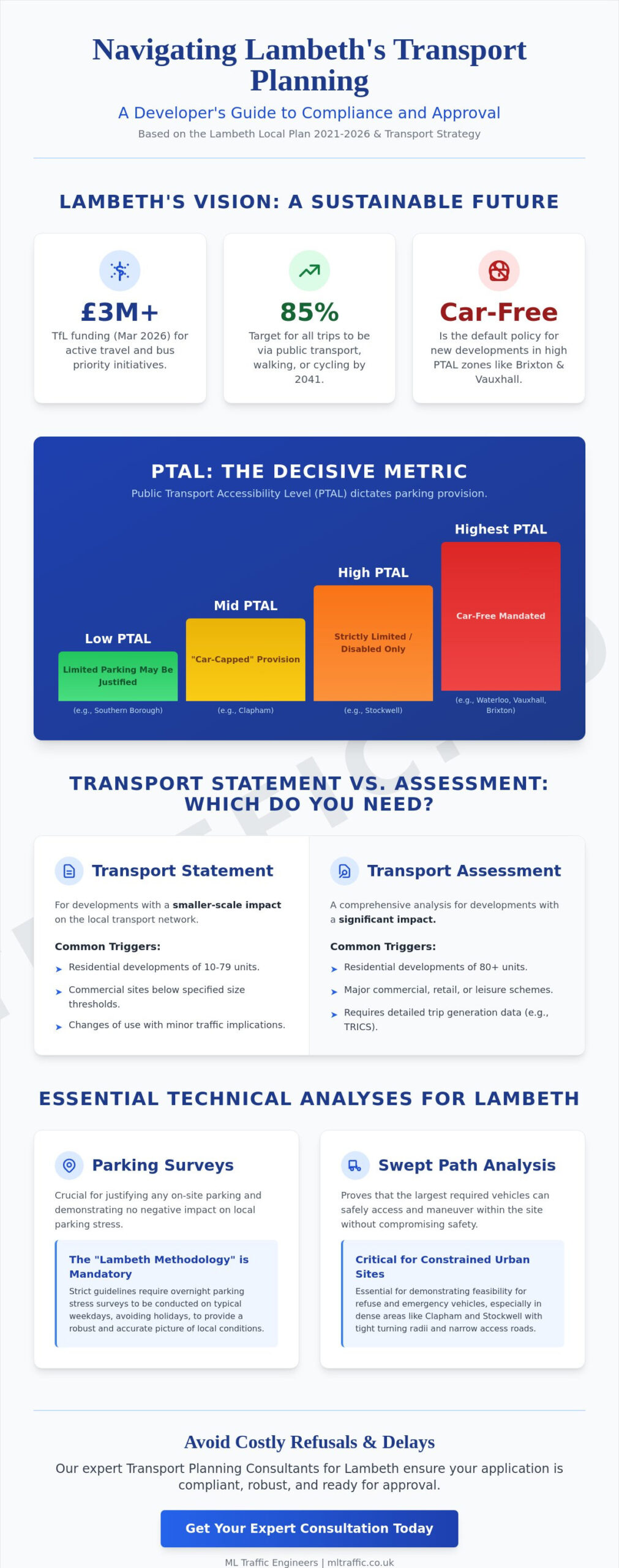
    Parking is often a contentious issue in planning applications. We use Parking Surveys, frequently following the Lambeth Methodology, to justify parking ratios and demonstrate that a development won’t overwhelm local streets. This involves conducting overnight parking stress surveys to provide a clear picture of existing demand. Similarly, our Traffic Surveys establish baseline flows before your development traffic is even added. This data is your strongest weapon against unreasonable council demands. When an authority claims a road is at capacity, an experienced highway consultant provides the independent traffic counts needed to challenge that assertion and keep your project moving.

    The Highway Planning Lifecycle: From Feasibility to S278

    The journey from site concept to legal highway agreement is a sequential process requiring meticulous technical oversight. A highway consultant manages this lifecycle to ensure each stage builds a defensible case for approval. With the introduction of Lane Rental Charges under the Street Works Order 2026, the financial stakes for works within the highway have never been higher. Efficient progression through these steps is essential to maintain project viability.

    • Step 1: Feasibility and Access Review. We identify “showstoppers” early by applying the 2025 updates to the Design Manual for Roads and Bridges (DMRB). This prevents investment in non-viable sites.
    • Step 2: Pre-application Consultation. Engaging with the Local Highway Authority (LHA) early builds rapport and clarifies their specific requirements before formal submission.
    • Step 3: Technical Submission. We draft the Transport Statement and Swept Path Analysis to provide the evidence base for your application.
    • Step 4: Negotiation. We act as your technical advocate, responding to post-submission queries and resolving objections from planning officers.
    • Step 5: Discharge of Conditions and S278. Once planning is granted, we manage the technical details required to move toward legal agreements and site commencement.

    Precision at every stage reduces the regulatory pressure on your team. If you are preparing a new submission, you can start your site feasibility review with our team today.

    Navigating Section 278 and Section 38 Agreements

    Securing planning consent is only half the battle. For works involving the existing public highway, you must enter into a Section 278 (S278) agreement. The 2026-2027 fee schedule now includes a minimum combined technical approval and inspection fee of £15,348 for schemes over £15,000. For larger projects, the technical approval fee is 3.75% of the construction value. A highway consultant manages this technical approval process to ensure your road designs meet the LHA standards without unnecessary over-engineering. For a deeper look at these requirements, read our Guide to Highway Design S278 & S38.

    Mitigating Planning Conditions

    Planning approvals often come with strings attached in the form of pre-commencement conditions. These frequently include requirements for Travel Plan monitoring to promote sustainable transport. We ensure these conditions are reasonable, necessary, and enforceable. While developers must also address logistics, we provide resources like our guide to Construction Logistics Plans to help you understand the full scope of 2026 approvals. Our focus remains on delivering the technical data, such as Traffic Surveys, needed to satisfy the LHA and clear your path to construction.

    Why ML Traffic Engineers UK is Your Strategic Highway Partner

    Choosing the right technical advocate determines whether your development moves forward or stalls at the first hurdle. ML Traffic Engineers UK provides the specialized authority needed to satisfy planning officers while protecting your commercial interests. We don’t just deliver data; we offer a reassuring presence in a high-stakes environment where precision is a functional necessity. A professional highway consultant from our team understands that every project is unique, requiring a tailored approach that balances safety standards with your specific site goals.

    Reliability and readiness define our operational model. We recognize that infrastructure projects are time-sensitive and often involve unpredictable regulatory shifts. Because we maintain a constant state of availability, we can respond to Local Highway Authority queries with the urgency your project demands. This proactive stance reduces the logistical pressure on your team and ensures that technical evidence is always ready when needed. We take pride in our ability to manage full project lifecycles from inception to completion.

    Our Approach to Technical Excellence

    We combine deep industry expertise with the latest modeling software to provide results that are both accurate and defensible. Our reports are rooted in a technical lexicon that planning officers across England recognize and respect. This standard of formal excellence is why our submissions consistently move through the review process without unnecessary friction. You can explore our range of project types to see how we apply this expertise to diverse development challenges.

    Contact Us for a Technical Fee Proposal

    We’re ready to assist with your next application. Send us your site plan, and we’ll provide a clear, functional assessment of the highway requirements. Our fee proposals are transparent and sequential, mirroring the natural progression of your project. We promise precision, adherence to industry benchmarks, and a commitment to your success. Get a quote for your highway consultancy needs from ML Traffic Engineers UK and move your project toward a successful conclusion.

    Securing Your Development’s Future with Technical Precision

    Success in modern planning requires more than just meeting basic requirements; it demands a proactive strategy that anticipates regulatory pushback. By integrating precise Swept Path Analysis and evidence-based Transport Assessments, you move beyond the validation hurdle and into a position of strength. A professional highway consultant acts as the vital link between your vision and the strict safety standards of the Local Highway Authority, ensuring that every design choice is both safe and commercially viable.

    ML Traffic Engineers UK has been a dependable partner for developers since 2014, providing the technical authority needed to navigate England’s complex planning landscape. With over a decade of success, we specialize in high-stakes reporting that stands up to the most rigorous scrutiny. Secure your planning approval with expert highway consultancy from ML Traffic Engineers UK. Let our expert knowledge of UK-wide requirements turn your technical challenges into a clear path toward site commencement.

    Frequently Asked Questions

    What is the difference between a highway consultant and a civil engineer?

    A highway consultant focuses on the planning, policy, and traffic flow aspects of a development rather than the structural design of the road itself. While a civil engineer handles the physical construction details, a consultant specializes in navigating the National Planning Policy Framework (NPPF) and securing technical approval from the Local Highway Authority. They bridge the gap between your site layout and the regulatory requirements for road safety and junction capacity.

    Do I need a highway consultant for a single dwelling access?

    Yes, many local authorities now require technical proof of safety even for small-scale projects. A highway consultant is often needed to demonstrate that a single access point has adequate visibility splays and doesn’t negatively impact road safety. Councils frequently request a Swept Path Analysis for individual houses to prove that emergency vehicles, such as fire tenders, can safely enter and turn within the site boundary.

    How much does a highway consultant cost for a planning application?

    Fees for consultancy services vary depending on the complexity of the project and the specific reports required by the council. A simple Swept Path Analysis for a minor development will cost less than a full Transport Assessment for a major commercial site. Developers should consider these costs as an investment in project viability, as professional reporting prevents expensive validation delays and reduces the risk of planning refusal.

    What is a Section 278 agreement and why do I need a consultant for it?

    A Section 278 (S278) agreement is a legal contract between a developer and the Highway Authority for works on the existing public road. You need a consultant to manage the technical approval process and ensure the proposed designs meet strict local standards. This specialist oversight prevents over-engineering and manages the technical details required to discharge planning conditions before construction begins on the highway.

    Can a highway consultant help if my planning application has been refused?

    A consultant provides the technical evidence necessary to challenge highway-related refusals during the appeal process. By analyzing the specific objections raised by the planning officer, they can conduct targeted Traffic Surveys or Swept Path Analysis to prove the development is safe. This data-driven approach is often the only way to demonstrate that a council’s objection is unreasonable or based on outdated information.

    How long does it take to produce a Transport Statement?

    The production of a Transport Statement typically takes between two and four weeks. This timeline depends on whether existing traffic data is available or if new Traffic Surveys are required to establish baseline flows. Engaging a consultant early in the feasibility stage ensures that these essential documents are ready for submission, preventing bottlenecks during the initial validation of your planning application.

    What vehicle templates are used for Swept Path Analysis in the UK?

    We use industry-standard vehicle templates from software such as AutoTURN 2026 to ensure accuracy. The most common templates for UK planning include the 11.4m refuse collection vehicle and the 8m fire tender. These simulations confirm that the site layout complies with the Manual for Streets and can accommodate the specific service vehicles used by local authorities and emergency services.

    Why is a parking survey required if I am providing on-site parking?

    Local authorities need to understand the impact of potential “overspill” parking on the surrounding road network. Even if you provide the required number of spaces, a parking survey using the Lambeth Methodology proves that the local streets can safely handle any additional demand. This evidence reassures planning officers that the development won’t lead to parking stress or safety hazards for existing residents.

    Which areas in London do you cover?

    We service Acton, Balham, Barking, Barnes, Barnet, Battersea, Beckenham, Bexleyheath, Brentford, Brixton, Bromley, Camberwell, Carshalton, Charlton, Chelsea, Chiswick, Clapham, Coulsdon, Croydon, Crystal Palace, Dagenham, Dulwich, Ealing, Edgware, Eltham, Enfield, Finchley, Forest Gate, Fulham, Golders Green, Greenwich, Hackney, Hammersmith, Hampstead, Harrow, Hayes, Highgate, Hounslow, Ilford, Islington, Kensington, Kentish Town, Kingston upon Thames, Lewisham, Mitcham, Muswell Hill, New Malden, Notting Hill, Orpington, Peckham, Pinner, Purley, Putney, Richmond, Romford, Ruislip, Sidcup, Southall, Southgate, Streatham, Surbiton, Sutton, Tooting, Tottenham, Twickenham, Uxbridge, Walthamstow, Wembley, West Norwood, Wimbledon, Wood Green, Woolwich, Bethnal Green, Shoreditch, Canary Wharf, Deptford, Leyton, Palmers Green, Stanmore, Upminster, Chislehurst, Erith, Feltham.

    Which cities in England do you cover?

    We service London, Birmingham, Manchester, Liverpool, Sheffield, Leeds.

    Michael Lee

    Article by

    Michael Lee

    Transport planner with over 35 years’ experience.

    Disclaimer

    The content on mltraffic.co.uk, including all technical articles, guides, and resources, is provided for general informational and educational purposes only. It is not intended to constitute professional advice in traffic engineering, transportation planning, development approvals, or any other technical or legal field.
    While ML Traffic Engineers makes every reasonable effort to ensure the accuracy, completeness, and timeliness of the information published, we do not provide any warranties or representations (express or implied) regarding its reliability, suitability, or availability for any particular purpose. Any reliance you place on the content is strictly at your own risk.
    In no event shall ML Traffic Engineers, its directors, employees, authors, or affiliates be liable for any direct, indirect, incidental, special, consequential, or punitive damages (including, without limitation, loss of profits, data, or business opportunities) arising out of or in connection with the use of, or inability to use, any information provided on this website.
    The articles and guides on this site are not a substitute for engaging a qualified, professional traffic engineer to assess your specific project requirements. For tailored advice, compliance assessments, or traffic engineering services, please contact a competent professional.
    This disclaimer may be updated from time to time without notice. By accessing or using this website, you agree to be bound by the most current version of this disclaimer.

  • What is a Traffic Engineer? A Guide for Developers

    What is a Traffic Engineer? A Guide for Developers

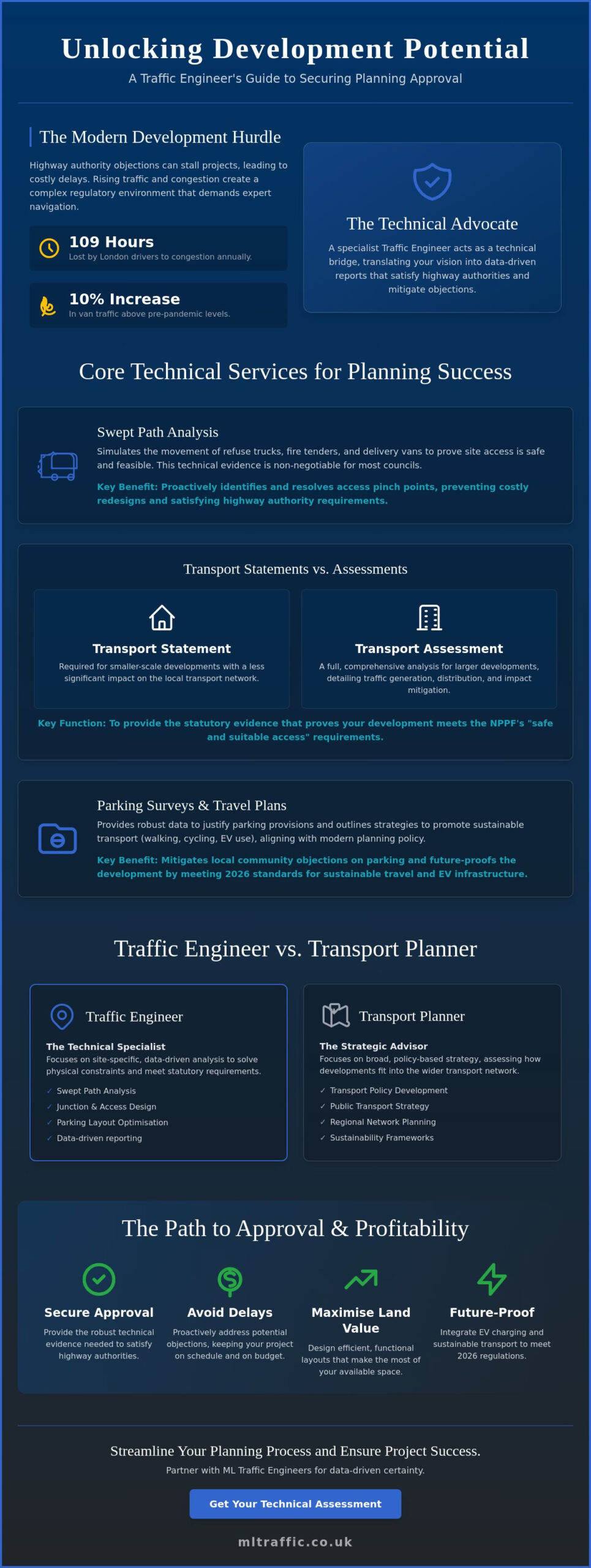
    With van traffic rising 10% above pre-pandemic levels and London drivers losing 109 hours a year to congestion, your development’s access strategy isn’t a simple box-ticking exercise. It’s a high-stakes regulatory hurdle. You’ve likely felt the frustration when a highway authority objection stalls your project; these delays create unnecessary costs and uncertainty for your timeline. A specialist traffic engineer acts as your technical advocate, transforming these logistical barriers into a clear path toward planning approval.

    This guide explains how expert transport data secures your site’s future. You’ll learn how to determine whether you need a Transport Statement or a full Transport Assessment to satisfy local authorities. We’ll also explore how technical tools like Swept Path Analysis and Parking Surveys provide the evidence needed to counter local objections. By the end of this article, you’ll understand how to design a safe, efficient layout that meets 2026 standards and maximises your land value.

    Key Takeaways

    • Understand the vital role of a traffic engineer in navigating complex UK transport policies and securing planning approval for your site.
    • Identify the specific technical documents, such as Transport Assessments and Travel Plans, required to satisfy highway authority requirements.
    • Learn to distinguish between traffic engineers and transport planners to ensure you engage the correct specialist for your project’s technical needs.
    • Discover how utilizing technical data like Swept Path Analysis and Parking Surveys can proactively mitigate risks and counter local objections.
    • Explore how early intervention and professional accuracy from ML Traffic Engineers streamline the planning process and maximize land value.

    Table of Contents

    The Role of a Traffic Engineer in Modern UK Development

    A traffic engineer serves as the technical bridge between your architectural vision and the strict requirements of the local highway authority. While the broad discipline of traffic engineering (transportation) encompasses highway capacity and signal timing, the modern UK developer needs a specialist focused on the planning cycle. These professionals translate complex vehicle movements into data-driven reports that satisfy statutory bodies and reduce regulatory friction. In a high-stakes environment where precision is a necessity, their role is to ensure your project moves from inception to completion without highway-related delays.

    To better understand this concept, watch this helpful video:

    Beyond Cones and Signs: Defining the Consultancy Role

    Many developers initially associate "traffic" with physical roadworks or temporary closures. However, in a consultancy context, the role is purely analytical and advisory. A traffic engineer focuses on data-driven reporting for statutory approvals rather than physical construction. They analyze how your proposed site will interact with the existing network through detailed Traffic Surveys. This work requires close collaboration with architects and planning officers to ensure that site layouts aren’t just aesthetic but functional. They provide the technical certainty that a refuse vehicle can turn safely or that a delivery van won’t block a primary arterial road. Accuracy is a functional necessity here.

    Why Traffic Engineering is Essential for Planning Approval

    Securing "safe and suitable access" remains a non-negotiable pillar of the National Planning Policy Framework (NPPF). Without expert technical evidence, your application is vulnerable to immediate highway authority objections. In 2026, the planning environment has become even more rigorous. New regulations, including the Traffic Management Permit Scheme (England) (Amendment) Regulations 2026, now mandate a focus on Electric Vehicle infrastructure and sustainable transport integration. A traffic engineer provides the evidence to mitigate local community objections. Whether it’s through a detailed Transport Assessment or a robust Travel Plan, they prove your development won’t compromise public safety or highway efficiency. This proactive approach saves time and protects your land value by removing the logistical barriers to approval.

    Core Technical Services: How Engineers Solve Site Constraints

    A traffic engineer provides the technical evidence required to prove a development is viable and safe. In 2026, this process relies heavily on digital modelling and simulation to test site layouts before any physical work begins. Recent updates to the Design Manual for Roads and Bridges (DMRB) on March 30, 2026, have refined the technical standards for these assessments. Additionally, the Traffic Management Permit Scheme (England) (Amendment) Regulations 2026, which came into force on April 10, 2026, now integrate Electric Vehicle (EV) charge point operators into the permit system. A specialist engineer ensures these new regulatory requirements are met without compromising site efficiency or parking capacity. Precision in these early stages is a functional necessity for project success.

    Swept Path Analysis: Ensuring Vehicle Access Feasibility

    Proving that emergency and service vehicles can navigate your site is a non-negotiable requirement for planning approval. A traffic engineer uses Swept Path Analysis Services to simulate the movement of specific vehicles, such as a 12-metre refuse truck or a fire tender. Modern councils demand this data for even small residential projects to prevent future access issues. This technical simulation identifies pinch points in your layout early. It allows for adjustments that protect your land value while ensuring public safety. If you’re developing on a tight urban site, accurate simulation is your best defense against highway authority objections.

    Transport Statements and Assessments: The Statutory Requirement

    The scale of your development determines whether you need a Transport Statement or a full Transport Assessment. While a Statement is typical for smaller projects with limited impact, an Assessment is a comprehensive study for larger developments. These reports evaluate how your project affects the local road network and public transport capacity. Understanding these requirements is vital, as this resource from Michigan State University explains the difference between broader transportation disciplines and specific technical applications. For projects in the capital, following a Transport Assessment London Guide ensures your submission aligns with the specific policies of the London Plan, such as car-free mandates in high-accessibility areas. Providing this technical evidence early reduces the risk of costly delays during the planning cycle. You can explore our technical planning services to see which reports your specific project requires.

    Traffic Engineer vs. Transport Planner: Navigating the Terminology

    Developers often use the terms "transport planner" and "traffic engineer" interchangeably, but this confusion can lead to critical gaps in a planning submission. A transport planner typically focuses on the "why" of a project. They handle high-level policy alignment, sustainable travel strategies, and long-term social impacts. In contrast, a traffic engineer is a technical specialist focused on the "how." They analyze the physical geometry of a site, calculate junction capacity, and ensure vehicle movements are safe and compliant with the latest standards. It’s also vital to distinguish these roles from traffic management contractors; an engineer provides the analytical design required long before any physical cones or signs appear on the road.

    This distinction is essential for meeting the technical requirements of modern UK infrastructure. The professional profile for Transportation Engineers highlights a reliance on mathematical modelling and complex problem-solving. While a planner might argue for a reduction in car parking based on local public transport accessibility, the engineer proves the remaining parking layout functions without causing vehicle conflict or safety risks. Precision is a functional necessity here. A successful planning application requires these two disciplines to work in tandem, ensuring policy goals are supported by technical reality.

    Strategic Planning vs. Technical Design

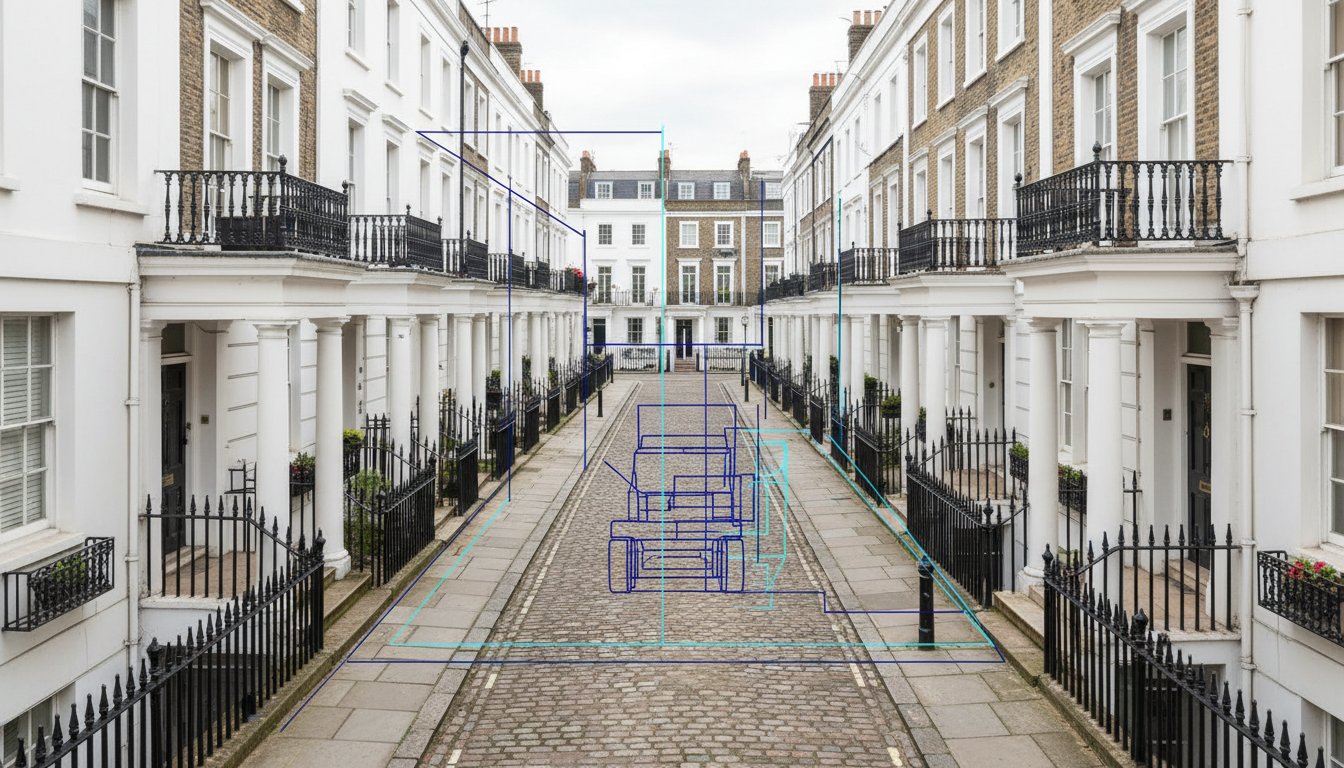
    Strategic planners are your primary navigators for the London Plan or national sustainability targets. They excel at arguing for a project’s place within a wider urban context. However, they rarely possess the tools to simulate the physical dynamics of a 12-metre vehicle entering a narrow mews. This is where the engineering role becomes indispensable. When you hire a traffic engineer, you’re securing the technical feasibility of your site. They focus on design elements such as visibility splays, gradient changes, and Swept Path Analysis. They provide the hard data that highway authorities demand before they’ll sign off on a project. Without this engineering input, a planner’s strategy remains a theoretical exercise rather than a buildable reality.

    When Do You Need a Specialist Traffic Engineer?

    Specific "trigger points" in a development cycle mandate the involvement of an engineering specialist. If your site has a complex junction, a steep access ramp, or a particularly tight entrance, a planner’s report won’t suffice. You need an engineer when your project involves works within the existing highway, specifically for Section 278 or Section 38 agreements. These legal requirements demand a level of technical precision that only an engineering consultant can provide. Early intervention is key to avoiding highway authority objections. You can find more technical guidance in our Highway Design S278 & S38 Guide. Using an engineer early ensures your site layout is optimized for both safety and land value, preventing expensive redesigns late in the planning process.

    Maximising Success in Your Planning Application

    Planning success is rarely accidental. It requires a proactive strategy where technical evidence addresses regulatory concerns before they escalate into formal refusals. A specialist traffic engineer identifies potential highway authority objections early in the cycle, allowing for design adjustments that protect your project’s timeline and budget. With Great Britain’s road traffic reaching 342.6 billion vehicle miles in 2025, local authorities are more critical than ever. The 2026 regulatory environment, including recent updates to the Design Manual for Roads and Bridges (DMRB) published on March 30, 2026, demands a higher standard of technical precision. Early technical intervention is a functional necessity to mitigate risk and avoid the heavy financial burden of a failed application.

    Early Engagement with Local Highway Authorities

    Pre-application engagement provides a clear path to approval. This process allows your consultant to discuss site constraints with council highway officers before you submit a formal application. Because engineers understand the technical lexicon of regulatory compliance, they can resolve "deal-breakers" like substandard visibility splays or restricted access points. This collaborative approach prevents the friction often caused by late-stage redesigns. It ensures that your site layout adheres to industry benchmarks from the outset, providing the reassurance that planning officers require. By speaking the same technical language as the authority, a traffic engineer builds the professional trust necessary to navigate complex urban sites.

    Using Data to Overcome Objections

    The primary obstacle for many developers is the public perception that a new site will cause "traffic chaos." You can dismantle these objections with high-quality data. Robust Traffic Surveys provide the evidence needed to prove that additional vehicle movements won’t compromise local junction capacity, even with van traffic now 10% higher than pre-pandemic levels. Similarly, Parking Surveys are vital when proposing car-free or low-parking developments. In London contexts, adhering to the Lambeth Methodology is essential for data to be accepted by local authorities. This methodology provides a standardised way to demonstrate that existing on-street capacity can accommodate any residual parking demand. This technical approach removes the subjectivity from local planning committee debates. It replaces anecdotal concerns with verifiable facts, securing your planning certainty and protecting the project’s overall land value.

    Precision in your technical submission is non-negotiable. Contact ML Traffic Engineers to secure the professional surveys needed for your planning application.

    What is a Traffic Engineer? A Guide for Developers

    Partnering with ML Traffic Engineers for Planning Certainty

    Success in the 2026 planning environment requires more than just technical data; it demands a partner who understands the high-stakes nature of property development. ML Traffic Engineers operates as a specialist UK consultancy dedicated to removing the regulatory and logistical pressures from your project. We recognize that precision is a functional necessity in every report we produce. Our team maintains a constant state of readiness to address the evolving requirements of highway authorities across England. By positioning ourselves as a vital guardian of public safety and professional integrity, we ensure your development meets every industry benchmark and legislative requirement from the outset.

    Our service model prioritizes rapid response and unwavering reliability. We manage full project lifecycles, moving your application from initial feasibility through to final statutory approval. This all-encompassing approach allows you to focus on the broader aspects of your development while we handle the intricate technical details. We take immense pride in our adherence to standards, ensuring that every submission is bulletproof and safety-conscious. When you work with a traffic engineer from our team, you gain a dependable partner who understands regional regulations so you don’t have to.

    Expert Technical Reporting for England’s Developers

    Our track record demonstrates a consistent ability to secure planning certainty for diverse project types. We specialize in delivering robust Transport Statements and Travel Plans tailored to the specific needs of your site. Navigating complex urban environments with restricted access is a core strength of our consultancy. We use advanced modelling tools to prove that even the tightest sites can function safely and efficiently. You can explore our full range of technical services by visiting What We Do. Each report we generate serves as a definitive piece of evidence to support your application’s success.

    Comprehensive Support from Inception to Approval

    The path to planning approval often involves technical challenges and unexpected comments from council highway officers. We provide comprehensive support that extends well beyond the initial data collection phase. Our proactive approach includes managing the dialogue with highway authorities and resolving technical objections with precision and speed. We don’t just provide reports; we provide solutions that protect your land value and project timeline. This commitment to excellence ensures that your development remains compliant with the latest 2026 standards, including recent updates to the Design Manual for Roads and Bridges. Contact ML Traffic Engineers for a project review to secure the technical authority your development requires.

    Secure Your Planning Approval with Technical Precision

    Navigating the 2026 planning landscape requires more than just a viable site; it demands technical evidence that satisfies the most rigorous highway authority standards. You’ve learned how a specialist traffic engineer transforms complex vehicle dynamics into the clear data required for statutory approval. By utilizing professional Parking Surveys and junction modelling, you replace local uncertainty with verifiable facts. From detailed Swept Path Analysis to comprehensive Transport Statements, these technical documents are the foundation of a successful application. Early intervention doesn’t just resolve objections; it actively protects your project’s timeline and land value.

    ML Traffic Engineers has provided this essential technical authority since 2014. With over a decade of planning success, we specialize in delivering the precise evidence developers need to navigate UK regional highway regulations. We ensure your site layout is safe, compliant, and ready for approval. Get Expert Traffic Engineering Support for Your Planning Application. Your project’s success is within reach when you have a dependable partner managing your technical submission.

    Frequently Asked Questions

    What is the difference between a traffic engineer and a transport planner?

    A traffic engineer focuses on the technical and operational aspects of a transport system, including road design, vehicle dynamics, and safety management. In contrast, a transport planner deals with strategic development and long-term policy implementation. While planners handle the high-level "why" of a project, engineers manage the "how" by calculating junction capacity and ensuring site geometry meets strict safety standards.

    When is a Transport Statement required for a planning application in the UK?

    A Transport Statement is typically required for developments that have relatively small transport implications but still need to demonstrate safe access. Local authorities set specific thresholds based on the number of residential units or commercial floor space proposed. This concise report proves that the development’s impact on the local network is acceptable and that the internal site layout functions correctly.

    How much does a traffic engineer cost for a small residential development?

    Consultancy fees depend on the complexity of the site and the specific reports required by the local highway authority. Developers should check with a consultant for a tailored quote based on their specific project scope. Factors such as the need for Parking Surveys or complex access designs will influence the final cost. It’s best to check directly to ensure all statutory requirements are covered.

    What is Swept Path Analysis and why does my architect need it?

    Swept Path Analysis is a digital simulation used to calculate the space required for specific vehicles, such as refuse trucks and fire tenders, to turn and manoeuvre. Architects use this data to ensure the site layout is functional and safe. Providing this technical evidence early prevents highway authority objections regarding vehicle access and protects the overall land value of the development by avoiding late-stage redesigns.

    Can a traffic engineer help if the council has already objected to my project?

    Yes, an engineer can provide technical evidence to counter specific highway authority objections. By conducting Traffic Surveys or using Swept Path Analysis to redesign access points, they can prove that the council’s concerns are mitigated. This technical advocacy often resolves disputes through data-driven reporting, frequently avoiding the need for a costly and time-consuming planning appeal.

    How long does it take to prepare a Transport Assessment for planning?

    The preparation time for a Transport Assessment varies based on the scale of the development and the depth of data collection required. A standard assessment usually takes several weeks to complete because it involves site visits, junction modelling, and coordination with planning officers. Starting this process early ensures the final report is robust and satisfies all regulatory requirements before the submission deadline.

    Do I need a traffic survey for a change of use application?

    A survey is often necessary if the change of use results in a significant increase in vehicle trips or a change in delivery patterns. Planning officers need to understand how the new use affects the local highway network compared to the previous permission. Providing accurate data demonstrates that the proposal won’t compromise local road safety or capacity, reducing the risk of a highway objection.

    What is a Section 278 agreement and why do I need an engineer for it?

    A Section 278 agreement is a legal contract between a developer and the Highway Authority for permanent works on a public road. You need a traffic engineer to provide the technical design and capacity analysis required for these works. Their expertise ensures that the proposed changes meet strict safety benchmarks and legislative requirements, which is a non-negotiable foundation for securing final approval.

    Which areas in London do you cover?

    We service Acton, Balham, Barking, Barnes, Barnet, Battersea, Beckenham, Bexleyheath, Brentford, Brixton, Bromley, Camberwell, Carshalton, Charlton, Chelsea, Chiswick, Clapham, Coulsdon, Croydon, Crystal Palace, Dagenham, Dulwich, Ealing, Edgware, Eltham, Enfield, Finchley, Forest Gate, Fulham, Golders Green, Greenwich, Hackney, Hammersmith, Hampstead, Harrow, Hayes, Highgate, Hounslow, Ilford, Islington, Kensington, Kentish Town, Kingston upon Thames, Lewisham, Mitcham, Muswell Hill, New Malden, Notting Hill, Orpington, Peckham, Pinner, Purley, Putney, Richmond, Romford, Ruislip, Sidcup, Southall, Southgate, Streatham, Surbiton, Sutton, Tooting, Tottenham, Twickenham, Uxbridge, Walthamstow, Wembley, West Norwood, Wimbledon, Wood Green, Woolwich, Bethnal Green, Shoreditch, Canary Wharf, Deptford, Leyton, Palmers Green, Stanmore, Upminster, Chislehurst, Erith, Feltham.

    Which cities in England do you cover?

    We service London, Birmingham, Manchester, Liverpool, Sheffield, Leeds.

    Michael Lee

    Article by

    Michael Lee

    Transport planner with over 35 years' experience.

    Disclaimer

    The content on mltraffic.co.uk, including all technical articles, guides, and resources, is provided for general informational and educational purposes only. It is not intended to constitute professional advice in traffic engineering, transportation planning, development approvals, or any other technical or legal field.
    While ML Traffic Engineers makes every reasonable effort to ensure the accuracy, completeness, and timeliness of the information published, we do not provide any warranties or representations (express or implied) regarding its reliability, suitability, or availability for any particular purpose. Any reliance you place on the content is strictly at your own risk.
    In no event shall ML Traffic Engineers, its directors, employees, authors, or affiliates be liable for any direct, indirect, incidental, special, consequential, or punitive damages (including, without limitation, loss of profits, data, or business opportunities) arising out of or in connection with the use of, or inability to use, any information provided on this website.
    The articles and guides on this site are not a substitute for engaging a qualified, professional traffic engineer to assess your specific project requirements. For tailored advice, compliance assessments, or traffic engineering services, please contact a competent professional.
    This disclaimer may be updated from time to time without notice. By accessing or using this website, you agree to be bound by the most current version of this disclaimer.

  • What is a Transport Planner? A Guide for Developers

    What is a Transport Planner? A Guide for Developers

    What if the difference between your project breaking ground and getting stuck in a multi-month regulatory deadlock was a single technical report? You already know that securing planning permission is becoming more expensive and complex, particularly following the 3.8% increase in planning application fees across England on April 1, 2026. It’s common to feel the pressure when local councils suddenly demand intricate data or when you’re forced to navigate the confusion between consumer journey apps and a professional transport planner who understands the law.

    You deserve a clear path to approval without the friction of unexpected technical hurdles. This guide shows you how a transport planner acts as a strategic risk-mitigator to secure your approvals and protect your bottom line. We will examine how specialized services like Swept Path Analysis and Transport Statements ensure your site access is safe and compliant with the latest 2026 standards. By the end of this guide, you’ll understand how to leverage technical expertise to avoid costly design revisions and keep your project moving forward at pace.

    Key Takeaways

    • Identify the specific role of a professional transport planner in translating complex regulatory requirements into technical reports that secure planning approval.
    • Differentiate between Transport Statements and comprehensive Transport Assessments to ensure your application meets the exact evidentiary standards of the local authority.
    • Utilize digital tools like Swept Path Analysis to provide definitive proof of safe site access and avoid expensive design revisions late in the project lifecycle.
    • Navigate the technical complexities of Section 278 and Section 106 agreements with precision to mitigate development risks and manage infrastructure impacts.
    • Leverage data-driven Parking Surveys and Traffic Surveys to address council objections regarding local network capacity and site viability.

    Table of Contents

    What is a Transport Planner? (And Why Developers Need One)

    A transport planner acts as a technical bridge between your architectural vision and the regulatory requirements of the local highway authority. This role isn’t about deciding where a new train line should go. Instead, it focuses on providing the robust technical evidence needed to prove that your specific development won’t negatively impact road safety or local congestion. They assess how a project integrates with the existing network, ensuring that site access is safe and the infrastructure can handle the increased demand.

    To better understand this concept, watch this helpful video:

    Professional transportation planning involves a rigorous cycle of data collection, traffic modelling, and the preparation of statutory reports. This work is entirely distinct from consumer-facing tools like TfL’s journey planners. While a journey app helps a commuter find the quickest route, a professional consultant uses specialized CAD software and TRICS data to prove that a refuse vehicle can safely maneuver within your site boundaries. They translate raw data into the technical language that council planning officers require for approval.

    The Role in the Planning Application Process

    In the context of a planning application, your transport planner serves as an expert witness. They handle technical scrutiny from council officers and provide the data required by the National Planning Policy Framework (NPPF). This involves liaising directly with Highway Authorities to agree on mitigation measures, ensuring that transport-related queries don’t stall your project. By providing this technical evidence early, you reduce the risk of late-stage objections that could derail your construction timeline or lead to expensive design changes.

    Consultancy vs. Public Sector Planning

    It’s vital to distinguish between public sector planners and private consultants. Public sector planners work for the local authority to set regional transport policy and manage the wider network. Private consultants, however, focus exclusively on the developer’s needs. They help you navigate specific council standards and use independent data to challenge unreasonable or outdated demands from local authorities. A transport planning consultant is a strategic partner who ensures your development remains viable, safe, and fully compliant with current legislation.

    Key Deliverables: Transport Statements and Assessments

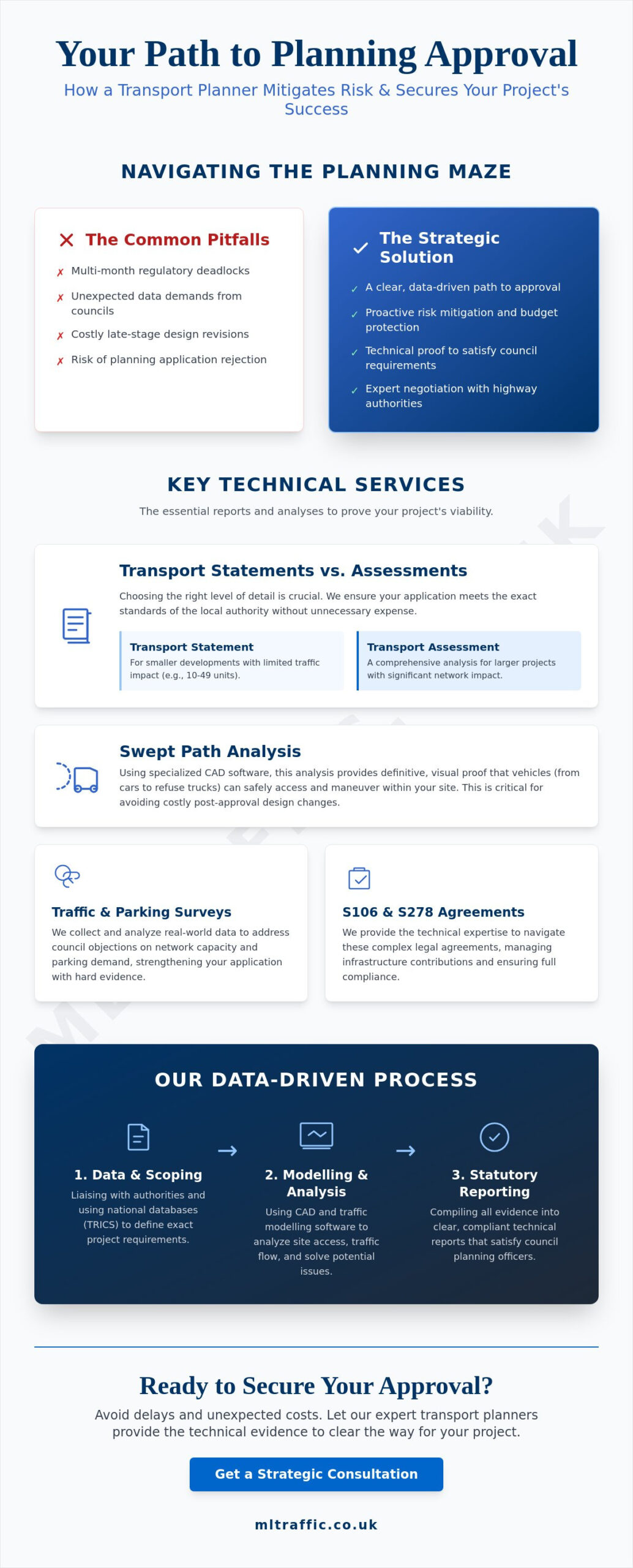
    A transport planner produces the specific technical documentation required for every stage of a planning application. The scale of your development determines the depth of reporting needed. Smaller projects with limited traffic implications typically require a Transport Statement. Larger developments that could significantly impact the local network necessitate a full Transport Assessment. Both types of documents rely on the TRICS database. This national system allows consultants to predict trip generation by comparing your project to similar land uses across the UK. By using this data, your consultant provides a realistic forecast of the volume of vehicles, cyclists, and pedestrians your site will attract.

    Choosing the Right Report for Your Project

    Selecting the correct report depends on specific thresholds set by individual local authorities. While official government guidance provides a general framework, councils often apply stricter requirements in dense urban environments. For residential developments, a Transport Statement is often the standard for 10 to 49 units, but these figures can change based on local policy. Engaging a professional early for a scoping study can prevent you from over-investing in a full assessment when a simpler statement would suffice. You can review our resources to understand how these technical requirements apply to your specific project type.

    Sustainable Travel and Travel Plans

    Modern planning success in 2026 relies heavily on sustainable transport strategies. A Travel Plan is no longer an optional extra; it is a vital tool to encourage active travel and reduce reliance on private cars. Since the electric vehicle exemption for the London Congestion Charge ended in late 2025, the focus has shifted toward infrastructure readiness. Your reports must now detail active EV charging points and high-quality cycle parking to meet the 100% provision mandate for new residential spaces. A robust plan can effectively offset concerns about traffic volume by demonstrating a clear commitment to reduced vehicle usage.

    Securing your planning approval requires precision in these technical reports. If you’re unsure which document your project needs, reviewing our technical services can help clarify the requirements for your next submission. A transport planner ensures your data is accurate and compliant from the first draft.

    What is a Transport Planner? A Guide for Developers

    Technical Analysis: Proving Site Viability

    Technical analysis transforms a conceptual design into a viable, functional site. While previous sections focused on the strategic reports required for submission, this stage involves the raw data that proves those reports are accurate. A transport planner utilizes advanced modelling software and on-site observations to ensure every vehicle, from a standard car to a 12-meter refuse truck, can navigate the proposed layout. This precision reduces the risk of the council rejecting a scheme based on perceived safety or access issues. It moves the conversation from abstract policy to physical reality.

    The Power of Swept Path Analysis

    Swept Path Analysis (SPA) is the cornerstone of modern site design. By simulating the movement of specific vehicles on your digital site plans, we identify potential pinch points before they become physical obstacles. This is particularly critical for emergency services access. If a fire tender cannot reach the furthest point of your development, the scheme will fail its safety assessment. Utilizing professional Swept Path Analysis services provides the definitive evidence needed to satisfy these safety requirements. This proactive approach prevents the need for expensive structural changes or road widening once construction has already begun.

    Parking Surveys and the Lambeth Methodology

    High-density urban developments often face intense scrutiny regarding parking capacity. To justify a specific parking ratio, we conduct comprehensive Parking Surveys. Following the Lambeth Methodology, these overnight surveys establish the exact level of parking stress on surrounding streets. This data is essential when proposing car-free developments in areas with high Public Transport Accessibility Levels (PTAL). It demonstrates that the development won’t cause overspill parking that inconveniences existing residents or compromises road safety. Accurate surveys are the only way to challenge council assumptions about local parking availability.

    Establishing the baseline environment also requires real-world Traffic Surveys. We measure vehicle speeds and volumes to determine the precise dimensions of visibility splays at new junctions. A visibility splay is the unobstructed view a driver needs to see oncoming traffic before pulling out. These sightlines must adhere to strict safety standards to prevent collisions. This level of technical rigor is a core responsibility within the Transport planner job profile, ensuring that every project contributes to a safer and more efficient highway network.

    Securing planning approval is only half the battle. Once technical viability is proven through analysis and surveys, a transport planner must navigate the legal frameworks that govern physical changes to the road network. Most developers encounter Section 278 (S278) agreements when their project requires modifications to the existing public highway. These agreements ensure that any changes, such as a new junction or pavement widening, meet the strict safety and construction standards of the local authority. Without this technical oversight, projects risk significant delays or refusal during the later stages of the planning process.

    Section 106 contributions also play a major role in the financial feasibility of a development. These are legally binding obligations used to mitigate the impact of a project on the wider transport infrastructure. A planner acts as your advocate, ensuring that requested contributions are proportionate and directly related to the development’s actual impact. They facilitate direct liaison with National Highways and local authorities to reach a technical consensus that protects your project’s timeline and budget.

    Understanding Highway Design Agreements

    It’s essential to distinguish between S278 and Section 38 (S38) agreements. While S278 covers works on the existing public highway, S38 relates to the adoption of entirely new roads built within the development site. A planner ensures that the technical design of these roads meets the council’s specific adoption standards from the outset. For a detailed breakdown of these requirements, read our Highway Design S278 & S38 Guide. This early alignment prevents the council from refusing to adopt the roads later, which would leave the developer with long-term maintenance liabilities.

    Pre-application Advice and Negotiation

    Risk mitigation starts long before the formal submission. Engaging a transport planner for pre-application discussions allows for early negotiation with council officers to find a technical middle ground on complex issues like site access or parking ratios. These early meetings provide an opportunity to address potential concerns in a collaborative environment rather than a confrontational one. Early engagement prevents “objection” letters from statutory consultees that can otherwise stall an application for months. This proactive liaison ensures that the final submission is already aligned with the highway authority’s expectations.

    If you’re preparing a new submission and need to navigate these regulatory requirements, view our project types to see how ML Traffic Engineers UK manages these legal agreements for developers.

    Why Choose ML Traffic Engineers UK for Your Transport Planning?

    Choosing the right transport planner is a critical decision for any developer. At ML Traffic Engineers UK, we provide specialized expertise in the English planning system, with a deep understanding of the evolving London-specific requirements. As of May 2026, motor vehicle traffic volumes have reached 105% of pre-COVID levels. This increase makes accurate data more essential than ever for securing approvals. We utilize a data-driven approach, leveraging the latest TRICS data and CAD-based Swept Path Analysis to deliver reports that withstand the highest levels of scrutiny. Our proven track record spans residential, commercial, and mixed-use developments, ensuring that your project benefits from our extensive industry knowledge.

    You gain direct access to senior consultants who prioritize rapid response and professional reassurance. In a high-stakes regulatory environment, precision is a functional necessity. We don’t just provide reports; we act as a reliable partner throughout the entire project lifecycle. Our team understands intricate regional regulations, such as the 2026 mandates for 100% EV charging access in residential developments. We handle these complexities so you don’t have to navigate them alone.

    Comprehensive Project Lifecycle Support

    Our support begins at the initial site feasibility stage and continues through to final planning sign-off. We produce tailored reporting that speaks the technical language of local authority planning officers, reducing the risk of friction during the application process. Whether we are conducting complex Parking Surveys or detailed Traffic Surveys, our focus remains on precision. This commitment ensures public safety and full regulatory compliance, protecting your project from costly delays. We manage the technical lexicon and industry benchmarks so you can focus on the broader architectural vision.

    Get Started with Your Transport Statement

    Initiating your technical assessment is a straightforward process. To provide an accurate quote for your specific development type, we typically require a site location plan and a clear description of the project scale. This information allows us to determine whether a Transport Statement or a more comprehensive Transport Assessment is the most appropriate deliverable. We value your time and understand the fast-moving nature of the infrastructure industry. By providing an all-encompassing, fully-managed service, we ensure your submission is robust from day one.

    Contact ML Traffic Engineers UK for your Transport Planning needs to discuss your next project and secure professional technical support today.

    Secure Your Development’s Future with Technical Precision

    Securing planning approval requires more than just a vision; it demands technical accuracy and a deep understanding of highway regulations. By integrating robust data from the outset, you protect your project from the high-stakes risks of regulatory delays and late-stage design changes. A professional transport planner acts as your primary advocate, translating complex traffic modelling and site constraints into the technical reporting that local authorities demand.

    Since our foundation in 2014, ML Traffic Engineers UK has delivered over a decade of planning success for developers navigating London Borough and National Highway requirements. Our comprehensive toolkit, including advanced Swept Path Analysis and TRICS trip generation data, ensures your submission is compliant and safe. We provide the technical authority needed to satisfy strict 2026 standards, from EV charging mandates to active travel targets.

    Don’t let technical transport data requests stall your project’s progress. Secure your planning approval with expert Transport Planning from ML Traffic Engineers UK. Our team is ready to provide the precision and reliability your development needs to move forward with confidence.

    Frequently Asked Questions

    What is the difference between a transport planner and a traffic engineer?

    A transport planner focuses on the strategic assessment, modeling, and reporting required to secure planning permission. They analyze how a development impacts the wider network and ensure compliance with transport policy. A traffic engineer typically handles the detailed design and technical engineering of physical infrastructure, such as junction geometry or traffic signal timings. While their roles overlap, the planner’s work is centered on the impact analysis phase of the project lifecycle.

    When is a Transport Statement required for a planning application in England?

    A Transport Statement is typically required for residential developments consisting of 10 to 49 units. However, local highway authorities in dense urban areas often set lower thresholds based on local network capacity. You should check the specific validation requirements of your local council, as they may demand a statement for smaller projects if the site is in a sensitive location or has complex access requirements.

    How much does a professional transport planner cost?

    Fees for a professional transport planner are determined by the complexity of the project and the specific deliverables required, such as Traffic Surveys or Swept Path Analysis. A comprehensive Transport Assessment involves more extensive modeling and data analysis than a Transport Statement, which impacts the overall project budget. We recommend requesting a tailored quote based on your site’s specific constraints and the local authority’s requirements.

    Can a transport planner help with a refused planning application?

    Yes, a planner is vital when a project is refused on highway or transport grounds. They analyze the council’s reasons for refusal and provide the technical evidence, such as revised Parking Surveys or improved access designs, to address those specific concerns. This evidence is essential for a successful resubmission or to support a formal planning appeal by proving the development is safe and viable.

    What is the TRICS database and why do planners use it?

    TRICS stands for the Trip Rate Information Computer System. It is the national standard database used to predict the number of trips a new development will generate. Planners use this data to provide a realistic forecast of vehicle, pedestrian, and cyclist movements by comparing your project to similar land uses across the UK. This ensures the local network can accommodate the additional demand without compromising safety.

    Do I need a transport planner for a small residential conversion?

    Small residential conversions don’t always require a full assessment, but they often trigger requests for a Parking Survey or a short Transport Statement. If your conversion is located in a high-density area with existing parking stress, the council will likely need technical proof that the new residents won’t negatively impact local street capacity. Providing this data early prevents the council from stalling your application with last-minute requests.

    What is Swept Path Analysis and is it mandatory?

    Swept Path Analysis is a digital simulation that proves specific vehicles can safely enter, maneuver within, and exit a site. While not mandatory for every single application, it’s almost always required when a development involves new access points or internal roads. Councils use it to verify that refuse trucks and fire tenders can operate without hitting curbs or buildings, ensuring the site meets essential safety standards.

    How long does it take to produce a Transport Assessment?

    Producing a full Transport Assessment typically takes several weeks, though this timeline depends on the scale of the project and the availability of data. If new Traffic Surveys or complex modeling are required, the process may take longer to ensure all information is accurate and compliant. Early engagement ensures that these technical reports are ready well before your submission deadline, reducing the risk of project delays.

    Which areas in London do you cover?

    We service Acton, Balham, Barking, Barnes, Barnet, Battersea, Beckenham, Bexleyheath, Brentford, Brixton, Bromley, Camberwell, Carshalton, Charlton, Chelsea, Chiswick, Clapham, Coulsdon, Croydon, Crystal Palace, Dagenham, Dulwich, Ealing, Edgware, Eltham, Enfield, Finchley, Forest Gate, Fulham, Golders Green, Greenwich, Hackney, Hammersmith, Hampstead, Harrow, Hayes, Highgate, Hounslow, Ilford, Islington, Kensington, Kentish Town, Kingston upon Thames, Lewisham, Mitcham, Muswell Hill, New Malden, Notting Hill, Orpington, Peckham, Pinner, Purley, Putney, Richmond, Romford, Ruislip, Sidcup, Southall, Southgate, Streatham, Surbiton, Sutton, Tooting, Tottenham, Twickenham, Uxbridge, Walthamstow, Wembley, West Norwood, Wimbledon, Wood Green, Woolwich, Bethnal Green, Shoreditch, Canary Wharf, Deptford, Leyton, Palmers Green, Stanmore, Upminster, Chislehurst, Erith, Feltham.

    Which cities in England do you cover?

    We service London, Birmingham, Manchester, Liverpool, Sheffield, Leeds.

    Michael Lee

    Article by

    Michael Lee

    Transport planner with over 35 years’ experience.

    Disclaimer

    The content on mltraffic.co.uk, including all technical articles, guides, and resources, is provided for general informational and educational purposes only. It is not intended to constitute professional advice in traffic engineering, transportation planning, development approvals, or any other technical or legal field.
    While ML Traffic Engineers makes every reasonable effort to ensure the accuracy, completeness, and timeliness of the information published, we do not provide any warranties or representations (express or implied) regarding its reliability, suitability, or availability for any particular purpose. Any reliance you place on the content is strictly at your own risk.
    In no event shall ML Traffic Engineers, its directors, employees, authors, or affiliates be liable for any direct, indirect, incidental, special, consequential, or punitive damages (including, without limitation, loss of profits, data, or business opportunities) arising out of or in connection with the use of, or inability to use, any information provided on this website.
    The articles and guides on this site are not a substitute for engaging a qualified, professional traffic engineer to assess your specific project requirements. For tailored advice, compliance assessments, or traffic engineering services, please contact a competent professional.
    This disclaimer may be updated from time to time without notice. By accessing or using this website, you agree to be bound by the most current version of this disclaimer.
  • Transport Statement Birmingham: A Developer’s Guide for 2026 approvals

    Transport Statement Birmingham: A Developer’s Guide for 2026 approvals

    Expanding our specialized infrastructure support from our established hubs in London, High Wycombe, and Slough, we are now assisting developers with the rigorous 2026 requirements in the West Midlands. With Birmingham’s population forecast to reach 1.25 million by 2031, the city council has implemented a £308 million Transport and Highways Delivery Programme that demands absolute technical precision. For developers, a transport statement Birmingham is now a vital strategic document rather than a simple administrative task; this is especially true following the 4.99% fee increase for highways-related charges in April 2026.

    We understand you need a robust report that passes council scrutiny on the first attempt to avoid the high costs of planning delays. This guide provides the clear guidance on site access and parking feasibility needed to secure your planning approval while minimizing potential Section 106 and 278 contribution costs. We will preview the essential data requirements for 2026, from navigating the Clean Air Zone to meeting new active travel benchmarks. Our goal is to reduce your regulatory pressure through precision-led reporting and unwavering reliability.

    Key Takeaways

    • Learn how to determine if your project needs a concise transport statement Birmingham or a full Transport Assessment based on your development’s scale.
    • Understand the technical integration of TRICS database modeling and baseline infrastructure analysis to predict traffic movements.
    • Identify how to address Birmingham’s Clean Air Zone (CAZ) mandates by incorporating sustainable pedestrian and cycling infrastructure.
    • Master the submission workflow, from initial site feasibility mapping to strategic scoping with Birmingham City Council highway officers.
    • Discover how precision-led Swept Path Analysis and Parking Surveys reduce regulatory friction and minimize Section 106 financial obligations.

    Table of Contents

    What is a Transport Statement for Birmingham Planning Applications?

    While our technical teams operate extensively across London, High Wycombe, and Slough, we apply the same rigorous standards to every transport statement Birmingham submission. Within the local planning framework, a Transport Statement is a technical report required for developments that don’t meet the high traffic thresholds of a full Transport Assessment (TA). It serves as a concise evaluation of a project’s impact on the highway network. This requirement is anchored in the National Planning Policy Framework (NPPF), which dictates that local decisions must account for sustainable movement and safety. By applying universal transportation planning principles, we ensure your project aligns with both national standards and the specific expectations of Birmingham City Council highway officers.

    To understand the existing infrastructure and network connectivity that your report must analyze, watch this helpful video:

    When is a Transport Statement Required in Birmingham?

    Thresholds for a Statement typically involve residential schemes between 50 and 80 units or commercial floor space of a moderate scale. However, the unique environmental requirements of the West Midlands often trigger the need for a report on much smaller sites. If your development is situated within the Birmingham Clean Air Zone (CAZ), the council may require a TS regardless of unit count to monitor emission impacts. We recommend checking the Birmingham Local Plan for site-specific requirements. Local policies often prioritize air quality and congestion management, making early technical scoping essential for sites that might otherwise fall below national thresholds.

    The Core Objectives of Your Statement

    Your transport statement Birmingham must achieve three primary goals to secure planning approval. First, it must demonstrate safe and suitable access for all road users, including pedestrians and cyclists. Second, we evaluate the residual cumulative impact on the surrounding road network to ensure junctions remain within capacity. Finally, the document must align with the Birmingham Transport Plan 2031. This strategic document emphasizes a transition toward a carbon-neutral network. If your scheme doesn’t actively support the city’s shift toward public transport and active travel, it faces a high risk of highway authority objection during the technical review phase.

    Technical Requirements: What Your Birmingham Statement Must Include

    Applying the same technical precision we utilize for developments in London, High Wycombe, and Slough, our reports for the West Midlands adhere strictly to UK government guidance on Transport Assessments. A professional transport statement Birmingham begins with a detailed baseline analysis of existing infrastructure. We document all pedestrian footways, cycle networks, and public transport nodes within a specified catchment area. To predict traffic movements, we utilize the TRICS database. This ensures your trip generation figures are based on validated data from comparable urban schemes, providing a defensible foundation for your planning application.

    Safety and sustainability are core components of the 2026 technical requirements. Your statement must include a review of Personal Injury Accident (PIA) data covering the most recent five-year period. This identifies any safety clusters near your site that could impact proposed access points. Furthermore, we conduct a sustainability audit to map proximity to Birmingham New Street, Snow Hill, and the expanding Sprint bus network. This audit aligns your project with the Birmingham Transport Plan 2031 objectives of reducing car dependency. Demonstrating high levels of connectivity is essential for securing approval in a city focused on carbon-neutral growth.

    Swept Path Analysis for Tight Urban Sites

    Many redevelopment sites feature narrow street patterns and restricted access points similar to those we manage in congested London boroughs. We use Swept Path Analysis to simulate the movement of refuse vehicles and emergency tenders. This technical proof is vital for proving that your site layout is functional and safe. Without this simulation, highway officers may object based on perceived maneuvering difficulties. Our analysis ensures your design works on paper before you commit to construction, preventing the need for expensive post-submission revisions.

    Parking Provision and Birmingham Standards

    Navigating Birmingham City Council’s maximum parking standards requires a strategic approach. For sites with high public transport accessibility, we often justify reduced parking provision to meet sustainability goals. By 2026, all new developments must also integrate EV charging infrastructure to comply with local network requirements. If your project faces parking constraints, we can conduct detailed Parking Surveys to establish current levels of street stress. This data-driven approach allows us to justify your parking strategy and reduce regulatory friction during the planning process.

    Addressing Birmingham’s Specific Transport Challenges

    Developers in 2026 must align their transport statement Birmingham with the city’s aggressive decarbonisation targets. The Birmingham Clean Air Zone (CAZ) remains a central pillar of this strategy. Revenue from the CAZ is continuously reinvested into the city’s transport network, meaning the council expects developers to prove their schemes won’t degrade air quality. For commercial sites, this requires robust delivery strategies that account for vehicle compliance within the zone. It’s not just about the vehicles; it’s about reducing the total number of trips through smarter logistics and site management.

    Major infrastructure projects like HS2 and the Curzon Street redevelopment are radically altering the city’s transport topography. These changes create a ripple effect across the inner ring road and the A38. A professional report must evaluate how your site integrates with these massive shifts. If your project sits near these major hubs, your statement needs to address long-term network capacity and connectivity. We focus on mitigating traffic impact on the A38 by promoting public transport expansion, such as the Midland Metro network and the new Sprint rapid transit buses. This ensures your development remains viable as the city’s infrastructure evolves.

    The Shift Toward Low-Traffic Neighbourhoods (LTNs)

    Birmingham’s commitment to Low-Traffic Neighbourhoods significantly influences site access strategies. The council prioritises reallocating road space to pedestrians and cyclists over private motorists. When we draft your transport statement Birmingham, we develop strong "modal shift" arguments. These arguments demonstrate how your development supports high-density urban living without increasing local congestion. We do this by integrating high-quality cycle storage and direct pedestrian links to local transit stations. Prioritising these non-car modes is often the only way to secure council support in restricted zones where car access is intentionally limited.

    Section 106 and 278 Negotiations

    A precise technical report is your strongest tool in financial negotiations. Birmingham City Council uses Section 106 and 278 agreements to fund infrastructure improvements. However, a well-drafted statement can prevent you from paying for network issues your development didn’t cause. We specialise in negotiating S278 agreements for off-site highway improvements. By providing granular data on trip generation and impact, we ensure that your required contributions remain proportional to your project’s actual footprint. Avoiding common pitfalls in S106 transport clauses can save your project significant capital during the technical approval phase.

    The Workflow: Preparing Your Statement for Submission

    A successful transport statement Birmingham follows a strict chronological path. Skipping steps or failing to agree on parameters with highway officers often leads to expensive revisions. The process begins with initial site feasibility and transport constraints mapping. We look for physical barriers, visibility issues, or existing traffic orders that might restrict access. Once the site’s potential is clear, we move to scoping the assessment with Birmingham City Council highway officers. This ensures the study area and methodology meet their specific expectations before you commit to full reporting.

    Following the scoping agreement, we initiate data collection. This includes parking surveys and traffic counts designed to capture current network behavior. Our technical team then performs the analysis, drafting the Transport Statement to address safety, sustainability, and capacity. The final step is a rigorous review before submission as part of your planning portal package. This sequential workflow ensures every claim in your report is backed by defensible data.

    The Scoping Process with Birmingham Highway Officers

    Scoping is the most critical phase for risk mitigation. In 2026, Birmingham City Council charges £1,732 for pre-application reviews for schemes up to 25 units. We recommend including a detailed scoping note that outlines your proposed trip generation methodology and the specific junctions you intend to analyze. Agreeing on the study area early prevents the council from requesting additional junction modeling midway through the planning process. Having experienced transport planning consultants lead these talks ensures technical terms align with local policy, reducing the likelihood of highway authority objections.

    Data Collection and Surveys

    Accuracy in data collection is paramount. Birmingham requires data to be current, typically collected within the last three years, to reflect the post-CAZ traffic environment. We use a mix of Automated Traffic Counts (ATCs) for long-term flow data and manual turning counts for specific junction behavior. Parking surveys must follow the council’s approved methodology, often requiring overnight observations to establish a true baseline of local parking stress. This precision prevents the council from dismissing your findings as outdated or unrepresentative.

    If you are ready to begin your project’s technical assessment, you can secure our professional transport planning services to ensure your data meets Birmingham’s 2026 standards.

    Transport Statement Birmingham: A Developer’s Guide for 2026 approvals

    Why ML Traffic Engineers for Your Birmingham Project?

    Choosing the right technical partner is the difference between immediate planning approval and costly, time-consuming resubmissions. At ML Traffic Engineers, we provide a precision-led approach that ensures every transport statement Birmingham we produce meets 2026 statutory standards. We understand that the 4.99% increase in highways-related charges and the £15,348 minimum fee for Section 278 technical approvals leave no room for error. Our reports are built on defensible data and rigorous analysis, designed specifically to satisfy the scrutiny of Birmingham City Council highway officers.

    We deploy a client-focused strategy that reduces regulatory pressure on developers and architects. By managing the technical complexities of your application, we allow you to focus on the broader aspects of your development. Our team is equipped to handle the full range of required services, including:

    • Detailed Transport Statements and full Transport Assessments.

    • Technical Swept Path Analysis to verify site accessibility for emergency and service vehicles.

    • Comprehensive Parking Surveys that align with local maximum standards.

    • Robust Travel Plans and Traffic Surveys to support sustainable urban integration.

    We recognize the fast-moving nature of the West Midlands construction sector. Our readiness and commitment to rapid response ensure we meet tight planning deadlines with unwavering reliability. We don’t just provide data; we provide a fully-managed service that moves your project from initial inception to final council negotiations.

    A Dependable Partner for West Midlands Infrastructure

    Our experience in navigating the intricate regional regulations of the West Midlands makes us a vital partner for your project. We understand how the Birmingham Transport Plan 2031 impacts private site access and how to frame modal shift arguments that win council support. We take immense pride in our professional integrity and adherence to industry benchmarks. As your technical consultant, we act as a guardian of project safety and compliance, ensuring your site design is functional and safe for all road users. You can explore our previous project types to see how we manage full lifecycles for various residential and commercial schemes.

    Get Your Birmingham Transport Statement Quote

    We provide direct, active support for all residential and commercial planning applications across the city. Whether you are navigating the complexities of the Clean Air Zone or need to justify reduced parking provision in a high PTAL area, our team is ready to discuss your site’s specific transport needs today. We focus on providing clarity and rapid information delivery to keep your project on track. Accuracy in your initial submission prevents the need for expensive post-submission revisions.

    Request a professional Transport Statement quote for your Birmingham project and secure the technical expertise required for 2026 planning success.

    Secure Your 2026 Planning Approval with Technical Precision

    Birmingham’s evolving infrastructure requires a proactive approach to technical planning. Successfully securing your 2026 approval depends on aligning your site with the city’s sustainable network goals and navigating specific Clean Air Zone requirements. A professional transport statement Birmingham must translate complex traffic data into a strategic argument for urban integration while minimizing your Section 106 and 278 contribution costs. Precision in the early stages prevents highway authority objections that can derail your project timeline.

    ML Traffic Engineers has been delivering planning success since 2014. Our specialized expertise in Swept Path Analysis and TRICS data ensures your report stands up to rigorous council scrutiny. As professional members of the Chartered Institution of Highways and Transportation (CIHT) and the Institute of Highway Engineers (IHE), we maintain the highest standards of technical excellence. We manage the full project lifecycle from initial feasibility to final submission so you don’t have to navigate these logistical pressures alone.

    Ready to move your development forward? Contact ML Traffic Engineers for a Birmingham Transport Statement Quote today. We are prepared to help you navigate the city’s complex regulatory landscape with confidence.

    Frequently Asked Questions

    How much does a Transport Statement cost in Birmingham for 2026?

    The cost of a technical report varies depending on the scale of the development and the complexity of the required data. Developers must also budget for Birmingham City Council’s statutory fees, such as the £1,732 charge for pre-application advice on minor schemes. For a precise quote tailored to your site’s specific constraints, you should consult with our technical team directly.

    What is the difference between a Transport Statement and a Transport Assessment?

    A Transport Statement is a concise report for smaller developments with limited traffic impact. In contrast, a Transport Assessment (TA) is a comprehensive document required for major projects that generate significant movement. While a Statement focuses on immediate site access and local infrastructure, a TA involves extensive junction modeling and a wider analysis of the regional road network.

    Can I write my own Transport Statement for a Birmingham application?

    While you can technically draft your own document, it’s not recommended for professional planning applications. Birmingham highway officers require technical data, such as TRICS trip generation and accident analysis, that must meet industry benchmarks. Reports that lack professional precision or fail to use recognized methodologies often face immediate objections, leading to expensive delays and potential planning refusal.

    How long does it take to produce a professional Transport Statement?

    The production timeline typically spans several weeks, depending on the speed of data collection and council scoping responses. This period allows for site visits, traffic counts, and the technical drafting of the report. Starting the process early ensures your transport statement Birmingham is fully verified and ready for submission alongside your main planning portal application package.

    Does a Transport Statement guarantee planning permission?

    A technical report doesn’t guarantee approval, but it provides the defensible evidence needed to overcome highway authority objections. It proves that your development won’t compromise public safety or road efficiency. By demonstrating that the residual cumulative impact is acceptable under the NPPF, you provide the council with the technical justification required to support your scheme’s transport strategy.

    Will I need a Travel Plan in addition to my Transport Statement?

    The requirement for a Travel Plan depends on the scale and use class of your development. Birmingham City Council often requests these for projects that exceed specific trip generation thresholds to encourage sustainable commuting. We identify these requirements during the initial scoping phase to ensure all necessary documents are prepared to satisfy the council’s local planning conditions.

    What happens if Birmingham City Council highway officers object to the Statement?

    If an objection is raised, we immediately review the technical grounds provided by the highway authority. This process often involves gathering additional data or performing a more detailed Parking Survey to address specific concerns. We act as your technical representative, negotiating with the council to find a viable design solution that maintains safety while securing your planning approval.

    Do I need a Swept Path Analysis for a small driveway access in Birmingham?

    A Swept Path Analysis is frequently required if the access serves larger vehicles or is located on a narrow street. In dense urban areas like Digbeth, the council may request this proof to ensure vehicles can enter and exit the site in a single movement. It provides the visual certainty that your transport statement Birmingham needs to prove the access is functional.

    Which areas do we cover?

    We service Acocks Green, Alum Rock, Ashted, Aston, Aston Cross, Austin Village, Balsall Heath, Balti Triangle, Bartley Green, Beech Lanes, Billesley, Birches Green, Birchfield, Birmingham Chinatown, Boldmere, Bordesley, Bordesley Green, Bournbrook, Bournville, Brandwood End, Brindleyplace, Bromford, Browns Green, Buckland End, California, Camp Hill, Castle Vale, Chad Valley, Churchfield, Cofton Common, Cotteridge, Deritend, Digbeth, Doe Bank, Driffold, Druids Heath, Duddeston, Eastside, Edgbaston, Erdington, Falcon Lodge, Five Ways, Four Oaks, Fox Hollies, Frankley, Garretts Green, Gib Heath, Gilbertstone, Glebe Farm, Gosta Green, Gravelly Hill, Great Barr, Greet, Grimstock Hill, Gun Quarter, Hall Green, Hamstead, Handsworth, Handsworth Wood, Harborne, Harts Green, Haslucks Green, Hawkesley, Hay Mills, High Heath, Highgate, Highter’s Heath, Hill Hook, Hill Wood, Hockley, Hodge Hill, Jewellery Quarter, Kents Moat, Kings Heath, Kings Norton, Kingstanding, Kitts Green, Ladywood, Lea Hall, Lee Bank, Ley Hill, Lifford, Little Bromwich, Lodge Hill, Longbridge, Lozells, Lyndon Green, Maney, Maypole, Minworth, Mere Green, Moor Green, Moseley, Nechells, New Frankley, New Oscott, Newtown, Northfield, Old Oscott, Over Green, Peddimore, Park Hall, Pelham, Perry Barr, Perry Beeches, Perry Common, Pheasey, Pype Hayes, Queslett, Quinton, Reddicap Heath, Rednal, Ridgacre, Rotton Park, Roughley, Rubery, Saltley, Sarehole, Selly Oak, Selly Park, Shard End, Sheldon, Shenley Fields, Shenley Green, Short Heath, Showell Green, Small Heath, Smithfield, Soho, Southside, South Yardley, South Woodgate, Sparkbrook, Sparkhill, Springfield, Spring Vale, Stechford, Stirchley, Stockfield, Stockland Green, Streetly, Sutton Coldfield, The Leverrets, Theatreland, Thimble End, Tile Cross, Tower Hill, Tudor Hill, Turves Green, Tyburn, Tyseley, Vauxhall, Wake Green, Walker’s Heath, Walmley, Ward End, Warstock, Washwood Heath, Wells Green, Weoley Hill, Weoley Castle, West Heath, Westside, Wiggins Hill, Whitehouse Common, Winson Green, Witton, Woodcock Hill, Woodgate, Wylde Green, Yardley, Yardley Wood.

    Michael Lee

    Article by

    Michael Lee

    Transport planner with over 35 years' experience.

    Disclaimer

    The content on mltraffic.co.uk, including all technical articles, guides, and resources, is provided for general informational and educational purposes only. It is not intended to constitute professional advice in traffic engineering, transportation planning, development approvals, or any other technical or legal field.
    While ML Traffic Engineers makes every reasonable effort to ensure the accuracy, completeness, and timeliness of the information published, we do not provide any warranties or representations (express or implied) regarding its reliability, suitability, or availability for any particular purpose. Any reliance you place on the content is strictly at your own risk.
    In no event shall ML Traffic Engineers, its directors, employees, authors, or affiliates be liable for any direct, indirect, incidental, special, consequential, or punitive damages (including, without limitation, loss of profits, data, or business opportunities) arising out of or in connection with the use of, or inability to use, any information provided on this website.
    The articles and guides on this site are not a substitute for engaging a qualified, professional traffic engineer to assess your specific project requirements. For tailored advice, compliance assessments, or traffic engineering services, please contact a competent professional.
    This disclaimer may be updated from time to time without notice. By accessing or using this website, you agree to be bound by the most current version of this disclaimer.

  • transport statement cost for small development England Best Practices and Expert Advice

    transport statement cost for small development England Best Practices and Expert Advice

    Did you know that robust transport documentation reduced planning appeal rates by 22% for residential schemes in 2023? Many developers assume the transport statement cost for small development England projects is fixed by site size, but it’s actually driven by technical risk and specific local data requirements. You’ve likely experienced the frustration of opaque consultancy fees or the fear that a local highway authority will reject your application based on NPPF threshold confusion. Precision is a functional necessity in this high-stakes environment where regulatory delays can stall your momentum for months.

    We understand that planning pressures are increasing, particularly with the 3.8% rise in England planning fees effective from 1 April 2026. This guide provides the technical authority you need to secure planning approval efficiently while maintaining full compliance with local standards. We’ll explain the primary factors influencing your report costs, from parking surveys to swept path analysis requirements. You’ll learn how to navigate current EV charging mandates and produce a submission that passes council scrutiny the first time. Our goal is to reduce your regulatory burden and provide a clear, logical path to project execution.

    Key Takeaways

    • Differentiate between a Transport Statement and a full Assessment to ensure you only commission the technical detail required for your site’s specific scale.
    • Identify how factors like projected trip generation and highway complexity determine the transport statement cost for small development England to avoid unexpected consultancy fees.
    • Minimise project delays by engaging a transport consultant at the feasibility stage to identify and resolve site accessibility issues before submitting your application.
    • Streamline the approval process with high-quality site plans that reduce drafting time and ensure compliance with strict local highway authority standards.
    • Gain a competitive advantage by applying expert technical advice tailored to the specific planning policies of councils in London, Slough, and High Wycombe.

    Table of Contents

    What Is a Transport Statement for Small Developments?

    A Transport Statement is a concise technical report required for development proposals that generate some traffic but don’t reach the threshold for a full Transport Assessment. This document forms a critical part of the broader transportation planning process by assessing site accessibility, safety, and the potential impact on the local highway network. While a full Assessment involves complex junction modeling across a wide geographical area, a Statement focuses on immediate site constraints and sustainable travel options. It provides the technical evidence needed to prove that a proposal aligns with the National Planning Policy Framework (NPPF).

    For developers, this report serves as a vital negotiation tool with the Local Highway Authority (LHA). Understanding the transport statement cost for small development England is often the first step in budgeting for a successful planning application. By addressing potential highway objections early, you reduce the risk of costly delays or application refusal. We focus on delivering precision so that the regulatory pressures on your project are minimised from the outset.

    Small Development Thresholds in England (2026)

    As of 2026, national guidelines typically require a Transport Statement for residential developments consisting of 10 to 49 units. However, thresholds for commercial sites vary significantly based on use classes, such as retail, industrial, or office space. Local councils in high-density areas like Slough or London frequently lower these thresholds. They do this because even a small increase in vehicle movements can have a disproportionate effect on already congested urban networks or sensitive local infrastructure. We track these regional variations to ensure your project remains compliant with local standards.

    The Purpose of the Statement in the Planning Process

    The primary objective is to demonstrate that the residual cumulative impact of the development is not severe. This is a specific legal test set by the NPPF that determines whether a project can be refused on transport grounds. We focus on ensuring safe access for all users, including pedestrians, cyclists, and motorists. A well-prepared report ensures that your site layout promotes sustainable transport and meets modern safety standards. For more technical guidance and support in achieving these benchmarks, you can access ML Traffic Engineers resources. We provide the technical authority required to navigate these intricate regional regulations efficiently.

    Key Factors Influencing Transport Statement Cost

    Determining the transport statement cost for small development England requires an analysis of technical risk rather than a flat fee based solely on unit numbers. Site location is a primary driver of these costs. A greenfield site with clear sightlines involves different technical challenges than a brownfield site with existing highway constraints. We prioritize precision in these assessments to ensure your submission meets UK government guidance regarding safety and accessibility. The level of consultation required with the Local Highway Authority (LHA) also dictates the workload, as complex sites often necessitate multiple rounds of pre-application feedback.

    Data acquisition forms a significant portion of the technical fee. We utilize the TRICS database to project trip generation, which requires professional subscription access to ensure the data is current and defensible. The scale of your proposed development directly dictates the volume of these projected movements. Larger small-scale sites, such as those approaching the 50-unit threshold, require more rigorous data sets to satisfy the LHA. If existing data is deemed insufficient by the council, physical Traffic Surveys may be necessary to establish baseline movements. These surveys provide the empirical evidence required to justify your development’s impact on the local network.

    Swept Path Analysis and Technical Modeling

    Swept Path Analysis (SPA) is a critical component that often influences the final fee. This technical modeling uses specialized software to simulate vehicle maneuvers, such as fire tenders or refuse trucks, within your site layout. Local authorities require this to guarantee that emergency and service vehicles can enter and exit in forward gear. While adding to the initial report cost, SPA prevents expensive design revisions during the construction phase by identifying tight turns or inadequate radii early. Precision here is non-negotiable for public safety and long-term site functionality.

    Local Authority Requirements (London vs. Home Counties)

    Regional variations significantly impact the scope of work. London boroughs often demand higher levels of scrutiny compared to councils in Slough or High Wycombe. In London, your Public Transport Accessibility Level (PTAL) rating dictates the depth of the Statement. A low PTAL score might necessitate more robust mitigation strategies or detailed Parking Surveys to address overspill concerns. If your site is near a strategic road network managed by National Highways, expect additional coordination requirements. We manage these intricate regional regulations so you don’t have to, maintaining a focus on rapid delivery and regulatory compliance.

    transport statement cost for small development England Best Practices and Expert Advice

    Transport Statement vs. Transport Assessment: Cost Comparison

    Choosing between these two documents isn’t just a matter of site size; it’s about the technical intensity required by the Local Highway Authority (LHA). While a Transport Statement focuses on the site’s immediate vicinity and access, a Transport Assessment demands a much wider geographical study area. This increased scope significantly inflates the project’s budget because it requires extensive junction capacity modeling using specialized software. According to official government guidance on Transport Statements, the report must be proportionate to the development’s impact. For most small sites, the transport statement cost for small development England remains manageable because it avoids the multi-junction analysis required for larger schemes.

    Statements are typically delivered on a fixed-fee basis, providing developers with cost certainty from the outset. In contrast, Assessments are often quoted in stages or as time-charge projects due to their unpredictable nature. If the LHA demands additional modeling for distant junctions after the initial submission, the fees can escalate rapidly. Selecting the wrong report type is a common pitfall that leads to immediate planning refusal. It’s vital to agree on the technical scope before commissioning work to ensure your investment leads to a successful planning outcome.

    When a Statement Isn’t Enough

    Specific triggers might necessitate a full Assessment even if your unit count is low. If your site is located near a junction with a high accident record or existing capacity issues, the council will likely demand a more rigorous study. Pre-application advice is the most reliable way to confirm which report is necessary for your specific location. For those managing larger or more sensitive projects in the capital, our Transport Assessment London guide provides deeper insight into these complex requirements. We manage the full project lifecycle to ensure your submission meets these heightened standards without unnecessary delays.

    Fee Structures for Small Developments

    Most professional quotes for a Transport Statement utilize a “lump sum” model that covers the site visit, data analysis, and report drafting. However, you should watch for hidden costs that aren’t always included in a basic proposal. These might include site visit travel expenses, LHA meeting fees, or the cost of purchasing specific traffic count data from third parties. We prioritize transparency by providing comprehensive support that identifies these variables early. This approach reduces the regulatory pressures on your team and ensures that your budget remains intact from inception to completion.

    How to Minimise Your Transport Planning Costs

    Reducing the transport statement cost for small development England projects requires technical foresight rather than just administrative filing. Precision saves money. By identifying potential highway objections during the initial design phase, you avoid the expensive cycle of re-submitting plans after a council refusal. We recommend engaging a consultant at the feasibility stage to identify red flags like inadequate visibility splays or restricted access points. Correcting these issues on paper is far cheaper than attempting to mitigate them once a formal application is already in progress.

    Efficiency in data management also drives down fees. You can lower your costs by providing clear, high-quality CAD site plans from the outset. This reduces the time our engineers spend cleaning up drafting errors. Consolidating your requirements into a single technical package is another effective strategy. For example, commissioning a Swept Path Analysis alongside your Transport Statement ensures that vehicle tracking and policy compliance are handled simultaneously. This integrated approach eliminates redundant work and streamlines the submission process.

    Leveraging existing data is a vital cost-saving measure. We always check for recent traffic surveys or council-held data before recommending new on-site counts. If the local network has already been modelled for a nearby development, we can often use that information to support your case. This prevents the need for expensive new survey equipment and manual data entry, keeping your project on track and within budget.

    The Value of Pre-Application Engagement

    Clear scoping with the Local Highway Authority (LHA) prevents scope creep. Without an agreed scope, councils may demand excessive junction analysis that isn’t proportionate to your site’s scale. We use our technical authority to negotiate a reduced study area, focusing only on the junctions that truly matter. This proactive engagement protects you from the 3.8% increase in planning fees effective from April 2026 by ensuring your first submission is robust enough to pass without costly revisions.

    Avoiding Common Mistakes

    Simple omissions often lead to the highest costs. Failing to include a required Travel Plan can stall an application for weeks. Similarly, using inaccurate vehicle templates for tracking can result in a site layout that refuse trucks cannot navigate, leading to immediate rejection. Ignoring local parking standards in high-pressure areas like Slough or London is another frequent error. We ensure every detail matches local council benchmarks so your application moves forward with urgency and reliability. To streamline your project lifecycle, secure a fixed-fee quote for your transport documentation today.

    Choosing ML Traffic Engineers for Your Transport Statement

    Securing a competitive transport statement cost for small development England projects depends on choosing a partner who understands the local landscape. We specialize in small to medium developments, providing the technical authority needed to navigate intricate regional regulations. Our engineers focus on producing planning-ready reports that anticipate and resolve potential highway objections before they stall your application. By integrating our services, we ensure that your submission is robust, compliant, and delivered with the urgency your project demands.

    Our team understands the high-stakes nature of planning applications. Precision is a functional necessity in this environment. We manage the full project lifecycle from initial data collection to final submission; this comprehensive approach reduces the logistical and regulatory pressures on your team. We don’t just provide data; we act as a vital guardian of your project’s timeline and budget. Whether you’re developing a small residential site or a commercial unit, our reports provide the clarity required to move forward with confidence.

    Our Approach to Cost-Effective Reporting

    We utilize direct communication with Highway Officers to streamline the approval process. This proactive engagement clarifies the technical scope early and prevents the “scope creep” that often inflates consultancy fees. Our engineers use the latest TRICS data and industry-standard modeling software to ensure every projection is defensible and accurate. To keep your project costs centralized and manageable, we offer integrated packages that include Swept Path Analysis and Parking Surveys. This all-encompassing service model eliminates the need for multiple consultants and ensures technical consistency across your entire submission. You can get a quote for your project to see how our transparent pricing supports your development goals.

    Proven Track Record in the South East

    Our deep expertise in London, High Wycombe, and Slough allows us to navigate the specific local planning policies that often catch developers off guard. We’ve successfully secured planning approvals for numerous small residential sites by addressing complex access and safety issues with technical precision. Our experience extends beyond the initial report; we also provide expert guidance on Section 278 and Section 38 agreements. This technical authority builds trust with planning committees and highway authorities alike. We position ourselves as a reliable partner that understands the fast-moving nature of infrastructure maintenance and emergency works, ensuring your transport statement cost for small development England remains a sound investment in your project’s success.

    Secure Your Planning Success with Expert Technical Advice

    Navigating the technical and regulatory landscape of English planning requires more than just a standard report. You now understand how factors like site location and vehicle tracking influence the total transport statement cost for small development England, and why early pre-application engagement is the most effective way to protect your budget. By prioritizing precision in your data collection and site modeling, you remove the guesswork from the local highway authority’s decision-making process. This approach ensures your project moves forward without the delays associated with technical objections or application rejections.

    Founded in 2014, ML Traffic Engineers brings over a decade of planning success to your development team. We are specialists in London and South East highway regulations, utilizing current TRICS data and industry-standard SPA software to deliver reports that stand up to rigorous council scrutiny. Our engineers are ready to manage the full technical lifecycle of your project, providing the unwavering reliability you need to succeed in a high-stakes environment. Request a Professional Transport Statement Quote to secure your project’s future today. We look forward to helping you achieve a first-time planning approval.

    Frequently Asked Questions

    Do I need a Transport Statement for a 5-house development in England?

    Requirement for a report depends entirely on your local planning authority’s specific thresholds and site sensitivity. While many councils set a baseline at 10 or more dwellings, authorities in high-density areas like London or Slough often require documentation for smaller schemes if there are existing safety concerns or restricted access points. Determining the transport statement cost for small development England early helps you budget for these local variations and ensures your application remains compliant with National Planning Policy Framework standards.

    How long does it take to produce a Transport Statement for a small site?

    Production typically takes between two and three weeks from the initial site visit to the final report delivery. This timeline depends on the availability of current traffic data and the complexity of the site’s access arrangements. If your project requires bespoke Traffic Surveys to establish baseline movements, you should allow additional time for data collection and analysis. We prioritize rapid delivery to ensure your planning submission remains on schedule.

    Is a site visit always required for a Transport Statement quote?

    A physical site visit is a non-negotiable requirement for producing an accurate and defensible technical report. Our engineers must personally assess visibility splays, local highway geometry, and existing parking pressures to ensure the report reflects real-world conditions. This precision is a functional necessity that prevents the local highway authority from questioning the validity of our findings. We include the site visit as a standard component of our professional service lifecycle.

    Can I use a Transport Statement from a previous planning application?

    You can only reuse a previous report if the traffic data remains current and the development’s scale hasn’t changed. Local authorities generally consider data older than three years to be outdated, especially in areas with significant recent infrastructure changes. Using obsolete TRICS data or failing to account for new local developments will likely lead to an immediate technical objection. We recommend a data refresh to maintain technical authority during the planning process.

    What is the difference between a Transport Statement and a Travel Plan?

    A Transport Statement focuses on the physical impact and safety of a development on the highway network. In contrast, a Travel Plan is a management strategy designed to encourage sustainable travel modes like cycling, walking, and public transport. While they are separate documents, local councils often require both for a single application to meet environmental and accessibility targets. We manage both requirements to provide an all-encompassing service for our clients.

    How much does Swept Path Analysis add to the total cost?

    Including vehicle tracking increases the technical workload but remains a vital investment for securing planning approval. The transport statement cost for small development England often incorporates this analysis to prove that emergency and refuse vehicles can navigate the site safely. By simulating these maneuvers during the design phase, you avoid the high cost of layout revisions after your application has been submitted. This proactive modeling acts as a safeguard for your project’s viability.

    Will a Transport Statement guarantee planning permission?

    No document can guarantee permission, but a robust technical report significantly reduces the risk of refusal on highway grounds. It provides the empirical evidence needed to demonstrate that your development’s impact isn’t severe according to NPPF criteria. Our role is to act as a dependable expert who defends your proposal through rigorous data and adherence to industry benchmarks. This professional integrity builds the necessary trust with planning committees and highway officers.

    What happens if the Local Highway Authority objects to the Statement?

    You must address technical objections through targeted modeling, design adjustments, or additional data clarification. We manage this negotiation process directly with the highway officers to resolve concerns as quickly as possible. This might involve refining a Swept Path Analysis or conducting additional Parking Surveys to satisfy specific local requirements. Our constant availability ensures that we respond to authority feedback with the urgency required to keep your project moving forward.

    Which areas in London do you cover?

    We service Acton, Balham, Barking, Barnes, Barnet, Battersea, Beckenham, Bexleyheath, Brentford, Brixton, Bromley, Camberwell, Carshalton, Charlton, Chelsea, Chiswick, Clapham, Coulsdon, Croydon, Crystal Palace, Dagenham, Dulwich, Ealing, Edgware, Eltham, Enfield, Finchley, Forest Gate, Fulham, Golders Green, Greenwich, Hackney, Hammersmith, Hampstead, Harrow, Hayes, Highgate, Hounslow, Ilford, Islington, Kensington, Kentish Town, Kingston upon Thames, Lewisham, Mitcham, Muswell Hill, New Malden, Notting Hill, Orpington, Peckham, Pinner, Purley, Putney, Richmond, Romford, Ruislip, Sidcup, Southall, Southgate, Streatham, Surbiton, Sutton, Tooting, Tottenham, Twickenham, Uxbridge, Walthamstow, Wembley, West Norwood, Wimbledon, Wood Green, Woolwich, Bethnal Green, Shoreditch, Canary Wharf, Deptford, Leyton, Palmers Green, Stanmore, Upminster, Chislehurst, Erith, Feltham.

    Which cities in England do you cover?

    We service London, Birmingham, Manchester, Liverpool, Sheffield, Leeds.

    Michael Lee

    Article by

    Michael Lee

    Transport planner with over 35 years’ experience.

    Disclaimer

    The content on mltraffic.co.uk, including all technical articles, guides, and resources, is provided for general informational and educational purposes only. It is not intended to constitute professional advice in traffic engineering, transportation planning, development approvals, or any other technical or legal field.
    While ML Traffic Engineers makes every reasonable effort to ensure the accuracy, completeness, and timeliness of the information published, we do not provide any warranties or representations (express or implied) regarding its reliability, suitability, or availability for any particular purpose. Any reliance you place on the content is strictly at your own risk.
    In no event shall ML Traffic Engineers, its directors, employees, authors, or affiliates be liable for any direct, indirect, incidental, special, consequential, or punitive damages (including, without limitation, loss of profits, data, or business opportunities) arising out of or in connection with the use of, or inability to use, any information provided on this website.
    The articles and guides on this site are not a substitute for engaging a qualified, professional traffic engineer to assess your specific project requirements. For tailored advice, compliance assessments, or traffic engineering services, please contact a competent professional.
    This disclaimer may be updated from time to time without notice. By accessing or using this website, you agree to be bound by the most current version of this disclaimer.
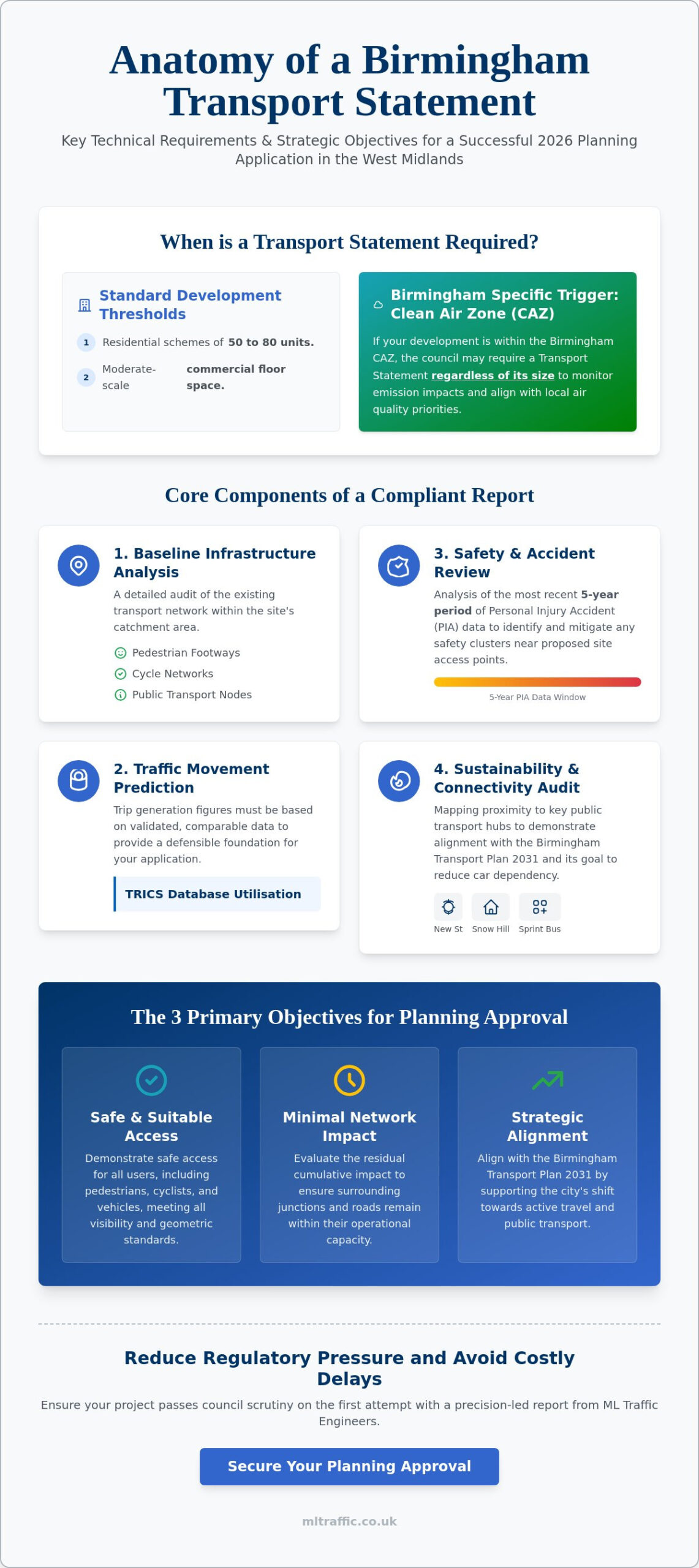
  • Transport Statement: The Developer’s 2026 Guide to Planning Approval

    Transport Statement: The Developer’s 2026 Guide to Planning Approval

    A rejected transport statement in London can trigger project delays of up to 16 weeks and cost over £5,000 in avoidable consultancy revisions. This is a high price for a technicality, yet many developers find themselves stalled by highway objections because they’ve misjudged the threshold between a Statement and a full Assessment. With the 2026 London Plan mandating car-free developments in high PTAL areas and the government considering major NPPF revisions, the margin for error has narrowed. Precision data is no longer optional; it’s the foundation of site viability.

    We understand that navigating local authority thresholds feels like hitting a moving target while planning application fees continue to rise. This guide provides a clear roadmap to mastering the technical requirements of your transport statement to secure planning permission and mitigate development risk. You’ll learn how to leverage technical reporting, including Swept Path Analysis and Parking Surveys, to ensure your project moves from inception to approval without the burden of Section 278 complications. We’ll outline the exact steps to deliver a compliant, cost-effective submission that satisfies even the most rigorous highway authorities.

    Key Takeaways

    • Understand how a professional transport statement acts as the technical bridge between site design and mandatory highway safety requirements.
    • Identify how PTAL scores and borough-specific standards in London dictate your reporting requirements and parking strategies.
    • Learn the sequential process of gathering traffic surveys and baseline data to validate site accessibility during the pre-application stage.
    • Discover how precision technical reporting, including Swept Path Analysis, prevents costly infrastructure redesigns during the construction phase.
    • Master the transition from initial assessment to final submission to eliminate highway objections and streamline your project’s path to approval.

    Table of Contents

    The Role of a Transport Statement in Modern Planning Applications

    A transport statement serves as the technical bridge between your site design and public highway safety. It’s more than a regulatory hurdle; it’s a strategic tool that translates architectural intent into a functional reality that local authorities can approve. By documenting how a development integrates with the existing network, this report proves that your project won’t compromise traffic flow or pedestrian safety. We focus on delivering precise data that justifies your site’s viability from the first submission.

    The National Planning Policy Framework (NPPF), last updated in February 2025, mandates these reports to ensure all developments promote sustainable travel. Effective transportation planning requires developers to identify and mitigate potential impacts on the road network before they become physical liabilities. Without this technical foundation, even well-designed projects face immediate objections from highway officers who prioritize network capacity and safety over developer timelines.

    NPPF Compliance and Statutory Requirements

    As of May 2026, the February 2025 NPPF remains the officially adopted framework, despite a significant consultation on revisions that concluded in March 2026. These regulations utilize “significant movement” triggers to alert local planning authorities to potential traffic issues. Securing transport for planning permission requires a report that demonstrates alignment with these national standards for accessibility. We ensure your submission addresses current sustainable transport goals, reducing the risk of the council requesting additional, costly data during the determination phase.

    Transport Statement vs. Transport Assessment

    Choosing the correct report scale is a critical financial decision for any developer. A transport statement offers a “lighter touch” for smaller developments that don’t meet major impact thresholds, focusing on immediate site access and local safety. In contrast, if your project exceeds specific local triggers, such as generating over 30 two-way vehicle movements per hour, you’ll likely require a full Transport Assessment London. We recommend early pre-application liaison with highway officers to negotiate the scope of the report. This proactive approach prevents the highway authority from imposing restrictive pre-commencement conditions that could stall your construction schedule for months.

    Core Components of a Professional Technical Report

    A professional transport statement provides the empirical evidence required to validate a development’s feasibility. It moves beyond basic site descriptions to offer a rigorous audit of existing infrastructure, including pedestrian footways, cycle lanes, and public transport nodes. By following official UK government guidance, we ensure that every report addresses the specific safety and capacity concerns of the local highway authority. This technical precision is vital for moving a project from the design phase to planning approval without costly revisions.

    Modern reporting must now account for 2026 Net Zero targets and the latest London Plan mandates. For developments in the capital, this includes documenting how the site will support the 100% active electric vehicle charging point requirement for all permitted parking spaces. High-quality reporting ensures these technical benchmarks are integrated into the initial site design rather than being addressed as expensive retrofits. We prioritize accuracy in these early audits to protect your project from future regulatory friction.

    Baseline Traffic Data and Site Accessibility Audits

    Accurate measurement of existing traffic volume and pedestrian flow is the first step in any technical submission. We utilize advanced data collection techniques to evaluate how well a site connects to active travel networks and public transport hubs. This assessment determines the site’s inherent sustainability and identifies any gaps in the local infrastructure that your development might need to address. Baseline data establishes the definitive zero-impact threshold against which all new development traffic is measured. If you require precise data for your application, commissioning professional Traffic Surveys provides the necessary evidence to satisfy highway officers.

    Trip Generation and TRICS Database Analysis

    Predicting the volume of people traveling to and from a new site requires a specialized approach using the TRICS database. This industry-standard tool allows us to forecast vehicle movements based on comparable use classes across the UK. However, raw data is rarely enough for a successful application. We adjust trip rates for London-specific factors, including the impacts of the Ultra Low Emission Zone (ULEZ) and the Congestion Charge, which significantly alter travel behavior. Precision in trip generation prevents highway authority objections regarding junction capacity and ensures your transport statement remains robust under scrutiny.

    The final component of the report focuses on mitigation measures. If the data suggests a potential negative impact on the local network, we propose specific design changes or infrastructure improvements to offset these effects. This proactive problem-solving demonstrates to the planning committee that the development is both safe and sustainable. By addressing these technical requirements early, you reduce the risk of planning delays and secure a more predictable path to construction.

    Transport Statement: The Developer’s 2026 Guide to Planning Approval

    London’s planning environment demands a level of technical granularity that often exceeds standard national requirements. While the official government guidance on Transport Statements provides a baseline for development impact, London developers must navigate the specific mandates of the London Plan 2026. This includes aligning your submission with the Healthy Streets Approach and the Mayor’s Transport Strategy, which aims for 80% of all trips in the capital to be made by foot, cycle, or public transport by 2041. We ensure your report addresses these high-level policy goals to prevent friction with Transport for London (TfL) or local highway officers.

    The geographic location of your site significantly dictates the complexity of your technical reporting. For instance, Transport Planning Consultants Tower Hamlets face vastly different challenges than those operating in outer London boroughs like Havering or Hillingdon. In high-density areas, the focus shifts entirely from vehicle capacity to pedestrian comfort and “Vision Zero” safety standards. This initiative targets the elimination of all deaths and serious injuries from London’s transport network by 2041, meaning your transport statement must prove that new site access points don’t introduce fresh risks to vulnerable road users.

    The Role of PTAL Ratings in Transport Logic

    Public Transport Accessibility Level (PTAL) scores are the primary driver for parking policy in the capital. Under the 2026 London Plan, any development located in an area with a PTAL score of 4 or higher is mandated to be “car-free.” We use PTAL data to justify reduced parking provisions, which can significantly lower your construction costs and maximize developable floor space. However, a car-free designation isn’t a shortcut; it necessitates the inclusion of comprehensive Travel Plans that outline how residents or employees will access the site via sustainable modes. High PTAL ratings allow us to argue against outdated minimum parking requirements that might otherwise stall an application.

    Borough-Specific Requirements: Lambeth vs. Westminster

    Each London borough maintains its own interpretation of highway safety and parking stress. If your project is in a borough like Lambeth, you’ll likely need to conduct parking surveys using the “Lambeth Methodology.” This specific technical approach measures overnight parking stress within a 200-meter radius of the site to ensure that overspill parking doesn’t compromise local road safety. In contrast, Westminster may prioritize different metrics, such as servicing and delivery access in constrained urban cores. We recommend engaging in pre-application discussions with TfL for any project impacting the Strategic Road Network or involving more than 150 residential units. This proactive step ensures your technical reporting meets local expectations before the formal submission date.

    The Data-Driven Process: From Survey to Submission

    Securing planning approval requires a sequential, data-driven methodology that leaves no room for ambiguity. A professional transport statement isn’t just a descriptive document; it’s the technical output of a rigorous five-step process designed to eliminate highway objections. We manage full project lifecycles from initial inception through to post-submission negotiation, ensuring your development meets every regulatory benchmark. This structured approach protects your timeline and reduces the risk of expensive redesigns during the construction phase.

    The process begins with a comprehensive site assessment and pre-application liaison with the highway authority. We agree on the scope of work early to prevent “scope creep” or unexpected data requests later in the application. Once the scope is fixed, we commission technical data collection, including Traffic Surveys and parking data, to establish the baseline conditions of the local network. This evidence-based foundation is essential for justifying the site’s viability to the planning committee.

    Integrating Swept Path Analysis and Parking Surveys

    Modern urban developments face intense scrutiny regarding vehicle access and local parking stress. Utilizing professional Swept Path Analysis services is essential for proving that refuse and emergency vehicles can safely navigate your site. SPA software simulates vehicle manoeuvres to validate site layouts, ensuring that large vehicles don’t need to perform dangerous reversing movements onto the public highway. We pair this with technical parking survey data to satisfy council concerns about overspill on local streets, proving that your development won’t compromise the existing residents’ access.

    Mitigating Negative Impacts through Design

    When our analysis identifies potential network pressure, we propose design-led mitigation to offset these impacts. This involves integrating “soft” measures like high-capacity cycle storage and car club memberships to reduce private vehicle dependency. If your project requires physical modifications to the local road network, the report provides the technical justification for highway design S278 works. A strong “Summary and Conclusions” section is vital here; it acts as the final technical argument that sways the planning officer in your favor by demonstrating a safe, sustainable, and policy-compliant layout.

    Following the drafting and internal review against local policy, we handle the submission to the planning portal. Our role doesn’t end at submission; we actively manage post-submission negotiations with highway officers to resolve any final queries. If you need to secure your project’s future with a robust technical report, contact our expert team today to begin your initial site assessment.

    Why Expert Transport Consultancy is Vital for Project Success

    Relying on “in-house” reports or generic templates often leads to immediate highway objections. Professional traffic engineers carry significantly more weight with Local Planning Authorities (LPAs) because their technical conclusions are backed by rigorous data and professional indemnity. We ensure every transport statement we produce aligns with the specific regulatory expectations of the borough in question. This technical authority doesn’t just secure approval; it provides a defensive shield against unreasonable planning conditions that could inflate your project costs.

    Precision at the planning stage prevents catastrophic redesigns during construction. If a site layout is approved based on flawed access data, the subsequent discovery of maneuverability issues can halt a project entirely. We utilize advanced Swept Path Analysis and Traffic Surveys to ensure your design is functional from the outset. This foresight is especially valuable when negotiating Section 106 and S278 agreements, where we act as a proactive partner to ensure infrastructure contributions are fair and technically justified. We manage full project lifecycles from inception to completion, delivering the data-driven certainty London developers require.

    Preventing Planning Delays and Highway Objections

    Many developers face delays because they miss borough-specific quirks or fail to account for cumulative impact. Common mistakes in a transport statement include utilizing outdated TRICS data or ignoring local parking stress methodologies like the Lambeth or Hilson Moran standards. These errors lead to immediate refusal or costly requests for further information. We manage the full lifecycle of your technical submission, from initial Parking Surveys to the final report. Our team’s adherence to industry benchmarks ensures that every submission meets the highest standards of formal excellence, providing the reassurance you need in a high-stakes environment.

    Bespoke Solutions for Challenging Urban Sites

    London’s constrained geography requires more than just standard templates. Overcoming access issues on narrow streets in boroughs like Islington or Camden requires innovative design thinking and deep local knowledge. We leverage our understanding of London’s 32 boroughs and the City to deliver tailored solutions for even the most restricted sites. Whether you are managing a minor residential scheme or a major commercial development, our team provides the technical certainty required for success. We pride ourselves on precision and adherence to standards, acting as a vital partner in your development team.

    Don’t leave your planning approval to chance. Contact ML Traffic Engineers for a professional Transport Statement quote and secure the technical expertise your project deserves.

    Securing Your Project’s Approval Through Technical Precision

    A robust transport statement acts as the definitive safeguard against planning delays and highway objections. By integrating precision data from Swept Path Analysis and Lambeth Parking Surveys, you transform a regulatory requirement into a strategic asset for site viability. Our team has provided this technical certainty since 2014, leveraging over a decade of specialized London planning expertise to protect developer timelines. We manage the full project lifecycle, from initial traffic data collection to the final report submission, ensuring every detail meets the rigorous standards of your local highway authority.

    Technical accuracy in the early stages prevents expensive redesigns and Section 278 complications during construction. We understand the unique pressures of the London planning landscape and provide the bespoke reporting necessary to satisfy both TfL and borough-specific mandates. Don’t leave your site’s viability to chance. Get a Professional Transport Statement Quote for Your Project today and move forward with confidence. We are ready to deliver the data-driven results your development deserves.

    Frequently Asked Questions

    What is the difference between a Transport Statement and a Transport Assessment?

    A transport statement is a concise report designed for developments with limited traffic impact, whereas a Transport Assessment is a comprehensive study for major schemes. The choice depends on local authority thresholds, such as requirement for an Assessment when vehicle movements exceed 30 per hour or 100 per day. Statements focus on local safety and site access, while Assessments require detailed junction modeling and wider network analysis.

    How long does it take to produce a Transport Statement for a London project?

    Production typically takes between two and four weeks, largely dictated by the timeframe for technical data collection. Commissioning traffic surveys or parking stress tests requires several days of site observation during neutral periods. Once the raw data is secured, our engineers perform the technical analysis and drafting within seven to ten working days to ensure your submission meets the next available planning committee deadline.

    Do I need a parking survey to support my Transport Statement?

    You’ll require a parking survey if your development is located in a high-density area or if the local authority suspects existing parking stress. In London, boroughs often mandate the Lambeth Methodology to assess overnight street capacity within a 200-meter radius. These surveys provide the empirical evidence needed in your transport statement to prove that overspill parking won’t compromise local highway safety or residential amenity.

    Will a Transport Statement guarantee my planning permission?

    No technical report can guarantee permission, but a professional statement effectively removes highway-related objections, which are a primary cause of planning refusal. By demonstrating compliance with the NPPF and the London Plan 2026, the report proves your site is safe and accessible. This technical certainty allows planning officers to focus on other aspects of your application, significantly reducing the risk of a recommendation for refusal on transport grounds.

    How much does a professional Transport Statement cost in 2026?

    Costs for a professional report are determined by the complexity of the development and the specific surveys required by the local authority. Factors such as the need for Swept Path Analysis or multi-day traffic counts influence the final technical fee. We recommend requesting a bespoke quote to ensure your budget accounts for all necessary data collection without paying for redundant analysis that the council hasn’t requested during pre-application discussions.

    Can I write my own Transport Statement for a small development?

    While you can technically draft your own report, it’s a high-risk strategy that often leads to immediate rejection by the highway authority. Professional reports require specialized technical analysis and access to industry-standard databases like TRICS. Without professional indemnity and technical accreditation, your submission may lack the necessary weight to overturn officer concerns, potentially leading to project delays of 12 to 16 weeks and expensive revisions.

    What happens if the Highway Authority objects to my Transport Statement?

    If an objection is raised, we enter a formal negotiation phase with the highway officer to address their specific concerns. This often involves refining the site layout through Swept Path Analysis or proposing additional mitigation measures like cycle infrastructure. Our proactive approach aims to resolve these technical disputes quickly, preventing the council from imposing restrictive pre-commencement conditions that could stall your construction start date or increase your Section 278 costs.

    Is a Travel Plan always required alongside a Transport Statement?

    A Travel Plan isn’t always mandatory for every small scheme, but local authorities increasingly request them to support sustainable travel goals. In London, high PTAL areas almost always require a Travel Plan to justify car-free or car-lite development models. These plans outline the “soft” measures, such as car club memberships or cycle vouchers, that will be implemented to reduce the development’s overall vehicle dependency and long-term environmental impact.

    Which areas do you cover?

    We service Acton, Balham, Barking, Barnes, Barnet, Battersea, Beckenham, Bexleyheath, Brentford, Brixton, Bromley, Camberwell, Carshalton, Charlton, Chelsea, Chiswick, Clapham, Coulsdon, Croydon, Crystal Palace, Dagenham, Dulwich, Ealing, Edgware, Eltham, Enfield, Finchley, Forest Gate, Fulham, Golders Green, Greenwich, Hackney, Hammersmith, Hampstead, Harrow, Hayes, Highgate, Hounslow, Ilford, Islington, Kensington, Kentish Town, Kingston upon Thames, Lewisham, Mitcham, Muswell Hill, New Malden, Notting Hill, Orpington, Peckham, Pinner, Purley, Putney, Richmond, Romford, Ruislip, Sidcup, Southall, Southgate, Streatham, Surbiton, Sutton, Tooting, Tottenham, Twickenham, Uxbridge, Walthamstow, Wembley, West Norwood, Wimbledon, Wood Green, Woolwich, Bethnal Green, Shoreditch, Canary Wharf, Deptford, Leyton, Palmers Green, Stanmore, Upminster, Chislehurst, Erith, Feltham.

    Which cities in England do you cover?

    We service Birmingham, Leeds, Liverpool and Manchester.

    Michael Lee

    Article by

    Michael Lee

    Transport planner with over 35 years’ experience.

    Disclaimer

    The content on mltraffic.co.uk, including all technical articles, guides, and resources, is provided for general informational and educational purposes only. It is not intended to constitute professional advice in traffic engineering, transportation planning, development approvals, or any other technical or legal field.
    While ML Traffic Engineers makes every reasonable effort to ensure the accuracy, completeness, and timeliness of the information published, we do not provide any warranties or representations (express or implied) regarding its reliability, suitability, or availability for any particular purpose. Any reliance you place on the content is strictly at your own risk.
    In no event shall ML Traffic Engineers, its directors, employees, authors, or affiliates be liable for any direct, indirect, incidental, special, consequential, or punitive damages (including, without limitation, loss of profits, data, or business opportunities) arising out of or in connection with the use of, or inability to use, any information provided on this website.
    The articles and guides on this site are not a substitute for engaging a qualified, professional traffic engineer to assess your specific project requirements. For tailored advice, compliance assessments, or traffic engineering services, please contact a competent professional.
    This disclaimer may be updated from time to time without notice. By accessing or using this website, you agree to be bound by the most current version of this disclaimer.

  • Transport Planning Consultants Lambeth: Navigating Local Planning Requirements in 2026

    Transport Planning Consultants Lambeth: Navigating Local Planning Requirements in 2026

    Could a single oversight in your parking survey methodology be the reason your next development faces a costly planning refusal? With Lambeth’s recent £3 million funding injection from Transport for London in March 2026, the borough’s shift toward active travel and bus priority is no longer a suggestion; it’s a strict regulatory mandate. As specialized Transport Planning Consultants Lambeth, we recognize that securing approval requires a hyper-local technical strategy that aligns perfectly with the Lambeth Local Plan 2021-2026.

    We understand the logistical strain of managing high PTAL areas that limit parking provision while still ensuring complex urban access for refuse and emergency vehicles. It’s a high-stakes balancing act where precision is a functional necessity. This guide provides the technical clarity you need to master local requirements, from conducting compliant Parking Surveys to executing detailed Swept Path Analysis. We’ll preview the essential reporting steps and the April 2026 national guidance updates to ensure your planning submission is robust, compliant, and ready for immediate approval.

    Key Takeaways

    • Understand how the Lambeth Local Plan 2021-2026 mandates car-free developments in high PTAL zones and the impact this has on your site’s parking provision.
    • Identify whether your project triggers the need for a Transport Statement or a full Assessment by reviewing specific residential and commercial development thresholds.
    • Expert Transport Planning Consultants Lambeth ensure your application follows the strict “Lambeth Methodology” for overnight parking stress surveys to avoid technical objections.
    • Utilize Swept Path Analysis to prove site feasibility for refuse and emergency vehicles, especially within the constrained urban layouts of Clapham and Stockwell.
    • Learn how data-driven reporting and professional Travel Plans reduce regulatory pressure and streamline the path toward a successful planning submission.

    The Lambeth Planning Landscape: Transport Policy and Requirements

    The Lambeth Local Plan 2021-2026 serves as the primary regulatory framework for all development within the borough. Its transport objectives are uncompromising, prioritizing sustainable growth and the reduction of private vehicle use. For developers, this means traditional parking-led designs are rarely acceptable. Instead, the council enforces a “car-free” or “car-capped” approach for most new projects, particularly those located in high-density areas. Professional Transport Planning Consultants Lambeth are essential for translating these high-level policies into actionable site layouts that meet technical scrutiny.

    Effective transportation planning in Lambeth requires more than just meeting minimum standards; it demands an active contribution to the borough’s environmental targets. With Lambeth securing over £3 million in TfL funding in March 2026 to support walking and cycling initiatives, the pressure on developers to provide robust sustainable infrastructure has never been higher. Early engagement with the Lambeth Highway Authority is critical for major developments. It allows us to identify potential site access constraints and traffic impact issues before they become grounds for refusal.

    To better understand the borough’s vision for expansion and infrastructure, watch this overview of the Lambeth Growth Plan:

    Understanding PTAL Ratings in Lambeth

    Public Transport Accessibility Level (PTAL) is the decisive metric for development in areas like Brixton, Vauxhall, and Waterloo. These districts often achieve the highest possible scores, which triggers a mandatory restriction on residential parking provision. We help developers navigate these constraints by providing data-driven justifications for site-specific requirements. In the southern, lower PTAL areas of the borough, we use detailed Parking Surveys to demonstrate where limited parking is necessary without compromising local network capacity.

    The Impact of the Lambeth Transport Strategy 2019-2040

    The Lambeth Transport Strategy sets an ambitious target for 85% of all trips to be made via public transport, walking, or cycling by 2041. Your planning submission must reflect the “Healthy Streets” approach, focusing on air quality and pedestrian safety. We integrate active travel infrastructure into site designs, ensuring that cycle storage and pedestrian pathways are core components of the project. Our role as Transport Planning Consultants Lambeth is to mitigate local traffic impact through precise reporting, ensuring your development supports the borough’s long-term vision while remaining commercially viable.

    Transport Statements vs. Assessments: Which Do You Need?

    Determining the correct level of reporting is the first step in any successful planning application. The distinction between a Transport Statement and a Transport Assessment depends on the scale of your development and its potential impact on the local highway network. As experienced Transport Planning Consultants Lambeth, we use the TRICS database to provide accurate trip generation forecasts. This data is vital for negotiating S106 and S278 legal agreements, ensuring that developer contributions are proportional to the project’s impact.

    The requirements are grounded in Lambeth’s Transport Strategy, which prioritizes sustainable modes over private car use. Since the UK government updated national guidance for Local Transport Plans in April 2026, the emphasis on integrated ticketing and road safety has become even more central to these reports. We provide the technical evidence needed to satisfy the Lambeth Local Plan’s specific development management policies, reducing the risk of costly delays during the consultation period.

    When is a Transport Statement Sufficient?

    A Transport Statement is typically required for smaller residential developments, often those under 20 units, where the traffic impact is expected to be minimal. These reports focus on accessibility and local transport links rather than complex junction modelling. We ensure every statement covers essential components like parking provision and high-quality cycle storage. If you’re unsure about your project’s scale, learn more about our Transport Statements and how they streamline the approval process for minor works.

    Full Transport Assessments for Major Lambeth Projects

    Large-scale developments, particularly in high-growth areas like Vauxhall or Nine Elms, trigger the need for a full Transport Assessment. These major projects require sophisticated traffic modelling to analyze the impact on surrounding junctions. Our expertise as Transport Planning Consultants Lambeth ensures that your major project addresses the 23,000 new jobs expected in Waterloo and Vauxhall through comprehensive multi-modal analysis. We manage the full project lifecycle, from initial assessment to ongoing support. For a deeper dive into these requirements, read The Developer’s Guide to Transport Assessments.

    Precision in these reports prevents delays and secures your site’s future. If you’re preparing a submission, it’s often beneficial to review our project types to see how we’ve handled similar technical challenges across the borough.

    Transport Planning Consultants Lambeth: Navigating Local Planning Requirements in 2026

    The Lambeth Parking Survey Methodology: Precision for Approval

    Generic parking surveys often lead to immediate planning delays or technical refusals in Lambeth. The council requires a specific, evidence-based approach to assess overnight parking stress, known as the Lambeth Methodology. This process is far more rigorous than standard industry practices. As specialized Transport Planning Consultants Lambeth, we manage the full data collection lifecycle to ensure your application meets these precise standards. We recognize that in a high-stakes planning environment, technical accuracy is a functional necessity.

    The core of this process is the 200-meter walking distance requirement. Unlike a simple radial line on a map, this measurement follows the actual pedestrian route from the site entrance. Within this defined area, every available on-street parking space must be mapped, categorized, and analyzed. This includes identifying spaces within various Controlled Parking Zones (CPZs) and understanding how their specific operating hours impact potential development overspill. This level of detail is a non-negotiable foundation of Lambeth’s official Transport Strategy, which seeks to manage street capacity without compromising safety.

    Conducting an Accurate Lambeth Parking Survey

    Lambeth Council mandates two separate overnight surveys to ensure data reliability. These must occur on a Tuesday/Wednesday and a Wednesday/Thursday between 00:30 and 05:30. We meticulously exclude “unusable” spaces, such as those within 10 meters of a junction, across driveways, or at bus stops. Our final report calculates parking stress percentages to the council’s exact standards, providing a transparent view of local capacity. We deliver these results with the readiness and precision required to withstand intense scrutiny from highway officers.

    Justifying Parking Provision in High-Density Zones

    In high-density urban zones, planning officers often worry that new developments will saturate existing street parking. We use our detailed survey data to prove that local streets can absorb any projected overflow. This technical evidence is vital for projects that do not meet the car-free criteria discussed in the previous sections. By presenting a clear delta between current stress levels and future projections, we mitigate officer concerns and reduce regulatory pressure. Explore our parking survey expertise to see how we translate complex street data into successful planning outcomes.

    Our team understands that a single misplaced data point can derail a project. We prioritize clarity and rapid delivery of information, ensuring that your submission remains on schedule. By adhering to these strict benchmarks, we act as a reliable partner that understands intricate regional regulations so that you don’t have to. Our goal is to provide an all-encompassing, fully-managed service that secures your planning approval through technical excellence.

    Swept Path Analysis: Ensuring Access in Lambeth’s Urban Fabric

    Proving that a site is physically accessible is a prerequisite for any Lambeth planning submission. In high-density areas like Vauxhall, Waterloo, or Brixton, every centimeter of road space is contested. We use Swept Path Analysis (SPA) to simulate vehicle movements through the borough’s narrowest streets, such as those found in Clapham or Stockwell. This technical modelling ensures that proposed developments don’t create gridlock or safety hazards. As Transport Planning Consultants Lambeth, we prioritize precision to reduce regulatory friction and demonstrate site feasibility from the outset.

    We use advanced software to track the path of specific vehicle templates against your proposed site layout. This process identifies potential “pinch points” where a vehicle might strike a curb, building, or street furniture. Catching these issues during the design phase helps developers avoid costly redesigns after a planning refusal. Our team provides the technical authority required to reassure highway officers that your project is safe and functional. We manage this process with the readiness and urgency that the industry demands.

    Refuse and Emergency Vehicle Access

    Lambeth Council enforces strict standards for refuse collection vehicle (RCV) maneuvering. We use specific London-standard templates to prove that a large RCV can safely service your site without multiple-point turns that block traffic. Emergency access is equally critical. We demonstrate compliance with Building Regulations Part B by showing clear, unobstructed paths for fire tenders. This documentation is essential for securing approval in constrained urban settings. For more technical details, see our guide on Securing Approval with Swept Path Analysis.

    Designing for Modern Delivery Needs

    The rise in online retail has changed how we design residential and commercial access. Modern developments must accommodate frequent van deliveries without obstructing the public highway. We calculate precise turning circles and visibility splays to ensure safe ingress and egress for all users. This data-driven approach allows us to optimize car park layouts and delivery bays, maximizing site value while meeting all highway safety requirements. If you need to prove site feasibility in a constrained location, book a professional Swept Path Analysis to secure your project’s future.

    Expert Transport Planning Consultancy in Lambeth: Why Local Knowledge Wins

    ML Traffic Engineers provides a level of technical depth that generalist planning firms often cannot match. While generalists offer broad advice, we function as specialized Transport Planning Consultants Lambeth, focusing specifically on the engineering and data requirements that drive planning decisions. Our local presence in London ensures we’re available for urgent site visits and direct liaison with Lambeth Highway Authority officers. This proximity allows our team to respond rapidly to evolving project demands, which is vital in a fast-moving infrastructure environment where timing is everything.

    We manage the full project lifecycle, moving from initial feasibility assessments to post-approval support for S278 agreements. Our reports use objective data to anticipate and neutralize the unique objections often raised by Lambeth Council regarding parking stress or vehicle access. If a project moves to an appeal, our data-driven reporting provides the robust technical evidence needed to defend your site layout. We take immense pride in our precision and adherence to standards, acting as a dependable partner so you don’t have to navigate complex regional regulations alone. Our support ensures that any required highway works are designed to adoptable standards from the outset.

    A Tailored Approach for Lambeth Developers

    Every development requires a strategy that speaks the specific language of local planning officers. We reduce project risk by offering pre-application transport advice, identifying potential hurdles before they lead to formal objections during the consultation phase. This proactive approach ensures that your initial submission is technically sound and aligned with the Lambeth Local Plan. To see how we’ve applied this methodology to diverse sites across the borough, you can view our project types and experience.

    Securing Your Planning Approval

    Technical precision is the foundation of a successful application in 2026. Minor errors in a parking survey or a flawed swept path analysis often result in costly design revisions and months of avoidable delays. Our Travel Plans complement your submission by demonstrating a clear commitment to the borough’s sustainability goals, helping to mitigate the impact of car-free development mandates. We provide an all-encompassing, fully-managed service that prioritizes your project’s timeline and regulatory compliance. If you’re ready to move forward with a partner who understands the high-stakes nature of London infrastructure, contact ML Traffic Engineers for a Lambeth project quote and ensure your development is backed by expert technical authority.

    Securing Technical Approval for Your Lambeth Development

    Mastering the intricate requirements of the Lambeth Local Plan 2021-2026 is essential for any developer looking to avoid project delays. As specialized Transport Planning Consultants Lambeth, we provide the technical authority needed to navigate high PTAL constraints and strict parking survey methodologies. Our team delivers data-driven reports that withstand the scrutiny of London Highway Authorities, ensuring your site layout is both compliant and optimized for modern urban needs. We understand that precision is a functional necessity in this high-stakes environment.

    We offer a proven track record in executing expert Swept Path Analysis for tight urban sites, proving feasibility where others see obstacles. Our commitment to the specific Lambeth Methodology ensures your submission is robust and ready for immediate review. Don’t leave your planning submission to chance when you can partner with a reliable expert who manages the full project lifecycle. We are ready to provide the technical evidence your project requires. Get a Professional Transport Report Quote for Your Lambeth Project and take the final step toward a successful planning outcome.

    Frequently Asked Questions

    Do I need a Transport Statement for a small residential conversion in Lambeth?

    Yes, you’ll likely need a Transport Statement if your conversion triggers the thresholds set in the Lambeth Local Plan. For smaller projects under 20 units, this report proves that the change in use won’t negatively impact local traffic or pedestrian safety. It focuses on accessibility, cycle storage, and parking provision to ensure your site remains compliant with the borough’s sustainable travel objectives.

    What is the Lambeth Methodology for parking surveys?

    The Lambeth Methodology is a strict technical standard for assessing overnight parking stress. It requires two separate surveys on consecutive weekday nights, typically Tuesday/Wednesday or Wednesday/Thursday, between 00:30 and 05:30. The survey must cover a 200-meter walking distance from the site entrance. We meticulously exclude unusable spaces near junctions or bus stops to provide the precision planning officers demand.

    How does a car-free development policy affect my planning application?

    A car-free policy prohibits on-site parking for residents, except for disabled badge holders, in high PTAL areas like Brixton or Vauxhall. Your application must include robust data showing how the project supports the borough’s goal of 85% sustainable mode share by 2041. Professional Transport Planning Consultants Lambeth are essential for justifying these designs and ensuring they meet the council’s strict car-capped development criteria.

    Can I use a generic vehicle template for Swept Path Analysis in London?

    No, generic vehicle templates are frequently rejected by Lambeth highway officers. You must use specific London-standard templates for refuse collection vehicles and fire tenders to prove site feasibility. Our Swept Path Analysis uses these precise dimensions to identify potential pinch points in narrow streets like those in Clapham. This ensures your site access is safe and functional for the exact vehicles operating in the borough.

    What happens if my parking survey shows 100% parking stress?

    If your survey shows 100% parking stress, it indicates that local streets are at capacity. Planning officers will likely object to any development that adds further demand to the network. We help you mitigate this risk by proposing car-free legal agreements or optimizing your site layout. These strategies prevent overspill into the surrounding neighborhood and maintain the safety and integrity of the local highway.

    How long does it take to prepare a Transport Assessment for Lambeth Council?

    Preparing a full Transport Assessment typically takes between four and six weeks. This timeframe allows for detailed site visits, data collection, and any necessary junction modelling for major projects in growth areas like Nine Elms. We prioritize rhythmic efficiency to ensure your reporting is delivered rapidly without compromising technical accuracy. This proactive approach helps you avoid costly delays during the planning consultation period.

    Does Lambeth require a Travel Plan for all new developments?

    No, Lambeth only requires a full Travel Plan for major developments or projects with significant transport implications. These plans outline specific measures to encourage walking, cycling, and public transport use among site users. For smaller developments, a shorter Travel Plan Statement might be sufficient. We provide the technical evidence needed to satisfy these requirements and reduce the regulatory pressure on your planning submission.

    What is the role of a Section 278 agreement in my transport planning?

    A Section 278 agreement is a legal contract that allows you to make permanent alterations to the public highway as part of your development. This includes creating new site entrances or improving pedestrian crossings to meet safety standards. We provide the expert reporting and technical data required to secure these agreements. Our support ensures all highway works are designed to adoptable standards from the very beginning.

    Michael Lee

    Article by

    Michael Lee

    Transport planner with over 35 years’ experience.

    Disclaimer

    The content on mltraffic.co.uk, including all technical articles, guides, and resources, is provided for general informational and educational purposes only. It is not intended to constitute professional advice in traffic engineering, transportation planning, development approvals, or any other technical or legal field.
    While ML Traffic Engineers makes every reasonable effort to ensure the accuracy, completeness, and timeliness of the information published, we do not provide any warranties or representations (express or implied) regarding its reliability, suitability, or availability for any particular purpose. Any reliance you place on the content is strictly at your own risk.
    In no event shall ML Traffic Engineers, its directors, employees, authors, or affiliates be liable for any direct, indirect, incidental, special, consequential, or punitive damages (including, without limitation, loss of profits, data, or business opportunities) arising out of or in connection with the use of, or inability to use, any information provided on this website.
    The articles and guides on this site are not a substitute for engaging a qualified, professional traffic engineer to assess your specific project requirements. For tailored advice, compliance assessments, or traffic engineering services, please contact a competent professional.
    This disclaimer may be updated from time to time without notice. By accessing or using this website, you agree to be bound by the most current version of this disclaimer.
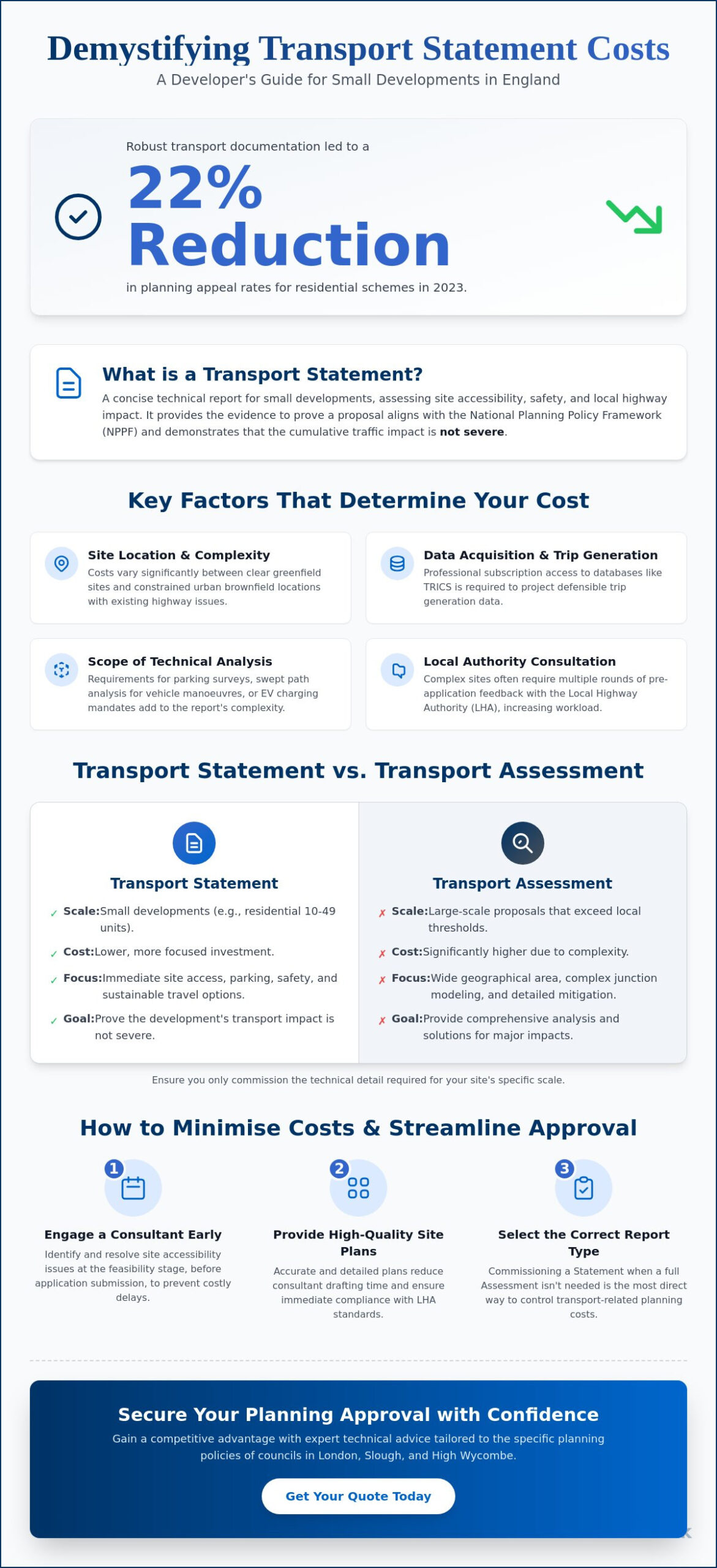
  • Transport Planning Consultants Kensington and Chelsea: Navigating RBKC Planning in 2026

    Transport Planning Consultants Kensington and Chelsea: Navigating RBKC Planning in 2026

    Securing planning permission in the Royal Borough of Kensington and Chelsea (RBKC) requires surgical precision rather than generic London-wide assessments. With the borough’s extreme density and narrow mews, a standard application often fails to address the unique logistical constraints that define this area. You probably recognize that strict parking policies and designated parking stress zones make obtaining approval a high-stakes challenge. As specialized Transport Planning Consultants Kensington and Chelsea, we understand that your project depends on technical accuracy and a deep knowledge of the New Local Plan adopted in July 2024.

    We’re here to help you master these complexities through expert Transport Statements and data-driven site analysis. You’ll learn how to minimize costs and avoid delays by meeting RBKC-specific criteria on your first submission. We provide clear guidance on navigating the 2026 statutory requirements, utilizing Swept Path Analysis for difficult access points, and leveraging the council’s £865.20 fast-track service to keep your development on schedule.

    Key Takeaways

    • Understand how the New Local Plan 2024 dictates transport requirements for all new developments within the borough.
    • Partner with Transport Planning Consultants Kensington and Chelsea to ensure your Transport Statements meet the council’s rigorous technical standards.
    • Utilize Swept Path Analysis and CAD design to prove site accessibility in narrow mews and high-density areas.
    • Learn how to conduct parking surveys that accurately reflect local stress levels to minimize the risk of planning refusal.
    • Discover the importance of PTAL ratings and Travel Plans in aligning your project with the Mayor of London’s Transport Strategy.

    The Role of Transport Planning Consultants in Kensington and Chelsea

    The Royal Borough of Kensington and Chelsea (RBKC) presents a unique environment where high property values meet extreme spatial constraints. In this high-stakes setting, Transport Planning Consultants Kensington and Chelsea act as the essential link between architectural vision and the rigid requirements of the local highway authority. Unlike other London boroughs, RBKC’s street network is characterized by historic mews and high-density residential blocks that leave zero margin for error in vehicle tracking or parking provision. We provide the technical authority needed to navigate these hurdles safely.

    Professional transportation planning ensures that a development proposal doesn’t just look good on paper but functions safely within the existing road network. We mitigate the risks inherent in high-value projects, where a single rejection based on “parking stress” can stall a multi-million-pound investment for months. Our team translates complex traffic data into a clear, evidence-based narrative that satisfies council officers and statutory consultees during the planning process.

    Navigating the RBKC Local Plan and Transport SPD

    RBKC adopted its New Local Plan on July 24, 2024, replacing the 2019 version. This document, alongside the Transport and Streets SPD, sets the benchmark for all current and future applications. We prioritize early engagement with highway officers to identify potential roadblocks before the formal submission. Current policies focus heavily on “Good Growth” and enhanced green ambitions, meaning your project must demonstrate a net-positive impact on local traffic flow and safety to succeed in 2026.

    When to Engage a Transport Consultant for Your Project

    Don’t wait until the full planning submission to consider logistics. Engaging us during the pre-application stage allows us to spot hurdles like narrow access points or inadequate visibility splays before they become costly design errors. For the 2026-27 period, RBKC charges £1,162.40 for detailed residential pre-application advice for 1-4 units. A Transport Statement is a mandatory requirement for most RBKC developments to prove that the proposal will not negatively impact the local highway network. By reviewing our comprehensive support services, you can ensure every technical aspect of your submission is handled with precision and speed.

    Transport Statements and Assessments for RBKC Planning Applications

    RBKC planning officers demand technical rigor. For most small to medium developments in the borough, a Transport Statement serves as the primary evidence base. It isn’t just a formality; it’s a technical justification that proves your project won’t compromise highway safety or exacerbate local congestion. We use the latest TRICS data and local traffic surveys to build a robust case for your development. This data-driven approach ensures that your proposals are grounded in reality rather than estimates.

    For more complex schemes, a comprehensive Transport Assessment is necessary. These reports delve into the cumulative impact of development on the wider network. We align every report with the Transport and Streets Supplementary Planning Document. This ensures your application meets the specific criteria set by the council for sustainable travel and infrastructure capacity. Integrating professional Transport Assessments London wide into your strategy is vital for navigating the city’s complex regulatory environment. As established Transport Planning Consultants Kensington and Chelsea, we provide the precision required for these high-stakes submissions.

    Key Components of a Successful Transport Statement

    A successful statement starts with a clear analysis of Public Transport Accessibility Levels (PTAL). In Kensington, PTAL ratings often dictate the maximum parking provision allowed under the New Local Plan. We calculate trip generation figures to show exactly how many new journeys your project will create. If the data suggests a potential impact on sensitive local mews or junctions, we develop practical mitigation strategies. This might involve enhancing pedestrian access or providing bespoke cycle storage solutions. You can view our range of technical services to see how we handle these specific requirements.

    Transport Assessments for Major Kensington Developments

    Major schemes, such as those within the Kensal Canalside or Earl’s Court Opportunity Areas, require sophisticated modeling. We analyze multi-modal transport impacts, ensuring that existing bus and tube networks can handle the increased demand. This process often involves direct collaboration with Transport for London (TfL) to ensure strategic corridors remain functional. Our reports focus on long-term viability, helping you meet the borough’s phased housing targets while maintaining the high standards of safety and accessibility that RBKC requires. We take the technical burden off your shoulders so you can focus on the broader project goals.

    Transport Planning Consultants Kensington and Chelsea: Navigating RBKC Planning in 2026

    Overcoming Spatial Constraints: Swept Path Analysis and Parking Surveys

    Kensington’s streetscape offers no room for error. Most residential developments in the borough involve narrow mews or basement excavations where access is physically limited. We provide high-precision Swept Path Analysis services to ensure your site layout works from day one. Without this technical proof, planning officers will likely refuse an application on the grounds of poor access or highway safety. As Transport Planning Consultants Kensington and Chelsea, we specialize in proving that your development can function safely within these historic constraints.

    Our team uses advanced CAD design to simulate vehicle movements across your site. We don’t just test for standard passenger cars. We model the maneuverability of refuse vehicles and fire tenders to satisfy the strict requirements of the RBKC Transport and Streets SPD. Proving that these essential services can enter and exit in a forward gear is often the difference between approval and rejection. We ensure your technical reports meet 2026 safety standards and provide a “safe pair of hands” for your planning submission.

    Swept Path Analysis for Tight Urban Sites

    Tight urban sites in Kensington demand more than just a visual check. We use CAD-based tracking to provide a definitive feasibility study for your architectural plans. Our models cover a range of vehicle templates, from standard delivery vans to the largest HGVs permitted on local roads. By identifying potential “pinch points” early, we help you adjust your design before it reaches the planning committee. This proactive approach eliminates the risk of a late-stage refusal based on vehicle access issues.

    Parking Surveys and the Lambeth Methodology in RBKC

    Parking stress is a critical metric in RBKC planning decisions. The borough contains some of the highest-density residential areas in the UK, making on-street parking a finite and protected resource. We conduct parking surveys following the Lambeth Methodology, which is the industry standard recognized by RBKC officers. These surveys typically require overnight observations on two separate weekday nights to establish a baseline of “parking stress” within a 200-meter radius of your site.

    As experienced Transport Planning Consultants Kensington and Chelsea, we use this data to justify car-free or car-capped developments. If your project has a high PTAL rating, we can demonstrate that the development won’t add to local parking pressure. We also address concerns regarding the loss of on-street spaces in residential mews, providing the technical evidence needed to mitigate local opposition. Our surveys give you the data required to navigate these sensitive negotiations with confidence.

    Sustainable Development: Travel Plans and PTAL in Kensington

    Sustainable transport strategies form the backbone of the New Local Plan 2024. In a borough as dense as Kensington and Chelsea, developers must prove they’re actively reducing car dependency to align with the council’s green ambitions. As Transport Planning Consultants Kensington and Chelsea, we design Travel Plans that satisfy both the Mayor of London’s Transport Strategy and local environmental goals. These documents act as a legal agreement between the developer and RBKC to ensure a long-term commitment to sustainable travel patterns.

    Securing planning approval in 2026 requires more than just a mention of public transport. You need a robust strategy that prioritizes active travel and minimizes the impact on the local highway network. We recommend referencing our London Travel Plans guide to ensure your submission meets the latest compliance standards. Our team provides the technical authority to justify your transport proposals through evidence-based reporting and professional excellence. If you need immediate assistance with your submission, contact our expert consultants today for a comprehensive solution.

    Developing Effective Residential and Workplace Travel Plans

    Effective Travel Plans require clear, measurable targets. We establish baseline data and set realistic goals for reducing single-occupancy vehicle trips over a five-year period. In the Royal Borough, this often involves incentivizing cycling and walking through improved on-site facilities and localized travel information. The London Plan 2026 has introduced stricter requirements for site layouts, demanding better integration of cycle storage and pedestrian-friendly access points. We ensure your project stays ahead of these regulatory shifts by implementing monitoring regimes that satisfy RBKC officers.

    PTAL and Parking Permit Restrictions

    Public Transport Accessibility Level (PTAL) scores are the primary tool used by RBKC to determine parking provision. Most areas in Kensington and Chelsea boast high PTAL scores of 5 or 6, which typically triggers a “permit-free” development condition. This means residents of new developments aren’t eligible for on-street parking permits, a policy designed to protect existing parking capacity for current residents. We help you navigate these restrictions by providing the data needed to justify your scheme’s transport impact.

    In pockets of the borough with lower PTAL scores, the challenge is different. We develop bespoke transport strategies that highlight alternative travel options, such as car clubs or proximity to major transport hubs like the upgraded South Kensington station. This technical approach allows us to argue for viable developments even in areas with perceived connectivity gaps. We take pride in delivering precision-led reports that address these specific RBKC parking permit restrictions, ensuring your project moves forward without regulatory delays.

    Why Choose ML Traffic Engineers for Your RBKC Project?

    ML Traffic Engineers provides the technical authority and professional excellence required for successful development in the Royal Borough. As established Transport Planning Consultants Kensington and Chelsea, we understand that precision is a legal and physical necessity. We operate with a sense of readiness and urgency that matches the fast-moving nature of the construction industry. Our team provides 24/7 availability to handle urgent planning deadlines or sudden technical queries from council officers. We position ourselves as a safe pair of hands, taking pride in our ability to deliver precision-led results that satisfy strict regulatory environments.

    We balance technical authority with a customer-centric approach. This ensures we alleviate the logistical burdens placed on your project team. Our communication flow is logical and sequential, moving from initial consultation to final implementation without unnecessary delay. We use direct and functional sentence structures to prioritize clarity. This allows busy project managers to grasp key benefits quickly. We don’t just supply reports; we act as a vital guardian of professional integrity and public safety throughout the planning lifecycle.

    A Comprehensive “Safe Pair of Hands” for Developers

    Managing the regulatory burdens of RBKC planning requires more than just generic advice. We provide accurate data collection through professional parking and traffic surveys that reflect the true state of Kensington’s road network. Our team uses CAD design for Swept Path Analysis to prove site feasibility in even the tightest urban locations. You should explore what we do for London developers to see how our bespoke solutions integrate with your wider design goals. We maintain a standard of formal excellence that aligns with the borough’s expectations for high-value property developments.

    Securing Your 2026 Planning Approval

    Securing approval on your first submission saves time and minimizes costs. Our technical reports are engineered to withstand the most rigorous scrutiny from RBKC highway officers. We ensure every document, from Travel Plans to Transport Statements, adheres to the latest 2026 legislative requirements. You can access our full suite of technical resources to stay informed on the standards required for modern planning applications. Contact us today for a bespoke fee proposal tailored to your specific Kensington project. We remain available around the clock to ensure your development stays on track and meets every statutory deadline.

    Secure Your Development’s Future in Kensington and Chelsea

    Success in the Royal Borough requires more than just an architectural vision; it demands technical precision and an intimate understanding of the New Local Plan 2024. You’ve seen how accurate Swept Path Analysis and rigorous parking surveys form the foundation of any successful application. By addressing PTAL ratings and sustainable Travel Plans early, you can navigate the borough’s strict parking permit restrictions and avoid costly delays. As specialized Transport Planning Consultants Kensington and Chelsea, we provide the data-driven reporting needed to withstand council scrutiny.

    Founded in 2014, ML Traffic Engineers brings over a decade of London planning experience to your project. We specialize in RBKC-specific technical requirements and offer 24/7 availability for your most time-sensitive submissions. Our team acts as a safe pair of hands, ensuring your project meets every safety and regulatory standard from day one. Contact ML Traffic Engineers for expert Transport Planning in Kensington and Chelsea to start your bespoke fee proposal. We look forward to helping you achieve a seamless planning approval.

    Frequently Asked Questions

    Do I need a Transport Statement for a small residential extension in Kensington?

    Generally, small householder extensions without subterranean works don’t require a full Transport Statement. However, RBKC officers may request one if the proposal affects parking or access in a sensitive mews or high-density area. We recommend checking the specific requirements of the New Local Plan 2024 for your site’s location to avoid unexpected delays.

    How does RBKC define “Parking Stress” for new developments?

    RBKC defines parking stress as the percentage of on-street parking bays occupied within a 200-meter walking distance of a site. Surveys must follow the Lambeth Methodology, usually requiring overnight observations on two separate weekday nights. If stress levels exceed 80%, the council may restrict the development’s impact on local parking capacity to protect existing residents’ access.

    What is the typical lead time for a Swept Path Analysis in London?

    We provide a rapid turnaround for technical reports, often delivering results within 3 to 5 business days. Our 24/7 availability ensures that we can meet urgent planning deadlines for projects across London. We prioritize precision and speed to keep your development schedule on track while maintaining total legislative compliance.

    Can a Transport Consultant help with a refused planning application in Chelsea?

    Yes, we can assist by providing technical evidence to address specific reasons for refusal related to highway safety or parking. As experienced Transport Planning Consultants Kensington and Chelsea, we analyze the council’s feedback and produce data-driven reports, such as updated Swept Path Analysis or Parking Surveys. This professional approach often helps in securing approval upon resubmission or appeal.

    What is a PTAL score and why does it matter for my Kensington project?

    PTAL stands for Public Transport Accessibility Level and it measures the density and frequency of public transport near a site. A high PTAL score of 5 or 6 typically leads to “permit-free” development conditions in Kensington. This means residents won’t be eligible for on-street parking permits, which helps the council manage high local parking demand through sustainable travel policies.

    Do ML Traffic Engineers provide Construction Traffic Management Plans (CTMP) for RBKC?

    No, ML Traffic Engineers does not provide Construction Traffic Management Plans (CTMP) or Construction Logistics Plans. We specialize in the technical planning phase, focusing on Transport Statements, Swept Path Analysis, and Parking Surveys. This focus ensures we deliver high-quality technical data to support your initial planning application and master the complexities of RBKC’s regulatory environment.

    How much does a Transport Statement cost for a project in Kensington and Chelsea?

    The cost of a Transport Statement varies based on the project’s scale and the complexity of the local road network. We don’t offer flat-rate pricing because every Kensington project has unique technical requirements and spatial constraints. As Transport Planning Consultants Kensington and Chelsea, we encourage you to contact us for a bespoke fee proposal tailored to your specific site and development goals.

    What vehicle templates are used for Swept Path Analysis in narrow mews?

    We use specialized CAD templates for refuse vehicles, fire tenders, and standard passenger cars. For narrow Kensington mews, we specifically model the maneuvers of an 11.2m refuse vehicle or a standard fire appliance to ensure safe access. Proving these vehicles can enter and exit in a forward gear is a mandatory requirement for securing RBKC planning approval in high-density areas.

    Michael Lee

    Article by

    Michael Lee

    Transport planner with over 35 years’ experience.

    Disclaimer

    The content on mltraffic.co.uk, including all technical articles, guides, and resources, is provided for general informational and educational purposes only. It is not intended to constitute professional advice in traffic engineering, transportation planning, development approvals, or any other technical or legal field.
    While ML Traffic Engineers makes every reasonable effort to ensure the accuracy, completeness, and timeliness of the information published, we do not provide any warranties or representations (express or implied) regarding its reliability, suitability, or availability for any particular purpose. Any reliance you place on the content is strictly at your own risk.
    In no event shall ML Traffic Engineers, its directors, employees, authors, or affiliates be liable for any direct, indirect, incidental, special, consequential, or punitive damages (including, without limitation, loss of profits, data, or business opportunities) arising out of or in connection with the use of, or inability to use, any information provided on this website.
    The articles and guides on this site are not a substitute for engaging a qualified, professional traffic engineer to assess your specific project requirements. For tailored advice, compliance assessments, or traffic engineering services, please contact a competent professional.
    This disclaimer may be updated from time to time without notice. By accessing or using this website, you agree to be bound by the most current version of this disclaimer.

  • Transport Planning Consultants Islington: Navigating 2026 Planning Approvals

    Transport Planning Consultants Islington: Navigating 2026 Planning Approvals

    With 48% of Islington’s population now engaging in at least 20 minutes of active travel every day, the borough ranks as the second highest in London for walking and cycling. This shift is a core pillar of the Islington Transport Strategy which aims for 87% of all journeys to be sustainable by 2041. For developers, this means the margin for error is zero. You’re likely feeling the pressure of Islington Council’s strict “car-free” mandates and the high risk of a planning refusal due to transport concerns. Partnering with experienced Transport Planning Consultants Islington is the only way to ensure your 2026 development project moves from a CAD design to a completed site without costly regulatory delays.

    We understand that coordinating between architects and highway authorities is a logistical burden you don’t need. Our team provides a total, managed solution, from initial Transport Assessments to robust Travel Plans that satisfy the latest 2026 requirements. By reading this guide, you’ll master the complexities of the current planning fees, such as the £9,351.87 charge for major applications, and learn how to use Swept Path Analysis to justify your site’s viability. We’ll show you exactly how to secure planning permission by aligning your project with the council’s vision for a net-zero borough through proactive, data-driven planning.

    Key Takeaways

    • Understand how the Islington Local Plan impacts 2026 planning submissions, specifically regarding car-free mandates and active travel targets.
    • Determine whether your project requires a full Transport Assessment or a Transport Statement based on current London Borough of Islington size thresholds.
    • Master the technical requirements for Swept Path Analysis and Parking Surveys to prove your development’s viability on Islington’s constrained Victorian road network.
    • Professional Transport Planning Consultants Islington provide the technical authority needed to manage S278 agreements and strategic negotiations with Transport for London.
    • Leverage 24/7 traffic survey data and bespoke Travel Plans to satisfy the council’s evidence requirements and minimize the risk of planning refusal.

    Understanding Islington’s Transport Planning Landscape in 2026

    Transport Planning Consultants Islington act as the vital bridge between your development vision and the London Borough of Islington’s (LBI) stringent regulatory framework. In 2026, this role is more technical than ever. We don’t just provide documents; we provide the data-led justification for your project’s impact on the local network. This involves a deep understanding of transportation planning to ensure every submission aligns with the borough’s long-term environmental goals. Our team manages the logistical burdens of the planning process, allowing you to focus on the architectural integrity of your build.

    Islington has cemented “car-free” as the default for almost all new developments as of May 2026. Unless you’re building specifically for Blue Badge holders, you won’t get parking permits for residents. This policy is significantly more aggressive than in neighboring Camden or Hackney. It requires precise site selection based on Public Transport Accessibility Level (PTAL) ratings. We use CAD design and detailed site analysis to prove that your project can thrive without traditional vehicle infrastructure.

    The Islington Local Plan and Transport Policy

    The Islington Local Plan mandates that developers prioritize the “Healthy Streets” approach. Unlike other boroughs, LBI requires a highly granular analysis of how a building interacts with the existing pavement and public realm. If your project involves 10 to 20 residential units, you’ll face a planning application fee of £9,351.87 for the 2026 to 2027 period. Islington residential schemes are required to demonstrate a PTAL rating of 4 or higher to successfully support the borough’s mandatory car-free development standards. We ensure your documentation meets these thresholds before you commit to the pre-application advice fee, which currently stands at £3,177.20 for major applications.

    The Shift Toward Sustainable and Active Travel

    Active travel is a non-negotiable priority for the council. 48% of residents walk or cycle for at least 20 minutes daily, making Islington the second highest borough in London for this metric as of 2024 data. Low Traffic Neighbourhoods (LTNs) now cover 24% of the borough, with plans to reach 61% by the end of 2026. These zones fundamentally change how we collect traffic data for our surveys. You must align your project with London Travel Plans to show you’re supporting these active travel targets. We provide bespoke solutions that integrate cycle storage and pedestrian access into the very start of your project lifecycle.

    Essential Documentation: Transport Statements and Assessments

    Securing planning approval in 2026 requires more than just a site plan; it demands technical proof of feasibility. Transport Planning Consultants Islington are responsible for determining whether your project requires a Transport Statement or a full Transport Assessment. The London Borough of Islington (LBI) typically requires a Transport Statement for smaller developments that don’t generate significant traffic. Larger schemes, such as those with 10 to 20 residential units or commercial spaces exceeding 1,000sqm, trigger the need for a comprehensive Assessment. We use the TRICS database to predict trip generation accurately, ensuring your project doesn’t exceed the capacity of local infrastructure. Following standards set by the Chartered Institution of Highways & Transportation, we provide the technical rigor necessary to satisfy council officers.

    Transport Statements for Small to Medium Developments

    A robust Islington Transport Statement focuses on the immediate impact of infill projects. Even for “car-free” developments, you must address parking stress for visitors and service vehicles. We conduct detailed Parking Surveys to prove that local highway capacity can handle the added demand. A common pitfall that leads to planning delays is failing to account for the cumulative impact of nearby approved schemes. By providing a total, managed solution, we prevent these administrative bottlenecks. If you aren’t sure which document you need, our team can review your site requirements immediately to ensure compliance.

    Full Transport Assessments for Major Islington Schemes

    Major developments require a deeper level of scrutiny. Our Transport Assessment London guide highlights that for LBI, this includes junction capacity analysis and multi-modal impact studies. You must show how residents will access the site via walking, cycling, or public transport. We integrate air quality and noise data into our reporting to align with the council’s 2030 net-zero goals. Engaging with LBI highways officers for pre-application advice is essential; the current fee for a major application follow-up meeting is £3,177.20. This proactive engagement, supported by our technical data, mitigates potential objections before the final submission. We manage the entire lifecycle of this documentation to keep your 2026 project on track.

    Transport Planning Consultants Islington: Navigating 2026 Planning Approvals

    Technical Precision: Swept Path Analysis and Parking Surveys

    Islington’s Victorian street layout presents unique logistical challenges that require surgical precision during the planning phase. Transport Planning Consultants Islington must provide definitive proof that a site is accessible before a single brick is laid. This is where technical data replaces guesswork. We utilize advanced CAD modeling to simulate vehicle movements, ensuring that your development doesn’t create a safety hazard or a traffic bottleneck. By integrating Swept Path Analysis Services early in the project lifecycle, we identify potential access issues that would otherwise trigger costly design revisions during the council’s review process. Our approach prioritizes safety and regulatory compliance, giving you a clear path to approval.

    Swept Path Analysis for Tight Urban Access

    Islington Council (LBI) is particularly strict about servicing and delivery arrangements on red routes and narrow residential roads. Our team uses industry-standard CAD software to model specific vehicle paths, ensuring that every truck can enter and exit the site in a forward gear. This is a non-negotiable safety requirement for urban projects. For all major residential and commercial schemes, LBI mandates the use of 12m refuse vehicle templates as the standard for verifying waste collection access. We also model fire tender movements to guarantee that emergency services aren’t obstructed by the building’s footprint or tight corner radii. This technical precision removes the ambiguity from your submission and demonstrates that your site is fit for purpose.

    Parking Surveys and Stress Testing

    While Islington’s “car-free” policy is the default, you must still justify the lack of parking through rigorous stress testing. We conduct Parking Surveys using the Lambeth Methodology to assess the available on-street capacity within a 200m radius of the site. This methodology is the gold standard for London boroughs and is expected by LBI highways officers. This data is essential for developments in PTAL 5 and 6 zones, where the council expects high public transport usage but still requires evidence of local impact. Our 24/7 survey teams perform overnight counts between 00:30 and 05:30 to capture the most accurate snapshot of resident parking demand. We also provide the technical data needed to justify the loss of any on-street bays for new crossovers or access points. By delivering a comprehensive data set, we ensure the council has no grounds to refuse your application based on parking concerns.

    Strategic Negotiations: S278 Agreements and TfL Engagement

    Strategic negotiation is where a project’s technical data meets the legal reality of the public highway. Transport Planning Consultants Islington don’t just stop at the application stage; we guide you through the financial and regulatory commitments required to break ground. Section 278 (S278) agreements are the primary mechanism for this. These legal contracts allow you to make permanent alterations to the public road, such as new junctions or pavement widening. For major works valued over £1m, the drawing approval fee is £6,380 for the 2026-2027 period. Even small-scale works up to £25,000 require a £570 fee. We manage these technical approvals to prevent your project from stalling after you’ve already secured planning permission.

    A critical gap in many submissions is the lack of integration between initial transport reports and the eventual logistics of the build. While our focus remains on the planning data, we ensure your Transport Assessment aligns with the requirements of a Construction Logistics Plan Consultant. This alignment is vital for clearing pre-commencement triggers. If your transport report doesn’t account for the physical constraints of the 2026 streetscape, you’ll face delays when applying for a Street Works Licence. New “Additional Short notice” fees were introduced in January 2026 for applications submitted without the correct notice period, making early coordination a financial necessity.

    The S278 Agreement Process in London

    The S278 process follows a strict sequence that we manage on your behalf. First, we secure technical approval of the highway designs from the local authority, ensuring they meet current safety standards. Next, we help you navigate the bonding process, where a financial guarantee is set aside to cover the cost of the works. Finally, we oversee the transition into the implementation and maintenance periods. During this phase, the council typically retains a portion of the bond for 12 months to ensure the new road layout performs as expected. Our proactive approach ensures these legal hurdles don’t disrupt your project timeline.

    Coordinating with Transport for London

    Engagement with Transport for London (TfL) is mandatory if your site borders a red route like the A1 (Upper Street). TfL applies the “Healthy Streets” lens to every major application near hubs like Angel or Archway. This means your project must demonstrate a positive impact on the pedestrian environment and public transport network. We negotiate mitigation measures, often involving Section 106 transport contributions, to ensure your development remains viable while meeting London-wide safety standards. If you’re managing a complex site near a TfL route, you can partner with our expert team to navigate these high-stakes negotiations with confidence.

    Partnering with ML Traffic Engineers for Islington Success

    Choosing the right Transport Planning Consultants Islington is the difference between a project that stalls and one that succeeds. ML Traffic Engineers provides a total, managed solution for developers who need to navigate the high-stakes environment of London planning. We position ourselves as a safe pair of hands, an entity that understands the intricate complexities of the 2026 regulatory environment so you don’t have to. Our technical authority balances precision with a customer-centric approach, aiming to alleviate the logistical and regulatory burdens placed on your project team. We manage the entire lifecycle of your transport requirements, from initial feasibility through to final implementation.

    Our 24/7 availability is a primary hallmark of our brand promise. Planning deadlines are often tight and unpredictable. We maintain a constant state of readiness to conduct urgent Traffic Surveys or collect technical data when the council demands immediate evidence. This reliability is essential in the fast-moving world of Islington development. Whether it’s an overnight Parking Survey using the Lambeth Methodology or a rapid CAD design revision for a Swept Path Analysis, our team is available to ensure your submission remains on track. We take immense pride in our precision and compliance, viewing our role as a vital partner in your project’s success.

    Why Local Expertise Matters

    Success in the London Borough of Islington (LBI) requires more than just technical skill; it requires local insight. We have a deep understanding of what we do specifically for the Islington context. Our team has direct experience with LBI highways officers and understands the specific nuances of the Islington Local Plan. We’ve successfully managed various project types across North London, ranging from small-scale infill residential units to major commercial developments. In early 2026, we secured approval for a challenging site near Highbury Corner by utilizing data-driven justifications that satisfied the council’s strict car-free mandates. This proactive approach prevents the common pitfalls that lead to planning refusal.

    Get Started with Your Islington Project

    Securing your 2026 planning approval starts with a robust fee proposal tailored to your site’s specific constraints. We provide comprehensive support for both Transport Statements and full Transport Assessments. Our initial consultations include site access reviews and feasibility checks to identify potential highway issues before they become expensive problems. We use bespoke solutions and seamless integration to ensure your transport documentation aligns perfectly with your architect’s vision. Contact us at mltraffic.co.uk for immediate expert support. Let our team manage the technical complexities while you focus on delivering a high-quality development for the Islington community.

    Securing Your Development’s Future in Islington

    Successful planning applications in May 2026 require more than just compliance; they demand a proactive strategy built on technical data. You’ve seen how Islington Council’s strict car-free policies and the 87% sustainable travel target by 2041 leave no room for error. Whether you’re navigating the £9,351.87 fee for major applications or negotiating complex S278 agreements, precision is your greatest asset. Our team provides the technical authority needed to justify every aspect of your site access and trip generation. We focus on results so you can focus on construction.

    As specialist Transport Planning Consultants Islington, we act as a safe pair of hands for your 2026 development. We offer 24/7 availability for urgent surveys and bring expert witness experience to planning appeals. We ensure your documentation, from Swept Path Analysis to Travel Plans, meets the highest safety and regulatory standards. Don’t let logistical burdens or planning delays derail your timeline. Request a Transport Planning Quote for Your Islington Project today. We’re ready to help you secure approval and move your project toward a successful completion.

    Frequently Asked Questions

    Do I need a transport consultant for a small extension in Islington?

    You don’t usually need a consultant for a simple residential extension. However, you must hire Transport Planning Consultants Islington if your project creates a new crossover or alters the public highway. Islington Council (LBI) often requests a brief Transport Statement for small commercial conversions to ensure local capacity isn’t overwhelmed. We provide the technical data required to clear these minor planning hurdles quickly.

    What is the “car-free” policy in Islington and how does it affect my project?

    Islington’s car-free policy is the mandatory standard for almost all new developments as of May 2026. This means the council won’t issue on-street parking permits to future residents or occupiers. The only exceptions are for Blue Badge holders or specific operational needs. You must demonstrate how your site will function without private vehicle access by providing robust Travel Plans and highlighting local public transport links.

    How long does it take to prepare a Transport Statement for an Islington application?

    A standard Transport Statement typically takes 14 to 21 days to complete. This timeline includes the 24/7 data collection phase and the technical drafting of the report. If your site requires a multi-day Parking Survey or complex Swept Path Analysis, the process might extend to four weeks. We maintain a constant state of readiness to meet tight submission deadlines and prevent administrative delays.

    Can I get planning permission in Islington if my site has a low PTAL rating?

    You can secure planning permission with a low PTAL rating, but the council requires stronger evidence of sustainability. Sites with a PTAL of 0 or 1 must prove they won’t increase local parking stress. We use detailed Traffic Surveys to show that your development’s trip generation remains minimal. High-quality Travel Plans that prioritize cycling and walking are essential for overcoming a site’s public transport limitations.

    What is a Swept Path Analysis and why is it required for my Islington site?

    Swept Path Analysis is a CAD-based simulation that proves vehicles can safely navigate your site’s access points. It’s a non-negotiable requirement for Islington’s narrow Victorian streets. We model the movements of 12m refuse vehicles and fire tenders to ensure emergency and service access. This technical precision prevents the council from refusing your application based on highway safety concerns or restricted vehicle maneuverability.

    How much does a parking survey cost for a London planning application?

    We don’t provide fixed pricing for surveys because costs vary based on the number of streets covered and the survey duration. However, it’s worth noting that Islington’s 2026-2027 fee schedule includes a £570 charge for S278 works up to £25,000. Our team provides bespoke fee proposals after an initial site review. This ensures you only pay for the specific data required for your unique planning application.

    What is the difference between an S278 and an S106 agreement in transport planning?

    An S278 agreement is a legal contract for physical works on the public highway, such as a new junction. Conversely, an S106 agreement involves financial contributions to mitigate the development’s impact on the wider community. While S278 covers the actual road construction costs and bonds, S106 might fund local bus improvements or cycling infrastructure. We manage the technical negotiations for both to keep your project compliant.

    How do Low Traffic Neighbourhoods (LTNs) in Islington affect traffic surveys?

    Low Traffic Neighbourhoods (LTNs) cover 24% of Islington and fundamentally change local traffic flow. When we conduct Traffic Surveys, we must account for these restricted routes to ensure our data reflects real-world conditions. The council expects survey data to show how your development interacts with these “Liveable Neighbourhoods.” We use 2024-2025 baseline data to provide a comparative analysis that satisfies LBI highways officers.

    Michael Lee

    Article by

    Michael Lee

    Transport planner with over 35 years’ experience.

    Disclaimer

    The content on mltraffic.co.uk, including all technical articles, guides, and resources, is provided for general informational and educational purposes only. It is not intended to constitute professional advice in traffic engineering, transportation planning, development approvals, or any other technical or legal field.
    While ML Traffic Engineers makes every reasonable effort to ensure the accuracy, completeness, and timeliness of the information published, we do not provide any warranties or representations (express or implied) regarding its reliability, suitability, or availability for any particular purpose. Any reliance you place on the content is strictly at your own risk.
    In no event shall ML Traffic Engineers, its directors, employees, authors, or affiliates be liable for any direct, indirect, incidental, special, consequential, or punitive damages (including, without limitation, loss of profits, data, or business opportunities) arising out of or in connection with the use of, or inability to use, any information provided on this website.
    The articles and guides on this site are not a substitute for engaging a qualified, professional traffic engineer to assess your specific project requirements. For tailored advice, compliance assessments, or traffic engineering services, please contact a competent professional.
    This disclaimer may be updated from time to time without notice. By accessing or using this website, you agree to be bound by the most current version of this disclaimer.
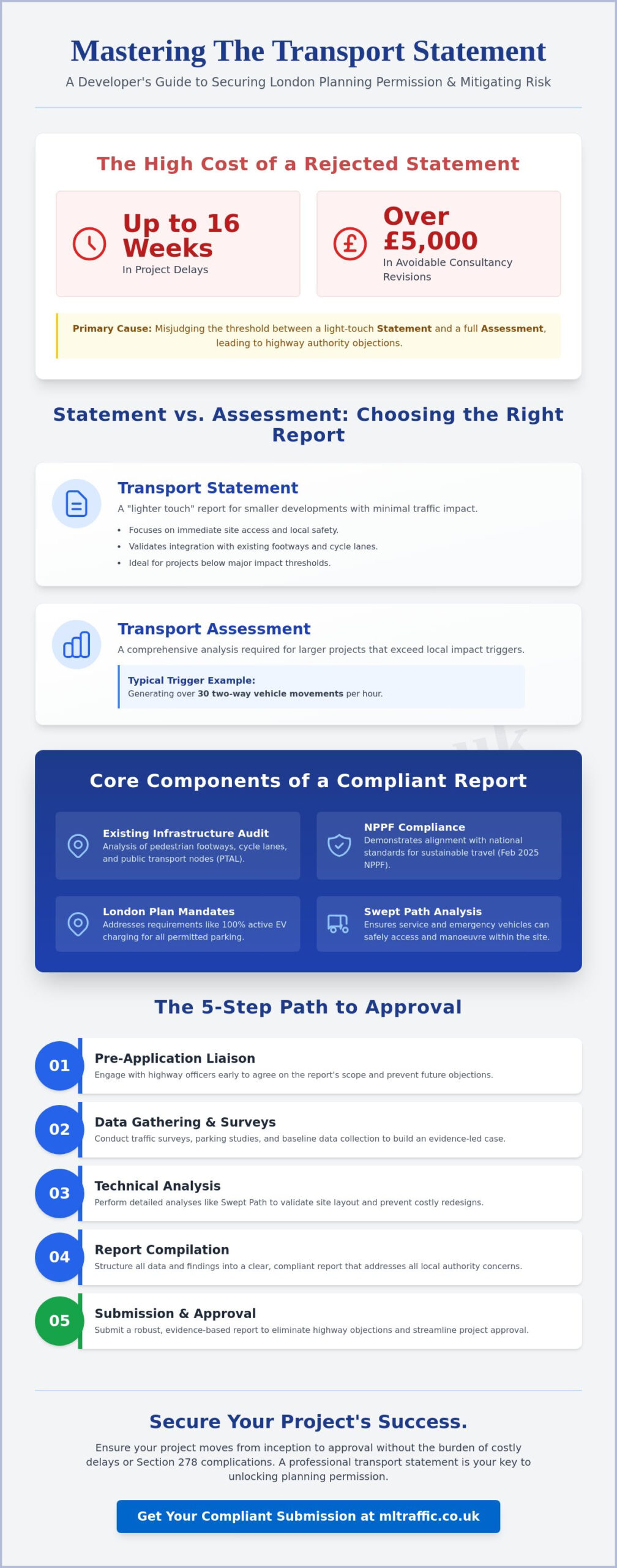
  • Transport Planning Consultants Camden: Navigating 2026 Planning Approvals

    Transport Planning Consultants Camden: Navigating 2026 Planning Approvals

    Camden’s 2026 planning landscape is no place for generic transport templates; it’s a borough where a single miscalculation in swept path analysis on a narrow historic street can halt a multi-million pound project. As specialist Transport Planning Consultants Camden, we understand that your success depends on reconciling historic constraints with the borough’s aggressive car-free mandates. You’re likely frustrated by high PTAL ratings in areas like King’s Cross that limit your development options or Council objections regarding vehicle manoeuvrability.

    We’re here to alleviate that regulatory burden by delivering planning-ready Transport Statements and CAD-designed swept path analysis that satisfy the 2025/26 to 2027/28 Delivery Plan. You’ll learn how to secure your Camden planning permission with expert transport data and technical precision. This guide outlines how to navigate the £5,674 local travel plan monitoring fees, negotiate S106 agreements, and use borough-specific traffic data to turn potential objections into approvals.

    Key Takeaways

    • Learn why Camden’s 2026 transport policies demand borough-specific data rather than generic templates to avoid immediate council objections.
    • Understand how PTAL ratings directly impact your development’s parking allowances and why a precise Transport Statement is essential for approval.
    • Discover how CAD-based swept path analysis proves safe access for refuse and emergency vehicles in Camden’s notoriously narrow historic streets.
    • Identify the specific requirements for Lambeth Methodology parking surveys, including the mandatory 200-metre survey radius Camden Council expects.
    • Partner with specialized Transport Planning Consultants Camden to access 24/7 technical support and expert negotiation for your Section 106 agreements.

    Camden’s transport policy landscape in 2026 follows the latest Transport Strategy Delivery Plan, which covers the period from 2025/26 to 2027/28. The London Borough of Camden (LBC) enforces some of the strictest car-free development requirements in the UK. This means most new projects are ineligible for on-street parking permits. The Camden Local Plan 2017 and the 15 January 2021 Planning Guidance on Transport serve as the primary benchmarks for every application. Engaging Transport Planning Consultants Camden at the feasibility stage is no longer optional; it’s a strategic necessity to avoid expensive design revisions. Early dialogue with LBC highways officers is critical because their time is currently billed at £60 per hour, and a single misinterpreted policy can lead to months of delays.


    Your technical submission will usually fall into two categories: a Transport Statement for smaller sites or a full Transport Assessment for larger developments. These reports provide the data-driven foundation for your planning application. They address how your site interacts with the wider transport planning network and ensure compliance with safety and environmental standards. We manage the entire process from initial site data collection to final council submission.

    The Impact of Camden’s Sustainable Transport Policies

    LBC’s car-free mandate is the cornerstone of their 2026 strategy. In high PTAL areas like King’s Cross, the Council expects developments to be entirely car-free, excluding essential operational or disabled parking. This shift reflects Camden’s success in active travel. Walking now accounts for 50% of all resident trips, up from 42% in 2017. Cycling modal share has also nearly doubled to 7% in the last six years. To secure approval, your project must contribute to the borough’s goal of placing 85% of residents within 400m of a strategic cycle route. We help you design infrastructure that meets these aggressive sustainability targets while maintaining site functionality.

    When to Appoint a Transport Planning Consultant in Camden

    Wait until the pre-application stage to appoint an expert and you’ve already waited too long. Identifying transport red flags like narrow access points or high PTAL-related parking restrictions during the initial CAD design phase saves time and capital. Transport Planning Consultants Camden provide the technical authority needed to negotiate Section 106 agreements, which often include Travel Plan monitoring fees of £5,674 for local level plans. We use precise data to justify your site’s operational needs, ensuring that Council objections don’t derail your timeline. Our 24/7 readiness means we can gather traffic data and perform technical assessments exactly when your project team needs them. For a full breakdown of our technical capabilities, visit our services overview.

    Transport Statements and PTAL Ratings: The Camden Framework

    A Transport Statement is a concise technical report designed for smaller developments to manage and mitigate localized transport impacts. In the context of Camden Council’s Transport Planning Requirements, these documents are vital for proving that a new site won’t overwhelm existing infrastructure. PTAL is the standard London metric for quantifying public transport access. Transport Planning Consultants Camden use the TRICS (Trip Rate Information Computer System) database to predict trip generation for specific land uses. This ensures that every claim is backed by comparative data from similar sites across the capital. By accurately forecasting how many people will travel to and from your development, we provide the technical foundation for a successful planning application.

    Camden Council uses PTAL scores to dictate parking allowances with zero tolerance for deviations in high-access zones. The council’s 2026 strategy prioritizes car-free developments, especially where public transport is readily available. If your site has a high PTAL score, you’re expected to provide zero on-site parking for residents or employees, except for essential blue badge spaces. We analyze these scores early in the process to help you understand exactly what the council will permit. This proactive approach prevents the need for expensive redesigns after you’ve already submitted your plans.

    PTAL 6a and 6b: Developing in Camden’s Transport Hubs

    Areas like King’s Cross, St Pancras, and Euston represent the pinnacle of connectivity. These sites often carry PTAL ratings of 6a or 6b, the highest possible scores. LBC mandates a strict zero-parking policy for these high-density schemes to align with their sustainable transport goals. While this presents logistical challenges, it allows developers to justify increased floor area. By leveraging these excellent transport links, you can maximize the potential of your site. We help you navigate these constraints by providing the technical data required to satisfy council scrutiny and prove that your development is truly sustainable.

    Mitigating Transport Impacts with Effective Travel Plans

    When a development’s impact exceeds specific thresholds, LBC requires comprehensive mitigation strategies. Designing London Travel Plans that satisfy Camden Council involves more than just listing nearby bus routes. You must implement tangible planning obligations such as car club memberships and cycle hire schemes to encourage active travel. Residential travel plans require different monitoring and reporting standards compared to workplace versions. Our team manages these ongoing requirements, ensuring your project remains compliant with Section 106 obligations. If you’re starting a new project, you can explore our transport consultancy services to ensure your site meets all local standards from day one.

    Transport Planning Consultants Camden: Navigating 2026 Planning Approvals

    Swept Path Analysis for Camden’s Historic and Narrow Streets

    Camden’s historic urban fabric presents a unique challenge for modern logistics. Many streets in Hampstead or Camden Town weren’t designed for 10.5-metre refuse vehicles or large delivery vans. This is where Swept Path Analysis services become critical. As experienced Transport Planning Consultants Camden, we use specialized CAD software to simulate vehicle movements within your proposed site layout. We demonstrate that vehicles can enter, turn, and exit in forward gear without endangering pedestrians or damaging the public realm. CAD-based vehicle tracking ensures that your design works in reality, preventing expensive physical access failures once the building is already constructed.

    London Borough of Camden (LBC) officers are particularly vigilant about pavement over-run. If a simulation shows a wheel crossing a footway, the council will likely object on safety grounds. We provide the technical evidence to satisfy LB Camden Standards, ensuring your servicing strategy is robust. This precision is vital for sites in conservation areas where street widening is impossible. Our team works round-the-clock to provide the technical data required to clear these hurdles quickly. Precision in these reports is non-negotiable because LBC’s 2025/26 to 2027/28 Delivery Plan emphasizes protecting the borough’s historic character while modernizing its utility.

    Vehicle Templates for Camden Planning Submissions

    LBC specifies exact vehicle dimensions for planning simulations. For refuse collection, we typically use a 9.2m or 10.5m phoenix-type vehicle, depending on the specific local fleet. Emergency access is equally scrutinized. Fire tenders require a minimum clear width of 3.7m and a turning circle that respects Camden’s narrow mews and cul-de-sacs. In tight conservation areas, we analyze multi-way junctions to prove that even the most restricted turnings are safe. Using the correct templates from the start prevents the council from requesting a resubmission due to inaccurate data. We ensure every simulation reflects the real-world constraints of the borough’s 250+ car club parking bays and active travel lanes.

    Integrating SPA into Site Design

    Swept Path Analysis (SPA) should never be an afterthought. Integrating it early allows you to optimize car park layouts and loading bay positions. This fluid movement is essential for justifying on-street servicing arrangements if on-site loading isn’t feasible. We also use SPA data to support Highway Design S278 negotiations. These agreements often involve changes to the existing public highway. By proving that your design accommodates the necessary vehicles safely, we help you secure approval for necessary road modifications. Transport Planning Consultants Camden provide the technical reassurance that your project is both compliant and functional. If you’re unsure about your site’s access potential, review our technical capabilities to see how we can assist your project team.

    Conducting Parking Surveys to LB Camden Standards

    Camden’s strict car-free policy makes on-street parking capacity a high-stakes metric. If you’re proposing residential units or need to justify the impact of a car-free scheme on the surrounding network, a parking survey is mandatory. Camden Council (LBC) mandates the ‘Lambeth Methodology’ for these assessments. This standardized approach ensures that data is consistent and defensible during planning committee hearings. Transport Planning Consultants Camden provide the technical precision required to map these spaces accurately. We identify every legal parking bay, including permit holder zones, shared-use bays, and pay-and-display areas within a specific 200-metre walking distance from the site entrance.

    Timing is everything in a Camden submission. LBC typically rejects surveys conducted during school holidays or near bank holidays because they don’t represent neutral conditions. We focus on ‘stress levels’ to determine if the local street network can absorb any displaced parking. If the survey shows that occupancy exceeds 85%, the council may view the development as a risk to local parking amenity. Our reports provide the clarity needed to navigate these objections before they result in a planning refusal.

    Step-by-Step Guide to a Camden Parking Survey

    A successful survey requires strict adherence to timing and geographical constraints. Our team follows a rigorous process to ensure compliance with LBC’s 2021 Planning Guidance on Transport:

    • Define the Survey Area: We map all legal parking capacity within a 200m radius, excluding private driveways or restricted red routes.
    • Overnight Snapshots: We conduct two separate counts between 00:30 and 05:30 on a Tuesday and Wednesday night. These represent the peak period for residential parking demand.
    • Calculate Stress Levels: We divide the number of vehicles parked by the total number of available spaces to find the percentage of parking stress.
    • Technical Reporting: We compile this data into a comprehensive report that integrates directly into your Transport Statement.

    Our 24/7 availability ensures we capture this data during the precise windows required by the council. If you need immediate data collection to meet a submission deadline, you can book a parking survey with our technical team today.

    Data Collection for Traffic and Pedestrian Flows

    Beyond parking, LBC often requires detailed traffic and pedestrian data for sites near sensitive receptors like schools or hospitals. We use Automatic Traffic Counters (ATC) to gather volume and speed data over a seven-day period. This provides a baseline for noise and air quality assessments. In high-footfall areas like Camden Market, manual turning counts are essential to track specific vehicle classes and pedestrian movements at junctions. We evaluate pedestrian comfort levels to ensure that new development doesn’t lead to overcrowding on narrow historic footways. This data-driven approach allows Transport Planning Consultants Camden to present a factual case for your development’s safety and viability.

    Expert Transport Planning Consultants for Camden Projects

    ML Traffic Engineers provide the technical authority required to navigate Camden’s complex 2026 planning environment. We don’t just produce generic reports; we deliver a managed solution that bridges the gap between complex CAD design and rigid council policy. Our team understands that precision is a legal and physical necessity in the London Borough of Camden. We’ve built a proven track record of securing approvals across the borough’s 20 wards by providing data that stands up to the most rigorous council scrutiny. From Bloomsbury to Hampstead, we ensure every technical submission aligns with the Camden Local Plan and the latest 2025/26 to 2027/28 Delivery Plan.

    Our 24/7 availability is a primary hallmark of our brand promise. Planning deadlines don’t wait for standard office hours, and neither do we. Whether you need an urgent overnight parking survey on a Tuesday or a revised swept path analysis for a morning committee meeting, our team is ready to act. As Transport Planning Consultants Camden, we take immense pride in our role as a safe pair of hands for developers and architects. We manage the logistical and regulatory burdens so you can focus on the broader vision of your development. Our readiness stems from the fast-moving nature of London construction, where a single day’s delay can impact project viability.

    A Managed Solution from Planning to Implementation

    We provide comprehensive support for Transport Assessment London projects, moving seamlessly from initial consultation to final implementation. Our engineers liaise directly with LBC Highways officers and Transport for London (TfL) to ensure your project aligns with the Mayor’s Transport Strategy. We prioritize safety and regulatory compliance in every document, ensuring that your site’s access and servicing strategies are beyond reproach. This proactive communication flow prevents the rhythmic delays often associated with urban planning. We position ourselves as a vital partner in your project’s lifecycle, ensuring that technical engineering data supports your architectural goals without compromise.

    Get Started with Your Camden Planning Application

    Every development in Camden requires a bespoke approach tailored to its specific location and land use. We invite you to request a tailored fee proposal that addresses your project’s unique transport requirements. Transport Planning Consultants Camden are essential for navigating the 15 January 2021 Planning Guidance on Transport and the strict car-free mandates currently in place. You can also access our resources for technical guidance on current London planning standards and data collection methodologies. Contact our London-based team today for an initial project review. We’ll help you navigate the 2026 planning cycle with the confidence and technical excellence your project deserves.

    Secure Your 2026 Camden Planning Approval

    Camden’s planning requirements leave no room for technical error. Success depends on aligning your site design with the borough’s strict car-free mandates and proving accessibility through precise CAD-based simulations. You’ve seen how PTAL scores dictate your parking strategy and why the Lambeth Methodology is non-negotiable for on-street capacity assessments. Navigating these technical hurdles requires a partner who understands the intricate local implementation plans and provides a safe pair of hands throughout the process.

    As specialized Transport Planning Consultants Camden, we provide the technical authority needed to clear council objections. Our 24/7 technical survey availability ensures your data is captured within the precise windows the council demands. We’re specialists in swept path analysis for narrow London streets, ensuring your servicing strategy is both safe and compliant. We bridge the gap between complex engineering and planning success so you don’t have to manage the regulatory burden alone.

    Secure your Camden project’s success – Contact ML Traffic Engineers today. We’re ready to help you turn your development vision into an approved reality.

    Frequently Asked Questions

    Do I need a Transport Statement for a small development in Camden?

    Yes, most small developments in Camden require a Transport Statement to prove they won’t overwhelm the local network. The Camden Planning Guidance adopted on 15 January 2021 sets specific thresholds for these reports. For example, office developments with more than 20 staff but less than 2,500m² typically need a local level report. As Transport Planning Consultants Camden, we tailor these statements to address the borough’s strict car-free mandates and active travel requirements.

    How does a high PTAL rating affect my parking allowance in Camden?

    A high PTAL rating of 4 or above generally mandates a completely car-free development in Camden. This means you cannot provide on-site parking for residents or employees, except for essential blue badge spaces. These ratings reflect the borough’s success in public transport access, where walking now accounts for 50% of all resident trips. We analyze these ratings early in the design phase to ensure your site layout complies with LBC’s zero-parking expectations.

    What is the Lambeth Methodology for parking surveys, and is it used in Camden?

    The Lambeth Methodology is the standard framework for measuring on-street parking capacity and is strictly required by Camden Council. This survey identifies all legal parking spaces within a 200-metre radius of your site entrance. We conduct two separate overnight snapshots between 00:30 and 05:30 on mid-week nights to capture peak residential demand. This data allows us to calculate parking stress and prove your development won’t negatively impact local residents.

    Can Swept Path Analysis help if Camden Council says my site access is too narrow?

    Yes, Swept Path Analysis provides the technical proof that vehicles can navigate tight or narrow access points safely. We use CAD-based simulations to track the movements of 10.5-metre refuse vehicles or fire tenders within your site. This is critical for developments in historic areas where street widening is impossible. By demonstrating safe access without pavement over-run, we help you overcome council objections regarding vehicle manoeuvrability.

    How long does it take to complete a Transport Statement for a Camden project?

    We typically complete a comprehensive Transport Statement within two to four weeks, depending on the complexity of the site. This timeline includes site data collection, trip generation modeling using the TRICS database, and final report drafting. Our 24/7 readiness allows us to mobilize survey teams immediately for overnight counts. This efficiency ensures that technical data collection doesn’t become a bottleneck for your planning submission deadline.

    What happens if my Camden development exceeds local parking stress thresholds?

    If parking stress exceeds the 85% threshold, the council may view your development as a risk to local parking amenity. In these cases, we use Travel Plans to mitigate concerns through measures like car club memberships or cycle hire schemes. These strategies demonstrate a commitment to reducing car dependency in line with the Camden Transport Strategy. We provide the technical evidence needed to show that these measures will effectively manage any displaced parking demand.

    Does ML Traffic Engineers provide 24/7 data collection in Camden?

    Yes, we maintain 24/7 availability for all technical data collection and traffic surveys across the London Borough of Camden. This constant readiness is a hallmark of our brand promise, ensuring we capture data during the precise windows required by LBC officers. Whether you need an urgent overnight parking count or peak-hour pedestrian flow data, our team is ready to mobilize. This reliability helps project managers meet tight regulatory deadlines without compromising on data precision.

    Will I need to negotiate a Section 278 agreement for my Camden site?

    You’ll need a Section 278 agreement if your development requires any physical changes to the existing public highway. This includes installing new site access points, dropped kerbs, or modifications to the footway. As Transport Planning Consultants Camden, we provide the technical drawings and swept path data required for these negotiations. We liaise directly with LBC Highways to ensure your proposed modifications meet all safety and design standards for approval.

    Michael Lee

    Article by

    Michael Lee

    Transport planner with over 35 years’ experience.

    Disclaimer

    The content on mltraffic.co.uk, including all technical articles, guides, and resources, is provided for general informational and educational purposes only. It is not intended to constitute professional advice in traffic engineering, transportation planning, development approvals, or any other technical or legal field.
    While ML Traffic Engineers makes every reasonable effort to ensure the accuracy, completeness, and timeliness of the information published, we do not provide any warranties or representations (express or implied) regarding its reliability, suitability, or availability for any particular purpose. Any reliance you place on the content is strictly at your own risk.
    In no event shall ML Traffic Engineers, its directors, employees, authors, or affiliates be liable for any direct, indirect, incidental, special, consequential, or punitive damages (including, without limitation, loss of profits, data, or business opportunities) arising out of or in connection with the use of, or inability to use, any information provided on this website.
    The articles and guides on this site are not a substitute for engaging a qualified, professional traffic engineer to assess your specific project requirements. For tailored advice, compliance assessments, or traffic engineering services, please contact a competent professional.
    This disclaimer may be updated from time to time without notice. By accessing or using this website, you agree to be bound by the most current version of this disclaimer.