Tag: planning permission

  • The Role of a Traffic Consultant in Securing UK Planning Approvals in 2026

    The Role of a Traffic Consultant in Securing UK Planning Approvals in 2026

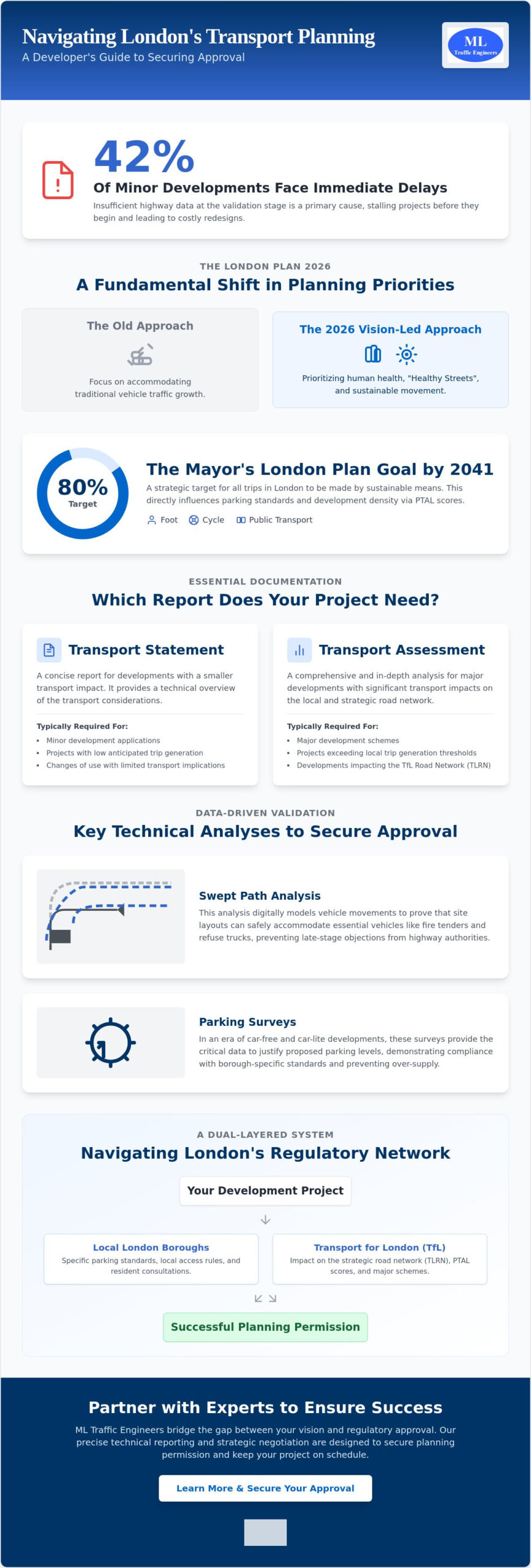
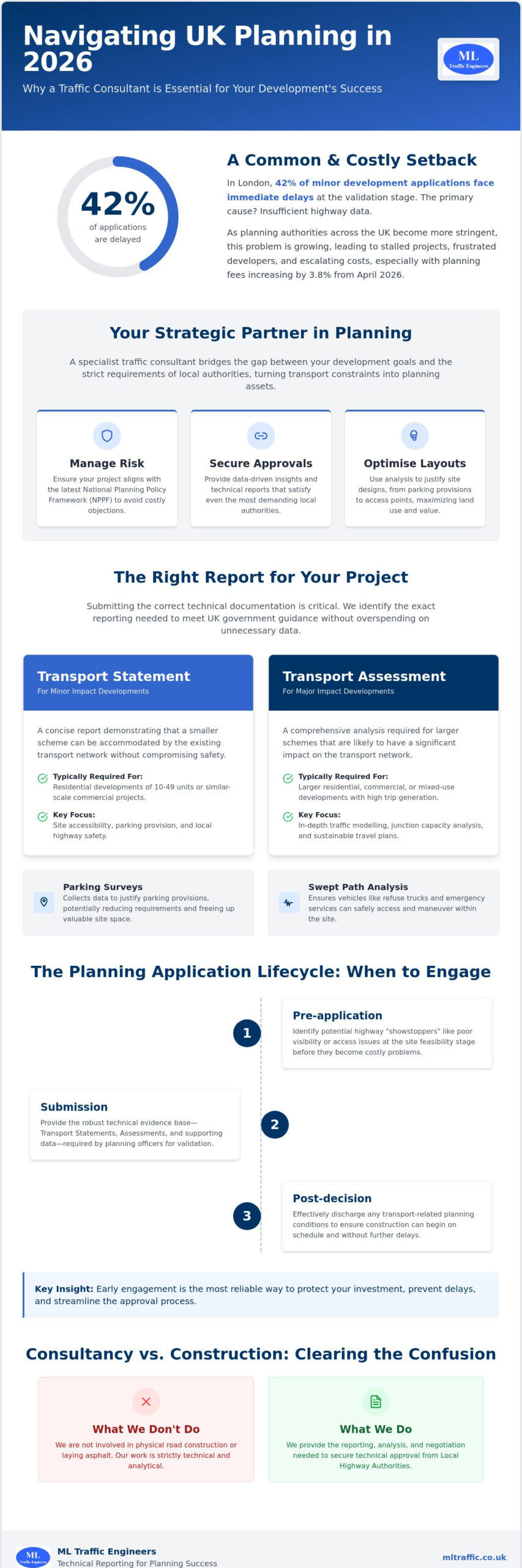
    In London, 42% of minor development applications face immediate delays at the validation stage simply because they lack sufficient highway data. This statistic highlights a growing trend across the UK where planning authorities are becoming increasingly stringent about transport impact. You likely understand the frustration of seeing a project stall because of a highway authority objection or confusion over whether you need a Transport Statement or a full Assessment. Securing planning permission in 2026 requires more than just a good design; it demands technical precision and a deep understanding of evolving regulations like the revised National Planning Policy Framework. Engaging a professional traffic consultant is no longer optional for developers who want to avoid costly setbacks.

    A specialist traffic consultant acts as a strategic partner to turn transport constraints into planning assets. We provide the technical reporting and data-driven insights, such as swept path analysis and parking surveys, needed to satisfy even the most demanding local authorities. This article explores how expert consultancy navigates complex 2026 regulations to secure approvals and optimize site layouts. You’ll discover how to minimize transport-related conditions and deliver cost-effective technical reports that keep your development on track and within budget.

    Key Takeaways

    • Understand how a traffic consultant manages transport risks to ensure your project aligns with the latest National Planning Policy Framework (NPPF) requirements.
    • Learn the critical differences between Transport Statements and Transport Assessments to ensure you submit the correct technical documentation for your development size.
    • Discover how technical data collection, including Parking Surveys and Swept Path Analysis, can justify lower parking provisions and optimise your site layout.
    • Identify why early engagement during the site feasibility stage is essential to prevent costly highway authority objections and application delays.
    • Gain insights into streamlining the approval process through comprehensive reporting that meets specific Local Highway Authority standards in England.

    What is a Traffic Consultant and Their Role in UK Planning?

    A traffic consultant is a technical expert tasked with managing the transport-related risks of a development project. Their primary objective is ensuring that a scheme complies with the National Planning Policy Framework (NPPF) and local highway standards. In the context of the 2026 planning cycle, where revisions to the NPPF emphasize efficient land use and sustainable transport hubs, this role is critical for securing a viable planning permission. They don’t just provide data; they act as a strategic bridge between your development goals and the strict requirements of local authorities.

    To better understand the distinction between the technical roles involved in this field, watch this helpful video:

    While the terms are often used interchangeably, a traffic engineer typically focuses on the physical movement of vehicles and site geometry, whereas a transport planner examines broader policy and the transportation planning process. A professional traffic consultant integrates both disciplines to provide a robust evidence base for local authorities. They ensure that your site is not only accessible but also policy-compliant in an environment where sustainable and active travel are now mandatory priorities.

    Consultancy vs. Construction: Clearing the Confusion

    It’s a common misconception that traffic consultants are involved in physical road construction. While Companies House often groups consultancy under “Construction of roads,” the reality is strictly technical and analytical. We specialize in what we do: reporting, analysis, and negotiation. We don’t lay asphalt; we provide the data that justifies the road layout or parking provision. Our focus remains on securing technical approval from Local Highway Authorities through rigorous reporting and adherence to industry benchmarks.

    The Planning Application Lifecycle

    Effective consultancy follows a logical, sequential flow that mirrors the progression of your project. This includes:

    • Pre-application: Identifying potential highway “showstoppers” like poor visibility splays before they become costly.
    • Submission: Providing the technical evidence base, such as Transport Statements, required by planning officers.
    • Post-decision: Discharging transport-related planning conditions effectively so construction can begin.

    Engaging a consultant early in the 2026 planning cycle is essential. With planning fees in England increasing by 3.8% from April 2026, the cost of a failed application is higher than ever. Precision in your initial submission is the most reliable way to protect your investment.

    Core Services: From Transport Statements to Technical Surveys

    Securing planning approval in 2026 requires a robust technical evidence base tailored to your development’s scale. With planning fees in England rising by 3.8% as of April 2026, getting the submission right the first time is a financial necessity. A professional traffic consultant identifies the exact reporting requirements to satisfy UK government guidance, ensuring you don’t overspend on unnecessary data while meeting every statutory obligation. These services range from preliminary statements for minor schemes to comprehensive assessments for major projects.

    For residential developments of 10 to 49 units, Transport Statements are typically the standard requirement. These concise reports address minor transport impacts and demonstrate that the existing network can accommodate new residents without compromising safety. Larger schemes with significant traffic generation require full Transport Assessments. These detailed documents analyze capacity, safety, and mitigation across a wider area. Getting this distinction right at the validation stage prevents the 42% delay rate often seen in complex urban planning environments where highway data is frequently found insufficient.

    The Technical Evidence Base

    Digital vehicle simulations provide the precision needed to satisfy highway officers and planning committees. Swept Path Analysis (SPA) uses specialized software to prove fire tenders and refuse vehicles can safely navigate your site. Without SPA, designs often face immediate rejection due to access concerns. We also use the TRICS database for trip forecasting and Travel Plans to support sustainable transport goals. These tools ensure your layout is both functional and policy-compliant from the start.

    Specialised Surveys for Local Authorities

    Authorities often demand specific data like the Lambeth Methodology for parking surveys. These overnight stress assessments prove the local network can absorb parking overflow, which is vital for car-free or low-parking schemes. We also conduct traffic counts and speed surveys to determine visibility splays at site entrances. These provide the hard evidence needed for technical negotiations. Explore these options on our What We Do page. Consulting with a traffic consultant early prevents technical objections and keeps your project moving forward.

    Why Developers Need a Traffic Consultant in 2026

    The financial stakes of UK development have never been higher. With planning appeal rates for residential schemes dropping by 22% when robust transport documentation is used, the ROI of professional technical support is clear. A traffic consultant does more than just fill out forms; they mitigate the risk of planning refusal by addressing highway safety and capacity concerns before they reach a committee. By providing an evidence based approach, we protect your project from the subjective objections that often stall applications.

    Land use optimization is another critical area where expert input pays for itself. In urban environments, the London Plan 2026 now mandates car-free developments in areas with a Public Transport Accessibility Level (PTAL) score of 4 or higher. We use empirical data from parking surveys to justify lower parking provisions, freeing up valuable square footage for additional units or amenities. Our members often hold qualifications from the Chartered Institution of Highways & Transportation, ensuring that all justifications meet the highest industry standards for technical excellence and safety.

    Beyond the initial application, we manage the complex negotiation of Section 278 Agreements. These legal requirements for permanent highway works can become a significant bottleneck if not handled with technical precision. If a project does face a challenge, we provide expert witness services for planning appeals, defending our technical findings with authoritative clarity to ensure your development moves forward.

    Cost Savings Through Design Optimization

    Accurate data prevents the expensive over-engineering of access roads and junctions. By using precise trip generation models, we often prove that standard, less invasive designs are sufficient for the projected traffic flow. This approach can also eliminate the need for costly underground parking. A robust transport assessment might demonstrate that local network capacity can support your density without such heavy infrastructure investment. We resolve the common “architect vs. highways” conflict by providing engineering led designs that satisfy both aesthetic goals and safety requirements.

    For commercial or industrial developments in 2026, ensuring that site access is optimized for heavy logistics is a key part of the planning process. To see how professional logistics providers manage complex freight movements, you can learn more about Tranzit Express Inc. and their role in the transportation industry.

    Navigating Local Authority Objections

    Professional credibility is your strongest asset when dealing with council engineers. We speak their language and understand their specific regional concerns. When an objection arises, we don’t just relay the bad news. We translate technical objections into actionable design changes that maintain your project’s viability. For a deeper look at how this works in complex urban settings, see our Transport Assessment London Guide. Rapid response and technical authority are essential for keeping your project on schedule.

    When to Engage a Traffic Consultant for Your Project

    The “Early Engagement” principle is the foundation of a successful planning strategy. Many developers make the mistake of waiting until they receive a formal objection from the Local Highway Authority before seeking expert advice. This reactive approach is costly. By the time an objection is raised, design changes are often expensive and time consuming to implement. Engaging a professional traffic consultant during the initial site feasibility stage allows you to determine if a site can actually support your proposed density. This foresight prevents you from investing in a scheme that is fundamentally flawed from a transport perspective.

    Coordinating with your design team during RIBA Stage 2 and 3 ensures that transport requirements are baked into the site’s DNA. This collaboration prevents the common conflict where an architect’s vision is compromised by late stage highway requirements. Additionally, the timing of survey data collection is critical for a valid submission. We strictly avoid school holidays and bank holidays to ensure the data is representative of typical network conditions. Unrepresentative data is a frequent cause for council rejection and can force you to repeat expensive data collection exercises.

    Pre-Application Strategy

    Using a consultant to scope the transport requirements with the council early is a proactive step that reduces regulatory pressure. This process identifies the specific need for specialized surveys before the application is submitted, allowing for a smoother validation process. Implementing early Swept Path Analysis can save weeks of redesign time by ensuring the site layout accommodates essential service vehicles from the first draft. This technical readiness demonstrates professional integrity to planning officers from the outset.

    The Submission Phase

    During the submission phase, we ensure all reports are current and meet 2026 policy standards, such as the latest NPPF revisions. We also manage technical requests for further information from authorities, including formal Regulation 25 requests. Given that 42% of minor applications face delays at validation due to insufficient data, your evidence base must be beyond reproach. If you are preparing a new application, you can request a technical review of your site feasibility to ensure compliance before submission.

    Checklist for developers: Is your transport evidence ready for submission?

    • Is your survey data representative and collected outside of holiday periods?
    • Does your Travel Plan align with the 2026 London Plan or regional standards?
    • Has your SPA been conducted using the specific refuse vehicle dimensions required by the local council?
    • Is your traffic consultant prepared to negotiate directly with highway engineers?
    The Role of a Traffic Consultant in Securing UK Planning Approvals in 2026

    Choosing ML Traffic Engineers for Your 2026 Planning Success

    ML Traffic Engineers UK has provided technical reporting and data collection for planning applications across England since 2014. We understand that precision is a functional necessity in the high-stakes environment of property development. As your traffic consultant, we manage the full project lifecycle from inception to completion. Our team balances technical authority with a client-focused approach to reduce the logistical and regulatory pressures on your business. We don’t just provide reports; we act as a reliable partner that understands intricate regional regulations so you don’t have to. This dedication to accuracy ensures that every submission meets the rigorous standards expected by planning committees and highway officers.

    Our methodology is rooted in specialized industry terminology and strict adherence to legislative requirements. We take immense pride in our precision and adherence to standards, which serves as the foundation for every project we undertake. Whether you’re developing a minor residential scheme or a complex mixed-use commercial site, our solutions are tailored to meet the specific requirements of the Local Highway Authority. This commitment to formal excellence ensures that our technical reports carry the weight and credibility needed to build trust with planning officers, effectively streamlining the path to approval.

    Expertise in London and Regional Planning

    Managing the unique challenges of urban site constraints requires a deep understanding of evolving policies. While the London Plan 2026 places significant emphasis on connectivity and sustainable density, our role is to translate these requirements into viable site layouts that satisfy both local and national targets. We have a consistent track record in delivering Transport Statements that win approval by directly addressing local authority concerns with empirical data. Our comprehensive approach moves your project from the initial feasibility stage through to final technical approval with efficiency and readiness, ensuring that no technical detail is overlooked.

    The ML Traffic Engineers UK Advantage

    The ML Traffic Engineers UK advantage lies in our precision-led engineering paired with a client-focused advisory approach. We provide an all-encompassing service that includes everything from raw data collection to expert technical reporting. This fully managed service model ensures you have a single, dependable point of contact for all transport-related planning matters, reducing the need for multiple vendors. We invite you to explore our project types to see how we’ve supported various residential and commercial developments across the country.

    Success in the 2026 planning cycle depends on technical accuracy and rapid response capabilities. We maintain a standard of professional integrity and civic responsibility that positions us as vital guardians of public safety. Don’t let transport objections stall your development’s progress or lead to unnecessary costs. Contact ML Traffic Engineers UK today to secure the technical expertise your project requires for a successful planning outcome.

    Secure Your Development’s Future in 2026

    Planning success in the current regulatory environment depends on technical precision and early strategic action. By integrating transport requirements into the earliest design phases, you avoid the common pitfalls of highway objections and validation delays. A professional traffic consultant provides the evidence base needed to justify site density and parking provisions, ensuring your project aligns with national standards. This proactive approach minimizes the risk of costly redesigns and protects your development’s timeline from unpredictable regulatory hurdles.

    ML Traffic Engineers UK acts as a reliable partner for Local Highway Authority negotiations, offering specialist consultants for NPPF compliance and expert Swept Path Analysis services. We manage the full lifecycle of your transport planning needs to ensure a seamless approval process. Our team is ready to provide the technical authority required to move your project from the feasibility stage through to successful completion with unwavering reliability.

    Get a Professional Quote for Your Transport Planning Needs

    Your vision for a successful development starts with a solid technical foundation. We’re ready to help you move your project forward with confidence and professional integrity.

    Frequently Asked Questions

    What is the difference between a Transport Statement and a Transport Assessment?

    The primary difference lies in the scale of the proposed development and the depth of analysis required. A Transport Statement is a concise report for smaller projects, typically residential schemes between 10 and 49 units, that have limited transport impacts. A Transport Assessment is a comprehensive document for larger developments. It requires detailed modeling of network capacity, safety, and mitigation measures to satisfy the Local Highway Authority.

    How much does a traffic consultant cost for a planning application?

    Fees for professional consultancy depend on the project’s complexity and the specific technical requirements of the local council. Costs vary based on whether the scheme requires a simple Statement or a full Assessment supported by extensive data collection. To ensure you receive a cost-effective solution that meets all regulatory benchmarks, it is best to request a tailored quote based on your specific site layout and development goals.

    Is a Swept Path Analysis always required for a new driveway or access?

    Local Highway Authorities frequently mandate Swept Path Analysis for any new access point to prove that essential vehicles, such as fire tenders and refuse trucks, can safely enter and turn. Proving these maneuvers through digital simulation is a functional necessity for modern planning approvals. Even for smaller sites, this analysis prevents immediate objections regarding highway safety and ensures your design complies with the latest street design standards.

    Once planning approval is secured, working with experienced contractors such as McCready Home Improvements ensures that the physical construction of driveways and property access meets the required quality and durability standards.

    How long does it take to produce a Transport Statement in 2026?

    A professional traffic consultant typically requires two to four weeks to produce a standard Transport Statement. This timeline depends heavily on the availability of representative survey data. In 2026, data collection must strictly avoid school holidays and bank holidays to ensure the findings are accurate and acceptable to planning officers. Early engagement ensures that your technical evidence is ready well before your planned submission date.

    Can a traffic consultant help if my planning application has already been refused?

    Yes, we can analyze the specific reasons for refusal and provide the technical evidence needed for a resubmission or appeal. We specialize in translating highway authority objections into actionable design changes that maintain project viability. Using robust transport documentation has been shown to reduce planning appeal rates by 22% for residential schemes, providing a clear path forward after an initial setback from the council.

    Do I need a traffic survey if my site is in a low-traffic area?

    You may still need a traffic survey to determine visibility splays or to prove that the local network can absorb even a minor increase in vehicle movements. Local authorities often demand empirical data rather than assumptions, regardless of current traffic levels. Surveys provide the technical evidence needed to justify your site’s access safety and capacity, ensuring your application isn’t delayed at the validation stage due to insufficient data.

    What information does a traffic consultant need from me to start?

    To begin the technical assessment, we require a clear site location plan, the proposed site layout, and details regarding the development’s scale and intended use class. Providing any previous correspondence with the council or the site’s planning history is also vital. This information allows us to scope the transport requirements accurately and identify potential highway “showstoppers” before they become costly issues during the formal application process.

    How does a Travel Plan differ from a Transport Assessment?

    A Transport Assessment analyzes the physical impact of a development on the highway network’s capacity and safety. In contrast, a Travel Plan is a long-term strategy focused on promoting sustainable transport modes like cycling and public transport. While the Assessment deals with vehicle movements and infrastructure, the Travel Plan outlines measures to reduce car dependency, which is a mandatory requirement for many schemes under the 2026 London Plan.

    Michael Lee

    Article by

    Michael Lee

    Transport planner with over 35 years' experience.

    Disclaimer

    The content on mltraffic.co.uk, including all technical articles, guides, and resources, is provided for general informational and educational purposes only. It is not intended to constitute professional advice in traffic engineering, transportation planning, development approvals, or any other technical or legal field.
    While ML Traffic Engineers makes every reasonable effort to ensure the accuracy, completeness, and timeliness of the information published, we do not provide any warranties or representations (express or implied) regarding its reliability, suitability, or availability for any particular purpose. Any reliance you place on the content is strictly at your own risk.
    In no event shall ML Traffic Engineers, its directors, employees, authors, or affiliates be liable for any direct, indirect, incidental, special, consequential, or punitive damages (including, without limitation, loss of profits, data, or business opportunities) arising out of or in connection with the use of, or inability to use, any information provided on this website.
    The articles and guides on this site are not a substitute for engaging a qualified, professional traffic engineer to assess your specific project requirements. For tailored advice, compliance assessments, or traffic engineering services, please contact a competent professional.
    This disclaimer may be updated from time to time without notice. By accessing or using this website, you agree to be bound by the most current version of this disclaimer.

  • Pre-application Transport Advice in London: A Developer’s Guide for 2026

    Pre-application Transport Advice in London: A Developer’s Guide for 2026

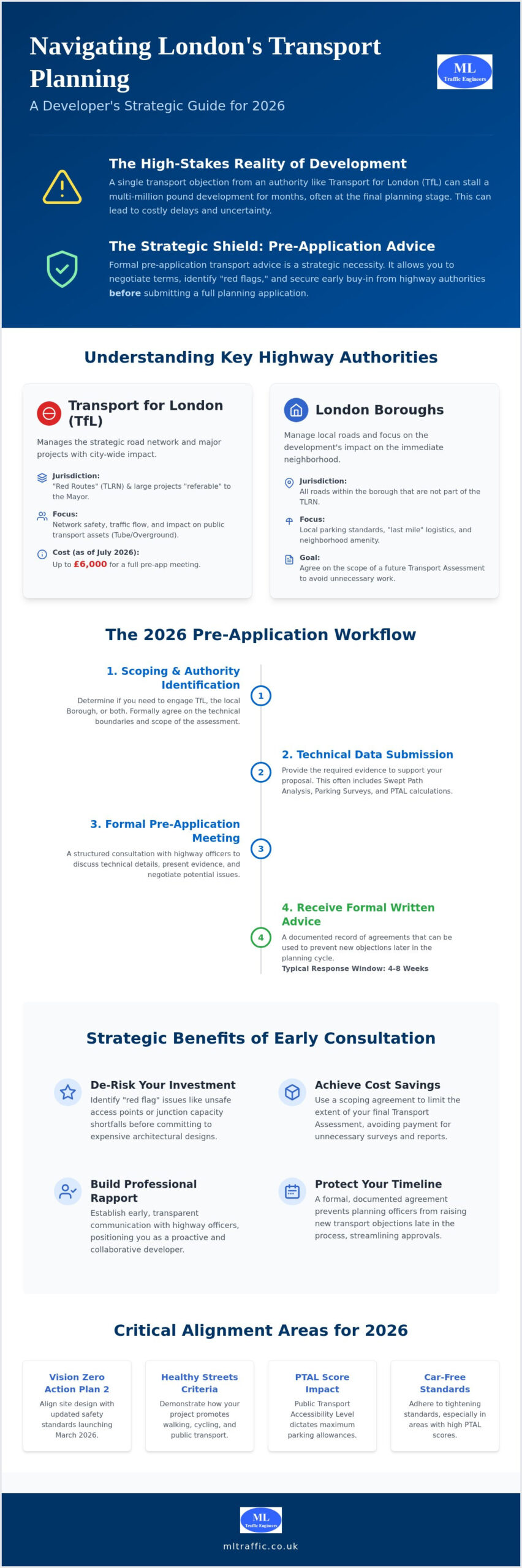
    A single transport objection from Transport for London can stall a multi-million pound development for months, often just as you reach the final planning stage. In this high-stakes regulatory environment, technical precision is a functional necessity for project survival. Seeking pre-application transport advice London is no longer just a recommendation. It’s a strategic shield that allows you to negotiate the terms of your approval before the formal clock starts ticking.

    We recognize the frustration of navigating conflicting requirements between local boroughs and strategic authorities. The fear of project-killing objections is valid, especially with the March 2026 launch of the Vision Zero Action Plan 2 and tightening car-free development standards. Uncertainty regarding technical detail often leads to unnecessary spending on reports that might not meet specific highway expectations.

    This guide provides a clear roadmap for navigating London’s transport planning requirements in 2026. You’ll learn how to secure early buy-in from authorities, identify non-negotiable issues, and agree on the scope for future Transport Assessments. This professional framework helps you streamline the approval process and protects your project timeline from regulatory delays.

    Key Takeaways

    • Understand the distinction between Local Borough and TfL jurisdictions to ensure your pre-application transport advice London is directed to the correct authority.
    • Learn how formal scoping agreements can limit the extent of your final Transport Assessment, reducing both reporting costs and technical delays.
    • Master the 2026 pre-app workflow to effectively manage the typical four to eight week response windows from London highway departments.
    • Identify potential “red flag” issues early by aligning your site design with Vision Zero safety standards and the latest Healthy Streets criteria.
    • Discover how technical data, such as Swept Path Analysis and Parking Surveys, provides the evidence needed to secure early buy-in from planning officers.

    What is Pre-application Transport Advice in London?

    Pre-application transport advice London is a formal technical consultation between a developer and a highway authority. It takes place before you submit a full planning application. This process is distinct from the broader planning permission process in the UK because it focuses exclusively on movement, safety, and infrastructure capacity. In 2026, the stakes are higher than ever. With the London Plan 2021 setting a target of 52,000 new homes annually, urban density is at an all-time high. This density forces authorities to be more protective of the existing road network.

    You shouldn’t rely on informal “duty officer” chats or quick phone calls. These don’t carry the weight of formal written advice. A formal pre-app provides a documented trail of agreement. This agreement can prevent a planning officer from raising new transport objections late in the cycle. It’s a strategic move to lock in your highway parameters early.

    To better understand how this process integrates with your project timeline, watch this helpful summary:

    When to Engage with Transport for London (TfL)

    Transport for London manages the Transport for London Road Network (TLRN), commonly known as “Red Routes.” If your development sits on one of these routes, or if it’s large enough to be “referable” to the Mayor, you must consult TfL. They also get involved if your site is near London Underground or Overground assets. Their requirements are rigorous and data-heavy. As of July 2026, TfL’s fees reflect this complexity. Initial screening costs £550, while a full pre-application meeting for referable projects can cost up to £6,000. You’ll need high-accuracy technical data, such as Swept Path Analysis, to prove your project won’t compromise the strategic network’s safety or flow.

    The Role of the London Borough Highway Authority

    Boroughs focus on local impact. They care about how your development affects the immediate neighborhood. This includes parking standards and “last mile” logistics for deliveries. Policies aren’t uniform across the city. What works in Southwark might be rejected in Westminster. Borough pre-apps help you navigate these local nuances. They ensure your proposal aligns with the March 2026 Vision Zero Action Plan 2 updates. Engaging early allows you to agree on the scope of a future Transport Assessment. This prevents you from paying for unnecessary surveys or technical reports that the borough doesn’t actually require.

    The Strategic Benefits of Early Transport Consultation

    Securing pre-application transport advice London isn’t just a regulatory hurdle. It’s a high-value strategy for risk mitigation. By engaging highway authorities early, you identify “red flag” issues before investing heavily in architectural designs. If a proposed access point is fundamentally unsafe or a junction lacks capacity, it’s better to know before your plans are fixed. This early transparency builds a professional rapport with council highway officers, positioning you as a proactive developer committed to safety and precision.

    A critical component of this stage is establishing the Public Transport Accessibility Level (PTAL). In London, your PTAL score directly dictates your maximum parking allowances. High PTAL scores often necessitate car-free developments, while lower scores might allow for limited on-site parking. Getting this confirmed during the pre-app stage prevents late-stage design changes that could compromise your project’s density or viability. The transport planning profession relies on these metrics to ensure new developments don’t overwhelm existing infrastructure.

    Cost Savings Through Scoping Agreements

    The most significant financial benefit of a pre-app is the scoping agreement. Scoping is the process of agreeing the technical boundaries of a Transport Assessment. Without this agreement, you might waste thousands of pounds modelling junctions that the council doesn’t actually care about. During a pre-app meeting, we negotiate which specific junctions require detailed capacity analysis and which can be omitted. This prevents “scope creep,” where authorities ask for additional data after you’ve already submitted your application. It locks in the technical workload, allowing for more accurate budgeting and faster turnaround times.

    De-risking Parking and Access Objections

    As London moves toward a car-free future, testing the viability of car-lite schemes is essential. Highway officers will scrutinize how residents and visitors travel if you don’t provide parking. Early feedback on site access points is also vital, especially for heavy vehicle movements. We use technical data to demonstrate that delivery trucks can safely enter and exit the site without blocking traffic. If the council has concerns about local street capacity, we can identify the need for parking surveys early in the cycle. This ensures you have the evidence ready to support your case when the formal application begins. If you want to ensure your site meets these rigorous standards, you can view our full range of technical transport services to see how we support the planning process.

    The London Pre-application Procedure for 2026

    The path to obtaining pre-application transport advice London follows a logical, five-step sequence designed to eliminate technical ambiguity. First, we conduct an internal site assessment to identify immediate constraints and PTAL ratings. Second, we prepare a robust request package, including a Scoping Note that outlines our proposed methodology. Third, the formal submission is made to the relevant authority along with the required fee. Fourth, we attend the consultation meeting to negotiate technical points. Finally, you receive the formal Advice Letter, which serves as your roadmap for the full application.

    Timescales vary across the capital, but most London Boroughs aim for a response within four to eight weeks. For larger, more complex developments, you’ll likely utilize a Planning Performance Agreement (PPA). A PPA provides a bespoke timetable and dedicated officer time, which is essential for projects with high infrastructure impact. In May 2026, authorities like the City of London Corporation updated their PPA fee structures, reflecting the increasing administrative demand for detailed transport oversight. A successful output is a written response that clearly confirms the scope of your future Transport Assessment.

    Information Required for a Robust Request

    Quality in equals quality out. You must provide detailed site location plans and a clear description of the proposed land use to get meaningful feedback. We recommend submitting a draft Transport Statement or a detailed Scoping Note at this stage. This document should include preliminary site layout drawings that highlight vehicle access points. Without these details, the highway officer’s advice will remain generic and offer little protection against future objections. Providing this information early proves your commitment to regulatory compliance and safety from the outset.

    The Role of Technical Data: Swept Path and Surveys

    Precision is a functional necessity during the pre-app phase. Providing a Swept Path Analysis at pre-app prevents costly access redesigns later in the project lifecycle. This technical evidence demonstrates that fire tenders and refuse vehicles can maneuver safely within your proposed layout from day one. We also use initial traffic count data to justify your proposed trip generation figures. If your data is accurate and follows industry benchmarks, officers are less likely to challenge your findings during the formal planning stage. This data-driven approach de-risks the entire development by resolving highway conflicts before they become project-killing obstacles.

    Pre-application Transport Advice in London: A Developer’s Guide for 2026

    Common Pitfalls in London Transport Planning

    Treating the pre-app as a box-ticking exercise is a costly mistake. Developers often submit “half-baked” plans that lack technical depth, resulting in generic and unhelpful advice from highway officers. If you don’t provide specific data, the council cannot give a specific response. This leaves you vulnerable to new objections during the formal planning stage. Another major error is ignoring cycle parking standards. The London Plan 2021/2026 updates demand high-quality, accessible cycle storage. Failing to integrate these requirements into your early ground floor layout can force a complete redesign of your building’s core later on.

    Construction logistics also require early consideration. While a formal plan is submitted later, you must demonstrate at the pre-app stage that the site is physically accessible for large vehicles. If a site cannot be safely serviced during the build, the highway authority may flag this as a fundamental constraint. Taking a proactive approach to Travel Plans and sustainable transport at this stage proves your project aligns with London’s long-term growth goals.

    The “Vision Zero” and Pedestrian Comfort Trap

    London’s focus on pedestrian safety frequently overrides traditional vehicle access needs. The March 2026 launch of the Vision Zero Action Plan 2 reinforced this priority. Standard road designs that work elsewhere often fail in London’s dense urban environment because they don’t prioritize the “Healthy Streets” approach. Your pre-application transport advice London must show how your development enhances the pedestrian experience. If your proposed vehicle crossover compromises footway safety or reduces pedestrian comfort levels, it will likely be rejected. We ensure your pre-app proposal aligns with the Mayor’s Transport Strategy to avoid these project-killing objections.

    Ignoring S278 and S38 Implications

    Off-site highway works can significantly impact project viability if they aren’t identified early. You must determine if the council requires you to modify the existing public highway to facilitate your development. These requirements are formalized through Highway Design S278 & S38 agreements. Whether it’s a new junction, footway improvements, or drainage changes, the costs can be substantial. Identifying these obligations during the pre-app allows you to factor them into your financial appraisals before you’re legally committed to the works. If you need to verify your site’s technical compliance before meeting the council, contact us for a professional review of your transport data.

    How ML Traffic Engineers Secures Your Pre-app Success

    ML Traffic Engineers brings technical precision to the high-stakes environment of London infrastructure. We provide the technical evidence required to secure pre-application transport advice London without the risk of scope creep or unexpected technical objections. Our team prepares expert Scoping Notes that focus specifically on the data points highway authorities demand. This focused approach minimizes your reporting costs by eliminating unnecessary analysis while ensuring every critical transport issue is addressed from the outset.

    Our technical capabilities cover the full project lifecycle. We utilize high-accuracy Swept Path Analysis, PTAL analysis, and detailed Parking Surveys to ensure your site layout is compliant with 2026 standards. Because we’ve been negotiating pre-application transport advice London with both TfL and local boroughs since 2014, we understand the specific nuances of each jurisdiction. This direct experience allows us to anticipate highway officer concerns before they’re even raised. We act as a dependable expert who takes pride in precision and adherence to industry benchmarks.

    Tailored Transport Consulting for Developers

    We don’t just fill out forms. We build a robust technical case for your development. In the dense urban environment of London, professional reassurance is a necessity for any high-stakes project. Our “right first time” approach accelerates your planning timeline and reduces the logistical and regulatory pressure on your team. We position ourselves as a reliable partner that understands intricate regional regulations so you don’t have to. If you’re ready to de-risk your project, visit the ML Traffic homepage to arrange a professional review of your site.

    From Pre-app to Planning Approval

    The pre-app is only the beginning of a successful project. We seamlessly transition the formal advice received into a winning Transport Assessment. Our support continues throughout the full planning lifecycle, ensuring that any subsequent queries from highway authorities are handled with technical authority and immediate action. We also specialize in Travel Plans to satisfy council conditions and secure final approval. This comprehensive, fully-managed service model ensures your project remains on track from inception to completion, providing the unwavering reliability you need in a fast-moving infrastructure market.

    Secure Your Planning Success with Strategic Transport Advice

    London’s planning environment in 2026 demands a proactive approach to highway infrastructure. Securing pre-application transport advice London is the most reliable method to de-risk your development and establish a clear roadmap for approval. This early consultation helps you lock in the technical scope of future reports, preventing unexpected demands that can stall your project. It also ensures your site design integrates seamlessly with the city’s focus on pedestrian safety and sustainable transit standards.

    ML Traffic Engineers has been a specialist in London transport planning since 2014. We bring a proven track record of successful negotiations with TfL and local boroughs, supported by expert Swept Path Analysis and high-accuracy technical surveys. Our “right first time” philosophy protects your timeline and your budget by resolving potential highway conflicts before they become project-killing obstacles. We take pride in our precision and adherence to the strict regulatory benchmarks that define the capital’s infrastructure.

    Secure expert pre-application transport advice for your London project today. Let’s work together to transform complex regulatory requirements into a clear and efficient path for your project’s completion. We’re ready to provide the technical authority your development deserves.

    Frequently Asked Questions

    Is pre-application transport advice mandatory in London?

    Pre-application transport advice London is not legally mandatory, but authorities strongly recommend it for most developments. Many London Boroughs treat this consultation as a prerequisite for major applications to ensure the submission is technically sound. Skipping this stage often leads to project-killing objections during the formal planning phase, which can stall your timeline for months.

    How much does TfL charge for pre-application advice in 2026?

    As of July 2026, TfL’s initial screening fee is £550 plus VAT. For applications referable to the Mayor, a full pre-application meeting costs £5,450 plus VAT if a screening has occurred, or £6,000 plus VAT for a one-off meeting. Non-referable applications and follow-up meetings are priced at £2,200 plus VAT, though written-only advice can receive a 50% discount.

    Can I use pre-app advice from one project for a similar site nearby?

    You cannot use pre-application transport advice London from one project for a similar site nearby because transport impacts are entirely site-specific. Local junction capacity, PTAL ratings, and specific site access constraints vary significantly even between adjacent plots. Authorities require a bespoke technical assessment for every new planning boundary to maintain safety and network efficiency across the city.

    How long is the written transport advice valid for?

    Written transport advice is generally considered valid for six to twelve months. However, its accuracy depends on the stability of local and strategic planning policies. Significant updates, such as the March 2026 launch of the Vision Zero Action Plan 2, can change the requirements for pedestrian safety and cycle parking. This can render older advice technically obsolete before you submit your application.

    What happens if the council changes their mind after the pre-app?

    Pre-application advice is not legally binding, so an authority can technically change its position during the formal application process. However, a formal written response provides a documented baseline for all future negotiations. If you’ve followed the advice and the council raises new objections without a corresponding change in policy, the pre-app letter serves as a vital technical defense for your project.

    Does pre-app advice guarantee planning permission?

    Receiving positive pre-app advice doesn’t guarantee planning permission. It resolve highway and movement issues, but your application must still satisfy other planning criteria such as architectural design, environmental impact, and residential amenity. It ensures that transport isn’t the reason for a refusal. It’s a strategic tool to clear one of the most complex hurdles in the planning lifecycle.

    How much detail should I include in a pre-app Transport Scoping Note?

    Your Scoping Note should include site location plans, proposed land use descriptions, and your methodology for trip generation. Including high-accuracy technical data like Swept Path Analysis at this stage is a functional necessity. This level of detail allows highway officers to provide specific, actionable feedback on vehicle maneuvering and access safety. It prevents costly redesigns and ensures your technical case is robust.

    Michael Lee

    Article by

    Michael Lee

    Transport planner with over 35 years' experience.

    Disclaimer

    The content on mltraffic.co.uk, including all technical articles, guides, and resources, is provided for general informational and educational purposes only. It is not intended to constitute professional advice in traffic engineering, transportation planning, development approvals, or any other technical or legal field.
    While ML Traffic Engineers makes every reasonable effort to ensure the accuracy, completeness, and timeliness of the information published, we do not provide any warranties or representations (express or implied) regarding its reliability, suitability, or availability for any particular purpose. Any reliance you place on the content is strictly at your own risk.
    In no event shall ML Traffic Engineers, its directors, employees, authors, or affiliates be liable for any direct, indirect, incidental, special, consequential, or punitive damages (including, without limitation, loss of profits, data, or business opportunities) arising out of or in connection with the use of, or inability to use, any information provided on this website.
    The articles and guides on this site are not a substitute for engaging a qualified, professional traffic engineer to assess your specific project requirements. For tailored advice, compliance assessments, or traffic engineering services, please contact a competent professional.
    This disclaimer may be updated from time to time without notice. By accessing or using this website, you agree to be bound by the most current version of this disclaimer.

  • Affordable Transport Assessment London: A Developer’s 2026 Guide

    Affordable Transport Assessment London: A Developer’s 2026 Guide

    Did you know that 42% of minor development applications in London face immediate delays at the validation stage because of insufficient highway data? Securing an affordable transport assessment London developers can rely on requires more than just finding a low quote. It demands a precise, data-driven approach that anticipates the intense scrutiny of the 2026 regulatory landscape. We understand the pressure to avoid “severe” impact labels that often lead to expensive Section 106 or 278 complications.

    You shouldn’t have to choose between a compliant report and a manageable budget. This guide provides the technical clarity you need to secure a TfL-compliant assessment that guarantees planning success while eliminating unnecessary consultancy fees. We will examine the specific thresholds between Transport Statements and Assessments, the latest Healthy Streets indicators, and how to navigate Active Travel Zone requirements to keep your project moving forward without delay.

    Key Takeaways

    • Understand how the 2026 London Plan prioritizes car-free developments and sustainable growth to ensure your project aligns with current regulatory standards.
    • Determine whether your project requires a concise Transport Statement or a full Assessment to avoid overpaying for unnecessary technical data.
    • Learn how to secure an affordable transport assessment London authorities will approve by integrating mandatory Active Travel Zone (ATZ) audits and Healthy Streets indicators from the start.
    • Reduce the risk of costly Section 106 or 278 complications through early engagement with specialists who understand local borough requirements.
    • Discover the benefits of a fully-managed service from ML Traffic Engineers UK that handles everything from data collection to final submission for a seamless planning process.

    Understanding Transport Assessments in the 2026 London Planning Landscape

    A Transport Assessment (TA) is a detailed technical study that evaluates how a proposed development affects the surrounding infrastructure. It goes beyond simple traffic counts, examining public transport capacity, pedestrian safety, and cyclist accessibility. Because the regulatory environment is so complex, securing an affordable transport assessment London authorities will accept requires a deep understanding of Transportation planning principles. A well-executed TA acts as a bridge between your architectural vision and the city’s strict operational requirements.

    The 2026 London Plan has shifted the focus entirely toward sustainable growth and car-free developments. This means that for most new projects, parking is restricted to essential blue-badge spaces only. The “Healthy Streets” approach is now the standard metric for success. It uses ten specific indicators to ensure roads are safe, shaded, and appealing for everyone. If your report doesn’t demonstrate how your site contributes to these indicators, you risk immediate pushback from council officers.

    To understand how these transport policies affect wider city infrastructure, watch this guide from Transport for London:

    The Role of the London Plan and Vision Zero

    Vision Zero is a core pillar of London’s strategy, aiming to eliminate all road traffic deaths and serious injuries by 2041. This initiative directly impacts how you design site access and loading bays to prevent collisions. There is a heavy emphasis on “Active Travel,” which requires developers to provide robust data on walking and cycling routes within a 20-minute radius. Vision Zero mandates that every planning application in 2026 demonstrates how the development actively reduces road danger for vulnerable users.

    Why London Boroughs Require Professional Transport Reporting

    Boroughs like Tower Hamlets and Camden have requirements that are significantly stricter than the rest of the UK. They use statutory powers to ensure any “severe” impacts on the highway network are fully mitigated before construction begins. A professional TA doesn’t just check boxes; it proactively defends your project against excessive Section 106 financial contributions by proving your impact is minimal. Navigating borough-specific parking standards and Public Transport Accessibility Levels (PTAL) requires local expertise to avoid validation delays. Working with specialists ensures you get a compliant, affordable transport assessment London councils can validate without demanding costly technical revisions later.

    Transport Statement vs. Transport Assessment: Choosing the Most Cost-Effective Path

    One of the most frequent causes of budget inflation in London development is the commissioning of an over-scoped technical report. While both documents analyze impact, a Transport Statement is a concise document intended for smaller projects with limited highway implications. In contrast, a full Transport Assessment is a rigorous, multi-modal study required for larger schemes. Selecting the correct path is critical for an affordable transport assessment London project. Securing an affordable transport assessment London developers can trust starts with a technical review of the site’s specific constraints.

    Our team at ML Traffic Engineers UK specializes in negotiating with planning officers to determine the absolute minimum scope required to satisfy national planning policy and local borough standards. Choosing a full Assessment when a Statement would suffice can lead to thousands of pounds in unnecessary technical fees. For a deeper look at procurement strategies, refer to our Transport Statement London – A Developer’s Buying Guide. This resource helps you identify where reporting can be streamlined without compromising the quality of the submission.

    Thresholds: When Can You Use a Transport Statement?

    Regulatory thresholds vary between the 32 London boroughs, but general patterns exist. A Transport Statement is typically sufficient for residential developments under 50 units. Some local authorities may extend this to 80 units if the site has a high Public Transport Accessibility Level (PTAL) rating. For commercial projects, a Statement usually covers retail or office spaces under 1,000 square meters. We also monitor vehicle movement triggers; a Statement is often the standard choice when a development is projected to generate between 30 and 50 vehicle movements during peak hours. If your project sits on the edge of these thresholds, it’s worth getting a technical review of your site constraints before committing to a specific report type.

    The Full Transport Assessment: When Is It Non-Negotiable?

    Large-scale projects classified as “Developments of Strategic Importance” must undergo a full Transport Assessment and are often referred to Transport for London (TfL). These reports require a comprehensive multi-modal trip generation analysis using the latest TRICS data, adjusted for specific London PTAL ratings. In Central London, any development that generates 50 or more vehicle movements in a single peak hour will almost always trigger the requirement for a full TA. These assessments must also integrate detailed parking management strategies and robust infrastructure mitigation plans to satisfy the London Plan’s sustainability goals.

    Essential Components of a London TA: Healthy Streets and ATZ

    Securing an affordable transport assessment London authorities will approve requires a move beyond simple traffic counts. In 2026, the technical focus is on the “Healthy Streets” approach. This methodology uses ten specific indicators to evaluate how a development interacts with the public realm. These indicators include “easy to cross,” “shade and shelter,” and “places to stop and rest.” Failure to demonstrate compliance with these metrics is a primary cause of planning refusal in boroughs like Islington and Southwark. We integrate these indicators into our reporting from the outset to ensure your project meets the Mayor’s transport goals without requiring multiple revisions.

    Accurate data collection is the foundation of a successful submission. This includes localized pedestrian and cycle counts and an analysis of current public transport capacity. Precision in this data prevents councils from requesting additional, expensive surveys mid-application. We also utilize Swept Path Analysis to confirm that site access is physically feasible for heavy goods vehicles and emergency services. By validating these movements early, we eliminate the risk of late-stage design changes that can inflate your project budget.

    Conducting an Active Travel Zone (ATZ) Audit

    The Active Travel Zone assessment is a mandatory supplement for most London projects. It requires a systematic audit of the walking and cycling environment within a 20-minute radius of the site. We follow a logical, sequential process to complete this:

    • Mapping Destinations: We identify key local attractors such as schools, healthcare facilities, and major transport hubs.
    • Route Analysis: Our experts walk the primary routes, collecting photographic evidence of pavement widths, lighting quality, and crossing safety.
    • Gap Identification: We highlight specific deficiencies in the existing network, such as missing dropped kerbs or inadequate cycle lanes.

    Integrating Travel Plans for Planning Approval

    A Travel Plan is often required alongside a TA to promote sustainable transport choices. This document outlines long-term management strategies to encourage residents or employees to walk, cycle, or use public transport. Working with Travel Plan Consultants: Strengthening Planning Applications ensures your strategy is both robust and realistic. In areas with high Public Transport Accessibility Levels (PTAL), a well-structured Travel Plan can effectively offset parking shortfalls. This is a critical strategy for developers aiming for car-free or low-car developments, as it demonstrates a commitment to the London Plan’s sustainability targets while maximizing the developable area of the site.

    Affordable Transport Assessment London: A Developer’s 2026 Guide

    How to Secure an Affordable Transport Assessment Without Risking Refusal

    There’s a common misconception that seeking an affordable transport assessment London developers can rely on means compromising on technical quality. In reality, the most cost-effective reports are often the most rigorous. High-quality traffic engineering identifies the narrowest possible scope of work, preventing you from over-investing in data that planning officers don’t actually require. By providing a precise Transport Assessment London: The Developer’s 2026 Guide to your project, we ensure that every technical argument is defensible and aligned with borough expectations.

    Efficiency also stems from how you procure these services. We recommend fixed-fee proposals over unpredictable hourly rates. This approach provides budget certainty and ensures the consultant is incentivized to deliver a right-first-time report. Our fully-managed service from ML Traffic Engineers UK focuses on removing regulatory friction, allowing you to focus on the broader development lifecycle without worrying about hidden consultancy costs or technical oversights.

    The Value of Early Pre-application Advice

    Early engagement with Transport for London (TfL) or borough highways officers is a strategic investment. These pre-application meetings allow us to “scope out” unnecessary technical chapters, such as complex junction modeling, if the impact is clearly minimal. We use preliminary Swept Path Analysis during this stage to de-risk site layouts, ensuring your refuse vehicles and fire tenders can maneuver before you finalize your architectural plans. Investing in a professional pre-app consultation provides a significantly higher return on investment than the high cost and uncertainty of a planning appeal following a refusal.

    Accurate Data: The Key to Avoiding “Severe” Impact Refusals

    Planning officers are increasingly skeptical of generic or outdated traffic data. With 42% of minor development applications in London facing immediate delays at the validation stage due to insufficient highway data, accuracy is non-negotiable. To justify lower parking ratios in constrained urban sites, we employ site-specific Parking Surveys using the Lambeth Methodology. This rigorous standard provides a clear snapshot of local parking stress, often proving that a development won’t negatively impact the surrounding streets. ML Traffic Engineers UK combines this with the latest TRICS data to provide defensible trip generation figures that stand up to council scrutiny. If you need immediate technical support for your submission, contact our expert transport planners today to secure a compliant and cost-effective reporting strategy.

    ML Traffic Engineers: Expert Transport Planning for London Developments

    ML Traffic Engineers provides the technical precision necessary to secure planning approval in a high-stakes regulatory environment. We offer a fully-managed service that handles every stage of the process. From the initial data collection point to the final report submission, our team manages the logistical and regulatory pressures so you don’t have to. Our role as a specialist partner is to ensure your development meets all legislative requirements while maintaining project momentum.

    Our experience spans the full range of London-specific challenges. We understand how Public Transport Accessibility Levels (PTAL) dictate parking ratios and how Ultra Low Emission Zone (ULEZ) standards influence travel planning. By choosing an affordable transport assessment London specialist, you gain a partner that prioritizes safety and compliance without compromising on project efficiency. We view our role not just as a service provider, but as a vital guardian of public and worker safety, ensuring every site access point is designed for maximum precision.

    Tailored Reporting for Every London Borough

    Requirements differ significantly between Inner London boroughs like Hackney and Outer London areas like Bromley. While Inner London authorities often demand a heavy focus on car-free “Active Travel” infrastructure, Outer London boroughs may require more detailed analysis of local highway capacity and residential parking stress. We handle all technical analysis in-house, including Swept Path Analysis and comprehensive Traffic Surveys. This integrated approach ensures consistency across your entire application and prevents the delays associated with outsourcing data collection. View our project types and expertise to see how we’ve supported diverse developments across the capital.

    Why Precision Matters in 2026 Planning Applications

    In the fast-moving world of London infrastructure, delays are expensive. ML Traffic Engineers reduces this risk by delivering reports that are right the first time. We maintain constant accessibility and provide rapid response capabilities throughout the planning cycle. This unwavering reliability ensures that your project remains on schedule, even when faced with unpredictable council requests or revisions. Precision is a functional necessity in 2026, and we take immense pride in our adherence to industry benchmarks and professional standards. If you require a compliant, affordable transport assessment London developers can trust for planning success, contact our team today for a tailored quote.

    Secure Your Planning Success in 2026

    Navigating the 2026 London Plan requires technical precision and a deep understanding of borough-specific mandates. By correctly identifying whether your project needs a concise Statement or a full Assessment, you eliminate wasted expenditure and focus resources where they matter most. Integrating Active Travel Zone audits and Healthy Streets indicators from the start prevents the validation delays that often stall applications in the capital. Securing an affordable transport assessment London developers can trust is about front-loading data to avoid costly revisions later in the process.

    We bring over 10 years of London planning experience to every project. Our team utilizes expert Swept Path Analysis and TRICS modelling to deliver defensible data that satisfies both TfL and local borough officers. This proven track record ensures your development meets all safety and sustainability benchmarks without unnecessary consultancy fees. Request an Affordable Transport Assessment Quote for Your London Project to secure a compliant, data-driven report today. Your project deserves a technical partner that values accuracy and efficiency as much as you do.

    Frequently Asked Questions

    How much does a transport assessment cost in London for 2026?

    The cost of a technical report depends on the scale of your development, its Public Transport Accessibility Level (PTAL), and specific borough requirements. Larger projects exceeding 50 residential units or 1,000 square meters of commercial space require more intensive data collection and multi-modal modeling. Securing an affordable transport assessment London developers can rely on involves scoping the project accurately to avoid paying for unnecessary technical chapters.

    What is the difference between a Transport Statement and a Transport Assessment?

    The primary difference lies in the level of detail and the size of the development being evaluated. A Transport Statement is a shorter report typically suitable for residential projects under 50 units or commercial spaces under 1,000 square meters. A full Transport Assessment is a comprehensive study required for larger developments that generate significant vehicle movements or have a strategic impact on the highway network.

    When is a Transport Assessment mandatory for a London planning application?

    You must submit a full assessment if your project is classified as a “Development of Strategic Importance” or if it exceeds local borough thresholds. This usually applies to residential schemes with 50 to 80 units or commercial developments over 1,000 square meters. Additionally, an assessment is often triggered if the site is projected to generate more than 50 vehicle movements during peak hours.

    How long does it take to complete a TfL-compliant Transport Assessment?

    A standard assessment usually takes between four to eight weeks to complete from the initial site visit to the final report submission. This timeline accounts for essential data collection, such as traffic counts and parking surveys, followed by technical analysis and policy alignment. Early engagement helps ensure that the data collection phase doesn’t cause delays during the peak planning season.

    Can I use a generic transport report for a London development?

    No, using generic data is a high-risk strategy that often leads to planning refusal. Research shows that 42% of minor development applications in London face immediate delays at the validation stage because of insufficient or outdated highway data. Every report must be site-specific and utilize the latest TRICS data adjusted for London’s unique Public Transport Accessibility Level (PTAL) ratings.

    What is an Active Travel Zone (ATZ) assessment and do I need one?

    An ATZ assessment is a mandatory audit that evaluates the walking and cycling environment within a 20-minute radius of your site. It identifies key routes to local schools, stations, and amenities to ensure they are safe and accessible. Most London developments now require this as a supplementary document to support the Mayor’s Healthy Streets indicators and sustainable transport goals.

    How does a low PTAL score affect my transport assessment requirements?

    A low PTAL score (0-2) indicates poor access to public transport, which often leads to stricter scrutiny of your parking and trip generation data. In these areas, you may need to provide more robust mitigation strategies or more detailed parking surveys to justify your development’s impact. Conversely, sites with a PTAL of 4 or higher must prioritize active travel infrastructure and car-free designs.

    Do I need a separate Travel Plan if I have a Transport Assessment?

    Large developments and those in high-PTAL areas often require a separate Travel Plan to outline long-term management strategies. While the assessment looks at the immediate impact on the network, the Travel Plan focuses on encouraging residents and staff to use sustainable transport. Including both documents can strengthen your application and help secure an affordable transport assessment London councils will approve without demanding further revisions.

    Michael Lee

    Article by

    Michael Lee

    Transport planner with over 35 years' experience.

    Disclaimer

    The content on mltraffic.co.uk, including all technical articles, guides, and resources, is provided for general informational and educational purposes only. It is not intended to constitute professional advice in traffic engineering, transportation planning, development approvals, or any other technical or legal field.
    While ML Traffic Engineers makes every reasonable effort to ensure the accuracy, completeness, and timeliness of the information published, we do not provide any warranties or representations (express or implied) regarding its reliability, suitability, or availability for any particular purpose. Any reliance you place on the content is strictly at your own risk.
    In no event shall ML Traffic Engineers, its directors, employees, authors, or affiliates be liable for any direct, indirect, incidental, special, consequential, or punitive damages (including, without limitation, loss of profits, data, or business opportunities) arising out of or in connection with the use of, or inability to use, any information provided on this website.
    The articles and guides on this site are not a substitute for engaging a qualified, professional traffic engineer to assess your specific project requirements. For tailored advice, compliance assessments, or traffic engineering services, please contact a competent professional.
    This disclaimer may be updated from time to time without notice. By accessing or using this website, you agree to be bound by the most current version of this disclaimer.

  • Tourist Hotel Transport Assessment

    Tourist Hotel Transport Assessment

    In 2026, a hotel planning application that focuses solely on guest car parking is a guaranteed recipe for a Highways Authority objection. You understand that the regulatory landscape has shifted, with new mandates like the London Plan requiring 100% active EV charging for permitted spaces and “car-free” developments in areas with a PTAL score of 4 or higher. A successful tourist hotel transport assessment must now function as a comprehensive operational logistics strategy rather than a simple traffic count. It’s no longer enough to estimate arrivals; you must account for the February 2026 Electronic Travel Authorisation (ETA) impacts and the move toward TfL’s Vision Zero safety goals.

    We recognize the frustration of facing validation delays due to insufficient seasonal peak data or disputes over coach drop-off zones. This article provides the technical clarity you need to navigate these hurdles and ensure your submission meets every regulatory requirement. We’ll explore how to build a robust, evidence-based report that secures planning permission while maintaining a seamless arrival experience for your guests. You’ll learn to mitigate traffic impacts without sacrificing the operational efficiency that your hotel development requires to succeed in a competitive market.

    Key Takeaways

    • Define the specific requirements for a tourist hotel transport assessment under the 2026 NPPF to ensure your development meets the threshold for significant impact.
    • Forecast guest profiles accurately using TRICS databases to manage seasonal demand peaks and temporal distribution during high-volume check-in periods.
    • Utilize Swept Path Analysis to design compliant coach drop-off bays and servicing zones, effectively removing the most common obstacles to planning approval.
    • Align your parking strategy with 2026 sustainability mandates and EV charging requirements while maintaining necessary operational functionality for guests and staff.
    • Establish a proactive mitigation strategy through pre-application engagement to address Highways Authority objections regarding local junction capacity and road safety.

    What is a Tourist Hotel Transport Assessment and Why is it Required?

    A tourist hotel transport assessment is a specialized technical report required by local planning authorities to evaluate how a hotel development affects the surrounding infrastructure. Under the 2026 National Planning Policy Framework (NPPF), these documents must demonstrate that a project promotes sustainable travel and avoids “severe” residual impacts on the road network. It’s a critical component of the planning application that moves beyond simple car counts to address the unique logistical needs of the hospitality sector. Local highway authorities view hotels as high-intensity operations that require precise Traffic engineering to prevent local congestion.

    Unlike residential or office developments, hotels generate complex traffic patterns. Guest arrivals often “bunch” around check-in times, and servicing requirements for laundry, food, and waste occur daily. The assessment provides the evidence base needed to prove that your site can handle these movements without compromising road safety or public transport efficiency.

    To better understand the logistical considerations for hotel guests, watch this helpful video:

    The threshold for what constitutes a “significant impact” varies by location. In high-density urban centres, authorities focus on the cumulative effect of multiple developments on public transport capacity. In contrast, a project in a tourist-heavy rural area or a National Park might trigger a full assessment with a much lower bedroom count. This is because even small increases in vehicle movements can overwhelm narrow rural lanes or sensitive environmental zones. For a deeper look at specific regional requirements, see our 2026 guide to transport assessments.

    Key Planning Triggers for 2026 Applications

    Not every project requires a full assessment, but several factors will trigger this requirement in 2026. Understanding these early prevents costly surprises during the validation phase.

    • Bedroom Count: Most authorities mandate a full assessment for hotels exceeding 100 bedrooms, though this threshold often drops to 50 or fewer in sensitive or highly congested areas.
    • Location-Specific Triggers: Developments within Areas of Outstanding Natural Beauty (AONBs) or National Parks face stricter scrutiny regarding traffic volume and visual impact on the highway.
    • Material Change of Use: Converting an existing office block or warehouse into tourist accommodation changes the trip profile of the building, often requiring a new assessment to justify the increased intensity of use.

    The Consequences of an Inadequate Assessment

    Submitting a report that lacks detail or uses outdated data leads to immediate friction with planning officers. Validation delays can stall your project for months, pushing your start date into the next financial year. If National Highways or local councils issue a statutory objection, you’ll likely face expensive redesigns to accommodate larger coach bays or revised access points. These late-stage changes often happen after your design is frozen, leading to significant structural and financial penalties. A robust assessment ensures your project remains on track and compliant from day one.

    Trip Generation and Seasonal Demand: Forecasting the 2026 Guest Profile

    Accurate forecasting starts with the TRICS database, the industry standard for establishing trip rates. Under 2026 TRICS methodology, trip generation is the quantitative measure of all individual arrivals and departures attributed to a development’s specific operational characteristics. For a tourist hotel transport assessment, this data must be granular. We don’t just look at daily totals; we analyze how these movements interact with the local network during peak hours. Following official government guidance ensures that your data stands up to the scrutiny of planning officers and highway engineers.

    Hotels present a unique challenge known as “bunching.” Unlike an office block where arrivals are spread across a morning window, hotels experience intense, concentrated peaks. Check-out times usually trigger a surge between 10:00 and 12:00, while check-ins create a secondary peak from 15:00 to 18:00. If your assessment fails to account for this temporal distribution, you risk underestimating the pressure on nearby junctions. This oversight often leads to objections from the Highways Authority regarding local capacity and road safety.

    Seasonal demand is another critical factor. A Tuesday in November provides a baseline, but a Friday in August represents the true stress test for a tourist destination. We prioritize these peak periods to ensure your development remains functional year-round. This analysis includes non-guest trips such as staff shift changes, which often overlap with guest arrivals. We also factor in delivery windows for essential services and the high-volume traffic spikes generated by on-site event spaces or wedding venues. Our specialists can help you navigate these complexities through tailored transportation analysis.

    Beyond TRICS: Localised Data Collection

    National databases provide a starting point, but they don’t always reflect the nuances of every site. When TRICS data feels insufficient, we conduct bespoke traffic surveys at comparable local hotels. This localized approach allows us to justify lower trip rate assumptions if the evidence shows your specific guest profile relies more on public transport. It provides a more defensible position during the planning process, especially in areas with unique travel constraints or high PTAL scores.

    Forecasting for the “Bleisure” and Staycation Market

    The 2026 guest profile is changing. The rise of hybrid work has blurred the lines between business and leisure travel, creating new mid-week demand patterns. Destination hotels now see a more even spread across the week, while transit-oriented hotels must adapt to shifting rail and air travel schedules. We adjust our forecasts to reflect these “bleisure” trends, ensuring the traffic flow models account for longer stays and different vehicle occupancy rates. Proximity to local tourist attractions also plays a major role, as guest movements often mirror the operating hours of nearby landmarks; similarly, travelers in the growing mobile leisure sector may explore Motorhome Habitation Service to ensure their vehicles are maintained during extended staycations.

    Operational Logistics: Servicing, Coaches, and Swept Path Analysis

    Servicing requirements are frequently the primary cause for planning refusal in hotel developments. While guest arrivals are critical, the daily churn of linen deliveries, food supplies, and refuse collection creates a high volume of heavy vehicle movements. A tourist hotel transport assessment must demonstrate that these operations can occur entirely within the site boundary or in designated, safe loading bays. Failure to prove this often leads to objections regarding the obstruction of the public highway. We ensure your logistics strategy aligns with the National Travel and Tourism Infrastructure Strategic Plan, which emphasizes the need for efficient infrastructure to manage tourism-related congestion.

    Coach access adds another layer of complexity. Modern tourist hotels must accommodate 12m or 15m coaches for group arrivals and tours. This requires precision in the design of turning circles and drop-off bays. It isn’t enough to provide a space; you must prove that a vehicle of that scale can enter and exit the site in a forward gear. We utilize advanced Swept Path Analysis to model these movements, removing any doubt about the feasibility of your site layout during the planning phase.

    Technical Standards for Swept Path Analysis (SPA)

    Our technical team uses specific vehicle templates to mirror real-world conditions. For 2026 applications, we typically model movements using a 15m ultra-low floor coach to ensure maximum compatibility. Beyond guest transport, we must also prove fire tender access for the entire building footprint. Local fire authorities will not validate a scheme where emergency vehicles cannot reach within 45m of every point on the ground floor. In 2026, SPA serves as the primary evidentiary tool for confirming that a site layout adheres to rigorous design safety audits and operational requirements.

    Managing Kerbside Activity

    The rise of app-based and pre-booked arrivals has fundamentally changed hotel front-of-house logistics. Professional providers like Ports Transfer require rapid, dedicated drop-off zones to prevent tail-backs onto the main road. If your entrance is poorly designed, even a few simultaneous arrivals can cause significant local gridlock. We analyze your expected guest flow to determine the necessary length of kerbside capacity. This proactive approach is essential for constrained urban sites where every centimetre of road space is contested. You can view examples of how we have managed these challenges in our Project Types archive, which covers a range of complex hotel developments.

    Tourist Hotel Transport Assessment

    Parking Strategy and Sustainable Travel in a Net-Zero Environment

    Designing a parking strategy for a modern hotel requires a delicate balance between guest convenience and strict environmental mandates. In a tourist hotel transport assessment, we must justify every space provided against local and national net-zero targets. For developments in London, the 2026 London Plan requires that 100% of permitted parking spaces include active electric vehicle charging points. This shift from passive to active provision is a functional necessity that impacts your site’s electrical load and capital expenditure from the earliest design stages. Our team ensures your infrastructure is ready for this mandate without over-specifying costly hardware.

    Accessibility remains a core pillar of inclusive design that cannot be compromised for the sake of parking reductions. While general parking numbers face increased scrutiny, Blue Badge provision must meet modern inclusive standards to ensure the hotel remains accessible to all visitors. We coordinate these requirements with a robust Travel Plan, which serves as a live document to manage and reduce car-based arrivals over the project’s lifecycle. If you need assistance navigating these complex parking and sustainability requirements, we provide comprehensive transportation planning support to secure your application.

    Calculating the “Right” Level of Parking

    We use Public Transport Accessibility Level (PTAL) ratings to determine the appropriate parking volume for your specific site. In areas with a PTAL score of 4 or higher, the London Plan 2026 mandates “car-free” developments. This means that, aside from essential disabled parking, no general guest parking is permitted. In rural hubs, we work with “maximum parking standards” which strictly limit the number of spaces based on your bedroom count. Managing staff parking is equally critical; we prioritize sustainable travel options for employees to preserve what little capacity remains for guests with specific mobility needs.

    Promoting Sustainable Guest Arrivals

    Sustainable tourism is a primary focus for planning authorities in 2026. Transport for London (TfL) aims for 80% of all trips to be made by foot, cycle, or public transport by 2026. We help you meet these ambitious targets by integrating your development with local shuttle bus services and rail networks. For “active tourism” developments, providing high-quality, secure cycle storage is essential for both guests and staff. A well-executed Travel Plan demonstrates to the Highways Authority that your development won’t necessitate costly highway capacity improvements, significantly smoothing the path to planning approval.

    Securing Approval: Addressing Highway Authority Objections

    Securing planning permission for a hotel development requires more than just submitting data. It requires a strategic approach to negotiation with the Highways Authority. We recommend early pre-application engagement to identify potential “Severe Impact” markers before they become formal objections. A tourist hotel transport assessment that addresses these concerns upfront is far more likely to succeed. By the time you reach the formal submission stage, the technical parameters of the site’s impact should already be understood by the reviewing officers. This proactive dialogue reduces regulatory pressure and streamlines the validation process.

    If the assessment identifies capacity issues at local junctions, we work to mitigate these through Section 106 or Section 278 agreements. These legal frameworks allow developers to fund off-site highway improvements or sustainable transport initiatives. This proactive stance demonstrates a commitment to public safety and network efficiency, often turning a potential refusal into an approved scheme with conditions. Our goal is to provide a Transport Assessment that serves as a definitive solution rather than a point of contention. We manage the full project lifecycle to ensure your 2026 application meets every benchmark.

    Common 2026 Objections and How to Counter Them

    Planning officers often raise specific concerns during the consultation period. We use technical precision to resolve these disputes rapidly. Common issues include:

    • Objection: “The development will cause congestion.” Solution: We provide rigorous junction capacity modelling using Junctions9 or LinSig software to demonstrate that the residual impact isn’t severe.
    • Objection: “Inadequate servicing space.” Solution: We submit a revised Swept Path Analysis using site-specific vehicle templates to prove that laundry and refuse vehicles can operate safely.
    • Objection: “Sustainability targets not met.” Solution: We provide an enhanced Travel Plan with concrete monitoring commitments and clear modal shift targets that align with 2026 mandates.

    The Final Submission Process

    Your transport report doesn’t exist in a vacuum. It must be fully integrated with the Design & Access Statement to provide a cohesive narrative for the development. When presenting technical data to a planning committee, we focus on clarity and safety. Non-technical members need to understand the outcomes of the data, not just the raw numbers. We ensure that every submission is robust, evidence-led, and ready for scrutiny. You can review our Resources page for technical templates and guidance to help prepare your documentation for a successful 2026 submission.

    Securing Your Hotel Planning Approval in 2026

    A successful tourist hotel transport assessment requires a precise balance of technical data and strategic negotiation. We have detailed how mastering seasonal trip generation and operational logistics, including detailed swept path analysis, prevents the common pitfalls that lead to planning refusal. By aligning your development with 2026 sustainability mandates and EV charging requirements, you demonstrate a clear commitment to the future of infrastructure safety and efficiency. These reports are functional necessities that reduce regulatory pressure and ensure your project moves from inception to completion without unnecessary delay.

    Our team brings UK-wide expertise to complex hotel planning applications. We are specialists in Swept Path Analysis and TRICS trip forecasting with a proven track record of securing approvals from local highway authorities across England. We understand the high-stakes nature of the hospitality industry and provide the unwavering reliability your project demands. Take the next step toward a robust, evidence-based planning submission today.

    Get a Professional Quote for Your Hotel Transport Assessment and let us manage the logistical complexities so you can focus on building a world-class destination.

    Frequently Asked Questions

    Is a Transport Statement or a Transport Assessment required for my hotel?

    The requirement depends on the scale of your development and its location relative to sensitive transport zones. Generally, a full tourist hotel transport assessment is mandatory for developments exceeding 100 bedrooms, while smaller projects may only require a Transport Statement. However, thresholds often drop to 50 bedrooms in National Parks, AONBs, or high-density urban centres where local network capacity is constrained.

    How do I calculate trip rates for a hotel that hasn’t been built yet?

    Trip rates for proposed developments are established using the TRICS database by selecting comparable operational sites. We filter the data by hotel type, bedroom count, and location to ensure the forecast is realistic. This methodology provides a defensible evidence base that local highway authorities recognize. It’s essential to account for seasonal peaks, such as summer weekends, to ensure the data reflects the most intense operational periods.

    What are the 2026 requirements for EV charging points in new hotels?

    For developments in London, the London Plan 2026 requires that 100% of permitted parking spaces include active electric vehicle charging points. This mandate ensures that every guest or staff vehicle space is ready for immediate use. In other regions, requirements follow national building regulations, but there is a clear trend toward increasing active provision to meet net-zero targets. We factor these electrical load requirements into your initial site logistics strategy.

    Can a hotel get planning permission with zero guest parking?

    Yes, hotels can secure planning permission without guest parking in areas with high public transport accessibility. In London, developments in areas with a PTAL score of 4 or higher are now expected to be “car-free” under the latest planning framework. This approach requires a robust Travel Plan to demonstrate how guests will access the site via rail, bus, or cycle. It’s a common strategy for constrained urban sites where road space is limited.

    What is the role of a Travel Plan in a hotel planning application?

    A Travel Plan is a long-term management strategy designed to reduce the reliance on private car travel. It outlines specific measures to encourage guests and staff to use sustainable transport modes. Authorities often include the implementation of this plan as a formal planning condition. It helps mitigate the impact on the local road network and supports the broader environmental goals of the local planning authority.

    How does Swept Path Analysis help with coach parking design?

    Swept Path Analysis uses digital modelling to simulate the physical movement of vehicles through your site layout. For tourist hotels, we typically model 12m or 15m coaches to ensure they can enter, manoeuvre, and exit in a forward gear. This technical proof is vital for securing approval, as it demonstrates that large vehicles won’t obstruct the public highway or create safety hazards during guest drop-offs.

    What happens if the local Highways Authority objects to my hotel project?

    An objection requires a technical response to address the specific concerns raised by the authority. We use junction capacity modelling or revised site layouts to prove that the development’s impact is not “severe.” In many cases, objections are resolved through negotiation and the agreement of mitigation measures via Section 106 or Section 278 agreements. Early engagement with the authority is the most effective way to prevent formal objections.

    How much does a tourist hotel transport assessment typically cost?

    Professional fees for a transport report vary based on the project’s scale, the number of junctions requiring modelling, and the complexity of the site. A large-scale resort in a sensitive rural area requires more extensive data collection than a small urban conversion. We recommend contacting a consultant for a tailored quote that reflects your specific site requirements and the expectations of the local planning authority.

    Michael Lee

    Article by

    Michael Lee

    Transport planner with over 35 years' experience.

    Disclaimer

    The content on mltraffic.co.uk, including all technical articles, guides, and resources, is provided for general informational and educational purposes only. It is not intended to constitute professional advice in traffic engineering, transportation planning, development approvals, or any other technical or legal field.
    While ML Traffic Engineers makes every reasonable effort to ensure the accuracy, completeness, and timeliness of the information published, we do not provide any warranties or representations (express or implied) regarding its reliability, suitability, or availability for any particular purpose. Any reliance you place on the content is strictly at your own risk.
    In no event shall ML Traffic Engineers, its directors, employees, authors, or affiliates be liable for any direct, indirect, incidental, special, consequential, or punitive damages (including, without limitation, loss of profits, data, or business opportunities) arising out of or in connection with the use of, or inability to use, any information provided on this website.
    The articles and guides on this site are not a substitute for engaging a qualified, professional traffic engineer to assess your specific project requirements. For tailored advice, compliance assessments, or traffic engineering services, please contact a competent professional.
    This disclaimer may be updated from time to time without notice. By accessing or using this website, you agree to be bound by the most current version of this disclaimer.
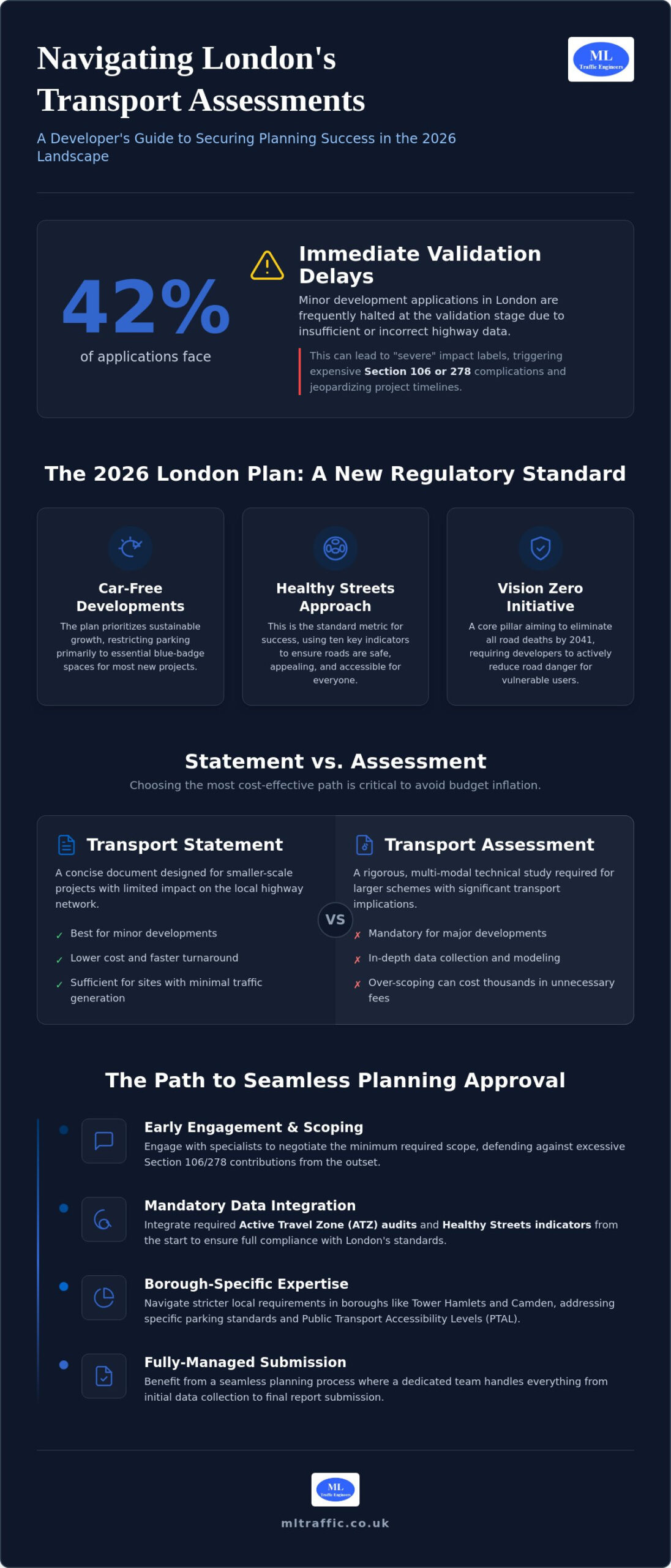
  • Public Bar Transport Assessment

    Public Bar Transport Assessment

    What if the primary barrier to your venue’s planning approval isn’t the number of parking spaces, but how efficiently your patrons disperse at 2 AM? You’ve likely faced the frustration of highway authority objections or felt overwhelmed by the technical requirements of a public bar transport assessment. Navigating the shift from traditional parking requirements to modern night-time safety standards can feel like a moving target. This is especially true with recent regulatory shifts, such as the January 2025 TfL Night-time Active Travel Zone requirements and the security mandates associated with Martyn’s Law.

    We understand that securing a license requires more than just a floor plan; it demands technical authority and a proactive approach to highway safety. This article provides a clear roadmap to mastering these complexities, ensuring you secure planning approval with precision while reducing the risk of costly delays. You’ll learn how to leverage accurate data to negotiate Section 106 requirements and determine whether your project needs a full Assessment or a streamlined Transport Statement.

    Key Takeaways

    • Identify the statutory triggers, including Gross Floor Area thresholds and change-of-use requirements, that necessitate a formal technical study for your venue.
    • Analyze the unique travel patterns of the night-time economy to understand why late-night dispersal data carries more weight than traditional peak hour traffic.
    • Master the technical requirements of a public bar transport assessment, including using the TRICS database and Swept Path Analysis to verify site access.
    • Discover how transport-led dispersal strategies can proactively mitigate highway safety objections and noise complaints from local authorities.
    • Learn how to navigate the full planning lifecycle to secure approval and negotiate Section 106 requirements with technical precision.

    What is a Public Bar Transport Assessment and When is it Mandatory?

    A public bar transport assessment serves as a vital technical document that evaluates how a proposed venue interacts with the surrounding transport infrastructure. It isn’t a mere formality; it’s a data-driven study of patron arrivals, staff travel patterns, and service vehicle access. Under the National Planning Policy Framework (NPPF), which received a significant update in December 2024, any development that generates significant movement must be supported by a robust transport submission. This ensures that the growth of The Night-Time Economy doesn’t compromise public safety or local road capacity.

    Statutory triggers for these assessments usually involve a change-of-use application or developments exceeding specific Gross Floor Area (GFA) thresholds. Because bars often fall into “Sui Generis” planning classes, they attract higher levels of scrutiny than standard retail units. Planning authorities want to see exactly how you’ll manage the “dispersal peak” when hundreds of patrons leave simultaneously at closing time. Failure to provide this data often results in immediate objections from highway officers.

    To better understand the strategic role of these assessments in modern development, watch this technical overview:

    Transport Statement vs. Assessment: Which One Do You Need?

    The level of detail required depends on the scale of your project. Smaller venues usually submit a Transport Statement, which focuses on local impact and site access. Larger venues or those in sensitive urban areas require a full Transport Assessment. These assessments involve complex traffic modeling and a wider geographical scope. Local borough variations across England mean that what suffices in one district might be rejected in another, making local expertise a functional necessity for approval.

    The Pre-Application Phase: Engaging Highway Authorities Early

    Success in the planning process often starts long before the formal application. Engaging highway authorities during a pre-application phase allows us to scope the public bar transport assessment to match their specific requirements. This collaborative approach identifies critical issues, such as narrow footways or inadequate loading bays, before they become deal-breakers. By addressing these technical hurdles early, you reduce the risk of late-stage highway safety objections that can delay your opening and inflate project costs. We focus on securing a clear roadmap to approval through precise data and proactive communication.

    The Night-Time Economy: How Bar Travel Patterns Differ from Traditional Pubs

    Traditional pubs often see their highest activity during lunch hours or early evening “happy hours,” but modern bars operate on a completely different temporal scale. For a public bar transport assessment, the standard “Highway Peak” between 5 PM and 6 PM is frequently irrelevant. Instead, the “Bar Peak” typically occurs around 11 PM or later. This shift means that while the general road network is at its quietest, a single venue can create a localized surge in activity that requires specialized management. Local authorities now prioritize these late-night windows to ensure that the growth of the evening economy doesn’t lead to localized gridlock or safety hazards.

    The impact of the Night-Time Economy (NTE) on local transport infrastructure is profound. Unlike gastropubs, where turnover is dictated by meal service times, bars experience longer “dwell times.” Patrons tend to accumulate throughout the evening, leading to a “dam effect” where a large volume of people exits the venue in a concentrated wave at closing time. This creates a unique pressure on public transport and private hire networks that traditional traffic modeling often fails to capture. Understanding these nuances is why we recommend reviewing our technical resources to see how we model these specific late-night peaks.

    Current data shows a decisive shift away from private car use in urban centers. Modern patrons rely almost exclusively on public transport and ride-sharing platforms like Uber or Bolt. This transition changes the infrastructure requirement from “long-stay parking” to “high-frequency turnover.” National guidance on Transport Assessments and Statements highlights the need for developments to provide sustainable travel options, but for bars, this specifically means managing the “surge” of app-based pickups.

    Taxi and Private Hire Vehicle (PHV) Management

    Quantifying pick-up and drop-off (PUDO) demand is a critical component of a modern public bar transport assessment. We design safe “waiting zones” to prevent PHVs from double-parking on busy high streets, which is a common cause of highway authority objections. Proactive design ensures that patrons have a designated space to wait for their vehicles without obstructing the footway. As of 2026, data trends indicate that PHV arrivals now account for up to 65% of all non-pedestrian trips to urban late-night venues, necessitating dedicated PUDO infrastructure in every successful planning application.

    Pedestrian Flow and Dispersal Strategies

    Managing the sudden exit of patrons at closing time is essential for maintaining public order and safety. We evaluate pavement capacity to ensure it can accommodate both the dispersal of guests and any required queuing or smoking areas. This technical analysis must link directly to the venue’s Operational Management Plan (OMP). By aligning transport data with management strategies, we prove to planners that the venue can operate safely without causing noise complaints or pedestrian overcrowding.

    Essential Technical Elements of a Robust Bar Assessment

    A robust public bar transport assessment relies on verifiable data rather than assumptions. We begin by establishing trip generation figures using the TRICS database. This industry-standard tool allows us to forecast exact patron and staff movements by analyzing data from similar venues across the UK. We don’t just guess how many people will visit your venue; we select comparable sites with similar floor areas and urban contexts. This ensures the trip rates are defensible during planning committee hearings. We analyze hourly arrivals and departures, focusing on that critical late-night window when the local network is most sensitive to new noise and movement. These findings must align with the broader framework of Transport analysis guidance to ensure your application meets national technical standards.

    Collision data analysis is another non-negotiable element. Our team scrutinizes the last five years of Personal Injury Accident (PIA) data for the immediate highway network. We look for patterns involving alcohol-related incidents or late-night pedestrian collisions. If a pattern exists, we propose specific mitigation measures, such as improved street lighting or relocated pedestrian crossings. This proactive, safety-first approach reassures the council that you’re a responsible operator committed to public welfare. Proving that your venue won’t exacerbate existing safety issues is critical for overcoming highway authority objections.

    Swept Path Analysis for Servicing and Deliveries

    Bars require frequent deliveries, often involving specialized vehicles like 10.7m dray wagons or standard refuse trucks. We use computer-aided design to perform Swept Path Analysis, which simulates vehicle movements on your site. This proves to planners that delivery bays are functional and don’t obstruct cycle lanes or pedestrian crossings. Precision here is vital; a single miscalculated turn in a narrow urban alleyway can lead to a planning refusal based on servicing concerns. We ensure your site layout accommodates these essential movements without compromising the safety of other road users.

    Parking and Accessibility (PTAL) justification

    In urban centers, justifying a car-free or low-parking development is standard practice. We utilize Public Transport Accessibility Level (PTAL) scores to demonstrate that your venue is well-served by trains, buses, and tubes. For areas where parking remains a concern, we conduct overnight parking surveys using the “Lambeth Methodology.” This technical approach measures current street capacity to prove that your patrons won’t over-burden local residents. Data-led parking surveys prevent the over-provision of car spaces in areas where sustainable travel is already the primary mode of transport. We ensure your application reflects the high accessibility of your location while maintaining local highway safety.

    Public Bar Transport Assessment

    Overcoming Common Planning Objections for Bar Developments

    Planning objections for new licensed premises often center on perceived risks to public safety or local amenity. A public bar transport assessment provides the technical evidence needed to dismantle these concerns. When authorities raise “Highway Safety” objections, we analyze visibility splays and pedestrian crossing capacity to prove the site remains safe under peak load. We don’t just state that the site is safe; we provide the geometric data and collision history analysis to confirm it. This level of precision is essential when negotiating with highway officers who prioritize risk mitigation above all else.

    Noise complaints are a frequent hurdle, but we address them through transport-led “Quiet Dispersal” routes. By identifying the most efficient paths to public transport hubs that bypass residential streets, we reduce the impact of patron noise on local residents. We also solve “Cumulative Impact” issues in established nightlife zones by demonstrating that the local infrastructure has the residual capacity to handle additional footfall. Our data proves that your venue won’t be the “tipping point” for local congestion. We also provide clear servicing schedules to ensure deliveries avoid peak traffic hours, keeping the local network fluid and reducing the risk of obstruction-based objections.

    Sustainable Travel and Travel Plans for Staff

    Securing planning consent often hinges on your commitment to sustainable travel. While patrons use ride-sharing, your late-night staff need reliable, safe ways to commute after hours. We develop robust Travel Plans that encourage the use of cycling or night-bus networks. Providing secure, well-lit cycle parking isn’t just a benefit for employees; it’s a functional requirement for many urban councils to reduce car dependency. If you need assistance with these documents, our Travel Plan Consultants can integrate these strategies into your broader application to strengthen your case.

    Negotiating Section 278 and Section 106 Agreements

    When a bar development requires physical highway improvements, such as new street lighting or upgraded paving, you’ll likely enter Section 278 or Section 106 negotiations. Our role at ML Traffic Engineers UK is to ensure “proportionality” in these developer contributions. We use the technical data from your public bar transport assessment to prevent you from overpaying for mitigation that exceeds your project’s actual impact. By providing an accurate baseline of existing traffic and pedestrian flow, we ensure your contributions remain fair and legally defensible. If you are facing complex highway requirements, contact ML Traffic Engineers UK today to review your site’s specific needs and ensure your project stays on track.

    Securing Planning Approval with ML Traffic Engineers UK

    ML Traffic Engineers UK manages the complete planning lifecycle for licensed premises. We take projects from initial traffic surveys through to planning committee support. Every public bar transport assessment we produce focuses on precision and regulatory adherence to reduce overall project risk. Because we operate in a high-stakes environment where accuracy is a functional necessity, we maintain a constant readiness to handle tight planning deadlines. We act as your reliable partner, managing intricate regional regulations so you don’t have to.

    Our team understands the specific requirements for bars in London and across England. We provide an all-encompassing, fully-managed service that acts as a guardian for your development’s viability. This technical authority ensures your dispersal strategies and access plans are defensible during formal scrutiny. By delivering rapid response capabilities, we ensure your application stays on schedule even when local authorities request urgent data updates or additional modeling.

    Why Hospitality Developers Trust ML Traffic Engineers UK

    Developers trust us because we solve access issues for constrained urban bar sites where others see roadblocks. We possess a deep understanding of the 2026 National Planning Policy Framework, allowing us to anticipate regulatory shifts before they impact your application. We coordinate directly with local highway authorities to smooth the approval process and resolve potential conflicts early. This proactive approach mirrors the natural progression of a project, moving from initial assessment to ongoing support. We take immense pride in our adherence to industry benchmarks, ensuring every submission is robust and legally sound.

    Next Steps for Your Bar Planning Application

    Requesting a site-specific fee proposal is the first step toward securing your planning consent. We provide transparent timelines, with a standard public bar transport assessment typically taking between two to four weeks. This efficiency reflects our understanding of the fast-moving nature of the hospitality industry and the need for rapid delivery of information. Contact ML Traffic Engineers UK for a Transport Assessment Quote to ensure your project benefits from industry-leading technical precision and unwavering reliability. We’re ready to support your application from inception to successful completion.

    Secure Your Venue’s Future with Technical Precision

    Successful bar developments in 2026 rely on more than just location; they require a sophisticated understanding of how patrons move in the late-night environment. By moving beyond traditional parking metrics to prioritize dispersal logistics and pedestrian safety, you can dismantle planning objections before they stall your project. A robust public bar transport assessment provides the technical foundation needed to secure a positive decision from highway authorities and local committees alike. Precision in these documents is a functional necessity that protects your investment from regulatory delays.

    ML Traffic Engineers UK brings over 10 years of planning application success to your development. As specialists in London and England transport regulations, we deliver the high-precision Swept Path Analysis and Parking Survey data required for complex urban sites. We act as a comprehensive partner, managing the full project lifecycle from initial surveys to final approval with unwavering reliability and technical authority. Our focus remains on providing an all-encompassing service so that you can focus on your venue’s operation.

    While we focus on the technical authority of your venue, for businesses looking to organize corporate integration trips or adventure expeditions, More Than Explore (MTE) provides comprehensive event management and unique team-building experiences.

    Get a Professional Transport Assessment for Your Bar Project

    We remain ready to support your next venture with the technical authority and rapid response capabilities your timeline demands. Secure your planning approval with a partner dedicated to professional integrity and adherence to the highest industry benchmarks.

    Frequently Asked Questions

    Do I need a transport assessment for a change of use to a bar?

    Yes, a technical study is typically required when changing a building’s use to a drinking establishment. Local planning authorities scrutinize these applications because bars often generate different dispersal patterns and higher late-night activity than previous retail or office uses. We evaluate your site’s Gross Floor Area and location to determine if the council requires a full Assessment or a more concise Statement to support your application.

    How much does a bar transport assessment typically cost in 2026?

    The investment required for a public bar transport assessment depends on the project’s scale and the specific data collection the local authority demands. Factors such as the number of junctions requiring modeling or the necessity of multi-night parking surveys will influence the final fee. We recommend requesting a site-specific proposal to ensure you receive a quote that reflects the technical requirements of your particular venue.

    What is the difference between a Transport Statement and a Transport Assessment?

    The primary difference lies in the scale of the study and the volume of traffic the venue generates. A Transport Statement is a streamlined report for smaller bars that have a limited impact on the local area. A Transport Assessment is a comprehensive technical document required for larger venues, involving detailed modeling of the wider highway network and more extensive data analysis to ensure public safety.

    How do you calculate trip generation for a bar using the TRICS database?

    We calculate trip generation by filtering the TRICS database for existing venues that mirror your bar’s size, location, and operational hours. By selecting comparable sites in similar urban or suburban contexts, we generate a defensible forecast of how many patrons and staff will arrive and depart at specific times. This evidence-based approach ensures your public bar transport assessment stands up to rigorous highway authority scrutiny.

    Can a bar get planning permission with zero on-site parking?

    Yes, many urban bars successfully secure planning permission with no on-site parking by demonstrating high Public Transport Accessibility Level (PTAL) scores. We justify car-free developments by proving that patrons can easily access the venue via night buses, trains, or ride-sharing services. Our assessments use parking survey data to confirm that any localized drop-off activity won’t compromise highway safety or residents’ access to street parking.

    What is Swept Path Analysis and why does my bar development need it?

    Swept Path Analysis is a digital simulation that tracks the movement of specific vehicles, such as 10.7m dray wagons, as they maneuver through your site. It is a functional necessity for proving that delivery and refuse vehicles can enter and exit the premises without mounting curbs or obstructing traffic. This technical verification reassures planners that your servicing strategy is safe and won’t cause localized congestion.

    How does a transport assessment address late-night noise concerns?

    We address noise concerns by designing transport-led dispersal strategies that guide patrons toward major transport hubs along “Quiet Dispersal” routes. By analyzing pedestrian flow, we identify paths that avoid residential streets, reducing the likelihood of noise complaints. This data-driven approach allows us to prove to environmental health officers that your venue can operate late into the night without negatively impacting the local community’s amenity.

    What happens if the local highway authority objects to my bar application?

    If an objection is raised, we immediately engage in technical negotiations with the highway officer to resolve the specific safety or capacity concerns. This often involves providing additional evidence, such as refined visibility splay data or updated parking surveys, to mitigate the perceived risks. Our proactive approach focuses on finding engineering solutions or management strategies that satisfy the authority’s safety benchmarks while protecting your project’s timeline.

    Michael Lee

    Article by

    Michael Lee

    Transport planner with over 35 years' experience.

    Disclaimer

    The content on mltraffic.co.uk, including all technical articles, guides, and resources, is provided for general informational and educational purposes only. It is not intended to constitute professional advice in traffic engineering, transportation planning, development approvals, or any other technical or legal field.
    While ML Traffic Engineers makes every reasonable effort to ensure the accuracy, completeness, and timeliness of the information published, we do not provide any warranties or representations (express or implied) regarding its reliability, suitability, or availability for any particular purpose. Any reliance you place on the content is strictly at your own risk.
    In no event shall ML Traffic Engineers, its directors, employees, authors, or affiliates be liable for any direct, indirect, incidental, special, consequential, or punitive damages (including, without limitation, loss of profits, data, or business opportunities) arising out of or in connection with the use of, or inability to use, any information provided on this website.
    The articles and guides on this site are not a substitute for engaging a qualified, professional traffic engineer to assess your specific project requirements. For tailored advice, compliance assessments, or traffic engineering services, please contact a competent professional.
    This disclaimer may be updated from time to time without notice. By accessing or using this website, you agree to be bound by the most current version of this disclaimer.
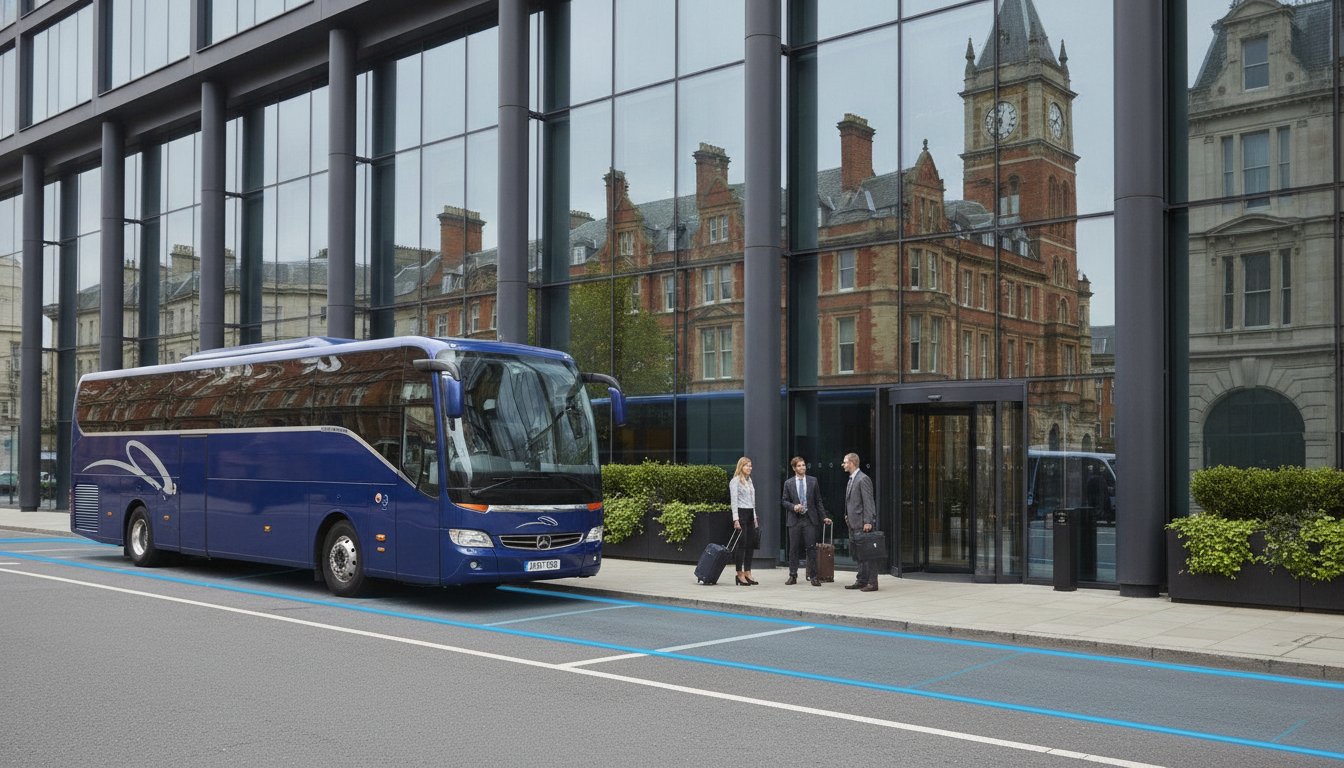
  • Function Centre Transport Assessment

    Function Centre Transport Assessment

    What if the technical report designed to secure your venue’s future is the primary reason for a planning refusal? Generic traffic assessments often fail to account for the intense “event-day” surges that trigger local opposition and council scrutiny. If you’re concerned about resident pressure regarding noise or the uncertainty of peak-hour modelling, your caution is well-founded. A specialized function centre transport assessment is the only way to prove your venue won’t cause traffic chaos during its most critical operating hours.

    We understand the pressure of navigating the National Planning Policy Framework (NPPF) and complex local borough standards across England. In this high-stakes environment, technical precision is a functional necessity to protect your investment and secure your site’s future. This article provides a clear roadmap to mastering these technical requirements. You’ll learn how to produce a robust report that satisfies the Highway Authority, addresses specific parking and access requirements, and ultimately minimises your planning risk through proactive risk management. We’ll move straight to the core methodologies you need to ensure your application stands up to the strictest regulatory standards.

    Key Takeaways

    • Understand why a technical function centre transport assessment is essential for evaluating the impact of guest surges and service vehicles on the local road network.
    • Learn how to utilise TRICS database modelling and modal split analysis to provide accurate trip generation data for high-capacity event dates.
    • Discover how Swept Path Analysis and visibility splay design prove your site can safely accommodate large vehicles and emergency access.
    • Identify effective mitigation strategies, including bespoke Travel Plans, to reduce environmental impact and satisfy Highway Authority requirements.
    • Gain a clear understanding of the regulatory hurdles involved in securing planning permission for high-impact venues across England.

    What is a Function Centre Transport Assessment?

    A function centre transport assessment is a rigorous technical study required for planning applications involving event-based developments across England. This document evaluates how guests, staff, and logistics vehicles interact with the existing highway network. It’s not just a formality; it’s a safety and capacity audit. We use these reports to demonstrate that your venue can operate without compromising the efficiency or safety of local roads. This technical authority is essential to satisfy the strict requirements of local planning authorities.

    Depending on the scale of your project, you may need either a Transport Statement or a full assessment. While statements are typically for smaller venues, larger centres require a comprehensive Transport Assessment. This ensures complete compliance with the National Planning Policy Framework (NPPF) and specific local borough standards. Precision here is a functional necessity to avoid costly planning delays and regulatory pushback.

    To better understand how these technical principles are applied in a real-world planning scenario, watch this case study:

    When is a Transport Assessment Mandatory?

    Local Highway Authorities typically set thresholds based on Gross Floor Area (GFA) or the expected volume of vehicle movements. If your venue exceeds these limits, a TA becomes a non-negotiable requirement. However, even small venues might need a full assessment if they’re located in sensitive or highly congested areas. The Trip generation data usually dictates the depth of the study. We recommend early engagement with the council to agree on the report’s scope. This proactive approach reduces regulatory pressure and ensures the final report meets every benchmark.

    The Unique Traffic Profile of Event Venues

    Function centres differ significantly from standard residential or commercial developments because they create a “surge” effect. This occurs when high volumes of guests arrive or depart within very short windows, often coinciding with the start or end of a ceremony. A generic traffic report won’t capture this nuance. Your function centre transport assessment must specifically model these peak periods to prove the site entrance and local junctions can handle the load. We also account for late-night departures and the associated noise impact. Managing these movements is vital to address resident concerns regarding safety and congestion on local roads after hours.

    Trip Generation and Modelling for Event Spaces

    Modelling traffic for event spaces requires a departure from standard daily averages. A function centre transport assessment must focus on the “peak-surge” characteristic of events. Unlike a supermarket where flow is steady, a wedding or corporate gala creates concentrated arrival and departure windows. We analyze these windows to ensure the local infrastructure doesn’t buckle under sudden pressure. This precision is a functional necessity for protecting your investment and maintaining road safety.

    Using the TRICS Database for Accuracy

    Planning officers require evidence-based projections. We utilise the TRICS database to provide this validated baseline for every project. By selecting comparable sites based on venue capacity and geographic location, we accurately predict vehicle movements. TRICS prevents speculative traffic claims by replacing guesswork with empirical data from established UK sites. This technical authority is essential when presenting your case to the Highway Authority. Accuracy in this phase reduces the logistical and regulatory pressures on your development team.

    Developing a Robust Modal Split

    A modal split determines exactly how guests travel to your site. We don’t just assume every guest arrives in a private car. We factor in the “designated driver” effect and the significant rise in ride-sharing services. For venues with high PTAL ratings, we adjust the data to reflect superior public transport accessibility. If your venue is part of a larger hotel or resort, we account for “linked trips” where guests are already staying on-site. This level of detail reduces the perceived impact on the road network and strengthens your planning application. You can explore our technical resources to see how these data sets are compiled.

    We specifically target the “Peak Hour” impacts. For most function centres, this isn’t the Monday morning rush. It’s usually Friday evenings or Saturday afternoons. Our modelling calculates parking accumulation to ensure every vehicle has a designated space. This prevents overspill onto surrounding public streets, which is a primary concern for local residents. Precision in these calculations is a non-negotiable foundation of our work. By demonstrating a clear understanding of these peaks, you minimise the risk of planning refusal based on local traffic concerns. Our team remains ready to manage these complex project lifecycles from inception to completion, which may include advising on the use of professional transport partners like JAF Executive Travels to streamline guest arrivals and minimize site congestion.

    Access Design and Swept Path Analysis

    A robust function centre transport assessment must prove the site entrance can safely accommodate a sudden influx of vehicles. We don’t just look at the numbers; we look at the geometry. Visibility splays are critical to ensure safe egress onto the public highway, especially when large event crowds leave simultaneously. If the entrance design is flawed, you risk queuing back onto main roads, which is a major red flag for planning officers. Our designs prioritise internal circulation to keep the public highway clear and safe at all times.

    Swept Path Analysis for Coaches and HGVs

    Logistics for event venues involve more than just passenger cars. We use Swept Path Analysis to model the movements of 12m or 15m coaches. This ensures that large vehicles can enter, turn, and exit the site in a forward gear. Standard turning circles often fail because they don’t account for the unique overhangs of modern event coaches or the tight delivery schedules of catering trucks. We also model emergency fire tenders to guarantee site safety. Precision in these simulations is a functional necessity to prevent operational bottlenecks once the venue opens.

    Parking Strategy and Junction Capacity

    A successful parking strategy avoids the pitfalls of both under-provision and over-provision. If you provide too few spaces, you face pressure from local residents regarding street congestion. If you provide too many, you might clash with council sustainability targets. We determine the optimum number of spaces by cross-referencing your venue’s capacity with our previously discussed trip generation data. This tailored approach reduces the logistical and regulatory pressures on the applicant.

    To assess the impact on the wider network, we use junction modelling software like Junctions 9, PICADY, and ARCADY. These tools allow us to predict delays and capacity issues at the site entrance during peak event hours. We also integrate electric vehicle (EV) charging points into the layout to ensure compliance with 2026 building regulations. Balancing vehicle access with pedestrian safety is the final piece of the puzzle. We design clear footways and crossing points to separate guest movements from vehicle flow. This comprehensive approach is a hallmark of a high-quality function centre transport assessment, providing the technical authority needed to secure planning permission.

    Mitigating Impact Through Travel Planning

    A technical function centre transport assessment is incomplete without a strategy to manage guest behaviour. While physical design handles the flow, a bespoke Travel Plan targets the source by reducing single-occupancy car journeys. We develop these plans to align with local sustainability goals and to satisfy the rigorous demands of the Highway Authority. This proactive approach reduces the logistical and regulatory pressures on the developer while ensuring a safer environment for the local community.

    One of the most significant hurdles in securing planning permission is addressing the noise and light pollution caused by late-night vehicle movements. Residents often fear that a new venue will transform a quiet street into a congested thoroughfare. We mitigate these impacts through operational management plans that dictate how traffic enters and exits the site during sensitive hours. By implementing sustainable transport incentives, such as shuttle buses from nearby rail hubs or secure cycle storage, we lower the total vehicle count. If you need a comprehensive strategy to secure your site’s future, our travel plan consultants are ready to assist with your application.

    Event Day Management Plans

    Managing a high-volume event requires on-site coordination. We specify the use of banksmen or traffic marshals to oversee guest arrivals and ensure that vehicles don’t queue onto the public highway. Pre-booking systems act as a vital traffic management tool, allowing operators to communicate arrival instructions and parking availability to guests before they depart. A robust operational management plan provides the documented assurance required to neutralise resident fears regarding late-night congestion and noise. This level of organization demonstrates a commitment to professional integrity and public safety.

    Sustainable Access and PTAL Ratings

    We leverage Public Transport Accessibility Level (PTAL) ratings to justify lower on-site parking provision where appropriate. If a site has excellent rail or bus links, we argue for a shift toward sustainable access, reducing the physical footprint of the development. Modern planning also mandates “Active Travel” considerations, requiring safe, well-lit walking and cycling routes for guests and staff. These commitments often form part of a Section 106 legal agreement, making the Travel Plan a binding document for the developer. By integrating these elements into your function centre transport assessment, you provide a sequential and logical path to planning approval. Our team manages full project lifecycles to ensure these commitments are both practical and achievable.

    Function Centre Transport Assessment

    Partnering with ML Traffic Engineers UK for Planning Success

    Securing planning permission for a high-impact venue requires a partner who understands the intricate regional regulations and the specific operational pressures of the event industry. ML Traffic Engineers UK specialises in navigating complex Transport Assessments for venues where precision is a functional necessity. Our team brings technical authority to every project, ensuring that your function centre transport assessment stands up to the most rigorous Highway Authority scrutiny across England.

    We maintain a proven track record of negotiating with local authorities to overcome common planning hurdles. This experience allows us to anticipate potential objections before they become roadblocks. Our comprehensive approach covers the full project lifecycle, moving from initial feasibility studies to post-planning monitoring. We focus on precision data collection, including tailored Parking Surveys and Traffic Counts that reflect the actual peak-hour conditions of your specific site. This dedication to accuracy reduces the logistical and regulatory pressure on our clients and provides a clear path to approval.

    Our Technical Precision

    We use industry-leading software to deliver high-quality Swept Path Analysis and junction modelling. Our reports are clear, professional, and designed to minimise “Request for Further Information” (RFI) delays. By providing a robust technical foundation from the start, we help you avoid the cycle of costly revisions. We handle the full project lifecycle for various project types, ensuring that every assessment meets the benchmarks required by modern building regulations. Our role isn’t just as a service provider; we act as a vital guardian of public safety and professional integrity.

    Get Your Transport Assessment Quote

    Early engagement is the most effective way to prevent design revisions later in the planning process. We recommend an initial site review and scoping session with our senior engineers to identify potential challenges early. This proactive strategy ensures that your site layout is optimised for both vehicle access and pedestrian safety from day one. Contact ML Traffic Engineers UK today to discuss your project requirements. We remain ready to provide a professional, safety-conscious function centre transport assessment that secures your venue’s future. Our commitment to constant availability and unwavering reliability makes us the dependable partner you need for planning success.

    Secure Your Venue’s Future with Technical Precision

    Securing planning permission for a high-impact event space requires a shift from generic traffic modelling to specialized event-day analysis. By prioritising precise trip generation and robust swept path analysis, you address the primary concerns of local authorities and residents alike. A comprehensive function centre transport assessment ensures your venue operates safely while meeting all legislative benchmarks. It’s the most effective way to minimise planning risk and prove your site’s viability.

    We bring technical authority to every project as members of the Chartered Institute of Highways & Transportation. Our team specialises in London and England planning regulations, utilising industry-standard tools like TRICS and AutoTurn to deliver reports that withstand the strictest scrutiny. We manage the full project lifecycle so you can focus on your venue’s success. Request a Quote for Your Function Centre Transport Assessment today to move your project forward with confidence. Your vision for a premier event space is within reach when it’s backed by expert engineering.

    Frequently Asked Questions

    Do I need a Transport Statement or a Transport Assessment for my function centre?

    The requirement depends on the scale of your development and local planning thresholds. Smaller venues with lower trip generation typically require a Transport Statement. Larger developments or those in sensitive areas need a full function centre transport assessment. We review your venue’s capacity and gross floor area against local borough standards to determine the correct technical path for your application.

    How much does a function centre transport assessment cost?

    Fees are determined by the complexity of the site and the specific requirements set by the Highway Authority. Costs depend on whether your project needs junction modelling, multi-day traffic surveys, or complex swept path simulations. We provide tailored quotes after an initial site review. This ensures the scope of work matches the regulatory demands of your project without including unnecessary technical studies.

    Will the council refuse my wedding venue application if local roads are narrow?

    Narrow roads aren’t an automatic trigger for refusal if we can demonstrate safe operation. We use technical data to prove that passing places and managed arrival windows maintain highway safety. A robust operational management plan often overcomes physical constraints. By staggering guest arrivals and using trained banksmen, we show the council that your venue won’t cause local gridlock or safety hazards.

    How is “peak traffic” calculated for an event venue?

    We calculate peak traffic by identifying the specific “surge” periods unique to your venue’s schedule. Unlike office blocks, function centres see peaks on Friday evenings or Saturday afternoons. We use the TRICS database to compare your site with similar UK venues. This allows us to predict guest, staff, and service vehicle movements with high precision during your most intense operating windows.

    Can a Travel Plan really help me get planning permission?

    A bespoke Travel Plan is a vital tool for mitigating transport impacts and meeting sustainability targets. It proves to planning officers that you’re actively reducing single-occupancy car journeys. By proposing shuttle buses, car-sharing incentives, or cycle storage, you address concerns about parking overspill. This proactive strategy often neutralises resident objections and demonstrates a commitment to professional integrity and public safety.

    What is Swept Path Analysis and why does my event venue need it?

    Swept Path Analysis is a technical simulation that tracks the movement of vehicles through your site layout. Your venue needs this to prove that 15m coaches, catering trucks, and emergency fire tenders can navigate safely. It ensures that large vehicles can enter and exit in a forward gear without striking kerbs or buildings. Precision in these simulations is a functional necessity for site safety.

    How do I handle parking requirements for a function centre in a town centre?

    Town centre venues can often justify reduced on-site parking by leveraging high PTAL ratings and nearby public infrastructure. We conduct a parking survey to identify available capacity in local car parks within an acceptable walking distance. This approach aligns with modern “Active Travel” requirements. It allows you to maximise your development’s floor area while still satisfying the council’s parking standards.

    What happens if the Highway Authority objects to my transport assessment?

    An objection triggers a technical negotiation phase where we address the Authority’s specific concerns. We might provide additional junction modelling or suggest minor highway improvements to mitigate the perceived impact. Our team remains ready to defend your function centre transport assessment through evidence-based analysis. We maintain a professional dialogue with authorities to find practical solutions that secure your planning permission.

    Michael Lee

    Article by

    Michael Lee

    Transport planner with over 35 years' experience.

    Disclaimer

    The content on mltraffic.co.uk, including all technical articles, guides, and resources, is provided for general informational and educational purposes only. It is not intended to constitute professional advice in traffic engineering, transportation planning, development approvals, or any other technical or legal field.
    While ML Traffic Engineers makes every reasonable effort to ensure the accuracy, completeness, and timeliness of the information published, we do not provide any warranties or representations (express or implied) regarding its reliability, suitability, or availability for any particular purpose. Any reliance you place on the content is strictly at your own risk.
    In no event shall ML Traffic Engineers, its directors, employees, authors, or affiliates be liable for any direct, indirect, incidental, special, consequential, or punitive damages (including, without limitation, loss of profits, data, or business opportunities) arising out of or in connection with the use of, or inability to use, any information provided on this website.
    The articles and guides on this site are not a substitute for engaging a qualified, professional traffic engineer to assess your specific project requirements. For tailored advice, compliance assessments, or traffic engineering services, please contact a competent professional.
    This disclaimer may be updated from time to time without notice. By accessing or using this website, you agree to be bound by the most current version of this disclaimer.
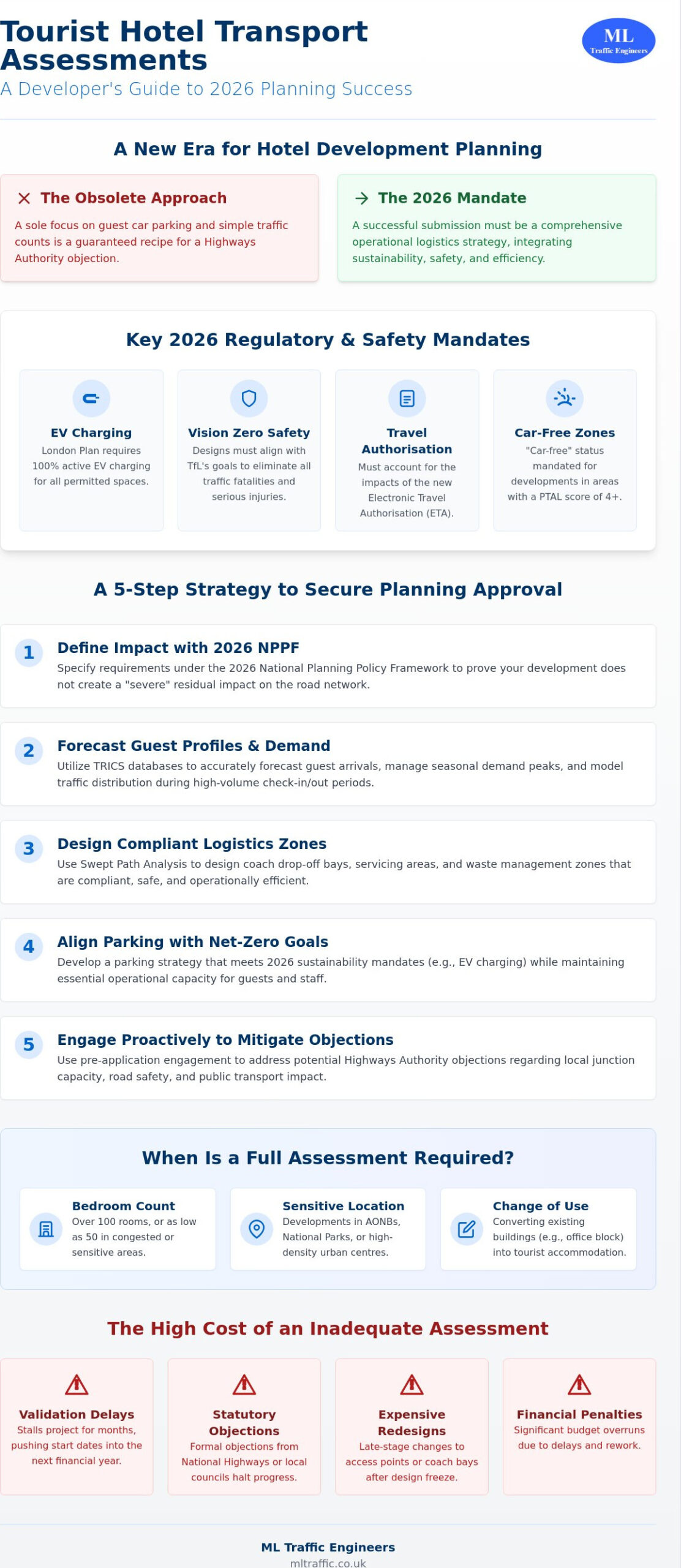
  • Mosque Transport Assessment

    Mosque Transport Assessment

    Why do so many mosque planning applications fail even when the architectural design is perfect? The answer usually lies in the Highway Authority’s concerns regarding the “Friday peak” and its impact on the local road network. It’s a common frustration for community leaders who face rejection because of perceived traffic congestion or parking overspill. Securing approval requires more than just a standard traffic report; you need a specialized mosque transport assessment that addresses the unique, concentrated arrival patterns of worshipers.

    We understand that navigating the National Planning Policy Framework and specific local validation guidance is a high-stakes challenge. You’re likely concerned about how to justify parking requirements in high-density areas or how to prove that Jumu’ah prayers won’t cause gridlock. This guide provides a clear roadmap to help you secure planning permission with minimal delays. We’ll explain how to use site-specific parking beat surveys and classified turning counts to build a robust case for your development. You’ll learn how to implement practical mitigation measures, such as volunteer stewarding and formal Travel Plans, that satisfy regulators and ensure the safety of the surrounding community.

    Key Takeaways

    • Understand the statutory requirements under the NPPF that make a professional mosque transport assessment essential for securing planning permission.
    • Identify why the “Friday Peak” between 12 PM and 2 PM is the critical window for traffic analysis rather than standard commuter hours.
    • Learn how to use Parking Surveys and Swept Path Analysis to provide the technical evidence required by Local Highway Authorities.
    • Discover how a robust Travel Plan can mitigate community concerns through managed car-sharing and sustainable transport initiatives.
    • Gain strategies for navigating complex negotiations with planning officials to avoid costly delays and project rejections.

    What is a Mosque Transport Assessment in the UK Planning Process?

    A mosque transport assessment is a specialized technical report that evaluates how a proposed place of worship will affect the local highway network. It’s a statutory requirement under the National Planning Policy Framework (NPPF) for any new build or significant extension that generates substantial movement. This document provides the Highway Authority with the data they need to judge if the local roads can handle the influx of worshipers safely. Without this evidence, planning applications for religious buildings often face immediate rejection due to concerns over traffic congestion and pedestrian safety.

    A transport planning consultant bridges the gap between the community’s needs and the council’s strict regulatory expectations. They don’t just calculate vehicle numbers; they translate religious practice into technical data. This process follows the UK’s approach to transport appraisal, which focuses on safety, environmental impact, and accessibility. Depending on the size of the project, you might need a full assessment or a simplified Transport Statement. Smaller sites with lower footfall typically qualify for a statement, while larger regional hubs require the exhaustive detail of a full Transport Assessment.

    To better understand how transit planning affects local accessibility, watch this helpful video:

    When is a Mosque-Specific Assessment Required?

    In England, thresholds for these reports are usually set by local planning authorities. Generally, any development exceeding 500 to 1,000 square meters will trigger a formal report. However, even small projects often require technical scrutiny during change-of-use applications. Converting an existing office or retail unit into a place of worship (Class F1) fundamentally shifts the traffic profile of a residential street. It’s vital to seek pre-application advice from the Local Highway Authority to agree on the scope of the report early. This proactive step prevents expensive delays and ensures the data collected meets specific council standards.

    The Legal Framework: NPPF and Local Transport Policies

    Paragraph 111 of the NPPF serves as the primary legal benchmark for planning decisions. It dictates that development should only be refused on highways grounds if there’s an unacceptable impact on safety, or if the residual cumulative impacts on the road network would be severe. In 2026 planning terms, residual cumulative impact is the total remaining pressure on local infrastructure after all physical and operational mitigation strategies have been fully implemented. A professional mosque transport assessment must align with regional parking standards, such as those found in the London Plan, which often prioritize public transport over private car use to reduce urban congestion.

    Identifying Specialized Peak Hours for Religious Developments

    Standard traffic models often fail to capture the operational reality of religious buildings. While a typical office or retail unit sees peaks during the morning and evening commute, a mosque operates on a unique temporal cycle. A robust mosque transport assessment must account for these specific surges to satisfy local highway authorities. If an assessment only analyzes the standard 8-9 AM and 5-6 PM windows, it ignores the moments of highest impact, leading to inevitable planning objections.

    The “Friday Peak” occurring between 12 PM and 2 PM represents the most significant stress test for the local highway network. This short, high-intensity window involves concentrated arrivals and departures that don’t align with standard network peaks. Beyond the weekly Jumu’ah prayers, we must also analyze seasonal peaks. Ramadan evening prayers (Taraweeh) and the biannual Eid festivals create massive, short-term surges. Additionally, weekday Madrasa sessions, usually between 4:30 PM and 6:30 PM, often coincide with the evening rush hour, requiring careful management of drop-off and pick-up activity in residential areas.

    TRICS Database and Faith-Based Trip Generation

    To forecast traffic volume, we utilize the TRICS database to select comparable sites based on size, location, and PTAL (Public Transport Accessibility Level) ratings. You can find more technical detail on what is the TRICS Database in our resource center. We align our data collection with the UK government’s official guidance to ensure the methodology withstands technical scrutiny from council officers. It’s not enough to use generic data; we must adjust these figures to reflect the specific demographic and travel habits of your congregation.

    Modal Split Analysis

    Understanding how worshipers travel is as important as knowing how many arrive. We conduct modal split analysis to determine the percentage of visitors who will arrive by car, bus, foot, or cycle. This isn’t just guesswork. We use empirical evidence from existing local mosques or site-specific surveys to provide a realistic picture of the “catchment area.” If your site has a high PTAL rating, we can often justify lower parking provision by proving that the majority of the congregation lives within walking distance or has access to reliable public transport. If you need help identifying these unique peaks for your project, our team can conduct detailed traffic surveys to provide the necessary evidence.

    Critical Data Collection: Parking Surveys and Swept Path Analysis

    Establishing a baseline for the local road network requires precise Traffic Surveys. These surveys record current traffic volumes, queue lengths, and junction delays before the mosque project begins. This data is the foundation of any professional mosque transport assessment. It allows us to compare the “with development” scenario against the existing conditions, ensuring that the Highway Authority has a clear picture of the potential impact on local residents.

    We follow the official government guidance to ensure all data collection meets rigorous technical standards. This includes conducting parking accumulation surveys to prove whether there’s sufficient on-site or on-street capacity to handle the peak worship times discussed in previous sections. Hard data is the only way to satisfy council officers who are often under pressure from local residents concerned about congestion.

    Parking Stress and Accumulation

    Measuring parking “stress” involves surveying all available on-street parking spaces within a 200-meter walking distance of the site. We typically apply the Lambeth Methodology, which requires surveys during the day and overnight to determine the “baseline” occupancy. For a mosque, we must also perform these surveys during the Friday Jumu’ah peak. This evidence is vital when justifying “zero-parking” developments in high PTAL areas like Central London, where the council’s policy often discourages private car ownership. By proving that the existing street capacity can absorb the surge without creating safety hazards, we can overcome one of the biggest hurdles to planning permission. This empirical approach replaces speculation with hard data, which is essential for projects in sensitive residential areas.

    Vehicle Manoeuvrability (Swept Path)

    It’s not enough to show that cars can park; you must also prove that larger vehicles can move. Our Swept Path Analysis Services in London use AutoCAD and AutoTurn software to simulate the movements of refuse trucks and fire tenders. This simulation ensures that these essential services can enter, turn, and exit the site safely without being obstructed by parked cars or narrow access points. Proving that delivery vehicles won’t block the public highway is a non-negotiable requirement for modern planning. Swept Path Analysis provides the technical certainty needed to prove that even the tightest urban mosque sites can accommodate emergency and service vehicle access without compromising local road safety. These detailed technical simulations are a cornerstone of a successful mosque transport assessment, turning potential planning objections into manageable design solutions.

    Mosque Transport Assessment

    Mitigating Traffic Impact with Effective Travel Plans

    While the technical data in your mosque transport assessment establishes the potential impact of the development, a Travel Plan dictates how the site will actually operate. This document serves as a live management tool for promoting sustainable transport and reducing reliance on private cars. For many councils, a robust Travel Plan is the deciding factor that overcomes Highway Authority objections. It demonstrates that the mosque is a proactive neighbor committed to active management rather than passive observation.

    Effective mitigation strategies often include car-sharing schemes and “walking bus” initiatives specifically designed for Madrasa students. By organizing groups of children to walk together under supervision, the mosque significantly reduces the volume of individual car trips during the sensitive evening peak. Managing dedicated drop-off and pick-up zones is equally critical. These zones prevent local congestion by ensuring that vehicles don’t idle in the public highway or block residential driveways. Our travel plan consultants specialize in designing these operational frameworks to ensure they’re both practical for the congregation and acceptable to the council.

    Soft Measures and Community Engagement

    Monitoring and Enforcement

    Councils frequently use Section 106 agreements to ensure that travel plans remain effective over the long term. These legal agreements make the implementation of the plan a non-negotiable condition of the planning permission. Regular monitoring through annual travel surveys allows the mosque to track progress against its initial targets and adjust strategies if needed. Modern technology provides efficient ways to manage demand. We often suggest using SMS alerts or dedicated apps to coordinate parking bookings during high-attendance events. This proactive approach proves to the Highway Authority that the mosque has the tools to manage its impact on the local community effectively. If you’re ready to develop a strategy that secures your project’s future, contact us to start your Travel Plan today.

    Securing Planning Approval with ML Traffic Engineers UK

    Planning permission for religious buildings involves complex regulatory hurdles that can stall even the most well-funded projects. At ML Traffic Engineers UK, we provide the technical authority needed to overcome these obstacles. A professional mosque transport assessment isn’t just a checkbox; it’s a strategic document designed to protect your project’s future. We manage every stage of the process, ensuring that your application meets the stringent requirements of local councils and the Highway Authority. Our engineers don’t just submit reports; we advocate for your project. We understand the specific benchmarks that planning officers use to evaluate applications, allowing us to anticipate and address objections before they become formal roadblocks.

    We manage the entire lifecycle of your transport planning needs. This end-to-end approach reduces project risk and ensures that all data is robust enough to withstand public inquiry or planning committee scrutiny. Our comprehensive service includes:

    • Site-specific data collection and Traffic Surveys to establish baseline conditions.
    • Technical reporting that aligns with current NPPF and regional policy requirements.
    • Direct liaison and negotiation with Local Highway Authority officers across England.
    • Operational mitigation strategies that satisfy safety and capacity concerns.

    Tailored Solutions for Faith-Based Projects

    Community and religious hubs have unique logistical needs that standard traffic reports often ignore. ML Traffic Engineers UK has built a track record of securing approvals for complex urban sites by providing bespoke solutions that address specific local concerns. Whether you’re dealing with high-density residential areas or restrictive parking zones, we provide the evidence needed to move forward. Our expertise ensures that your mosque’s operational reality is accurately reflected in the planning data. For developers working within the capital, our Transport Assessment London: 2026 Guide offers essential insights into navigating regional planning success and meeting Transport for London’s rigorous standards.

    Get Started with Your Mosque Transport Assessment

    Early engagement is the most effective way to avoid costly design changes and planning delays. By consulting with ML Traffic Engineers UK during the initial stages of your project, you ensure that transport considerations are integrated into your site layout from the beginning. This proactive strategy demonstrates professional integrity and a commitment to public safety, which builds trust with local planning officers. We handle the technical negotiations so you can focus on building your community. Contact us today to request a bespoke quote for your mosque transport assessment and take the first step toward a successful planning outcome.

    Move Forward with Technical Certainty

    Securing planning permission for a place of worship requires a shift from standard traffic modeling to a specialized approach that respects the operational reality of your congregation. By focusing on the Friday peak and utilizing precise data, you provide the technical certainty that local highway authorities demand. A comprehensive mosque transport assessment ensures that every potential objection, from parking stress to emergency vehicle access, is addressed with empirical evidence and practical mitigation strategies.

    ML Traffic Engineers UK brings specialized expertise in religious building transport planning to every project we manage. We understand the high stakes involved in community developments and offer the precision and rapid response needed to meet tight planning deadlines. Our team handles the complex regulatory negotiations so you don’t have to worry about technical pushback. Contact ML Traffic Engineers UK for a Professional Mosque Transport Assessment to secure your project’s approval. You’re one step closer to establishing a vital community hub with a partner that values precision, safety, and professional integrity.

    Frequently Asked Questions

    Do I need a transport assessment for a small mosque extension?

    You will likely need an assessment if the extension increases the capacity for worshipers or triggers local planning thresholds. Even small additions can fundamentally change the traffic profile of a residential street. Councils require this data to ensure the increased footfall doesn’t compromise local safety or exceed parking capacity. In many cases, a simplified Transport Statement is sufficient for smaller extensions.

    What is the “Friday Peak” and why does the council care about it?

    The Friday Peak is the high-intensity window between 12 PM and 2 PM during Jumu’ah prayers. Councils prioritize this window because the concentrated arrival of worshipers creates a unique stress test for the local highway network. A professional mosque transport assessment must prove that this specific surge won’t lead to severe congestion or safety hazards for other road users in the immediate area.

    Can we get planning permission for a mosque with no on-site parking?

    Yes, securing approval for a car-free mosque is possible if the site has excellent public transport links or high PTAL ratings. You must provide technical evidence through a parking survey to show that local streets can absorb any potential overflow. In high-density urban areas, many councils actually prefer developments that discourage private car use in favor of sustainable travel methods.

    How long does it take to complete a mosque transport assessment?

    A standard mosque transport assessment typically takes four to six weeks to finalize. This timeline accounts for the specialized data collection required, such as parking beat surveys conducted during Friday prayers or evening Madrasa sessions. We prioritize precision during this phase to ensure the final technical report withstands the scrutiny of the Highway Authority and avoids unnecessary planning delays.

    What is the TRICS database and how is it used for religious buildings?

    TRICS is the national standard system for trip generation analysis in the UK. We use it to identify comparable religious sites and forecast the number of vehicle and pedestrian movements your specific mosque will generate. This allows us to build a credible traffic model based on established industry benchmarks rather than using generic assumptions that councils might reject.

    How does Swept Path Analysis help our mosque application?

    Swept Path Analysis uses computer simulations to prove that large vehicles, such as fire tenders and refuse trucks, can safely navigate your site. This is a critical safety requirement for tight urban developments where maneuverability is limited. By showing that emergency services can access the building without obstruction, you remove a major technical hurdle that often leads to planning objections.

    Will a Travel Plan really make a difference to the council’s decision?

    A Travel Plan is often the deciding factor in a successful application because it demonstrates proactive management of transport impacts. It provides a formal framework for car-sharing, walking buses, and other sustainable initiatives. Councils view a robust plan as a securable commitment to community safety, which helps mitigate concerns about the long-term impact of the development on local infrastructure.

    What happens if the parking survey shows high local stress?

    If surveys indicate high parking stress, we focus on operational mitigation strategies to manage demand effectively. This might involve implementing staggered prayer times or a managed parking booking system for peak events. We work with you to design practical solutions that satisfy the Highway Authority’s requirements while ensuring the mosque remains accessible and functional for your congregation.

    Michael Lee

    Article by

    Michael Lee

    Transport planner with over 35 years' experience.

    Disclaimer

    The content on mltraffic.co.uk, including all technical articles, guides, and resources, is provided for general informational and educational purposes only. It is not intended to constitute professional advice in traffic engineering, transportation planning, development approvals, or any other technical or legal field.
    While ML Traffic Engineers makes every reasonable effort to ensure the accuracy, completeness, and timeliness of the information published, we do not provide any warranties or representations (express or implied) regarding its reliability, suitability, or availability for any particular purpose. Any reliance you place on the content is strictly at your own risk.
    In no event shall ML Traffic Engineers, its directors, employees, authors, or affiliates be liable for any direct, indirect, incidental, special, consequential, or punitive damages (including, without limitation, loss of profits, data, or business opportunities) arising out of or in connection with the use of, or inability to use, any information provided on this website.
    The articles and guides on this site are not a substitute for engaging a qualified, professional traffic engineer to assess your specific project requirements. For tailored advice, compliance assessments, or traffic engineering services, please contact a competent professional.
    This disclaimer may be updated from time to time without notice. By accessing or using this website, you agree to be bound by the most current version of this disclaimer.

  • Church Transport Assessment

    Church Transport Assessment

    Most planning applications for places of worship fail not because of the building design, but because of a single Sunday morning parking survey. If you’re managing a new development or expansion, the “Sunday Peak” is likely your biggest regulatory hurdle. It’s frustrating to face potential refusal based on local parking complaints when you’re simply trying to serve your community. You shouldn’t have to navigate these technical requirements alone, especially when a rejected statement can stall your project for up to 16 weeks and lead to significant revision costs.

    This article provides the expert guidance you need to complete a robust church transport assessment that satisfies local authorities. We’ll explore how to align your project with current standards, including London’s Vision Zero safety goals and the shift toward Active Travel infrastructure. You’ll learn exactly which data points the council requires, from swept path analysis to specific Sunday traffic counts. By the end of this guide, you’ll understand how to secure planning permission with minimal friction and avoid the high costs of unnecessary technical reporting. We focus on the precision required to move your project from inception to completion while maintaining full regulatory compliance.

    Key Takeaways

    • Understand how to align your project with the National Planning Policy Framework (NPPF) to prioritize sustainable travel for community hubs.
    • Learn how a professional church transport assessment utilizes the Lambeth Methodology to accurately manage “Sunday Peak” parking demands and mitigate council concerns.
    • Discover why technical Swept Path Analysis is essential for proving safe site access for fire tenders and community transport vehicles.
    • Identify the specific trip generation modeling tools, such as the TRICS database, used to project traffic impacts for various religious uses.
    • Gain insights into reducing regulatory pressure by adhering to industry benchmarks and Local Highway Authority standards for first-time planning approval.

    A church transport assessment is a technical study that serves as a vital component of your planning application. It evaluates how a place of worship interacts with the surrounding road network, focusing on safety and efficiency. This study is a specific application of the broader transportation planning process, tailored to the unique surges in activity associated with religious services. The National Planning Policy Framework (NPPF) dictates that community hubs must prioritize sustainable travel. Consequently, the Local Highway Authority (LHA) will closely review your proposal to ensure it aligns with local safety benchmarks and doesn’t cause severe cumulative impacts on the network.

    To better understand the logistical challenges involved in these projects, watch this helpful video:

    Understanding the difference between a Transport Statement and a full Assessment saves time and resources. A Statement is a concise report for developments with minor traffic implications. A full Assessment is a comprehensive document required when a project’s scale suggests a significant impact on local infrastructure. ML Traffic Engineers UK specializes in determining which path your project requires to ensure you don’t pay for unnecessary reporting.

    Change of Use and Class F1 Requirements

    Converting retail or industrial units into places of worship falls under Class F1 of the UK planning system. Even if your project qualifies for ‘Permitted Development,’ the council often demands transport data. This happens because planning authorities look for an ‘intensification of use.’ They want to know if a building originally used for storage can safely accommodate hundreds of people arriving simultaneously. We provide the data necessary to prove your site can handle these shifts without disrupting the local community.

    When is a Full Transport Assessment Mandatory?

    Mandatory thresholds vary by borough, but they typically hinge on floor area or congregation size. For example, a site exceeding 1,000sqm often triggers a full assessment. Your location also dictates the level of scrutiny. Urban sites in London must navigate stricter ‘car-free’ mandates, while rural sites must address vehicle displacement. ML Traffic Engineers UK helps you identify the exact reporting level needed for your specific site, ensuring your application moves forward without technical delays.

    Core Components of a Comprehensive Church Transport Study

    Trip Generation and the TRICS Database

    Predicting exactly how many people will travel to your site is a technical necessity. We utilize the TRICS database, which is the national standard for trip rate analysis in the UK. By comparing your proposal to data from similar religious institutions, we can accurately forecast vehicle movements for Sunday services and weekday events. We refine this standard data by adjusting for your congregation’s specific demographics, such as age and local residency patterns. While focusing on UK standards, it’s helpful to recognize that Federal transportation regulations for churches often emphasize similar safety and operational benchmarks for faith-based groups. Incorporating TRICS data into a church transport assessment prevents the over-estimation of traffic by grounding projections in verified, observed site behavior rather than theoretical maximums.

    Sustainable Transport and Accessibility

    Urban planning in 2026 places a heavy emphasis on accessibility without car dependency. For sites in major cities, we calculate the Public Transport Accessibility Level (PTAL) to determine how easily your members can reach you via bus, train, or tube. We also assess pedestrian and cycle routes to ensure the site is safely reachable for everyone, regardless of their mode of transport. Integrating a Travel Plan is often the most effective way to promote non-car travel and satisfy council requirements for sustainable development. If you need assistance navigating these accessibility requirements, our experts can provide a comprehensive site review to identify the best mitigation strategies for your congregation.

    Managing the ‘Sunday Peak’: Parking Surveys and Impact

    Local councils prioritize the peak one-hour arrival and departure windows because these periods represent the highest risk for traffic congestion and residential friction. For a place of worship, this surge usually occurs on Sunday morning, creating a unique profile that standard weekday data cannot capture. A professional church transport assessment must quantify this impact using the Lambeth Methodology, which remains the gold standard for parking surveys in the UK. This methodology provides a transparent framework for measuring on-street capacity and ensuring that the proposed development won’t lead to “parking stress” in the immediate vicinity.

    Calculating parking accumulation is a critical step in this process. We track the net change in vehicle numbers throughout the day to prove the site can handle its congregation without overflowing onto restricted roads. This data is essential for satisfying the requirements found in the official Guidance on Transport Assessment. When on-site parking is limited, we develop mitigation strategies that focus on safety and community harmony, ensuring your application remains viable even in dense urban environments. If you are concerned about local resistance to your project, our team can help you prepare a robust technical parking report to address those fears directly.

    Conducting a Robust Parking Survey

    Defining the survey area is the first technical hurdle. Most authorities require a 200m walking distance radius around the site to capture the likely impact on local residents. Timing is equally vital; for churches, Saturday and Sunday data is non-negotiable. We record the exact number of available spaces at 15-minute intervals during the peak windows. By calculating the “stress levels”, which is the percentage of occupied spaces, we provide a clear picture of whether the local streets can absorb any additional demand without compromising road safety.

    Justifying Reduced Parking Provisions

    If your site can’t meet standard parking ratios, we look for innovative justifications. “Dual Use” parking agreements are a powerful tool. These allow churches to use nearby business or school car parks that sit empty on weekends. We also analyze the impact of Controlled Parking Zones (CPZs). While a CPZ might limit congregant parking, it also prevents long-term overspill from other sources, which can actually strengthen your case. Finally, we draft a parking management strategy. This document outlines how your team will use stewards or signage to direct traffic, proving to the council that you have a proactive plan to manage your congregation’s arrival.

    Technical Requirements: Swept Path Analysis for Churches

    A successful church transport assessment must demonstrate that the physical constraints of the site don’t compromise public safety. While earlier sections focused on traffic volume and parking stress, this technical phase examines the actual movement of vehicles. Local planning authorities require proof that your site can accommodate the specific vehicles required for its operation without causing hazards on the public highway. We use specialized software to create these simulations, ensuring your car park layout is functional before any construction begins. Integrating these technical drawings into your church transport assessment reduces the risk of the council requesting further information, which often causes significant project delays.

    Emergency and Service Vehicle Access

    Statutory requirements dictate that fire tenders must be able to reach within 45 meters of all points within a community-use building. We use Swept Path Analysis as a digital simulation tool to accurately model vehicle movements against your proposed site plan. This isn’t just about the main entrance; it includes ensuring that heavy emergency vehicles can maneuver through gates and around tight corners without getting stuck. Refuse collection is another critical hurdle. Councils expect bin lorries to service church plots without blocking through-traffic or requiring dangerous long-distance reversing maneuvers. Our analysis identifies these potential “clash points” early, preventing the need for costly redesigns of car park entrances or boundary walls after the planning application is submitted.

    Minibus and Drop-off Zone Design

    Religious sites often operate community outreach programs that rely on minibuses and specialized transport. Many generic assessments overlook these vehicles, but we include them as a core part of our study. We design safe drop-off points specifically for elderly or disabled congregation members to ensure they don’t have to navigate live traffic lanes. It’s essential that minibuses can turn fully within the site boundaries. Reversing onto a main road is a high-risk maneuver that frequently leads to planning refusal on safety grounds. Our technical reports also verify that parking bay dimensions and aisle widths meet current standards, allowing for the wider turning circles required by community transport vehicles. To prevent expensive design errors and ensure your site is fully accessible, book a technical site assessment with our engineering team today.

    Church Transport Assessment

    Securing Planning Approval with ML Traffic Engineers UK

    ML Traffic Engineers UK provides a comprehensive service that manages the entire project lifecycle, ensuring that religious developments navigate the planning process without technical setbacks. We understand that places of worship face unique scrutiny from both local authorities and neighboring residents. Our team identifies potential hurdles before they escalate into formal objections. By adhering to strict industry benchmarks and Local Highway Authority standards, we ensure your church transport assessment is technically sound and ready for immediate submission. We maintain deep expertise in navigating the intricate transport policies across England’s boroughs, including the specific safety requirements of the London Plan 2026 and Vision Zero goals.

    We take pride in our role as a vital guardian of public safety, ensuring every report we produce is rooted in precision and legislative compliance. We don’t just provide raw data; we offer a fully-managed service that reduces the regulatory burden on your congregation. Our approach moves logically from initial site surveys to ongoing support during the planning process. This efficiency is a hallmark of our brand promise, ensuring that your project stays on schedule and avoids the 16-week delays often associated with rejected technical statements or incomplete reporting.

    A Reassuring Partner for Religious Developments

    Our technical authority acts as a shield against planning refusal. ML Traffic Engineers UK produces tailored reporting that satisfies the rigorous demands of professional planners while respecting the mission of the parishioners. By focusing on safety-conscious and sustainable site design, we help you build a case that local residents can support. We position ourselves as a reliable partner that understands regional regulations so you don’t have to. This commitment to professional integrity ensures that every church transport assessment we deliver meets the highest standards of formal excellence and civic responsibility.

    Next Steps for Your Church Project

    Early engagement with transport consultants is the most effective way to avoid costly design errors. Engaging our team during the initial design phase allows us to optimize your site layout for vehicle movements and parking efficiency before plans are finalized. You can request a Transport Assessment quote to begin the process for your specific site. Before you submit your application, ensure your technical package includes:

    • Verified trip generation data using the TRICS database tailored to your congregation size.
    • A parking survey conducted according to the Lambeth Methodology for Sunday peak windows.
    • Digital Swept Path Analysis for fire tenders and community transport vehicles.
    • A comprehensive Travel Plan focused on sustainable travel and accessibility.
    • A formal parking management strategy to mitigate residential overspill concerns.

    Our team remains ready to support your project from inception to completion, providing the unwavering reliability and rapid response capabilities needed for a successful planning outcome.

    Secure Your Planning Approval with Technical Precision

    Securing planning permission for a place of worship requires more than just architectural vision; it demands a data-driven strategy that addresses the specific surges in local traffic. You can’t afford to overlook technical precision when neighbors and councils are focused on parking overspill. By prioritizing the Sunday Peak and utilizing the Lambeth Methodology for parking surveys, you proactively resolve these concerns. A robust church transport assessment provides the technical evidence needed to prove your site is safe, accessible, and compliant with the latest National Planning Policy Framework standards.

    Our team brings deep expertise in UK planning law and specialized TRICS modelling to every project. We maintain a proven track record with religious and community developments, ensuring that your Swept Path Analysis and technical reporting meet the highest professional standards. We are ready to manage your full project lifecycle from initial survey to final submission. Request a Professional Church Transport Assessment Quote to move your development forward with confidence. Your community deserves a facility that is safe, reachable, and fully integrated into the local transport network.

    Frequently Asked Questions

    Is a transport assessment required for a change of use to a church?

    Yes, local authorities typically require a church transport assessment for Class F1 change of use applications. Planners examine the “intensification of use” to see if the new religious use generates higher traffic surges than the previous occupant. Even if the building footprint remains unchanged, the shift to high-occupancy worship services creates a unique traffic profile. We provide the technical data needed to prove the site can safely accommodate these specific congregational peaks.

    How much parking does a church need to provide for planning permission?

    Parking requirements depend on your local authority’s standards and the site’s Public Transport Accessibility Level (PTAL) score. In high-accessibility areas, such as London PTAL 4 or higher, the 2026 London Plan mandates car-free developments. For sites in lower-accessibility areas, the council may permit limited parking provided you include 100% active electric vehicle charging points. We analyze these regional regulations to ensure your proposal meets the exact legislative threshold.

    What is the difference between a Transport Statement and a Transport Assessment for a place of worship?

    The primary difference lies in the scale of the development and its expected traffic impact. A Transport Statement is a shorter report for smaller sites with minor traffic implications. A full Transport Assessment is a comprehensive study required for larger congregations or sites with complex access needs. We identify the correct reporting level early in the project lifecycle to prevent you from paying for unnecessary technical work.

    Can a church get planning permission with no on-site parking?

    Yes, churches can secure planning permission with zero on-site parking, particularly in urban centers with high public transport connectivity. To achieve this, you must submit a robust parking survey proving that any overspill can be absorbed by the local network. We often use “Dual Use” agreements with nearby businesses or schools to demonstrate that your congregation has access to off-site spaces during Sunday peaks without causing residential friction.

    How long does a parking survey for a church take to complete?

    A standard parking survey for a religious site typically takes one to two weekends to complete. We must capture data during your peak service times, which usually fall on Saturday and Sunday mornings. Our team records parking occupancy at 15-minute intervals within a 200m radius of the site. This intensive data collection period provides the precise “stress level” evidence required by the Local Highway Authority to validate your application.

    What happens if the local residents object to our church due to traffic?

    Technical data is the most effective way to neutralize objections regarding traffic and parking congestion. When residents raise concerns, the council looks for objective evidence rather than anecdotal complaints. We provide professional church transport assessment reports and parking management strategies that outline how your team will direct traffic. This proactive approach demonstrates your commitment to community safety and professional integrity while satisfying the council’s requirements. To further support your mission, IntegraSense provides specialist consultancy in accessibility and governance, ensuring your facility is inclusive and professionally managed.

    Do we need a Travel Plan if our congregation is small?

    Councils frequently require a Travel Plan even for smaller congregations to support “Active Travel” goals. This document outlines how you will encourage walking, cycling, and public transport use among your members. Urban planning policies in 2026 prioritize reducing car dependency regardless of the project size. A well-drafted plan strengthens your application by showing alignment with regional sustainability and safety benchmarks like the Vision Zero safety goals.

    How does Swept Path Analysis help our church planning application?

    Swept Path Analysis provides digital proof that emergency services and refuse vehicles can safely access and exit your site. This simulation tool models the exact turning circles of fire tenders and community minibuses against your proposed layout. Without this evidence, councils may refuse applications over safety concerns regarding vehicles blocking the highway. We use this analysis to optimize your site plan and avoid costly redesigns of car park entrances or boundary walls.

    Michael Lee

    Article by

    Michael Lee

    Transport planner with over 35 years' experience.

    Disclaimer

    The content on mltraffic.co.uk, including all technical articles, guides, and resources, is provided for general informational and educational purposes only. It is not intended to constitute professional advice in traffic engineering, transportation planning, development approvals, or any other technical or legal field.
    While ML Traffic Engineers makes every reasonable effort to ensure the accuracy, completeness, and timeliness of the information published, we do not provide any warranties or representations (express or implied) regarding its reliability, suitability, or availability for any particular purpose. Any reliance you place on the content is strictly at your own risk.
    In no event shall ML Traffic Engineers, its directors, employees, authors, or affiliates be liable for any direct, indirect, incidental, special, consequential, or punitive damages (including, without limitation, loss of profits, data, or business opportunities) arising out of or in connection with the use of, or inability to use, any information provided on this website.
    The articles and guides on this site are not a substitute for engaging a qualified, professional traffic engineer to assess your specific project requirements. For tailored advice, compliance assessments, or traffic engineering services, please contact a competent professional.
    This disclaimer may be updated from time to time without notice. By accessing or using this website, you agree to be bound by the most current version of this disclaimer.
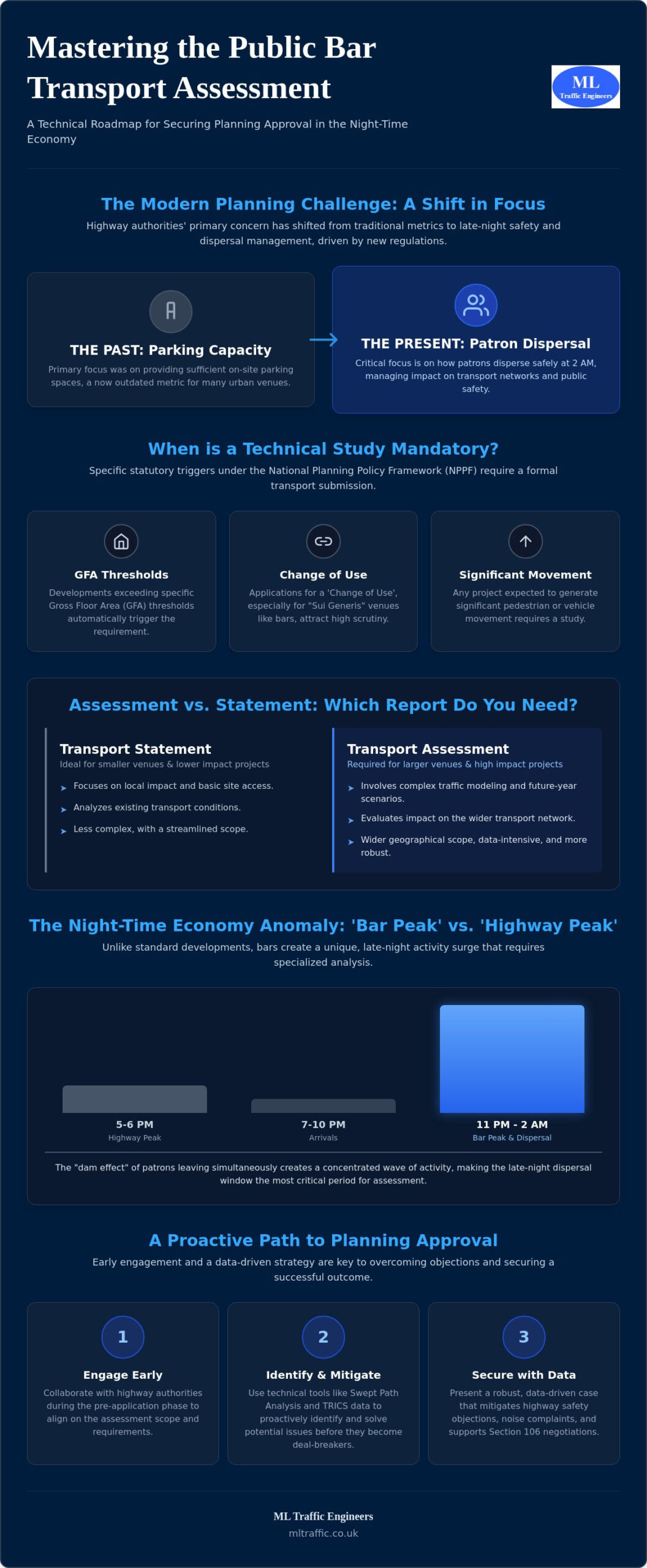
  • Transport Planning Consultants in London: The 2026 Developer’s Guide

    Transport Planning Consultants in London: The 2026 Developer’s Guide

    Did you know that 42% of minor development applications across London boroughs face immediate delays at the validation stage because of insufficient highway data? For developers, these setbacks often stem from complex borough-specific parking standards or unexpected technical objections late in the planning cycle. It’s frustrating to see a project stall just as it gains momentum. Engaging expert transport planning consultants london is a functional necessity to ensure your scheme meets the rigorous demands of Transport for London and local authorities.

    We understand that you need clear communication with highway authorities and cost-effective technical reports that don’t compromise on precision. This guide promises to simplify the complexities of London planning applications by providing a clear roadmap for transport strategy and regulatory compliance. You’ll gain a comprehensive overview of the 2026 landscape, including the shift toward vision-led planning, the requirements for car-free developments in high PTAL areas, and the specific thresholds for Transport Statements and Assessments.

    Key Takeaways

    • Learn how the 2026 regulatory environment requires a data-led approach to bridge the gap between development goals and highway authority expectations.
    • Identify the specific scale-based thresholds that dictate whether your London project needs a Transport Statement or a comprehensive Transport Assessment.
    • Understand how technical data from Swept Path Analysis and Parking Surveys validates your site layout for fire tenders and refuse vehicles.
    • Navigate the dual-layered requirements of local London boroughs and the Transport for London Road Network to prevent costly validation delays.
    • Discover why expert transport planning consultants london are essential for securing planning permission through precise technical reporting and strategic negotiation.

    The Role of Transport Planning Consultants in London’s 2026 Landscape

    In 2026, the gap between a developer’s vision and a highway authority’s approval is wider than ever. Professional transport planning consultants london act as the essential bridge, translating architectural intent into technically compliant reports. This involves managing the entire transport planning process from the initial site assessment through to final planning approval. By aligning project goals with the specific requirements of the 32 London boroughs, consultants ensure that developments aren’t just viable but also compliant with the latest strategic frameworks.

    The regulatory environment has moved away from simply accommodating vehicle volumes. Today, the focus is on a vision-led approach that prioritizes human health and sustainable movement over traditional traffic growth models. This shift requires a data-intensive strategy where every design choice is justified by technical evidence. You can’t rely on outdated national guidance when TfL and borough officers expect granular, site-specific data. Whether it’s proving site access via Swept Path Analysis or justifying parking levels through Parking Surveys, precision is a functional necessity to avoid immediate delays at the validation stage.

    To better understand the environmental and strategic shifts driving these requirements, watch this helpful video from Transport for London:

    Navigating the London Plan 2026

    The Mayor’s London Plan sets a strategic target for 80% of all trips to be made by foot, cycle, or public transport by 2041. For developers, this means the Public Transport Accessibility Level (PTAL) score of a site is now the primary factor in determining density and parking provision. In areas with high PTAL scores of 4 or above, “car-free” developments are often the only path to approval. Expert transport planning consultants london help you navigate these mandates by developing robust Travel Plans that promote active travel and reduce reliance on private vehicles. This proactive strategy ensures your application aligns with the “Healthy Streets” approach, which is now a non-negotiable benchmark for all major London schemes.

    Reducing Logistical Friction for Developers

    Professional reports aren’t just paperwork; they’re a vital tool for risk mitigation. High-quality Transport Statements and Transport Assessments provide the technical authority needed to address local resident objections and speed up the statutory consultation period. Early engagement prevents costly redesigns that occur when highway authorities identify technical flaws late in the cycle. We provide a fully-managed service that identifies these risks early. Visit our services overview to see how we manage the full project lifecycle from assessment to support. This rhythmic efficiency ensures your project maintains momentum from inception to completion, reducing the regulatory pressure on your team.

    Essential Documentation: Transport Statements vs. Assessments

    Selecting the incorrect level of documentation is a leading cause of application rejection in the capital. Navigating highway requirements under the National Planning Policy Framework (NPPF) requires developers to scale their reporting based on the anticipated impact of their scheme. Professional transport planning consultants london provide the technical precision needed to classify your project correctly from the start. This ensures you don’t overspend on unnecessary analysis for minor sites or face technical objections for under-reporting on major developments.

    Every report serves as a legal and technical justification for your site layout. While the National Planning Policy Framework sets the broad context, London’s specific requirements are often more stringent. Missing a single data point regarding cycle storage or trip generation can lead to immediate delays at the validation stage. We prioritize the rapid delivery of these documents to keep your project on schedule. If you need to understand the specifics of our reporting process, you can explore our detailed service list.

    Transport Statements for Minor Developments

    A Transport Statement is a concise report for smaller developments with limited transport impacts. In London, this document is typically required when a proposal is expected to generate between 30 and 50 vehicle movements during peak hours. Boroughs like Tower Hamlets and Camden now demand that even these minor applications include high-quality data on cycle parking and waste strategy. We focus on site observations and local highway impact to prove that your development won’t compromise public safety or local traffic flow. Our team manages the full project lifecycle, ensuring that your Transport Statement meets all borough-specific standards.

    Transport Assessments for Major Schemes

    Major projects require the rigorous multi-modal analysis found in a full Transport Assessment. The common threshold for a residential development in London is 80 or more units, while commercial proposals often require this assessment if they exceed 2,500 square meters. These documents use the TRICS database to predict travel patterns across walking, cycling, and public transport. This is vital for developments in areas with high PTAL scores where car-free mandates apply. For a deeper look at these requirements, read our Transport Assessment London: The Developer’s 2026 Guide. We also integrate Travel Plans into these assessments to satisfy Section 106 obligations and demonstrate a long-term commitment to sustainable travel targets.

    Data-Driven Success: Swept Path Analysis and Parking Surveys

    Technical data serves as the “proof of concept” for every London development. Without empirical evidence, even the most innovative architectural designs risk rejection by highway officers. Professional transport planning consultants london use advanced data collection to demonstrate that a site can function safely within the existing infrastructure. This evidence-based approach is vital because 42% of minor applications in London face delays specifically due to insufficient highway data. By providing precise technical reporting from the start, we reduce the regulatory pressure on your project team and ensure a smoother path to approval.

    We manage the full data collection lifecycle, from initial site observations to the final submission. This includes justifying site access points and junction designs through comprehensive Traffic Surveys. These surveys provide the baseline data needed to predict how new trip generation will impact local road networks. When technical authority is backed by hard data, it becomes much harder for authorities or local objectors to stall a project based on anecdotal concerns.

    Precision via Swept Path Analysis

    Swept Path Analysis (SPA) is a non-negotiable requirement for demonstrating that a site can accommodate essential service vehicles. We utilize industry-standard AutoTURN software to simulate the exact movements of vehicles within your site layout. In London, this means designing for specific vehicle templates, such as the standard London Fire Brigade tender or borough-specific refuse trucks. Our analysis ensures that these large vehicles can enter, turn, and exit the site in a forward gear without overhanging curbs or endangering pedestrians. For a deeper look at this process, see our Practical Guide to Swept Path Analysis in 2026.

    Parking Stress Surveys and the Lambeth Methodology

    Most London boroughs require Parking Surveys to follow the “Lambeth Methodology” to assess local parking capacity. This typically involves overnight surveys conducted between 12:30 am and 5:30 am on two separate weekday nights. The goal is to identify “parking stress” on surrounding streets. This data is critical when justifying “parking-free” or “car-lite” developments in high PTAL areas. It proves to the council that any potential “overspill” parking from the new development won’t overwhelm neighbouring residential streets. As expert transport planning consultants london, we provide the detailed reporting needed to address these concerns head-on, ensuring your parking strategy aligns with both the London Plan and local borough standards.

    Transport Planning Consultants in London: The 2026 Developer’s Guide

    London developers face a unique dual-layered regulatory environment. Planning applications are split between the oversight of 32 local boroughs and the strategic requirements of Transport for London (TfL). This division creates a complex approval path that requires constant vigilance. If your site sits on or near the Transport for London Road Network (TLRN), also known as “Red Routes”, you face high-level scrutiny from strategic officers. Expert transport planning consultants london manage this friction by aligning local site goals with city-wide transport objectives—such as maintaining network flow through the prompt roadside assistance provided by Instant Recovery—ensuring that one authority’s demands don’t contradict the other’s.

    We manage the technical negotiations for Section 278 (s278) agreements. These legal contracts are essential when your development requires physical changes to the public highway, such as new site access or junction improvements. In 2026, Active Travel Zone (ATZ) assessments have become a primary focus for both TfL and local boroughs. These assessments evaluate the quality of walking and cycling routes within a specific radius of your site. Our team provides the data-led reporting needed to prove your scheme supports the city’s sustainable travel goals.

    TfL Pre-Application Advice

    Engaging TfL early is critical for any site near a Red Route or Tube station. They review applications against the Healthy Streets Approach and Vision Zero safety standards, which aim to eliminate all traffic fatalities. This process often involves high-level scrutiny of your construction logistics and delivery plans. We act as your technical authority during these pre-application meetings, reducing the risk of unexpected objections. To strengthen your position during these negotiations, consider how our Travel Plan consultants can demonstrate your commitment to sustainable transport targets.

    Borough-Specific Nuances

    A transport strategy that secures approval in Westminster may fail in Hackney due to differing local priorities. Policies regarding cycle parking standards, Controlled Parking Zone (CPZ) restrictions, and car-free mandates vary significantly across the capital. We understand these intricate regional regulations so you don’t have to. Our role extends beyond reporting; we attend planning committee meetings to provide technical clarity when members raise concerns. If you need a reliable partner to manage these complex negotiations, contact our team today to secure your project’s timeline.

    Choosing ML Traffic Engineers UK for Your London Project

    Securing planning permission in the capital requires a partner who understands that precision isn’t optional. We position ourselves as the leading transport planning consultants london by delivering technical reports that withstand the highest levels of scrutiny. ML Traffic Engineers UK manages the entire project lifecycle, from initial data collection to final negotiations with highway officers. This comprehensive approach ensures that your development remains compliant with the latest strategic mandates while meeting urgent planning deadlines.

    We take immense pride in our adherence to industry benchmarks. Our reports aren’t just documents; they’re professional tools designed to reduce logistical and regulatory pressures on your team. We maintain a consistent sense of readiness to address technical objections as they arise. This unwavering reliability has built our proven track record across all 32 London boroughs and with Transport for London. We understand intricate regional regulations so you don’t have to, acting as a vital guardian of professional integrity for your project.

    Just as we emphasize technical certification for our engineers, ensuring your broader workforce has recognized credentials is a key part of project risk management. For developers with international operations or team members seeking Australian certification, you can learn more about Right Pathway and their RPL facilitation services.

    A Reliable Partner for Complex Sites

    Complex urban sites demand a safety-conscious and reassuring approach. ML Traffic Engineers UK provides a fully-managed service that covers every technical requirement, including Swept Path Analysis and Parking Surveys. Our focus remains on reducing the administrative burden through expert advocacy. By providing clear, data-backed documentation, we speed up the statutory consultation period and mitigate the risk of late-cycle redesigns. You can view the full scope of our expertise on our what we do page. This rhythmic efficiency ensures your project maintains momentum from inception to completion.

    Ready to Secure Your Planning Approval?

    Time is a critical asset in infrastructure development. Our direct communication and active voice ensure that information reaches you and the planning authorities without delay. We offer tailored fee proposals that reflect the specific requirements of your London site. Don’t let technical objections stall your progress. We provide the technical authority needed to navigate the most challenging planning environments. Contact ML Traffic Engineers UK for a Transport Planning Consultation today to ensure your project moves from assessment to execution with absolute precision.

    Streamline Your London Planning Approval with Technical Precision

    Success in the 2026 London development market depends on technical authority and data-driven strategy. You’ve seen how vision-led planning and rigorous documentation standards, such as the Lambeth Methodology for parking stress, define modern applications. Aligning your project with the Healthy Streets Approach while balancing borough-specific mandates is a functional necessity for any developer. Professional transport planning consultants london provide the strategic negotiation skills required to bridge the gap between your architectural vision and highway authority requirements.

    ML Traffic Engineers UK provides the unwavering reliability you need to navigate these complexities. Founded in 2014, we bring over a decade of success to every project. Our expertise in TRICS multi-modal analysis and Swept Path Analysis ensures your site layout is both safe and compliant. We manage the full project lifecycle from initial survey to final submission, reducing the logistical pressure on your team. We take pride in our precision and adherence to industry benchmarks, acting as a dependable partner for even the most complex urban sites.

    Ready to move forward? Get a Quote for Your London Transport Planning Requirements and secure your project’s timeline today. ML Traffic Engineers UK is here to ensure your development reaches its full potential with professional integrity and expert advocacy.

    Frequently Asked Questions

    Do I need a transport planning consultant for a small London development?

    Yes, you should engage transport planning consultants london even for small schemes to ensure your data meets borough-specific validation requirements. Small developments often trigger technical objections regarding cycle storage or refuse collection that can stall an application. Expert reporting provides the technical authority needed to satisfy local highway officers and prevent immediate delays at the validation stage.

    What is the difference between a Transport Statement and a Transport Assessment in London?

    The difference lies in the scale of the development and its anticipated impact on the local network. A Transport Statement is a concise report for minor schemes generating limited traffic; while a Transport Assessment provides a comprehensive multi-modal analysis for major projects. Thresholds often include 80 residential units or 2,500 square meters of commercial space as triggers for a full assessment.

    How long does it take to prepare a Transport Statement for a planning application?

    A standard Transport Statement typically requires two to four weeks to prepare, including the time for site observations and policy analysis. The timeline depends heavily on the complexity of the site and the specific data requirements of the local borough. We prioritize rapid delivery to ensure your planning application remains on schedule and meets all technical benchmarks.

    Why is Swept Path Analysis required for my London site layout?

    Swept Path Analysis is required to prove that essential service vehicles, such as London Fire Brigade tenders and refuse trucks, can safely navigate your site. It uses simulation software to demonstrate that these vehicles can enter and exit in a forward gear. This technical “proof of concept” is a non-negotiable foundation for securing approval for your site layout.

    What is the Lambeth Methodology for parking surveys?

    The Lambeth Methodology is the industry-standard framework for conducting parking stress surveys in London. It involves recording the number of parked vehicles on surrounding streets during two separate weekday nights between 12:30 am and 5:30 am. This data justifies your parking provision and demonstrates that your development won’t overwhelm local residential parking capacity.

    Can a transport consultant help with TfL Red Route access issues?

    Yes, a consultant acts as your technical advocate during negotiations with Transport for London regarding Red Route access. We provide the strategic advice and technical reporting needed to navigate TfL’s Healthy Streets Approach and Vision Zero safety audits. Early engagement through pre-application advice is critical for resolving access issues before they impact your planning timeline.

    How does a high PTAL rating affect my parking requirements?

    A high Public Transport Accessibility Level (PTAL) score significantly reduces the amount of parking you are permitted to provide. In areas with a PTAL rating of 4 or higher, the London Plan generally mandates “car-free” developments, where parking is restricted to disabled persons’ spaces only. We help you justify this through robust Travel Plans and active travel strategies.

    What is a Section 278 agreement and when is it needed?

    A Section 278 (s278) agreement is a legal contract between a developer and the highway authority for permanent works on the public highway. You will need this agreement if your project requires physical changes, such as a new site entrance or junction improvements. We manage the technical documentation required to secure these agreements and ensure compliance with legislative requirements.

    Michael Lee

    Article by

    Michael Lee

    Transport planner with over 35 years' experience.

    Disclaimer

    The content on mltraffic.co.uk, including all technical articles, guides, and resources, is provided for general informational and educational purposes only. It is not intended to constitute professional advice in traffic engineering, transportation planning, development approvals, or any other technical or legal field.
    While ML Traffic Engineers makes every reasonable effort to ensure the accuracy, completeness, and timeliness of the information published, we do not provide any warranties or representations (express or implied) regarding its reliability, suitability, or availability for any particular purpose. Any reliance you place on the content is strictly at your own risk.
    In no event shall ML Traffic Engineers, its directors, employees, authors, or affiliates be liable for any direct, indirect, incidental, special, consequential, or punitive damages (including, without limitation, loss of profits, data, or business opportunities) arising out of or in connection with the use of, or inability to use, any information provided on this website.
    The articles and guides on this site are not a substitute for engaging a qualified, professional traffic engineer to assess your specific project requirements. For tailored advice, compliance assessments, or traffic engineering services, please contact a competent professional.
    This disclaimer may be updated from time to time without notice. By accessing or using this website, you agree to be bound by the most current version of this disclaimer.

  • Hindu Temple Transport Assessment

    Hindu Temple Transport Assessment

    Standard transport models often fail for places of worship because they treat a spiritual community hub like a generic office block. If you’re managing a planning application, you’ve likely encountered the friction between rigid local authority parking standards and the reality of high-intensity traffic peaks during festivals like Diwali or Holi. It’s frustrating when a project that serves the public good is met with resident objections regarding parking overspill and road safety.

    We understand that securing a successful Hindu temple transport assessment requires more than just filling out forms; it demands a technical, data-led strategy that reflects the unique peaking patterns of your congregation. This guide provides a comprehensive roadmap to mastering the complexities of planning permission. You’ll learn how to leverage the latest TRICS data and bespoke parking surveys to satisfy the Highway Authority and mitigate local concerns.

    We’ll preview the essential steps for building a robust Travel Plan and optimizing your site layout for safe vehicle access. With the National Planning Policy Framework in transition throughout 2026, now is the time to adopt a “vision and validate” approach that ensures your development is both compliant and community-focused.

    Key Takeaways

    • Differentiate between a Transport Statement and a full assessment to align your application with the latest National Planning Policy Framework standards.
    • Utilize the TRICS database and bespoke parking surveys to generate credible trip rates that reflect your temple’s specific attendance patterns.
    • Implement tiered mitigation strategies to successfully manage traffic surges during major religious festivals and resolve local resident objections.
    • Secure a robust Hindu temple transport assessment by mastering pre-application engagement with Highway Authorities and National Highways.
    • Learn how professional traffic modeling optimizes site layouts for safe vehicle access and long-term regulatory compliance.

    What is a Transport Assessment for a Hindu Temple?

    A Hindu temple transport assessment is a specialized technical document required to evaluate the impact of a religious development on the local highway network. It differs significantly from a Transport Statement, which is typically reserved for smaller projects with minimal traffic generation. For Class F1 developments, the planning process in 2026 demands a high level of precision. This is because temples don’t follow the predictable 9-to-5 traffic patterns of an office or retail site. Instead, they produce concentrated peaks of activity that require careful modeling to avoid local gridlock.

    The National Planning Policy Framework (NPPF) serves as the primary regulatory anchor for these assessments. Currently, the industry is operating in a transition phase following the major policy review that concluded in March 2026. This means your report must reflect the latest “vision and validate” principles. Rather than just predicting traffic growth, you must demonstrate a commitment to sustainable transport and active travel from the outset. This ensures the site remains functional without placing an undue burden on existing infrastructure.

    To better understand the technical depth required for these reports, watch this helpful video:

    When is a Full Transport Assessment Required?

    Local planning authorities decide the level of reporting based on the scale of the development and its potential impact. While there’s no fixed national law, a full assessment is generally expected if the site generates more than 30 two-way vehicle movements in a single hour or over 100 movements per day. For a temple, these thresholds are often triggered by the size of the main prayer hall or the expected congregation during weekend services.

    Location significantly influences the scope of the work. Urban sites often face rigid parking caps and must prioritize public transport links. Conversely, rural developments may need to address vehicle speeds and visibility splays at site entrances. Because requirements vary between counties, we prioritize early engagement with highway officers to agree on the assessment parameters before work begins.

    The Core Components of a Temple Transport Report

    Every successful report starts with a rigorous analysis of baseline conditions. We collect real-time traffic data to understand how the local road network currently performs. This includes reviewing safety records and junction capacity to ensure the new development won’t compromise public safety. It’s about establishing a factual foundation that can withstand scrutiny from local residents and planning committees.

    Accessibility audits are equally vital. We examine the quality of pedestrian footways, the safety of cycling routes, and the frequency of nearby bus or rail services. By proving the site is accessible through multiple modes of transport, we strengthen the case for approval. This alignment with Local Transport Plans is essential for satisfying statutory consultees like National Highways or Transport for London.

    Technical Data: Trip Generation and Parking Standards

    Accurate data is the foundation of any Hindu temple transport assessment. We utilize the TRICS database to predict vehicle movements, but “Place of Worship” data can be broad and occasionally misleading. Following official government guidance, we ensure the selected data set matches the specific operational characteristics of your site. This involves filtering results to find comparable locations that mirror your temple’s size and geographic setting.

    Finding truly comparable sites is often the most significant hurdle in the planning process. A temple in a dense urban center operates differently than a suburban facility. We refine these models by analyzing congregation size and specific catchment areas. This level of precision prevents the Highway Authority from overestimating traffic impact based on generic or outdated data. Our team specializes in identifying these nuances to build a credible case for your development.

    Parking accumulation studies are equally vital for a successful application. We don’t just count cars; we analyze how long they stay and when they arrive. If you need to justify a lower number of on-site spaces, professional Parking Surveys provide the evidence required. These surveys prove whether local on-street capacity can safely handle overflow during peak times without causing a nuisance to neighbors. You can view our full range of technical traffic engineering services to see how we support complex applications with site-specific data.

    Calculating Trip Generation for Religious Festivals

    Standard Sunday peaks don’t represent the full operational reality of a temple. For major festivals like Diwali or Holi, we use survey data from existing temples to demonstrate how car-sharing reduces the total number of vehicles. High vehicle occupancy is a common cultural trait within the Hindu community. By documenting an average of three to four people per car, we can significantly lower trip rate estimates in the Hindu temple transport assessment, making the project more acceptable to planners.

    This strong sense of community often extends to shared travel experiences; for those interested in organizing group visits to spiritual landmarks in India or Southeast Asia, you can learn more about Tailormade Journeys Limited.

    Meeting (and Challenging) Local Parking Standards

    UK planning policy continues to shift toward maximum parking standards to discourage private car use. In high PTAL areas, particularly across London, we frequently justify “Zero-Parking” schemes for new religious developments. However, we must still strictly adhere to 2026 requirements for disabled bays and electric vehicle (EV) charging points. We balance these rigid standards with practical site layouts that prioritize safety and accessibility for all visitors, regardless of how they choose to travel.

    Overcoming Objections: Managing Festival Peaks and Congestion

    The most frequent objection to new religious developments is the perceived impact on the local road network during major events. While a site might function perfectly on a weekday afternoon, resident concerns focus on the high-intensity peaks of Diwali, Holi, or Janmashtami. A successful Hindu temple transport assessment must address these fears with technical precision rather than vague promises. We utilize site-specific Traffic Surveys to establish exactly how much spare capacity exists at nearby junctions. This data allows us to prove that the network can absorb temporary increases in volume when the right management is in place.

    We implement tiered mitigation strategies to separate daily operations from peak festival management. According to official government guidance, mitigation must be proportionate to the impact of the development. For standard days, the focus remains on onsite parking and pedestrian safety. For festivals, we deploy advanced measures such as temporary traffic marshals, off-site parking agreements, and pre-booked arrival slots. This proactive approach reassures the Highway Authority that the community has a clear, actionable plan for every scenario.

    The Role of a Robust Travel Plan

    A Travel Plan is a dynamic document that sets measurable targets for reducing single-occupancy car journeys. We often propose shuttle bus services from local rail stations during major festivals to intercept visitors before they reach the site. Appointing a Travel Plan Coordinator is a critical step in this process. This individual monitors community compliance and ensures that sustainable travel initiatives remain effective long after the planning permission is granted. It turns a technical report into a living commitment to local road safety and civic responsibility.

    Swept Path Analysis for Temple Sites

    Temple forecourts are often architecturally complex and space-constrained. We use Swept Path Analysis to simulate the movement of refuse vehicles, fire tenders, and coaches within these tight spaces. It’s vital to demonstrate that emergency vehicles can access the site and exit in a forward gear without requiring dangerous multiple-point turns. We also ensure that delivery vehicles and visitor coaches can complete “In and Out” manoeuvres safely without obstructing the public highway. Our engineers utilize AutoTURN software to verify vehicle swept paths, which prevents costly layout revisions during the late stages of the planning phase.

    Hindu Temple Transport Assessment

    Successful planning outcomes depend on early collaboration with the Local Highway Authority. Before submitting your Hindu temple transport assessment, you should engage in pre-application discussions to agree on the study area and the scope of junction modeling. This proactive step prevents the rejection of your technical data later in the process. It also provides a platform to address resident concerns before they escalate into formal objections during the public consultation phase. We manage these early-stage meetings to ensure the assessment parameters are both fair and achievable.

    When your site sits near a major A-road or motorway, National Highways will act as a statutory consultee. Their review follows DfT Circular 01/2022, which prioritizes sustainable development over road capacity expansion. If your project is in the capital, Transport for London (TfL) will assess your application against the London Plan healthy streets indicators. We coordinate these high-stakes negotiations on your behalf. Our engineers provide the technical responses needed to satisfy every regulatory body, keeping your project moving through the planning portal without unnecessary friction.

    Understanding Section 278 (S278) Requirements

    A Section 278 Agreement is necessary when your development requires changes to the existing public highway. This often happens when a new temple needs a safe vehicle entrance or a pedestrian crossing to connect to a nearby bus stop. These agreements are legally binding and involve specific financial obligations for the developer. Common S278 works include:

    • New or improved site access points for better visibility.
    • Junction widening to accommodate coach turning circles.
    • Installation of traffic signals or zebra crossings to protect visitors.
    • Footway improvements to enhance pedestrian safety and site accessibility.

    Costs for these works include the construction itself, alongside the highway authority’s fees for design checks, legal reviews, and site supervision. You’ll likely need to provide a highway bond to guarantee the works are completed to the required standard. Because these fees are not standardized and are specific to each project, early cost estimation is vital for your project budget.

    Securing Approval via Transport Statements

    For smaller religious developments, a full assessment might be unnecessary. A well-drafted Transport Statement can often satisfy the planning officer if the expected vehicle movements fall below the 30-per-hour threshold. This shorter report still requires a high level of technical accuracy to be planning-ready. We include a summary of expected visitor numbers, an analysis of local public transport, and a clear description of the proposed temple use. Precision in your data serves as the primary defence against planning appeals and costly delays. If you need professional support for your application, contact our traffic engineers for a detailed project review.

    Why Choose ML Traffic Engineers UK for Temple Developments?

    Securing planning approval for a place of worship requires a partner who understands the intersection of religious practice and highway regulations. ML Traffic Engineers UK provides a specialized service that bridges the gap between technical engineering and community focused planning. We’ve built a reputation for securing approvals for F1 Class developments by delivering precision led reports that satisfy even the most stringent local authorities. Our team manages every stage of the process in house. From the initial Traffic Surveys to the final submission of your Hindu temple transport assessment, we maintain total control over data quality and technical accuracy.

    We prioritize a safety-first approach. This protects the interests of your congregation while addressing the safety concerns raised by planning committees. For many religious organizations, this dedication to safety also involves ensuring that volunteers and staff are prepared for medical emergencies through First Medical Training Ltd. Our experts don’t just provide data; we provide solutions that reduce regulatory pressure on your team. By handling the technical lexicon and highway negotiations, we allow you to focus on the spiritual and community aspects of your development. Our readiness to act and constant availability make us a reliable partner for high-stakes infrastructure projects.

    Our Tailored Approach to Religious Sites

    Generic engineering firms often miss the nuances of religious peaking patterns. We model these specific surges with accuracy, ensuring that your application reflects the actual behavior of your community. Our extensive experience negotiating with London Boroughs and County Councils across England gives us a distinct advantage. We understand the local variations in parking standards and accessibility requirements that can make or break an application. You can contact ML Traffic Engineers UK today for a bespoke project review to discuss your site’s specific challenges.

    Case Studies: Turning Objections into Approvals

    Our track record includes numerous urban temple projects where initial resident objections threatened to derail the planning process. Through detailed Swept Path Analysis, we’ve demonstrated that even the most constrained sites can accommodate emergency vehicles and coaches safely. Our robust Travel Plans have successfully shifted the focus from car dependency to sustainable access, often convincing highway officers to support the development.

    These technical interventions do more than just secure approval. They often result in significant cost savings for our clients. By proving that certain off-site improvements are unnecessary or by negotiating fairer terms for Section 106 or Section 278 agreements, we reduce the financial burden on the developer. Every client receives direct access to our senior consultants. This ensures that high-level expertise is applied to every Hindu temple transport assessment, providing the unwavering reliability your project demands.

    Secure Your Planning Approval with Technical Precision

    Securing planning permission for a place of worship requires a strategy that balances technical compliance with community needs. We’ve explored how data-driven trip generation models and tiered festival management plans turn local objections into a clear path for approval. A professional Hindu temple transport assessment provides the technical evidence necessary to satisfy the Highway Authority and protect your development’s future.

    Founded in 2014, ML Traffic Engineers UK brings over a decade of UK planning expertise to your project. Our team delivers professional, safety-conscious reporting that meets all statutory requirements, from Swept Path Analysis to detailed Parking Surveys. We manage the full project lifecycle, ensuring your site layout is optimized for safe vehicle access and long-term regulatory compliance. Don’t let complex highway regulations or resident concerns delay your spiritual mission.

    Request a Transport Assessment Quote for Your Temple Project to receive a bespoke review from our senior consultants. We’re ready to help you build a lasting, accessible foundation for your congregation.

    Frequently Asked Questions

    Do I need a Transport Assessment for a small community temple?

    Whether you need a full Hindu temple transport assessment depends on the scale of your congregation and the expected vehicle movements. Smaller developments that generate fewer than 30 two-way vehicle movements in any hour typically only require a Transport Statement. However, if your site is in a sensitive area or has limited access, the council might still request a more detailed report to ensure local road safety isn’t compromised.

    How does a Travel Plan help in getting planning permission for a place of worship?

    A Travel Plan acts as a formal commitment to reducing car dependency and promoting sustainable transport like cycling or public transport. It helps secure planning permission by proving to the Highway Authority that you have a proactive strategy to manage visitor numbers. By setting measurable targets and appointing a coordinator, you demonstrate that the temple won’t cause long-term congestion or parking stress in the neighborhood.

    What is the Lambeth Methodology for parking surveys, and does it apply to temples?

    The Lambeth Methodology is a standard industry practice used to measure “parking stress” on local streets. While councils originally designed it for residential developments, we often adapt it for temples to prove that enough on-street capacity exists during peak service times. These surveys involve counting parked cars late at night and during your busiest weekend hours to show that visitors won’t block access for residents.

    Can the council refuse my temple application based on traffic alone?

    The council can refuse an application if the transport impact is considered “severe” under the National Planning Policy Framework. This usually happens when a development causes dangerous levels of congestion or lacks safe access for pedestrians and emergency vehicles. Our role is to provide technical data and mitigation strategies that prove the impact is manageable, preventing a refusal based on anecdotal traffic concerns from local objectors.

    How much does a Hindu temple transport assessment typically cost?

    The cost of a Hindu temple transport assessment varies significantly based on the project’s scale and the number of junctions we need to model. Factors like the requirement for manual traffic counts, the complexity of the site layout, and the need for multi-day parking surveys will influence the final fee. We provide bespoke quotes that reflect the specific technical requirements of your local highway authority and the size of your development.

    What is Swept Path Analysis and why is it required for my site?

    Swept Path Analysis uses specialized software like AutoTURN to simulate the movement of large vehicles within your site layout. It’s a mandatory requirement for most planning applications to prove that fire tenders, refuse trucks, and visitor coaches can enter and exit the site safely in a forward gear. This analysis ensures your design functions correctly before construction begins, preventing costly revisions to the site’s physical boundaries or access points.

    How do we handle traffic management for Diwali and other major festivals?

    We manage high-intensity festival peaks through a tiered Traffic Management Plan that triggers additional measures during major events. This often includes hiring professional marshals to direct cars, using off-site “park and ride” locations, and implementing a pre-booked arrival system for visitors. These measures are detailed in your transport report to reassure planners that your community can handle surges like Diwali without disrupting the wider local road network.

    What is the difference between a Transport Statement and a Transport Assessment?

    The primary difference lies in the scale of the development and the depth of the technical analysis. A Transport Statement is a concise report for smaller projects with limited traffic impact. In contrast, a full assessment is a comprehensive document that includes detailed junction modeling and a much wider study area. We determine which report you need by reviewing your floor area and expected visitor numbers against local highway authority thresholds.

    Michael Lee

    Article by

    Michael Lee

    Transport planner with over 35 years' experience.

    Disclaimer

    The content on mltraffic.co.uk, including all technical articles, guides, and resources, is provided for general informational and educational purposes only. It is not intended to constitute professional advice in traffic engineering, transportation planning, development approvals, or any other technical or legal field.
    While ML Traffic Engineers makes every reasonable effort to ensure the accuracy, completeness, and timeliness of the information published, we do not provide any warranties or representations (express or implied) regarding its reliability, suitability, or availability for any particular purpose. Any reliance you place on the content is strictly at your own risk.
    In no event shall ML Traffic Engineers, its directors, employees, authors, or affiliates be liable for any direct, indirect, incidental, special, consequential, or punitive damages (including, without limitation, loss of profits, data, or business opportunities) arising out of or in connection with the use of, or inability to use, any information provided on this website.
    The articles and guides on this site are not a substitute for engaging a qualified, professional traffic engineer to assess your specific project requirements. For tailored advice, compliance assessments, or traffic engineering services, please contact a competent professional.
    This disclaimer may be updated from time to time without notice. By accessing or using this website, you agree to be bound by the most current version of this disclaimer.