
A single transport objection from Transport for London can stall a multi-million pound development for months, often just as you reach the final planning stage. In this high-stakes regulatory environment, technical precision is a functional necessity for project survival. Seeking pre-application transport advice London is no longer just a recommendation. It’s a strategic shield that allows you to negotiate the terms of your approval before the formal clock starts ticking.
We recognize the frustration of navigating conflicting requirements between local boroughs and strategic authorities. The fear of project-killing objections is valid, especially with the March 2026 launch of the Vision Zero Action Plan 2 and tightening car-free development standards. Uncertainty regarding technical detail often leads to unnecessary spending on reports that might not meet specific highway expectations.
This guide provides a clear roadmap for navigating London’s transport planning requirements in 2026. You’ll learn how to secure early buy-in from authorities, identify non-negotiable issues, and agree on the scope for future Transport Assessments. This professional framework helps you streamline the approval process and protects your project timeline from regulatory delays.
Key Takeaways
- Understand the distinction between Local Borough and TfL jurisdictions to ensure your pre-application transport advice London is directed to the correct authority.
- Learn how formal scoping agreements can limit the extent of your final Transport Assessment, reducing both reporting costs and technical delays.
- Master the 2026 pre-app workflow to effectively manage the typical four to eight week response windows from London highway departments.
- Identify potential “red flag” issues early by aligning your site design with Vision Zero safety standards and the latest Healthy Streets criteria.
- Discover how technical data, such as Swept Path Analysis and Parking Surveys, provides the evidence needed to secure early buy-in from planning officers.
What is Pre-application Transport Advice in London?
Pre-application transport advice London is a formal technical consultation between a developer and a highway authority. It takes place before you submit a full planning application. This process is distinct from the broader planning permission process in the UK because it focuses exclusively on movement, safety, and infrastructure capacity. In 2026, the stakes are higher than ever. With the London Plan 2021 setting a target of 52,000 new homes annually, urban density is at an all-time high. This density forces authorities to be more protective of the existing road network.
You shouldn’t rely on informal “duty officer” chats or quick phone calls. These don’t carry the weight of formal written advice. A formal pre-app provides a documented trail of agreement. This agreement can prevent a planning officer from raising new transport objections late in the cycle. It’s a strategic move to lock in your highway parameters early.
To better understand how this process integrates with your project timeline, watch this helpful summary:
When to Engage with Transport for London (TfL)
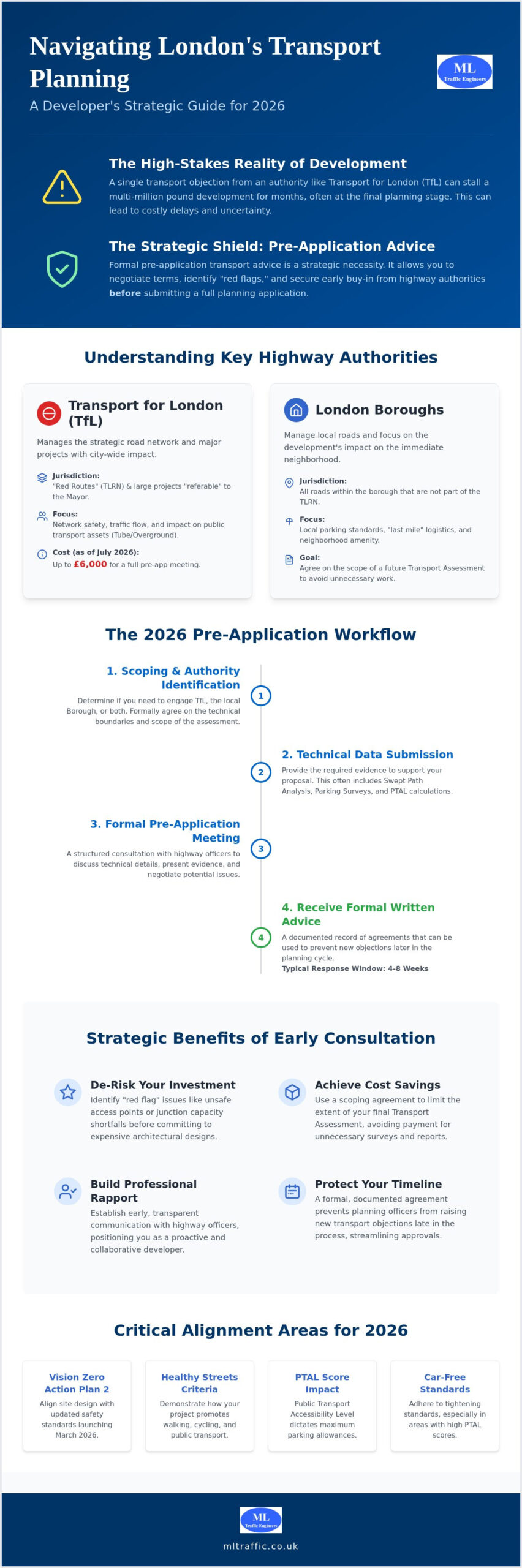
Transport for London manages the Transport for London Road Network (TLRN), commonly known as “Red Routes.” If your development sits on one of these routes, or if it’s large enough to be “referable” to the Mayor, you must consult TfL. They also get involved if your site is near London Underground or Overground assets. Their requirements are rigorous and data-heavy. As of July 2026, TfL’s fees reflect this complexity. Initial screening costs £550, while a full pre-application meeting for referable projects can cost up to £6,000. You’ll need high-accuracy technical data, such as Swept Path Analysis, to prove your project won’t compromise the strategic network’s safety or flow.
The Role of the London Borough Highway Authority
Boroughs focus on local impact. They care about how your development affects the immediate neighborhood. This includes parking standards and “last mile” logistics for deliveries. Policies aren’t uniform across the city. What works in Southwark might be rejected in Westminster. Borough pre-apps help you navigate these local nuances. They ensure your proposal aligns with the March 2026 Vision Zero Action Plan 2 updates. Engaging early allows you to agree on the scope of a future Transport Assessment. This prevents you from paying for unnecessary surveys or technical reports that the borough doesn’t actually require.
The Strategic Benefits of Early Transport Consultation
Securing pre-application transport advice London isn’t just a regulatory hurdle. It’s a high-value strategy for risk mitigation. By engaging highway authorities early, you identify “red flag” issues before investing heavily in architectural designs. If a proposed access point is fundamentally unsafe or a junction lacks capacity, it’s better to know before your plans are fixed. This early transparency builds a professional rapport with council highway officers, positioning you as a proactive developer committed to safety and precision.
A critical component of this stage is establishing the Public Transport Accessibility Level (PTAL). In London, your PTAL score directly dictates your maximum parking allowances. High PTAL scores often necessitate car-free developments, while lower scores might allow for limited on-site parking. Getting this confirmed during the pre-app stage prevents late-stage design changes that could compromise your project’s density or viability. The transport planning profession relies on these metrics to ensure new developments don’t overwhelm existing infrastructure.
Cost Savings Through Scoping Agreements
The most significant financial benefit of a pre-app is the scoping agreement. Scoping is the process of agreeing the technical boundaries of a Transport Assessment. Without this agreement, you might waste thousands of pounds modelling junctions that the council doesn’t actually care about. During a pre-app meeting, we negotiate which specific junctions require detailed capacity analysis and which can be omitted. This prevents “scope creep,” where authorities ask for additional data after you’ve already submitted your application. It locks in the technical workload, allowing for more accurate budgeting and faster turnaround times.
De-risking Parking and Access Objections
As London moves toward a car-free future, testing the viability of car-lite schemes is essential. Highway officers will scrutinize how residents and visitors travel if you don’t provide parking. Early feedback on site access points is also vital, especially for heavy vehicle movements. We use technical data to demonstrate that delivery trucks can safely enter and exit the site without blocking traffic. If the council has concerns about local street capacity, we can identify the need for parking surveys early in the cycle. This ensures you have the evidence ready to support your case when the formal application begins. If you want to ensure your site meets these rigorous standards, you can view our full range of technical transport services to see how we support the planning process.
The London Pre-application Procedure for 2026
The path to obtaining pre-application transport advice London follows a logical, five-step sequence designed to eliminate technical ambiguity. First, we conduct an internal site assessment to identify immediate constraints and PTAL ratings. Second, we prepare a robust request package, including a Scoping Note that outlines our proposed methodology. Third, the formal submission is made to the relevant authority along with the required fee. Fourth, we attend the consultation meeting to negotiate technical points. Finally, you receive the formal Advice Letter, which serves as your roadmap for the full application.
Timescales vary across the capital, but most London Boroughs aim for a response within four to eight weeks. For larger, more complex developments, you’ll likely utilize a Planning Performance Agreement (PPA). A PPA provides a bespoke timetable and dedicated officer time, which is essential for projects with high infrastructure impact. In May 2026, authorities like the City of London Corporation updated their PPA fee structures, reflecting the increasing administrative demand for detailed transport oversight. A successful output is a written response that clearly confirms the scope of your future Transport Assessment.
Information Required for a Robust Request
Quality in equals quality out. You must provide detailed site location plans and a clear description of the proposed land use to get meaningful feedback. We recommend submitting a draft Transport Statement or a detailed Scoping Note at this stage. This document should include preliminary site layout drawings that highlight vehicle access points. Without these details, the highway officer’s advice will remain generic and offer little protection against future objections. Providing this information early proves your commitment to regulatory compliance and safety from the outset.
The Role of Technical Data: Swept Path and Surveys
Precision is a functional necessity during the pre-app phase. Providing a Swept Path Analysis at pre-app prevents costly access redesigns later in the project lifecycle. This technical evidence demonstrates that fire tenders and refuse vehicles can maneuver safely within your proposed layout from day one. We also use initial traffic count data to justify your proposed trip generation figures. If your data is accurate and follows industry benchmarks, officers are less likely to challenge your findings during the formal planning stage. This data-driven approach de-risks the entire development by resolving highway conflicts before they become project-killing obstacles.
Common Pitfalls in London Transport Planning
Treating the pre-app as a box-ticking exercise is a costly mistake. Developers often submit “half-baked” plans that lack technical depth, resulting in generic and unhelpful advice from highway officers. If you don’t provide specific data, the council cannot give a specific response. This leaves you vulnerable to new objections during the formal planning stage. Another major error is ignoring cycle parking standards. The London Plan 2021/2026 updates demand high-quality, accessible cycle storage. Failing to integrate these requirements into your early ground floor layout can force a complete redesign of your building’s core later on.
Construction logistics also require early consideration. While a formal plan is submitted later, you must demonstrate at the pre-app stage that the site is physically accessible for large vehicles. If a site cannot be safely serviced during the build, the highway authority may flag this as a fundamental constraint. Taking a proactive approach to Travel Plans and sustainable transport at this stage proves your project aligns with London’s long-term growth goals.
The “Vision Zero” and Pedestrian Comfort Trap
London’s focus on pedestrian safety frequently overrides traditional vehicle access needs. The March 2026 launch of the Vision Zero Action Plan 2 reinforced this priority. Standard road designs that work elsewhere often fail in London’s dense urban environment because they don’t prioritize the “Healthy Streets” approach. Your pre-application transport advice London must show how your development enhances the pedestrian experience. If your proposed vehicle crossover compromises footway safety or reduces pedestrian comfort levels, it will likely be rejected. We ensure your pre-app proposal aligns with the Mayor’s Transport Strategy to avoid these project-killing objections.
Ignoring S278 and S38 Implications
Off-site highway works can significantly impact project viability if they aren’t identified early. You must determine if the council requires you to modify the existing public highway to facilitate your development. These requirements are formalized through Highway Design S278 & S38 agreements. Whether it’s a new junction, footway improvements, or drainage changes, the costs can be substantial. Identifying these obligations during the pre-app allows you to factor them into your financial appraisals before you’re legally committed to the works. If you need to verify your site’s technical compliance before meeting the council, contact us for a professional review of your transport data.
How ML Traffic Engineers Secures Your Pre-app Success
ML Traffic Engineers brings technical precision to the high-stakes environment of London infrastructure. We provide the technical evidence required to secure pre-application transport advice London without the risk of scope creep or unexpected technical objections. Our team prepares expert Scoping Notes that focus specifically on the data points highway authorities demand. This focused approach minimizes your reporting costs by eliminating unnecessary analysis while ensuring every critical transport issue is addressed from the outset.
Our technical capabilities cover the full project lifecycle. We utilize high-accuracy Swept Path Analysis, PTAL analysis, and detailed Parking Surveys to ensure your site layout is compliant with 2026 standards. Because we’ve been negotiating pre-application transport advice London with both TfL and local boroughs since 2014, we understand the specific nuances of each jurisdiction. This direct experience allows us to anticipate highway officer concerns before they’re even raised. We act as a dependable expert who takes pride in precision and adherence to industry benchmarks.
Tailored Transport Consulting for Developers
We don’t just fill out forms. We build a robust technical case for your development. In the dense urban environment of London, professional reassurance is a necessity for any high-stakes project. Our “right first time” approach accelerates your planning timeline and reduces the logistical and regulatory pressure on your team. We position ourselves as a reliable partner that understands intricate regional regulations so you don’t have to. If you’re ready to de-risk your project, visit the ML Traffic homepage to arrange a professional review of your site.
From Pre-app to Planning Approval
The pre-app is only the beginning of a successful project. We seamlessly transition the formal advice received into a winning Transport Assessment. Our support continues throughout the full planning lifecycle, ensuring that any subsequent queries from highway authorities are handled with technical authority and immediate action. We also specialize in Travel Plans to satisfy council conditions and secure final approval. This comprehensive, fully-managed service model ensures your project remains on track from inception to completion, providing the unwavering reliability you need in a fast-moving infrastructure market.
Secure Your Planning Success with Strategic Transport Advice
London’s planning environment in 2026 demands a proactive approach to highway infrastructure. Securing pre-application transport advice London is the most reliable method to de-risk your development and establish a clear roadmap for approval. This early consultation helps you lock in the technical scope of future reports, preventing unexpected demands that can stall your project. It also ensures your site design integrates seamlessly with the city’s focus on pedestrian safety and sustainable transit standards.
ML Traffic Engineers has been a specialist in London transport planning since 2014. We bring a proven track record of successful negotiations with TfL and local boroughs, supported by expert Swept Path Analysis and high-accuracy technical surveys. Our “right first time” philosophy protects your timeline and your budget by resolving potential highway conflicts before they become project-killing obstacles. We take pride in our precision and adherence to the strict regulatory benchmarks that define the capital’s infrastructure.
Secure expert pre-application transport advice for your London project today. Let’s work together to transform complex regulatory requirements into a clear and efficient path for your project’s completion. We’re ready to provide the technical authority your development deserves.
Frequently Asked Questions
Is pre-application transport advice mandatory in London?
Pre-application transport advice London is not legally mandatory, but authorities strongly recommend it for most developments. Many London Boroughs treat this consultation as a prerequisite for major applications to ensure the submission is technically sound. Skipping this stage often leads to project-killing objections during the formal planning phase, which can stall your timeline for months.
How much does TfL charge for pre-application advice in 2026?
As of July 2026, TfL’s initial screening fee is £550 plus VAT. For applications referable to the Mayor, a full pre-application meeting costs £5,450 plus VAT if a screening has occurred, or £6,000 plus VAT for a one-off meeting. Non-referable applications and follow-up meetings are priced at £2,200 plus VAT, though written-only advice can receive a 50% discount.
Can I use pre-app advice from one project for a similar site nearby?
You cannot use pre-application transport advice London from one project for a similar site nearby because transport impacts are entirely site-specific. Local junction capacity, PTAL ratings, and specific site access constraints vary significantly even between adjacent plots. Authorities require a bespoke technical assessment for every new planning boundary to maintain safety and network efficiency across the city.
How long is the written transport advice valid for?
Written transport advice is generally considered valid for six to twelve months. However, its accuracy depends on the stability of local and strategic planning policies. Significant updates, such as the March 2026 launch of the Vision Zero Action Plan 2, can change the requirements for pedestrian safety and cycle parking. This can render older advice technically obsolete before you submit your application.
What happens if the council changes their mind after the pre-app?
Pre-application advice is not legally binding, so an authority can technically change its position during the formal application process. However, a formal written response provides a documented baseline for all future negotiations. If you’ve followed the advice and the council raises new objections without a corresponding change in policy, the pre-app letter serves as a vital technical defense for your project.
Does pre-app advice guarantee planning permission?
Receiving positive pre-app advice doesn’t guarantee planning permission. It resolve highway and movement issues, but your application must still satisfy other planning criteria such as architectural design, environmental impact, and residential amenity. It ensures that transport isn’t the reason for a refusal. It’s a strategic tool to clear one of the most complex hurdles in the planning lifecycle.
How much detail should I include in a pre-app Transport Scoping Note?
Your Scoping Note should include site location plans, proposed land use descriptions, and your methodology for trip generation. Including high-accuracy technical data like Swept Path Analysis at this stage is a functional necessity. This level of detail allows highway officers to provide specific, actionable feedback on vehicle maneuvering and access safety. It prevents costly redesigns and ensures your technical case is robust.

Disclaimer
The content on mltraffic.co.uk, including all technical articles, guides, and resources, is provided for general informational and educational purposes only. It is not intended to constitute professional advice in traffic engineering, transportation planning, development approvals, or any other technical or legal field.
While ML Traffic Engineers makes every reasonable effort to ensure the accuracy, completeness, and timeliness of the information published, we do not provide any warranties or representations (express or implied) regarding its reliability, suitability, or availability for any particular purpose. Any reliance you place on the content is strictly at your own risk.
In no event shall ML Traffic Engineers, its directors, employees, authors, or affiliates be liable for any direct, indirect, incidental, special, consequential, or punitive damages (including, without limitation, loss of profits, data, or business opportunities) arising out of or in connection with the use of, or inability to use, any information provided on this website.
The articles and guides on this site are not a substitute for engaging a qualified, professional traffic engineer to assess your specific project requirements. For tailored advice, compliance assessments, or traffic engineering services, please contact a competent professional.
This disclaimer may be updated from time to time without notice. By accessing or using this website, you agree to be bound by the most current version of this disclaimer.