Tag: Transport Assessment

  • DfT Transport Assessment Guidance: Key Aspects

    DfT Transport Assessment Guidance: Key Aspects

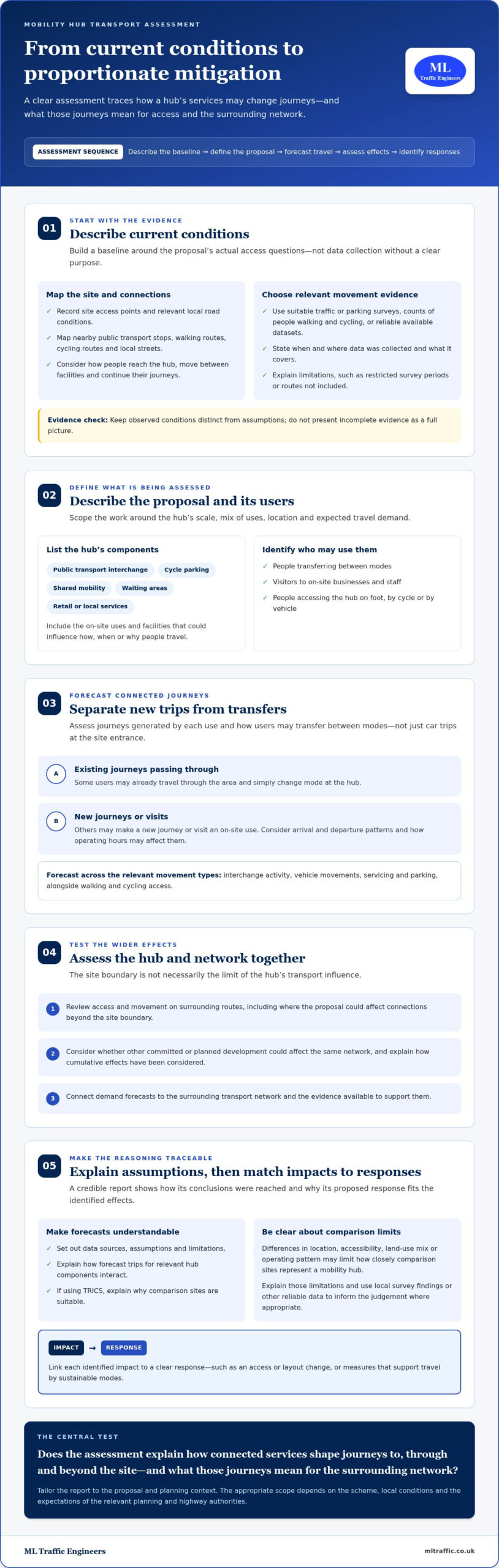
    Relying on the withdrawn 2007 standards is one of the fastest ways to guarantee a planning refusal in 2026. It’s understandable if you feel overwhelmed by the transition to the current Planning Practice Guidance and local authority expectations. Mastering the official Guidance on Transport Assessment published by the Department for Transport is essential for any developer who needs to meet the National Planning Policy Framework standards updated on February 7, 2025. Technical precision during the pre-application phase prevents expensive logistical bottlenecks and regulatory delays during the decision-taking process.

    This article simplifies the complexities of transport documentation so you can move forward with confidence. You’ll learn how to distinguish between a “lighter-touch” Transport Statement and a full Transport Assessment based on indicative local authority thresholds. We provide a definitive checklist of required content, helping you manage the project lifecycle from initial data collection to final planning approval. By the end, you’ll know exactly how to secure professional reports that satisfy statutory requirements and protect your project’s timeline from unnecessary scrutiny.

    Key Takeaways

    • Navigate the transition from the 2007 guidance to current 2025 NPPF standards to ensure your development remains compliant with the latest regulatory framework.
    • Determine if your project needs a comprehensive technical report or a simplified submission by following the official Guidance on Transport Assessment published by the Department for Transport.
    • Master the core requirements for auditing existing transport networks, including site access, parking provision, and internal site layouts.
    • Learn how to identify and mitigate “severe” transport impacts through strategic Travel Plans and physical network improvements.
    • Build a data-driven strategy that aligns with 2026 Net Zero targets to achieve faster planning approval from local highway authorities.

    The Evolution of DfT Guidance on Transport Assessments

    A Transport Assessment (TA) serves as the primary technical mechanism for evaluating the impact of a proposed development on the highway network. It isn’t just a paperwork exercise; it’s a rigorous, data-driven report required by local planning authorities to ensure public safety and network efficiency. Central to this process is the Guidance on Transport Assessment published by the Department for Transport, which provides the framework for identifying how a project affects local infrastructure and the wider community.

    The regulatory environment shifted significantly in 2014 when the Department for Transport technically withdrew the comprehensive 2007 guidance, moving toward the Planning Practice Guidance (PPG). This transition aimed to make the transportation planning process more proportionate. However, the National Planning Policy Framework (NPPF), last updated on February 7, 2025, remains the ultimate authority. It mandates that development should only be prevented on highway grounds if there’s an unacceptable impact on highway safety or if the residual cumulative impacts on the road network would be severe.

    To better understand this concept, watch this helpful video:

    Understanding the Guidance Paradox

    The industry currently operates under a paradox. While the official 2007 Guidance on Transport Assessment published by the Department for Transport was archived, its technical methodologies remain the gold standard for traffic modelling and data analysis. Local highway authorities frequently expect the depth of detail found in the legacy document, even though current PPG suggests a “lighter touch.” ML Traffic Engineers bridges this gap by applying modern PPG principles while maintaining the technical rigour demanded by local officers. We navigate these conflicting expectations to ensure your Transport Assessments meet both statutory requirements and local preferences without unnecessary delays.

    The Purpose of the Assessment for Developers

    For a developer, the assessment is a strategic tool rather than a hurdle. It identifies potential capacity issues before they become grounds for refusal. A compliant report demonstrates a clear priority for sustainable travel modes, such as walking and cycling, over private car use. This alignment with government policy is crucial for securing approval. By auditing existing conditions and projecting future demand, we help clients mitigate safety risks early in the design phase. This proactive approach reduces the likelihood of expensive post-submission redesigns or the rejection of planning applications due to insufficient transport data.

    Transport Statements vs. Assessments: Determining Your Requirements

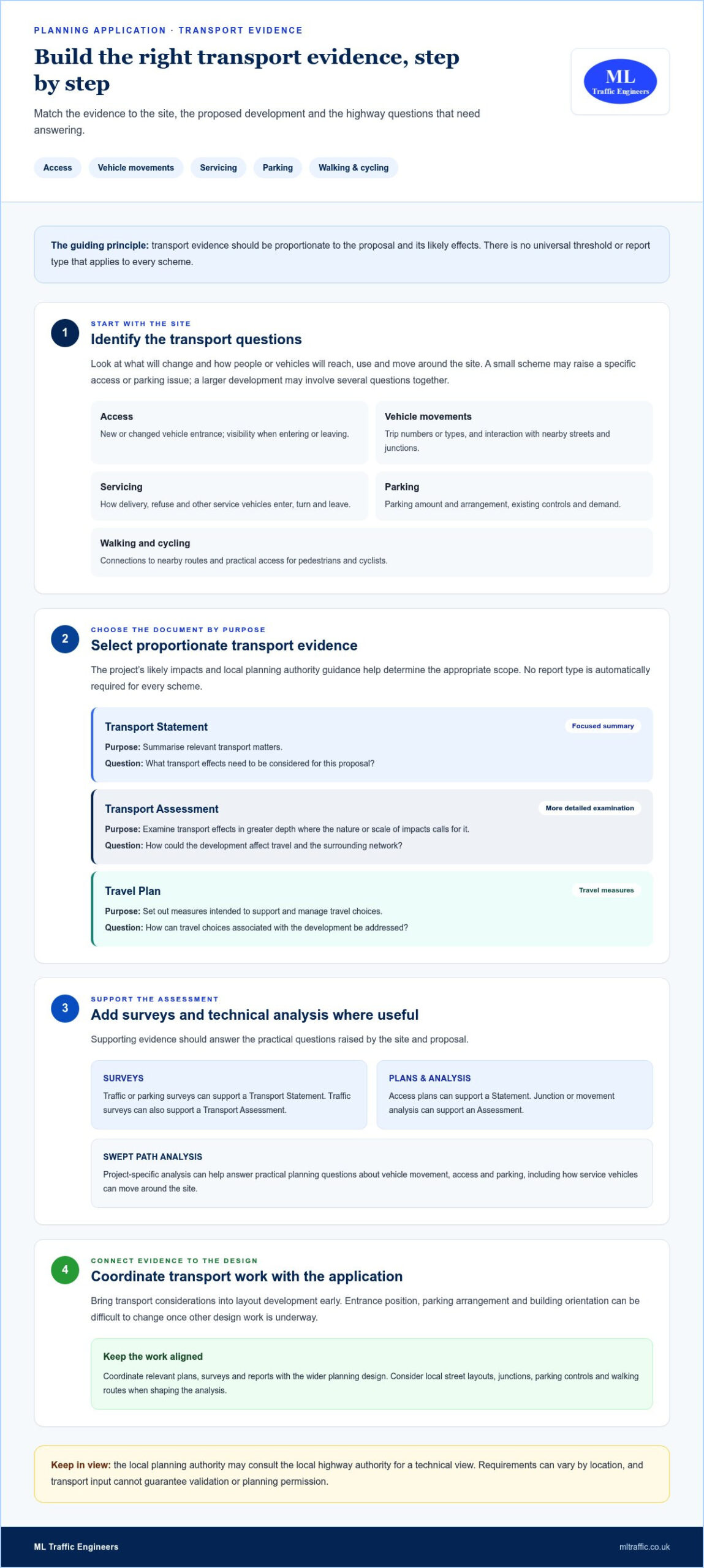
    A Transport Statement (TS) is a simplified report designed for developments with limited transport implications. In contrast, a full Transport Assessment (TA) is a legal necessity for larger schemes to prove that the development won’t create “severe” residual impacts on the highway. The Current Government Guidance on Transport Assessments clarifies that the level of detail in these documents must always be proportionate to the scale and complexity of the project. Understanding which path to take is the first step in ensuring your planning application isn’t stalled by technical objections.

    Adhering to the Guidance on Transport Assessment published by the Department for Transport is vital when negotiating with Local Highway Authorities (LHAs). While the LHA makes the final determination on a case-by-case basis, certain indicative thresholds usually trigger a full assessment. These typically include developments generating 30 or more two-way vehicle movements in any peak hour, projects generating 100 or more movements per day, or any site proposing 100 or more parking spaces. If your project falls below these levels, a Transport Statement is often sufficient to satisfy the planning officer.

    Threshold Analysis for 2026 Developments

    Gross Floor Area (GFA) often serves as the initial trigger for residential, retail, and industrial sites. However, modern planning focuses heavily on cumulative impact. Even if your site falls below standard thresholds, an assessment might be required if the local junction is already operating near capacity. For example, a small residential development in a congested urban centre may require a full TA where a similar site in a rural area would only need a Statement. It’s about the sensitivity of the local network, not just the physical size of your building.

    The Scoping Process: Avoiding Unnecessary Work

    Early engagement through a formal scoping exercise prevents wasted resources on irrelevant data collection. During this stage, you must agree on the “Study Area” with the highway authority to determine exactly which junctions require modelling. You’ll also define “Assessment Years,” typically comparing the opening year against a 5 or 10-year post-completion horizon to account for long-term traffic growth. Getting these details right from the start is essential for a smooth planning journey.

    You can learn more about our Transport Planning and Assessment Reports to see how we handle these technical negotiations. Our team ensures that the scope of work is strictly limited to what’s necessary for compliance, saving you both time and professional fees. If you’re currently preparing a planning submission, securing an early agreement on the scope is the most reliable way to prevent expensive revisions later in the process.

    DfT Transport Assessment Guidance: Key Aspects

    Core Components of a Compliant Transport Assessment

    A robust planning submission relies on a logical sequence of evidence. The Guidance on Transport Assessment published by the Department for Transport mandates a clear audit of the existing transport network before any modelling begins. This involves evaluating current safety records, public transport accessibility, and infrastructure capacity within the study area agreed upon during the scoping phase. Without a precise baseline, the local highway authority cannot accurately measure the impact of your proposed development.

    Predicting future traffic flows requires the use of the TRICS database. This industry-standard tool allows us to calculate trip generation based on data from comparable sites across the country. We don’t just guess numbers; we use verified data to model how many vehicle, pedestrian, and cycle movements your site will produce. This analysis forms the foundation of junction capacity tests. We examine the Ratio of Flow to Capacity (RFC) to ensure no local junction becomes overloaded, keeping your project in line with NPPF safety standards.

    Detailing the internal layout involves more than just drawing parking bays. We must demonstrate that site access is positioned to maintain visibility splays and that pedestrian routes don’t conflict with heavy vehicle movements. Precision during this stage reduces the risk of the local highway authority requesting expensive redesigns after you’ve already submitted your application. It’s about proving that the site is functional from day one.

    Technical Data and Traffic Surveys

    Accurate Parking Surveys are essential when justifying reduced car provision in urban areas. These surveys prove that existing street capacity can handle any potential overspill, preventing objections based on local congestion. We also conduct comprehensive Traffic Surveys to establish real-time baseline flows. High-quality data prevents local councils or residents from challenging the validity of your technical report during the public consultation phase.

    Swept Path Analysis: Proving Site Feasibility

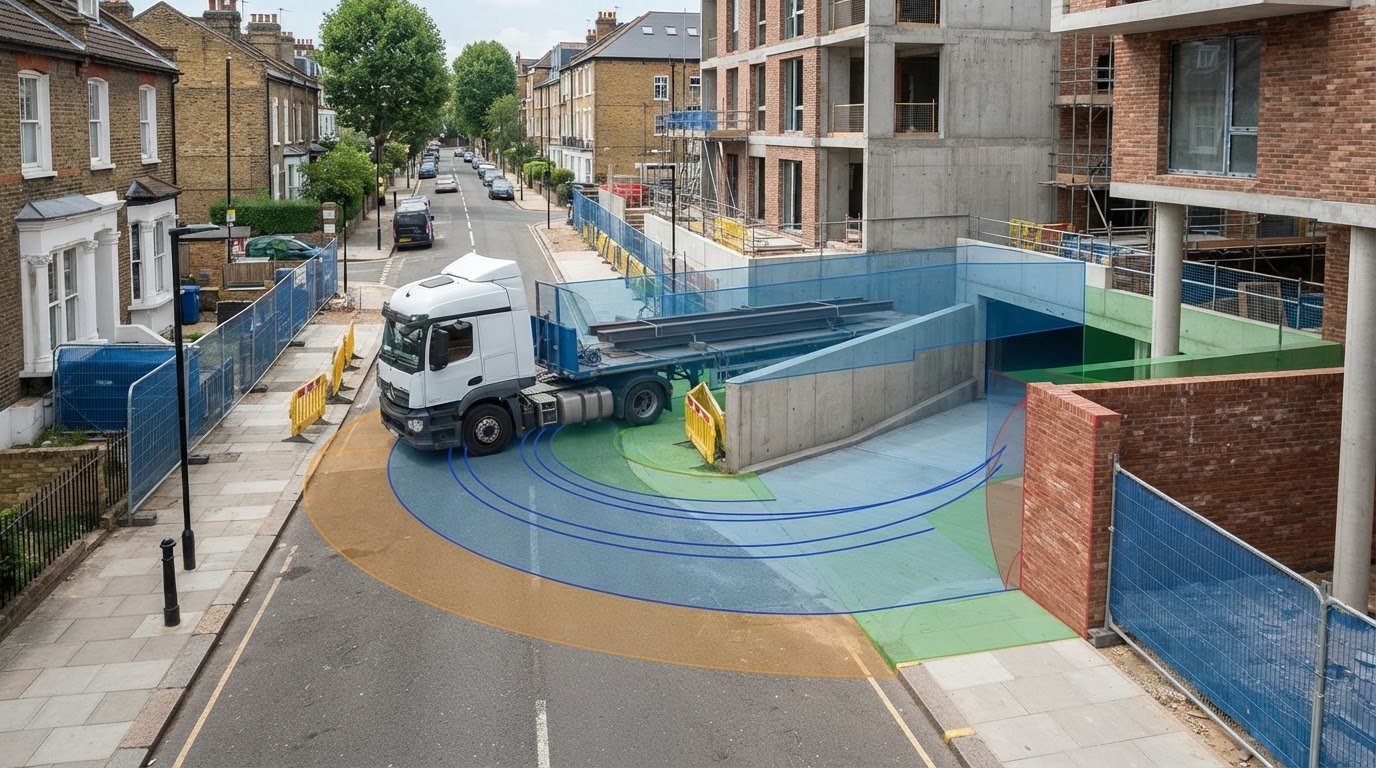
    Adhering to the Guidance on Transport Assessment published by the Department for Transport ensures that your swept path analysis meets the rigorous safety standards expected by statutory consultees. Our Essential Guide to Swept Path Analysis explains how digital modelling verifies vehicle manoeuvrability. We use specific templates for fire tenders and refuse vehicles to secure technical approval from highway officers. If a large vehicle can’t safely enter and exit your site in a forward gear, the layout will likely face a swift planning refusal.

    Mitigation Strategies and Travel Planning

    If your technical analysis identifies capacity or safety issues, you must propose robust mitigation strategies. The National Planning Policy Framework (NPPF) specifies that planning permission should only be refused on highways grounds if the residual cumulative impacts on the road network are severe. The Guidance on Transport Assessment published by the Department for Transport provides the technical foundation for determining which mitigation measures are proportionate to the scale of your development. Our role is to ensure these measures are technically feasible and cost-effective before they’re formalised in legal agreements.

    Mitigation often involves a combination of physical infrastructure and management strategies. Physical works, such as junction improvements or the installation of new pedestrian crossings, are typically secured through Section 278 agreements. Financial contributions toward wider network improvements or public transport enhancements fall under Section 106 obligations. Negotiating these agreements requires a high level of technical precision. We provide the data necessary to ensure that the scope of these works remains directly related to the impact of your site, preventing unnecessary financial overreach.

    Sustainable Mitigation Measures

    Modern planning policy prioritises active travel over traditional road widening. We design mitigation packages that focus on improving walking and cycling routes to reduce the need for car-based trips. This includes integrating electric vehicle (EV) charging infrastructure and high-quality cycle storage into the initial site design. For a deeper dive into the technical requirements for infrastructure delivery, see our guide on Navigating Highway Design S278 & S38. These sustainable measures often carry more weight with planning officers than simply adding road capacity.

    Effective Travel Plans for Planning Success

    A Travel Plan is a long-term management strategy that accompanies your assessment to promote sustainable transport. It must include SMART targets for modal shift, such as reducing single-occupancy vehicle trips by a specific percentage over five years. Local authorities now demand clear monitoring and enforcement mechanisms to ensure these targets are met. You can find more detail in our London Travel Plans: The Essential Guide. A well-structured plan acts as a safeguard, providing the council with the confidence that the development’s impact will be managed effectively throughout its lifecycle.

    Our team specializes in delivering compliant documentation that bridges the gap between technical assessment and practical mitigation. If you’re facing potential objections due to traffic impact, contact us for expert Transport Assessment and Travel Plan services to secure your planning approval.

    Securing Planning Approval with ML Traffic Engineers

    Success in modern planning requires more than just submitting a technical report. It demands a data-driven strategy that anticipates the scrutiny of local highway officers. By following the Guidance on Transport Assessment published by the Department for Transport, we provide the technical evidence needed to overcome objections before they stall your project. Our approach focuses on precision. We eliminate the guesswork that often leads to planning delays or expensive requests for further information. We ensure every data point stands up to rigorous cross-examination by statutory consultees during the public consultation phase.

    The 2026 planning landscape has evolved significantly. Net Zero and Vision Zero targets are no longer optional considerations; they’re central to how assessments are judged by local authorities. Planners now prioritize developments that actively contribute to decarbonization and absolute road safety. We integrate these mandates into every report, proving through rigorous analysis that your project aligns with the latest government standards. This proactive alignment reduces the logistical and regulatory pressures on your team, allowing you to focus on the broader aspects of your development while we handle the technical complexities.

    The ML Traffic Advantage: Accuracy and Speed

    We manage the full project lifecycle. From the initial scoping meeting with the Local Highway Authority (LHA) to final technical approval, our team provides constant support and unwavering reliability. This “inception to completion” philosophy ensures that the transport strategy remains consistent even as the site design evolves. We understand the specific nuances of London-specific policies and regional England requirements. Our experts act as a reliable partner, managing intricate regional regulations so you don’t have to. You can explore our project types and expertise to see how we’ve secured approvals across diverse residential and commercial sectors.

    Ensuring Regulatory Compliance in 2026

    Adhering to the latest “Decarbonising Transport” mandates is a non-negotiable foundation of our work. We use the Guidance on Transport Assessment published by the Department for Transport to frame our safety and capacity arguments. Our technical authority reduces your project risk by providing a shield against regulatory pressure. We don’t just provide a document; we act as your professional representative in high-stakes negotiations with highway officers. Our focus on providing an all-encompassing, fully-managed service ensures that your transport documentation is resilient, compliant, and ready for immediate action.

    Get a Transport Assessment Quote for your project today to ensure your submission meets every statutory requirement and accelerates your timeline to planning approval.

    Streamline Your Planning Journey with Expert Transport Documentation

    Navigating the modern planning landscape requires a technical partner who understands the nuances of regulatory change. You’ve seen how the shift from legacy standards to the current NPPF requires a precise application of the Guidance on Transport Assessment published by the Department for Transport. Identifying the correct thresholds for your development and implementing robust mitigation strategies are the primary ways to avoid costly planning delays and technical objections.

    Since 2014, ML Traffic Engineers has delivered over a decade of planning success for developers across England and London. We specialize in high-precision Swept Path Analysis and TRICS modelling to ensure every report meets the strictest highway authority standards. Our deep understanding of regional transport policy allows us to reduce your project risk and accelerate approval timelines. Contact ML Traffic Engineers for a DfT-compliant Transport Assessment to secure your project’s future. We’re ready to help you turn complex technical requirements into a successful planning outcome.

    Frequently Asked Questions

    Is the 2007 Guidance on Transport Assessment still valid in 2026?

    Technically, the 2007 document was withdrawn and replaced by Planning Practice Guidance (PPG) in 2014. However, local highway authorities still rely on its detailed technical frameworks for traffic modelling and data presentation. Most professionals treat the 2007 methodologies as the industry standard for high-stakes technical reports today.

    What is the difference between a Transport Assessment and a Transport Statement?

    A Transport Statement is a simplified report for developments with minor transport impacts, while a Transport Assessment is a comprehensive technical study for larger projects. Statements focus primarily on local site access and safety. Assessments require deeper analysis of junction capacity and wider network impacts over a 5 to 10-year horizon.

    How do I know if my development requires a Transport Assessment?

    The requirement depends on the scale of your project and specific local planning authority thresholds. Typically, any development generating over 30 two-way vehicle movements in a peak hour requires a full report. You should refer to the Guidance on Transport Assessment published by the Department for Transport to determine if your specific land use triggers this necessity.

    What is the “Study Area” in a Transport Assessment?

    The Study Area is the specific geographic region where the development’s traffic impact is measured. This usually includes the site access points and any local junctions that might experience a significant increase in traffic. You must agree on this area with the Local Highway Authority during the initial scoping stage to avoid wasted modelling effort.

    Can a Transport Assessment be used to justify zero parking on a site?

    Yes, an assessment can justify low or zero parking by proving high public transport accessibility and utilizing detailed parking surveys. We use data to show that any potential overspill won’t negatively affect local road safety or capacity. This evidence is crucial for developments in dense urban centers where car-free living is prioritized.

    How long does it take to prepare a DfT-compliant Transport Assessment?

    Preparation time varies based on the complexity of the site and the need for fresh traffic surveys. A standard report often takes several weeks to complete, accounting for data collection, modelling, and authority scoping. Engaging an expert early ensures that the technical analysis stays on track with your planning submission deadlines.

    What happens if my Transport Assessment shows a negative impact on traffic?

    If the assessment identifies a negative impact, you must propose mitigation measures to reduce the effect to an acceptable level. Under the NPPF, planning refusal only occurs if the residual cumulative impacts are severe. Mitigation might include physical junction improvements or enhanced sustainable travel options secured through Section 106 or Section 278 agreements.

    Do I need a separate Travel Plan if I have a Transport Assessment?

    Larger developments usually require a Travel Plan alongside the main assessment. While the assessment identifies the technical impact, the Travel Plan serves as a long-term management strategy to encourage sustainable transport modes. The Guidance on Transport Assessment published by the Department for Transport suggests integrating these documents to provide a complete picture of site accessibility.

    Michael Lee

    Article by

    Michael Lee

    Transport planner with over 35 years' experience.

    Disclaimer

    The content on mltraffic.co.uk, including all technical articles, guides, and resources, is provided for general informational and educational purposes only. It is not intended to constitute professional advice in traffic engineering, transportation planning, development approvals, or any other technical or legal field.
    While ML Traffic Engineers makes every reasonable effort to ensure the accuracy, completeness, and timeliness of the information published, we do not provide any warranties or representations (express or implied) regarding its reliability, suitability, or availability for any particular purpose. Any reliance you place on the content is strictly at your own risk.
    In no event shall ML Traffic Engineers, its directors, employees, authors, or affiliates be liable for any direct, indirect, incidental, special, consequential, or punitive damages (including, without limitation, loss of profits, data, or business opportunities) arising out of or in connection with the use of, or inability to use, any information provided on this website.
    The articles and guides on this site are not a substitute for engaging a qualified, professional traffic engineer to assess your specific project requirements. For tailored advice, compliance assessments, or traffic engineering services, please contact a competent professional.
    This disclaimer may be updated from time to time without notice. By accessing or using this website, you agree to be bound by the most current version of this disclaimer.
  • Transport Statement Manchester: A Developer’s Guide for 2026 approvals

    Transport Statement Manchester: A Developer’s Guide for 2026 approvals

    Your planning application’s success in 2026 depends less on vehicle access and more on how your site integrates with the Bee Network’s active travel mandates. As Greater Manchester pushes toward its 2038 carbon-neutral goal, submitting a robust transport statement Manchester is the only way to ensure your project isn’t sidelined by technical objections. Local authorities now prioritize the "Right Mix" target, which demands that 50% of all journeys occur via public transport, walking, or cycling by 2040.

    You probably feel the pressure of shifting thresholds and the uncertainty of whether your development requires a simple Statement or a full Assessment. It’s a high-stakes environment where a single data omission can lead to months of planning delays and rising costs. This guide provides the technical clarity you need to align with current TfGM requirements and secure a planning-compliant submission. We’ll help you manage the regulatory pressure so you can focus on delivery.

    We’ll examine the impact of the 2026 fare freezes on travel demand, the lifting of concessionary restrictions, and the specific data sets required to satisfy Manchester’s evolving 2050 Transport Strategy. By the end of this article, you’ll have a clear roadmap for producing cost-effective technical reporting that meets every legislative benchmark.

    Key Takeaways

    • Understand the specific criteria Manchester City Council uses to evaluate site accessibility and safety for smaller developments.
    • Learn how to align your project with the Bee Network’s active travel mandates to ensure your proposal supports integrated public transport goals.
    • Identify the exact triggers, such as unit counts or commercial floorspace, that determine if you need a transport statement Manchester or a more complex Assessment.
    • Discover the essential technical components required for a successful submission, including comprehensive site audits and robust access strategies.
    • Leverage professional data-led analysis and technical tools to streamline your planning approval and reduce regulatory delays.

    Table of Contents

    What is a Transport Statement in the Manchester Planning Context?

    A transport statement Manchester serves as a vital technical document for developers seeking planning permission for projects with relatively low transport implications. Unlike broader city-wide strategies, this report focuses on the site-specific impact of your proposal. A Transport Statement is a technical justification for a development’s traffic impact. It provides local planning authorities with the data required to assess whether a site is safe, accessible, and compliant with current infrastructure standards. Manchester City Council requires this document to ensure that new developments don’t compromise the existing network or public safety.

    To see how Manchester’s transport identity is evolving, watch this brief video:

    The report prioritizes sustainable travel and local mitigation measures. It forms a crucial part of the transportation planning process by demonstrating how your project will interact with the local highway network. By addressing potential issues early, you reduce the risk of costly delays during the planning cycle. Using precision data helps to lower the logistical and regulatory pressures on your team throughout the project lifecycle.

    When is a Transport Statement Mandatory?

    Determining the need for a transport statement Manchester involves checking specific thresholds set by the local highway authority. Typically, residential developments between 30 and 80 dwellings or commercial spaces exceeding 1,500sqm require this level of reporting. However, requirements vary significantly between boroughs. A project in Salford might face different triggers than one in Manchester City Centre due to local congestion levels and infrastructure capacity. You can learn more about how we manage these requirements on our technical services page. We always recommend seeking pre-application advice to confirm the exact scope of work needed. This proactive step prevents the submission of insufficient data, which is a common cause of application refusal.

    The Role of National and Local Policy

    Your application must align with the National Planning Policy Framework (NPPF), which mandates that all developments should be located where they can maximize sustainable transport modes. In Greater Manchester, this national policy is filtered through the 2040 Transport Strategy. This strategy emphasizes the "Right Mix" target, aiming for 50% of journeys to be non-car based by 2040. For 2026 approvals, developers must also consider the emerging goals of the 2050 Strategy. These policies prioritize the Bee Network, requiring sites to demonstrate seamless connectivity to integrated bus and tram services. Adherence to these standards isn’t optional; it’s a non-negotiable foundation for securing planning consent in the current regulatory environment.

    Aligning Your Development with the Bee Network and 2040 Strategy

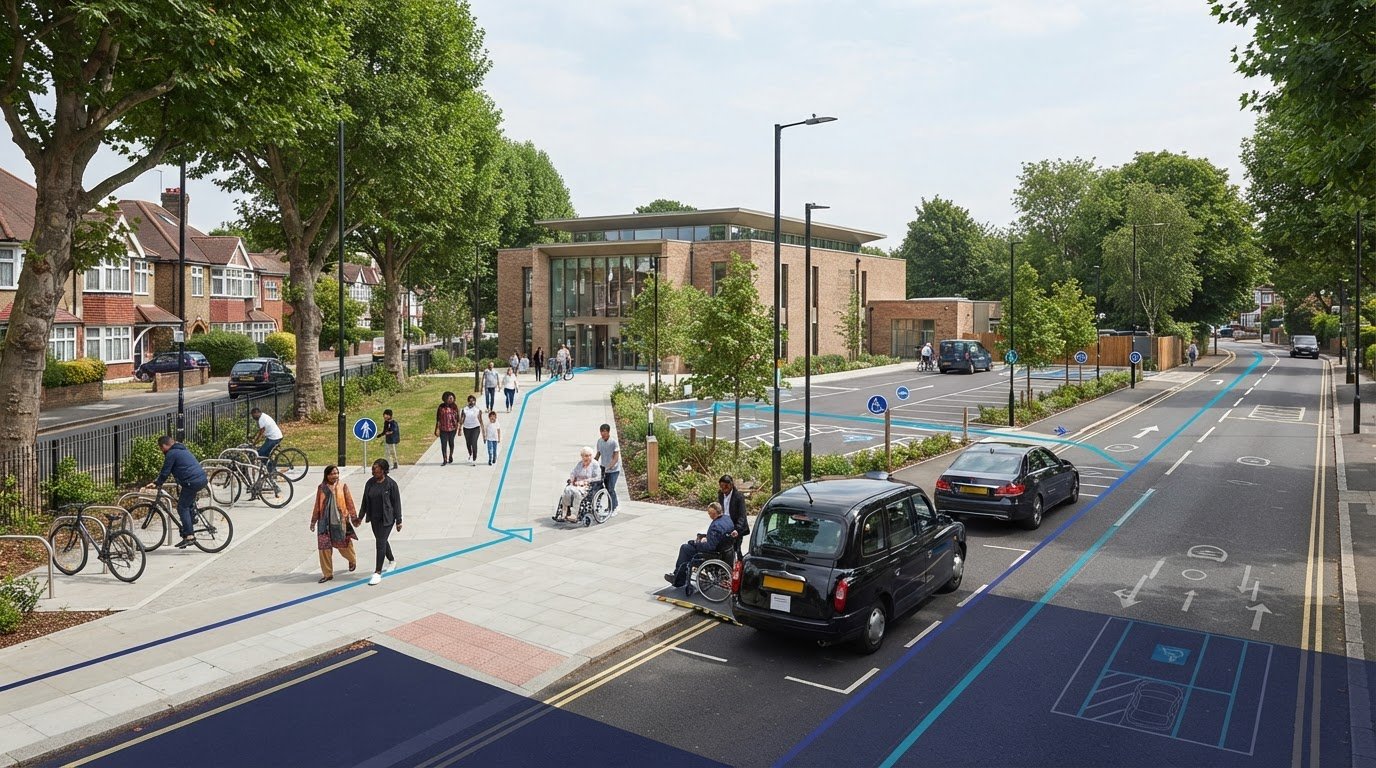
    Securing planning approval in 2026 requires more than a standard traffic count. Your development must actively demonstrate how it plugs into the Bee Network, Manchester’s fully integrated transport system. Local planning officers now scrutinize how sites facilitate access to bus, tram, and rail services as a single, cohesive journey. When preparing a transport statement Manchester, you must prove that your site supports the regional ambition for a "public transport first" approach. It’s no longer enough to just list nearby bus stops. You must show that the infrastructure surrounding your site makes these services the most logical choice for future residents or employees.

    The "Active Travel" mandate is a central pillar of the Greater Manchester Transport Strategy 2040. This policy prioritizes walking, wheeling, and cycling over private vehicle use. In Manchester, accessibility is increasingly measured by how well a site connects to this network, moving beyond traditional PTAL equivalents. You need to provide evidence that your site layout encourages these modes through safe, well-lit, and direct connections to existing cycleways and pedestrian paths. Demonstrating these site-specific contributions to regional transport ambitions is essential for a smooth approval process.

    The Shift Toward Sustainable Modal Split

    Achieving the "Right Mix" target of 50% non-car journeys by 2040 requires a data-led approach. We use the TRICS database to provide accurate predictions of multi-modal trip generation for your specific development type. Your submission should include clear targets for reducing private car dependency, backed by technical analysis. Integrating high-quality cycle storage and electric vehicle (EV) charging infrastructure is now a standard requirement rather than an optional extra. These features must be sized appropriately to satisfy both local borough standards and national policy. If you’re concerned about meeting these thresholds, our team can provide a comprehensive parking survey or site audit to ensure your proposal is compliant.

    Navigating the 2050 Delivery Plan

    2026 serves as a critical transition year for developers. While the 2040 strategy remains the operational foundation, the 2050 Delivery Plan introduces new considerations for "Community-Led Transport" and "Zero Emission Zones." Your planning evidence must be future-proofed against these emerging policies. Relying on outdated data or generic statements will lead to significant delays. Precision reporting and data-driven traffic surveys are non-negotiable in this high-stakes environment. We ensure your transport statement Manchester reflects the most current regional ambitions, including the permanent 2026 fare freezes and the expansion of 24/7 concessionary travel on the Bee Network. This level of technical authority reduces the regulatory pressure on your team and keeps your project moving forward.

    Transport Statement Manchester: A Developer’s Guide for 2026 approvals

    Transport Statement vs. Assessment: Understanding Manchester Thresholds

    Manchester planning authorities differentiate between these technical documents based on the scale of potential impact. A transport statement Manchester focuses on the immediate site vicinity and its direct access points. It’s designed for smaller projects where the traffic increase is localized but still requires technical justification. In contrast, a Transport Assessment involves wider network modeling and complex junction analysis across several kilometers of the surrounding highway. Choosing the right document at the start reduces the logistical and regulatory pressures on your team throughout the project lifecycle.

    Typical triggers for a Statement include residential developments of 30 to 80 dwellings or commercial applications exceeding 1,500sqm. Opting for the Statement route is often the faster and more cost-effective path because it avoids the lengthy data collection periods required for full assessments. However, developers must be wary of "scope creep." This happens when an initial Statement is deemed insufficient by the council, leading to a demand for a full Assessment mid-way through the planning process. We provide the technical authority needed to scope your project accurately from day one, preventing these expensive delays.

    Key Differences in Data Requirements

    Report depth varies significantly between these two formats. A Statement usually requires simple junction capacity checks and a review of local accident data over the last five years. An Assessment demands comprehensive traffic flow analysis and multi-modal modeling using the latest TRICS data. Regardless of the report type, Swept Path Analysis remains essential to prove that refuse and emergency vehicles can navigate your Manchester site safely. We model every vehicle maneuver against local highway standards to ensure your site layout is functionally sound and safety-compliant.

    Choosing the Right Consultant for Your Manchester Project

    Navigating the Bee Network requires deep local expertise. Planning officers in Greater Manchester expect reports that reflect the region’s specific active travel priorities and the 2026 fare freeze impacts on public transport uptake. Our Transport Planning and Assessment Reports are built on precision and adherence to industry benchmarks. We understand the nuances between different borough requirements, such as the specific parking standards in Salford versus Manchester City Centre. Accurate scoping prevents unnecessary planning friction and keeps your development moving forward toward a smooth approval. We take pride in our role as a dependable expert, managing the intricate regional regulations so you don’t have to.

    Key Components of a Successful Manchester Transport Submission

    A successful transport statement Manchester requires a methodical approach to data collection and site analysis. It begins with a detailed site audit of existing conditions. You must document current pedestrian footfall, cycle path availability, and the proximity of Bee Network assets. This baseline data allows you to build a robust access strategy that ensures safe entry and exit for all vehicle types. We prioritize precision in these assessments to reduce the logistical and regulatory pressures on your planning team during the application process.

    Swept Path Analysis and Site Access

    Manchester City Council requires rigorous technical drawings to prove that large vehicles can navigate your site without compromising safety. We utilize advanced software to demonstrate fire tender and refuse vehicle maneuverability. Rigorous Swept Path Analysis prevents critical design errors before you reach the construction phase. These technical drawings are non-negotiable for 2026 approvals. If your site layout can’t accommodate a standard refuse vehicle, your application will likely face immediate technical objections from the highways department.

    Parking Surveys and Sustainable Travel

    In high-density areas like Ancoats or Deansgate, conducting parking stress surveys is essential. You must justify your proposed parking levels by balancing local standards with regional sustainability goals. High Bee Network connectivity often allows for reduced parking ratios. This is especially true given the 2026 bus and Metrolink fare freezes, which make public transport a more attractive option for residents. A robust Travel Plan is the most effective way to support your Statement and prove your commitment to active travel. These documents work together to show how your development will manage demand without overwhelming the local highway network.

    Common Pitfalls in Manchester Applications

    Many developers fail by ignoring "Vision Zero" safety standards. These mandates require that pedestrian and cyclist safety be the primary consideration in every design. Another common error is underestimating the impact of construction traffic on local residents. Inaccurate data collection can also derail an application. We use 24-hour traffic surveys to ensure your report reflects reality rather than estimates. Reliable data is the foundation of a successful submission and prevents the need for costly post-submission revisions.

    If you need precise, data-driven support for your project, contact us for professional Transport Statements and Swept Path Analysis today.

    Expert Transport Planning with ML Traffic Engineers

    ML Traffic Engineers UK brings technical authority to the complex UK planning landscape. We specialize in delivering high-quality Transport Statements and technical analysis that satisfy the most stringent local requirements. Our team understands that precision isn’t just a preference; it’s a functional necessity in a high-stakes regulatory environment. We balance technical authority with a client-focused approach to reduce the logistical pressures on your development team. By choosing an expert partner, you ensure that every data point in your transport statement Manchester is robust and defensible.

    Our firm manages full project lifecycles from inception to completion. We utilize a data-led approach, employing the latest TRICS database versions and technical analysis tools to predict multi-modal trip generation accurately. This commitment to precision reflects our role as a vital guardian of project integrity and public safety. We provide a comprehensive, fully-managed service that allows developers to navigate Manchester’s evolving transport policies with confidence.

    Our Process for Manchester Developers

    We follow a logical and sequential communication flow to move your project from initial assessment to final submission. Our process is designed for efficiency and includes:

    • Initial Consultation: We define the exact scope of your project and identify the relevant borough-specific triggers to prevent scope creep.

    • Rigorous Data Collection: Our team conducts detailed traffic and parking surveys, ensuring all data reflects the current 2026 transport environment.

    • Authority Liaison: We actively engage with local highway authorities to ensure your proposal aligns with the specific standards of the relevant council.

    This structured approach allows us to act as a reliable partner. We handle the intricate regional regulations so you don’t have to spend time navigating complex policy documents alone.

    Why Precision Matters in 2026

    The planning landscape in 2026 is increasingly strict. As regional transport delivery plans evolve, local councils have become more selective regarding development impacts. Inaccurate data leads to immediate objections and significant delays. We know that time is your most valuable asset in property development. Our reports provide the technical clarity needed to avoid these rising costs. ML Traffic Engineers UK prioritizes adherence to industry benchmarks as a non-negotiable foundation of our work.

    Our readiness and commitment to technical excellence provide the unwavering reliability your project deserves. We use direct and functional reporting that prioritizes the rapid delivery of information to planning officers. Don’t let insufficient transport data stall your progress in a fast-moving market.

    Contact ML Traffic Engineers UK for a Manchester Transport Statement Quote to secure your 2026 planning approval with precision-engineered reporting.

    Securing planning consent requires a precise balance between development goals and regional sustainability targets. By aligning with the Bee Network’s connectivity mandates and understanding the technical thresholds for a transport statement Manchester, you position your project for a smoother approval. Reliable, evidence-based reporting is the only way to mitigate the logistical pressures of the current planning cycle and avoid costly technical objections.

    ML Traffic Engineers UK was founded in 2014 and offers a decade of specialized UK planning expertise. We manage the full project lifecycle from inception to completion, specializing in precision Swept Path Analysis and data-led reporting. Our team acts as a vital guardian of your project’s safety and integrity, ensuring every submission adheres to strict legislative requirements and industry benchmarks.

    Get a Professional Transport Statement for Your Manchester Project

    We’re ready to help you navigate these intricate regional regulations and keep your development on track. Success isn’t far off when your technical evidence is beyond reproach.

    Frequently Asked Questions

    Do I need a Transport Statement for a small residential development in Manchester?

    A transport statement Manchester is typically mandatory for residential developments falling between 30 and 80 dwellings. However, Manchester City Council may request one for smaller sites if the project is located in a high-congestion area or near a sensitive junction. You should check the specific Local Implementation Plan (LIP) for your borough to confirm if your site triggers these technical requirements.

    How long does it take to prepare a Transport Statement for a planning application?

    Preparation usually takes between two and four weeks once all necessary data is collected. The timeline depends heavily on whether your project requires fresh traffic surveys or parking surveys to establish baseline conditions. We prioritize efficient delivery to help you meet strict planning deadlines and reduce the risk of regulatory delays.

    What is the difference between a Transport Statement and a Transport Assessment?

    The primary difference lies in the scale of the analysis and the geographical scope of the report. A Statement is a concise document focusing on the immediate site access and local transport infrastructure for smaller projects. An Assessment is a comprehensive study required for larger developments that may impact the wider highway network, often requiring complex junction modeling.

    Will the Bee Network affect my development’s parking requirements?

    Yes, the expansion of the Bee Network often justifies lower parking ratios for new developments. Because Greater Manchester has frozen bus and Metrolink fares through 2026, public transport is a more viable alternative to private car use. Planning officers increasingly support reduced parking in areas with high connectivity to integrated bus and tram services.

    What is Swept Path Analysis, and is it required for my Manchester site?

    Swept Path Analysis is the digital modeling of vehicle movements to prove that large vehicles can navigate your site safely. It’s almost always required for Manchester applications to demonstrate that refuse trucks and fire tenders can enter and exit in a forward gear. These technical drawings are a non-negotiable foundation for ensuring site safety and operational integrity.

    How much does a Transport Statement typically cost for a developer?

    Technical reporting costs vary based on the scale of your development and the specific data sets required by the local authority. Factors such as the need for on-site traffic surveys or complex access designs will influence the final fee. We recommend requesting a tailored proposal to ensure your budget reflects the actual technical requirements of your specific site.

    Can a Transport Statement help secure planning permission for a controversial site?

    Providing a data-driven transport statement Manchester is the most effective way to mitigate objections regarding traffic and safety. By using objective evidence from the TRICS database and local accident records, you can demonstrate that your development won’t negatively impact the highway. This technical authority helps reassure planning committees and local residents that the site is functionally sound.

    Who is the Local Highway Authority in Greater Manchester?

    The Local Highway Authority consists of the 10 individual local councils, including Manchester City Council, Salford City Council, and Bolton Council. Each authority manages its own local road network while collaborating with Transport for Greater Manchester (TfGM) on regional strategies. You must submit your transport documentation to the specific council where your development is located.

    Which areas do we cover?

    We service Altrincham, Ashton-under-Lyne, Atherton, Blackrod, Bolton, Bramhall, Bury, Cadishead, Chadderton, Cheadle, Chorlton-cum-Hardy, Didsbury, Droylsden, Eccles, Failsworth, Farnworth, Hazel Grove, Heywood, Horwich, Hyde, Leigh, Littleborough, Manchester, Marple, Middleton, Mossley, Oldham, Prestwich, Radcliffe, Rochdale, Royton, Sale, Salford, Stalybridge, Stockport, Stretford, Swinton, Walkden, Westhoughton, Whitefield, Withington, Worsley, Wigan, Wythenshawe

    Michael Lee

    Article by

    Michael Lee

    Transport planner with over 35 years' experience.

    Disclaimer

    The content on mltraffic.co.uk, including all technical articles, guides, and resources, is provided for general informational and educational purposes only. It is not intended to constitute professional advice in traffic engineering, transportation planning, development approvals, or any other technical or legal field.
    While ML Traffic Engineers makes every reasonable effort to ensure the accuracy, completeness, and timeliness of the information published, we do not provide any warranties or representations (express or implied) regarding its reliability, suitability, or availability for any particular purpose. Any reliance you place on the content is strictly at your own risk.
    In no event shall ML Traffic Engineers, its directors, employees, authors, or affiliates be liable for any direct, indirect, incidental, special, consequential, or punitive damages (including, without limitation, loss of profits, data, or business opportunities) arising out of or in connection with the use of, or inability to use, any information provided on this website.
    The articles and guides on this site are not a substitute for engaging a qualified, professional traffic engineer to assess your specific project requirements. For tailored advice, compliance assessments, or traffic engineering services, please contact a competent professional.
    This disclaimer may be updated from time to time without notice. By accessing or using this website, you agree to be bound by the most current version of this disclaimer.
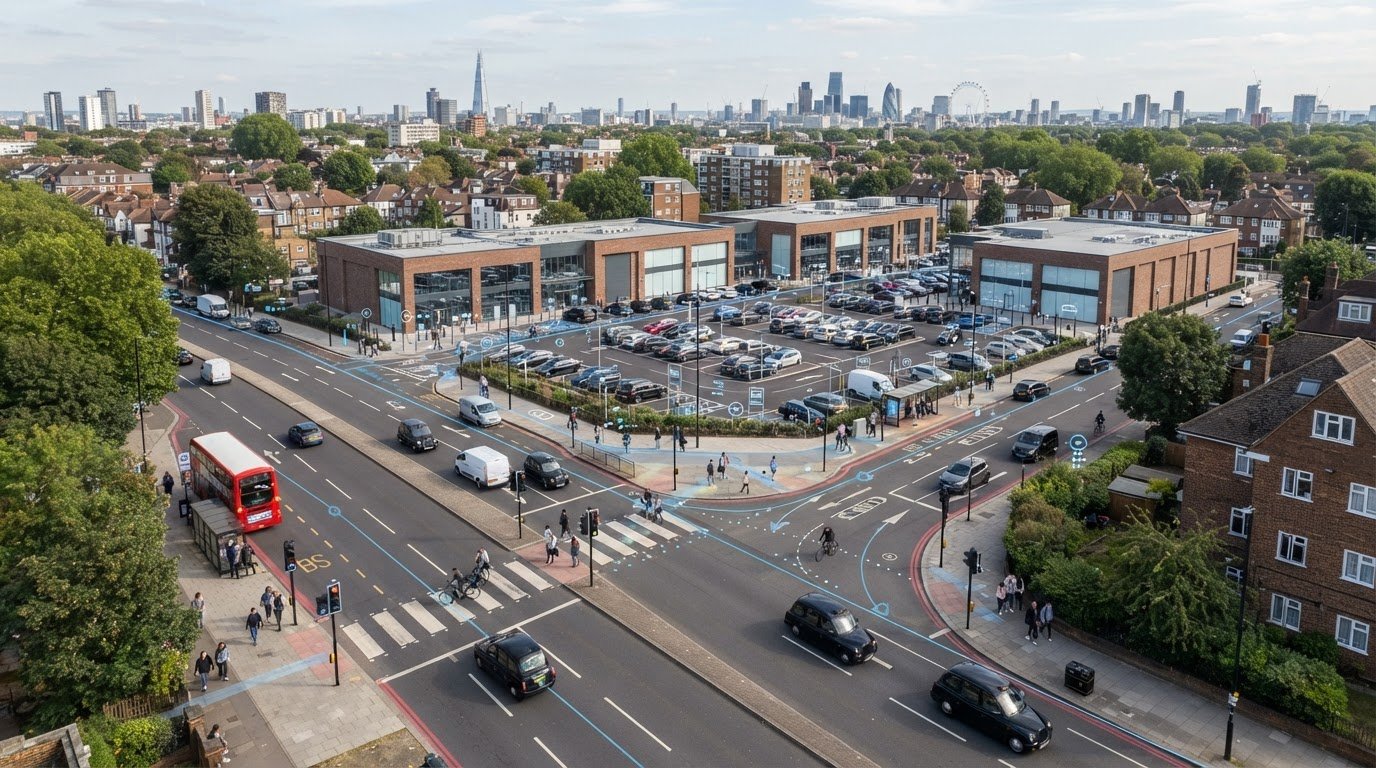
  • What is a Highway Consultant? A Guide for Developers

    What is a Highway Consultant? A Guide for Developers

    With planning fees in England rising by 3.8% as of April 2026 and new statutory consultee surcharges now in effect, a single objection from a Local Highway Authority can turn a profitable project into a financial liability. You likely feel the pressure of these escalating costs and the technical complexity of the 2025 updates to the Design Manual for Roads and Bridges (DMRB). A professional highway consultant acts as your technical advocate, ensuring that your submission meets these rigorous standards before they cause a validation bottleneck.

    This guide explains how a highway consultant navigates technical reporting and regulatory hurdles to secure your development’s planning approval. You’ll learn how precision tools like AutoTURN 2026 and detailed Transport Assessments prevent delays and mitigate unexpected costs in Section 278 agreements. We will outline the essential services, from Swept Path Analysis to Parking Surveys, that transform technical constraints into planning assets and ensure clear communication with highway authorities.

    Key Takeaways

    • Understand how a highway consultant bridges the gap between your development design and the Local Highway Authority’s rigorous safety standards.
    • Discover how to prevent application validation delays by preparing the correct hierarchy of technical reports, from Transport Statements to full Transport Assessments.
    • Learn why Swept Path Analysis and Parking Surveys are critical for proving your site layout can safely accommodate refuse trucks and emergency vehicles.
    • Identify potential “showstoppers” early in the planning lifecycle through strategic feasibility reviews and pre-application consultations.
    • Explore how Travel Plans help satisfy modern environmental quotas by promoting sustainable transport options within your project’s design.

    Table of Contents

    What is a Highway Consultant and Why Does Your Project Need One?

    A highway consultant serves as the technical liaison between your development team and the Local Highway Authority. They apply the principles of Highway engineering to ensure your site layout is safe, functional, and compliant with current UK standards. Many developers encounter the "validation hurdle" early in the process. This is an administrative wall where a planning department refuses to register an application because the required highway evidence is missing. By providing precision data from the outset, a consultant ensures your project moves past the validation stage and into the review phase without delay.

    To better understand the strategic role of a specialist in this field, watch this video:

    Beyond administrative support, these experts offer significant commercial value. They optimize access designs to reduce unnecessary infrastructure spending while maintaining safety. A highway consultant doesn’t just fill out forms. They negotiate with local authorities to ensure that required works are proportionate to the development’s scale. Their role involves managing the full project lifecycle, from initial Traffic Surveys to the final coordination of Transport Assessments. Precision is a functional necessity in this environment.

    The Intersection of Engineering and Planning Law

    Highway consultants translate the National Planning Policy Framework (NPPF) into actionable site plans. They anticipate the requirements of statutory consultees, such as National Highways, before objections are raised. Early engagement during the feasibility stage identifies "showstoppers" like insufficient visibility splays or junction capacity issues. This proactive approach ensures your project aligns with the 2025 updates to the Design Manual for Roads and Bridges (DMRB) and avoids costly late-stage redesigns.

    When to Appoint a Highway Consultant

    Strategic timing dictates the profitability of your development. During pre-acquisition, a consultant assesses site viability to identify access constraints before you commit capital. At the pre-application stage, they prepare the essential evidence base, including Travel Plans and Parking Surveys, to satisfy planning officers. Even in post-refusal scenarios, a highway consultant provides the expert technical evidence needed to challenge decisions during planning appeals and reduce regulatory pressure.

    Technical Reports: Securing Planning Approval through Evidence

    Evidence is the foundation of planning success. A highway consultant uses technical reports to prove that a development’s impact on the road network is acceptable or can be mitigated through design. This data-driven approach mirrors the state use of engineering consultants to provide specialized expertise that internal teams often lack. With traffic volumes reaching 342.6 billion vehicle miles in 2025, local authorities demand higher levels of proof regarding junction capacity and road safety than in previous years. Precision in these reports is a functional necessity to avoid costly delays.

    Central to this proof is the TRICS database. This tool allows us to predict trip generation with high accuracy by comparing your project to similar existing sites. Beyond just vehicle numbers, modern planning requires Transport Planning and Assessment Reports that incorporate sustainable travel strategies. Travel Plans are now a standard requirement for most developments. They promote walking, cycling, and public transport to satisfy environmental quotas and reduce the overall traffic footprint. Reviewing our technical service list helps determine which report hierarchy your specific site requires.

    Transport Statements for Small to Medium Developments

    For smaller projects, a Transport Statement provides a concise evaluation of access and safety. In 2026, these reports must strictly adhere to local parking standards and provide robust cycle storage solutions. They ensure that even modest developments don’t negatively impact the existing highway. These documents focus on the immediate vicinity of the site and confirm that the proposed use is compatible with the local road character. You can find more details in our 2026 guide to Transport Statements.

    Transport Assessments for Complex Projects

    Large-scale or high-impact developments trigger the need for a full Transport Assessment. This involves complex junction capacity modeling and an analysis of the wider highway network. We develop mitigation strategies that balance the authority’s requirements with your commercial viability. When the Strategic Road Network (SRN) is involved, the level of scrutiny increases significantly. We provide the technical authority needed to negotiate these high-stakes environments. Our team manages the full lifecycle of these assessments, ensuring that every data point stands up to rigorous examination by the Local Highway Authority.

    What is a Highway Consultant? A Guide for Developers

    The Data Layer: Swept Path Analysis and Parking Surveys

    Data is the only objective defense against planning refusal. While a developer might assume a site entrance is wide enough, a highway consultant uses empirical evidence to remove that uncertainty. Guesswork in site layout often leads to immediate objections from the Local Highway Authority, particularly regarding safety and accessibility. By integrating precise data collection with technical analysis, we ensure your layout is both functional and compliant with the latest 2025 updates to the DMRB. Guesswork kills projects.

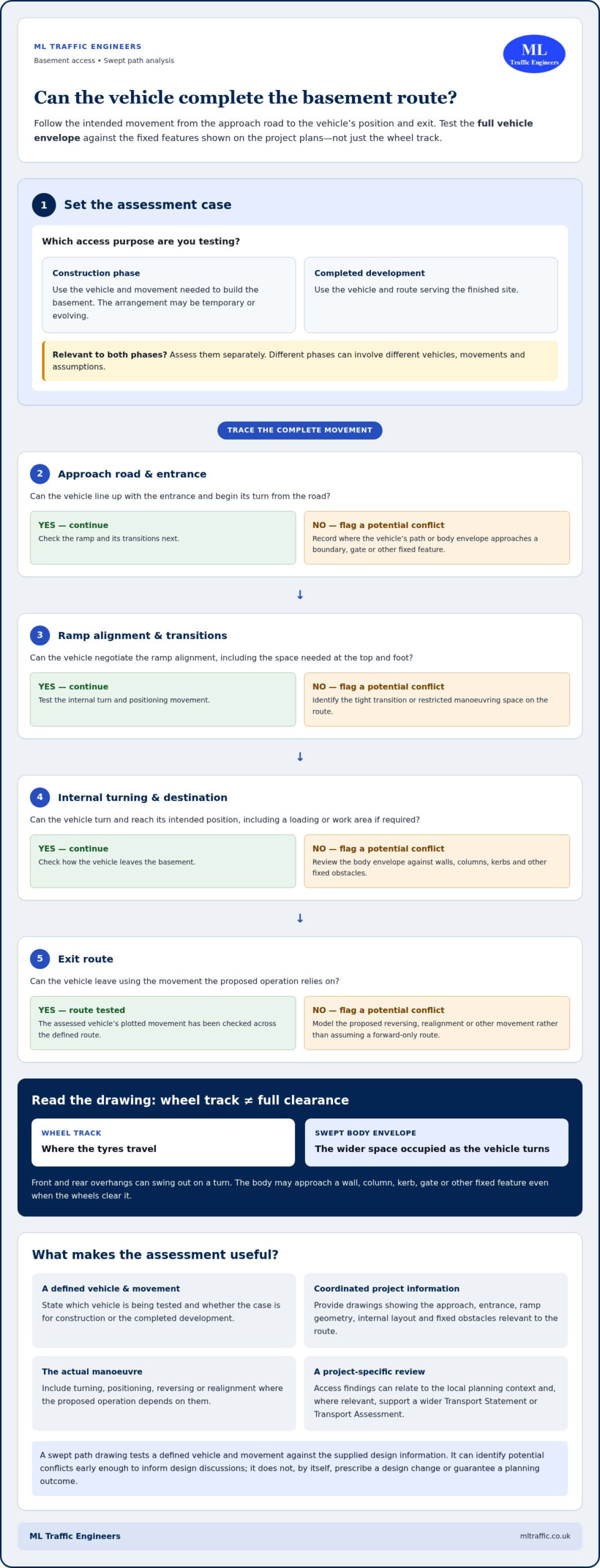
    Swept Path Analysis (SPA) is the primary tool for proving that large vehicles, such as fire tenders and refuse lorries, can safely maneuver within your development. Adhering to rigorous technical standards, much like the framework found in Federal Highway Administration policies, ensures that every vehicle movement is mathematically verified. This technical rigor prevents the safety hazards that arise when site designs fail to accommodate essential services. You can explore our full range of Swept Path Analysis services to see how this data secures your approval.

    Visualizing Access with Swept Path Analysis

    We use industry-standard software, specifically AutoTURN 2026, to simulate real-world vehicle movements. This version includes 102 new standard vehicles for Europe, ensuring your design accounts for modern transport dimensions. By visualizing these paths, we confirm compliance with the "Manual for Streets" and specific local design guides. This isn’t just about safety. Accurate SPA can actually save space. By refining the geometry of junctions and turning heads, we maximize your developable land area while maintaining full regulatory compliance.

    The Critical Role of Parking and Traffic Surveys

    Parking is often a contentious issue in planning applications. We use Parking Surveys, frequently following the Lambeth Methodology, to justify parking ratios and demonstrate that a development won’t overwhelm local streets. This involves conducting overnight parking stress surveys to provide a clear picture of existing demand. Similarly, our Traffic Surveys establish baseline flows before your development traffic is even added. This data is your strongest weapon against unreasonable council demands. When an authority claims a road is at capacity, an experienced highway consultant provides the independent traffic counts needed to challenge that assertion and keep your project moving.

    The Highway Planning Lifecycle: From Feasibility to S278

    The journey from site concept to legal highway agreement is a sequential process requiring meticulous technical oversight. A highway consultant manages this lifecycle to ensure each stage builds a defensible case for approval. With the introduction of Lane Rental Charges under the Street Works Order 2026, the financial stakes for works within the highway have never been higher. Efficient progression through these steps is essential to maintain project viability.

    • Step 1: Feasibility and Access Review. We identify "showstoppers" early by applying the 2025 updates to the Design Manual for Roads and Bridges (DMRB). This prevents investment in non-viable sites.

    • Step 2: Pre-application Consultation. Engaging with the Local Highway Authority (LHA) early builds rapport and clarifies their specific requirements before formal submission.

    • Step 3: Technical Submission. We draft the Transport Statement and Swept Path Analysis to provide the evidence base for your application.

    • Step 4: Negotiation. We act as your technical advocate, responding to post-submission queries and resolving objections from planning officers.

    • Step 5: Discharge of Conditions and S278. Once planning is granted, we manage the technical details required to move toward legal agreements and site commencement.

    Precision at every stage reduces the regulatory pressure on your team. If you are preparing a new submission, you can start your site feasibility review with our team today.

    Navigating Section 278 and Section 38 Agreements

    Securing planning consent is only half the battle. For works involving the existing public highway, you must enter into a Section 278 (S278) agreement. The 2026-2027 fee schedule now includes a minimum combined technical approval and inspection fee of £15,348 for schemes over £15,000. For larger projects, the technical approval fee is 3.75% of the construction value. A highway consultant manages this technical approval process to ensure your road designs meet the LHA standards without unnecessary over-engineering. For a deeper look at these requirements, read our Guide to Highway Design S278 & S38.

    Mitigating Planning Conditions

    Planning approvals often come with strings attached in the form of pre-commencement conditions. These frequently include requirements for Travel Plan monitoring to promote sustainable transport. We ensure these conditions are reasonable, necessary, and enforceable. While developers must also address logistics, we provide resources like our guide to Construction Logistics Plans to help you understand the full scope of 2026 approvals. Our focus remains on delivering the technical data, such as Traffic Surveys, needed to satisfy the LHA and clear your path to construction.

    Why ML Traffic Engineers UK is Your Strategic Highway Partner

    Choosing the right technical advocate determines whether your development moves forward or stalls at the first hurdle. ML Traffic Engineers UK provides the specialized authority needed to satisfy planning officers while protecting your commercial interests. We don’t just deliver data; we offer a reassuring presence in a high-stakes environment where precision is a functional necessity. A professional highway consultant from our team understands that every project is unique, requiring a tailored approach that balances safety standards with your specific site goals.

    Reliability and readiness define our operational model. We recognize that infrastructure projects are time-sensitive and often involve unpredictable regulatory shifts. Because we maintain a constant state of availability, we can respond to Local Highway Authority queries with the urgency your project demands. This proactive stance reduces the logistical pressure on your team and ensures that technical evidence is always ready when needed. We take pride in our ability to manage full project lifecycles from inception to completion.

    Our Approach to Technical Excellence

    We combine deep industry expertise with the latest modeling software to provide results that are both accurate and defensible. Our reports are rooted in a technical lexicon that planning officers across England recognize and respect. This standard of formal excellence is why our submissions consistently move through the review process without unnecessary friction. You can explore our range of project types to see how we apply this expertise to diverse development challenges.

    Contact Us for a Technical Fee Proposal

    We’re ready to assist with your next application. Send us your site plan, and we’ll provide a clear, functional assessment of the highway requirements. Our fee proposals are transparent and sequential, mirroring the natural progression of your project. We promise precision, adherence to industry benchmarks, and a commitment to your success. Get a quote for your highway consultancy needs from ML Traffic Engineers UK and move your project toward a successful conclusion.

    Securing Your Development’s Future with Technical Precision

    Success in modern planning requires more than just meeting basic requirements; it demands a proactive strategy that anticipates regulatory pushback. By integrating precise Swept Path Analysis and evidence-based Transport Assessments, you move beyond the validation hurdle and into a position of strength. A professional highway consultant acts as the vital link between your vision and the strict safety standards of the Local Highway Authority, ensuring that every design choice is both safe and commercially viable.

    ML Traffic Engineers UK has been a dependable partner for developers since 2014, providing the technical authority needed to navigate England’s complex planning landscape. With over a decade of success, we specialize in high-stakes reporting that stands up to the most rigorous scrutiny. Secure your planning approval with expert highway consultancy from ML Traffic Engineers UK. Let our expert knowledge of UK-wide requirements turn your technical challenges into a clear path toward site commencement.

    Frequently Asked Questions

    What is the difference between a highway consultant and a civil engineer?

    A highway consultant focuses on the planning, policy, and traffic flow aspects of a development rather than the structural design of the road itself. While a civil engineer handles the physical construction details, a consultant specializes in navigating the National Planning Policy Framework (NPPF) and securing technical approval from the Local Highway Authority. They bridge the gap between your site layout and the regulatory requirements for road safety and junction capacity.

    Do I need a highway consultant for a single dwelling access?

    Yes, many local authorities now require technical proof of safety even for small-scale projects. A highway consultant is often needed to demonstrate that a single access point has adequate visibility splays and doesn’t negatively impact road safety. Councils frequently request a Swept Path Analysis for individual houses to prove that emergency vehicles, such as fire tenders, can safely enter and turn within the site boundary.

    How much does a highway consultant cost for a planning application?

    Fees for consultancy services vary depending on the complexity of the project and the specific reports required by the council. A simple Swept Path Analysis for a minor development will cost less than a full Transport Assessment for a major commercial site. Developers should consider these costs as an investment in project viability, as professional reporting prevents expensive validation delays and reduces the risk of planning refusal.

    What is a Section 278 agreement and why do I need a consultant for it?

    A Section 278 (S278) agreement is a legal contract between a developer and the Highway Authority for works on the existing public road. You need a consultant to manage the technical approval process and ensure the proposed designs meet strict local standards. This specialist oversight prevents over-engineering and manages the technical details required to discharge planning conditions before construction begins on the highway.

    Can a highway consultant help if my planning application has been refused?

    A consultant provides the technical evidence necessary to challenge highway-related refusals during the appeal process. By analyzing the specific objections raised by the planning officer, they can conduct targeted Traffic Surveys or Swept Path Analysis to prove the development is safe. This data-driven approach is often the only way to demonstrate that a council’s objection is unreasonable or based on outdated information.

    How long does it take to produce a Transport Statement?

    The production of a Transport Statement typically takes between two and four weeks. This timeline depends on whether existing traffic data is available or if new Traffic Surveys are required to establish baseline flows. Engaging a consultant early in the feasibility stage ensures that these essential documents are ready for submission, preventing bottlenecks during the initial validation of your planning application.

    What vehicle templates are used for Swept Path Analysis in the UK?

    We use industry-standard vehicle templates from software such as AutoTURN 2026 to ensure accuracy. The most common templates for UK planning include the 11.4m refuse collection vehicle and the 8m fire tender. These simulations confirm that the site layout complies with the Manual for Streets and can accommodate the specific service vehicles used by local authorities and emergency services.

    Why is a parking survey required if I am providing on-site parking?

    Local authorities need to understand the impact of potential "overspill" parking on the surrounding road network. Even if you provide the required number of spaces, a parking survey using the Lambeth Methodology proves that the local streets can safely handle any additional demand. This evidence reassures planning officers that the development won’t lead to parking stress or safety hazards for existing residents.

    Which areas in London do you cover?

    We service Acton, Balham, Barking, Barnes, Barnet, Battersea, Beckenham, Bexleyheath, Brentford, Brixton, Bromley, Camberwell, Carshalton, Charlton, Chelsea, Chiswick, Clapham, Coulsdon, Croydon, Crystal Palace, Dagenham, Dulwich, Ealing, Edgware, Eltham, Enfield, Finchley, Forest Gate, Fulham, Golders Green, Greenwich, Hackney, Hammersmith, Hampstead, Harrow, Hayes, Highgate, Hounslow, Ilford, Islington, Kensington, Kentish Town, Kingston upon Thames, Lewisham, Mitcham, Muswell Hill, New Malden, Notting Hill, Orpington, Peckham, Pinner, Purley, Putney, Richmond, Romford, Ruislip, Sidcup, Southall, Southgate, Streatham, Surbiton, Sutton, Tooting, Tottenham, Twickenham, Uxbridge, Walthamstow, Wembley, West Norwood, Wimbledon, Wood Green, Woolwich, Bethnal Green, Shoreditch, Canary Wharf, Deptford, Leyton, Palmers Green, Stanmore, Upminster, Chislehurst, Erith, Feltham.

    Which cities in England do you cover?

    We service London, Birmingham, Manchester, Liverpool, Sheffield, Leeds.

    Michael Lee

    Article by

    Michael Lee

    Transport planner with over 35 years' experience.

    Disclaimer

    The content on mltraffic.co.uk, including all technical articles, guides, and resources, is provided for general informational and educational purposes only. It is not intended to constitute professional advice in traffic engineering, transportation planning, development approvals, or any other technical or legal field.
    While ML Traffic Engineers makes every reasonable effort to ensure the accuracy, completeness, and timeliness of the information published, we do not provide any warranties or representations (express or implied) regarding its reliability, suitability, or availability for any particular purpose. Any reliance you place on the content is strictly at your own risk.
    In no event shall ML Traffic Engineers, its directors, employees, authors, or affiliates be liable for any direct, indirect, incidental, special, consequential, or punitive damages (including, without limitation, loss of profits, data, or business opportunities) arising out of or in connection with the use of, or inability to use, any information provided on this website.
    The articles and guides on this site are not a substitute for engaging a qualified, professional traffic engineer to assess your specific project requirements. For tailored advice, compliance assessments, or traffic engineering services, please contact a competent professional.
    This disclaimer may be updated from time to time without notice. By accessing or using this website, you agree to be bound by the most current version of this disclaimer.
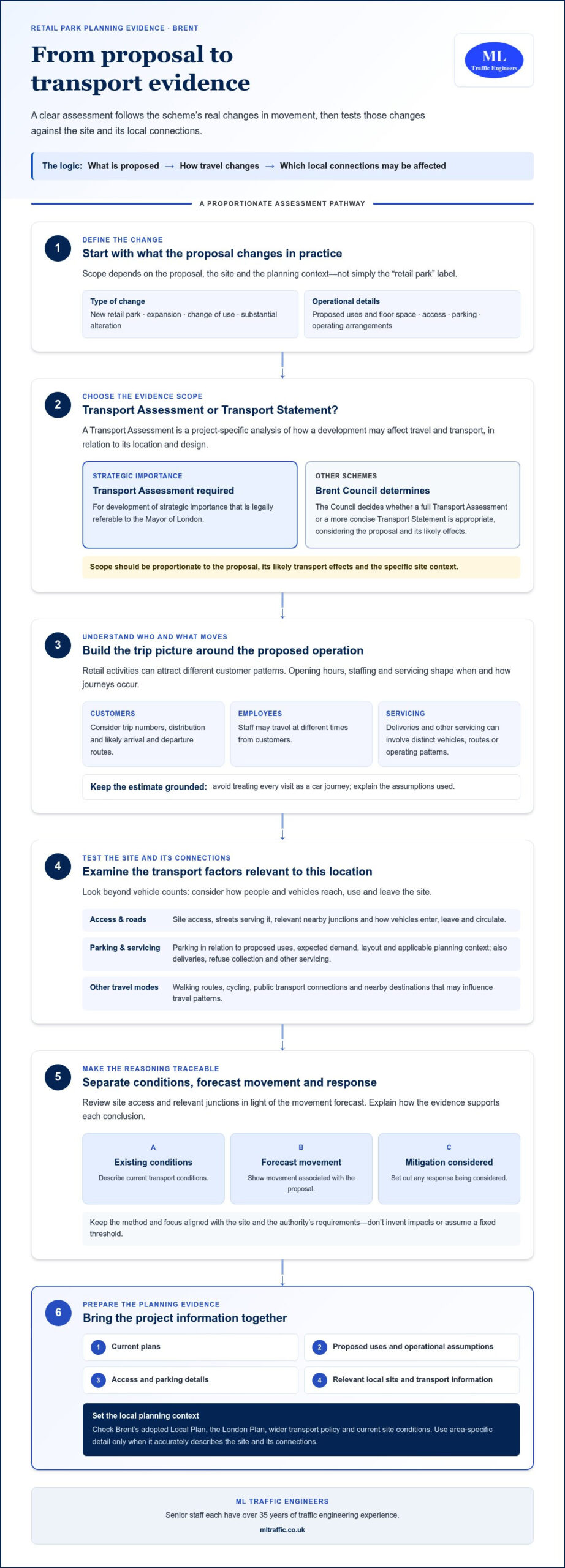
  • What is a Traffic Engineer? A Guide for Developers

    What is a Traffic Engineer? A Guide for Developers

    With van traffic rising 10% above pre-pandemic levels and London drivers losing 109 hours a year to congestion, your development’s access strategy isn’t a simple box-ticking exercise. It’s a high-stakes regulatory hurdle. You’ve likely felt the frustration when a highway authority objection stalls your project; these delays create unnecessary costs and uncertainty for your timeline. A specialist traffic engineer acts as your technical advocate, transforming these logistical barriers into a clear path toward planning approval.

    This guide explains how expert transport data secures your site’s future. You’ll learn how to determine whether you need a Transport Statement or a full Transport Assessment to satisfy local authorities. We’ll also explore how technical tools like Swept Path Analysis and Parking Surveys provide the evidence needed to counter local objections. By the end of this article, you’ll understand how to design a safe, efficient layout that meets 2026 standards and maximises your land value.

    Key Takeaways

    • Understand the vital role of a traffic engineer in navigating complex UK transport policies and securing planning approval for your site.
    • Identify the specific technical documents, such as Transport Assessments and Travel Plans, required to satisfy highway authority requirements.
    • Learn to distinguish between traffic engineers and transport planners to ensure you engage the correct specialist for your project’s technical needs.
    • Discover how utilizing technical data like Swept Path Analysis and Parking Surveys can proactively mitigate risks and counter local objections.
    • Explore how early intervention and professional accuracy from ML Traffic Engineers streamline the planning process and maximize land value.

    Table of Contents

    The Role of a Traffic Engineer in Modern UK Development

    A traffic engineer serves as the technical bridge between your architectural vision and the strict requirements of the local highway authority. While the broad discipline of traffic engineering (transportation) encompasses highway capacity and signal timing, the modern UK developer needs a specialist focused on the planning cycle. These professionals translate complex vehicle movements into data-driven reports that satisfy statutory bodies and reduce regulatory friction. In a high-stakes environment where precision is a necessity, their role is to ensure your project moves from inception to completion without highway-related delays.

    To better understand this concept, watch this helpful video:

    Beyond Cones and Signs: Defining the Consultancy Role

    Many developers initially associate "traffic" with physical roadworks or temporary closures. However, in a consultancy context, the role is purely analytical and advisory. A traffic engineer focuses on data-driven reporting for statutory approvals rather than physical construction. They analyze how your proposed site will interact with the existing network through detailed Traffic Surveys. This work requires close collaboration with architects and planning officers to ensure that site layouts aren’t just aesthetic but functional. They provide the technical certainty that a refuse vehicle can turn safely or that a delivery van won’t block a primary arterial road. Accuracy is a functional necessity here.

    Why Traffic Engineering is Essential for Planning Approval

    Securing "safe and suitable access" remains a non-negotiable pillar of the National Planning Policy Framework (NPPF). Without expert technical evidence, your application is vulnerable to immediate highway authority objections. In 2026, the planning environment has become even more rigorous. New regulations, including the Traffic Management Permit Scheme (England) (Amendment) Regulations 2026, now mandate a focus on Electric Vehicle infrastructure and sustainable transport integration. A traffic engineer provides the evidence to mitigate local community objections. Whether it’s through a detailed Transport Assessment or a robust Travel Plan, they prove your development won’t compromise public safety or highway efficiency. This proactive approach saves time and protects your land value by removing the logistical barriers to approval.

    Core Technical Services: How Engineers Solve Site Constraints

    A traffic engineer provides the technical evidence required to prove a development is viable and safe. In 2026, this process relies heavily on digital modelling and simulation to test site layouts before any physical work begins. Recent updates to the Design Manual for Roads and Bridges (DMRB) on March 30, 2026, have refined the technical standards for these assessments. Additionally, the Traffic Management Permit Scheme (England) (Amendment) Regulations 2026, which came into force on April 10, 2026, now integrate Electric Vehicle (EV) charge point operators into the permit system. A specialist engineer ensures these new regulatory requirements are met without compromising site efficiency or parking capacity. Precision in these early stages is a functional necessity for project success.

    Swept Path Analysis: Ensuring Vehicle Access Feasibility

    Proving that emergency and service vehicles can navigate your site is a non-negotiable requirement for planning approval. A traffic engineer uses Swept Path Analysis Services to simulate the movement of specific vehicles, such as a 12-metre refuse truck or a fire tender. Modern councils demand this data for even small residential projects to prevent future access issues. This technical simulation identifies pinch points in your layout early. It allows for adjustments that protect your land value while ensuring public safety. If you’re developing on a tight urban site, accurate simulation is your best defense against highway authority objections.

    Transport Statements and Assessments: The Statutory Requirement

    The scale of your development determines whether you need a Transport Statement or a full Transport Assessment. While a Statement is typical for smaller projects with limited impact, an Assessment is a comprehensive study for larger developments. These reports evaluate how your project affects the local road network and public transport capacity. Understanding these requirements is vital, as this resource from Michigan State University explains the difference between broader transportation disciplines and specific technical applications. For projects in the capital, following a Transport Assessment London Guide ensures your submission aligns with the specific policies of the London Plan, such as car-free mandates in high-accessibility areas. Providing this technical evidence early reduces the risk of costly delays during the planning cycle. You can explore our technical planning services to see which reports your specific project requires.

    What is a Traffic Engineer? A Guide for Developers

    Traffic Engineer vs. Transport Planner: Navigating the Terminology

    Developers often use the terms "transport planner" and "traffic engineer" interchangeably, but this confusion can lead to critical gaps in a planning submission. A transport planner typically focuses on the "why" of a project. They handle high-level policy alignment, sustainable travel strategies, and long-term social impacts. In contrast, a traffic engineer is a technical specialist focused on the "how." They analyze the physical geometry of a site, calculate junction capacity, and ensure vehicle movements are safe and compliant with the latest standards. It’s also vital to distinguish these roles from traffic management contractors; an engineer provides the analytical design required long before any physical cones or signs appear on the road.

    This distinction is essential for meeting the technical requirements of modern UK infrastructure. The professional profile for Transportation Engineers highlights a reliance on mathematical modelling and complex problem-solving. While a planner might argue for a reduction in car parking based on local public transport accessibility, the engineer proves the remaining parking layout functions without causing vehicle conflict or safety risks. Precision is a functional necessity here. A successful planning application requires these two disciplines to work in tandem, ensuring policy goals are supported by technical reality.

    Strategic Planning vs. Technical Design

    Strategic planners are your primary navigators for the London Plan or national sustainability targets. They excel at arguing for a project’s place within a wider urban context. However, they rarely possess the tools to simulate the physical dynamics of a 12-metre vehicle entering a narrow mews. This is where the engineering role becomes indispensable. When you hire a traffic engineer, you’re securing the technical feasibility of your site. They focus on design elements such as visibility splays, gradient changes, and Swept Path Analysis. They provide the hard data that highway authorities demand before they’ll sign off on a project. Without this engineering input, a planner’s strategy remains a theoretical exercise rather than a buildable reality.

    When Do You Need a Specialist Traffic Engineer?

    Specific "trigger points" in a development cycle mandate the involvement of an engineering specialist. If your site has a complex junction, a steep access ramp, or a particularly tight entrance, a planner’s report won’t suffice. You need an engineer when your project involves works within the existing highway, specifically for Section 278 or Section 38 agreements. These legal requirements demand a level of technical precision that only an engineering consultant can provide. Early intervention is key to avoiding highway authority objections. You can find more technical guidance in our Highway Design S278 & S38 Guide. Using an engineer early ensures your site layout is optimized for both safety and land value, preventing expensive redesigns late in the planning process.

    Maximising Success in Your Planning Application

    Planning success is rarely accidental. It requires a proactive strategy where technical evidence addresses regulatory concerns before they escalate into formal refusals. A specialist traffic engineer identifies potential highway authority objections early in the cycle, allowing for design adjustments that protect your project’s timeline and budget. With Great Britain’s road traffic reaching 342.6 billion vehicle miles in 2025, local authorities are more critical than ever. The 2026 regulatory environment, including recent updates to the Design Manual for Roads and Bridges (DMRB) published on March 30, 2026, demands a higher standard of technical precision. Early technical intervention is a functional necessity to mitigate risk and avoid the heavy financial burden of a failed application.

    Early Engagement with Local Highway Authorities

    Pre-application engagement provides a clear path to approval. This process allows your consultant to discuss site constraints with council highway officers before you submit a formal application. Because engineers understand the technical lexicon of regulatory compliance, they can resolve "deal-breakers" like substandard visibility splays or restricted access points. This collaborative approach prevents the friction often caused by late-stage redesigns. It ensures that your site layout adheres to industry benchmarks from the outset, providing the reassurance that planning officers require. By speaking the same technical language as the authority, a traffic engineer builds the professional trust necessary to navigate complex urban sites.

    Using Data to Overcome Objections

    The primary obstacle for many developers is the public perception that a new site will cause "traffic chaos." You can dismantle these objections with high-quality data. Robust Traffic Surveys provide the evidence needed to prove that additional vehicle movements won’t compromise local junction capacity, even with van traffic now 10% higher than pre-pandemic levels. Similarly, Parking Surveys are vital when proposing car-free or low-parking developments. In London contexts, adhering to the Lambeth Methodology is essential for data to be accepted by local authorities. This methodology provides a standardised way to demonstrate that existing on-street capacity can accommodate any residual parking demand. This technical approach removes the subjectivity from local planning committee debates. It replaces anecdotal concerns with verifiable facts, securing your planning certainty and protecting the project’s overall land value.

    Precision in your technical submission is non-negotiable. Contact ML Traffic Engineers to secure the professional surveys needed for your planning application.

    Partnering with ML Traffic Engineers for Planning Certainty

    Success in the 2026 planning environment requires more than just technical data; it demands a partner who understands the high-stakes nature of property development. ML Traffic Engineers operates as a specialist UK consultancy dedicated to removing the regulatory and logistical pressures from your project. We recognize that precision is a functional necessity in every report we produce. Our team maintains a constant state of readiness to address the evolving requirements of highway authorities across England. By positioning ourselves as a vital guardian of public safety and professional integrity, we ensure your development meets every industry benchmark and legislative requirement from the outset.

    Our service model prioritizes rapid response and unwavering reliability. We manage full project lifecycles, moving your application from initial feasibility through to final statutory approval. This all-encompassing approach allows you to focus on the broader aspects of your development while we handle the intricate technical details. We take immense pride in our adherence to standards, ensuring that every submission is bulletproof and safety-conscious. When you work with a traffic engineer from our team, you gain a dependable partner who understands regional regulations so you don’t have to.

    Expert Technical Reporting for England’s Developers

    Our track record demonstrates a consistent ability to secure planning certainty for diverse project types. We specialize in delivering robust Transport Statements and Travel Plans tailored to the specific needs of your site. Navigating complex urban environments with restricted access is a core strength of our consultancy. We use advanced modelling tools to prove that even the tightest sites can function safely and efficiently. You can explore our full range of technical services by visiting What We Do. Each report we generate serves as a definitive piece of evidence to support your application’s success.

    Comprehensive Support from Inception to Approval

    The path to planning approval often involves technical challenges and unexpected comments from council highway officers. We provide comprehensive support that extends well beyond the initial data collection phase. Our proactive approach includes managing the dialogue with highway authorities and resolving technical objections with precision and speed. We don’t just provide reports; we provide solutions that protect your land value and project timeline. This commitment to excellence ensures that your development remains compliant with the latest 2026 standards, including recent updates to the Design Manual for Roads and Bridges. Contact ML Traffic Engineers for a project review to secure the technical authority your development requires.

    Secure Your Planning Approval with Technical Precision

    Navigating the 2026 planning landscape requires more than just a viable site; it demands technical evidence that satisfies the most rigorous highway authority standards. You’ve learned how a specialist traffic engineer transforms complex vehicle dynamics into the clear data required for statutory approval. By utilizing professional Parking Surveys and junction modelling, you replace local uncertainty with verifiable facts. From detailed Swept Path Analysis to comprehensive Transport Statements, these technical documents are the foundation of a successful application. Early intervention doesn’t just resolve objections; it actively protects your project’s timeline and land value.

    ML Traffic Engineers has provided this essential technical authority since 2014. With over a decade of planning success, we specialize in delivering the precise evidence developers need to navigate UK regional highway regulations. We ensure your site layout is safe, compliant, and ready for approval. Get Expert Traffic Engineering Support for Your Planning Application. Your project’s success is within reach when you have a dependable partner managing your technical submission.

    Frequently Asked Questions

    What is the difference between a traffic engineer and a transport planner?

    A traffic engineer focuses on the technical and operational aspects of a transport system, including road design, vehicle dynamics, and safety management. In contrast, a transport planner deals with strategic development and long-term policy implementation. While planners handle the high-level "why" of a project, engineers manage the "how" by calculating junction capacity and ensuring site geometry meets strict safety standards.

    When is a Transport Statement required for a planning application in the UK?

    A Transport Statement is typically required for developments that have relatively small transport implications but still need to demonstrate safe access. Local authorities set specific thresholds based on the number of residential units or commercial floor space proposed. This concise report proves that the development’s impact on the local network is acceptable and that the internal site layout functions correctly.

    How much does a traffic engineer cost for a small residential development?

    Consultancy fees depend on the complexity of the site and the specific reports required by the local highway authority. Developers should check with a consultant for a tailored quote based on their specific project scope. Factors such as the need for Parking Surveys or complex access designs will influence the final cost. It’s best to check directly to ensure all statutory requirements are covered.

    What is Swept Path Analysis and why does my architect need it?

    Swept Path Analysis is a digital simulation used to calculate the space required for specific vehicles, such as refuse trucks and fire tenders, to turn and manoeuvre. Architects use this data to ensure the site layout is functional and safe. Providing this technical evidence early prevents highway authority objections regarding vehicle access and protects the overall land value of the development by avoiding late-stage redesigns.

    Can a traffic engineer help if the council has already objected to my project?

    Yes, an engineer can provide technical evidence to counter specific highway authority objections. By conducting Traffic Surveys or using Swept Path Analysis to redesign access points, they can prove that the council’s concerns are mitigated. This technical advocacy often resolves disputes through data-driven reporting, frequently avoiding the need for a costly and time-consuming planning appeal.

    How long does it take to prepare a Transport Assessment for planning?

    The preparation time for a Transport Assessment varies based on the scale of the development and the depth of data collection required. A standard assessment usually takes several weeks to complete because it involves site visits, junction modelling, and coordination with planning officers. Starting this process early ensures the final report is robust and satisfies all regulatory requirements before the submission deadline.

    Do I need a traffic survey for a change of use application?

    A survey is often necessary if the change of use results in a significant increase in vehicle trips or a change in delivery patterns. Planning officers need to understand how the new use affects the local highway network compared to the previous permission. Providing accurate data demonstrates that the proposal won’t compromise local road safety or capacity, reducing the risk of a highway objection.

    What is a Section 278 agreement and why do I need an engineer for it?

    A Section 278 agreement is a legal contract between a developer and the Highway Authority for permanent works on a public road. You need a traffic engineer to provide the technical design and capacity analysis required for these works. Their expertise ensures that the proposed changes meet strict safety benchmarks and legislative requirements, which is a non-negotiable foundation for securing final approval.

    Which areas in London do you cover?

    We service Acton, Balham, Barking, Barnes, Barnet, Battersea, Beckenham, Bexleyheath, Brentford, Brixton, Bromley, Camberwell, Carshalton, Charlton, Chelsea, Chiswick, Clapham, Coulsdon, Croydon, Crystal Palace, Dagenham, Dulwich, Ealing, Edgware, Eltham, Enfield, Finchley, Forest Gate, Fulham, Golders Green, Greenwich, Hackney, Hammersmith, Hampstead, Harrow, Hayes, Highgate, Hounslow, Ilford, Islington, Kensington, Kentish Town, Kingston upon Thames, Lewisham, Mitcham, Muswell Hill, New Malden, Notting Hill, Orpington, Peckham, Pinner, Purley, Putney, Richmond, Romford, Ruislip, Sidcup, Southall, Southgate, Streatham, Surbiton, Sutton, Tooting, Tottenham, Twickenham, Uxbridge, Walthamstow, Wembley, West Norwood, Wimbledon, Wood Green, Woolwich, Bethnal Green, Shoreditch, Canary Wharf, Deptford, Leyton, Palmers Green, Stanmore, Upminster, Chislehurst, Erith, Feltham.

    Which cities in England do you cover?

    We service London, Birmingham, Manchester, Liverpool, Sheffield, Leeds.

    Michael Lee

    Article by

    Michael Lee

    Transport planner with over 35 years' experience.

    Disclaimer

    The content on mltraffic.co.uk, including all technical articles, guides, and resources, is provided for general informational and educational purposes only. It is not intended to constitute professional advice in traffic engineering, transportation planning, development approvals, or any other technical or legal field.
    While ML Traffic Engineers makes every reasonable effort to ensure the accuracy, completeness, and timeliness of the information published, we do not provide any warranties or representations (express or implied) regarding its reliability, suitability, or availability for any particular purpose. Any reliance you place on the content is strictly at your own risk.
    In no event shall ML Traffic Engineers, its directors, employees, authors, or affiliates be liable for any direct, indirect, incidental, special, consequential, or punitive damages (including, without limitation, loss of profits, data, or business opportunities) arising out of or in connection with the use of, or inability to use, any information provided on this website.
    The articles and guides on this site are not a substitute for engaging a qualified, professional traffic engineer to assess your specific project requirements. For tailored advice, compliance assessments, or traffic engineering services, please contact a competent professional.
    This disclaimer may be updated from time to time without notice. By accessing or using this website, you agree to be bound by the most current version of this disclaimer.
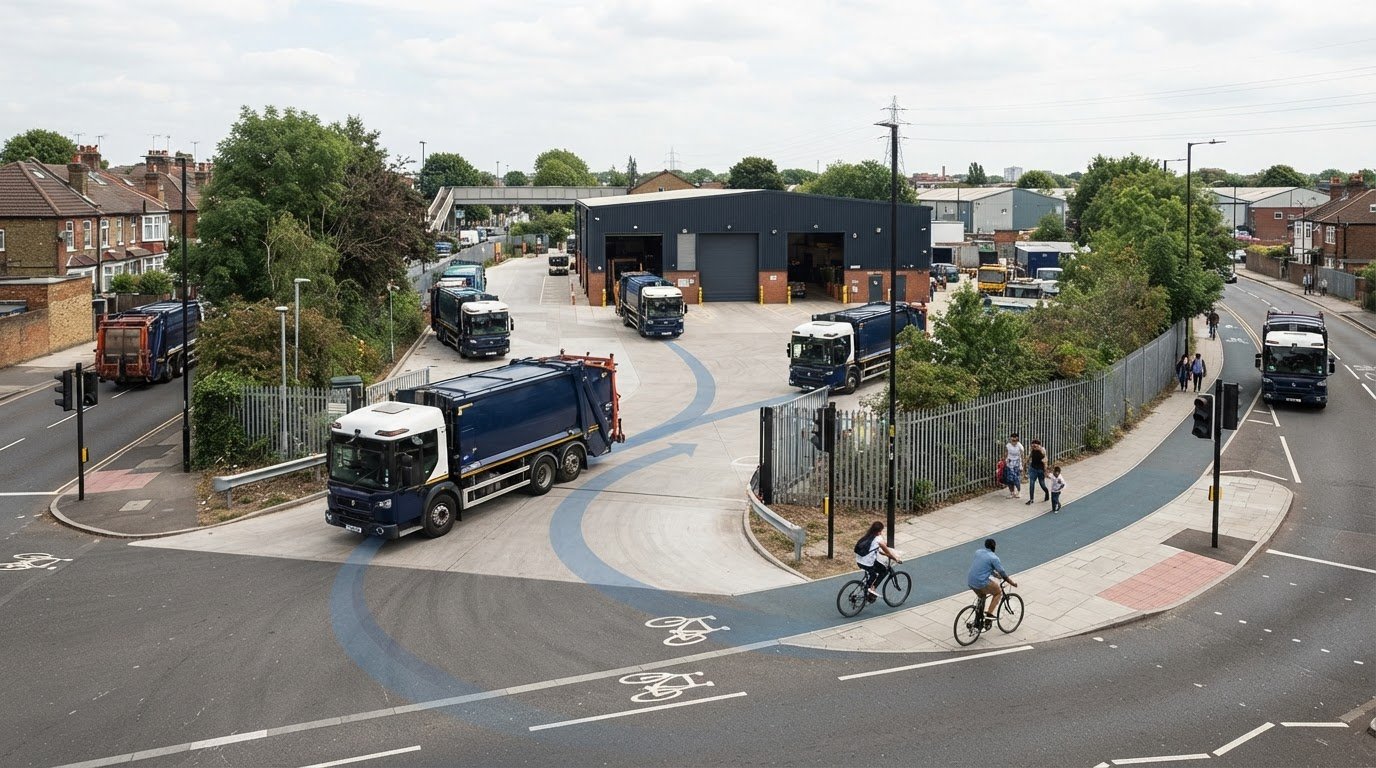
  • Transport Engineering Consultants London: Navigating Planning Approvals in 2026

    Transport Engineering Consultants London: Navigating Planning Approvals in 2026

    In 2026, London ranks as the sixth most congested city in the world, with drivers losing an average of 109 hours a year in rush-hour traffic. You likely feel the weight of these statistics every time you submit a planning application. Between the London Plan’s strict car-free mandates for areas with a PTAL of 4 or higher and the varying parking standards across individual boroughs, securing consent often feels like a moving target. Insufficient transport data or a poorly timed submission can lead to expensive delays that stall your project’s momentum.

    This guide demonstrates how expert transport engineering consultants london provide the technical precision required to navigate these regulatory hurdles and unlock your site’s maximum potential. We’ll show you how to transform logistical constraints into approved developments through accurate data and strategic planning. We’ll examine the role of professional Transport Assessments, Swept Path Analysis, and tailored Travel Plans in securing successful outcomes while keeping your mitigation strategies cost-effective.

    Key Takeaways

    • Understand how technical justification bridges architectural vision and statutory requirements in London’s high-density environment.
    • Learn how transport engineering consultants london determine whether your project requires a Transport Statement or a full Assessment to satisfy borough-specific structures.
    • Discover how Swept Path Analysis and Parking Surveys prove site layout viability and justify parking provisions on constrained city streets.
    • Master the complexities of PTAL ratings and borough standards to maintain high-density residential goals even in areas with lower accessibility scores.
    • Identify how precision-led reporting and rapid response capabilities help developers meet urgent planning deadlines and reduce regulatory pressure.

    Table of Contents

    The Strategic Role of Transport Engineering Consultants in London Planning

    Transport engineering serves as the technical bridge between an architectural concept and its operational reality on the highway network. In London, where traffic volumes in May 2026 reached 105% of pre-2020 levels, every new development faces intense scrutiny from local authorities. Professional transport engineering consultants london provide the evidence-based justification required to prove that a project won’t negatively affect local traffic flow, safety, or public transport efficiency. This technical rigor is essential for both minor residential schemes and major commercial hubs that must coexist within the city’s limited road space.

    Unlocking a site’s value in a city ranked the sixth most congested globally requires more than just good design. It demands a deep understanding of transportation planning principles and the specific constraints of the capital’s infrastructure. With Islington’s Local Plan aiming for 87% of journeys to be sustainable by 2041, the pressure to deliver high-density, car-free schemes is immense. Consultants translate these policy targets into viable site layouts by providing accurate data on vehicle movements and access requirements. This helps developers maximize their site’s density while remaining compliant with statutory requirements.

    When Do You Need a Transport Consultant?

    Many developers wait until they receive an objection from a Highway Officer before seeking professional help. This reactive approach often leads to expensive delays and redesign costs. You should engage a consultant at the earliest feasibility stage for triggers such as a change of use, the addition of new residential units, or significant commercial expansions. Early involvement identifies fundamental design flaws, such as inadequate access for service vehicles or non-compliant parking layouts, before they become built-in problems that are difficult to fix.

    Expert guidance is particularly valuable during pre-application discussions with London Boroughs and Transport for London (TfL). These meetings set the scope for all required technical work. Establishing a clear, data-backed strategy during these early talks reduces the risk of being asked for additional, costly surveys later in the process. It ensures that the project team understands the specific expectations of the highway authority from day one.

    The Impact on Planning Success Rates

    Professional credibility is a decisive factor when an application reaches a planning committee. Data-driven reports, such as Transport Statements and Assessments, provide the objective evidence needed to neutralize objections from statutory consultees. When a Highway Officer reviews a submission backed by precise technical analysis and current traffic data, the path to approval becomes significantly clearer. The goal is to present a project that feels like a low-risk addition to the existing network.

    High-quality reporting demonstrates a commitment to safety and regulatory excellence. This proactive stance builds trust with planning authorities and helps streamline the decision-making process. For sector-specific examples of how this technical authority applies to different developments, you can explore various ML Traffic Engineers project types. Ultimately, the right consultant provides a seamless transition from the planning stage to execution, ensuring your development is both viable and safe.

    Core Technical Deliverables: Transport Statements and Assessments

    Distinguishing between a Transport Statement and a Transport Assessment is the first step in any successful planning application. The scale of your development dictates which report is necessary. Smaller schemes often only require a Statement, while larger developments exceeding 80 residential units or 2,500sqm of commercial space usually trigger a full Assessment. Professional transport engineering consultants london ensure these reports align with the London Plan and individual borough requirements to prevent costly delays during the review process.

    Every report must be compliant with 2026 policy standards. This includes calculating the Public Transport Accessibility Level (PTAL) of the site and demonstrating how the project supports the Mayor’s target for 80% of all journeys to be made by walking, cycling, or public transport. For a deeper dive into the technical requirements, consult our Transport Assessment London Guide.

    Transport Statements for Small to Medium Developments

    A Transport Statement focuses on site-specific logistics such as access points, parking provision, and basic trip generation. These reports satisfy local borough requirements for minor applications by proving that the development’s impact on the immediate highway is negligible. We use localized data to justify parking ratios, especially in boroughs like Islington where car-free developments are mandated for schemes with a PTAL rating of 4 or higher. These documents provide the technical reassurance Highway Officers need to recommend approval for smaller sites.

    Comprehensive Transport Assessments for Major Sites

    Major developments require a more rigorous approach. A full Transport Assessment includes complex junction modelling and a wider network impact analysis. We utilize the TRICS database for accurate trip rate forecasting, ensuring that the predicted traffic volume is based on comparable, real-world sites. This data-driven precision is vital when negotiating mitigation measures with planning authorities.

    A critical outcome of these assessments is the identification of necessary infrastructure improvements. These often lead to S106 contributions or S278 agreements. In 2026, for example, Islington Council’s drawing approval fee for major S278 works valued over £1m is £6,380. Identifying these requirements early allows you to factor these costs into your initial feasibility studies. If you need clarity on your site’s specific requirements, you can explore our full range of technical services to see how we manage these complex deliverables.

    Transport Engineering Consultants London: Navigating Planning Approvals in 2026

    Ensuring Site Feasibility through Swept Path Analysis and Parking Surveys

    Feasibility is fundamentally about risk mitigation. Redesigning a site layout after you have submitted a planning application is a costly error that stalls project timelines. Expert transport engineering consultants london use digital modeling to prove that a development’s internal geometry works for real-world vehicles before a single brick is laid. By simulating vehicle movements during the design phase, we identify potential pinch points that would otherwise trigger objections from highway officers. This technical foresight ensures that your site layout is both operationally efficient and compliant with the rigorous standards set by the Chartered Institution of Highways & Transportation (CIHT).

    We utilize the latest industry software, such as AutoTURN 2026.12.1.0, to conduct Swept Path Analysis (SPA). This tool allows us to map the precise path of various vehicles as they navigate site entrances, turning heads, and loading bays. Relying on generic dimensions isn’t enough in London’s constrained urban environment. Precision is a functional necessity to ensure that your architectural vision doesn’t conflict with the physical requirements of the highway network.

    Swept Path Analysis: Fire Tenders to Refuse Vehicles

    Fire tender access is a non-negotiable safety requirement. If a fire engine cannot reach every part of a building within statutory distances, the application will fail. We perform detailed tracking to confirm that emergency vehicles can enter, turn, and exit the site without obstruction. Similarly, we use SPA to satisfy council waste management teams by proving that refuse vehicles can service the development safely. Demonstrating this capability early in the process protects your project from fundamental design flaws. For more details on these technical requirements, see our Swept Path Analysis Services in London.

    Parking Surveys: Navigating the Lambeth Methodology

    Parking provision is often the most contested element of a London planning application. When a developer proposes a car-free or car-capped scheme, they must prove that the development won’t increase "parking stress" on surrounding streets. We conduct Parking Surveys using the Lambeth Methodology, which is the industry standard for London stress tests. This process involves precise data collection during the peak period of residential parking demand, typically between 00:30 and 05:30 on two separate weekday nights.

    The resulting data provides a clear picture of the available capacity within a 200-meter walking distance of the site. In areas with high Controlled Parking Zone (CPZ) pressure, this evidence is vital. It allows transport engineering consultants london to justify lower parking ratios by showing that the local network can absorb any residual demand. Accurate survey data turns a subjective debate about parking into an objective, technical discussion, significantly increasing your chances of a successful outcome.

    The Public Transport Accessibility Level (PTAL) is the primary metric used by Transport for London (TfL) to quantify how well a site connects to the public transport network. For developers, this score is a non-negotiable determinant of a project’s density and parking capacity. In a city where traffic volumes reached 105% of 2020 levels by May 2026, transport engineering consultants london use these ratings to establish the technical boundaries of what can be built. While a high PTAL rating of 4 or above typically mandates car-free development under the London Plan, sites with lower scores require a more nuanced technical strategy to justify high-density residential use.

    A common objection developers face is the assumption that a low PTAL rating automatically limits development density. You can often overcome this hurdle by implementing a comprehensive Travel Plan. We use these documents to propose sustainable travel alternatives, such as improved cycling infrastructure or car-club memberships, which satisfy the "Healthy Streets" approach favored by planning officers. This allows you to maintain higher density targets by proving the development won’t create additional pressure on the local highway network.

    Understanding PTAL Ratings for Developers

    TfL calculates PTAL on a scale of 0 to 6b. This score depends on the walking distance to transport nodes and the frequency of services. These numbers directly dictate the maximum allowable parking spaces. For example, the London Plan mandates car-free developments for any scheme with a PTAL of 4 or higher in Inner London. If your site sits on the boundary of two different zones, we conduct a detailed assessment to ensure the most favorable rating is applied. We don’t just accept automated outputs; we verify the data against current service levels to ensure your site’s accessibility is represented accurately.

    Borough-Specific Planning Nuances

    Every London borough interprets the London Plan through its own Local Plan, creating a complex web of varying standards. Requirements in high-density areas like Westminster or Tower Hamlets are vastly different from those in Outer London boroughs. For specific insights into these regional challenges, consult our guide for Transport Planning Consultants Tower Hamlets. In these central locations, the focus shifts almost entirely to pedestrian safety and the management of delivery movements within constrained spaces.

    Experienced transport engineering consultants london act as your technical mediator during discussions with the Borough Highway Officer. We provide the professional credibility needed to navigate these intricate regional regulations so you don’t have to. By presenting clear, data-driven justifications for your site’s transport strategy, we reduce the likelihood of costly delays or planning refusals. If you’re preparing a submission for a challenging London site, our technical team is ready to provide the specialized support required for planning success.

    Choosing ML Traffic Engineers: Precision-Led Transport Solutions

    Selecting the right technical partner is the final step in de-risking your development. ML Traffic Engineers operates with a focus on technical accuracy and safety-conscious reporting, ensuring that every document survives the most rigorous highway authority audits. As transport engineering consultants london, we provide the technical authority needed to reduce regulatory pressure on your team. We manage the full project lifecycle from initial data collection through to final report submission. This all-encompassing service ensures consistency across your Traffic Surveys, Transport Assessments, and Travel Plans.

    Precision is a functional necessity in London’s high-stakes planning environment. We understand that planning deadlines are often unforgiving. Our firm maintains a constant sense of readiness and urgency to meet these demands. We combine an intimate knowledge of regional London regulations with a client-focused approach, positioning ourselves as a dependable partner rather than a simple service provider. We take pride in our adherence to industry benchmarks, ensuring that your submission is compliant with the latest legislative requirements from the outset.

    From Planning Approval to Section 278 Implementation

    Our support doesn’t end when you receive planning consent. The transition from a successful application to physical implementation requires detailed technical design and further statutory approvals. We support the post-planning phase by managing the highway design requirements for S278 and S38 agreements. These agreements are essential for any development that involves modifications to the existing public highway or the adoption of new roads. We provide the technical drawings and justification needed to secure these legal agreements efficiently. For a comprehensive look at this process, read our Highway Design S278 & S38 Guide.

    Contact Our London Transport Experts

    Successful planning outcomes rely on the quality of the data and the credibility of the consultant. Whether you’re managing a minor residential scheme or a major commercial hub, our team provides the specialized support required for 2026 approvals. We offer extensive coverage across London, High Wycombe, and Slough, bringing localized expertise to every project. Our commitment to formal excellence and professional integrity ensures that your development is viewed as a safe, viable addition to the city’s infrastructure.

    Don’t let logistical or regulatory hurdles stall your project’s progress. You can access our full suite of technical documents and industry guidance by visiting the ML Traffic Engineers resources page. If you require a project-specific quote or an initial access review, contact our experts today. We’re ready to provide the precision-led solutions your site needs to achieve planning success.

    Securing Your Site’s Future in London’s 2026 Planning Landscape

    Navigating the technical requirements of the London Plan and borough-specific mandates requires more than just high-level strategy. It demands the precision of data-driven reporting to ensure your site layout is viable and compliant. By integrating detailed Swept Path Analysis and comprehensive Parking Surveys early in the process, you eliminate the risk of late-stage redesigns and highway authority objections. These technical justifications don’t just support your application; they protect your investment from avoidable delays and ensure your project aligns with the city’s evolving infrastructure goals.

    ML Traffic Engineers provides the technical authority and expert knowledge of London Borough highway requirements needed to streamline your application. Our proven track record in securing planning consents for complex sites ensures your development moves efficiently from inception to execution. When you partner with transport engineering consultants london, you gain a reliable ally that understands the intricate regional regulations so you don’t have to. We’re ready to help you unlock your site’s full potential and move your project forward with certainty.

    Contact ML Traffic Engineers for a Professional Transport Quote today and ensure your project meets every regulatory benchmark with confidence.

    Frequently Asked Questions

    What is the difference between a Transport Statement and a Transport Assessment in London?

    The scale and potential impact of your development determine which document is required. A Transport Statement is typically sufficient for minor applications with lower trip generation, while a Transport Assessment is mandatory for major developments that require detailed junction modeling and wider network analysis. Expert transport engineering consultants london ensure the correct report is prepared to meet specific borough thresholds and avoid processing delays.

    How much does a parking survey cost for a London planning application?

    The cost of a parking survey depends on the size of the survey area and the specific methodology required by the local council. Factors such as the number of nights surveyed and the complexity of the street network influence the final fee. Developers should request a project-specific quote to ensure the survey meets the exact technical standards of the relevant London borough and provides the necessary data for approval.

    When is Swept Path Analysis legally required for a new development?

    Swept Path Analysis is required whenever a development needs to prove that specific vehicles can safely enter, maneuver within, and exit the site. This is most common for fire tender access and refuse collection, where highway officers require technical proof that these vehicles won’t be obstructed. It’s a non-negotiable safety requirement for most new site layouts in London and protects the project from fundamental design flaws.

    Can a Transport Consultant help me get a car-free development approved?

    Yes, a consultant justifies car-free schemes by providing data-driven evidence that the local network can support the development without private vehicle parking. This often involves using high PTAL ratings and a robust Travel Plan to demonstrate that residents have viable sustainable travel alternatives. This technical justification is essential for aligning with the Mayor’s Transport Strategy and borough-level sustainability targets.

    How does a high PTAL rating affect my parking provision?

    A high Public Transport Accessibility Level (PTAL) rating of 4 or above significantly reduces the maximum number of parking spaces allowed. In many Inner London boroughs, a high rating mandates a car-free development, with the exception of disabled person parking. Professional transport engineering consultants london use these ratings to establish the technical boundaries for parking density during the initial design phase to ensure policy compliance.

    What is the Lambeth Methodology for parking surveys?

    The Lambeth Methodology is the industry standard for measuring parking stress in London. It involves counting parked vehicles within a 200-meter walking distance of the site during the early morning hours, typically between 00:30 and 05:30. This data proves whether there’s sufficient on-street capacity to absorb any parking demand generated by the new development, which is vital in areas with high parking pressure.

    How long does it take to prepare a Transport Statement?

    Preparation time varies based on the availability of survey data and the complexity of the site access. Once all required Traffic Surveys and data collection are complete, the technical reporting phase usually takes between two to four weeks. Engaging a consultant early in the project lifecycle ensures that these timelines align with your planned submission dates and prevents urgent planning deadlines from being missed.

    Do I need a Travel Plan for a small residential development?

    While smaller developments often only require a Transport Statement, some boroughs may request a Travel Plan as a condition of approval. This is particularly common if the development is in an area with low transport accessibility or if the developer is seeking to mitigate potential traffic impacts. A Travel Plan outlines the long-term management strategy for encouraging sustainable travel among residents and is often a requirement for securing planning consent.

    Which areas in London do you cover?

    We service Acton, Balham, Barking, Barnes, Barnet, Battersea, Beckenham, Bexleyheath, Brentford, Brixton, Bromley, Camberwell, Carshalton, Charlton, Chelsea, Chiswick, Clapham, Coulsdon, Croydon, Crystal Palace, Dagenham, Dulwich, Ealing, Edgware, Eltham, Enfield, Finchley, Forest Gate, Fulham, Golders Green, Greenwich, Hackney, Hammersmith, Hampstead, Harrow, Hayes, Highgate, Hounslow, Ilford, Islington, Kensington, Kentish Town, Kingston upon Thames, Lewisham, Mitcham, Muswell Hill, New Malden, Notting Hill, Orpington, Peckham, Pinner, Purley, Putney, Richmond, Romford, Ruislip, Sidcup, Southall, Southgate, Streatham, Surbiton, Sutton, Tooting, Tottenham, Twickenham, Uxbridge, Walthamstow, Wembley, West Norwood, Wimbledon, Wood Green, Woolwich, Bethnal Green, Shoreditch, Canary Wharf, Deptford, Leyton, Palmers Green, Stanmore, Upminster, Chislehurst, Erith, Feltham.

    Which cities in England do you cover?

    We service London, Birmingham, Manchester, Liverpool, Sheffield, Leeds.

    Michael Lee

    Article by

    Michael Lee

    Transport planner with over 35 years' experience.

    Disclaimer

    The content on mltraffic.co.uk, including all technical articles, guides, and resources, is provided for general informational and educational purposes only. It is not intended to constitute professional advice in traffic engineering, transportation planning, development approvals, or any other technical or legal field.
    While ML Traffic Engineers makes every reasonable effort to ensure the accuracy, completeness, and timeliness of the information published, we do not provide any warranties or representations (express or implied) regarding its reliability, suitability, or availability for any particular purpose. Any reliance you place on the content is strictly at your own risk.
    In no event shall ML Traffic Engineers, its directors, employees, authors, or affiliates be liable for any direct, indirect, incidental, special, consequential, or punitive damages (including, without limitation, loss of profits, data, or business opportunities) arising out of or in connection with the use of, or inability to use, any information provided on this website.
    The articles and guides on this site are not a substitute for engaging a qualified, professional traffic engineer to assess your specific project requirements. For tailored advice, compliance assessments, or traffic engineering services, please contact a competent professional.
    This disclaimer may be updated from time to time without notice. By accessing or using this website, you agree to be bound by the most current version of this disclaimer.
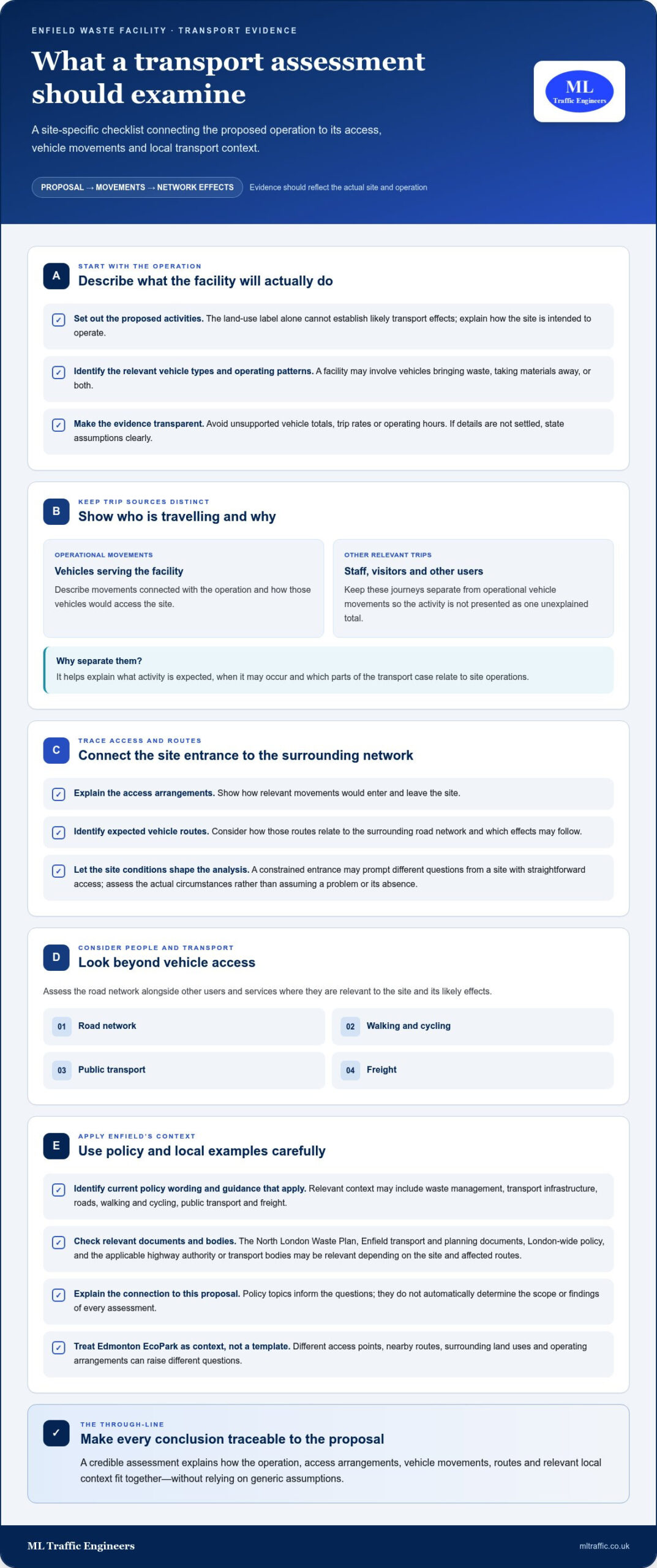
  • Common Transport Issues in Planning Applications: A 2026 Developer’s Guide

    Common Transport Issues in Planning Applications: A 2026 Developer’s Guide

    Data collection costs for transport assessments have surged by 15% since 2024, yet many developers still face costly delays due to unpredictable highway officer demands. You’ve likely experienced the frustration of a project stalling because of borough-specific parking stress requirements or technical disputes over site access. In the high-stakes regulatory environment of London and the Home Counties, technical precision is a functional necessity rather than a luxury. This guide identifies the most frequent common transport issues in planning applications and provides the technical strategies needed to resolve them effectively.

    We’ll examine the critical 2026 mandates, including the requirement for 100% active EV charging and the strict car-free rules for areas with a PTAL of 4 or higher. You’ll learn how to use professional parking surveys, swept path analysis, and robust transport statements to provide the validated data authorities require. By aligning your technical documentation with the latest NPPF standards and local borough expectations, you can transform transport objections into a clear path toward swift planning approval and cost-effective delivery.

    Key Takeaways

    • Master the shift toward ‘Vision and Validate’ policies to resolve common transport issues in planning applications and avoid summary refusal.
    • Utilize Swept Path Analysis to validate site access designs and prove manoeuvrability for service vehicles on constrained urban sites.
    • Identify how PTAL ratings of 4 or higher dictate your development’s density and the necessity of car-free mandates.
    • Build a defensible evidence base using TRICS forecasting and traffic surveys to satisfy the demand for rigorous technical data.
    • It’s vital to understand how Section 278 and Section 38 agreements turn technical highway objections into viable planning conditions.

    Table of Contents

    Why Transport Issues Delay Planning Applications in 2026

    The UK planning system underwent a fundamental shift in 2026, moving decisively from the traditional "Predict and Provide" model to a "Vision and Validate" approach. This change means local authorities no longer simply look at how much traffic a development will create and ask for more road space. Instead, they require developers to set a sustainable vision for travel and prove how it will be achieved. Failure to adapt to this methodology is one of the most common transport issues in planning applications today. When a project doesn’t align with these modern expectations, highway officers often recommend summary refusal based on inadequate site access, safety concerns, or a lack of sustainable infrastructure.

    Securing consent requires a deep understanding of the transportation planning process and how it integrates with local policy. Developers must distinguish between a Transport Statement for smaller schemes and a full Transport Assessment for residential developments of 80 units or more. Engaging with these requirements during the early RIBA stages prevents the need for expensive structural redesigns later in the project lifecycle. Technical documentation must be precise, data-driven, and ready to withstand rigorous scrutiny from statutory consultees.

    To better understand when to involve technical experts in your project, watch this helpful video:

    The Statutory Role of the Local Highway Authority

    In London and the Home Counties, the Local Highway Authority (LHA) acts as a critical guardian of public safety and network capacity. Highway officers possess the power to stall an application if they believe the "safety and capacity" of the existing road network is compromised. We recommend seeking pre-application advice to identify site-specific constraints before submitting formal plans. This proactive step allows us to tailor our Transport Statements and Assessments to address the LHA’s specific concerns regarding local junctions or pedestrian safety zones.

    NPPF vs. Local Plan: The Hierarchy of Objections

    The National Planning Policy Framework (NPPF) remains the primary guide for development in England. It states that development should only be prevented on transport grounds if the residual cumulative impacts on the road network would be "severe." However, local plans often impose stricter requirements. The 2026 London Plan, for instance, now mandates 100% active electric vehicle charging points for all permitted spaces and enforces car-free developments in areas with a Public Transport Access Level (PTAL) of 4 or higher. In the context of transport planning, sustainable development is defined as a project that prioritises active travel and public transport integration to meet current needs without increasing long-term car dependency. Adhering to these benchmarks is non-negotiable for securing planning approval in the current regulatory climate.

    Access and Manoeuvrability: The Swept Path Analysis Hurdle

    Urban infill developments face unique challenges, primarily regarding the physical constraints of existing streetscapes. Inadequate site access remains one of the most common transport issues in planning applications, often leading to technical objections that can stall a project indefinitely. To overcome these hurdles, developers must provide empirical evidence that vehicles can enter, turn, and exit the site safely. Swept Path Analysis (SPA) is the industry standard for providing this proof, using digital modelling to simulate the movement of specific vehicle templates within your site’s footprint.

    Precise SPA drawings prevent the risk of receiving an "undeliverable" planning consent. A permission that looks good on paper but fails to account for the turning circle of a refuse freighter will inevitably fail at the construction or operational stage. The UK government guidance emphasises the role of technical assessments in mitigating development impacts, but local authorities now demand high-resolution digital simulations over static, manual drawings. Our team provides the comprehensive technical reporting required to validate these designs before they reach the highway officer’s desk.

    Proving Fire Tender and Refuse Access

    By 2026, London Boroughs have largely phased out the acceptance of manual tracking diagrams. Emergency vehicle access is a non-negotiable safety requirement, specifically regarding the turning circles and weight tolerances for fire tenders. Refuse freighters also require significant space, and failure to prove their manoeuvrability often results in a recommendation for refusal. Utilising professional Swept Path Analysis Services in London ensures your site layout accounts for the 2026 standards for both emergency and service vehicle templates, including the increasingly common long-wheelbase delivery vans.

    Visibility Splays and Junction Design

    Visibility splays are the sightlines required for drivers to see and be seen when exiting a site. These are calculated based on safe stopping distances, which must be supported by local speed survey data. Street furniture, existing landscaping, and third-party land often obstruct these splays, creating significant planning friction. However, technical data can often justify narrower access points, particularly in heritage or sensitive areas. By using precise traffic surveys to document actual local speeds, we can often negotiate reduced visibility requirements that preserve the aesthetic character of a site without compromising safety standards. This data-led approach turns subjective objections into objective, manageable planning conditions.

    Common Transport Issues in Planning Applications: A 2026 Developer’s Guide

    The Public Transport Accessibility Level (PTAL) system serves as the primary metric for determining development density and allowable parking provision across London. Under the 2026 London Plan, sites with a PTAL rating of 4, 5, or 6 are strictly mandated as car-free developments. This policy aims to eliminate non-essential car trips, yet it creates significant friction during the planning process. Developers must still provide technical justification for essential vehicle access, specifically for Blue Badge holders and operational service requirements. Addressing these parking limitations is one of the most common transport issues in planning applications, as failing to provide a robust technical case can lead to immediate refusal.

    Baseline data for parking assessments has also shifted due to the expansion of the Ultra Low Emission Zone (ULEZ). Modern assessments must reflect updated car ownership patterns that have emerged since the ULEZ boundary was finalised. While a development may be car-free, the surrounding road network remains under pressure. We use precise Parking Surveys to document existing street capacity, ensuring that any residual parking demand from the development does not negatively impact local residents or highway safety.

    Parking Stress Surveys and the Lambeth Methodology

    London Boroughs frequently require a formal parking stress survey when a development proposes less parking than local residents might expect. We apply the Lambeth Methodology, which involves a detailed assessment of all available on-street parking within a 200-metre walking distance of the site. These assessments typically occur over two consecutive weekday nights to capture peak residential demand. Parking surveys must be conducted during neutral weeks to ensure the recorded data accurately represents typical local demand without the skewing effects of school holidays or major seasonal events.

    Active Travel and Cycle Storage Requirements

    To offset low parking provision, the 2026 standards require a significant commitment to active travel infrastructure. This includes meeting strict London Plan requirements for both long-stay and short-stay cycle parking, which must be secure, covered, and easily accessible. Since 2019, daily cycling stages in London have increased by 43%, making high-quality storage a functional necessity for site viability. We integrate ‘Healthy Streets’ indicators into our site access designs to prioritise pedestrian comfort and safety. Additionally, we provide comprehensive Travel Plans that outline clear strategies for reducing car dependency, turning potential transport objections into manageable planning conditions.

    Data-Driven Solutions: Surveys and Trip Generation

    Technical objections often stem from a lack of empirical evidence. Subjective concerns from local residents regarding congestion or safety can stall a project, but objective data provides a clear path forward. Establishing an accurate baseline through Manual and Automatic Traffic Counts (ATC) is essential for resolving common transport issues in planning applications. These surveys provide the raw data needed to prove that a development’s impact on the local highway network is manageable and within statutory limits. Precise data collection ensures that your submission is resilient against anecdotal complaints during the public consultation phase.

    Beyond baseline counts, we use speed surveys to determine the actual 85th percentile speeds of vehicles passing the site. This data is critical for calculating safe stopping distances and visibility splays accurately. When local objectors claim that a new development will "flood the streets with cars," professional technical reporting disproves these perceptions with hard numbers. By presenting a data-backed case, we shift the conversation from emotional speculation to technical reality, ensuring the highway officer has the facts required to recommend approval.

    Trip Generation: Forecasting Development Impact

    We forecast the future impact of a site by using the TRICS database, the UK standard for trip generation analysis. This process involves comparing your proposed project against similar, existing developments to predict vehicle movements with high precision. In sustainable urban locations, we successfully argue for ‘multi-modal’ trip reductions by demonstrating how residents will use public transport and cycling instead of private cars. You can find technical templates for these assessments in the ML Traffic Engineers Resources section. This evidence-based forecasting is vital for justifying your development’s scale to the local authority.

    Traffic Surveys in Slough and High Wycombe

    Requirements for traffic data vary significantly once you move outside central London into the Home Counties. In areas like Slough and High Wycombe, local authorities such as Buckinghamshire or Berkshire often demand specific survey durations or locations to satisfy Section 278 (S278) highway works. These works involve permanent changes to the public highway, and the design must be supported by rigorous local speed and volume data. We ensure all Traffic Surveys meet these specific regional standards to prevent delays during the technical approval stage. This regional expertise ensures your project remains compliant with diverse local policy requirements.

    Secure the data you need for a successful application by booking a professional Traffic Survey today to validate your site’s impact.

    Overcoming Objections with ML Traffic Engineers

    Resolving common transport issues in planning applications requires more than raw data collection. It demands a strategic approach to negotiation that transforms technical objections into manageable planning conditions. We bridge the gap between your development goals and the strict requirements of the Local Highway Authority. By providing integrated data collection and technical reporting, we ensure your submission is resilient and capable of withstanding rigorous scrutiny. This professional oversight reduces regulatory pressure and provides a clear path toward project completion.

    Our team manages the technical complexities of Section 278 (S278) and Section 38 (S38) agreements. These legal frameworks are essential when a development requires permanent alterations to the public highway or the adoption of new roads. We provide the precise technical documentation and design validation needed to satisfy highway officers in London and the Home Counties. This expertise ensures that highway works are both compliant with industry benchmarks and aligned with your project’s commercial objectives.

    From Survey to Planning Consent: A Full Lifecycle Service

    We provide a comprehensive service that supports your project from initial inception through to final approval. Our engineers coordinate directly with architects and planners to optimize site layouts for vehicle manoeuvrability and pedestrian safety. This early-stage collaboration prevents the need for expensive redesigns during the later RIBA stages. We possess extensive experience in negotiating with Transport for London (TfL) and local borough highway officers, allowing us to resolve technical disputes before they lead to refusal. Explore our ML Traffic Engineers Project Types to see how this lifecycle support has secured consent for diverse developments.

    Securing Your Planning Approval in 2026

    The 2026 property market operates with a sense of urgency that leaves no room for technical errors or slow response times. We prioritize rapid technical delivery to ensure your application remains on schedule. Our bespoke Transport Statements and Assessments are specifically tailored to the unique regulatory landscapes of London and the surrounding counties. Whether you require a validated parking survey or a complex swept path analysis, we deliver high-accuracy reporting that highway officers trust.

    Precision is a functional necessity in the current planning environment. We offer tailored quotes for our full range of services, including traffic surveys and travel plans, to meet your specific site constraints. Contact ML Traffic Engineers for expert planning support and ensure your development meets the highest standards of safety and compliance.

    Success in the 2026 planning landscape depends on your ability to replace subjective objections with empirical data. We’ve explored how the shift toward ‘Vision and Validate’ policies and the enforcement of car-free mandates in high PTAL areas have redefined project viability. Using digital Swept Path Analysis and accurate TRICS forecasting ensures your site access and trip generation data remain beyond reproach. By addressing these common transport issues in planning applications early, you prevent costly redesigns and keep your project timeline on track.

    ML Traffic Engineers provides the technical authority needed to navigate these regulatory pressures. We possess expert knowledge of all 32 London Boroughs and specialise in delivering high-resolution SPA drawings and robust Transport Statements. Our team has maintained a proven track record of securing planning approvals for developers since 2014. Don’t let technical hurdles stall your progress. Request a quote for your Transport Statement or Swept Path Analysis today to benefit from our precision-focused approach. We’re ready to help you turn technical objections into valid planning consents.

    Frequently Asked Questions

    What is the most common transport reason for planning refusal in London?

    Inadequate site access and safety concerns are the leading reasons for transport-related refusals in London. Local authorities prioritise the safety of road users and the operational capacity of the existing network. If your submission fails to prove that a refuse vehicle or fire tender can turn safely within the site footprint, the highway officer will likely recommend refusal. Professional technical reporting is required to resolve these common transport issues in planning applications before they reach the committee stage.

    Do I need a Transport Statement for a small residential development?

    Small residential developments usually require a Transport Statement rather than a full assessment. This document provides a concise overview of transport impacts for schemes that don’t meet the 80-unit threshold for a full Transport Assessment. It’s a critical tool for addressing local parking and access constraints early in the process. Even for minor schemes, a Statement provides the technical justification needed to satisfy highway officers in the Home Counties and London Boroughs.

    How does a PTAL rating affect my development’s parking allowance?

    A high PTAL rating of 4, 5, or 6 typically triggers a mandate for car-free development across London. This means no on-site parking is permitted except for Blue Badge holders and essential service vehicles. Conversely, lower PTAL ratings allow for limited parking provision based on the specific standards of the local borough’s plan. We use precise data to help developers navigate these density constraints while ensuring essential access remains functional and compliant.

    Is a Swept Path Analysis mandatory for all new site accesses?

    Swept Path Analysis is a functional necessity for almost all new site accesses in urban environments. While not explicitly mandatory for every single driveway, London boroughs and many Home Counties authorities won’t approve a layout without digital proof of vehicle manoeuvrability. It ensures that service and emergency vehicles don’t over-run kerbs or block the public highway. Providing this digital simulation is the most effective way to disprove technical objections regarding site safety.

    What is the difference between a Transport Statement and a Transport Assessment?

    The primary difference lies in the scale of the development and the depth of the data required. A Transport Statement is a simplified report for smaller schemes, whereas a Transport Assessment is a comprehensive study required for residential developments of 80 units or more. Assessments involve more complex junction modelling and wider network impact analysis. Both documents serve to identify and resolve common transport issues in planning applications by providing a clear evidence base for the council.

    How long is a traffic survey valid for a planning application?

    Traffic survey data is generally considered valid for three years, though many local authorities prefer data collected within the last 12 to 24 months. If significant development or road layout changes have occurred nearby, the council may request a fresh survey to reflect the current baseline. We ensure our traffic surveys meet these contemporary standards to prevent technical objections. Accurate, recent data is the foundation of a resilient planning submission.

    Can a Travel Plan reduce the amount of parking I am required to provide?

    A robust Travel Plan can often justify a reduction in mandatory parking provision by promoting sustainable travel modes. By outlining clear strategies for cycling, walking, and public transport use, you demonstrate a reduced reliance on private cars. This mitigation strategy is essential for meeting the sustainability targets of the 2026 London Plan. It shows the local authority that the development will actively manage its transport impact through long-term behavioral change.

    What is a Section 278 agreement and when do I need one?

    A Section 278 agreement is a legal contract between a developer and the Local Highway Authority for works on the public highway. You’ll need one if your planning consent requires permanent changes to existing roads, such as a new junction or a modified access point. These agreements ensure all works meet strict safety and construction standards. We provide the technical reporting and design validation needed to secure these agreements and move your project into the execution phase.

    Which areas do you cover?

    We service Acton, Balham, Barking, Barnes, Barnet, Battersea, Beckenham, Bexleyheath, Brentford, Brixton, Bromley, Camberwell, Carshalton, Charlton, Chelsea, Chiswick, Clapham, Coulsdon, Croydon, Crystal Palace, Dagenham, Dulwich, Ealing, Edgware, Eltham, Enfield, Finchley, Forest Gate, Fulham, Golders Green, Greenwich, Hackney, Hammersmith, Hampstead, Harrow, Hayes, Highgate, Hounslow, Ilford, Islington, Kensington, Kentish Town, Kingston upon Thames, Lewisham, Mitcham, Muswell Hill, New Malden, Notting Hill, Orpington, Peckham, Pinner, Purley, Putney, Richmond, Romford, Ruislip, Sidcup, Southall, Southgate, Streatham, Surbiton, Sutton, Tooting, Tottenham, Twickenham, Uxbridge, Walthamstow, Wembley, West Norwood, Wimbledon, Wood Green, Woolwich, Bethnal Green, Shoreditch, Canary Wharf, Deptford, Leyton, Palmers Green, Stanmore, Upminster, Chislehurst, Erith, Feltham.

    Which cities in England do you cover?

    We service London, Birmingham, Manchester, Liverpool, Sheffield, Leeds.

    Michael Lee

    Article by

    Michael Lee

    Transport planner with over 35 years' experience.

    Disclaimer

    The content on mltraffic.co.uk, including all technical articles, guides, and resources, is provided for general informational and educational purposes only. It is not intended to constitute professional advice in traffic engineering, transportation planning, development approvals, or any other technical or legal field.
    While ML Traffic Engineers makes every reasonable effort to ensure the accuracy, completeness, and timeliness of the information published, we do not provide any warranties or representations (express or implied) regarding its reliability, suitability, or availability for any particular purpose. Any reliance you place on the content is strictly at your own risk.
    In no event shall ML Traffic Engineers, its directors, employees, authors, or affiliates be liable for any direct, indirect, incidental, special, consequential, or punitive damages (including, without limitation, loss of profits, data, or business opportunities) arising out of or in connection with the use of, or inability to use, any information provided on this website.
    The articles and guides on this site are not a substitute for engaging a qualified, professional traffic engineer to assess your specific project requirements. For tailored advice, compliance assessments, or traffic engineering services, please contact a competent professional.
    This disclaimer may be updated from time to time without notice. By accessing or using this website, you agree to be bound by the most current version of this disclaimer.
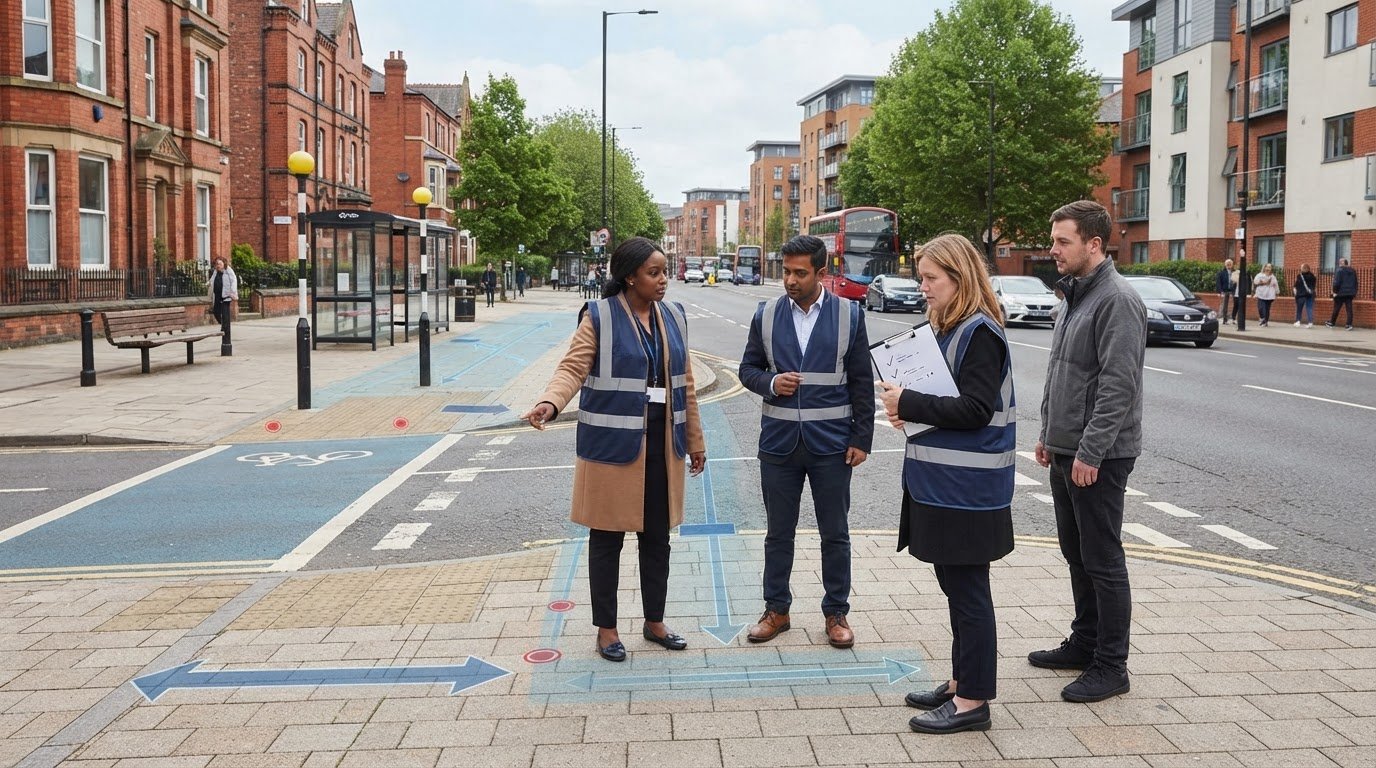
  • Transport Statement: The Developer’s 2026 Guide to Planning Approval

    Transport Statement: The Developer’s 2026 Guide to Planning Approval

    A rejected transport statement in London can trigger project delays of up to 16 weeks and cost over £5,000 in avoidable consultancy revisions. This is a high price for a technicality, yet many developers find themselves stalled by highway objections because they’ve misjudged the threshold between a Statement and a full Assessment. With the 2026 London Plan mandating car-free developments in high PTAL areas and the government considering major NPPF revisions, the margin for error has narrowed. Precision data is no longer optional; it’s the foundation of site viability.

    We understand that navigating local authority thresholds feels like hitting a moving target while planning application fees continue to rise. This guide provides a clear roadmap to mastering the technical requirements of your transport statement to secure planning permission and mitigate development risk. You’ll learn how to leverage technical reporting, including Swept Path Analysis and Parking Surveys, to ensure your project moves from inception to approval without the burden of Section 278 complications. We’ll outline the exact steps to deliver a compliant, cost-effective submission that satisfies even the most rigorous highway authorities.

    Key Takeaways

    • Understand how a professional transport statement acts as the technical bridge between site design and mandatory highway safety requirements.
    • Identify how PTAL scores and borough-specific standards in London dictate your reporting requirements and parking strategies.
    • Learn the sequential process of gathering traffic surveys and baseline data to validate site accessibility during the pre-application stage.
    • Discover how precision technical reporting, including Swept Path Analysis, prevents costly infrastructure redesigns during the construction phase.
    • Master the transition from initial assessment to final submission to eliminate highway objections and streamline your project’s path to approval.

    Table of Contents

    The Role of a Transport Statement in Modern Planning Applications

    A transport statement serves as the technical bridge between your site design and public highway safety. It’s more than a regulatory hurdle; it’s a strategic tool that translates architectural intent into a functional reality that local authorities can approve. By documenting how a development integrates with the existing network, this report proves that your project won’t compromise traffic flow or pedestrian safety. We focus on delivering precise data that justifies your site’s viability from the first submission.

    The National Planning Policy Framework (NPPF), last updated in February 2025, mandates these reports to ensure all developments promote sustainable travel. Effective transportation planning requires developers to identify and mitigate potential impacts on the road network before they become physical liabilities. Without this technical foundation, even well-designed projects face immediate objections from highway officers who prioritize network capacity and safety over developer timelines.

    To better understand how these reports function within the planning process, watch this helpful video:

    NPPF Compliance and Statutory Requirements

    As of May 2026, the February 2025 NPPF remains the officially adopted framework, despite a significant consultation on revisions that concluded in March 2026. These regulations utilize "significant movement" triggers to alert local planning authorities to potential traffic issues. Securing transport for planning permission requires a report that demonstrates alignment with these national standards for accessibility. We ensure your submission addresses current sustainable transport goals, reducing the risk of the council requesting additional, costly data during the determination phase.

    Transport Statement vs. Transport Assessment

    Choosing the correct report scale is a critical financial decision for any developer. A transport statement offers a "lighter touch" for smaller developments that don’t meet major impact thresholds, focusing on immediate site access and local safety. In contrast, if your project exceeds specific local triggers, such as generating over 30 two-way vehicle movements per hour, you’ll likely require a full Transport Assessment London. We recommend early pre-application liaison with highway officers to negotiate the scope of the report. This proactive approach prevents the highway authority from imposing restrictive pre-commencement conditions that could stall your construction schedule for months.

    Core Components of a Professional Technical Report

    A professional transport statement provides the empirical evidence required to validate a development’s feasibility. It moves beyond basic site descriptions to offer a rigorous audit of existing infrastructure, including pedestrian footways, cycle lanes, and public transport nodes. By following official UK government guidance, we ensure that every report addresses the specific safety and capacity concerns of the local highway authority. This technical precision is vital for moving a project from the design phase to planning approval without costly revisions.

    Modern reporting must now account for 2026 Net Zero targets and the latest London Plan mandates. For developments in the capital, this includes documenting how the site will support the 100% active electric vehicle charging point requirement for all permitted parking spaces. High-quality reporting ensures these technical benchmarks are integrated into the initial site design rather than being addressed as expensive retrofits. We prioritize accuracy in these early audits to protect your project from future regulatory friction.

    Baseline Traffic Data and Site Accessibility Audits

    Accurate measurement of existing traffic volume and pedestrian flow is the first step in any technical submission. We utilize advanced data collection techniques to evaluate how well a site connects to active travel networks and public transport hubs. This assessment determines the site’s inherent sustainability and identifies any gaps in the local infrastructure that your development might need to address. Baseline data establishes the definitive zero-impact threshold against which all new development traffic is measured. If you require precise data for your application, commissioning professional Traffic Surveys provides the necessary evidence to satisfy highway officers.

    Trip Generation and TRICS Database Analysis

    Predicting the volume of people traveling to and from a new site requires a specialized approach using the TRICS database. This industry-standard tool allows us to forecast vehicle movements based on comparable use classes across the UK. However, raw data is rarely enough for a successful application. We adjust trip rates for London-specific factors, including the impacts of the Ultra Low Emission Zone (ULEZ) and the Congestion Charge, which significantly alter travel behavior. Precision in trip generation prevents highway authority objections regarding junction capacity and ensures your transport statement remains robust under scrutiny.

    The final component of the report focuses on mitigation measures. If the data suggests a potential negative impact on the local network, we propose specific design changes or infrastructure improvements to offset these effects. This proactive problem-solving demonstrates to the planning committee that the development is both safe and sustainable. By addressing these technical requirements early, you reduce the risk of planning delays and secure a more predictable path to construction.

    Transport Statement: The Developer’s 2026 Guide to Planning Approval

    London’s planning environment demands a level of technical granularity that often exceeds standard national requirements. While the official government guidance on Transport Statements provides a baseline for development impact, London developers must navigate the specific mandates of the London Plan 2026. This includes aligning your submission with the Healthy Streets Approach and the Mayor’s Transport Strategy, which aims for 80% of all trips in the capital to be made by foot, cycle, or public transport by 2041. We ensure your report addresses these high-level policy goals to prevent friction with Transport for London (TfL) or local highway officers.

    The geographic location of your site significantly dictates the complexity of your technical reporting. For instance, Transport Planning Consultants Tower Hamlets face vastly different challenges than those operating in outer London boroughs like Havering or Hillingdon. In high-density areas, the focus shifts entirely from vehicle capacity to pedestrian comfort and "Vision Zero" safety standards. This initiative targets the elimination of all deaths and serious injuries from London’s transport network by 2041, meaning your transport statement must prove that new site access points don’t introduce fresh risks to vulnerable road users.

    The Role of PTAL Ratings in Transport Logic

    Public Transport Accessibility Level (PTAL) scores are the primary driver for parking policy in the capital. Under the 2026 London Plan, any development located in an area with a PTAL score of 4 or higher is mandated to be "car-free." We use PTAL data to justify reduced parking provisions, which can significantly lower your construction costs and maximize developable floor space. However, a car-free designation isn’t a shortcut; it necessitates the inclusion of comprehensive Travel Plans that outline how residents or employees will access the site via sustainable modes. High PTAL ratings allow us to argue against outdated minimum parking requirements that might otherwise stall an application.

    Borough-Specific Requirements: Lambeth vs. Westminster

    Each London borough maintains its own interpretation of highway safety and parking stress. If your project is in a borough like Lambeth, you’ll likely need to conduct parking surveys using the "Lambeth Methodology." This specific technical approach measures overnight parking stress within a 200-meter radius of the site to ensure that overspill parking doesn’t compromise local road safety. In contrast, Westminster may prioritize different metrics, such as servicing and delivery access in constrained urban cores. We recommend engaging in pre-application discussions with TfL for any project impacting the Strategic Road Network or involving more than 150 residential units. This proactive step ensures your technical reporting meets local expectations before the formal submission date.

    The Data-Driven Process: From Survey to Submission

    Securing planning approval requires a sequential, data-driven methodology that leaves no room for ambiguity. A professional transport statement isn’t just a descriptive document; it’s the technical output of a rigorous five-step process designed to eliminate highway objections. We manage full project lifecycles from initial inception through to post-submission negotiation, ensuring your development meets every regulatory benchmark. This structured approach protects your timeline and reduces the risk of expensive redesigns during the construction phase.

    The process begins with a comprehensive site assessment and pre-application liaison with the highway authority. We agree on the scope of work early to prevent "scope creep" or unexpected data requests later in the application. Once the scope is fixed, we commission technical data collection, including Traffic Surveys and parking data, to establish the baseline conditions of the local network. This evidence-based foundation is essential for justifying the site’s viability to the planning committee.

    Integrating Swept Path Analysis and Parking Surveys

    Modern urban developments face intense scrutiny regarding vehicle access and local parking stress. Utilizing professional Swept Path Analysis services is essential for proving that refuse and emergency vehicles can safely navigate your site. SPA software simulates vehicle manoeuvres to validate site layouts, ensuring that large vehicles don’t need to perform dangerous reversing movements onto the public highway. We pair this with technical parking survey data to satisfy council concerns about overspill on local streets, proving that your development won’t compromise the existing residents’ access.

    Mitigating Negative Impacts through Design

    When our analysis identifies potential network pressure, we propose design-led mitigation to offset these impacts. This involves integrating "soft" measures like high-capacity cycle storage and car club memberships to reduce private vehicle dependency. If your project requires physical modifications to the local road network, the report provides the technical justification for highway design S278 works. A strong "Summary and Conclusions" section is vital here; it acts as the final technical argument that sways the planning officer in your favor by demonstrating a safe, sustainable, and policy-compliant layout.

    Following the drafting and internal review against local policy, we handle the submission to the planning portal. Our role doesn’t end at submission; we actively manage post-submission negotiations with highway officers to resolve any final queries. If you need to secure your project’s future with a robust technical report, contact our expert team today to begin your initial site assessment.

    Why Expert Transport Consultancy is Vital for Project Success

    Relying on "in-house" reports or generic templates often leads to immediate highway objections. Professional traffic engineers carry significantly more weight with Local Planning Authorities (LPAs) because their technical conclusions are backed by rigorous data and professional indemnity. We ensure every transport statement we produce aligns with the specific regulatory expectations of the borough in question. This technical authority doesn’t just secure approval; it provides a defensive shield against unreasonable planning conditions that could inflate your project costs.

    Precision at the planning stage prevents catastrophic redesigns during construction. If a site layout is approved based on flawed access data, the subsequent discovery of maneuverability issues can halt a project entirely. We utilize advanced Swept Path Analysis and Traffic Surveys to ensure your design is functional from the outset. This foresight is especially valuable when negotiating Section 106 and S278 agreements, where we act as a proactive partner to ensure infrastructure contributions are fair and technically justified. We manage full project lifecycles from inception to completion, delivering the data-driven certainty London developers require.

    Preventing Planning Delays and Highway Objections

    Many developers face delays because they miss borough-specific quirks or fail to account for cumulative impact. Common mistakes in a transport statement include utilizing outdated TRICS data or ignoring local parking stress methodologies like the Lambeth or Hilson Moran standards. These errors lead to immediate refusal or costly requests for further information. We manage the full lifecycle of your technical submission, from initial Parking Surveys to the final report. Our team’s adherence to industry benchmarks ensures that every submission meets the highest standards of formal excellence, providing the reassurance you need in a high-stakes environment.

    Bespoke Solutions for Challenging Urban Sites

    London’s constrained geography requires more than just standard templates. Overcoming access issues on narrow streets in boroughs like Islington or Camden requires innovative design thinking and deep local knowledge. We leverage our understanding of London’s 32 boroughs and the City to deliver tailored solutions for even the most restricted sites. Whether you are managing a minor residential scheme or a major commercial development, our team provides the technical certainty required for success. We pride ourselves on precision and adherence to standards, acting as a vital partner in your development team.

    Don’t leave your planning approval to chance. Contact ML Traffic Engineers for a professional Transport Statement quote and secure the technical expertise your project deserves.

    Securing Your Project’s Approval Through Technical Precision

    A robust transport statement acts as the definitive safeguard against planning delays and highway objections. By integrating precision data from Swept Path Analysis and Lambeth Parking Surveys, you transform a regulatory requirement into a strategic asset for site viability. Our team has provided this technical certainty since 2014, leveraging over a decade of specialized London planning expertise to protect developer timelines. We manage the full project lifecycle, from initial traffic data collection to the final report submission, ensuring every detail meets the rigorous standards of your local highway authority.

    Technical accuracy in the early stages prevents expensive redesigns and Section 278 complications during construction. We understand the unique pressures of the London planning landscape and provide the bespoke reporting necessary to satisfy both TfL and borough-specific mandates. Don’t leave your site’s viability to chance. Get a Professional Transport Statement Quote for Your Project today and move forward with confidence. We are ready to deliver the data-driven results your development deserves.

    Frequently Asked Questions

    What is the difference between a Transport Statement and a Transport Assessment?

    A transport statement is a concise report designed for developments with limited traffic impact, whereas a Transport Assessment is a comprehensive study for major schemes. The choice depends on local authority thresholds, such as requirement for an Assessment when vehicle movements exceed 30 per hour or 100 per day. Statements focus on local safety and site access, while Assessments require detailed junction modeling and wider network analysis.

    How long does it take to produce a Transport Statement for a London project?

    Production typically takes between two and four weeks, largely dictated by the timeframe for technical data collection. Commissioning traffic surveys or parking stress tests requires several days of site observation during neutral periods. Once the raw data is secured, our engineers perform the technical analysis and drafting within seven to ten working days to ensure your submission meets the next available planning committee deadline.

    Do I need a parking survey to support my Transport Statement?

    You’ll require a parking survey if your development is located in a high-density area or if the local authority suspects existing parking stress. In London, boroughs often mandate the Lambeth Methodology to assess overnight street capacity within a 200-meter radius. These surveys provide the empirical evidence needed in your transport statement to prove that overspill parking won’t compromise local highway safety or residential amenity.

    Will a Transport Statement guarantee my planning permission?

    No technical report can guarantee permission, but a professional statement effectively removes highway-related objections, which are a primary cause of planning refusal. By demonstrating compliance with the NPPF and the London Plan 2026, the report proves your site is safe and accessible. This technical certainty allows planning officers to focus on other aspects of your application, significantly reducing the risk of a recommendation for refusal on transport grounds.

    How much does a professional Transport Statement cost in 2026?

    Costs for a professional report are determined by the complexity of the development and the specific surveys required by the local authority. Factors such as the need for Swept Path Analysis or multi-day traffic counts influence the final technical fee. We recommend requesting a bespoke quote to ensure your budget accounts for all necessary data collection without paying for redundant analysis that the council hasn’t requested during pre-application discussions.

    Can I write my own Transport Statement for a small development?

    While you can technically draft your own report, it’s a high-risk strategy that often leads to immediate rejection by the highway authority. Professional reports require specialized technical analysis and access to industry-standard databases like TRICS. Without professional indemnity and technical accreditation, your submission may lack the necessary weight to overturn officer concerns, potentially leading to project delays of 12 to 16 weeks and expensive revisions.

    What happens if the Highway Authority objects to my Transport Statement?

    If an objection is raised, we enter a formal negotiation phase with the highway officer to address their specific concerns. This often involves refining the site layout through Swept Path Analysis or proposing additional mitigation measures like cycle infrastructure. Our proactive approach aims to resolve these technical disputes quickly, preventing the council from imposing restrictive pre-commencement conditions that could stall your construction start date or increase your Section 278 costs.

    Is a Travel Plan always required alongside a Transport Statement?

    A Travel Plan isn’t always mandatory for every small scheme, but local authorities increasingly request them to support sustainable travel goals. In London, high PTAL areas almost always require a Travel Plan to justify car-free or car-lite development models. These plans outline the "soft" measures, such as car club memberships or cycle vouchers, that will be implemented to reduce the development’s overall vehicle dependency and long-term environmental impact.

    Which areas do you cover?

    We service Acton, Balham, Barking, Barnes, Barnet, Battersea, Beckenham, Bexleyheath, Brentford, Brixton, Bromley, Camberwell, Carshalton, Charlton, Chelsea, Chiswick, Clapham, Coulsdon, Croydon, Crystal Palace, Dagenham, Dulwich, Ealing, Edgware, Eltham, Enfield, Finchley, Forest Gate, Fulham, Golders Green, Greenwich, Hackney, Hammersmith, Hampstead, Harrow, Hayes, Highgate, Hounslow, Ilford, Islington, Kensington, Kentish Town, Kingston upon Thames, Lewisham, Mitcham, Muswell Hill, New Malden, Notting Hill, Orpington, Peckham, Pinner, Purley, Putney, Richmond, Romford, Ruislip, Sidcup, Southall, Southgate, Streatham, Surbiton, Sutton, Tooting, Tottenham, Twickenham, Uxbridge, Walthamstow, Wembley, West Norwood, Wimbledon, Wood Green, Woolwich, Bethnal Green, Shoreditch, Canary Wharf, Deptford, Leyton, Palmers Green, Stanmore, Upminster, Chislehurst, Erith, Feltham.

    Which cities in England do you cover?

    We service Birmingham, Leeds, Liverpool and Manchester.

    Michael Lee

    Article by

    Michael Lee

    Transport planner with over 35 years' experience.

    Disclaimer

    The content on mltraffic.co.uk, including all technical articles, guides, and resources, is provided for general informational and educational purposes only. It is not intended to constitute professional advice in traffic engineering, transportation planning, development approvals, or any other technical or legal field.
    While ML Traffic Engineers makes every reasonable effort to ensure the accuracy, completeness, and timeliness of the information published, we do not provide any warranties or representations (express or implied) regarding its reliability, suitability, or availability for any particular purpose. Any reliance you place on the content is strictly at your own risk.
    In no event shall ML Traffic Engineers, its directors, employees, authors, or affiliates be liable for any direct, indirect, incidental, special, consequential, or punitive damages (including, without limitation, loss of profits, data, or business opportunities) arising out of or in connection with the use of, or inability to use, any information provided on this website.
    The articles and guides on this site are not a substitute for engaging a qualified, professional traffic engineer to assess your specific project requirements. For tailored advice, compliance assessments, or traffic engineering services, please contact a competent professional.
    This disclaimer may be updated from time to time without notice. By accessing or using this website, you agree to be bound by the most current version of this disclaimer.
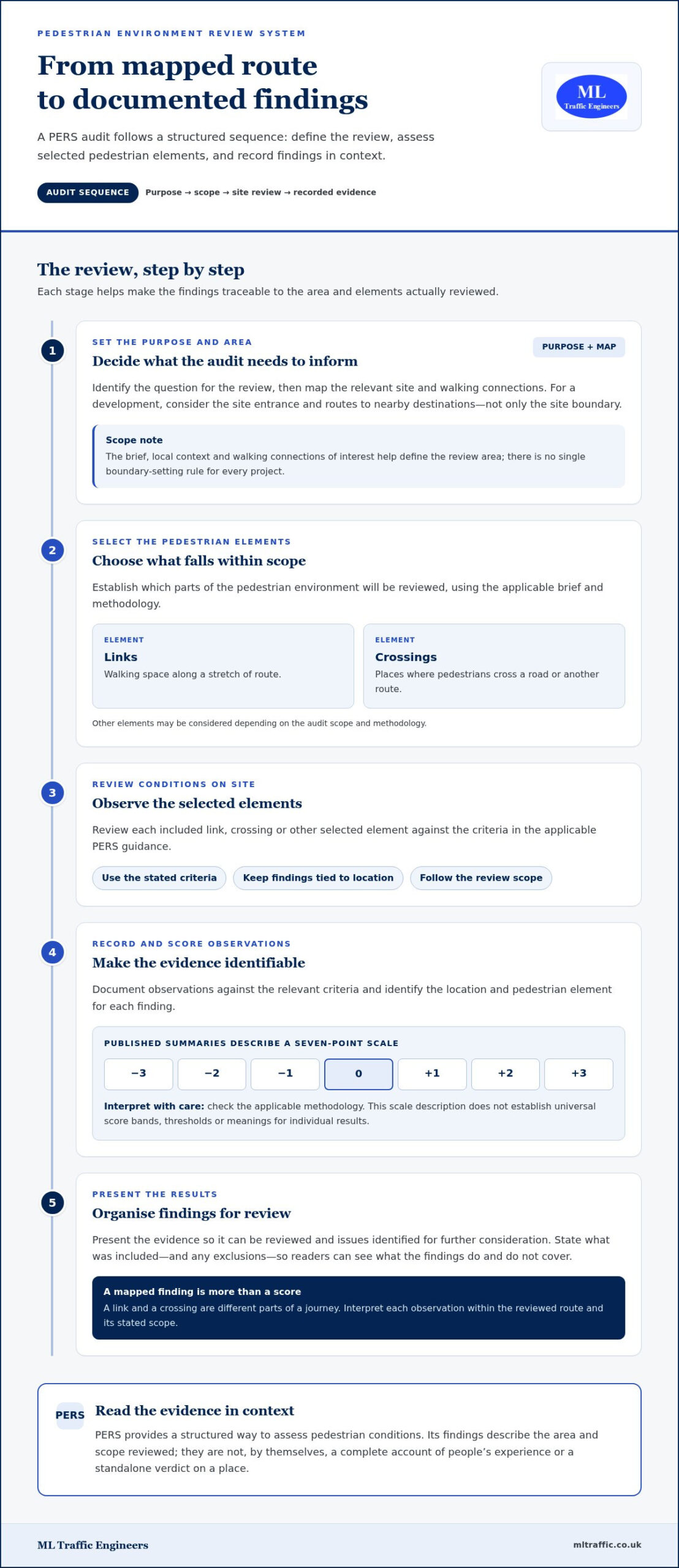
  • Transport Planning Consultants Barking and Dagenham: The 2026 Developer’s Guide

    Transport Planning Consultants Barking and Dagenham: The 2026 Developer’s Guide

    With the Barking and Dagenham 2037 Local Plan targeting the delivery of over 40,000 new homes, the pressure on the borough’s infrastructure has reached a critical point. Developers often find that securing approval hinges on how they address heavy congestion on the A13 and A124, which is why engaging expert Transport Planning Consultants Barking and Dagenham is now a functional necessity for any major project. You likely recognize that meeting the stringent sustainability criteria set by Be First and the council remains the most significant hurdle to breaking ground in high-density regeneration zones.

    This guide provides the technical clarity you need to navigate these complex regulations; it ensures your transport reports satisfy both LBBD and TfL requirements for rapid project approval. We will examine the indexed 2026 CIL rates, explain the “car-lite” expectations of the recently updated Housing Strategy, and outline how technical documents like Swept Path Analysis and Parking Surveys can de-risk your application. From initial Traffic Surveys to comprehensive Transport Assessments and Travel Plans, we provide the precision required to move your development from inception to completion without regulatory delay.

    Key Takeaways

    • Understand the evolving relationship between LBBD and Be First London to align your project with regional infrastructure and growth targets.
    • Identify when your development requires specialized reports from expert Transport Planning Consultants Barking and Dagenham to ensure a compliant and smooth submission process.
    • Learn how to utilize Swept Path Analysis and Parking Surveys to overcome site access constraints and satisfy strict fire safety and refuse collection standards.
    • Discover strategic methods for mitigating traffic impact on the A13 and A124 corridors while maintaining required air quality and sustainability benchmarks.
    • Gain insight into how technical precision in Transport Assessments and Travel Plans reduces the risk of planning objections and accelerates project approval.

    Barking and Dagenham has transformed into a primary engine for London’s housing growth. The 2037 Local Plan, formally adopted on September 18, 2024, outlines an ambitious target of 40,000 new homes and 20,000 jobs. This rapid expansion places significant strain on the existing highway network, particularly along the A13 and A12 corridors. Developers must navigate a complex regulatory environment managed by Be First London, the council’s dedicated regeneration arm. Be First oversees the borough’s transport infrastructure with a clear mandate to achieve a 75% sustainable transport mode share.

    To secure approval, your project must integrate seamlessly with these strategic goals. Professional Transport Planning Consultants Barking and Dagenham provide the technical authority needed to satisfy LBBD and TfL requirements. We specialize in translating high-level policy into site-specific solutions that mitigate congestion and ensure safety. Our team manages the full project lifecycle, from initial site assessment to final planning submission, ensuring every technical report meets the borough’s rigorous standards.

    To better understand the community focus in the borough, watch this helpful video:

    The Impact of the Barking Riverside Development

    Barking Riverside remains one of the largest regeneration projects in Europe. Its development significantly alters the local highway baseline. When we prepare assessments for smaller sites, we must evaluate the cumulative impact of these major works on local junctions. Increased reliance on the East London Transit system means developers must prove their sites support public transport accessibility. You can view our work on various residential development projects to see how we manage these interactions. We ensure your site remains functional even as the surrounding area densifies.

    Transport Policy in the Thames Road Regeneration Area

    The Thames Road area represents a challenging industrial transition zone. The council’s Factory District vision seeks to maintain industrial capacity while introducing residential units. This requires a sophisticated approach to transport planning. We must balance the logistical needs of heavy goods vehicles with the safety of new residents. Our technical reports focus on clear segregation and robust mitigation strategies. We ensure mixed-use sites remain viable and safe for all users, adhering to the specific transport ambitions of the Thames Road framework.

    Essential Transport Reports for LBBD Planning Applications

    Planning applications in the London Borough of Barking and Dagenham (LBBD) require specific technical documentation to demonstrate that a project won’t compromise road safety or network efficiency. The level of detail depends entirely on the scale and location of your proposal. Experienced Transport Planning Consultants Barking and Dagenham identify the correct reporting path early, preventing costly delays during the validation stage. We align every document with the London Plan 2021/2026 standards, ensuring your project meets the borough’s sustainability and “car-lite” targets. Be First London maintains a high bar for technical accuracy, meaning your submission must be robust from day one.

    Early engagement with the Highways Authority and Be First is essential. It establishes the scope of work and identifies potential objections before the formal submission. Barking and Dagenham council frequently requires a full Travel Plan for developments that exceed specific trip generation thresholds. These plans act as a long-term strategy to reduce private car use, which is vital for sites near the congested A13 corridor. Our team manages the entire process, providing the technical authority needed to secure Highways Authority support and reduce the regulatory pressure on your team.

    Transport Statements for Smaller Developments

    Small developments, such as residential conversions or minor commercial units, typically require a Transport Statement. This report focuses on trip generation, parking provision, and local site access. We analyze how the proposal affects the immediate street scene and ensure parking levels comply with the latest LBBD standards. These reports usually include:

    • Detailed analysis of existing transport conditions and local infrastructure
    • Forecasted trip generation for the proposed use
    • Evidence of safe and efficient pedestrian and vehicle access

    You can review our technical capabilities in our full service overview to understand how we tailor these reports for smaller sites. We ensure that even minor applications receive the precision required for a successful outcome.

    Comprehensive Transport Assessments for Major Schemes

    Major schemes within the Barking Town Centre growth zone or the Thames Road area demand a comprehensive Transport Assessment. These reports involve detailed modelling of junction capacity at key Dagenham intersections to prove the local network can handle the additional load. We utilize TRICS data for accurate trip forecasting, providing a data-driven foundation for your application. This level of precision is non-negotiable for high-density projects where site access and local congestion are primary concerns for planning officers. Our assessments provide the reassurance needed to mitigate concerns regarding the cumulative impact of large-scale regeneration. To ensure your major application is technically sound, you should consult with our engineering team before finalizing your site layout.

    Transport Planning Consultants Barking and Dagenham: The 2026 Developer’s Guide

    Specialized Analysis: Swept Path and Parking in Barking

    High-density regeneration in Barking Town Centre and the Thames Road industrial transition zone leaves no margin for error in site layout design. Developers often face significant pushback if their plans don’t demonstrate clear, safe access for emergency and service vehicles. Engaging expert Transport Planning Consultants Barking and Dagenham ensures that these technical requirements are integrated into your site plan from the earliest stages. We provide the specialized analysis needed to satisfy the London Borough of Barking and Dagenham’s strict safety and sustainability standards, reducing the risk of costly design revisions during the planning process.

    Our approach balances technical authority with a thorough understanding of local constraints. We recognize that Barking and Dagenham council prioritizes “car-lite” developments to meet the 75% sustainable transport mode share target. However, achieving this requires robust data to justify reduced parking ratios or complex site access. We manage the full project lifecycle, providing the technical reports that bridge the gap between ambitious architectural design and functional highway safety.

    Swept Path Analysis for Fire and Refuse Access

    Demonstrating vehicle manoeuvrability is a non-negotiable requirement for any LBBD planning application. We utilize industry-standard software to model the movements of 11.4m refuse vehicles and fire tenders, ensuring they can navigate tight Dagenham cul-de-sacs or complex internal courtyards. This technical precision prevents the Highways Authority from objecting on the grounds of restricted access. Our Swept Path Analysis services provide the visual evidence needed to prove your site is safe and operational for all essential services. We identify potential “pinch points” early, allowing for minor design adjustments that save thousands in later structural changes.

    Parking Surveys and PTAL Ratings in Barking

    Parking remain a contentious issue in high-density regeneration zones. We conduct overnight parking stress surveys using the Lambeth Methodology to provide a clear picture of local street capacity in residential Dagenham. This data is vital when justifying parking ratios in areas with low Public Transport Accessibility Level (PTAL) scores. In Barking Town Centre, where the council encourages car-free living, we use Traffic Surveys to demonstrate that your proposal won’t result in overspill parking on neighboring streets. We don’t just present data; we build a technical case that supports your development’s density while respecting the borough’s long-term sustainability goals. This strategic approach has proven successful in overcoming parking-related objections for various residential and mixed-use schemes across the borough.

    Overcoming Common Transport Planning Hurdles in the Borough

    Securing planning permission often feels like a balancing act between ambitious development goals and the physical constraints of the local road network. As experienced Transport Planning Consultants Barking and Dagenham, we frequently mitigate objections related to congestion on the A13 and A124. These corridors are critical to the borough’s economy but remain highly sensitive to additional traffic load. We don’t just identify these issues; we provide the technical solutions needed to satisfy Be First London and the Highways Authority. Our role involves demonstrating that your project won’t exacerbate existing delays, often through sophisticated Traffic Surveys and capacity modelling.

    Be First London operates with a clear mandate for “Good Growth,” which means every new development must contribute to the borough’s environmental resilience. Air quality is a primary concern in regeneration zones like Dagenham Heathway. We help you navigate these requirements by integrating sustainable transport measures that reduce tailpipe emissions. This proactive approach reduces the regulatory pressure on your team and ensures your application aligns with the “It Starts Here: Partnerships for Change” strategic plan agreed upon in February 2026. We manage the technical negotiations so you can focus on the construction phase.

    Negotiating Section 278 (s278) Agreements

    Major developments often require highway improvements outside the site boundary, such as new junctions or pedestrian crossings. These works fall under Section 278 agreements. We provide the technical precision required for LBBD highway adoption, ensuring designs meet all safety and engineering standards. This process requires a deep understanding of local authority preferences to avoid protracted negotiation periods. You can find detailed technical requirements in our Highway Design S278 guide. We ensure these agreements are cost-effective and technically sound from the outset.

    Sustainable Transport and Travel Plans

    The borough’s goal for 75% of trips to be taken by sustainable modes by 2037 makes Active Travel a cornerstone of any application. We specialize in securing approval for car-free or car-capped developments by creating robust Travel Plans that encourage cycling and walking. These plans aren’t just paperwork; they’re functional strategies that include electric vehicle (EV) charging infrastructure and improved pedestrian connectivity. Our technical authority allows us to justify reduced parking ratios even in areas with lower PTAL scores. To ensure your site layout supports these sustainability targets, contact us for a technical assessment of your current plans.

    Why ML Traffic Engineers is Your Strategic Partner in Barking and Dagenham

    Securing planning approval in a high-growth borough requires more than just standard documentation. ML Traffic Engineers serves as the premier choice for Transport Planning Consultants Barking and Dagenham by providing the technical authority needed to navigate Be First’s rigorous approval processes. We understand that the success of your development depends on technical reports that leave no room for ambiguity. Our team focuses on precision and adherence to industry benchmarks, ensuring that every submission reduces the logistical and regulatory pressures on your project team. We don’t just provide data; we deliver a clear path to approval.

    Our firm takes pride in its role as a dependable expert that understands intricate regional regulations. We manage the full project lifecycle from initial feasibility to final execution, allowing you to focus on the broader aspects of your development. This comprehensive support is a hallmark of our brand promise. We view ourselves as a vital partner in the borough’s growth, ensuring that new infrastructure remains safe and functional for the community. Whether you’re working on a high-density scheme in Barking Town Centre or a mixed-use project in Dagenham East, we provide the technical reliability you need to succeed.

    Technical precision is a functional necessity in the current planning environment. We’ve built a proven track record by simplifying complex transport data into actionable insights for planning officers. Our experts are ready to support projects of all scales, from small residential conversions to large-scale regeneration at Barking Riverside. We maintain a constant state of readiness to address the fast-moving and often unpredictable nature of the planning process, providing reassurance through unwavering reliability and professional integrity.

    Comprehensive Transport Planning Services

    We offer a full suite of services designed to meet the specific requirements of the London Borough of Barking and Dagenham. Our team specializes in producing high-quality technical documents that satisfy both local and regional authorities. You can explore the full scope of what we do to see how our expertise aligns with your project goals. Our core offerings include:

    • Detailed Transport Statements and comprehensive Transport Assessments
    • Precision Swept Path Analysis for emergency and refuse vehicle access
    • Accurate Parking Surveys and Traffic Surveys to justify site density
    • Robust Travel Plans that support the borough’s sustainability targets

    We prioritize clarity and the rapid delivery of information, ensuring your project stays on schedule. Our technical lexicon is paired with a client-focused approach that makes complex regulations easy to manage.

    Contact Us for a Barking and Dagenham Project Quote

    Ready to move your development forward? You can gain direct access to senior transport consultants who understand the specific challenges of the Dagenham and Barking landscape. We provide tailored advice for your specific site, ensuring that your transport strategy is both cost-effective and technically sound. Don’t let regulatory hurdles delay your progress. Get started with ML Traffic Engineers today to receive a comprehensive quote and secure the technical authority your project deserves.

    Securing Your Development’s Future in Barking and Dagenham

    Success in the borough’s high-stakes regeneration zones depends on a technical strategy that aligns with the 2037 Local Plan. You’ve identified that meeting the 75% sustainable transport mode target requires more than just standard documentation; it demands precision. By prioritizing robust Swept Path Analysis and data-driven Parking Surveys, you effectively de-risk your application against Highways Authority objections. Technical authority is the primary tool for navigating the intricate requirements set by Be First and LBBD planning officers.

    ML Traffic Engineers serves as a dependable partner with a proven track record of managing project lifecycles from inception to completion. Founded in 2014, we are specialists in London-wide planning approvals who understand how to translate complex transport data into successful outcomes. Engaging the right Transport Planning Consultants Barking and Dagenham ensures your project meets every industry benchmark and legislative requirement without unnecessary delay. We maintain a constant state of readiness to support your development goals across the region.

    Contact ML Traffic Engineers for expert transport planning in Barking and Dagenham to receive tailored support for your next submission. We look forward to helping you achieve a rapid and successful planning approval.

    Frequently Asked Questions

    Do I need a Transport Statement or a Transport Assessment for my Barking project?

    Small-scale projects like residential conversions or minor commercial units usually require a Transport Statement, while major developments necessitate a full Transport Assessment. The document type depends on the trip generation thresholds defined by Be First London. Expert Transport Planning Consultants Barking and Dagenham identify the correct reporting path during the initial site feasibility stage to avoid validation delays at the council.

    What are the specific parking standards for new developments in Barking and Dagenham?

    New developments in high-density regeneration zones are expected to be “car-free” or “car-lite” under the Barking and Dagenham 2037 Local Plan. Policies DMT2 and DMT3 mandate reduced parking ratios to support the borough’s target of 75% sustainable transport mode share. Developers must justify any parking provision through detailed technical reports that reflect the specific accessibility of the site.

    How does Be First London influence the transport planning process?

    Be First London acts as the council’s dedicated regeneration arm and manages the borough’s transport infrastructure strategy. They set the technical standards for all planning submissions and review every report for compliance with the Local Plan. Their primary focus is ensuring that new developments integrate seamlessly with existing public transport and active travel networks to support regional growth.

    What is a Lambeth Methodology parking survey and do I need one?

    The Lambeth Methodology is the industry standard for conducting overnight parking surveys to measure local street capacity. You need this specialized survey if your project proposes limited on-site parking in a residential area. It provides the data-driven evidence required to prove to planning officers that your development won’t create unacceptable parking stress on surrounding streets.

    How much does a transport planning consultant cost for a London application?

    The cost of transport planning services depends on the scale of the development and the complexity of the required technical analysis. Every site has unique constraints, such as proximity to the A13 or specific access requirements, that influence the scope of work. Developers should request a tailored quote from Transport Planning Consultants Barking and Dagenham to get an accurate estimate for their specific application.

    Can a Travel Plan help me get planning permission in a low PTAL area?

    A Travel Plan is a vital tool for securing permission in areas with lower Public Transport Accessibility Level (PTAL) scores by promoting alternative transport modes. It outlines long-term strategies like cycle storage and car clubs to reduce private vehicle dependency. This proactive approach helps satisfy council requirements for sustainable growth even when existing public transport links are limited.

    How long does it take to complete a Swept Path Analysis for a Dagenham site?

    The time required to complete a Swept Path Analysis depends on the number of site access points and the variety of vehicle types being modeled. We typically model 11.4m refuse vehicles and fire tenders to ensure safe maneuvering within the site layout. Providing accurate CAD site plans early in the process helps our technical team expedite the modeling and reporting phase.

    What is the role of TfL in Barking and Dagenham transport planning?

    Transport for London (TfL) reviews applications that impact the Strategic Road Network, such as the A13 and A12, or the borough’s bus and rail infrastructure. They act as a statutory consultee to ensure new developments align with the Mayor’s Transport Strategy. Early collaboration between developers and TfL is essential for the successful delivery of major regeneration schemes in the borough.

    Michael Lee

    Article by

    Michael Lee

    Transport planner with over 35 years' experience.

    Disclaimer

    The content on mltraffic.co.uk, including all technical articles, guides, and resources, is provided for general informational and educational purposes only. It is not intended to constitute professional advice in traffic engineering, transportation planning, development approvals, or any other technical or legal field.
    While ML Traffic Engineers makes every reasonable effort to ensure the accuracy, completeness, and timeliness of the information published, we do not provide any warranties or representations (express or implied) regarding its reliability, suitability, or availability for any particular purpose. Any reliance you place on the content is strictly at your own risk.
    In no event shall ML Traffic Engineers, its directors, employees, authors, or affiliates be liable for any direct, indirect, incidental, special, consequential, or punitive damages (including, without limitation, loss of profits, data, or business opportunities) arising out of or in connection with the use of, or inability to use, any information provided on this website.
    The articles and guides on this site are not a substitute for engaging a qualified, professional traffic engineer to assess your specific project requirements. For tailored advice, compliance assessments, or traffic engineering services, please contact a competent professional.
    This disclaimer may be updated from time to time without notice. By accessing or using this website, you agree to be bound by the most current version of this disclaimer.
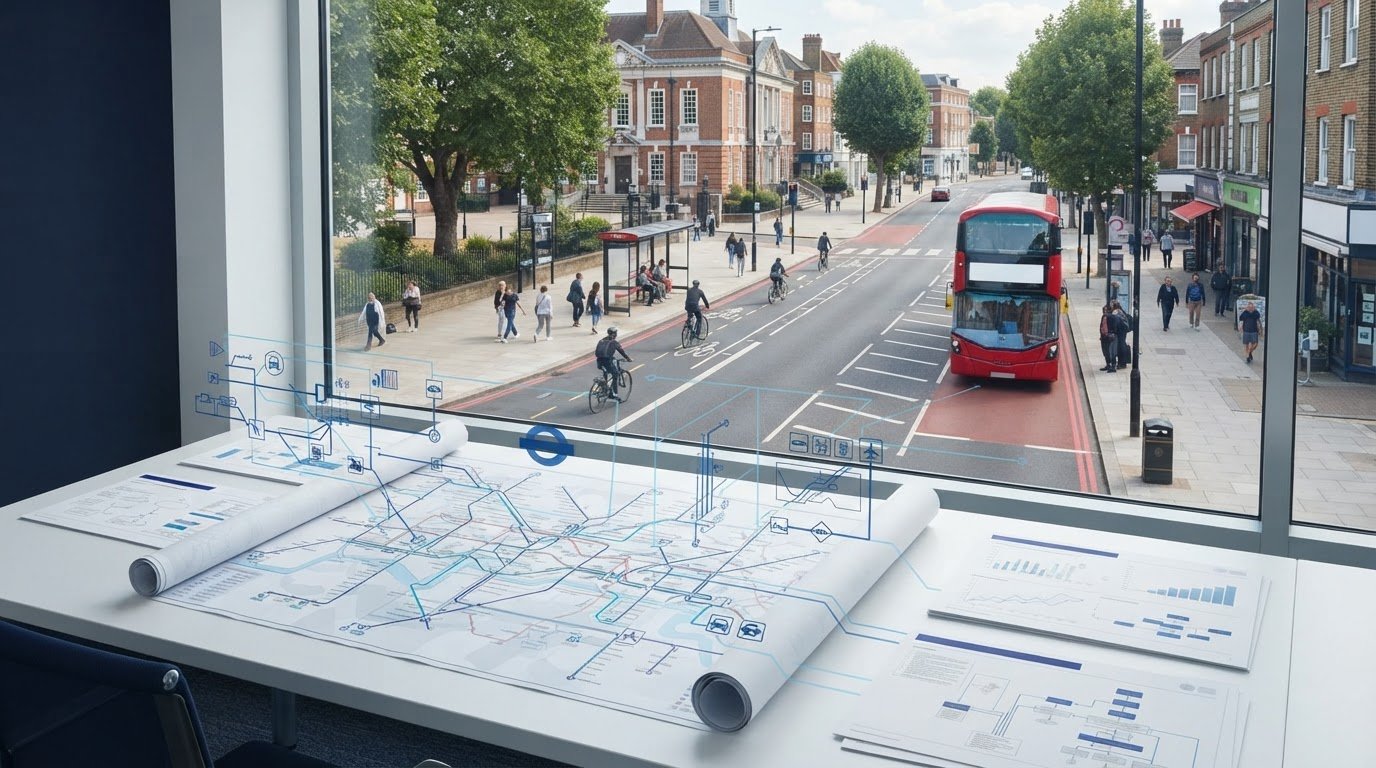
  • Transport Planning Consultants Islington: Navigating 2026 Planning Approvals

    Transport Planning Consultants Islington: Navigating 2026 Planning Approvals

    With 48% of Islington’s population now engaging in at least 20 minutes of active travel every day, the borough ranks as the second highest in London for walking and cycling. This shift is a core pillar of the Islington Transport Strategy which aims for 87% of all journeys to be sustainable by 2041. For developers, this means the margin for error is zero. You’re likely feeling the pressure of Islington Council’s strict “car-free” mandates and the high risk of a planning refusal due to transport concerns. Partnering with experienced Transport Planning Consultants Islington is the only way to ensure your 2026 development project moves from a CAD design to a completed site without costly regulatory delays.

    We understand that coordinating between architects and highway authorities is a logistical burden you don’t need. Our team provides a total, managed solution, from initial Transport Assessments to robust Travel Plans that satisfy the latest 2026 requirements. By reading this guide, you’ll master the complexities of the current planning fees, such as the £9,351.87 charge for major applications, and learn how to use Swept Path Analysis to justify your site’s viability. We’ll show you exactly how to secure planning permission by aligning your project with the council’s vision for a net-zero borough through proactive, data-driven planning.

    Key Takeaways

    • Understand how the Islington Local Plan impacts 2026 planning submissions, specifically regarding car-free mandates and active travel targets.
    • Determine whether your project requires a full Transport Assessment or a Transport Statement based on current London Borough of Islington size thresholds.
    • Master the technical requirements for Swept Path Analysis and Parking Surveys to prove your development’s viability on Islington’s constrained Victorian road network.
    • Professional Transport Planning Consultants Islington provide the technical authority needed to manage S278 agreements and strategic negotiations with Transport for London.
    • Leverage 24/7 traffic survey data and bespoke Travel Plans to satisfy the council’s evidence requirements and minimize the risk of planning refusal.

    Understanding Islington’s Transport Planning Landscape in 2026

    Transport Planning Consultants Islington act as the vital bridge between your development vision and the London Borough of Islington’s (LBI) stringent regulatory framework. In 2026, this role is more technical than ever. We don’t just provide documents; we provide the data-led justification for your project’s impact on the local network. This involves a deep understanding of transportation planning to ensure every submission aligns with the borough’s long-term environmental goals. Our team manages the logistical burdens of the planning process, allowing you to focus on the architectural integrity of your build.

    To better understand the distinction between the planning and engineering roles in this field, watch this helpful video:

    Islington has cemented “car-free” as the default for almost all new developments as of May 2026. Unless you’re building specifically for Blue Badge holders, you won’t get parking permits for residents. This policy is significantly more aggressive than in neighboring Camden or Hackney. It requires precise site selection based on Public Transport Accessibility Level (PTAL) ratings. We use CAD design and detailed site analysis to prove that your project can thrive without traditional vehicle infrastructure.

    The Islington Local Plan and Transport Policy

    The Islington Local Plan mandates that developers prioritize the “Healthy Streets” approach. Unlike other boroughs, LBI requires a highly granular analysis of how a building interacts with the existing pavement and public realm. If your project involves 10 to 20 residential units, you’ll face a planning application fee of £9,351.87 for the 2026 to 2027 period. Islington residential schemes are required to demonstrate a PTAL rating of 4 or higher to successfully support the borough’s mandatory car-free development standards. We ensure your documentation meets these thresholds before you commit to the pre-application advice fee, which currently stands at £3,177.20 for major applications.

    The Shift Toward Sustainable and Active Travel

    Active travel is a non-negotiable priority for the council. 48% of residents walk or cycle for at least 20 minutes daily, making Islington the second highest borough in London for this metric as of 2024 data. Low Traffic Neighbourhoods (LTNs) now cover 24% of the borough, with plans to reach 61% by the end of 2026. These zones fundamentally change how we collect traffic data for our surveys. You must align your project with London Travel Plans to show you’re supporting these active travel targets. We provide bespoke solutions that integrate cycle storage and pedestrian access into the very start of your project lifecycle.

    Essential Documentation: Transport Statements and Assessments

    Securing planning approval in 2026 requires more than just a site plan; it demands technical proof of feasibility. Transport Planning Consultants Islington are responsible for determining whether your project requires a Transport Statement or a full Transport Assessment. The London Borough of Islington (LBI) typically requires a Transport Statement for smaller developments that don’t generate significant traffic. Larger schemes, such as those with 10 to 20 residential units or commercial spaces exceeding 1,000sqm, trigger the need for a comprehensive Assessment. We use the TRICS database to predict trip generation accurately, ensuring your project doesn’t exceed the capacity of local infrastructure. Following standards set by the Chartered Institution of Highways & Transportation, we provide the technical rigor necessary to satisfy council officers.

    Transport Statements for Small to Medium Developments

    A robust Islington Transport Statement focuses on the immediate impact of infill projects. Even for “car-free” developments, you must address parking stress for visitors and service vehicles. We conduct detailed Parking Surveys to prove that local highway capacity can handle the added demand. A common pitfall that leads to planning delays is failing to account for the cumulative impact of nearby approved schemes. By providing a total, managed solution, we prevent these administrative bottlenecks. If you aren’t sure which document you need, our team can review your site requirements immediately to ensure compliance.

    Full Transport Assessments for Major Islington Schemes

    Major developments require a deeper level of scrutiny. Our Transport Assessment London guide highlights that for LBI, this includes junction capacity analysis and multi-modal impact studies. You must show how residents will access the site via walking, cycling, or public transport. We integrate air quality and noise data into our reporting to align with the council’s 2030 net-zero goals. Engaging with LBI highways officers for pre-application advice is essential; the current fee for a major application follow-up meeting is £3,177.20. This proactive engagement, supported by our technical data, mitigates potential objections before the final submission. We manage the entire lifecycle of this documentation to keep your 2026 project on track.

    Transport Planning Consultants Islington: Navigating 2026 Planning Approvals

    Technical Precision: Swept Path Analysis and Parking Surveys

    Islington’s Victorian street layout presents unique logistical challenges that require surgical precision during the planning phase. Transport Planning Consultants Islington must provide definitive proof that a site is accessible before a single brick is laid. This is where technical data replaces guesswork. We utilize advanced CAD modeling to simulate vehicle movements, ensuring that your development doesn’t create a safety hazard or a traffic bottleneck. By integrating Swept Path Analysis Services early in the project lifecycle, we identify potential access issues that would otherwise trigger costly design revisions during the council’s review process. Our approach prioritizes safety and regulatory compliance, giving you a clear path to approval.

    Swept Path Analysis for Tight Urban Access

    Islington Council (LBI) is particularly strict about servicing and delivery arrangements on red routes and narrow residential roads. Our team uses industry-standard CAD software to model specific vehicle paths, ensuring that every truck can enter and exit the site in a forward gear. This is a non-negotiable safety requirement for urban projects. For all major residential and commercial schemes, LBI mandates the use of 12m refuse vehicle templates as the standard for verifying waste collection access. We also model fire tender movements to guarantee that emergency services aren’t obstructed by the building’s footprint or tight corner radii. This technical precision removes the ambiguity from your submission and demonstrates that your site is fit for purpose.

    Parking Surveys and Stress Testing

    While Islington’s “car-free” policy is the default, you must still justify the lack of parking through rigorous stress testing. We conduct Parking Surveys using the Lambeth Methodology to assess the available on-street capacity within a 200m radius of the site. This methodology is the gold standard for London boroughs and is expected by LBI highways officers. This data is essential for developments in PTAL 5 and 6 zones, where the council expects high public transport usage but still requires evidence of local impact. Our 24/7 survey teams perform overnight counts between 00:30 and 05:30 to capture the most accurate snapshot of resident parking demand. We also provide the technical data needed to justify the loss of any on-street bays for new crossovers or access points. By delivering a comprehensive data set, we ensure the council has no grounds to refuse your application based on parking concerns.

    Strategic Negotiations: S278 Agreements and TfL Engagement

    Strategic negotiation is where a project’s technical data meets the legal reality of the public highway. Transport Planning Consultants Islington don’t just stop at the application stage; we guide you through the financial and regulatory commitments required to break ground. Section 278 (S278) agreements are the primary mechanism for this. These legal contracts allow you to make permanent alterations to the public road, such as new junctions or pavement widening. For major works valued over £1m, the drawing approval fee is £6,380 for the 2026-2027 period. Even small-scale works up to £25,000 require a £570 fee. We manage these technical approvals to prevent your project from stalling after you’ve already secured planning permission.

    A critical gap in many submissions is the lack of integration between initial transport reports and the eventual logistics of the build. While our focus remains on the planning data, we ensure your Transport Assessment aligns with the requirements of a Construction Logistics Plan Consultant. This alignment is vital for clearing pre-commencement triggers. If your transport report doesn’t account for the physical constraints of the 2026 streetscape, you’ll face delays when applying for a Street Works Licence. New “Additional Short notice” fees were introduced in January 2026 for applications submitted without the correct notice period, making early coordination a financial necessity.

    The S278 Agreement Process in London

    The S278 process follows a strict sequence that we manage on your behalf. First, we secure technical approval of the highway designs from the local authority, ensuring they meet current safety standards. Next, we help you navigate the bonding process, where a financial guarantee is set aside to cover the cost of the works. Finally, we oversee the transition into the implementation and maintenance periods. During this phase, the council typically retains a portion of the bond for 12 months to ensure the new road layout performs as expected. Our proactive approach ensures these legal hurdles don’t disrupt your project timeline.

    Coordinating with Transport for London

    Engagement with Transport for London (TfL) is mandatory if your site borders a red route like the A1 (Upper Street). TfL applies the “Healthy Streets” lens to every major application near hubs like Angel or Archway. This means your project must demonstrate a positive impact on the pedestrian environment and public transport network. We negotiate mitigation measures, often involving Section 106 transport contributions, to ensure your development remains viable while meeting London-wide safety standards. If you’re managing a complex site near a TfL route, you can partner with our expert team to navigate these high-stakes negotiations with confidence.

    Partnering with ML Traffic Engineers for Islington Success

    Choosing the right Transport Planning Consultants Islington is the difference between a project that stalls and one that succeeds. ML Traffic Engineers provides a total, managed solution for developers who need to navigate the high-stakes environment of London planning. We position ourselves as a safe pair of hands, an entity that understands the intricate complexities of the 2026 regulatory environment so you don’t have to. Our technical authority balances precision with a customer-centric approach, aiming to alleviate the logistical and regulatory burdens placed on your project team. We manage the entire lifecycle of your transport requirements, from initial feasibility through to final implementation.

    Our 24/7 availability is a primary hallmark of our brand promise. Planning deadlines are often tight and unpredictable. We maintain a constant state of readiness to conduct urgent Traffic Surveys or collect technical data when the council demands immediate evidence. This reliability is essential in the fast-moving world of Islington development. Whether it’s an overnight Parking Survey using the Lambeth Methodology or a rapid CAD design revision for a Swept Path Analysis, our team is available to ensure your submission remains on track. We take immense pride in our precision and compliance, viewing our role as a vital partner in your project’s success.

    Why Local Expertise Matters

    Success in the London Borough of Islington (LBI) requires more than just technical skill; it requires local insight. We have a deep understanding of what we do specifically for the Islington context. Our team has direct experience with LBI highways officers and understands the specific nuances of the Islington Local Plan. We’ve successfully managed various project types across North London, ranging from small-scale infill residential units to major commercial developments. In early 2026, we secured approval for a challenging site near Highbury Corner by utilizing data-driven justifications that satisfied the council’s strict car-free mandates. This proactive approach prevents the common pitfalls that lead to planning refusal.

    Get Started with Your Islington Project

    Securing your 2026 planning approval starts with a robust fee proposal tailored to your site’s specific constraints. We provide comprehensive support for both Transport Statements and full Transport Assessments. Our initial consultations include site access reviews and feasibility checks to identify potential highway issues before they become expensive problems. We use bespoke solutions and seamless integration to ensure your transport documentation aligns perfectly with your architect’s vision. Contact us at mltraffic.co.uk for immediate expert support. Let our team manage the technical complexities while you focus on delivering a high-quality development for the Islington community.

    Securing Your Development’s Future in Islington

    Successful planning applications in May 2026 require more than just compliance; they demand a proactive strategy built on technical data. You’ve seen how Islington Council’s strict car-free policies and the 87% sustainable travel target by 2041 leave no room for error. Whether you’re navigating the £9,351.87 fee for major applications or negotiating complex S278 agreements, precision is your greatest asset. Our team provides the technical authority needed to justify every aspect of your site access and trip generation. We focus on results so you can focus on construction.

    As specialist Transport Planning Consultants Islington, we act as a safe pair of hands for your 2026 development. We offer 24/7 availability for urgent surveys and bring expert witness experience to planning appeals. We ensure your documentation, from Swept Path Analysis to Travel Plans, meets the highest safety and regulatory standards. Don’t let logistical burdens or planning delays derail your timeline. Request a Transport Planning Quote for Your Islington Project today. We’re ready to help you secure approval and move your project toward a successful completion.

    Frequently Asked Questions

    Do I need a transport consultant for a small extension in Islington?

    You don’t usually need a consultant for a simple residential extension. However, you must hire Transport Planning Consultants Islington if your project creates a new crossover or alters the public highway. Islington Council (LBI) often requests a brief Transport Statement for small commercial conversions to ensure local capacity isn’t overwhelmed. We provide the technical data required to clear these minor planning hurdles quickly.

    What is the “car-free” policy in Islington and how does it affect my project?

    Islington’s car-free policy is the mandatory standard for almost all new developments as of May 2026. This means the council won’t issue on-street parking permits to future residents or occupiers. The only exceptions are for Blue Badge holders or specific operational needs. You must demonstrate how your site will function without private vehicle access by providing robust Travel Plans and highlighting local public transport links.

    How long does it take to prepare a Transport Statement for an Islington application?

    A standard Transport Statement typically takes 14 to 21 days to complete. This timeline includes the 24/7 data collection phase and the technical drafting of the report. If your site requires a multi-day Parking Survey or complex Swept Path Analysis, the process might extend to four weeks. We maintain a constant state of readiness to meet tight submission deadlines and prevent administrative delays.

    Can I get planning permission in Islington if my site has a low PTAL rating?

    You can secure planning permission with a low PTAL rating, but the council requires stronger evidence of sustainability. Sites with a PTAL of 0 or 1 must prove they won’t increase local parking stress. We use detailed Traffic Surveys to show that your development’s trip generation remains minimal. High-quality Travel Plans that prioritize cycling and walking are essential for overcoming a site’s public transport limitations.

    What is a Swept Path Analysis and why is it required for my Islington site?

    Swept Path Analysis is a CAD-based simulation that proves vehicles can safely navigate your site’s access points. It’s a non-negotiable requirement for Islington’s narrow Victorian streets. We model the movements of 12m refuse vehicles and fire tenders to ensure emergency and service access. This technical precision prevents the council from refusing your application based on highway safety concerns or restricted vehicle maneuverability.

    How much does a parking survey cost for a London planning application?

    We don’t provide fixed pricing for surveys because costs vary based on the number of streets covered and the survey duration. However, it’s worth noting that Islington’s 2026-2027 fee schedule includes a £570 charge for S278 works up to £25,000. Our team provides bespoke fee proposals after an initial site review. This ensures you only pay for the specific data required for your unique planning application.

    What is the difference between an S278 and an S106 agreement in transport planning?

    An S278 agreement is a legal contract for physical works on the public highway, such as a new junction. Conversely, an S106 agreement involves financial contributions to mitigate the development’s impact on the wider community. While S278 covers the actual road construction costs and bonds, S106 might fund local bus improvements or cycling infrastructure. We manage the technical negotiations for both to keep your project compliant.

    How do Low Traffic Neighbourhoods (LTNs) in Islington affect traffic surveys?

    Low Traffic Neighbourhoods (LTNs) cover 24% of Islington and fundamentally change local traffic flow. When we conduct Traffic Surveys, we must account for these restricted routes to ensure our data reflects real-world conditions. The council expects survey data to show how your development interacts with these “Liveable Neighbourhoods.” We use 2024-2025 baseline data to provide a comparative analysis that satisfies LBI highways officers.

    Michael Lee

    Article by

    Michael Lee

    Transport planner with over 35 years' experience.

    Disclaimer

    The content on mltraffic.co.uk, including all technical articles, guides, and resources, is provided for general informational and educational purposes only. It is not intended to constitute professional advice in traffic engineering, transportation planning, development approvals, or any other technical or legal field.
    While ML Traffic Engineers makes every reasonable effort to ensure the accuracy, completeness, and timeliness of the information published, we do not provide any warranties or representations (express or implied) regarding its reliability, suitability, or availability for any particular purpose. Any reliance you place on the content is strictly at your own risk.
    In no event shall ML Traffic Engineers, its directors, employees, authors, or affiliates be liable for any direct, indirect, incidental, special, consequential, or punitive damages (including, without limitation, loss of profits, data, or business opportunities) arising out of or in connection with the use of, or inability to use, any information provided on this website.
    The articles and guides on this site are not a substitute for engaging a qualified, professional traffic engineer to assess your specific project requirements. For tailored advice, compliance assessments, or traffic engineering services, please contact a competent professional.
    This disclaimer may be updated from time to time without notice. By accessing or using this website, you agree to be bound by the most current version of this disclaimer.
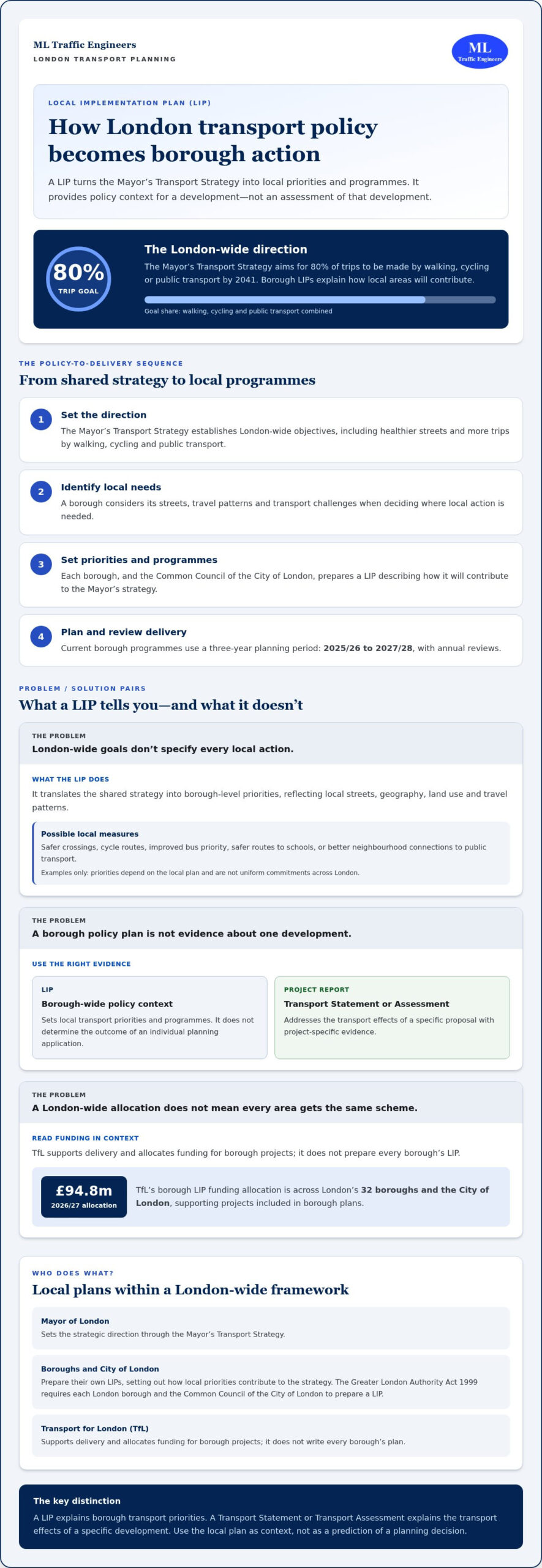
  • Transport Planning Consultants in London: Navigating 2026 Planning Approvals

    Transport Planning Consultants in London: Navigating 2026 Planning Approvals

    A single technical objection from Transport for London (TfL) can instantly invalidate a £4,500 Transport Assessment, forcing expensive site redesigns and months of project delays. With data collection costs rising by 15% over the last 24 months, developers can’t afford to submit reports based on guesswork. You likely feel the pressure of the 2026 London Plan updates, where car-free mandates for PTAL 4 areas and 100% EV charging requirements make site access a high-stakes puzzle. Choosing the right transport planning consultants is the difference between a stalled project and a seamless approval.

    We understand that meeting borough-specific parking standards and the new £18 Congestion Charge regulations feels like a constant uphill battle. This article provides the expert clarity you need to master London’s complex planning environment. You’ll learn how to leverage 2026.12.1.0 AutoTURN software for flawless Swept Path Analysis, secure cost-effective access solutions, and produce the data-backed technical reports required to satisfy even the strictest planning officers.

    Key Takeaways

    • Identify whether your development requires a Transport Statement or a data-heavy Transport Assessment based on the 80-unit residential threshold.
    • Utilize Swept Path Analysis to provide CAD-based proof of vehicle maneuverability on tight London sites and avoid costly redesigns.
    • Collaborate with experienced transport planning consultants to navigate borough-specific parking standards and the latest 2026 London Plan mandates.
    • Replace speculative data with rigorous parking surveys using the Lambeth Methodology to satisfy local highway department requirements.
    • Integrate transport planning into the initial design phase to proactively mitigate potential TfL objections and ensure a faster path to approval.

    Table of Contents

    The Strategic Role of Transport Planning Consultants in London

    Transport planning serves as the critical bridge between architectural vision and the physical reality of highway safety. It’s a multidisciplinary field where technical precision meets regulatory compliance. In a city where 26.6 million daily trips were recorded in 2024, the margin for error in site design is non-existent. Professional transportation planning ensures that new developments don’t just exist in isolation but integrate safely into London’s high-density infrastructure. Our role is to mitigate the impact of your project on the existing road network, ensuring that traffic flow remains consistent and worker safety is never compromised.

    London’s planning environment is significantly more rigorous than other UK regions. The "Healthy Streets" approach is now a core requirement for any successful application. This policy prioritizes human health and the experience of using London’s streets. With sustainable travel mode shares reaching 63.4% in 2024, your development must prove it supports walking, cycling, and public transit. We provide the technical authority needed to demonstrate this alignment to planning officers.

    To better understand the distinction between the professionals involved in this process, watch this helpful video:

    Navigating the London Plan and TfL Requirements

    Transport policy in the capital follows a strict hierarchy. It begins with the National Planning Policy Framework (NPPF) and moves into the detailed mandates of the London Plan. Navigating these layers requires expert transport planning consultants who understand Transport for London (TfL) expectations. Securing TfL pre-application advice is a vital step that saves developers months of potential delays. We also analyze your site’s Public Transport Accessibility Level (PTAL). Because the London Plan mandates car-free developments for sites with a PTAL score of 4 or higher, accurate data is essential for determining your project’s density and parking capacity.

    When Do You Need a Transport Planning Consultant?

    You need to identify technical "trigger points" early to manage your budget effectively. A full Transport Assessment is typically required for developments of 80 or more residential units or commercial spaces exceeding 2,500sqm. In "Sensitive Areas," these thresholds often drop to just 30 units. Engaging a consultant during the feasibility stage prevents expensive design revisions. We manage a wide variety of ML Traffic project types, ensuring that whether you’re planning a residential complex or a major utility work, your site access is compliant from day one. Early CAD design and data-backed reports provide a safe pair of hands for your planning journey.

    Technical Documentation: Transport Statements and Assessments

    Success in London planning depends on technical precision. Professional transport planning consultants produce these documents to demonstrate that your project won’t compromise highway safety or network efficiency. While official government guidance provides the basic framework, London’s high-density environment demands a much more granular approach. These reports aren’t just paperwork; they’re the evidence base that secures your site’s viability.

    Transport Statements vs. Transport Assessments

    The scale of your project dictates the depth of the report required. For smaller sites, a Transport Statement (TS) focuses on local access, safety, and parking. Once you exceed 80 residential units or 2,500sqm of commercial space, you’ll need a full Transport Assessment (TA). These assessments are data-heavy and reflect the 15% increase in data collection costs seen since 2024. We utilize the TRICS database to predict multi-modal trip generation accurately, ensuring your application isn’t rejected due to flawed traffic projections. You can find more details on these technical requirements in our London Transport Assessment guide.

    A standard TA in 2026 typically includes:

    • Junction Capacity Modelling: Proving that local intersections can handle the additional load.

    • Cumulative Impact Analysis: Assessing your project alongside other committed developments in the area.

    • Policy Alignment: Demonstrating how the site meets the specific requirements of the borough’s Local Plan.

    The Importance of Travel Plans in 2026

    A Travel Plan is a mandatory strategy for reducing car dependency and encouraging sustainable transport. In 2026, these plans must address the 100% active electric vehicle charging point requirement for all new parking spaces. They also prioritize the 43% increase in daily cycling stages recorded since 2019. Beyond the planning phase, you’re often required to monitor these plans for several years to prove the site remains compliant with its original sustainability goals. Our London Travel Plans resource explains how to manage these ongoing obligations effectively.

    If you’re unsure which document your project requires, our team can review your site layout as part of our comprehensive support. Early engagement ensures that your technical documentation is robust enough to withstand scrutiny from TfL and local highway departments.

    Transport Planning Consultants in London: Navigating 2026 Planning Approvals

    Swept Path Analysis: Proving Site Feasibility

    Swept Path Analysis (SPA) is the definitive proof that your site design functions in the real world. It uses CAD-based simulations to map the exact path a vehicle takes while performing maneuvers such as turning, reversing, or parking. In London, where historic street layouts meet high-density modern developments, SPA is a non-negotiable requirement for planning approval. You cannot rely on generic assumptions when dealing with the city’s narrow access points and restricted footprints. Professional transport planning consultants use this data to identify "dead-end" access issues before they trigger a planning refusal.

    We utilize the latest AutoTURN 2026.12.1.0 software to create these simulations with total precision. This allows us to account for the exact dimensions of critical vehicles, including London Fire Brigade (LFB) tenders, 11.4m refuse collectors, and large delivery vans. The Chartered Institution of Highways & Transportation (CIHT) emphasizes that high-quality technical modeling is essential for maintaining public safety and infrastructure integrity. By simulating these movements early, we ensure your site supports London’s "Vision Zero" goals and remains safe for all road users.

    Avoiding Planning Refusal with Accurate SPA

    Fire safety is a primary concern for every London planning authority. If your SPA doesn’t prove that an LFB tender can reach within 45 meters of all points within a building, your application will likely fail. Refuse collection requirements also vary significantly across the capital. For example, Lambeth often requires a specific 11.4m refuse vehicle template, while Southwark may have different clearance standards for its collection teams. Our Swept Path Analysis services ensure your site meets these borough-specific mandates, preventing costly redesigns after your application has been submitted.

    Optimising Car Park Layouts

    SPA also dictates the efficiency and profitability of your internal site layout. We use it to maximize parking spaces while ensuring drivers can enter and exit in a forward gear, a common requirement for major London developments. This is particularly vital for underground car parks where structural columns, steep ramps, and tight turning circles limit maneuverability. By using bespoke vehicle templates, we ensure that even the tightest loading bays remain functional. This proactive approach eliminates the risk of "unworkable" designs that lead to operational headaches and safety hazards once the building is occupied. We provide a safe pair of hands, ensuring every centimeter of your site is utilized effectively and compliantly.

    Data-Driven Planning: Parking and Traffic Surveys

    Planning officers in London have no interest in "gut feelings" or estimates. They demand raw, verified data. Since data collection costs rose by 15% over the last 24 months, every survey must be executed perfectly the first time to avoid budget overruns. Using professional transport planning consultants who manage their own data collection ensures that your submission is backed by technical authority and physical proof. We provide a safe pair of hands by capturing the exact metrics required to satisfy borough-specific highway requirements.

    The Lambeth Methodology Explained

    The "Lambeth Methodology" is the industry standard for overnight parking stress surveys across London. It provides a standardized way to measure how much on-street parking is available within a 200-meter walking distance of your site. Planning departments use this data to determine if a development will negatively impact local residents’ ability to park. We follow a strict sequential process to ensure compliance:

    • Timing: Our technicians conduct surveys between 00:30 and 05:30 when residential parking demand is at its peak.

    • Frequency: We perform the count on two separate weekday nights, typically a Tuesday and a Wednesday, to ensure the data represents a typical week.

    • Scope: We record every parked vehicle and identify available "legal" spaces, including permit bays and shared-use bays.

    This data is critical for justifying lower parking provisions in areas with high PTAL scores. It proves to the council that any overspill parking can be safely absorbed by the existing street network without causing congestion or safety hazards.

    Traffic Surveys for Junction Analysis

    For larger developments, authorities often require detailed traffic modelling using software like LinSig or Junctions 9. This modelling is only as good as the base data provided. We deploy Automatic Traffic Counters (ATC) for 24/7 monitoring and conduct manual turning counts to capture real-time vehicle movements at specific intersections. This precision is essential for assessing if a junction can handle the additional trips predicted by the TRICS database. You can access our ML Traffic resources for survey templates to see the level of detail required for a successful submission.

    Managing data collection in-house allows us to maintain a standard of formal excellence. It eliminates the communication gap between the surveyors on the road and the consultants writing the report. This seamless integration means we can respond to urgent planning deadlines with immediate action. If you need a bespoke data solution for your next project, our team is available to provide comprehensive support from the initial count to the final technical report.

    Selecting the Right London Transport Consultancy

    Selecting the right partner is a strategic decision that directly impacts your project’s timeline and budget. In a city where planning policy changes as frequently as the £18 Congestion Charge regulations, you need more than a report writer. You need transport planning consultants who act as a safe pair of hands, managing the entire lifecycle from initial data collection to final technical submission. Choosing a firm that understands the 24/7 nature of London’s infrastructure ensures that your project remains on track, even when urgent regulatory hurdles arise.

    Local knowledge remains your most valuable asset. National firms with a broad UK focus often lack the specific relationships and nuanced understanding of individual London Borough highway departments. Whether it’s the specific refuse vehicle templates for Southwark or the overnight parking stress requirements in Lambeth, these details determine your success. Our team brings 10+ years of experience navigating these regulatory hurdles, ensuring your application meets every local mandate. We prioritize clarity and speed, providing direct solutions that alleviate the logistical burdens on your project management team.

    Before you hire a consultancy, use this checklist to verify their capability:

    • Do they perform their own data collection and parking surveys in-house to ensure data integrity?

    • Are they using the most current software, such as AutoTURN 2026.12.1.0, for all Swept Path Analysis?

    • Do they offer 24/7 availability to meet urgent, last-minute planning deadlines?

    • Can they demonstrate a track record of overcoming TfL objections on similar project types?

    The ML Traffic Advantage

    We provide a total managed solution that bridges the gap between complex CAD design and rigid planning policy. Our approach is fundamentally professional and safety-conscious, reflecting the high-stakes nature of London’s road network. We don’t just deliver a document; we provide technical authority and 24/7 readiness. This unwavering reliability means we’re always available to address queries from planning officers or perform emergency data revisions as your site design evolves. We take pride in our precision, ensuring every report is a vital guardian of public safety and worker welfare.

    Next Steps for Your London Project

    Securing planning approval in 2026 requires precision and speed. We’ve simplified the process to help you move from a site plan to a technical submission without the logistical burden. You can explore our full range of services and see what we do to support developers across the capital. Contact our team today for an initial site appraisal. We’ll review your project requirements and provide a bespoke technical strategy designed to secure your planning permission efficiently and cost-effectively. Let us manage the complexities of the road network so you can focus on delivering your development.

    Master Your 2026 London Planning Strategy

    Success in the capital’s rigid planning environment requires more than just policy knowledge. It demands technical precision and verified data. By integrating accurate Swept Path Analysis and rigorous Lambeth Parking Surveys into your early design phase, you proactively eliminate the technical objections that stall major developments. Our role as transport planning consultants is to provide the technical authority needed to navigate these high-stakes requirements with total confidence. We handle the technical complexities so you don’t have to.

    Founded in 2014, ML Traffic brings over a decade of London-specific expertise to your project. We provide 24/7 availability for urgent technical traffic requirements, ensuring your deadlines are always met regardless of project scale. Don’t leave your site’s feasibility to chance in an environment where data collection costs have risen by 15% since 2024. Secure your London planning approval with ML Traffic Engineers; contact us for a quote. We look forward to helping you transform your architectural vision into a compliant and approved reality.

    Frequently Asked Questions

    What is the difference between a Transport Statement and a Transport Assessment?

    The primary difference is the scale of the development and the depth of data required. A Transport Statement (TS) is a concise report for smaller projects, typically those under 80 residential units, focusing on local access and safety. A Transport Assessment (TA) is a comprehensive, data-heavy document required for major developments exceeding 80 units or 2,500sqm of commercial space. TAs require detailed junction modelling and cumulative impact analysis to satisfy Transport for London requirements.

    How much does a transport planning consultant cost in London?

    Average hourly rates for a planning consultant in 2026 range between £130 and £300. For specific technical documents, a professional Transport Assessment typically starts at £4,500 for minor residential schemes and can exceed £25,000 for complex mixed-use projects. Producing a standalone Travel Plan in conjunction with these assessments generally starts at £2,000 plus VAT. These costs reflect the technical precision and data collection required for London-specific approvals.

    What is a PTAL rating and how does it affect my planning application?

    PTAL stands for Public Transport Accessibility Level, a scoring system from 0 to 6b that measures access to the transport network. It’s a critical metric because the London Plan mandates car-free developments in any area with a PTAL score of 4 or higher. Your PTAL rating dictates the maximum allowable parking spaces and the required density of your development. Accurate PTAL analysis by transport planning consultants ensures your site layout remains compliant with the latest 2026 density standards.

    When is a Swept Path Analysis required for a London development?

    A Swept Path Analysis (SPA) is required whenever a development involves new or restricted vehicle access points. It’s non-negotiable for proving that emergency services, such as London Fire Brigade tenders, can reach within 45 meters of all points in a building. You’ll also need SPA to demonstrate that refuse vehicles and delivery vans can enter and exit the site in a forward gear. We use AutoTURN 2026.12.1.0 to provide these CAD simulations with total precision.

    What is the Lambeth Methodology for parking surveys?

    The Lambeth Methodology is the gold standard for measuring "parking stress" within a 200-meter walking distance of a site. It requires surveyors to record all parked vehicles and legal spaces on two separate weekday nights between 00:30 and 05:30. This data provides the physical proof needed to justify parking provisions to local borough highway departments. It’s an essential requirement for developments in areas where on-street parking is already near capacity.

    How long does it take to prepare a Transport Statement for a London project?

    Preparation typically takes between two and four weeks. This timeline accounts for the two nights of data collection required for parking surveys and the technical CAD design for access points. If your project has an urgent deadline, transport planning consultants with 24/7 availability can often accelerate the reporting process. Early engagement during the feasibility stage is the best way to ensure your technical submission meets your project’s milestones.

    Can a transport consultant help with Section 278 agreements?

    Yes, consultants manage the technical approval process for Section 278 agreements, which cover permanent alterations to the public highway. This includes the CAD design of new site entrances, junction improvements, or specialized traffic signals. We handle the liaison with borough engineers to ensure all designs meet Chapter 8 compliance and safety standards. This managed solution prevents legal and construction delays during the implementation phase of your development.

    Do I need a Travel Plan for a small residential development in London?

    While full Travel Plans are usually reserved for larger sites, many London boroughs now require a "Travel Plan Statement" for smaller developments in sensitive areas. This is especially true if you’re proposing a car-free development or if the site has a high PTAL score. These plans outline how residents will be encouraged to use sustainable modes of transport. They must also address the 2026 requirement for 100% active electric vehicle charging points for any permitted parking spaces.

    Which areas in London do you cover?

    We service Acton, Balham, Barking, Barnes, Barnet, Battersea, Beckenham, Bexleyheath, Brentford, Brixton, Bromley, Camberwell, Carshalton, Charlton, Chelsea, Chiswick, Clapham, Coulsdon, Croydon, Crystal Palace, Dagenham, Dulwich, Ealing, Edgware, Eltham, Enfield, Finchley, Forest Gate, Fulham, Golders Green, Greenwich, Hackney, Hammersmith, Hampstead, Harrow, Hayes, Highgate, Hounslow, Ilford, Islington, Kensington, Kentish Town, Kingston upon Thames, Lewisham, Mitcham, Muswell Hill, New Malden, Notting Hill, Orpington, Peckham, Pinner, Purley, Putney, Richmond, Romford, Ruislip, Sidcup, Southall, Southgate, Streatham, Surbiton, Sutton, Tooting, Tottenham, Twickenham, Uxbridge, Walthamstow, Wembley, West Norwood, Wimbledon, Wood Green, Woolwich, Bethnal Green, Shoreditch, Canary Wharf, Deptford, Leyton, Palmers Green, Stanmore, Upminster, Chislehurst, Erith, Feltham.

    Which cities in England do you cover?

    We service London, Birmingham, Manchester, Liverpool, Sheffield, Leeds.

    Michael Lee

    Article by

    Michael Lee

    Transport planner with over 35 years' experience.

    Disclaimer

    The content on mltraffic.co.uk, including all technical articles, guides, and resources, is provided for general informational and educational purposes only. It is not intended to constitute professional advice in traffic engineering, transportation planning, development approvals, or any other technical or legal field.
    While ML Traffic Engineers makes every reasonable effort to ensure the accuracy, completeness, and timeliness of the information published, we do not provide any warranties or representations (express or implied) regarding its reliability, suitability, or availability for any particular purpose. Any reliance you place on the content is strictly at your own risk.
    In no event shall ML Traffic Engineers, its directors, employees, authors, or affiliates be liable for any direct, indirect, incidental, special, consequential, or punitive damages (including, without limitation, loss of profits, data, or business opportunities) arising out of or in connection with the use of, or inability to use, any information provided on this website.
    The articles and guides on this site are not a substitute for engaging a qualified, professional traffic engineer to assess your specific project requirements. For tailored advice, compliance assessments, or traffic engineering services, please contact a competent professional.
    This disclaimer may be updated from time to time without notice. By accessing or using this website, you agree to be bound by the most current version of this disclaimer.