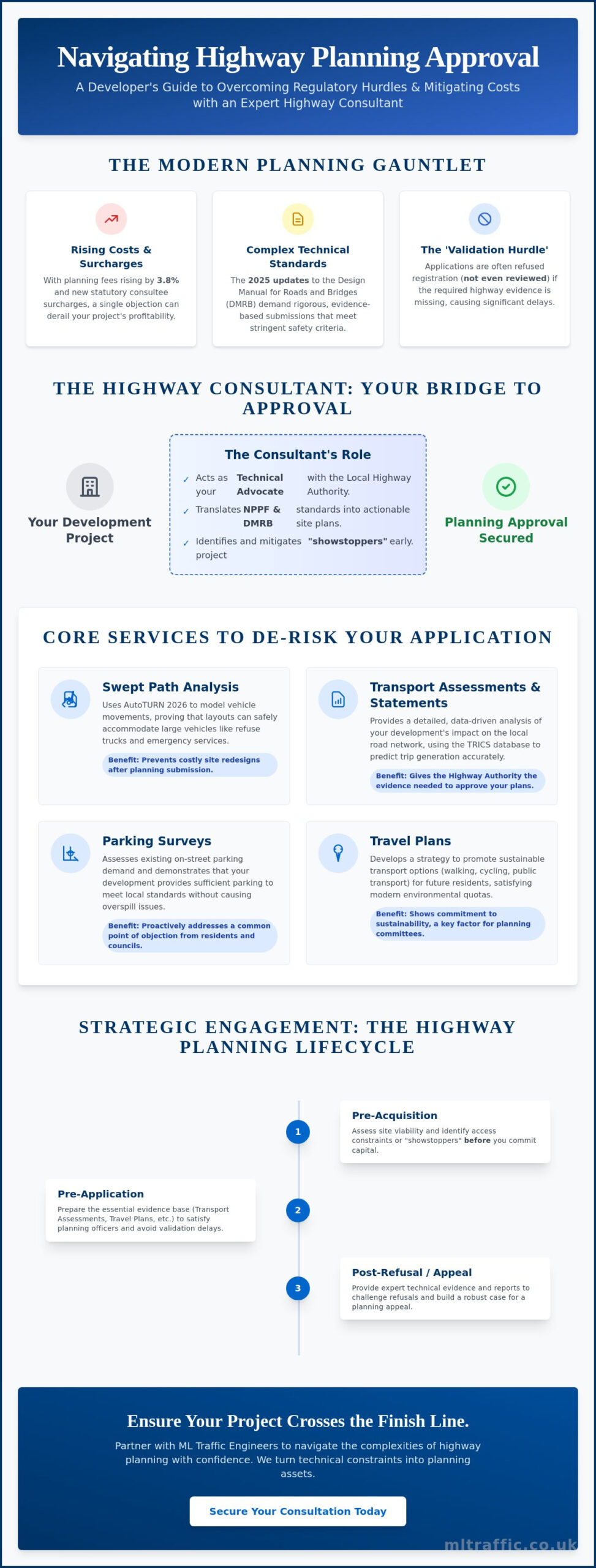
With planning fees in England rising by 3.8% as of April 2026 and new statutory consultee surcharges now in effect, a single objection from a Local Highway Authority can turn a profitable project into a financial liability. You likely feel the pressure of these escalating costs and the technical complexity of the 2025 updates to the Design Manual for Roads and Bridges (DMRB). A professional highway consultant acts as your technical advocate, ensuring that your submission meets these rigorous standards before they cause a validation bottleneck.
This guide explains how a highway consultant navigates technical reporting and regulatory hurdles to secure your development’s planning approval. You’ll learn how precision tools like AutoTURN 2026 and detailed Transport Assessments prevent delays and mitigate unexpected costs in Section 278 agreements. We will outline the essential services, from Swept Path Analysis to Parking Surveys, that transform technical constraints into planning assets and ensure clear communication with highway authorities.
Key Takeaways
- Understand how a highway consultant bridges the gap between your development design and the Local Highway Authority’s rigorous safety standards.
- Discover how to prevent application validation delays by preparing the correct hierarchy of technical reports, from Transport Statements to full Transport Assessments.
- Learn why Swept Path Analysis and Parking Surveys are critical for proving your site layout can safely accommodate refuse trucks and emergency vehicles.
- Identify potential “showstoppers” early in the planning lifecycle through strategic feasibility reviews and pre-application consultations.
- Explore how Travel Plans help satisfy modern environmental quotas by promoting sustainable transport options within your project’s design.
Table of Contents
-
What is a Highway Consultant and Why Does Your Project Need One?
-
Technical Reports: Securing Planning Approval through Evidence
-
Why ML Traffic Engineers UK is Your Strategic Highway Partner
What is a Highway Consultant and Why Does Your Project Need One?
A highway consultant serves as the technical liaison between your development team and the Local Highway Authority. They apply the principles of Highway engineering to ensure your site layout is safe, functional, and compliant with current UK standards. Many developers encounter the "validation hurdle" early in the process. This is an administrative wall where a planning department refuses to register an application because the required highway evidence is missing. By providing precision data from the outset, a consultant ensures your project moves past the validation stage and into the review phase without delay.
To better understand the strategic role of a specialist in this field, watch this video:
Beyond administrative support, these experts offer significant commercial value. They optimize access designs to reduce unnecessary infrastructure spending while maintaining safety. A highway consultant doesn’t just fill out forms. They negotiate with local authorities to ensure that required works are proportionate to the development’s scale. Their role involves managing the full project lifecycle, from initial Traffic Surveys to the final coordination of Transport Assessments. Precision is a functional necessity in this environment.
The Intersection of Engineering and Planning Law
Highway consultants translate the National Planning Policy Framework (NPPF) into actionable site plans. They anticipate the requirements of statutory consultees, such as National Highways, before objections are raised. Early engagement during the feasibility stage identifies "showstoppers" like insufficient visibility splays or junction capacity issues. This proactive approach ensures your project aligns with the 2025 updates to the Design Manual for Roads and Bridges (DMRB) and avoids costly late-stage redesigns.
When to Appoint a Highway Consultant
Strategic timing dictates the profitability of your development. During pre-acquisition, a consultant assesses site viability to identify access constraints before you commit capital. At the pre-application stage, they prepare the essential evidence base, including Travel Plans and Parking Surveys, to satisfy planning officers. Even in post-refusal scenarios, a highway consultant provides the expert technical evidence needed to challenge decisions during planning appeals and reduce regulatory pressure.
Technical Reports: Securing Planning Approval through Evidence
Evidence is the foundation of planning success. A highway consultant uses technical reports to prove that a development’s impact on the road network is acceptable or can be mitigated through design. This data-driven approach mirrors the state use of engineering consultants to provide specialized expertise that internal teams often lack. With traffic volumes reaching 342.6 billion vehicle miles in 2025, local authorities demand higher levels of proof regarding junction capacity and road safety than in previous years. Precision in these reports is a functional necessity to avoid costly delays.
Central to this proof is the TRICS database. This tool allows us to predict trip generation with high accuracy by comparing your project to similar existing sites. Beyond just vehicle numbers, modern planning requires Transport Planning and Assessment Reports that incorporate sustainable travel strategies. Travel Plans are now a standard requirement for most developments. They promote walking, cycling, and public transport to satisfy environmental quotas and reduce the overall traffic footprint. Reviewing our technical service list helps determine which report hierarchy your specific site requires.
Transport Statements for Small to Medium Developments
For smaller projects, a Transport Statement provides a concise evaluation of access and safety. In 2026, these reports must strictly adhere to local parking standards and provide robust cycle storage solutions. They ensure that even modest developments don’t negatively impact the existing highway. These documents focus on the immediate vicinity of the site and confirm that the proposed use is compatible with the local road character. You can find more details in our 2026 guide to Transport Statements.
Transport Assessments for Complex Projects
Large-scale or high-impact developments trigger the need for a full Transport Assessment. This involves complex junction capacity modeling and an analysis of the wider highway network. We develop mitigation strategies that balance the authority’s requirements with your commercial viability. When the Strategic Road Network (SRN) is involved, the level of scrutiny increases significantly. We provide the technical authority needed to negotiate these high-stakes environments. Our team manages the full lifecycle of these assessments, ensuring that every data point stands up to rigorous examination by the Local Highway Authority.
The Data Layer: Swept Path Analysis and Parking Surveys
Data is the only objective defense against planning refusal. While a developer might assume a site entrance is wide enough, a highway consultant uses empirical evidence to remove that uncertainty. Guesswork in site layout often leads to immediate objections from the Local Highway Authority, particularly regarding safety and accessibility. By integrating precise data collection with technical analysis, we ensure your layout is both functional and compliant with the latest 2025 updates to the DMRB. Guesswork kills projects.
Swept Path Analysis (SPA) is the primary tool for proving that large vehicles, such as fire tenders and refuse lorries, can safely maneuver within your development. Adhering to rigorous technical standards, much like the framework found in Federal Highway Administration policies, ensures that every vehicle movement is mathematically verified. This technical rigor prevents the safety hazards that arise when site designs fail to accommodate essential services. You can explore our full range of Swept Path Analysis services to see how this data secures your approval.
Visualizing Access with Swept Path Analysis
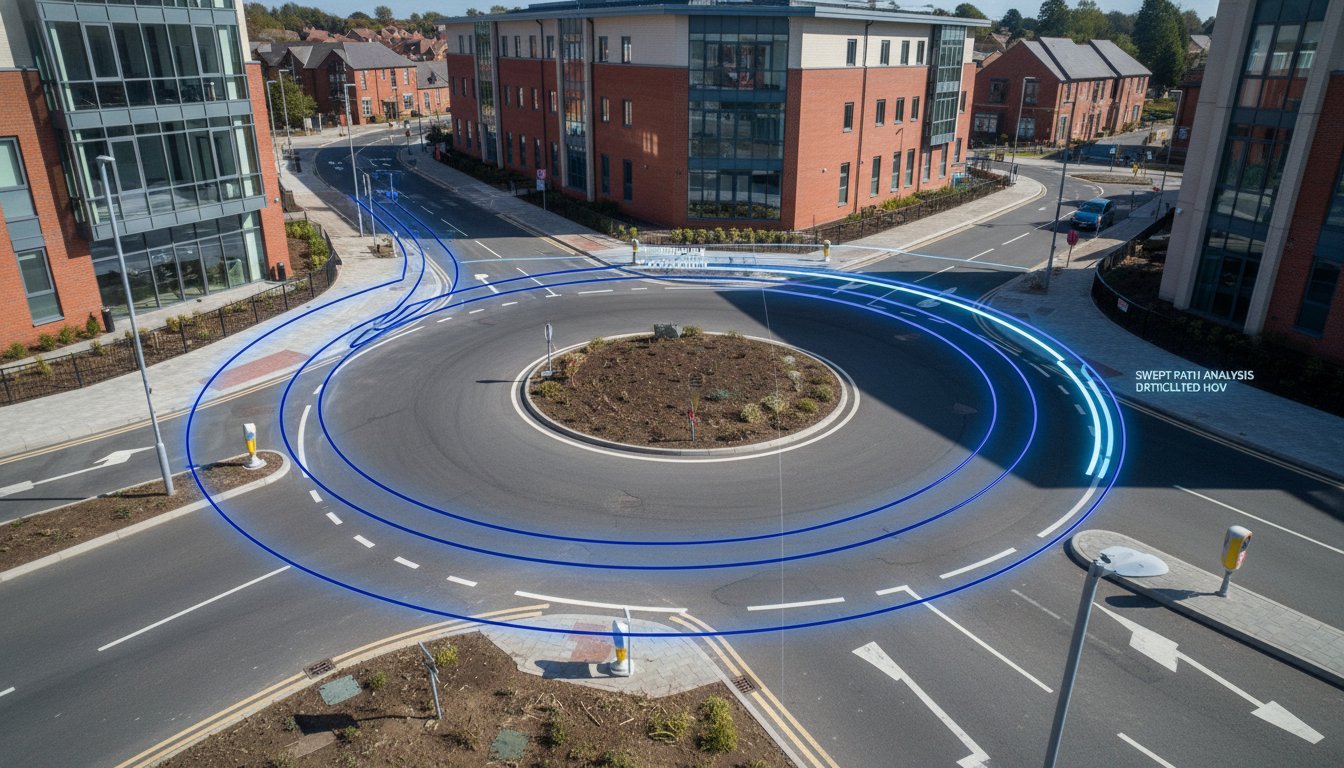
We use industry-standard software, specifically AutoTURN 2026, to simulate real-world vehicle movements. This version includes 102 new standard vehicles for Europe, ensuring your design accounts for modern transport dimensions. By visualizing these paths, we confirm compliance with the "Manual for Streets" and specific local design guides. This isn’t just about safety. Accurate SPA can actually save space. By refining the geometry of junctions and turning heads, we maximize your developable land area while maintaining full regulatory compliance.
The Critical Role of Parking and Traffic Surveys
Parking is often a contentious issue in planning applications. We use Parking Surveys, frequently following the Lambeth Methodology, to justify parking ratios and demonstrate that a development won’t overwhelm local streets. This involves conducting overnight parking stress surveys to provide a clear picture of existing demand. Similarly, our Traffic Surveys establish baseline flows before your development traffic is even added. This data is your strongest weapon against unreasonable council demands. When an authority claims a road is at capacity, an experienced highway consultant provides the independent traffic counts needed to challenge that assertion and keep your project moving.
The Highway Planning Lifecycle: From Feasibility to S278
The journey from site concept to legal highway agreement is a sequential process requiring meticulous technical oversight. A highway consultant manages this lifecycle to ensure each stage builds a defensible case for approval. With the introduction of Lane Rental Charges under the Street Works Order 2026, the financial stakes for works within the highway have never been higher. Efficient progression through these steps is essential to maintain project viability.
-
Step 1: Feasibility and Access Review. We identify "showstoppers" early by applying the 2025 updates to the Design Manual for Roads and Bridges (DMRB). This prevents investment in non-viable sites.
-
Step 2: Pre-application Consultation. Engaging with the Local Highway Authority (LHA) early builds rapport and clarifies their specific requirements before formal submission.
-
Step 3: Technical Submission. We draft the Transport Statement and Swept Path Analysis to provide the evidence base for your application.
-
Step 4: Negotiation. We act as your technical advocate, responding to post-submission queries and resolving objections from planning officers.
-
Step 5: Discharge of Conditions and S278. Once planning is granted, we manage the technical details required to move toward legal agreements and site commencement.
Precision at every stage reduces the regulatory pressure on your team. If you are preparing a new submission, you can start your site feasibility review with our team today.
Navigating Section 278 and Section 38 Agreements
Securing planning consent is only half the battle. For works involving the existing public highway, you must enter into a Section 278 (S278) agreement. The 2026-2027 fee schedule now includes a minimum combined technical approval and inspection fee of £15,348 for schemes over £15,000. For larger projects, the technical approval fee is 3.75% of the construction value. A highway consultant manages this technical approval process to ensure your road designs meet the LHA standards without unnecessary over-engineering. For a deeper look at these requirements, read our Guide to Highway Design S278 & S38.
Mitigating Planning Conditions
Planning approvals often come with strings attached in the form of pre-commencement conditions. These frequently include requirements for Travel Plan monitoring to promote sustainable transport. We ensure these conditions are reasonable, necessary, and enforceable. While developers must also address logistics, we provide resources like our guide to Construction Logistics Plans to help you understand the full scope of 2026 approvals. Our focus remains on delivering the technical data, such as Traffic Surveys, needed to satisfy the LHA and clear your path to construction.
Why ML Traffic Engineers UK is Your Strategic Highway Partner
Choosing the right technical advocate determines whether your development moves forward or stalls at the first hurdle. ML Traffic Engineers UK provides the specialized authority needed to satisfy planning officers while protecting your commercial interests. We don’t just deliver data; we offer a reassuring presence in a high-stakes environment where precision is a functional necessity. A professional highway consultant from our team understands that every project is unique, requiring a tailored approach that balances safety standards with your specific site goals.
Reliability and readiness define our operational model. We recognize that infrastructure projects are time-sensitive and often involve unpredictable regulatory shifts. Because we maintain a constant state of availability, we can respond to Local Highway Authority queries with the urgency your project demands. This proactive stance reduces the logistical pressure on your team and ensures that technical evidence is always ready when needed. We take pride in our ability to manage full project lifecycles from inception to completion.
Our Approach to Technical Excellence
We combine deep industry expertise with the latest modeling software to provide results that are both accurate and defensible. Our reports are rooted in a technical lexicon that planning officers across England recognize and respect. This standard of formal excellence is why our submissions consistently move through the review process without unnecessary friction. You can explore our range of project types to see how we apply this expertise to diverse development challenges.
Contact Us for a Technical Fee Proposal
We’re ready to assist with your next application. Send us your site plan, and we’ll provide a clear, functional assessment of the highway requirements. Our fee proposals are transparent and sequential, mirroring the natural progression of your project. We promise precision, adherence to industry benchmarks, and a commitment to your success. Get a quote for your highway consultancy needs from ML Traffic Engineers UK and move your project toward a successful conclusion.
Securing Your Development’s Future with Technical Precision
Success in modern planning requires more than just meeting basic requirements; it demands a proactive strategy that anticipates regulatory pushback. By integrating precise Swept Path Analysis and evidence-based Transport Assessments, you move beyond the validation hurdle and into a position of strength. A professional highway consultant acts as the vital link between your vision and the strict safety standards of the Local Highway Authority, ensuring that every design choice is both safe and commercially viable.
ML Traffic Engineers UK has been a dependable partner for developers since 2014, providing the technical authority needed to navigate England’s complex planning landscape. With over a decade of success, we specialize in high-stakes reporting that stands up to the most rigorous scrutiny. Secure your planning approval with expert highway consultancy from ML Traffic Engineers UK. Let our expert knowledge of UK-wide requirements turn your technical challenges into a clear path toward site commencement.
Frequently Asked Questions
What is the difference between a highway consultant and a civil engineer?
A highway consultant focuses on the planning, policy, and traffic flow aspects of a development rather than the structural design of the road itself. While a civil engineer handles the physical construction details, a consultant specializes in navigating the National Planning Policy Framework (NPPF) and securing technical approval from the Local Highway Authority. They bridge the gap between your site layout and the regulatory requirements for road safety and junction capacity.
Do I need a highway consultant for a single dwelling access?
Yes, many local authorities now require technical proof of safety even for small-scale projects. A highway consultant is often needed to demonstrate that a single access point has adequate visibility splays and doesn’t negatively impact road safety. Councils frequently request a Swept Path Analysis for individual houses to prove that emergency vehicles, such as fire tenders, can safely enter and turn within the site boundary.
How much does a highway consultant cost for a planning application?
Fees for consultancy services vary depending on the complexity of the project and the specific reports required by the council. A simple Swept Path Analysis for a minor development will cost less than a full Transport Assessment for a major commercial site. Developers should consider these costs as an investment in project viability, as professional reporting prevents expensive validation delays and reduces the risk of planning refusal.
What is a Section 278 agreement and why do I need a consultant for it?
A Section 278 (S278) agreement is a legal contract between a developer and the Highway Authority for works on the existing public road. You need a consultant to manage the technical approval process and ensure the proposed designs meet strict local standards. This specialist oversight prevents over-engineering and manages the technical details required to discharge planning conditions before construction begins on the highway.
Can a highway consultant help if my planning application has been refused?
A consultant provides the technical evidence necessary to challenge highway-related refusals during the appeal process. By analyzing the specific objections raised by the planning officer, they can conduct targeted Traffic Surveys or Swept Path Analysis to prove the development is safe. This data-driven approach is often the only way to demonstrate that a council’s objection is unreasonable or based on outdated information.
How long does it take to produce a Transport Statement?
The production of a Transport Statement typically takes between two and four weeks. This timeline depends on whether existing traffic data is available or if new Traffic Surveys are required to establish baseline flows. Engaging a consultant early in the feasibility stage ensures that these essential documents are ready for submission, preventing bottlenecks during the initial validation of your planning application.
What vehicle templates are used for Swept Path Analysis in the UK?
We use industry-standard vehicle templates from software such as AutoTURN 2026 to ensure accuracy. The most common templates for UK planning include the 11.4m refuse collection vehicle and the 8m fire tender. These simulations confirm that the site layout complies with the Manual for Streets and can accommodate the specific service vehicles used by local authorities and emergency services.
Why is a parking survey required if I am providing on-site parking?
Local authorities need to understand the impact of potential "overspill" parking on the surrounding road network. Even if you provide the required number of spaces, a parking survey using the Lambeth Methodology proves that the local streets can safely handle any additional demand. This evidence reassures planning officers that the development won’t lead to parking stress or safety hazards for existing residents.
Which areas in London do you cover?
We service Acton, Balham, Barking, Barnes, Barnet, Battersea, Beckenham, Bexleyheath, Brentford, Brixton, Bromley, Camberwell, Carshalton, Charlton, Chelsea, Chiswick, Clapham, Coulsdon, Croydon, Crystal Palace, Dagenham, Dulwich, Ealing, Edgware, Eltham, Enfield, Finchley, Forest Gate, Fulham, Golders Green, Greenwich, Hackney, Hammersmith, Hampstead, Harrow, Hayes, Highgate, Hounslow, Ilford, Islington, Kensington, Kentish Town, Kingston upon Thames, Lewisham, Mitcham, Muswell Hill, New Malden, Notting Hill, Orpington, Peckham, Pinner, Purley, Putney, Richmond, Romford, Ruislip, Sidcup, Southall, Southgate, Streatham, Surbiton, Sutton, Tooting, Tottenham, Twickenham, Uxbridge, Walthamstow, Wembley, West Norwood, Wimbledon, Wood Green, Woolwich, Bethnal Green, Shoreditch, Canary Wharf, Deptford, Leyton, Palmers Green, Stanmore, Upminster, Chislehurst, Erith, Feltham.
Which cities in England do you cover?
We service London, Birmingham, Manchester, Liverpool, Sheffield, Leeds.

Disclaimer
The content on mltraffic.co.uk, including all technical articles, guides, and resources, is provided for general informational and educational purposes only. It is not intended to constitute professional advice in traffic engineering, transportation planning, development approvals, or any other technical or legal field.
While ML Traffic Engineers makes every reasonable effort to ensure the accuracy, completeness, and timeliness of the information published, we do not provide any warranties or representations (express or implied) regarding its reliability, suitability, or availability for any particular purpose. Any reliance you place on the content is strictly at your own risk.
In no event shall ML Traffic Engineers, its directors, employees, authors, or affiliates be liable for any direct, indirect, incidental, special, consequential, or punitive damages (including, without limitation, loss of profits, data, or business opportunities) arising out of or in connection with the use of, or inability to use, any information provided on this website.
The articles and guides on this site are not a substitute for engaging a qualified, professional traffic engineer to assess your specific project requirements. For tailored advice, compliance assessments, or traffic engineering services, please contact a competent professional.
This disclaimer may be updated from time to time without notice. By accessing or using this website, you agree to be bound by the most current version of this disclaimer.