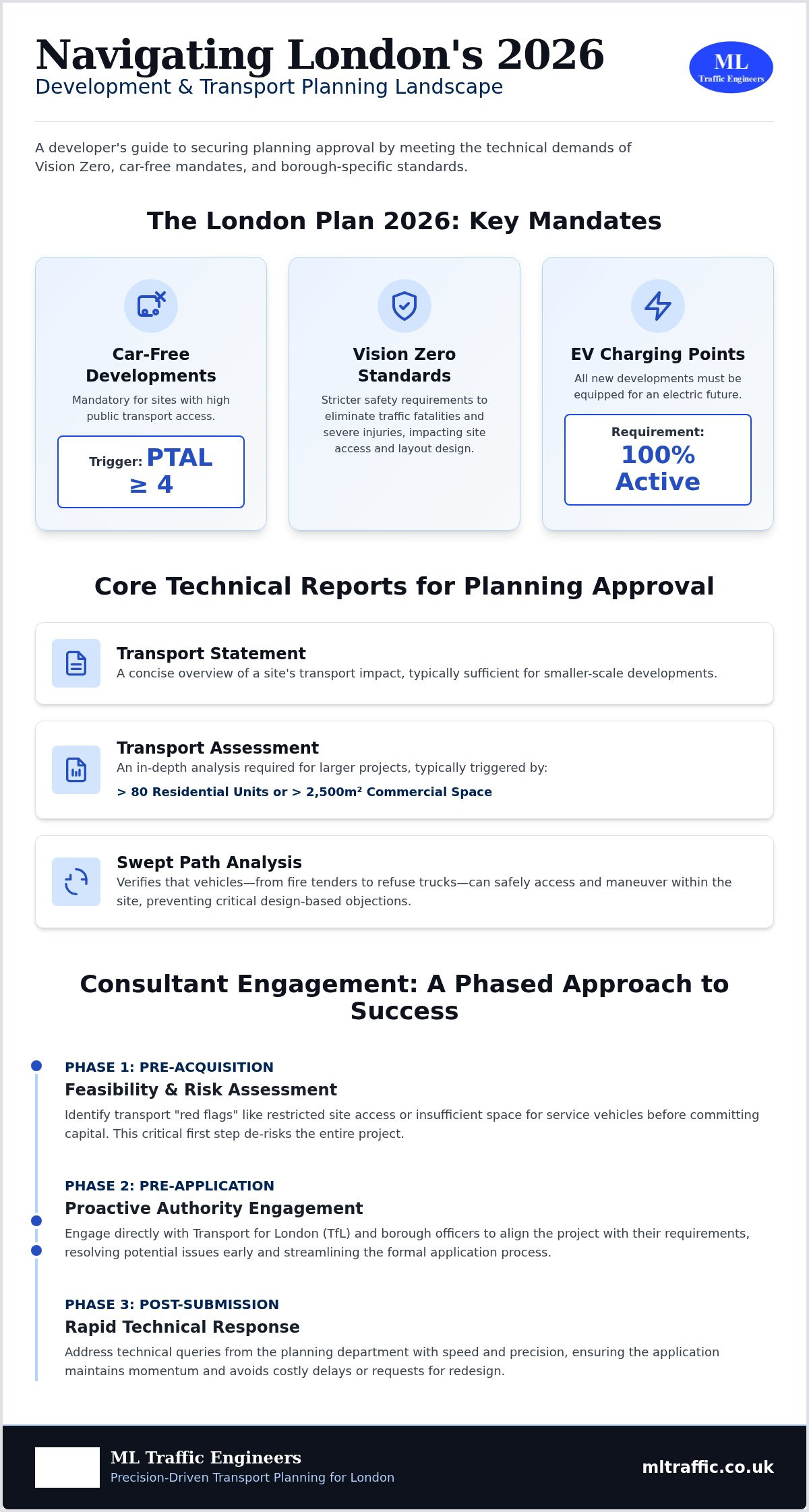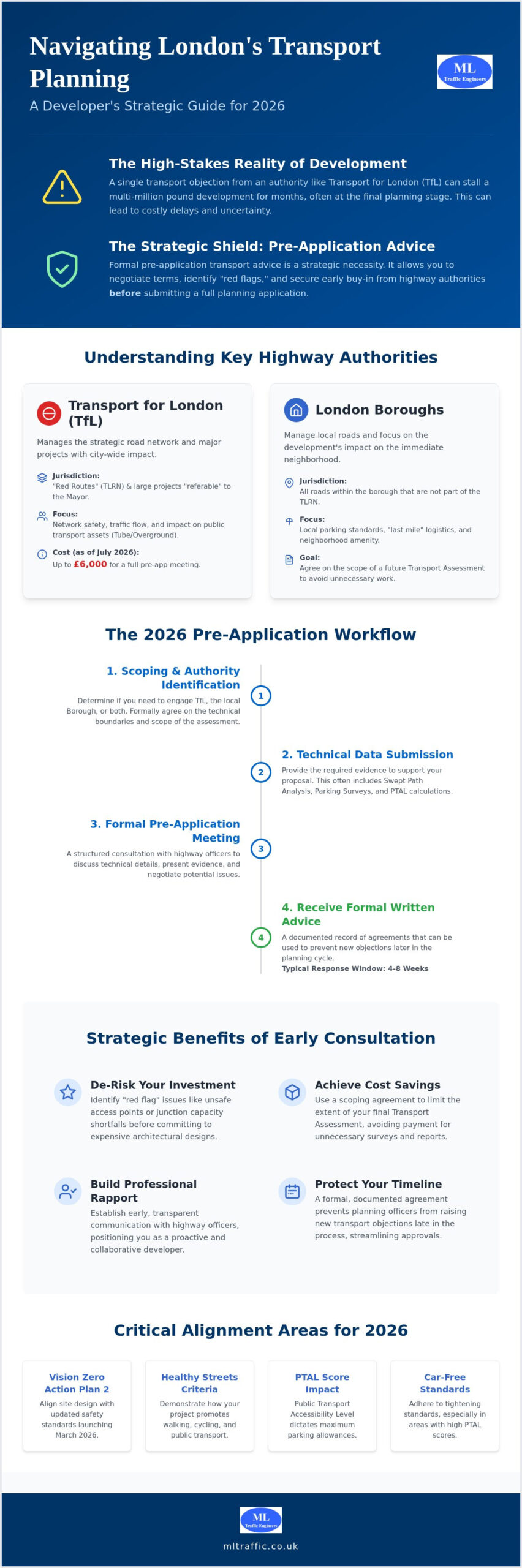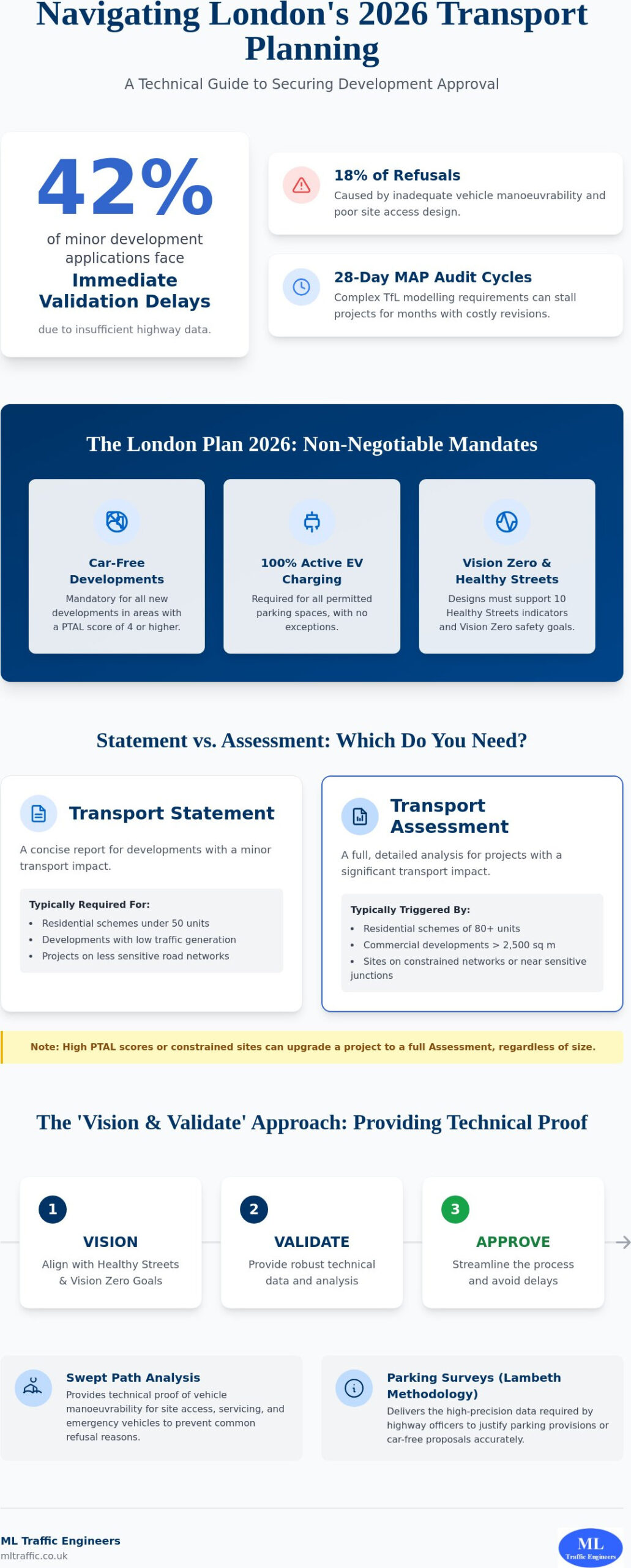
Tag: Vision Zero

  • Transport Statement Leeds: A Developer’s Guide for 2026 approvals

    Transport Statement Leeds: A Developer’s Guide for 2026 approvals

    Can a single oversight in your technical data derail a multi-million pound development before the first stone is laid? For developers operating in West Yorkshire, securing a successful transport statement leeds is no longer just about traffic counts. It requires aligning with a city aiming for a 30% reduction in car trip lengths to meet its 2030 carbon-neutral targets. We recognize that opaque requirements from Leeds City Council Highways often create a climate of uncertainty, where the fear of planning refusal or unexpected mitigation costs looms over every application.

    This guide provides the clear roadmap you need to master specific transport planning requirements and secure 2026 approvals. You’ll gain the technical insights necessary to produce professional data that stands up to the most rigorous scrutiny while maintaining cost-effective highway solutions. We will examine the latest Connecting Leeds Transport Strategy, the impact of Vision Zero 2040 on road design, and the essential steps to ensure your project supports the city’s transition to a sustainable, liveable urban centre.

    Key Takeaways

    • Understand the specific criteria Leeds City Council uses to evaluate developments with lower traffic impacts to ensure your project qualifies for a streamlined report.
    • Learn how to analyze baseline transport conditions in high-demand areas like Headingley to design safe and compliant access arrangements for all road users.
    • Discover how to align your site strategy with the “Vision Zero” safety approach and the Leeds Core Cycle Network to meet strict sustainability standards.
    • Master the step-by-step submission process to secure a robust transport statement leeds that proactively addresses potential highway mitigation costs.
    • Identify the essential data collection methods, including parking beat surveys and traffic counts, required to provide technical data that withstands council scrutiny.

    What is a Transport Statement for Leeds Planning Applications?

    A transport statement leeds is a technical document required for developments that don’t generate significant volumes of traffic but still impact the local highway network. It serves as a concise, evidence-based report that outlines how a project will manage access and safety. Leeds City Council (LCC), acting as the Local Highway Authority, uses this data to decide if a proposal aligns with regional safety standards. Without a professionally prepared statement, your planning application in West Yorkshire won’t pass the initial validation stage. It’s a mandatory requirement that proves your site is accessible and safe for all users.

    Beyond being a legal necessity, the report functions as a critical negotiation tool. It provides the technical basis for discussions between your design team and LCC Highways officers. By presenting clear data early, you can often mitigate the need for expensive off-site highway works. Our team ensures these reports reflect the high standards of modern transportation planning, providing a firm foundation for project approval. To understand how these documents fit into the city’s wider infrastructure goals, watch this overview of the Leeds transport system:

    Transport Statement vs. Transport Assessment in Leeds

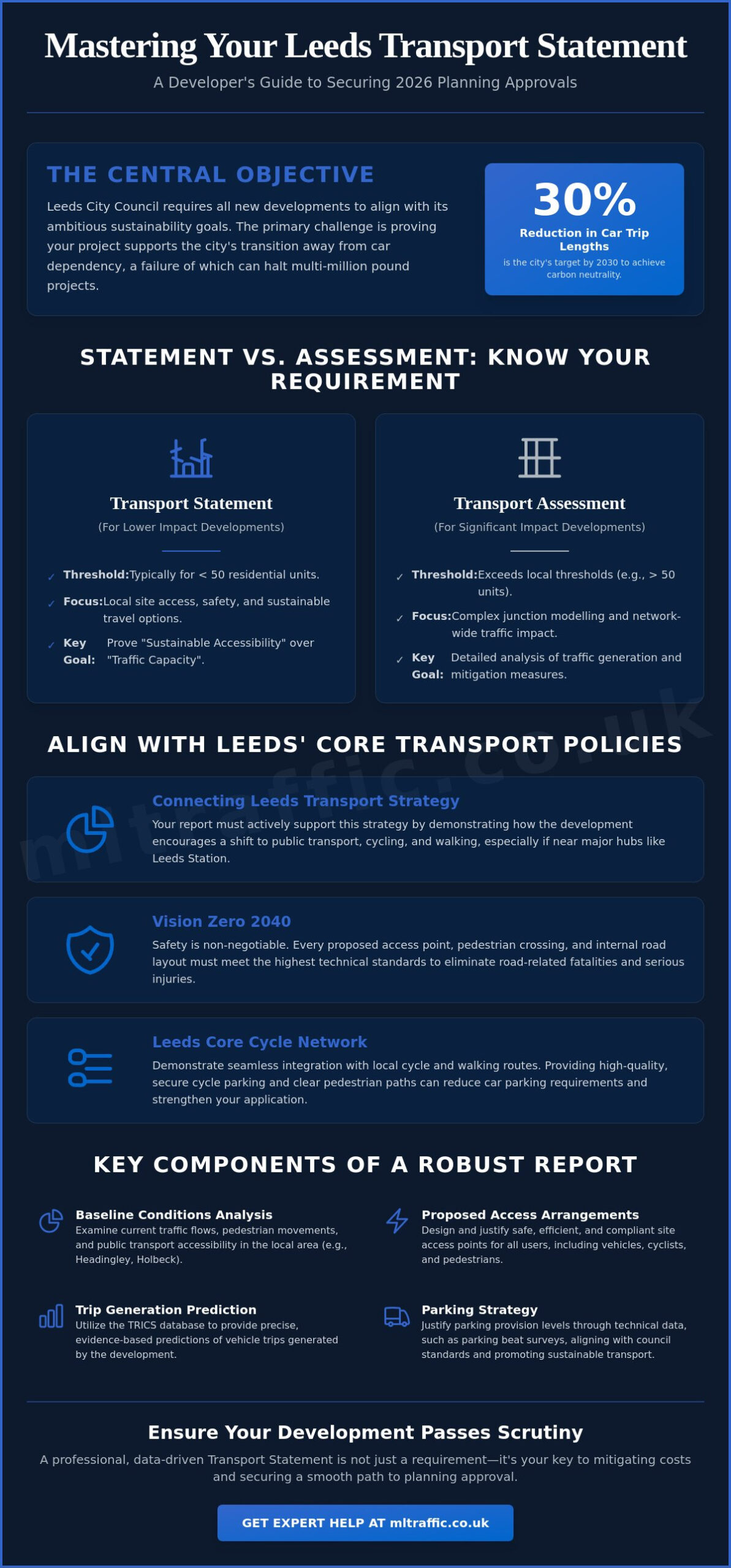
    LCC applies specific thresholds to determine which type of report you need. Generally, residential developments with fewer than 50 units only require a Statement. If your project exceeds this, or involves large-scale commercial space, a full Transport Assessment is usually necessary. The Statement is less exhaustive than an Assessment, focusing on local access rather than complex junction modelling. However, the focus in 2026 has shifted significantly. Officers no longer prioritize “traffic capacity” alone. Instead, they look for “sustainable accessibility,” meaning your report must prove that residents or visitors don’t have to rely on private cars to reach your site. You can view the different technical reports we provide to see which fits your specific project scale.

    The Strategic Importance of the Connecting Leeds Initiative

    Your transport statement leeds must actively support the Connecting Leeds Transport Strategy. This policy aims for a 30% reduction in the length of car trips across the city to help Leeds become carbon neutral by 2030. Because Leeds Station is the busiest transport hub in the north of England, your development’s proximity to rail and bus corridors is a major factor in LCC’s decision. If your site is near the Leeds Inner Ring Road, your strategy needs to address how you’ll manage vehicle movements without increasing congestion. The council’s commitment to “Vision Zero” means that safety isn’t negotiable. Every access point and pedestrian crossing you propose must meet the highest technical benchmarks to avoid planning refusal.

    Key Components of a Technical Transport Report in Leeds

    A technical transport statement leeds provides a granular analysis of the existing highway network. We examine baseline conditions in high-pressure areas such as Headingley or Holbeck to understand current traffic flows and pedestrian movements. This data allows us to design proposed access arrangements that guarantee safe entry and exit for all road users. We don’t just guess traffic volumes. Instead, we use the TRICS database to predict trip generation based on comparable sites. This precision ensures your application stands up to the scrutiny of Leeds City Council officers.

    Aligning with the Connecting Leeds Transport Strategy is essential for 2026 approvals. Your report needs to evaluate the site’s proximity to Leeds station and key bus corridors to prove that sustainable travel is a viable option. Demonstrating a clear path for walking and cycling can often reduce the need for extensive car parking. This saves you significant development costs while meeting city-wide environmental goals.

    Swept Path Analysis: Proving Site Manoeuvrability

    Leeds is famous for its narrow Victorian streets and tight urban infill sites. This makes Swept Path Analysis services a critical component of any successful application. We use specialized software to simulate the movement of large vehicles. This proves that fire tenders and refuse trucks can navigate your site safely. LCC Environmental Services will often reject a plan if refuse vehicle access isn’t clearly demonstrated. Common pitfalls in SPA often occur in Leeds City Centre where space is at a premium. We identify these issues early. This prevents delays during the consultation phase.

    Parking Surveys and Policy Compliance

    Navigating the council’s parking standards requires an understanding of different zones across the city. Central zones encourage lower car ownership. Suburban projects may face stricter requirements. We conduct detailed parking surveys to justify lower-than-standard provision when the local network has sufficient capacity. Your report must also integrate EV charging infrastructure as per the latest 2026 building regulations. These technical requirements are non-negotiable for modern approvals. If you’re unsure about your specific obligations, our team can help you prepare a robust transport statement leeds that addresses every council concern.

    Transport Statement Leeds: A Developer’s Guide for 2026 approvals

    Aligning with Leeds Sustainable Transport Policy

    Leeds City Council has adopted a “Vision Zero” strategy with the goal of eliminating all traffic fatalities and serious injuries by 2040. When you submit a transport statement leeds, you must demonstrate that your development prioritizes the safety of pedestrians and cyclists over vehicle speed. This isn’t just a local preference; it aligns with the broader National Planning Policy Framework which emphasizes promoting sustainable transport. Your site’s layout must integrate seamlessly with the Leeds Core Cycle Network. This ensures that residents can access major employment hubs without relying on the highway network.

    The West Yorkshire Connectivity Infrastructure Plan provides a framework for these regional improvements. For larger projects, you may face consultation from Active Travel England. They evaluate whether your design truly supports walking and cycling. We manage these interactions by providing technical data that proves your site contributes to a more connected city. Our approach focuses on meeting these high-level policy goals while protecting the commercial viability of your project.

    The Role of Travel Plans in Leeds Planning

    A Travel Plan is often a mandatory supplement to your transport statement leeds for commercial or larger residential sites. These plans focus on behavior change. You might offer discounted bus passes or implement car-sharing schemes to reduce the number of single-occupancy vehicle trips. Leeds City Council expects ongoing monitoring after the site is occupied. This ensures that the sustainable travel targets you set during the planning phase are actually met in practice.

    Maximising PTAL and Accessibility Scores

    Leeds utilizes an accessibility mapping system that functions similarly to London’s PTAL scores. If your site sits along the A61 or A64 corridors, you benefit from high-frequency bus services. This makes it easier to justify reduced parking provision. However, if your development is in an area with lower public transport frequency, your transport strategy must be more robust. We help you justify these locations by highlighting planned infrastructure improvements or by proposing site-specific enhancements that bridge the connectivity gap. This technical precision reduces the risk of council officers requesting expensive off-site mitigation works.

    Securing planning permission in Leeds requires a logical, sequential approach to the highway planning process. We begin with a pre-application consultation with LCC Highways to agree on the specific scope of work. This early engagement prevents the wasted cost of collecting irrelevant data or conducting unnecessary surveys. Once the scope is defined, we execute a structured five-step process to move your project toward approval:

    • Step 1: Pre-application consultation to define the technical parameters with LCC Highways officers.
    • Step 2: Data collection, including site-specific traffic counts and parking beat surveys to establish a baseline.
    • Step 3: Technical drafting and SPA modelling to ensure the design is physically feasible for refuse and emergency vehicles.
    • Step 4: Submission and response, where we manage communications with statutory consultees to resolve technical queries.
    • Step 5: Legal negotiation of Section 106 or Section 278 agreements for any required off-site highway works.

    Our team manages the entire lifecycle of your transport statement leeds, from initial data collection to final legal negotiations, ensuring your project remains on schedule.

    Common Highway Objections in Leeds and How to Overcome Them

    LCC Highways often raise objections based on an “unacceptable impact on highway safety” or concerns about “overspill parking.” These issues are particularly common in high-density residential areas like Chapel Allerton. We overcome these objections through precise design mitigation and data-driven evidence. If a council officer makes exaggerated traffic impact claims, we use more comprehensive Transport Assessments to provide the necessary counter-evidence. This technical authority protects your project from subjective decisions and ensures the council’s requests remain proportionate to your development’s actual impact.

    Section 278 Agreements in West Yorkshire

    If your development requires physical changes to the public highway, such as a new junction or a widened footway, you’ll need a Section 278 agreement. Securing technical approval for Highway Design S278 involves a detailed review by LCC engineers to ensure the works meet West Yorkshire standards. You must budget for commuted sums, which are payments made to the council for the future maintenance of the new infrastructure. We provide the technical drawings and specifications required to pass LCC inspection fees and secure technical approval without unnecessary revisions. This proactive management minimizes the logistical and financial pressures on your project team.

    Why Choose ML Traffic Engineers UK for Your Leeds Development?

    Partnering with ML Traffic Engineers UK ensures your project is backed by a consultancy that understands the specific nuances of the West Yorkshire Combined Authority and LCC. We offer a data-driven methodology that removes the uncertainty often associated with highway planning. Preparing a transport statement leeds requires more than just technical reporting; it demands a deep understanding of local policy shifts and the specific expectations of LCC Highways officers. Our track record includes securing approvals for complex urban sites where space is at a premium and regulatory scrutiny is at its highest. Precision is non-negotiable.

    We take immense pride in our role as a dependable, highly organized expert. Our team manages the entire project lifecycle from inception to completion. We handle everything from the initial site assessment and Swept Path Analysis to the final monitoring of a Travel Plan. This comprehensive, fully-managed service serves as a unique hallmark of our brand promise. By maintaining a focus on precision and adherence to standards, we minimize the risk of planning delays and help you avoid the unexpected costs of excessive highway mitigation. We view our role not just as a service provider, but as a vital partner in ensuring public safety through rigorous technical analysis.

    Our Technical Expertise

    We utilize the latest CAD and SPA software to conduct precise manoeuvrability testing. This level of technical accuracy is essential for proving that your site can accommodate refuse vehicles and fire tenders, especially on constrained urban sites in the city centre. Our engineers have direct experience negotiating with LCC Highways officers on a regular basis. We understand the specific lexicon and data points they require to grant approval. This specialized knowledge allows us to advocate effectively for your project, ensuring that mitigation requests remain proportionate and fair. You can visit our What We Do page to see the full range of technical reports we provide to support your application.

    Get a Quote for Your Leeds Project

    We recognize that the infrastructure maintenance and development environment is fast-moving and often unpredictable. ML Traffic Engineers UK offers a fast turnaround for every transport statement leeds to ensure you meet your critical submission deadlines. We provide transparent pricing with no hidden technical fees, allowing you to budget with confidence from the start. Reliability is the foundation of our service. We maintain a standard of formal excellence that aligns with the strict regulatory environments in which we operate. You can contact us via our homepage for an initial site review. We’ll help you identify potential highway risks early and provide the technical authority needed to secure your 2026 planning approval.

    Securing Your 2026 Planning Approval

    Successful development in West Yorkshire requires a proactive approach to highway planning. Aligning with the Connecting Leeds strategy and meeting Vision Zero safety standards is now essential for a smooth application process. A robust transport statement leeds acts as your primary defense against planning delays. It provides the technical evidence needed to justify your site design and access arrangements. By prioritizing sustainable accessibility and precise data, you can navigate council requirements with confidence and avoid disproportionate mitigation costs.

    We bring over 10 years of UK transport planning expertise to every project. Our team specializes in Leeds City Council highway standards and provides specialist Swept Path Analysis capabilities to solve the tightest urban site constraints. We understand the regulatory pressures you face and offer the technical authority required to secure a positive outcome. Request a Transport Statement Quote for Your Leeds Project today to ensure your development remains on track. We’re ready to help you move your project from the drawing board to the construction phase.

    Frequently Asked Questions

    Do I need a Transport Statement for a small residential conversion in Leeds?

    Leeds City Council typically requires a transport statement leeds for conversions that increase the intensity of use or alter existing access. Even small residential projects must prove they don’t compromise highway safety or local parking capacity. We assess your specific site to determine if LCC will mandate a formal report for validation.

    How much does a Transport Statement cost for a Leeds planning application?

    The cost depends on the specific technical requirements and the amount of data collection needed for your site. We don’t offer flat-rate pricing because every development has unique highway constraints. Instead, we provide a transparent, bespoke quote once we’ve reviewed your project’s scope and LCC’s expectations.

    What is the difference between a Transport Statement and a Transport Assessment in West Yorkshire?

    A Transport Statement is a concise report for developments with lower traffic impacts, while a Transport Assessment is a comprehensive study for larger projects. In West Yorkshire, the threshold for a full Assessment is usually 50 residential units or significant commercial floor space. Assessments require complex junction modeling that isn’t necessary for a standard Statement.

    Will Leeds City Council accept a Transport Statement without Swept Path Analysis?

    LCC rarely accepts reports for constrained sites without technical proof of vehicle manoeuvrability. Refuse vehicle and fire tender access are non-negotiable for Environmental Services. We include Swept Path Analysis as a standard component to ensure your design is physically feasible and avoids immediate rejection.

    How long does it take to produce a Transport Statement for a Leeds project?

    Most reports are completed within a 2 to 4 week timeframe. This duration allows for the mobilization of traffic counts and the technical drafting of the report. We understand the urgency of planning deadlines and work to deliver high-quality data as rapidly as possible to keep your project moving.

    What happens if LCC Highways objects to my Transport Statement?

    We immediately analyze the technical basis of the objection to find a viable solution. This often involves negotiating with highways officers or proposing design mitigations that address their safety concerns. Our goal is to provide the technical authority needed to overturn objections and secure your planning permission.

    Do I need a parking survey for a car-free development in Leeds City Centre?

    A parking survey is often mandatory for car-free sites to prove that residents won’t park in the surrounding area. LCC wants to see evidence that your project won’t cause “parking overspill” on local streets. We conduct these surveys during peak hours to provide a realistic picture of current street capacity.

    Can a Transport Statement help reduce Section 106 contributions?

    Professional technical evidence can ensure your Section 106 contributions are based on actual impact rather than generic formulas. By proving your development generates fewer trips than standard models predict, we can help keep your highway mitigation costs proportionate. This data-driven approach protects the commercial viability of your Leeds project.

    Michael Lee

    Article by

    Michael Lee

    Transport planner with over 35 years' experience.

    Disclaimer

    The content on mltraffic.co.uk, including all technical articles, guides, and resources, is provided for general informational and educational purposes only. It is not intended to constitute professional advice in traffic engineering, transportation planning, development approvals, or any other technical or legal field.
    While ML Traffic Engineers makes every reasonable effort to ensure the accuracy, completeness, and timeliness of the information published, we do not provide any warranties or representations (express or implied) regarding its reliability, suitability, or availability for any particular purpose. Any reliance you place on the content is strictly at your own risk.
    In no event shall ML Traffic Engineers, its directors, employees, authors, or affiliates be liable for any direct, indirect, incidental, special, consequential, or punitive damages (including, without limitation, loss of profits, data, or business opportunities) arising out of or in connection with the use of, or inability to use, any information provided on this website.
    The articles and guides on this site are not a substitute for engaging a qualified, professional traffic engineer to assess your specific project requirements. For tailored advice, compliance assessments, or traffic engineering services, please contact a competent professional.
    This disclaimer may be updated from time to time without notice. By accessing or using this website, you agree to be bound by the most current version of this disclaimer.
  • Transport Planning Consultants Hounslow: Navigating 2026 Planning Approvals

    Transport Planning Consultants Hounslow: Navigating 2026 Planning Approvals

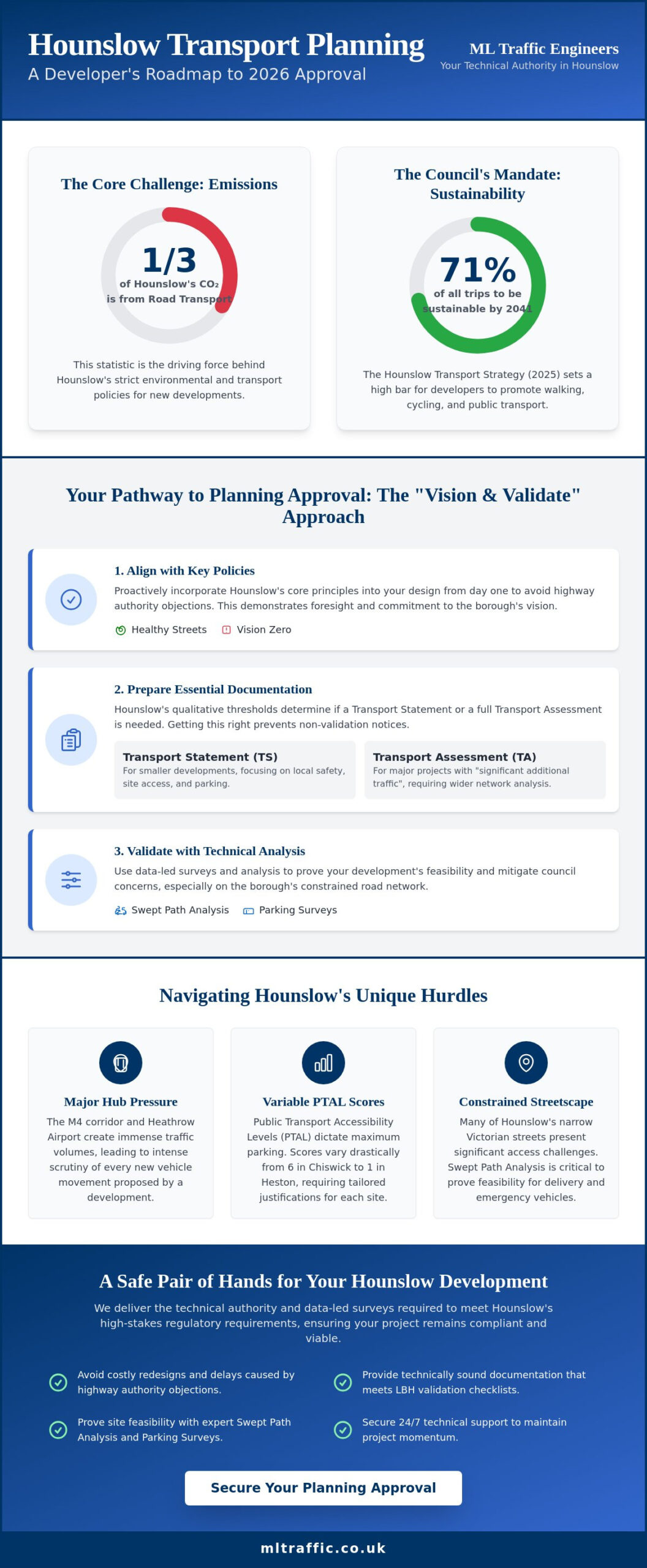
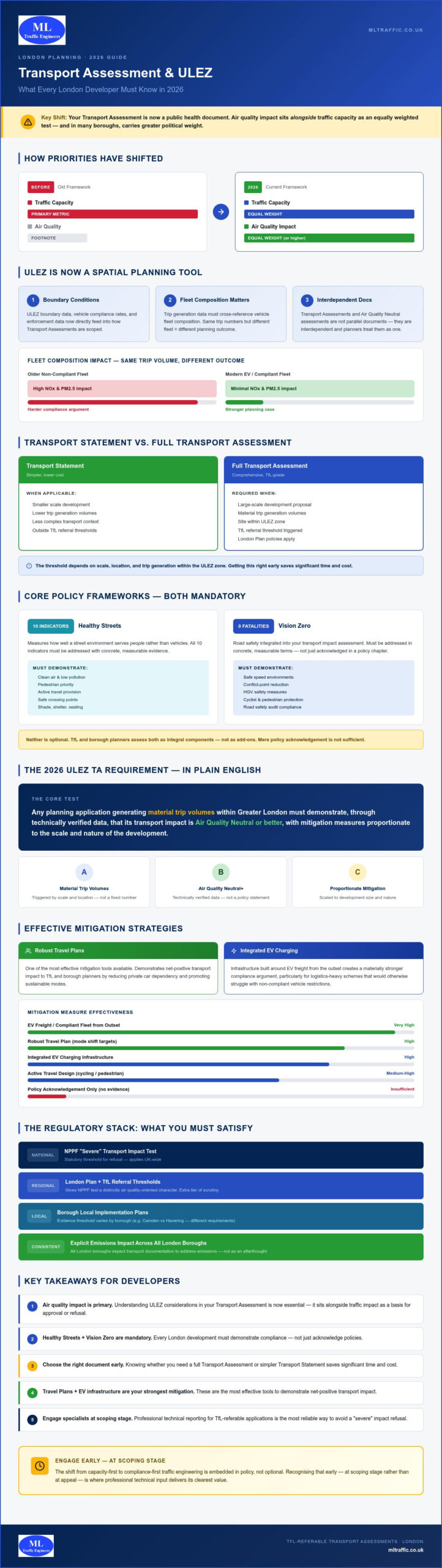
    Road transport accounts for one third of all CO2 emissions in Hounslow. This figure drives the rigorous Hounslow Transport Strategy adopted on March 25, 2025, which demands that 71% of all trips be sustainable by 2041. For developers, this means the era of simple site access is over. As leading Transport Planning Consultants Hounslow, we provide the technical authority and data-led surveys required to meet these high-stakes regulatory requirements. We act as a safe pair of hands, ensuring your project remains compliant and viable from the initial consultation.

    You’re probably aware that highway authority objections are the primary cause of project delays and high redesign costs. We promise to help you avoid these pitfalls by delivering technically sound transport statements and swept path analysis that align with the 2026 Public Transport Plan. This article outlines the “Vision and Validate” approach necessary for 2026 planning approvals. We’ll show you how to leverage local planning insights and pre-application advice to achieve a swift, cost-effective result for your Hounslow development.

    Key Takeaways

    • Align your development with the Hounslow Transport Strategy 2025 to proactively address highway authority concerns and avoid costly redesigns.
    • Identify the specific triggers for Transport Statements and Assessments to ensure your documentation is technically sound and meets the council’s qualitative thresholds.
    • Partner with expert Transport Planning Consultants Hounslow to utilize Swept Path Analysis and Parking Surveys, proving site feasibility on the borough’s narrow Victorian streets.
    • Implement ‘Healthy Streets’ and ‘Vision Zero’ principles into your site access design to satisfy the London Borough of Hounslow’s 2026 safety and accessibility benchmarks.
    • Secure 24/7 technical support to manage complex regulatory requirements and maintain momentum toward your planning approval deadline.

    Effective transportation planning in West London requires more than just drawing lines on a map. In Hounslow, it represents the critical intersection between the council’s rigid policy frameworks and the technical feasibility of your site. As the local Highway Authority, the London Borough of Hounslow (LBH) holds final say over how your development interacts with the public road network. We understand that securing approval depends on aligning your project with the Hounslow Transport Strategy adopted on March 25, 2025. This document sets a high bar for safety and environmental performance that every developer must clear.

    The borough’s infrastructure is heavily influenced by the M4 corridor and Heathrow Airport. These major hubs funnel immense traffic volumes through local residential areas, creating a regulatory environment where every vehicle movement is scrutinized. As experienced Transport Planning Consultants Hounslow, we analyze these external pressures to ensure your site access designs don’t just work on paper but survive the scrutiny of the LBH planning committee. The 2026 updates to the Hounslow Local Plan have introduced stricter requirements for developers, making professional technical support a necessity to avoid costly delays.

    To better understand the council’s vision for the future of the borough’s infrastructure, watch this helpful video:

    Hounslow’s Unique Transport Challenges

    Developers face significant hurdles when managing air quality and noise constraints, particularly near major arterial routes like the A4. Road transport currently generates one third of all CO2 emissions in the borough. This fact drives the council’s push for high-density, car-free developments in areas like Brentford and Feltham. Additionally, Heathrow’s 24/7 operations place unique demands on residential street capacity. We help you navigate these complexities by using data-led surveys to prove your development won’t exacerbate existing congestion. Our team understands how to balance these high-density requirements with the practicalities of site access.

    The Role of PTAL Ratings in Hounslow

    Public Transport Accessibility Level (PTAL) scores are the primary tool used by LBH to determine your project’s maximum allowable parking. These scores vary wildly across the borough. A site in high-density Chiswick might boast a PTAL of 5 or 6, while a project in Heston could struggle with a score of 1 or 2. This rating directly dictates your parking provision under the London Plan. We specialize in interpreting these scores and providing the necessary technical justification to the Highway Authority. You can learn more about our technical approach on our services page.

    Essential Transport Documentation for Hounslow Planning Approvals

    The London Borough of Hounslow (LBH) requires specific technical documentation to validate any planning application that impacts the local highway. These requirements aren’t arbitrary. They’re dictated by the LBH Validation checklist v.8 and the Hounslow Transport Strategy adopted on March 25, 2025. Choosing experienced Transport Planning Consultants Hounslow ensures your submission includes the correct level of detail from the start. This proactive approach prevents the highway authority from issuing non-validation notices or requesting expensive mid-process revisions. You can see how we’ve applied these reports across various sectors on our project types page.

    Transport Statements vs. Transport Assessments

    LBH uses a qualitative assessment to determine which report your project needs. While general benchmarks suggest a Transport Statement (TS) for smaller developments, such as those under 50 to 80 residential units, the council focuses on the “significant additional traffic” a site might generate. A TS focuses on local safety and site access. In contrast, major developments require a full Transport Assessment (TA). These documents use TRICS data and complex junction capacity analysis to predict wider network impacts. If you’re unsure which path your project falls under, our Transport Assessment London Guide provides a technical breakdown of the 2026 requirements.

    Even small sites may trigger a TA if they’re located in parking-stressed areas or propose a reduction in existing parking. We analyze these triggers early to ensure your application remains technically sound. If you’re preparing a submission, our team offers initial consultations to clarify these qualitative thresholds before you submit.

    The Importance of Travel Plans in 2026

    Hounslow Council views the Framework Travel Plan as a living document rather than a one-time checkbox. It’s a critical tool for meeting the borough’s target of 71% sustainable trips by 2041. Because road transport causes one third of Hounslow’s CO2 emissions, the council prioritizes developments that actively reduce car dependency. These plans must include measurable targets for walking, cycling, and public transport use. The council’s investment in projects like the £1 million Isleworth Station accessibility upgrade highlights their commitment to these modes. Our London Travel Plans Guide explains how to draft a plan that satisfies LBH’s 2026 sustainability benchmarks while remaining practical for the site operator.

    Transport Planning Consultants Hounslow: Navigating 2026 Planning Approvals

    Technical Precision: Swept Path Analysis and Parking Surveys

    Hounslow’s historic road layout presents physical constraints that generic planning advice cannot solve. Narrow Victorian streets in areas like Brentford and Isleworth require a high level of technical accuracy to prove site viability. As Transport Planning Consultants Hounslow, we provide the precision needed to navigate these tight urban environments. We use advanced CAD design to eliminate guesswork, ensuring your site access is safe, functional, and compliant with current highway standards. This technical authority protects you from the high costs of redesigning access points after a planning submission has already been made.

    Precision is a legal and physical necessity in West London’s high-stakes planning environment. Our team acts as a safe pair of hands, utilizing data-led surveys to satisfy the London Borough of Hounslow’s (LBH) rigorous safety standards. With the UK government currently consulting on a new national default fee schedule as of March 23, 2026, the financial risk of a rejected application is higher than ever. Getting the technical details right the first time is the only way to maintain your project’s momentum and budget.

    Swept Path Analysis for Hounslow Sites

    Swept Path Analysis (SPA) is a digital simulation of vehicle turning circles used to predict how a specific vehicle will navigate a proposed layout. We use this technology to test fire tender and refuse vehicle access for new Hounslow cul-de-sacs, ensuring emergency services and council services aren’t hindered. In industrial zones near the M4, we demonstrate safe ingress and egress for HGVs to prevent vehicle strikes or pavement mounting. Our Swept Path Analysis Services provide the visual, technically sound proof that planners require for constrained site designs. We deliver bespoke solutions that address the specific geometry of your site, rather than relying on generic templates.

    Parking Surveys and the Lambeth Methodology

    Hounslow planners frequently demand overnight parking surveys for residential conversions or new builds in “parking-stressed” zones. We apply the Lambeth Methodology to assess on-street parking capacity within a 200m radius of your site. This rigorous standard is the benchmark for LBH, requiring surveys conducted at specific times—typically between 1:00 AM and 3:00 AM—to capture peak residential demand. The data-driven evidence from these traffic surveys is vital for S106 negotiations, often determining whether a development can proceed as “car-free” or if parking permits must be restricted. We provide comprehensive support throughout this data collection process, ensuring the results are transparent and defensible during the committee stage.

    Policy Alignment: Vision Zero and Healthy Streets in Hounslow

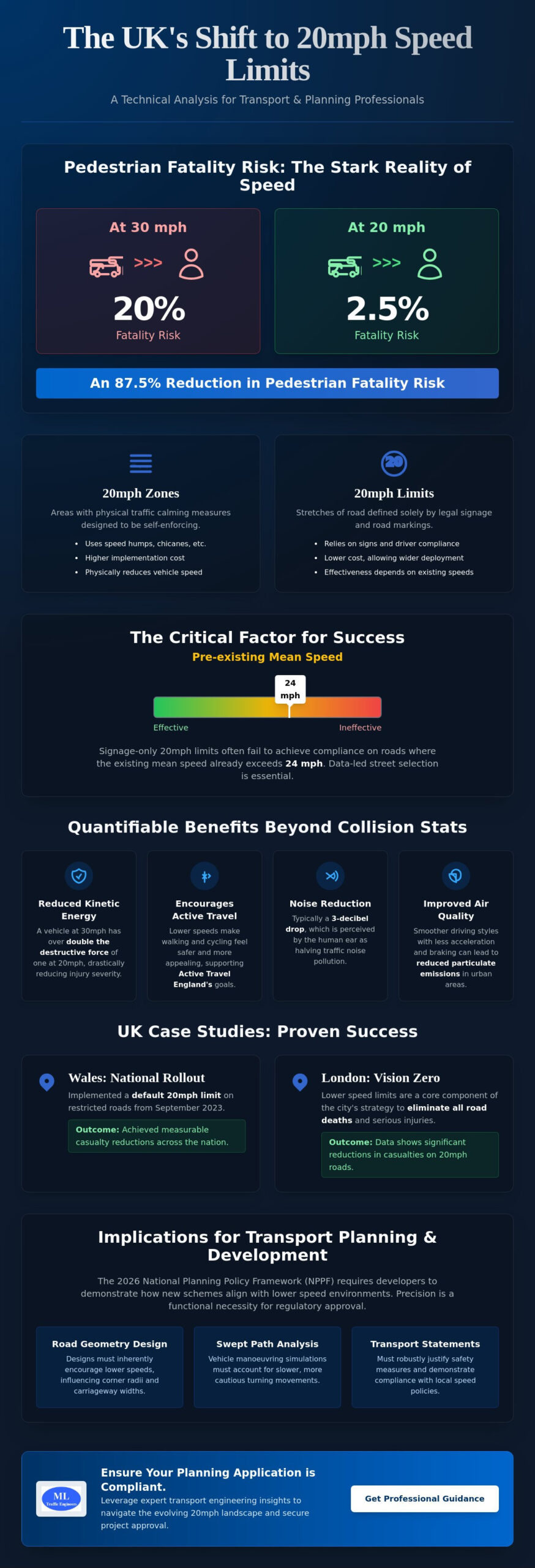
    Hounslow’s planning landscape in 2026 is defined by a rigorous commitment to “Vision Zero.” This policy aims to eliminate all deaths and serious injuries on the borough’s road network. When you submit a planning application, the council evaluates your site access design through this lens of absolute safety. As professional Transport Planning Consultants Hounslow, we align your development with these life-saving objectives from the earliest design phase. We ensure your project isn’t just a set of drawings but a technically sound contribution to a safer West London.

    The 2026 National Planning Policy Framework (NPPF) updates have solidified the shift from “Predict and Provide” to “Vision and Validate.” Instead of simply predicting car growth and providing road space, developers must now set a sustainable vision for their site and validate it with data. This approach is central to achieving the council’s target of 71% sustainable trips by 2041. We provide the technical authority to navigate this transition, using local planning insights to prove your site can thrive with reduced car dependency while maintaining operational efficiency.

    Implementing Healthy Streets Indicators

    The “Healthy Streets” approach is the standard for Hounslow town centres. This framework prioritizes pedestrians and cyclists by assessing ten key indicators, including “easy to cross” and “not too noisy.” We integrate these indicators into your transport planning to reduce the “severance” effect of major roads like the A4. By incorporating active frontages and safe crossing designs, your development becomes an integrated part of the community rather than an isolated island. Our team ensures these designs meet LBH’s specific accessibility benchmarks, which were bolstered by the council’s £1 million investment in Isleworth Station accessibility in the 2023/24 fiscal year.

    Section 278 and Highway Design

    Most developments in Hounslow require off-site highway improvements facilitated through Section 278 (S278) agreements. These legal contracts allow you to carry out works on the public highway, such as creating new junctions or improving footways. Our Highway Design S278 Guide details the technical requirements for these submissions. We prioritize Chapter 8 safety standards throughout the design process to ensure your implementation is compliant and safe for the public. If you need to secure your project’s future with technically sound site access, explore our full range of managed solutions.

    Why Choose ML Traffic Engineers as Your Hounslow Consultants?

    Securing planning approval in West London requires more than just technical skill; it demands a partner who understands the high-stakes nature of regulatory compliance. We position ourselves as a safe pair of hands, managing the intricate complexities of UK road regulations so you don’t have to. As leading Transport Planning Consultants Hounslow, we offer 24/7 availability to meet urgent planning deadlines and emergency revisions. This constant readiness is a primary hallmark of our brand promise, ensuring that busy project managers never lose momentum due to a consultant’s lack of availability. Since our founding in 2014, we’ve built a track record of precision and reliability across the borough.

    Our technical authority is rooted in a data-driven approach. We don’t guess at traffic volumes or parking capacity. Instead, we provide the empirical evidence required to satisfy the London Borough of Hounslow’s (LBH) specific planning preferences. This includes aligning every technical report with the Hounslow Transport Strategy adopted on March 25, 2025, and the emerging Public Transport Plan anticipated for summer 2026. By choosing us, you ensure your project benefits from seamless integration between initial CAD design and final technical documentation. We prioritize clarity and speed of information, allowing you to grasp the scope of our offerings without navigating through unnecessary filler.

    Our Total Managed Solution

    We provide a comprehensive service that covers the entire lifecycle of your project’s transport requirements. Our team manages everything from initial site feasibility studies to final planning submission support. We maintain direct communication with local highway officers to pre-empt objections before they cause delays. If a project reaches a stalemate, we offer expert witness services for Hounslow planning appeals. This total managed solution ensures that your development stays on track, regardless of the regulatory hurdles encountered. We take pride in our professional integrity, acting as vital guardians of both public safety and your project’s success.

    Get Started on Your Hounslow Project

    Don’t let highway authority objections stall your development’s progress. We invite you to visit our What We Do page to see the full scope of our bespoke solutions. Whether you need a simple parking survey or a complex transport assessment for a major site in Brentford, our team is ready to assist. We operate with a sense of urgency that matches the fast-moving nature of construction and utility works. Contact us today for a bespoke quote or an initial transport consultation. We’ve been serving West London since 2014, providing the technical precision and professional integrity required to secure your site’s future.

    Secure Your Site’s Future in Hounslow

    Navigating the London Borough of Hounslow’s planning requirements requires aligning with the Transport Strategy adopted on March 25, 2025. Developers must transition to a “Vision and Validate” approach to meet the 71% sustainable trip target by 2041. Technical precision through swept path analysis and parking surveys using the Lambeth Methodology ensures your site remains viable on Hounslow’s constrained Victorian streets. These standards are the foundation of a successful 2026 planning application. Our data-led approach provides the evidence needed to satisfy the Highway Authority and avoid costly delays.

    As expert Transport Planning Consultants Hounslow, we provide the technical authority and data-driven surveys needed for complex 2026 planning approvals. We offer 24/7 availability for urgent reports and deep knowledge of the Hounslow Local Plan 2026 to ensure your project stays on schedule. Our team acts as a safe pair of hands, managing everything from initial feasibility to final technical documentation. Secure your Hounslow planning approval with expert transport consultants and move your development forward with confidence. We’re ready to help you navigate these regulatory hurdles and achieve your project goals.

    Frequently Asked Questions

    When do I need a transport planning consultant for a Hounslow development?

    You need a consultant whenever your project generates significant additional traffic or proposes a reduction in existing parking. This requirement comes from the council’s Validation checklist v.8. Professional Transport Planning Consultants Hounslow ensure your technical reports meet the benchmarks set in the Hounslow Transport Strategy adopted on March 25, 2025. Engaging an expert early helps you navigate pre-application advice and avoid highway authority objections.

    What is the difference between a Transport Statement and a Transport Assessment in Hounslow?

    A Transport Statement is a concise report for smaller developments with limited impact on the local road network. A Transport Assessment is a comprehensive document for major schemes that requires TRICS data and detailed junction capacity analysis. Hounslow Council uses a qualitative assessment to decide which report you need. They focus on the potential for “significant additional traffic” rather than relying on a fixed number of units.

    How much does a transport statement cost for a Hounslow planning application?

    Consultant fees for a transport statement depend on the site’s specific constraints and the complexity of the required data. While the London Borough of Hounslow published a 2026-2027 fee schedule for planning applications, such as £610 for outline applications on sites under 0.5 hectares, these are council administrative fees only. Technical report costs are separate. We provide bespoke quotes based on the technical authority and surveys your specific site requires.

    Is Swept Path Analysis mandatory for all new Hounslow developments?

    It’s mandatory for any development where vehicle manoeuvrability is a concern for the Highway Authority. This specifically applies to fire tenders, refuse vehicles, and HGV deliveries. Because Hounslow features many narrow Victorian streets, planners require CAD-based digital simulations to prove these vehicles can safely enter, turn, and exit the site. Providing this proof early prevents delays caused by safety concerns regarding emergency service access.

    What is the ‘Vision and Validate’ approach in 2026 transport planning?

    This approach replaces the traditional “Predict and Provide” model by prioritizing sustainable travel goals over car capacity. It aligns with the 2026 NPPF updates and Hounslow’s target for 71% of all trips to be made by walking, cycling, or public transport by 2041. Developers must set a sustainable vision for their site and then validate it with technical data. This often involves implementing robust Travel Plans and “Healthy Streets” indicators.

    How does Hounslow Council assess parking stress in residential areas?

    The council assesses parking stress using the Lambeth Methodology to measure on-street capacity within a 200m radius of the site. This process requires overnight parking surveys conducted between 1:00 AM and 3:00 AM on two separate weekday nights. These surveys provide the data-driven evidence needed for S106 negotiations. Planners use this data to decide if a development can be “car-free” or if residents should be restricted from obtaining parking permits.

    Can a transport consultant help with a Section 278 agreement in Hounslow?

    Yes, Transport Planning Consultants Hounslow provide the technical designs and safety documentation required for Section 278 (S278) agreements. These legal contracts allow developers to perform works on the public highway, such as junction improvements or footway repairs. We ensure all designs comply with Chapter 8 safety standards and LBH specifications. Our team manages the technical dialogue with highway officers to facilitate a smooth approval process for your off-site works.

    What are the PTAL requirements for developments in Chiswick vs Brentford?

    Public Transport Accessibility Level (PTAL) scores dictate the maximum allowable parking for your site under the London Plan. Sites in high-density Chiswick often achieve PTAL scores of 5 or 6, which typically requires car-free or very low parking provision. Brentford’s scores vary between 3 and 5, depending on proximity to the railway station and bus corridors. We analyze these scores to ensure your parking provision satisfies the council’s 2026 sustainability benchmarks.

    Michael Lee

    Article by

    Michael Lee

    Transport planner with over 35 years’ experience.

    Disclaimer

    The content on mltraffic.co.uk, including all technical articles, guides, and resources, is provided for general informational and educational purposes only. It is not intended to constitute professional advice in traffic engineering, transportation planning, development approvals, or any other technical or legal field.
    While ML Traffic Engineers makes every reasonable effort to ensure the accuracy, completeness, and timeliness of the information published, we do not provide any warranties or representations (express or implied) regarding its reliability, suitability, or availability for any particular purpose. Any reliance you place on the content is strictly at your own risk.
    In no event shall ML Traffic Engineers, its directors, employees, authors, or affiliates be liable for any direct, indirect, incidental, special, consequential, or punitive damages (including, without limitation, loss of profits, data, or business opportunities) arising out of or in connection with the use of, or inability to use, any information provided on this website.
    The articles and guides on this site are not a substitute for engaging a qualified, professional traffic engineer to assess your specific project requirements. For tailored advice, compliance assessments, or traffic engineering services, please contact a competent professional.
    This disclaimer may be updated from time to time without notice. By accessing or using this website, you agree to be bound by the most current version of this disclaimer.
  • The Developer’s Guide to Delivery and Servicing Plans (DSP) in London 2026

    The Developer’s Guide to Delivery and Servicing Plans (DSP) in London 2026

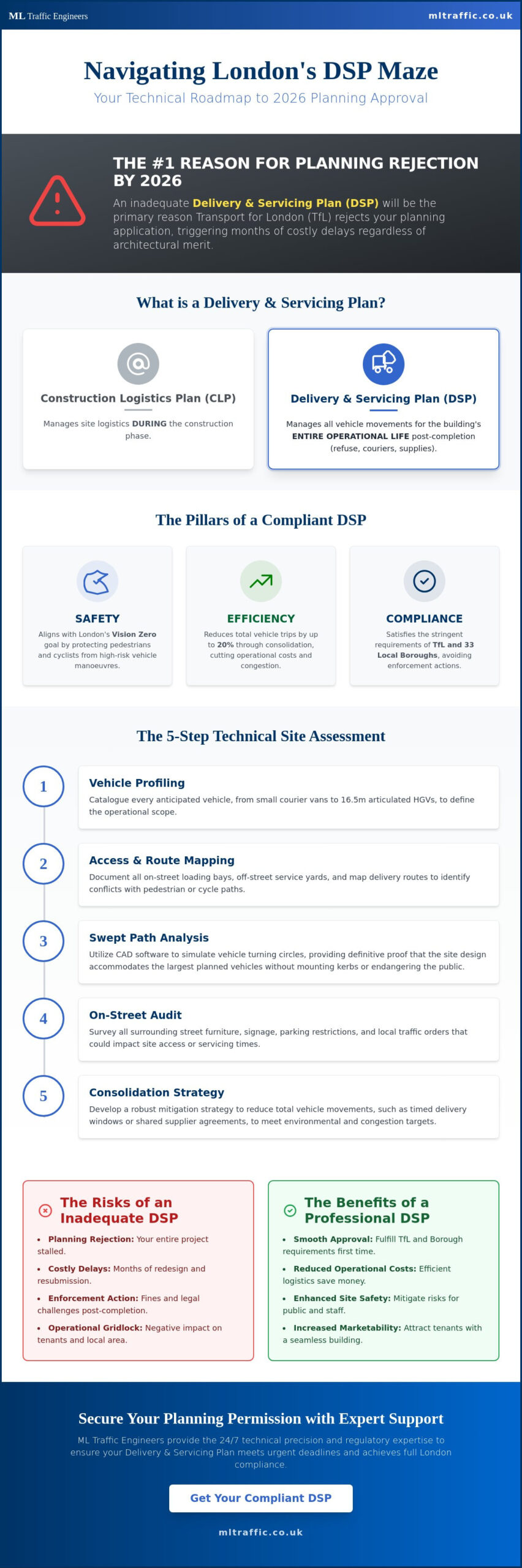
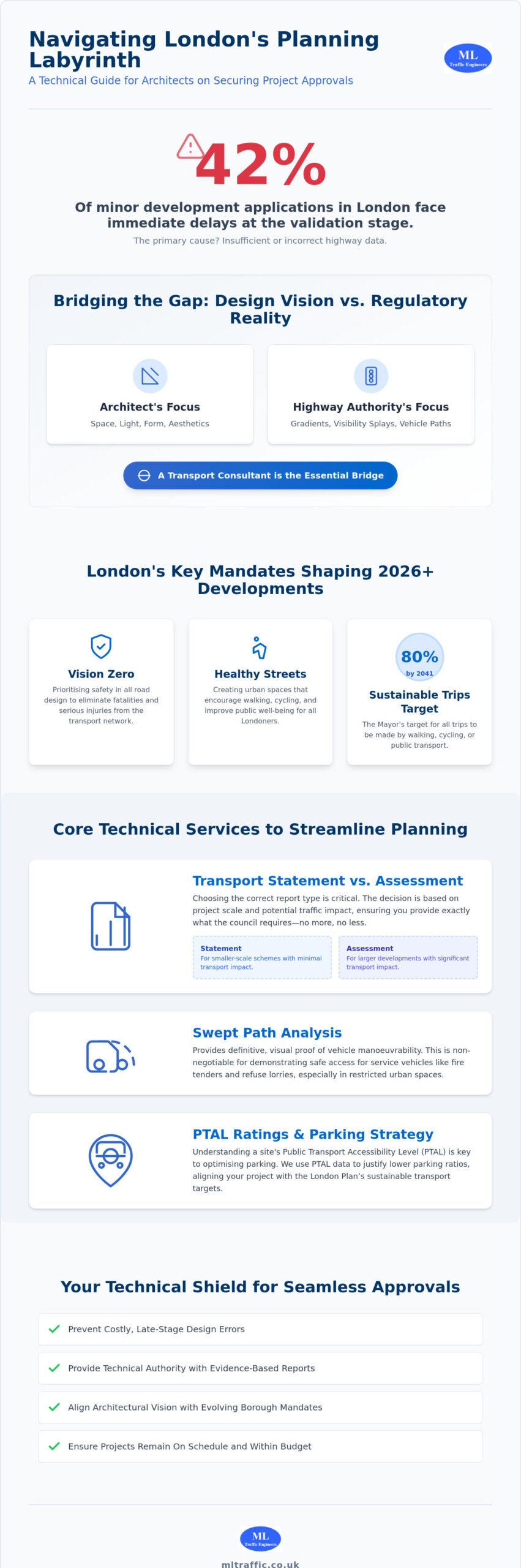
    By 2026, an inadequate delivery and servicing plan london will be the primary reason Transport for London (TfL) rejects your planning application, regardless of your project’s architectural merit. You already know that managing 33 local authorities means facing a fragmented landscape of conflicting logistical requirements and tightening Vision Zero safety standards. It’s a high-stakes environment where a single oversight in vehicle swept path analysis or loading bay scheduling can trigger months of costly planning delays. We understand the pressure to balance operational efficiency with 2026 environmental standards is immense.

    This guide provides the technical roadmap you need to master the DSP approval process and secure your planning permission. We’ll examine the specific data points required for compliance, from ULEZ-aligned logistics to the integration of Chapter 8 safety protocols, giving you a clear path to reduced congestion and seamless operational implementation. By following these steps, you can mitigate the rising costs of London compliance and ensure your project moves from the initial planning phase through to final implementation without friction.

    Key Takeaways

    • Understand the mandatory technical requirements for London planning authorities and why high-density urban factors necessitate a robust logistics strategy.
    • Learn how to conduct a rigorous site assessment for your delivery and servicing plan london, ensuring all vehicle types from transit vans to 16.5m HGVs are accounted for.
    • Master the principle of consolidation to reduce total vehicle movements and successfully mitigate common planning objections regarding restricted site access.
    • Navigate the regulatory hierarchy between Transport for London (TfL) and local boroughs to streamline your submission and approval timelines.
    • Discover how partnering with specialized traffic engineers provides the 24/7 technical support and precision required to meet urgent project deadlines and ensure full compliance.

    Table of Contents

    What is a Delivery and Servicing Plan (DSP) in the London Context?

    A delivery and servicing plan london is a technical report required by local planning authorities to manage vehicle movements for a completed development. It isn’t just a box-ticking exercise. It’s a live strategy to ensure your building doesn’t gridlock the surrounding streets once it’s occupied. London’s geography presents unique challenges that make these plans essential. High-density zones and historic narrow streets mean that every vehicle stop must be calculated. While a Construction Logistics Plan (CLP) governs the build phase, the DSP focuses on the building’s permanent operational life, managing everything from refuse collection to courier drops.

    To better understand how professional logistics and servicing operate within the capital, watch this helpful video:

    The primary goals of a DSP are safety, efficiency, and environmental compliance. You must demonstrate that your site’s logistics won’t compromise London’s transport network. At ML Traffic, we provide the technical precision required to meet these high-stakes regulatory demands. We offer a total, managed solution to ensure your project stays compliant with the latest Transport for London (TfL) standards. Our 24/7 readiness reflects the constant movement of the city, providing developers with a safe pair of hands for complex urban requirements.

    Why London Planning Authorities Require a DSP

    London’s planning authorities rely on the London Plan 2021 and its 2026 updates to dictate logistics standards. These policies aim to reduce the volume of freight vehicles during peak hours to ease congestion. In boroughs like Westminster, Camden, or Southwark, a DSP is often a mandatory planning condition for any commercial development exceeding 1,000 square metres. It mitigates the impact on the local highway network by identifying designated loading bays and specific timing windows. Without an approved plan, you risk significant delays in discharging your planning conditions or facing enforcement action.

    The Benefits of a Proactive Servicing Strategy

    A well-designed DSP does more than satisfy a planning officer; it cuts operational costs. By consolidating deliveries, some urban sites reduce their total vehicle trips by up to 20%. Safety is another major driver. A proactive strategy aligns with London’s Vision Zero goal to eliminate all traffic fatalities and serious injuries by 2041. It protects pedestrians and cyclists from high-risk vehicle maneuvers. Finally, efficient logistics improve marketability. Tenants want buildings where post and supplies arrive without friction. We help you achieve this through our comprehensive traffic management support, ensuring your site operates with professional integrity and precision.

    How to Conduct a Site Assessment for a London DSP

    A robust site assessment forms the technical foundation of any successful delivery and servicing plan london. Developers must move beyond general assumptions to provide granular data that satisfies local planning authorities and Transport for London (TfL). This process involves a sequential five-step methodology to ensure every logistical movement is accounted for before construction begins.

    • Step 1: Identify vehicle profiles. You must catalogue every vehicle type expected on-site, ranging from small transit vans for parcel deliveries to 16.5m articulated HGVs for heavy plant or retail restocking.

    • Step 2: Map site access. Document all existing on-street loading bays and off-street service yards. Identify potential conflicts between delivery routes and pedestrian footfall.

    • Step 3: Conduct a Swept Path Analysis. Use CAD software to simulate vehicle movements. This proves that your design accommodates the turning circles of specific vehicles without mounting kerbs.

    • Step 4: Audit street furniture and restrictions. Survey the immediate area for Red Routes, Controlled Parking Zones (CPZs), and physical obstructions like bollards or cycle lanes that limit manoeuvrability.

    • Step 5: Estimate trip frequency. Calculate the daily and weekly volume of servicing trips. Accurate forecasting prevents bottlenecks that could lead to illegal idling or traffic congestion.

    Following TfL’s official DSP Guidance ensures your assessment aligns with the latest 2026 standards for urban freight management and safety.

    Technical Data Collection and Traffic Surveys

    Accurate traffic data is essential for baseline logistics modelling. We use precise parking surveys to identify available loading capacity and existing kerbside stress levels within a 200-metre radius of the site. This data prevents developers from proposing loading solutions in areas already at 100% capacity. TRICS data is the industry standard for trip rate estimation, providing a database of survey information across the UK and Ireland to predict future vehicle movements. Our team often supplements this with bespoke counts to capture 24/7 activity patterns.

    Using Swept Path Analysis for Logistics Feasibility

    CAD-based swept path analysis prevents costly design failures by testing vehicle paths against the proposed site layout. It’s vital to use London-specific vehicle templates, such as the standard 10.5m refuse freighter or specific fire tender dimensions used by the London Fire Brigade. SPA proves to TfL that deliveries won’t cause "tail-out" onto major roads, where a stationary vehicle blocks active traffic lanes. If a 12m rigid truck can’t clear the highway boundary while waiting to enter a service yard, the planning application will likely face rejection. If you need to verify your site’s capacity, our engineers provide comprehensive traffic support to secure your planning approval.

    The Developer’s Guide to Delivery and Servicing Plans (DSP) in London 2026

    Key Mitigation Strategies for 2026 London Compliance

    Small-scale developers often assume a comprehensive delivery and servicing plan london is only necessary for major infrastructure projects. This is a misconception. Even a single-dwelling site in a high-density borough requires rigorous logistics management to avoid fines and project delays. Precision planning actually unlocks value on constrained sites by preventing the bottlenecks that lead to wasted man-hours. Our team at ML Traffic provides comprehensive support to ensure these plans are both practical and compliant.

    Consolidation is the primary strategy for 2026 compliance. By centralising procurement and using preferred supplier lists, sites can reduce total vehicle arrivals by 30% to 50%. This reduces the administrative burden on site managers and lowers the risk of environmental non-compliance. Effective consolidation involves grouping deliveries at a nearby holding centre and using a single "last-mile" vehicle to complete the journey.

    Sustainable Logistics and Low-Emission Zones

    Transitioning to zero-emission fleets is no longer a choice for London developers. You must prioritise partners using cargo bikes for small parcels and electric vans for larger items. The London ULEZ and Construction guide provides a roadmap for vehicle standards that will be mandatory by 2026. Zonal delivery timing is another essential tool. By restricting arrivals to specific windows, you avoid peak congestion and school run hours. These policies align with the statutory requirements found in The London Plan 2021, which mandates sustainable transport across all 32 boroughs and the City of London.

    Safety Standards: FORS and CLOCS

    Safety standards like FORS (Fleet Operator Recognition Scheme) and CLOCS (Construction Logistics and Community Safety) are the industry benchmarks for 2026. Most local authorities now require FORS Silver or Gold as a minimum for all servicing vehicles. Physical site measures are equally vital to protect Vulnerable Road Users (VRUs). Your delivery and servicing plan london should include:

    • Marshaling: Trained personnel to manage vehicle-pedestrian interactions at site entry points.

    • Convex Mirrors: Strategically placed at exits to eliminate blind spots for exiting drivers.

    • Signage: High-visibility Chapter 8 compliant signage to alert the public of heavy vehicle movements.

    • EV Infrastructure: Dedicated charging points for electric delivery vans to support the transition to green logistics.

    These measures protect the public and insulate the project from legal liability. We manage these intricate complexities of UK road regulations so you don’t have to, ensuring every site movement is safe and documented.

    Securing approval for a delivery and servicing plan london requires a clear understanding of the jurisdictional hierarchy. Transport for London (TfL) maintains authority over the Strategic Road Network (SRN) and all Red Routes. If your development site borders these critical arteries, TfL acts as the primary consultee. Local boroughs manage the remaining 95% of London’s roads. You must align your strategy with the specific Local Transport Plan (LTP) of the relevant council to avoid costly delays during the planning phase.

    The approval timeline typically follows the standard 8 to 13-week planning cycle. You should submit your draft DSP alongside your initial planning application. Highway officers will scrutinize your vehicle swept path analyses and loading bay dimensions for precision. Once the council grants permission, the DSP usually becomes a legal obligation through a Section 106 agreement. This agreement makes your logistics targets legally binding. If your site fails to meet these benchmarks, the local authority can issue enforcement notices or financial penalties under the Town and Country Planning Act 1990.

    Pre-application engagement is the most effective way to streamline this process. Meet with highway officers early to discuss site constraints. This proactive approach identifies potential "deal-breakers" before you finalize your CAD designs. ML Traffic provides the technical authority needed for these high-stakes negotiations, ensuring your plans meet every safety and regulatory standard from day one. We handle the intricate complexities of UK road regulations so you don’t have to.

    Borough-Specific Nuances in Transport Planning

    Requirements vary significantly between the Central Activities Zone (CAZ) and Outer London. Central sites often face "timed access" restrictions, forcing deliveries into off-peak windows between 19:00 and 07:00. In contrast, outer boroughs focus on protecting local infrastructure. For example, navigating Transport Planning in Croydon or Lewisham requires specific knowledge of local "Quietways" and Cycle Superhighways. These routes often have weight limits or restricted access hours to protect cyclists and pedestrians.

    Monitoring and Reviewing Your DSP

    A DSP is a live document, not a one-off report. Most planning permissions include a condition for annual or biennial monitoring for at least five years post-completion. You’ll need to use digital delivery booking systems to track every vehicle that services your building. This data allows you to compare actual performance against the targets set in your original delivery and servicing plan london. If your site consistently exceeds its trip generation limits, the council may demand immediate mitigation measures. We offer comprehensive support to manage this ongoing compliance, providing a safe pair of hands for your long-term logistics strategy.

    To ensure your project meets all borough-specific requirements, explore our comprehensive transport planning services.

    Professional DSP Technical Reports for London Developers

    Securing planning approval in 2026 requires more than a standard document; it demands a robust, technical delivery and servicing plan london authorities can verify. Outsourcing this task to specialized traffic engineers eliminates the risk of costly planning delays. We provide the precise data and professional oversight necessary to satisfy Transport for London (TfL) and local borough requirements. Our reports use real-world metrics to prove your site’s operational viability from day one.

    Project managers often face tight windows for submission. Our team maintains 24/7 availability to handle urgent deadlines, ensuring your application stays on track. We prioritize clarity and technical accuracy, using industry-standard CAD software to model vehicle movements and loading requirements. This data-driven approach builds immediate trust with planning officers, as it demonstrates a commitment to public safety and urban efficiency. We’ve found that reports backed by rigorous technical analysis reduce the need for follow-up queries by 40% on average.

    Why Choose ML Traffic Engineers?

    Our firm brings extensive experience to the table, having managed a vast array of project types across the capital’s most constrained environments. We understand the specific nuances of London’s Red Routes and low-traffic neighborhoods. This technical authority simplifies the dialogue with TfL and local councils, as we speak their language regarding road safety and traffic flow. We offer a total managed solution, taking your project from the initial site survey through to the final, submission-ready report.

    • Comprehensive site audits and vehicle swept path analysis.

    • Expertise in Chapter 8 compliance and temporary traffic signals.

    • Direct liaison with local planning and highways authorities.

    • Seamless integration with existing construction management plans.

    Getting Started with Your Delivery and Servicing Plan

    The initial consultation focuses on your site’s unique operational needs and specific data requirements. We examine everything from delivery frequencies to the physical dimensions of your loading bays. This ensures the resulting delivery and servicing plan london planners receive is both practical and compliant. If you’re looking for further industry insights or regulatory updates, our resource hub contains valuable information on current planning trends.

    Don’t leave your planning success to chance. Contact ML Traffic Engineers today for a bespoke DSP quote and ensure your London development meets every regulatory standard with precision and speed.

    Future-Proof Your London Development for 2026

    Navigating the evolving regulatory landscape in the capital requires more than just a basic document. By 2026, every delivery and servicing plan london developers submit must demonstrate rigorous mitigation of congestion and emissions to satisfy the Mayor’s Transport Strategy. Success depends on precise technical data, incorporating the latest TRICS trip generation figures and accurate Swept Path Analysis to prove vehicle maneuverability within tight urban constraints. Meeting the specific requirements of all 32 London Boroughs and Transport for London (TfL) is essential for securing planning permission without facing costly delays or project refusals.

    ML Traffic Engineers provides a total, managed solution for your technical reporting needs. Our team operates with 24/7 availability to handle urgent project timelines, ensuring your application remains on track even under tight deadlines. We combine industry-standard CAD design with deep legislative knowledge to deliver bespoke reports that satisfy local authorities the first time. It’s about providing a safe pair of hands so you can focus on the construction phase. We understand the high-stakes nature of these submissions and prioritise precision in every report we produce.

    Secure your London planning approval with a professional Delivery and Servicing Plan from ML Traffic Engineers.

    We’re ready to help you clear the final regulatory hurdle of your planning journey with confidence and precision.

    Frequently Asked Questions

    Is a Delivery and Servicing Plan (DSP) legally required for all London developments?

    A Delivery and Servicing Plan (DSP) is mandatory for any new development in London that generates a significant volume of freight or service trips under the London Plan 2021. Local planning authorities enforce this through Section 106 agreements to manage the 15% of London’s peak hour traffic currently caused by freight vehicles. If your project sits on the Transport for London Road Network (TLRN), submitting a DSP is a non-negotiable requirement for planning approval.

    How does a DSP differ from a Construction Logistics Plan (CLP)?

    The delivery and servicing plan london focuses on the permanent, daily operations of a building once it’s occupied by tenants or residents. In contrast, a Construction Logistics Plan (CLP) only manages vehicle movements during the demolition and build phases. While a CLP handles heavy plant and raw materials, the DSP ensures that long-term activities like refuse collection and parcel deliveries don’t compromise road safety or local traffic flow.

    Can a DSP help my development comply with London’s Vision Zero safety goals?

    Your DSP directly supports the Mayor of London’s Vision Zero goal to eliminate all transport-related deaths and serious injuries by 2041. By mandating the use of Direct Vision Standard (DVS) rated vehicles and scheduling arrivals outside of peak pedestrian hours, you significantly reduce high-risk interactions. We use precise CAD modeling to ensure vehicle paths don’t overlap with cycle lanes or pedestrian footways, keeping your site compliant and safe.

    What happens if a developer fails to follow the approved DSP?

    Failure to adhere to an approved DSP is a breach of planning control under the Town and Country Planning Act 1990. Local councils have the power to issue Breach of Condition Notices, which can lead to unlimited fines upon summary conviction in a magistrates’ court. Persistent non-compliance often results in an injunction that halts site operations until you can prove full alignment with the agreed traffic management strategy.

    Do I need a new DSP if I change the use of my building (e.g., office to retail)?

    You must submit an updated DSP when changing a building’s use class because the freight profile and trip frequency will change. Retail units often require 3 times the daily delivery volume of an office space of the same size. Planning authorities require a new assessment to ensure the existing loading bays can handle larger vehicle types, such as 12-tonne refrigerated trucks, without obstructing the public highway.

    How much does a professional Delivery and Servicing Plan cost to produce?

    The cost of a professional delivery and servicing plan london varies based on the complexity of the site and the specific requirements of the local borough’s transport officers. Fees are typically driven by the level of CAD-based swept path analysis required and the number of vehicle templates assessed. Investing in a technical, compliant plan at the start prevents the much higher costs of planning delays or post-occupancy enforcement actions.

    What specific vehicle templates are used for London refuse collection in a DSP?

    We typically use standard 32-tonne 8×4 refuse collection vehicle templates as defined by the Freight Transport Association (FTA) for London assessments. These vehicles are approximately 9.2 metres long and require specific turning radii that must be verified through swept path analysis. Ensuring your site can accommodate these standard 1100-litre bin lorries is essential to prevent vehicles from idling on the main carriageway during collection cycles.

    Can a DSP be used to justify a reduction in on-site parking spaces?

    A robust DSP can justify a reduction in on-site parking by demonstrating that goods and services are managed through efficient consolidation and scheduled windows. By proving that 90% of deliveries will occur within managed time slots, developers can often meet the London Plan’s "car-free" requirements for high-density areas. This strategy maximizes your building’s usable floor space while satisfying the council’s demand for lower emissions and reduced traffic congestion.

    Which areas in London do you cover?

    We service Acton, Balham, Barking, Barnes, Barnet, Battersea, Beckenham, Bexleyheath, Brentford, Brixton, Bromley, Camberwell, Carshalton, Charlton, Chelsea, Chiswick, Clapham, Coulsdon, Croydon, Crystal Palace, Dagenham, Dulwich, Ealing, Edgware, Eltham, Enfield, Finchley, Forest Gate, Fulham, Golders Green, Greenwich, Hackney, Hammersmith, Hampstead, Harrow, Hayes, Highgate, Hounslow, Ilford, Islington, Kensington, Kentish Town, Kingston upon Thames, Lewisham, Mitcham, Muswell Hill, New Malden, Notting Hill, Orpington, Peckham, Pinner, Purley, Putney, Richmond, Romford, Ruislip, Sidcup, Southall, Southgate, Streatham, Surbiton, Sutton, Tooting, Tottenham, Twickenham, Uxbridge, Walthamstow, Wembley, West Norwood, Wimbledon, Wood Green, Woolwich, Bethnal Green, Shoreditch, Canary Wharf, Deptford, Leyton, Palmers Green, Stanmore, Upminster, Chislehurst, Erith, Feltham.

    Which cities in England do you cover?

    We service London, Birmingham, Manchester, Liverpool, Sheffield, Leeds.

    Michael Lee

    Article by

    Michael Lee

    Transport planner with over 35 years' experience.

    Disclaimer

    The content on mltraffic.co.uk, including all technical articles, guides, and resources, is provided for general informational and educational purposes only. It is not intended to constitute professional advice in traffic engineering, transportation planning, development approvals, or any other technical or legal field.
    While ML Traffic Engineers makes every reasonable effort to ensure the accuracy, completeness, and timeliness of the information published, we do not provide any warranties or representations (express or implied) regarding its reliability, suitability, or availability for any particular purpose. Any reliance you place on the content is strictly at your own risk.
    In no event shall ML Traffic Engineers, its directors, employees, authors, or affiliates be liable for any direct, indirect, incidental, special, consequential, or punitive damages (including, without limitation, loss of profits, data, or business opportunities) arising out of or in connection with the use of, or inability to use, any information provided on this website.
    The articles and guides on this site are not a substitute for engaging a qualified, professional traffic engineer to assess your specific project requirements. For tailored advice, compliance assessments, or traffic engineering services, please contact a competent professional.
    This disclaimer may be updated from time to time without notice. By accessing or using this website, you agree to be bound by the most current version of this disclaimer.

  • Transport Planning Consultants Hammersmith and Fulham: The 2026 Developer’s Guide

    Transport Planning Consultants Hammersmith and Fulham: The 2026 Developer’s Guide

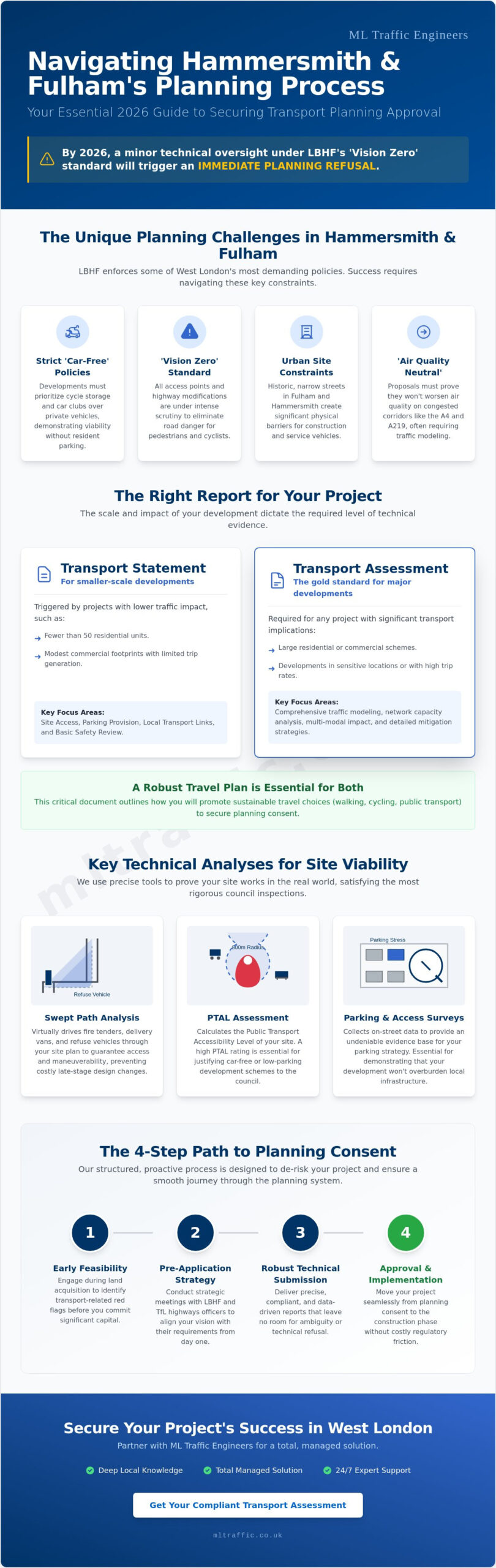
    By 2026, Hammersmith and Fulham Council’s commitment to the ‘Vision Zero’ safety standard means even a minor technical oversight in your site access plan will trigger an immediate planning refusal. You already know that securing approval in this borough is a high-stakes balancing act between ambitious density and rigid highways constraints. It’s frustrating when inadequate data or confusion over PTAL ratings stalls your project before it even begins. Working with expert Transport Planning Consultants Hammersmith and Fulham ensures your technical submissions are precise, compliant, and ready for scrutiny.

    This guide provides the technical roadmap you need to satisfy council demands and turn complex car-free policies into viable development opportunities. We’ll show you how to produce accurate reports that pass the most rigorous inspections while keeping your site access solutions cost-effective. We’ll cover everything from the latest 2026 Transport Assessment requirements to specific strategies for mitigating highways safety concerns. This ensures your project moves from the drawing board to the construction phase without the friction of regulatory delays.

    Key Takeaways

    • Expert Transport Planning Consultants Hammersmith and Fulham provide the essential technical bridge between your development design and the London Borough of Hammersmith and Fulham’s (LBHF) rigorous highway authority requirements.
    • Learn to distinguish between Transport Statements and full Assessments while understanding how a robust Travel Plan secures essential planning consent for complex London sites.
    • Discover how to resolve site access challenges in dense urban environments like Fulham using Swept Path Analysis for fire tenders and refuse vehicles.
    • Master the LBHF planning process by conducting preliminary PTAL assessments and engaging in strategic pre-application discussions with both the council and TfL.
    • Secure a total managed solution that leverages extensive experience with local planning officers to move your project seamlessly from initial data collection to final implementation.

    The Role of Transport Planning Consultants in Hammersmith and Fulham

    Transport planning consultants act as the technical bridge between a developer’s vision and the strict requirements of the London Borough of Hammersmith and Fulham (LBHF) highway authority. For 2026 applications, these specialists ensure that a project’s design doesn’t just look good on paper but functions within the existing road network. They analyze traffic flow, pedestrian safety, and logistics to secure planning approval. The Role of Transport Planning involves data-driven strategies that prevent costly design errors before they reach the public inquiry stage.

    Engaging expert Transport Planning Consultants Hammersmith and Fulham is essential for 2026 developments due to the borough’s evolving Local Plan. High Public Transport Accessibility Level (PTAL) ratings, common in areas like Shepherd’s Bush and Hammersmith Broadway, trigger specific density and parking constraints. A consultant mitigates the risk of refusal by proving that a development won’t negatively impact local highway capacity or safety. We provide total, managed solutions that handle everything from initial data collection to final implementation, ensuring your project remains compliant with the latest UK road regulations.

    Why LBHF is a Unique Planning Environment

    LBHF enforces some of the strictest ‘Car-Free’ development policies in West London. Developers must demonstrate how residents will thrive without private vehicles, focusing instead on cycle storage and car club integration. The borough’s historic street layouts in Fulham and Hammersmith create physical constraints that modern delivery vehicles often struggle to navigate. Additionally, every 2026 application must support ‘Air Quality Neutral’ objectives. Our consultants use CAD design and traffic modeling to prove that your site won’t increase nitrogen dioxide levels on congested corridors like the A4 or A219.

    When to Engage a Transport Consultant

    Early engagement is the only way to avoid design dead-ends. Commissioning a site feasibility study during the land acquisition phase identifies potential access issues that could kill a project. You’ll need a solid transport strategy before your first pre-application meeting with LBHF highways officers to set a professional tone. This ensures the transport strategy aligns with the architect’s vision from day one, preventing late-stage revisions that blow the budget. Our team remains available 24/7 to provide technical support, ensuring your transport assessment

    Essential Technical Reports for LBHF Planning Applications

    The 2026 planning landscape in West London demands absolute precision from developers. Securing planning consent requires a technical evidence base that aligns with the Hammersmith and Fulham Planning Process. As specialist Transport Planning Consultants Hammersmith and Fulham, we focus on delivering reports that satisfy both the London Plan and the LBHF Local Plan. Your submission must demonstrate a clear commitment to the Healthy Streets approach, prioritizing pedestrian safety and sustainable movement over private vehicle use.

    Transport Statements vs. Assessments

    The scale and location of your development dictate which technical report you need. Smaller projects, typically those creating fewer than 50 residential units or modest commercial footprints, require a Transport Statement. This document outlines site access, parking provision, and local transport links. A Transport Assessment serves as the gold standard for major developments, providing a comprehensive analysis of all potential traffic impacts.

    Key components of a robust Transport Statement for Hammersmith projects include:

    • A detailed audit of the existing transport infrastructure within a 400-meter radius of the site.
    • Analysis of the Public Transport Accessibility Level (PTAL) rating, which often exceeds level 5 in areas like Shepherd’s Bush.
    • Accurate multi-modal trip generation data using the TRICS database, which currently holds over 7,500 survey counts.
    • Evidence of compliance with the 2021 London Plan zero-parking standards for well-connected areas.

    Travel Plans: More Than Just a Document

    A well-crafted Travel Plan acts as a long-term strategy to reduce the environmental impact of your site. It isn’t a static paper; it’s a commitment to encouraging sustainable transport modes such as cycling and car-sharing. LBHF planners look for specific targets and monitoring regimes to ensure these plans remain effective post-occupation. Failing to meet these targets can lead to financial penalties under Section 106 agreements.

    You’ll encounter three primary types of Travel Plans during the development lifecycle:

    • Framework Travel Plans: Used for outline applications where final occupiers are unknown.
    • Interim Travel Plans: Applied during the transition phase before a full survey of site users is possible.
    • Full Travel Plans: The final version based on actual travel data from site occupants.

    For a deep dive into these requirements, consult our London Travel Plans Guide. Our team provides comprehensive support throughout this process, ensuring your application moves through the council’s pipeline without unnecessary delays. We operate with 24/7 readiness to address any technical queries raised by highway officers during the consultation period.

    Transport Planning Consultants Hammersmith and Fulham: The 2026 Developer’s Guide

    Overcoming Site Constraints with Swept Path Analysis and Parking Surveys

    Tight urban environments like Fulham’s residential streets present significant logistical hurdles for modern developers. Narrow roads and historic Victorian layouts mean standard vehicle movements are rarely guaranteed. Expert Transport Planning Consultants Hammersmith and Fulham provide the technical precision required to prove a site is viable. We use data to transform constrained sites into approved developments by addressing access and parking concerns early in the design phase. This proactive approach ensures that site layouts are functional and compliant with the latest 2026 safety standards.

    Visualising Access with Swept Path Analysis

    The London Borough of Hammersmith and Fulham (LBHF) prioritises safety and efficient refuse collection above all else. We use advanced CAD software to simulate vehicle movements within your proposed site layout. This process identifies pinch points before they become construction-phase nightmares. If a 12-metre fire tender or a 10.5-metre refuse vehicle can’t clear a corner, the project stalls. Our Swept Path Analysis Services provide the visual proof needed for planning approval. The team at ML Traffic Engineers follows strict industry standards to ensure every turn and reverse maneuver is mathematically sound. This technical authority removes guesswork and prevents costly redesigns during the later stages of the project.

    By simulating the exact wheel paths and body overhangs of specific vehicles, we provide a total, managed solution for site access. This level of detail is essential for securing the trust of highways officers who must ensure that emergency services and utility vehicles can operate without obstruction. Our reports highlight exactly where kerbs need to be dropped or site entrances widened to accommodate the necessary traffic flow, keeping your project on track for a successful planning committee decision.

    The Lambeth Methodology for Parking Surveys

    LBHF often insists on the Lambeth Methodology for overnight parking stress tests. This is a non-negotiable requirement when you want to justify lower-than-standard parking provision in high-density areas. We measure parking stress within a 200-metre walking distance of the development site. These surveys typically occur between 00:30 and 05:30 on two separate weekday nights to capture peak residential demand. This data reveals the actual capacity of the street network. If the survey shows a parking stress level below 80 percent, it often unlocks development potential that would otherwise be blocked by restrictive local policies.

    Data-driven evidence is the most effective tool to overcome local resident objections regarding traffic increases. It moves the conversation from subjective fears to objective facts. As leading Transport Planning Consultants Hammersmith and Fulham, we ensure these surveys are conducted with 24/7 precision, providing the robust evidence needed to satisfy both the council and the community. Our comprehensive support ensures that every survey meets the specific technical requirements of the borough’s highways department.

    Securing planning approval in the London Borough of Hammersmith and Fulham (LBHF) requires a precise, sequential approach. Developers must align their transport strategies with the LBHF Local Plan and the latest London Plan standards. Professional Transport Planning Consultants Hammersmith and Fulham provide the technical rigour needed to move from initial concept to site commencement without regulatory friction. We focus on delivering a total, managed solution that satisfies both local and strategic authorities.

    • Step 1: Preliminary site access and PTAL assessment. We begin by determining the Public Transport Accessibility Level (PTAL). In areas like Hammersmith Broadway, PTAL scores frequently reach 6b. This high rating often dictates car-free development mandates under 2026 planning policy.
    • Step 2: Pre-application discussions. Engaging LBHF and Transport for London (TfL) early identifies potential constraints. This stage clarifies expectations for the A4 Great West Road and other Strategic Road Network (SRN) routes.
    • Step 3: Prepare technical documentation. This includes Transport Assessments, Travel Plans, and Construction Logistics Plans (CLP). Every document must meet the latest safety and sustainability benchmarks to avoid immediate rejection.
    • Step 4: Respond to statutory consultee comments. We manage the technical dialogue when LBHF Highways or TfL request clarifications on trip generation, swept path analysis, or cycle parking.
    • Step 5: Negotiate legal agreements. Finalising Section 106 and Section 278 agreements ensures off-site highway improvements are legally compliant and financially predictable.

    Dealing with Statutory Consultees

    TfL’s involvement is mandatory for major applications or those impacting the Transport for London Road Network (TLRN). Their focus remains on Healthy Streets indicators and Vision Zero safety targets. Addressing concerns from the LBHF Highways Department requires immediate, data-backed responses. Proactive communication prevents the standard 13-week statutory period from stretching into months of delays. Our Transport Planning Consultants Hammersmith and Fulham maintain constant availability to resolve technical objections as they arise, ensuring your project stays on schedule.

    Section 278 Agreements and Highway Works

    When a development requires physical changes to the public highway, such as new crossovers or junction remodelling, a Section 278 (S278) agreement is essential. This legal framework allows developers to fund and execute works on the local road network under LBHF supervision. Precision in CAD design and traffic management planning is vital to meet the borough’s strict safety standards. For a detailed breakdown of these requirements, see our Highway Design S278 Guide. We ensure your project moves from the planning phase to implementation with total compliance and zero safety compromises.

    To secure your project’s technical approval and navigate LBHF regulations, contact our expert planning team for a comprehensive consultation.

    Why ML Traffic Engineers is Your Partner in West London

    Successfully delivering a project in the London Borough of Hammersmith and Fulham (LBHF) requires more than just technical drawings. It demands a deep, working knowledge of the specific expectations held by local planning officers. ML Traffic Engineers brings years of direct experience to the table, having successfully navigated the borough’s strict requirements for air quality, noise reduction, and pedestrian safety. We don’t just provide advice; we offer a total, managed solution. This lifecycle begins with precise site data collection and continues through to professional CAD design and final on-site implementation. We take full responsibility for the logistics so you can focus on the build.

    Construction doesn’t stop at 5:00 PM, and neither do we. Our 24/7 availability is a core pillar of our service, designed to meet the urgent needs of fast-moving West London projects. Whether it’s an emergency utility repair on the A4 or a scheduled crane lift in Fulham, our team remains ready to respond. This round-the-clock readiness ensures that your project stays on schedule and avoids costly delays. As experienced Transport Planning Consultants Hammersmith and Fulham, we prioritize precision and compliance in every report we produce. We ensure every detail aligns with the Traffic Signs Manual and local highways authority mandates to prevent legal bottlenecks.

    Our Technical Expertise

    Our team consists of highly organized specialists who live and breathe UK road regulations. We maintain a rigorous standard of Chapter 8 compliance, ensuring every temporary traffic management scheme is legally watertight and physically safe. We use advanced CAD software to create bespoke traffic plans that minimize disruption to the public while maximizing site efficiency. You can view our project types to see how we handle diverse challenges, or explore what we do to understand our full range of technical capabilities. Precision isn’t an option for us; it’s our baseline.

    Securing Your Development’s Future

    In a borough as densely populated as Hammersmith and Fulham, local sentiment matters. By partnering with ML Traffic, you position your development as a ‘safe pair of hands’ for the local community. We design systems that protect cyclists, pedestrians, and motorists alike, reducing the regulatory burden on your management team. Our reports provide the clarity needed to secure planning approvals quickly and maintain positive relationships with LBHF stakeholders. We manage the intricate complexities of the road network so you don’t have to worry about compliance failures. Contact ML Traffic for a consultation on your LBHF project today and secure a partner dedicated to your project’s success.

    Accelerate Your Hammersmith and Fulham Planning Success

    Navigating the London Borough of Hammersmith and Fulham planning process requires more than just standard reports. It demands technical precision in Swept Path Analysis and a deep understanding of local S278 and S38 requirements. Since 2014, ML Traffic Engineers has provided this level of detail for developers across West London. Our team brings over 10 years of specific London planning experience to every project; we ensure your Transport Assessment meets the highest regulatory standards.

    Delays in the planning phase can be costly for any 2026 development. We eliminate these bottlenecks with our 24/7 emergency response and rapid report turnaround times. By choosing the right Transport Planning Consultants Hammersmith and Fulham, you gain a partner dedicated to technical excellence and professional integrity. We handle the intricate CAD designs and parking surveys so you don’t have to. Our proactive approach transforms complex site constraints into viable, compliant solutions.

    Secure your project’s approval with expert transport planning advice from ML Traffic. Your development’s success is our priority.

    Frequently Asked Questions

    Do I need a Transport Statement for a small residential conversion in Fulham?

    You generally need a Transport Statement for a small residential conversion in Fulham if the project creates new dwellings or alters existing access. The London Borough of Hammersmith and Fulham (LBHF) requires these documents to ensure your development doesn’t negatively impact local traffic flow or parking capacity. Our transport planning consultants Hammersmith and Fulham team reviews your site against the LBHF Local Plan 2018 to ensure full compliance from the first submission.

    What is a PTAL rating and how does it affect my planning application in London?

    PTAL stands for Public Transport Accessibility Level, a standard method used by Transport for London (TfL) to grade locations on a scale from 0 to 6b. A high PTAL rating, such as 5 or 6, often allows for car-free developments with zero on-site parking. Conversely, a low rating of 1 or 2 typically requires more robust parking provisions to satisfy LBHF planning officers during the application process.

    How long does a parking survey take to complete according to LBHF standards?

    A standard parking survey in Hammersmith and Fulham takes two consecutive weekday nights to complete, typically between 00:30 and 05:30. This follows the Lambeth Methodology, which is the industry standard for measuring overnight parking stress. We collect data on Tuesday and Wednesday or Wednesday and Thursday nights to provide a representative snapshot of local parking demand for your specific planning application.

    Can Swept Path Analysis help if my site has very narrow access?

    Swept Path Analysis uses CAD software to simulate the movement of specific vehicles, proving that delivery trucks or emergency services can navigate narrow site entrances safely. This technical drawing is a non-negotiable requirement for constrained urban sites in Fulham where access margins are tight. It removes guesswork by providing accurate visual evidence that your site layout functions correctly without risking collisions or blocking public highways.

    What is the difference between a Transport Assessment and a Transport Statement?

    The primary difference lies in the scale of the development and its projected impact on the local road network. A Transport Statement is a concise report for smaller projects with limited traffic implications, while a Transport Assessment is a comprehensive study for larger developments. LBHF guidance clarifies that developments exceeding 50 residential units or 1,000 square metres of commercial space usually trigger a full Assessment.

    Will I need to pay for off-site transport improvements under a Section 106 agreement?

    You’ll likely pay for off-site transport improvements through a Section 106 agreement if your project increases demand on local infrastructure. These legally binding contributions fund specific upgrades like new cycle lanes, bus stop improvements, or pedestrian crossings near your site. In 2023, LBHF secured millions in developer contributions to enhance the borough’s sustainable transport network, ensuring that new growth doesn’t compromise existing public safety.

    How much does it cost to hire a transport planning consultant for a London project?

    Hiring transport planning consultants Hammersmith and Fulham typically costs between £1,500 and £3,000 for a standard Transport Statement on a small-scale project. For complex Transport Assessments involving detailed traffic modelling or extensive junction analysis, fees can exceed £5,000. These costs vary based on the project’s complexity and the specific technical requirements set out by the local highway authority during your pre-application discussions.

    What happens if the council’s highways department objects to my development?

    If the council’s highways department objects, you must address their specific technical concerns through design revisions or additional data. We immediately review the objection to identify if a revised Swept Path Analysis or a more robust Travel Plan can mitigate their concerns. Our 24/7 readiness ensures we respond to these regulatory hurdles quickly, negotiating bespoke solutions that satisfy safety standards while keeping your development timeline on track.

    Michael Lee

    Article by

    Michael Lee

    Transport planner with over 35 years’ experience.

    Disclaimer

    The content on mltraffic.co.uk, including all technical articles, guides, and resources, is provided for general informational and educational purposes only. It is not intended to constitute professional advice in traffic engineering, transportation planning, development approvals, or any other technical or legal field.
    While ML Traffic Engineers makes every reasonable effort to ensure the accuracy, completeness, and timeliness of the information published, we do not provide any warranties or representations (express or implied) regarding its reliability, suitability, or availability for any particular purpose. Any reliance you place on the content is strictly at your own risk.
    In no event shall ML Traffic Engineers, its directors, employees, authors, or affiliates be liable for any direct, indirect, incidental, special, consequential, or punitive damages (including, without limitation, loss of profits, data, or business opportunities) arising out of or in connection with the use of, or inability to use, any information provided on this website.
    The articles and guides on this site are not a substitute for engaging a qualified, professional traffic engineer to assess your specific project requirements. For tailored advice, compliance assessments, or traffic engineering services, please contact a competent professional.
    This disclaimer may be updated from time to time without notice. By accessing or using this website, you agree to be bound by the most current version of this disclaimer.