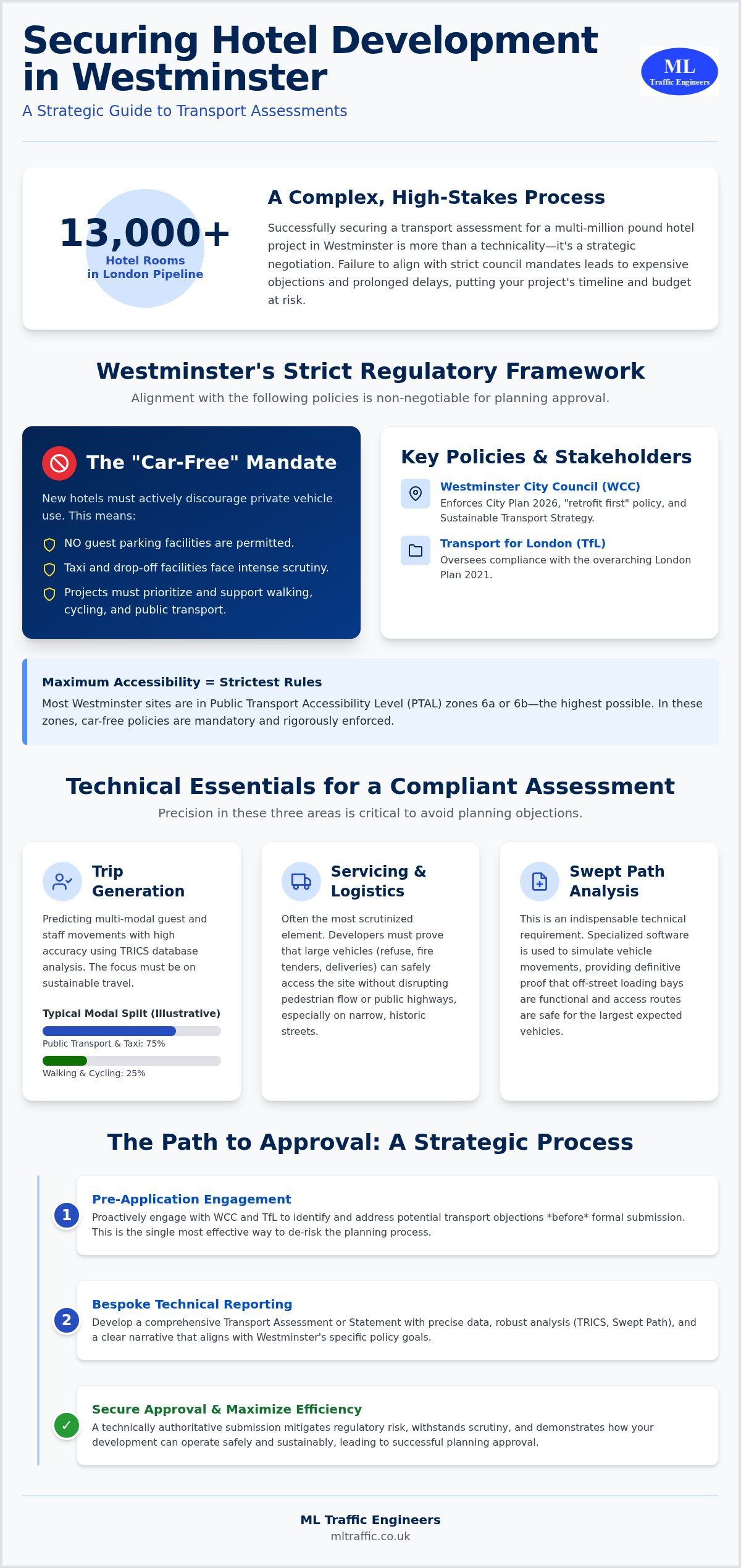
In Westminster, a transport assessment is no longer just a technical requirement; it’s a strategic negotiation tool that can make or break a multi-million pound project. With over 13,000 hotel rooms currently in the London pipeline, the competition for planning approval is intense. Successfully securing a transport assessment for hotel development in Westminster requires more than simple data collection. It demands a precise alignment with the council’s 2026 Sustainable Transport Strategy and its rigorous “car-free” mandates. If your submission fails to address these evolving standards, you risk facing expensive objections and prolonged delays.
You likely know that coordinating between Transport for London (TfL) and Westminster City Council (WCC) is a complex, high-stakes process where technical errors lead to immediate friction. This guide provides a strategic roadmap to navigate these stringent requirements while protecting your project’s timeline and budget. We’ll examine the 2026 City Plan updates, explain how to manage trip generation for servicing, and show you how to turn technical compliance into a functional advantage for your planning application. By the end, you’ll have a clear path to minimizing risk and maximizing site efficiency.
Key Takeaways
- Understand the impact of Westminster City Council’s 2026 Sustainable Transport Strategy and car-free mandates on your project feasibility.
- Learn how to leverage TRICS data and Swept Path Analysis to secure a transport assessment for hotel development in Westminster that survives rigorous highways scrutiny.
- Identify the critical technical requirements for hotel servicing and multi-modal guest trip generation that prevent planning delays.
- Master the pre-application engagement process with WCC and TfL to address potential transport objections before formal submission.
- Discover how technical authority and bespoke reporting can mitigate regulatory risks for both boutique and luxury hotel developments.
Navigating Westminster’s Strict Transport Planning Framework for Hotels
A Transport Assessment is a statutory requirement for hotel developments in Westminster. It provides the technical evidence needed to prove a project won’t negatively impact the borough’s infrastructure. Central to this process is transportation planning, which balances the needs of guests with the safety of the public. Successfully securing a transport assessment for hotel development in Westminster depends on your ability to align with these evolving standards.
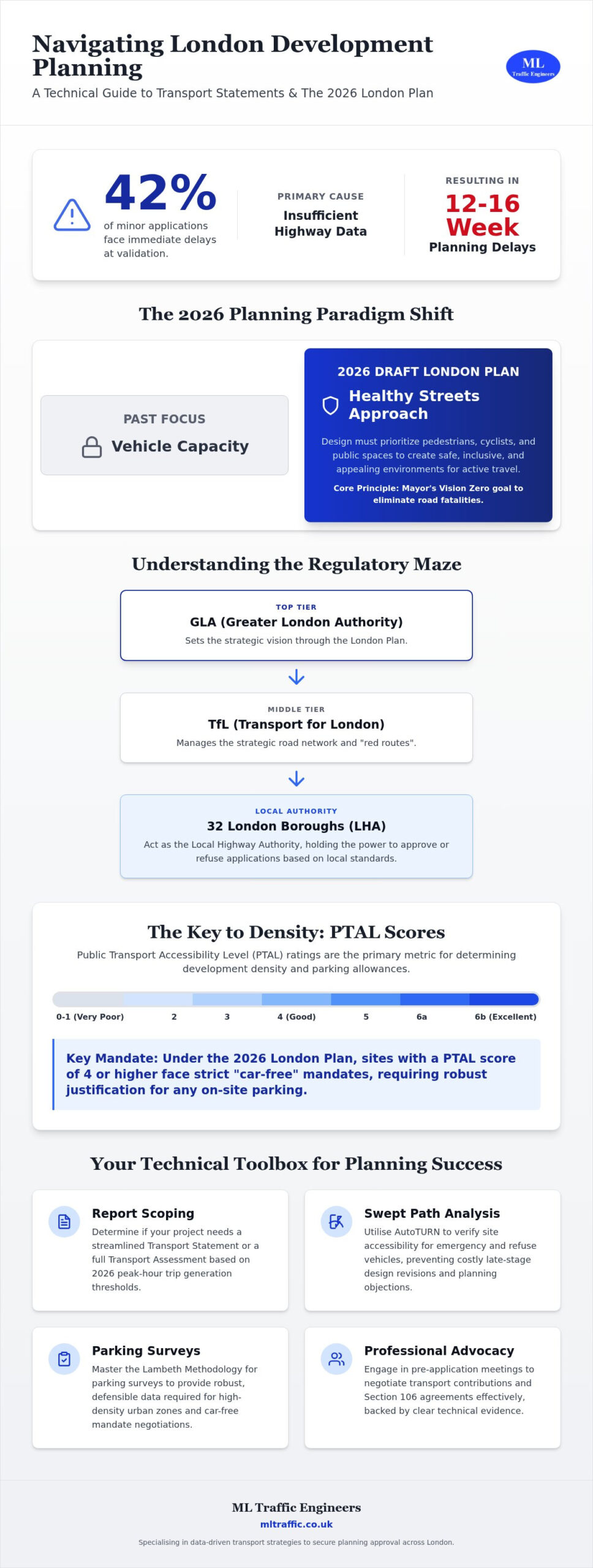
Westminster City Council (WCC) and Transport for London (TfL) act as the primary stakeholders. They strictly enforce the London Plan 2021 and the Westminster City Plan 2019-2040. In 2026, a partial review of the City Plan introduced a “retrofit first” policy and strengthened sustainability targets. These updates mean technical compliance is more rigorous than ever, especially regarding the borough’s strict “car-free” policy. Under this mandate, new hotels must discourage private vehicle use, requiring guests to arrive via public transport, walking, or cycling.
To better understand this concept, watch this helpful video:
Why Westminster is Unique for Hotel Developers
Most development sites in the borough fall within Public Transport Accessibility Level (PTAL) zones 6a or 6b. These are the highest ratings in London. In these areas, car-free policies are mandatory. You cannot provide guest parking, and even drop-off facilities face intense scrutiny. Developers must now use “Healthy Streets” indicators to show how their site supports walking and cycling. This aligns with the Sustainable Transport Strategy 2026-2036, which aims for a 70% reduction in road casualties by 2030. Managing high pedestrian flow in areas like Covent Garden or Soho requires precise data to avoid planning objections.
Thresholds for Transport Assessments vs. Statements
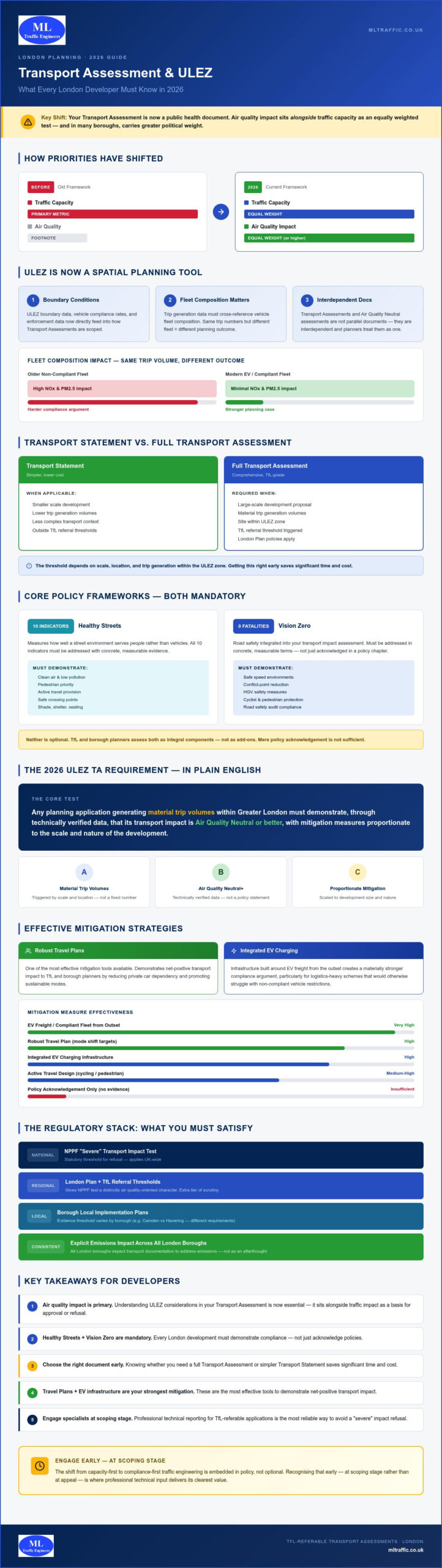
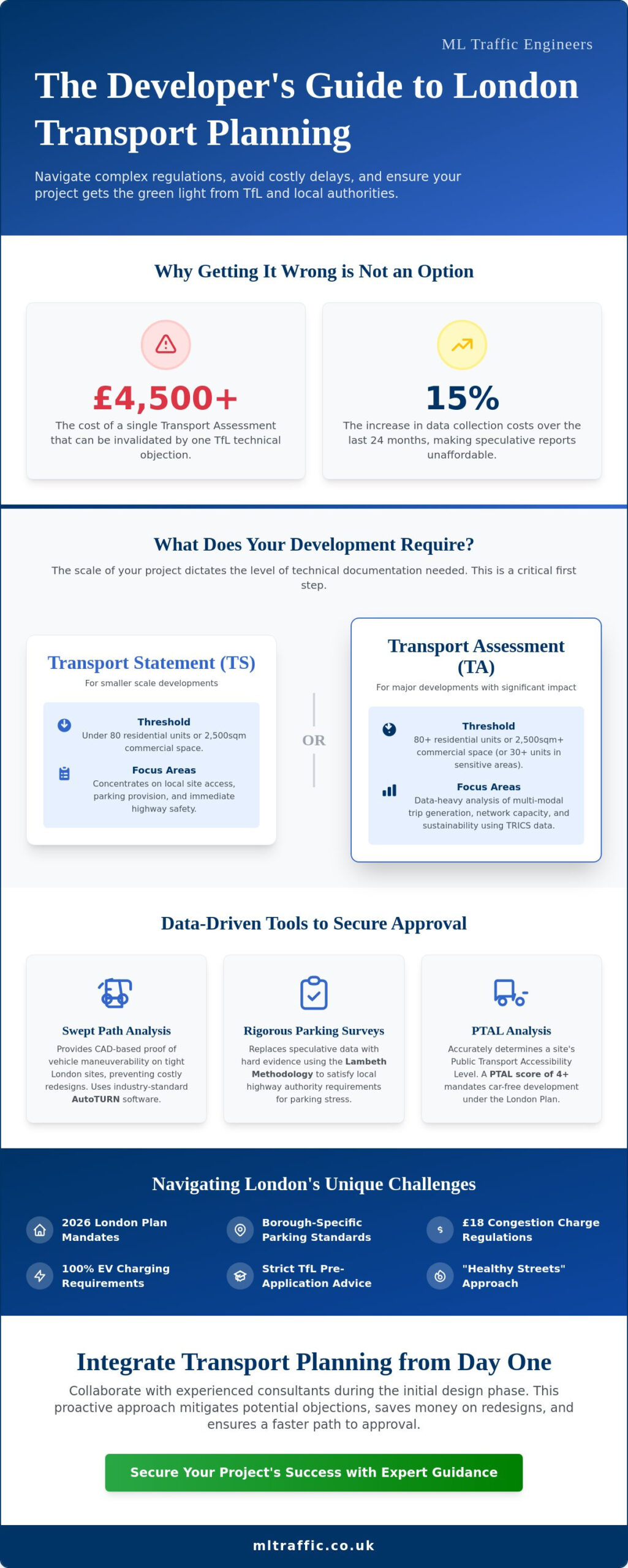
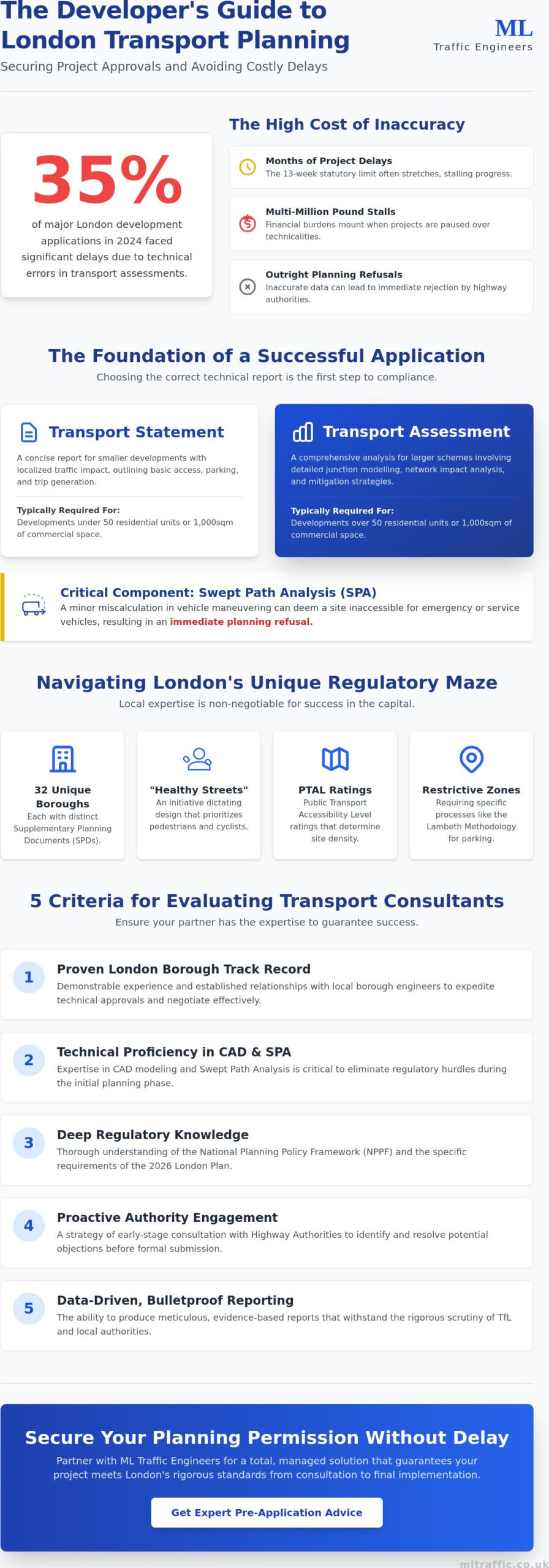
WCC uses specific triggers to determine if you need a full Assessment or a shorter Statement. Generally, larger projects with high room counts or significant Gross Floor Area (GFA) require the full Assessment. Smaller boutique conversions might only require a Transport Statement, though this still requires technical precision. A transport assessment for hotel development in Westminster is a comprehensive technical document designed to evaluate the impact of a proposed scheme on the local highway network and public transport capacity to ensure safe and sustainable operation. For a detailed breakdown of these requirements, see our Transport Assessment London guide.
Technical Essentials: Trip Generation, Servicing, and Swept Path Analysis
Precision is a functional necessity when preparing a transport assessment for hotel development in Westminster. Every movement matters. This includes guest taxi arrivals, staff commutes, and the constant flow of logistics. We utilize TRICS database analysis to predict these multi-modal trip generations with high accuracy. This isn’t just a numbers game; it’s about providing a realistic forecast based on comparable high-density London sites. By analyzing cycling, walking, and public transport trends, we ensure your submission reflects the real-world operation of a modern hotel.
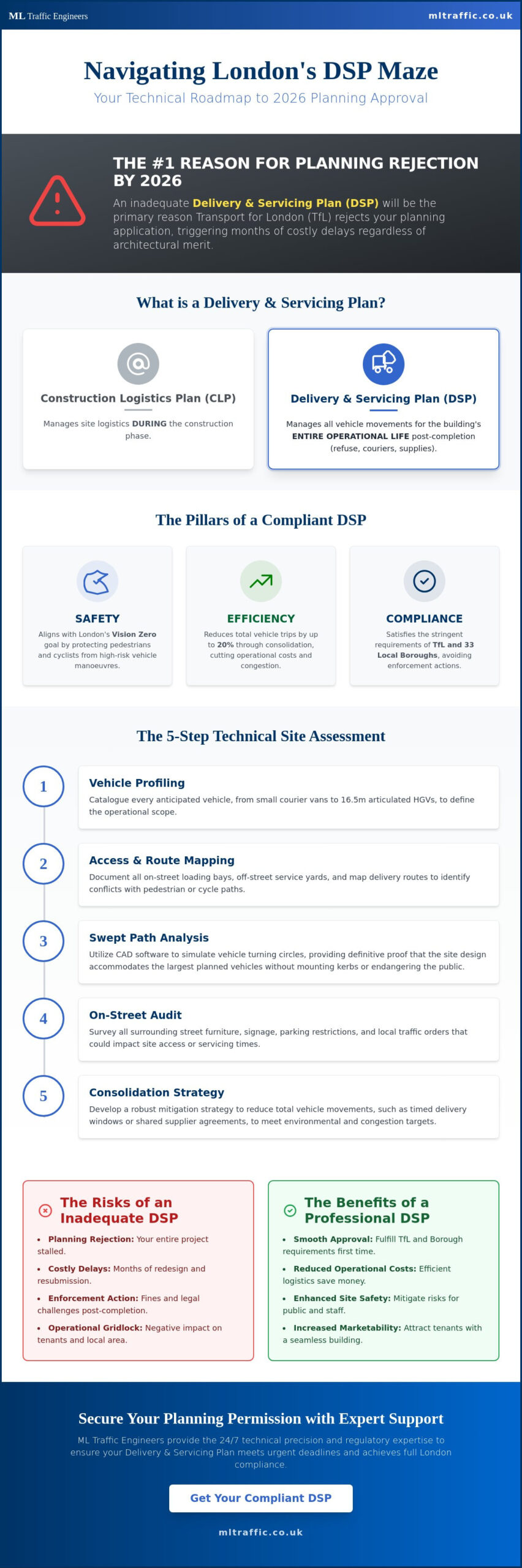
Servicing is often the most scrutinized element of a planning application. Westminster’s historic street patterns and narrow lanes leave no room for error. You must demonstrate that large vehicles, such as refuse trucks and fire tenders, can navigate the site safely. This is where Swept Path Analysis is indispensable. Using specialized software, we simulate vehicle movements to verify that off-street loading bays are functional and don’t require vehicles to mount pavements or obstruct traffic. Ensuring these technical details are correct from the start reduces the risk of expensive redesigns later.
Managing Hotel Servicing in Westminster
Red routes and strict no-loading restrictions dominate the borough. A robust Delivery and Servicing Plan (DSP) is required to manage the logistics of linen, food, and waste. Modern WCC standards now prioritize zero-emission delivery solutions to align with the city’s 2040 net-zero goals. We help developers design servicing strategies that utilize consolidation centers or electric vehicle fleets. If your site lacks internal loading space, we negotiate with WCC to establish safe, timed on-street servicing windows that don’t compromise local traffic flow.
Guest Access and Public Realm Impact
Large-scale hotels face unique challenges regarding coach drop-offs and taxi queuing. High pedestrian volumes in areas like Victoria or Marylebone mean your development must not obstruct public footways. We conduct Active Travel Zone (ATZ) assessments to evaluate the safety and comfort of routes surrounding your site. This ensures your project integrates seamlessly into the “Healthy Streets” framework. For a comprehensive overview of these regional requirements, refer to our Transport Assessment London: The Developer’s 2026 Guide.
Sustainability is the final pillar of a successful submission. A Travel Plan acts as a formal commitment to reduce the environmental impact of your hotel’s operation. We design bespoke plans that incentivise staff to use public transport and provide guests with clear sustainable travel options. This proactive approach supports the council’s air quality targets and strengthens your overall planning case. If you require technical authority for your project, exploring our transport planning services can provide the clarity you need to move forward.
Evaluation Criteria: Selecting Your Transport Planning Partner
Selecting the right consultant for a transport assessment for hotel development in Westminster is a high-stakes decision. You don’t just need a technical report; you need a strategic partner who understands the specific expectations of Westminster City Council (WCC) highways officers. Relationships with local authorities are non-negotiable. An experienced consultant anticipates the objections a highways officer might raise and addresses them within the initial submission. This foresight prevents the costly back-and-forth that often delays hotel projects.
Technical authority is built on precision. We utilize industry-standard software like AutoTurn for Swept Path Analysis and Vissim for complex traffic modelling. These tools allow us to demonstrate exactly how your site will function under peak hotel operations. Because the hospitality industry never sleeps, we maintain a sense of readiness and urgency. Our team manages the full project lifecycle, providing comprehensive support from the first site visit to representation at the final planning committee.
Specialist vs. Generalist Consultants
Generalist UK firms often miss the intricate nuances of Westminster’s transport network. For example, the interplay between TfL red routes and WCC-controlled side streets requires a deep understanding of dual-authority coordination. A specialist partner manages these complexities so you don’t have to. Whether your project requires a full assessment or a more concise report, our approach to Transport Statements ensures that even smaller boutique developments receive the same level of technical scrutiny as large-scale luxury builds.
Data Accuracy and Survey Methodology
Relying on generic or outdated data is a significant planning risk. We prioritize bespoke Traffic Surveys that capture current local conditions. While many firms use the standard Lambeth Methodology for parking, WCC often requires specific parking stress requirements that are more stringent. We conduct surveys during peak hotel hours to ensure the data reflects real-world impact. Technical data precision serves as the vital guardian of your planning approval, ensuring every claim is backed by irrefutable evidence. This commitment to accuracy reduces regulatory pressure and maximizes your site’s operational efficiency.
The Westminster Pre-Application Process: Strategy and Timelines
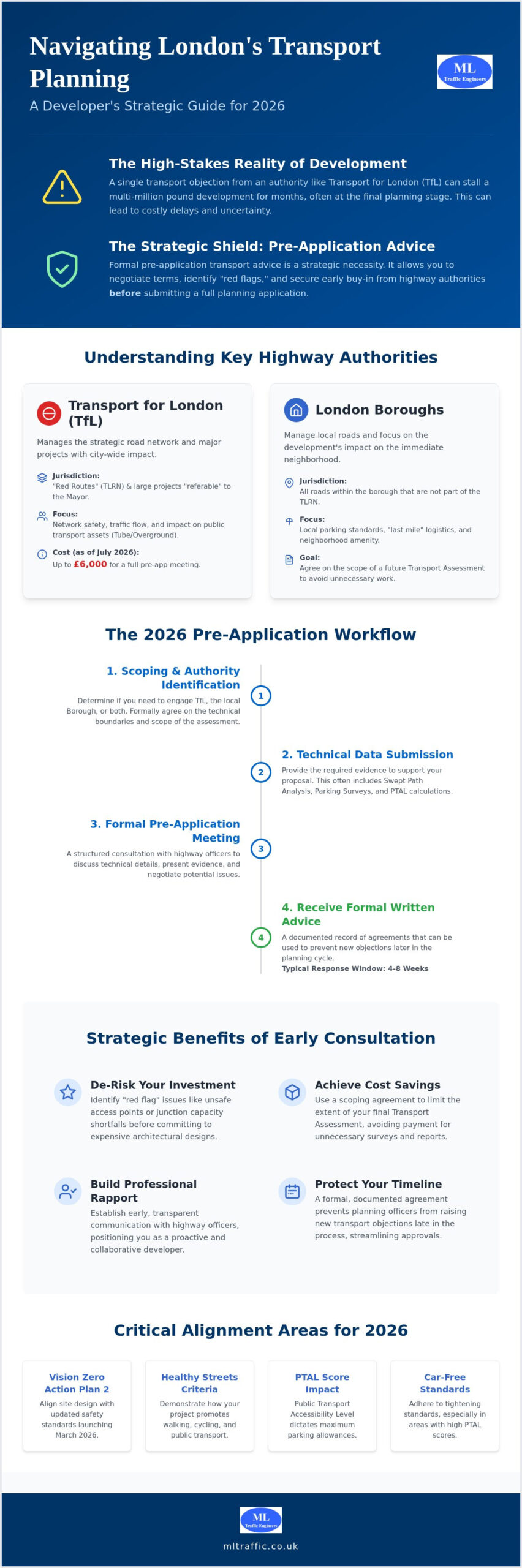
Pre-application engagement isn’t just a meeting; it’s a strategic de-risking tool. In a high-stakes environment where a transport assessment for hotel development in Westminster is required, early consultation prevents technical objections from stalling your project. The process follows a logical sequence designed to align your development with current council expectations. For the 2026/27 period, Westminster City Council has set pre-application fees for large-scale major developments at £25,000. Investing in this process early allows us to secure technical buy-in before the formal submission.
- Step 1: Initial Site Feasibility: We conduct a baseline PTAL assessment to determine the site’s accessibility. Given that most Westminster sites hit PTAL 6a or 6b, this step confirms the mandatory car-free status.
- Step 2: Formal Engagement: We initiate discussions with WCC and TfL to present the initial transport concept.
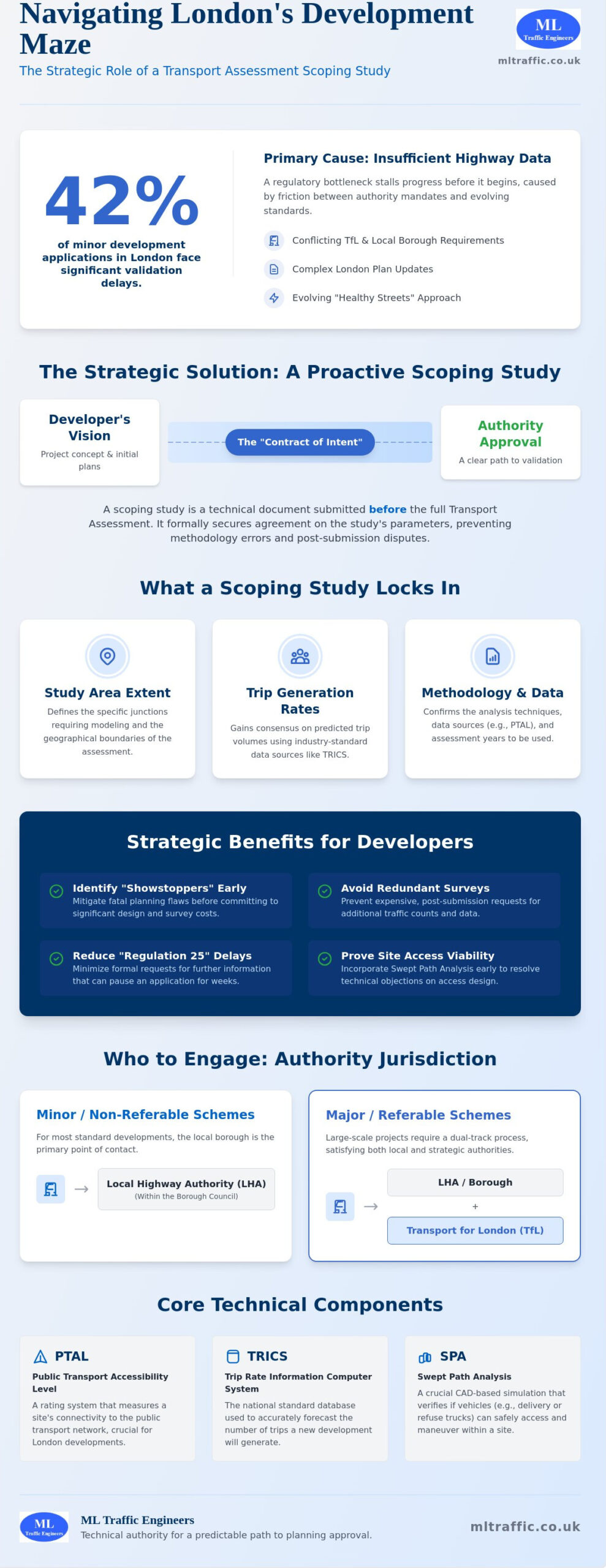
- Step 3: Scoping the Works: We negotiate the ‘Scope of Works’ to ensure data collection is targeted. This prevents you from paying for unnecessary technical surveys that don’t add value to the planning case.
- Step 4: Iterative Feedback: We submit draft reports and manage the feedback loops, addressing concerns regarding servicing or guest arrivals in real-time.
- Step 5: Final Submission: We provide ongoing support through the statutory consultation period, representing your interests at planning committees if required.
Negotiating with TfL and WCC
Standard parking requirements in Westminster are exceptionally strict. To justify any departures from these norms, you must present a compelling case centered on sustainability. We use bespoke Travel Plans as a primary mitigation tool during these negotiations. These plans demonstrate a commitment to the borough’s 2040 net-zero targets. We also address Section 106 and Section 278 requirements early. By identifying potential highway improvement costs at the pre-application stage, we protect your project’s financial feasibility and prevent last-minute budgetary shocks.
Common Pitfalls in Hotel Transport Planning
Many developers underestimate the logistical demands of a modern hotel. A common error is failing to account for the cumulative impact of neighboring sites. With 13,657 hotel rooms in the current London pipeline, WCC officers closely monitor how multiple developments affect local traffic and air quality. Your transport assessment for hotel development in Westminster must also reflect the Mayor’s Transport Strategy, specifically the Vision Zero goal of eliminating road deaths by 2041. Ignoring these broader policy objectives often leads to immediate planning refusals. To ensure your application meets every regulatory benchmark, speak with our transport planning specialists about your site requirements.
Securing Approval: How ML Traffic Engineers UK Delivers Westminster Hotel TAs
Technical precision is the hallmark of ML Traffic Engineers UK. Our reports are engineered to withstand the rigorous scrutiny of Westminster City Council highways officers, who demand absolute clarity on guest and servicing movements. When you commission a transport assessment for hotel development in Westminster, you aren’t just buying a document; you’re securing a strategic partner. We tailor every report to the specific scale of your project, ensuring that boutique conversions and large-scale luxury flagships receive the exact level of technical detail required for approval. This bespoke approach ensures that no technical detail is overlooked, from the initial site visit to the final planning committee representation.
The hospitality sector operates around the clock, and so does our team. ML Traffic Engineers UK maintains a state of constant readiness, providing the rapid response capabilities necessary to meet urgent planning deadlines or address last-minute council queries. This sense of urgency reduces the logistical pressure on your development team, allowing you to focus on the broader aspects of your project. We take immense pride in our ability to manage full project lifecycles, acting as a vital guardian of your professional integrity and public safety within the high-stakes environment of central London planning.
Comprehensive Service from Inception to Completion
We provide an all-encompassing, fully-managed service that simplifies the complex submission process. By integrating Swept Path Analysis, Parking Surveys, and Travel Planning into a single, cohesive package, ML Traffic Engineers UK eliminates the technical friction that often arises when using multiple consultants. This integration ensures that the data used in your servicing plan perfectly aligns with your pedestrian comfort assessments. Our commitment to professional excellence and strict adherence to industry benchmarks ensures that your submission is robust from the moment it reaches the highways department. You can explore our extensive experience in the Central Activities Zone by reviewing Our Project Types and Portfolio.
Next Steps for Your Westminster Project
Early engagement is the most effective way to de-risk your project and prevent expensive design errors. By consulting with ML Traffic Engineers UK before finalizing your site layout, you can identify potential servicing conflicts and optimize your transport assessment for hotel development in Westminster. We provide tailored quotes that reflect the specific requirements of your planning application, ensuring you don’t pay for unnecessary data collection. Our team is ready to provide the technical authority and regulatory expertise needed to secure your project’s future. Contact us today to secure a partner that understands the intricate demands of Westminster’s transport network and is committed to your planning success.
Securing Your Hotel’s Future in Westminster
Securing planning approval in the borough is a landmark achievement for any developer. A robust transport assessment for hotel development in Westminster doesn’t just satisfy statutory requirements; it ensures your site remains functionally viable in one of the world’s most demanding urban environments. By prioritizing technical precision and early engagement, you protect your investment from the logistical bottlenecks that often hinder high-density projects. This strategic approach transforms regulatory compliance into a foundation for operational excellence and long-term site efficiency.
ML Traffic Engineers UK stands ready to provide the technical authority and constant accessibility your project requires. We offer comprehensive support from the initial pre-application stage through to the final planning committee, ensuring every report meets the highest industry benchmarks. Our commitment to professional integrity and rapid response times makes us the ideal partner for your next London development. Secure Your Westminster Planning Approval with ML Traffic Engineers UK. We look forward to helping you navigate these complex requirements and achieving a successful outcome for your hotel.
Frequently Asked Questions
Do all hotel developments in Westminster require a full Transport Assessment?
No, the requirement depends specifically on the project’s scale and its projected impact on the local network. While major new builds typically trigger a full transport assessment for hotel development in Westminster, smaller boutique conversions might only necessitate a Transport Statement. We determine the correct documentation level during the initial feasibility stage by evaluating your specific room count and floor area against the current Westminster City Council thresholds.
How does PTAL 6b affect my hotel’s parking allowance in Westminster?
A PTAL rating of 6b represents the highest possible public transport accessibility, which mandates a strictly car-free development under the 2026 City Plan. In these zones, the council prohibits on-site guest or staff parking to align with regional sustainability goals. The only standard exceptions involve essential blue badge provision. Our reports focus on demonstrating how your site effectively utilizes this high accessibility to eliminate the need for private vehicle arrivals.
What is the typical timeline for a Westminster Transport Assessment?
Technical preparation usually spans four to six weeks, covering data collection, trip modeling, and swept path simulations. However, the full timeline must account for the formal pre-application engagement with WCC and TfL, which can add several months to the program. We recommend initiating technical work at least six months before your target submission date to ensure all regulatory feedback is integrated and potential objections are addressed before the statutory period begins.
Will I need a separate Travel Plan for my hotel staff and guests?
Yes, a formal Travel Plan is a standard requirement for almost all hotel applications in the borough. This document serves as a long-term commitment to reducing the environmental impact of your operations. It must outline specific measures to encourage sustainable travel choices for both employees and visitors. We integrate these plans into your transport assessment for hotel development in Westminster to provide a cohesive strategy that supports the council’s 2040 net-zero aspirations.
How does Westminster City Council view coach drop-off zones for new hotels?
WCC scrutinizes coach drop-off facilities heavily, particularly in high-density areas like Victoria or Marylebone. If your hotel model anticipates group travel, you must provide a detailed management strategy that proves coaches won’t obstruct the highway or compromise pedestrian safety. We use technical simulations to verify that coach movements are feasible. If on-site provision isn’t possible, we negotiate with the council to identify safe, timed on-street alternatives that don’t disrupt local traffic.
Can ML Traffic Engineers UK assist with Section 278 highway works agreements?
ML Traffic Engineers UK provides the critical technical data and survey evidence required to negotiate these agreements with the highway authority. While we don’t perform the physical road construction, we deliver the precise technical assessments and traffic data used to define the scope of necessary improvements. We ensure that proposed highway works are technically sound and meet the borough’s safety standards, acting as your technical representative during the negotiation process.
What happens if TfL objects to my hotel’s transport strategy?
If TfL raises an objection, we enter a period of technical negotiation to resolve their specific concerns regarding the Strategic Road Network. This often involves refining the delivery and servicing strategy or providing more granular data on peak-hour guest arrivals. Because we engage with TfL early in the pre-application stage, we typically identify these friction points early. This allows us to adjust the technical submission and secure buy-in before the formal planning committee stage.
Do I need a Parking Stress Survey for a car-free hotel in Westminster?
Yes, the council frequently requires a Parking Stress Survey even for car-free developments. This is to assess the potential impact of taxi drop-offs and servicing vehicles on the surrounding street capacity. You must demonstrate that your project won’t lead to dangerous stopping or overspill that affects local residents. We conduct these surveys during peak hotel hours to ensure the data accurately reflects the real-world pressures on the local highway network.

Disclaimer
The content on mltraffic.co.uk, including all technical articles, guides, and resources, is provided for general informational and educational purposes only. It is not intended to constitute professional advice in traffic engineering, transportation planning, development approvals, or any other technical or legal field.
While ML Traffic Engineers makes every reasonable effort to ensure the accuracy, completeness, and timeliness of the information published, we do not provide any warranties or representations (express or implied) regarding its reliability, suitability, or availability for any particular purpose. Any reliance you place on the content is strictly at your own risk.
In no event shall ML Traffic Engineers, its directors, employees, authors, or affiliates be liable for any direct, indirect, incidental, special, consequential, or punitive damages (including, without limitation, loss of profits, data, or business opportunities) arising out of or in connection with the use of, or inability to use, any information provided on this website.
The articles and guides on this site are not a substitute for engaging a qualified, professional traffic engineer to assess your specific project requirements. For tailored advice, compliance assessments, or traffic engineering services, please contact a competent professional.
This disclaimer may be updated from time to time without notice. By accessing or using this website, you agree to be bound by the most current version of this disclaimer.