
A single overlooked detail in your road safety audit can stall a multi-million pound London development for months. In the 2024 planning cycle, local authorities reported that over 30% of major applications faced delays due to non-compliant highway designs. You likely understand the frustration of navigating Transport for London’s (TfL) rigorous safety standards while trying to keep your project on schedule. It’s a high-stakes balancing act where precision is a legal necessity.
We’ve created this 2026 guide to help you master these complexities and secure planning approval without the headache of costly, late-stage design changes. You’ll gain a clear understanding of when to trigger each RSA stage and how to align your CAD designs with current UK road regulations. We will examine the specific requirements for GG 119 compliance and provide a sequential roadmap for a successful submission to your local borough.
Key Takeaways
- Identify and mitigate potential collision risks early to ensure your London highway scheme meets the highest safety and technical standards.
- Navigate the transition between Stage 1 Preliminary Design and Stage 2 Detailed Design to secure planning consent without project delays.
- Understand the critical distinction between a Transport Statement and a road safety audit to ensure your design is both justified and safety-validated.
- Align your development with GG 119 standards and TfL requirements to satisfy the Overseeing Organisation and maintain total regulatory compliance.
- Streamline your project timeline by learning how to commission an expert audit team and prepare a comprehensive Audit Brief.
Table of Contents
What is a Road Safety Audit (RSA) for London Developments?
A What is a Road Safety Audit is a systematic and independent technical assessment of a highway scheme’s safety performance. It’s a proactive tool that identifies potential collision risks before a road is built or modified. Developers must understand that this isn’t a simple checklist; it’s a rigorous evaluation of how all road users will interact with the new infrastructure. By 2026, the focus on safety in the capital has reached an all-time high, making these audits central to the planning process.
The core objective of any road safety audit is to spot design flaws that could lead to injuries. Auditors apply a "Who can be hurt here?" methodology. This approach forces a shift in perspective from the designer to the user. It considers the elderly pedestrian, the delivery cyclist, and the heavy goods vehicle driver. In London, Transport for London (TfL) and local boroughs mandate these audits for almost every project that impacts the public highway.
To better understand this concept, watch this helpful video:
The Independence Requirement
Objectivity is critical for safety. The audit team must be entirely independent of the design team to ensure an unbiased review. This separation prevents any conflict of interest where a designer might overlook a risk to stay within budget or meet a specific aesthetic goal. A standard audit team includes at least two trained professionals: a Team Leader and a Team Member. Each professional must meet specific competency requirements defined by national standards. London boroughs strictly enforce this independence for Section 278 agreements. They require a fresh set of eyes to validate that the design is fit for purpose and safe for the public. Our team provides comprehensive support to ensure your project meets these stringent regulatory demands without delay.
Vision Zero and London’s Safety Context
London’s transport strategy is built around Vision Zero. This is the ambitious goal to eliminate all deaths and serious injuries on the city’s roads. By 2026, this priority dictates every planning decision made by TfL and the 32 London boroughs. The road safety audit is a primary mechanism for achieving this goal. It ensures that new developments don’t introduce fresh hazards into the network. All audits must comply with the DMRB GG 119 standard, which provides the framework for the RSA process across the UK. Following this standard isn’t just about compliance; it’s about professional integrity and protecting the lives of Londoners. We manage this process from the initial planning phase through to final implementation, ensuring your project aligns with the Mayor’s safety targets.
The 4 Stages of the Road Safety Audit Process
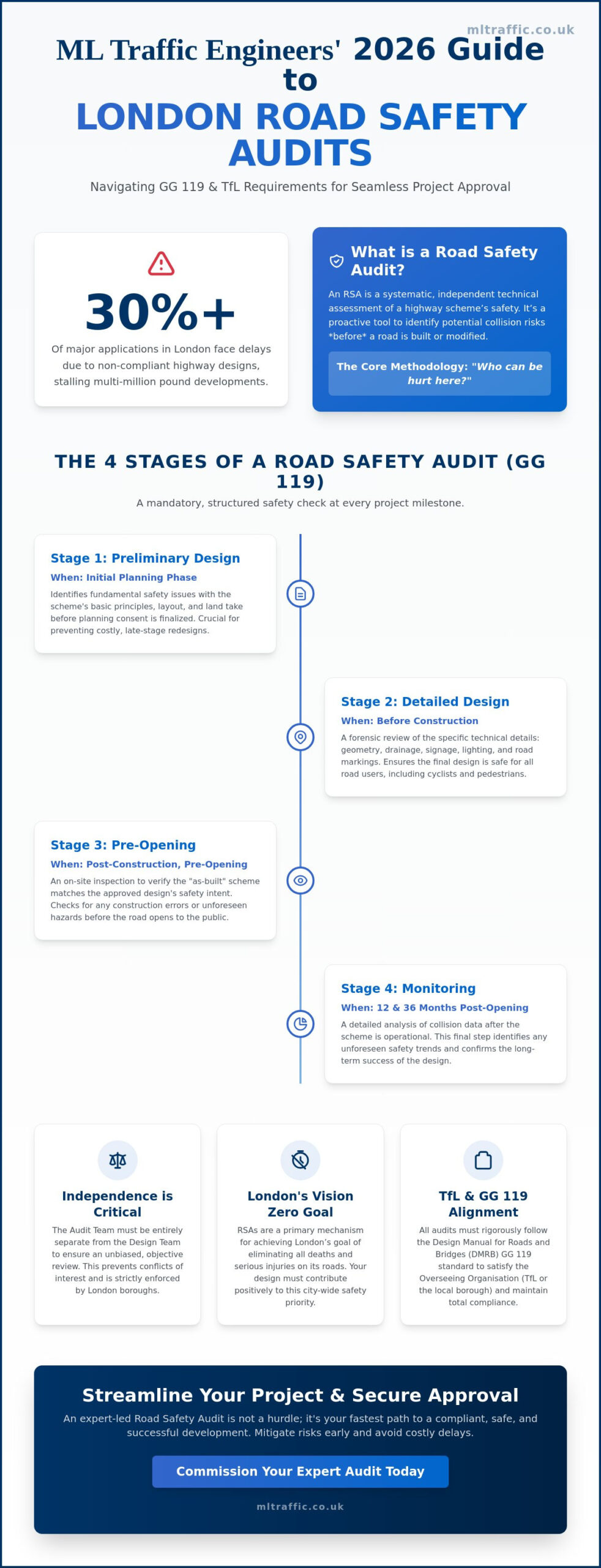
Adhering to the GG 119 standard is a mandatory requirement for any developer altering the highway in London. This framework, known as The 4 Stages of the Road Safety Audit Process, provides a structured safety check at every milestone of a project’s lifecycle. By identifying potential hazards early, you prevent expensive remedial works after the tarmac is laid.
-
Stage 1: Preliminary Design – This occurs during the initial planning phase. The goal is to identify fundamental safety issues before you finalize land take or secure full planning consent.
-
Stage 2: Detailed Design – Completed before construction begins. The audit team reviews specific geometry, drainage, signage, and lighting plans to ensure the technical design is safe for all users.
-
Stage 3: Pre-Opening – An on-site inspection conducted after construction is finished but before the road opens to the public. It ensures the "as-built" scheme matches the safety intent of the design.
-
Stage 4: Monitoring – This involves a detailed analysis of collision data 12 and 36 months after the scheme opens to identify any unforeseen safety trends.
Engaging a road safety audit team early ensures that your project remains compliant with Transport for London (TfL) requirements. If your project involves complex site logistics, our team provides comprehensive traffic management services to support your planning goals.
When to Initiate Stage 1 and 2
For smaller London developments, such as residential infills or minor commercial access points, you can often combine Stage 1 and Stage 2. This streamlined approach saves approximately three to four weeks in the planning cycle by producing a single, comprehensive report. You must have a robust Swept Path Analysis ready for the Stage 2 review. This data proves that emergency vehicles and refuse trucks can navigate your layout without mounting kerbs or striking street furniture. Typical triggers for a road safety audit in the capital include the creation of new site accesses, junction improvements, or any change that alters the existing traffic flow on the public highway.
What Happens During the Stage 3 Site Visit?
The Stage 3 inspection is a physical, on-site evaluation that requires both day and night-time visits. Night inspections are critical for checking the retro-reflectivity of signs and ensuring that street lighting eliminates dark spots where pedestrians might be hidden. In high-density boroughs like Camden or Southwark, the audit focuses heavily on vulnerable road users, including cyclists and pedestrians, to ensure they aren’t forced into conflict with heavy goods vehicles. The Audit Brief is the essential document provided by the designer to the auditor that outlines the project scope and any previous design relaxations. Auditors walk and drive the route to experience the road from every perspective, ensuring that no detail, from tactile paving to signal timings, is overlooked.
Road Safety Audit vs. Transport Statement: What Do You Need?
A Transport Statement and a road safety audit serve distinct functions in the London planning process. They aren’t interchangeable. A Transport Statement acts as the justification for your development. It provides the data to prove that the local highway network can accommodate the projected increase in traffic, often quantifying trip generation for a specific number of residential units or commercial square footage. It answers the question: "Will this project cause a bottleneck?"
In contrast, a road safety audit is a technical validation of the highway design itself. It doesn’t care about traffic volumes or parking ratios. Instead, it focuses exclusively on identifying potential hazards within the proposed layout. This document protects the developer and the Highway Authority from future liability by ensuring the physical infrastructure doesn’t inherently cause collisions. While a Transport Statement focuses on capacity and policy, the RSA focuses on the safety of every road user, from cyclists to heavy goods vehicle drivers.
When One Does Not Replace the Other
Having a comprehensive Transport Assessment or Statement does not exempt you from the RSA process. Most London boroughs require both for any project involving physical changes to the public highway. If an RSA identifies a significant risk, such as inadequate sightlines at a new junction, you must revise your designs. These revisions often require updates to your Transport Statement to ensure the new layout still meets the original capacity and flow requirements.
Use this checklist to determine if your project requires both documents:
-
Are you creating a new bellmouth or priority junction?
-
Does the proposal involve altering existing kerb lines or pedestrian crossings?
-
Will the development change the speed limit or traffic calming measures on the adjacent road?
-
Is there a significant increase in vulnerable road users, such as school children or elderly residents?
London-Specific Triggers for Combined Reports
London’s unique urban fabric often triggers the need for simultaneous safety and transport reviews. Projects involving flat conversions in London are a prime example. These developments frequently utilize narrow Victorian access points that weren’t designed for modern delivery vehicles or high-frequency resident turnover. A borough like Croydon may demand a safety review of the specific access geometry, while Lewisham might prioritize the safety of adjacent cycle lanes.
Local authorities in the capital are increasingly strict about these requirements to meet Vision Zero safety targets. We see developers facing delays when they assume a simple transport report covers all bases. You need a coordinated approach where the safety audit informs the final transport strategy, ensuring your submission is robust enough to pass the first time. For commercial and mixed-use schemes, this also means ensuring your delivery and servicing plan london requirements are addressed alongside the safety audit to prevent TfL from rejecting your application on logistical grounds. Developers working in east London should note that Transport Planning Consultants Tower Hamlets can provide borough-specific expertise on navigating the New Local Plan 2023–2038 requirements and active travel integration standards that directly influence how safety audits are assessed in that borough.
Critical Safety Standards for London Developers in 2026
Compliance begins with GG 119. This is the mandatory standard for every road safety audit conducted on the UK road network. In the London context, the Highway Authority, whether it’s Transport for London (TfL) or a specific Borough, acts as the Overseeing Organisation. They define the audit’s scope and hold final approval power. Every report follows a strict Problem and Recommendation structure. This format ensures that for every identified safety risk, there’s a direct, technical solution proposed to mitigate it. It prevents vague feedback and forces a focus on actionable safety improvements.
The Designer’s Response is the most critical document following the audit. It’s where your team addresses each recommendation. If you disagree with the auditor, you can’t simply ignore the point. You must provide a technical justification. In 2026, disagreements often lead to an Exception Report. This requires formal sign-off from the Overseeing Organisation; without it, your project won’t reach the construction phase. Precision in these responses is vital to avoid iterative delays that stall planning permission.
Managing Section 278 and Section 38 Requirements
Successful developers integrate the road safety audit process directly into Highway Design S278 & S38 agreements. Failing to address safety issues during the design phase is a costly mistake. Retrospective design changes can easily add £20,000 to £60,000 to a project’s budget depending on the junction complexity. We recommend liaising with London borough engineers at the feasibility stage. This early collaboration ensures your design aligns with local requirements before the formal audit begins, reducing the risk of expensive late-stage revisions.
Vulnerable Road User (VRU) Focus in London
London’s Healthy Streets approach has fundamentally changed audit outcomes in 2026. There’s now intense scrutiny on cycle lane segregation and pedestrian crossing timings. Auditors frequently use TRICS data to model exact volumes of non-motorised users. If your design prioritizes vehicle flow at the expense of cyclist safety, it’ll fail the audit. You must demonstrate that your scheme supports the 10 Healthy Streets Indicators, specifically focusing on ease of crossing and reduced driver speeds. Precision in these areas is no longer optional; it’s a core requirement for planning approval in every London borough. Developers working in north London should be aware that Transport Planning Consultants Haringey can provide borough-specific guidance on meeting these Healthy Streets requirements within Haringey Council’s planning framework.
Ready to secure your project’s compliance? View our comprehensive traffic management services to ensure your design meets every London safety standard.
How to Navigate the Road Safety Audit Process Efficiently
Commissioning a road safety audit requires precision from the start. You must appoint an independent team consisting of at least two members who meet the GG 119 standards. This team shouldn’t have been involved in the original design process to ensure an unbiased perspective. To keep your project on schedule, provide the audit team with a comprehensive Audit Brief. This document needs to include the latest scheme drawings, traffic flow statistics, and verified collision data from the last 36 months. Missing information often forces auditors to stop work, which leads to missed planning deadlines and increased costs.
Technical data serves as the backbone of a successful audit. We recommend including detailed Parking Surveys to demonstrate how existing kerbside activity impacts visibility splays. ML Traffic provides the underlying transport planning documents that auditors rely on to validate safety claims. Our technical team ensures your data is current and compliant with specific London borough requirements, providing a total managed solution for your application.
Avoiding Common Pitfalls and Delays
Opting for the cheapest audit service often results in expensive design rejections. If a road safety audit fails to identify a conflict point that Transport for London (TfL) later flags, you face significant redesign costs and construction delays. Seeking pre-application advice from Transport Planning Consultants in Lewisham or other London boroughs helps resolve these issues before the formal audit begins. We use Swept Path Analysis to safety-proof your design. This digital simulation confirms that emergency vehicles and heavy goods vehicles can navigate your site without compromising pedestrian safety or mounting the kerb. For developments with significant freight or servicing activity, ensuring your delivery and servicing plan in London is coordinated with your road safety audit findings is essential to avoid conflicting requirements that could delay your planning consent.
Next Steps for Your London Development
The audit timeline follows a logical progression from Stage 1 through Stage 3. Early engagement is the most effective way to streamline this process. It allows our engineers to integrate safety features into the design phase rather than retrofitting them later. This proactive approach minimizes the risk of a "non-compliance" notice from the highway authority.
-
Stage 1: Submit during the initial planning application to secure permission.
-
Stage 2: Complete this during the detailed design phase before starting any S278 or S38 works.
-
Stage 3: Conduct a site visit immediately after construction finishes to identify any unforeseen hazards.
Ready to secure your planning approval? Contact ML Traffic Engineers today for expert Transport Statements and the technical analysis required for a successful audit. Our team is ready to provide the professional support your development needs to stay compliant and on track.
Secure Your Planning Approval for 2026 London Developments
Achieving planning compliance in London requires a meticulous approach to the four-stage road safety audit process. Developers must align their projects with the latest 2026 TfL standards and specific requirements across all 32 London boroughs to avoid costly delays. Success relies on integrating technical data, such as Swept Path Analysis, into your initial transport planning phase. This ensures every vehicle movement is accounted for and safety risks are mitigated before construction begins.
ML Traffic acts as your dependable partner, managing the intricate complexities of UK road regulations so you don’t have to. We provide 24/7 availability for urgent projects, delivering the technical authority and CAD design expertise needed for seamless integration. Our specialists focus on precision, ensuring your project meets every legal and physical safety necessity. We’re ready to move your development forward with the urgency and reliability your timeline demands.
Get a Professional Transport Statement for Your London Project
We look forward to helping you navigate your next successful planning application with confidence.
Frequently Asked Questions
Is a Road Safety Audit a legal requirement for all London developments?
A road safety audit is mandatory for any London development that involves permanent changes to the highway network under Section 278 or Section 38 agreements. Transport for London (TfL) requires these audits for all schemes on the Strategic Road Network to ensure compliance with the London Plan 2021. If your project alters traffic flow or pedestrian crossings, planning permission usually depends on successful audit completion.
How much does a Road Safety Audit cost for a typical London project?
Costs for a road safety audit depend on the project’s scale and the specific requirements of the local highway authority. For a standard residential development, fees cover the audit team’s site visit and the formal report. You should also account for the local borough’s separate review fee, which some London councils set between £750 and £2,000 as of 2024. Total investment reflects the complexity of the road layout.
Can my own transport consultant carry out the Road Safety Audit?
Your design consultant cannot perform the audit because GG 119 regulations require total independence between the designers and the auditors. The audit team must consist of at least two trained professionals who haven’t been involved in your project’s planning phase. This separation prevents bias and ensures that safety remains the sole priority during the evaluation. We provide this independent oversight to keep your project moving.
What happens if the RSA identifies a problem I cannot fix?
You must address every problem identified in the report through a formal Designer’s Response. If a specific recommendation is physically impossible to implement, you’ll need to propose an alternative safety mitigation that satisfies the Highway Authority. The Overseeing Organisation makes the final decision on whether to accept your justification for not following a specific audit recommendation. We help navigate these regulatory hurdles.
How long does the Road Safety Audit process take from start to finish?
The entire process generally takes between 10 and 20 working days from the moment you provide the full design package. This timeframe includes the mandatory daylight and nighttime site observations required for most stages. We prioritize rapid turnarounds to prevent bottlenecks in your construction schedule, ensuring that safety reports reach the local authority without unnecessary delays. Precision and speed are our operational standards.
What is the difference between a Stage 1 and Stage 2 RSA?
A Stage 1 RSA assesses the preliminary design during the planning application phase to identify fundamental safety issues. Stage 2 occurs once you’ve completed the detailed design, focusing on specific elements like signage, lighting, and drainage before construction starts. Combining these into a Stage 1/2 audit is common for smaller London developments to streamline the 2026 planning process. Each stage serves as a vital safety checkpoint.
Do I need an RSA for a simple dropped kerb or crossover in London?
You don’t typically need a full RSA for a standard domestic dropped kerb unless the local borough specifically requests it due to high-risk locations. However, commercial crossovers or those on TfL Red Routes often require a formal safety assessment to protect pedestrians and cyclists. Always check your specific planning conditions, as 15% of London boroughs have updated their crossover policies since 2023 to improve urban safety.
What is GG 119 and why does it matter for my audit?
GG 119 is the national standard within the Design Manual for Roads and Bridges that governs how road safety audits are conducted in the UK. It replaced the older HD 19/15 standard in 2020 and sets strict requirements for auditor qualifications and report formats. Compliance with GG 119 is non-negotiable for any project seeking approval from TfL or London highway authorities. It provides the legal framework for our safety evaluations.
Which areas in London do you cover?
We service Acton, Balham, Barking, Barnes, Barnet, Battersea, Beckenham, Bexleyheath, Brentford, Brixton, Bromley, Camberwell, Carshalton, Charlton, Chelsea, Chiswick, Clapham, Coulsdon, Croydon, Crystal Palace, Dagenham, Dulwich, Ealing, Edgware, Eltham, Enfield, Finchley, Forest Gate, Fulham, Golders Green, Greenwich, Hackney, Hammersmith, Hampstead, Harrow, Hayes, Highgate, Hounslow, Ilford, Islington, Kensington, Kentish Town, Kingston upon Thames, Lewisham, Mitcham, Muswell Hill, New Malden, Notting Hill, Orpington, Peckham, Pinner, Purley, Putney, Richmond, Romford, Ruislip, Sidcup, Southall, Southgate, Streatham, Surbiton, Sutton, Tooting, Tottenham, Twickenham, Uxbridge, Walthamstow, Wembley, West Norwood, Wimbledon, Wood Green, Woolwich, Bethnal Green, Shoreditch, Canary Wharf, Deptford, Leyton, Palmers Green, Stanmore, Upminster, Chislehurst, Erith, Feltham.
Which cities in England do you cover?
We service London, Birmingham, Manchester, Liverpool, Sheffield, Leeds.

Disclaimer
The content on mltraffic.co.uk, including all technical articles, guides, and resources, is provided for general informational and educational purposes only. It is not intended to constitute professional advice in traffic engineering, transportation planning, development approvals, or any other technical or legal field.
While ML Traffic Engineers makes every reasonable effort to ensure the accuracy, completeness, and timeliness of the information published, we do not provide any warranties or representations (express or implied) regarding its reliability, suitability, or availability for any particular purpose. Any reliance you place on the content is strictly at your own risk.
In no event shall ML Traffic Engineers, its directors, employees, authors, or affiliates be liable for any direct, indirect, incidental, special, consequential, or punitive damages (including, without limitation, loss of profits, data, or business opportunities) arising out of or in connection with the use of, or inability to use, any information provided on this website.
The articles and guides on this site are not a substitute for engaging a qualified, professional traffic engineer to assess your specific project requirements. For tailored advice, compliance assessments, or traffic engineering services, please contact a competent professional.
This disclaimer may be updated from time to time without notice. By accessing or using this website, you agree to be bound by the most current version of this disclaimer.