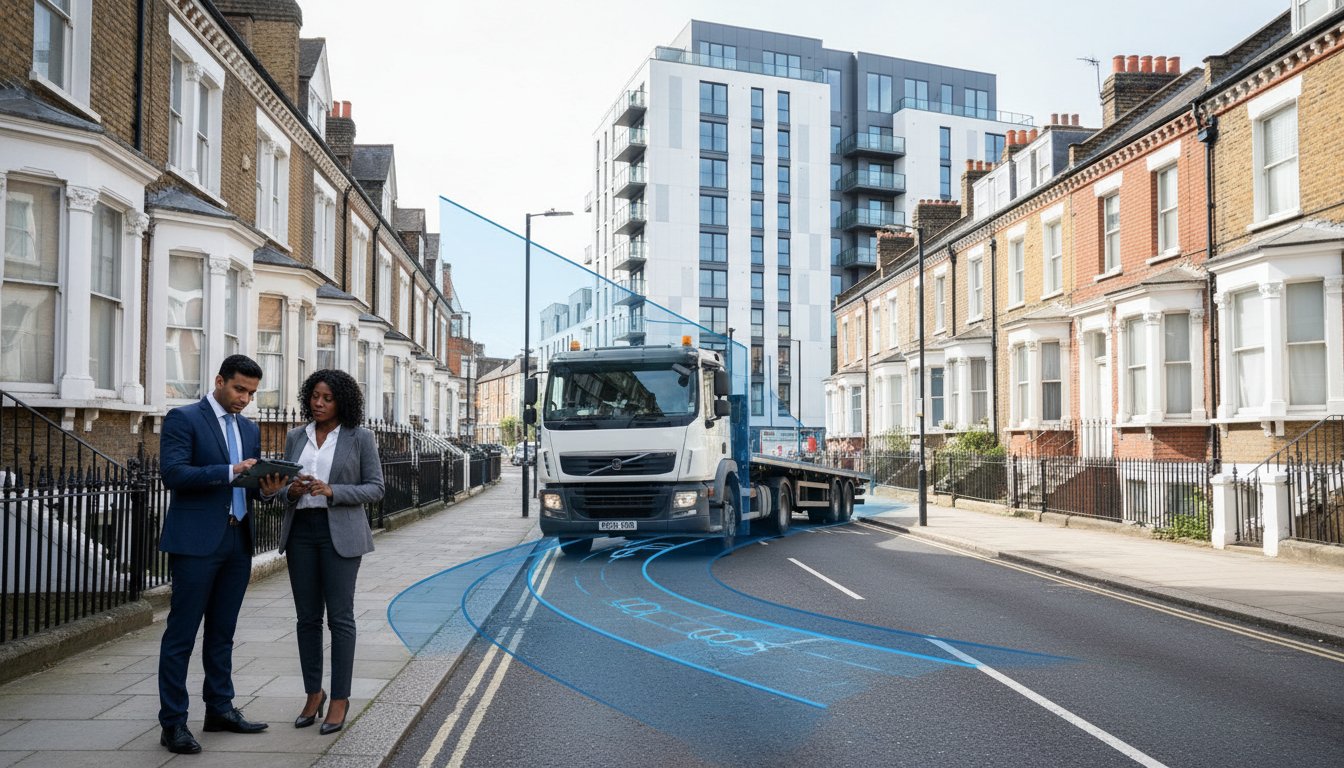
A single parking space in a Lewisham development can represent the difference between a project’s green light and a total rejection from the council. You likely recognize that securing approval in 2026 requires more than just a basic site plan; it demands a technical strategy that addresses the borough’s unique constraints. Partnering with expert Transport Planning Consultants Lewisham ensures your project survives the scrutiny of strict parking standards and low PTAL ratings in areas like Deptford or Catford.
We understand that narrow Victorian street access often complicates emergency vehicle tracking and site logistics. You’re probably already feeling the pressure of balancing high-density housing targets with Lewisham’s uncompromising safety requirements. This guide provides a clear roadmap to secure your development’s approval. We’ll show you how to optimize site layouts for vehicle access and navigate the intricacies of s278 and s38 agreements with precision. From initial CAD designs to final implementation, we’ll cover the essential steps to turn regulatory burdens into a successful planning outcome.
Key Takeaways
- Align your site with the London Plan 2026 and Lewisham Local Plan to navigate “car-lite” requirements and ensure regulatory compliance.
- Partner with expert Transport Planning Consultants Lewisham to streamline the planning process and secure rapid project approval through technical authority.
- Master the technical data needed for success, from high-accuracy Swept Path Analysis to the mandatory Lambeth Methodology for parking surveys.
- Differentiate between Transport Statements and Assessments to provide the precise documentation Lewisham Highways demands for commercial and residential sites.
- Discover how early pre-application engagement provides a “safe pair of hands,” mitigating regulatory risks and accelerating your development’s timeline.
Why You Need a Transport Consultancy in Lewisham
In the complex planning environment of South East London, Transport Planning Consultants Lewisham act as the technical bridge between a developer’s vision and the Borough’s strict regulatory requirements. Securing planning permission in 2026 requires more than just a site plan; it demands a deep understanding of transport planning models that prioritize sustainable travel over private vehicle use. The London Plan 2021 has accelerated the shift toward “Car-Free” and “Car-Lite” schemes, making it nearly impossible to gain approval for traditional parking-heavy developments in areas like Deptford or Catford.
Without precise data to mitigate risks, developers face immediate project refusals or expensive, late-stage redesigns that erode profit margins. Professional consultants provide the empirical evidence needed to satisfy Lewisham Council that a new scheme won’t paralyze the local road network. This involves detailed trip generation analysis and robust mitigation strategies that address the concerns of both planning officers and local residents.
Lewisham’s Unique Transport Geography
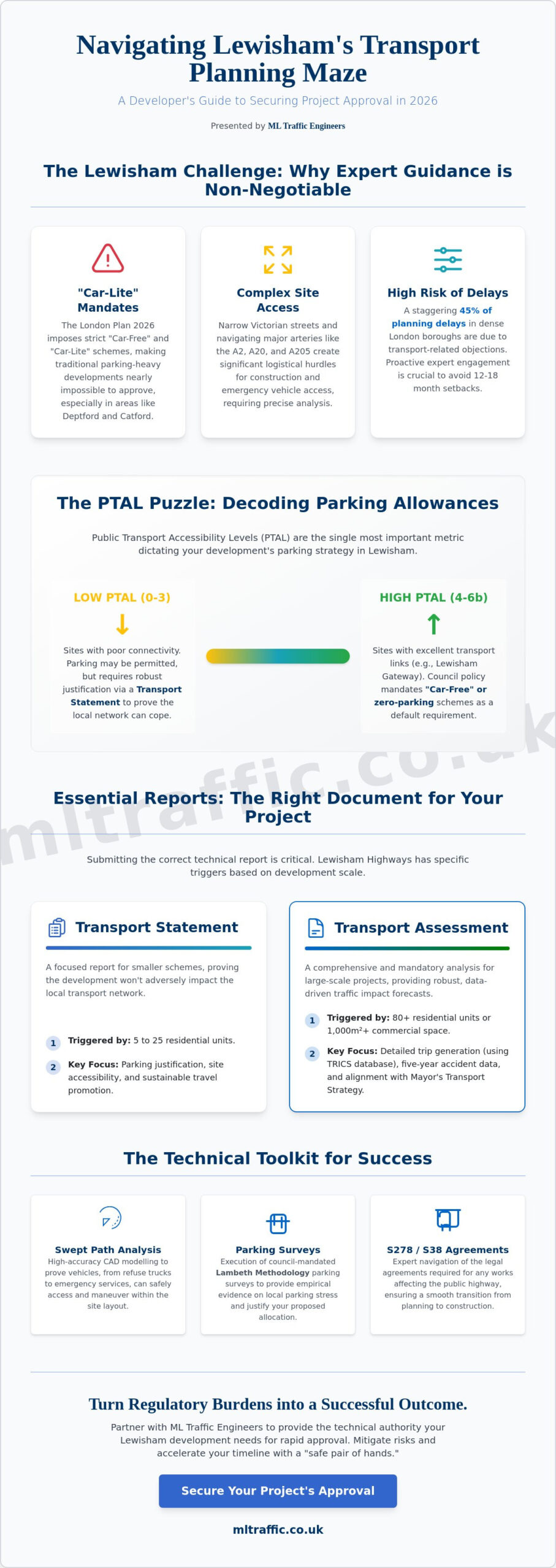
Lewisham presents a fragmented transport landscape. You have high-capacity hubs like Lewisham Gateway, boasting a PTAL of 6b, contrasted with isolated zones in the south of the borough where connectivity is poor. Navigating the constraints of the A2, A20, and the South Circular (A205) is a primary hurdle for any logistics or construction plan. Local knowledge of the Lewisham Council planning department is a strategic advantage. It allows consultants to anticipate specific concerns regarding local junctions and air quality long before a formal application is submitted. This proactive approach prevents the 12 to 18-month delays often seen when transport issues are treated as an afterthought.
The Impact of PTAL Ratings on Your Development
Public Transport Accessibility Levels (PTAL) are the baseline for every development in London. In Lewisham, your PTAL score dictates the maximum number of parking spaces you’re allowed to provide. High PTAL scores often mandate zero parking, while lower scores require a nuanced approach to satisfy Council members. For sites with low connectivity, we deploy a Transport Statement to justify the viability of the project. These documents use technical evidence to prove that the local network can handle the additional pressure. Ignoring these metrics leads to significant friction; a 2023 industry report suggested that transport-related objections cause up to 45% of planning delays in high-density London boroughs. Working with experienced Transport Planning Consultants Lewisham ensures your PTAL strategy is optimized from day one.
Essential Transport Reports for Lewisham Planning Success
Securing planning permission in Lewisham requires a data-led approach to site accessibility and traffic impact. Transport Planning Consultants Lewisham must provide precise documentation to satisfy the London Borough of Lewisham’s highways officers. These reports aren’t just paperwork; they’re the technical foundation for your development’s viability. If your project involves flat conversions in London, you’ll likely need a Transport Statement to address increased density and parking pressure.
Transport Statements vs. Assessments
The scale of your development determines the depth of reporting required. Lewisham Council typically triggers a Transport Statement for smaller residential schemes between 5 and 25 units. For projects exceeding 80 residential units or commercial spaces over 1,000 square meters, a full Transport Assessment is mandatory. We use the TRICS database to provide accurate trip generation forecasts for South East London sites, ensuring your traffic impact predictions are robust. These documents must analyze five-year accident data and demonstrate alignment with the Mayor’s Transport Strategy to ensure compliance with London-wide safety and health targets. Every report includes a policy compliance audit to prove the site supports the Healthy Streets approach.
Travel Plans: Encouraging Sustainable Shift
Large-scale residential and commercial projects require a comprehensive Travel Plan. This document isn’t a static report but a long-term commitment to reducing single-occupancy vehicle trips. Lewisham strictly enforces cycle parking standards, often requiring one space per bedroom for residential units. Electric vehicle (EV) charging infrastructure is also a priority; current regulations demand 20% active and 80% passive charging provision for new parking spaces. Technical notes are vital tools when officers raise specific objections regarding local road capacity or junction safety. They allow for a focused response that avoids the delays of a full report revision. Our team provides comprehensive support to ensure every technical detail meets the 2026 regulatory standards. We manage the monitoring and management phases, providing the 24/7 reliability needed to keep your project moving toward implementation.
Precise data prevents planning delays. Transport Planning Consultants Lewisham use these reports to mitigate risks before they become costly objections. By integrating technical notes early, developers can address specific highway concerns without restarting the entire consultation process. This proactive management ensures that your 2026 project timeline remains intact despite the complex regulatory environment in South East London.
Technical Data: Parking Surveys and Swept Path Analysis
Success in Lewisham’s planning environment depends on raw, indisputable data. Lewisham Council rarely accepts anecdotal evidence regarding parking or access. They demand technical rigor. As experienced Transport Planning Consultants Lewisham, we provide the specific datasets required to clear highways objections and secure planning permission for complex developments.
Our team conducts comprehensive traffic counts and pedestrian flow analysis, particularly in high-density areas like Lewisham Town Centre and Catford. We deploy sensors and manual counters to capture real-time movement patterns. This data ensures that your development’s entrance doesn’t conflict with the borough’s vision for safer, more accessible streets as outlined in Lewisham’s Transport Strategy 2019-2041. Precision at this stage prevents costly design revisions during the Section 278 agreement process.
Parking Stress Surveys in Lewisham
Developers hire Transport Planning Consultants Lewisham to conduct surveys that adhere strictly to the “Lambeth Methodology.” We perform these overnight surveys between 00:30 and 05:30 on two separate weekday nights to capture peak residential parking demand. Our surveyors map every available legal parking space within a 200-meter walking distance of the site. This is essential for developments in Brockley or Blackheath where Controlled Parking Zones (CPZs) are already at high capacity.
Robust data can overturn “lack of parking” objections from local residents or council members. If we prove that existing parking stress is below 85%, it demonstrates that the local road network can absorb potential overspill. We don’t just collect numbers; we provide the analytical context that highways officers need to approve your application. Our 24/7 data collection teams are ready to deploy at short notice to meet tight submission deadlines.
Swept Path Analysis for Site Access
Site feasibility often hinges on whether a vehicle can actually get in and out without mounting the pavement or hitting street furniture. We use advanced CAD software to perform Swept Path Analysis (SPA). This simulates the turning circles of specific vehicles, including 10.7-meter refuse trucks and heavy delivery vans. It’s a non-negotiable requirement for Lewisham Highways officers who must ensure that new developments don’t lead to blocked roads or dangerous reversing maneuvers.
The “Fire Tender” challenge is particularly acute on Lewisham’s narrow residential streets. We simulate the exact movements of a 7.7-meter fire engine to guarantee emergency access at all times. Our team optimizes tight site entrances to ensure compliance with safety standards while maximizing the developable area of your site. You can view our full range of Swept Path Analysis Services to see how we secure planning approval for complex London sites.
Navigating Lewisham Council and TfL Policy
Securing planning permission in 2026 requires a precise alignment with the London Plan 2026 and the updated Lewisham Local Plan. Developers often face delays because they underestimate the complexity of multi-agency requirements. If your project sits adjacent to the Transport for London Road Network (TLRN), such as the A205 South Circular or the A21, you must manage dual layers of scrutiny from both Lewisham Council and TfL. Transport Planning Consultants Lewisham act as the vital bridge in these negotiations, ensuring that technical submissions satisfy both local and regional highway authorities simultaneously.
Early engagement is a non-negotiable step for successful project delivery. Pre-application meetings with Lewisham Highways allow for the early identification of potential “showstoppers,” such as restrictive access points or inadequate space for delivery vehicles. This proactive approach helps in defining Section 106 transport contributions and Community Infrastructure Levy (CIL) requirements long before the final planning committee meets. We provide the technical authority needed to justify your site’s impact, preventing costly redesigns during the later stages of the planning cycle.
Lewisham Local Plan 2026: What Developers Need to Know
The 2026 Local Plan places a heavy emphasis on “Vision Zero” and active travel. Every new development must demonstrate how it reduces car dependency and improves air quality for the borough’s 300,000 residents. You’ll need to provide robust evidence of how your site supports cycling infrastructure and pedestrian safety. A compliant road safety audit is an essential component of this evidence, ensuring your highway design meets GG 119 standards and satisfies TfL’s rigorous safety requirements. Logistics are equally scrutinized. With the Ultra Low Emission Zone (ULEZ) standards now firmly embedded in London’s infrastructure, your construction logistics plan must account for compliant vehicle movements. For a detailed breakdown of these requirements, refer to our London ULEZ and Construction Guide to ensure your fleet remains compliant and avoids heavy daily charges. Commercial and mixed-use schemes must also address how goods vehicles will access the site post-construction; a robust delivery and servicing plan London developers submit to TfL is increasingly scrutinized as a standalone document that can determine whether your application proceeds or stalls.
Highway Design and Legal Agreements
Once planning is granted, the focus shifts to the technical execution of highway works. Any modifications to the public road network require formal S278 or S38 agreements. These legal contracts ensure that all works meet Lewisham’s specific adoptable standards for materials and safety. Precision is essential here. Our team handles the CAD designs and technical specifications required to gain technical approval from council engineers. We manage the entire lifecycle of these agreements, from initial design to the final certificate of completion.
- Bespoke CAD design for complex urban junctions.
- Full compliance with Chapter 8 safety standards.
- 24/7 support for emergency road works and utility connections.
- Seamless integration of temporary traffic signals during construction phases.
We operate as a safe pair of hands, taking the regulatory burden off your shoulders. Explore our full range of services by visiting ML Traffic What We Do to see how we streamline the highway adoption process.
Contact our team today for a comprehensive transport planning consultation to secure your Lewisham project’s success.
Choosing ML Traffic Engineers for Your Lewisham Project
ML Traffic Engineers provides the technical precision and regulatory insight required to secure planning consents in South East London. As experienced Transport Planning Consultants Lewisham, we act as a safe pair of hands for developers, managing everything from minor residential conversions to major mixed-use schemes. Our team understands that 2026 planning requirements demand more than just data collection. They require a proactive approach to road safety and environmental impact that satisfies both the local authority and the community.
We maintain 24/7 availability for urgent data collection and survey requirements. If a local authority requests a last-minute parking survey or traffic count, we deploy our teams immediately to ensure your project timeline remains intact. This readiness stems from our commitment to alleviating the logistical burdens that often stall development. We handle the complexities of UK road regulations so you don’t have to.
Our Local Expertise in South East London
Our track record includes successful approvals across Lewisham and Catford, where we’ve navigated the specific challenges of the South Circular and local Controlled Parking Zones (CPZs). We’ve also applied this expertise in neighboring boroughs, as detailed in our guide for Croydon. Developers working across North London face similar regulatory complexity, and our guide for Transport Planning Consultants Haringey outlines how high-density PTAL 6 sites require the same data-driven approach to avoid TfL objections and Section 106 delays. For developers with sites in East London, our guide for Transport Planning Consultants Tower Hamlets explains how the borough’s New Local Plan 2023–2038 and active travel requirements demand the same rigorous technical approach to PTAL ratings and CIL compliance. We don’t just present raw data; we translate complex traffic figures into persuasive arguments that align with the London Plan. You can contact us today for a comprehensive Project Type Review to assess your specific site requirements.
The ML Traffic Advantage
Speed and accuracy define our service. We deliver Transport Statements and Parking Surveys with rapid turnaround times to keep your application moving through the planning portal. Our reporting is cost-effective because we focus strictly on the evidence necessary for approval, avoiding unnecessary filler that complicates the process. When you choose us as your Transport Planning Consultants Lewisham, you gain a partner dedicated to professional integrity.
- Chapter 8 compliance is a non-negotiable standard for all our on-site survey work.
- CAD design capabilities allow for precise swept path analysis and site layout optimization.
- 24/7 emergency response ensures we’re ready when site conditions or council requirements change unexpectedly.
We take pride in our role as a total managed solution provider. By handling the intricate details of traffic management and planning policy, we allow you to focus on the broader goals of your development. Our consultancy isn’t just a service. It’s a commitment to safety and precision that ensures your project moves from the drawing board to the construction phase without regulatory delays.
Secure Your Lewisham Development Approval for 2026
Navigating Lewisham’s 2026 planning landscape requires more than standard documentation. Developers must integrate precise technical data, including parking surveys and swept path analysis, to meet the borough’s evolving highways requirements. Success depends on total compliance with TfL policies and local frameworks. ML Traffic Engineers provides over 10 years of London planning experience to ensure your project meets every regulatory benchmark. We offer 24/7 technical survey support, delivering the high-stakes precision necessary for legal and physical safety. As expert Transport Planning Consultants Lewisham, we manage the lifecycle from initial CAD design to final implementation. Our team acts as a safe pair of hands, handling complex road regulations so you don’t have to. We’re ready to help you move forward with confidence and secure the permissions your development needs. Get a free consultation for your Lewisham development from ML Traffic Engineers. Your project’s success starts with technical precision and unwavering reliability.
Frequently Asked Questions
Do I need a transport statement for a small development in Lewisham?
Yes, Lewisham Council typically requires a Transport Statement for residential developments of 5 to 49 units. Smaller schemes under 5 units might still require one if the site has specific access constraints or sits in a Controlled Parking Zone (CPZ). Our Transport Planning Consultants Lewisham team ensures these documents meet the latest 2026 London Plan standards to prevent planning delays.
What is the Lambeth Methodology for parking surveys, and why does Lewisham use it?
The Lambeth Methodology is the industry standard for parking stress surveys, requiring two overnight snapshots between 00:30 and 05:30 on weekday nights. Lewisham Council adopts this framework because it provides a consistent 200-meter radius assessment of kerbside capacity. This data proves whether a development can safely absorb overspill parking without impacting local residents or emergency vehicle access.
How does a low PTAL rating affect my Lewisham planning application?
A low Public Transport Access Level (PTAL) score of 0 to 2 indicates poor connectivity, which often triggers a requirement for higher on-site parking provision. Lewisham planners use PTAL data to determine if your site supports car-free living or requires a robust Travel Plan. We analyze the 2026 TfL connectivity data to mitigate low scores through improved cycling infrastructure or car club contributions.
Can a transport consultant help with a car-free development in a CPZ?
Yes, we specialize in securing car-free agreements by demonstrating that the development won’t increase local parking stress. In Lewisham, this often involves a Section 106 agreement that prevents residents from applying for on-street permits. Our Transport Planning Consultants Lewisham experts provide the technical evidence needed to satisfy Council officers that the local infrastructure supports a zero-parking model.
What is Swept Path Analysis, and is it required for my site?
Swept Path Analysis uses CAD software to simulate the movement of specific vehicles, such as an 11.4-meter refuse truck, through your site layout. Lewisham Council requires this for any development involving new access points or tight turning circles. It’s a non-negotiable safety requirement to ensure emergency services and delivery vehicles can enter and exit the site in a forward gear.
How much does a transport consultancy report cost for a Lewisham project?
Fees for transport reports depend on the project scale and the specific requirements set by the Lewisham Council Highways department. A basic Transport Statement for a minor development involves different technical inputs than a full Transport Assessment for a major 50-plus unit scheme. We provide bespoke quotes based on the 2026 scope of works required to achieve planning compliance without hidden costs.
How long does it take to complete a parking survey in London?
A standard parking survey takes approximately 7 to 10 working days to complete from the initial site visit to the final report delivery. This timeline accounts for the two separate overnight observations required by the Lambeth Methodology. We maintain a 24/7 operational readiness to deploy surveyors quickly, ensuring your planning submission stays on track with accurate, real-time data.
What happens if Lewisham Council Highways object to my transport assessment?
If the Highways department objects, we enter a formal negotiation phase to address their specific technical concerns. This often involves refining the site access design or updating the Travel Plan with additional mitigation measures. Our team acts as your technical advocate, using data-driven evidence to resolve objections and secure a positive recommendation for your planning committee.

Article by
Michael Lee
Transport planner with over 35 years’ experience.
Disclaimer
The content on mltraffic.co.uk, including all technical articles, guides, and resources, is provided for general informational and educational purposes only. It is not intended to constitute professional advice in traffic engineering, transportation planning, development approvals, or any other technical or legal field.
While ML Traffic Engineers makes every reasonable effort to ensure the accuracy, completeness, and timeliness of the information published, we do not provide any warranties or representations (express or implied) regarding its reliability, suitability, or availability for any particular purpose. Any reliance you place on the content is strictly at your own risk.
In no event shall ML Traffic Engineers, its directors, employees, authors, or affiliates be liable for any direct, indirect, incidental, special, consequential, or punitive damages (including, without limitation, loss of profits, data, or business opportunities) arising out of or in connection with the use of, or inability to use, any information provided on this website.
The articles and guides on this site are not a substitute for engaging a qualified, professional traffic engineer to assess your specific project requirements. For tailored advice, compliance assessments, or traffic engineering services, please contact a competent professional.
This disclaimer may be updated from time to time without notice. By accessing or using this website, you agree to be bound by the most current version of this disclaimer.