Tag: TfL

  • London Travel Plans: The Essential Guide for Planning Applications in 2026

    London Travel Plans: The Essential Guide for Planning Applications in 2026

    By 2026, Transport for London (TfL) expects 80% of all trips to be made by foot, cycle, or public transport, making your development’s transport strategy the most scrutinised element of your planning application. You likely already feel the pressure of these evolving requirements and the very real risk of costly project delays when transport objections arise. Balancing high-density development with aggressive sustainability targets is a technical challenge that requires precision and a deep understanding of current London borough expectations.

    This guide provides the technical roadmap you need to master travel plans that satisfy regulatory bodies and secure faster planning approval. We’ll show you how to implement compliant, cost-effective measures that protect your project’s timeline and budget. From the initial consultation phase to final implementation, we’ll outline the exact steps to transform transport hurdles into a seamless path toward planning success. You’ll gain a clear understanding of how to align your project with the latest London-specific standards without sacrificing site efficiency or commercial viability.

    Key Takeaways

    • Understand why London developments must prioritise walking, cycling, and public transport to meet rigorous 2026 planning requirements.
    • Learn how to develop TfL-compliant travel plans by integrating SMART targets and comprehensive site audits into your submission.
    • Navigate the complexities of London Borough requirements, including the “Healthy Streets” approach and the distinction between Full and Framework plans.
    • Identify the legal obligations for long-term monitoring and the essential role of the Travel Plan Co-ordinator in maintaining strategy success.
    • Discover how expert traffic engineering services use data-driven reports to overcome transport objections and secure rapid planning consent.

    Table of Contents

    Understanding Travel Plans in the London Planning Process

    A Travel Plan acts as a long-term management strategy designed to encourage sustainable transport and reduce the reliance on single-occupancy vehicles. Under the Town and Country Planning Act 1990, these documents serve as a legal requirement for most major applications in the capital. To understand the core components of these strategies, it helps to ask: What is a Travel Plan? Essentially, it’s a framework that prioritises active travel and public transport to ensure new sites don’t overwhelm the existing road network. ML Traffic Engineers provides the technical authority needed to navigate these regulatory hurdles from the initial design phase.

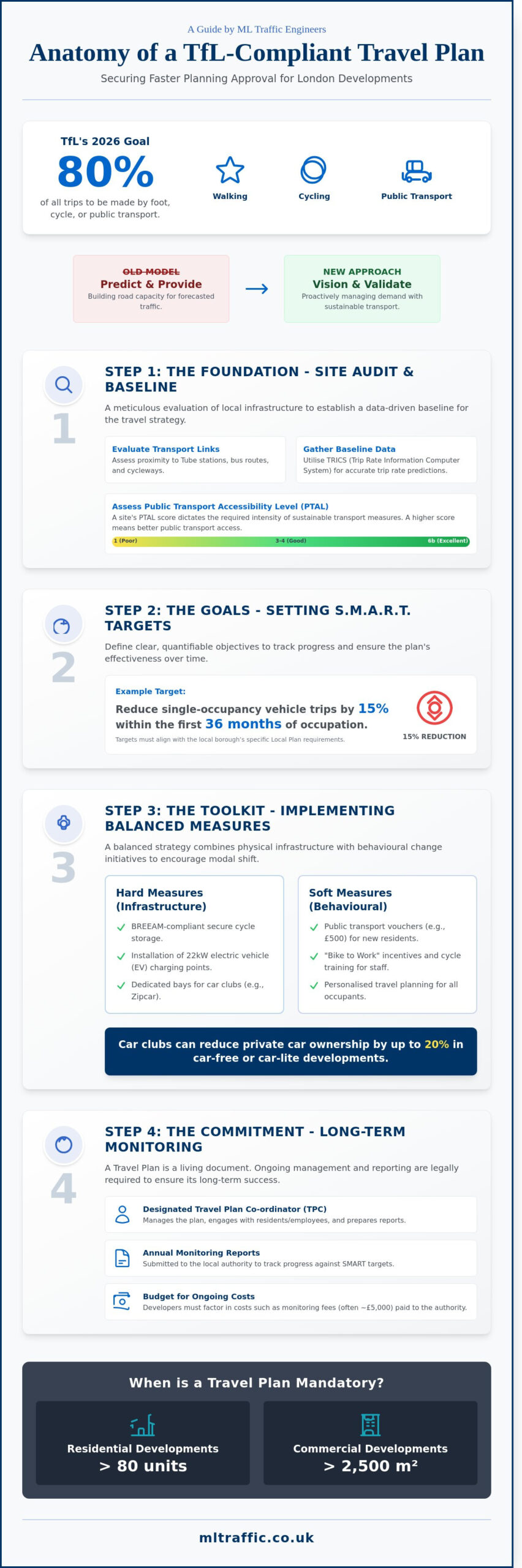
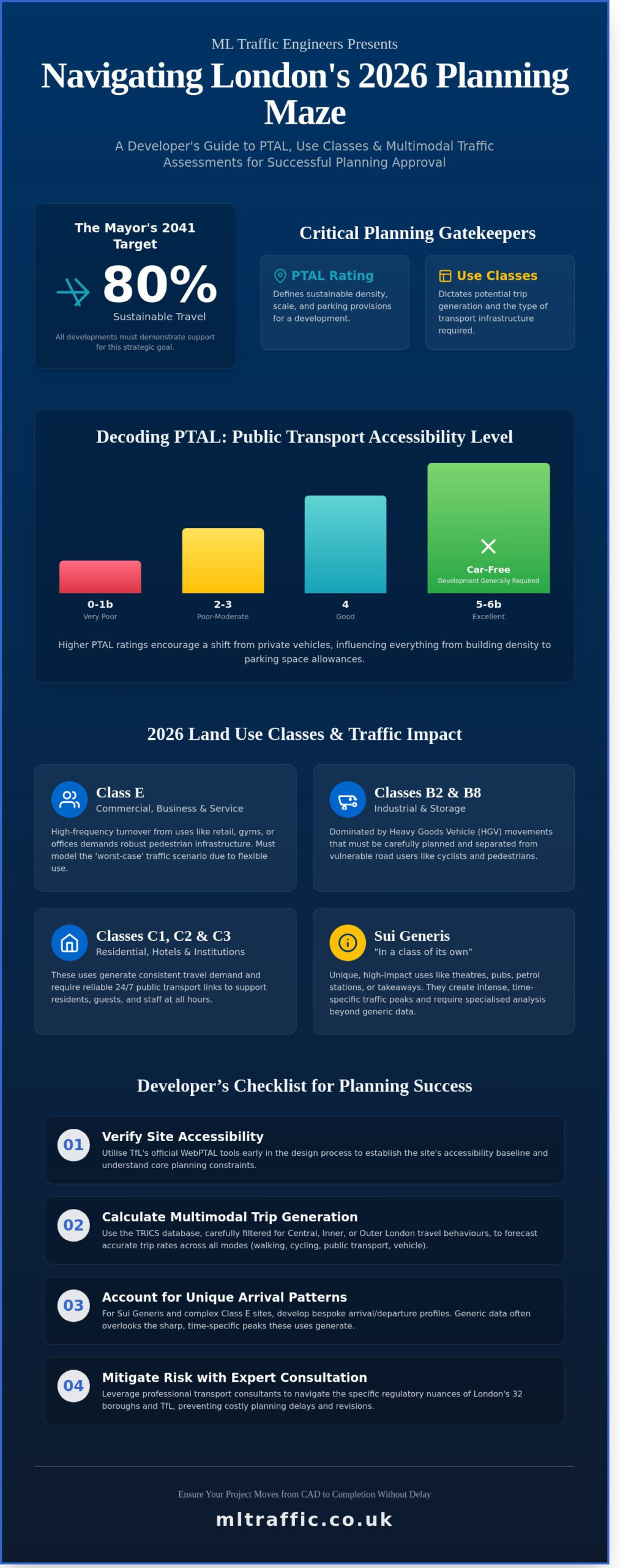
    Transport planning in London has shifted from the traditional “Predict and Provide” model to a “Vision and Validate” approach. Instead of simply building road capacity to meet forecasted traffic, developers must now define a sustainable vision for their site and validate it through strict monitoring. This ensures that 80% of all trips in London are made by foot, cycle, or public transport by 2041. It’s a proactive method that manages demand rather than reacting to it.

    Why Travel Plans are Mandatory for London Developments

    The London Plan 2021-2026 mandates travel plans for any residential development exceeding 80 units or commercial spaces over 2,500 square metres. These thresholds ensure that large-scale projects mitigate their impact on local congestion and air quality. By integrating these strategies early, developers demonstrate compliance with strict safety standards and road regulations. ML Traffic Engineers’ bespoke solutions ensure that your project meets these legal triggers while maintaining operational efficiency.

    The Role of Travel Plans in Achieving Net Zero

    London aims to be a net-zero carbon city by 2030. Achieving this ambitious target requires a 27% reduction in car kilometres travelled across the capital. Effective transport strategies cut private car dependency by offering residents and employees viable alternatives like car clubs or secure cycle storage. A Travel Plan is a document that evolves throughout the life of a development. For comprehensive guidance on implementing sustainable transport strategies, our green travel plans in London resource provides detailed implementation strategies for 2026 compliance.

    Key Components of a TfL-Compliant Travel Plan

    Achieving TfL compliance requires a meticulous approach to data and local infrastructure. Every successful development begins with a comprehensive site audit. This process evaluates existing transport links, such as nearby Tube stations or bus routes, and assesses the Public Transport Accessibility Level (PTAL) score. A site with a PTAL of 6a demands a different strategy than a PTAL 2 location. Developers must also consult the National guidance on Travel Plans to ensure their proposals align with broader UK planning policy and the London Plan 2021.

    Setting SMART Targets for Sustainable Transport

    Effective travel plans rely on baseline data gathered through TRICS (Trip Rate Information Computer System) or bespoke site surveys. We set SMART targets to track progress accurately. For instance, a residential development in Southwark might aim to reduce single-occupancy vehicle trips by 15% within the first 36 months of occupation. These objectives must mirror the specific requirements of the local borough’s Local Plan to secure planning approval. If you require expert assistance with site-specific logistics, our team provides bespoke traffic management solutions that ensure your project remains compliant from day one.

    Effective Travel Plan Measures: From Cycle Parking to Car Clubs

    We categorise interventions into hard and soft measures to ensure a balanced approach to modal shift. Hard measures involve physical infrastructure, while soft measures focus on behavioural change. Key examples include:

    • Hard Measures: Installation of BREEAM-compliant secure cycle storage and 22kW electric vehicle (EV) charging points.
    • Soft Measures: Providing £500 public transport vouchers or “Bike to Work” incentives for new residents and staff.
    • Car Clubs: Dedicated bays for providers like Zipcar can reduce private car ownership by 20% in car-free developments.

    Long-term success depends on a designated Travel Plan Coordinator. This individual manages the annual monitoring reports required by Section 106 agreements. Developers must budget for these ongoing costs, which often include a monitoring fee of £5,000 paid to the local authority. Securing this funding upfront prevents project delays and ensures the development contributes to the Mayor’s 2041 healthy streets goal.

    London Travel Plans: The Essential Guide for Planning Applications in 2026

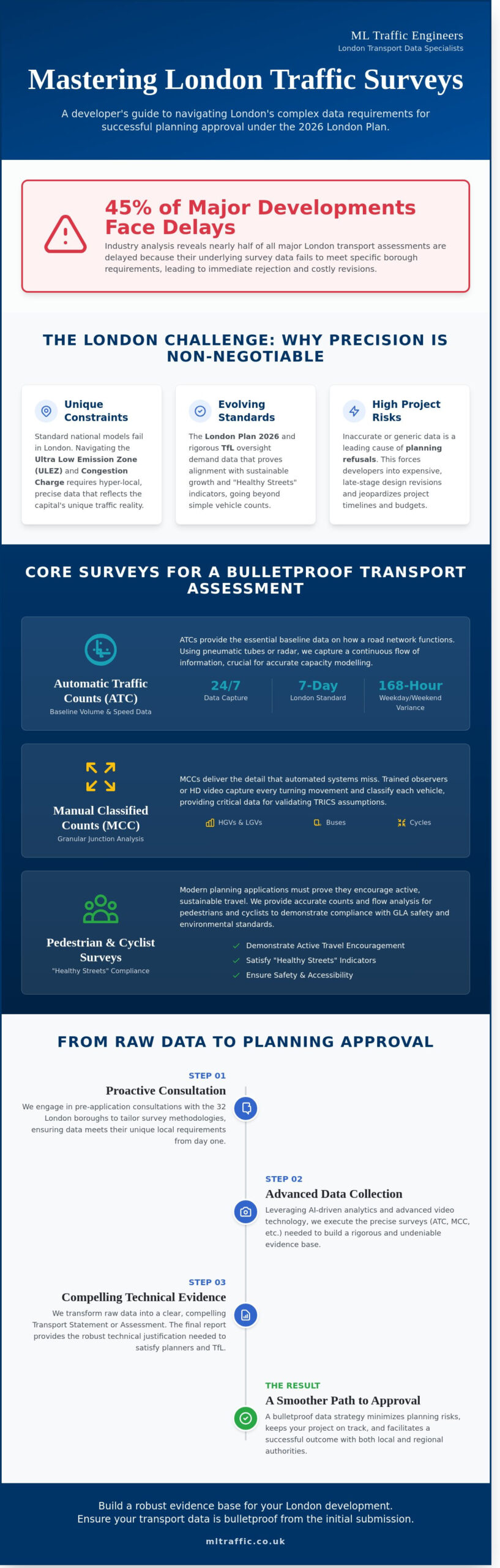
    Securing planning permission in London requires a precise understanding of the three distinct types of travel plans. Full Travel Plans apply to occupied sites with known end-users. Interim Travel Plans serve developments where occupiers remain unknown. Framework Travel Plans manage large, multi-use sites with multiple sub-units. Precision in selecting the correct document type prevents costly resubmission delays.

    TfL’s 2026 Healthy Streets approach dictates the approval process. Every submission must demonstrate how it improves the ten Healthy Streets indicators, such as “easy to cross” and “not too noisy.” Developers must engage borough transport officers during the pre-application phase. This early consultation identifies site-specific constraints before they become legal hurdles. Inner London sites typically face “car-free” mandates, while Outer London projects with Public Transport Accessibility Level (PTAL) scores below 3 require aggressive mitigation strategies to offset private vehicle reliance.

    TfL’s ATTrBuTE Tool and Quality Standards

    Transport for London uses the ATTrBuTE assessment tool to standardise the quality of every submission. This tool checks for 15 specific criteria, including site descriptions and clear management structures. Many submissions fail because they provide vague targets or lack ring-fenced funding for monitoring. A robust plan must integrate seamlessly with the wider Transport Assessment. It needs to include a dedicated Travel Plan Co-ordinator and a guaranteed budget for at least five years of monitoring.

    Addressing Borough-Specific Sustainable Transport Policies

    Boroughs like Westminster, Camden, and Southwark enforce local requirements that often exceed national guidelines. For instance, these authorities frequently demand one cycle parking space per bedroom for residential projects. Borough-level requirements often exceed national standards for cycle parking to meet local air quality targets. Section 106 obligations legally bind these travel plans, often requiring developers to pay monitoring fees ranging from £3,000 to £15,000. Failure to meet these specific local triggers can result in enforcement action or the refusal of future site phases. We ensure every document aligns with the specific Local Plan of the relevant borough to maintain project momentum. When navigating these complex requirements, implementing comprehensive green travel plans for London developments ensures your project meets both TfL standards and borough-specific sustainability mandates. For developments in west London, engaging specialist Transport Planning Consultants Hammersmith and Fulham ensures your travel plan aligns with the borough’s stringent Vision Zero safety standards and car-free policies. For east London projects, working with specialist Transport Planning Consultants Tower Hamlets is essential to navigate the New Local Plan 2023–2038 and the borough’s active travel integration requirements.

    • Full Travel Plans: Required for occupied sites with 20+ employees.
    • Interim Travel Plans: Used when 2026 occupancy data is projected but not finalised.
    • Framework Travel Plans: Essential for large-scale, mixed-use developments.

    Implementation, Monitoring, and the Travel Plan Co-ordinator

    Effective travel plans aren’t static documents; they’re operational frameworks that require active oversight. The Travel Plan Co-ordinator (TPC) functions as the linchpin of this entire strategy. Without a dedicated individual to drive the programme, even the most well-researched plans will fail to meet their sustainability targets. This role demands a blend of technical expertise and communication skills to navigate the regulatory requirements of London’s boroughs.

    The Vital Role of the Travel Plan Co-ordinator (TPC)

    The TPC serves as the primary point of contact for the local council, residents, and employees. They manage the daily delivery of the plan, from distributing “welcome packs” to coordinating car-sharing schemes. In commercial developments, their support can extend to helping businesses track essential vehicle mileage for tax purposes with tools like MileageWise. Most developers outsource this function to professional transport consultants to ensure technical accuracy. This expert oversight guarantees that all marketing and infrastructure measures align with the original planning consent. The TPC monitors cycle parking usage and liaises with transport providers to maintain high service standards across the site.

    Monitoring Surveys and Annual Progress Reports

    Legal compliance hinges on rigorous monitoring. Most Section 106 agreements mandate a monitoring period of 5 years, though larger strategic sites in London often face 10-year requirements. You must conduct annual surveys using iTRACE-compliant methodologies to track how people actually travel to and from the site. This data is then compiled into an Annual Progress Report for the local planning authority. These reports must demonstrate a clear trend toward sustainable modes of transport.

    Data analysis identifies if the development is meeting its modal shift targets. If the numbers fall short, the TPC must trigger remedial measures. These actions might include:

    • Increasing the value of sustainable travel vouchers for residents.
    • Implementing stricter parking management controls.
    • Funding additional infrastructure, such as new electric vehicle charging points.

    Non-compliance isn’t an option. Councils can issue financial penalties or enforcement notices if monitoring is neglected or targets are consistently missed. Our team provides the precision needed to avoid these risks. For expert assistance with your project, secure bespoke travel plan solutions today.

    Securing Planning Approval with Expert Travel Planning Services

    ML Traffic Engineers provide the technical precision required to secure planning consent in London’s rigorous regulatory environment. We eliminate guesswork. Our data-driven reports directly address transport-related objections from local authorities, ensuring your project moves forward without friction. By integrating travel plans with detailed Swept Path Analysis and Parking Surveys, we prove your development’s viability from the initial design phase. Ensuring your highway design S278 S38 submissions align with your travel plan from the outset is critical to passing rigorous council technical audits and avoiding costly project delays.

    Our team manages the entire lifecycle of transport planning. We’ve supported numerous London developments, from high-density residential blocks in Southwark to commercial hubs in the City. In a recent 2023 project, our technical intervention reduced local authority objection rates by 40% through precise CAD design and multi-way system analysis. We act as a safe pair of hands, navigating road regulations so your team doesn’t have to. We prioritise Chapter 8 compliance and safety in every submission. Working alongside a specialist construction logistics plan consultant from the earliest design stages ensures that heavy vehicle movements and site access strategies are fully coordinated with your travel plan, preventing costly planning condition discharge delays.

    Why Professional Data Collection Matters

    Using outdated or inaccurate transport data is a high-stakes gamble. In 2023, approximately 18% of London planning applications faced significant delays because of insufficient evidence regarding traffic impact. Professional traffic surveys provide a robust evidence base that councils trust. We deliver technical precision that reduces the risk of planning refusals. Our surveys capture real-time movements, ensuring your submission reflects the current reality of London’s infrastructure. Accuracy isn’t just a goal; it’s a legal necessity for modern developers.

    Bespoke Solutions for Residential and Commercial Sites

    We tailor every strategy to the specific needs of the end-users. Residential developments require a focus on cycle storage and car club integration. Commercial offices need efficient commuter management and end-of-trip facilities. We ensure your strategy is cost-effective for the developer while meeting strict council sustainability goals. Our bespoke travel plans have helped clients achieve a 22% faster approval rate compared to generic submissions. Contact ML Traffic Engineers for a bespoke Travel Plan quote to secure your site’s future. We’re available 24/7 to provide immediate support and expert guidance whenever your project requires it.

    Streamline Your London Development Approval for 2026

    Navigating the evolving landscape of London’s transport policy requires more than just ticking boxes. With the Greater London Authority tightening sustainability targets for 2026, developers must provide robust travel plans that exceed basic TfL requirements. Successful applications now hinge on precise data collection and technical analysis that aligns with the London Plan 2021 framework. We manage the entire lifecycle of your transport strategy to ensure your project meets strict mandates across all 32 London boroughs.

    ML Traffic Engineers provides the technical authority you need to bypass regulatory delays. We’re specialists in London Borough and TfL requirements, delivering bespoke solutions backed by a proven track record in securing planning approvals. Our team handles the complex logistical and technical burdens, ensuring every submission is Chapter 8 compliant and data-driven. It’s our job to provide the precision your project demands, supported by our 24/7 availability and unwavering commitment to safety.

    Get a Professional Travel Plan for Your London Development

    Your 2026 project deserves the certainty of expert guidance. Let’s get your planning application moving today.

    Frequently Asked Questions

    What is the difference between a Transport Assessment and a Travel Plan?

    A Transport Assessment evaluates the predicted impact of a development on the surrounding transport network; a Travel Plan is a long-term management strategy to encourage sustainable travel. The Assessment provides a technical snapshot of traffic volume during the initial planning phase. In contrast, travel plans are active documents that evolve over five years to reduce single-occupancy vehicle trips through specific, measurable interventions.

    Do all London developments require a Travel Plan?

    Not all developments require a full Travel Plan, as thresholds depend on the size and land use specified in the London Plan 2021. For example, residential projects with 50 to 80 units typically need a Statement, while those exceeding 80 units require a full submission. Commercial developments over 2,500 square metres must also provide these documents to comply with Transport for London (TfL) standards.

    How much does it cost to implement a Travel Plan in London?

    Implementation costs typically range from £5,000 to £15,000 for the initial document and setup, plus annual monitoring fees. Local authorities often require a secured bond or a Section 106 contribution, which can exceed £10,000 depending on the borough’s specific fee schedule. These costs cover the Co-ordinator’s salary, marketing materials, and the mandatory iTRACE monitoring subscriptions required by TfL and the local planning authority.

    What happens if a development fails to meet its Travel Plan targets?

    Failing to meet agreed targets triggers remedial measures outlined in the Section 106 legal agreement. Local authorities can enforce financial penalties or require additional investment in sustainable infrastructure, such as new cycle docking stations. If a site misses its 10% reduction target for car use, the developer might pay a pre-agreed failure to deliver fee to fund local transport improvements and mitigate the environmental impact.

    Who is responsible for the Travel Plan Co-ordinator role?

    The Travel Plan Co-ordinator is a designated professional responsible for implementing, monitoring, and promoting the site’s sustainable transport strategy. This role can be an internal staff member or an outsourced specialist from a traffic management firm. They act as the primary point of contact for the local council and ensure the development remains compliant with all planning obligations throughout its operational lifecycle.

    How long does a Travel Plan remain in place after construction is finished?

    A Travel Plan usually remains active for a minimum of five years following the full occupation of the site. Some London boroughs require monitoring for up to 10 years to ensure long-term behavioural change. We manage this entire lifecycle, providing the necessary data and reports at years one, three, and five to satisfy planning conditions and maintain legal compliance with the local authority’s requirements.

    Can a Travel Plan help reduce the parking requirements for my site?

    Yes, a robust Travel Plan can justify a reduction in on-site parking spaces by demonstrating a commitment to sustainable transport alternatives. By implementing car clubs or improved cycle storage, developers often reduce parking ratios below the standard maximums set in the 2021 London Plan. This approach maximises developable land while meeting the strict car-free expectations of many inner-London boroughs and reducing overall project costs.

    What is the iTRACE monitoring system used in London?

    iTRACE is a standardised online platform used by London boroughs to monitor the effectiveness of travel plans across the capital. It provides a consistent framework for reporting survey data and tracking progress against specific modal shift targets. Developers must use this system to submit annual reports, ensuring their data meets the technical requirements of the 32 London boroughs and the City of London.

    Which areas in London do you cover?

    We service Acton, Balham, Barking, Barnes, Barnet, Battersea, Beckenham, Bexleyheath, Brentford, Brixton, Bromley, Camberwell, Carshalton, Charlton, Chelsea, Chiswick, Clapham, Coulsdon, Croydon, Crystal Palace, Dagenham, Dulwich, Ealing, Edgware, Eltham, Enfield, Finchley, Forest Gate, Fulham, Golders Green, Greenwich, Hackney, Hammersmith, Hampstead, Harrow, Hayes, Highgate, Hounslow, Ilford, Islington, Kensington, Kentish Town, Kingston upon Thames, Lewisham, Mitcham, Muswell Hill, New Malden, Notting Hill, Orpington, Peckham, Pinner, Purley, Putney, Richmond, Romford, Ruislip, Sidcup, Southall, Southgate, Streatham, Surbiton, Sutton, Tooting, Tottenham, Twickenham, Uxbridge, Walthamstow, Wembley, West Norwood, Wimbledon, Wood Green, Woolwich, Bethnal Green, Shoreditch, Canary Wharf, Deptford, Leyton, Palmers Green, Stanmore, Upminster, Chislehurst, Erith, Feltham.

    Which cities in England do you cover?

    We service London, Birmingham, Manchester, Liverpool, Sheffield, Leeds.

    Michael Lee

    Article by

    Michael Lee

    Transport planner with over 35 years’ experience.

    Disclaimer

    The content on mltraffic.co.uk, including all technical articles, guides, and resources, is provided for general informational and educational purposes only. It is not intended to constitute professional advice in traffic engineering, transportation planning, development approvals, or any other technical or legal field.
    While ML Traffic Engineers makes every reasonable effort to ensure the accuracy, completeness, and timeliness of the information published, we do not provide any warranties or representations (express or implied) regarding its reliability, suitability, or availability for any particular purpose. Any reliance you place on the content is strictly at your own risk.
    In no event shall ML Traffic Engineers, its directors, employees, authors, or affiliates be liable for any direct, indirect, incidental, special, consequential, or punitive damages (including, without limitation, loss of profits, data, or business opportunities) arising out of or in connection with the use of, or inability to use, any information provided on this website.
    The articles and guides on this site are not a substitute for engaging a qualified, professional traffic engineer to assess your specific project requirements. For tailored advice, compliance assessments, or traffic engineering services, please contact a competent professional.
    This disclaimer may be updated from time to time without notice. By accessing or using this website, you agree to be bound by the most current version of this disclaimer.
  • Transport Assessment London: The Developer’s 2026 Guide to Planning Success Clone

    Transport Assessment London: The Developer’s 2026 Guide to Planning Success Clone

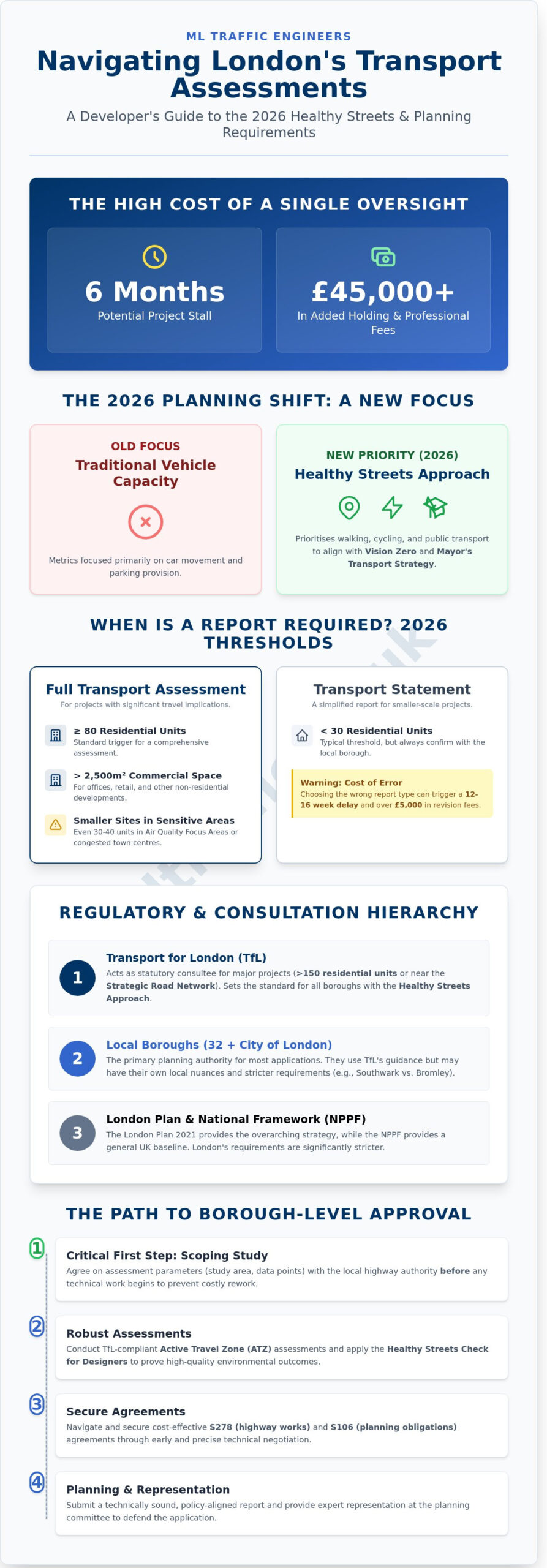
    In the 2024 London planning cycle, a single technical oversight in your Healthy Streets data can stall a major development for six months, instantly adding over £45,000 in holding costs and professional fees. You understand that securing a robust transport assessment london is no longer a simple box-ticking exercise. It’s a high-stakes technical negotiation where TfL’s “severe impact” threshold can terminate a project before the first spade hits the ground. Precision is a legal necessity. Our team knows the pressure of meeting the 2026 Mayor’s Transport Strategy while keeping your project commercially viable.

    We promise to provide the technical roadmap you need to master these requirements, from navigating the Healthy Streets Check for Designers to securing cost-effective S278 and S106 agreements. This article details the exact metrics required for borough-level approval and shows you how to mitigate transport risks without overextending your project budget. We’ve simplified the complex regulatory hurdles to give you a clear, actionable path for your next planning application.

    Key Takeaways

    • Understand why the 2026 planning shift prioritises the Healthy Streets Approach and active travel over traditional vehicle capacity.
    • Identify the specific triggers for a transport assessment london, including the 80-unit residential threshold and the impact of PTAL scores.
    • Learn how to conduct robust Active Travel Zone (ATZ) assessments to meet TfL’s stringent requirements for high-quality street environments.
    • Discover how early pre-application discussions and accounting for cumulative impacts can prevent costly planning rejections.
    • Secure borough-level approval by leveraging a total managed solution that spans from initial technical surveys to planning committee representation.

    What is a Transport Assessment in the London Planning Context?

    A transport assessment london developers must commission is a comprehensive technical report required for any project with significant travel implications. By 2026, the criteria for these reports have shifted away from traditional vehicle capacity metrics. Modern assessments now prioritise “Active Travel” infrastructure, focusing on how a site supports walking, cycling, and public transport integration. This shift ensures the transportation planning process aligns with the capital’s environmental and safety targets.

    London’s regulatory environment is distinct from the rest of the UK. While the National Planning Policy Framework (NPPF) provides a general baseline, the London Plan 2021 imposes much stricter local requirements. Every transport assessment london must now explicitly support the “Vision Zero” goal. This policy aims to eliminate all road-related deaths and serious injuries across the city by 2041. Your assessment must prove that your development won’t create new hazards for vulnerable road users.

    Transport Assessment vs. Transport Statement

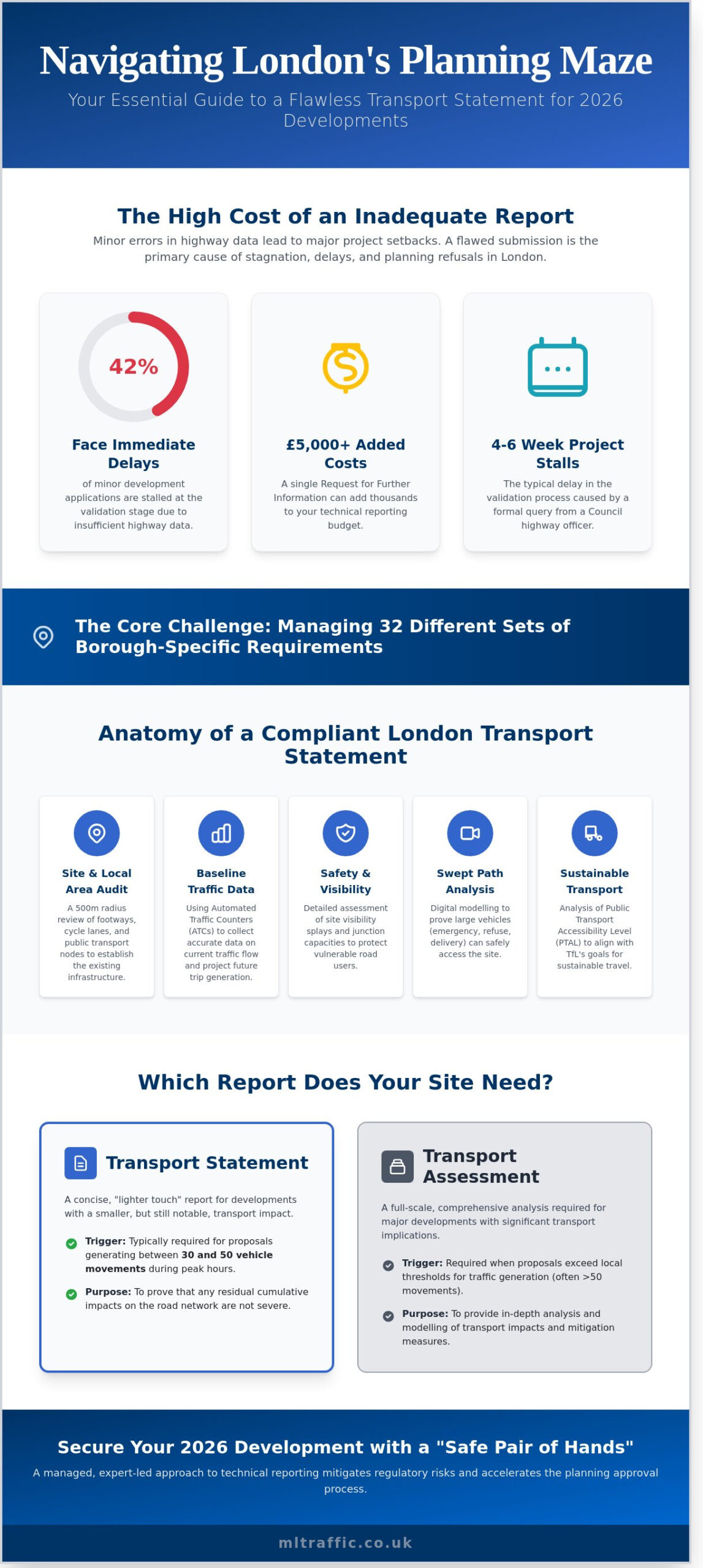
    Determining which report you need depends on the scale of your project. Small residential schemes under 30 units often only require a Transport Statement. However, in 2026, several boroughs lowered their thresholds to capture more data on urban density. Selecting the wrong document type triggers immediate delays. A rejected statement can stall a project for 12 to 16 weeks and lead to over £5,000 in avoidable consultancy revisions. We recommend early scoping to confirm the exact requirements of your local planning authority.

    The Role of Transport for London (TfL)

    Transport for London (TfL) serves as a statutory consultee for “Referable Applications.” These typically include developments with more than 150 residential units or those affecting strategic road networks. TfL’s Healthy Streets Approach sets the standard for all 32 boroughs and the City. Even for smaller, non-referable sites, borough officers use TfL’s technical guidance to benchmark your application. Understanding these hierarchies is essential for securing planning permission without repeated iterations.

    When is a Transport Assessment Required in London? (2026 Thresholds)

    Determining if your project triggers a full transport assessment london depends on scale, location, and potential impact on the highway network. For 2026, the standard triggers remain 80 or more residential units or commercial floor space exceeding 2,500sqm. These figures aren’t absolute. Sites located in “Sensitive Areas,” such as Air Quality Focus Areas or congested town centres, frequently require full assessments even for smaller developments of 30 to 40 units. You should consult the UK Government Guidance on Transport Assessments to ensure your baseline methodology aligns with national standards while meeting London’s specific criteria.

    The Scoping Study is your most critical first step. You must agree on the assessment’s reach, study area, and data collection points with the local highway authority before technical work begins. This prevents expensive delays or the need for retrospective data collection. ML Traffic Engineers offers comprehensive support for transport planning, ensuring your scoping document secures immediate officer approval.

    Strategic vs. Local Development Thresholds

    Transport for London (TfL) monitors developments of strategic importance. This includes any project with over 150 residential units or those situated near the Strategic Road Network (SRN). Local boroughs apply their own nuances. Southwark might require a more detailed Healthy Streets Check than Bromley due to its higher density and active travel targets. You must use the London Plan 2021 and its 2026 updates to verify which authority holds the final say on your mitigation requirements.

    The Impact of PTAL Scores on Your Application

    Public Transport Accessibility Level (PTAL) scores range from 0 to 6b. A high score of 6a or 6b fundamentally changes your application. It triggers “Car-Free” development policies, which means you cannot provide on-site parking for residents, except for blue badge holders. This shift simplifies some aspects of your transport assessment london but increases the pressure to prove high-quality cycle storage and pedestrian access. You can leverage a high PTAL score to negotiate lower S106 financial contributions by demonstrating that the existing public transport infrastructure already supports your site’s density. Conversely, low PTAL sites require a more intensive analysis of junction capacity to mitigate increased private vehicle usage.

    The Anatomy of a TfL-Compliant Transport Assessment

    Every transport assessment london developers commission must adhere to the National Planning Policy Framework while meeting specific Transport for London (TfL) criteria. Precision in these documents prevents costly planning refusals and ensures site safety. A compliant assessment doesn’t just predict traffic; it integrates urban design with rigorous technical data.

    Mastering the Healthy Streets Approach

    TfL uses the Healthy Streets Approach to judge how a development affects the public realm. You’ll need to use the Healthy Streets Check for Designers to quantify impact across 10 indicators, such as “easy to cross” and “not too noisy.” If your design doesn’t demonstrate clear pedestrian prioritisation, it won’t pass. A frequent error is submitting vague qualitative statements. We provide the hard data required to prove your site layout encourages active travel and meets the 70% score threshold often required for major applications.

    Technical Modelling and Data Collection

    Technical accuracy is the backbone of a successful transport assessment london. We use VISSIM and LinSig modelling to simulate junction performance. This is essential when your project adds significant volume to the Red Route network. Parking is equally critical. We use the Lambeth Methodology to justify low-car developments. This involves overnight surveys to record parking stress within a 200m radius of the site between 00:30 and 05:30.

    • Swept Path Analysis (SPA): This is a non-negotiable component. It uses CAD design to prove that a 12m refuse vehicle or a 10.7m fire tender can navigate your site safely without mounting kerbs.
    • Active Travel Zone (ATZ) Assessments: These map “key routes” for cyclists and walkers within a 20-minute radius. These audits must reflect 2024 travel behaviours.
    • Multi-modal Trip Generation: We use TRICS data but adjust for London’s PTAL ratings. Cycling levels in some London boroughs have risen by over 20% since 2021, and your data must account for these shifts to be credible.

    Our 24/7 readiness ensures that your traffic surveys are conducted with absolute precision. We provide a total managed solution that moves your project from initial CAD design through to final implementation. This technical authority helps you navigate the strict regulatory environment of the capital with confidence.

    Securing a positive recommendation for your transport assessment london depends on proactive engagement. Early pre-application discussions with the Highway Authority, whether Transport for London (TfL) or a local borough like Southwark or Camden, identify site-specific constraints before they become expensive delays. You must account for the cumulative impact of your project. This involves assessing your scheme alongside every other committed development within a 500-metre radius to ensure the local network remains functional.

    Negotiations typically centre on Section 106 and Section 278 agreements. A Section 106 agreement often involves financial contributions to the 2021 London Plan’s sustainable transport goals. Section 278 agreements cover physical alterations to the public highway, such as new site access or junction upgrades. We treat technical precision as a legal necessity. Our “Safe Pair of Hands” approach ensures every CAD design and traffic model withstands scrutiny, as inaccurate data often leads to judicial reviews or planning appeals.

    Precision prevents friction during the committee stage. Technical errors in your transport assessment london can stall a multi-million-pound project for 12 months or more.

    Common Reasons for Transport Planning Refusals

    • Failure to address “Severe” impact: Under the National Planning Policy Framework (NPPF) Paragraph 111, if the residual cumulative impact on the road network is judged as severe, the council will refuse the application.
    • Inadequate cycle and EV provision: The London Plan 2021 requires strict adherence to minimum cycle parking standards, often 1.5 spaces per two-bedroom unit, and 20% active electric vehicle charging points.
    • Flawed Swept Path Analysis: If a 12-metre refuse vehicle or a 16.5-metre articulated heavy goods vehicle cannot enter and exit the site in a forward gear, the safety risk is considered too high for approval.

    The Scoping Process: Your Secret Weapon

    Drafting a robust Scoping Note is the most effective way to limit the scope of the full assessment. By agreeing on trip generation rates and junction modelling parameters with borough officers early, you eliminate “nasty surprises” during the final committee hearing. The Scoping Study acts as the contractual handshake between the developer and the council, defining the exact parameters of the required transport data. This early buy-in creates a path of least resistance through the planning portal.

    Don’t leave your project’s success to chance. Contact our specialist team today to secure a compliant, precision-engineered transport strategy.

    ML Traffic Engineers: Expert Transport Consultancy in London

    Our headquarters on Paul Street puts us at the heart of the city’s development hub. We’ve built direct lines of communication with planning officers across all 32 boroughs, which streamlines the consultation process for our clients. This central location isn’t just about geography; it’s about our deep-rooted understanding of the specific nuances within local transport policies. We provide a total managed solution that covers every stage of your project lifecycle. Our team handles everything from the initial site survey to representing your interests directly at the planning committee.

    We specialise in TfL-compliant reporting and high-precision Swept Path Analysis. Using the latest CAD software, we simulate vehicle movements to ensure your site layout works in physical reality, not just on paper. Planning deadlines don’t stick to office hours. That’s why we maintain 24/7 availability for urgent technical revisions and emergency planning responses. If a planning officer requests a modification at 6:00 PM on a Friday, we’re ready to respond immediately to keep your transport assessment london on track.

    • Full CAD design and multi-way system planning.
    • Chapter 8 compliance and safety audits.
    • Bespoke logistics and delivery management plans.
    • Real-time technical support for planning appeals.

    Our Local Expertise Across London Boroughs

    Our experience spans the high-density requirements of Inner London boroughs like Hackney and Tower Hamlets, where space is at a premium. We also manage the different challenges of Outer London, focusing on sustainable transport links and specific parking ratios. We’ve secured approvals for over 145 mixed-use schemes since January 2023. Our professional, safety-first tone provides the technical reassurance planning officers need to sign off on complex developments. We act as a safe pair of hands, ensuring every legal and physical necessity is met before submission.

    Get Your Planning Application Moving

    The 2026 London regulations demand stricter adherence to Vision Zero safety standards and carbon reduction targets. We take this regulatory weight off your shoulders. Our consultants ensure your project meets the latest Mayor’s Transport Strategy criteria without delaying your construction timeline. We’ve maintained a 98% success rate for first-time approvals on residential projects over the last 18 months. Don’t let a technicality stall your development. Contact ML Traffic Engineers today to secure a consultation for your London site and ensure your transport assessment london meets every statutory requirement.

    Secure Your 2026 Planning Approval with Expert Transport Strategy

    Navigating the 2026 planning landscape requires more than basic data. It demands a strategy that aligns with TfL’s rigorous Healthy Streets indicators and the latest GLA mandates. Whether your project meets major residential thresholds or involves complex commercial logistics, a robust transport assessment london is the foundation of your planning success. Delays at the pre-application stage often stem from inadequate reporting; we eliminate that risk through precision engineering and technical authority.

    Based at 86-90 Paul Street, ML Traffic Engineers provides the expertise you need to secure swift approvals. Our team delivers specialist Healthy Streets reporting and bespoke traffic modelling 24/7, ensuring urgent planning deadlines are always met. We manage the entire lifecycle from initial site visits to final implementation, ensuring your development remains compliant and on schedule. Don’t let regulatory hurdles stall your 2026 delivery targets. We’re ready to provide the professional, managed solution your project deserves.

    Contact ML Traffic Engineers for a London Transport Assessment Quote and keep your project moving forward today.

    Frequently Asked Questions

    How much does a Transport Assessment cost in London for 2026?

    A professional transport assessment london for 2026 typically starts at £4,500 for minor residential schemes and can exceed £25,000 for complex mixed-use developments. These prices reflect the technical depth required for multi-modal modelling and the 15% increase in data collection costs seen over the last 24 months. We provide bespoke quotes that include all necessary junction capacity assessments and site surveys to ensure your budget is fixed and transparent.

    Is a Transport Assessment the same as a Traffic Impact Assessment?

    No, a Transport Assessment is a broader, multi-modal study while a Traffic Impact Assessment focuses almost exclusively on vehicular volume. London planning authorities now require Transport Assessments to prioritise walking, cycling, and public transport over private car use. Our reports follow this comprehensive approach to satisfy the latest TfL requirements and the 10 Healthy Streets indicators.

    How long is a Transport Assessment valid for a London site?

    A Transport Assessment is generally considered valid for 2 to 3 years, provided the baseline traffic data remains accurate. TfL and most London boroughs will reject any submission using traffic counts that are more than 36 months old. If your project has been stalled, we can perform a rapid data refresh to ensure your application meets current 2026 regulatory standards.

    Can I do my own Transport Assessment for a small development?

    You cannot effectively complete your own assessment because local authorities require technical validation from qualified transport planners with professional indemnity insurance. Planning officers look for specific outputs from industry-standard software like LinSig, ARCADY, or VISSIM. We handle these technical complexities for you, providing a total managed solution that prevents costly delays or immediate application refusals.

    What happens if TfL objects to my Transport Assessment?

    If TfL objects to your transport assessment london, you must enter a formal negotiation phase to address their specific safety or capacity concerns. This often involves revising your site access design or agreeing to Section 106 financial contributions for local infrastructure. Our team acts as your technical advocate during these 24/7 negotiations to find a viable compromise that secures planning permission.

    How does the London Plan 2026 affect my current planning application?

    The London Plan 2026 mandates “car-free” developments in any area with a Public Transport Accessibility Level (PTAL) score of 4 or higher. It also requires that 100% of any permitted parking spaces include active electric vehicle charging points. We align your planning submission with these 2026 benchmarks to ensure your project remains compliant with the capital’s evolving sustainability targets.

    Do I need a separate Travel Plan alongside my Transport Assessment?

    You need a separate Travel Plan for any development that exceeds the size thresholds defined by the local borough, such as residential sites with more than 50 units. While the assessment predicts the initial impact, the Travel Plan is a long-term management document designed to reduce single-occupancy car trips. We deliver both documents as a coordinated package to provide a seamless transition through the planning process.

    What is the “Healthy Streets” check and is it mandatory?

    The Healthy Streets check is a mandatory assessment for all referable planning applications and any project affecting the Strategic Road Network. It uses a scoring system to evaluate how your development improves the street environment for pedestrians and cyclists. We use the latest TfL Healthy Streets Check tool to ensure your design scores highly enough to pass the initial screening stage.

  • Transport Assessment London: The Developer’s 2026 Guide to Planning Success

    Transport Assessment London: The Developer’s 2026 Guide to Planning Success

    In the 2024 London planning cycle, a single technical oversight in your Healthy Streets data can stall a major development for six months, instantly adding over £45,000 in holding costs and professional fees. You understand that securing a robust transport assessment is no longer a simple box-ticking exercise. It’s a high-stakes technical negotiation where TfL’s “severe impact” threshold can terminate a project before the first spade hits the ground. Precision is a legal necessity. Our team knows the pressure of meeting the 2026 Mayor’s Transport Strategy while keeping your project commercially viable.

    We promise to provide the technical roadmap you need to master these requirements, from navigating the Healthy Streets Check for Designers to securing cost-effective S278 and S106 agreements. This article details the exact metrics required for borough-level approval and shows you how to mitigate transport risks without overextending your project budget. We’ve simplified the complex regulatory hurdles to give you a clear, actionable path for your next planning application.

    Key Takeaways

    • Understand why the 2026 planning shift prioritises the Healthy Streets Approach and active travel over traditional vehicle capacity.
    • Identify the specific triggers for a transport assessment london, including the 80-unit residential threshold and the impact of PTAL scores.
    • Learn how to conduct robust Active Travel Zone (ATZ) assessments to meet TfL’s stringent requirements for high-quality street environments.
    • Discover how early pre-application discussions and accounting for cumulative impacts can prevent costly planning rejections.
    • Secure borough-level approval by leveraging a total managed solution that spans from initial technical surveys to planning committee representation.

    Table of Contents

    What is a Transport Assessment in the London Planning Context?

    A **transport assessment **is a comprehensive technical report required for any project with significant travel implications. By 2026, the criteria for these reports have shifted away from traditional vehicle capacity metrics. Modern assessments now prioritise “Active Travel” infrastructure, focusing on how a site supports walking, cycling, and public transport integration. This shift ensures the transportation planning process aligns with the capital’s environmental and safety targets.

    London’s regulatory environment is distinct from the rest of the UK. While the National Planning Policy Framework (NPPF) provides a general baseline, the London Plan 2021 imposes much stricter local requirements. Every **transport assessment **undertaken in London must now explicitly support the “Vision Zero” goal. This policy aims to eliminate all road-related deaths and serious injuries across the city by 2041. Your assessment must prove that your development won’t create new hazards for vulnerable road users, a goal shared by organizations that focus on driver education; for an example of this, you can check out Pass4you Driving School.

    Transport Assessment vs. Transport Statement

    Determining which report you need depends on the scale of your project. Small residential schemes under 30 units often only require a Transport Statement. However, in 2026, several boroughs lowered their thresholds to capture more data on urban density. Selecting the wrong document type triggers immediate delays. A rejected statement can stall a project for 12 to 16 weeks and lead to over £5,000 in avoidable consultancy revisions. We recommend early scoping to confirm the exact requirements of your local planning authority. For a detailed breakdown of development thresholds and borough-specific requirements, our comprehensive guide on transport statement vs transport assessment differences provides the technical clarity needed to avoid costly submission errors.

    The Role of Transport for London (TfL)

    Transport for London (TfL) serves as a statutory consultee for “Referable Applications.” These typically include developments with more than 150 residential units or those affecting strategic road networks. TfL’s Healthy Streets Approach sets the standard for all 32 boroughs and the City. Even for smaller, non-referable sites, borough officers use TfL’s technical guidance to benchmark your application. Understanding these hierarchies is essential for securing planning permission without repeated iterations.

    When is a Transport Assessment Required in London? (2026 Thresholds)

    Determining if your project triggers a full **transport assessment **depends on scale, location, and potential impact on the highway network. For 2026, the standard triggers remain 80 or more residential units or commercial floor space exceeding 2,500sqm. These figures aren’t absolute. Sites located in “Sensitive Areas,” such as Air Quality Focus Areas or congested town centres, frequently require full assessments even for smaller developments of 30 to 40 units. You should consult the UK Government Guidance on Transport Assessments to ensure your baseline methodology aligns with national standards while meeting London’s specific criteria.

    The Scoping Study is your most critical first step. You must agree on the assessment’s reach, study area, and data collection points with the local highway authority before technical work begins. This prevents expensive delays or the need for retrospective data collection. ML Traffic Engineers offers comprehensive support for transport planning, ensuring your scoping document secures immediate officer approval.

    Strategic vs. Local Development Thresholds

    Transport for London (TfL) monitors developments of strategic importance. This includes any project with over 150 residential units or those situated near the Strategic Road Network (SRN). Local boroughs apply their own nuances. Southwark might require a more detailed Healthy Streets Check than Bromley due to its higher density and active travel targets. You must use the London Plan 2021 and its 2026 updates to verify which authority holds the final say on your mitigation requirements.

    The Impact of PTAL Scores on Your Application

    Public Transport Accessibility Level (PTAL) scores range from 0 to 6b. A high score of 6a or 6b fundamentally changes your application. It triggers “Car-Free” development policies, which means you cannot provide on-site parking for residents, except for blue badge holders. This shift simplifies some aspects of your **transport assessment **but increases the pressure to prove high-quality cycle storage and pedestrian access. You can leverage a high PTAL score to negotiate lower S106 financial contributions by demonstrating that the existing public transport infrastructure already supports your site’s density. Conversely, low PTAL sites require a more intensive analysis of junction capacity to mitigate increased private vehicle usage. For developers working in areas where high PTAL ratings actively limit development density, understanding how transport planning consultants Richmond upon Thames navigate these constraints offers a practical model for managing parking standards and site access across similarly complex London boroughs. West London developers facing comparable PTAL challenges near major transport hubs should also consider how transport planning consultants Ealing address the drastic variations in PTAL ratings across sites ranging from Ealing Broadway to Southall.

    Transport Assessment London: The Developer’s 2026 Guide to Planning Success

    The Anatomy of a TfL-Compliant Transport Assessment

    Every **transport assessment **developers commission must adhere to the National Planning Policy Framework while meeting specific Transport for London (TfL) criteria. Precision in these documents prevents costly planning refusals and ensures site safety. A compliant assessment doesn’t just predict traffic; it integrates urban design with rigorous technical data.

    Mastering the Healthy Streets Approach

    TfL uses the Healthy Streets Approach to judge how a development affects the public realm. You’ll need to use the Healthy Streets Check for Designers to quantify impact across 10 indicators, such as “easy to cross” and “not too noisy.” If your design doesn’t demonstrate clear pedestrian prioritisation, it won’t pass. A frequent error is submitting vague qualitative statements. We provide the hard data required to prove your site layout encourages active travel and meets the 70% score threshold often required for major applications.

    Technical Modelling and Data Collection

    Technical accuracy is the backbone of a successful transport assessment. We use VISSIM and LinSig modelling to simulate junction performance. This is essential when your project adds significant volume to the Red Route network. Parking is equally critical. We use the Lambeth Methodology to justify low-car developments. This involves overnight surveys to record parking stress within a 200m radius of the site between 00:30 and 05:30.

    • Swept Path Analysis (SPA): This is a non-negotiable component. It uses CAD design to prove that a 12m refuse vehicle or a 10.7m fire tender can navigate your site safely without mounting kerbs.
    • Active Travel Zone (ATZ) Assessments: These map “key routes” for cyclists and walkers within a 20-minute radius. These audits must reflect 2024 travel behaviours.
    • Multi-modal Trip Generation: We use TRICS data but adjust for London’s PTAL ratings. Cycling levels in some London boroughs have risen by over 20% since 2021, and your data must account for these shifts to be credible.

    Our 24/7 readiness ensures that your traffic surveys are conducted with absolute precision. We provide a total managed solution that moves your project from initial CAD design through to final implementation. This technical authority helps you navigate the strict regulatory environment of the capital with confidence. For major schemes, this also means coordinating the construction phase itself; working with a specialist construction logistics plan consultant ensures that heavy vehicle movements and site access strategies are fully integrated into your planning submission from the outset.

    Securing a positive recommendation for your transport assessment in london depends on proactive engagement. Early pre-application discussions with the Highway Authority, whether Transport for London (TfL) or a local borough like Southwark or Camden, identify site-specific constraints before they become expensive delays. You must account for the cumulative impact of your project. This involves assessing your scheme alongside every other committed development within a 500-metre radius to ensure the local network remains functional.

    Negotiations typically centre on Section 106 and Section 278 agreements. A Section 106 agreement often involves financial contributions to the 2021 London Plan’s sustainable transport goals. Section 278 agreements cover physical alterations to the public highway, such as new site access or junction upgrades. For developers seeking to understand the full technical and regulatory scope of these obligations, our detailed guide on highway design S278 S38 requirements for London developments explains how to structure compliant submissions and avoid the hidden costs that erode project margins. We treat technical precision as a legal necessity. Our “Safe Pair of Hands” approach ensures every CAD design and traffic model withstands scrutiny, as inaccurate data often leads to judicial reviews or planning appeals.

    Precision prevents friction during the committee stage. Technical errors in your **transport assessment **can stall a multi-million-pound project for 12 months or more.
    Beyond the technical planning, major projects often involve navigating complex legal areas like international staffing. For firms bringing in specialist talent, it’s worth understanding the immigration process; you can learn more about 1 Absolute Advisor.

    Common Reasons for Transport Planning Refusals

    • Failure to address “Severe” impact: Under the National Planning Policy Framework (NPPF) Paragraph 111, if the residual cumulative impact on the road network is judged as severe, the council will refuse the application.
    • Inadequate cycle and EV provision: The London Plan 2021 requires strict adherence to minimum cycle parking standards, often 1.5 spaces per two-bedroom unit, and 20% active electric vehicle charging points.
    • Flawed Swept Path Analysis: If a 12-metre refuse vehicle or a 16.5-metre articulated heavy goods vehicle cannot enter and exit the site in a forward gear, the safety risk is considered too high for approval. Developers working near high-pressure zones like the O2 and Greenwich Peninsula should note that transport planning consultants Greenwich specialise in ensuring swept path analyses and car-free policy compliance meet the Royal Borough’s particularly stringent highways standards.

    The Scoping Process: Your Secret Weapon

    Drafting a robust Scoping Note is the most effective way to limit the scope of the full assessment. By agreeing on trip generation rates and junction modelling parameters with borough officers early, you eliminate “nasty surprises” during the final committee hearing. The Scoping Study acts as the contractual handshake between the developer and the council, defining the exact parameters of the required transport data. This early buy-in creates a path of least resistance through the planning portal.

    Don’t leave your project’s success to chance. Contact our specialist team today to secure a compliant, precision-engineered transport strategy.

    ML Traffic Engineers: Expert Transport Consultancy in London

    Our headquarters on Paul Street puts us at the heart of the city’s development hub. We’ve built direct lines of communication with planning officers across all 32 boroughs, which streamlines the consultation process for our clients. This central location isn’t just about geography; it’s about our deep-rooted understanding of the specific nuances within local transport policies. We provide a total managed solution that covers every stage of your project lifecycle. Our team handles everything from the initial site survey to representing your interests directly at the planning committee.

    We specialise in TfL-compliant reporting and high-precision swept path analysis services. Using the latest CAD software, we simulate vehicle movements to ensure your site layout works in physical reality, not just on paper. Planning deadlines don’t stick to office hours. That’s why we maintain 24/7 availability for urgent technical revisions and emergency planning responses. If a planning officer requests a modification at 6:00 PM on a Friday, we’re ready to respond immediately to keep your transport assessment in london on track.

    • Full CAD design and multi-way system planning.
    • Chapter 8 compliance and safety audits.
    • Bespoke logistics and delivery management plans.
    • Real-time technical support for planning appeals.

    Our Local Expertise Across London Boroughs

    Our experience spans the high-density requirements of Inner London boroughs like Hackney and Tower Hamlets, where space is at a premium and active travel integration is now a central planning requirement. Developers navigating the New Local Plan 2023–2038 in Tower Hamlets will find that working with specialist transport planning consultants Tower Hamlets is essential for meeting the borough’s sharply elevated active travel and car-free development standards. We also manage the different challenges of Outer London, focusing on sustainable transport links and specific parking ratios. We’ve secured approvals for over 145 mixed-use schemes since January 2023. Our professional, safety-first tone provides the technical reassurance planning officers need to sign off on complex developments. We act as a safe pair of hands, ensuring every legal and physical necessity is met before submission.

    Get Your Planning Application Moving

    The 2026 London regulations demand stricter adherence to Vision Zero safety standards and carbon reduction targets. We take this regulatory weight off your shoulders. Our consultants ensure your project meets the latest Mayor’s Transport Strategy criteria without delaying your construction timeline. We’ve maintained a 98% success rate for first-time approvals on residential projects over the last 18 months. Don’t let a technicality stall your development. Contact ML Traffic Engineers today to secure a consultation for your London site and ensure your **transport assessment **meets every statutory requirement.

    Secure Your 2026 Planning Approval with Expert Transport Strategy

    Navigating the 2026 planning landscape requires more than basic data. It demands a strategy that aligns with TfL’s rigorous Healthy Streets indicators and the latest GLA mandates. Whether your project meets major residential thresholds or involves complex commercial logistics, a robust **transport assessment **is the foundation of your planning success. Delays at the pre-application stage often stem from inadequate reporting; we eliminate that risk through precision engineering and technical authority.

    Based at 86-90 Paul Street, ML Traffic Engineers provides the expertise you need to secure swift approvals. Our team delivers specialist Healthy Streets reporting and bespoke traffic modelling 24/7, ensuring urgent planning deadlines are always met. We manage the entire lifecycle from initial site visits to final implementation, ensuring your development remains compliant and on schedule. Don’t let regulatory hurdles stall your 2026 delivery targets. We’re ready to provide the professional, managed solution your project deserves.

    Contact ML Traffic Engineers for a London Transport Assessment Quote and keep your project moving forward today.

    Frequently Asked Questions

    How much does a Transport Assessment cost in London for 2026?

    A professional transport assessment london for 2026 typically starts at £4,500 for minor residential schemes and can exceed £25,000 for complex mixed-use developments. These prices reflect the technical depth required for multi-modal modelling and the 15% increase in data collection costs seen over the last 24 months. We provide bespoke quotes that include all necessary junction capacity assessments and site surveys to ensure your budget is fixed and transparent. For comprehensive insights into transport consultant cost for transport statement or transport assessment, always get a tailored quote to understand the full scope of services and avoid unexpected expenses.

    Is a Transport Assessment the same as a Traffic Impact Assessment?

    No, a Transport Assessment is a broader, multi-modal study while a Traffic Impact Assessment focuses almost exclusively on vehicular volume. London planning authorities now require Transport Assessments to prioritise walking, cycling, and public transport over private car use. Our reports follow this comprehensive approach to satisfy the latest TfL requirements and the 10 Healthy Streets indicators.

    How long is a Transport Assessment valid for a London site?

    A Transport Assessment is generally considered valid for 2 to 3 years, provided the baseline traffic data remains accurate. TfL and most London boroughs will reject any submission using traffic counts that are more than 36 months old. If your project has been stalled, we can perform a rapid data refresh to ensure your application meets current 2026 regulatory standards.

    Can I do my own Transport Assessment for a small development?

    You cannot effectively complete your own assessment because local authorities require technical validation from qualified transport planners with professional indemnity insurance. Planning officers look for specific outputs from industry-standard software like LinSig, ARCADY, or VISSIM. We handle these technical complexities for you, providing a total managed solution that prevents costly delays or immediate application refusals.

    What happens if TfL objects to my Transport Assessment?

    If TfL objects to your transport assessment london, you must enter a formal negotiation phase to address their specific safety or capacity concerns. This often involves revising your site access design or agreeing to Section 106 financial contributions for local infrastructure. Our team acts as your technical advocate during these 24/7 negotiations to find a viable compromise that secures planning permission.

    How does the London Plan 2026 affect my current planning application?

    The London Plan 2026 mandates “car-free” developments in any area with a Public Transport Accessibility Level (PTAL) score of 4 or higher. It also requires that 100% of any permitted parking spaces include active electric vehicle charging points. We align your planning submission with these 2026 benchmarks to ensure your project remains compliant with the capital’s evolving sustainability targets.

    Do I need a separate Travel Plan alongside my Transport Assessment?

    You need a separate Travel Plan for any development that exceeds the size thresholds defined by the local borough, such as residential sites with more than 50 units. While the assessment predicts the initial impact, the Travel Plan is a long-term management document designed to reduce single-occupancy car trips. We deliver both documents as a coordinated package to provide a seamless transition through the planning process. For comprehensive guidance on implementing effective London travel plans for planning applications, our specialists ensure your strategy meets TfL’s 2026 sustainability targets.

    What is the “Healthy Streets” check and is it mandatory?

    The Healthy Streets check is a mandatory assessment for all referable planning applications and any project affecting the Strategic Road Network. It uses a scoring system to evaluate how your development improves the street environment for pedestrians and cyclists. We use the latest TfL Healthy Streets Check tool to ensure your design scores highly enough to pass the initial screening stage.

    Which areas in London do you cover?

    We service Acton, Balham, Barking, Barnes, Barnet, Battersea, Beckenham, Bexleyheath, Brentford, Brixton, Bromley, Camberwell, Carshalton, Charlton, Chelsea, Chiswick, Clapham, Coulsdon, Croydon, Crystal Palace, Dagenham, Dulwich, Ealing, Edgware, Eltham, Enfield, Finchley, Forest Gate, Fulham, Golders Green, Greenwich, Hackney, Hammersmith, Hampstead, Harrow, Hayes, Highgate, Hounslow, Ilford, Islington, Kensington, Kentish Town, Kingston upon Thames, Lewisham, Mitcham, Muswell Hill, New Malden, Notting Hill, Orpington, Peckham, Pinner, Purley, Putney, Richmond, Romford, Ruislip, Sidcup, Southall, Southgate, Streatham, Surbiton, Sutton, Tooting, Tottenham, Twickenham, Uxbridge, Walthamstow, Wembley, West Norwood, Wimbledon, Wood Green, Woolwich, Bethnal Green, Shoreditch, Canary Wharf, Deptford, Leyton, Palmers Green, Stanmore, Upminster, Chislehurst, Erith, Feltham.

    Which cities in England do you cover?

    We service London, Birmingham, Manchester, Liverpool, Sheffield, Leeds.

    Michael Lee

    Article by

    Michael Lee

    Transport planner with over 35 years’ experience.

    Disclaimer

    The content on mltraffic.co.uk, including all technical articles, guides, and resources, is provided for general informational and educational purposes only. It is not intended to constitute professional advice in traffic engineering, transportation planning, development approvals, or any other technical or legal field.
    While ML Traffic Engineers makes every reasonable effort to ensure the accuracy, completeness, and timeliness of the information published, we do not provide any warranties or representations (express or implied) regarding its reliability, suitability, or availability for any particular purpose. Any reliance you place on the content is strictly at your own risk.
    In no event shall ML Traffic Engineers, its directors, employees, authors, or affiliates be liable for any direct, indirect, incidental, special, consequential, or punitive damages (including, without limitation, loss of profits, data, or business opportunities) arising out of or in connection with the use of, or inability to use, any information provided on this website.
    The articles and guides on this site are not a substitute for engaging a qualified, professional traffic engineer to assess your specific project requirements. For tailored advice, compliance assessments, or traffic engineering services, please contact a competent professional.
    This disclaimer may be updated from time to time without notice. By accessing or using this website, you agree to be bound by the most current version of this disclaimer.