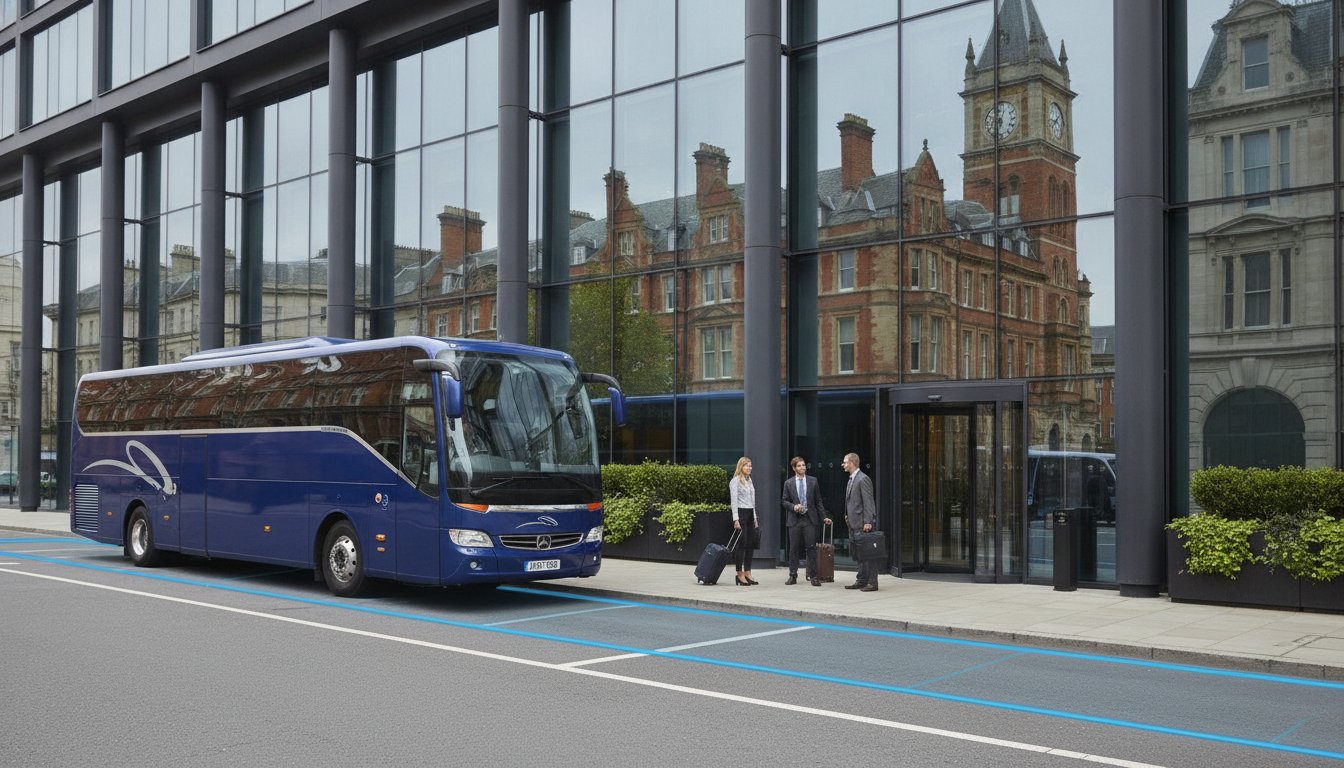
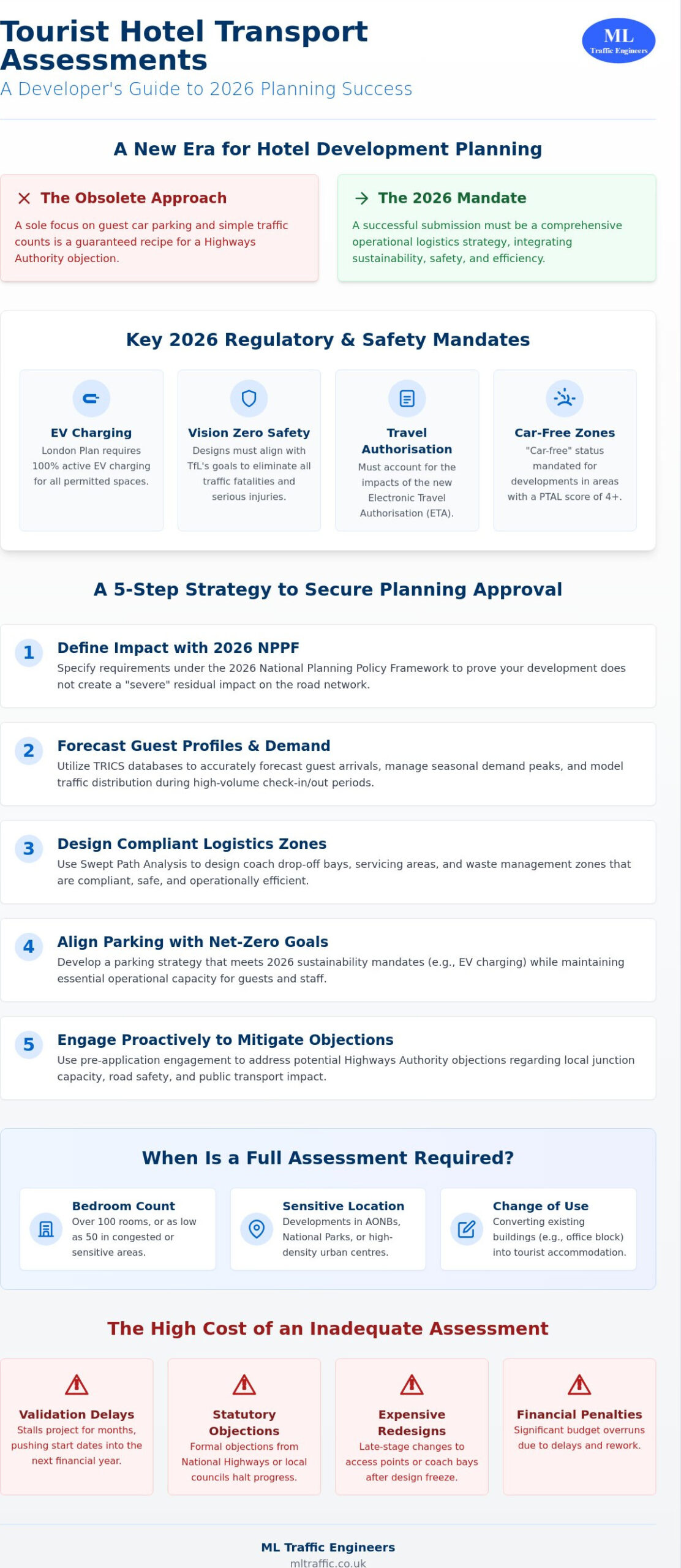
In 2026, a hotel planning application that focuses solely on guest car parking is a guaranteed recipe for a Highways Authority objection. You understand that the regulatory landscape has shifted, with new mandates like the London Plan requiring 100% active EV charging for permitted spaces and “car-free” developments in areas with a PTAL score of 4 or higher. A successful tourist hotel transport assessment must now function as a comprehensive operational logistics strategy rather than a simple traffic count. It’s no longer enough to estimate arrivals; you must account for the February 2026 Electronic Travel Authorisation (ETA) impacts and the move toward TfL’s Vision Zero safety goals.
We recognize the frustration of facing validation delays due to insufficient seasonal peak data or disputes over coach drop-off zones. This article provides the technical clarity you need to navigate these hurdles and ensure your submission meets every regulatory requirement. We’ll explore how to build a robust, evidence-based report that secures planning permission while maintaining a seamless arrival experience for your guests. You’ll learn to mitigate traffic impacts without sacrificing the operational efficiency that your hotel development requires to succeed in a competitive market.
Key Takeaways
- Define the specific requirements for a tourist hotel transport assessment under the 2026 NPPF to ensure your development meets the threshold for significant impact.
- Forecast guest profiles accurately using TRICS databases to manage seasonal demand peaks and temporal distribution during high-volume check-in periods.
- Utilize Swept Path Analysis to design compliant coach drop-off bays and servicing zones, effectively removing the most common obstacles to planning approval.
- Align your parking strategy with 2026 sustainability mandates and EV charging requirements while maintaining necessary operational functionality for guests and staff.
- Establish a proactive mitigation strategy through pre-application engagement to address Highways Authority objections regarding local junction capacity and road safety.
What is a Tourist Hotel Transport Assessment and Why is it Required?
A tourist hotel transport assessment is a specialized technical report required by local planning authorities to evaluate how a hotel development affects the surrounding infrastructure. Under the 2026 National Planning Policy Framework (NPPF), these documents must demonstrate that a project promotes sustainable travel and avoids “severe” residual impacts on the road network. It’s a critical component of the planning application that moves beyond simple car counts to address the unique logistical needs of the hospitality sector. Local highway authorities view hotels as high-intensity operations that require precise Traffic engineering to prevent local congestion.
Unlike residential or office developments, hotels generate complex traffic patterns. Guest arrivals often “bunch” around check-in times, and servicing requirements for laundry, food, and waste occur daily. The assessment provides the evidence base needed to prove that your site can handle these movements without compromising road safety or public transport efficiency.
To better understand the logistical considerations for hotel guests, watch this helpful video:
The threshold for what constitutes a “significant impact” varies by location. In high-density urban centres, authorities focus on the cumulative effect of multiple developments on public transport capacity. In contrast, a project in a tourist-heavy rural area or a National Park might trigger a full assessment with a much lower bedroom count. This is because even small increases in vehicle movements can overwhelm narrow rural lanes or sensitive environmental zones. For a deeper look at specific regional requirements, see our 2026 guide to transport assessments.
Key Planning Triggers for 2026 Applications
Not every project requires a full assessment, but several factors will trigger this requirement in 2026. Understanding these early prevents costly surprises during the validation phase.
- Bedroom Count: Most authorities mandate a full assessment for hotels exceeding 100 bedrooms, though this threshold often drops to 50 or fewer in sensitive or highly congested areas.
- Location-Specific Triggers: Developments within Areas of Outstanding Natural Beauty (AONBs) or National Parks face stricter scrutiny regarding traffic volume and visual impact on the highway.
- Material Change of Use: Converting an existing office block or warehouse into tourist accommodation changes the trip profile of the building, often requiring a new assessment to justify the increased intensity of use.
The Consequences of an Inadequate Assessment
Submitting a report that lacks detail or uses outdated data leads to immediate friction with planning officers. Validation delays can stall your project for months, pushing your start date into the next financial year. If National Highways or local councils issue a statutory objection, you’ll likely face expensive redesigns to accommodate larger coach bays or revised access points. These late-stage changes often happen after your design is frozen, leading to significant structural and financial penalties. A robust assessment ensures your project remains on track and compliant from day one.
Trip Generation and Seasonal Demand: Forecasting the 2026 Guest Profile
Accurate forecasting starts with the TRICS database, the industry standard for establishing trip rates. Under 2026 TRICS methodology, trip generation is the quantitative measure of all individual arrivals and departures attributed to a development’s specific operational characteristics. For a tourist hotel transport assessment, this data must be granular. We don’t just look at daily totals; we analyze how these movements interact with the local network during peak hours. Following official government guidance ensures that your data stands up to the scrutiny of planning officers and highway engineers.
Hotels present a unique challenge known as “bunching.” Unlike an office block where arrivals are spread across a morning window, hotels experience intense, concentrated peaks. Check-out times usually trigger a surge between 10:00 and 12:00, while check-ins create a secondary peak from 15:00 to 18:00. If your assessment fails to account for this temporal distribution, you risk underestimating the pressure on nearby junctions. This oversight often leads to objections from the Highways Authority regarding local capacity and road safety.
Seasonal demand is another critical factor. A Tuesday in November provides a baseline, but a Friday in August represents the true stress test for a tourist destination. We prioritize these peak periods to ensure your development remains functional year-round. This analysis includes non-guest trips such as staff shift changes, which often overlap with guest arrivals. We also factor in delivery windows for essential services and the high-volume traffic spikes generated by on-site event spaces or wedding venues. Our specialists can help you navigate these complexities through tailored transportation analysis.
Beyond TRICS: Localised Data Collection
National databases provide a starting point, but they don’t always reflect the nuances of every site. When TRICS data feels insufficient, we conduct bespoke traffic surveys at comparable local hotels. This localized approach allows us to justify lower trip rate assumptions if the evidence shows your specific guest profile relies more on public transport. It provides a more defensible position during the planning process, especially in areas with unique travel constraints or high PTAL scores.
Forecasting for the “Bleisure” and Staycation Market
The 2026 guest profile is changing. The rise of hybrid work has blurred the lines between business and leisure travel, creating new mid-week demand patterns. Destination hotels now see a more even spread across the week, while transit-oriented hotels must adapt to shifting rail and air travel schedules. We adjust our forecasts to reflect these “bleisure” trends, ensuring the traffic flow models account for longer stays and different vehicle occupancy rates. Proximity to local tourist attractions also plays a major role, as guest movements often mirror the operating hours of nearby landmarks; similarly, travelers in the growing mobile leisure sector may explore Motorhome Habitation Service to ensure their vehicles are maintained during extended staycations.
Operational Logistics: Servicing, Coaches, and Swept Path Analysis
Servicing requirements are frequently the primary cause for planning refusal in hotel developments. While guest arrivals are critical, the daily churn of linen deliveries, food supplies, and refuse collection creates a high volume of heavy vehicle movements. A tourist hotel transport assessment must demonstrate that these operations can occur entirely within the site boundary or in designated, safe loading bays. Failure to prove this often leads to objections regarding the obstruction of the public highway. We ensure your logistics strategy aligns with the National Travel and Tourism Infrastructure Strategic Plan, which emphasizes the need for efficient infrastructure to manage tourism-related congestion.
Coach access adds another layer of complexity. Modern tourist hotels must accommodate 12m or 15m coaches for group arrivals and tours. This requires precision in the design of turning circles and drop-off bays. It isn’t enough to provide a space; you must prove that a vehicle of that scale can enter and exit the site in a forward gear. We utilize advanced Swept Path Analysis to model these movements, removing any doubt about the feasibility of your site layout during the planning phase.
Technical Standards for Swept Path Analysis (SPA)
Our technical team uses specific vehicle templates to mirror real-world conditions. For 2026 applications, we typically model movements using a 15m ultra-low floor coach to ensure maximum compatibility. Beyond guest transport, we must also prove fire tender access for the entire building footprint. Local fire authorities will not validate a scheme where emergency vehicles cannot reach within 45m of every point on the ground floor. In 2026, SPA serves as the primary evidentiary tool for confirming that a site layout adheres to rigorous design safety audits and operational requirements.
Managing Kerbside Activity
The rise of app-based and pre-booked arrivals has fundamentally changed hotel front-of-house logistics. Professional providers like Ports Transfer require rapid, dedicated drop-off zones to prevent tail-backs onto the main road. If your entrance is poorly designed, even a few simultaneous arrivals can cause significant local gridlock. We analyze your expected guest flow to determine the necessary length of kerbside capacity. This proactive approach is essential for constrained urban sites where every centimetre of road space is contested. You can view examples of how we have managed these challenges in our Project Types archive, which covers a range of complex hotel developments.
Parking Strategy and Sustainable Travel in a Net-Zero Environment
Designing a parking strategy for a modern hotel requires a delicate balance between guest convenience and strict environmental mandates. In a tourist hotel transport assessment, we must justify every space provided against local and national net-zero targets. For developments in London, the 2026 London Plan requires that 100% of permitted parking spaces include active electric vehicle charging points. This shift from passive to active provision is a functional necessity that impacts your site’s electrical load and capital expenditure from the earliest design stages. Our team ensures your infrastructure is ready for this mandate without over-specifying costly hardware.
Accessibility remains a core pillar of inclusive design that cannot be compromised for the sake of parking reductions. While general parking numbers face increased scrutiny, Blue Badge provision must meet modern inclusive standards to ensure the hotel remains accessible to all visitors. We coordinate these requirements with a robust Travel Plan, which serves as a live document to manage and reduce car-based arrivals over the project’s lifecycle. If you need assistance navigating these complex parking and sustainability requirements, we provide comprehensive transportation planning support to secure your application.
Calculating the “Right” Level of Parking
We use Public Transport Accessibility Level (PTAL) ratings to determine the appropriate parking volume for your specific site. In areas with a PTAL score of 4 or higher, the London Plan 2026 mandates “car-free” developments. This means that, aside from essential disabled parking, no general guest parking is permitted. In rural hubs, we work with “maximum parking standards” which strictly limit the number of spaces based on your bedroom count. Managing staff parking is equally critical; we prioritize sustainable travel options for employees to preserve what little capacity remains for guests with specific mobility needs.
Promoting Sustainable Guest Arrivals
Sustainable tourism is a primary focus for planning authorities in 2026. Transport for London (TfL) aims for 80% of all trips to be made by foot, cycle, or public transport by 2026. We help you meet these ambitious targets by integrating your development with local shuttle bus services and rail networks. For “active tourism” developments, providing high-quality, secure cycle storage is essential for both guests and staff. A well-executed Travel Plan demonstrates to the Highways Authority that your development won’t necessitate costly highway capacity improvements, significantly smoothing the path to planning approval.
Securing Approval: Addressing Highway Authority Objections
Securing planning permission for a hotel development requires more than just submitting data. It requires a strategic approach to negotiation with the Highways Authority. We recommend early pre-application engagement to identify potential “Severe Impact” markers before they become formal objections. A tourist hotel transport assessment that addresses these concerns upfront is far more likely to succeed. By the time you reach the formal submission stage, the technical parameters of the site’s impact should already be understood by the reviewing officers. This proactive dialogue reduces regulatory pressure and streamlines the validation process.
If the assessment identifies capacity issues at local junctions, we work to mitigate these through Section 106 or Section 278 agreements. These legal frameworks allow developers to fund off-site highway improvements or sustainable transport initiatives. This proactive stance demonstrates a commitment to public safety and network efficiency, often turning a potential refusal into an approved scheme with conditions. Our goal is to provide a Transport Assessment that serves as a definitive solution rather than a point of contention. We manage the full project lifecycle to ensure your 2026 application meets every benchmark.
Common 2026 Objections and How to Counter Them
Planning officers often raise specific concerns during the consultation period. We use technical precision to resolve these disputes rapidly. Common issues include:
- Objection: “The development will cause congestion.” Solution: We provide rigorous junction capacity modelling using Junctions9 or LinSig software to demonstrate that the residual impact isn’t severe.
- Objection: “Inadequate servicing space.” Solution: We submit a revised Swept Path Analysis using site-specific vehicle templates to prove that laundry and refuse vehicles can operate safely.
- Objection: “Sustainability targets not met.” Solution: We provide an enhanced Travel Plan with concrete monitoring commitments and clear modal shift targets that align with 2026 mandates.
The Final Submission Process
Your transport report doesn’t exist in a vacuum. It must be fully integrated with the Design & Access Statement to provide a cohesive narrative for the development. When presenting technical data to a planning committee, we focus on clarity and safety. Non-technical members need to understand the outcomes of the data, not just the raw numbers. We ensure that every submission is robust, evidence-led, and ready for scrutiny. You can review our Resources page for technical templates and guidance to help prepare your documentation for a successful 2026 submission.
Securing Your Hotel Planning Approval in 2026
A successful tourist hotel transport assessment requires a precise balance of technical data and strategic negotiation. We have detailed how mastering seasonal trip generation and operational logistics, including detailed swept path analysis, prevents the common pitfalls that lead to planning refusal. By aligning your development with 2026 sustainability mandates and EV charging requirements, you demonstrate a clear commitment to the future of infrastructure safety and efficiency. These reports are functional necessities that reduce regulatory pressure and ensure your project moves from inception to completion without unnecessary delay.
Our team brings UK-wide expertise to complex hotel planning applications. We are specialists in Swept Path Analysis and TRICS trip forecasting with a proven track record of securing approvals from local highway authorities across England. We understand the high-stakes nature of the hospitality industry and provide the unwavering reliability your project demands. Take the next step toward a robust, evidence-based planning submission today.
Get a Professional Quote for Your Hotel Transport Assessment and let us manage the logistical complexities so you can focus on building a world-class destination.
Frequently Asked Questions
Is a Transport Statement or a Transport Assessment required for my hotel?
The requirement depends on the scale of your development and its location relative to sensitive transport zones. Generally, a full tourist hotel transport assessment is mandatory for developments exceeding 100 bedrooms, while smaller projects may only require a Transport Statement. However, thresholds often drop to 50 bedrooms in National Parks, AONBs, or high-density urban centres where local network capacity is constrained.
How do I calculate trip rates for a hotel that hasn’t been built yet?
Trip rates for proposed developments are established using the TRICS database by selecting comparable operational sites. We filter the data by hotel type, bedroom count, and location to ensure the forecast is realistic. This methodology provides a defensible evidence base that local highway authorities recognize. It’s essential to account for seasonal peaks, such as summer weekends, to ensure the data reflects the most intense operational periods.
What are the 2026 requirements for EV charging points in new hotels?
For developments in London, the London Plan 2026 requires that 100% of permitted parking spaces include active electric vehicle charging points. This mandate ensures that every guest or staff vehicle space is ready for immediate use. In other regions, requirements follow national building regulations, but there is a clear trend toward increasing active provision to meet net-zero targets. We factor these electrical load requirements into your initial site logistics strategy.
Can a hotel get planning permission with zero guest parking?
Yes, hotels can secure planning permission without guest parking in areas with high public transport accessibility. In London, developments in areas with a PTAL score of 4 or higher are now expected to be “car-free” under the latest planning framework. This approach requires a robust Travel Plan to demonstrate how guests will access the site via rail, bus, or cycle. It’s a common strategy for constrained urban sites where road space is limited.
What is the role of a Travel Plan in a hotel planning application?
A Travel Plan is a long-term management strategy designed to reduce the reliance on private car travel. It outlines specific measures to encourage guests and staff to use sustainable transport modes. Authorities often include the implementation of this plan as a formal planning condition. It helps mitigate the impact on the local road network and supports the broader environmental goals of the local planning authority.
How does Swept Path Analysis help with coach parking design?
Swept Path Analysis uses digital modelling to simulate the physical movement of vehicles through your site layout. For tourist hotels, we typically model 12m or 15m coaches to ensure they can enter, manoeuvre, and exit in a forward gear. This technical proof is vital for securing approval, as it demonstrates that large vehicles won’t obstruct the public highway or create safety hazards during guest drop-offs.
What happens if the local Highways Authority objects to my hotel project?
An objection requires a technical response to address the specific concerns raised by the authority. We use junction capacity modelling or revised site layouts to prove that the development’s impact is not “severe.” In many cases, objections are resolved through negotiation and the agreement of mitigation measures via Section 106 or Section 278 agreements. Early engagement with the authority is the most effective way to prevent formal objections.
How much does a tourist hotel transport assessment typically cost?
Professional fees for a transport report vary based on the project’s scale, the number of junctions requiring modelling, and the complexity of the site. A large-scale resort in a sensitive rural area requires more extensive data collection than a small urban conversion. We recommend contacting a consultant for a tailored quote that reflects your specific site requirements and the expectations of the local planning authority.

Disclaimer
The content on mltraffic.co.uk, including all technical articles, guides, and resources, is provided for general informational and educational purposes only. It is not intended to constitute professional advice in traffic engineering, transportation planning, development approvals, or any other technical or legal field.
While ML Traffic Engineers makes every reasonable effort to ensure the accuracy, completeness, and timeliness of the information published, we do not provide any warranties or representations (express or implied) regarding its reliability, suitability, or availability for any particular purpose. Any reliance you place on the content is strictly at your own risk.
In no event shall ML Traffic Engineers, its directors, employees, authors, or affiliates be liable for any direct, indirect, incidental, special, consequential, or punitive damages (including, without limitation, loss of profits, data, or business opportunities) arising out of or in connection with the use of, or inability to use, any information provided on this website.
The articles and guides on this site are not a substitute for engaging a qualified, professional traffic engineer to assess your specific project requirements. For tailored advice, compliance assessments, or traffic engineering services, please contact a competent professional.
This disclaimer may be updated from time to time without notice. By accessing or using this website, you agree to be bound by the most current version of this disclaimer.