
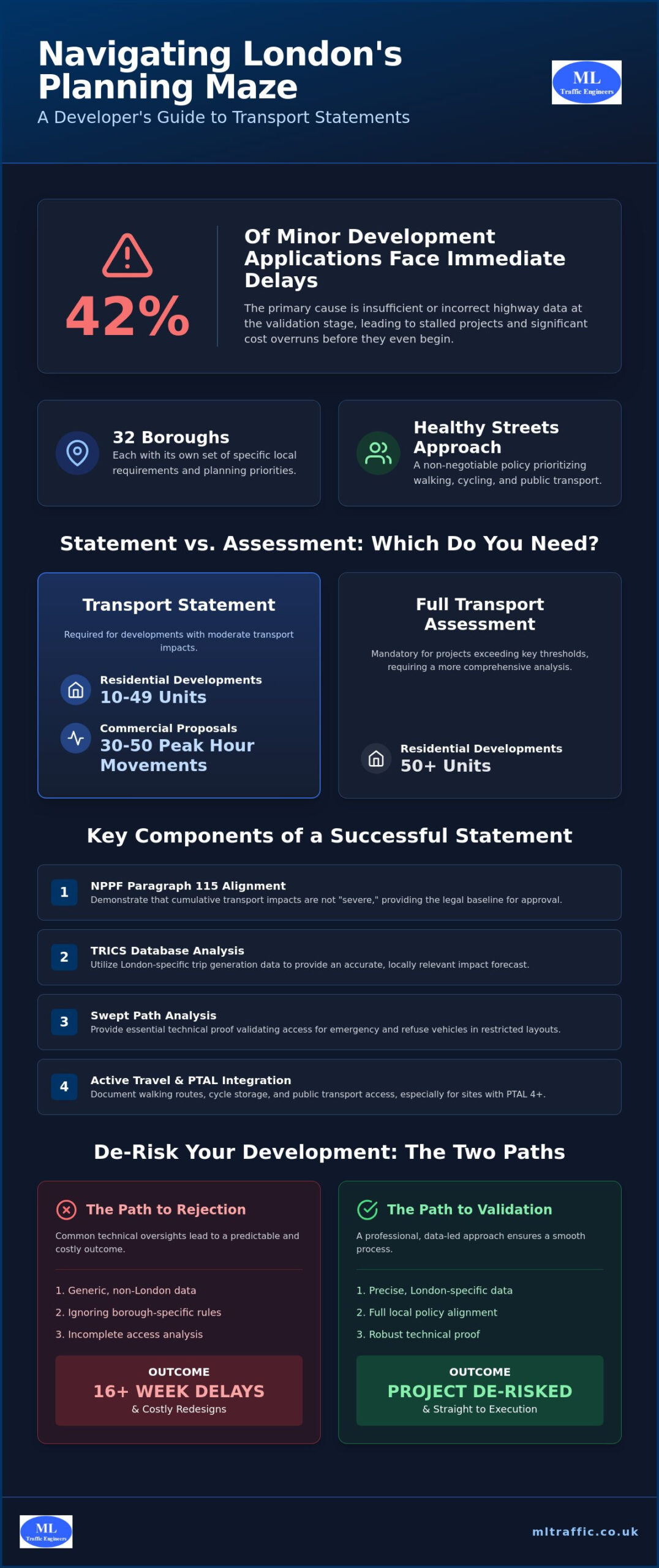
Forty-two percent of minor development applications across London boroughs face immediate delays at the validation stage because of insufficient highway data. It’s a frustrating reality for developers who’ve already invested months into design and site acquisition. You likely understand that securing a london transport statement for planning application is no longer a simple checkbox exercise; it’s a high-stakes technical negotiation of urban space. With 32 different sets of borough-specific requirements and a strict focus on the Healthy Streets approach, the margin for error has never been thinner.
We’ve designed this guide to help you master these complexities, ensuring your site access is validated and your project is fully de-risked. You’ll learn how to navigate the 2026 thresholds where a Transport Statement is sufficient for residential developments under 50 units, and exactly when a full assessment becomes mandatory. We will detail the critical data points required for London Plan 2026 compliance, from PTAL 4 infrastructure mandates to active travel integration. By following this technical roadmap, you can avoid the 16 week delays that stem from rejected submissions and move straight to project execution.
Key Takeaways
- Understand how a london transport statement for planning application aligns with NPPF Paragraph 115 to demonstrate that your project’s transport impacts are not severe.
- Learn to utilize TRICS database analysis and baseline documentation to prove your site’s capacity for 2026 urban density requirements.
- Identify the specific vehicle movement and unit thresholds that dictate whether your project requires a concise Statement or a comprehensive Assessment.
- Discover why Swept Path Analysis is the essential technical proof needed to validate emergency and refuse vehicle access in restricted London layouts.
- De-risk your development by identifying the common technical oversights that lead to costly redesigns and planning validation delays.
Understanding the London Transport Statement in 2026
A london transport statement for planning application is a technical report required for developments that generate moderate transport impacts. It serves as the foundation for Understanding the London Transport Statement in 2026 within the capital’s unique regulatory framework. Unlike the rest of the UK, London’s high urban density forces boroughs like Tower Hamlets, Camden, or Hackney to set much lower thresholds for technical reporting. This ensures that even minor changes to site usage don’t compromise the safety or efficiency of the local highway network. Every statement must justify the development’s footprint against existing infrastructure capacity.
The legal baseline for these documents remains the National Planning Policy Framework (NPPF) Paragraph 115. This policy dictates that development should only be prevented on transport grounds if the residual cumulative impacts on the road network are severe. In 2026, proving that impacts aren’t “severe” requires precise data on trip generation and site accessibility. A well-prepared statement provides the technical evidence needed to satisfy both local planners and highway engineers that your project is safe and sustainable.
To better understand how the capital manages these infrastructure demands, watch this helpful video:
The London Plan and Local Authority Requirements
Your application doesn’t exist in a vacuum. It must align with the Mayor’s Transport Strategy and the London Plan 2021. While Transport for London (TfL) oversees strategic routes, your primary interaction is often with the Local Highway Authority (LHA). Each borough has specific priorities that can stall a project if ignored. The “Healthy Streets” approach is now a non-negotiable requirement. Your statement must demonstrate how the design prioritizes walking, cycling, and public transport over private vehicle use. This involves documenting high-quality walking routes and secure e-scooter charging points for sites with a PTAL of 4 or higher. We provide specialized Transport Statements that address these borough-specific technicalities directly to ensure a smooth validation process.
When is a Transport Statement Mandatory?
Determining the need for a report depends on the scale and location of your project. In 2026, a Transport Statement is generally mandatory for:
- Residential developments containing between 10 and 49 units.
- Commercial proposals generating between 30 and 50 vehicle movements during peak hours.
- Developments in sensitive urban zones where even minor traffic increases could impact safety.
If your project exceeds 50 units, the requirement often shifts to a full Transport Assessment. Identifying the correct document early prevents the 12 to 16 week delays associated with validation failures. We ensure your submission meets every local threshold from the start, protecting your timeline and your budget.
Protecting your budget also involves long-term sustainability planning; for landlords and developers looking to improve the energy efficiency of their properties, Madison May Consulting Ltd provides specialist retrofit consultancy services.
Key Components of a Successful London Transport Statement
A successful london transport statement for planning application begins with a detailed audit of baseline conditions. We document every aspect of the existing transport infrastructure, from local bus stop frequencies to current site usage levels. This data forms the technical benchmark against which all future impacts are measured. To ensure accuracy, we utilize the TRICS database for trip generation analysis. This allows us to extract London-specific data that reflects the unique travel patterns of the capital’s residents and workers. Relying on generic national data is a common reason for validation failure in boroughs like Southwark or Islington.
Impact mitigation is the final pillar of a robust statement. If our analysis predicts increased pressure on the local network, we propose concrete mitigation strategies. These might involve site access redesigns, improved signage, or financial contributions to local infrastructure. Our goal is to ensure that your project remains compliant with the UK government guidance on transport statements while meeting the specific rigors of the London planning system. We prioritize active travel infrastructure, ensuring that walking and cycling routes are integrated into the site’s design from the earliest stages.
PTAL Ratings: The Heart of London Transport Planning
The Public Transport Accessibility Level (PTAL) is the primary metric used to determine parking allowances in London. A site’s score, ranging from 0 to 6b, directly influences how many parking spaces the borough will permit. For a 2026 submission, sites with high PTAL scores are often required to be car-free to align with the London Plan. In areas with lower scores, we provide technical justification for necessary parking through detailed site-specific analysis. High PTAL ratings also frequently trigger the requirement for a London Travel Plan to promote sustainable commuting patterns from the outset.
Parking Surveys and Stress Analysis
When a development proposes limited parking, boroughs often demand a parking survey based on the Lambeth Methodology. This survey analyzes overnight parking stress on surrounding streets to prove that overspill won’t compromise highway safety. We conduct these Parking Surveys with precision to validate your car-capped or car-free strategy. Beyond vehicles, we ensure your project meets the latest cycle parking standards. This includes providing high-quality, secure storage that accommodates non-standard cycles and e-bikes as required by the 2026 London Plan updates. Precision in these surveys prevents costly redesigns during the later stages of the planning process.
Transport Statement vs. Transport Assessment: Which Do You Need?
Choosing between a Statement and an Assessment is the first critical decision in your planning journey. A london transport statement for planning application is a concise document for schemes with moderate impacts. In contrast, an Assessment is a comprehensive study for larger projects. Selecting the wrong report type leads to immediate rejection during the validation stage. This mistake often stalls a project for 12 to 16 weeks. To help you decide, consult the official Transport Statement vs. Transport Assessment: Which Do You Need? guidance. While a small residential infill project might only require a Statement, a major commercial hub will always trigger a full Assessment.
The technical difference lies in the scope of impact and depth of analysis. A Statement focuses on site-specific access and local infrastructure. An Assessment evaluates the broader cumulative impact on the regional road and public transport network. We ensure your submission matches the scale of your development to avoid unnecessary technical reporting costs. Precision at this stage is a functional necessity to de-risk your project.
The Threshold Test for London Developers
In 2026, London boroughs have tightened their definitions of “significant transport movements.” A Transport Statement is generally sufficient for residential developments under 50 units. Once you reach the 50 to 80 unit range, most boroughs now shift the requirement to a full Transport Assessment. For commercial Gross Floor Area (GFA), the trigger often sits between 1,000 and 2,500 square meters depending on the use class. If your proposal generates between 30 and 50 vehicle movements during peak hours, a Statement is your baseline. For major schemes referable to the Mayor, you should consult our Transport Assessment London guide to meet the higher standards required.
Pre-application Advice and Scoping
Early engagement with the Local Highway Authority or TfL prevents over-engineering your technical reports. We recommend submitting a formal scoping note before starting your london transport statement for planning application. This document outlines our proposed methodology and data sources for approval. It ensures we don’t spend your budget on unnecessary analysis while focusing on the specific concerns of highway engineers. This collaborative approach reduces project risk and validates site access early in the design phase. It’s an efficient way to manage costs while securing a planning-ready report that passes validation on the first attempt. We manage this entire lifecycle to ensure your project stays on track.
Technical Proof: Swept Path Analysis and Site Access
A london transport statement for planning application is fundamentally incomplete without technical verification of site geometry. Swept Path Analysis (SPA) serves as the most critical technical appendix for urban developments. It provides the empirical proof that your proposed layout can physically accommodate the vehicles required for daily operations. In the context of London’s constrained mews and backland sites, SPA is often the deciding factor between a swift approval and a costly refusal. We use this analysis to simulate vehicle movements, ensuring that the design works in practice before it reaches the planning committee.
Proving access for fire tenders and refuse vehicles is a non-negotiable requirement for every London borough. If a refuse truck cannot safely enter and exit your site in a forward gear, the Local Highway Authority (LHA) will likely object to the entire application. We integrate SPA directly into the narrative of your statement to justify parking layouts and delivery bay feasibility. This prevents the risks associated with “blind” design, where architects finalize site plans without verifying vehicle turning circles. Engaging our technical team for a Swept Path Analysis early in the design phase ensures your project remains viable from the start.
Vehicle Templates and London Standards
Precision is a functional necessity when dealing with London’s narrow highway network. We utilize AutoTurn Swept Path Analysis software to model specific vehicle templates required by LHAs. This includes the standard 11.2m-long refuse vehicle and the various fire tender dimensions used by the London Fire Brigade. Our analysis accounts for “over-run” and safety margins to ensure vehicles don’t clip curbs or threaten pedestrian safety in high-traffic urban areas. By providing this level of detail, we reduce the regulatory pressure on your team and demonstrate a commitment to highway safety.
Access and Junction Design
The site entrance is often the most scrutinized element of a london transport statement for planning application. We calculate visibility splays with precision to ensure pedestrian safety and prevent collisions. Our analysis also proves that your development won’t cause “tail-back” onto the public highway, which is a primary concern for boroughs managing congested routes. We integrate these findings into your broader car park design strategy to maximize space without compromising functionality. This sequential approach moves your project from initial assessment to a planning-ready technical report that highway engineers can approve with confidence. If you need to validate your site access today, our team is ready to provide the technical proof required.
Securing Approval: Why Professional Transport Planning Matters
The financial consequences of a failed london transport statement for planning application extend to every professional involved in the project. When a report lacks technical precision, planning officers often lose confidence in the site’s viability. This loss of trust leads to protracted negotiations and expensive redesigns that could’ve been avoided with a proactive strategy. ML Traffic Engineers UK provides the technical authority needed to navigate these high-stakes submissions. We specialize in producing “straight-talking” reports that bridge the gap between developer ambitions and the strict safety mandates of local highway authorities.
While technical planning reports address regulatory hurdles, comprehensive project security also involves protecting your physical assets. For developers using plant and machinery on-site, justquoteme.co.uk offers bespoke insurance solutions to safeguard against unforeseen operational disruptions.
The ML Traffic Advantage for London Projects
Our team brings over a decade of experience to every scheme we manage. We maintain a deep database of London-specific traffic patterns and borough-level precedents that generic firms often overlook. By choosing ML Traffic Engineers UK, you gain a partner that understands the nuanced differences between Inner and Outer London requirements. We recently resolved a complex access dispute for a mixed-use site by providing high-fidelity data that satisfied even the most cautious planning committees. This level of detail protects your project from the validation errors that stall nearly half of all minor applications at the first hurdle.
Next Steps for Your Planning Application
Starting your technical reporting early is the most effective way to maintain your project’s momentum. We provide a fully-managed service that covers everything from initial data collection to final submission support. You can request a tailored quote for a transport statement or assessment to get an accurate view of your project’s technical needs. Our team is ready to deliver the precision your application requires. Contact ML Traffic Engineers UK for a professional transport statement quote today and ensure your development stays on the path to approval.
Secure Your 2026 Planning Approval
Mastering the london transport statement for planning application is the most effective way to de-risk your development and avoid the validation delays that stall so many London projects. By correctly identifying your document thresholds and providing rigorous technical proof through Swept Path Analysis, you ensure your site access is both safe and functional. Precision in TRICS data collection and adherence to the Healthy Streets approach are no longer optional extras; they are the foundations of a successful submission in 2026.
ML Traffic Engineers UK has been a dedicated partner for developers since 2014. We offer over a decade of London planning expertise, specializing in complex borough-specific regulatory compliance and advanced technical reporting. Our team manages the full project lifecycle to reduce your logistical pressure and ensure a planning-ready result every time. Get a professional Transport Statement for your London project today and move your development toward a successful completion with confidence. Your project deserves the technical authority that only an experienced specialist can provide.
Frequently Asked Questions
Do I need a transport statement for a small residential conversion in London?
A transport statement is usually required if your conversion generates between 30 and 50 vehicle movements during peak hours or sits within a sensitive urban zone. Even if the unit count is low, boroughs like Camden or Tower Hamlets may demand a statement to ensure the local highway network can support the change in use. If your project is in a high PTAL area, you must also prove how the design supports active travel and car-free living.
What is the difference between a transport statement and a transport assessment?
The primary difference lies in the depth of technical analysis and the scale of the development. A transport statement is a concise report for moderate impact schemes, typically residential projects under 50 units. A transport assessment is a comprehensive study for larger developments that evaluates broader cumulative impacts on regional infrastructure. Choosing the wrong document type often leads to immediate validation failure at the planning stage.
How much does a London transport statement cost in 2026?
The cost of a london transport statement for planning application depends on the complexity of the site and the specific technical appendices required by the borough. Factors such as the need for a detailed parking survey or complex swept path analysis will influence the final fee. We recommend requesting a site-specific quote to ensure all local highway authority requirements are covered without over-engineering the report.
How long is a transport statement valid for a planning application?
A transport statement is typically considered valid for 6 to 12 months from the date of the baseline data collection. Highway authorities generally require “current” data to ensure the report reflects the latest traffic patterns and infrastructure changes. If your application is delayed beyond a year, you may need to update the TRICS analysis or conduct fresh parking surveys to satisfy the planning officer.
Can I write my own transport statement for a planning submission?
Writing your own statement is not recommended because the document requires specialized technical data that is not available to the public. Professional reports rely on the TRICS database for trip generation and AutoTurn software for swept path analysis. Without these verified technical proofs, your application will likely face immediate rejection at the validation stage, leading to avoidable costs and project delays.
What happens if my transport statement is rejected by the Highway Authority?
A rejection by the Highway Authority leads to immediate project stalls that can last between 12 and 16 weeks. You will likely face requests for additional data collection or significant site redesigns to address safety concerns. These revisions often cost thousands in extra consultancy fees and can jeopardize your project’s timeline. Professional reporting ensures these technicalities are addressed before the first submission.
Is a swept path analysis always required with a transport statement?
Swept path analysis is not mandatory for every statement, but it is essential for most London projects with restricted access. If your site involves tight mews, backlands, or narrow entrance gates, you must prove that refuse and fire vehicles can enter and exit safely. Providing this technical proof upfront prevents the Highway Authority from objecting on the grounds of site functionality or public safety.
Does a transport statement include a travel plan?
A transport statement and a travel plan are separate documents, though they are often submitted together to support a london transport statement for planning application. The statement focuses on the physical impact of the development on the road network. The travel plan outlines long-term strategies to encourage sustainable travel among residents or employees. High PTAL scores often trigger the requirement for both documents to ensure London Plan compliance.

Disclaimer
The content on mltraffic.co.uk, including all technical articles, guides, and resources, is provided for general informational and educational purposes only. It is not intended to constitute professional advice in traffic engineering, transportation planning, development approvals, or any other technical or legal field.
While ML Traffic Engineers makes every reasonable effort to ensure the accuracy, completeness, and timeliness of the information published, we do not provide any warranties or representations (express or implied) regarding its reliability, suitability, or availability for any particular purpose. Any reliance you place on the content is strictly at your own risk.
In no event shall ML Traffic Engineers, its directors, employees, authors, or affiliates be liable for any direct, indirect, incidental, special, consequential, or punitive damages (including, without limitation, loss of profits, data, or business opportunities) arising out of or in connection with the use of, or inability to use, any information provided on this website.
The articles and guides on this site are not a substitute for engaging a qualified, professional traffic engineer to assess your specific project requirements. For tailored advice, compliance assessments, or traffic engineering services, please contact a competent professional.
This disclaimer may be updated from time to time without notice. By accessing or using this website, you agree to be bound by the most current version of this disclaimer.